Video summary
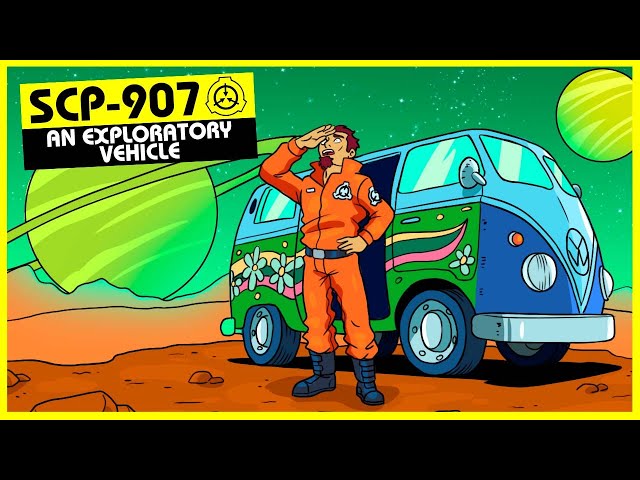
SCP-907 is classified as a Safe object and functions as a highly specialized mobile research station housed within Garage 3 of Site-54. The vehicle, originally a 1960 Volkswagen van that appears structurally normal to the naked eye, has been heavily modified by the Foundation with all interior seats removed in favor of advanced testing equipment and computing systems. Containment protocols dictate that the ignition key must remain sealed under the custody of the local security director and can only be requisitioned by Level 3 personnel for authorized missions. Once fully stocked with rations, emergency supplies, an EVA suit, and remote probes, SCP-907 is prepared to depart on a scheduled testing mission carried out exclusively by Level 1 and 2 staff members who are strictly prohibited from exiting the vehicle during transit unless facing absolute necessity.
Upon activation of its engine, SCP-907 vanishes from local time-space and enters a state of Transit that lasts between five to ten minutes before reappearing on an extrasolar planet located in another galaxy or even other universes. During this transition period, the vehicle is completely isolated from external conditions; any object or person remaining inside will remain unaffected by outside environmental factors regardless of whether doors or windows are open. When the Transit concludes and the engine stops automatically—despite attempts to manually turn it off—the Foundation observes a minor relativistic effect where significantly more time has passed on Earth than within the vehicle, though this temporal lag never exceeds two weeks. After completing between five to fifteen such jumps across different celestial bodies, SCP-907 returns to its original departure point on Earth, at which moment all internal supplies are refreshed for the next mission.
The Foundation has cataloged over 300 distinct extrasolar planets and moons visited via this vehicle, revealing a universe far more diverse than previously understood despite finding no traces of life in any location reached so far. These destinations range from SCP-907-A, a graphite-covered world with diamond formations and temperatures averaging negative two hundred degrees Celsius, to the scorching methane atmosphere of SCP-907-B where ground-level heat exceeds five hundred fifty degrees. Other notable locations include the semi-liquid core of a hydrogen gas giant known as SCP-907-C, an icy moon marbled by extreme thermal fluctuations (SCP-907-E), and the massive arsenic-rich planet SCP-907-F which features winds reaching two hundred seventy kilometers per hour. Even among these hostile environments, such as the self-sterilizing world of SCP-907-D bathed in severe ultraviolet radiation, no biological entities have been detected to date.
In conclusion, while over three hundred unique celestial bodies have been successfully visited and documented using this anomalous vehicle, none have yielded evidence of extraterrestrial life forms or civilizations capable of surviving the harsh conditions found on these worlds. The consistent absence of life across such a vast array of planetary types suggests either that life is exceptionally rare in the observable multiverse or that SCP-907's specific transit mechanism only connects to uninhabited locations, effectively acting as an automated surveyor rather than a scout for colonization. As researchers continue their exploratory missions under strict safety protocols, they remain vigilant against potential anomalies while documenting the unique geological and atmospheric properties of each new world encountered in this endless cosmic journey beyond our own solar system.
Read the full video transcript
foreign
scp-907 object class safe special
containment procedures
scp-907 is to be kept under standard
surveillance within garage 3 of site 54.
the key to activate scp-907 is to be
kept in a sealed Locker under the
possession of the local security
director it may only be requisitioned by
level 3 Personnel for purposes of
testing scp-907
scp-907 is outfitted as a mobile
research station and is to be kept fully
stocked at all times
this stock includes all necessary
research Computing and living equipment
a 10-day supply of rations plus a
five-day emergency supply an
appropriately modified Mark II Eva suit
and a standard set of 10 remote ax10
probes
the inventory of scp-907 is to be
refreshed after every testing mission
for the sake of caution testing of
scp-907 is to be carried out by level 1
and 2 personnel only as according to the
official testing schedule
scp-907 is not to be exited by the
researcher during testing missions
except in matters of absolute necessity
description
scp-907 is a 1960 VW van bearing no
internal or external structural
anomalies
the vehicle had received a new coat of
paint shortly before recovery but
otherwise all modification to the
vehicle has been carried out by the
foundation
said modification includes the removal
of all seats in the vehicle and the
addition of testing and research
equipment
upon the starting of its engine
scp-907 will disappear from local time
space and undergo a state of Transit
this state will persist for five to ten
minutes after which the engine will stop
of its own accord removing the key or
attempting to turn off the engine
manually has proven unsuccessful while
Transit is ongoing when Transit has been
completed
scp-907 will reappear on the surface of
an extra Solar Planet many planets
appear to be located in other galaxies
making identification through positions
of known Stellar objects impossible no
traces of Life have been found on any
Planet reached via scp-907
scp-907 itself and all conditions within
will not be affected by any outside
conditions
so long as an object or person is
completely within scp-907 even if there
is an open door or window present they
will be unaffected by the outside
environment
scp-907 will return to Earth in the same
location as its departure after 5 to 15
stops the vehicle is seen to undergo a
minor relativistic effect during Transit
where a longer period of time will have
transpired on Earth than it has in
scp-907 but this time period has yet to
exceed a lag of two weeks
addendum while over 300 extra solar
planets have been cataloged through
usage of scp-907 several have been
encountered on multiple occasions
these include
scp-907a terrestrial planet
approximately 1.5 times Earth's mass
orbiting an m-class star no atmosphere
or moons are present the landscape is
covered in a thick layer of graphite
with surface formations of diamond due
to seismic upheaval surface temperature
averages negative 200 degrees Celsius
scp-907b
terrestrial planet with an atmosphere of
methane and carbon dioxide measuring
approximately 90 AMP exterior
temperature at ground level is in excess
of 550 degrees Celsius
Trace compounds of unknown chemical
composition give the lower atmosphere an
iridescent quality
scp-907c
insufficient data believed to be the
semi-liquid core of a standard hydrogen
gas giant
scp-907d terrestrial planet
approximately three times Earth's mass
orbiting a cake-class star a trace
atmosphere of carbon dioxide and
nitrogen is present as well as a single
Moon while liquid water is present the
environment is self-sterilizing due to
severe ultraviolet radiation from the
planet's Sun
scp-907e icy Moon orbiting a ringed
helium giant no atmosphere present
irregular composition of the ice
combined with abnormal warming and
cooling patterns has caused a marbled
pattern on the surface
scp-907f terrestrial planet
approximately 17 times the mass of Earth
orbiting a b-class star
six small moons present the atmosphere
is made primarily of nitrogen and argon
and large quantities of Arsenic and
Mercury are present in the soil Winds of
up to 270 kilometers per hour have been
recorded
lesson complete if you miss the previous
orientation go watch scp-908
scouring Hive right now or for the
complete course watch this playlist