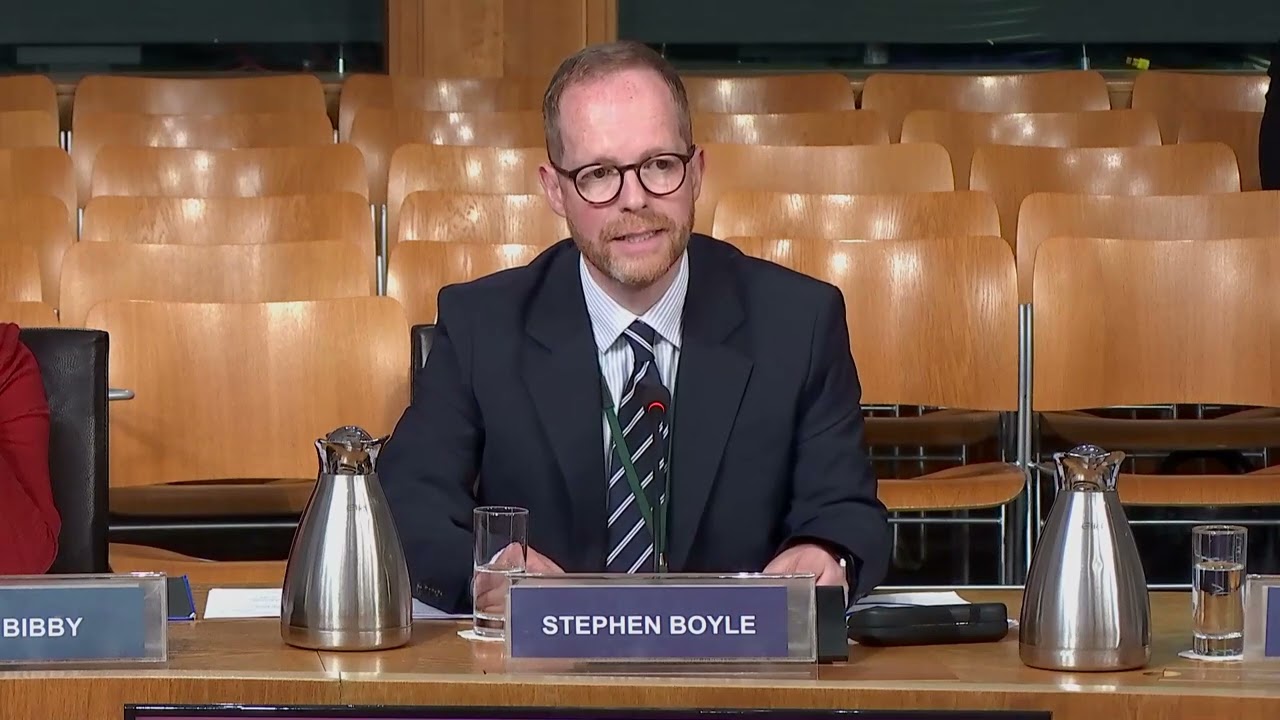
Video summary
The first meeting of Session 7 of the Scottish Commission for Public Audit Committee, convened by Jenny Mento, focused primarily on reviewing Audit Scotland's annual report and accounts for the year ending March 31, 2026. Colin Crosby, Chair of Audit Scotland, and Steven Boyle, Auditor General for Scotland, welcomed the committee, marking this as a significant occasion given it was Crosby's final appearance before his term concluded. They emphasized the critical role of public audit in scrutinizing approximately £60 billion in public spending, particularly amidst significant fiscal pressures and ongoing public sector reform. Key strategic priorities identified included ensuring long-term fiscal sustainability by shifting from short-term to multi-year planning, as well as adapting to rapid technological changes such as artificial intelligence. The session also addressed the organization's commitment to maintaining high-quality, independent scrutiny despite existing resource constraints.
A major portion of the evidence presented covered specific operational challenges and strategic adjustments within Audit Scotland. Cyber security was identified as the top risk alongside recovery arrangements, necessitating a "when not if" approach to mitigation. To address audit delays caused by external factors in local and central government, recovery programs were launched with targets aiming for 75% completion the following year, rising to 80-90% subsequently; while statutory deadlines are rarely missed, internal framework slips can still impact relevance and reputation. The committee also discussed a new approach to best value and proportionality, proposing a regime for smaller bodies based on financial thresholds rather than full International Standards on Auditing, shifting from periodic deep dives to continuous reviews. Furthermore, the organization highlighted workforce pressures, noting that 54% of staff feel insufficiently resourced, with sickness absence rising due to personal circumstances like cancer diagnoses rather than organizational drift, prompting investments in automated systems and expanded apprenticeship programs.
The hearing further explored diversity, inclusion, and future strategies, including a voluntary employee passport scheme for staff with disabilities and reverse mentoring programs, though challenges remain regarding disability statistics linked to the workforce's age profile. Implementation of recommendations remains slower than desired despite 91% acceptance rates, as the Commission lacks enforcement powers but sustains impact through follow-up audits and annual reviews. Financially, additional fees paid to audit firms were attributed to public bodies' readiness issues and complex compliance standards, with future costs expected to rise due to cyber security investments. Audit Scotland has also integrated a human rights-based approach into performance audits, collaborating with the Scottish Human Rights Commission on issues like digital exclusion, while proceeding cautiously with AI to ensure human oversight for all judgments on public spending. The session concluded with confirmation from external auditors that the financial statements provide a true and fair view, followed by formal thanks to witnesses and staff before closing the meeting.
Read the full video transcript
Welcome to the first meeting of session
seven of the Scottish Commission for
Public Audit Committee. I'm Jenny Mento,
uh the MSP for Argu But and in
accordance with the previous
commission's process, I have the
pleasure of convening this meeting for
the first two items of business. I would
like to take this opportunity to welcome
all members and I look forward to
working with you on the commission. We
have received uh apologies from uh
Michael Mara MSP.
So agenda item number one is for each of
us to declare any interests we have that
are relevant to the work of the
commission.
Uh background information for this is
provided in the declaration of interest
section of paper one. I uh refer the
committee to my declaration of interests
um and I have no relevant interests to
declare. However, in a former life uh I
was a member of the Institute of Charter
Accountants of Scotland and have taken
part in some audits um along uh in my
training but I'm no longer a member.
Kate, can I turn to you? Um I believe I
have no no interest to declare and Neil
>> um no no relevant interest to declare
other I'm a member of the public audit
committee giving the public audit
committee for the record.
>> Okay. Thanks and Miles.
>> Thank you. No relevant interest to
declare and also a member of public
audit committee.
>> Thank you. Thank you all. The agenda
item number two is the choice of chair.
The procedure is explained in uh the
choice of chair section of paper one and
I would seek nominations for this
position.
Um if I may, I would uh nominate Miles
Briggs, MSP, to take on the role of
chair. We do not require a seconder. So
Miles, would you be content to do so?
Great. Well, congratulations um on your
appointment and we will uh shift seats.
Thanks.
>> We'll change our names quickly.
>> Quickly as well.
>> Thanks.
>> Thank you.
The commission's next task is to choose
a deputy chair and I'd like to seek
nominations for that position. Um, and
I'd like to nominate Jenny Mento if
she's willing to to be deputy chair.
>> Yes, I'm willing.
>> Thank you, Jenny. Thanks very much. Um,
do we all agree? Thank you. Um, can I
congratulate you, Jenny, on being
elected deputy chair and looking forward
to working with all members of the
commission as well in this session of
parliament. Um the fourth uh item on our
agenda today is to take evidence from
Audit Scotland's annual report and
accounts for the year 31st of March 2026
as well as the auditor's report um on
the accounts. Members can find copies of
these documents as well as a management
letter from TC group in paper two of
their uh meeting papers. Um, and I'd
like to welcome to the meeting Colin
Crosby, the chair of the board of Audit
Scotland, Steven Bole, auditor general
for Scotland, Vicky Bby, chief operating
officer, and Marquez Sanir, head of
finance at Audit Scotland. Now, I
understand that this is the last meeting
of the commission that Colin Crosby will
attend before his term of office ends.
So, I'd like to specifically express the
commission's thanks to Colin for all his
hard work during his term in office. I'd
also like to put on the record our
thanks to Andy Monroe who's the head of
internal audit and has been the adviser
to the commission over the last few
sessions of parliament for all his help
and support which she's given to the
commission as well. Um and I'd now like
to invite Colleen Crosby and then the
auditor general to make a short
introductory statement. Over to you
Stephen. Uh good morning chair and
thanks for your your your kind words. Um
and good morning to the members of the
commission. I was hesitating to see
whether I should say chairs but I'll
just restrict it to single uh at this
point. Um it's great to have this
opportunity to speak with you today and
to go through our performance during the
year 2526.
And before that can I congratulate you
all for uh your successful election uh
to the parliament and indeed uh to this
committee um which I hope you'll all see
is uh worthy of congratulation.
Audit Scotland and the SCPA have had a
strong and productive working
relationship for many years and I
believe this has been built on a clear
uh and mutual respect for the importance
of open, fair and independent scrutiny
of audits uh of audit Scotland and an
understanding of each other's roles and
aims.
Um at a time of sustained and
significant pressure on public services
and finances and a clear agenda for the
major public sector reform, the role of
public audit uh has never been more
important. It must not only provide
assurance but also make uh a clear and
positive impact.
During the past year uh we undertook an
indepth evaluation of that impact. Um
this midterm review of our purpose
public audit Scotland confirms that our
work makes an important and valued
contribution in supporting both
improvement within public bodies and in
parliamentary scrutiny of around 60
billion of public spending.
However, we recognize that we need to do
more uh to create better understanding
and to demonstrate um our impact and the
increase thereof.
While delivering impact now is
essential, we're equally focused on the
future.
Uh we have been underway with an
ambitious program for transformation a
transformational change looking at the
scope of audit, how we deliver it and
the shape of audit Scotland itself. This
will ensure that our work remains
proportionate, efficient and responsive
to technological change with the right
skills to meet emerging challenges.
During 2526, we laid key foundation
stones for that trans transformation.
Um we are building on that in the
current year to ensure we deliver our
long-term ambitions. Uh at the same
time, it's quite right in the light of
the recent program for government um and
other moving external circumstances. We
also reflect our on we reflect on our
direction of travel to make sure it's
where public audit needs to go. I
believe we're on the right path. But I
know that my colleagues in Northern
Scotland's board and executive team will
constantly be reviewing and monitoring
this as we progress.
Um, as you mentioned, this is my final
report as chair before leaving uh post
at the end of this month. Uh, I'd like
to acknowledge the strength of the
organization. Audit Scotland is trusted,
respected, and increasingly well
understood.
uh that is testament to a board that
provides strong governance, constructive
challenge and most of all uh to the
dedication and integrity of the audit
Scotland staff.
On a personal note, it's been a
tremendous privilege to be a board to be
a board member and latly chair of Audit
Scotland,
an organization that aims to be an
exemplar public body, efficient,
effective, independent, and importantly
forward-looking.
Thank you Colin Steven. [clears throat]
>> Thank you very much chair. Um and
perhaps firstly just to echo Colin's
congratulations to uh you chair and vice
chair for your appointment and how much
myself colleagues look forward to
working with you in your roles as
members of the SCPA.
Um and not quite my end of term uh
chair, but uh is is worth noting that uh
my term as both auditor general for
Scotland and as audit Scotland's
accountable officer um has around um 20
or so months um remaining um and I very
much look forward to engaging with the
SCPA during the remainder of my term in
this role.
calling a set of some of the the context
for it, but um if you're content here,
maybe say a few additional words and
touch on some of the content of our
annual report and accounts.
Public audit brings a unique whole
system perspective to the performance of
public bodies and their public spending.
Public audit in our view is a
fundamental cog of a modern democracy
through its role in providing
independent, objective and robust
scrutiny and in supporting Parliament to
perform its oversight of the services
that the people of Scotland rely upon.
In recent years, public audit and many
other organizations have helped sharpen
the focus on the sustainability of
public spending, public services and in
and amongst that the need for uh public
service reform. As we've all seen, the
program for government over the past few
weeks has set out an ambition of reform
at pace and scale and the priority that
that sets.
Through our work, we have noted public
service reform in the context of major
structural, fiscal, and demographic
challenges and changes within Scotland.
Our public services continue to operate
under fiscal pressure, and through our
audit work, we've consistently
identified risks to long-term
sustainability, the implications these
have for public services and the
opportunities amongst that. Addressing
all of this, of course, will require
sustained coordinated actions, in
particular, a stronger and clearer focus
on long-term fiscal sustainability and a
move from short-term approaches to
medium and longer term systemwide
planning, multi-year funding, and
alignment of priorities, resources, and
delivery. As an organization in Audit
Scotland, we face similar pressures of
tightening public finances together with
increasing demand. Over the past year,
we've taken stock of our impact and how
we prepare for the future. We've made
progress in shaping that future,
including the what the future public
audit model of Scotland might look like.
We've modernized our audit approaches
and our operating model, including
preparing to harness the opportunities
and importantly managing the risks
arising from new technologies,
especially artificial intelligence.
We are clear on the need for fiscal
discipline chair and efficiencies today
and we ended 202526
with a small operational under spend. As
Colin notes, I'd also like to record my
thanks to my colleagues in audit
Scotland and also to the audit firms
that we contract with for the
professionalism and dedication that they
have shown throughout the year. These
people, my colleagues, are fundamental
to the value and the work that public
audit delivers in the public interest.
And I think between Colin, Vicky, Wacas,
and myself, we very much look forward to
answering your questions. Thank you.
>> And thank you, Auditor General. Um, I'd
like to start um with some questions and
specifically um start with risk
management. And could I ask you um what
are the top three risks most likely to
crystallize do you think for Scotland
within the next year or two? um which
give greatest concern to your to the
board and the executive team.
>> I'm I'm happy to start chair actually
and certainly bring Colin actually she
have perspective on the board's role and
particularly that of the audit committee
and how our governance over overseas
risks um if it's helpful and I'm sure
Vicki and Awakas might want to say a
word as well. The top risks in fact the
top two risks in audit Scotland um are
in respect of cyber security um both
both about the likelihood and
preparations to avoid a cyber security
attack and then very much alongside that
is the arrangements we have in place to
recover from a cyber security. Our
um very dedicated and experienced um uh
information management colleagues have
hammered home the message to the
executive team and the board that we
should be preparing and anticipating a
cyber attack. The the language of it's
when not if and members will have seen
the impact that cyber attacks have had
both on commercial organizations and
public bodies. Indeed, I've done reports
to parliament on the impact that a cyber
attack has. Um, so in audit Scotland is
both of those top two risks. You know,
like many organizations, chair, we
deploy um risk management arrangements,
a rag rating um and so on. Um, and it's
always read and you know despite the
mitigating actions that that we
identified, forgive me perhaps for
obvious reasons, maybe won't share what
those mitigations are and given we're in
public session. Um, but it's a very um
clear and present risk to our
organization and the delivery of our
functions. in terms of the you know what
comes next. It's not that I'm racking my
brains because we have a few competing
risks for for that uh talk but we the
management of our finances the
experience that we give our colleagues
in audit Scotland thinking about some of
the changes that are coming through both
uh in the audit market changes and and
regulatory arrangements the the quality
and reliability are all up there but
I'll maybe pass to Vicky first of all
she wants to say and then uh very
briefly bring Colin in as well. Yeah,
thank you. Good morning everyone. Um we
have um a robust as as Dean says risk
management process in place and actually
just two weeks ago the audit committee
had a risk deep dive into what our top
risks are and looking at our risk
appetite and really challenging
ourselves on what risks do we want to
mitigate down but also what risks do we
want to operate up to particularly in
this transformation
um agenda and future planning. Um so um
it's it's striking that right balance. I
mean fundamentally our quality though of
the public audit um is vital for that
independence and trust. So we have and I
think be discussing later our quality
arrangements. So we monitor that very
closely as Stephen said um our resources
um but we are on a big transformation um
journey at the moment like many
organizations are and it's looking about
how ensuring we are delivering now what
we need to do but looking for the future
and managing that with our people taking
them with us feeling that they're
supported but there's quite significant
change coming in the profession of audit
as a whole and also as an organization
to ensure that we are as value for money
efficient and impactful as possible. So
I would say those are our key risks but
I think what is key is that we are
actively um speak about risk at the
board the audit committee and as an
executive team.
>> Thank you. Um, I'd like to move on to
delays to audit completion because page
eight of the annual report on accounts
which you provided uh states that
continue to work on recovering audit
delivery timelines against internal
targets following disruptions, truncated
timelines and new auditing standards in
recent years. So, so can I ask um if you
could explain the specific reasons for
continuing delays and what risks are
there in respect to public confidence um
in the audit of our public bodies?
>> I think as a as a starter chair I would
say we're not yet where we want to be in
terms of the delivery of annual audits
of of public bodies. Um
the some of the history of this um and I
I'm reluctant to reference it but it's
it's relevant is uh co disrupted quite
significantly the completion of annual
audits since that period
we have been on a a recovery program
that the intention was by the end of the
current five-year audit appointment we
operate in a fivey year cycle of audit
appointments uh in public bodies which
would take us to at the end of um 26 27
we would have recovered. There has been
progress inside that figure. So for
example NHS audits and further education
college audits are almost all done by
the internal target deadlines. The two
sectors that are more challenging are
local government and central government
bodies. Local government especially has
some bodies that are [clears throat]
behind in the in the preparation and
then audit of financial statements and
some central government bodies um are
not as severe but somewhat in that
bracket too. The the two perhaps two
piece of information to share with the
commission this morning is that um our
our expectation is that it will get to
75%
next year and then we hope nudging
towards 80 90% the year after. An audit
is a partnership in terms of its
completion which you is that for
auditors [clears throat]
in order to audit financial statements
the public body has to prepare them.
They have to be prepared
accompanied by clear detailed
comprehensive working papers so that
auditors can interrogate the system and
so forth. And there's a combination of
factors. Some is about we're not we
don't resource
to uh allow for much flexibility in the
time scale. So if a public body misses
their slot as it were, that can have a
knock-on implication for the completion
of various other um audits. We work
hard. We're communicating effectively
with auditors and public bodies on my
expectations and similarly that of the
accounts commission for local
government. We think there's a positive
trajectory happening in terms of
completion. But I wouldn't want to leave
the commission with impression that
we're content with where we are. We are
actively working and managing this local
engagement with with audited bodies and
auditors escalation where we need to. Um
but just to assure the commission we are
very much treating this as a priority by
way of recovery and if it's I think
Colin would say word this. So
>> yeah thanks Stephen. Um
the there's a piece about uh the
the apparent delay which I think is is
worth dwelling on and that twothirds of
the the delay is caused by external uh
factors along the lines that um Steven
has outlined and I think it's probably
it's a slightly um strange argument to
take but we get terribly concerned as a
board when we slip behind our own
internal framework. work. That doesn't
necessarily mean to say that the actual
work in terms of when it has to be
delivered statutoily is late although
some a very small percentage are. And
why do I make that point? Well, that it
brings back the risks that you were
speaking to in the first item in that
time audit impacts on the relevance of
what we're seeing. So that the board are
very very concerned to be relevant and
for timely work to be done and that
leads into a risk which I would like to
add to the uh the couple which are
mentioned which is reputation without
audit Scotland having a first rate
reputation. we don't have the same
impact either with uh those involved in
in all matters Hollywood but also with
the with the public at large who in some
ways uh are a major stakeholder.
>> Thank you. And in relation to what you'd
highlighted in in what is a process for
external organizations preparing for an
audit, is that an area which given many
of these organizations will be seeing
this annually
you've put to them so that this is an
easier process for you to be able to go
and see that information which you're
telling us sometimes isn't prepared for
your auditors to to access.
>> Yeah, [clears throat] very much so. and
Vicki can can say a word or two about
this I suppose to set out for the
commission um what auditors proactively
do in a steady state for for public
bodies and then maybe perhaps also if
you wish what happens when things don't
work um
>> yeah so we've been working to do a lot
more um with um audited bodies about
what the expectations are and as Stephen
said earlier is a partnership um but
actually we've Um we have got a project
ongoing at the moment to try and engage
on that extra level of detail and also
how that links to fees which you might
want to come extra fees which you might
want to um raise earlier and
transparency about if you're not ready
there is a consequence to that and
understanding why um that is um in terms
of the controls we have around this is
um delivery is taken very um seriously.
It's got to be weighed up against
quality because you need to ensure that
that just delivery to that target is not
your primary objective. Um an audit um
and auditors um are signing off in their
own name. So they need to know that they
have delivered that audit to the quality
standards. Um so that um is a driver.
However, a lot of the late audits, it's
quite a stark figure we have got here.
But when we pick look underneath, some
of them are maybe days or weeks late. um
and and reasons of um audit committee
timing and things like that. So we work
with the um the audited bodies just to
make sure their governance is in place
but there are some that are very late um
and we have an escalation process that
um is quite transparent with the public
bodies and where we want to intervene
and and the same for the auditor general
but also the accounts commission
particularly in some of the areas of
local government and we are working um
with the auditors and um the audited
bodies to try and get that back on
track.
>> Okay, sorry.
Thank you, Miles. Um, yeah, just a a
slight followup uh on this. Um, I saw uh
that um a key change you're proposing is
a more proportionate approach for
smaller bodies. I was wondering if you
could tell us a little bit more about
that and how that relates to actually
supporting public bodies to be ready
>> for their audits.
>> Um, you're quite right. This is one of
the hallmarks of the uh future public
audit model that we're proposing
together with the code of audit practice
that the council commission and I um
consulted on extensively and and
published a few months ago. And I think
it it recognizes M. evidence that um
Scotland has a wide range of of size and
scale of public bodies from the Scottish
government, very large health boards and
councils [clears throat] to the other
end of the spectrum some tiny public
bodies you know with only a very small
number of employees and very small
finance departments. Our approach has
been not [clears throat] quite an audit
as an audit but perhaps the accounting
framework with which public bodies are
required to use. So if you're in local
government body, you have to follow
local government accounting codes. For
central government bodies, you follow
the financial reporting manual in your
preparation. But there is more that we
felt we could do as an organization to
perhaps bring a more proportionate
context to how our audit work. Um we we
engage uh widely. we engage particularly
with the predecessor public audit
committee to reassure that we are still
going to carry out an audit but we're
going to do it under a different um
auditing regime but so it's satisfactory
it's robust but it's less ownorous than
the international standards on auditing
for those small bodies. We set a
financial threshold actually so that
there's clarity for public bodies that
um of turnover level you sit below that
you'll have what we think is a more
proportionate but still robust approach.
It's it's a fine balance but recognizing
that size and scale is relevant for the
context of what an organization can cope
with in its preparation and then its
audit and that um with the current cycle
will come in as part of the new audit
appointment arrangements.
That's helpful. Thank Thanks very much.
I'm going to now open up the session to
questions um from other members. Can I
invite Deputy Chair?
>> Thank you. Thanks, Miles. Um and thank
you for your answers. Um I've got some
quite general questions. Um I'm I'm
interested that so so much of your work
is specifically looking at the numbers,
but you've also clearly got um a review
of policies as well. and you've set up
specific themes when you're looking at
best value uh in local government. So
I'm I'm interested how how you go about
measuring best value in the various
topic headlines but then also what
followup you do because um in 2526 the
theme was transformation. So councils
will have done that in year one. what's
the continuum for other years because
given public service reform that's going
to be quite quite a big area.
>> Um yes um I can come in. So um
audit Scotland um provide the audit work
for the auditor general and for the
accounts commission. The auditor
general's got that the wider scope and
in local government there's the wider
scope and the best value work. The
accounts commission has been looking at
at this in detail as part of our re
future audit um model and um best value
aspects have changed that um over years
and there's proposition for it to change
again. What used to happen um is that um
every council over a cycle would get a
detailed um best value um review and
without wanting to sound flippant, it
sounded like the best value bus had come
into town and did a deep dive audit.
What was felt was that a more
proportionate um review, not
proportionate but more continuous look.
Um so all councils as part of their
annual audit have that best value review
and the controller of audit will do a
deep dive report once over the fiveyear
period. The commission has and the um
controller of audit have been looking at
recommendations because particularly um
in local government a number of very
similar recommendations are made
repeatedly every year. So there's work
that we are doing internally about the
focus of the recommendation making sure
it's smart and then manageable so that
um uh response isn't just ongoing that
there's clear actions but from the
principle to be helpful and the
commission are looking at how they're
actually changing their work program to
be coming back and following up in more
detail on those recommendations as part
of the future um of public audit model.
The commission is looking at and using
some of the benchmark framework that the
improvement service have about having a
more riskbased approach to best value.
So looking at the ones that they maybe
have more concern around financial
sustainability or whatever reasons and
the controller of audit will base um
their work on that more riskbased
um approach. But um it's not for me to
speak on half of the commission but
they're actively um looking at this
again with the principle that we're
adopting for all what is the most impact
how can we help but also um what the
commission has been doing when they've
done a specific best value review on a
council what are the lessons learned for
the whole sector what you know so
financial management ensuring section 95
officers are properly resourced so
they're looking at that more
>> thank thanks for that Vicki and um I'm
very aware that councils across
Scotland, local authorities across
Scotland are all different shapes and
sizes. And I think one of the um
important things in the program for
government um was that the note that
some local authorities are too small to
be strategic, but also to and others are
too large to be local. I would argue
that there are some that fit in both of
these boxes. So one um transformational
change in one council might not work for
another.
What what do you have any specific
examples as well of what of where where
you've been able to spot transformation
in one council and shift it to another?
>> Yeah, I mean maybe as a followup we can
share because there's been specific um
reports by the commission and happy to
share the specific examples. I don't
have them to hand immediately,
apologies. Um but for example where um
one council has put in a new um um
system accounting system how are the
lessons been learned the auditor and the
controller of audit has been doing
specific um work around that the
commission is very focused on uh no
oneizefits all um I think where they're
looking at is ensuring that councilors
are deliberate in their decision- making
and looking for best practice good
practice and sharing that considering
that in the um transformation approaches
um that they take, but I'd be very happy
to share um some specific examples on
local government.
>> Great. Thank you. I think I think Kate,
you've got some questions around
deliveries. Do you want to
>> Yeah, if that's okay, I follow up. So, I
also had some a question around the best
value that um Jenny Mento was asking
about. I just um you mentioned uh a risk
based approach and the improvement
framework, but um part of your scope
includes how well public bodies use
resources to improve outcomes for
people. Um I was just wondering if you
could tell us a bit more about how
central people's outcomes are to
determining best value, how you're
measuring how you're measuring that.
>> Um okay. Um
so the it's um I'm not trying to evade
the question but um some of this is for
the controller of audit and um maybe the
accounts commission um but um focusing
on the work um that they do that I have
got um very outcome focused. We had a
strategy seminar with the accounts
commission this week and looking at the
impact um and their focus is very much
not just on the processes in place but
looking for council's decision making
and actions to be focused in on um the
outcomes but um I'm sure um I don't want
to speak on behalf of the controller of
audit but particularly in her work that
she does I'd be very h she would be very
happy to follow up for the DPA um with
specifically what she's looking at um in
relation to outcomes [clears throat] and
the best value.
>> Thank you.
>> Okay. Um thanks. Uh
in in your report there's um figures on
the review of the sample of audits um
carried out through your audit quality
framework. So, I'm I'm just interested
in the difference between um audits that
are performed um internally um but also
ones that are performed externally. It's
quite a difference 93% um versus 75%. I
just wonder you've got any comments or
thoughts on that.
>> I'm happy to start on that and again
we'll um bring colleagues in if anything
further they wish to add. Deputy chair
chair question about risk and one of the
biggest risks to us as an organization
is that
our work subsequently found to be
unreliable.
So you know whether we individually
as auditors of public bodies produce an
opinion that's that's um on the annual
accounts is found to be incorrect or
more personally for me if I produce uh a
performance or value for money audit
report that those findings uh again are
are proven to be not what they're set
out in the report. So in order Scotland
probably over the past six, seven years
we've invested heavily in quality um
management arrangements um some with
some direct compliance to comparing to
international auditing standards um and
then also broadening out um the
usability of the reports and the their
subsequent impact. We do it two through
two main means you're you're referring
to. One is we have um a contractual
arrangement with the institute of
chartered accountants of England in
Wales pre before that inst chartered
accountants of Scotland and they look at
all our work and they look at the audit
work that firms undertake on behalf of
myself and the accounts commission. They
test it against um quality frameworks
and [clears throat]
auditing standards. Uh and as you also
uh reference um we have an internal
quality team too that test that work. Um
you're right there are there are slight
variations between them but where we
take assurance where I take assurance
the commission the Scotland board um
Colin might want to come in on this I'm
sure as well both sets of results are
reliable
>> and the reason we know that
categorically is we get our external
reviewers to evaluate the work of our
internal reviewers as well. So we take
assurance from that that inevitably it's
a relatively small sample across
reliable but not covering the totality
of our audit work. Um the main message I
take out from it is that our work is
reliable. It can so when auditors are
giving those opinions they are robust.
We are not as an organization seeing a
continued uh set of results to suggest
the need for significant improvements um
in auditor's work and I think we're on a
trajectory of improvement um recognize
that there might always be blips you
know things happen as people that we are
dealing with um but there's a sustained
underpinning of quality culturally and
with arrangements in place in the
organization but again I'm keen to bring
Colin because this is a a real focus
just for the audit committee and the
board.
>> We're going to come on to item five
later which is specifically around
quality of audit. So we can maybe expand
on some questions then. Yeah. Jenny,
anything else?
>> I'll hand back.
>> Great. Neil,
>> thanks chair. Firstly, can I just say
that I think this report demonstrates
the breadth of the work that Audit
Scotland do and also the quality of the
work um the share volume and the
quality. Um
notwithstanding that obviously you
recognize where there's where there's
areas for for for improvement um and
rightly so. On page 19 of the report it
it talks about you know some of the
pressures that staff are under in terms
of producing reports. 46% feel they have
sufficient time and resources. You've
recognized that as an issue because that
suggests 54% don't. Um you've you've
talked about the new uh resource
management approach um in terms of
improving that capacity because
obviously that's that's key. Um
in the report also it talks about the
number of sick days increasing the
average number of sick days increasing
on an upward trajectory over the next
three years in terms of
uh first of all the the capacity issues
in terms of staff feeling they have
enough time. Do you want to expand on
that uh resource management program uh
approach and also
to what extent is that the number of
sick days having an effect on the the
capacity that you've got to
produce the volume and the quality of
the work that you're doing?
>> I'm very happy to be to start. I'm sure
Vicky will want to elaborate on it.
These are all indicators, I suppose, of
the organizational health that I think
that you're picking out, our ability to
do what we're here to do on behalf of
Parliament and the people of Scotland
with the resources at our disposal and
the and the experts that that we employ.
We want to, you know, build careers for
people to for them to stay and develop
uh for for many many years. Um, and that
is the case for for most of our
colleagues, but but we we speak to our
people regularly. We survey them. We
consult with them. We have appropriate
line management arrangements to try and
nurture people's uh careers with us so
that they can perform to the best of
their abilities. There's a a couple of
points that you mention um which I'll
maybe touch on a couple and Vicki can
say more. The sickness absence is
increasing in the organization. The
underlying trend is more around some
colleagues for very personal
circumstances are dealing with events
that are causing them to be off longer
term sick. So we we look closely at the
data that suggests that um is there a an
organizational drift but [clears throat]
most of our numbers are being driven by
some colleagues off for longer term
reasons on the um the feedback from
staff. Two things can be right at the
same time. And I think it's what what we
see from that box of the last uh on page
19, 46% of people uh feel that they have
resources. You're right. That would
imply 54% of people don't feel they've
got sufficient resource resources at
times throughout the year. Audits are
pressurized. You know, we there's no
doubt like anyone else in the public
sector, we're operating with a finite
amount of resource. Some deadlines are
movable and some are not. And that can
cause peaks and pressure at different
points of the year. The statistic I I
think and I'm not no way trying to
undermine that or underplay that because
it really matters and we can say a bit
more what we're doing about it, but is
that culturally 89% of people are also
telling us that they are continually
encouraged to deliver high quality
audits. So we're trying to morph both
those things. Um at the the same time
the resource management that you
mentioned is a is a significant
organizational development that we're
making so that we can deploy our people
onto [clears throat] different financial
and best value audits in a more
sophisticated way than we had
previously. So the benefit that we're
acrewing from our investment in new
technology is making a difference uh in
the short period that we've had it
already. But again I'll pass to Vicki to
say more on those points.
>> Um thank you. Um probably nothing more
to add on the sick days. We we we but
provide assurance that we do look at it
in detail because it's a trend and our
remuneration committee is particularly
um interested in this. It's a trend
that's not going in the right direction.
So we do get that granularity and
unfortunately is people with some
long-term uh long-term um
we've seen an increase sadly in cancer
um diagnosis and things like that. So um
and we are very supportive to um our
staff and and we have um and and we want
to be on the capacity and resources
issue. Um this is the fine balance of
the delivery and the maintaining the
delivery the quality and staff as we
have postco been trying to effectively
do 15 months audits work 15 months worth
of worth of work into 12 months and
really just think to get back on track.
So it's finding that right balance with
staff. At the same time um we are
bringing through changes that you know
the resourcing system to allow staff to
be more agile and move across the
organization to where the resource
requires it.
Staff are signed up to that and know
it's right. But in itself that is just a
change in a way of doing things for a
number of staff and it's a good news.
We've had a number of staff that have
been with the organization a long time
as well which is a positive indicator
but for changing the way we do things um
that can um we've got to ensure that
people feel supported on that um
journey. One of our big investments
that's ongoing now at the moment is the
investment in our new um audit system
which we've partnered um we've worked
with the NEO. they made the big
investment and and and we're very
appreciative that they're allowing us to
use their system which actually will
take a lot of the repetition out. It's
much more um automated. Um it is clearer
on quality. Um the system requires you
to um um um input the things that a good
audit requires. So that will help
quality but actually it will really help
staff in the resourcing of it um as
well.
Thank you for that and I'm sorry to hear
about the circumstances around the
long-term sickness since when the
organization in terms of that resource
and capacity and improving that do you
uh take on audit apprenticeships. Do you
think there's an opportunity to increase
that going forward to build that
capacity? Um yes and and um we are very
enthusiastic about the apprenticeship
approach. So we have um roots in and
traditionally it's been um graduates and
we take them and support them through
the ICAS. We've had a small number of um
school lever programs and we want to
expand that um like many organizations
are doing at the moment. um also looking
at graduate um apprenticeships. So
you're studying for your degree and
working at the same time. We're taking
on um and then we have core modern
apprentices in terms of our business
support and all um coms and um the
technology side and we've actually just
looking at we've approved um a a role
for doing a graduate apprenticeship in
the technology side and the data side.
So we're actually looking um we'll maybe
come on to it but we're doing a lot of
workforce planning um at the moment
about what the future auditor is and
what the future auditor requirements are
and what um is a generalist auditor
what's a specialist and what data is
required. So there are other routes for
bringing in um our pipeline um because
we are very committed to ensuring um in
the advent of technology like a number
of industries that is the bit that's
getting squeezed um first to to balance
finances and we feel we've got um a
strong role to play in um ensuring our
wider public duty of bringing in a
pipeline of um um young um people into
the organization but also for having
strong financial awareness across the
Scottish public sector as well. One
things I I sorry I meant to add on just
our our people. We do do regular people
surveys. Um um we've been doing best
companies and we do regular pulsive
surveys. Um last year in the best
companies we got um a very very strong
result that actually was and we really
celebrated. Um so that has been
improving. So people are under pressure
but they're also seeing the benefits of
working in Audit Scotland as well.
>> Thank you. Thank you. Neil Kate, can I
bring you in?
>> Um thank you. Actually, some follow-up
questions on workforce. Um note that in
the report um training costs were
underspent against the budget by around
67,000. And I was just wondering if you
could um help us understand the reasons
for the underspend and um tell us a bit
about how you're ensuring that that'll
be uh spent on appropriate training
arrangements uh in the future. Um and
also the report references DEI measures
uh and I was wondering if you could
elaborate a bit more on how your DEI
measures are going.
>> Yeah, you happy?
>> Yes, thank you. Um so in the training
budget which might sound like I'm just
contradicting what I just said in the
2526 budget to balance the budget we
actually did reduce our um graduate
intake by eight. Um so um and that was
really clear to us that that was we
still have around the 50 um
graduates um but on that year um there
was a drop and that really gave us a
pointer to make sure that this isn't
becoming a repeat pattern and it's not
that we are. So that is the reason why
the training budget because we pay for
we do our training through ICAS took a
reduction in that year and that really
gave us um the sort of prompt to make
sure we are not seeing a trend in that
direction because that is not where we
want to go. Um on the um de and I um we
are strong on um gender um pay. We're um
pretty um um now slightly moved into
women slightly higher pay, but we're
pretty equal. Um we um the areas that
we're really focusing on are ethnic
minorities. Um and the recent stats are
that um that is improving but we are
looking at our recruitment processes to
ensure that we are and we get we work
with um expert organizations in this
area to make sure we are being inclusive
as possible. The area that we are
significantly below the national average
on is our disability
um stats and we're very conscious of
that and trying we've been trying to do
quite a lot of work to understand why
that is. So people and we've done quite
a lot of work to ensure that people are
declaring they've got a disability um
whatever form that may take because not
all disabilities are visible. Um so
we've been um and we've introduced a um
employee passport scheme which is again
voluntary but particularly um if
somebody
>> I use this one because um is dyslexic
for example they can have and they it's
difficult to say get a report that's
track changes they can say on their
passport so they don't need to keep
repeating it to if they're moving around
with different managers how that works.
So, we're actively trying to um ensure
that we're inclusive as possible, but I
think we recognize we have still got a
way to go. And you look at particularly
on our disability statistics. Um we also
do a reverse mentoring um program. Um my
mentor um is um just qualified and they
um have a disability. So actually
they've been um
>> telling me actually how supportive
they've felt but interestingly they felt
that their disability maybe results in a
peak that they wouldn't necessarily go
further. Um [snorts] so we're wanting to
make sure that that p because that's not
we don't feel that but if that's
perceived so we're actively looking at
ways to ensure that we can be as
inclusive as possible.
>> Thank you.
>> Thanks chair. Um the one or two points
which I think probably um I can sweep
off sweep up on slightly. Um I think the
board as a whole is is uh pretty content
with its position with regard to DEI. Um
in the majority the vast majority of the
situations were a we're above the
demographic uh percentage for the
particular uh issue. Disability I
suspect will always be a slight
challenge for us because of the age
profile of our of our staff. We don't
match the national demographic in terms
of that, but we're conscious of doing
absolutely everything we can. The the
situation which I think is is important
to to get when when we're looking at a
broad suite of of entrance points to
training. What we have to be conscious
of is that regardless of the entrance
point, we can be as broad as as we like.
We have to get people who can get to a
particular professional skill level. And
that will be even more important to
achieve if AI takes out a base load of
repetitive work. So we have to get to
the point where the people we're taking
in can get this judgmental skills they
require um in the way that's that's
going to be required with regard to AI.
Uh and I was laughing in a contract
laughing I don't know whether I was
crying but looking in a contract which
said no output will go out without
having been human oversight which I
never thought in my life I would see in
a contract but that's the measure of of
the skill that we have to get to with
regard to that and coming back to uh a
point with regard to um performance uh
which Neans was speaking about bear in
mind that some of our report performance
reporting isn't only in local authority
goes across other areas and reports and
you're speaking about reach and people
being at the heart of it reports like
the GP services which was a whole of
Scotland report is very much people and
patient focused so we do very much think
of where the output of the work is meant
to to to lie
>> Kate do you have any more questions
>> um I have a couple more if we have time
um so um the report mentions that 91% of
your recommendations are being taken
which is great. Uh but that there's a
slow pace of change at public bodies. I
was wondering if you have identified any
recurring reasons for the slow pace of
change, any recurring themes around
which recommendations aren't being taken
up. Um yeah,
>> I'm happy to start on that. So
we're happy that our recommendations are
are accepted. Um which matters from the
audits that we looked at. You're right.
they are not being implemented at the
pace that we would want them to be. That
feels really important. You know, our
audit reports, yes, they provide
assurance, but the recommendations that
are integral to them are designed to
support sustained improvement, stronger
controls, better assurance on public
spending and and public services. So,
we're doing a bit of work to to look at,
you know, um
allows us to preserve our independence.
We're not in this space. I don't I don't
think I would have ever a sense of
feeling comfortable of co-designing or
co-creating recommendations. Like
auditors have to preserve that
independence. They make the
recommendations on the the work that
they see.
>> But we think there's probably space for
for better engagement uh with public
bodies. So we craft
recommendations that are realistic in
terms of those that can be implemented.
um
we're all trained to be skeptical as
auditors. So I do have a you know just
to preserve that that actually
we can sustain our impact beyond the
completion of an audit that it's you
know built in follow-up work and for for
example as some members will know you
know yesterday at the public audit
committee we had a follow-up report on
post school education uh reform
arrangements that's an example of how we
can deploy quite a significant you know
piece of additional audit work on
follow-up so that whilst the original
recommendations might not have been
implemented. You know, we can still
bring a further audit lens. And there's
other ways we can do it through the
annual audits as well.
>> So that the audit recommendations,
they're reasonable. They make sense. But
ultimately, um what we don't have nor I
think we should have are powers to
enforce the application of a
recommendation. our recommendations
uh are are that it is for the public
body, their governance, their use of
resources ultimately to determine
whether the recommendations um are
something that they want to take
forward. But we're alert to just to
reassure the commission. It's something
we're looking closely at that we have
recommendations that can go further than
some of the statistics that from the
recent samples that we've had.
>> Do I have time for
>> Yes. So, this one's a little bit niche.
>> Apologies. Um, I was just interesting
interested to read about the work you've
been doing with the Scottish Human
Rights Commission, uh, and the UN
Commission of Human Rights. Um, and just
interested to hear a bit more about the
practical toolkit and how you feel the
human rights framework can strengthen
your audit methodologies.
>> Yeah, very I'm happy to start actually
welcome to come in as well. We've um
we've been deploying a human rights
based approach um in our particularly
our our performance and best value
audits now for a few years. Um and as as
one part of our other is how are we as
an organization um performing? We've got
appropriate outcomes along those lines
too. But particularly
um engaging and learning with others. We
held an event um in the autumn of last
year with the Scottish Human Rights
Commission um to can set out how we can
as scrutiny bodies work together so that
you know first of all any appropriate
guidance or um good practice that we can
identify and share with public bodies
about the application of public services
and public spending effectively and then
what we'll do as organizations through
our audit work. Um perhaps one of the
strongest example that sticks in my mind
of late is um an audit we did on digital
exclusion uh in the last session of
parliament particularly looking at the
pace of change of public services the
rapid adoption of technology
um is that that will work for many
people but not everybody and so just
think how are people's rights being
preserved with the changing nature of
public services. So we looked at that
and then I think per perhaps alongside
that we've done quite a lot of auditing
of social security. Yeah.
>> Um in the last session and then we've
got a report pending on uh the Scottish
child payment over the course of the
next few weeks again setting out an
understanding through our audit work
what human rights and how they're being
supported through the delivery of public
service then where we come into that
too.
>> Thank you.
>> Thanks very much Kate. Um I'll bring
Jenny back in.
>> Thanks J. Um we you you touched on it a
bit earlier but um the fees paid
additional fees paid to audit firms. So
on page 34 it's indicated that fees and
expenses paid to firms was 1.55 million
more than budget. So I'm interested to
understand um if that's something that's
going to be ongoing or if you believe um
that this won't I suppose won't continue
and also um what systems and processes
you have in place to ensure that these
additional costs represent value for
money to the audited bodies and
taxpayers who fund them. Um because I
think there's always that key thing that
audit fees should be reasonable.
Yeah, you're you're right. Audit fees um
should be reasonable. Um I could without
going into all of the kind of the nature
of the appointment model, but the
accounts commission and myself appoint
auditors either people who work for
Audit Scotland or um from six audit
firms following a a procurement
exercise. Um the audit fee assumes a few
things that um as as we've touched on
earlier this morning the public body is
ready to be audited. They have prepared
uh a comprehensive annual report and
accounts with the appropriate working
papers. That happens most of the time
but not all of the time. And I think
that's some of the examples of why some
auditors say that
um have come to the view that additional
fees were needed for time lost or
additional audit work beyond what would
reasonably be expected um from an audit.
I'll bring back in in a moment uh deputy
chair just to say about some of the
scrutiny that we apply as the system
leader for um public audit in Scotland.
So that but fundamentally the audit fee
is agreed between the public body and
the auditor is that is the relationship
that exists. It's not for audit Scotland
to set what the additional fee should be
and that consensus and agreement is what
happens. Yes, after discussion between
the public body but it's but it's clear
it's important for auditors to set out
with a bit of granularity if they need
to to the public body why additional
fees. Couple of other examples. Um there
are new standards. There are new
compliance arrangements that come in
either from accounts preparation or from
auditing standards that auditors and
public bodies have to follow. But it's
primarily the extent to which the public
body is ready to support the audit is
the main contributor to additional fees.
But again Vicki can can say more on that
point.
>> Yes. Um so that's true. So we'll set the
fee framework at the start of the
appointment period and and everybody has
their core fees and um in those
appointment letters it it is set out
what is expected for a good partnership
audit. um where additional work is
required. Um the profession um has the
requirements of the profession have
increased significantly over um recent
years which requires an order with all
the um compliance of what is required
particularly on the balance sheet which
I think really frustrates a number of
public bodies because actually um a lot
of the risk is potentially around some
of the expenditure in the um income and
expenditure account but auditor are
required. I mean the balance sheet is
important. Please don't hear but where
the um valuation of non-current assets
for example a lot of work goes in there
to comply with accounting standards. Um
the audited bodies are aware of these
but if they've not got controls and
systems in place that require extra work
um that um does result in additional
fees. Um as Steven said those additional
fees are agreed between the public body
and the auditor now um they will come to
audit Scotland particularly if it's over
a threshold needs to come to myself to
approve discussion happening there is um
sometimes I think that gets um
misinterpreted that audit Scotland has
approved the additional fee so we are
very aware of this and we are doing work
within the team to ensure just more
transparency as much as possible that
actually the agreement is between the
audited body and the auditor. And we're
working with um auditors to ensure that
they're having these conversations
upfront. So there's an expectation
rather than at the end of the audit.
Here's a lot of additional um fees
because absolutely it's public money. Um
which um thinking about ensuring that's
spent on frontline services is better
than audit fees. But we need to ensure
there's a rigor and quality and protect
that in public audit for an audit to be
signed off.
>> On the future of public audit model, we
are looking at what are the requirements
of um audit going forward. That's why we
sort wanted to bring in start with this
proportionate for the smaller bodies.
But there's also work we want to do
around um engaging with the relevant
parties on the financial reporting
framework particularly in local
government. it um the financial accounts
are really really complex um and with
all the statutory adjustments we and
that's a UK level we need to work and we
really are putting energy into trying to
work there's a new local audit office
being set up down in England work with
them work with sit lassac that's the
technical body to try and improve the
financial reporting framework and then
that will require less audit on top of
that so that's the current arrangement
but there's a future that we think we
can improve improve this going forward.
>> That that's really helpful Vicki because
is that um what you pointed out you're
better spending money on frontline
services whether that's in health board
or in local authorities. So it's it's
helpful to hear about that work that's
being done to perhaps um around
making sure there the audits perhaps are
more fit for purpose. It is there a time
frame for that? No, what we so we did
our um as a part of our future public
audit model work, we engaged extensively
across parliament, across public bodies
um and very strongly came back saying
ensure that you have a strong quality
regime sticking to the international
auditing standards. Um so we do have
that rigor um around that and that came
across very
>> strongly from the previous public audit
committee your predecessors um as well
but on the work it requires a lot of
work with um
um the local audit particularly if
you're taking on local government the
local audit office down south for LASAC
but actually Scottish government as well
and we want to engage so I can't um put
um a timeline on it. I would cavit
particularly on some of the assets and
the balance sheet work. This has been
discussed for a long time. We have had
particular discussions in audit Scotland
that we want to see much greater
momentum and we will do everything we
can um but it's not within our gift.
That doesn't mean we won't um pursue.
>> That's helpful. I think the one thing I
would add deputy chair is that the model
that we have for um annual audits in
Scotland is a wider scope one. So
auditors give an opinion on the
financial statements which is is the
absolute underpinning but they go
further. So the accounts commissioner
and I ask auditors to give judgments
>> on financial management, sustainability,
value for money, use of resources,
governance and leadership. Um we think
that model works. I believe it works. I
think it gives assurance to people who
use public services, parliament, elected
members and local authorities about a
much wider gambit. So you've got an
independent perspective on how the
organization is performing. Not just
important as it is, but not just the
balance sheet, the notes, the accounts
and the performance report. Um the
feedback that we got from the
consultation echoed that view from the
accounts commission that this is felt as
one of the real unique selling points.
don't have a crystal ball of what the
future might hold for the profession
more widely but I think especially if it
h transpires that artificial
intelligence is deployed within a
commercial audit and commercial accounts
preparation environment the role of
auditors is going to change and it will
be much more about organizational
performance and how the money's been
used what outcomes were coming from that
as opposed to the numbers on the page
>> yeah and I I think as well just um
auditing has continually evolved um I
remember when I was doing it it was
tolerable error was the calculation that
we had to use when now it's reviewing uh
AI I suppose that helped um uh
collecting information to be checked by
that human eye.
>> Great.
>> If I could just Yes. add a a small point
to that in that in my um time spent out
with Audit Scotland occasionally I get
um into situations where audited bodies
are present and the the feedback which
comes from them is uniformly positive
about the non-financial commentary in
terms of how our observations have
helped them in terms of organizing the
the way they do things the priority they
give to things etc etc so the in a very
nice way the feedback is actually
remarkably positive as to what we're
achieving uh in terms of impact for the
audited bodies
>> which again must go back to what Vicki
was talking about earlier about the
importance of the the staff that you
have and the team that they can actually
understand the bodies that you are
you're auditing and recognize where
improvements could be made.
>> Oh absolutely they need to do that. Um,
and they need to be able to uh relate to
the people they're they're informing.
They have to have an ability to
communicate. Um, I would add given I'm a
certain age beyond that of an AI screed,
but that's by the buy.
Thank
>> uh thank you Jenny. Um I had a final
question in relation to well it's a
theme I think we've we've touched upon
quite a bit and and it's in information
technology and noted from the reports
that costs were higher in 2526
um than in 2425 by £101,000 or
equivalent of 49% and just wondered uh
reasons for that. We've touched upon
quite a few things from cyber attacks to
uh potential development for AI. So just
wondered if we could explain that and
and maybe also then move on to potential
future expected costs around information
technology.
>> Yeah, thank you chair. Actually can give
wackers um an opportunity to set some of
that detail up for the commission. Thank
you.
>> Yeah, good morning. Um so the main
reason for that increase in 2526 was um
as the auditor [clears throat] general
and VK have highlighted previously, one
of the key risks on a risk register
currently is cyber security. So we
invested quite heavily in 2526 um in
cyber security which is why you're
seeing that jump um and in terms of the
trajectory for future periods. We do
expect those costs to increase uh not
only because of cyber security but also
because we have now started implementing
our new audit software um and the
development costs related to that will
flow through in those um line items
moving forward.
>> That's helpful. Thank you. It would be
useful as well if the commission could
be kept a breast of those projected
costs going forward as well. Kate, can I
bring back?
>> Yeah, if I could come in on AI if that's
okay. Um, yeah, I was wanting to ask
about your note in the report about
incorporating AI into your future work
and would like to know if these
discussions have progressed since the
report was published and any risks
you've identified around this.
>> We are pro progressing with caution in
in the use of of AI. Um the technology
is changing rapidly. The amount of
investment is eye watering that some of
the large um audit organizations are
investing in technology.
From audit Scotland's perspective, we
have made quite considered careful use
of AI um with appropriate boundaries
particularly in reference to um cyber
security that the information that we
are given that we use from public bodies
>> is ringfenced within our own system.
>> But as the chair quite rightly mentions
that our colleagues are people are
making the judgments not AI. Um wackers
was quite right to mention too that
we're using uh and Vicky covered this as
well to a degree. Um we're investing in
our IT equipment, the audit skills and
systems that our colleagues are using.
It's not an AI system that the national
audit office have developed that we're
partnering with, but there's a scope for
it to evolve so that it could use um AI
more care carefully in future. The main
assurance I want to give uh the
commission this morning though is that
we're treating this with caution. We're
putting the right governance scrutiny
around it. We've set up a special
project within the organization. How and
when and at what what pace we are we are
using AI uh within the organization.
Most fundamental of all our colleagues
will make the judgments um the decisions
the opinions that we give on public
spending um in Scotland. Um so it's with
caution. I think probably about like
chair keen to be updated on on our IT. I
suspect AI and our use of it will be a
regular feature of the engagement that
we have with the SCPA. But I think
Colin, you might want to say a word or
two.
>> Yeah. Thanks, Stephen. A year or so back
um
the board was perplexed by AI and we
convened what we describes a a deep dive
into the risks associated with that and
there was a very intriguing point made
uh comparing AA and AI and AA in fact
which advanced automation was really
just making proper use of all the
digital facilities there were in terms
of data analysis data retrieval which
enabled for people to to deal with work
much more quickly.
That's not the AI part which is so that
a significant part of this gets swept
into the banner of AI but in fact
advanced automation so that we get into
what meantime is a relatively small
proportion of what we're proposing which
is the AI part and that's the bit we're
um looking at very carefully as a board
for all the judgmental reasons we've
just discussed. Uh but there's no doubt
it's here. There's no doubt it's going
to to enable us to do uh more detailed
work quicker with with uh I suspect the
same number of people as opposed to
fewer people. Um and on the cost front,
we'll increase our costs on on uh on IT
and and licenses and and software. That
will become an integral part of of the
budget which will change. There may be
slightly fewer people, but there'll be
more IT cost.
>> Thank you. Um, do any members have any
other questions they want to ask? In
that case, can I thank you for the
evidence you've given us this morning
and I'm going to take a short suspension
for a change over of witnesses. Thank
you.
Welcome back. Um I'd like to welcome to
this section of the meeting David
Jeffcoat partner and Jillian so audit
and accounts manager from the CT group
and can I ask if David or Jillian if
you'd like to make any comments before
we move to questions.
>> Yes. Thank you. Uh good morning um chair
and the commission. Um I would like to
give a summary of our work um to
accompany our audit opinion and our
audit summary report. Um we're appointed
to carry out the external audit of the
financial statements of audit Scotland
for the year to 31st of March 2026. Our
audit work commenced uh with the
planning and interim work in February
and our main audit field work started in
early May. I signed the audit report on
the 12th of June 2026. Our audit was
carried out in accordance with
international standards on auditing. Our
audit opinion is contained within the
audit report in the accounts and it
confirms that the financial statements
of Audit Scotland give a true and fair
view as at 31st of March 2026 that
they've been properly prepared in
accordance with international financial
reporting standards and the government's
financial reporting manual and in
accordance with the public finance and
accountability act 2000. Our opinion
also covers sections of the remuneration
report and confirms that these have been
properly prepared. Um for the record I
can confirm that adequate accounting
record records have been kept by Audit
Scotland and that we received all the
information um and explanation to be
required before issuing the audit
opinion. Our audit opinion confirms that
expenditure has been incurred and
receipts applied in accordance with PFA
act 2000. As part of our audit work, we
have prepared an audit summary report uh
for the management of Audit Scotland. Uh
and a copy of this has been sent to the
commission. Uh the audit summary report
notes our responses to key audit areas
and where applicable reports on any
weaknesses in the accounting systems and
internal controls uh that may come to
our attention during the audit. If I
could summarize our response to the key
areas, um our audit work on management
override of controls uh considers the
authorization, appropriateness, accuracy
of bookkeeping um and accounting
journals and related financial controls.
Um and we identified no issues to bring
to the attention of the commission. Our
audit work on revenue recognition uh
considered the accuracy of recording
income in the appropriate accounting
period and is linked uh to our auditing
of work in progress balances. uh we are
satisfied the accounting estimate uh for
work in progress adopts a consistent
approach with prior years. It's based on
sound assumptions and accurately account
calculated and we um uh believe there's
no material misstatement of revenue uh
of or work in progress balances. Our
audit work also considered the
appropriateness of pension accounting.
Our review of the accounting treatment
for pensions on the statement of
financial position and the notes to the
accounts identified no issues. uh and we
are satisfied that the treatment of the
pension balance uh being nil on the
financial a statement of financial
position is consistent with recent
previous years and consistent with the
acturies reports uh and uh all the
disclosures have been noted
appropriately in the financial
statements.
An audit summary report also notes
actual or potential accounting
adjustments identified during the audit.
Um whilst there were adjustments
identified and updated of a
presentational nature um to some
narrative uh in the disclosures within
the annual report, our audit work did
not identify uh any um accounting
adjustments to the draft accounts
themselves. We did identify two minor
potential adjustments um but neither had
a material impact on the statement of
net comprehensive expenditure. So we
were content for these to be unadjusted.
Uh our audit summary report is also an
opportunity to propose recommendations
to internal controls or financial
controls in operation. Uh and I'm happy
to confirm that we did not identify any
matters that we needed to raise to
management or the commission. Um
finally, on behalf of me and my audit
team, uh I would like to record our
thanks and appreciation to the staff at
Audit Scotland uh for their continued uh
continued helpful and prompt cooperation
during the audit. Happy to take any
questions from the commission. Thank
you.
>> Thank you very much, David. That was
they're very thorough indeed as you've
covered a lot of the questions I had
noted down this morning which is good.
Um you mentioned two minor adjustments.
Could you outline what they were in
relation to?
>> Yeah. So this is on page seven of our
audit summary report. Um one was to do
with class 1A NIC. So when this is
calculated again you've got to imagine
that the uh council prepared end of
April. It's quite an early audit in that
sense. We we we start our our main
fieldwork in the start of May. Um, so I
think there was a an element of
estimation in there as well. And then as
we sort of progressed identified that
there was a maybe miscalculation if you
like of just just 28,000. So just over
what we would call trivial but certainly
not material. Um the the second point on
that page there was around the lease
liability prepayments. This goes back to
this uh accounting standard that got
brought in about three years ago with
your your lease liabilities and your
right of use assets. Um, and I think
what happened here is that some rent had
been paid early and been allocated to uh
prepayments where we think actually they
probably should have been into lease
liabilities. But again, the number there
just 67,000 um pounds. So in the context
of the um financial statements overall
uh not considered to be material um and
happy for it to be unadjusted which
actually just really means that there's
so less work but you start changing
small balances has lock on impact to to
other work. So content overall um with
both of those. That's that's helpful.
Um, can I ask other members if they have
any questions they'd like to ask?
Jillian, is there anything you'd like to
add to this? Otherwise, can I thank you
very much for
>> attending today and for your evidence
and we'll have a short suspension for
another change over witnesses. Thank
you.
Welcome back. Our final evidence session
this morning is agenda item two which is
on Audit Scotland's quality of public
audit in Scotland's annual report 2526.
And can I welcome back Colin Crosby,
chair of the board of audits Scotland,
Steven Bole, auditor general for
Scotland, Vicky Bby, chief operating
officer, along with Johnny Ste, director
um of audit quality appointments, Audit
Scotland. Um and also we have uh
Wasanir, head of finance from Audit
Scotland as well on the panel. Thank you
all for for joining us today. And I'd
like to invite Johnny Stein to make a
short um opening statement.
>> Johnny,
>> thanks so much.
>> Um yes, this presents our quality of
public audit in Scotland report um for
2526. We believe we've uh this shows a a
positive um story this year. Very good
um quality results for both financial
audit and performance audit. Um as we
mentioned earlier, still some work to do
around audit delivery. Happy to discuss
any of that with you today. The report
also covers importantly our feedback
from stakeholders. So we send a survey
out each year to um the audited bodies
themselves and again you'll see we've
consistently um achieved strong um
stakeholder feedback from our our survey
and our the people we work with as well
on the audits. Um I think that's all I
probably want to say by way of
introduction. Happy to take any
questions. Thank you.
>> That's helpful. Thank you. Um you
mentioned feedback. Um could you outline
some of um the potential changes people
are auditing have fed back to you in
terms of how that's delivered? We've
obviously heard evidence uh this morning
in relation to some of the reasonings
around delays and wondered what feedback
you've got from different uh
organizations on that. Yeah. So broadly
um the chapter five in the report sets
out we measure the survey results from
one to five four being a level where
stakeholders feel um they have a kind of
usefulness of the annual audit overall.
So across the board most of those
indicators are showing between a between
a score of four and five which is
obviously showing a good good engagement
with with audited bodies. as well. As we
touched on earlier, we do have some
audits uh in our portfolio where there's
late delivery h and and quite often
those are the sort of survey responses
where there might be lower responses
where there've been challenges um
particular audit um dealing with
adjustments required to the audit.
Again, perhaps the the feedback is
slightly lower where there's been a more
protracted audit process, more
complications and and and more kind of
larger audits as well. So, that's a kind
of broad steer of the the feedback we're
getting. But overall, as I say, the
feedback we've consistently had for a
number of years has been has been a
positive one.
>> Thank you. Thanks for that. I'm going to
open up uh this session to to other
members. Does anyone have questions
they'd like to ask?
>> Yeah, Jenny.
>> Um I think I jumped into this in the in
the earlier session um about uh the the
feedback and the reviews that uh the
Institute of Chartered Accountants in
England and Wales do. So be really
helpful to hear a bit more information
about that and where where you've
learned I suppose from their
recommendation recommendations and how
you share them with external auditors as
well.
>> Yeah, absolutely. So it's a it's an
absolutely crucial part of the quality
process where as the auditors general
explained earlier we have a contract
with ICW who specialize in in quality
monitoring across the UK not just in
audit Scotland. So they have the ability
to share their knowledge of what's going
on elsewhere in the UK with audit
agencies. They also review um and also
we mentioned we have a strong internal
quality team we've built up over the
last four or five years as well. My
previous role was head of quality and
helping to establish that so that our
quality monitoring arrangements are
continual throughout the year. They're
not they're no longer an annual process
where whereby the results we have here
are what we call code reviews. There are
the graded reviews of completed audit
engagements but our internal team also
carry out series of hot reviews thematic
reviews throughout the year to support
audit teams um as well which is a very
constructive supportive process
especially for you know new engagement
leads managers and directors but going
back to the ICW feedback that's an
absolute crucial part as I say to to
learning from areas of improvement we
need to make um and those we have a very
strong connection with quality findings
and how that informs our training
offering and the delivery of of things
like our audit approaches,
methodologies, systems and tools that
may need to be developed. So, it's a
it's a crucial indicator that we use at
Audit Scotland to improve.
See, thank I would echo all that Johnny
has said, I think what I witness so as
as well as being the recipient of audit
work, I'm also directly involved in two
audits uh personally. The audit the
Scottish parliamentary corporate body
and the Scottish government um both
hugely important organizations and two
of the most high profile that we audit.
The Scottish government by its nature
and its scale is a particularly complex,
you know, it's a consolidator. It's a
group audit. Um, and I think some of the
the work that Johnny and his colleagues
and and and also in our innovation and
quality team brings some of the learning
from quality reviews back into what
happens the following year. So
improvement plans, but also technical
panels and seen some of the the work
that is happening currently and as as
we're concluding our audit of the
Scottish government, the technical panel
really benefiting from uh
recommendations and judgments that were
made through quality reviews, whether
it's by ICW or the internal teams. So
we're living the results of quality. you
know, it's not it's not an abstract
thing that you know, we'll have our
improvement plan and we'll report it to
the executive team and the board can see
in day in day out that organization we
want to maintain high standards and
where we don't get it right, we make
those necessary changes for the
following year.
>> Thank you. Did did I notice when I was
reading um the papers that you're al
there's also quite a connection with um
uh audit uh across the world and you've
been you're involved in that and
possibly taking on um I think you're
you're uh deputy leaders on that. Can
you talk a bit about that and again what
learnings is coming into Scotland from
that pan? I'm very happy to say that
actually Vicky and Johnny might want to
say a word or two. It's the two main
vehicles. We want to be an outward
facing organization um that you know
learns from elsewhere in in Scotland and
the UK, Europe and beyond. Um it's
actually it's a stance that Audit
Scotland's had for a long time. We've
we've undertaken international work.
We've engaged internationally for for
many many years. Um currently the two
main vehicles. One is audit Scotland is
a member of the public audit forum um
which encompasses the national audit
office audit Wales the Northern Ireland
audit office and ourselves. Um I meet
with my contemporaries a couple of times
a year to um exchange insight and
learning and we have connections across
different roles and responsibilities
throughout the organization. So the
public audit forum is a really important
vehicle for us. we're all dealing with
relatively similar issues and to share
resources. What we've touched on it
already this morning, but one of
[clears throat] the really important
benefits from that has been the
technology that we've uh been able to
access and share from some of the
development the national audit office
has done. That's served us in very
goodstead. Vicky's touched on some of
the engagement we're having with the
creation of the local audit office. So
the the the desire for um local
government accounting in England um to
uh address some of the many challenges
that that sector has faced now for best
part of 10 years. Uh so we are playing
our part in helping them establish that
organization. But you mentioned also um
some of the European engagement that we
have. So um we are members of Eurai.
Forgive me there are a lot of uh an
acronyms in in audit space. Well, this
is
>> Yeah. So, Euroise effectively the
European regional audit institutions.
Um, Audit Scotland um is currently part
the the the management arrangements for
that. We hold the deputy um again some
of the titles are quite grand deputy
presidency I think it's referred to and
in 2028
audit Scotland will become the president
of um Eurai. Um it's a tremendous
accolade for us as an organization.
allows us to engage with organizations
uh at regional audit status or or
national status across Europe. We learn
from that. We're learning about their
application of international standards
into our performance audit and best
value work and you know Johnny if I can
say we're too but some of the results
that we're having in terms of quality on
performance audit have been sustained
very high quality. So again there's
plenty of assurance for me and the
accounts commission on the work that's
been undertaken and then I hope back
into parliament and users over of our
work too but again I think a few of us
want want to come in this time but maybe
come to Johnny first.
>> Yeah I think just a kind of wider
context of quality monitoring the views
as well it's not only to identify the
issues it's also to share and best
practice good practice as well. So we
have a number of results this year that
grade one audits. Excellent results.
Again, we we carry out root cause
analysis for both the good and areas of
improvement audits as well to share that
learning and that happens within audit
Scotland but with the other agencies
which which um the auditor general just
described as well. So that that learning
with with staff and with other agencies
is crucial. That's
>> thanks chair. Um I'm never quite sure
what is defined as international but one
of the things that has been instigated
over the past 12 24 months has been
essentially a twice a year meeting of
the chairs of the four audit
organizations within the UK um which has
proved to be wellreceived and actually
very very useful. There's no really
formal agenda but the exchange of issues
and problems is shared and and that's
actually hugely useful. I think the
other thing which comes out of that um
and it it sits ill with me to be
immodest but to say that Scotland isn't
um one of the thought leaders of that
group would be quite wrong um in that
we're actually ahead of the curve in
many things and we should be quite proud
of that and it's also good to be at the
head of things because if we can be the
instigator of change then it's a heck of
a sight easier to implement that within
ourselves than trying to implement under
somebody else's terms.
>> Thank you. You're allowed to sing your
praises.
>> Absolutely. [laughter]
>> Maybe don't do that enough in Scotland
to be quite honest. Um are there any
other questions from members on this? I
I had a final question I was interested
in because earlier we discussed a
development of um a potential new model
for smaller auditing audits. And I just
wondered in terms of um guaranteeing and
maintaining the quality of that and what
you've mentioned and outlined in
relation to other UK auditors, is there
something they're also looking to do and
is there a model which is in development
what this would potentially look like?
So I think it would be quite useful for
us to to see what that looks like.
>> Yeah. Um so we cast our net widely to to
explore um how other jurisdictions we're
we're tackling I guess this challenge of
proportionality so that audit can still
provide assurance but feels manageable
and reasonable especially for those
small bodies. There've been a lot of
talk about it in different places the
need to do so. Um but to to echo Colin
to agree I think we are further ahead
than other places in bringing in uh this
approach. We know that there are
discussions happening uh broadly in
parallel. I think HM Treasury and the
National Audit Office and others are
also looking in um to this and there's
been considerable discussion within the
profession about varying standards of
assurance for um smaller organizations
lower thresholds within the companies
act um for audit as well. We've tried to
strike this balance between still we
think public spending should be held to
a higher level of assurance than in a in
a commercial setting. So still giving
assurance to uh parliament and taxpayers
but making it feel like a more
manageable approach here. But again I'll
pause if Johnny wants to add anything. I
think just to add one quick point um a
report is underpinned by an audit
quality framework which we um which sets
out high quality uh public audit work
for all of our audit providers. That
framework um we'll need to revise as a
result of the the changes that are
coming in the code of audit practice and
the smaller bodies you've referred to.
So that that'll be something that we
have in our our uh activities next year.
>> That's helpful. Thanks very much. Um if
we have no more questions, can I just
thank you all for the evidence you've
given uh to us this morning and others
who have also provided evidence. Um can
I also thank our clarking team and also
Spice for their support today. And I now
close this meeting of the Scottish
Commission on Public Audit. Thank you.