Video summary
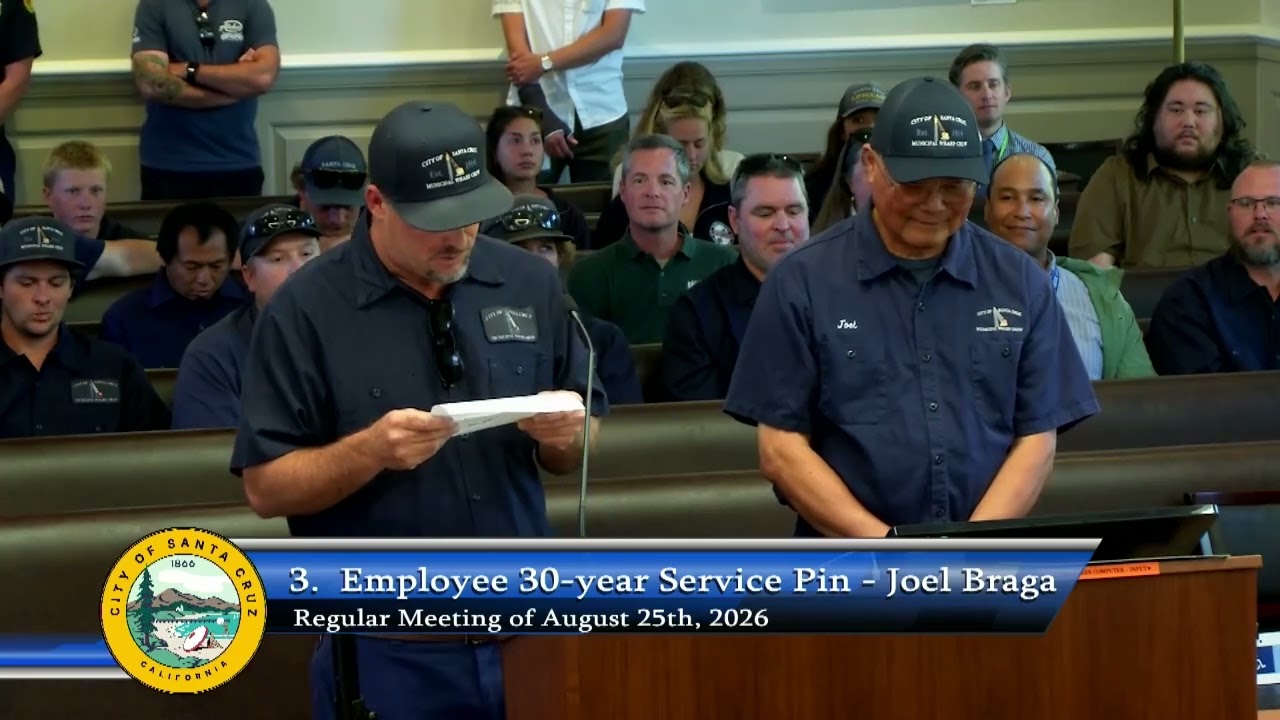
The Santa Cruz City Council meeting commenced with the establishment of a quorum through remote participation by Council Member O'Hara before moving into a closed session regarding liability claims and real property negotiations at 121 SoCal Avenue. Upon reconvening, the council honored long-serving employee Joel Braa with a pin for his three decades of dedication to parks maintenance, recognizing his resilience against natural disasters and the pandemic, followed by a Mayoral Proclamation designating August 25, 2026, as Marine Safety Professionals Recognition Day. This proclamation highlighted recent rescue efforts, including the saving of a ten-year-old boy at Seabright State Beach, while acknowledging over 30,000 safety contacts made recently; oral communications also covered diverse community concerns ranging from lightning storms and towing incidents to potential drive-thru modifications for the county building Starbucks location. Additionally, Dana Wagner from Meals on Wheels presented fiscal year data showing nearly 125,000 meals delivered countywide but noted a growing waiting list due to funding shortfalls since April 2025.
Following brief comments on road safety grants, the council approved the consent agenda and addressed critical infrastructure projects, including the realignment of the Westcliffe Drive path necessitated by bluff erosion at Gettel Street. City Engineer Kevin Crossley explained that moving the multi-use path back from the edge to mitigate erosion risks would result in the loss of eight parking spaces but was deemed the most cost-effective solution given grant limitations and state resiliency funding aimed at completing the project by year-end. Concurrently, the council discussed traffic management strategies for temporary parking removals on Bay Street and the installation of protected bike lanes on Bay Drive, with staff confirming a two-month detour plan that would direct local traffic only while monitoring neighborhood impacts. The presentation on Bay Drive outlined a phased approach utilizing temporary materials for a six-to-nine-month pilot to address high collision rates, featuring downhill left turns, rumble strips, and speed feedback signs, while clarifying that stop signs or signals were not recommended due to traffic spillover concerns and insufficient warrant thresholds.
The meeting concluded with the council voting to adopt a motion recommending the inclusion of fire department response data for arterial and collector streets in the upcoming safety action plan, alongside friendly amendments to consider traffic volumes on Escalona and explore citywide speed limit reductions under state law AB43. After addressing community feedback regarding the exclusion of speed humps on Escalona due to its status as a fire response route, the council reconvened following a recess to hear presentations from Recreation Superintendent Mr. Manhattan Jones and Sister Cities Commission Chair Ms. Carola Barton about recent delegations to their sister city in Brest, France. These exchanges included participation in a climate resilience conference focused on AI usage for coastal cities, cultural events like "Lake Cases," and a reciprocal youth bonding program involving Junior Guard members, leading to commitments for sustainable AI use, expanded youth exchanges, and arts collaborations. The council expressed strong support for these initiatives, welcomed the gift book from Mayor Serge Blanco, and adjourned the meeting pending photo opportunities.
Read the full video transcript
We are live. We are streaming. We do
have audio. The only thing that we don't
have is the visual which I don't think
is an issue.
>> Okay. So, we can begin.
>> Yes.
>> Thank you.
>> Santa Cruz City Council meeting will
come to order. The clerk will call the
role to establish a quorum.
>> Council member Triggero
>> present.
>> Bruner
>> present. Newsome
>> present.
>> Boulder. Council member O'Hara is
absent.
>> Vice Mayor Kellori Johnson
>> present.
>> And Mayor Keely
>> here. Uh for the interest of the public,
Council Member O'Hara will be
participating remotely from a location
uh at 201 Main Street in Green Bay,
Wisconsin.
Um and uh the agenda the agenda was
posted uh at this location no less than
72 hours prior to this meeting. So
council member uh O'Hara will be
participating uh remotely. Statement of
disqualifications. We have any
statements of disqualifications?
Council member Brutder.
Uh, close session item number two, real
property negotiations at 121 SoCal
Avenue. Uh, out of an abundance of
caution as it relates to my employment
downtown.
>> Thank you very much, council member. Do
we have others who have uh any
statements of disqualification?
Seeing hearing none, we are on public
comment on the closed session items.
Those items include conference with
legal counsel on liability claims under
the government code and real property
negotiations at 121 SoCal Avenue. Is
there anyone with us in chambers today
who wishes to comment? Miss Bush, do we
have anyone online who wishes to
comment?
>> No, we don't.
>> Thank you. Uh what we will do at this
point is we are going to adjourn into
close session to take up those items
that I just mentioned. We will be back
in session at 1:30 or upon conclusion of
close session uh whichever one of those
happens later. We now stand adjourned
into close session.
Santa Cruz City Council is back in
session. Clerk, would you call the role
to establish quorum again?
>> Council member Tgerero,
>> present.
>> Bruner,
>> present.
>> Newsome,
>> present.
>> Boulder,
>> here.
>> O'Hara,
>> here.
>> Vice Mayor Kellenory Johnson,
>> present.
>> Present. Uh for those of you who may be
wondering, Council Member O'Hara is by
prior arrangement joining us
electronically. She is in Green Bay,
Wisconsin. Uh and uh we are glad she can
join us. Council member, glad that
you're here. Thank you so much. Uh we
are on we're going to go slightly out of
order here. Uh I'm going to move oral
communication after these two
presentations. Our first presentation is
a 30-year employee service pin for Joel
Braa. Uh and uh Mr. Elliott is here and
we would appreciate it, Mr. Elliott, if
you would approach.
Good afternoon, my friends.
>> Thank you, Mayor. I'd like to introduce
our acting warf supervisor, Corey
Quinnold.
>> Corey, good afternoon, sir.
>> Hello. Hopefully everyone can hear me.
>> Yes, sir.
>> Okay. Hello everyone. My name is Corey
Quinnald and I'm Joel Braa's supervisor
down at the War and Beaches. We're here
today to celebrate an incredible
milestone in Joel's career. Joel is our
senior parks maintenance worker and his
years of hard work and dedication are
greatly appreciated.
In 1992, the Chicago Bulls won their
second NBA championship.
Google didn't exist. Gas was about a 125
a gallon and Joel started working for
the city of Santa Cruz as a temporary
employee. His shifts were split between
the Santa Cruz sports department and
working at Lach Loman since 1994. Joel
has also continued to work with the
Santa Cruz sports department refereeing
youth sports programs. So for more than
30 years, Joel hasn't just served the
city through parks and recreation. He
has also played an important important
role in our community by helping provide
local kids with a positive experience
through youth sports. That's awesome.
In 1996, Joel earned a full-time
position with parks and recreation in
the downtown division. After one year,
he transferred to beach services at
Lifeguard headquarters. Landing that
full-time position was a blessing for
Joel and his family. Once Joel
transferred to beach services, he found
his niche. And how can you blame him?
His job sites included Cow's Beach,
Maine Beach, and the Wararf. The scope
of the work, the constant challenges of
the marine environment, and the
opportunity to serve the city of Santa
Cruz all made this a perfect fit for
Joel.
Every day, Joel helps prepare and
maintain our beaches for junior guards,
the volleyball community, the countless
wararf and beach events. Throughout his
career, he has worked through six El
Nino, including the very strong 1996 and
97 event, three tsunamis, and the
unprecedented challenge of shutting down
the beach during a global pandemic.
Throughout
all these challenges, Joel has continued
to show up and adapt and get the job
done.
>> Joel,
I've had the privilege of working with
you for 16 years. What I see every day
is a guy who comes to work because he
genuinely loves his job, his job site,
and his crew.
Your dedication to serving the city and
preparing our beaches for the public
does not go unnoticed. You're a great
equipment operator. Whether you're
running the Boston Wher, sand sifter, K
Cabota, or loader,
>> you're reliable, hardworking, a leader,
and a great representative of the Warf
Crew.
30 years is an incredible
accomplishment. It represents not just
the time you've put in, but the
countless early mornings, long days,
challenging conditions, and the pride
you've taken in doing your job well.
Congratulations, Joel, and thank you for
30 years of dedicated service to the
city of Santa Cruz. Here is your 30-year
pin.
>> Mr. Braa The floor is yours, sir.
Please.
>> Hi, everybody. Um, just want to say
thank you very much for the opportunity
and uh to be able to serve and uh other
than that, that's all I got to say.
>> Well, we are so grateful to you for
selecting Santa Cruz as the place that
you were going to spend your
professional life and it means a great
deal to us that you've done that. And uh
we know that there are challenges
whether it's on the beach every day or
out on the warf whether it's the end of
the wararf getting ripped off by mother
nature or people driving off to it or
keeping it for the millions of people
who come out there every day or every
year rather uh who come out there to
enjoy all the opportunities out on the
longest wooden wararf in the western
hemisphere. Uh we thank you for all of
that. Uh that is for all of us here in
elective life. oftentimes you folks are
the face uh that the public sees and
that our visitors see and your courtesy
and decency and humanity uh with all of
those folks is much appreciated. Thank
you very much, sir.
>> Thank you.
We're on item four, a mayoral
proclamation regarding Marine Safety
Professionals Recognition Day. And uh
Council Member Renee Golder will be
making this presentation.
>> Thank you, Mayor. And I'm so glad that
the Warfin Beach crew is here along with
our talented lifeguards and fire
professionals. Um because it's really
all of you that are out there keeping
people safe in the community. And I know
before I was on council, I used to jog
in the mornings and I would see Joel in
the mornings when I um down at the
beach. So I felt safe down there even in
the pre-dawn hours. And so everybody's
doing their part to keep the public
safe.
>> And so with that uh we're going to read
this proclamation. So whereas every day
along Santa Cruz County's coastline,
dedicated marine safety professionals
answer the call to protect lives,
demonstrating courage, skill, and
selfless
selfless service in unprecedented and
often dangerous ocean conditions.
Whereas protecting our beaches and
waterways requires the daily dedication
by the city of Santa Cruz marine safety
personnel, Santa Cruz state lifeguards
and Santa Cruz County lifeguards,
firefighters, rescue swimmers,
dispatchers, and regional public safety
partners. And whereas on July 26th,
2026, California's state park lifeguard
Ryder Williams courageously rescued a
10-year-old boy from the dangerous surf
at Seabbrite State Beach, reminding our
community and the rest of the world that
uh marine work safety professionals
perform every day. And whereas dramatic
rescues may capture headlines, the
greatest success of the marine safety
professionals are often the emergencies
prevented through education, vigilance,
and thousands of proactive safety
contacts. During the significant south
swell swell in uh July 24th to 26, the
city of Santa Cruz marine safety
personnel alone completed 5,847
preventative actions. Is that just the
city?
>> Because I was like, yeah, there was a
lot in the county, too. That's insane.
That's a big number.
assisted in 34 individual in need of
water rescue, responded to 23 medical
aid incidents, resolved 19 missing
persons, and pro provided hundreds of
additional public safety contacts.
Whereas, Junior Guard programs
throughout the county help prepare the
next generation of ocean stewards by
teaching water safety, leadership,
teamwork, and public service while
inspiring many future lifeguards and the
first responders. established the
program in 1996. The first the city
junior guard program trains over 1,000
junior guards each summer. And whereas
the professionalism, courage, and
commitment demonstrated by the marine
safety professionals throughout Santa
Cruz County often make our beaches safer
and strengthen our community every day.
Now therefore, I Renee Golder on behalf
of the council and the mayor Fred
Keelley do hereby proclaim August 25th n
or 19 2026 uh in the city of Santa Cruz
as Marine Safety Professionals
Recognition Day. And we thank and
recognize the dedicated men and women
who work tirelessly to keep our
coastline safe.
Chief OD, good afternoon, sir. I am
imagining no one should go to the beach
at this moment, apparently. Uh,
but thank you so much each and every one
of you. Chief, the floor is yours, sir.
If I thank you, sir, uh Rob OD, uh Santa
Cruz fire chief, um Mayor Keely, Council
Member Golder, and the rest of the city
council colleagues and community
members, thank you for the opportunity
to recognize these fantastic men and
women who protect our coastline every
day. Um I think it goes without saying
that marine safety is a defining public
safety responsibility in Santa Cruz. um
our beaches and ocean um is among our
not only our greatest asset but as we
see with climate change um increased
access social media um it's also
becoming a very dangerous uh um endeavor
as well. Um, but today again is about
recognizing these professionals, but I
have to also recognize some of our
partners, California State Park
lifeguards, um, our firefighters and
rescue swimmers who also enter the
water. Um, our harbor uh, patrol and law
enforcement partners and all other
regional uh, public safety agencies. Um,
our success depends on teamwork,
training, uh, communication, and most
importantly, a shared commitment to
protecting lives. Um, again, July 25th,
the rescue at Sebrite State Beach by
state parks lifeguard Ryder Williams
rescuing a 10-year-old uh boy. Um,
obviously was seen by many around the
not only the state but the world. Um,
but it represents um a small portion of
what work is actually occurring every
single day along our coastline. um like
you mentioned earlier um the 5,000 plus
safety contacts in the county there were
um an additional 25,000
um totaling you know over 30,000 uh
safety contacts um we state parks had 58
rescues so we totaled in the in the
county 92 um and so it's just another
example of all the great work that is
done every single day um and it's
important to remember that lifeguarding
is all about prevention so every warning
conversation repositioning of a swimmer
and proactive contact actually prevents
these emergencies before they even
happen. So, they're doing amazing work
um that doesn't get recognized by social
media and the media at large. Um because
basically prevention is one of the
clearest measures of a successful marine
safety program and and I couldn't um
have a better program to stand in front
of than I do right here. Um but it's
also about building that next
generation. So, I want to also show
gratitude to our partners in p in uh
parks and wreck for the junior lifeguard
program. Again, started 1966. We get
over a thousand kids every single year.
And we are really, not only is it water
safety, but it's about teaching
leadership, teamwork, uh responsibility,
and service to the community. Um, and I
think it's pretty safe to say that many
of the people standing behind me, u, our
lifeguards, our firefighters, public
safety professionals, all began their
careers as junior lifeguards, and
yourself included.
Yes. So again, this work requires a
tremendous amount of courage when an
emergency occurs, vigilance when
conditions are changing, and compassion
when people are having one of the worst
moments of their lives. Um, most
importantly, these folks all work
together uh without a regard for his
jurisdiction, uniform, or whomever needs
help. Um, so this proclamation is an an
opportunity for all of us to say thank
you um to those of you that are serving
um to those that serve before you and
for those that are preparing to carry
out this mission in the future. So, I uh
want to thank you all as the fire chief
uh for your professionalism, your
courage, and your commitment to leading
our uh community um in safety and our
entire coastline. So, thank you all very
much. And thank you guys for the
opportunity to recognize all the
fantastic work they do every single day.
SO,
>> thank you all so much.
Please do.
>> I just want to say please also express
we know that the lifeguards are mostly
seasonal and many of them are back in
college or high school. We have kids as
young as 16 working as lifeguards across
the county. Make sure that if they're in
school that they got uh the gratitude
from this this body. And don't forget
our partners in Matt's home beach.
>> Tola
had to say it.
Thank you so much. All right, we are
uh if you all are waiting around for a
cue from us, don't. And I want and I
want to thank my friend with the cowboy
hat for putting up with my cowboy hat.
Judge, thank you.
>> You're a good man.
I will tell you the joke later.
What a bunch of good folks. My goodness.
That's a good way to
>> wrap summer up, right? Those folks. Wow.
How sweet.
In order to go forward, we will go
backwards. We are on oral communication.
This would be the opportunity for anyone
to address us on a matter under our
jurisdiction, but not on today's agenda
for a period of time not to exceed two
minutes in the event that we have folks
both here in chambers and online. We
will toggle back and forth, somebody
here, then somebody online, and so on.
Mr. Ewing, good afternoon. Welcome to
the council meeting.
>> You know, it's definitely a good
afternoon. My name is James Yuing
Whitman. Um, you know, I just had to
film the people that were in here and
then of course like clockwork they left
before the plethora of public speakers
that may have said something that might
have got their attention. It's pretty
consistent.
I just have to laugh. I'm laughing more
and more. Uh,
you know, I had I had the just the crazy
Confederate sea of dunes to be parked at
Twin Lakes on top of the cab of my
truck. It's a big deck to be woken up by
these intense lights and thunder.
And uh I was reminded of uh CNN 1985
report. They were talking about the
military's use of uh lightning as
military weapons and also 60 gigahertz
as military weapon. The 60 gigahertz is
uh our Y gig. They couldn't come up with
a better poison than 2.4 gigahertz which
is our modern Wi-Fi to affect humans. So
yeah, lightning is weapons. I mean, the
house that I lived on Stodder, which is
off of uh Alba, was turned into foundry
ash, you know, dozens of fruit trees
weren't affected. The redwood trees
weren't affected. Um, but the houses
were turned into foundry ash up Alba
Road. You could see a lot of vehicles
that are, you know, the first
presentation I'm aware of was the church
fires in 1983 in Australia that were
talking about these directed energy
weapons. So, it would have been great to
address a whole bunch of
people who are going to help the
community when things happen, but they
don't realize that companies like the
Rand Corporation are just using them as
the disposable individuals because the
only people being affected more by
frequencies than law enforcement and
emergency responders are teachers and
youth.
So, it is really just kind of comical.
You know, I I was at the supervisors
briefly and as if there's something
within their power to do and I said,
"Yeah, maybe it's within your power to
join the side of the living." And I
suppose I'm we can all change. And at
least one person smiling at that. Thank
you.
>> Thank you, sir. Do you have anyone
online? We're going to be right with
you. We're going to take person online
first. Thank you for your forbearance.
Person online. Good afternoon. Welcome
to the Santa Cruz City Council meeting.
person online
three.
>> Hi.
>> Hi. Good afternoon. We can hear you.
Welcome.
>> Good afternoon. Thank you. I appreciate
the opportunity to speak with you. Um so
I'm a resident of Santa Claus County. Um
I work for the sheriff's department out
here. I'm getting ready to retire
myself. So was kind of cool to listen to
the retirement speech from um the the
supervisor. That was a great speech. Um
but however, so my family and I were at
the boardwalk celebrating um one of my
granddaughter's birthdays and I am
handicapped. Um my father is severely
handicapped and we parked in what we
thought was a handicap spot. Um it was
on the street in front of several other
handicapped spots that were marked
handicapped. Now the reason that I
thought it was handicapped is because
the curb looked blue to me along the
street. Um there were other cars parked
along the street, the block uh previous
to that. And so I did not think parking
on the street was a problem and I saw a
blue curb and took the opportunity to
park at a place that my father and I
could walk to that would um get us to
the boardwalk. So when I came out at
9:00 p.m., I was shocked to see that my
car was missing and honestly thought
that the car had been stolen. Um, so I
approached the boardwalk staff and they,
you know, told me to call the police,
which I did. And I was told that my car
was towed because I was in a non-parking
um zone. Now, there were no parking
signs that were posted. However, a blue
curb overrides any of that. So, of
course, I ignored those signs. Um, and
in addition to that, there were no
handicap parking um signs saying, you
know, this is the handicap space.
However, again, if the curb is blue, my
understanding is that you can park there
regardless. So, thinking that I was
parked in a blue curb spot, um I was
pretty shocked. So, we were stranded um
in the dark um at the boardwalk. My
family had already left. They were in
separate cars. Um so,
anyway, we were stranded and it took us
several hours and lots of money to get
my car back.
Thank you. Appreciate. Good afternoon,
sir. And welcome.
>> Hey, council. Yeah. Um I guess you trust
council members to show their video on
Zoom. That's cool. Um uh that sounds
trying uh that that uh prior speakers.
Um that was pretty heartening. You know,
the thing about the marine safety um
professionals, they just did uh health
um community health uh professionals uh
awareness, not recognition, awareness
week, and it starts on my birthday,
which is ironic because I have a health
science degree, which I've done
absolutely nothing with. Um
but um yeah, I was thinking a little bit
about um the Starbucks structure.
someone named Carrie um Marcela who's
renting or leasing that space numbers
right there on a on a flyer on the
building and it's it's like about 2,000
square feet. It's it's got nice high
ceilings inside there. And um one thing
that became a political football at
various times during the uh prior um
prior years politically were uh
drive-throughs, drive-thru businesses.
And um you know that was a different
time. That was when you know the
mayorship was a single year and it was
it was a you know was elected um in and
amongst council members and um now we
have the large mayor mayorship and maybe
maybe we could get that to be a little
bit more flexible um just just for
expedience. I don't know there there's a
coffee place inside I wish I knew how
much time I had left actually. Um
um there's there's a coffee place inside
the um the county building and obviously
that's in inconvenient for people
driving by. Um I suggested to them that
if they took over the Starbucks
building, say they got a reasonable rent
or at least they could they could have
someone with an electric bike who could
shuttle orders over to the county
building, whatever. Um but yeah um uh
making it somehow a drive-thru. Um that
would somehow make that um it was former
Shell station a long time ago. It was
like a gas station a long long long
while long while long while long while
long while long while long while long
while long while long while long while
long while long while long while long
while long while long while long while
long while long while long back.
>> All right. I guess I have more things to
say but I don't have time to say it.
Thanks.
>> Well thank you. Do we have anyone
online?
>> Good afternoon and welcome.
>> Good afternoon Mayor Keely. City Council
members. My name is Dana Wagner. the
director of Meals on Wheels Santa Cruz
County program of community bridges. I'm
here today to share data with you from
the fiscal year that ended on June 30th.
I feel duty bound to apprise you of how
city dollars have been spent for fiscal
year 2026. Meals on wheels delivered
nearly 125,000 meals to homebound
seniors. In the city of Santa Cruz, we
delivered over 47,000 meals. We served
nearly 1500 Santa Cruz County residents,
older adults, including the 500 in Santa
Cruz City. We conducted over 2,000
wellness checks with our participants to
ensure their well-being and coordinated
with services with close to 800 of these
in city residents. At our four
congregate dining sites, we serve close
to 33,000 meals to older adults, 7,200
of these at London Nelson Community
Center. Seniors participating in Meals
on Wheels are overwhelmingly satisfied
with the service they receive. 98% of
those receiving homed delivered meals
stated our service helps them avoid
institutional placement. And 98% of
congregate diners state that the
congregate meals held them to feel less
isolated. As you may be aware, Meals on
Wheels has had to implement a waiting
list due to funding shortfills. Since
April 2025, we were unable to assist 17
older adults with food and connection
due to lack of funding. And we continue
to get 10 to 12 applications each week
for service. I know that the city and
county are reviewing the funding process
for safety net programs and I'm grateful
for this review and prioritization of
basic needs. I wanted to present these
numbers today to let you know that the
city dollars are optimally utilized to
ensure the health and well-being of our
growing growing senior population. On
behalf of the nearly 1500 seniors
participating in Meals on Wheels, I'm
grateful for your support. Thank you for
your time and attention.
>> Well, thank you so much. Please take our
thanks and appreciation back to all of
your colleagues. It is absolutely
wonderful what you do. You do so much
with limited resources uh to help fill
an extraordinary need in our community.
Thank you very much for being here.
Thank you for the work that you do.
>> Thank you so much. Appreciate your time.
>> We're on presiding officer
announcements, I believe. Oh, excuse me.
I'm sorry. Please come up. I didn't mean
to short shift you there. Excuse me.
Good afternoon and welcome. Good
afternoon. Uh, I just moved here about a
month or two ago and I'm a waterman and
I just have to say I love Santa Cruz.
Um, I don't know what you guys are doing
here, but you're doing it right. You
know, bathrooms by the beach, beach
access, you know, the safety in the
water. So, thank you so much and your
work is being recognized by by the
people. Thank you.
>> Well, how kind of you. Welcome to Santa
Cruz. Bring your friends.
Thank you. Uh, presiding officer
announcements. I have none. statements
and disqualification on the uh on the
agenda going forward today. Seeing hear
none, we will move to additions and
deletions. Miss Bush, additions or
deletions?
>> I have none.
>> Madam city attorney,
>> I have none.
>> Very good. City attorney report on
closed session.
>> Yes. Council met in close session at
1:00 in the courtyard conference room.
Uh discussed liability claims. Uh the
claims of Phoebe Anne Kelly, claim of
John Balquist as trustee of the Anthony
J. Coochi Trust. claim of Mary Sierra,
claim of Maria Gabriella Martin, and the
claim of Maryanne Roberts. Council also
discussed real property negotiations
uh concerning 121 SoCal Avenue and 1316
through 1320 Pacific Avenue with its uh
city negotiator and council member
Bruner disqualified herself from that
conversation.
>> Thank you, Madam City Attorney. Madam
City Clerk, any items on the agenda,
council agenda going forward you'd like
to draw our attention to?
>> No changes. No.
>> Thank you so much. We are on the consent
agenda. For those of you that might not
be familiar with it, we will be taking
up items six through 11 inclusive on one
motion. Prior to doing that, however,
council members will have the
opportunity to pull an item, comment on
an item, or ask questions about an item.
Similarly, we will go out to the public
and see if folks wish to do those
things, make comment on the consent
agenda. I will start through and I'm
going to start with council member
O'Hara
who is with us remotely. Council member,
good afternoon.
>> Good afternoon. Nothing for me, Mayor.
Thank you.
>> Thank you very much, Council Member.
Madame Vice Mayor, Council Member Nuome,
Council Member Bruner, Council Member
Bruner.
>> Thank you. I have just a couple of brief
comments. Um the first one is agenda
item 10, safe streets and roads for all.
It's a grant application public works.
And I just wanted to highlight in
reading through this item how valuable
these grants are in moving forward uh
needed safety and improvements and work
in our city across our city. I think I
speak um
for my district as well as all the other
districts uh when I was mayor. Safety on
our roads uh is a high priority for our
community, our residents. And um this
was a very interesting grant that um uh
pilots a postc crash care through EMS
innovation and I found it very
fascinating. I'd never heard of that.
And I just want to um thank staff for
going after these grants and identifying
all the different areas under road
safety and public safety that exist and
and it's no easy feat and um I'm very
curious to see the outcomes of this. So,
thank you. And the other item, similar
comments, agenda item 11, the HSIP 11
and 12 unsignalized crossing improvement
project. Thank you for all the work and
bringing that forward.
>> Thank you, council member. Council
member Charro. Very good. Let me see if
anyone who is with us today wishes to
make comments on the consent agenda. Mr.
Yuing, good afternoon again.
Yeah, it's nice to be here. Maybe my
recording won't turn off as soon as I
come to the podium like a few minutes
ago. So, I'm going to comment on the
minutes just my own digital idiot. Um,
comment on the minutes from the August
11th meeting and then number 10, the
grants and number nine, the resource
recovery for the Caterpillar 826K
rebuild.
Uh gee, I think in the last 10 days the
corporation in the United States
is $40 trillion in debt that they're
admitting to.
Wonder how that's going to affect grants
all across.
How are they going to reconcile that $40
trillion?
Seems pretty wild to me. Um
you know, I could only imagine what the
826 looks like. I have spent a fair
amount of time going to the dump
probably 500 times in my life. Those
things all need to be repaired at some
point. That's quite an expensive
rebuild, but hopefully it gets back on
track pretty quickly.
So besides that, we're all in this
together and it is really quite the
exciting time of what's going to happen
next. It seems like it's an Abin on
Costello show with the other areas of
political leadership the past 30 years
that I've been tracking it. Anyway, nice
to see you guys. Thanks.
>> Thank you, sir. Anyone online?
>> No one hand.
>> Good afternoon. Welcome again.
Appreciate James willingness to jump up
really fast when uh something because
otherwise there's no one online. I might
miss my opportunity. Um I want to echo
what uh Sonia said about um uh road
safety and um yeah road um yeah being
road uh yeah community being high
priority for the community. Um and and
for non-comm community members, you
know, um a certain
uh demographic, you know, comes to Santa
Cruz to smoke a a J with students, you
know what I mean? It's not, you know,
not exactly um all Santa Cruz people you
see on a summer day. Um but uh the um
uh I just I just got done speaking to um
uh the county board of supervisors uh
conveniently um run their meetings the
same u the other month or day of the
week or yeah um I would talked to them a
little bit about the shoulder on Highway
9 which um you know is within the city
limits here uh to to you know pretty far
in when you're going towards Felton. Um
and uh it's it's deplorable. I mean it's
very very unsafe for pedestrians, you
know, people stuck somehow walking that
way. And that's a that the optics of
that is very bad. So I'm I'm kind of
pushing or promoting that they improve
that. And that would include, you know,
this body u maybe looking at um along
there.
um when they do road work, you know, uh
sometimes the amount of like thought
they give to like uh uh traffic uh and
and pedestrians and bicycles is that's
going to reflect like how well they do
when they're done, you know, how how how
good the shoulder is going to be. Um
looking just to note that um now again,
okay, here I can see um
uh
I think I think pe people when they come
here, they drive very impulsively.
there's very there's a lot of impulsive
driving and I think you can do small
things to um try to um stem that uh
impulse or those impulses that that you
know that that you know it's it's it is
the you know it's the uh they call that
short attention span um you know like
look squirrel you know that kind of
thing right um you know I do I do think
that um signage is great signage signage
helps um I do think that um you just
just general, you know, like defense
like just like just like with fire
safety, defensible space like the
sidewalk should be wellkept. The
sidewalk should be, you know, a place to
to to be able to get away from traffic,
but also, you know, I mean, kind of
integrated in in a certain sense
because, you know, sometimes you're
going to find people that need to get
from the roadway to the curb and they're
in a wheelchair. So, I mean, there's all
kinds of things you can do to kind of
smooth out the edges and not make make
it look like the East Bay where there's
this like really tall curb and cars are
just going by at, you know, a million
miles a minute, you know, and it's seems
u impossible to live around. Okay. Um,
thank you.
>> Well, thank you. Anyone else under
communication? We have anybody else
online? Matters back before the body,
pleasure of the body. Council member
Trigger.
>> Motion to approve.
>> Motion to approve the council consent
agenda as recommended. as presented.
Second by council member Golder. Debate
or discussion.
Seeing hearing none, the clerk will call
the role.
>> Council member Triggero
>> I.
>> Grer
>> I.
>> Newsome
>> I.
>> Holder
>> I.
>> O'Hara
>> I.
>> Vice Mayor Kellar Johnson
>> I.
>> Mayor Keely
>> I. Motion passes and so ordered.
We will now move to general business
which apparently today is the Nathan
Nuin comprehensive agenda for the
afternoon. We will begin with item 12,
Westcliffe Drive path realignment. Uh we
have material in our packet. Um and uh
Mr. Nuin, I see you are deferring to one
of your colleagues to make this
presentation. Good afternoon, sir, and
welcome. Uh, good afternoon. Kevin
Crossley, city engineer. Um, it's been a
while since I slip flipped through a
slide deck up here. Do we have a
pointer? There we go.
Um,
pretty self-explanatory title. We're
going to be talking about some proposed
changes to the multi-use path along West
Cliff and a couple locations. We're
going to work from uh west to east. So,
we're going to start at uh the end of
Getel Street where we had a pretty
significant bluff failure. Um I think in
December of last year and so uh we
deployed those lovely orange water
barricades everybody's come come to know
and love and uh looked at a couple of
different options. Um our first approach
was looking at whether we could just
fence the area off and call it good. Uh
but uh we think that the bluff is going
to continue to erode. Um and so we
didn't think that was a very good
long-term solution. Uh we toyed around
with seaw walls. Um we built a lot of
those so we know how expensive they are
um and how hard they are to permit. Uh
so we quickly concluded that moving the
path back was the uh most cost-effective
and durable long-term solution here. Um
what that looks like is uh basically the
path straightening out in this location
um to what is currently the back of
curb. Uh taking out that sweep um moving
some benches back that currently are
located pretty close to the edge of
bluff. And uh the big trade-off here is
that we're going to lose eight spaces of
parking. Uh we did do a couple things.
We looked at availability of street
parking. There's quite a bit of that in
the general vicinity of this eight spot
parking lot and we also did toy around
with alternative locations to relocate
the parking. Uh but what you run into is
basically pinching the path and not
having enough space uh like we have
currently in this location. So all
things considered and given that we are
working on a pretty tight grant-f funded
budget, we felt that this was the most
cost-effective solution that sort of fit
all those different criteria. Um, we're
touching a pretty big footprint here and
we're going to be taking out a lot of
ice plants. So, that's another uh
feature of this project that's not
evident from this picture, but uh trying
to take out as much of that as possible
and kind of clean the area up like we
have in other areas that we've done
recent work.
Uh we had a planning commission hearing
last week to go through the uh design
variance and local coastal permit
process and there was no uh major public
comment on the item at the planning
commission meeting.
Um we do have to uh detour westbound
traffic to facilitate construction here.
Uh there's not enough space to move the
pedestrians through and vehicles both
ways even if we temporarily control
parking. So, that's uh something that
we're going to be uh preparing a
noticing process around. Um this is the
draft exhibit that would go into kind of
a postcard mailer. We've done that in
other uh areas along West Cliff during
construction uh to give folks a heads up
ahead of the time that there's going to
be these detours in place.
So, with that, that wraps up the
ghetto's location. Um
gotta love an engineer and a plot. Um
so, This was, I thought, an interesting
way to tee this item up. Um, one of the
consultants uh that we work with, he
shared this with me about three months
ago. And, uh, kind of the key things to
take away from this is that, uh, beach
width has been declining at, uh, some of
our most popular beaches, including its
and main beach. Uh, it bounces around
because the sand comes and goes with the
different seasons. Uh but the trend
especially at its beach has been a
gradual decline in average beach width
there. Uh in 2020 it was bouncing
between 100 and 200 feet average width
and it's down to zero to 100 feet
depending on the time of uh the data
collection. And so the uh the
consequence of that is that with less
beach there's more opportunity for
direct wave attack. And so this viewing
area that really had a nice sand buffer
in front of it most of the time um
routinely does not have any sand in
front of it and the waves um splash up
and over it. And um I never put videos
in slides because they never work, but
there's a great video of somebody that
gets completely knocked off their feet.
It's becoming a more reoccurring uh
thing. And so, uh, parks and wreck, uh,
led a process to install these very
lovely concrete blocks to basically
close the area off and keep the
landscaping material that was getting
blasted by the waves off of the path,
which is another safety issue. So, what
we're recommending is to um take what's
been temporarily closed off and make
that a permanent closure. Uh, this area
that's just kind of this funny green
shape would become a landscaped area. We
would move some of the memorial benches
and other things that are in that sort
of middle area out to the edges where
they're safer uh for everybody to
continue using and enjoying. Um and then
we would fence this area off with a a
low wooden fence that would help to try
to confine the landscaping material into
that area and not present ongoing
maintenance issues for um parks and
wrecks. So, kind of wrapping things up,
no armoring proposed. This is being
funded through a state grant we received
a couple years ago for Westcliffe
resiliency and we're trying to fasttrack
this to get it done by the end of this
calendar year. And I would be remiss
without talking about Lighthouse Point
which is in the neighborhood of the
other projects. Um so we have an ongoing
study lower right photo was taken
recently with a bunch of engineers and
geologists and geo uh physicists out
there looking at different things uh in
this area. Um, we did survey the area at
the beginning of this year. Uh, the
conclusions from that survey haven't
changed. We still have quite a bit of
bluff material. It's keeping the two
encroaching caves from combining.
There's a lot of concern that that'll
affect long-term currents if those caves
join, uh, which could then affect the
surf break. So, we still have material
between the two caves. And then the cave
closest to the lighthouse is still by
our estimate about 40 ft from the uh the
the foundation of the lighthouse. So we
don't think there's any um immediate
risks. There is ongoing bluff erosion
happening. It's a very visible popular
area. So we're aware of that. Um it
presents an ongoing safety issue for
those who choose to jump over the fence.
Uh but at the moment we don't see any
immediate issues. There's a lot of
questions we have coming up with the
media hyper on El Nino. So with that,
I'll move to the recommendation.
Questions or comments?
Vice Mayor is recognized. Then Council
Member Golder.
>> Thank you, Mayor.
>> And thank you for the presentation and
the work and um all the you have done
with the surrounding neighbor. So, just
a few questions. Um,
starting with the potential, what what
outreach has been Oh, yes. What outreach
has been done um already with community
members? And then um uh I think you
spoke this a little bit, but what kind
of noticing will be done prior to um the
construction?
>> Uh we sent out uh through the the
Westlift contact list. We sent out a
couple notices through our comm's team
ahead of the planning commission
meeting. Uh we also had mandatory
signage posted at the different project
locations along West Cliff. And uh when
we have a more concrete construction
schedule, we'll send out those postcard
mailers that'll give everybody a heads
up of the the detour and the timeline
for that.
>> Okay. And um I know you talked about um
looking at what alternatives there might
have been. Can you just expand on that a
little bit? If we didn't remove the
parking spots at schedules, what would
happen? What are the alternatives?
>> Oh, the path is currently back up to the
picture here.
>> So, the the path is sandwiched between
the parking spaces, the road, and the
bluff basically. M
>> and so
uh I think within the next year or so
the path would be undermined and we
would have to close it or move it in
some way. So the the obvious solution to
us was to straighten it out at the
expense of parking here. Um
if we uh tried to, you know, do
something different, I think it could
create some weird geometry with a path.
We we talked about saving some of the
the parking spots but not all. gets a
weird drainage. And so we just really
couldn't figure out a way to keep those
eight spaces and uh pull the path back
as much as we needed to. We're still
within like a I think a 30-year
estimated erosion zone. So um we target
things to be pulled back 50 if we can
and we're not even accomplishing that
with this project, but we're doing the
best we can.
>> Got it. Thank you. Okay. And then um so
you brought up the media hype around El
Nino. Well, we shall see um how it all
will happen in our community, but what
are we doing with public works and what
are we doing as a city to prepare both
infrastructure-wise and just preparing
the community? Ron Delano,
>> Mr. Dwin, good afternoon.
>> Good afternoon, Mayor U, city council.
Nathan Win, director of public works. Uh
as a part of our annual uh winter
preparization efforts, uh teams across
uh different departments are already
performing uh vegetation management in
our in particular our storm uh in
particular our levy system. There's
vegetation management that's happening
uh that will last actually through uh
the month of October. Uh the teams are
also going out into different uh sites u
regards to like creeks and channels
clearing out storm drains and coverts.
Um they're also checking on different
systems to help with our flood control
system, our pump stations in particular,
making sure that uh that our
preventative maintenance is continuing
to be performed as well as uh making
sure we have emergency ve uh fuel
available for those uh storm incidences.
And so there's a a continued effort that
will happen starting already and last
through uh the fall season as we prepare
for uh potentially a wet season.
>> Thank you. That's it for now. Thank you.
Council member Golder is recognized
>> again. Thank you. And I do appreciate
the partnership with everyone in the
departments that have been working with
us and the community through all of
this. And this has not gone to Coastal
yet, but you've been in communication
with them.
>> Uh so this project in particular was
permitted through the city's local
Coastal program
>> because it doesn't require a direct
coastal permit. Uh but we did consult
with the coastal staff informally about
the parking removal in particular.
>> Yeah, I would say also to the extent
we're acknowledging that we are doing
these managed retreat projects when in
other places especially with the
lighthouse when there's a push for
people that want to try and save
lighthouse point where we might have to
do a seaw wall or add some kind of
infrastructure buffering there to
protect the surf break. So I just and
I'm sure you're doing that but I just
would like to be noted. And then in
terms of the the temporary uh is it
westbound you said that was going around
and
>> Yep. Yeah. westbound.
>> Uh with that, are we planning on doing
any traffic control? And I'm looking
back at Claire. Are we are we just going
to just
>> see back there too? What what's
contemplated at the moment is uh the
detour signage of course and then uh
some signs that would say uh local
traffic only um on some of the other
streets like John and Gilles.
>> Okay.
I guess I'm just wondering if there's a
big outcry from the neighborhood. Oh,
the traffic's horrible. Are we planning
on addressing that or are we just going
to say it's only two months? Sorry. I
guess that's what I'm wondering. I just
wanted to be clear from the outset
because inevitably we're going to get
the emails.
>> I'll chime in real quickly. I think if
we need to make adjustments, we'll do
that. Um so we'll be we'll be monitoring
the traffic activity closely if we hear
feedback from neighbors as we always do.
Uh we're willing to um willing to look
at what adjustments could be made.
Fortunately, as as you noted, Council
Member Golder, it's it's temporary.
>> Sure. So the the hope is to expedite the
project, get through it as quickly as
possible and and try to mitigate the
impacts on the surrounding neighborhood.
>> I super appreciate that and I know one
thing that neighbors always appreciate
too is maybe extra law enforcement
presence just in the area at the
beginning and on the weekends as people
are getting used to the patterns or
maybe during the Thanksgiving holiday,
Halloween, things like that where
there's more people that are not in the
neighborhood or not in town coming out
and about. If I think if we could do
those things, it would go a long way.
Thank you.
>> Thank you, Council Member Bruner.
>> Thank you, Mayor. Uh thank you for the
additional presentation visuals and
information. Um and actually one of my
questions about the parking was was
asked and answered. Um I I I wanted to
clarify my question is around the
temporary in the RFP it said 60 days uh
completion of work. Does that include
the temporary detour route? Is that how
long will that temporary route be?
>> That's the total duration of the
contract for both locations and we're
estimating that in this location will
have up to two months of detour.
>> Up to two months of detour. And then my
other question was what is the most
effective way
um for the community to give um input
and feedback if there are concerns? Is
it through CRISP the community requests
for service portal under traffic
concerns? Um, how are we when we send
out noticing and mail directing them?
Where are we directing input contact?
>> Well, we'll have a designated project
representative that's uh on the back
side of this uh postcard. It will be the
point of contact.
>> Okay. So, they just contact that person
directly.
>> Yep.
>> Okay.
That concludes my questions. Thank you.
>> Thank you. Further questions, comments
by members. Let me see if there's anyone
with us today who wishes to make comment
on this item. This will be the
opportunity to do so. Good afternoon and
welcome, sir.
>> My name is Richard.
>> Get right over there to the microphone.
>> Caver. Uh me and my buddies surveyed
most of these caves back in ' 86. You
cannot plug caves up.
This is a horrible, horrible proposal.
It's not very well thought out. I have
solutions to everything here.
Unfortunately, not be well paid at paid
at all. The bottom line, if you guys
pass this, we're going to file in
federal court. All rights reserved.
Thank you.
>> Well, thank you, sir. Anyone else with
us wish to comment? Do we have anyone
online, Miss Bush?
>> We do not.
>> Matters back before the body, pleasure
of the body. I'll move the
recommendation as presented in the staff
report.
>> Vice Mayor moves and council member
Golder seconds to approve the item.
Further debate or discussion? Seeing in
hearing none, the clerk will call the
role.
>> Council member Triggero
>> I.
>> Gruner
>> I.
>> Newsome.
>> I
>> O'Hara
>> I.
>> Vice Mayor Kellen Johnson
>> I.
>> Mayor Keely
>> I. Motion passes and so ordered.
We are on item 13. This is a Bay Drive
protected bike lanes and pedestrian path
project. Public works will be presenting
on this item.
Mr. Starky and Miss Galuli. Good
afternoon,
>> Miss Guly. Floor is yours.
>> Thank you. Good afternoon, mayor and
council members. Claire Gloely,
principal transportation planner for the
city of Santa Cruz in public works. I
will likely be joined at times by Matt
Starky, our transportation manager, but
probably only if we need him. Um, I'm
excited to be here today to present on
the Bay Drive protected bike lanes and
ped pedestrian paths project.
Here we are in action.
The motion before you has three elements
that I just want to forecast for you.
The first is a pilot design at the
intersections of Bay and Escalona.
The second component that we'll talk
about is future complete streets uh
treatments at Anita and Toledo, the
intersections of Bay and Anita and Bay
and Toledo. And the third component is
finalizing the rightaway with Santa Cruz
City Schools for the frontage of Bayiew.
So there are three pieces that we'll go
through one by one in this agenda report
today.
I want to first just level set about the
schedule because you've heard from me
multiple times on this project and we're
delivering it in multiple phases. So you
have seen the component that is complete
phase one which is on bay between
Escalona and Nobel. That's where we have
already installed a separated bike lane
and pedestrian path.
Where we are right now is as we go into
fall 2026, that's when recommendation
one, the proposed Bay Escalina pilot
installation would take place. We'll
talk about that, but we're aiming to get
that in before UCSC returns.
Looking forward towards the end of this
year and early in Q1 2027 is when you
would see the full design for Bay
between California and High come back to
you for council action. And then we
would bid that project. We'd look to go
to construction for that portion of the
project in summer of 2027.
That would be followed in spring 2028
with CALR doing their capital
maintenance project CAPM project which
is their repaving project that will go
between the 19 intersection and western
city limits and will construct the
portion of our project the Bay Mission
intersection. So setting us up where we
are. We're currently in design for the
overall project and today we're looking
at a quick build component in advance of
the capital project, the capital project
going to construction in summer 2027 and
the CALR project following that. So lots
of components here.
Another reason of why are we here today
and why are we talking about Bay at all.
We have 137 lane miles of streets in the
city of Santa Cruz. And in August of
2019, this body adopted a vision zero
resolution and set a ambitious goal to
eliminate traffic fatalities and serious
injuries in our city by 2030. Uh we are
not the only city that's done this. This
is a a worldwide effort that says
serious injuries and fatalities on our
roadways are preventable. We have the
tools to be able to address them and we
should prioritize the interventions that
we take on our streets where we can do
the greatest amount of good and minimize
the amount of harm that we see.
this uh effort in vision zero efforts
that we take utilize the safe systems
approach and in the past in traffic
engineering what we had said was
collisions happen someone's at fault and
that person needs to take individual
responsibility for what that was what we
know from research and really borrowing
from a public health framework is that
there are things that we can do at the
population level and at the system level
that have much better impact than the
individual level. So the individual
level is things like um you know our
driver education campaigns or roadway
signage that says slow down, do your
part. At the systems level where we're
circled here in red, the built
environment level is how do you change
the infrastructure to make it so that
the system is safer as a whole? How do
you make it so that when you're on the
roadway, you're operating at a safe
speed, you're able to make safe
decisions, and that we're minimizing the
patterns that we see on our roadways
that contribute to the greatest number
of severe injury and fatality
collisions, which is in what's in front
of us today.
The efforts that we have before us today
are informed by a lot of past work. In
2021, following our vision zero
resolution, we adopted the local roadway
safety plan, which identified the bay
corridor as one of our priority
corridors based upon the history of
collisions that we have there. Um, we
use that local roadway safety plan
actually to secure the funding that's
funding the work that we're doing right
now. Since that time, we've also adopted
the active transportation plan, which
identifies us as a priority multimmoal
corridor, and we're working on the
safety action plan, which will come to
you in October. that went to the
Transportation and Public Works
Commission at their last meeting, uh,
which still identifies Bay as one of the
top serious injury and fatality
collision locations in the city.
So, all this to say, we're not pulling
this project out of thin air. We're
pulling this project out of a history of
collisions and a prioritized framework
of where we invest limited planning and
capital dollars to address the largest
safety concerns that we have in our
community.
Grounded in safety, grounded in data.
And we've been to you before. You've
given us direction to work on this
project, to prioritize this project.
It's in um our CIP and we're continuing
to that which we're really excited
about.
That's the preamble to part one. Bay
Escalona which is uh the first
recommendation in your staff report
today. So to ground this here we are
recommending Bay Escalona to go forward
as a quick build project which means
that we will use temporary materials to
pilot a traffic safety intervention to
see if it's something that then we
should put in concrete for a long-term
project.
We brought this to the Transportation
Public Works Commission. There's a lot
going on here. I'll explain it. Um, and
when we went to the Transportation
Public Works Commission, what we said is
we did a lot of analysis and the
intersection of Bayoncalona is one of
the top 10 intersections in the city for
collisions. Between 2020 and 2025, there
were eight collisions at this corridor.
And most of them were going from one
side of Escalona to the other. And most
of the time it was from people
misjudging the speed of cars coming down
or up bay. So a pattern of broadside
collisions, people traveling across bay
at Escalona.
So when we went to TPWC, we said, "Hey,
the intervention that we can do here is
to just close it, put a median in the
middle, and that would prevent that
movement that's happening across
Escalona." Um, and it would address that
pattern of collisions. We could do it
quick with paint and posts. And we heard
a lot of feedback and I think this is an
example of a really successful community
engagement process is lots of folks
said, "Hey, there's issues with speed."
And hey, if you close that downhill left
turn from Bay to Escalona, all of that
traffic is going to spill over onto
Kenneth and onto King and onto
neighborhood streets. And there's
actually a lot of people that do that.
and we heard concerns from the Escalona
neighbors about um localized concerns on
their street related to missing
sidewalks and lack of bike facilities.
And so we took all of that
and form our recommendation to you
today.
So our recommendation is to pilot a
quick build intervention at Bay and
Escalona that would maintain the
downhill lift from Bay to Escalona
roughly southbound to eastbound although
it's on a diagonal
um but would maintain our recommendation
to prohibit the Escalona to Escalona
straight movement which is where the
majority of collisions are occurring. So
this addresses the community concern we
heard from surrounding streets about
spillover traffic that would then um go
onto King Kenneth and other neighboring
streets which was one of the big things
that we heard. So this change in
recommendation addresses that.
Other things that we added here in the
recommendation are on the downhill where
you see the ones
I don't know does this have a
um we added rumble strips transverse
rumble strips. So you have a tactile
warning as you're coming downhill as a
gateway feature that you're going from
where you're not in a neighborhood to
where you're in a neighborhood. There's
also the addition of a speed feedback
sign at the base warning you that as
you're moving from the 30 mph zone to
the 25 mile per hour zone, you should be
slowing down. You're entering a
neighborhood, the context is different.
Here we maintain uh bike access across
Escalona. This is identified in the
active transportation plan as a
neighborhood connector and we do have
lots of folks who are doing that. It
gives them a place to land in the middle
and it maintains the um existing
flashing warning sign for pedestrians,
the RFB at that location. This is
something that we could again set up
very quickly with paint and posts. And
what a quick build is really is
installing cheap and fast, testing out
how it goes, refining, and then making
an assessment if we want to keep,
remove, improve, and put it into our
final design. So the recommendation here
is to do it quick, to do it before UCSC
comes back and traffic patterns change
and to assess how it goes and if it goes
well to use curbs and concrete later as
part of that final design that will be
going to construction in summer 2027.
That's part one of the recommendation
today.
Part two is getting design direction
from council for future intersection
changes on Bay at the intersections of
Anita and Toledo. And I
don't see Drew here from the
neighborhood yet, but I would like to
start off this by saying thank you to
Council Member Colintari Johnson and to
Drew and Ella and the um Anita Toledo
all of neighbors for doing a lot of
community organizing and and backing up
the recommendation in front of you
today.
So the recommendation that we have from
you last year was to put in a
birectional bike lane on the west side
of bay. And one of the things we said
that that would require is turn
restrictions at Toledo and Anita
for uh cyclist safety as they're coming
through due to sight distance and
queuing from the intersection at Mission
Street. And there are a lot of different
ways that you can do that. So, we
engaged with the neighbors at Toledo,
Anita and Olive uh to hear about their
concerns with changes to circulation in
their neighborhood and we had two
neighborhood meetings out there. They
were really great in sharing their
feedback and we thought we got it right
and we went to transportation public
works commission. We brought them this
proposal here that changed part of olive
to two-way and had one median and had
some turn restrictions. We got a
recommendation from TPWC, but we heard
from the neighbors and they said, "We'd
actually want a little tweak."
And we said, "Fine, we can put in that
little tweak that works for the
project." Um, and so the recommendation
before you today is to confirm mountable
medians as the intersection treatment at
the intersections of Bay and Toledo and
Bay and Anita. This is what they would
look like in this visual here, and it's
in one of your attachments. And um this
is something that worked for the fire
department, the police department, the
neighborhood, the project, and I think
is a great example of really hearing
feedback and making project changes that
reflect what we heard.
Part three, the final part of the action
today is a recommendation on finalizing
right of way. So, we've been working
with um principal Renee Golder in that
role in Santa Cruz City Schools to
identify that as part of the safe routes
to school project and making sure that
students can access Bayiew and Mission
Hill, we need to utilize a little bit of
the Santa Cruz City Schools district
property on the Bayiew frontage to widen
the sidewalk out and to create enough
space. And Santa Cruz City Schools in
being great partners said, "Absolutely,
we're on the same page. Let's figure out
how to do this." So, our lawyers and
their lawyers work together and what's
in your packet today is finalizing that
rightaway transfer that then we would go
um take to the recorder's office. It was
a really great experience. I'm very very
thankful to Superintendent Monroe and
the district facility staff and the
whole team for making sure that this is
a project that really checks a lot of
boxes in our shared interests and was
just a really great experience. I feel
really really proud of.
That brings me to the recommendation
that you see in your report today and
I'm available for any questions. Thank
you.
>> Questions members? I think uh I can see
Can I see council member O'Hara? Do you
have your hand up? I'm trying to see
from here a very small screen in front
of me. I can I
>> I did not. But I appreciate your your
attention, mayor, and I'm I'm certainly
um have some comments once we get to
discussion. Thank you. Would you like to
be recognized at this time?
>> Uh, no. I'm fine. Thank you.
>> Okay. Very good. Council member Golder.
>> Thank you. And I agree. It was a great
collaboration trying to get to this
point. I do have a question that comes
to me from the public and I've I've
heard you answer before, but I just want
to a lot of the concern with Bay
especially near Escalona that we heard
from the neighbors was in regards to
speeding. And so something you didn't
address was people had asked why not a
stop sign? Why not at the stoplight? And
you've told me privately, but you didn't
say it in the presentation specifically.
Yeah, happy to take that question. Um,
in your packet also and in the agenda
for anyone that wants to reference it at
home. When we uh looked at this project,
we did both a signal warrant and a stop
warrant, which the engineers could tell
you more about, but it's essentially a
worksheet that goes through the official
way that you have to determine if we say
yes to a signal warrant or a stop
warrant. and the Bay Escalona
intersection did not meet our thresholds
for a stop sign or a signal at this
time. We additionally did some um
transportation analysis for operations
and what we found is if we were to put
in a stop sign at this location, it
would add about two and a half minutes
of additional delay and moved about 600
vehicles off of bay onto neighboring
streets. And so in looking at that from
the analysis, what we said was not only
would we not recommend a stop sign or a
signal because it doesn't meet our
established thresholds, but the amount
of spillover traffic into surrounding
neighborhoods and the amount of delay
that it would contribute here wouldn't
be a trade-off that we would recommend.
You would probably hear a lot from those
other neighbors about the spillover
traffic on their
>> Sure. You would. So that I think leads
to the next point of the spillover
traffic. How do you guys plan to measure
that during this pilot period?
Um, we have traffic counters, so we'll
go out and measure that. And with the
changed recommendation from a full
closure to maintaining the downhill left
turn from Bay to Escalona, we would
anticipate very little spillover
traffic. And then my final question, I
know Officer Black no longer works with
the Santa Cruz Police Department. Is
there plans to put other law enforcement
out there during the pilot part or the
initial part just to warn or ticket
address the issue, too.
>> Great question. I can't speak to SCPD
operations, but I will say that
Lieutenant Why, who is now in charge of
traffic for SCPD, is doing a great job
engaging with Matt Starky and I about
prioritization and um getting speed
trailer out, getting enforcement out.
SCPD could probably tell you this is one
of the locations that they do the most
amount of enforcement in the city. We
had actually some great neighbors at
TPWC specifically pointing at the police
officers and saying, "Oh, I see you
sitting outside my house all the time."
So, we'll continue to do enforcement
there as we're working towards the
bigger project which we would anticipate
would have more speed reduction, our
capital project going into construction
in 2027.
>> Thank you. The vice mayor is recognized.
>> Thank you, mayor. Thank you so much for
the presentation and of course all the
work over the several years and
especially in the last six months or so.
really really appreciate um just the
open communication you've had with
community members and with myself and
the whole team. Um I do have a couple of
questions. Um Council Member Golder
asked about Escalona and stop signs and
signals. How about speed bumps? We got
some emails and some communication about
speed bumps in Escalona. Could you speak
to that? I know that, let me just back
up and say I know that um we are
addressing the Bay Corridor, but as
we're addressing the Bay Corridor, these
questions have come up from community
members. So, I wonder if we could just
take a few moments to address some of
those concerns.
>> Yeah, absolutely. Um Escalona is a
collector street and is on our fire
response route and on our fire response
routes, we typically do not include
speed bumps because they have a negative
impact on the ability to um respond with
our fire apparatus. So, it's one of the
things we constantly talk to with fire
about. I think something that we should
all feel really proud about is last year
we spent about $ three and a half
million dollars on improvements on
Escalona. It included installing
sidewalks on one side of the street
within the project limits, about 50
additional new curb ramps. In some
locations, we added new bike lanes. We
narrowed the lanes for speed reduction.
Um, and Escalone is identified as one of
our neighborhood connectors in our
active transportation plan. So, I think
what that is to say is that at this time
we're not looking at speed bumps, but we
will continue to look at speed reduction
strategies and other continued
improvements that um highlight the
features that make a good neighborhood
connector.
>> Okay. So, follow up to that um you
mentioned the
safety action plan that's underway. Um
>> is that the plan that will help us look
at speed reduction efforts citywide?
What is what is our plan for speed
reduction efforts citywide because
showed that great map that showed all
the different color lines in the cities?
>> Yes. So, the safety action plan will
come to you in October. It just went to
the Transportation Public Works
Commission. One of their recommendations
to you is to direct us to utilize recent
state law AB43
um and other relevant state laws to
citywide look at ways that we can reduce
our speed limits in uh the areas that
state law allows us to and proximate to
schools. So that action will be coming
to you in October to direct us to do
that. Um it's one of the proven traffic
safety interventions that we would want
to take on.
>> Okay, last question for right now. Um
you mentioned pilot
um and I think you said construction of
Bay Colona pilot would be in summer of
2027. So the pilot is like six to nine
months or what is the length of pilot is
my actual question. Yes. So we would
look to construct the pilot this summer
fall right now when we're in hopefully
before UCSC gets back into session. We
have the uh purchase order queued up
waiting for directions that we can order
the materials that we need. Um, and it
would be the pilot would be a minimum
six months we would look for.
>> Okay.
>> And we'll be coming to you this in Q1 of
2027 with direction for the overall
capital project, which would be a great
time to touch base on that.
>> And this was in the agenda report, but
could you quickly touch on how we how
will we evaluate if the pilot is
successful?
>> Yes, we'll um I'm sure all neighbors
will reach out and give us feedback, but
we'll also be doing traffic counts in
proximate areas. Um, and we'll also be
looking at collisions and talking with
police and fire about their experience
as well.
>> All right, those are my questions for
now. Thank you.
>> Thank you. Council member Bruner is
recognized.
>> Thank you. Um, thank you so much for
your presentation. It was articulated
very well and clear. I appreciated
reading through this agenda report and
the visuals. had to stare a few times
and to get all the color-coded lines,
but um going out there and seeing the
area and combined with the visuals was
very helpful. Um so, thank you for that.
Uh, I wanted to I've received a few
emails um concerns and if you could just
speak to um there are concerns that this
will not increase safety for cyclists
and instead create confusion for
cyclists for versus cars. Um, can you
speak to that uh research with that?
>> Yes, I think that's a great question.
And I think a lot of the areas of um
concern and confusion that we got were
that I think maybe folks aren't used to
us changing changing our recommendation
based on the feedback we got. And so the
transportation public works commission
meeting where we had our um our
preliminary recommendation
had a full closure here and didn't have
a gap for bikes to be able to make it
through. And we heard a lot of feedback
and we made a lot of changes. So I think
a lot of the confusion that we've heard
is around that and less awareness of the
changes that we made
>> around the original recommendation.
>> Yes. Yeah.
>> Transportation.
>> Okay. Took that feedback made changes
and I think the result of those changes
is a lot more clear addresses the
primary concerns that we heard. We have
a really really clear pathway in here
for bikes to still be able to get
straight across here at Escalona. Um and
I think it will be very intuitive on the
ground.
Thank you. Uh that's helpful. And um the
other thing I wanted to say was um
I think overall, you know, knowing that
this will be a six-month pilot and the
temporary quick build nature of of
this, I know we've been talking about
this area um for years. I didn't realize
it since 2021.
Um and I think that um I really
appreciate the the data driven approach
to that has informed the recommendations
where we are today and that includes not
just the studies and um but also the
community input as well. So uh thank
you.
>> Thank you. Let me see if council members
have other questions. Council member
O'Hara, I want to make sure I give you
an opportunity on to be heard on this
item if you wish to.
>> Thank you, Mayor. Um I have um just a
few comments about
um just sharing some appreciate
appreciation as council member Bruner
also just suggested um as to how long
this process has been in the works and
knowing um and I wanted to comment on
the fact that our staff is flexible,
nimble and open to constructive feedback
is really important and I appreciate the
work that you did to not not only engage
with the community but take those
comments seriously and um update the
proposals based on that. I do also want
to reflect on um as a longtime eastsider
who now lives up on campus
um pretty much every day coming down Bay
Street there it's not well I'm I'm being
dramatic here very often coming down Bay
Street there are significant issues um
between pedestrians bikes and cars at
that corner um and living on campus and
using that as my my you know
transportation
uh kind of plan to get down into the
west side. I see that all the time and
so I know how critical this work is um
and I really appreciate the the
thoughtful um process that is unfolded
around this even though there are hard
tradeoffs that we have to be considering
and I and I understand those trade-offs.
Thank you.
>> Thank you council member. Other
questions, comments by council members.
This be the opportunity for and as uh
Mr. Lar Mr. Larson is approaching people
probably know Mr. Larson as a member of
the county board of education and all
around good guy but I also want to thank
you for your years of service as chief
deputy state controller where I know
that we did some work together with
state controller and you were very
helpful on that in Sacramento. So thank
you sir.
>> Thank you Mr. mayor and thank you
council manager, attorneys, staff just
for your continued collective service to
our city and all our neighbors. So,
thank you so much. Um, also wanted to
thank you for your earlier consent
calendar item for the unsignalized
pedestrian improvements as part of that
body. You improved some improvements to
Payton and King, which is a complex
offset intersection right next to
Mission Hill Middle School. So, thank
you for that. I think those are great
improvements. you're moving ahead with
there and that really embodies what our
neighborhood lower Escalona and the
Escalona Greenway has always been
focused on pedestrian and safety improve
pedestrian and cyclist improvements. I
come from a family of cyclists so I now
have to wrestle my son for my ebike. Uh
but it's um otherwise it's a pretty good
deal um where we live, where we're
approximate to the campus, the coast,
downtown, as well as all of the west
side. Um really want to second what
council members have said, staff's
outgoing outreach to the community has
been great throughout this process. Um,
I also wanted to acknowledge on behalf
of our neighborhood that we appreciate
that the city for a long time has
designated the Escalona Greenway as a
bike way, bike corridor, and most
recently in your recent update to the
active active transportation plan. We're
now a designated neighborhood collector
uh connector. So, it's intended to be a
pedestrian and cyclist connection from
basically downtown and Harvey West to
the west side and campus. So, really
appreciate that as well as all the prior
bicycle and pedestrian improvements
you've made on Bay that you've made at
Escalona and Bay and that you've made on
the eastern most portion of Escalona
where I live. I'm here to speak to you
about the rest of Escalona, though,
because from Payton to Bay, it's
dangerous to be a pedestrian or a
cyclist, yet we have hundreds of
pedestrians and cyclists every day
walking dogs, going to school, or
whatever. And while our neighborhood
strongly supported option one, as
they've written you in your packet
today, whether you approve option one or
option two, we do ask for three
additional referrals to staff and maybe
a fourth based on our comment today.
first in the traffic study that's being
done during the pilot period to make
sure that Escalona
traffic volumes, speed volumes, and
accidents are considered as part of that
analysis. We actually think the loss of
the left turn on Northbound Bay.
>> Mr. Larson, hold for me for just a
second because I can see pretty soon
that red light's going to go up. You are
here speaking on behalf of a number of
your neighbors. Is that right? We didn't
have a coordinated meeting, but we've
had emails on these topics.
>> The answer is yes. Right. Okay. I'm
going to grant you two additional
minutes to do that. Thank you.
>> Um,
let's see. So, three maybe four requests
for staff consideration just to make
sure the Escalona traffic speed and
accident information is included in the
pilot period. Second, to um look at
traffic calming, pedestrian, and cyclist
safety improvements during the interim
period to be considered when the full
capital project comes forward. While we
understand the argument that we're a
designated fire route, it's our belief
from our living there that fire trucks
never use the windy, curvy, hilly
Escalona as a pass through to get to
other incidents that aren't on the
block. So we understand the fire
department issue. There are other
traffic calming solutions as well. So we
would like speed humps and those other
solutions considered. Um third is to
direct staff to include Escalona as a
consideration for the 20 mph limit to
come back to you in October as part of
that broader study. Understand you can't
make that decision today. All you can do
is ask staff to consider that. That's
all I'm requesting at this point that
Escalona be considered for that 20 mile
an hour limit. And the last one that
just came up today that I haven't
discussed with my neighbors is
requesting fire department response data
for how often does fire apparatus
actually go through the hilly curvy
section of Escalona,
>> which is where we need the speed homes.
We don't believe there's ever been a
fire equipment going along that part of
Escalona that wasn't responding to an
incident on Escalona. So, we think it
may be appropriate to look at limited
speed humps and certainly other traffic
calming along Escalona. That's it. Those
four requests for direction to staff.
Mr.
>> Lion, thank you for being here. Let me
see if there's anyone else who is with
us who wishes to provide comment.
Good afternoon and welcome. Miss Bush,
do we have anyone online? We'll hear
from you, sir, and then we'll go to
person online, then we'll be right with
you. Thank you for your forbearance.
Good afternoon, sir.
>> You need you need a button, Fred, that
hits the Thank you for your forbearance.
>> Um
I uh I just want to tell you about, you
know, you study medicine. Uh you're
going to you're going to come up against
uh this very serious topic of mortality
and morbidity.
And uh there are three big the big three
things that tend to kill us other than
cancer and heart attacks. Um you've got
um automobiles, not in this or not in
any particular order. Automobiles um
overdoses and uh weapons and violence
the big three. And uh there's two sides
of each of those. There's there's the
innocent um victims of those and then
there are the people, you know, can
engage in those activities.
state of the I guess. Um but uh yeah uh
it's it's been bad for a long time. I
don't know if you've ever seen the movie
uh Wagons East. So it's hilarious movie.
Um and uh they they decide that West is
like too terrible and rude and they're
going to head back east wagon train back
to go back back east. And uh there's a
there's a moment in the movie where
they're they're actually uh you know the
the um the um US cavalry is gonna
massacre them and they they're going to
circle the wagons and the Native
Americans says no square the wagons.
What square? Well yeah sharp corners you
just they don't know what to but they do
it anyway and it works. Anyways, um for
me, I look at um Bayon High and I think
okay, uh the metro took a an I think I
mentioned in an off-hand way a theory I
had that if they just took buses to the
base of campus, it would serve campus
communities uh getting to and from
campus. They have two routes now. They
have the 18B and the 19B,
but um I've never taken either of those
routes, but the idea is they go to the
base of campus, then they go back
downtown and, you know, by their rinse
their feet, right? Um and they're, you
know, they're limited. They don't have
too many routes per day, but there's
like 470 buses that go up there uh on a
on a school day in the most of the year.
Um, so buses, uh, cars, motorcycles,
bicycles, pedestrians, ebikes,
recreational motorbikes, scooters, etc.
Um,
you know, it's, uh, it's something that
they improved only about like three
years ago. I don't remember exactly, but
they they widened the lanes. Uh, and
I've walked up that that that way at
night time. Not a lot of people do that.
And there's that little path that goes
through the center and you can take that
or you can take the bike lane and make
make you know on the down slope you know
the bicyclists will you know be really
um perturbed that you're walking in the
bike lane perhaps or you know and cars
but um that's not entirely safe and
that's bad you know but now it's safer
and another thing um you can do is you
know bay and mission um there have been
terrible um uh DND incidents you know
death memory incidents there. Large
trucks have tangled with cyclists. Um, a
few more things to say on it, but I'm
glad that you're moving in the right
direction. Obviously, attention uh tends
to help things.
>> Thank you, sir.
Person online. We're going, Miss Bush,
we do have someone. We do. We'll take
the person online. Good afternoon.
Welcome to the city council meeting.
>> Hello. Can you hear me?
>> Yes, we can.
Hi. Uh, this is, uh, Drew from Olive
Street. Uh, thanks Claire for giving me
the shout out earlier. Appreciate that.
Um, I just wanted to, uh, call in. Sorry
I couldn't be there in person. Just
wanted to, uh, call in and say how much
I appreciated the engagement um, from
public works and from the vice mayor um,
on this issue. um you know uh many hours
were spent debating and and working on
this uh this plan and um they really uh
took the took the community's um point
of view and feedback in into
consideration. Um Claire and Matt and
the vice mayor came to my backyard and
handled questions from the entire
neighborhood um and with great grace and
humility um and gave us a really good
view into how complicated this process
is. So um just again thank you from
myself and and from other uh residents
in the neighborhood. Um you know I don't
I don't think the plan is perfect. I
don't think any plan is perfect, but I
think this is a reasonable compromise.
And uh again, thank you uh uh to public
works and to the city council.
Appreciate it all.
>> Thank you for calling in. Good
afternoon, sir. Welcome.
>> Thank you, mayor. Council members, I'm
Glenn Stewart. I live on King Street,
1210 King Street, three houses from Bay.
I tell you that in part because I see
the enforcement that's taking place out
there and the police are doing a good
job. When they uh catch a speeder coming
down bay, they often end up in front of
my house. And uh we were watching TV the
other night. The red lights came on. I
opened the front door and I heard the
officer say, "I stop you tonight because
you're going 55 on bay. We have a
problem.
>> Now,
one of the ramifications here uh is that
we're redirecting traffic as a way to
get a handle on uh speed. We're
redirecting traffic uh right turn in,
right turn out. I live on King Street.
That really doesn't affect me except
folks are going to be making circles
around the block in order to get home or
in order to get to work. what we're
asking for. And my neighbors and I have
petitioned previously for a speed hump.
I hope we can reconsider this, but uh on
the west side of Bay, got one on the
east side of Bay. And what I see is
people slow down coming to the
intersection
on the west side of Bay. They see the
green light. They race for the green
light. And that's a part of where we're
getting these broad sides. You can sit
out there for 5 minutes any time of day
and see someone run the red light
>> back to life. It it just people are in a
hurry. So if there is a way uh for us to
get the same treatment on our side of
Bay as the folks on the east side of Bay
have, a speed bone would slow those
people down. It'd be a big deal. Thank
you.
>> Well, thank you, sir. Appreciate it.
Miss Bush, do we have anyone else
online?
>> No one with their hand up.
>> No one with their hand up. Last call.
Anyone with us who wish to testify on
this matter?
Seeing in hearing none, the matter is
back before the body. The vice mayor is
recognized.
>> Thank you, mayor. Um I have a motion to
approve staff recommendation as provided
in the um agenda
>> report. Um I have one additional piece
and then I'll see if my um colleague has
pieces around Colona. Um my additional
piece is for um
the fire department response data to
bring back fire department response data
on critical streets. I don't know what
the actual term is. So maybe public
works can help me here. Um when they are
bring when they are coming to council on
the safe safety action plan. So not just
Escalona but all of the major streets.
Can we look at fire department response
data on what's the term critical streets
is what I said but
>> fire response routes?
>> No. Um what I'm asking for and then
we'll see how I can put into a motion is
that to have fire department response
data
um on the major streets within the city.
So how often are fire trucks going on
the major streets within the city? major
like Delaware, Escalona, Bay, SoCal,
Water. What are those streets called?
>> Are arterials and collectors? Matt looks
like he has an answer.
>> Arterials and collector collector
streets.
>> Yes, I think that would be a great
designation. Currently, we have a map of
designated fire and emergency response
routes. They're generally those
collectors and arterial roadways
throughout the city. So, I think those
would be the ones for us to review more
closely.
>> Okay. So then the motion, the added
motion is to please bring fire
department response data on arterial and
collector streets when the safety action
plan comes to council.
>> I just put a time frame on it like for
the last two years. Is that a reasonable
amount? Okay.
>> Okay. That's my motion and and I'll look
to my colleague around escala stuff. So,
I'm going to make sure your motion is to
adopt this the recommendations in our
packet plus the additional language that
you just provided. Correct.
>> Correct.
>> Okay. There is a motion and I understand
it may be added to. Is there a second?
>> There is a second with uh I guess
friendly amendment.
>> Friendly amendment being offered by
council member Newsome.
>> Uh that
uh traffic and speed volumes on Escalona
be considered in uh the pilot's traffic
study.
uh and that uh explore using AB43
and other trafficcoming measures uh for
speed limit reductions citywide
including approximate to this project
and on Escalona
>> is a friendly amendment. Is it
considered that by the maker of the
motion?
>> Yes.
>> Very good. You may open on your motion,
madam vice chair.
>> Okay. Thank you. Um, so again, a big
thank you to Claire, Matt, Nathan, all
of you, um, and the team. A huge thank
you to the neighbors. Um, and a request
that we please stay in touch. Uh, this
is a pilot. We're testing it. That's why
I asked the question about evaluation,
but you all are, um, the the boots on
the ground, as they say. You're seeing
it, you're experiencing it. So, let's
please stay in touch in these next
months that the pilot's in place and
really see how it's working and how it's
not and what other pivots we may need to
make. Um, yeah, I looked to my colleague
here um whose district is in that
portion of Escalona that that we've
heard um tonight this afternoon around
and gotten some emails. So, thank you
for those additions. Um, and I think
Drew said, you know, the plan isn't
perfect, but it's a compromise. I think
it's pretty darn close. Um hopefully we
we shall see, but I think it's pretty
darn close. So again, we're going to
test it and we're going to see. And um I
really appreciate this holistic approach
and um thank you to Claire for sending
me this public health article that I
geeked out on because it was speaking my
language. That is the approach that you
you and the team are taking. Um really
the built environment dictates the
choices that we make. I mean, we see
this in my world, the public health
world all the time. So, what the bigger
picture is is that we're trying to make
the safe behavior the easiest choice by
putting these um mitigation efforts in
place. So, um the research and data says
that it should work, but again, you
neighbors are the eyes and boots on the
ground. So, um I'm I'm
I don't know if excites the word, but
but it's been long time coming and I'm
welcoming um testing this out. Thanks
for all the work.
>> Mr. Newsome is recognized.
>> Oh, thank you, Mayor. Just want to uh
associate myself with my the comments of
my colleague and just thank staff for
all the work and thank neighbors for uh
their feedback on this project. Thank
you.
>> Council member Bruner is recognized.
>> Thank you, Mayor. Um,
I wanted to just ask a question based on
some of the based on the public input.
Uh, and that and I know there was the
friendly amendment. I wanted to just get
clarity. My understanding on fire
response data was specifically on the
curvy part of Escalona if and I don't
know how to define that if that's clear
to you. um for the purpose of installing
speed bumps there because the reason
speed bumps weren't uh a considered
option was because it's considered a
fire response route. But according to
the neighbors there, fire does not
respond through that section of
Escalona. And I think that was my
understanding of of the ask and and
no
>> I maybe I can clarify my understanding
which I hope will be active listening to
get it right. My understanding is that
we are going to use fire response data
on arterials and collectors citywide for
the past two years and bring that back
to you when we review the safety action
plan. One of the things I'm excited
about doing with that is getting into
that data and being able to give you
more clarity on what that looks like and
using that to potentially inform maybe a
tiered approach to fire response routes
where different treatments could be
available best based on, you know, the
number of times folks respond.
>> I guess I understand that part of it.
Yes, the arterial and and collector
routes. Um what I understood from public
comment is specifically on that section
of Escalona to be included in that um
fire response data and I just wanted to
make sure that was clear in the motion
because that was
>> Escalona is considered one of those
arterial roads. So I wanted it not just
to be on Escalona but all of the
arterial roads. Yes included.
>> Yes.
>> Okay. And then um with the uh potential
of speed bumps for that section, right?
Because
like assessing it having that assessment
with that data. So data on that
assessment or traffic calming, for
example, speed bumps on that section.
>> Yeah. Um thanks for the question about
um speed humps. Uh they're often a a
good tool to use on local roadways.
>> Um our collected arterial roadways
handle more traffic and we need to be
more careful about the types of
deflection we use on the roadway
particularly on Escalona in that
section. It's a very hilly road and so
speed humps and bicycles don't mix very
well. And so there's other treatments
that we may look at using on a street
like Escalona based on the the context.
So, I think the request we're hearing is
we want speed humps. We want to reduce
traffic or reduce speeds. I think
there's other tools we may actually need
to use on a road like Escalona to help
achieve that.
>> Great. And yeah, as long as with that
data that's all present um when that
comes back, I just wanted that clarity.
Thank you. Um my other uh uh question
and maybe for council member Nuome who
added the friendly amendment about uh
the traffic study during the pilot
period for traffic volumes and speed
volumes. Just clarity on that will also
include accident information and
collision information, injury
information.
Okay, great. Um
and um my last comment is um again just
appreciation for all of the data that
has informed these recommendations
and um and and also appreciating the the
big picture look at uh how our built
environment makes the choices that um we
make uh every day. And a big big um
encouragement to our residents and
drivers and community members, our
bicyclists that you are also partners in
this. And um you know, we do what we can
here in making these decisions,
directing investments and funding to
safer in infrastructure.
And all of this comes also from
behaviors that everyone has a choice and
and um just a reminder to drive safe
whether it's a ve vehicle or a bicycle
um every day with intention. Thank you.
>> Thank you. Council member O'Hara is
recognized.
Thank you, Mayor. And I I um please
forgive me if I'm not tracking as
closely as I should be because I'm it's
a little bit hard to to reconcile
everything that's been said with regard
to the motion, but I think council
member Bruner got to this, but I wanted
to ask a direct question to the maker
and the second. Um do did we cover all
of Mr. Larson's four requests in your
motion and the friendly amendments?
Madame Vice Mayor,
>> I'll look to my colleague um who did the
Escalano part, but I believe so.
>> Council member, Council Member Nome.
>> Yes, I believe so as well.
>> Could I Thank you. Could I get some
clarification from staff as well? Just
to kind of triple down on that, is
everything that Mr. Larson requested
being part of this follow-up study? Um,
and are we tackling everything
specifically that was requested?
>> M. could lonely.
>> I think so as I understand it and I
would layer on to that that we've worked
closely with the Escalona neighbors over
the past couple years since COVID and we
had slow streets and through the active
transportation plan outreach through our
project on Escalona. I feel like we have
a really good idea of the interests of
those neighbors. The issue that we have
is similar to the issues citywide is
identifying the funding and the capital
project in order to address the concerns
that they have. So we have those on the
radar. It's one of the things I think
about consistently when funding
opportunities come up. And so I think
not only does this motion recognize what
Mr. Lson brought forward, but I think we
also um have a really good understanding
about the ancillary elements to that.
>> Okay. Um, I think that feels good to me.
I guess I would just note that the the
qualification of I believe and I think
is giving me a little bit of trepidation
about whether we've captured everything,
but I think as Miss Gallobly shared. Um,
I believe that we have very productive
ongoing conversations with the Escalona
neighbors and I certainly know that Mr.
Larson, who's not only, as the mayor
recognized, deputy state controller, but
our previous planning director here at
the at the city, um can can and will
continue to advocate strongly if we did
miss anything. Thank you.
>> Thank you, council member. Further
debate or discussion? Seeing and hearing
none, the clerk will call the role.
>> Council member Tgero,
>> I.
>> Bruner,
>> I.
>> Newsome,
>> I.
>> Holder.
>> Hi.
>> O'Hara.
>> I. Vice Mayor Kellen Tory Johnson
>> I and Mayor
>> Keely
>> I motion passes and so ordered. Uh we
are going to stand in recess until 3:45
at which point we will come back and we
will return rather and take up item 14.
Santa Cruz City Council is back in
session following our afternoon recess.
Clerk would call the role to reestablish
quorum.
>> Council member Tgerero
>> present.
>> Bruner
>> present.
>> Newsome
>> present.
>> Holder
>> here. Um I will say council member um
O'Hara has left the meeting. Vice Mayor
Kalentari Johnson present
>> and Mayor Keley
>> present. U note uh council member O'Hara
is in Green Bay, Wisconsin. She has been
joining this meeting all day pursuant to
our rules uh and has participated fully.
She is not with us now uh and will be
recorded as absent only for this item.
Uh we are very pleased to uh welcome our
good friends uh back to Santa Cruz and
are very interested in hearing about
your wonderful trip. So first thing I'm
going to do is recognize Mr. Heden Jones
from the parks and recreation department
and Miss Barton from uh the sister city
commission. Good afternoon sir. The
floor is yours.
>> Thank you Mr. Mayor and thank you city
council. Um my name is Mr. Manhattan
Jones. I'm the superintendent of
recreation for the city of Santa Cruz
and I'm here joined with Carola Barton
who's the chair of the sister cities
committee
the presentation up uh we're here to
discuss two delegations that recently u
went to be one was an adult delegation
comprised of sister city committee
members and subcommittee members for
bureits as well as myself representing
the city and a second delegation of
junior guards that went to be this past
summer.
So why sister cities matter and I
believe chair Barton can provide
background behind that.
>> Miss Barton, good afternoon. Thanks to
you and your colleagues for your good
work on the commission.
>> Thank you. Thank you. It's such a
privilege to be working on sister
cities. I've been on numerous boards and
committees and this is one of my very
favorites because it's all about making
friends. I was just telling my Cisco
uh
community member Maggie that this is one
of the things I do that where people
aren't going to hide because I'm not
asking for money this time. So it's so
great.
>> That's why we're so pleased to see you.
>> Okay.
Anyway, um we're very proud of our
junior guards that recently went to beer
and we also thoroughly enjoyed the
French u junior guards that came here.
It's a wonderful experience to see these
young people.
Their faces light up when I say how was
it? It changed my life. I mean that's
just the most beautiful thing to hear.
Also, our adult delegation recently went
to um the uh a conference about climate
resiliency for coastal cities and that
was also a really amazing experience and
people come back with their own their
own experiences that enrich their lives
but also it it there's the ripple effect
out into our community. So, thank you
for this opportunity. I'd like now to
introduce
Trey
>> and thank you Chair Barton. Um just some
quick fast facts about BRES France and
why it was selected as a sister city um
a few years back. Um Bites sits on the
Atlantic coast of France in the south of
France. Um it's home to a number of
different industries but it's very
popular among uh surfers as a surfer
destination. Um its economy is centered
on tourism, hospitality and coastal
recreation. Um it's a bit smaller than
the city of Santa Cruz, but there are
two other cities adjoin it. Um one is
called um the I'm going to and sorry
um which you know comprise the region
itself. So with those two other cities,
it's about the same size as the city of
Santa Cruz.
Um part of the adult delegation, I'm
going to ask Maggie to come up. She is
the uh chair of the BRES uh
subcommittee. um is that we attended the
ways of change forum which is an
international conference on uh climate
sustainability u but in general they
also talk about different issues that
coastal cities face uh and the dilemmas
that they face uh this year's theme
centered around AI coastal resilience
and uh amongst the coastal territories
some of the conversations that we had uh
included um discussions with researchers
um other uh in members of industry
policy makers including at international
level such um that this was uh
considered a summit of the G7. So we had
um delegates from Taiwan attend,
delegates from Portugal attend and
delegates from um various other sister
cities within Europe uh for BRS. um
topics included the sustainable use of
AI in particular um emphasis was given
towards data centers and how cities
themselves are actually using AI whether
it's uh for you know generating policy
and doing research or in some cases
evaluating data like large scale data um
some cities even used it to map
different um spaces along um the coast
um to understand coastal erosion um we
worked with a number of different groups
while we were and attended a number of
different sessions and we were also
fortunate enough to have a presentation
completed by our own uh specialists um
in the city manager's office um which
discuss our practices use of AI
currently.
>> I had the
>> good afternoon and welcome to you.
>> Thank you. Um I would say I had the
opportunity and the pleasure to
participate in one of the opening
ceremonies. They had a number of sister
cities um come up and give their
perspective. Dr. Tiffany Wise West
primed me with a lot of good facts. So,
I was able to speak on the behalf of
Santa Cruz and all of the work we've
done with sustainability and climate
resiliency. There was a city from Sagal,
um a bureau's representative, someone
from Cash Cash Portugal. So, it was
really um kind of a cool opportunity. We
were one of the only cities from the US
that was attending the conference
through little Trey is a kind of a
superstar. Um and we had a number of
awesome conversations with people and so
it was really great to be able to
highlight the work of the city.
Uh one of the key takeaways from this
and this will come back to council at
some form in the future um is there is a
commitment by this coalition uh for the
sustainable use of AI and I know that
the city council has already adopted a
number of resolutions around AI. Um this
particular group would like to see the
city u eventually join that coalition
and again that will come down to the uh
in the future.
Um, our other exchange also included a
civic exchange with the mayor uh in the
mayor's council of a birates. Um, he's
right there to I guess my left in the
picture in the photo. He's the bigger
guy. Um, his name is Shir Blanco. He's a
former rugby player and for me I didn't
know that that's actually a big deal.
But in the Aritz itself, he's equivalent
to Joe Montana. So even beyond that,
like I was in the uh airport in Dublin
and I was just having a conversation
with someone and I mentioned that I got
to meet Serge Blanco and they were
stunned. They were totally excited like
you shook his hand. Um it was really
cool. Um one of the things that they
impressed upon us um was that the
priorities for their particular uh city
for the next two years includes um
updating enhancing the recreational
facilities. Similar to Santa Cruz,
they're in the same boat where they have
a significant amount of deferred
maintenance, including at their aquatics
facility, and believe it or not, it's
also over the age of six years old. And
they wanted to refocus priorities
towards that. Um, they also have a
number of ball fields and recreational
fields that are in disrepair and
disarray, and they're uh spending the
next two years focused on rebuilding and
retooling those spaces for public use.
Um they also um want to pump um more
additional funds towards tourism because
tourism is a leading u economic
indicator for activity for them. Um
which includes international travel. Um
but also maintaining that balance with
the the residents and and their um their
quality of life. Um so these are also
some of the shared same challenges that
we experience. So it's nice to
understand how they're dealing with
these challenges and how we can adapt
and adopt some of their practices into
Santa Cruz.
Um, I also like to note that there is a
number of slugs. There's more than one
slug in that photo. Uh, Jean Peptis,
he's the person immediately next to me.
He actually went to UC Santa Cruz and
he's a deputy mayor in Pureates.
>> Um, other uh um activities that the
adult delegation imparted on or included
um arts, culture, and innovation. Um, we
attended one of their summer kickoffs,
which is similar to our Tuesday night
live series or the uh Midtown Fridays
series. It's called Lake Casetas. Um,
it's a week-long event. Uh, it goes from
5:00 until 2 o'clock in the morning
every day on their beach.
Every day on their beach for a full
week. Um, they have live DJs, they have
live music, they have food, they have
apparel. Um, well, it it was really
interesting. One of the things that we
observe is that earlier in the day you
see older adults and families, but then
as the evening hours start to Wayne, you
see all the younger adults come out and
have fun. So, it really was programming
for the full community.
>> Um, other uh exp um del um sorry uh
spaces that we went to included a tour
uh by the Updators. They're a local
group um of graffiti muralists uh and
they lead um community into creating uh
new murals all around the and these are
some of the most beautiful spaces that
I've seen and I think Maggie can comment
on that a little bit too.
>> Uh this was my favorite part of the
trip. Uh Adrienne who runs updators
spent an entire afternoon with us taking
us throughout all of these different
areas where he's really worked um to
educate the community about street art
and graffiti. He's personally changed um
some of the spaces uh to beautify them.
There was a public housing development
where they brought all the community
members out and added graffiti. They go
into schools and teach them about that.
They go to senior centers and teach them
about graffiti. So, he's just um a very
charming, lovely person. And so, we're
working to be able to bring him here to
this um community and share his ideas.
He's done a number of community events
just around education of art. So that
was that was one of my best parts.
>> Uh one of the things I really
appreciated by Adrian's tour is that he
actually took us to their downtown area
which not too dissimilar from ours
except for the older buildings. Um and
one of the walls they had set aside um
was for the community to actively uh
update that wall once a month. So every
month it got a new mural placed on that
wall and you got everybody participating
in that which is really cool. Um and
then one of the last things that we um
toured um was the um University of ESIA
which is an engineering school. It's
just outside of Borits but similar to
how Cabrio College um provides services
for the full community in Santa Cruz
County. This school does the same thing.
Um what was really interesting about
this school and we got to meet with some
of their faculty and board uh were that
it's an engineering school that's
centered on a corporate business campus
uh campus. So there's lots of other
businesses um all around that school and
the school itself focuses on two
different platforms. It's both an
incubator and an accelerator. So
students that have ideas um from
engineering who want to apply those
ideas into their public se or sorry the
private sector have an opportunity to do
that um and they also have um funding
routes for them. So depending on their
ideas they're able to accelerate their
um production or they're able to you
know start their business on that campus
which is really cool.
And last but not least, but I wanted to
bring uh our second delegation of youth
um which was from our junior guard
program here in Santa Cruz. Um it's a
full exchange. So we had guards that
went out to be from Santa Cruz, but we
also had a reciprocal exchange where
their lifesavers, not guards, uh came to
Santa Cruz and visited. So I'll bring
the kids up and they can also provide
their own testimony. I think Gavin was
the one who's going to be tap for that,
right?
Good afternoon, sir.
>> Good afternoon. Uh it's a little bit
strange being able to talk about
something exciting that I did instead of
uh housing or whatever. Anyways,
>> so uh I I often get up here and talk
about the need to build an affordable
city, but um vital to our city also is
building a livable one. And doing that
through culture exchanges like this is
really important. Um I think it was a
really amazing experience for like all
of us. No one really had any issues. And
um but I think the my favorite part of
the exchange was when they came here and
uh we were able to show them around and
I I kind of decided that that part felt
like it went by faster because we were
um able to to let them appreciate our
town. And it was kind of interesting
seeing what like they really appreciated
and then other things they didn't care
as much about. Um, which I think is
similar to like how uh we felt when we
went there. Like they took us to laser
tag and we were like, "Cool, we've have
laser tag, too." But some of the most
impactful moments were just kind of the
smaller ones where they weren't
necessarily trying to show off or
anything, but just um aing being able to
see the small details of how they do
things similarly uh similar to us or
different from us. Um and then yeah when
they came here uh one of the things they
like most got excited about was like
In-N-Out for example um in San Francisco
we took them or um but then uh I think
what the throughine of us being there
and them coming here was just how the
ocean and like our shared connection to
it really always was um what anchored us
like when we took we took them to uh
Fingerbull which is a boogie boarding
spot um off of West Cliff and that was
like one of most fun days of just
connecting by the ocean and then there
it was really hot. It was in the midst
of a heat wave and we would be in the
ocean every day many hours. Um and that
time was really when we bonded with them
over that shared love of the ocean and
that's what you know obviously brought
us together in the first place was that
uh we're all junior guards. So yeah, I
think the program was amazing. I hope
you continue to fund it, of course. And
uh yeah, so I think we all had an
amazing time and learned a lot. Thank
you.
>> Well, thank you.
>> Future council member right there. So,
some of the key takeaways for us um is
that we learned that, you know,
obviously there are practical and
meaningful exchanges. uh for examp
had it's not just going to a country
it's actually meeting and um making new
friends for the rest of their lives and
these will be important friendships um
in throughout their life um we
understand coastal communities and we
share common challenges um in which if
we share common challenges we may have
common solutions to those challenges um
as I said I mentioned before um um there
is an an idea for the city council to
join the coalition uh for sustainable
use of AI. And so, um, if there there's
any council member that's interested in
taking that charge, we're here here for
you. Um, there's also future arts and
culture changes. Um, especially with
beautifying our public spaces. I know
that we're in the midst of a number of
development boom with downtown and other
corridors. But it's also remember we
want to make the space um a beautiful
place that's in uh where everyone can
enjoy the quality of life. Looking
ahead, we're looking to expand um our
youth outreach and youth exchange. So,
while the junior gradu program is
definitely that bridge program that
keeps us sustained um with BRES um year
over year, we like to also offer other
opportunities for youth to go to BRES
and other sister cities as well. Um and
we'll continue this. So, with that, I I
bet I do.
>> Well, don't go away too far too quickly.
Well, first of all, thank you very much
and congratulations to all of you. Thank
you for going on that trip, for coming
back, for reporting, from sharing your
experiences in another country, uh,
cultural experiences and so on. We're
very, uh, pleased that you were able to
have that experience and we thank you,
the adults, uh, for your part. Thank you
also. This is, uh, I think how the world
works the best is when we, uh, get to
know each other and we get to talk to
each other and we get to spend time with
each other. So, thank you very much. I
suspect my colleagues h might have
something to say and council member
Bruner and I suspect others. Council
member,
>> thank you so much. I've been eagerly
awaiting uh a report back. Um thank you
and thank you Gavin for speaking on
behalf of this whole group who went. I'm
curious, what was your favorite food
there?
>> I tried.
>> Yes, I was.
Yeah.
>> Yeah.
>> Yeah. I just I I I'm also a product of
uh exchanges, cultural exchanges growing
up and in high school and living abroad.
And it absolutely contributes to your
experience as a human being and having
understanding for different cultures,
different languages, different food,
music, art. It enriches you at levels
you won't even recognize until later.
Maybe you do now, but I'm really excited
to also hear the potential for expansion
with our youth groups, not just for
junior guards. I know that uh Shingu
Japan had a youth group centered around
music that went as an exchange and um I
look forward to um seeing how we can
support with more of that. And um my
other comment um for the uh adult uh
takeaways and um Maggie, thank you so
much for your sharing your perspective
as well. Um I think you know it sums up
the the um what what our city uh gains
from these types of exchanges. I was
mayor when I got to officially sign the
sister city with Beeritz documents and
it was so exciting and to to have these
connections means everything and I hope
that all of our residents can um get
engaged and and connect in different
ways and make new friends and be
enriched in all of these exchanges. So,
thank you to everyone who participates
at every level. Share with your friends
and reach out to us if you have ideas as
well, right? And um thank you and
hopefully um in the future we'll have
more more opportunities for folks to to
experience this scholarships too.
>> Thank you for the the vice mayor is
recognized. Yeah, just briefly I also
just thank you. The breadth of what you
um presented what all of you presented
to us and what you experienced was
really impressive. So I'm excited to
hear and see that you all had so much
great such great experience and that
there is a what's next as part of that
conversation. Um and I'm going to
practice my French now.
Who understood that?
>> Thank you. Thank you for representing
us.
>> Secretary,
>> any opportunity I get.
>> Goodness.
>> I'll just briefly say how fun it was to
be hosting Matthew, the coach from the
life life saving savers uh group and
>> vice mayor came over and helped me make
salad and dinner for all of you. So,
thank thank you. Um and if any of you
still has those two bike locks, I'm
watching for them. They borrowed. But
seriously, when we had him here, even as
a young adult, um the things that he
found fascinating, he had never left
Europe, uh was Costco, line dancing, uh
thrift stores, and um just little things
like that. Being able to oh drive, he
drove my daughter's boyfriend's truck.
He'd never seen a truck so big. It was
an old Toyota, huge old Toyota. And it
was just really great to see um the
beginning of the delegation when all the
kids' luggage got lost and they were all
wearing Santa Cruz gear and when I was
at the party over at the French's house,
I couldn't tell who was who because
you've all grown up and I didn't
recognize all of you and I was like
who's French, who's American, and you
couldn't tell. And I asked um Matthew
later, we were talking about it and he
said one thing that was really eye
opening for him was the fact that the
kids were wearing gear from their
schools. He said over there, "No one has
any pride in their schools. That would
never happen." And so, as a party gift,
the assistant principal of Santa Cruz
High gave Matthew some Santa Cruz High
gear to take back to France because he
was going to say, "Hey, we should be
proud of our schools, too."
>> So, anyway, just the little things like
like Gavin said was really cool to see.
Thank you.
>> Thank you.
>> Well, thank you so much. We good? We're
good. Well, thank you. And what have you
got there in your hands? So, this is a
gift um from uh Mayor Blanco from
Morates um to Santa Cruz. And so, I will
leave this with the city council. Um it
will still belong to sister cities, but
um you guys can certainly peruse a book
and includes a number of um
illustrations from the all around town
and some of their really cool
destinations and sites.
>> We have the vice mayor who speaks
French. Anyway, we'll
>> accept that.
And that completes your presentation.
>> That does complete the presentation. I'm
not sure if the kids would like to have
a photo as well with city council.
>> Well, we would like that. We would like
that. So, what we're going to do, just
give us a second here. We're going to
bring a
conclusion to today's council meeting.
We're going to adjourn. And after we
adjourn, stay with us and we'll do some
pictures. All right. Let me see if there
is further business to come before the
body.
>> Nothing for me.
>> Madam City Attorney,
>> nothing further.
>> Motion to adjurnn would be in order.
Council member Golder moves. Council
member Bruner seconds to adjurnn.
Non-debatable. Those in favor signify by
saying I. Opposed. Motion carries. And
so ordered. We stand adjourned. We'll
take pictures.
>> Hey y'all come up here.
>> Come on up here. But I'm here.