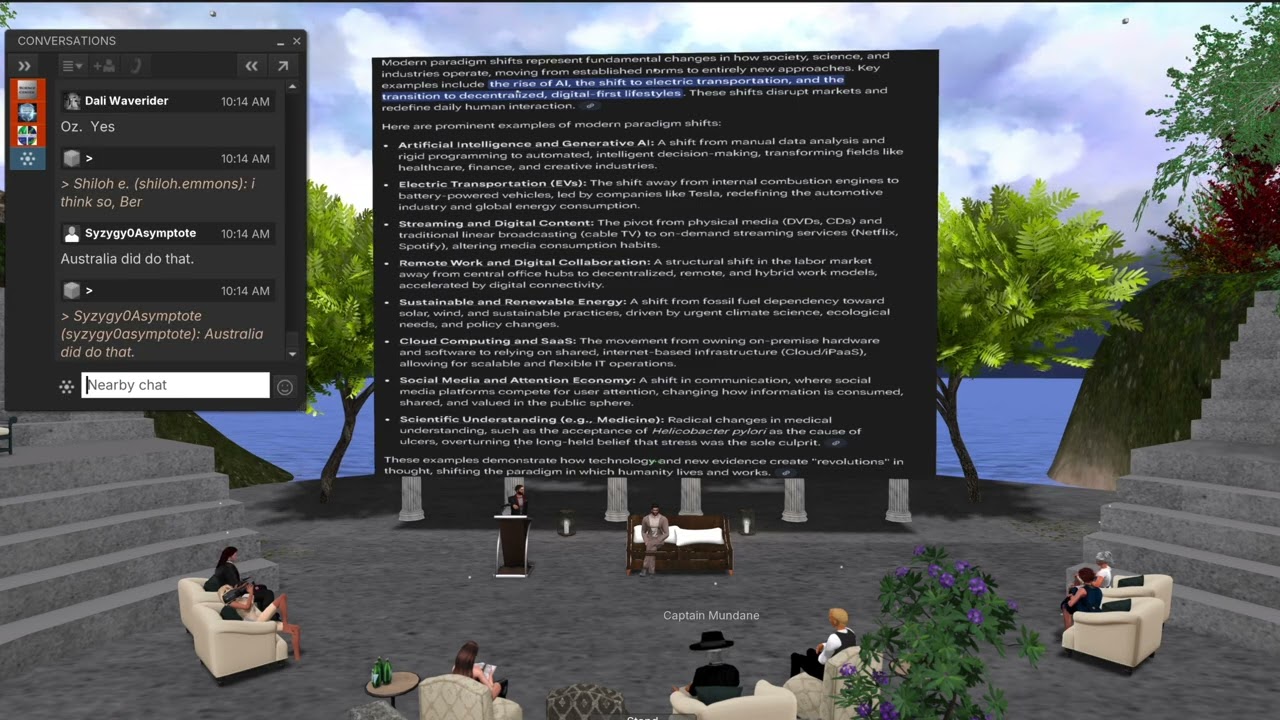
Video summary
The video explores significant paradigm shifts in science and society through a discussion rooted in Thomas Kuhn's concept of radical changes in human understanding, ranging from historical milestones like heliocentrism to modern disruptions caused by artificial intelligence. In the realm of AI, it is viewed as an inevitable force that disrupts employment markets for new graduates and creative fields while presenting complex legal challenges regarding copyright ownership; although patents may still be granted for novel inventions regardless of AI assistance, transferring rights from algorithms remains legally unclear, with U.S. authorities generally rejecting works generated solely by machines without human authorship. Similarly, the energy sector is witnessing a shift where China leads in low-cost electric vehicles and fleets while Western nations struggle to keep pace, alongside growing confusion among policymakers about renewable storage solutions like batteries and wind power efficacy, even as sustainable energy transitions are seen as unavoidable despite not yet constituting a full paradigm shift on their own.
Beyond technology, the discussion highlights how digital content consumption has evolved from ownership via purchases to subscription-based "renting" models that have transformed Hollywood through mergers, while remote work trends have emptied downtown office spaces and redirected construction efforts toward residential projects. In scientific research specifically, tools like AlphaFold in molecular biology illustrate a new dynamic where AI handles data sorting to generate hypotheses for protein folding, yet the fundamental process of hypothesis testing and experimentation remains driven by humans who must experimentally verify these leads. This evolution is contrasted with society's rapid embrace of technologies like ChatGPT against science's necessary skepticism toward claims that could overturn established models such as particle physics or cosmology, particularly when experimental evidence for phenomena like dark matter lacks sufficient support.
The conversation further examines the formalization of modern scientific processes through shared datasets and rigorous peer review, which aim to make paradigm shifts more reliable even if institutional influence can sometimes slow progress. A recurring theme throughout these changes is the evolution of warfare, tracing a path from tanks and air forces between World Wars I and II, through nuclear power, to current drone technology that raises profound philosophical questions about the morality of unmanned systems versus piloted ones. The ongoing conflict in Ukraine serves as a prime example of this tactical paradigm shift involving both deploying and defending against drones, clarifying that while some AI companies have refused Pentagon contracts for fully autonomous killing machines due to legal liability concerns over accidental civilian deaths, current operations still involve human oversight rather than independent "Terminator-style" autonomy. Ultimately, the panel concludes by reflecting on how these diverse shifts—from energy grids to digital rights and military tactics—represent permanent transformations in how humanity understands its world while navigating the complexities of ethics, law, and scientific verification.
Read the full video transcript
Heat. Heat.
All right, let's let's begin then. So,
welcome everyone to this event at the
Science Circle.
We are doing a 2021 revisited panel. And
so 2020 was a year that was highly
active for the science circle on a lot
of very interesting topics. And as a way
of, you know, reflecting and spending a
little bit of time revisiting and
updating from that that year, we do
these revisited panels. And so today,
uh, the two main talks that we were
going to do a revisit on was a
presentation by Jeppi Longo on art and
physics, but uh, he is he has not
arrived yet. The other one was, as you
can look at Matt, sorry, look at Matt's
screen behind us, and that's showing
that we had a panel back in 2020, a uh a
conversation about paradigm shifts and
in the context of and his uh book,
the structure of scientific revolutions.
So the three speakers sorry right the
three panelists in that case were Matt
as moderator who is here again today to
give us an update and then Jeppi Longo
and actually myself. So if Jeppy uh does
not show up then I will give a little
bit of a conversation and some uh some
thoughts on paradigm shifts uh not as
moderator but more as as a panelist. And
so, uh, what I will do now is turn the
microphone over to Matt and he'll give a
little bit of an introduction about
himself and then give you some updates
on thinking about paradigm shifts as
well as a little bit of a review, right?
A little bit of review.
All right. Uh, thank you, Stephen. Can
everybody hear me? This is, uh, Baragon
Betts, also Matt Burr is my real name.
Um, so hopefully you can hear me. Uh I
did post in uh nearby chat just now a
link to the uh to the OG panel
discussion uh which uh was uh you know
if I say so myself pretty darn
interesting.
Um uh you know uh you know for example
uh you know we talked about topics like
uh like diseases like chalera and
malaria sort of general biology you know
changes in uh like big jumps in progress
uh in in those topics. Um uh we talked
about science as a profession. We talked
about falsification. Uh that you know
kind of the uh uh how one uh I think it
one of the u I guess tenets of science
that has become adopted recently is the
ability to be falsified. Whether a
proposition can be falsified if it can't
be falsified you know it's uh it can be
sort of preserved. Um so we talked about
of course Dharma's theory of evolution.
We talked about dark matter. Uh we
talked about um um uh what else? Well,
let's see what else. And then finally,
we had a long discussion at the end of
that about how overwhelming science can
be. So um uh and I think I think we can
all sort of relate to that. Um but uh
basically a uh just also just a quick
primer here that uh a paradigm shift um
is kind of a
uh kind of a sort basically a permanent
and sort of radical change in the way
science uh or I guess not even science
but just the way humanity um sort of
understands the world. And I think the
classic example of that is the capertic
revolution where we uh universally came
to understand that the earth goes around
the sun um for example um and also uh
you know another example might be
Darwin's uh theory of evolution uh about
how the how species originate right so
those are those are paradigm shifts you
know you move away from from sort of
supernatural creationism to a science um
based understanding of how species
originate, right? So those are examples
of paradigm shifts. So um and that's
what we talked about like five years
ago.
Um but let's take a look. So things have
changed quite a bit. Let me go to my
next slide here. Let's just kind of get
into it. Uh
there we go. So I apologize apologize
for all the text. Um, uh, but I'm hoping
you can just kind of maybe zoom in on
this slide here. Uh, I do think that
this is a, uh, a pretty intriguing, uh,
uh, list of, um, of topics that we can
discuss. And by the way, feel free to,
um, you know, put your comments in
nearby chat or or even, you know, I
don't even mind if you join in by voice
if you want to. So, we can keep this,
you know, fairly informal, I think. Um
but uh I'll just quickly kind of run
through the the topic uh the headline
topics here and then we can dive in uh
to more uh granular discussion of each
of these. So um uh u so just quickly
modern paradigm shifts represent
fundamental changes how society science
and industries operate moving from
established norms to entirely new
approaches. Um, okay. So, we're going to
be looking at uh things like of course
AI, you know, that's going to be
inescapable. Uh, also um the uh the
growing uh significance of uh electric
transportation and just I would say sort
of green uh energy sources in general.
Um also you know the transformation of
Hollywood to streaming uh platforms and
digital content I think uh is still uh
uh still making a huge impact uh in our
daily lives. Now also remote work I
think has really transformed the economy
and society since co um and of course we
now have tools to be able to to do that.
Um and then here again sustainable and
renewable energy know that's relates to
the electric transportation I think but
so we can get into that also we have uh
oh this idea cloud computing and SAS
service as a software as a service is
SAS
and um you know this kind of uh well uh
this kind of we don't own anything
anymore. we're just renting, you know,
all of our all of our content. Uh, and
that has some interesting, uh, I think
uh, implications. Also um of course the
emergence of uh social media,
the attention economy um you know how
how you know how do we um I guess
where where do we position the
importance of social media in you know
especially sort of in competition with
our actual real physical lives. Um and
then um finally
uh excuse me the last one here
scientific understanding.
So um I think uh the example given here
on the slide is uh the fact that we
discovered that there is a bacteria that
causes ulcers. Um, but I think what I'd
like to get into here, frankly, would be
a discussion of the current Maha
movement, um, of, you know, make America
healthy again as as embodied by RFK Jr.
in terms of his understanding of
science. We are now kind of in a under a
regime that has a radically different
understanding of what science is than I
think we have been comfortable with in
the past. All right. So, um
uh um let me So, uh
let me go back and take a look at our I
want to go back and look at some
comments here in nearby chat.
Uh
we don't really own literature anymore.
That's right. Shiloh points that out.
But yeah, and then Sizzy, uh the EVs
actually preceded gas engine cars.
That's exactly right. Isn't that
interesting? Yeah. Uh and uh um and a
day points out that the UK is going to
ban children under 16 for having special
media accounts. I think uh didn't uh
didn't Australia already do that
actually. So um
misunderstanding of scientist the 1830s.
Yeah. Yeah. Well, we're going to get to
all of this. Uh okay. Let's let's start
at the Yes. Thank you, Saj. That's
right. Australia did do it. But let's
start at the at the top of this uh um of
our list here and let's just get into
AI. All right. Uh in fact, you can tell
actually that this slide was prepared by
AI, right? Uh so uh you know u so I I
did a prompt on this and then you know
basically uh made an image of the
results, right? So that's uh I think I
think fairly common that everybody is
doing this now, right? Um and uh I you
know I don't know if I have anything
particularly
uh insightful to talk say about
artificial intelligence and generative
AI um uh you know that uh any more than
what anybody else has. You know I have
my anxieties about it. Um I you know it
is um uh you know it has been
interesting uh for example this spring
uh when um the tech people were giving
their uh commencement addresses to new
graduates at universities and when they
mentioned AI they got booed. Um and I
think this is because so many of these
students spent four years you know
really to prepare themselves to go into
the tech industry only to discover that
uh you know their their jobs are being
rendered obsolete by artificial
intelligence. Do you remember? I think
maybe it was related to COVID, but there
used to be kind of a a catchphrase of,
you know, learn to code. Um, you know,
just code, baby, code. Uh, you could
always, you know, learning to code was
kind of considered sort of a a um a a a
golden ticket to being able to get a
job. But that has just completely fallen
into the trash bin because AI is now um
can now, you know, write code
instantaneously,
right? And this is going to just
completely challenge the uh the
employment market for new for new grads.
And of course, it's a it's a huge
challenge for creative fields as well.
You know, I have a particular Yeah. Matt
Shack Max uh says that the the code
doesn't always work and that I was you
know as I as the words are leaving my
lips I had that same thought which is
that the code doesn't always work and
you know I have this experience in my in
my own profession uh you know I u I do
patents and trademarks and uh a lot of
my clients now are sending me you know
AI generated content um and they are
also using AI to help to quote unquote
help me um negotiate with the uh with
the patent office. Um but but what I
often find is that you know the AI
doesn't understand what a patent is. It
doesn't really understand what a claim
is. Doesn't really understand what an
invention is. Um and so the the fact
that so it's token predicting capacities
don't quite meet the moment. So, I have
to do a lot of um in some ways it's
almost more work because I have to go in
and kind of really carefully look at the
content I get from my clients and edit
it uh pretty closely and it's it's
almost more work, you know, it's a
little bit crazy. And then also uh I'm
doing my uh CLE this month, you know,
for continuing education. Uh, and I
listened to um a presentation recently
about copyright for AI
and um uh that um that it is a huge
challenge for the copyright office. Um
just basically quickly that uh the you
know the point is that only humans can
create copyrightable works of
authorship.
Um so a machine cannot own a copyright.
Um and uh also the um the copyright
office will if you submit kind of a
mixed work like a a maybe um a song or a
work of um of visual art uh that you
know was kind of at the product of a an
AI prompt. Um, the copyright office will
either reject that or it will actually
parse out which elements of the work
you've submitted are yours that are
authored by you and the and you will
have to disclaim the portions that were
generated by the AI. So, it's very very
challenging and I also feel that
especially in this particular Yeah,
exactly Shiloh. Uh it's also um uh uh I
also fear how now I think this is the
proper position for the copyright office
to take uh right um but I do fear that
especially this present administration
is very very chummy with the AI
community and I think and and also you
know Hollywood I think there's going to
be a huge amount of political pressure
for the copyright office to grant
copyright right to AI generated works.
And I think this is a slippery slope to
sort of chaos.
So, we'll see what's going to happen
with that. But I think it would be I I
just don't know. I just don't know how
we're going to make that work. You know,
you can't uh you know, I mean, are we if
you can say that a machine can own a
copyright, are you can say that a
machine can enter into a contract? Can a
machine enter into a license agreement?
I don't know. But my instinct says no.
No, it cannot.
All right. Well, so anyway, I can now
that I've kind of gotten worked up about
that, uh I we could probably go on for
for a long time about it. Uh but we do
have a lot to talk about. So I just
wanted to basically just kind of uh um
uh vent about my own personal work
concerns about AI. And hopefully you
found that interesting. But uh let's
let's kind of touch on some of these
others here too. Um
so let's talk a little bit about uh
electric transportation EVAs and stuff
like that. Um
again I don't have a lot of tremendous
insight about this but I do think that
it's extremely interesting that China um
has made a huge commitment to uh
electric uh vehicles. um you know they
have entire some cities in China have
entire fleets of electric buses for
example uh they make very they make
really lowcost high-end electric
vehicles that are simply unavailable
here in the west um you know I've seen
you know you know maybe they're
propaganda but I have seen Tik Toks that
sort of show uh you know really amazing
Chinese uh electric vehicles and things
like that so Um and I just feel like
again we're in a we're in a particular a
particular moment where you know we are
dropping the ball uh in terms of keeping
up uh competitively worldwide uh in this
arena of electric transportation
um which is weird because even uh you
know even Elon Musk is invested in
electric transportation. So it's very
I'm very very confused about uh uh
Elon's uh sort of um relationship to
this particular topic. I don't quite
understand
why he is uh it seems to me to be
supporting policies that are detrimental
to his own investments.
So if anybody has any insight about
that, please feel free to share them uh
because because I'm kind of baffled by
it. And then moving on, we have
streaming and digital content uh which I
think has completely transformed uh
Hollywood and uh and television
networks. Um it is uh like I think this
idea all of this digital stuff you know
has just recently in the last year just
led to um a series of cascading um uh
mergers of uh streaming platforms and
traditional um television networks
getting kind of bundled up into
streaming platforms. Um this also again
seems very chaotic to me. Um and um
and it is troubling that we don't really
own anything anymore. So um I u I again
I don't really have any solutions. Uh
hang on a second. I'm just going to go
and check on the uh on the comments here
in nearby chat. Make I don't want to
make sure I don't neglect that. Um,
>> we have says it's not really possible to
keep up
>> with the largest and so to be the most
powerful country in the world, the EVU
market is huge and highly competitive.
That is absolutely right.
So, um,
and Nurero asked you guys, you guys
really got into the AI thing and Neuro
asked uh um, who owns the products of
AI?
That's right. So,
um,
and I don't know if I have a clear I
don't know if anyone has a clear
question to that. I do think that,
um, typically, um, the person who caused
the AI content to be created probably
owns it. Um, I think it is
improbable to me that it will be found
that the machine or the algorithm itself
owns the product of AI. But I think I
think in this I almost think that
ownership in this context is a little
bit we may need some new concepts
because I mean in my mind things that
are generated by machines are just in
the public domain like they're not owned
by anybody. Um, but maybe I'm naive
about that. And I think and it is I
think the economics of having like it's
obvious that all future content can't be
in the public domain, right? I mean, I
do think there is a proper role for the
ownership of authored content. If you
write a book, you know, you should own
the copyright. If you write a song, you
should own the copyright to that song.
So and so forth, right? Um so um so I I
mean I don't know what the solution is
to these things but but these are we are
clearly in the midst of a paradigm shift
uh with all of these uh questions that
are being raised right so
>> so there's also an interesting question
from Shiloh
>> so Shiloh also mentions certain diseases
generated vaccines well you know right
that actually is a good point I did want
to make sure I touched on that that
there are some some fantastic
um uh you know legitimate uses of AI you
know the one that I think is the one of
the most interesting is the uh what's
the one that um that predicts uh protein
folding uh so that um you know it will
generate uh all of these various
candidates for the way uh a string of
amino acids will fold um and that uh
this you know is extremely useful for us
for devising uh new kinds of peptides
that are reactive. We can we can sort of
customize um you know active sites
within a protein protein. We can build
proteins with custom active sites and
things like that. Um and the ability of
uh AI to uh you know to sort of sift
through you know just tons and tons of
data instantaneously to generate this
output uh I think is uh is fantastic uh
you know and it's also used in astronomy
you know for um uh for analyzing just
the tons and tons of data that comes out
from all of our new telescopes and
things like that. That is a fantastic
use of AI I think to just help us manage
vast amounts of data.
But I will say that you know uh that the
value of that uh AI product is in you
know what it allows a humans to do with
it. How it allows us to analyze that
output. So it doesn't have I don't think
that the AI content has value in itself
other than uh how it helps us you know
make decisions about what we want to do
or what we want to look at or what we
want to make. So
um
all right I'm going to move on here
because we're almost at the half hour
point. I don't want to I didn't want to
consume the whole hour here. Uh so um uh
so let's just quickly touch also on
remote work and digital collaboration.
Uh you know uh I work almost exclusively
remotely now and I have clients from all
over the country all over the world
really. So um
uh so I think remote work has been a
huge transformation. You know the
downtowns of cities are becoming um
empty. Um the the the buildings downtown
in downtowns are being repurposed. Um
it's it's just uh incredible really. Um
and uh um uh I don't know. I mean most
you know uh like you know I live in
Austin and uh we have just a tremendous
amount of of construction building
construction going on but it's almost
all residential. there's hardly any
office uh office space being built
anymore. So, I think that's interesting,
too. Yeah. And Shiloh mentions it's a
it's a change in tax space as well.
Yeah. I do wonder like whether like how
will um property taxes be affected by
the um by the abandonment of uh
downtowns and cities, for example. I
don't know. These are all these are all
these are just huge huge changes in
society. And let's touch touch base
quickly on sustainable and renewable
energy. I don't know if you guys caught
it recently. There was a uh a Senate
hearing by uh one of the administrations
um I forget. I think he might have been
uh
in the energy department. Josh, I wish I
had remembered that, but um he was being
challenged about wind power and and he
was going on about how pointless wind
power is. And I think that uh a lot of
these um uh people now think that
that the wind itself is the energy that
for example like we're using wind to
like push cars down the highway or
something like that. You know, I don't
know if they fully understand that the
wind is used to generate electricity.
Do you think the wind power blows? But
uh but I you know, I I don't know. I
think they I don't think they understand
that we used energy that we used wind to
convert it to usable energy. It's it's a
it's very very strange. They also don't
seem to understand that that batteries
exist. So they seem to believe that a
lot of these green energies sources um
are only available when that source is
happening that we don't seem to have the
ability to store energy. So this is all
very confusing to me. I don't quite
understand that. But at any rate,
setting that aside,
I I do think that uh um uh that I think
sustainable and renewable energy is
still um I don't know if it really
qualifies as a
paradigm shift. Now, I think it's on the
cusp of being a a paradigm shift. I
think there is the potential of a
paradigm shift in the way uh we we uh
provide energy. I don't know if we're
quite there yet. Uh and yes points out
such batteries already exist in China.
That's right. Uh, you know what I
remember many years a not many years ago
but I don't know five or 10 years ago
reading a um an interview in the New
Yorker with the CEO of Exxon
and uh in that interview and I don't
remember who the man's name was but he
said that Exxon considered their biggest
competitor was batteries.
Um, and this was, you know, maybe five
or 10 years ago. And they recognized
that again that this uh um sort of
paradigm shift of uh of um of renewable
green energy uh was inevitable. This is
the message I got is that they recognize
that this is inevitable that we are
going to have to have uh renewable
energy and have to have ways to store
it.
So,
so maybe I I mean I don't know if it's
paradigm shift yet, but I do think it is
inevitable that that paradigm shift is
going to happen.
Okay, let's uh let's again let's just
move along here to cloud computing and
software as a service.
Uh
so uh again this has to do with uh not
owning anything. you know, it's um
Spotify and iTunes and Netflix and
YouTube and all of that stuff. Um, you
know, uh, you know, even when you
I don't know. I mean, I feel like I have
uh purchased the um
Oh, actually
uh Stephen, are you trying to talk to
me? I just noticed. Uh,
>> well, there were a couple times where I
pitched Are you hearing me now?
>> Yes, I do hear you. Thank you.
>> Yeah, there were just a couple times I
was trying to direct the conversation
and and you just kept talking. So, uh,
>> I I did not hear you. I do hear you now,
though. So, thank you.
>> Okay.
>> Uh, yeah. Uh so I think what I wanted to
well let's before we continue on with
cloud computing
uh there were a couple questions in the
chat related to ownership of products
that I think is kind of a we should
pause for a second to look at the
distinctions that my understanding of
trademarks and the way the patent office
views AI generated content is that
because they can't be sure of tracing
the ownership of contributions and they
can't be sure that there wasn't a
contribution to an intellectual property
that really should be based on what AI
found but then didn't give credit to
that the patent office right now is not
granting
um
uh copyright to certain AI generated
content
>> and so that's one aspect of it but I
think but the other question that came
up from Shiloh was this idea that oh if
a company is using AI to generate some
sort of patent patentable type of
invention. That that's distinctly
different in that the cop the patent
filing
should describe and have um a
reproducible way of talking about some
invention. And the as long as the
invention itself has novelty
that is you know there's no prior art to
what the thing does and that has novelty
and value then that should be granted
regardless of how one generated some
sort of background understanding or
information related to it. So I think
that that's something worth addressing
that there are different purposes of
those two of filings.
>> Uh I agree with you. I do think that uh
an AI assisted or AI generated invention
for uh for uh for a patent uh is that
should not an issue because authorship
is not really an issue with whether
something is patentable. Um that it does
that relates to sort of the ownership uh
question. I mean, I suppose uh some
parties might uh
um might raise a fuss about who who the
inventor is or for example, who can be
like who has the legal rights to assign
the ownership of that patent to a
corporation or to license that patent to
uh other users, things like that. um uh
you don't so so you know the so the
owner of that patent I think and also so
and I mean here's kind of the the the
dilemma is that you know so the AI
generates uh let's say um drawings uh
and a written description of some
apparatus
and then so but how does the AI transfer
the ownership to you so that you can
file a patent on it. Um, so that is a
little bit uh uh unclear to me. In a
way, you might you could almost say that
you discovered the invention, but of
course I don't know. Um, but that but
then does the does the invention become
sort of a uh just an algorithm like a
mathematical formula that just you know
that that the patent office considers
unpatentable? So that's kind of a but so
that's kind of a whole minefield about
that uh that I'm not sure how that's
going to get sorted out. But I do think
there will be a tremendous amount of
pressure, political pressure for at
least corporations or business entities
to be able to own inventions um
primarily sort of devised by AI. Um, so
however that gets sorted out, the law
will somehow be able to accommodate
that, even if it has to kind of twist
the the logic of the law a little bit to
accomplish that. Um, and I do want to
make it clear that uh, patents and
trademarks and copyrights are all
distinct forms of intellectual property.
Um, so a patent is just something that
is new and useful and not obvious.
That's all. Right? As long as it's if it
meets those criteria, you should be able
to get a patent on it.
And not obvious has a specific meaning
in the patent law, it basically means
that the examiner cannot come up with
any combination of prior art that uh
will satisfy all the elements that you
have claimed in your patent
applications. That's what obviousness
means. It may not have been obvious to
you to combine all of those references,
but the mere fact that those references
exist and the examiner found them makes
them obvious. A trademark is for
promoting your goods or services. A
trademark completely different from a
patent even though they're in the same
office of the government. They're
totally different. Uh a trademark has to
do with your trade, with your business,
how you know the the brand name of your
product, things like that. And uh you
want to protect that you know that no
one can
pretend to be you by coming up for
example with a you know like remember in
coming to America where the guys had the
the McDonald's ripoff the McDougall's
restaurant might have the golden arcs
not the golden arches so it's totally
different but anyway um so trademarks
are very uh different and they they
mainly have to not be descriptive and
they can't conflict with another another
trademark. You know, in other words, in
terms of being confusing about who owns
them.
>> Baragan, can I ask you something then
about trademark and patents if Okay. I I
used a pharmaceutical company. All
right. And so there are solving issues
with like I just posted um AI generated
um you know uh solutions for uh
antibiotic resistance or certain
infectious diseases.
Does the company apply for the patent
first and then it goes to FDA approval
or does it go through FDA approval and
then they apply for the patent?
>> Uh you always apply for the patent
first. The the patent application is the
first thing you do mainly because an
element of patentability is novelty.
Your invention has to be new. Um and um
so the problem with waiting too long to
file for your patent is that it will
stop being new. um you know for example
uh you don't want to wait you know for
example if you apply to the FBA FDA for
approval you then you have to disclose
that to the FDA you have to disclose
your invention to the FDA that might
make it public now it's not new anymore
you've ruined your IP rights to it right
so you always want to file your patents
as soon as you possibly can even if it's
only as a provisional patent that's the
that's the general sort of the my the
conservative answer to that question.
Um,
finally, I do also want to point out
that copyright is also very different
from patent or trademark. Copyright
protects works of authorship.
So, you are the a you're not the
inventor of the work. You're the author
of the work. If you create a sculpture,
if you write a song, you make a movie,
you're the author of the work. And
that's what a copyright protects are
works of authorship. Okay? And um when
you own the copyright, you have the
exclusive rights to create derivative
works from your work. If you write a
novel
u then you own the derivative works for
example that's how you are able to
license your novel to Hollywood to make
a movie out of it. The movie is a
derivative work of your novel right and
as a copyright owner you have the
exclusive right to make derivative works
or to license others to make derivative
works. So, so copyrights are are very
powerful. Um, and uh and actually
trademarks are very powerful too. You
know, I think of all the forms of of
intellectual property, frankly, I think
patents are the most problematic to be
honest. So, anyway, I didn't mean to get
into a whole thing about that, but but I
do think that, you know, all of these
sort of IP issues are pertinent to
discussing paradigm shifts in a sense,
right? I mean because in a weird way uh
these um uh uh the law has already kind
of thought about a lot of these issues
you know u at least from the from the
pre-paradigm status of them right so
when you when you are in the midst of a
paradigm shift one of the things that is
affected by the paradigm shift is the
law how the law is going to react to it
so that's all quite interesting I Okay.
So, um anyway, um so we've got about 15
minutes left. Stephen, what do you want
to uh how do you want to sort of proceed
to do I can finish out my topics here,
but um uh was do you want to see if
Jeppi is going to have a should I leave
time for Jeppe to uh have uh some you
know presentation also? How do you want
to proceed?
uh Jeppi has not uh come online or made
contact with me and someone else is
checking with him on Facebook. Let's um
let's uh
switch over for just a second to a
little bit of some commentary I want to
make about paradigm shifts and the
scientific process.
>> Uh good. And then I think what we'll do
is open up the floor to some questions
and see if anyone has and just some
thoughts because again let me say let me
say two things is that for when we think
about paradigm shifts you know the the
vernacular of the term now applies to
changes that are social changes that are
economical uh changes that are cultural
as well as technology and science. And
so if people would like to reflect on on
what that kind of means for society that
just like what described, a lot of
times paradigm shifts come up against a
lot of resistance. And when we see that
in the world, where do we see
resistance? Do we feel resistance to it?
But there actually lots of times in
culture, unlike science, where the this
paradigm shift can be very rapidly
embraced and people can get very excited
about it. Although in some cases it
turns out to not be that much of a
shift. So I think um as as we start to
close out this conversation I would like
for the audience to think about some of
their thoughts or feelings or
experiences with what we call paradigm
shifts and make a contribution. I do
want to come back to one specific thing
which is this and you have them listed
up here as scientific understanding that
there are ways I think Jeppy was going
to talk about this because he did at the
original panel that when we understand
science the way the process has worked
is that we usually have an idea we
construct some experiments and we
generate large overarching theories that
are really just models of the world and
then science
uh as we do science they either fit that
model that we have or they don't and
then if they don't that's why we try and
change the model and what's interesting
is that with AI or some of these other
large computational ways of doing it we
don't have we can actually use those
tools to generate a variety of options
of a theory and to take uh the the best
use some degree of of fact fitting to
say well what actually is the most
likely theory behind something behind
all these options. Now, he was more of a
a theoretical and cosmological physics
type of um scientist. So, that's I think
in a space where we're still trying to
figure out what the nature of the
universe is. there are still very large
competing hypotheses about the age, the
origin, the science, the components of
the universe that there's still a lot of
interesting space in there where
computational power can give us new or
different insights. Uh but I do want to
come back to um in the practice of
science, how does AI really it does
change the science profession in certain
ways in that you can take very large
data sets and try and sort through them
to find things that correlate to what
you want. So right now I am a I'm a
molecular biologist at a seed company
and some of the there are a lot of
startups but I think large companies
doing this too where they will use AI
and they'll just generate lots and lots
of genomic data expression data protein
data metabolomics data and then do
comparisons across species to say hey
can we find a gene that can that is
likely to convey some sort of a useful
trait if we were to turn it into a
biotechnology product. And so that
amount of shifting and sorting through
data that you otherwise couldn't do
individually is a really interesting
place where um you can do some early
discovery to get leads. And I think the
comparison here is most like to a a
journalist is that you get leads, but
you still have to do a lot of pounding
the concrete to and you know doing lots
of pipe heading to actually do
experiments. And a lot of times those
experiments are still something where
the art and the the inside of an
individual human being actually makes
the biggest difference. Now there are
places where you can actually automate
an entire workflow where synthetic
biology if you're looking to change the
properties through mutagenesis and
randomly changing stuff and sorting
through there are places where some of
that science becomes automated but the
it hasn't changed the fundamental idea
that someone comes up with a hypothesis
wants to do something different and test
it. So that's still a very you know
human agencydriven driven process and so
I think that's that's interesting as
well but AI is making a big impact in
terms of how we do and conduct some of
the science.
Yeah, absolutely. For like the the
protein folding example I gave where we
have where you know the AI will generate
tons of of of
plausible AI folding examples that we
can then sort through to see which ones
really work.
>> Yeah. Yeah. That's alpha fold. Uh that's
the Nobel Prize
>> and David Baker was also involved in um
aspects of using AI for protein
structure prediction. And so, you know,
that's an amazing thing like you can we
now have this ability at a much now
again there's a trade-off, right? We
have a fairly reasonable guess that the
structure of a protein that we're trying
to work with that alpha fold is doing a
fairly good job of predicting it. Uh,
but you still have some uncertainty that
in fact it wasn't it wasn't
experimentally demonstrated to be the
structure you want. So you get a lot
more ease of of likelihood of things
that you do get to work with, but there
can always be this bit of uncertainty.
But it is amazing. I' I've used it. It's
pretty amazing.
>> So yeah,
>> that's cool.
>> We are hitting 10 minutes left. So
>> let's survey the audience.
>> That's a great idea. And I did also just
quickly want to point out that I do
think AI has been amazingly quickly
adopted by the public. Uh people love to
talk to chat GPT and this whole um and
like just immediately people just just
just got into it right away which was a
little bit shocking to me to be honest.
>> Yeah, chat chat GBT was the most rapidly
adopted app in the history of of
technology or at least computer
technology. Uh although I think there's
a lot of resistance coming up now. these
a bunch of uh graduation speakers got
booed when they tried to to tout how
great AI was. So I think
>> that's right.
>> Um let's come back to some of these
questions that are in the local chat
because I think this idea of resisting
paradigms and and just hopping on to a
paradigm shift. I think AI ends up being
a good social example that we don't
really know and nobody's really I think
doing a very precise job of trying to
model what the actual change can be at
the end when we just do adoption of chat
GPT or other LLMs for the workforce. And
so, you know,
this this idea that we tend to resist a
paradigm shift, I think is very helpful
in that case because it can slow down
something that could end up having at
least I'm I'm going to guess in in most
cases AI replacing humans is is not a
good idea, at least at this stage of of
adoption, how young the technology is.
Um, and that's something that Cis G said
as well as Phil ask talking about those
resistances.
Um,
>> yeah. I was wondering if I could jump in
here.
>> Yeah. Yes.
>> Yeah. Thanks. I I just wanted to say I
mean the whole subject of paradigm
shifts is is of course extremely
exciting and and um it's it's great to
be living and also very difficult to be
living through such times. Um but we
have to be very careful as as Phil
mentioned briefly. um there is
resistance to paradigm shifts and that
resistance is quite reasonable and
necessary because you don't want to
accept any kind of idea that comes down
the pike. You have to be I mean science
is supposed to at least for scientific
paradigm shifts should be providing the
guidance although you know it's
difficult to provide the guidance when
you're at the forefront of science and
uh we can talk about technology paradigm
shifts for example as I mentioned in
chat there were um the first electric
vehicle were uh electric courseless
carriages in the 1830s but those were
replaced by gasoline powered cars
internal combustion engine because
gasoline was more basic um oil was found
in great abundance and it was cheap to
to drill in those days and and and
refine and produce gasoline. So that was
seemed to be the way to go but that was
a major paradigm shift but it was a
horrible paradigm shift because of all
the problems that's caused us. Um it's
caused it certain provide a number of
advantages but it's caused a number of
disadvantages as well and then we can
talk about what's happening in
cosmology. You yourself mentioned what's
happening in cosmology right now. The
accepted model for cosmology is the
lambda CDM model which is basically has
to do with the uh um the dark energy
dark matter. Um and uh the universe uh
was born in the big bang 13.8 billion
years ago. But observations by Hubble
and other telescopes and have have found
a number of problems with the with the
lambda CDN model.
One problem is that um is that galaxies
uh don't cluster um as much as they
should according to this these models.
Another uh problem is figuring out what
the Hubble constant is. How rapidly is
the universe expanding in the early
universe? It seems to be um expanding at
a different rate than it is in in the uh
in the modern universe and that's not
really explained very well by the lambda
CDM law. And then there's uh the problem
that there seem to be from how from the
uh the James Turk Maxwell telescope
observations um they found that there
are galaxies that are are are seem to be
um much more uh much more star formation
has occurred than could have happened in
the early universe. So is the universe
actually older than we think? I mean all
these things could overturn the lambda
CDM model. We have a completely new
paradigm to describe our universe or
not. Maybe there just takes a few little
tweaks to fix everything. You know, I
think uh uh uh uh thank you very much S.
I appreciate that comment so much and uh
and also you Stephen and you know I
think an issue that or I don't know a
challenge that astronomy has is that
it's observational. it's not kind of
experimental and uh for you know I kind
of think of that because I'm a big
booster of the standard model of
particle physics um and uh mainly
because it's proven to be so
experimentally robust um and has sort of
you know uh been able to withstand
challenges over many decades uh to it uh
not not without some modification of
course but I think the basic premise is
still very solid. And one of the things
that a lot of science communication
communicators in the popular uh popular
media like to do is to constantly say
that some new discovery will overturn
the standard model and we're going to
have to rewrite science completely and
things like that, you know, and uh I'm
always extremely skeptical of cla so so
I have resistance to uh paradigm shift
claims when it comes to like the
standard model of particle physics. Um
but uh but I do think other fields are
more
uh are
I think um
are are more on the foundation is a
little bit uh less firm than it is for
the standard model. So um so that so I
think I think you can sort of res I sort
of resist paradigm shifts a little bit
selectively that way.
>> Yeah, I mean that is that is correct.
And you you do have to have some
resistance and not just anything. The
standard particle model does have its
problems. For example, and do we how do
you include gravity with the other
forces? Not really.
>> Good point. That's a good point.
>> You need gravitons. For example, if if
quantum quantum mechanics is correct,
then gravity must be composed of
gravitons and gravitons are not included
in the standard particle model. Um dark
matter particles, what are dark matter
matter particles? If they exist, for
example, they might not exist. There may
be other explanations. So uh there do
need to be modifications. Gravity is is
it quantized? Maybe it's not quantized.
There are other explanations for that as
well. So there are a number of things to
be considered but for now the standard
particle model is is is what we should
be using for now anyway.
>> Yeah. And I think uh part of the problem
there is that uh dark matter and gravity
are difficult to um to clarify
experimentally,
right? Right. I mean, it's hard to
devise an experiment to find a graviton
or to find dark matter. We're sort of we
it's we're very dependent on
observations we can make rather than
setting up a controlled experiment. So,
I think that's part of the challenge.
>> Yeah. But I think what I what I also
something I mentioned in the original
panel too is that one thing we now have
is this profession of science which
was only starting to really I think
appreciate at the time he wrote you know
the book in that we have these very
formal processes of submitting new
claims and new ideas of paradigm
shifting ideas. We have people who vet
them. we have the sharing of the
materials and methods for how we went
about and tried to do something.
Sometimes we share whole data sets. You
see that a lot in high energy or
cosmology based data sets. And so we
actually now have I think a very
interesting new process behind paradigm
shifts that uh and that that make it a
more reliable thing. Although in some
cases you can have influence that slows
down progress. But um yeah, high energy
particle physics and cosmology are still
two great great topics to to discuss. So
we're hitting the last few minutes. Um
one thing I want to comment on something
Phil said is that it's nice to know that
we don't know everything yet. Again,
that keeps scientists as well as anybody
involved in paradigm shifting spaces uh
employed and doing interesting stuff.
Um you know one thing Gus points out
another paradigm shifting idea and this
is something you if you look at history
this happens multiple times is how do we
conduct warfare?
Uh you know the idea of tanks being a
new technology really changed fair from
World War I to World War II as well as
having air forces and planes and all
that. Uh nuclear power really changed
that. Now this idea of drone technology
uh especially those that are not uh uh
manned or you know piloted by a human.
What does that mean you know for new new
idea of warfare then fit into also our
philosophy and sense of what is the
right way to conduct the the noble way
to conduct war? Uh that's a very
interesting point uh Stephen. Uh you
know I do I think it's like I think
Ukraine is uh we are in the midst of
witnessing a paradigm shift in
battlefield tactics that Ukraine is
using uh in terms of both the the
deployment of drones and in defending
themselves against drones. That's all
very fascinating. Yeah.
So uh so in this last minute any la any
comments from the audience? any sort of
comments on Baragon's list of AI or
social cultural ones?
>> Um, well, Sumo mentions this idea of
autonomous drones. Um, and I do think
that just reminded me that uh uh that uh
it was interesting that uh I think was
it uh uh we I forget which of the AI
companies uh refused to license the
Pentagon for autonomous uh basically AI
killing machines. Um uh and uh and I do
think that uh that in that the Ukraine
drones are not autonomous. They're flown
by drone operators. Um, and but but I do
think that it's interesting that even
the AI companies themselves sort of draw
the line at Terminator style autonomous
killing machines.
>> Yeah, I think it comes back to what is
the philosophy? What is what is winning
a war? What is the proper way to conduct
one under the law?
>> Yes. Thank you, S.
>> Yeah. No, I think anthropic wanted to
avoid suddenly becoming liable, legally
liable for somebody's death when the US
Army used their technology to
accidentally kill an innocent and then
who's liable for that.
Uh, which I think is a big question, big
part of the question. So, we're at time.
I I what I would like to do is thank
everyone for uh attending and
interacting with the panelist, the one
who did show up, uh, Matt Burr.
Stephen, thank you for inviting me
today. I really appreciate it and I
enjoyed it. Thank you so much. Thank you
for coming, Matt.