Video summary
This project serves as a proof-of-concept demonstrating the successful migration of a WordPress blog from Elementor Pro to the native Full Site Editor (FSE) using Claude Code for automation. The primary objective was to streamline bulk migration tasks while preserving design fidelity and accessibility, ultimately saving significant time compared to manual methods or previous builder-based workflows. By cloning an existing site built with the Hello theme, disabling the page builder, and migrating content to the default Twenty Twenty-Five theme, the process leveraged local development environments like DevKinsta on Linux machines equipped with Docker support. A critical technical advancement involved utilizing Model Context Protocol tools, such as Firefox MCP, which granted Claude Code direct access to browser code inspectors for precise debugging of CSS conflicts, including kebab-case class naming issues.
The migration workflow was governed by strict safeguards and specific AI configurations designed to prioritize native WordPress settings over custom child themes or plugins unless absolutely necessary. To mitigate security risks associated with granting broad system access to the AI agent, the process relied on code snippets rather than extensions for core functionality and avoided custom PHP functions in published pages. The AI's capabilities were further refined through a `cloud.md` file that defined specific skills for accessibility writing and content management, while workflow management tools like read-only production access, change logs, and To-Do lists ensured stability during long-term projects. Initial tests on simple layouts achieved pixel-perfect reproduction, but subsequent trials on complex client sites proved equally successful by combining AI-generated code with specialized plugins to handle animations and advanced effects without modifying theme files directly.
Despite the positive outcomes, the speaker noted minor oversights such as untranslated Spanish text and excessive block nesting in footers that required manual optimization for performance. The analysis highlighted a trade-off where using AI shifts the user's role from execution to supervision; while this increases mental workload by requiring oversight of parallel processing tasks, it significantly accelerates progress by allowing multitasking during code generation periods. Challenges with AI hallucinations were observed when context became too large or instructions vague, particularly regarding complex layouts versus simpler conversions which maintained approximately 80% cleanliness. To manage these complexities and prevent scope creep, the workflow integrated Architecture Decision Records to document feature approvals and utilized Obsidian as a "second brain" repository for storing project history, accessibility rules, and identity data accessible by the AI agent.
In conclusion, this experiment underscores a shifting industry mentality where users increasingly value self-developed solutions despite potential security gaps compared to maintained premium licenses. The successful conversion of 42 articles and Custom Post Type data validates the feasibility of replacing heavy page builders with native FSE standards using intelligent automation. Future possibilities include shared cloud plugins for collaborative skill updates, further enhancing the efficiency of such migrations. Ultimately, while manual completion might have taken up to a week, the AI-assisted approach reduced timelines significantly by enabling human oversight alongside automated execution, proving that strategic use of tools like Claude Code can effectively modernize WordPress sites without compromising on design integrity or security protocols.
Read the full video transcript
No, no, I haven't prepared anything at all.
No introduction is needed. There is
the first page of the slideshow.
Okay, it says Toulouse and June 15,
2026, but it's a return to the past.
So you'll see, it's going to be super
interesting to see how it happened
in the past.
I had forgotten about that.
So, well, it's not like it was 15
days ago or anything. So it's okay, it hasn't changed
much. Uh, OK. So the
objective was to test
the migration of a site using
Cloud Code. So,
in this case, the migration
was the migration of a site under
Elementor to FSE mode. Uh, so,
uh, the purpose of this presentation,
uh, because [clears throat] well, like many others, I
discovered a
few weeks ago, at the beginning of May I think, uh, the
whole advantage of having Cloud Code
running directly on a machine and,
uh, its efficiency in working
directly on files. So.
So, so I entrusted it to an agent, uh,
wait, I'm going to... Oh no, if he moves,
I'm not going to see him. Wait. So, there's
a screen issue, I need to...
Okay, we'll do it this way. So,
using Cloud Code to
migrate a site. So, who am I
? Well, I'm Tyril Sanson, a
WordPress website designer for over
ten years. Um, I'm primarily an
information systems engineer.
I renewed my
OPQast certification at the beginning of the year and I encourage everyone
to take this certification exam.
This allows us to reframe things in
terms of website design. I
am also a teacher for the
MSc Digital Marketing at TBS Toulouse
Business School and, until recently, co-organizer
of the WordPress
Toulouse Meetup. And as My announced this morning
on LinkedIn, but I didn't have
time to reply, I'm also leaving this
great adventure to
rest a little, but that wo
n't stop us, as you said Myis,
from returning to attend the Meetup. Uh, and
then uh, I'm also a
WordPress contributor with uh, with
translations, uh, and I've been exploring uh for
2 and a half, almost 3 years, uh, AI
in uh, my daily work. So.
So, uh, the objective was, uh, if we
got rid of Elementor and let an AI
automate the bulk of the work. Because,
well, uh, so why uh, fire
Elementor? Well, because now, uh,
FSEOR or any other builder, uh,
because now FSE seems to be
reaching maturity, uh, it offers
great ease of use.
That is to say, we only have one editor in
the site, right, we don't have an element
or div or uh and so forth and uh the
native editor. Well, sites that are
built in FSE mode are
generally much faster than those
made with a builder. Uh, unless
we go back to the time, I used to spend
one to two days optimizing the site I had
made with Elementor. Well
, now it's no longer necessary. So,
there is an undeniable time saving. And,
and especially for the users of the
site, a single editor, and that's a
point, it's a point that's a bit late but
important. So [clears throat]
my test was to see if I can
migrate quickly because
I can do it by hand, uh, there's
no problem with that. But if I can do it
faster with Unia and in this
case Cloud Code.
Uh,
so the framework is a site I
left, since then I've done better and uh,
basically the example I'm taking
today was a site that had been
a blog, a simple blog built
with Elementor. So, I wanted to
test it on that site.
So it's not a benchmark, it's
just a test to see how it
goes. OK. So uh the objective was to
migrate the site, as I said uh from
Elementor to the FSE uh by managing
the agent uh and uh it has to be
reliable, supervised and profitable.
Profitable, what does that mean? Well,
that means we don't spend an
eternity on it, or at least less time
than if we did it by hand. Uh, the
perimeter, so it's a real site.
So, I started with a clone of the site, you know
. I didn't, uh, I cloned the site,
I didn't recreate it from scratch.
I made a clone of the site in which
I disabled Elementor and uh,
so the cloud code had to have
all the data
locally. That's what prevents
potential data loss or transfer errors. Uh uh
[cough][throat clearing] there was
also uh a CPT work since it is
a blog by an author, a philosopher
and author who has published books. So,
there is an extension
called Moberry Book Manager which
creates a CPT book. So, uh, it was necessary to be
able to manage, uh, the CPT work. The
imposed method was a design
system and an audit of quality
and accessibility to begin with,
and then we do the migration
once we have analyzed the
situation. Uh, and that's
the goal, well, the end result is achieved
if we have the complete, functional site
without a builder and with a
time saving. That's the goal.
Uh, so I started from a set of
specifications that I
made with Cloud, but not with
the other code. I did it
in the AI cloud, explaining to him what
I wanted, that it was necessary to
move from mentor to FSE, that it was
necessary to
respect, uh, finally analyze the web
design to reproduce the same. So
I spent one to two hours, I think,
making this specification document, and for
me it's an important point because it's
the starting point, meaning that
afterwards when I launched Clut Code I only had to tell it to
look at the
specification document and let's go.
Uh, so, uh, the filotude site
is, well, it has 42 articles, 10, 10, 10, 10
works in CPT format and 9 models.
The goal was to do it with
2025, so the default
WordPress theme, the most
compatible theme par excellence with WordPress,
and the certainty that this theme will
always be compatible since, as we
saw with previous themes with each
WordPress update, the themes
since 2018, I think it was the
first one, right
2018 or yes, I think it was
2018. Anyway, they all followed and
in principle they are all compatible. Uh so that's
why I was aiming for 2025
and uh and I had uh I added
Spectra uh because it seemed to me that it was
missing certain features
uh
and we'll see that well we won't see but
uh I made another one then I
moved on to another stage after that
project and in fact I don't even
need Spectra. But anyway, we
used it in, uh, I used it on this, on this,
on this test.
Uh so Eléor Pro uh the
starting theme is Elémentor Pro, the
Hello theme which is the default theme of
well which is offered by uh by
Elémentor.
Uh, the site is hosted by Switch,
the CPT works as a Manager, I
mentioned it and there was also a
contact form. So uh Ah
yes, the contact form, it has an
anti-spam called Mosparo. Uh, I'm
not going to talk about it much here, but
I recommend Mosparo. It's
a very interesting solution that
I've been using in production for at
least a year and which is really very
effective on anti-spam
and which obviously one of the first
criteria for me is respect for
privacy. So, it's settling in
like a matomo on our emergence. And
then, the thing is, you have to
connect it to the form. And there
was a little
point of tension because uh
Mosparo offers
modules uh that connect with
some uh
some form extensions and
with Elementor obviously, but not with
everything. Uh, for example,
some time ago, when I started
making FSE sites, I used
Cadence and there was no
module for Cadence and there isn't one
for Spectra either.
So, uh, this was the
point where I was going to be able to challenge
Cloud
Cloud Code, since this problem needed to be solved
. OK. So, the configuration
uh on my PC was uh well then I
quote, the clone I installed it, I
used Devkinsta. Uh, it's uh, a
bit like the same systems as
uh, local byfly Wheel or MAMP, Wamp and
so on, everything we've known uh for
years to generate a
local web server with everything you need
as if you were with a hosting provider.
But it's local. So, I did it
, I used Devkinsta on my end
because being on a Linux machine,
uh, uh, there was, uh, local, it wasn't
working. Uh, there are a few
tools like that which claim to
work under, uh, I think local
claimed to work under, uh,
Linux, and I spent a few hours
trying to get it working only to
realize in the end that it said,
"Yes, yes, it works, but we do
n't maintain it." Well, thanks
for wasting your time. Finally,
Deathkinsta works, and for the
record, Deathkinsta
works with Docker. So it
also allowed me to delve into
the use of Docker, which I find
really interesting. Uh, so there
was a second effect that was cool,
Defkinsta, so to install the code,
to install the site, the clone of the
Cloud Code site. So, well, it's settling in now.
There is an installation script that
works on all platforms that
is provided by Cloud. Well, there you go
. Then, I uh
I used the MCP uh Firefox
uh because on a previous project
uh where I had already tested Claude Code
on site migration huh, not
as formal as on this project. Uh, there was
a problem, which is that when uh,
Claude made changes,
he asked me to take a
screenshot and submit it to him
to see what he had done.
And so, uh, you can imagine how
laborious that can be. And actually, uh, well,
I discovered, uh, I
discovered that there was
an MCP. Um, I'm hesitating because actually I
need to talk about
Camirou, I think uh who is a guy
uh that's it, it's Camirou that I
recommend to you as a resource. Uh, he
publishes a newsletter every Friday, uh,
with a watch, uh, on lots of
tools, and uh, at the same time as I was
doing this project and other projects
with ODIA, I added all the
extensions, skills, uh, and
MCPs that he could talk about. In this
case, it was he who led me to,
I think it was he who led me to, to
learn about
MCP Firefox. So the MCP, the MCP
model context protocol, as a reminder,
is actually like an API. This allows
Unia to understand or know how to
use such and such a thing. So the
Firefox MCP allows Cloud to know how to
use Firefox and the Firefox
Dev Tool. So that means having
access to the code inspector and that's
huge because then he has a whole
range of tools that allow him to
properly analyze what he is
doing. When there are problems, he
can go into the code of the page, he
can see what is wrong and so on, and
then I can give him
the inspector, take a piece of
code, tell him here is this code, what is
happening or change it and so on. And
so there is a much
more precise dialogue which, well, allows for
a more precise dialogue. The concept of
skills as well. Uh, so the skills, uh,
last night at the
WordPress Toulouse Meetup, there was uh,
Valentin who gave a presentation
uh, uh, of Cloud Code. We don't
see things the same way. Um, for me,
skills are about defining an ability. Uh,
so I'm not going to go back over what
Valentin was saying because
it doesn't belong in this video
and it would complicate things. But
uh, for me, that's what I understood
uh from different videos and
different tutorials uh about
skills. It defines a context, a role
and uh limits and
uh and deliverables, let's say,
uh that the AI must provide. So,
I see that you, Thierry, are nodding your head
, we don't agree.
intervene if you have a
different view because I had
a point of disagreement with him
and I would be quite ready to
discuss it.
Thiry,
yes, in my opinion it's more of a
skill, actually. So actually, uh,
yes, you can give it a context. Uh,
actually your approach is more
like a master prompt, basically, a
very global prompt in which
you will give it a role to embody,
uh, a task to perform and then a
deliverable. but ultimately it could
be much more powerful than that.
It's, uh, it's really a skill in its own right
. And uh so there you go
, so you can have some for
example uh
I use them for example for
writing to make content uh
accessible in fact to readers. So
in fact the ability will be to
say, "Attention, there are people who have
difficulty understanding
content." Well, there are methods that
exist that are proven. This is
how they work. And uh, so basically
, this allows the AI agent to have
that skill. So it's like
you have Batman who doesn't have any
superpowers, and you
give him the skill of another
superhero, and so he can
acquire that skill and therefore
embody it and use it.
Well listen, I might have
expressed myself poorly because that's what
I meant, because that's what I mean, what
I hear in
the skills. For me, I have
a WordPress development skill, I have
a skill in preparing quotes, I have
a skill in
writing emails or writing
articles. Write articles while
respecting SEO. Well, there you go, I have
different skills. I have a
manager that manages my
Olibar tool. Uh,
and indeed, it's a skill,
not a task; it's not just "I do
n't know how to do a small task." So.
So, uh, well, anyway, so
I have uh skills, uh, there are some uh,
on site maintenance and so on.
Uh, and I also used, uh, the, uh,
so it was, uh, Wép training,
Fabrice Ducarme who had published, that's also what put me
on the, and also, uh,
let's pay tribute to Thierry since he's here, uh,
your articles on LinkedIn that
boosted me to go in that direction.
Uh so the skill was uh a skill
that came out uh Fabrice Ducarme which is
called Spectra uh Astra Spectra
uh which I recovered and
transformed into 2025 Spectra. Well, although,
a priori, as Fabrice says, that
skill, Astra Spectra can do
2025. But anyway, since I had absolutely no
intention of using Astra,
I wanted to clean all that up. So I
made a fork, uh, well, I had
Claude make a fork. Uh, and there's also
a skill called WP FSE Redesign.
So he has a framework for what she
should do, how, and in particular an
important point, is to try to
use WordPress as much as possible
because Claude can
easily start, develop snippets,
develop code, develop CSS.
Uh, so we'll get the result, but if
we're not careful, we'll end up with
a set of elements
that could have just been the
WordPress settings. Another important point is that
I didn't want to do a
children's theme. Um, it would have been
possible to create a child theme for
2025 to integrate
um all the settings um specific to this
site. I wanted to stay on the
default 2025 theme and have all the data
be records in the
database, except when that's not
possible and well we used the custom
CSS but it remains so it's in the it's in
the custom CSS area of
kind I don't know if it's specific to
2025 or it's the
custom CSS area of the WordPress editor. Can
someone shed some light on this for me
?
Sorry, I was reading your
article, I wasn't listening to you. [laughs]
Ah well there you go, I was saying uh there is a uh a
custom CSS field uh
custom CSS.
Yes.
Does it belong to 2025 or does it
belong to the publisher?
That's the publisher.
OK. And so whatever the theme, we will
have this CSS, which will be the CS, or rather the
custom CS for the block. Yeah, okay
.
We are talking about the same thing,
that is, the area in the back office where
I open custom CSS and paste all
my CSS into it. Not the CSS for each
block, right?
So I was talking about the
block level. After the other one, yes, it must
be global from memory, but I do
n't use it so I'm not going to tell you anything wrong.
All right. OK. Ah yes, so I don't use the
C'est vrai que on aussi
par bloc csc but in my opinion uh it
becomes manageable afterwards if we have to Ah yes
but in which block did I
put it and so on. So I put everything together
in the custom CSS and it could
indeed be in a child theme with
the CSS like we do with
child themes. Uh, OK.
Cyril, I just have one question.
How do you
add features and
functions without a child theme? Do you create plugins or
use code snippets or
things like that?
Snipe codes? Yes yes yes yes yes yes
indeed.
Yeah, yeah. Uh, yes, yes, it's uh,
for now I've never had to, it's
always snippets,
that is to say, code. Finally, what
I need to add is that there are often
30 lines, maybe 50 lines
maximum. Uh, I'm not going to
develop an extension to do that.
Uh, and I find that, well, I use
CodeSnippet, uh, I find that
the interface is, well, yes, there is a
conversation, a discussion on yes, but uh,
it's in a database, whereas if it were
in files, it would be
faster. I think it comes down to
microseconds. So I find it very
practical to have my snippets exposed in
my code snippet in the back office.
I can activate them, deactivate them.
I have the code right in front of me. Well,
rather than going to edit a
functions.php file if I've put it in
a theme or uh in a plugin. Well, there you go
.
Actually, Olivier, if you're on a
custom theme, you can go and
modify your theme directly. So,
but in this case, it's true that if you're talking about
any kind of toy, yes, the idea would be to
either make an extension,
a child theme, or use a
code-adding plugin. So, I'm not a
big fan of code-adding plugins
for security reasons because
when you get hacked, well, you already have
the wolf in the sheepfold, you know. We have
all the tools that allow us
to inject code and this was exploited for a time by these
types of plugins.
So, uh, be careful anyway.
Hm.
OK. Uh, so then there were
guards before launching the
Bon, I'm going to speed things up a bit because it's been
almost half an hour. So
there were safeguards which
were placed, uh, in the
skills, I think. And uh, so the production
is obviously read-only since there is
no
access to the production anyway. He has access to it
as a testimony. That's the
starting point. So there is absolutely no
risk at that level. Uh, then,
I realized after
a while, because it's spread out, I
do this over several days, that I
need a change log and I need a
tod list because when I start again
the next day,
where am I? I noted
things in my notebook, so I have a
change log and a tod list, and it has the
constraint of constantly logging what it has done
with the date, time, etc., so that
in the change
log and the tod list, well, the
next things we're going to have and that
may happen as we go along,
saying, oh well, we'll have to think about
doing that, so we don't have the tod list, yes, just
a small remark, in fact, when
we use Cloud Code in the terminal, it
uses sessions made of work,
and when we finish it, it often says, "
Attention, you can resume the
previous session," and it gives an
identifier. So remember to note it down
because of the
exchange we had
previously. So sometimes you have to
do a little compaction because the
context window can be very
large, but then you can resume
a discussion that didn't exist. So yes, well, uh, well,
I didn't see
the identifier go by. What I have is that I have
the Claude T-Continue command
which actually brings up the
previous session. OK. Uh,
when I've done a
normal workday, I don't need that
because at the end of the day, I tell him,
uh, double-check that you've filled out the
change log. So for me, that's how it is, that's where it will be the
source of truth. Uh, on the other hand,
if I stop during the day
because I have to do something,
I closed the session, indeed, I
go and I have the work not finished,
there is an action that is still in
progress, I will restart it with Claude
T-R, continue, uh, and he goes back to
the session. Uh, speaking of sessions
and compaction, I read. After
obviously, there are a lot of things
we're still in the dark about with
Lia, but I read that it was good to have
a compact camera at 40%. So
the idea is that it's an order,
the orders that we place. So, I haven't
shown it, I don't have an
image, I'll have one later, but it's a
terminal, we're working in a
terminal, so for those who aren't
used to it, it can be a little
unpleasant. I believe Cloud Desktop
can use Cloud Code. So there you have it
, I haven't installed Cloud
Desktop
because Cloud Code in
terminal mode suits me just fine. But for
those who don't like terminals,
Cloud Desktop can be used. Uh,
another important point is that I
installed Claude,
uh, and then when I start it, I
start it in a folder. That is to say, he does
n't have access to my entire PC. That's
in theory,
in theory, he doesn't have access to my entire
PC.
Okay, let's assume that's
true because anyway, if he has to
go all over my PC, he's going to burn through
all his tokens, he's going to get
lost. So, there is... But anyway
, how does that work now? We launch
Claude, so we call it in the
terminal, we type Claude, it's the UDE, it appears
, finally the session
appears and at that moment, the first
command to type the first time in the
folder where we have a project
is /hinit.
So, Claude is going to get started, he's
going to analyze the environment. So this
case, he's going to first ask whether we
trust this case or
not. So it's a kind of lock
to tell him that yes, we can
go into this file, we trust what's in
this file. So
he analyzes the file
potentially as there is already the
specifications, he will find the
specifications, he will take them into
account and he will generate the cloud. MD MD
for Mark. So, it's a
simple layout language that
allows you to have bold text, titles,
lists, and so on, and it's
easily editable. It's a
text file, the MD, but one that is very popular with
AI. This allows them
to have a more structured text than just
plain text. So, once we've
launched Init, it generates the cloud code,
the cloud.md file, sorry. And that's where he will,
uh, he will, uh, have a definition
of his mission himself, a first
definition.
Contrary to what I've heard
recently, it is not necessary to restart the init
every few days. Well, one
time is enough on this matter, on this
project. If we start a new project,
Claude is not aware of the new
project. In fact, I did a test.
So, maybe he can lie to me.
I asked him, uh, I asked the
chat if he could retrieve some
information I had done on a
cloud code session. He told me, "No, I ca
n't." I say, "But then, a priori,
he can't." Okay, and I say, "But what makes me sure
you're
not doing it?" He told me, "It's a matter of
trust, uh, so it's
a matter of trust
with the users who have a duty to
preserve, uh, to respect
private data, and if we ever
discovered that this was not the case, his
reputation would be ruined."
I see that makes you smile, Thierry,
we agree. That's it, in fact, he
can retrieve sessions, in fact,
as the sessions are
recorded on the disk, in fact he
can retrieve them. Uh, you should know
that the cloud.md MD file, when it has
the root of the project, is a file
that is always read. Every time we
communicate with Lia, he always goes
through that file. So it's really
an important file when you want to
give it instructions, rules to
follow, or whatever. So if, for example,
you said earlier that you had an
accessibility constraint or something else, you
can really tell it in the club
cloud.md to say, "Here's a heads-up,
each time you have checks to
do, guards to respect, and so
on." And there is also a cloud MD or
instructions that are at a more
global level in the very installation of the
cloud. So it means that we can have
working methodologies that are
really global in fact, regardless of
the discussions.
Yes. By the way, on my PC, there is
a cloud point in my
profile which contains the
cloud code installation and which contains a
skill folder in which I put all the
skills I have generated. So, I
generally generate skills
using the chat. Uh, he uses the
skill creator himself,
no,
which is a default skill of
Claude's. So the skill creator, we
call it uh to call a skill,
you have to press slash and the name of the
skill. And at that moment, he knows he has to
use that skill. Sometimes, you do
n't need to call up a skill. If we
ask him for a task, I don't know, give me
a quote, he knows that in
his skills, he has quotes
,
he will go and get it himself. So.
Uh, so then regarding the safeguards, uh,
we don't generate a whole page, we
do three sections maximum and
then we analyze, uh,
we check the result before declaring it
a success. And uh, so that's what
I was saying earlier,
CSS as a last resort, we exhaust
native settings first.
Uh ah yes so I had a problem
because of kebabs at one point
for those who don't know what
kebabs are actually it's not that it's that it's
kebab cases uh
I discovered so what's
also interesting with
Claude Code is that it's very
educational too it makes me discover
things that I didn't know
methods that I didn't know that he
himself proposes that secures
processes and that I adopt and that
seems
very relevant to me. So. So the
kebab case is actually, I'm not going to go into too much
detail,
but it's a way of writing. So
kebab case is when we write with
dashes, we separate the words with a dash.
So it makes a skewer with
pieces of meat on it. Hence the kebab
case, not to be confused with the camel
case. The camel case, which is a
lowercase capital letter drawn as a capital letter. So.
No, it's not even that there's no
shot in the
glued camel.
Yeah, it's all stuck together. And the words,
the new words, each word is
determined by the capital letter. That's the
camel case.
The snake, uh sorry,
there's the snake case where you replace
dashes with underscores.
THANKS. Well, there you have it, one more piece of evidence.
Uh, OK. So there was a little bit of a
mess at one point because,
well, with the kebab case, he had put a
CSS class that was not well understood
by WordPress and so my titles
were not in the right format. So
I say, "But what's going on?"
And he ended up discovering the
bug himself because of the uh kebab case. Uh,
and so it was diagnosed thanks to
MCP Firefox and the Death Tool. Uh,
then uh, the result is, well, uh, there were
uh, zero theme files that
were modified since we kept them. All
settings were made at the
base level. Uh, I deleted
Mentor so I earned
140M. Uh,
all the customization, uh, like the
Jon type, it's in Global Style. And
he also generated, uh, uh,
a MU plugin, uh, of 30 lines, uh,
to answer your question, Olivier.
So this is an M plugin because it consists of
functions, or rather
elements, that must be launched at the
base. So, there you go, it's done, it's
placed in a mu plugin but it
handled that automatically.
So the agent audited the
data and the mentors, since
as he was, we were on a clone, he
had the production as a reference visual,
he had the clone with Elementor
disabled. So the pages were
broken, but he had access to all
the data, all the metadata
of Elementor. So it allowed him
to have uh the visuals and the code
directly in the
clone's database. Uh, we converted, uh, the pages
and articles. Uh, there was a small
quality audit of the content that was
done. So, I was able to make a few
small changes.
Uh, there were some
bugs and he
cleaned them up. Uh, so that's the agent.
And me, uh, well, I actually had the
first action, which was to tell him,
uh, analyze the design of this site and
give me, uh,
give me the system design, well,
report it in the system part of the
design part of 2025. So the
color palette, the fonts, the
spaces, uh, the heading levels, uh, well,
everything that is used in
the site. He analyzed the production site and
generated a design.mmd file for me.
So then I spent an hour or two
rereading it and realized that, well,
he had discovered that there was a
font that was loaded but was
never used. We cleaned up. Uh, so, like
that, I was able to clarify the
design, make decisions in this
design.md file, and then when the
project was launched, well, he first
implemented this design in 2025, and
then he only had to retrieve the
fonts, or rather use the fonts that
were defined, the colors that
were defined, and so on.
Uh,
and then, well, after page by
page, when he was
putting the models in place,
I would go and check and make
corrections. Sometimes, to
save tokens, uh, well,
I tell him, uh, if there's a
modification I can make,
tell me, I'll make it. If it's
a setting to be made in the uh in the
font size or something
like that, I'll define it myself.
He can do it, but uh, we'd be better off
saving tokens by
doing the actions ourselves. So,
we need to find the right balance between
letting him do whatever he wants but it will
potentially involve a lot of
tokens. So, uh, speaking of tokens and
subscriptions, uh,
on this project, I started with Claude
Max. Before, I had started a
first project with Claude Pro, which
is available here for €18. Well, after 2 or 3 hours,
I had reached the limit of my credit and I
had to wait another 2 or 3 hours to be able to
benefit from more credit. So very quickly,
I switched to Cloud Max, but that was on a
previous project,
and to this day, so
I've been using it for 3 months, I haven't
exhausted Cloud Max. So. And the
subscription costs €90. Uh, 100 dollars is
90 euros, that's, uh, there you go. Well, there you go. So
in fact it's a dialogue with the
machine. Well, the point is that while
he's working. So sometimes it's
true that it's a bit long. There are
actions that I believe
the longest action must have lasted half an
hour. Uh, sometimes it's a few
seconds, but more often it's a few minutes
. Uh, sometimes it starts with 5 or 6
minutes and so it's another
way of working because at that
moment, well,
I'm going to read some dog, I'm going to test something
else, I'm going to check something
. So in fact, it's like
we're working as a team, there are two of us
working. Well, while he's
cooking, I'll do something else. We
meet up, uh, well, sometimes I do something
else, like hanging out the
laundry that I work on from home. But
well, it has to be done. So it's best to do it
at the right time. Well, let's
say that it frees up time in
professional tasks, it frees up the mind
to think, to anticipate, uh, to
add things to the to-do list because
while we're waiting for a
result, we're still connected to
the project. We think to ourselves, "Ah, but in terms of
security, what have I
planned, or in terms of and so forth? Ah, look,
this feature." Okay, there you go. Uh,
Cyril,
yes?
Do you have an example of the
before and after screenshots?
Ah well, it's the same thing.
Ah, it's the same.
Well, otherwise he did a bad job. No,
because it could be
adapted. Perhaps if the
blog is a little bit old or if they
had used Elementor to really
touch it up, add a graphic touch,
I don't know, visual effects or
stuff, there could have been a
little evolution too. So, uh, it just so happens
that I'm the one who originally created this site
. Uh, I think this is
one of the first sites I made about
twelve years ago. Uh, I did it first
with a theme, uh,
a free theme I think. Uh, and it was
me who migrated it to
Elementor
when the Elementor hype
arrived. Uh, and so, uh, it's
me who made this site. So it's true
that the design isn't great,
but my goal was to reproduce
the same design.
The next step, if
I have the time, will be to give it a
new design using Cloud Design for
example. But here, the proof of
concept was: can I
create perfect pixels? That was
the goal. So, to answer your
question about uh uh things about
effects, there were no effects,
it was really very basic. Uh,
you can go see it at filotude.fr,
but I have done since now that
I have validated this proof of
concept with this example, I have made
another site for one of my
clients, much more elaborate with a
design that had been done by Ines Fipo,
which was really very elaborate.
I managed to migrate it. There were, uh,
two or three effects that were a little, uh,
tense. Uh, like, there were
little vignettes that were just floating around
like that. There was some text, uh,
which in a dynamic way, uh, in a
title, there was the "le" which was
surrounded, uh, like that in a
dynamic way. There was a line that
came and went around it. Uh,
there might have been yet another
effect.
And actually, I'm going off-topic here, from what
I'm trying to explain.
It's not in that context, but what
I did was, well, actually Claude
generated the code for that, to make my
moving thumbnails, to make my
text surrounded. He did it really well and
I said, "No, I don't agree, I
want us to find a
solution together." So, we found
two plugins, one that does the text
in a circle, the other that does the
moving thumbnail. And so, I
implemented them. Uh, and I have... Oh, well, oh no, that's it,
Thierry, it's
on this project that I used your
carousel
since you released a
carousel extension that works in block mode.
I had to complete it because, well,
at least I can show it this way.
So, with my cunning, I'm going to show you.
We're waiting for it to appear. Is everything alright
? Yes. So there you have it, Finitude. And
actually, it's, uh, it's
in a book.
So, this part
is based on your carousel Thierry which
I had redrawn because I
needed the arrows to be in the
design, I needed uh the little
dots underneath. Uh, so this is actually an
addition because it didn't exist
in the
base version under Elementor, it didn't
exist, uh, but I took
advantage of it, I saw that you had released this,
I said well, I'll test it and there you go,
so it allows you to do this. Uh
, then there was also another thing, which was
integration.
So, he gave me some code to
integrate Mosparo
because the Spectra form doesn't
integrate Mosparo.
Uh, knowing that
on the new project I made
where it was necessary to surround the text and
so on, uh, well, I didn't use
Spectra, I just used Jet Builder
form builder uh to make the
form, well, to make yes the
contact form, and Jet Form
integrates Mosparo by default. So
the choice was made more in that
direction. In other words, what uh
form system uh is capable of
responding to my request?
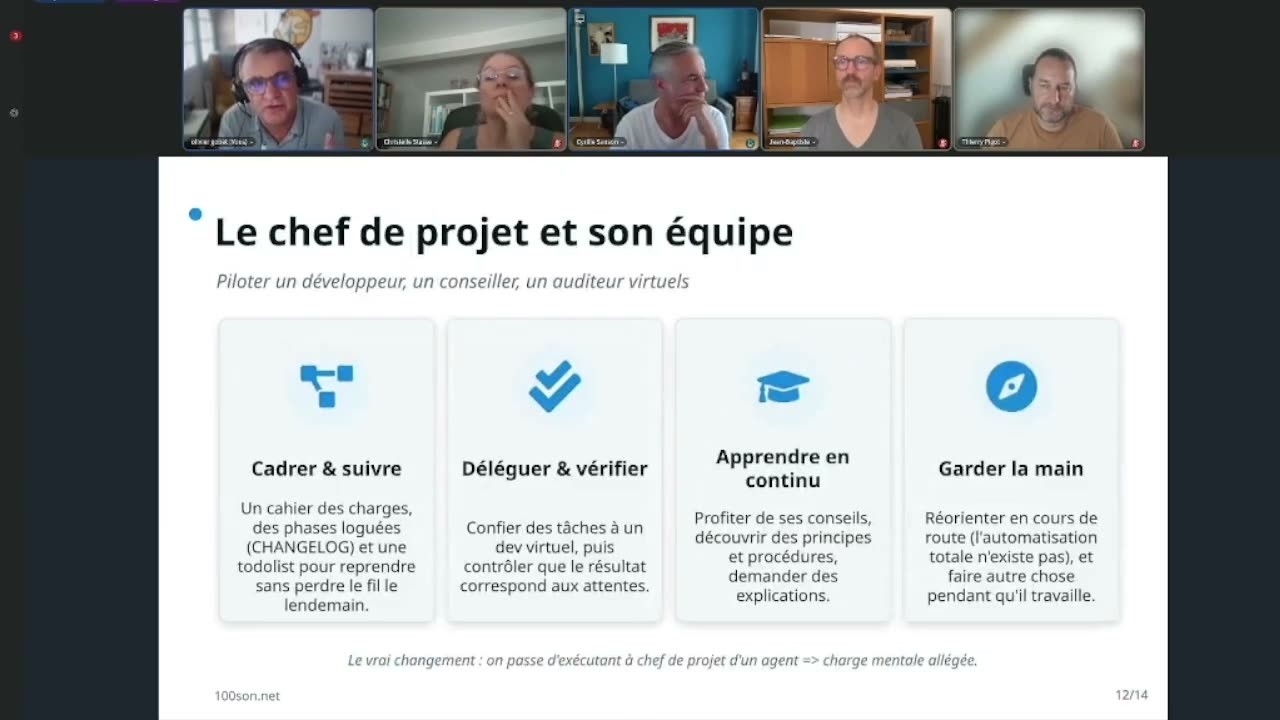
Uh, so here the "I" with, uh,
in this case, we are in project manager mode
with my team. So my
team is an employee who
costs me €90 per month and is called Cloud
Code. Uh, you have to frame it and follow it.
Delegation and verification are necessary. Well, that's what
I already said. I am
constantly learning, I take advantage of this
advice. When I don't understand, I ask again
, I say "But explain to me
why that?" Well, for example, this is
anecdotal, but at the kebab case, I
said, "Wait, I've never seen that before.
What does that mean?" And that's why
I went with an
explanation where he showed me all
the documentation and I understood, that's the
story about Kbabe.
And you, you learned, but
how did you manage to make sure
that Claude learned too
? But he was the one who taught me that.
Yes, but during this
project, are there things that you
say you need in the next project, that
I must not rediscover, or rather, that
he must rediscover new things in
fact. Have you dealt with this aspect
of memory? He has, he has, it's one of
his basic instructions. The POC, the
proof of concept, was there to improve
the process. So the WP skill, uh,
FSE migration, uh, and its entire
change log procedure, the whole procedure
is done to, uh, improve. Uh,
he keeps the scripts he generated
to perform actions. He
keeps them and he includes them
in his WP skill, uh,
FSE migration. So he has
an obligation to do that and he generates it,
so I discovered the terms quirk
quirks, which are kinds of tricks and
workarounds. Uh, so he knows, he has
all that, he has little by little, he has a
library of quirks of things that you
need, well, for example, the kebab case can get
trapped on that. He is learning.
So, that's what's
really interesting,
it improves with each project, and the
project I did next was
much more elaborate, and I got a
result that really blew me away.
I saved time and so on.
And you checked that
physically because sometimes
Claude says yes yes uh because in
fact it's in his context.
So actually
no, it writes the files, it writes the
files. There are the, there is the Louise of
quirk, there are the scripts, there are the uh
and in the skill, there are uh there are the, there are
the quirks and the
bypasses as we are, what is it
in English,
I don't remember, there is a term, uh no, the
goocha,
the traps.
Yeah, it
's gocha. So, he made a
list of gocha, so he has his own
terminology which is rather
Anglo-Saxon, right? Uh, but so he
knows that he mustn't, he mustn't get
trapped by this, this, and this. Well,
afterwards there were very few
hallucinations, very few really, and
a great stability, something I did
n't have with
Chat GPT which I used for 2 years.
When I asked to modify some code,
it went off in all directions, he
changed a lot of things. So.
When he modifies something for me, he only
touches one sentence, one word, one
function. There you go, that's where it's staying and everything else hasn't
changed. That's really what gave me
confidence to
go ahead with a
site migration because I wasn't going to do a
site migration if the result was
a disaster.
So we keep control,
uh, with reorientations along the
way, uh, because there is no
total automation. So each
time there are steps, uh, we move forward step by
step, I can change my mind
depending on how things present themselves
and where to seize an opportunity when, well,
I added this carousel, uh, well, that
wasn't planned at the start. So
, I had a quick question,
it's uh, Clone, actually you had, I do
n't know, 20 or 40 articles there, in fact he
dealt with them one by one. Uh no no
, the articles actually there is
an article template.
All right. But how exactly did he
do the cleaning each time? Who is it,
or did he create a
cleanup script? He uh, so there is
very little cleanup to do uh
because the articles were the old
articles, they were in the
old WordPress editor mode. The new ones
were already in FSE mode so there's
nothing to change. And the only thing he
changed was that he converted
the articles in editor mode, he
converted them into So there, there is nothing
to do. It's like if you go to an
article, you do a bulk conversion, they
are converted in a block. Uh, I had
another project where I actually
developed an extension, I
should publish it, which
cleans up articles. There
were 700 articles there; it was another
project I did before where I had
700 articles. It wasn't feasible to do it by hand
. But with the other code, he
uh removed the line breaks, uh
transformed it. I had H4 tags which were used to
take an image and the text
to make the caption.
Well, he, uh, he noticed that.
Finally, he created filters
and uh, he cleaned all that up. I generated
an extension, I'll try to
publish it, it's buggy but it's a
really interesting page and he made me
an amazing interface. I did the project by
hand with him and afterwards
I developed the extension that I would have liked to have
. Okay, I'll try to
share it because it might be useful.
The gain, uh, well, I don't have an
exact figure on the timing. Finally, I think I
put 4 days, presumably 4
consecutive days. Well, the advantage is that
I can do something else while it's
working. Well, the limit was that it was a
simple site, but since then I've made a
more elaborate site and it went well
. Uh, we'd have to see there, I
might have a site with that to
see what it would look like. Uh, there was
no animation, but on the
project I did afterwards, well, there were
animations and it worked, and
uh, and I worked locally. So,
if we need to work
directly on a server,
it might be more complicated. I don't know about that
. Have you already tested it with
Thierry, using
Cloud Code installed on a server and
working on the website on a
server?
Your microphone is muted. In fact, you
can, uh, there is, so it's always
tricky to go, uh, directly
to a server, uh,
but with the MCP, in fact, we
can connect, uh, for example,
for example, I am an elected official of
my municipality here and uh, I have to
regularly post news,
events and all that, and so I get
sent things in bulk, sometimes it's
a PowerPoint, sometimes it's a
poster, and then I have to write the
content. Finally, and this is kind of the least fun part
. Actually, I
give it to Claude, he
automatically does the events, the
news, everything is a mess
on the site. So in fact, he is
connected to the site and uh in fact with
the pay-per-access there, in fact, we can
give him possible actions
in fact on the site. So, all of this
requires developing a small plugin
to do it.
But as a result, he can actually go
directly to do things on the
site. That's why earlier I
was asking whether it was
the AI that works directly because we
can also come with an MCP or
just the PI remains in fact we can go and
dialogue with a site and do
things in H which and it can go as far as
building a site.
Oh, well, it can even go as far as building
a website. Yes, we can do things.
Yes.
All right. OK. Well, I preferred to do it
locally. Anyway, I did it
locally because it
seemed simpler and because there is
no latency, no
risk of losing connection, etc.
So, uh, and he had all the
files, all the files, at hand.
So for me, that was the
point. Um,
and regarding what you were saying, I
can do something else while I'm
working. Well, while there's
work to be done, I don't want to go hang out my
laundry. There is a command/remote
in fact which allows when you have
the Cloud application on your phone
and in fact you can have
on your phone a
view of what Claude is
doing and in the
Cloud application you can see where he is and you
can validate things, talk to
him even without being next to him. Slash
remote and I send it to my mobile.
Yeah.
OK. In fact, when your
mobile is connected to your
cloud account, when you go to the
cloud code section of your mobile, you will be
able to find the exchanges.
OK, agreed.
I'm
watching your Netflix series while he's
working, you know.
Yeah, OK. Uh [laughs]
not really. Uh, so I have the V2, that's what
the MCP Quest was connected to, and
well, it's done. Uh, and I
also connected uh with the MCP Chrome Lighthouse
uh on another project recently,
I did uh a pass uh I had to
do an audit of a site. So I did
the audit and then I thought, let's see
if I do a
Lighthouse audit. So, Quest
was over in 20 minutes. Uh, he gave me
the summary, uh, but I didn't
go into it because it wasn't
the purpose for my client, but I
still provided it as an appendix to my audit
to the client to say, well, if you want to
go further, there might be
things to see, but uh, but you have to dig deeper
. That's not it, that's not it.
But it's interesting because,
uh, because it gave me the opportunity, I
provided it there for a clear explanation, but I
also did it on the site that comes right after this
example. Uh, so which was
more elaborate, uh, I launched, that's
where for the first time, I launched the
HP Quest MCP and I saw that there were
things that I hadn't done. It's
a site that I developed myself, well
with Ines, but uh there were
things that I had overlooked which
are not much but uh for
example, there were words in
Spanish, well you have to indicate in the
code that the word is in Spanish. So.
Well,
if you don't have something that reminds you,
there you go, there weren't many non-
conformities but I found it
interesting as a method of
finalizing
a project to say well, if we're going to
be really thorough, we'll remove all the...
there are three levels of non-
conformity but so we can at least
remove the red non-conformities. Well, there you go
. Uh, so I wrote
an article
about this project and you can
find it using the QR code or the
URL below. So. So.
Do you have any
questions? We have
one minute left. [laughs]
We can, we can go overboard. We are allowed to do so
exceptionally. OK. So, you made your skill
available then, or uh,
the skill, well, WP remote,
uh, WP migration FSE.
Yeah, that was your personal skill.
Yeah, so I have the project, I
published them all on GitHub but privately
uh because uh I realized
there was customer data and I
need to clean it up. I ca
n't publish them like this, but uh, I
hope I'll have time to clean them up
because, well, it's getting richer, you know. It's, uh, in our best
interest to do that. Well
, I benefited from your work, from
that of Fabrice du Carme, from what is
finally shared by the gems that
Camille Rou finds. So. So, uh,
we have, well, I'm finally in the
free software world, I'm convinced that we have
an interest in sharing information.
Cyril, can you cut the
presentation so we can see
everyone? Uh, no, not that there are a huge number of us
.
Ah yes, I cut while doing that. So.
THANKS.
And my question is because, well,
ultimately,
the starting site, it seemed
relatively simple. You had used
Elementor but it wasn't there was
a need for layout on
more complex sites.
Do the layouts
created using Elementor
truly adhere to
Gutinberg standards? Is it, or is it
only
columns with... That's what you were saying earlier
with a lot of CSS, so
avoid that, but will it
use, I don't know, the media block?
Is he going to use things
like that?
Uh, so, uh, so,
I haven't mentioned it, but there is, there is still
a small
optimization process because, for
example, in the footer, I
noticed that he had put blocks within blocks within blocks within
blocks
a little too much, uh, not in an
unreasonable way. I'm exaggerating in my
wording, but uh uh
I corrected him on that. I said, uh,
optimize this for me. And then I did it by
hand and I said, "You
see, we can go further." Ah yes, okay
. Okay, well, I'll make a note of that. So.
So there is that. But otherwise, uh, uh,
I'll do it
if you don't frame it well, of course,
how does the FSE work, what are the, uh,
you see the constraint you were
saying, use native blocks, use
native styles, in short, make sure to,
and as a last resort, add a
CSS class and make a CSS overlay. If
you don't hammer it constantly,
it can eventually uh
ignite and put an HTML block in there and
do a big brute force thing
inside it. I haven't, I haven't, uh, I have
n't had that case too much,
I don't think. But uh, that's because
you may have framed it a little bit
beforehand. But if a novice says, "Hey,
here's a JPEG file of
a page template, and put it back in, convert it
to FSE, it'll do it 80-70-80
% clean, you know. Uh, but when you
open the Gutinber code, you'll say, 'OK,
that's not right,' because there are
HTML blocks everywhere. So it'll be pseudo-
pixel perfect, but not 100% native.
And then there are subtleties
specific to Gutinber because Gutinber will
declare things in a `` tag. In fact, when you
open the Gutinber code, when you
display it in code view, you have
HTML comments inside, you have
Jison data, and then you have
data in the tags, so
CSS classes, for example, or
styles.
Well, in fact, there are orders to
respect, and if the order of the
CSS classes, for example, Jison, isn't the
same as the one in the HTML tag,
well, it creates an error. And that's where
we get the famous block that appears,
attempting to recover. There you go,
I've had it, that's become something
he knows he has to check.
Yeah.
Yeah. That's recurring, and even when you
frame it, there's always a point where, what you have to
see
is that it works very well for the
first 10 minutes, and then after a
while the context is a bit too
big and he hallucinates.
We often say that hallucinations start
to make up nonsense. Well, in this case, it's
just that he's coding nonsense. Okay
.
In both cases, well, so far, I haven't had
that problem.
And the overall assessment is very positive for me
because there's no... so
the concern is that I won't put any
code in. I'm not a developer by training. I
'm a website designer,
but I don't... development. I
do a little bit, but I don't have the
ability to analyze thousands of
lines of code. Uh,
so I won't put online any
code that seems a bit
complicated or a bit long that I do
n't fully understand. Snippets are short;
they're for creating a small effect in one
place. Uh, I have,
in these
instructions, there are
security guidelines too. You have to be careful to
respect the security rules.
Uh, here, everything I've done is just
pages that are published, so there are
no functions in them. It's
separate, you see, apart from a form,
but the form is provided by
a form extension. So it's
not the extension that creates the form and
could generate an error. So that's
the main advantage of FSE. FSE is
still HTML files, apart from the
function.php PHP file and then possibly
a few features that we can
add to the theme, but It's practically all
HTML, after all.
And here's a little tip: I use
Obsidian a lot, actually—the famous
second brain—for my
note-taking. The cloud, the
global cloud point, is
instructed to always invoke my... my... what do we
call
it? My... my repository, well, what's the
term?
Repository, yeah. And the
whole
repository is built to
have entry points. When it
arrives at an entry point,
depending on its requests, it's
directed into subfolders.
All of this is interconnected
with the
Obsidian naming convention, with tags and so on. So it
allows it—it's
really Claude's second brain—
and sometimes when I come across
a problem,
I'll say, "Hey, put this in the...
capitalize it, reference it." And so
the next time it arrives,
it... The instruction is always to
say, "Is it in the
repository or not?" Do I already have an
instruction that allows me to
respond to a need, a
problem, or something else? And if it does
n't find it, well, then it will
look for it itself. It's
on your
Obsidian machine.
Obsidian, it's on my machine. Well,
the repository is on my machine, but
you can find it there. Well, you can find the
repository, maybe if you take the
cloud option with them, you can
find it everywhere. But, uh, so that, well,
I mean that, it's a
problem of knowing where you put it,
how you share it. No, but so
it accesses it directly... Oh yes,
there it does. Yes, yes,
it has access, in fact, that's why when
you said, when I launch Claude in a
folder, it doesn't know the other
folders, actually. Yes, it wanders around, well,
it won't do it without asking your
permission, but It can wander wherever it
wants on your computer. So, uh,
yeah, it could. Yeah. Hm hm.
So, there you go, it knows
where my repository is, uh, it knows what it
finds inside. For example,
there are all the
accessibility rules. Well, sometimes you have
115 performance audit points
, the op rules, you know, there are a
lot of things there,
actually. And it knows that
when, for example, it's going to create a button,
it'll say, "Hey, how do we make a
button?" It'll make sure that it
complies with the rules. You see, it's
OK.
And I'm not obligated to invoke an
MCP server, to be dependent on a serial number
because today you're using
Quest's SMP server, uh, well, that's going to
generate costs for them because all of that is still
machines to
maintain, so all of that, so you
're not immune. that tomorrow they make this
service paid,
the closure, well, you see, so the more you
capitalize on things, the better. But you shouldn't
internalize everything either, because there's the
problem of updating all that.
But, uh,
and that means you have
a Quest section in your Obsidian?
Uh, yeah, well, I have a lot of
stuff in there, actually. It has everything. It has
my identity. So, in fact, it knows who
I am, what I do, what
the different structures are that I
work for, what my
methodologies are.
So, in fact, there's a folder for
identity, offers and services, methods and
processes, tools. It also has the history of
all the projects. So, for
example, the difficulty we
also have is, for example, you did
this work on Elementor, and then in
six months you're going to do another one, and
then maybe you haven't
forgotten that one because it's
the first one, but But at some point
you'll say, "Ah, I don't remember
which project I used to put
Thierry's tool for making
carousels." The kind of classic thing
Leenir is starting to lose a few
brain cells [laughs].
And so, well, actually, your second
brain has capitalized on it, so
[clears throat] you can
ask him, we go to each project at the
end of a project, do a bit of a review of
what we did, how we did it,
what tools we used, and so on. So, it's really
specific to each person, their own
method. Do
you plan to do an
article on the basics of using
Obsidian? Because I imagine it's
quite elaborate, but just a point, the
1, the 101 of Obsidian.
Well, actually, I know it's in a
proposal for a conference at an
upcoming World Camp, so I don't know if
it will be accepted.
Okay, well, we'll see you there. [laughs]
But but The idea is to address these
points, to also discuss the possibility of
creating cloud plugins. This
is incredibly interesting. We can create
our own marketplace. We can
register it there when we're
working collaboratively, so we'll
see more about that during the
contribution day. I won't give too much away,
but the idea is that,
for WordPress
France contributors, we can create a cloud plugin.
This plugin can be
downloaded, updated, and
developed; it's a
GitHub repository. And then, behind it,
we can have skills,
scripts,
commands, agents, and so on. This
is a plugin that we
install, and so we can all have the same one
. This is incredibly interesting
because we have the same work tool
. So, in a
business or community context like
ours, this can be very
useful because we all have
the same tools, and if
tomorrow one of us... We update it
because we've acquired a new
skill or updated an existing one,
or something else. We put it in the
plugin, and then we do a
plugin update. Cloud
even knows this;
it can configure Cloud to auto-
update. It can say, "Hey, this repository has
been updated," and it will
automatically update itself, and we'll
always have the correct
skill updates. Okay
.
Super interesting.
Anyway, yeah, it's always
interesting to have these kinds of challenges, to step outside the
box a bit because it allows you to try
new
things and, above all, to develop your
skills. That's good. So I
think you've learned more here than
with Camille's posts, where
sometimes it's interesting, but
putting it into practice is always a
bit complicated. So yes, well,
here it's about getting your
hands dirty. Uh,
if I had done it manually, I would have
done what I know how to do it.
Uh, there, I was faced with
someone
who brought something new, who... who
did tasks that
freed up my time and mind. Uh,
so it's... it was... Yes, it's very
enriching so far.
With hindsight
and the objectivity I know you for.
[laughs] Do you think that if you had done
all that yourself because, as
Olivier said, we weren't working on a
complicated site, do you think it would have
taken you more than four days doing it
completely from scratch by hand? Uh, oh yes, oh yes, oh
yes. Oh, no problem. Yes, yes, yes,
yes.
No, no, no, I would have taken...
potentially maybe a week,
but I did it with a different site, you know
. Right after that, I started a
much more elaborate project, uh, and I
delivered it. I'm waiting for the client to
approve it, but I'm waiting...
If he tells me OK, I put it into
production. Because what
I've noticed with Lia is that
it ultimately saves time in
the sense that you're not the one doing the work,
but it doesn't really save you time
because you still have to
supervise, control, and so on. So,
you have to, and it adds a bit of extra
mental workload because
sometimes you might think, "I've
thought of a new
feature or something," as I was saying earlier, and then, like
you said, when your brain isn't actually executing
the task, it doesn't get
the self-satisfaction of
completed work. So, you feel like... I
know I have
some days where I feel
more tired than I am, even though I've been
working all day.
So, I agree with you
because
it actually speeds things up, and
so there's a
There's actually a difference:
we do more things. We do
the task, we follow along, and there are times
when we have to wait for it to be finished,
but we're not
resting. We're moving on to something else,
and that makes time feel
denser. And then there's also—maybe it's
because it's
new that next year
I'll be tired of it—but even
outside of that, I'm running around thinking, "Hey, what if I
told him this, and if he did that,
girl, and hey, I could
try that." So, I've
moved on to a higher level. It's
not migrating a website; it's
managing a client. And on top of that, it
happened with a client where there's tons of
information, where I'm
drowning in it, with
emails, emails with 10 points to address.
Luckily, I have Claude, and
an email with 10 points to address, but
four people to deal with.
So If I had to do that with my
limited skills and limited brainpower, it would
take me all day. Here, in two hours,
I was able to process a huge email.
The problem is,
the client I'm dealing with—I wonder if he's
not a bit of a handful—is throwing
things out there, topic after topic
.
I have to keep him in check. I mean, we'll
see later, we'll finish this, we'll
see later, we'll see later, we'll see
later, because, well, that's
an attitude clients can have
when you start a project with
them; they want to cram in as much as possible
before things get complicated and
the bill increases.
Actually, I wrote a
LinkedIn article about this. I
use the ADR method a lot,
Architecture Decision Records.
Basically, when you get an email, a
client sends you something—a
decision—they'll say, "Okay,
now I'd like the button to
be green, I'd like..." "Add this
feature and so on." Well,
basically, you give that to Lia, she makes
a standardized document with our databases in mind,
and you say, "Well, on such and such a
day, we agreed to make the button
this color." And I make a
new ADR which says, "On such and such a day, we agreed to
add this feature."
And that's how I'm going to implement it. So,
when Lia starts coding, she has the whole
history of what was
decided and everything that was rejected
because sometimes she can go off on
a tangent thinking she's doing the right thing,
but sometimes I might
ask her for something because I myself
forgot, and she'll tell me, "Be careful, in
ADR72 we said we weren't doing it
like that," and you see, so there's that. It actually
forces you to
have slightly stricter methods,
or to find your own method. Hm
Hm.
OK. Uh, I'll have to
leave you now. This is
interesting. Yeah.
Thanks Thierry, thanks Jean-Baptiste.
We didn't hear from you, but you're alright.
You did leave for a moment, though, huh?
Yeah, I arrived this morning, it was
complicated, sorry. Uh, no, it's all very
dense. Uh, I haven't gotten my
hands on it yet, but it does
scare me a little to
face this, and I'm not super comfortable
with the idea of
giving access to my entire computer
via the console. Uh,
indeed, as you mentioned earlier
, it's a contract of trust,
but you don't know how far he'll go
. Uh, in
my opinion, he doesn't have the interest
or the energy. Uh, that consumes resources, we mustn't
forget that. And uh,
why would it consume resources? To retrieve
information.
Uh,
he's going to search a computer, he's going to
Trying to grab information.
Google already does that.
Okay. So, well, Google does it for everyone with
Gmail addresses. Uh,
their emails are scanned. Okay. Uh, I'm
not sure it's in Lia's best interest
to produce anything other than what she's
asked to do, uh, to do
parallel work. Because if, while
I'm asking her to
transform a page, she's going to rummage through, I do
n't know, my social security files
or my contacts, you know,
personal stuff, uh, what's she going to
do with that?
No, she's not necessarily going to do that.
On the other hand, you can have problems if
you use Cloud Cork, or
cloud cowork, in fact, she can, uh,
manipulate programs
on your computer and, uh, execute
actions or other things. And in that case, it
needs to be well controlled because she
could potentially send an email without your
knowledge, thinking she's doing the right thing because
you asked her to do
things, and so yes, that can happen later in
terminal mode or something, it's Yes, I
think there is
less risk
and above all the fear we
often have is to say "I'm afraid of
losing control of the skill
because that can also be that
sometimes we can feel
dispossessed of certain things.
So at some point, we also have to
accept that AL allows us to
do things that we might
not have allowed ourselves to do before. Uh,
Cyril was talking about development,
saying I don't do development or
something. Well, maybe he'll do it now,
but it's Claude who will do it
. In fact, he might just be
checking that it's doing things the way
he asked. Uh, maybe he
'll ask our agent to
check security or something. So it will
never be 100% reliable, but
I think we'll see, or rather we're
already seeing, for example on the
WordPress repository, more and more plugins
arriving because anyone can
develop plugins now. And
besides, I saw an article
this week where premium plugins
are actually declining in terms of
other licenses because
today you were talking about using
Gravity Forms or some other tool,
well you say but today I created
my own
form solution, you see that's what it
can ultimately bring you.
Yes. Anyway, I prefer to use
Gravity Form rather than something I do
n't know, whether it's made by Unia
or by a developer with 100
users.
No, well,
actually, there is a real
change in mentality. We, we will
say that we have the knowledge of the
fact that when you pay for a
license, it is because it will be maintained
,
secured, updated and so on, that your
own code, well, in fact, after 6
months, it can have
security flaws and then it's over. But
for many people, in fact, there is the
aspect,
there is the satisfaction of having done it
yourself. We can see it on the
posters now, well, stuff, uh,
we have some really wow posters. So
we, as
graphic designers or at least sensitive to this, would
say it's a horror, it's
overloaded, it doesn't tell a story, we don't even know
where it is. So there you have it, there are some
because we have an expert eye on this,
but for newbies, it's a new
Eldorado that opens up, you know. So, and
we're really going to see that at all
levels.
Yes, yes, yes. Yes, yes, yes. I can
see it. I'm so annoyed, I have a... we have... we have... we have...
cut the recording there or not?
Uh no,
no, not on Ostera.
I'll cut it if you want. We'll say
goodbye, okay?
Bye. [laughs]
And the off-air part starts, huh.
And the off-air segment begins. Uh, it's cut off there.