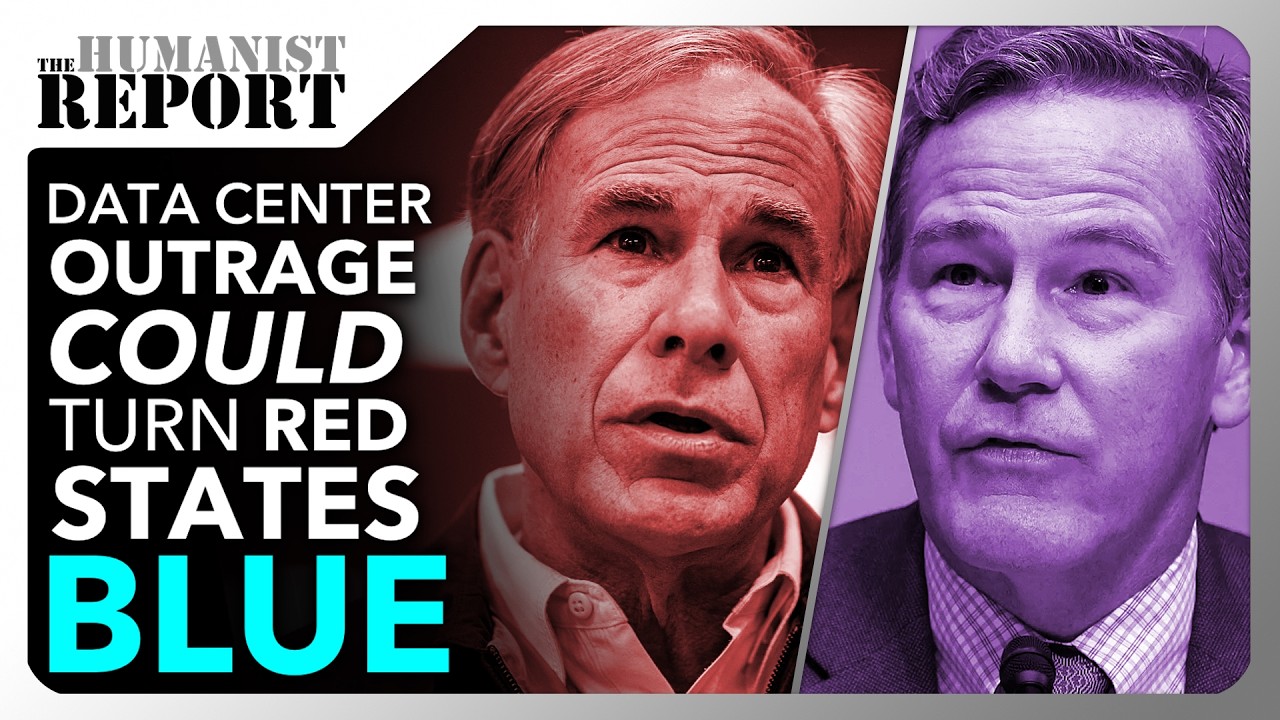
Republicans in Full-Blown Panic Mode as Rural Voters Revolt Against Data Centers
Watch on YouTubeVideo summary
For the first time in years, the Republican Party has been forced into a defensive position as intense public backlash against data centers threatens their electoral prospects, particularly in key Senate races. Reports indicate that the party's campaign arm has privately warned major technology companies that the negative sentiment surrounding these facilities is so severe it could cost them control of the Senate in November. Consequently, both Republican leaders and AI executives are scrambling to launch media campaigns aimed at shifting public opinion before it becomes permanently entrenched. This situation marks a significant shift, as Republicans—who typically advocate for rapid technological expansion—are now retreating from their previous pro-data center stance, a move that has shocked observers who usually see Democrats taking the lead on such retreats.
The panic within the GOP is largely driven by specific electoral vulnerabilities, most notably in Ohio where incumbent Senator Sherrod Brown is effectively using data centers as a central issue to challenge Republican John Husted. Husted had aggressively recruited data center companies to the state with favorable tax deals, but this strategy has backfired as residents face skyrocketing electricity bills and environmental concerns. Internal polling suggests that opposition to data centers has grown significantly since March, with a majority of Republicans now opposing them. The stakes are incredibly high; if Husted loses, it could establish data centers as political poison nationwide, potentially causing the AI bubble to burst prematurely and damaging the broader economy under a Republican administration, a scenario the party desperately wants to avoid.
This backlash is not isolated to Ohio but is also severely impacting Texas Governor Greg Abbott in deep-red rural areas, where some conservative voters are considering voting for a Democrat to oust him specifically due to his support for data centers. Similarly, Oregon Governor Tina Cotekch recently executed a sharp political pivot by canceling land sales for data centers and endorsing local moratoriums after realizing that her continued support was making her vulnerable to attacks from her Republican opponent. In Wisconsin, the race between Democrat David Crowley and Republican Tom Tiffany illustrates how voters are increasingly skeptical of Republican rhetoric; despite Tom Tiffany attempting to attack Crowley's pro-data center stance, he is trailing because his own record includes voting for federal bills that restricted state AI regulation and accepting donations from AI lobbyists, exposing him as a hypocrite in the eyes of the electorate.
Ultimately, the transcript concludes that while politicians in both parties are rapidly pivoting away from data centers to survive politically, Democrats must seize this moment to hold Republicans accountable rather than letting them run away from the issue. The anger over data centers represents genuine grassroots rage, unlike manufactured outrage often directed at minorities by Republicans, and voters are now meticulously scrutinizing politicians' records for ties to big tech money. This dynamic proves that citizens still hold significant power over their representatives during election cycles; if politicians do not listen to this widespread demand for regulation or moratoriums, they risk being punished at the ballot box, potentially leading to historic political losses where Democrats win in red states and Republicans lose in blue ones due to this single issue.
Read the full video transcript
For the first time in years, it is now
the Republican party who's forced to
play defense for once now that their
support for AI and big tech is blowing
up in their faces. Axios reports that
the Republican party's send campaign arm
sent a private memo to their AI
overlords letting them know that the
backlash to data centers has become so
intense that it is hurting their chances
of retaining the Senate in November. And
Republicans reportedly want big tech
companies to quote do whatever it takes
to stem the public backlash. And AI
companies are trying because, as Axios
explains, tech giants are scrambling to
pull together media campaigns to try to
shift opinion before it hardens locally
and nationally. But it may be too late
because Axios continues. AI CEOs and top
Republicans share in the rising panic.
They tell us internal polls show data
centers are as popular as spent nuclear
waste and more broadly have become a
proxy for feelings about AI and you
absolutely love to see it. Now data
centers have become so unbelievably
toxic that Republicans have been forced
to do what they almost never do. They
are retreating. That to me is shocking
because it's usually the Democrats who
are retreating but in this instance it
is Republicans who are retreating. And
Republicans are especially concerned
about the Senate race in Ohio where the
Democrat Sherrod Brown is hammering John
Hustad, the Republican for supporting
data centers. Here's one of the ads that
Brown is running. He's been called the
face of data [music] centers in Ohio.
Why? Because John Hustad spent years
aggressively recruiting data [music]
centers to the state, cutting sweetheart
tax deals and fast-tracking approvals
while ordinary residents watch their
electricity bills explode. [music]
We are here with Ohio Senator John
Houston. He has a lot of experience with
something called data [music] centers.
John Houston. Who's he really working
for?
>> I'm sure Brown and I approve this
message.
>> That, my friends, is a very good ad.
That is a devastating message that is
going to resonate with voters across the
political spectrum. I say that because a
Gallup poll from back in March found
that seven and 10 people oppose data
centers either somewhat or strongly. And
that includes 63% of Republicans. And if
I had to guess, I would say that hatred
for data centers has only grown since
March. Now, this data is also reflected
in the GOP's own internal polling, hence
the panic. But they're worried that if
the Republican loses this Ohio race,
it'll have long-term repercussions for
the entire tech industry going forward.
To go back to the Axios article, they
write, "If Husted loses and data centers
get the blame, politicians across the
country will take notice and they will
not go near the next one." The memo says
this has become a sleeper issue for the
entire election cycle. So to
Republicans, this is about more than
this one Senate seat. Of course, they
want to win. Of course, they want to
retain control of the Senate. But this
race could solidify the status of data
centers as political poison. And the
industry as a whole would suffer as a
result of that. And the AI bubble might
even burst a little bit faster because
of it, which would tank the entire
economy while a Republican president is
in charge, mind you. meaning that the
entire Republican party would be blamed
for it, as was the case with the 2008
Great Recession when George W. Bush was
still president. And Republicans
obviously don't want that to happen.
They would prefer to benefit from the AI
gravy train for years to come. So, they
know that it's a ticking time bomb and
they're sounding the alarm so that way
their AI donors know that like, hey,
this is kind of the last chance for all
of us to get rich, so you've got to turn
things around. But unfortunately for
them, it may already be too late. And I
can assure you this isn't unique to Ohio
because Politico reports that it's
hurting Texas Governor Greg Abbott in
deep red rural areas too. In fact,
Shelby Webb of Politico argues that the
governor is actually bleeding support
due to data centers and explains some
longtime conservatives are now
considering the unthinkable, voting in
November for a Democrat to be Texas's
next governor. And Abbott's August
directive to pause Texas data center
grid approvals hasn't convinced all of
them to vote for him. quote, "They
understand the repercussions of that,
but you know what I'm hearing is, yeah,
we'll have a Democrat in there and grit
our teeth and bear it, but hopefully
we'll come out of it the following
election," said Nanny, who lives in Tom
Green County. They're so upset. They
just want Abbott out. The welcoming
approach that Abbott's Texas has taken
toward data centers until now makes the
rural push back and the governor's
retreat particularly striking as the
industry grapples with resistance
nationwide. Rural people feel like
they're the ones seeing the brunt of
this and they don't like it, said Jim
Henson, executive director of the Texas
Politics Project. These issues are
starting to bond together a lot of the
people against data centers. So, if
Texas actually does do the unthinkable
and they elect a Democratic governor for
the first time in 35 years, it will be
because of data centers. And if that
happens, you can stick a fork in the
industry. It'll be cooked at that point.
There's just no coming back from that.
It will be the biggest political loser
in modern American history. And that's
assuming that it's not already too late.
But I will say that Republicans are very
good at adapting, whereas Democrats are
much slower to adapt. Now, to Democrats
credit, a lot of corporate Democrats are
pivoting away from data centers
themselves, but they do need to go the
extra step and pin the unpopularity of
data centers on Republicans. And I just
don't know that they're savvy enough to
do that. And it's also a lot harder to
do that, a lot more unpersuasive if your
party oversaw the proliferation of data
centers when you had power. But I am
pleased to see that Democrats are at
least doing the bare minimum, which is
pivoting away from data centers. For
example, Pennsylvania Governor Josh
Shapiro did a 180 on data centers and is
now making an effort to actually try to
regulate them, which is interesting. My
governor Tina Cotekch of Oregon also did
a 180 and she canled a 32 acre land sale
previously allocated to a data center
and she subsequently endorsed locally
endorsed moratoriums even though earlier
this year it seemed like she was
hellbent on turning our entire state
into one giant data center and she
conspicuously pivoted around the time
that polling showed that her Republican
opponent was actually leading. Now,
correlation doesn't equal causation, but
if I had to guess, I'd say that Governor
Cotch probably felt like she had no
choice but to pivot away from data
centers because if she didn't, she was
leaving herself vulnerable to attacks
from the Republican who might have tried
to outflank her on this issue because
everybody knows that people in Oregon
are pissed off about data centers. We
all [ __ ] hate them. They are
everywhere. And last time I checked, we
ranked fifth throughout the country for
the most data centers. And listen,
nobody likes Christine Drazzen. She's
run for governor of Oregon before and
she lost. But she's been strategically
quiet on the issue of data centers and
she even offered some platitudes here
and there about, you know, maybe we'll
leave this up to communities. And I
think that COC feared that a lot of
Oregonians would make the same
calculation that rural voters in Texas
might make and she might have expected
some Democrats to cross party lines or
just not vote in order to punish her for
enabling the takeover of data centers in
our state. And I'm skeptical that, you
know, voters would actually opt for a
Republican in Oregon because this is a
deep blue state. But COE wouldn't have
made a pivot that sharp if her internal
polling didn't scare her shitless. Now,
for those wondering, no, our governor
didn't face a substantial primary
challenge. There were approximately
14,395
primary opponents running against her,
and leftist votes were split like a
hundred different ways. But the fact
that a governor in a deep blue state
like Oregon is feeling the heat, too,
that really demonstrates just how angry
voters are about this issue. But here's
the thing. Republicans are also capable
of pivoting. And in order to obscure
their previous support for data centers,
they're going the extra step of pivoting
and attacking their opponents for being
pro- data center. And if you look at the
gubernatorial race in Wisconsin where
Franchesca Hong, the anti-data center
DSA candidate, narrowly lost, it's
actually the Republican who's attacking
the Democrat David Crowley over his
support for data centers. Meet data
center David Crowley.
>> There's an opportunity for us to really
become AI and a data hub for not only
for the entire country, but for the
entire globe.
>> And he wants you to pay for it. Data
center David Crowley won't roll back
data center tax incentives. Our lakes
run dry. Family farms paved over. Why?
Because Crowley's campaign is funded by
the people building them. Data center
David Crowley. Big tech wins. Wisconsin
pay.
>> Damn. In retrospect, Franchesca Hong's
Thanksgiving tweet doesn't look too bad
now, does it? But if you would have told
me that Sherrod Brown ran that ad, I
would have believed you because it could
have been anyone's ad. A Democrat, a
socialist. If you look at, you know,
Franchesca Hong, she was running
strongly against data centers, hence why
she had so much momentum. But that's an
ad from Crowley's pro- data center
Republican opponent, Tom Tiffany. He
sounds like a lib or a lefty. And as the
Wisconsin Examiner reports, data centers
are becoming a central issue of the
race, largely because Crowley's
Republican opponent is hammering him for
supporting data centers. Now, the irony
is that Tiffany doesn't mention data
centers in his platform at all because
he supports them himself, but he's
deploying the typical Republican
strategy of forcing the Democrat to play
defense in order to downplay his own
vulnerabilities. But thankfully, it
actually doesn't seem to be working. A
new poll shows that Tiffany is trailing
Crowley by four points. And part of the
reason why his attack doesn't seem to be
landing is because voters know that
Tiffany is a hypocrite. The Cap Times
editorial board released an article
pointing out that Tiffany actually
serves the AI oligarchs himself and they
referenced a vote that he made for an
earlier version of Trump's big [ __ ]
bill that would have banned states from
regulating AI for 10 years. That is
devastating. That's a huge blemish on
your record if you are purporting to be
the anti-data center candidate. On top
of that, other local outlets are drawing
attention to the money that he took from
AI lobbyists. Meanwhile, Crowley himself
has actually pivoted away from data
centers and announced his support for
robust regulations while simultaneously
highlighting Tiffany's duplicity on this
particular issue. So, even though it was
ostensibly savvy to center the race
around data centers, one could argue
that Tiffany's decision to do that may
have actually come back to bite him in
the ass because this is one of the few
issues where voters aren't falling for
GOP bullshitting as easily. They're
tapped in and they're going through the
records of politicians with fine tooth
combs to sus out any traitors because
once again, and I can't stress this
enough, people [ __ ] hate data
centers. With that being said, I still
think that Crowley needs to go on the
offensive a bit more and he needs to use
the word moratorium and be explicit.
Now, he's been reluctant to do that
because he says that as the governor, he
wouldn't have the legal authority to
enact a statewide moratorum. But our
governor in Oregon said the same thing
which is why she's supporting the next
best thing which is a locally enforced
moratorum across the state. Like she's
endorsing communities enacting their own
moratoriums. And that word is really
important because it's straightforward
and it tells voters exactly where you
stand. My governor using that word
communicates to me that she got the
[ __ ] message. She knows how pissed
off we are. And this is one of the only
times where I would ever recommend that
somebody look to something that Tina
Cotch is doing, right? But it just goes
to show you that politicians have to
listen. Otherwise, the unthinkable could
happen. A Republican could lose to a
Democrat in a red state and a Democrat
could lose to a Republican in a blue
state. And nationally speaking, every
single Democrat has to drive home the
same message. They've got to hammer
Republicans for supporting data centers.
Do not let Republicans run away from
this. Tie them to data centers directly.
highlight any donations that they've
taken from big tech companies and draw
attention to any meetings that they've
had with AI executives and lobbyists
because this is a 7030 issue of high
salience to voters, especially in states
that have already been taken over by
data centers and Democrats have to seize
the opportunity once and for all.
They've got Republicans right where they
want them. And if they don't harness the
rage towards data centers, Republicans
are going to try to, which is exactly
what Tom Tiffany is doing. But midterms
aside, the fact that so many politicians
in both parties are running away from
data centers at 100 miles an hour is a
reminder that we actually do still have
some power in this country. It doesn't
mean that our politicians care about us
as human beings because they don't. But
they do have to listen to us, especially
during election years, because they care
about themselves and they know that if
we're pissed off, we will punish them
for not doing what we want. And I think
that Democratic socialists and socialist
adjacent candidates have been successful
specifically because they've been able
to harness that rage. It's the exact
same political strategy that Republicans
use with the difference being that the
rage they harness is always manufactured
and misdirected towards minorities.
Whereas the rage that Democratic
socialists harness is actual rage that
stems from the bottom up and not the top
down. So just remember that you are the
boss of these politicians. This proves
it. And the faster more Americans
understand this, the better off we'll
all be.
[music]
>> [music]