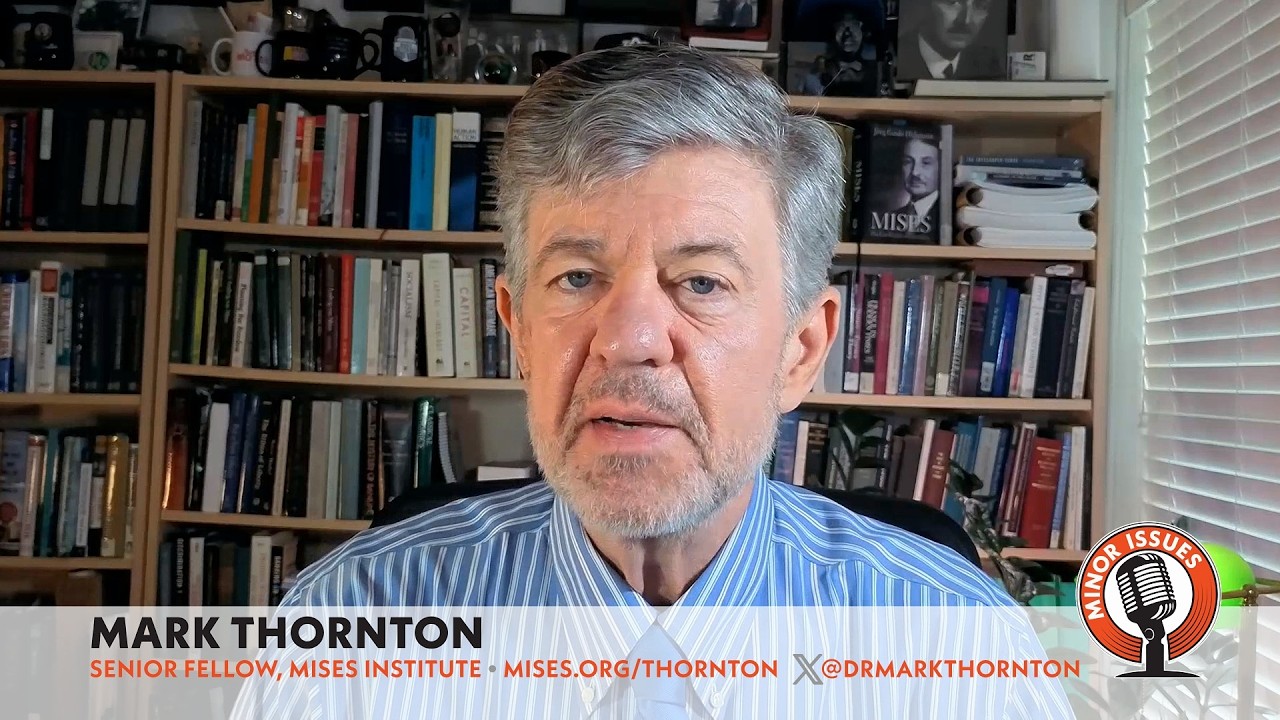
Video summary
Mark Thornton argues that long-term political outcomes are driven primarily by ideology rather than interest groups or specific events, noting a significant internal realignment within the major parties where Democrats have drifted toward socialism and government spending while Republicans remain dominated by crony capitalists seeking special privileges for big business. Despite these superficial differences, he asserts that both factions support policies such as inflation, war, high debt, and measures that harm the middle class, creating an environment of political stagnation reinforced by barriers like gerrymandering and restrictive campaign finance rules that prevent third-party competition. Thornton warns that when elites become insulated from public ideology due to these structural obstacles, there is a risk of revolutionary scenarios emerging if this failed realignment continues unchecked, drawing parallels to historical revolutions in Russia, France, and America.
The discussion extends into economic concerns characterized by widespread distrust in institutions and a bifurcated economy where most households face declining purchasing power despite stock market highs, alongside growing risks in the private credit and equity sectors showing signs of stress. Central banks are increasingly turning toward gold amid geopolitical conflicts and fears of weaponization, signaling a shift away from reliance on U.S. Treasuries as safe assets. Furthermore, Thornton identifies artificial intelligence (AI) as another technology bubble fueled by artificial credit and misinformation, consistent with Austrian business cycle theory which posits that speculative booms in advanced tech sectors inevitably precede busts driven by entrepreneurial errors rather than genuine productivity gains.
Applying the Austrian theory of the business cycle specifically to AI, the speaker predicts an imminent cluster of mistakes where corporations with high credit ratings borrow hundreds of billions at artificially low or negative real interest rates, expecting repayment through inflated dollars while relying on government bailouts and contracts often involving surveillance and population control rather than pure economic value. This trend is accompanied by concerns over digital infrastructure projects like the Genius Act and attempts to tokenize assets as part of a broader move toward state-controlled systems resembling those in China. The speaker addresses young people who have detached from mainstream politics due to awareness of massive debt, social security deficits, and degraded public services, advising them to understand free market mechanics, recognize government intervention as the root cause of economic imbalances, and distinguish propaganda from reality.
The analysis concludes with a call to reject central banks and regulatory states in favor of returning to gold and silver money, advocating for resources available through Mises.org that include podcasts and books such as Murray Rothbard's *The Case for a 100% Gold Dollar*. By understanding these free market principles, individuals can better navigate the current economic landscape where government intervention distorts prices and creates artificial booms in sectors like AI. Ultimately, the video suggests that true political freedom requires dismantling the barriers to competition and restoring sound monetary systems to prevent future crises driven by credit expansion and ideological rigidity within both major parties.
Read the full video transcript
Hello and welcome to another episode of
the Minor Issues Podcast. I'm Mark
Thornton at the Misesus Institute. Well,
on July 18th, we took a little look at
an important concept for Austrian
economists called major party alignment.
It's something that Murray Rothbard
thought was very important uh both in
the real world and for historical
analysis particularly uh in his views
about the history of the United States.
Um, in that episode, not only did we
introduce the concept, but we also took
a look at what's happening right now to
the internal realignment within the
Democrat party. Uh, in particularly the
rise of Democrat socialism within that
framework.
Now, of course, in that episode, I
mentioned that this phenomenon is not
just affecting the uh Democrat party,
but it's also affecting the Republican
party. And that's what we're going to
take a look at most, especially today
for important Austrian style
insights. So to give a quick overview of
the Austrian perspective on the role of
politics,
uh the key factor there is
ideology.
uh where political scientists and
economists look at interest group
politics which is important obviously
but ideology ultimately rules the roost
so to speak in terms of the long-term
outcomes and therefore the actual
current standing of politics and the
political system and the government
itself. So, it's not just special
interest groups uh and events that
coincide and determine reality for us,
but
it's also ideological change and
political entrepreneurship
coming
into intersection with events that cause
very large changes in politics and the
economy. as well. So while many people
are distraught over the current capture
of our government nearly completely
controlled by special interest groups, I
must I must admit uh both in the
Democrat and the Republican party. um
there is um a way out of this in the
sense that ideology does matter and it
ultimately becomes
uh the driving force in society and in
politics.
So this is a topic that has been um on
last weekend I noticed in several media
major media outlets and several podcasts
they were talking about
uh alignment in the political parties
but they were narrowly focused on who
was going to be the leader of the two
major parties. who is going to replace
Trump
um in after the um midterm elections uh
as the leader of the party and the
presidential candidate and who was going
to step forward and uh be the
presidential candidate for the Democrat
party and uh what the political platform
would be of the Democrat party. Um, and
of course I think a lot of people are
rightly to conclude that we really have
a uni party that Democrats and
Republicans really there's not a dime's
worth of difference between the two. As
George Wallace said many decades ago now
uh and it's still true today, they argue
over the finer points and uh very
limited budget actions
um you know that actually separate them.
They both support inflation. They both
support war. They both support
government spending run a muck. They
both support a large national debt. Um
they both support uh the destruction of
the middle class. Uh the elevation of
the upper class and uh the sort of the
prison type lifestyle for uh lowincome
people in the United States. And there's
really not much of a difference. Uh they
they come to battle uh occasionally to
make it look like a a a competition
u and over small slivers of the
government's budget in in little teeny
issues, but there's not much uh
difference there. So how does ideology
win in a in an environment like this?
Well, the Democrat party uh to recap it
has traditionally been the people's
party and it's a barometer of the
American economic and political system
through time. The original ideology of
the Democrat party was very much
libertarian
uh for property rights, limited
government, states rights and all the
rest. And uh the Democrat party
dominated and um America went through um
an extended period of what I would call
extreme prosperity when rates of
economic growth were the highest they've
ever been when adjusting for population
and you know the value of the dollar and
all the rest. incomes were rising,
economic growth was increasing,
standards of living. Uh innovation was
at its peak uh back in the 1800s. Uh we
think nowadays that innovation is great,
but uh it was also great uh back then in
terms of the day. Um, so that's the way
they started out and they gradually got
worse over time in the post civil war.
Uh, the the Greenback Party faction sort
of invaded the ideological mindset of
the Democrats towards more inflation and
more spending.
Um, in the early 20th century, you had
uh large numbers of immigrants
uh joining the Democrat party. You had
progressives
uh who were actually socialists,
fascists, and they were really invading
both Democrat and Republican party. And
then in the 1930s during the Great
Depression,
um the uh black population generally
left the Republican party uh because of
Hoover
um in his previous roles and joined the
Democrat party um and you know and then
manufacturing workers who were hard hit
by the Great Depression, they joined uh
the Democrat party in large numbers and
uh you know the democ ocrat party um
rose once again to prominence
and now we have a fully socialist uh
form of democrat party and democratic
uh socialist
uh form of economic system as well.
Um and that was largely driven by the
progressives during the progressive era.
Now, the Republican party is really not
the people's party. Um, the Republican
party started out as a coalition, really
a coalition consisting of the crony
capitalists from the wig party. And uh
to that you would add uh things
like protectionism
uh which is more or less the same thing
as cronyism
and any kind of people who supported big
government spending programs. Uh and
then there were the special interest
parties, the one issue groups, uh the
free soil party which sought uh free
government land
uh for people and um then there were the
no nothings who opposed immigration.
Uh there was the anti-slavery
movement uh initially in the Republican
party and that was fractured up amongst
several
uh minor parties and interest groups. Um
and then there were of course
evangelicals were spread around in these
uh groups as well as the prohibitionists
those people who wanted to make alcohol
illegal which was a really big issue
actually in the 1840s and 1850s. It uh
the alcohol prohibition at the state
level passed in many states. uh it rose
to prominence and then of course the
experience was so awful that it it was
uh quietly repealed and left uh the
scene and leaving the prohibitionist
party which was had been rising uh in
need of a home. So they formed the
Republican party uh were elected under
Lincoln, came to power uh reset the
landscape politically and economically
uh in the United States.
And
that coalition is not unlike the
coalition that we see today. The
Republican party
is dominated by crony capitalists and
protectionists, people in big business
uh and their workforce who are seeking
special government privileges, special
government favors. They want to benefit
themselves to the detriment of the rest
of the population.
Uh and that's still true today. And that
so the protectionist element in the
Republican party supporting President
Trump was very strong and helped him win
election the first time. Biden continued
those policies and it helped get
President Trump elected the second time.
And of course that quickly, you know,
the the protectionist tariffs of Trump
uh quickly burned and failed. And uh
it's been a miserable failure as usual.
Um, but that is really the core, the old
wig party core uh of the Republican
party. And then to that you add uh the
Republicans have to sucker in um other
groups uh where they'll say various
things. the party leaders of the
Republicans, they'll say various things
to try to lure in uh single issue
parties and groups um and minor parties
and groups um you know and so uh Trump
was able to sucker in the libertarians
and the anti-war crowd and the you know
limited government crowd, the
constitutionalists and just a bunch of
um groups out there that have that want
to really maintain ain their own
individual ideological identity. They
don't want to be labeled a party and who
can blame them. I mean both parties are
widely hated according to the opinion
polls uh today. So
Trump put together a massive amount of
these um single interest and special
interest um ideological groups. not bis
uh not special interest in terms of you
know wanting to suck out money for
yourself from the general population.
So that's where the Republican start
party uh looks today and that's very
much in doubt because President Trump uh
has already lost a lot of those special
uh groups and those single interest
groups. um the whole mega
uh support group for his campaigns
um has melted away completely
essentially and uh and of course
President Trump himself
uh is an add-on to the Republican party.
Um, a lot of Republicans I talked to,
they like to hearken back uh to people
like Ronald Reagan and Donald Trump
um as their heroes, but those two people
uh were like old-fashioned
Democrats who were, you know, fiscally
conservative and socially liberal
um people and uh uh that's their
background and uh they've they've just
migrated over time in order they they
migrated over time in order to win
elections essentially. So where is all
that going? Well, in the backdrop of all
this of course is that the government,
the state itself has created all sorts
of barriers to entry into politics. So,
it's very hard for minor parties to uh
qualify for elections and to compete
with the massive amount of campaign
money by the special provided by the
special interest groups.
And there are all sorts of voting
regulations and of course uh they've
stopped increasing the size of the House
of Representatives
um almost a century ago. Uh so that it's
very hard to get single even a single
member of a third party into the House
of Representatives.
Uh and then there's gerrymandering and
all sorts of manipulations
um of of the political system at the
local, state, and federal level that
makes it very very hard to uh realign
these parties along the lines that are
dictated by the fundamental ideologies
of the American population.
Um, and so we haven't had a major party
realignment
uh for a while now. Um, I would say that
uh Ronald Reagan's capture of the
evangelical prolife movement from the
Democrat party in 1980
uh was effectively at least a minor
variation on the major party
realignment. Uh but major party
realignment is important. Um, and I'm
going to
link in the description to an excellent
article um by Patrick, Dr. Patrick
Newman in the Quarterly Journal of
Austrian Economics that talks about uh a
lot of these political facets
uh of American society.
uh in the show notes. I'm also going to
excerpt an um uh something from Murray
Rothbart himself on this issue. And
finally, I'm I'm going to link to a new
article by David Brady um on placing
Murray Rothbard,
his life in terms of modern politics and
it gives you somewhat of a a little good
flavor of where we are today in that
whole uh mess of things. Now, the the
problem with the special interest groups
making politics harder
um
to um have these realignments and for
ideology to uh connect with actual
elections and people representing us. um
is that that uh is not a is not a long
run guaranteed uh protection scenario
for these groups. Um eventually
uh that can cause problems to build up
within the system and instead of
political competition on election
byelection basis
uh restabilizing
political outcomes or the occasional
generational political party
realignment.
Um
again realigning the actual ideology of
Americans with their uh vote with their
representatives and with the political
system. Uh if that's for stalled for too
long of course you get into a
revolutionary
scenario and that's very very dangerous
because it's like war that I've been
talking about the last couple issue uh
episodes. Once you get once you get
something like that started, once you
get a war started or once you get a
revolution started, generally there
might be some logical basis uh for those
for starting those processes. But once
they're ignited, uh there's nobody
controlling those processes and they
very often get out of control and they
um result in catastrophic new conditions
rather than improvements. Um, and just
to uh give you a hint about the import
of all this, uh, if you take a look at
the Russian Revolution,
the French Revolution, and the American
Revolution,
uh, what you'll see is that in all three
cases, the political are oligarchy, um,
the political elites that I refer to who
actually control society, if they become
smug about their position. If they
become uncompetitive behind the barriers
to political competition that they're
erecting to get into our way of getting
the representatives that we think best
represent our ideology.
Um that's when the revolutions occur. So
the uh Russian oligarchs uh the Zars and
so forth, they become they they became
smug behind uh the power and the
authority that they had and the re and
they were actually making reforms and
they thought that they were the good
guys and that they were doing the right
thing. Um but that smuggness ultimately
undid them because they weren't
listening to the people. The same thing
very much with the French monarchy. They
became smug in their position. Uh the
the French monarchy had been in place
for hundreds and hundreds of years. Um
and they were grand and glorious and
they thought that they were all knowing
and all powerful. And of course they
were undone by a people's revolution
starting with a bajgeois revolution but
ultimately ending in a radical uh deadly
uh revolution. And even the our own
American revolution, of course, uh
Americans know this all too well is that
the king of England uh was smug and
powerful and uh wasn't going to have any
of these bratty colonists telling him
what to do or what they thought uh the
king of England should be doing. Uh
because, you know, they were smug about
their positions of power. They thought
that they were insulated from the
ideology that existed in the colonies.
Uh not realizing that these were all
people who had fled the old world and
wanted to get away from the old world
ways. And here the king of England is
trying to reimpose it um on them. And um
and as a result um three very unlikely
uh events were set off set in motion by
the good guys. Uh but ultimately they
the the revolutions themselves did not
really turn out um the way that
everybody had hoped and that everybody
anticipated.
And um so this is a really uh important
concept moving forward. Um, I think that
knowing all of this information, knowing
the points that Austrians have made
about by Rothbart and and Mises and Hume
and Hayek and all the rest who think
ideology is the real driving force. um
and that manipulating the political
competition
uh is going to have those negative
um consequences just as manipulating the
economy is going to have negative
consequences.
So it's on the one hand it provides for
some optimism about the future that the
these special interest groups cannot
forever uh stand behind the scenes and
manipulate uh the economy and the
political sector uh forever without
consequences.
uh but the road down that path uh to
improving society in contrast of uh the
road of just letting the uh free market
economy uh improve society. You know,
there's a lot of pitfalls and dangers
uh with reforming the political process,
but it can be done. And uh this is, you
know, just some information about how
that may turn out moving forward. So,
thank you for watching this episode of
the Minor Issues Podcast. Again, thank
you for liking and subscribing and
sharing uh episodes of the Minor Issues
Podcast on social media. It's very much
appreciated. And we will have
uh sideb uh is a recent uh interview
that I've done uh on on a different
podcast. Uh but uh yes, so please enjoy
that as well. Uh it'll come up after
this.
>> Welcome back everyone to a new episode
of Little by Little. And um very very
excited to bring back a returning guest,
Mark Thornton, senior fellow at at the
Misesus Institute and one of the
foremost voices in Austrian economics.
and um with so much uncertainty in
today's economy and that is for sure. I
can't think of a better guest to help us
connect the dots um very excited to
welcome in Mark Thornton. Mark, welcome
in my man. Good to see you. Great to
have you and I've been looking very
forward to this. How you been?
>> It it's great to be back on your show
and uh I've been great. We've had a
great summer here at the institute with
uh undergraduate students and students
coming in and people visiting and we're
getting ready for a very active fall to
uh you know go around the country and
around the world with the good news of
Austrian economics and free markets.
>> Yeah. And I think of people even well
educated people typically educated in in
US um higher education
facilities home colleges universities
it's focused on the um Kenzian form of
economics and and even highly educated
people in that field don't quite
understand what Austrian economics are.
It's a breath of fresh air. It's an
eyeopener. People should um check out
the Mises Institute for sure. changed my
life early on and um I I think if more
people understood it I think it would
change theirs as well. You know Mark,
we're we're living through as the
Chinese curse says may you live in
interesting times which is a curse.
These are fascinating and especially the
important macro events maybe the biggest
of our lifetime. I do mean that that
we're seeing things change at a level no
one's ever seen before. So let me start
with the big picture. You know, you set
you spent your career studying business
cycles through the Austrian lens. And
I'm curious when you look at today's
economy, where are we? Are we still in
the boom? Or has the bust already begun
perhaps and most people just don't
recognize it yet?
Well, I think the even bigger picture
and one that makes all the other smaller
picture including the business cycle
clearer to everyone
is the fact that we are in the early
stages of what might one day be called
World War II because the world is in
conflict
um pretty much everywhere you look. And
uh that's certainly true with our quasi
war in the Ukraine and Russia. And it's
very obviously true with the situation
in the Middle East uh where we're
battling
uh with Israel, the uh state of Iran. Uh
but really the conflict is uh
domestically, you know, created by the
United States to a large extent.
and it's focused on oil right now. Um,
you know, with the Middle East certainly
a big part of that with uh shutting off
of Russia and the pipeline from Russia.
Um, our takeover of the Venezuelan
economy which is unnoteworthy except for
one thing and that's oil and it was oil
that they were selling to China. And so
this seems to be a just a general tactic
in the background running through
everything that's going on is that uh
the United States is trying to use oil
uh to somehow fight off uh China and u
you know cut it off uh from oil and and
raw materials and things of that nature.
uh but China is very well uh endowed
with a lot of resources and refining
capacity for everything and uh you know
they're 89%
um energy independent one of the you
know the most significant countries
manufacturing countries with almost 100%
energy
independence. Now of course built into
that scenario is the business cycle and
the business cycle is really driven by
the behavior of central banks which have
been inflating keeping interest rates
real interest rates uh very very low for
a very very long period of time and we
have
stock markets particularly in the United
States at significant all-time highs
highs and historic all-time highs as far
as overvaluation
and that manipulation by our central
bank and it's true for other central
banks as well. Everybody's inflating. Uh
there's no question about that. Um but
you know below the surface you know the
on the surface you see our gross
domestic product continuing to rise our
aggregate unemployment rate still in a
normal uh range and stock markets at or
near all-time highs. So on the surface
it sounds fine and good but below the
surface you have twothirds of American
households which are experiencing
negative
uh increases or real decreases in their
purchasing power. And so you have
twothirds of Americans who are suffering
from one degree to another from higher
and higher prices uh in the economy and
um you know that's been a continuing
process now for several years actually.
Some of it's being covered up by the
internal activities of the central bank.
some of it's being covered up by um the
statistics that they use. Uh but there's
no question um given the fact that
consumer sentiment
uh measures and and polls in the United
States are at the lowest level they've
ever been since they started taking
those polls. Uh and then we look at the
real inflationadjusted wage rates in the
United States, not the overall income
which includes you know assets and
dividends and and wealth uh producing
forms of income profits. Uh but if we
look at just wage rates and adjust them
for inflation that's falling. So um you
know it's a bifurcated
divided economy
uh where the vast majority are doing
poor poor and their prospects for
improvement are diminishing. Certainly
the wealthy are you know riding high on
the wave of the stock markets as well as
other assets that they are the primary
holders for. So, uh, you know, it's, uh,
you know, and then of course, uh, what
happens, uh, to all of the macro moving
pieces when that stock market reverses
itself. Uh, it's sustainable for a long
period of time, but it that period of
time is not infinite. They can only
stretch the financial balance sheets so
far before it breaks. And I have a
feeling that we're very close to
breaking points when it comes to
corporate and individual balance sheets.
Uh mom and pop balance sheets.
um the bond market which is of course
superers sized um in comparison to the
stock markets and even in the stock
markets the leading edges in high-tech
uh data centers uh private equity and
private credit all of those things
appear to be uh the way they phrase it
is rolling over
um again and what happens when all that
breaks and Again, of course, the list of
these financial factors
uh would also include the national
government deficit um which would
balloon under those conditions. I mean,
we're running um World War style
budget deficits in the federal
government right now and um there's
increasing pressures on that. And what
happens
when an economic and stock market crisis
happen is that unemployment goes up. So
government benefits have to increase. Uh
taxes collected by the government have
to go down and the deficit balloons. And
if it balloons into the current bond
market, US government bond market, as
well as Japan and Europe and so on and
so forth, it looks like a huge crisis
coming to me.
>> Yeah, well said. I agree. Um, a lot of
what you said in my mind centers around
one word and that is trust or lack
thereof. You mentioned things like
inflation, unemployment. I don't know
how many people trust the official
narrative coming out of the Bureau of
Labor Statistics. There have been a lot
of times I thought they should just pull
the L out and call it BS, but the the
long-term Treasury yields, the bond
market, you know, I've always believed
that the bond market is smarter than the
economists or even the Federal Reserve.
I think, you know, we're conditioned to
believe that inflation expectations mean
the Fed can't accommodate and lower
rates. Therefore, if rates remain
elevated, we will attract money into the
bond market. But if the world stops
trusting not only the way we measure
inflation and unemployment, if they stop
trusting our fiscal irresponsibility,
um, and and began to really stop
trusting us in terms of our ability to
be fiscally responsible, um, our
geopolitical and our our
foreign policy around the world, I think
that is what the bond market is is
hinting at. And to that point, long-term
Treasury yields continue to climb even
though everyone seems to be expecting
lower rates. Mark, what do you think the
bond market is trying to tell us to your
point here that the rest of the market
might be missing? Well, I it's at your
basic point. I think you're absolutely
correct that fundamentally
all of these activities and all of these
feelings out there point to a general
distrust distrust.
Um and in opinion polls again
um Americans do not trust their
political institutions. They do not
trust Congress and the political
parties. Uh twothirds of Americans are
actively
opposed uh to our government right now.
Uh and of the remaining third, there's
really only a small sliver that
positively support the American
government. So, and and of course, a lot
of those people went out of their way in
the most recent polling to indicate that
inflation is enemy number one. It's
really harming their households and
their budgets uh and their family life.
Uh they feel inflation as a tax that's
building every paycheck and taking more
and more of their purchasing power. So
it's a general distrust and then once
you get that level of distrust
up higher in the income and wealth
categories of of the population the
people who are you know bond holders uh
who are investing money in companies and
in government debt around the world I
mean there's one country after another
seems to be slipping
um from favor of this class and that
would certainly include Britain and uh
Japan and many other countries but it's
happening here in the United States
because we're stretching
the limits of trust with investors and
that's really showing up in the
government bond market. uh the 10-year
US government bond is at a as in a
recent high level, which means the
prices of those bonds are falling. Uh in
the 30-year government bond, which by
the way, they're not really issuing
much in the way of new long uh 30-year
government bonds. And yet despite the
decreasing supply
uh the price of those bonds have been
falling
and which is very atypical and the of
course the interest rate has risen and
if you look at a chart of the 30 the
interest rate on the 30-year US
government bond it's actually broken
above
uh a very high level of I think the the
ceiling was over the last several years
was about 5% and it's recently broken
above those levels which is a very bad
sign. Um it's a clear sign I should say
uh of the level of distrust that you
talked about because uh the bond market
in particular is uh it's a matter of
trust or distrust for things like how
much is the Fed going to inflate? Um how
much inflation are they willing to
tolerate? And right now if you adjust
these nominal market rates uh in the
economy for the actual increases in
prices, the actual price inflation in
the economy, the rate of return, the
afterinflation rate of return for bond
holders despite the higher interest
rates is actually shrunk to a very low
level. So they're not they're not
getting much of a return after inflation
and they're losing trust in the future
of these long-term debt instruments. And
that's why the Treasury has had to
funnel almost all of the new borrowing
into very shortterm interest instruments
into the economy.
>> Yeah, I think you're out of your mind if
you own a 30-year Treasury at 5%. I
think people are also out of their mind
to believe that inflation is under
three. John Williams of Shadow Stats
simply calculates inflation the way they
used to before. They've massaged it to
to uh plate their inflationary agenda.
And he would say add an 11 before the
number they're giving you. And that's
closer to where we're at. I mean, you
look at Fed Chair Wars wants to strip
out the um outliers on either side,
which would bring inflation even down
closer to 2 and a half%. They haven't
hit 2% in I don't know seven or eight
years at all. And and to think that
that's a an expectation. In fact, I even
wonder why we are conditioned to believe
2% inflation
um is good. I mean stable if we had
negative inflation I think people's
lives would be better. Why do we have to
believe that the erosion of our money
supply over time is a good thing? And uh
that's another argument altogether. I
had an interesting discussion with Judy
Shelton about that and she told me it
was Janet Yellen's husband that proposed
it years and years and years ago. So
that uh you know because if if if you
know you didn't have that if you had
stable prices you couldn't give your
workers uh um a raise or they would cut
off the bottom line of the manufacturer.
So if we have a 2% inflation and you
give people a 1% cost per year increase,
while they feel they're getting ahead,
they're actually falling behind. And now
the way that they've massaged the
inflation numbers, a 5% yield is
probably a negative real return of five
or 6%. We'll we'll we'll couch that one
for a moment, but I do agree with you.
The bond market is signaling something
that, hey, we want a higher yield than
you're probably prepared to give. Let's
switch gears a little bit. You know,
I've followed you now for a while and
and I know that you've argued for years
that easy money creates the illusion of
prosperity. I agree very much so.
Suppressed interest rates create that
illusion in our 401k, in our house. And
this also encourages massive
malinvestment and um distortions in in
in um assets and um uh you know
malinvestment in businesses and all of
these things that wouldn't otherwise
happen if you didn't have a a suppressed
or distorted super low interest rate
environment. Now, one of the questions I
want to ask you is something that's been
on my mind a little bit lately. It's
about private credit and we've seen it
ex explode over the last few years and
it's largely outside the traditional
banking system. Um, recently we've seen
funds gated and repetitively and stress
beginning to show the FDIC just came out
and said they're concerned about the
exposure even to the big banks uh for
private credit because private credit
still borrows money from the big banks.
One of the things I wanted to ask you is
that most recently we've seen the heads
of credit, private credit at both
Blackstone and Black Rockck, the two big
entities that experienced these gating
episodes, they both stepped down
recently at the same time. Now, maybe
it's just a coincidence and maybe it's
not. How significant to you is the
private credit risk and could it be the
next crack maybe that investors should
be watching? I'll tell you that I am. Oh
yes. I mean I explored uh private credit
uh private equity actually um as the
next black swan a while back on my own
podcast.
And this uh form of financing
very similar to junk bonds and it
emerged in the flood of credit that came
into the market during and after COVID.
Um and ultimately the market's going to
find ways of putting the Fed's funny
money uh to work. And uh that's what
emerged in 2022 through 2025.
And it was a boom of tremendous
uh expansion of credit and you know
getting into the u financial books of so
many different c companies and so many
different financial entities.
And it was only a matter of time
that the results of this type of
financing would start to show up. And
that happened at the end of 2025
when all of a sudden you know uh private
equity uh was couldn't get access to to
money to make their deals. the deals
started souring
and uh private credit was brought in as
a way of you know funneling new funds
into this apparatus. Um and then at the
end of 2025
uh the Fed had to in start uh
quantitative easing with it a new
program that they said this is not
quantitative easing. Of course, it was
going to take easing, but they said it
was because of illiquidity
uh in private equity and private credit
and a few other places in the economy.
So, they started injecting $40 billion
of brand new money uh into the
marketplace late last year and they've
been doing it every month. Uh and you
know, it was supposed to be a shortterm
stop gap measure and it's continued on.
I expect that it's going to expand
uh to a great extent and not contract
and go away as a short-term measure uh
because the results
from private equity continue
uh to come out and continue to be uh
negative. Whereas when they first
started everything was hunky dory. uh
none of the uh new financial creations
uh was showing losses, but when you're
dealing with high risk finance, I mean,
it's built in that you're going to, you
know, if you have a hundred deals,
there's a certain percentage of them
that you expect to do badly and you
expect to do poorly and not make it.
Well, once that started emerging uh in
late 2025,
uh that's when the Fed came to the
rescue. Uh but things have not improved.
Things have only gone further south. And
when I heard that both of those CEOs
mysteriously are stepping down uh in
unison, I thought, well, that is really
not an indication of what's going on
right now, but what is to come in the
near future. they don't want to be there
or they're being kicked out or forced
out in some respect because they
threaten the overall
brand that their that their operations
represent. So that's what I think is
happening is that uh they've been
displaced or have left because there's
more bad news on the horizon and it
looks like the case for private equity
and private credit as a leading
candidate of the next black swan is
working pretty well right now. And
unfortunately,
of course, the tie-ins between uh those
two facets of the market and banks, for
example,
um are going to lead to widespread
negative consequences
um and make it more difficult for the
rest of the market to uh maintain the
flow of funds, you know, for for
everything from margin debt to financing
the federal government. So you can
imagine how uh that one black swan which
was small and teeny five years ago is
now uh uppermost in the thinking on Wall
Street, the big banks and uh the US
Treasury Department.
>> Yeah, especially with margin debt at
all-time high. Um
it it it certainly is something to for
people to ponder and you have a lot of
very wealthy families that are loaded
into private equity that could very
quickly change that dynamic. All of this
kind of brings me to gold for a little
bit. Um one question on it anyway. You
know most of my career people in the
mainstream financial advisors would
dismiss gold. It didn't pay any
interest. Those would call it a bar
barbarous relic. for the last nine
years, and I've I've screamed about this
on my podcast as much as I can, being
redundant as as possible, the central
banks, which I consider to be not only
the the biggest money in the world, but
the most well-informed, privy to
analysts and information, none none of
us will ever see. Maybe you will at the
Mises Institute, but most of us won't.
And these folks have been buying gold
hand over fist. In fact, over the last
several years at the fastest pace in
modern history. Um in fact this first
quarter of this year they it was the
largest first quarter purchase ever in
the history of central banks um goldwise
and in fact they lied about it as the
World Gold Council said no you didn't
buy 16 tons you bought 244 tons by a
factor of 15 you lied. They're keeping
it quiet and they show the import export
numbers um and were able to say the
central banks bought 15 times what they
said they bought. Um same thing with
China. they uh they way under reported
their numbers. Goldman Sachs just said
it was under reportported by 10 times or
something to that degree. So the m
bottom line here is central banks are as
fast as they can it seems um purchasing
gold all while reducing their exposure
back again here to the common theme of
US treasuries.
I guess I'd like to ask your
perspective. Do you think they
understand something that the mainstream
doesn't as it pertains to gold and to
treasuries?
And more importantly, as we watch a
system of rails being payment systems
like SIPs and Embridge, of vaulting
systems in Singapore, in Hong Kong, now
in uh Dubai, Mumbai, Shanghai,
um Brazil, um St. Petersburg, Moscow,
the new bricks vault, the vaulting and
now the settlement systems in Hong Kong
in another currency. All of these things
are being built. So my question is not
only what do the central banks
understand that the mainstream investor
or the mainstream market ignores and do
you believe that we are witnessing a
bigger shift away from government debt
as an asset largely through
weaponization? maybe that this
realization of moving towards real
monetary assets instead of US
treasuries. Hope hopefully that wasn't
too convoluted. Bottom line is what does
the market not understand that the
central banks do understand and is gold
moving towards a new system or is this
just simple diversification by the
central banks?
Well, it hearkens back to my first
statement about the status of war in the
global economy that we're in inching and
moving in that direction around the
globe. And I think that the countries
involved, which would include of course
Russia and Eastern Europe and the Middle
East and all of the BRICS countries who
have been aiming at an alternative
rather than a monopolized
monetary global monetary system by the
US. So they've been at it for a long
time. But now you add these other uh
conditions of global
economic and military conflict which is
really greatly exacerbated
uh the situation and admittedly right
now it's quasi wars and you know
you know the US um censoring or uh
censuring uh various countries and their
um their holdings and so forth. Uh but
ultimately
you know gold is money and it works no m
under all conditions including war. Uh
whereas fiat paper money doesn't work at
all. uh especially for the secondary and
tertiary
uh currencies, they lose um almost all
of their value in a global conflict. So
um it's not surprising that uh nations,
governments are moving in the direction
of holding gold, a little bit of silver,
more silver as well these days um in the
countries that um you know that center
around the BRICS countries. So, China,
Brazil, uh, Russia, uh, India and so
forth, but also Turkey and Poland and
other places that are closer and better
informed about the nature of the
conflict. Now, in Western Europe and in
the United States, um all of those
countries and nations, the governments
and the regular people seem to be
completely
um out to lunch as far as being informed
of the status of this situation and
Americans in particular because we've
had a dominating currency, they seem
completely unaware. So Americans are not
really and Canadians and Western
Europeans are not really buying uh gold
and silver to protect their wealth um
under what could be very radically
different uh uh environment moving
forward. Whereas uh countries that have
a better knowledge about the effects of
inflation and the status of the current
situation
uh such as Japan, China, India, Turkey
and so forth. uh not only are those
nations and their central banks buying
gold and silver, but the people
themselves are also heavily invested
um throughout the whole Asia Minor and
Middle East um and throughout Asia from
Eastern Europe all the way over to
Japan. So, you know, there's some people
who are misinformed and governments who
are misinforming and um
and and so it depends on where you are
because it depends on how well the
information is available and how much
propaganda is working against people
acquiring the correct information about
the current status of the global economy
and what seems very likely to happen uh
coming in the future.
>> Yeah, I agree. Um very much so, as a
matter of fact, and and I do think that
gold is being viewed as um kind of as a
an alternative to that type of to the
sanctioning, to the weaponization,
um to the fiscal irresponsibility,
to the uncertainty, the lack of trust.
Let's um shift gears just a little bit
and uh talk about AI. And um I think
that everyone agrees it's going to
change the world. Um you can see it. Um
it's kind of frightening as a matter of
fact. But history also teaches us that
just about every revolutionary
technology, you go, you look at the
railroads, which I studied, um,
electricity to the internet, all of
these massive innovations, revolutionary
innovations and technology
um, somehow created an investment bubble
first before that technology changed the
world. And um do you believe we are
watching the next great tech revolution
or are we still in the great investment
bubble phase u as we've seen before?
>> Yeah. A key feature of the Austrian
business cycle theory is that the bubble
forms and the name is given to a certain
class of assets and it's almost always
associated with so-called advanced
technologies.
So the cuttingedge technologies
are where all of this massive flow of
funds and credit, artificial credit from
the central bank, where they tend to
accumulate the most, whether that's
housing uh or in this case artificial
intelligence. And the key thing there is
misinformation.
uh the lack of information on the part
of investors about what's really going
on. And high-tech is great at duping
investors because they're sold these
stories about productivity and the
productivity is true. It's real. Uh
there's no doubt about it that the
internet and railroads and canals and
you know so many other things uh made
life uh for people more productive and
better for the for society um as a
result. But under conditions of a lot of
artificial credit entering the market,
it's very easy uh to be lured in by
stories rather than, you know, profits
and incomes of corporations
which are real and sustainable. And so
the investment gets overdone in addition
to flooding into certain sectors. It
gets overdone
uh in those sectors as well. And so the
valuations
of course uh
just fly off the page uh in terms of
anything related to normal conditions.
And so that's a really uh a feature of
the Austrian theory of the business
cycle of how it uh comes about and uh
what the expected results are. And we
expect a cluster of entrepreneurial and
investment error uh to occur you know
sometime in the near uh future with
respect to artificial intelligence. But
in also in terms of artificial
intelligence, we have a very small
number of companies that are leading the
way and then all of their suppliers uh
following in the aftermath. And these
are corporations that have very high
credit ratings. So they can borrow money
at very low interest rates and they know
that the real interest rates right now
are either very low when you adjust it
for inflation or even negative as you
correctly suggest. So they're borrowing
money almost for free and they're
borrowing hundreds of billions of
dollars of money and they know they can
or they expect that they'll be able to
pay the loans off, the bonds off with
inflated away dollars. And so they're
being lured in uh they're better
informed than most people uh and they're
better positioned than most people, but
they are also succumbing to the lure of
the inflationary process. Um and they
have prospects of the government bailing
them out uh by the Treasury and the Fed
and so forth. Uh they've been encouraged
by the government um to do all of this.
They've been brought to Washington DC by
President Trump and given a lot of
inside information by the administration
and flights around the world and and so
on and so forth. Um,
and also they've been given a lot of
government contracts. One of the things
that most people don't realize is that a
lot of AI revenue is dependent on
government contracts to keep tabs on to
spy on and to control the American
population. So that's those are things
that the government is touting uh in
terms of AI is going to help us with
jobs and productivity and so on and so
forth. But I think the bulk of it is
going to help the government uh keep uh
tabs on us, make sure we're paying our
taxes, make sure we're not, you know,
doing negative things about the
government or opposing the government
just like they do in China, you know,
where they they basically suppress
people's privacy and they suppress
people's uh civil rights, their natural
rights, their human rights um on a very
large scale. And I think that's why
there's such a rush, a mad rush to get
this done as soon as possible.
>> Yeah. Katherine Austin Fitz, who I've
had the pleasure of getting to know a
little bit, had lunch with her recently,
talks about this as the digital
surveillance, digital ID, the Genius
Act, says we're moving towards digital
money next January and beyond um this
digital infrastructure. um tokenizing
all the real world assets is certainly
something to u to understand and uh for
everyone's sake they should spend a
little time researching it it's it's eye
opening for sure. Um, finally, Mark, I
if if your Austrian view of the world is
right, and I tend to lean far more
towards the Austrian side than the
Kenzian,
um, we've spent decades distorting
markets would be the theory, with cheap
money, suppressed interest rates,
excessive debt, which created
distortions in asset prices and and
malinvestment in in corporations, as an
example.
um you're speaking in front of a group
of young people, a college or whatnot.
What's the one piece of advice that you
would like to leave people with? If this
theory is correct, if we are entering
the period of time that you see coming,
the result of the distortion of
suppressed interest rates, decades of
suppressed interest rates, the results
of the fiscal irresponsibility, the
weaponization of the Treasury market,
the possibility of of rates moving
higher and what that does to asset
prices, all of these things that we've
covered today, you got some advice that
you would you would leave with a young
person or anyone someone who's just
trying to figure out what to do in this
environment. What might that advice be?
>> Well, I'm very optimistic about the
future, Andy. Despite everything that I
said, I mean, because I deal mostly with
young people and their education,
um, I can see that most young adults
have completely detached themselves from
the major political parties and even the
political process. So they know that
that is not the wave of the future or
way to make themselves or society
better. Uh I've seen the American
population turn against their government
uh oppose the government and um you know
they do not support the government in
opinion polling. probably 10 times as
many Americans now um oppose what the
government is doing compared to when I
was in college. Um and also they've
they've disconnected themselves with the
mainstream media and they're more likely
to be watching your program than
watching the six o'clock news on
television. So they and they know the
problems. They know that my generation
has put $40 trillion dollar of debt on
their back. They know that my generation
has created and expanded this social
security monster. Uh and it's already
running red ink. Um and they know that
you know that uh government uh my
generation has gotten government to
expand into health care and into higher
education to the point where it's beyond
um affordable for most people and
they've driven the quality of health
care and health in America down and
education and the value of a college
degree down. So they they're very well
aware of the current situation and they
know because of the cumulative effect of
all that that that is not um the
government doing the favors. That's the
government causing problems. And so I
encourage them to be able to learn how
to to
understand what's propaganda and what's
not. And of course, most of all, I
encourage them to understand how a free
market economy works and the theoretical
connections which keep it all together
and keep it very well regulated without
any government intervention and to
realize that a free society is a
prosperous society. It's a happy society
and that when you see these signs of uh
financial and economic unbalances,
mismanagement,
you can almost always find a government
program or regulation or something uh
behind the scene that's causing it. And
they're very receptive to that. It's
very intuitive to them. And so the
uh teaching Austrian economics, the
economics presented by the Austrian
school over the last 150 years has
become easier and easier for me over
time precisely because of the changes
from my generation
uh which was you know cold war believe
in the state all that kind of stuff to
now where they're completely uh
questioning everything that gets put
forth to them and they're eliminating
things that they realize like the major
political parties and the old mainstream
media that are clearly not worth their
time and effort and are misleading.
>> Well, Mark, I uh I appreciate your sage
wisdom and I'm sure people will get a
lot out of it. I understand you have an
offer for our listeners and what's the
best way for people to follow what
you're doing at the Mises Institute?
>> Well, it's mises.org
and I have a podcast. We have several
short podcasts that we do from the
Misesus Institute.
uh and we're giving away short books uh
this entire year in this this coming
month is Murray Rothbard's the the case
for 100% gold dollar which you know
seemed to be completely unrealistic
decades ago but now is uh I think within
our reach you know as more and more
Americans and people around the world
really uh actually say you know I'm not
holding US dollars. I'm not holding US
bonds or bonds. I'm not holding life
insurance policies. I'd rather be
stacking silver than any of those other
things because it's real. Well, that's
just the first step until we get to an
ideological movement uh that forces the
political system uh to help us get back
to this uh market form of money where
gold and silver are money in the in
society and we don't need central banks
and all this regulatory state uh to keep
us safe. you know, gold and silver
coins. Believe me, once you get your
hands on them, you feel a lot safer just
doing that.
>> Well, God bless you, Mark. Thank you for
doing what you're doing. Very selfless
endeavor and trying to wake up people
and young people at that. Education is
everything. Information is everything.
You can see that in markets, too. Mark,
I I once again have thoroughly enjoyed
chatting with you, and I hope we do it
again before too long. Um but you have
my respect certainly in that of the
Mises Institute and I hope everyone
checks it out. Uh it changed my life 25
30 plus years ago. Actually about 35
years ago changed my life and um and I I
wouldn't uh I wouldn't give it up for
anything. So thank you once again for
joining and I look forward to picking up
where we left off. Until then I hope you
and everyone else has a wonderful day
and uh stays well.
Thank you, Andy. I love you and
everything you do.