Regulation Has Made Housing Unaffordable – with economist Bryan Caplan
Watch on YouTubeVideo summary
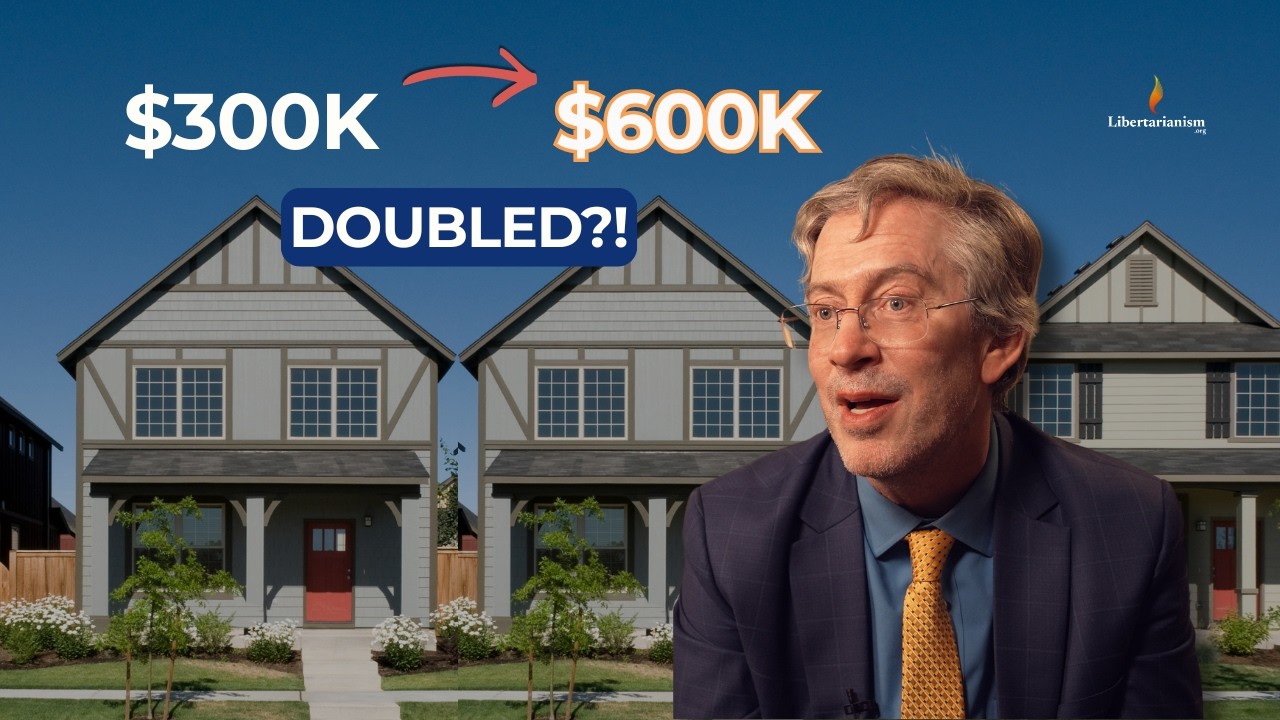
Housing regulation in the United States has significantly driven up costs, with estimates suggesting that on average across the country, these rules have doubled housing prices. This surge occurs because housing represents about 20% of a typical household's income, and its price has risen far faster than inflation for decades. The core argument presented is that this excessive cost increase is largely artificial; if supply had been allowed to respond naturally to demand, prices would not have needed to rise so dramatically. Government intervention, particularly at the city and local levels, treats developers almost like criminals by imposing strict barriers to construction, such as limiting building heights despite available technology or enforcing minimum lot sizes that prevent high-density housing. Additionally, regulations often mandate excessive parking spaces regardless of customer demand and subject multi-family housing projects to extra scrutiny, effectively strangling the industry in desirable locations while leaving remote areas largely unregulated.
The persistence of these regulations stems not just from the self-interest of existing homeowners who benefit from low prices when they bought their properties, but from a widespread societal belief that builders should be treated with extreme caution. This mindset is rooted in the historical "law of nuisance," which placed the burden on neighbors to prove substantial physical harm before restricting property use, a system that has largely been replaced by modern regulations where mere complaints about aesthetics or views are enough to halt projects. While critics point to legitimate concerns like traffic and noise, the transcript argues that these issues are easily solvable through market mechanisms like electronic road pricing or simply moving away from crowded areas. However, people refuse to do so because they value the accompanying benefits of dense living, such as job opportunities, shopping, social connections, and cultural activities, which are lost in isolated regions. Consequently, society is willing to pay a premium for this "package deal" of problems and benefits, even though it results in unaffordable housing.
A critical misconception identified is that many people deny the fundamental economic connection between supply and price; surveys show that roughly one-third of individuals believe increasing housing production would raise prices or make no difference, rather than lowering them. This misunderstanding leads to a lack of concern regarding restrictive regulations. Furthermore, high housing costs exacerbate inequality because housing is a necessity where poorer households spend a larger share of their income on it. When regulation doubles the price of this necessity, it disproportionately affects those with lower incomes, worsening economic disparity. The transcript concludes that the current regulatory framework represents a tragic mistake born from a global trend favoring intervention over free markets, influenced by ideological shifts against private property rights despite a century of successful economic growth under such systems. To fix the crisis, the speaker suggests returning to a system where the burden of proof lies with those claiming harm and requiring evidence of significant physical damage before construction can be stopped, thereby allowing supply to meet demand and restoring affordability.
Read the full video transcript
There's a lot of empirical work trying
to estimate this, and I think a fair
quick version is that averaging over the
entire United States, regulation [music]
has doubled the price of housing. Yeah,
so two things to understand. One is
housing is the very largest item in the
budget, about 20% of people's income
gets spent on housing. And the price of
housing has risen so much more rapidly
than inflation for many decades. And of
course, it's naturally the main thing
people think about with affordability.
What the good news is that that rise in
price in excess of inflation is almost
totally artificial. There's no reason
why it needed to do so.
Supply, if it had been allowed to
respond, would have taken care of it.
And what government has done, government
can undo. Housing is one of the most
regulated industries in the United
States. Really, governments, especially
city and local governments, regard
developers as criminals. Anytime they
want to build housing, the idea is,
"Well, what could go wrong? I can think
of a thousand things to go wrong, and
prove nothing will go wrong." The kinds
of things that they are looking at,
course, you can't build it too tall.
So, even though we totally have the
technology to build hundred-story
buildings in desirable locations,
getting the pieces of paper that allow
you to use the technology is almost
impossible in a lot of places like San
Francisco. And other places, it's still
pretty hard. Just easy by comparison.
Another big regulation is minimum lot
size. You need at least an acre of land
for every house. "What's wrong with you?
You're trying to cheat people by putting
too many houses on a piece of land."
It's like, "Well,
it costs more when you put it on more
land, so a lot of people would rather
pay less and get less land, but
governments generally see it as their
business to prevent that from happening.
Governments do not like multi-family
housing. If you want to build an
apartment then you or townhouses, then
you're subject to extra scrutiny.
Governments try to ensure that builders
put in a lot of parking spaces. Rather
than do the sensible thing of just
charge for parking, they want to make
sure that builders provide it whether
the customers want it or not.
Why do you think the government has
taken on this role and how were things
before?
The most popular story is that existing
homeowners really benefit from this
regulation because they bought when
prices were low and they're enjoying the
really high prices.
That's not completely wrong, but [music]
it's grossly overstated. The main thing
to understand is that almost all humans
favor these regulations. It's not just
homeowners, tenants favor them, too. It
comes down to it is normal for people to
just start thinking about what could go
wrong in this industry and then say
government ought to go and pass a bunch
of laws to make sure that everything is
fine. It's like, [music] well, after all
these laws, the housing may be really
nice, but it's so expensive that a lot
of people just can't afford it.
So that's, I would say, is really the
main issue. It isn't the self-interest
of homeowners. It is the general view
that it would be terrible for society if
builders were not treated like
criminals. Our United States is part of
the English legal tradition and about
700 years ago, the English legal
tradition developed the law of nuisance
which basically said if you're trying to
have if you have a big bonfire on your
property and it's choking your
neighbors, they can take you to court
and sue you. If you have a smelly pig
farm and it's ruining your enjoyment of
your house, you can take them to court
and you can make them stop and so on.
So, but the key thing about the law of
nuisance, first of all, the burden is on
the complainer.
You you presumably you can do whatever
you want unless you're actually crossing
property property lines. And then if if
there's odor or smoke or other harm
that's coming, then it's up to you to
take them to court, and then you got to
prove a substantial physical harm.
This is a system that's was replaced
[music] you know basically regulation
replaced it. What I say we have learned
over the last 100 years is that
the law the law of nuisance was better
than what we have.
And that was the previous system. Like
they're not all crazy, but the they the
burden of proof should be on show that
your complaint is not crazy. And if you
don't do that, then tough luck.
Fun story in Washington D.C.
There something like half of all noise
complaints filed against the [music]
Reagan Airport were filed by one person.
One lunatic who's just trying to shut
down the airport. [music] It's like
look, you live near an airport. We're
not going to shut down the airport. Yes,
it's going to cause some noise. Too bad,
tough luck, suck it up. That's a better
system. How much does regulation
actually increase prices? There's a lot
of empirical work trying to estimate
this, and I think a fair quick version
is that averaging over the entire United
States, regulation has doubled the price
of housing.
It has increased it by vastly more in
the most desirable locations. So, in San
Francisco, it's plausible that it's
multiplied it by a factor of 10. Maybe
Manhattan more like five, Los Angeles
maybe more like three.
Of course, since it's an average, that
means there's a bunch of areas in the
country where it has not been doubled.
And there's even some areas where
housing is still really [music] cheap.
It's basically places that hardly anyone
wants to live. So, if you [music] get
some land out in the middle of nowhere,
then government doesn't bother you. You
could build a whole city out there, and
until the people are there, no one is
going to be reading you a bunch of
rules.
The problem there of course is what good
is it to have the right to build a
skyscraper in the middle of Alaska? No
one wants to live there anyway.
The best way of understanding it is
anywhere that people want to be,
anywhere that is a cool place to live,
government is strangling the industry.
What are some of the misconceptions of
people to maybe be against this kind of
thing? So, yeah, New York is already
too densely populated. Why do we want
more people there?
>> The biggest misconception of all, which
for anyone who studied even basic
economics is hard to believe, but the
data show it [music] very strongly, is
that most people just deny there's any
connection between supply and price.
If you just go and ask people what would
happen if there were to be a 10%
increase the amount of housing produced
in the city, if government has approved
10% more,
roughly speaking, about a third of
people give the right answer, which is
prices would go down, but a third of
people say it wouldn't make any
difference, but a third of people say
prices would go up. So, if that's what
you believe, if you think there's just
no connection at all between production
and price, then it's not too surprising
that people aren't worried about
regulation because they don't think
regulation has a downside,
>> [music]
>> but one that is deep, one that
the more you think about it,
the more inescapable it is, is that
look,
the complaints that people have about
building, they're not totally wrong.
It's true that if you build more stuff,
there's going to be more traffic, more
parking problems.
Yes, you can go and use electronic road
pricing and parking prices to get around
this, but still,
>> [music]
>> that's not that likely to happen. So, in
the real world, you go and allow more
stuff, there's going to be some more
problems, but what hardly anyone thinks
about is yes, but there will also be
some more really good things that almost
everybody likes. Like, what do people
like about there being more construction
in their area? And it's like,
well, let's just start.
>> [music]
>> People like there being more job
opportunities. Places with more people
have more job opportunities. People like
the shopping opportunities. Places with
more people more shopping opportunities.
>> [music]
>> People like the social opportunities.
They like being around other people who
might be friends, people they might
date, people who might be their kids'
friends. And then cultural
opportunities. There's just more things
to go and see and do in more populated
areas. And here's the amazing thing to
think about.
If you realize that there is a simple
way to avoid all problems of living
around other people. Just think about
everything bad about other people. The
parking, the traffic, [music]
the noise, the pollution.
Everyone has a really easy way to solve
these problems [music]
single-handedly and just move to the
middle of nowhere.
Hardly anyone wants to do this.
Why? Because you lose all those good
things I was talking about. You lose the
job opportunities. You lose social,
shopping, cultural opportunities. When I
live near people, I get a package of all
the bad things that people have and all
the good things. [music]
And guess what?
Most people are willing to pay a lot of
extra money to get the package of all
bad plus all good because it is a
package deal. You can't just get good
stuff without bad stuff. But even though
almost all of the talk about housing is
the negativity, it's the complaining.
And yet [music] the very fact you're
there shows that you don't want to be in
a place where you don't have all the
problems associated with people cuz when
you lose the problems, [music] you lose
all the benefits and the benefits are
better than the problems. So, what I'm
[music] hearing
what you're saying is also that housing
is a lot more than just housing. There's
a lot of problems that seem on the
>> [music]
>> surface to have nothing to do with
housing that have a lot to do with
housing. One simple example. There's so
much complaining about inequality.
And it's our terrible unequal society.
Everything's so awful, so unfair. And
yet it's like, "Well, wait a second.
Housing is what economists call a
necessity. A necessity by definition is
a product where the richer you are, the
smaller a share of your income you spend
on it. The poorer you are, the larger
share. So, when the price of housing
goes up, it's a problem for almost
everybody cuz hardly anyone is so rich
where it's just like, housing, it's not
a big deal. But, it is a bigger deal for
the poor because they're spending a
larger share. So, you double the price
of that, that really leads to a large
increase in inequality. Turns what I'm
proposing is like, [music] I think the
best thing would just be to go and admit
we've made a tragic mistake. Law of
nuisance is a better [music] system
where we first of all say the burden's
on the complainer and second of all, you
got to prove large physical harm. It's
not enough to say, I don't like the
style of your architecture, I don't like
the color pink, or even like you're
blocking my view. Like, that kind of
stuff should just be considered, no, too
bad, tough luck, no way. That's going to
lead us to this terrible system we got
right now where housing is ridiculously
expensive.
Why do you think this shift started? Is
it part of a more general trend in the
US of regulating everything?
>> Yeah, it's part of a general global
trend, of course. You know, 100 years
ago, this is the time that socialism is
on the rise over the world. Like, 100
years ago, this is the the time of the
you know, the rise of the Soviet Union.
And the Soviet Union, this is not in a
vacuum. All over the world, you have
first of all,
people that are similar to the
Bolsheviks who just want full-blown
violent socialist revolution. But then,
you have a lot of other people like,
look, great idea, but let's do it
democratically. Or great idea, but let's
at least not have a bloodbath.
All of these are just based upon [music]
this idea of the problem with the world
is free markets and private property.
Look, an idea that
is so at odds with all the experience
they had at the time.
Humanity had just seen the best 100
years of economic growth of all time,
which was largely [music] accomplished
under relatively free markets and
fairly strict private property rights.
And then it's like, so like why is it
that you would think that after 100
years of things working really well that
we should totally change the system? The
Marxist actually the best answer, which
is they had this crazy stage theory of
history of saying, well, each part of
history there's a new system that's good
for it. It's like, no, maybe there's
just one system that's always good and
we didn't have it in the past and then
we got it for a while and it worked and
we should just keep it.