Video summary
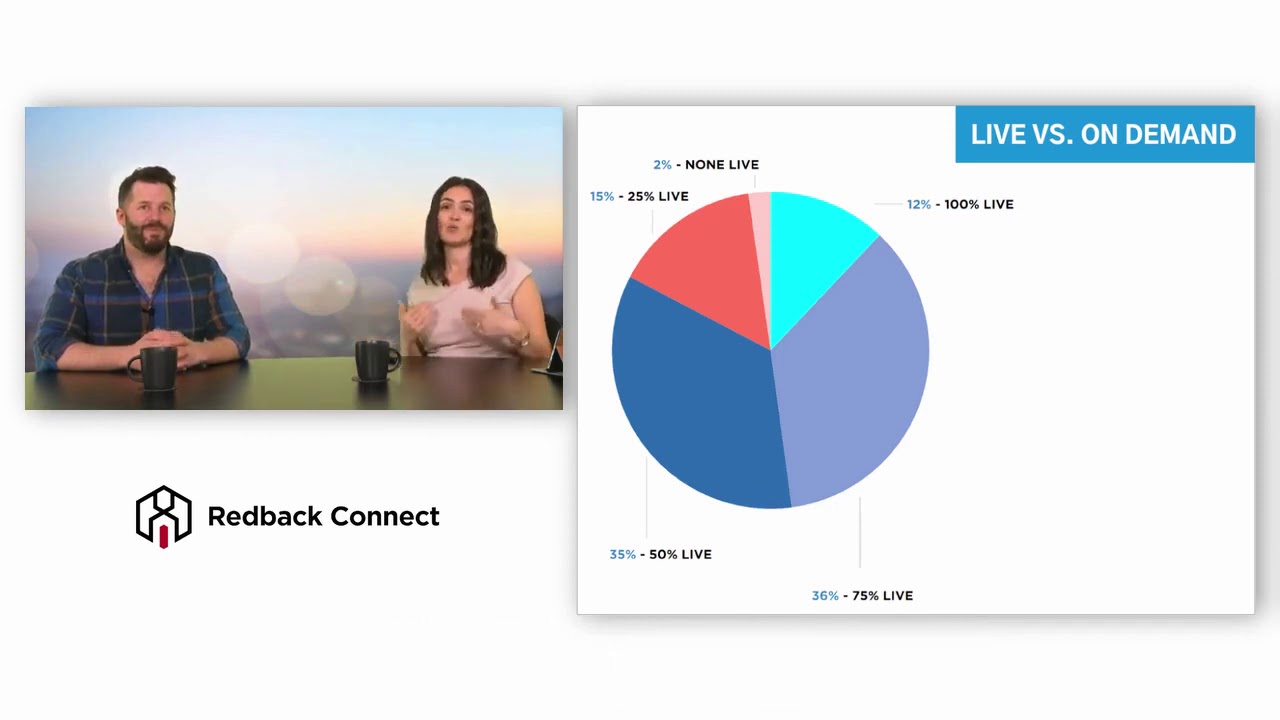
The Redback Report 2020 highlights significant transformations in the digital event landscape driven by the COVID-19 pandemic, revealing a diverse audience split between corporate sectors, not-for-profit organizations, and government entities. While live attendance has decreased to an average of 35% to 40%, reflecting a growing preference for on-demand content similar to streaming services like Netflix, there remains strong engagement with hybrid models where remote work coexists with physical presence. Organizers are advised to maximize success by blending pre-recorded polished sessions with live Q&A rather than relying solely on real-time metrics or technical setups that risk failure due to internet instability. This approach not only reduces risks but also accommodates shorter attention spans and home distractions, suggesting event durations should extend beyond single days while offering "snackable" short-form content for later viewing.
To maintain high engagement levels amidst challenges like drop-off rates affecting 86% of attendees, the report emphasizes that audio quality is far more critical than video clarity in retaining an audience's interest. Strategies to combat disengagement include submitting questions in advance, creating urgency through last-minute releases, and utilizing enthusiastic presenters who understand digital environments better than traditional speakers. Furthermore, scheduling preferences have shifted toward Tuesday and Wednesday mornings with longer one-hour slots preferred for professional development accreditation, although evening events remain popular despite connectivity concerns. The format has also evolved to favor two-person discussions or panel sessions over single presenters, ensuring a dynamic experience that keeps participants actively involved throughout the session.
Looking toward the future, 79% of respondents view virtual formats as equal or superior due to their enhanced accessibility and reach, signaling an industry shift where physical events will inevitably incorporate digital elements rather than replacing them entirely. Success in this new era depends on a unified strategy that integrates live, physical, and on-demand content while avoiding excessive self-promotion at the start of sessions to prevent early drop-offs. Organizations are responding by establishing internal training hubs for presenters, removing email barriers through direct website exports with burned-in captions, and leveraging transcripts for broader marketing reach via blogs. Ultimately, the industry is moving toward a hybrid future that leverages various streaming platforms to extend touch points for sponsors and attendees alike, ensuring that digital events continue to evolve alongside changing audience behaviors and technological capabilities.
Read the full video transcript
hello and welcome to today's red back
webinar where we're going to be
uncovering the red back report for 2020
we're so excited because as we all know
it's been a crazy year for online events
and this is our eighth year where we've
actually gone and discovered insights
and trends into how people run webinars
and what people's preferences are when
they attend webinars
so we know that 2020 has been like no
other the impact of covert has
changed the world of events forever
especially those that are virtual
today is all about uncovering the
findings that have come up in the report
going through them to make sure that you
understand them in detail
and then also providing you with some
tips to make sure that you can run
awesome events that really stand out
from the rest
so we encourage you to participate and
ask questions as we'll be going through
them throughout the webinar
i'd like to welcome michael how are you
good sarah thanks for having me great so
michael's going to be discussing some of
the content with me as we go through
today
and it's great to have you on michael
because we're both very passionate about
different types of events that's very
true and different applications in
events as well
before we get started and get into the
data i really want to encourage you to
submit your questions throughout
so to do that please click on the dark
blue raise hand icon in the top right
corner of your screen
we will also be referring obviously to
the report and some other
accessible material so to access your
copy of the report and also additional
information
you can click on the light blue drop
down arrow and of course towards the end
of the webinar we'll be asking you to
submit your feedback
obviously because we like to improve our
own webinars absolutely
okay so let's get straight into the
respondents and the sort of data that we
collected
so we actually surveyed over a hundred
qualitative
um respondents so we went out and they
completed around a five to ten minute
survey
and if you are online and you do
complete that a huge thank you because
the insights were amazing that we
captured through there
and then we also went back and we
actually looked over 1500 events in the
past 12 months
and we've had such a huge variety of
events haven't we oh god they've all
been
the three standard ones the normal ones
the remote studio and customer venue but
the applications for how they've used
yeah um
have been very varied and this data was
great because it allowed us to
understand how our customers are running
events
but then the other data that we captured
in terms of people's responses
allowed us to understand people's
preferences so combining the two of
those made for some great insights
as you'll see by the graph on your
screen uh this actually goes through the
types of people who completed the survey
so one in three are actually from the
corporate sector
and 42 hailed from the not-for-profit
sector
and i think a big part of this michael
is that we know that
associations and membership
organizations have been using webinars
for so long
and when covert did hit they really
adapted quite quickly because they
already had these in place didn't they
they did or they were able to utilize
their programs for cpd and other stuff
to use other external communications so
it was really great to see them pivot
quite quickly and i know everyone's
heard pivot way too much but we'll say
it a couple of times today so i do
apologize for that
but it was great to see so many people
from the third sector it was also nice
to see seven percent came from
government
and i think stakeholder engagement is
definitely on the increase when it comes
to government organizations
um and the applications as we'll see in
this report have just blown us out of
the water people have been so creative
um so why do we attend events and i
think it's important for us
as webinar organizers and planners to
understand this
when we're creating content to
understand why people attend
and the types of events that they want
to attend so
30 first of all i'll just give you a
stat which i thought was very
overwhelming
30 of respondents said that they attend
over 10 events per month
which is massive which is huge and a
further 34
said they attend six to 10 events per
month so that's more than
two a week absolutely it's more than two
a week but you also got to wonder
have these increase in events just not
just replace the physical trainings and
stuff they were doing face to face
but are people doing even more because i
can't and i think the insight from that
as well is when we did this survey last
year
when we asked people the same question
only two percent
said that they were attending um about
over ten per month
and when it came to those who attended
between six to ten that was five percent
so as you can see there's been a huge
increase from two percent to thirty
percent
and five percent thirty four percent and
that just goes to show how people are
attending and what they're actually
expecting
another thing i'll also note is um we
conducted another survey during hobart
as you know around remote working and
people's um experiences
and 80 of people who have been working
from home said they want to continue
when they re-enter the workforce
and i think we've seen that shift as a
lot of the restrictions have been lifted
as well with people adapting this sort
of hybrid approach approach
where some are still going into the
office and i think it's going to be like
that for events as well
where you're never going to replace that
face-to-face component
and as face-to-face events and physical
events really
come back into play you're still going
to have that hybrid approach because
people want it don't they
they do they do and it allows you also
to expand that physical event
into more touch points as well yeah so a
great hybrid approach is definitely on
the rise
and you know we can see here learning
education development is still one of
the top reasons
um when they're all combined why people
actually attend
so we know that events are on the rise
there's no secret there
um but can we just take a look into how
much we think they're on the rise and do
people that
expect to attend more as we move into
2020 and 2021 oh absolutely i think
looking at the stats and seeing that
they're going to be attending more and
it's just because of the ease of the
technology now
yeah the apprehension of running digital
events a couple years ago where people
are really scared about the technology
they now see it works
so people are looking at their programs
they're looking at what they're going to
be doing
uh 51 expect to attend more which is
great
and it allows people to be a little bit
more creative with what they're trying
to achieve as well so that's the
exciting stuff to see here
um i love the fact that two percent
nowhere near as many
after this and you're always going to
have those people in your stats but i
reckon
we will see a continuation of not just
more around the digital events that we
see the traditional live ones
but a lot more around the on-demand
strategy a lot more around the content
creation strategy because not everything
needs to be live do you think we've hit
our peak
definitely not no no no no i just think
the peak it's i don't think it's going
to be a peak because it's going to be a
ever evolving landscape of how these
virtual events are being done
okay the next section i want to go into
now is live and on demand and i want to
spend some time on this because it's
always contentious when we speak to our
customers and consult with our customers
but it also has seen a massive change
over the past 12 months
so while we're attending more and more
events we're also attending more and
more live and
michael i think this is interesting
because over the past probably five
years
we've seen a dramatic decrease in the
types of people attending events live so
your average attendance rate
has dropped to around 35 to 40 percent
and
that's average and that's just because
it's the way that we digest content now
yes
it's on demand it says netflix
generation we want to watch stuff when
we want to want it
we don't necessarily want to watch it
live and there's pros and cons for both
we understand but it's important to note
that this year
83 of respondents are attending at least
half
of all the digital events they watch
live so that's pretty huge
that's massive i think um and then
you've got people who always register
and wait for the on-demand version and
for everyone out there looking to create
their series
one bit of advice is to make sure that
you don't get hung up on your live
attendance rate
and i think that's one of the mistakes
that many people make early on in their
webinar programs
they tend to focus on the live
attendance and they use that
as a measure of investment so okay how
what am i measuring the success of my
event on
i'm going to see how many people attend
live just because those people are live
it doesn't mean that they're necessarily
more engaged so you really need to
consider your on-demand strategy but i
think it's really interesting that
people
are attending more events live it is and
i think it's also funny to look at the
stats where people still say that
they're registering just for the on
demand
but i wonder how many people that
register for the on demand actually then
go back and watch it
yeah and i think as well like people are
just busy they are they are and they
want to
when people are digesting content and
that very much netflix tall it's not the
click of a button you don't want to be
waiting for something so
so what does this all mean how can this
help us as event organizers and planners
um and when it comes to increasing live
viewership i think you mentioned
pre-recorded content before and that's
on the rise isn't it it is people are
wanting more polished professional
looking content
but it's also removing the burden of
again a lot of our presenters aren't
used to digital events
so that security blanket of being able
to know like look i can pre-record it i
get to review it
maybe edit a bit and then play it back
as if it was live so then it could
either be some live engagement still
or just purely on-demand content but
this pre-recorded content is
it's again people are aware of the fact
that it's not all about the live
you can still have the live element but
you are trying to create a really
professional
piece of content as well that's going to
live past that live event
so pre-record definitely gives you that
ability to do that
i also think and there has been increase
in pre-recorded content and this is also
something to consider when it comes to
planning your events
is because we've seen such an increase
in people attending remotely
so people presenters are attending
statistically the more people you have
present remotely the more issues you're
going to have as far as i'm concerned
so we've got more remote presenters
we've got more unreliable internet
connections
and doing on-demand content just gives
you that peace of mind
but i still think there is room to mix
up your live and pre-recorded content
absolutely look and as you talked about
remote presenters
that's just risk and the more remote
presenters that you have is the more
failure points that you can potentially
have with internet so especially high
profile
international speakers or anyone that's
coming in think about like can i have
this pre-recorded
and then create a polished piece of
content that i can insert into my live
event
and every time that you do that it
removes one failure point
for each one of those that you do so
it's a great strategy to do it allows
you to
also put to ease the presenter's
apprehension for maybe having to
use their own technology because remote
presenters they are controlling their
slides their computer
everything and it can be a little bit
daunting so by removing these things
you're trying to more focus on
making that presenter comfortable and
creating the good content
and so while we all know that
pre-recorded content is great there is
obviously still a place for live
membership
so what are some tips for increasing
live viewers because i think
at the end of the day the pros of live
viewership are there is interaction
the ability to ask questions and
interact with people and
it's also depends on the types of
people's personality i always think
the people who are going to attend your
events live are the ones that are going
to attend networking events
they're the people who want to
participate and engage so we need to
cater to all types of people so how do
we increase live viewership well there's
a couple easy tips and one of them is i
think our standard our favorite one is
get people to pre-submit questions
by getting people to pre-submit
questions it does get them invested in
the event because i want to want to see
if that question was actually answered
online
so that draws them into the event create
some urgency with
simulive vets and when we talk about
simulated live that can be the
pre-recorded content played as if it was
live
but what it also can allow you to do is
instead of having these massive lead
times of like two or three weeks of
registrations
if you have that on-demand content
pre-recorded and created you could do
a last-minute event so there's a sense
of urgency for it so it's like hey guys
this week on thursday you release this
on
monday tune in live we're gonna have
this person yeah it's an easy way of
knocking out quick events if you have
that content pre-done and definitely
that urgency will drive numbers up
because you're not competing against
other things in the calendar
use the blended approach play recorded
files at the end
um have one of your speakers and
moderators appear live to answer the
question so that's combining the cmu
live with
create the content before and then at
the end of it still being in your
presenters that you use to do the live q
a so you don't lose out on those
elements
there was one more that i was gonna say
but it's just completely lost my mind so
move on to it so we also uh mentioned
virtual conferences and applications and
things that we've seen come
out of um the pandemic and the way that
people are being more creative with the
types of events they're running
so what types of events are people
attending these days or have they been
attending over the past six months or so
i i love looking at the stats that we
have right now because i think a lot of
these things people are classifying
as in a digital event as a very broad
spectrum it's very broad it's very broad
and there are the two different
platforms that you look at like right
now we're doing a live webinar
it's broadcast only a lot of the stuff
that we see that came back from the
report
are generally collaborative meetings so
like briefings workshops those are the
two-way communications but
we can see webinars are still number one
yeah 26 percent of people have come in
for that
um the customer meetings at 11 some
briefings like i like the fact that
we're seeing an incline of these but
what's really stood out this year and
forced people to do it as the virtual
conferences yeah
yeah people have done the hybrid
approach for years of streaming a couple
of the keynotes or maybe streaming the
whole thing but having the physical
audience there
people were forced now to take a fully
digital approach to it
and it's pushed our boundaries of what
we were doing beforehand and how we're
going to change the technology
but it forced a lot of event organizers
to be really creative not just for
delivering the virtual events
but also how they're going to benefit
the sponsors and everything and what
they were doing for them as well
yeah and i think you know to the point
here there's
going to be different types of speakers
and topics and
different types of audience and that
should dictate the format of your event
um we've also got a comment here from
one of our audience members that
pre-recorded content looks more polished
and cleaner from an audience
points of view not limited by the
constraints of a live delivery platform
which i think is
you know so valid yeah definitely it
does allow you especially with
look feel branding um especially for
like really important presenters and
everything you get a more controlled
environment doing that so yeah
definitely props almost
the statement there yeah great thank you
for that um henrietta
so tips for taking your physical
conference
nice little segment i know this is so
this is what you're talking about
i'm smiling because you are so
passionate when it comes to physical
conferences and i know that you've
consulted with so many customers over
the past few months
and the biggest thing that um i think
you've taught me is that
just because you do you're you're going
to have your agenda and you're going to
run your event this way
live and in a physical environment you
need to change
the online environment because people as
you can see are attending more events
they're getting shorter attention spans
so what are some other tips for taking
your physical conference online
the number one is reworking your agenda
what you were doing for a face-to-face
event
isn't going to translate well for a
participant experience especially for
asking them to commit to eight hours
behind their desk at home when they've
got kids at home yeah they've got kids
at home and
they've also got so many different
applications for their working
environment right now because they're
not able to physically take themselves
away from their work situation and go to
a conference
they'll still have teams open they'll
still have chat open they'll still have
messages popping up and
oh something urgents come up so you've
got to be quite clever about how you
actually take your agenda
and my recommendations for customers one
extend it
like you have an opportunity to extend
your event now beyond that one day or
two days
it could be a week it could be two weeks
so we're talking about having maybe
three or four different sessions on a
day and then giving people the rest of
their day back to catch up on work
and then just extending that so your
content lives on for longer lives on for
longer it also
allows your participants to know they're
only committing for a small portion of
time
so maybe look at your format like you
would of a physical conference have your
keynotes first thing in the morning get
them really excited but then at the end
of the day
do maybe a panel session or a fireside
chat yeah the other thing is not
everything needs to be live
for a virtual conference you want to
commit to your your
big budget ones so your your keynotes
the really high
i'm losing my words but the really
important speakers
you want them to be live because they're
your draw cards anyone else on the
agenda that you were using for
different streams or different
concurrent sessions have those as
pre-recorded
have them already pre-hosted on the site
or each day release new content
yeah so that in between the two live
sessions you send an email to us
everyone's saying hey guys we've just
now released three new sessions on our
page
go and have a look and then participate
in interactive chat
there's some really fun ways of doing
this and i guess that gives you
more touch points with people so if you
just have like the one day conference
and you have everything online and
people are watching it back to back
you've had one touch point with the
people so that's not necessarily great
for you and your members or the people
you're communicating with but also for
your sponsors
whereas you could potentially have every
a single day um or half a day or certain
sessions with sponsors can't you yeah
you can use pre-recorded content for
sponsor pre-rolls and post roles for
sessions other things like if you are
doing back-to-back sessions and you've
got a break in the middle
why not actually have the sponsor come
on live and talk about why they're
sponsoring the event yeah
using those simple things of dead air
where you were having those catering
breaks so yeah i was gonna say recent
lunch but i meant morning
um you can use that time to your
advantage and actually give more value
back to your speakers
the other things is when you're looking
at the type of technology you're using
for virtual conferences it could be a
mix of a couple different things it
could be studio like we're doing right
now
and remote presenters so the real thing
is making sure you test and test and
test
making sure that you're absolutely
confident with anyone going live if
there is anything potentially going to
go wrong
then you want to look at on-demand um
creating recorded content that you can
play as if live
but i think the absolute number one tip
that we have is hire a virtual emcee
yes we do this for our physical events
we do this for physical conferences you
need to do it for a digital one because
you need someone that's carrying the
whole
excitement and getting everyone um
kind of geed up for your event and they
can be hosting it from a studio like
we're doing right now they can do it
remotely as well
but that's the person that's guiding
your participants through every session
and everything and they should really
bookend them
and so many mcs are now experienced in
the virtual world i know we've had
conversations with so many of them and
if you need advice on um people to
contact feel free to get in touch but
these are people who have really there i
say pivoted
in a time like this and really you know
they've really stepped up their game to
do things virtually and i think
it's really hard for someone who is used
to presenting face-to-face to actually
learn to present behind a camera
and so i think it's important that you
find an mc that's familiar with the
online environment as well to make that
work but some great advice there and i
think it's great that we've now
uncovered the types of people who
responded to the event also the types of
applications that what we're actually
seeing on the rise so virtual
conferences like we said definitely on
the rise
i also predict in the next what's
happening now but the next time we do
this report virtual agm's are going to
skyrocket
um because people are now with the
guidelines provided by asic and whatnot
um and the extension of that people are
now actually attending and holding more
virtual agm's and they're seeing record
numbers so definitely one to watch out
for
i think award shows will also be up
there oh yes award shows we're doing a
few of those as well
okay let's get into the exciting part
which everyone loves um
and i just want to preface this part of
the presentation by saying
these are obviously um this is obviously
um
responses from the people who complete
the survey and when we go through the
preferred days and times and durations
it's important not to get hung up and
think okay this is the most popular date
and time here's when i should hold my
event
it's about looking beyond the data and
seeing the different trends and saying
okay if these are the most common days
why and what does my audience want and
i think as we go through this as well
start to think about how you can figure
out what's going to be more engaging for
your audience so
i think it's also good to point out as
well that with the response you had
over a third of it was for professional
development exactly so a lot of these
times the day of the week and everything
that we're talking about right now
is majority for professional development
so if you're looking at any other event
type it's probably not going to work for
that time so you need to be just
putting that in and i think it's
important to understand when other
people are holding their events and to
remember that
you know there is this thing of webinar
fatigue which people have been talking
about for years and it hasn't happened
yet
and if we keep running um awesome events
and i don't think it will happen
but you don't necessarily want to be
holding your events in peak times as
well
you want to be different the application
as well so we can see tuesday and
wednesday came through as the most
common
times and days of the week that's
usually the case and it has been for the
past few years
but we've seen a drop on thursdays as
well as we head to the end of the week
um and but as we can see the red back
customers over the data that we analyzed
25 percent of people prefer thursdays as
well so
it's really about mixing up your content
and finding out your audience
i definitely think if you've been
running webinars for a while um or if
you're new to webinars
you should be going to your audience and
you should be asking them
when would you like to attend webinars
because it definitely makes
um not only you're getting the right
responses and you're then adapting
whatever you're doing but it also means
that you're asking for this feedback and
that's only a good thing
i also think mondays and fridays i love
monday and friday
yeah you know maybe some people depends
on the types of audiences in terms of
mondays and how hectic some mondays are
for people
but friday afternoons definitely mixing
up making it a little bit more casual
your fireside chat
your panel discussions those sorts of
ones and then we go into
preferred times and this is probably
just a continuation of what we were
talking about because
mid morning has always been so huge
however
i personally think that lunch and learns
and we can see here aren't as popular
popular as they once were yeah
no i love lunch and learns i yes we'd
all like to have that work life
separation sorry um but it's also a nice
time for if you are going to unwind and
you want to do
something it is that time that you can
actually take it and a lot of people
like you look at our customers 29 of
them love the lunch times yeah
yeah which is great to see afternoons
i still think yeah depending on the time
of day when you're choosing to do it
yeah
again to sarah's point and i absolutely
agree is that by going out to your
community or your members or your
customers or anything and getting them
involved early
will also help you achieve greater
numbers in the beginning because people
are invested in the communications
exactly and you need to understand and
most of you would probably know this
already without even asking your
audience
what do you what is your community doing
in the morning in the at lunchtime and
in the afternoon
are they physically behind a computer
are they more the types of people who
actually just want to watch on-demand
content and therefore it doesn't matter
when you want to hold your events
so all this needs to be considered in
the early stages of your events
and evenings as we can see are still
they've always been quite low but we
still have a huge amount of customers
that run their events in the evenings
we do and i think that's but that's a
lot of their community professional
development professional development
having to do it outside of hours yeah
the only thing that i would be talking
to
a lot of people about nowadays is just
with everyone working from home
and not having to like that transition
time from like leaving the office to go
home afterwards and people are trying to
do events over five o'clock or six
o'clock at night
is that's peak congestion on internet
networks at the moment because people
are streaming
yeah so it's again knowing about what's
happening in the environment when you're
trying to do your events as well
and i think this takes us to the next
part which is really what's driving the
shift and i think
the biggest thing that i would say when
it comes to your times and your
um times your the days of the week that
you want to hold your events
is think about what's happening in the
world and how our working habits are
changing and
this is actually for me this quote so i
used to love mid-morning webinars but
working from home
my my days have changed my working hours
have changed
i don't have to necessarily spend time
traveling into the office when i work
from home so i'm working from 7am
i get to i have breakfast i get to
probably just after lunch 1 32 o'clock
and i'm thinking
oh my god i haven't had lunch yet
because you're constantly on and you're
constantly working
you're not going for those coffee runs
with people in your office you're not
standing by the water cooler and having
conversations with people and taking
those breaks you are always on
so having that 3 30 afternoon
you know that's sort of like the new
snack time for me
you know okay can i grab a cup of tea
sit down and watch half an hour 45
minutes worth of content
think about people's working habits and
how they're changing um but then also
you know at that time of the day is your
audience going picking up the kids from
school because they're now working from
home and they have the ability to do
that
so it really really depends on your
audience and like i said you're never
going to get 100 live attendance rate
or if you are it's very well done and i
don't know what you're presenting
but really start to consider this and
consider people's changing habits and
the fact that they're going to continue
to shift as well
nice i think that when you're looking at
the the shift and everything
i always go back to the data and
everything and especially like you just
said
we're not looking for 100 attendance for
the live event
but you are wanting to make sure you're
tracking the on demand so that strategy
around actually getting your attendance
numbers afterwards
and the proof back to the business about
the success of it it isn't the live
stats it's how many touch points like
how many people have actually seen the
content
and that's when you'll see in the first
three months after a live event
if you've done a great job of marketing
getting touch points going back to it
that's when you'll see that drive
yeah and this is also duration as well
so
our events are getting longer they are
which i find really funny considering
the previous year
um we were seeing so many events come up
where during working hours of trying to
go underneath that one hour into the 45
minute mark
but yeah 46 percent of people coming in
60 minute duration back to the one hour
which was
our early days was always one hour for
everything and then yeah massive dropped
down to 33
for 45 minutes i still really like the
45 minutes i'm not committing to an hour
but again
it depends on content this report again
had a massive
contributors of professional development
which would need that minimum of one
hour for cpd
so that does play into it but we can
definitely see that still 33
is a large number for seeing different
types of events coming in
16 30 minutes they have their place
depending on what it is
then 19 minutes so i find really funny
being 35. i think
there definitely was this trend that we
thought was coming around in the past 12
months or 12 months ago
where people wanted a shorter snackable
content and it was these 30 minutes
i think that definitely has a place for
on-demand content so
my attention span for on-demand content
is going to be different than what it is
live so
if you are running these hour events
depending on the type of content
when you do host it on demand consider
breaking that up into different chunks
so you may split it into two
and have part one and part two so people
don't have to actually
invest in an entire hour or even to four
minute segments
yeah if you've got a facilitator that
can really guide your content and you
can have clean breaks when you edit
that's
also another way to sort of mix it up as
well but when we look at the data of um
over 1500 of our events in the past 12
months
here's the average duration of the
events as well which is um also quite
large
it's really large and i think this does
come into play when we look at the
virtual conferences we've been doing
because they are just to be transparent
with other events that we run
an event duration is off the single one
so if we did a full day conference
that's just one event so
and we've done so many of these so
especially for the remote webinars
pushing that up to 73 minutes
massive yeah and then we look at our
studio jobs as well where we had someone
facilitating from a day
also done at our customer venue ones
before we had to stop going to customer
venues
those are generally your hybrid events
so those were those longer
um keynotes and plenary sessions and
everything that we were doing
so that's why our minutes are so high um
but it is it's because people are
utilizing
using the event types differently yeah
absolutely and so once again
interest in data not something that
you're going to treat as gospel but just
really interesting to see
how others are running their events and
how you can adapt that to the way you're
running events so
we're two thirds of the way in we've got
15 minutes left so please ask any
questions that come through
we're going to go into the last section
now and this is a fun
section i think it's all fun guys so
really
let's talk about preferred format
because this is something that um i'm
very very happy to see in the report and
there's a few things where i was like
yes i could have written it myself
um but i think format is definitely
overlooked when it comes to events we
spend obviously a lot of time on content
and presenters and technology
and so we should but the format is also
something that should be played around
with and something if you're running a
webinar program it's good to mix things
up a bit and keep it fresh
and i am so glad that we see moderators
take in front seat
um the fact that we have two people
discussions
as something that's rated higher but
then we've got panel discussions as well
so we're talking what
49 almost half of people prefer more
than one presenter
his music to my ears because it just
makes it so much more engaging
it makes it more engaging and it's
easier for the presenters as well if
sarah and i were just sitting here right
now
by ourselves trying to do this report it
could get a little monotoned you would
lose the excitement but we feed off each
other
yeah we bounce different ideas so having
a format where you have the two people
sarah also does all the moderation for
me so i can't touch the slide clicker
i'm not trusted i don't trust him
because there's a difference but it
means that she gets to steer the
conversation so she knows her talking
points i have my ones as well
and it makes it so much more enjoyable
and you get to actually have fun with it
now it's not gospel there will be event
types where you need to have that single
presenter
and you can't always have a moderator
for it but to you exactly to your point
it's breaking up your content knowing
how things are going to go i personally
love the panel discussions and fire
slide chats more casual approach to them
because slides are needed for a lot of
things but that's not the be all and end
all
if you can carry an event by
conversation it's much more enjoyable
and there are certain events where
there's definitely the need for a
moderator so obviously virtual
conferences we discussed virtual agm's
are crucial
you need to have a chairperson at those
events and also
just consider your presenters and as i
said not everyone's going to be natural
presenting behind the camera
and we'll go into presenters in a moment
but you'll see how crucial it is
that your presenters actually convey
their passion and enthusiasm
and sometimes the best way to do that is
to have a moderator or facilitator and
these can be hired through managed
providers but use someone in your
organization that could be right next to
you
what i have seen michael over the past
few months is a rise in the amount of
ceos taking
um front and center when it comes to
their events and especially when
everything sort of hit us in sort of
march april
and people started to change all their
events and go online
there was an abundance of ceos becoming
the moderator as soon as the webinar
started
hi everyone thank you for joining there
was this empathetic
caring speech around why they've chosen
to go online and thank you for helping
us on this journey
most people renamed their series as well
so it had this really nice feel to it
and i think it's really important to
consider the goal of your program and
the branding of your program as well
um every single time you run a webinar
it is a reflection of your brand
absolutely you know your brand is much
more than just your logos on the slides
it's about the person presenting
and how the moderator is controlling
that and half the time if you're
presenting and it's just a single
presenter
then you probably aren't going to
remember call to actions or time
or technology so you need a moderator to
actually manage that
and they're really underrated and
definitely don't sort of
pinch your pennies when it comes to
moderation
and just on that here's some tips for
moderation as well um
and we've got so much more content on
tips for moderators so feel free to get
in touch if you want some more but
they need to understand the content and
presentation ahead of time
it's not a matter of your presenter and
your moderator just turn up on the day
hi how
are you they need to understand the tone
and the energy and the types of
events that they want to convey and the
emotions don't they absolutely like you
don't want someone to be cold
and disconnected from the content that's
what i mean yeah scripts are not
recommended
however it's his fine line i think with
moderation in rehearsing
and you don't want to be too rehearsed
where you're reading from a script um if
it is more formal maybe an autocue might
be necessary but
you want to have this organic flow and
this connection between your moderator
and facilitator
because it will definitely break through
the technology barrier as well
and also tips on how to guide them back
to the topic if they start to waffle
like i generally do
yeah yeah exactly um and the other thing
is avoiding the long bios and getting to
the point
yeah well look people already know who
the speakers are that generally should
be on your marketing anyway links off to
linkedin
and you don't want to disconnect people
from the content because at the
beginning you've either started doing a
company spew
or you started being too salesy around
the content or anything that's really
jarring to it it should just start
straight away and go into it the only
thing that you might want to do at the
beginning is just remind people how to
engage with the platform
but even that you guys saw it today we
had a housekeeping video at the
beginning so we don't even have to do
that yeah
exactly um keep it simple i say and
focus on that
um well here we go this is interesting
isn't it
oh look like we look at the most
important things at the participant
level
and what they're doing when they're
coming into an event and year on year
this comes in and no matter how much
time we tell our customers
it is the truth it's crystal clear audio
quality is the number one
yep like people are gonna forgive um
a poor video camera from someone's
laptop if they've got good audio
yeah but if they got bad audio people
are not going to stay online that's the
main that's just the rule
it's so much easier to walk away from an
event i know we talk about that a bit
but that's the thing like
you don't want anything that's going to
discourage people from actually staying
online
so number one crystal clear audio number
two
is being able to see the presenters on a
webcam which is great but not always
needed
and that also does come into play that
if your presenters aren't really
comfortable in front of camera
do not force them to have it because
your audience don't need it as much as
that audio
so you are trying to play the strengths
the ability to download resources and
additional stuff from the actual page is
great to see that it's still in there
yeah
um i find it really funny that zero for
being able to ask a
private question i think people are
getting more into the actual public
chats and everything
um and then the ability to connect with
other attendees via open chat
yeah that was at zero as well so just
actually don't listen to me i think it
just reinforces the fact that you
really want um audio to be a priority
event
and i think um having backup plans is
really important when it comes to audio
and testing and training um and we could
do a whole session more on the sort of
technical stuff when it comes to your
webinars
um but definitely some room for room for
expansion
on that topic isn't there but passion is
everything yes it is
so um this is something there's so many
things that have changed um in the
report over the past eight years however
this is something
and i'm you can go back and read every
report it's been the same every single
year
and this is when we ask people what is
the most important thing to you when it
comes to um preferences
and presenters and your events um
presenters are enthusiastic and engaging
um so
this is huge because in an event
an online event people can just close
down your browser and leave
they don't have that embarrassment of
getting up and walking away so it's
really important to understand
what's going to keep them online and
what's going to keep them engaged
and an engaging presenter online
obviously trumps
everything else and it's important that
you have these things you want easy
technology
but you don't need to you can't control
that well you can but your provider who
you work with can assist with that
the content needs to be delivered as
promised but you need to work with your
presenters
to create content and make sure what
you're marketing is the same as what's
been spoken about
but passion and enthusiasm is so
important and as we can see almost half
of the people actually said that
um and also we also asked people around
attendees personal preferences
if they could improve online events what
would they actually want
um so 51 want access to presenters after
a webinar
and we've seen this rise in online
forums after events as well
so people redirecting either to
discussion groups or creating their own
online communities and there's platforms
out there that do that now
22 want to submit questions verbally so
there's sort of two ways to do this
um and that's opening up the lines for
people on the actual event through voip
which isn't really recommended because
you don't know what you're going to get
on the other end
but there is another way where you can
actually have people dial into a
teleconference
and you can have a managed solution you
can have people dial in and ask
questions that way
or video chat as well and i guaran i
don't
i can't guarantee anything um but i
think that
um in the next 12 months we're going to
see an increase in this so
if anyone's watched q a on the abc you
will actually
see a lot of people pre-submit video
questions beforehand
so getting your audience to pre-submit
those questions beforehand and we do
that in the registration like written
but getting them to do that via video
and then playing those videos in the
event i think is a great it's a good
opportunity for you when you've done the
the text based
yeah pre-submission of questions and
you're reviewing them leading up to the
event you're like you know what that
would actually be a really good video
one
reach out to the person who's admitted
you've got their email address and say
hey would you mind using your iphone
yourself doing it yeah i'll put it up
the other thing is like and this is what
i was going to talk about for increasing
live attendance i finally came around to
it
is with that 51 of people who want to
actually have access to the presenters
after the webinar
this is really good to have that
secondary event that happens straight
afterwards
but limited seating so first hundred
people that register
will get invited or first 100 people who
attend the event will receive the
invitation afterwards
to join our linkedin discussion group so
then that way it drives more people into
it because they have another touch point
afterwards yeah absolutely
um and this is just another thing as
well and this also talks to
why do people drop off their events so
86
admit to dropping off events and that's
a reality it's also 20
up from last year as well so we've got
high expectations
here are some things that you need to
make sure you have so the content like i
said make sure that it's shared with
your presenter so you're marketing and
talking about the same thing
if you're running lead generation events
call to actions need to be really subtle
i think and it's more about nurturing
people after your webinar which is once
again a whole different topic
you need to make sure your event runs to
time and i'm a stickler for this and i
understand that we've only got seven
more minutes so i'm going to be really
really um just speed it up yeah i'm
going to make sure that i get there in
the end but if you do run over time
that's okay just let people know that
that's going to be the case and respect
people's time
but i definitely think if i register for
something and i hop online
and someone starts talking about
themselves for about 10 minutes then
talking about their product or service
i'm done
yeah no well it's also with looking at
the um the
increase in volume of webinars as well
if you haven't grabbed their attention
at the beginning
yeah staying online there's another one
happening yeah exactly
and i think yeah i just want to spend a
few moments just talking about the
future of digital events before we get
to a few questions that have come
through
um so you know 79 say virtual is as good
or better
um but what do you think we need to make
sure that digital events are here to
stay and completely compelling
oh look there's i keep looking at the
strategies that we're working with some
customers
and it's not the one size but it's all
or even the fact that you're looking at
replacing all your physical events
it is really having that defined
strategy about how virtual is going to
work with
physical and how live is going to play
in and where on demand is going to play
in
and how you keep getting people back to
your content those are the kind of
the main things you're looking at like
virtual is definitely so a lot of people
saying it's better
and i think that's just because it's
easier access to different speakers
present
it's present it's it's right now we have
it's right at our fingertips
so afterwards people are going to be
expecting the same international
speakers are going to expect the same
events
and so there's going to have to be that
really cool strategy but i think
yeah the definitely not at the peak like
we talked about before but that peak is
going to constantly evolve and i think
it is this unified strategy around
what's live what's tied in with the
physical event can my content be
yeah on demand only so there's a lot of
different touch points you get to do so
but also just be creative you guys are
only limited to your creative creativity
when it comes to digital events
so be bold try something new and i think
the other thing is people's attitudes
are changing and they have changed to
events so therefore you've got
huge potential when it comes to creating
your events and you can have so much fun
with these now
i also think the fact that four out of
10 people have attended for online
entertainment
i think there's going to be a huge
increase in that just to further engage
people and resonate with your
employees especially if a lot of
businesses continue to work from home
so like you mentioned earlier we're
doing a lot of virtual awards now
there's charity fundraisers there's
meet um comedy events as well so i think
you're right it's definitely endless in
terms of what you can achieve
um but i i just want to get to some
questions now um
it is a bit of a meaty report so
definitely download and take a look at
some of those results and feel free to
get in touch if you have any um
questions yeah feel free to connect on
linkedin yeah i just um we've got a
question from belinda around the
findings of the report so
are we going to change up the way that
we run digital events so this is very
interesting um
so belinda we have actually done a few
things um and i've sort of taken
i've sort of extracted a few things out
of this and there's two parts it's what
we're consulting yes to our customers on
how to run their events but also for our
own internal events so
we are experimenting a lot more with
on-demand content
as well so one of the things that we've
done is training presenters is huge for
us
and the report telling us or reinforcing
that presenters
are very crucial when it comes to your
events we've actually created
an online presenter hub full of
on-demand content which we're launching
next week
um and that's on our webinars.com
website which is getting refreshed
so i think for us hearing what people
are wanting and the fact that presenters
are so important it forced us to look at
our content because all of our content
was for our customers
whereas we had to create content for our
presenters to help them
run better events so that's the first
thing the other thing we've done
is we've realized that on-demand content
is important but i also think it needs
to be more accessible and i think
in the past for all of our on-demand
content
people would go watch it afterwards but
they'd have to enter their email address
to join
what we've done is we've changed it up a
bit now and we're giving it access to
everyone so
all of our webinars are on our website
we
export the video file and we actually
caption it so we've got burnt on
captions so
anyone can actually read it and it's
completely compliant and accessible
for anyone and then we actually export a
transcript of our content
and then we create a blog on that as
well for marketing purposes so we're
starting to reuse our content in a
variety of ways
and just get more creative with it yeah
we're definitely doing things
differently with our customers
from the report as well and i think it's
some customers are really open to trying
new things
others are clear of it until they're
forced to do it
and everything but i do think it's
actually a good challenge for us to look
at a couple of these things
and maybe create an example of saying
hey from the report findings yeah this
is what
video questions look like this is and
actually create a dummy
we'll do it instead of a live one maybe
it's an on-demand piece of content but
that'd be a fun thing for us to work on
yeah and the whole virtual agm side for
us has just opened up a huge room across
possibilities a whole new product line
we're working with a lot of peak bodies
as well to make sure that people
are running um successful virtual agm's
and um one of the things we started to
experiment with but we didn't really
continue but i want to continue
is the whole concept of short snappy
webinars on a friday afternoon
and running events at different times i
still want to do webinars and wine
yeah i know he's been begging me to do
that for a while but we'll see
um okay we've got another question so
what are your predictions for live
events making a comeback
so um you just briefly alluded to this
yeah i did and i think they're
absolutely going to be coming back but
there's going to be now
i think every live event will have some
form of virtual element tied to it
whether it's a pre-event or a post event
so you're extending the touch points of
the event
or actually streaming that event out to
people that couldn't travel
um yeah i think event like physical
events are definitely coming back
there's always gonna be a need for them
but they're gonna completely there will
always
i feel have a virtual element somehow i
can't wait for physical events to come
back
i can't wait to choose that glass of
champagne with someone and have a
conversation with them that's different
but i think the thing to remember is in
that for the past 10 years especially in
the
physical events occur with a hybrid
element
so people don't run physical events or
any sort of um virtual
any sort of conferences especially when
it comes to membership-based conferences
unless they have that hybrid event
because it does work and there's so much
success so i feel like this everything
that's happened in the past few months
has forced us into that
and i feel like it's just going to open
up so many possibilities not only for
you as organizers and your attendees but
also for your sponsors as well the other
big change that we've looked at this
year and i never write on time
but we stream to all platforms yeah
that's the other main thing like we're
not limited by this sort of stuff so
when we look at
especially the virtual conferences there
are amazing platforms out there that we
are working with customers now to their
platform of choice
and helping them with the streaming
stuff so yeah possibilities
yeah and we recognize now there's
different platforms for different things
and sometimes our streaming platform
isn't always relevant sometimes we will
actually use another platform that a
customer has so
i think it's about us all working
together to develop great content and
compelling content um to deliver your
message when it matters most
and that brings us to 11 45 and i
promised you guys i'll stay the time
so thank you everyone for joining it's
been great having you online
download the report contact us for
information um but thank you michael
it's great always having fun thank you
sarah i loved it hostess with the
mostess that's me
all right thanks guys enjoy the rest of
your day bye