Red Light Therapy News August 2026: HUGE Developments
Watch on YouTubeVideo summary
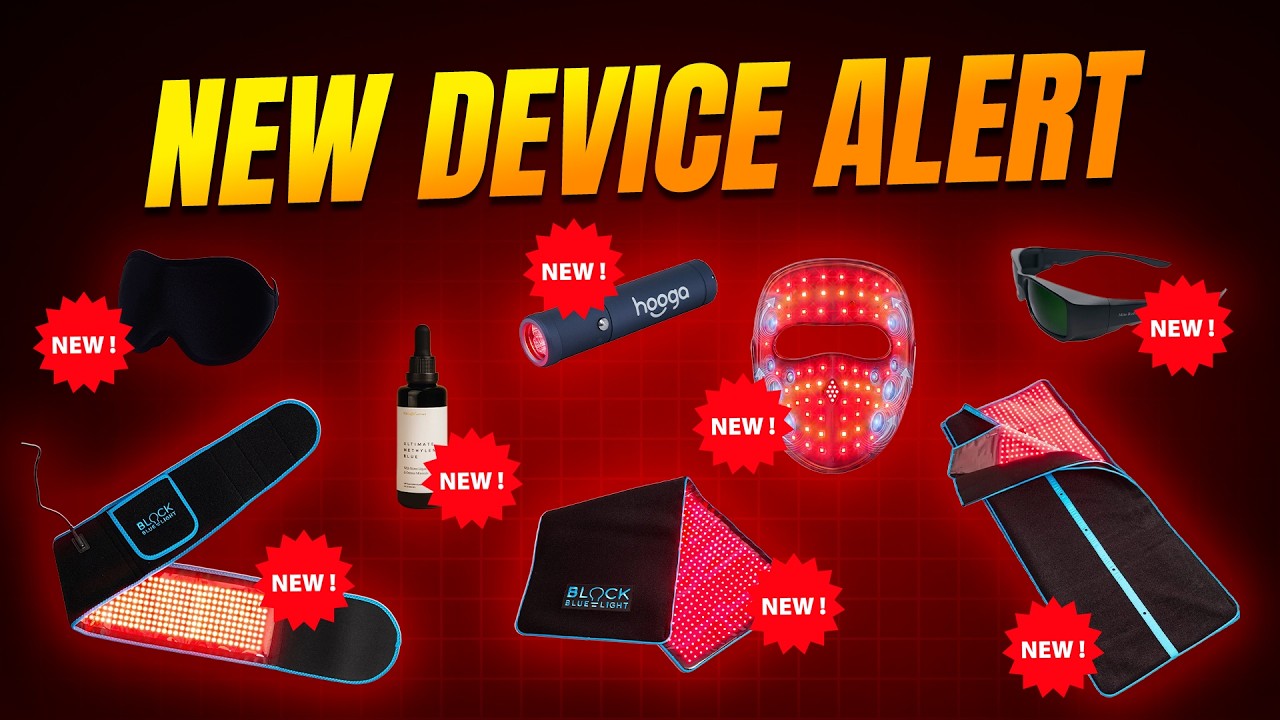
The August 2026 edition of Red Light Therapy news highlights a surge in premium product innovations, particularly in eye protection and wearable devices. Mito Red has introduced the Pro glasses in dark and extra-dark versions designed to shield users from excessive red and near-infrared light when standing close to high-power panels, priced affordably at $29.99. Simultaneously, BlockBlueLight has expanded its portfolio beyond panels to include a pod-style blanket, a mat, and a belt featuring specific wavelengths like 660nm and 810nm, alongside an upgraded sleep mask that emphasizes the importance of darkness for circadian rhythm regulation. Additionally, Hooga has launched a new torch with a precision tip capable of targeting the oral cavity for gum and tooth treatment, as well as the ears for tinnitus relief, offering a cost-effective alternative to more expensive specialized devices.
A significant breakthrough in this month's news is a new clinical study conducted by Vielight regarding mild cognitive impairment (MCI), which serves as a precursor to Alzheimer's disease. Led by Dr. Neda Rashidi and a team of researchers, the trial utilized Vielight helmets equipped with 810nm LEDs pulsing at 40 hertz to treat participants. The results demonstrated notable improvements in memory, global cognition, and mitochondrial dynamics within the brain, alongside a reduction in inflammatory markers like interleukin-6. While the study noted that some minor side effects such as transient headaches or fatigue occurred in both active and placebo groups, these issues resolved spontaneously, reinforcing the safety profile of the therapy while confirming its efficacy in slowing cognitive decline without serious adverse events.
Beyond hardware, the video addresses the growing integration of artificial intelligence in health and wellness, exemplified by Vielight's new patent on AI-driven protocols and their own website's implementation of an AI chatbot to assist users with navigation. The discussion also delves into practical applications for athletes facing high G-forces during racing or combat sports, where light therapy may help mitigate traumatic brain injury risks. Furthermore, the presenter clarifies common questions about using handheld torches for brain treatment on a budget; while acknowledging that holding a torch against the skull is cumbersome and does not perfectly replicate clinical protocols due to wavelength penetration issues, it remains a viable low-cost option if used cautiously and slowly to target areas like the prefrontal cortex.
The summary concludes with an overview of upcoming content scheduled for September, which will cover new Chroma UV products, detailed comparisons between red and near-infrared light dosing strategies, and specialized interviews on female health and fertility led by expert Tracy Donagan. The presenter also shares a personal correction regarding dosing mistakes made in previous discussions, emphasizing the need to distinguish between facial and body dosing requirements to avoid overdosing. As the community continues to explore these developments, from premium methylene blue formulations containing nano liquid gold to the broader framework of combining light therapy with diet, exercise, and sleep, the consensus remains that while individual studies have limitations in sample size, they provide crucial confirmation for integrating red light therapy into comprehensive health management plans.
Read the full video transcript
Hey, welcome to the Redlight Therapy
news for August 2026.
We've got some new products, which is
like a very premium methylene blue
product. And also new Redlight Therapy
mask that doesn't just emit light
through lasers and LEDs, but also
through electrostimulation.
Then there's some new signs on life
therapy for Alzheimer's disease or mild
cognitive impairment.
And a very surprising question that I
got a lot actually in our Facebook group
about using a charged device on the
brain.
Uh which is more focused on yeah, budget
purposes. First of all, some new
products. Um yeah, Mito Red has come out
with uh the Mito Red Pro glasses. There
are two versions. There's a dark version
and an extra dark version. And these
lower the light input into your eyes.
So, if you're like standing very close
to a Redlight Therapy panel, if there's
lots of light coming in, then this can
reduce the amount of red and near
infrared going to your eyes. Pretty
good, I think, for some people who use
the the panels very up close or other
high high power products. Um this one is
$29.99 before discounts, but you can use
the discount link below. And yeah, I've
written about this a lot in the past.
So, yeah, if you want some extra
resources, not just for now, but also in
the for other topics I mentioned in this
video, then check them out below. But
yeah, my articles on eye health on eye
health and eye safety are linked below.
Then BlockBlueLight has come out with
some yeah, quite interesting products
because yeah, it's this is just market
demand. So many people want these
products, and BlockBlueLight had been
focusing mostly on panels in the past,
but they've now started with a new
Redlight Therapy blankets. Which is like
a pod design.
Um it has three different wavelengths,
660, 810, and 830 with adjustable
brightness, 66% new infrared.
Then, besides the blanket, there's also
a new red light therapy mat with the
same wavelengths. And they are offering
a red light therapy belt with the with
different wavelengths, 630, 660, 810,
and 830.
When it comes to the prices, their
blanket is $1,785.
The mat is $1,071
and the belt is 357
euros dollars. But yeah, you Again, you
can save with the discount at the link
below.
Also from Block Blue Light, they have a
sleep mask now or at least upgraded
them. They had them for a long time.
Yeah, technically it's not light
therapy, but yeah, you know I've been
talking a lot about circadian rhythm,
etc. And yeah, not only how you need
light during the daytime, but also
darkness at night. And I personally
cannot do with without a sleep mask
because I'm traveling a lot, different
Airbnbs, etc. And yeah, if you really
want to make sure that you have that
darkness at night, then a sleep mask is
the way to go. And I've been seeing the
evolution and development in the sleep
mask over the years. So this Yeah, the
technology and and the closure etc.
around the eyes has been becoming a lot
better. So I
Yeah, I personally cannot wait to test
out Block Blue Light's
mask. Now, Hooga have come out with a
new torch also with precision tip. And
the precision tip is very interesting
because it allows you to treat the the
oral cavity, right? I've been a big fan
of using red light therapy for oral
health. And so far I have only been
recommending the light path LED because
that is the torch that really has a tip
so that you can treat the gums
individually for instance. You can treat
the gums, you can treat the teeth or
hypersensitivity.
This
Yeah, it's good to see it gets some
competition here in this area.
It's not just for the oral health. You
can also you stick it into your ear for
instance. Yeah, for short treatments.
there is some evidence for hearing loss.
And there is quite good evidence for
doing that for tinnitus, for instance.
The Hooga torch has the 460, 630, 660,
850, and 940. So, five different
wavelengths. Seems interesting,
especially because of the price points,
which is low. And yeah, that may be a
good reason while uh why people may be
buying this. And I'll come back to the
torch later on this video. or Jobs,
however you pronounce it, have come up
with a 60 laser mask. Now, earlier the
40 mask was pretty popular. That was
like a premium option. This mask has
four different wavelengths. It has the
1064 wavelength actually in the near
infrared.
Um yeah, some people are were in the
past a little bit concerned about that.
But yeah, if if you see my recent video
on red light on on facial fat,
I don't think there's any concern there
that you may risk losing facial fat when
using near infrared. And there's a
little bit of a special thing with this
mask of It's not just red light
therapy. This is also EMS,
microcurrents, or
uh electrostimulation.
A few years ago, I did some research
into this topic. And there is some
evidence because back then we had the
like the Solawave wand
and that also uses microcurrents. And
there is some evidence for skin health,
etc., that there are benefits there.
This 60 laser mask costs 869
US dollars at this point. Uh but this
code Alex will save some money off that
uh below.
Then, very interesting, methylene blue.
SaunaSpace has come out with a yeah,
methylene blue product. It also contains
some other ingredients,
uh nano liquid gold, and Ormus minerals.
Yeah, apparently this is like a premium
version of the methylene blue. We have
been getting a lot of questions about
this. So, yeah, recently I decided to
write a short article on the topic
that's out right now on the Light
Therapy Insiders website, so you should
go check it out. My recommendation on uh
methylene blue right now is yeah, start
with the basics, see how you respond to
that, and then actually you may yeah,
want to consider this
space product if you want something
special, but my recommendation is
check how you respond to the to the
individual methylene blue first at a
very low dose, and yeah, you can work up
from there or
try different more premium products, but
the simple methylene blue remains the
basic. Then, Vielight have a Yeah,
there's an article um they have now a
patent on their AI. On their YouTube
page, they explain in a 40-minute video
the ins and outs of that whole process.
It is very interesting to see how much
AI is making an introduction in health
and wellness space. We actually at the
at the Light Therapy Insiders website,
we have a chatbot that uses AI, and that
helps you navigate all of the content on
our websites because there are there are
hundreds of articles on our website
right now. All of my medical content is
still human-written, 100% human-written,
written by me, and fact-checked by me,
etc., but the AI, if you have a specific
question, the AI helps you navigate all
of the content much better. So, check
that out as well as on on our website.
If you go to the website, on the bottom
right, there is the AI
um chatbot.
Now, Vielight have another article also
about race driving. Yeah, where you can
imagine that you're exposed to lots of G
power, right? Also, you need uh elite
cognitive approach performance for that,
like very high
processing speed in the brain because
you need to be able to respond very
quickly. And yeah, it's also a little
bit of dangerous because yeah, you with
a collision or um even yeah, the the
quick movements, etc., there's a lot of
pressure on the body in that way. And I
will tell you that I
uh just did a interview with an expert
of Vielight that will be coming out in
the near future about traumatic brain
injury and related health conditions.
Yeah, even head collision advance during
combat sports, etc. And the Vielight
light therapy on that topic. So, yeah,
subscribe for that if you're interested
below. Some other articles here,
Platinum Melody have just come out with
a handheld panel, the Biomax Go. So,
they have a new article promoting that.
Rouge have a very good article on neck
pain. There's quite some evidence on
that topic right now already, scientific
evidence using red light therapy for
neck pain. And Chroma have a new article
on red light therapy before or after
work out but it's better here. There's
There's lots of discussion around that
over the years. Yeah, I published an
article on that as well plus some
videos.
And yeah, my general conclusion which
Chroma agrees with is that it's better
to do it before the work out.
Now, there is a monthly study.
Vielight have just come out with a
new trial on mild cognitive impairment.
And mild cognitive impairment from the
brain is basically a pre-stadium for
Alzheimer's disease.
Yeah, this research is carried out in
parts by
Dr. Neda Rashidi who is an MD
and also PhD. I've interviewed her
before on this channel. So, yeah, check
that out below.
But also other researchers, right? So,
she's part of a team, Dr. Corinne
Fischer. And the interesting thing here,
yeah, the the the study here is only
available on Vielight website right now.
There's I'll link to a PDF of the
publication below.
Yeah, Dr. Neda Rashidi is part of 14
other researchers. But for you, the most
important thing is they're using the
Vielight helmets. I think it is an older
model.
Yeah. The study does say it uses 810. It
uses five LEDs and an infra-nasal one.
So, yeah, one here and four at other
locations of the brain and one up the
nose. There's 40 hertz pulsing used
here. And the paper shows that right now
in this paper, there's a 75 to 100
milliwatts over centimeters squared at
each of the LEDs in terms of dosing. So,
that's important to remember.
For these participants here, this is the
most important outcome. So, the results
of the study, they showed better memory.
Yeah, with mild cognitive impairment and
Alzheimer's that's often impaired or
gets impaired over time. And as you know
that yeah, it it gets worse over the
over the months and years until it's
it's it's very bad. But apparently here
with the Vielight
at 810 40 hertz pulsing, which is
similar to the gamma device right now,
they have improved memory. They've also
improved global cognition.
Yeah, they used an MMSE test here.
Many different things such as time and
place, attention, calculation with
numbers, recall, language, etc. Then
there's more efficient energy
production.
Mild cognitive impairment and
Alzheimer's disease are also linked to
poor energy production in the brain. So,
but yeah, the researchers here show
changes in mitochondrial dynamics and
also a test that you can do the lactate
to pyruvate ratio.
Apparently that improves with the light
therapy. It can also lower inflammation,
interleukin-6, which is an inflammatory
marker tied to cognitive decline.
Apparently that goes down and yeah,
better network connectivity.
So, for like yeah, it helps the default
mode network, which is important with
like ordinary normal
a normal mental state. If you're not
like focusing, but just yeah, being
normal or relaxed during the day. All
quite good in my opinion. So, yeah, many
different benefits. Video three of the
study, they it shows some other outcomes
as well. Urea,
L-carnitine, etc. So, researchers tested
lots of different biomarkers. And then
said interesting perspective here, they
say that no serious adverse effects
occurred in abstract.
Yeah, that's good. There's also lots of
discussion about this topic about brain
red light therapy in our Facebook group.
Yeah, little bit of a side story, but I
lent out a VILight device to one of my
acquaintances back in the day. It's
maybe two or three years ago, and he
told me he had Parkinson's disease, and
he told me like, "I get some headaches
from this." So, he stopped using it,
which is not ideal
because, yeah, let's see what happens
here in this study. In the VILight
study, they say no serious adverse
events occurred. But, mild self-limiting
events were reported by 10 out of 20
participants, four in the active group
and six in the sham group, that is like
placebo. They think that they get the
real treatment, but they don't. And,
yeah, this included transient scalp and
head discomfort,
headaches or migraines, nasal or
forehead dryness, low mood by fatigue,
and all resolved spontaneously. So,
yeah, in my opinion, although, yeah, of
course, always talk to your doctor if
you're using the brain devices with a,
yeah, neurodegenerative condition. But,
the lesson here, in my opinion, is that,
yeah, some people, also my acquaintance,
they may get a little bit of a headache
or, yeah, fatigue or irritability. But,
yeah, in that case, maybe just go slow,
use the VILight for half of the time
that you would normally do, and then
build up from there.
Yeah, there were also
some in Yeah, so, not everything was
positive in terms of the There were some
outcomes such as tau proteins where
which are linked to Alzheimer's disease
which didn't change. Yeah, we discussed
this topic as well in the in the
interview I did with Dr. Nada so check
that out below but overall very good
that this study has come out that
there's more confirmation now that the
light therapy works for
mild cognitive impairment and
Alzheimer's disease. Of course, it's not
perfect this study. We need more
participants here. There was it's only
10 participants in the intervention
group than in the in the sham group so
the placebo group. Um yeah.
Also caveat here. I always say that we
really need to understand mild cognitive
impairment
and Alzheimer's disease from a much
broader framework which is true for many
complex diseases from from a diet from
exercise from movement from sleep
perspective supplements etc. So
everything can play a part but still
light therapy is an important factor
here in my opinion. And yeah, I also
wish in this study that some other
outcomes were tested. For instance, as
simple something as simple as like an
aura ring for sleep quality. I know it's
not perfect or or a questionnaire. The
Pittsburgh sleep quality index for
instance for measuring sleep quality
daily step count etc. So but I know that
they cannot measure anything and it's
very very thorough this study so that's
pretty good.
Yeah, of course we need more more
studies on this topic with more
participants. For now this study with 10
participants in the intervention group
than in the control group is very good
in my opinion. So that we go to the Q&A.
I already told you that we're going back
to the topic of the torches and yeah,
this is a question that yeah, I caused
myself a little bit because I started
talking about this last year but yeah,
people ask me like Bart what do you
think about using the torch device for
brain treatment? Because that Vlight
device that I just talked about it can
cost into the thousands of dollars and
yeah, I know for many people that's not
affordable. So in many cases
in my opinion, although we need studies
on this to 100% confirm this, but yeah,
there's no
no reason to assume why this wouldn't
work.
So what you would do is for instance at
the prefrontal cortex, the CEO of your
brain basically, put a torch there, hold
it for a few minutes,
see how you respond,
do it again in like 3 days and yeah,
treat your brain
like this brain area, the prefrontal
cortex, treat it for
yeah,
for a few minutes again with and that
area is really involved with abstract
thought, planning, impulse control, etc.
So
yeah, the big benefit here is that you
can use a device that that starts at
like maybe $200 for like a Hooga torch
and goes up to like yeah, maybe four or
$500.
Hooga has a torch, Chroma has a nice
torch right now, Lightpath LED has a
torch and probably some other companies
as well, but at least here you have few
options. My recommendation there is that
it can work and it very possibly works
really well. But you have to go slow and
there are some downsides as well because
yeah, first of all, you're not really
recreating the exact protocol that's
used in the studies. So like the Vlight
device that I talked about, it has five
LEDs at different locations of the of
the brain, right? You're not
recreating that exact protocol of how
it's applied for like 20 minutes or 30
minutes to the brain.
Secondly, it is also very cumbersome to
hold a torch device here like if I
really want to treat properly, I may
need to hold it hold the torch here at
the prefrontal cortex for 10 minutes,
then hold it at the back of my head for
like cerebellum treatment or or the
lower part of the neck for 10 minutes.
So, that's very cumbersome. It's not
really a great solution. So, there are
downsides to this. But yeah, I can
imagine if somebody really is is on a
low budget, that you could use a torch
device for that treatment. Now, there
are other downsides as well because like
that Vlight device for instance had a 10
nanometers only.
And if you're using a torch device, then
there may be some red light red light in
there, right? Which doesn't really
penetrate the skull really well. Or
there may be blue light in it. So, it's
a little bit yeah, it's an imperfection.
But I would still say that the torch
device is
in my opinion a pretty good low budget
solution if you go really slow. Of
course, this is not medical advice, but
if you go really slow and build up from
there. And yeah, start reading like even
the speech areas, the prefrontal cortex,
the cerebellum, etc. Start reading these
areas yourself with a torch device. And
so, then we come to almost the last part
of this video upcoming
content of ours. First of all, Alex has
a video coming up about the many
different Chroma devices. They've
released some really nice products, I
think in the last two years, 2025, 2026.
Some UV light products which I I
personally am a big fan of.
Of course, in the correct context, in
the correct uses, etc. Yeah, even some
some some indoor lighting
which is really not that good often if
you're just using the standard LEDs that
are in most houses. So, that's great.
Like a desk lamp that can increase your
focus,
keep you awake, etc. during the day and
wind you down at at night. Then there's
a video from me about red and near
infrared light comparing both and yeah,
in what circumstance you would need to
be use one of these.
And a video about from Alex about
dosing.
Yeah, he said he says he was wrong about
something something very important and I
think it is about the different dose
that is needed by the by the face and by
the rest of the body. And yeah, if
you're using panels, then you can
overdose the face in many cases. We have
published a lot recently. Uh, first of
all is my methylene blue article that I
already mentioned. Alex has a review out
of the Rouge Nano, which is pretty
interesting here. Uh, handheld the
panel. Apparently, it's one of his
favorites for a handheld panel.
Theoretically again, handheld panel, you
could also use that for the brain,
right? But it is a little bit, um, yeah,
cumbersome, I think, to even hold that
there. So, I would still go for a torso
device, but yeah, handheld devices are
very good for like joint treatments, uh,
travel, etc.
Alex has a Light Lab interview with a
with professionals from a full 10X Lab.
Then there's my interview with Tracy
Donagan on light therapy for female
health. And this is really a specialized
topic. Tracy Donagan, she has years and
years and years of experience working
with women on fertility and other female
health issues. So, I don't really feel
qualified to,
uh, yeah, make judgment on that. So,
that's why I interviewed Tracy about
this topic. So, go check that out if
you're interested about that. And Alex
has an a review of the Masam Aura. So,
yeah, um, these videos that just came
out, you can check them out to the sides
of me and we'll go and see you ahead in
the September news radio and probably
Alex should be back from his holiday by
then.