Video summary
Knee pain is a widespread issue affecting 25% of adults, with the prevalence rising significantly as people age due to conditions like osteoarthritis, meniscus tears, or ligament injuries such as ACL damage. While red light therapy has shown promising results for many, it is crucial to understand that there is no single "one-size-fits-all" solution; treatment effectiveness depends heavily on identifying the specific structure causing pain, whether it be the joint itself, surrounding tendons like the quadriceps tendon, or ligaments. Current evidence strongly supports using near-infrared light within a wavelength range of 800 to 1070 nanometers and delivering doses between 20 and 30 joules per square centimeter for optimal results in cases involving deeper tissues like osteoarthritis. Although some trial and error is often necessary to find the perfect dose, this specific protocol generally offers a safe and effective starting point that can reduce pain scores by two to four points on a scale of ten while improving stiffness and overall function.
The scientific backing for red light therapy in knee care extends beyond simple pain relief; studies indicate it helps lower inflammation, enhances blood circulation, and promotes tissue regeneration. Research involving tendons and ligaments suggests that combining high-intensity laser or LED therapy with exercise yields the best outcomes, significantly increasing range of motion and reducing disability. For instance, clinical trials have demonstrated that active treatment groups experienced substantial pain reduction and improved knee flexibility compared to control groups over short periods like two weeks. However, evidence regarding specific structures like the meniscus or ACL reconstruction remains less robust due to a lack of large-scale human studies, meaning while individual case reports are positive, broader recommendations for these areas should be approached with caution until more comprehensive data becomes available.
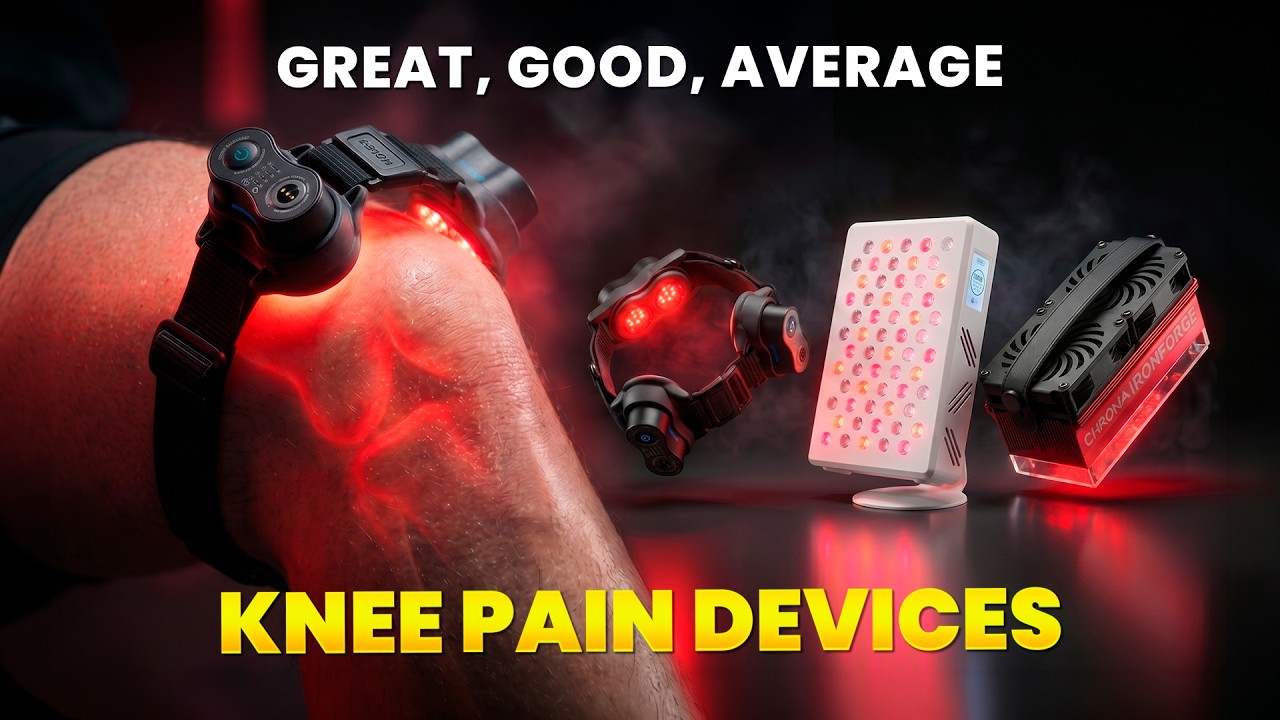
When selecting a device, anatomical fit and power output are critical factors because the knee is not a flat surface but a complex joint requiring targeted treatment from various angles to reach deep structures effectively. Devices like the Knee On Move Plus stand out as top recommendations specifically designed for this purpose, allowing users to precisely target different tissues such as the kneecap or internal joints without needing excessive maneuvering. Other powerful options include high-intensity devices that can deliver higher doses beneficial for deeper inflammation, while handheld units offer affordability but require more time and careful positioning from multiple sides of the knee. Additionally, wall-mounted panels may serve as a secondary option to treat surrounding muscles in the upper and lower legs, addressing potential dysfunction linked to tendon issues, though this approach has less direct clinical evidence compared to focused joint devices.
Ultimately, red light therapy should be viewed as one powerful component of a holistic management plan rather than a standalone cure for knee pain. To maximize benefits, users must integrate lifestyle changes such as maintaining a healthy weight through exercise and hydrotherapy, ensuring adequate protein intake, managing sleep quality, and supporting gut health to bolster the immune system against inflammatory conditions like rheumatoid arthritis. Nutritional support including Vitamin D supplementation and evidence-based compounds like glucosamine or creatine further complements light therapy efforts. By combining appropriate near-infrared dosing with consistent movement and proper nutrition, individuals can achieve significant long-term relief from knee pain while avoiding reliance on invasive procedures like joint replacements when possible.
Read the full video transcript
Hey, today we're going to talk about the
best red light therapy device for knee
pain.
And yeah, that's a that's a topic that
will influence many people when they
once they get older. Unfortunately, I'm
not affected yet at 8:39. But yeah, who
knows? Maybe I need the video in a few
years time because
I injured my knee or
I have maybe developed osteoarthritis,
which are very different cases
of knee pain and that's something we'll
get into in a second. We are affiliated
with some of the companies in this
video. We earn a commission if you use a
discount code or a discount link that is
listed below. We got these products free
of charge. All our opinions are our own
and this is not medical advice. Now, my
conclusion here, just to give you the
basic information first,
um as as I said, knee pain there's not a
thing such as knee pain. It depends a
little bit on whether you have like
meniscus pain or knee osteoarthritis or
the ligaments, the
um yeah, medial cruciate cruciate
ligament or the ACL for instance can be
affected.
But 25% of adults have knee pain and
that number is increasing right now and
yeah, the risk increases with age. So,
even though at age 39 right now, I may
not be affected, um yeah, at 50 or 60
and it the statistical likelihood that I
personally am affected despite exercise
etc. is goes up.
Uh right now, the knee osteoarthritis
which affect many people has a pretty
good evidence-based and yeah, I refer to
my video on that topic below or at least
on osteoarthritis in general, so check
that out if it's out already.
Right now, the new infrared range
between 800 and say 11
1070 is is has the best evidence with
doses between 20 and 30 joules over
centimeter squared. If you don't really
know what that mean, uh check my content
on dosing below in the description. And
yeah, there's a little bit of trial and
error warranted. That's the case. So, if
that dosing range doesn't work out,
maybe you need to do a little bit less,
maybe you need
to do a little bit more. And then other
structures of the knee, such as the
meniscus or
yeah, there's very little evidence and
also on some of the bands or ligaments,
there's very little evidence on on the
tendon that move from your upper leg to
the lower leg of the quadriceps, the
patellofemoral
tendon and ligament later
that there's there's more evidence
there. So, it it will work well there
with a combination of amber red and near
infrared.
But, I would say in general the
treatment protocols are all over the
place, but I think in general with near
infrared with like a moderate dose, you
cannot go wrong.
And my conclusion then is that yeah, the
Knee on Move Plus is probably the best
device because it was originally
developed for the knee.
Um you can really target structures very
specifically, like like the quadriceps
tendon for instance or the the joint
inside the joint of the of the knee.
It's great.
The Chrome Iron Force is great here in
my opinion, especially if you need a
little bit of higher dose or you want to
target very specific structures, that
that's great. And a handheld device is
pretty good as well, but you will need
depending on the knee, you will need to
treat
um yeah, from different angles. So,
put it at the side of your knee, in
front of the knee at at the at the other
side of the knee for instance. It may
take a little bit more time, but it's
it's it's
yeah, it's a very good affordable option
in this case. And like I said, overall
my recommendation here is a dose of 10
to 30 joules of cm² with near infrared
predominance. But, don't forget about
lifestyle and nutrition. I'll get into
these in a in in yeah, in a second.
So, if we look at the knee
uh we can see many different structures
such as live different bands or
ligaments at at the side of the knee in
the front of the knee for instance and
in many different areas different bones.
Yeah, the quadriceps tendon for instance
that can be
so the muscles above the knee with the
tendon that moves over the knee over the
kneecap the patella.
With the ligaments attached so all of
these structures whether it's the
muscles which is a little bit more rare
or the attachments of that muscle on the
patella and the ligaments there
yeah quadriceps tendon. Which is more
rare to be affected the ligaments at the
side of the knee can be affected the
meniscus which dampens like the
pressure.
Within the.
Femur the thigh bone and the tibia on
the lower leg. So yeah all of these
structures can be affected and depending
on the condition the
even the physical therapy treatment I've
seen these patients myself as a physical
therapist.
Working in a hospital and in private
clinics for instance.
But also yeah the treatment will differ
in physical therapy but also slightly in
terms of light therapy treatment and
we'll get to that in a second. So why
does knee pain matter?
Like I said 25% of adults are affected
that number increases has increased by
65% over the last 20 years.
It costs lots of primary care visits.
The osteoarthritis affects 700 million
people.
And yeah other issues in include the
patellofemoral pain meniscus issues in
12% of the population.
So that is like the joint structure
between the
femur and the tibia there's a meniscus
that dampens the effects it's a little
bit of an oversimplification but it's
like a shock absorber in a way.
And that is tear torn in 12% of the
population so.
Together with knee osteoarthritis,
meniscus problems, um
ligaments or band problems, there's
there's a big part of the population
that develops problems here with age.
And I will say with yeah, the intense
exercise that I do, I'm also in that
category. So, I would need to be careful
over time.
And
the knee osteoarthritis mostly affects
people over age 55. And yeah, in in for
many people that is like moderate or too
severe and rehab would
would help. And many people
walk around with knee osteoarthritis
that's untreated. So, they need new
solutions.
And yeah, because of the knee
osteoarthritis, knee replacements have
also become very popular recently. I
will briefly go over my other video on
osteoarthritis as well, but
many of the things are already
mentioned.
Uh there's great
pain-lowering effects here. Pain scores
generally are reduced by two to four
points on a scale from zero to 10. So,
zero is no pain, 10 is the maximum pain
that you can imagine.
And pain is reduced by yeah, by 20 to
40%, which is a lot. Uh so, if you're at
at like a seven in the beginning, which
is like moderate to high pain, you go to
the to a four, which is
um
yeah, a low pain basically, which is a
big improvement. There's better
better stiffness, so less stiffness, a
lower disability. We need a lot more
research, but right now, yeah, there are
many mechanisms such as
inflammations, blood circulation, tissue
regeneration that shows that
for knee osteoarthritis, there are very
good effects.
Um
yeah, here in knee osteoarthritis, the
most important knee condition, it's best
to combine it with exercise therapy or
hydrotherapy where you're swimming or
exercising in the water.
And
uh a brace
the high intensity treatments do better
here. And like I said, the newer
infrared rays between the 810 and 1070
nm
range works best here.
There are many unknowns
um around dosing still. Actually, here
some heating of the tissues because
you're using higher powers devices will
will actually improve the treatment. And
frequent treatments are best. So, yeah,
if you can do like four or five five
times per week, that that's probably
better.
And after a treatment period, I will say
that the study showed that the results
last for many months. So, yeah, you can
treat for like
a month or two or three and then get
results for like three or four months
after that. But ideally, you keep
treating yourself just like exercise.
You You shouldn't stop with it.
Then there are some other reviews on
arthritis. Uh for instance, yeah,
they're very good effects there for
overall um
results uh such as
uh lower inflammation in both animal and
human studies.
I will quote here. And yeah, here again,
there are questions about the specific
parameters such as wavelength, dose,
power density, irradiation time, and
treatment site.
Uh but light therapy PBM
photobiomodulation or red light therapy
in common language has been shown to
reduce pain, swelling, and morning
stiffness indicating its ability to
suppress arthritic inflammation.
But yeah, not all studies show great
outcome, but overall
um
the the effects are
very good. And
so, this review was from 2023.
There was another review from from the
year 2000, but
um yeah, I decided not to include that
because it's too old.
Then
that's I I'll go So, that's knee
osteoarthritis and arthritis. Now, let's
consider the the tendon that runs from
the upper leg to the lower leg. And here
there's a study with 1064 nanometers, 45
participants.
One of them is the high power laser and
exercise group. That's group number one.
And here they say that group number one
was found to be statistically more
effective than other groups in reducing
pain,
increasing knee flexion, and increasing
lower extremity function. So,
pain, range of motion,
and the function, the ability to use the
knee all went up.
There were 10 treatments over 2 weeks.
And again, the message here for the knee
is to combine exercise and lasers or
light therapy in general.
And again, the medium to high dose works
Yeah.
Pretty well here, but it's quite
complex. And read the full study if you
want more information.
The citations are listed below, by the
way.
Then there's a study on the on anterior
knee pain, on the front of the knee,
on in combat officer in police combat
and police officers. 26 participants.
The groups are a little bit Yeah,
complicated, but
the active treatment, the the pain scale
between 0 and 100, they it was reduced
by 13 points in the active treatment
groups. They used eight treatments over
4 weeks.
So, that's
two treatments per week. And again, the
dosing is quite complex here. Read the
full study if you want full info, but
here again, the Yeah, the
light therapy, a combination of red and
near infrared, worked pretty well.
Then again, a combination of in this
case amber lights and near infrared
lights,
two groups, a light therapy and a sham
group, three times per week treatment
for 4 weeks. And again, better
reductions in pain in the light therapy
group.
And yeah, high intensity lasers work
well here again.
Then there's a study on non-specific
knee pain from 2014.
Again, a very weird dosing protocol.
Read the Read the full study again, but
a combination of red light at 640 875
near infrared and
9
05 nanometer with super pulsing, so it's
all complicated.
But overall,
yeah, there was a questionnaire used in
the study, the SF-36 physical component
summary.
Uh that that
Yeah, that distinguishes between
physical functioning,
health, bodily pain, general health, and
overall health and functioning improved
and pain was also lower after the 10th
light therapy treatment.
And then there is a general knee pain
study from 2009, also 810 nanometer
light.
So
Now, then there's a general knee pain
study from 2009 where they used an 810
nanometer light. Again, complicated
dosing, so it's not like
straightforward, but again, the overall
the
results were very good for pain in this
study. And then one last study from from
this year that I missed, but it's yeah,
it wasn't found in Floddy My Ice Cream's
Excel sheet. 60 women of ages between 18
and 25
with lasers on very specific points. And
both group
Both groups exercised twice treatment
per per week for 4 weeks. The
intervention group had better flexion
and extension, so that's the movement in
the knee.
And
better pain levels. So then there are
some other reviews on tendinopathy, so
that's that's
tendon pain. A review from 2022.
Uh
It includes 18 earlier studies and yeah,
here this review which
which contains earlier studies analyses
and integrates earlier studies on the
topic here they show again that light
therapy reduce pain and disability in
the lower extremity tendinopathy so
which can include the knee.
And yeah, I will say that some of the
other studies from 2024 2025 also show
very
promising outcomes. Then I will lastly
say a little bit about this.
There are some yeah, individual studies
sometimes in animals on the meniscus on
some of the ligaments on ACL
reconstruction
which is the the ligament in front of
the knee.
I won't go into full detail here because
there's just not enough
evidence because it's often one one
single study. I will say that it's
generally positive with pain reductions
etc. But I I cannot give it's not too
actionable because ideally I want yeah,
multiple studies in humans on these
topics.
So, yeah.
Given all this evidence I just went
through let's look at the criteria
that we want in a device that I'll yeah,
go into a little bit more detail here. I
only give you the device that I think
are best but let's look at this.
Ideally we want devices that target the
knee structures pretty well. So, yeah,
something that fits the knee
the anatomy of the knee because it's not
like a flat surface. It is like a round
structure. So, ideally you yeah, you
want something that is able to target
that.
Uh you want you would want to target
different structures such as like the
the the tendon in front of the knee on
the kneecap for instance or like the
joints the meniscus inside the knee by
placing devices on on the anatomy of the
knee. Then there's near near infrared
predominance because yeah, as we have
seen near infrared works slightly better
in this case adequate power especially
for deeper tissues so stronger devices
might be slightly better, especially
with deeper structures such as the
meniscus or knee osteoarthritis, you
would want sufficient power.
And a little bit of thermal build-up is
pretty beneficial and not not
detrimental.
Which again leads me to the best
devices, the Kemble Move Plus, because
you can target almost any knee tissue
with that.
The Chrome Iron Far is pretty good
because it's really powerful, near
infrared based, and you can really move
around the knee at any tissue that we
would you would want to target, right?
All of these devices allow for like my
optimal dose between
5 to 10 J of cm squared at very least to
up to 30 J of cm squared, potentially
more if you respond better with more.
You can certainly, yeah, test that and
try it and then see if it works. Keep
continuing it. If If it doesn't work, go
back to my recommended dose here.
And but panels will should work
relatively well as like a second
alternative, whether it's like a
wall panel or body panel, especially for
like surrounding tissues. Although this
this hasn't been shown in studies, so
yeah, don't hold me down to it. But with
[clears throat] with a panel, the
benefit is that like all the muscle
muscles in the upper leg and the lower
leg will be better targeted than with
like a yeah, like a Kemble device, which
is more aimed at the joint itself.
So, yeah, and it's not hard to imagine
why you would want to treat surrounding
tissues too,
because um yeah, if you have like a
tendon issue at like the patella, the
kneecap, then it's not hard to imagine
that there may be some dysfunction with
the muscle that's attached to the tendon
as well, right? So
that's my recommendation here. Also,
again, don't don't forget about
lifestyle and nutrition, movement,
exercise, weight management, especially
with osteoarthritis. So if If like
overweight or obese, that's a problem.
Uh the more
and range of motion, so you need to move
the knee a lot. Immune system, gut
health, especially with uh rheumatoid
arthritis.
Sleep quality, protein intake is
important. Vitamin D with any type of uh
arthritis.
And supplements such as creatine, uh
adenosine, glucosamine, and chondroitin.
These are all all have some
evidence-based. So, don't just focus on
light therapy, focus on other
interventions as well. And lastly, yeah,
I use light my ice guns my methodology
lovely. I use light my ice guns and gel
sheet on this uh on joint arthritis,
joint osteoarthritis, and pain knee. Do
it those were the search terms. You
could check the
studies yourself for that. And also,
yeah, more broadly some other reviews on
on knee health in general and PubMed
searches for knee pain.
Citations lastly, and yeah, if you have
any questions, leave them below.