Video summary
The Real World Crypto 2020 conference highlighted critical vulnerabilities in modern communication and navigation systems, emphasizing the necessity of formal methods to ensure security. David Basin demonstrated how model checking tools like Tamarin Prover were applied to analyze the complex 3GPP 5G authentication protocol, reducing over 720 pages of documentation into roughly 500 lines of verification rules. This rigorous analysis uncovered significant flaws, including an omission in binding subscriber identifiers that could lead to billing errors and a tracing attack where replaying error messages allowed adversaries to track users despite the use of temporary identifiers. Basin concluded that such formal methods are essential for catching subtle design oversights before standardization is finalized. The session then transitioned to discussions on WPA3, where speakers revealed that timing side-channels during password verification could still enable offline dictionary attacks against Wi-Fi 6 and early implementations, even after mitigation attempts like fixed iteration counts failed to fully eliminate variance in code paths.
Further investigation into WPA3 security exposed a range of implementation-specific weaknesses beyond simple timing leaks, including reliance on system time for entropy which poses catastrophic risks, denial-of-service vectors through expensive computations, and downgrade attacks facilitated by curve selection flaws. While the Wi-Fi Alliance issued guidelines prohibiting side-channels and updated standards to enforce constant-time methods that exclude MAC addresses from hash-to-curve calculations, fundamental issues regarding transcript inclusion in key derivation and backward compatibility remain unresolved. The consensus was that although new drafts address many of these problems with costly countermeasures, widespread adoption remains uncertain due to the persistence of vulnerabilities like "trustful first use" requirements for downgrade prevention. These findings underscored that simply updating standards is insufficient without addressing deep-seated architectural choices in open-source implementations and ensuring robust entropy sources are universally adopted across hardware manufacturers.
In parallel, the conference addressed spoofing risks within Global Navigation Satellite Systems (GNSS), noting that GPS signals can be easily manipulated for trivial applications like Pokémon GO but pose unacceptable threats to critical infrastructure due to bandwidth limitations of approximately 120 bps. To overcome legacy constraints restricting authentication to only 40 bits and making public-key cryptography impractical, the Galileo project implemented a symmetric key hierarchy based on Merkle trees where roots of trust are hardcoded into devices and authenticated via periodic digital signatures from satellites. This system utilizes hash chains lasting about three months with time-frame references acting as salts to generate effective keys truncated to 90–128 bits, while Message Authentication Codes were reduced to 10–32 bits based on security analysis proving sufficiency despite truncation. The protocol allows receivers to authenticate location data by verifying MACs against current effective keys and validating key transitions through hashing against previously authenticated roots, effectively managing the tight time windows required for secure navigation without relying on impractical signature sizes.
Despite these innovative solutions using SHA-256 and ECDSA with support for various hash functions, concerns remain regarding future quantum attacks as post-quantum signatures were not yet included in the standard. The Galileo system relies heavily on physical mechanisms to handle signal jamming and delay rather than cryptographic defenses against replay within tight windows, allowing variable delays up to five minutes for different use cases but lacking backward compatibility with older protocols without risking downgrade attacks if non-compliant devices exist. Ultimately, both sessions converged on a central theme: the transition from theoretical security models to real-world deployment requires continuous vigilance, as even minor oversights in protocol design or implementation can lead to severe privacy failures and infrastructure risks that only rigorous testing and adaptive standardization practices can mitigate effectively over time.
Read the full video transcript
all right so we already just ready to
start the third day of real-world crypto
and our first session today is on
wireless protocol security and our first
speaker is David Basin who's gonna talk
about 5g security so David all yours
thank you so I need a clicker is this
the just the right one
somebody took the clicker I'd love to
give a talk but we need new tactics
occur did you take it okay it's a
pleasure to be here and to talk about
work on model checking 5g security this
will actually be a talk within a talk
the outer talk will be on the importance
of formal methods and particular model
checking for security protocols and I'll
introduce some techniques that may be
new for some of you that I think can be
very important for the real world crypto
community the talk inside the talk will
be an application of these techniques to
5g and the security standard within 5g
the work I'm talking about is a large
collaboration it involves different
teams also international across
countries
one is the team of researchers who have
worked together with me on the tamarin
project and I listed them here tamarin
is a model checker and I'll tell you a
little bit about it and it's been under
development for over eight years the
second team which I'll talk about and
there's some overlaps are those who have
worked with me on the 5g on modeling and
reasoning about the 5g specification v t
is a huge specification we took a number
of years to follow the formalization of
that and that also took a fair amount of
manpower so big thanks to those people
who worked with me also I just like to
mention that for some of the sites I'm
Tamara and I'd like to thank calves
because their slides that I bought
borrowed from him
let's begin with security protocols and
the need for formal methods this isn't
5g this is from the internet key
exchange it's one of the faces it's one
of the modes the details don't matter
you don't need to understand it but I
just point out a few features for
example we have keys that are being used
for encryption and these keys are being
derived from various other keys so
there's a key and then there's a driving
key than an authentication key an
encryption key etc so we have all these
nested hashes and you might ask yourself
clicker okay there we go we might ask
ourself why all of these nested hashes
and well there are good practices and
one good practice is you use different
keys from different things for you begin
by driving a lot of keys then if you
look carefully you might see for example
that these diffie-hellman public keys
these GD x g the y's are sometimes
written another order and these cookies
against denial of service or sometimes
also change and you might ask yourself
this argument order matter and there
might be some people in the audience
would say yes it's a good idea to change
the order of things because this will
prevent certain types of attacks like
reflection attacks where you play a
message back to a party and he accepts
in a different step I would argue these
are not the questions we should be
asking the fundamental question we
should ask are what does this protocol
actually do what does this protocol
actually achieve and in what environment
so and our environments have adversaries
so against what adversary does that have
the properties who would like these are
the real questions not these questions
that somehow motivate best practices
about how to organize protocols but
nevertheless protocol design today is
typically approached as an art there are
these best practices there are
committees within the IETF w3c and other
organizations that build protocols they
often have to reuse existing protocols
and the whole thing reminds me a little
bit of the following story some of you
may know it so I have here a picture of
a roast that's a big piece of meat and
the story goes as follows when I made a
roast I always started by cutting off
the ends just like my grandmother did
someone wants to ask me why I did it and
I realized I had no idea it never even
occurred to me to wonder it's just the
way it was done eventually I asked my
grandmother grandmother why do you cut
the ends
of a roast and she answered because my
pan is small and otherwise the roast
would not fit so this is to some extent
how I see how I think protocols are
being designed we have these best
practices we carry things out sometimes
we don't even question why the
alternative would be protocol design as
a science and here I mean in the root
sense of the word science so that is
discovering and knowing something that
you can demonstrate and verify within a
larger community and formal methods is
one way of doing this it's a way to
build better protocols where we have
very precise specifications of the
system so the protocol of the
environment ie the adversary which with
which it interacts and also the
properties and if we do this well and we
have supporting tools than we can debug
verify and explore alternatives and I'm
happy to say that there's been a lot of
progress over the last 20 plus years in
formal methods for security protocols
and tools have advanced to the point
where we can apply these protocols with
reasonable effort to protocols that
really matter and here I've listed in
yellow some of the protocols that my
team has worked on so protocols for
entity authentication 5g I'll be talking
about that today there are some great
work at Oxford with cast cash Kramer's
on TLS 1.3 and this is very exciting and
slowly companies are becoming tool users
I hope by giving such a talk I might
motivate those of you who come from
industry to consider whether such tools
might help you in your work so where is
the difficulty I mean the problems were
not easy it's not just like you snap a
finger and you verify protocol so this
is kind of a standard picture from
verification 101 what we do is we have a
specification of the system that
sometimes called the model because
you're making a model of the system at
some level of abstraction and you'd like
to show that it satisfies certain
properties and why is this difficult to
do well for security protocols we have
to first specify how the system operates
and if you look at a typical standard
whether it's an IETF standard some other
standard often you have the problem that
before formalization comes you must be
precise and protocol design documents
are often incomplete
and imprecise often it's unclear what
the adversary model even is so protocols
are given without adversary models or
there are statements like this protocol
should not be subject to replay attacks
that's like saying his program should
not suffering from a buffer overflow yes
that's true but it doesn't tell you what
the program actually does another
problem is from the security properties
what shall be achieved and here
properties are often implicit or
imprecise so example authenticate what
is authenticate really mean their
various ways you can make that precise
and finally of course the notion of
satisfaction does a system meet its its
requirements here ideally we have proof
and in the best possible case machine
check proof because humans can get lazy
or make mistakes and here we're up
against undecidability so I'll be
talking about verification of symbolic
model and here even for very simple
classes of protocols basic properties
like as a key a secret is undecidable
and even if you restrict yourself to
restricted cases where you can only have
for example finitely many interleaved
runs of a protocol you still have a
problem intractable problem so the
weapon of choice that we've been working
on that I'll tell you a little bit about
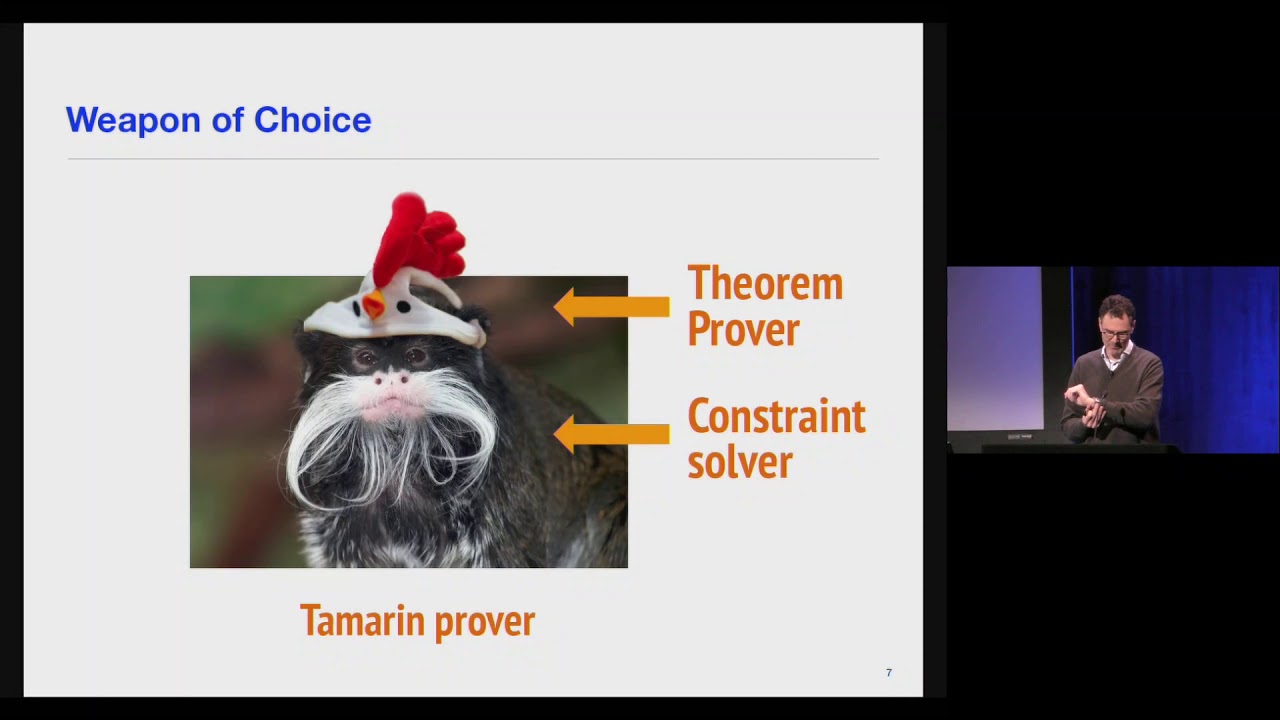
is tamarin so tamarin is not an acronym
it's actually a monkey kind of acute
monkey and tamarin is basically our
tamarin is basically a constraint solver
that solves constraints about what the
adversary could do in a particular
situation and then we turn that
constraint solver into a few improver so
it's a constraint solver disguised as if
you're improver I'll say a little bit
about what tamarin does I won't say
really how it works I want to talk about
the algorithmic background to it there
would be a different talk for a
different community but I'll just tell
you a little bit about how you might use
such a model checker and then we'll move
to 5g so as is often the case in model
checking you have the specification of
the system this doesn't work all that
well the specification of your system
that's called your model you have the
property you negate your property and
you would like to have a behavior that's
consistent with the system so it's a
system behavior that false applies your
property or property and in our case
with tamarin we use constraint solving
define that and if we find such a
behavior that's an attack
and we get a representation of it you
could present that to the user for
example as a message sequence chart if
you would like and importantly if the
constraints are inconsistent then no
possible attack can exist and this means
no matter how you into leave runs the
protocol arbitrarily many runs with the
adversary there cannot be an attack and
that constitutes a proof of course since
the underlying problems are undecidable
you might run out of time memory
patience etc and then tamarin allows you
to go into an interactive mode where you
can work with this theorem prover
constrained solver to interactively
construct a proof or to provide hints so
sometimes you need exhilarate invariance
or even possibly change the underlying
proof strategy being used
that's called Oracle's okay how do you
actually use this in practice so
protocols are specified using a
specification language called multi set
rewriting multi set rewriting is a
little bit like term rewriting for those
of you who know it but rather than
changing one term to another you change
a multi set which you can think of as a
bag of facts into another bag of facts
and these bag of facts represent the
states of the different protocol
participants think of them as each
having a little protocol automata so
what state are they in what do they know
and also for example the state of the
network which might contain information
on messages being sent out received but
the adversary knows etc so here's a
little example so in multi said
rewriting our rules transform a
left-hand side to the right-hand side
and it can also be labeled with actions
these are it gives rise to a labeled
rewriting system a label transition
system there's a typical example of a
rule the left-hand side says if we have
input to our network so n represents
input to the network of some K think of
it as a key and in our multi set some a
protocol automata with some thread ID
thread ID is in some step is in its
first step then in that case our
protocol would say well advance your
step two step two and output on the
network and acknowledgment and also in
your state record that you receive this
key K okay so this would very person to
transition from taking input off the
network to recording and outputting a
response
and this would be labeled with a threat
ID have accepted que se as a key so this
gives rise to transition system with the
tre semantics so now imagine we have a
state of our system says this bag this
multi set of facts and this multi set we
have many facts but among them are that
key is input to the network and some
thread ID 3 is in step 1 then we can
match that with the left-hand side of
this rule so key would be instantiate K
would be instantiate with key thread
idea would be instantiate with tid 3 etc
then this rule would say we can take
these facts out and replace them with
instantiated right hand side of the rule
so we match the left-hand side we
replace it with instantiating right hand
side so we get a new state with AK
output on the network and this thread ID
has advanced its state and recorded that
it's gotten the key moreover this
transition is labeled that thread ID has
accepted the key and this gives rise to
a label transition and you can continue
this because you'll have other rules
available and you get a trace which is a
sequence of transitions and in
particular the trace we entered what we
understand by a trace the trace amman
--tx is the sequence of these red parts
here and that trace is important because
we specify properties over traces so we
can say for example somebody is accepted
a key and the adversary doesn't know it
that might be something that we would
specify that may be a security property
so I showed you an example of a rule and
in general in protocols you'll have
multiple rules so for example I have
multiple roles in each role will have a
role automata there might be a initiator
role or responder role a key server role
this would be an example of the role
automata for the client state machine
for TLS 1.3 and here for each of these
arrows here we would have a multiset
rewriting rule okay
so in general you'll have quite a lot of
multis head rewriting rules for
complicated protocols we also have to
specify our adversary so for our
adversary what we want a network
adversary who's active sometimes this is
called a dual of yao adversary
historically at least in the symbolic
setting but as cryptographers here know
a network adversary you know seems
strong they see everything they can they
can interfere but actually we want to
that are even stronger adversaries who
can for example corrupt long-term
secrets corrupt around a number
generator corrupt session state this
would correspond to different Oracle's
in the computational setting so here's
an example of how you might specify
session reveal yeah
excuse me right so you can specify these
adversary capabilities also by multi set
rewriting rules so here's how you would
specify a session reveal so if there is
a state where some thread ID has learned
a key then that key can be output to the
adversary and that transition will be
labeled with thread IDs key has been
revealed to the adversary okay so again
so we spent we have rules for all the
different protocol automata and we can
also have rules for the behavior of the
attacker now the question is how do we
specify properties the properties
themself are specified in a guarded
fragment at first-order logic with time
points it's essentially morally like a
past time first-order temporal logic you
can say if something has happened and
something can't happen before or at
other points in the trace so here is an
example of how you might specify that a
key is secret it would be for all
threaded e's for all keys it's a two
sorted logic so one of the sources over
time points for all time points I if a
thread ID tid has accepted a key at time
point I then there isn't another time
point J where the adversary knows the
key so K here means the adversary has
learned the key at time point J okay so
in this way we can specify properties
and the property will hold if all
possible traces of the protocol satisfy
that property okay so you specify good
properties and then you want to see if
when you negate them you can find traces
that violate the properties that's how
model checking works and again these are
interpreted over the red bits over the
traces
okay then at the end of the day there's
a question of well what does tamarin
really do what's the magic of tamarin so
tamarin takes these specifications of
the role automata of the adversary of
the security properties and then it uses
various constraints all VL gorillas
which I will not go into which I will
not describe further to try
and see if there is a way that the
different protocol automata can somehow
be run together with the adversary to
attack the protocol and if it's not the
case then we will have a proof that no
possible attack can exist at all so let
me now move from tamarin that was kind
of a quick high-level bluffers guide to
what a model checker my - to analyzing
5g I'm gonna use my phone as a little
prop so 5g of course as you know is the
new standard for for wireless
communication it's standardized by the
3gpp the the first full release of it at
least that the first full relief release
of the basic 5g protocol was last year
June fourteenth two thousand eighteen
this is a protocol that is going to have
massive uptake so right now most of you
are using four G so LTE maybe in some
places of the world even 3G but for
current cellular services we have about
five billion mobile subscribers and we
can expect that and more for 5g because
5g will also be used enable the Internet
of Things and things like this and you
can expect that a large portion of the
world's population will eventually have
5g axis so the question is okay very
good this is a protocol it's used for
communication communication is critical
how is it secured and there are various
parts of it that are security relevant
and here I'll be talking about aka
authentication and key agreement and
what I'll be describing here you can
find more about in a CCS paper so how
does the thent occation key agreement
work within 5g so the idea is we have
user equipment there's a bunch of
acronyms here so the UE the user
equipment which has a sim now called au
sim a universal subscriber identity
module I want to be able to use this for
for telephone calls and so I am Swiss
and I have a phone registered in
Switzerland with Swisscom so Swiss come
is my home network and I come here in
New York and according to my phone phone
my serving network is t-mobile so I
don't have any security association with
t-mobile but I have my home network I
would like to set up an association in a
secure channel with a serving network
and 5g aka is about how you do that how
the subscriber and the serving network
authenticate each other and set up a key
okay now of course some security you
typically don't get security from
nothing so we have some set of
assumptions namely that on my use sim my
my user subscripting
user equipment in the home network will
share a symmetric key it will I'll have
a permanent identifier called the su p
we also had su piece in previous
versions of 5g like 4G that's a
subscriber permanent identifier the su p
is privacy relevant and in 4g there were
problems with MC caches because as you
go around say in New York your phone is
often transmitting your su p so you can
you can hear that at various places if
you if you're listening for it and you
can track me as I go through New York
so in 5g they said we want to get that
right so we're going to conceal the
soupy and something called a tsuki we're
gonna see that later so the su p will be
used to drive a tsuki and that'll be
derived in a randomized way such that
that changes so presumably I cannot be
traced as I go through New York there's
also a sequence number so it's the
sequence number based protocol and I
will also my use we couldn't we'll also
have the public key of the home network
ok sets the set up let's look at how the
protocol works I will give you the main
ideas I won't go into through every
little micro step because there's a lot
of detail here but I'd like to give you
the main idea of how it works first I
will send to the serving network say
here in New York
my supey but I will mask it I will
encrypt it using the home networks
public key so here this is just my
terminology for asymmetric encryption is
randomized using some random value that
I generate it's encrypted with the
public key of the home network and I
tell the serving Network also what is
the identity of the home network case we
heard I have a little message sequence
chart this shows the little setup
assumptions who knows what and I'm going
to send the tsuki from the subscriber to
the serving network and then the serving
network now knows who the home network
is so it says I am the serving network
and here is the Sookie and then the home
network can choose an authentication
method there are several and I will tell
you about
aka and here on this slide I have the
successful case of aka and I'll also
show you a couple failure modes and
again I don't want to explain every
little line of this but I still want to
give you the main ideas so it's a kind
of a challenge response protocol where
the home network will generate a random
number now just so you know these
various FS are keyed a keyed one-way
functions and there are also various
other one-way functions such as
challenge and the like in PC which is
used for key derivation function some of
these have slightly different properties
but I won't go into those details for
now so what would would be what we do
here is we use this shared key shared
with sis with subscriber to make a Mac
of the home network sequence number and
also this random value and then we use
another one-way function with two with
this random value and the key to produce
a random string and this random string
will be used as a one-way function to
conceal excuse me excuse me a one-time
pad effectively to conceal the the home
network sequence number so we don't want
to send sequence numbers in the in the
clear and the pair of this for this
encrypted sequence number and the Mac is
called attend that will be sent over and
then unpacked on the other side and then
we calculate various responses that the
different parties can expect and then
from all of this data this key the
randomness and the sequence number and
the the serving networks name we
generate a key seed and this will be
used eventually by the serving network
in the subscriber to derive a common
shared key and we increment our counter
for the home network ok this various
data then is sent this is a secure
channel between the home network and the
serving network so the randomness this
authentication information an expected
response in this key seed function for
driving a key then the randomness and
this authentication information is sent
over to the subscriber and what is the
subscriber do it first of all it unpacks
the information then it generates this
one-time pad itself because it's given
the randomness and it has this shared
key then it generates what it believes
to be the sequence of
for the home network then it can also
compute you have little explanations
here then it can also compute the Mac
itself with this data that it generated
and has and then it performs two checks
and these checks are important the first
check it does is that the Mac it
calculated is the same as the maket
received so in other words it checks the
authenticity of the information god
over-the-air whose the communication
between the serve and the subscribers
over-the-air so it checks that it got
something authentic that this was
authentically generated by the home
network and then it checks recentness it
checks the it's sequence number of the
user equipment it shouldn't be greater
than the sequence number of the home
network as otherwise we would have a
replay attack so it's important to
remember these two checks
authenticity and freshness if both of
the checks succeed then there are some
steps where it updates its sequence
number to that of the home network it
computes a response it can compute now
this key seed because it has all of the
data that the home network used for this
key seed so it can compute the same key
seed so it in a serving network and
later on drive a common key it sends the
response to the to the serving network
who checks that it's legitimate and if
it's legitimate it sends it to the home
network and the home network also checks
that everything is legitimate and if
everything succeeds so here we had the
serving network sending this Sookie to
the home network than the home network
says I now give you the serving network
the soup P so you know really which
subscriber you're talking to because
until then the serving network hasn't
authenticated the subscriber it just has
a sookie which is a pseudonym but now it
really has a soup P so it can use that
for billing and for other functions okay
there are two failure cases the first
thing we thought is that there's a
failure mode where the mac checks so
that's i the mac checks but the counter
but the message is not recent we have a
problem with checking the counter this
would happen when a message is being
replayed now if that's the case and we
have to synchronize and this is a
problem with with protocols involved
counters you have to effectively send
your counter to the home network so the
counter can read so the home network can
resynchronize its counter so to do that
what you do is again you want to take
your sequence number you want to one
time padded so you have to generate
padding information and then you can
pack that together and send information
on the synchronization to the home
network now an important thing for you
to remember is that this synchronization
information is sent when there is a Mac
failure and it's sent with information
that only the subscriber can generate
because it depends on the subscribers
key so please keep that in mind so this
was the case that we had we have to
resynchronize whoops and then the second
failure is when there's a Mac failure
and we simply send an error message that
there's a Mac failure in the protocol
aborts okay so that was a high-level
view of how the protocol works this is
the type of thing that what I've
described here is actually spread out
over seven hundred and twenty two pages
in in 3gpp documentation but now we can
ask ourselves the question of is the
protocol secure so stepping back and
model checking first we make things
precise and after we made things precise
may have a precise understanding we can
make things formal and check so here are
questions you might ask is the home
network talking to a subscriber talking
to user equipment with the ballade you
sim or to an imposture privacy so for G
had the problem with in CMC catchers but
am i traceable as I roam through New
York and if so how would that work so
here we use Cameron but I have to say
verification was really challenging
often it's the case where we have
problems from practice and we're not
ready to handle them at some point in
time this motivates a lot of work so in
particular it's a challenging protocol
because it has state it has sequence
numbers the state is fairly complicated
it uses X horse an operator so we have
to be able to adequately model different
cryptographic operators and XOR is
fairly difficult to handle we formalize
that equation Lee and it makes it very
difficult to integrate XOR is very
difficult to integrate into our
constrained solvers are constrained for
solvers work well it's something which
is called sub term convergent theories
and this isn't one of them
so we had to go off and develop
theoretical basis for integrating XOR
privacy requirements are also quite
tricky so to see if you're being tracked
those are not trace properties they're
hyper properties there are two hyper
properties so you formalize privacy
typically by observational equivalence
and that's not a trace property for
those of you who know about things like
hyper properties it's a hyper property
that's required extending our tool
notches to verify protocols with respect
to trace properties but also
observational equivalence and of course
there can be unbounded lis many sessions
that are interleaved so this required a
lot of work and we were able to use some
very recent tamarin extensions which are
published in other papers for example
observational equivalence an XOR okay so
how the formal analysis worked we
formalized RAF 1.0.0 of the standard and
this required following the
standardization body for about a year
building based models and augmenting
them with their different changes so
keeping up with them and this is a
methodology that seems to work fairly
well for example the Oxford team with
the Cass Kramer's did this for for TLS
1.3 and you can really you know as
verification engineers so to speak
follow standardization committees and
give them feedback we had to work with
the documents of the 3gpp and that was
over 722 pages of documents and it
required a little bit of interaction to
make things precise to understand them
and the tamarin model for the protocol
was 500 lines of multi set rewriting
rules the specification of the desired
goals plus some additional lemmas which
were needed to make that the the
verifier terminate was over was roughly
around a thousand lines with 124 lemmas
so the specification didn't really it
wasn't very clear about the adversary so
what we often do with tamarin is if you
don't tell us the adversary will figure
it out for you namely will first verify
the the protocol with a fairly weak
network adversary and then we'll add
different compromise capabilities you
can actually have a partial order of
adversaries we'll try and find the
strongest adversaries under which the
properties hold and said another way we
try and find out what compromise
capabilities break the protocol okay so
that also took a bit of work to find the
strongest adversary models
and it was computationally intensive
doing a verification would take over
five hours okay would we find out for
authentication so what properties should
hold well the standard itself specifies
surprisingly few and weak attenti
keishon goals so we had to guess for
ourself what authentication goals should
hold and certainly what's important is
that the subscribers and the serving
network so here I am using a serving
network in New York we agree on a
session key so we have authenticated
keep the key cumin I know who the
serving network is they know who I am we
have a common view of the key that
wasn't explicitly stated but when you
state that it actually fails it fails
for kind of a trivial reason
that's actually pretty embarrassing
namely the last message sent from the
home network to the serving network
whereas here the sukiya sent and then
the soupier sent doesn't bind the supey
to anything at all so in a in a world
where interleave messages are possible
it's possible for the serving network to
get the wrong supey and if this were to
occur this would be a real problem it
could result in building the wrong
subscriber for services what's
interesting is the previous version of
the standard did not have this flaw
earlier versions did not have this flaw
but at some point somebody just left out
some message and this very simple
mistake came into the standard so
protocols can help you with simple
mistakes they can also help you with
very subtle mistakes here is a case of
caching a simple mistake it's almost
like type checking this type of stuff
shouldn't happen there are a number of
other problems which you could debate if
they're really problems or not the
standard aims at only implicit
authentication so implicit
authentication as well we we have
agreement on the Keen we know who each
other are but only after the key is used
so whether or not that's good or not
depends on how the protocol will be
composed with other protocols if it's
always going to be composed with other
protocols in the future where you use
the key before you rely on knowing who
the partner is and that's okay otherwise
it's not okay I would argue you should
always try to have explicit
authentication it turns out it's very
easy to get in this protocol with very
minor modifications no additional
cryptography
I would argue that that's an improvement
whether it's an improvement or not
depends on how you actually plan to use
the protocol but also interesting is
Sookie is security and privacy so here
are some good things the session key is
secret assuming there are no corrupted
long term keys which i think is a fine
assumption and you have a secure channel
between the serving network in the home
network there is no weak forward secrecy
for the key seed function but you
wouldn't expect it because it's a
symmetric key cryptography also that's
okay
the long term key will remain secret
when running the protocol this is all
fine but there's something which wasn't
fine and this was a real shock the supey
remains secret so this common MC catcher
attack won't work
assuming no corrupted SN or serving
network or home network but and this was
really surprising that wasn't sufficient
to ensure untraceable ax T so please
remember the first failure mode when the
Mac was correct but a message was
replayed so you have an active adversary
who replays a who hears a message from
the serving network to my user equipment
and can later replay it then I will
always have a response that you can
identify and you can associate with me
because only I can produce it and that
can be seen by an external party I will
always give the same response where I
Reese where I resynchronize the the
sequence number and this is a response
that only I can give so by looking at
the response that I give in this failure
mode you can actually track me as I go
through New York and as I go through the
world okay so the problem is so they got
right the fact that the supey isn't
being sent in the clear but the error
messages are actually enough to trace
absque rye burrs and this is this is a
shock right this is one of the features
of 5g is that it should have improved
anonymity properties privacy properties
and this absolutely fails and unlike the
previous issues that that I mentioned
there is no easy fix to this to this
problem so the current version of 5g has
this problem and there are still ongoing
discussions it's not clear yet how to
fix this so one of the nice things with
working on formal methods is you can
find attack the
tacks are real the attacks matter it
generated a fair amount of media here I
have just some of the media in English
in German in French etc I had lots of
interesting calls with handset
manufacturers and liked the ideas that I
mentioned are very general I focused
here on 5g the story within the story
but the outer story is you can really
use this for many protocols that matter
here are some examples of the types of
things that we can analyze in fact
rather easily with with the tamarind
tool let me draw some conclusions for
the outer story art versus science I
think we can improve the way protocols
are built understood and analyzed in
particular the community has come a long
way the formal methods community twenty
years ago we were doing very simple
Alice and Bob exchange a key now we can
handle protocols at the scale of a TLS
1.3 and 5g and I think standardization
efforts should really be doing this they
should be following the development of
the protocols using these tools either
themself or together in collaboration
with groups that that that enjoy working
with formal methods doing so as good
hygiene it forces you to be explicit
about your protocol your adversary in
your property as I indicated you can
find errors or produce proofs and that
this is really a realistic effort to do
of course the game isn't completely
completely won we're always up against
the problem of complexity complexity
complexity the underlying problems are
still undecidable it's always a question
of how we improve the scope of our
protocol of our of our tools what kinds
of protocols can we model and how
accurately how faithfully we can model
them and finally an important point and
that's one of the reasons I'm here is
education I think it's very important to
get the message out
let engineers know you can use these
tools and to work together in training
engineers
thank you
[Applause]
we have time for one question okay so I
am one of the user of Tamra improver and
you said about different kinds of
adversary so how can you modify the
capability of Dolloff yarr so I gave you
an example of sessions tape reveal you
just add rules right so we add rules
that okay because I was trying to have a
Vickie heat diffie-hellman model and
yeah so for diffie-hellman you would
want to have perfect forward secrecy
perfect forward secrecy is just secrecy
where you have a long term key reveal a
long term key reveal could be formalized
as a rule that after a session key has
been established the long term key can
be output to the network okay thank you
can we just throw away those 700 pages
and just use your 500 lines to
understand the I I would say you should
use both together so so the seven the
722 lines contain additional things for
example
hey Giselle things for example data type
definitions so so you know how big are
strings and things like this there's
some justification arguments for things
you get some history referenced others
to answer I think you need both so I
think that that it's in formal or
semi-formal documentation should be
complemented with formal models this
model denial service attacks to dad
that's not in the scope of this model
and we would have to discuss what what
we mean so I mean you can do some kinds
of analysis of denial of service of
service like say can they get you to
perform can the adversary get you to a
point in the protocol to perform
expensive cryptographic operations you
can analyze those types of things with
these tools but that wasn't here
[Applause]
okay that was a fantastic talk and I
guess we're gonna move on to another
wireless protocol wg3
which was actually not on the list of
protocols analyzed and so we're gonna
hear about dragonblood okay good morning
everyone thank you for the introduction
so I will be talking about dragonfly and
how it is used in wp3 ants EEP PWD so I
am motif on oof and I did this work
together with AOL Rowan Ronan who will
do the second half of this talk so let's
first do a very quick introduction this
is all related to Wi-Fi security and if
you look at the history we first had web
which is quite horribly broken in
response data find WPA based on a draft
over the I Triple E standard and finally
we have the latest I Triple E standard
of wpa2 but wpa2 is vulnerable to
offline dictionary attacks and recently
there were also key reinstallation
attacks against it and in response to
all this they recently standardized WPA
3 um they decided to use the so called
dragonfly handshake on the dragonfly
handshake is what we call a pig meaning
a does authentication based on a
password on dragonfly previously was
also used in the EPW deep protocol and
this is a protocol you use in certain in
a low amount of enterprise networks
where you authenticate using a username
on the password this handshake provides
the usual properties you have mutual
authentication you negotiate a session
key but the more important thing is this
does defend against offline dictionary
attacks in contrast to wpa2 so how does
the protocol work well let's say we have
a client here that wants to connect to
an access point then the first thing
needs to happen is that both parties
need to convert their shared password
which is for example in ASCII or Unicode
they need to convert it to a group
element P and this element can then be
used in the actual cryptographic
calculations and once this is done the
handshake can execute the actual first
phase of the messages this is called the
commit phase and to simplify it the
commit phase essentially negotiates a
new session key in the second phase of
the handshake we have the confirmed
phrase aunt and a high-level this
confirms that both peers negotiated the
same key and they prove to each other
that they indeed possess the same
password but the big question here is
how is the password converted to this
group element P and here the first
remark is that the handshake can operate
using both mod P crypto groups on
elliptic curves but we will focus on
elliptic curves here so the question
becomes how can we convert a password
into a point on the elliptic curve so
this is often called a hash to curve
algorithm and how can you do this well a
naive way would be to take the shared
password to combine it with the MAC
addresses of the client and the access
point and we can then take the resulting
output from the hash function and
interpret it as the x coordinate of the
point on the curve now there's one
problem here and this is that not all x
coordinates are actually on the curve
because some of them do not have a
corresponding Y value in fact half of
the X values do not have a solution here
for the Y coordinates so that's a
problem so how did they decide to handle
this well they decided to add if test
here where there were they first check
does this square root have a solution
and if not they will execute extra
iterations
they will include the encounter into the
hash function here that calculates the
x-coordinate this means an every new
iteration we get a new point X on the
curve so probably quite of you already
see the problem here the problem is the
password now the number of iterations
now depends on the password being used
and it also depends on the public MAC
addresses what's actually quite
surprising here is that the ietf on TRG
the in fact warned about this timing
leak but the designers didn't consider
this series enough they thought ok this
is a bit of a theoretical attack and we
don't think it actually leaks the
passphrase unfortunately we can abuse
this side-channel leak to do a
dictionary attack and I will now explain
how this works so our threat model here
is that either we can set up a rogue
access point on induce the client into
connecting to us and we can also do it
the other way around we can act as a
malicious client and try to attack the
access point so both of these threat
models are valid for our attack so let's
assume that we are for example attacking
the access point and we're going to
assume that we can use timing
measurements to determine how many
iterations the access point needs to
convert the passphrase
into a curve on the point in particular
I'm going to spoof the client MAC
address a and I will measure that the
access point needs two iterations and of
course what I can do is I can take my
dictionary of passwords I go through
them I execute this algorithm on my own
computer and I can then compare my
offline computations with the one I
measured and I can use this to exclude
passwords unfortunately making one
single measurement is not enough to
include to exclude all possible
passwords so we need more information
and our example here two passwords still
remain possible so how do we get more
information to
uniquely identify the password well if
we go back to our algorithm here we can
see that the MAC address of the client
influences the execution of this
algorithm so what we can do is we can
simply spoof a different client MAC
address and we effectively get an
independent execution of our algorithm
so to come back here we can spoof a
client MAC address B we can again
measure how many iterations does the
target execute we compare this to our
offline results and we can keep doing
this until we uniquely recover the
password to give you an idea about the
complexity of this attack if we want to
brute force the RockYou password dump we
would need on average about 17 MAC
addresses to uniquely determine the
password the takeaway message here is
that the number of iterations that are
executed for a set of MAC addresses
forms a signature of the password so one
thing I haven't touched on yet is can we
indeed measure these timing differences
in practice so here we did an experiment
on a raspberry pi 1 and the reason why
we picked a raspberry pi 1 is because
it's CPU is similar to a common home
router and even some professional access
points in this case we attacked the EPW
D protocol so this is for example used
in I would say about 3 to 4 percent of a
neural networks yield attack was
surprisingly effective when we make
around 30 measurements per MAC address
ant we filter out noise using Crosby's
box test then 30 measurements is enough
to recover the number of iterations so
that covers the case for a PWD which was
defined already several years ago when
they standardized WPA 3 they did realize
that they finally listed to die if I TF
ones here for G at least partly ant they
included countermeasures so what I did
with WPA 3 they try to prevent
leaks by always doing 40 iterations here
on simply returning the first point that
has a valid solution for the
y-coordinate now that's not everything
they did on top of it they also
implemented this in blind that constant
time to again try to prevent side
channel leaks on top of that once the
real password has been converted into a
group element here they will execute the
extra iterations of these total of 48
aerations using a random password again
this was done to defend against possible
side channel leaks now the question is
does that solve everything
the answer is unfortunately no the
reason why is if we take the resulting
outputs here of the hash function this
needs to be truncated to the size of the
prime P so if we use it 256 bits curve
the the what is returned here are the
first 256 bits of the hash output now
the problem is if we use brain pool
curves then there's actually a high
likelihood that this output here even
when truncated will still be bigger than
the prime of the curve on that we do
introduce a small theoretical base in
the calculation so we want to avoid that
and how did they decide to avoid this
well they simply used rejection sampling
sampling unincluded an if test here so
the question is is it our our side
channels now really soft and some of you
may already see it we have a problem
here this code may now be skipped on the
amount of times that this code of
escaped depends on our share shared
passphrase now can we exploit this
because we still because the extra
iterations are executed based on a
random password and the answer is yes
because the variance now depends on when
the password
element here was found to illustrate
this if our point P is found here in the
first iteration then all the extra
iterations are performed on a random
password on the variants is high while
if this is found in the very last
iteration then there are no extra
iteration based on a random password on
the variants 0 on top of that the
average execution time also depends on
on which iteration the password was
found as well so both the variants on
the average execution time still leak
information about the passphrase and if
we then again try to execute this attack
in practice on a Raspberry Pi against an
open-source WPA 3 implementation we
notice that measuring this is a bit more
difficult but still by performing 300
measurements per MAC address we can
still determine we can still recover
enough information to brute-force the
MAC address so that covers my part and
now here we'll talk about some more
vulnerabilities ok thank you
so now we're going to talk about cache
attacks and we're going to use a
relatively similar similar type model
but now we've only going to target the
client and here we're going to assume
that we act like a malicious access
point and we're going to add the extra
assumption that we are able to run some
code on the client device now this code
is going to run in user mode it doesn't
require any special privileges or
permission so basically for example any
app that you download on your smart
phone it might be sufficient and it's
only required to be able to measure such
a macro contextual sectionals so why do
we need this and if we want to be able
to attack any step of curves the
previous attack that was mentioned is
not applicable the lesson is that it
needs to use the prime number that is
very very close to a power of 2 and then
there's the negligible chance that we'll
see this random this rejection sampling
okay so what can we do
we're now going to use a cash attack
called flashing reload this is an
enabler us to detect the exact point in
time where a specific code line was
executed in this case and the code line
that stores the recovered point inside
the valuable now this is going to happen
in any and check that we make and we
want to know in which iteration does it
happen so in parallel
we'll also going to monitor the code to
the hash notion and this is supposed to
give us a kind of time doing different
iterations
now as this type of a text is usually
very noisy and we will only want to we
have a one bit of information
many if this first iteration was
successful or not and to do it we use
and what's called the cache template
attack and we're going to run several
measurements and we're going to give a
specific idea or number to each possible
resort and then we can look at the
distribution of the results that we get
in both cases if the first iteration was
successful or not it is easy to see that
those distribution are very distinct and
basically all we need is about 20
measurements in a very simple linear
classifier to be able to lick this one
bit of information now we see that we
are able to leak information and
password both with cache attacks and
which time in the text but the question
is can we actually exploited to recover
the original password so to try to test
this what we did was to provide a full
probabilistic analysis of the amount of
different measurements and computational
steps that are required in order to
recover the unique password out of
different size of dictionaries we then
continued to implement this type of
attack using GPU code and then try to
see how much money it will cost us on
AWS instances to actually recover the
password and we can see that for example
for and they have I been point database
of password which include all of the
password dumps ever linked to the
internet it will cost us about 2 cent in
the worst case which is the
recovery of password for the missed
curves and even if we go over a very
large personal domain Archaea nate
symbol it still suffered that's
relatively cheap for an attacker to do
and again if this is your day job you'll
probably buy your own GPUs and it will
cost you much less than that okay so we
are able to recover a password and now
we went ahead and tried to look at more
implementation specific vulnerabilities
and now this might come as a shock to
some of you but we were able to see
several implementation that has better
randomness and for example one
implementation uses the system tank as
the only entropy sauce and interesting
fact is is that for wpa2 this doesn't
really matter it doesn't even affect the
security over for WPS
so this is catastrophical and allow us
to actually recover the password element
another shocking finding is that we are
able to perform invalid health attack
several implementation didn't verify the
point that they received in the
handshake and this basically enabled us
to recover the session key in by
president dedication there are also
several Wi-Fi specific attacks and the
simplest one is denial of service and
doing the entire fourth iteration is
something that's very computationally
expensive and it's relatively easy to
saturate the access point CPU and then
cause it was monthly spot to stop
responding there is also the danger of
downgrade attack basically in transition
mode above WP to in WP network share the
same password now this is something that
has been handled by their standard and
doing the handshake this done great will
be detected and the connection will be
dropped
however this will only happen after a
partial completion of the WP toe and
check and this actually provides us all
of the information that we need to do
the previous dictionary attack and
offline and recover the password and
there are also several issues with the
support for multiple curves it's
relatively easy to downgrade their
chosen curve so we can foster
and the client an access point to use
curves that are ideal and we cook in
perfectly
Oh easier to attack using sectionals so
after we've had all this funding we
started a very nice and interesting
process of disclosure with the Wi-Fi
lines we try to notified all of the
involved parties as early as possible
because we wanted to be able to try to
influence the WPA standard direction was
as followed we started with a privately
backward-compatible security guidelines
and several patches that were
distributed between the different
vendors after we looked at those patches
we were able to find the baneful
side channel that was shown previously
and this led to another round of
disclosure and that also includes
several patches and recently about two
months ago they were they updated the
guidelines and enough for hibbett the
use of curbs all together and if we look
at the latest guidelines in the way we
try to mitigate this type of attacks so
there are several guidance that we try
the Wi-Fi Alliance provides to the
different vendors and one of the
guidelines is a very simple straight
fault
please implement your code without any
satchels another guideline says that if
in some case the WPS three transition
mode does not meet the security
requirements then please separate your
passwords and in the end what you say is
that if you fail to implement those
guidelines this might result in an
attack and copies of the network and
what I am virtual is how this can be
checked for matrices not very easy to
find such channels in a different codec
for many different implementations but
I'm not sure if this is going to be part
of the certification process or not even
after all of this there are still some
fundamental issues that were not solve
the main one is of course this is
something this kind of protocol is very
hard to implement in constant time
without any state units and no matter
what device is doing this 42 version is
something which might be too costly and
we actually saw several implementation
they didn't do the whole 48 directions
fortunately and I Triple E is now
updated a draft of the standard which
several of the our recommendations the
most important one is to exclude the MAC
addresses from the hash to curve
calculation or together and incorporate
it in a later part of the protocol this
allows the password element to be
computed offline and it does not only
make the protocol much safer it also
makes it much more more efficient to
implement more well and this switch from
this hash to curve that we shown with
was called hunting and pecking to a
constant time hash to curve solution
they explicitly prohibit the use of many
different groups and they have no oppose
position how to prevent a cryptographic
group downgrade attack and there are
some remaining issues in the new
standard and I think maybe the most
notable one is that unlike many modern
protocols they do not hush in the
transcript of the messages in in
propagated in the key derivation this
has many issues it makes it much much
harder to actually write a formal proof
the protocol and it raises many risks of
implementation issues for example the
way that they prevent the cryptographic
group downgrade attack is now dependent
on different checks that Pokemon should
make and if we simply incorporate the
transcript in the Kindle evasion it will
be made implicitly another problem is
the way the dumb go to WP aw pay - this
is something that's currently not
addressed in the standard at all there
is a possible solution what we call
trustful first use which basically means
if I connect to a network can you see
that is WPA I will never agree to try to
connect it with with WEP to wpa2
protocol this is actually done by both
Android and the network manager of Linux
but as long as there's one single device
that doesn't follow these guidelines we
can always attack it and use it for the
offline mode force attack another
remaining issue is that those new
solutions are not backward-compatible
this question how can they be adopted
today maybe there will be a WPS 3.1
but we're not clear how the why
freelance is going to end this and how
they can prevent for example the risk
for Dan we detect to the current which
will WPC after all this you might ask
yourself should we use wb-3 the question
fight now think is yes w2 is trivial to
attack so anything else is probably
better and in conclusion we can say wp3
is vulnerable to stir channel attacks
that like might lead to password
recovery the current control measures
are very costly and very hard to
implement
there is a new draft for that solves
many of the issues we are not we don't
know if it's going to be adopted or not
but maybe most importantly those issues
could and should have been avoided in
the first place if the standardization
process would have been more inclusive
and for example we just seen one example
with FFG and there's the TLS 1.3 err
process we feel that we could've ended
avoided all of these little problems and
in that we'll be happy to answer any
questions thank you
great we have time for one question it's
more of a request than a question and so
currently CFR G is running a pig
selection process
I don't think side channel analysis has
really been considered as a first-class
security concern yet in this election
so please would you guys get involved
and give us some of your cycles and take
a look at the proposals thank you yeah I
know that they're also using the hash to
curve Draft on there they're really
looking at but you're not the handshake
itself me exactly thank you okay really
cool work and then now we're gonna move
on to the third talk of the session
which is gonna be on navigation security
so really looking forward to the talk
and not GPS actually but on Galileo
security Tomer is gonna give a talk all
right so that's my slide nope
good so this is a joint walk with a long
list of capable people whose names are
projected here so I won't read them cuz
I'll probably butcher their names in the
native language and the talk is about
Galileo authentication Galileo and for
those who don't know is global
navigation satellite system or GNSS
operated by the European Union and even
if you're not familiar with the term
GNSS there's at least one such system
that you are familiar with and that is
the u.s. GPS so bluntly put Galileo is
the European GPS and in fact there are
full deployed systems like that the US
GPS the Russian GLONASS Chinese Baidu
and the European Galileo in addition to
two regional systems the Indian narvik
and the Japanese michibiki and I take
that in this educated crowd
everyone knows the principles of GPS
navigation you stand somewhere with your
cell phone there are satellites floating
around
the earth sending the location
periodically in a reference time for
when the message was sent your phone
collects mesh messages like that it
records the time in which the message
was received and once it has enough of
those four in the case of satellite
navigation it substitutes the values
that it has into these equations which
solving them then gives you your
location and you'll use GNSS I came here
using by using Google Maps many cars
come equipped with satellite not the
onboard satellite navigation systems and
for my mother tones I use devices like
this to track my progress but actually
GNSS is not only a consumer's technology
it is heavily used in infrastructure in
aviation in Mali navigation
synchronizing power grids doing things
in the financial sector it is really a
part of the modern-day
infrastructure which is why it's so
shocking how is it is to spoof signals
in Genesis in preparing this
presentation about a week ago
I searched YouTube for GPS spoofing and
filtered out all results older than one
week still there are hundreds of videos
explain how to spoof Genesis data and
what I find most insulting in this is
the motive that the motivation doesn't
seem to be hijacking an airplane all
crashing down the power grid it is to
cheat in a game played with your cell
phone called Pokemon go
so what we have is a critical piece of
infrastructure originally designed by
the US military that can be spoofed by
people playing Pokemon go now there's no
disrespect towards these people I am one
of them I play pokemon go and I spoof
Genesis data but I still find the risk
unacceptable and so do the people at the
Galileo project at the European
Commission which is why they decided
that their service will offer a public
authentication and that means that when
you use your device to determine your
location based on Galileo satellites you
will have assurance that this
information is true so what we need is a
system that we want an open system
anyone can start their cell phone get
the data and start navigating but we we
want only legitimate satellites to be
able to send the signatures for this
data so that obviously puts us in the
domain of public key cryptography but
actually that comes with a problem due
to the frequency in which Genesis
operates the bandwidth is extremely
limited it's between 50 bits per second
and 200 bits per second it's 120 bits
per second in Galileo and if you need
context for this number about 20 years
ago when I was 16 and I got my first
home modem it was 43 times faster than
this 20 years ago and on top of that due
to legacy support the part allocated for
authentication in Galileo is only 40
bits every other second of 20 bits per
second on average so public key
cryptography is out of the question
because the signatures would just be too
long and that doesn't leave us too many
options right we only have two types so
we probably should be using symmetric
ography but this also still comes with
problems symmetric key cryptography is
called that way because the keys to all
parties are the same all parties are
indistinguishable with respect to the
role in the protocol so suppose we use
the same secret key for all receivers if
I receive a message which I can verify
using this key it means that I can also
sign another message and send it to
someone else who won't be able to
distinguish between me as a sender and a
legitimate sender so using the same key
for all the server's is not an option
how about using a different key for each
user
well first it's unclear how we would do
the key exchange here right what I'll
just talk to the satellite tell him okay
we'll call it if he held it alight so
not that and even if there was a way to
disseminate these keys there's still the
problem that the satellite would have to
sign the same information using
different keys and send them to all the
receivers on a channel that I've already
told you that is extremely limited which
leaves us with the question of what can
we still do so I will now present the
system developed at Cal Leuven and just
to clarify I'm not this is not a
proposal this is the system that Galilei
will be using it has been approved on
all levels already implemented and
testing should commence
sometime soon I'm not exactly sure when
and the system is based on key hierarchy
I use the pyramid because I'm not sure
in the hierarchy whether the bottom of
the pyramid is the top or the bottom of
the hierarchy we have several layers of
kill and I'll go into each of them
hopefully then you understand how the
system works so at the bottom of the
pyramid we have the route of a medical
tree a medical tree for those not
familiar with the concept and this is a
bit awkward to explain what medical
trees and medical is in the audience I
hope I do it well amiracle tree is a way
to provide a short commitment to
multiple values what you do is put the
values you want to commit to in the
leaves and in the first step you have
each of them separately
that's this layer and then you have two
values at the time to create a tree like
structure then the commitment is the
of this tree now I want to authenticate
a value sorry I want to reveal one of
the commitments so I provide the value I
want to reveal along with the
authentication pad which are the nodes
with a circle around them and what the
verifier does is to hash this value and
they get this value and then they hash
these two values and they slowly rebuild
the tree and compare the route they get
with the commitment they received and if
they match it means that the value sent
was part of the original commitment
otherwise it means that someone found
the collision in a collision free hash
function also this doesn't expose any
other value because let's say that I
have this value when backwards in the
tree means that you can find a pre-image
in a pre-image resistant hash function
which we assumed to be hard in our case
what we put in the lives of public keys
not too many of them and those will be
used to out the lifetime of the system
which should walk for I know 10 20 years
and we really hope that we would never
need to replace any of those kids but
just in case we have a few others the
root of the tree is hard coded into your
device so what we have again is a
medical tree used to authenticate a
public key and the public key is used to
verify a digital signature for a wood
key I know that I said that there's no
room in this protocol for digital
signatures well I lied as long as you
don't have to obtain the digital
signature to every message you send we
can once in a while
infrequently sending a new root key we
can probably fit in a digital signature
and I say probably but we know that we
can because we're testing the system now
what is the root key a load key is the
end of a hash chain the hash chain is
built by selecting a secret key and
hashing it and then the output is hashed
again and each output is hashed and we
have now a chain of hashes and the last
value in this chain is
the root key the root key can be made
public because it's the output of hash
function so you cannot go back in this
chain and it is authenticated using a
digital signature then the wood key is
used to authenticate an effective key an
effective key is another link in this
chain now I'll tell you in two slides
one what's effective about it meanwhile
I'll I'll tell you that having one of
those keys let's say the one before last
it's easy to verify that it's called by
hashing it once if it maps to the root
key that we've authenticated using the
digital signature it means that it was
sent by the original generator of the
chain because no one else can find a
pre-image but for me as the person who
generated the chain it's easy to provide
three images I just hash forward and
finally the effective key of an
effective key is used to authenticate
our payload the message or the location
data M and for that we use the Tesla
protocol developed by Reagan others in
2005 and it was walks in the following
way the time is split into discrete
components and I guess you can say it
but it's I minus 1 I plus 1 etc each
link in the chain is associated with one
time frame and that's the an effective
key is the key associated with what we
think of is now later this key will no
longer be effective it would be obsolete
and we will have another less active key
now how do we authenticate a message
he'll in the first time frame and every
subsequent time frame we get three data
items we get em I'll call it n minus one
which is the location data for that time
frame and a message authentication code
which is the symmetric key analog of a
digital signature so a map of the
location data mi minus one with the
effective key ki minus one
I don't have this key so I can check the
Mac I take these two values and just
stole them some well for the later use
the third that item is KL the root key
which as I said is verified by means of
a digital signature so far I don't have
my location and I haven't authenticated
any location that's fine moving on to
the next time step I again I get the
location data M I and the message
authentication code mi sorry the message
authentication code for mi using the
effective ki KI and I don't I can't
verify that so I just store it I also
get a I minus one that's an obsolete key
that was effective in the previous time
frame what I do is to hash it and see if
it matches a kid have already
authenticated in this case KL if it does
I fetch the two data items from the
previous time frame now I can now check
the Mac if it checks out I know that I
can trust mi minus 1 that was
authenticated using this Mac moving on
to the next time frame the same thing
happens played at items mi plus 1 and
Mac of mi plus 1 with the effective key
I store those and I get ki and obsolete
ki KI is hashed and if the output
matches ki minus 1 ki minus 1 I know to
be authentic so now I fetch these two
data items with the previous time frame
and I authenticate them and this is done
over and over until the chain is
exhausted a chain should last for about
three months and then it's replaced and
that's how our 10th occasion protocol
works what we see here is an is an
authentication scheme that authenticates
values in with a certain delay in this
example the delay is one time frame but
the Galileo protocol actually allows
different time frame so it supports
multiple
delays up to five minutes for different
use cases and this is it
then we also had to make some changes to
the original protocol if we would use
them it in the naive way we would need a
hash chain for each satellite right we
need we have a constellation of about 24
satellites so 24 chains each of them
requiring a different wood key means
also that we each of them requires a
different digital signature and that
would very quickly eat all of our
bandwidth so instead we found a way to
use one chain in all satellites another
change we made is that in generating the
hash chain it's not only the effective
key that is given as an input we also
add an AI value this is a reference to
the time frame in which this key will be
effective and it's like salt in password
hashing for that particular key and an
alpha value which is sold for the entire
chain and also some random stuff because
why not
this is an actual system and it should
be working for a really long time and we
don't know whether sha-256 will be
secure for the entire duration of the
system so for each of the primitives we
use we have several options and for
hashing we use sha-256 but we also
support sharply 224 and sharply 256 for
mac macking we use h moksha 256 but we
also support Simic AES and for digital
signatures we use ECDSA with these
curves all of these parameters you get
from the satellite in the header of the
message telling you which primitives are
being used for the particular instance
all security parameters unfortunately
even after building this complicated
system with the keyhole key we can't fit
all the data we need to send into a
message so
have to plant eight some values and I
hope this is not too outrageous it
should be I hope to survive this we
truncate the effective keys to 90 some
of between 90 and 128 bits and we
translate the message authentication
codes to someone between 10 and 32 bits
now I'm I don't recommend using max of
10 bits not even 32 bits but in our
particular use case we have a security
analysis showing why this is secure I
don't think I have time to talk about it
but maybe in the questions phase so to
conclude Galileo will be using solid
gelila will be offering a way to
authenticate publicly the navigation
data you receive from it so that you can
play pokemon go without fearing that
someone will cheat and steal your
pokemon gym thank you
[Applause]
let me ask one question so these kind of
systems they're very difficult to change
once you deploy once you deploy them
they're gonna be out there for decades
so aren't you worried about quantum
attacks like in 30 years 40 years ECDSA
who knows where it's gonna be so I agree
these decisions are made above my
paygrade
we actually discussed the possibility to
include so I this would probably they
should be here in the digital signatures
I know that they've considered adding
post quantum signatures as supported
mechanism and decided not to and again I
don't get this a vote in this okay maybe
I misunderstood something it sounds to
me like you have relying on very long
chains and you only sign the very first
up message what happens to a day GNSS
system which is turned off for the first
month I think comes on and then it
starts hearing it how does it how is it
going to get the verified case of I
values yeah so the root key is sent
constantly by the satellite as the we
have time for a slightly longer question
on each packet you receive from the
satellite has the base information that
I just explained and some management at
minimal use is the root key and it's
digital signature so if you get this key
for example you also know what your time
reference is you just hash it multiple
times and see that it matches the root
key that you also received from the
satellite with a digital signature so
how long is the chain actually is it
like a million hashes or it's about well
it's three months about three times
three keys every 30 seconds someone who
is probably a bad mathematician than I
am but three
six keys every minute for three months
okay so okay yeah huge number of hashes
okay so how do you prevent an attacker
from taking the signal from the
satellite delaying it amplifying it
slightly and then the receiver locks
onto the amplified signal and can't
decode the original signal it's
authentic but it's been delayed so now
there's a shift in the position
satellite but yes so first of all this
system does not prevent someone from
just jamming the signal that's not what
we offer heal the receiver know has
loose time synchronization with the
satellite so it knows which key since
the time reference is part of the key
you won't be able to use it after the
time frame ended so if you're using the
rapid authentication you can delay it by
10 SEC maybe even less satellite
navigation is even less accurate than
that so that's not really a problem and
beyond that the satellite can detect
that the message is arrive too late and
cannot be used you don't see it I mean
we're talking you know a microsecond
delay is a 100 meters a millisecond away
is several kilometers so I'm not sure
about these numbers possibly I don't
have this slide here the error
correlated when the satiric sandy the
signal is anyway larger than this set a
satellite navigation is less accurate
than what we think what we use again not
my field been explained that is assisted
satellite navigation so your question
comes from the assistance part anyway
and not from the satellite but I think
the cryptography is not designed to
detect to defend against those kinds of
attacks I mean this there are other
mechanisms in the systems or more
physical mechanisms
that are designed to defend against that
against German but German replaying he's
referring to re playing attack well no
so the cryptography does prevent a plane
as long well with within the delay of
the loose time synchronization you have
with the satellite okay well this is a
good topic for an offline offline
discussion fantastic thank you this has
been fantastic a really really very pop
all right so we have a break coming just
before we break quick announcement
there's a clicker that's been found so
if anybody wants a clicker there'll be a
clicker up here on the on the stage and
so we have a break now and we're gonna
resume at 11 a.m.