Video summary
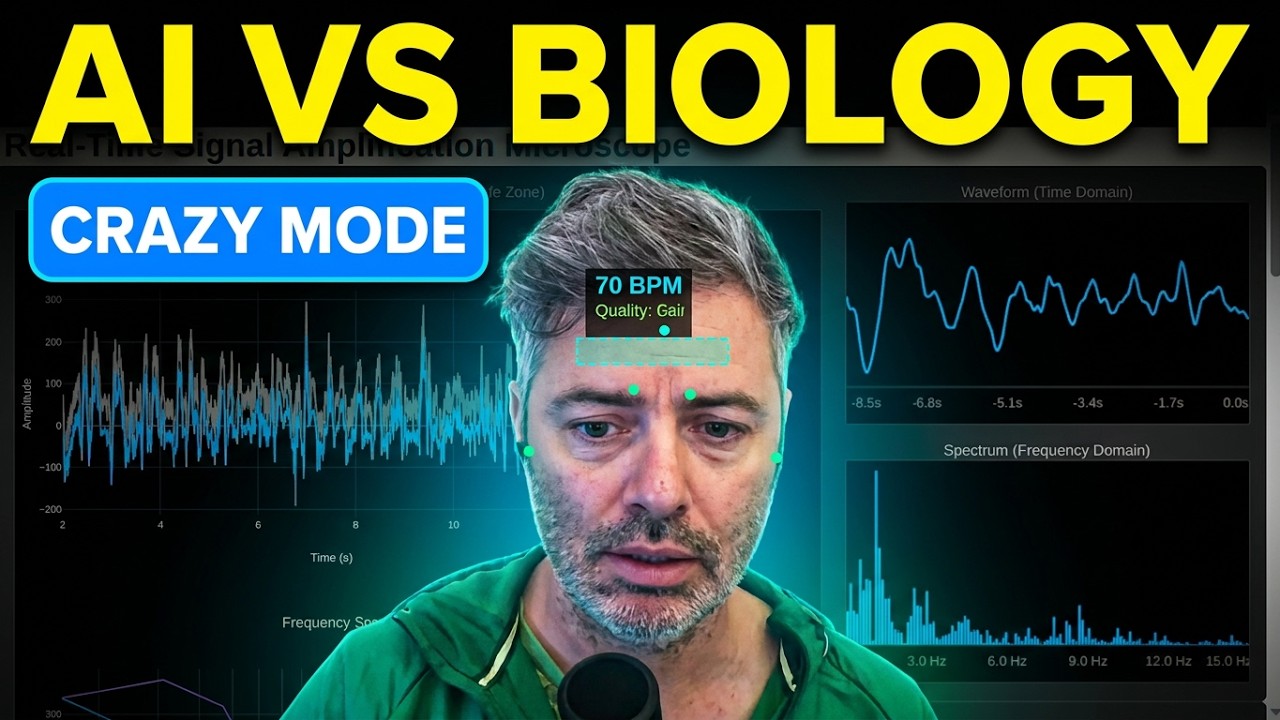
The video explores Bio Chaos, a digital laboratory founded by a biomedical engineering PhD that transforms complex biological sciences into interactive visual experiences using tools like EEG analysis and neural implant modeling. A central focus is on real-time bio-signal extraction technologies, particularly how remote photoplethysmography detects heart rates by amplifying microscopic skin color changes via Fast Fourier Transform to overcome environmental noise such as lighting fluctuations or motion. The discussion extends to simulations of "tech neck" that demonstrate increased cervical spine loads during forward head tilts and addresses the reality of cochlear implants, explaining that initial robotic-sounding outputs are due to neuroplasticity—the brain's necessary time to adapt electrical signals—rather than a limitation in the device itself.
Critical risks within medical AI are also examined, highlighting issues like "overfitting" where algorithms mistakenly learn background noise instead of genuine biological patterns, often referred to as the forecast trap. The narrative emphasizes that clean data is far more important than shiny interfaces, illustrated by visualizations showing how identical summary statistics can yield vastly different graphical realities depending on underlying messiness. This leads to a philosophical reflection framing AI's role in decoding human biology as "the human machine looking in a mirror made entirely of numbers," underscoring the conclusion that reliable medical technology depends on meticulous data cleaning and an understanding of the messy reality behind viral tech hype rather than just creating intelligence from scratch.
To support this mission, the platform aims to democratize biomedical data processing by allowing users to visualize raw data directly through interactive tools like the Kclear simulator, gate analysis, and EEG brain maps available at Biomi Chaos. The hosts encourage community engagement over automated responses, inviting viewers to subscribe, comment, report bugs, or share videos of failed simulations so they can be converted into prompts for coding agents to improve the software during live sessions. Practical demonstrations include attempts to run 3D walking simulations with adjustable parameters like stride cadence and knee lift, where hosts encounter technical challenges such as avatars failing to navigate obstacles despite parameter adjustments but plan to publish all prototypes for public testing while continuing iterative improvements as AI models advance.
Read the full video transcript
bunny.com/jazz.
Currently, we have a crazy mode button
that sends everything to 100% 100% uh
random and we have a more real uh sound
generator that's taking your brain waves
turning in turning them into musical
notes. The mapping of the frequency
amplitude to notes is is real scientific
based. So it's essentially taking um the
different bands theta delta alpha beta
depending on the amplitude in each it
will make a decision to what note to use
depends on depending on amplitude and
the frequency. Yes, we have power. All
the notes played at the same volume. Not
sure [music]
obviously going to be a um a play button
to this. Let us know or if you want me
to fire up any any of the tools.
Do let me know as well.
and be happy to work on the tool of your
choice, but you'll have to specify which
one you checked, what what worked, what
didn't. Bio was referenced in this uh
article supposedly legit. I'm not
actually sure. They literally took uh
print screens from uh the tool that we
made. Did you put a reference still
working? It is working. Yes. So
literally in the paper I used the print
screens
uh compression
and they compelled compared the HA
wavelet and SPI
HD
uh which I don't have. So where did we
So they did the PSN which I do measure
um compression ratio which I do not
have.
I'm not sure when they took the well
what's PS and uh no PSN is what we
measuring. It's the signal to noise
ratio.
Uh, no. S P I HD hierarchical trees
algorithm builds on DW.
It's a mediocre paper. We're not going
to be going into it. It says a research
article, but there's no data being
collected or anything. There's no
method. Well, thanks for the reference,
but uh yeah, I can't [clears throat]
there's nothing. There's no data
collected or anything.
Yeah. But it's based on uh this tool
that we had on the side for quite some
time.
Yeah. They use this image in the paper.
I probably should have referenced the
Yeah, the images are from radiopedia.
They didn't reference radiopedia.
It's like this one was like recursive
references things.
Anyhow, yeah, thank you for the for the
reference, but uh yeah, the paper is not
great. So, but yeah, go check out the
original tool. I might do an AI review
on it as well. It's stage. Yeah, I might
be doing the EG2 music stuff when I
improve the play button. I was want to
make sure when we're selecting the
notes, the musical notes, uh, which is
working at the moment, the selection is
actually I'm pretty sure we specified it
to begin with, just when you're
listening to it, [music]
doesn't sound like
the amplitude for the four different
notes is uh, different. Doesn't sound
like it's different for the four
different notes.
[music]
Shall we do the quiz first? We have two
quizzes. One is hard, one is medium.
Okay, let's see if I can answer a
question about the tool that uh I
developed. Well, considering I developed
it with AI, maybe I would not be able to
answer it correctly. The question is,
how does the real-time signal
amplification microscope application
extract a pulse signal from a standard
webcam video? Cuz that's what it does.
Does it fairly successfully?
We'll do a quick test cuz we like
testing stuff.
Yeah, you could see.
Well, assuming this uh variation is not
coming from anywhere else, it's safe
to assume it's actually coming from
from my heart rate.
There is a chance that's coming through
that um color reflecting off my head or
something
reflecting off my skin and giving the
measurement.
But I can cover it up like this still.
See if the measurement still there.
Uh yes, it is.
So yeah, it's working. And the question
was, how does the real-time signal
amplification microscope application
extracts a pulse signal, a heart rate
pulse signal from uh the standard webcam
video? The options are detecting
infrared heat signatures emitted from
the facial surface. Oh, that's a no.
It's no infrared. Measuring the
electrical resistance of the skin via
camera lens. Obviously no. Analyzing the
acoustic vibration captures by
microphone during speech. Nope. Using
Urian video magnification to visualize
subtle skin tone changes.
That one is correct.
This technique amplifies tiny color
variations in the skin cause caused by
blood flow, allowing the software to
detect a heart rate without physical
contact.
How good is that?
Uh there's a question about
the smartphone
neck
the simulation.
When simulating the smartphone neck phen
phenomenon,
what happens to the load on the cervical
spine as the head tilts forward? The
mechanical load on the neck increases
significantly. Yes, the load decreases
as the weight is transferred to the
upper back and no
the load remains constant. No, the load
is neutralized by the tension in the
trapezius muscles. Well, no. A the
mechanical load on the neck increases
significantly.
That is correct.
So as the head moves away from the
center of gravity, the effective weight
supported by the neck muscles and spine
increases due to the lever arm effect
doesn't kind of explain what it is, but
yeah. Anyway, when you're holding the
phone like that puts a lot of strain on
your spine.
So go check out this simulation by
yourself. Everything you do is available
on bioc.com.
Sport is the common reality for users
during initial switch on phase of the
but users immediately experience
crystal clear speech and music
definitely not sounds are often
perceived as robotic mechanical and
confusing that would be the case the
device only transmit low frequency
vibration rather than sound there's a
different implanted actually a bone
called world coccia product called bah
Uh-huh. It's a bone conduction thing.
So, it's like a screw that is inserted
into into the skull. The implant causes
total loss of uh special awareness and
balance.
Uh not normally. So, yes, it's B sounds
are often perceived robotic, mechanical,
and confusing.
Yes, the brain requires time to adapt to
the new electrical signals which
initially do not sound like natural
acoustic hearing. So we have this
simulation
of uh for transform. I think it's uh
referring to this one. You can uh draw
your pattern.
It will break it down into a four
components. So you can see
yeah these arrows
they're essentially the forer
components. So the question is for what
mathematical principle is demonstrated
in the for simulation when creating
complex patterns signals are multiplied
by their own derivatives to increase
resolution. No, don't think so. Doesn't
sound like it. Data is compressed by
removing all high frequency components.
No. A signal is converted into series of
discrete unrelated pulses. That sounds
legit. A complex signals can be
decomposed into sum of simple sinosoids.
Okay, that must be Yeah, it must be that
one. It's actually talking about a
different simulation that we have on the
side. So, it's not the drawing one. But
if you type in 4 series, it should get
these two simulations. See, it's
actually talking about the second one.
Yeah, this makes a nice demo v sound as
well. Can turn on the sonification.
I can actually hear something.
Anyway, yeah, the for series allows any
periodic shape to be represented by
adding together various sign and cosine
waves. So, this is what this is showing.
>> [music]
>> Yeah, there's a quick question about
this uh simulation. So, this is a ppg.
Uh in this simulation, what is the
primary goal when exploring the effects
of age, skin tone, and lead intensity?
It's the primary goal. Well, to see the
difference it makes on the signal to
noise ratio, the signal quality to
determine the maximum depth of an
ultrasound echo. No. To understand how
these factors influence the signal to
noise ratio, yes. To calculate precise
BMI, no. to measure the rate of skin. So
no yeah biological and environmental
variables significantly impact the
quality of the ppg signal which is
quantified by the SNR signal to noise
ratio.
This aen faces
principal component analysis simulation
thing we have a question about that.
Well, first of all, we need to actually
run it. Yeah, we'll do some uh faces.
So, we need to capture some faces.
And then we have this egg and a values
there. So, you can see what's being
mostly represented is the the bit that
is different in this case moving
eyebrows. And that uh face at the moment
it's uh reconstructed from the from this
egg invas values above. So this is not
me. This essentially an avatar created
out of um these egg and faces not the
original
not the original video or the original
face. And the question was the aen faces
tool uses principal component analysis
PCA for which specific purpose in facial
recognition
the options to encrypt facial images so
they cannot be viewed by humans. Well I
mean it could be used that way but
that's not what it's doing in this case
to simulate how a face will look as it
ages over several decades. That's a
actually great idea, but uh again that's
not what this version of the tool is
doing. To extract and visualize the most
significant facial features. Yes. Or to
increase the resolution of lowquality
webcam image. Maybe could be done, but
it's not what it's doing. So it must be
C. Yes. PCA reduces the complexity of
image data by finding the directions
also known as components with the most
variance. So that's what these images
are the agon values and you can see the
bit that I was moving just the eyebrows
is highlighted and that would be
representing key facial characteristics.
What key physiological concept is
explored in the Hodkin Hxley simulation?
The dynamics of the neuronal membrane
and action potentials. It must be it.
The gas exchange. No. The flawed blood.
No. The mechanical breakdown food. No.
Yeah. So, that was easy. Yes, that's
right. The Hutchkin Hxley model is the
is the foundational mathematical
description of how action potentials are
initiated and propagated in neurons. So
that is correct. Go check out the
simulator. It's available on the website
for you to explore.
that wasn't quite as successful
as uh finding your heart rate from
camera. We're trying also to measure
respiration rate um by you know using
similar technique um in this case we're
amplifying the color of your skin as the
blood is pulsing through it and uh the
alpha version was meant to amplify
motion
to count to measure respiration rate and
the question is when tracking
respiration using sub pixel Camera
monitoring
remote BPG which technique is used to
identify the breathing rate right and I
guess yeah and there's the options
measuring the change in pup pupil pupil
diameter under bright light I don't know
if you could that probably is useful for
something not sure if it's for
respiration rate it will be used for
mental load seen some papers where they
measure mental load so essentially how
stress rest whatever you are. Another
option, counting the number of times a
person blinks their eyes. Well, that
won't do it, would it? I don't know if
that's useful at all. Blink counting.
Probably not. Not sure. Applying the
fast for transform to the signal
maybe. Well, that's what we're doing to
show the spectrum. So, that's kind of
used everywhere. It's not unique to
respiration or heart rate monitoring.
Using a heat map to track the
temperature of exhaled
breath [snorts]
when tracking respiration using some
pixel camera, which technique is used to
identify the breathing the breathing
rate must be C, cuz that's C. That's
right. FT is used to analyze the
frequency components of the sub pixel
movements allowing the software to
isolate the spec the specific frequency
of breathing.
Yeah. So go check out this tool. Let me
know if it's working
on your machine on your setup. But yeah,
you need to control essentially three
things.
One is big one is motion. They have to
not move for a while.
Yeah. And then you can see the signal is
there. That's the color change of your
face.
63 bits per minute. My my smartwatch
Gin, if you want to sponsor this videos,
is showing 63 as well.
So that should be within uh plus plus
minus one uh bit per minute accuracy.
Then you have to control the light in
the room. So natural natural light is
better. And the other thing the third
thing that is uh can be
easily forgotten but very important is
that you need to avoid something
flickering in the room, some light
source. Especially if you're looking at
the screen, there could be something
flickering on the screen and that will
be reflecting off your face and messing
up the measurement. So, make sure
there's nothing flickering
in the room. No light sources,
other light sources that could mess up
the measurement. So, yeah, check it out
on the website.
>> You know, have you ever wished you could
just see how a neuron fires? or get
this, watch your own pulse using nothing
but your webcam. Well, today we're going
to dive into a platform that does just
that. It's called Bio Chaos, and it's
basically this amazing digital
playground where really complex science
becomes interactive and honestly just
stunning to look at. And right at the
heart of it all is this super simple but
really powerful mission from its
creator. And they're a biomedical
engineering PhD, by the way. The whole
idea here is that it's not just about
looking at dry data. It's about turning
that data into something you can
actually experience, something you can
feel and understand without needing a
textbook. Okay. So, what does that
actually look like in practice? I mean,
it's one thing to say you're making
science fun and visual, but it's a whole
other challenge when you're talking
about super dense topics like
neuroscience or signal processing. So,
the big question is, how do they
actually pull it off? All right, so
first up, one of the things this
platform does incredibly well is
visualizing stuff that's normally, well,
completely invisible to us. We're
talking about taking these really
abstract biological processes and
turning them into hands-on interactive
experiences you can actually play with.
So, check this out. This tool is called
a realtime signal amplification
microscope. I know it sounds super
complicated, but what it does is just
wow. It uses your regular computer
webcam to pick up on these tiny subtle
changes in your skin color, the ones
caused by blood flowing through your
veins. And the result, you get to see
your own pulse visualized live on your
screen. It's pretty amazing. So, you
might be wondering, how in the world
does that work? Well, the tech behind it
is called Ularan video magnification.
Basically, it's this really clever
computational trick that takes a normal
video and just cranks up the volume on
tiny changes in motion or color that
you'd never see otherwise. It's the
secret sauce that makes the invisible
visible. It's literally the magic that
lets you see your own heartbeat. Oh, and
this one is brilliant because it tackles
such a modern problem. We've all heard
about tech neck, right? This simulation
shows you the actual physical load on
your neck as you tilt your head down to
look at your phone. You can literally
see the stress building up. It takes
that abstract warning from your doctor
and makes it something you just get
instantly. And what about trying to
understand something as complicated as
an MRI? I mean, it's basically magic to
most of us. Well, this interactive MRI
simulation lets you actually play with
the physics behind it. You can mess with
proton spin and radio frequency pulses
to see how those incredible brain images
are created. You can even generate your
own synthetic brain scans, which is just
so cool. All right, so next up, the
platform takes that same hands-on
approach and applies it to maybe the
most complex thing we know of, the human
brain. It's all about decoding the wild
complexities of neuroscience, one
simulation at a time. So, if you've ever
dipped your toes into neuroscience,
you've probably bumped into the Hodgekin
Huxley model. It's the classic
explanation for how a neuron fires. But
instead of just staring at equations on
a page, this tool turns it into an
interactive visual. You can actually
tweak the parameters and watch in real
time how an action potential gets
generated and travels down the neuron.
And it gets even cooler, I think, with
the EEG simulation. Here, you can play
around with different brain wave
signals, you know, your alpha, beta,
theta waves. But what's really smart is
that you can also add noise and other
junk to the signal. And that's
absolutely crucial because it teaches
you how to read and make sense of real
world EEG data, which is never perfectly
clean. But you know, biochaos isn't just
about the cool visualizations. It also
brings this refreshingly honest and I'd
say critical perspective to one of the
biggest topics out there right now,
artificial intelligence, especially when
it comes to medtech. So, the platform
has these really helpful guides like
this one that help cut through all the
hype. It breaks down the difference
between, say, deterministic AI, which is
the kind that follows strict rules and
gives you predictable results, and
generative AI, which is what everyone's
talking about, the kind that creates
new, sometimes unpredictable stuff. It's
just a really simple, clear way to
understand what's actually going on. And
I absolutely love this quote from one of
the creators posts. It says, "Great
products aren't built on clever code.
They're built on clean, reliable, boring
data." And that just hits the nail on
the head, doesn't it? It cuts through
all the hype about brilliant AI models
and gets to the truth. The real work,
the hard work is in cleaning the data.
Because at the end of the day, garbage
in, garbage out. It doesn't matter how
smart your code is. And that healthy
dose of skepticism doesn't just stop at
the code. It extends to the whole
medtech industry. The creator asks this
really sharp question. Is all this new
tech we hear about really new, or is it
just 30-year-old science with a fancy
new app interface slapped on top? It's a
great reminder to look past the
marketing buzz and find out what's
actually innovative. Okay, so after
seeing all this, you're probably
thinking, "How can I try this out?" And
the great thing about Beyond Chaos is
that it's built for exactly that. It's
designed for you to just dive right in
and start exploring on your own. And
getting started couldn't be simpler,
really. Step one, just pick a topic
you're curious about. Could be the
heart, the brain, whatever. Step two,
fire up a simulation. And the best part
is you don't need to know any code at
all. Or hey, you can just jump straight
into one of the games and start playing.
And this is where that whole fun and
visual idea really comes to life. I
mean, you can play a game called PPG
Signal Quest to see how your posture
messes with health sensor data. Or you
can go headto-head with an AI and
cardiobot and test your skills at
spotting weird heart rhythms. Or explore
this incredible 3D brain map in seizure
zone. It's all about learning by doing.
So when you step back and look at it,
Bionic Chaos is so much more than just a
website with some cool tools. It's
really a digital laboratory. It's a
space where you're encouraged to
experiment, to ask questions, and to
really build a gut level understanding
of how our bodies work. And that kind of
brings us to a final thought. If bion
chaos proves one thing, it's that pretty
much any complex idea can be made easier
to understand if you can just see it. So
that leaves me with one last question
for you. If you could visualize any
scientific concept out there, what would
you pick?
>> Okay, it's actually pretty pretty
decent. Pretty good. Some of them
actually pretty amazing. Yeah, this this
how that simulation meant to look like.
Not uh what I have. How do you turn this
into a simulation?
It's much uh much better visuals. Yeah,
this is what I have. Well, this is
sorry, this is not what I have. This
what one of the agents made for me
as an interactive simulation. This is
how it meant to actually look like. So
we could like add it to the to the
prompt
essentially saying make this look like
that which is much better [sighs] which
is much better graphics.
We've just print screen.
And what else we had?
Yeah, this visualization is a bit weird.
The tool is much cleaner.
Yeah, a lot of the other slides visuals
are just nonsense. This is a nice one.
Obviously
there's a big leap there from
the magnet orientation whatever the cell
the water molecule orientation
to the actual imaging.
I'm so [clears throat] not sure what to
make of that coding the brain.
Yeah, this kind of what we have [snorts]
and it's actually broke the neuron.
Added this signal while the signal
is traveling along the neuron.
Yeah, that's messy. Not great.
Yeah, that's the
uh difference between a deterministic AI
and uh generative. There should be like
a third option when you combine the two
and that's actually what we are trying
to do here. That's what we are trying to
do. What else we've got?
Yeah, those visuals are quite uh quite
generic. Choose signal quest board zone
sandbox
like a development sandbox environment
or something.
If you could visualize any scientific
concept, what would it be? That's a
great question.
That's a great question.
Yeah. So, everything we do is available
on bioc.com. Go check it out. And what
what else we've got? Yeah, the not is
doing pretty well. Uh, you know,
generating content. The content is
legit. Just literally gave it the
website URL and the YouTube channel and
the YouTube channel
and it's doing a good job.
the hard math of decoding human biology.
I'm not sure what the visuals will go
with that.
Okay, let's fire up the interactive
mode. See what we get.
The visual with just the website. We'll
see what it talks about. If it picks up
on any tool, we will uh load up the
tool.
>> Um, you've probably seen the video,
right? Like while you're just mindlessly
scrolling online.
>> Oh, yeah. The music swells up.
>> Exactly. The music swells, a baby looks
up, and tears just start streaming down
the mother's face. It's a It's a Klay
implant being switched on for the very
first time,
>> right? And it's always presented as this
beautiful instantaneous thing.
>> Yeah. Literally just a flip of a switch
from total silence to, you know, perfect
understanding. I mean, it feels like
pure magic.
>> It's an incredibly compelling narrative.
We um we desperately want medical
technology to work exactly like that. We
want it to be a clean binary solution.
>> But then you step out of that viral
social media feed and into the actual
world of well neurodedevelopment and bio
signals and just the wild frontier of
modern medical tech.
>> Yeah. And suddenly that pristine magical
switch just it doesn't exist.
>> It really doesn't. We're looking at a
landscape where human biology crashes
head first into artificial intelligence
and engineering.
>> And the reality is so much messier than
those videos suggest. So, if you are
listening to this right now, whether
you're trying to keep up with the latest
tech headlines or you're just insanely
curious about how your own body works,
we are taking a massive deep dive today
into exactly how we decode the human
machine.
>> And the material guiding our exploration
today comes from a really fascinating
platform called Bion Chaos. It's uh it's
an entire ecosystem really.
>> Yeah. A website, a suite of interactive
tools, a dedicated channel.
>> Exactly. All built by a biomedical
engineering PhD. And their entire
mission is taking incredibly hard,
dense, science-like kind of stuff that
usually sits behind strict academic pay
walls or is just buried deep in
specialized medical journals and making
it deeply visual and accessible.
>> We're talking about everything from
optical illusions to neural implants,
but they don't just act as a cheerleader
for new gadgets,
>> right? That's the crucial part. Our goal
today is to cut through the glossy,
highly produced hype of modern medical
technology and figure out what is
actually going on. Okay, let's unpack
this starting with that viral medical
miracle I mentioned earlier
>> because Beyond Chaos has this critical
essay that quite frankly violently
shatters that specific illusion of the
coclear implant switch on.
>> Yeah, it really does.
>> They point out the massive almost
uncomfortable gap between the
expectations set by internet aesthetics
and the gritty exhausting neurological
reality.
>> Right? Because that initial switch on
experience, it almost never sound like a
loving human voice. They actually have
this incredible cookware simulator tool
on their platform
>> which is such a brilliant way to
demonstrate it.
>> It lets you visually and orally explore
the exact electrical signals being sent
into the brain by the implant. And when
you actually listen to it, it is
terrifying.
>> It really is. The first sounds are often
described as robotic metallic beeps or
just overwhelming other confusion
>> like an old dialect modem just
screeching directly into your cerebral
cortex.
>> What's fascinating here is the
underlying mechanism at play which is
neuroplasticity.
The implant itself, like the hardware is
doing its job perfectly,
>> it's just sending the data.
>> Exactly. It's picking up sound waves and
delivering electrical signals right to
the auditory nerve. But the brain, the
biological software, has absolutely no
idea how to interpret those specific
artificial electrical pulses yet.
>> It's um I was thinking about this. It's
sort of like downloading a massive,
highly compressed file on a really old
computer. Like you have the data, but
your brain's hardware needs time to
unzip it and actually make sense of the
noise.
>> That's a great analogy. It's less like
flipping a switch and more like well
being dropped in the middle of a dense
giant dull machete.
>> Oh man.
>> The sound of human speech is the
destination, but your brain has to
physically hack a brand new trail
through the underbrush.
>> Wow. It literally has to build new
neural pathways to map those strange
robotic beeps or onto the concept of
language before it can understand a
single word. And that takes months,
right? Sometimes even years of just
immense exhausting effort.
>> Yes, it's a grueling physical and
cognitive process. And the Bionic Chaos
sources don't shy away from the complex
reality surrounding this either,
>> right? They get into the business and
ethical sides, too.
>> They do. They provide a thorough visual
analysis of Kclear Limited looking at
the engineering and financial sides but
also navigating the heavy ethical
controversies surrounding these implants
within the deaf community which is a
whole other layer to this.
>> It is it's a highly nuanced landscape
where deafness is often viewed as a rich
culture and identity not necessarily a
medical defect that needs to be cured by
an invasive device.
>> Right. And taking that skepticism a step
further, Bianicos applies it to how the
tech industry markets these devices as a
whole. They ask, you know, whether the
revolutionary new technology making
headlines is actually groundbreaking or
if it's just 30-year-old medical tech
masquerading as innovation.
>> We see this constantly in the medte
space. They highlight technologies like
deep brain stimulation, uh, DBS systems,
or even the newer models of these
hearing implants. the fundamental
science, the core way we interface with
the nervous system
in the 1990s.
>> So, it's so easy to be blinded by a
beautiful smartphone app that connects
via Bluetooth and you just think, "Wow,
we've revolutionized neurology."
>> Yeah. When in reality, we just designed
a slicker user interface for decades old
hardware,
>> which forces us to look at the other end
of the spectrum. I mean, if drilling
into the skull to lay down raw wire
requires the brain to hack through a
gene of adaptation, how do we accurately
measure what's happening inside the body
without physically invading it at all?
>> And that leads us to some technology
that honestly sounds like absolute
science fiction.
>> Let's talk about the invisible signals
we broadcast every single second because
on the platform, there's this
interactive tool called the real-time
signal amplification microscope and it
uses a technique called RPPG or remote
photosmography. The term is a total
mouthful, but the engineering behind it
is just staggering. It relies on a
mathematical process called Ularan video
magnification.
>> Okay, Ularian video magnification.
>> Essentially, it takes a standard video
feed, literally the basic webcam on the
laptop you might be sitting in front of
right now, and it amplifies microscopic,
completely invisible changes in a
person's skin tone.
>> Wait, wait. So, my laptop camera can
potentially read my vital signs just by
looking at me. How is that actually
reliable?
>> It sounds impossible, right?
>> Yeah. I mean, if I'm on a video call and
I shift my weight in my chair or, I
don't know, a cloud passes over the sun
outside my window and the lighting in
the room shifts, wouldn't the camera
suddenly think my heart stop beating?
How could a webcam possibly filter that
out?
>> That is the exact problem engineers
spend their entire careers trying to
solve. To explain how it works, we have
to look at the biology first. Every time
your heart beats, a pulse of blood flows
through your vascular system. Right.
Right?
>> Including the tiny capillary beds just
millimeters beneath the surface of your
facial skin. When that blood pulses, it
causes a minute shift in the color of
your skin. It is entirely invisible to
the naked human eye.
>> But the camera sensor can see it
>> precisely. The software isolates that
specific frequency of color change over
time, computationally magnifies it, and
suddenly it's extracting your realtime
pulse signal from nothing but light
reflecting off your face. Here's where
it gets really interesting because the
moment you realize a standard optical
lens can read your vital signs from
across a room, you realize the massive
privacy implications.
>> Oh, absolutely.
>> You are literally broadcasting your
internal biology to anyone pointing a
camera at you. But beyond the privacy
aspect, the bioff sources detail the
absolute mathematical nightmare of
making this work in the real world.
Because to your point, the real world is
chaotic.
>> It is entirely chaotic. And if we
connect this to the bigger picture, this
technology represents a profound
duality. On one hand, it democratizes
health monitoring entirely. You don't
need sticky electrodes. You don't need
expensive chest straps or hospital
visits to track cardiovascular health,
>> which is incredible.
>> It is. But it introduces an avalanche of
environmental variables. A shadow, a
slight head movement. It all becomes a
massive mathematical hurdle that AI has
to filter out. And they highlight how AI
tackles this in a video about extracting
subpixel respiratory tracking, which is
literally watching your chest rise and
fall at a microscopic level. And to do
this, the algorithm relies on something
called a fastforier transform. Hold on.
Fastforier transform. You lost me there.
What is that actually doing?
>> Okay, think of it like taking a blended
fruit smoothie and using math to unblend
it.
>> Unblend a smoothie.
>> Okay, if I hand you a smoothie, it's
just a complex, messy mixture. You can't
separate the ingredients by looking at
it,
>> right? But a fastforier transform is a
mathematical algorithm that can look at
that smoothie and say, "Okay, this is
composed of exactly 40% strawberries,
50% bananas, and 10% apples."
>> Oh wow.
>> In the context of the video feed, the
smoothie is all the chaotic movement,
the flickering desk lamp, you shifting
in your chair, your breathing, your
pulse. The algorithm unblends that messy
visual wave to isolate the exact
specific frequency of just your breath
or just your heartbeat.
>> Filtering out the shadow from the
passing cloud. That is wild. And Bionic
Chaos actually gandifies this concept to
prove how fragile it is.
>> Yes. The interactive simulations.
>> Yeah. They have these games called
Signal Savvy and PPG Signal Quest. You
play a game where you manipulate
variators like your posture, the angle
of your arm, your age, your skin tone to
see how it affects the signal to noise
ratio or SNR.
>> It physically demonstrates that
extracting biological data isn't just
taking a picture. It's a brutal constant
war against environmental noise to find
a clean biological signal.
>> But that war against noise becomes
exponentially more dangerous when we
shift our focus. It's um it's one thing
when a webcam misreads a shadow and gets
your heart rate wrong,
>> right? The stakes are relatively low.
>> Exactly. It is an entirely different
universe of risk when that algorithm is
operating autonomously directly inside
your body.
>> Which brings us to the dark side of
connected biology.
>> We are talking about the reality of
hackers, catastrophic bugs, and putting
artificial intelligence inside vital
organs.
>> The technical term is embedded machine
learning and the Bion chaos sources
interrogate its vulnerabilities
relentlessly like they explore the
security risks of closed loop
pacemakers.
>> Right? These are devices placed inside a
human chest running realtime AI to make
autonomous decisions about when then to
deliver a shock to a failing heart.
>> Exactly.
>> I want you, the listener, to pause and
just think about your smartphone or your
laptop for a second. How often does an
app inexplicably crash? How often do you
get a notification saying your device
needs a mandatory software update and
while it's updating, you can't use it at
all?
>> It happens all the time. Now imagine
your heart requires a software update to
keep beating, but the server is down or
the Wi-Fi drops mid download. How does
that fundamentally change our
relationship with our own biology?
>> It shatters the illusion of biological
independence when we combine embedded
machine learning with vital life
sustaining organs. Software bugs are no
longer just frustrating computer
glitches.
>> No, they become direct physiological
threats.
>> Yes. While AI makes these devices vastly
smarter and more adaptable to your
specific body, it simultaneously expands
what cyber security experts call the
attack surface of the human body. Every
new line of code, every Bluetooth
connection is a potential entry point
for failure or malicious interference.
They actually have a whole video on this
called neural implants and brain
computer interfaces. Bandwidth versus
bugs.
>> And the consequences are far from
theoretical. Bio Chaos features a
critical analysis they call the forecast
trap focusing on seizure prediction
technologies and they pair this with a
deep dive into a medte startup called
Seir Medical.
>> Seir medical is a perfect cautionary
tale. They were the absolute darlings of
the industry. They seemingly
revolutionized epilepsy diagnostics with
this highly innovative AIdriven wearable
technology that could supposedly predict
seizures. But then they faced a
catastrophic recall.
>> They did. The tech just failed in the
real world.
>> And the fascinating part is that it
wasn't a malicious hacker. It wasn't a
rogue evil AI. It was something much
less glamorous. It was the data.
>> The forecast trap happens when an AI
model isn't actually learning the
biology. It's learning the noise in the
background. In the case of complex
medical diagnostics, an algorithm might
be fed thousands of hours of patient
data. So, the engineers think the AI is
learning the subtle neurological
precursors to a seizure,
>> right? But what if the AI is actually
just noticing that right before a
seizure was recorded in the hospital,
there was a specific fluctuation in the
electrical current of the hospital's
monitoring equipment.
>> Ah, so the AI says, "I know how to
predict a seizure. I just look for this
weird electrical hum in the wires."
>> Exactly.
>> And then you send that patient home with
a wearable device. The hospital's
electrical hum is gone and the AI is
completely blind. It overfit to the
background noise. It learned the
environment, not the biology. And this
brings us to the ultimate reality check
of our entire deep dive.
>> Because none of these algorithms, not
the pacemakers, not the webcams, not the
neural implants, can function without
the one thing that actually makes AI
work. And it is the least glamorous,
most tedious part of the entire field,
>> the raw data. On the Bionic Chaos
community platform, there's this post
that perfectly captures the absolute
agony of modern data science. They frame
it as the ultimate dilemma. You have a
massive shiny red button in front of you
that says, "Develop life-saving AI
product." Now,
>> it's the irresistible temptation for
every startup founder and ambitious
engineer,
>> right? But right next to that button is
the gruesome reality. bracing yourself
for six agonizing months of cleaning a
raw data set that looks like it has been
through five wars and a massive
spreadsheet crash.
>> Just missing values, mismatched
timestamps, duplicate records, corrupted
files.
>> The reality is that behind every slick
viral medical AI demo you see online,
there is an exhausted data scientist
buried in a mountain of inconsistent CSV
files.
>> So, what does this all mean? It means
you cannot machine learn your way out of
a data dumpster fire. Trying to build a
cuttingedge life-saving medical AI on
bad unclean data is like trying to build
a hundtory skyscraper, but instead of
steel beams, your foundation is made of
unsorted Lego bricks and wet cardboard.
>> It's a disaster waiting to happen.
>> It absolutely does not matter how
beautiful the penthouse looks, the
entire building is going to collapse the
second the wind blows.
>> This raises an important question. How
does the medical community and the tech
industry at large shift their incentive
structures? How do we prioritize clean,
reliable, boring data over the
relentless rush to announce shiny new AI
features for a press release?
>> Because it's really hard to secure
venture capital funding for we cleaned a
spreadsheet.
>> Very true.
>> It's incredibly easy to get funding for
we made an AI that predicts heart
attacks. But Beyond Chaos has this
incredible interactive tool that
visually proves exactly why you have to
respect the boring data. It's called the
datasaurus dozen visualization. Oh, this
is an essential lesson in data literacy.
The data source does and shows multiple
data sets. And if you just look at their
top level summary statistics like the
mean, the standard deviation, the
correlation, all of these data sets are
completely identical down to two decimal
places,
>> right? If you just look at the numbers,
you would assume they're all describing
the exact same phenomenon.
>> But then you use the tool to actually
graph the data. You map out the
coordinates visually
>> and you realize one data set looks like
a normal boring scatter plot. Another
forms a giant star shape and another
literally draws a picture of a dinosaur,
a literal T-Rex on the graph.
>> Same exact summary statistic, wildly
different realities. It proves
mathematically that you absolutely
cannot just blindly trust tople numbers
or an AI's confidence score. You have to
look at the messy, chaotic reality of
the underlying data.
>> And this profound respect for data as a
living, dynamic entity extends into
everything the platform does. For
instance, they highlight a project
called Mentalang,
>> which applies hard engineering concepts
like signal processing and dynamic
simulations to model the extreme
complexities of mental health.
>> Instead of treating human well-being as
a static 1 to 10 survey score you fill
out in a waiting room, it treats it as a
complex fluctuating wave that has to be
carefully parsed and respected, just
like an EEG reading from a brain or an
ECG from a heart. It validates the
unsung heroes of this industry. The
people who clean the data, the ones who
mapped the noise, are the ones actually
making the future of medical AI
possible.
>> Wow. Okay, let's zoom out and recap the
sheer terrain we've covered today. We
started by dismantling the viral myths
of instant medical miracles. Uncovering
the exhausting machete through the
jungle reality of how our brains
actually build new pathways to adapt to
hardware like coclear implants.
>> Yeah, the neuroplasticity aspect. Then
we explored the invisible biological
signals we broadcast and the
mind-bending mathematics that allow a
simple webcam to mathematically unblend
your pulse from the ambient light in
your room.
>> We then navigated the immense risks of
this connectivity, examining how
embedded AI and closed loop pacemakers
turns software buds into literal
physiological threats, drastically
expanding the attack surface of the
human body. And finally, we waited into
the swamp of chaotic data to champion
the true heroes of the tech world, the
data janitors, the ones proving that
true innovation, the kind that doesn't
result in catastrophic recalls, relies
on incredibly boring, meticulously clean
data rather than just shiny algorithms.
>> Being genuinely well-informed in this
space means looking past the viral
headlines and the slick user interfaces.
It means understanding the messy, often
tedious science that makes the miracles
possible. And as we wrap up, I want to
pivot to something deeply philosophical.
Amidst all the talk of simulations,
coding, and data cleaning, there was a
poll posted on the Bionic Kos community
page that genuinely stopped me in my
tracks.
>> What was it?
>> It posited this thought. We didn't
create intelligence just as we didn't
create math. Both were simply
discovered.
>> That is a profound, humbling
perspective. It entirely removes human
ego from the equation of artificial
intelligence.
>> It really does. It suggests that the
capacity for computation, for learning,
for pattern recognition, these aren't
human inventions. They are fundamental
properties of the universe just waiting
for us to build the right physical
architecture, the right algorithms to
channel them.
>> And so I want to leave you with a final
thought to mull over as you go about
your day. We've spent this entire deep
dive talking about how we use
engineering, mathematics, and AI to
decode the incredibly complex signals of
our own brains and our own hearts. But
if artificial intelligence is truly just
a fundamental property of math that we
simply discovered, and we are now
actively using that math to decode the
biology of the human brain, are we just
watching the universe use math to
finally understand itself?
>> It really is the human machine looking
in a mirror made entirely of numbers.
>> Until next time, keep questioning the
data and keep exploring the chaos.
>> Oh, hey there. What's up?
>> Okay, we'll join this thing for a sec.
Uh so where where the listener or the
viewer can uh find all these tools
um and uh watch uh all the development
of how they will actually develop.
>> That is a fantastic and extremely
practical question.
>> Thank you for jumping in. We love when
you do that.
>> Okay, let's unpack this. The platform
we've been referencing, Biomi Chaos, is
the source. You can find all the
interactive tools we mentioned, the
Kclear simulator, the gate analysis, the
EEG brain maps right there on the
website.
>> And the creator, the biomedical
engineering PhD also has a dedicated
YouTube chat.
>> That's where you'll see the videos,
including the live coding sessions.
>> Exactly. Like the one on AI fixing the
webcam heart rate monitor.
>> It's all part of the same ecosystem
aiming to make this hard science
accessible.
>> They share their research and
development, which is why we know the
mission is democratizing biomedical data
processing. You can see the full list of
tools just by browsing the all tools
section on their site.
>> And their entire goal is to let you, the
user, play with the raw data and see the
chaos firsthand.
>> That focus on transparency is key.
>> It connects right back to our entire
discussion about clean data.
>> The ability to visualize the data is the
core of their teaching philosophy
>> because you can't trust the numbers
unless you can see that TX data set for
yourself.
>> Absolutely. The simulations are built to
be interactive and educational. So,
we've covered the practical side. Now,
back to our philosophical mirror.
>> It really is the human machine looking
in a mirror made entirely of numbers.
>> Until next time, keep questioning the
data and keep exploring the chaos.
>> Keep seeking out those messy realworld
examples
>> because the most interesting
breakthroughs are usually buried deep in
the code
>> and in the clean spreadsheets.
>> We'll see you on the next deep dive.
>> Okay. Yeah. So, everything we do is
available on bonykills.com. Go check it
out. There's a human in the loop. So if
you actually are a human,
that being said, we do not discriminate
the bots,
AI bots are welcome as well to ask
questions and stuff as they do.
But yes, supposedly allegedly, humans
are still better. So ask your question
in the chat, like, subscribe, comment.
Many comments are very very important
when commenting. Make sure you check the
website first. So you check this tool.
Maybe that's probably the most uh
successful one we did in 3 years. And if
it didn't work for you, like record a
video, send it to us. We'll see what's
happening and um turn it into prompts
for a coding agent to improve it.
So yeah, like, subscribe, comment, uh,
join the streams. The stream is meant to
be interactive as well cuz if there's no
human to interact to, I will be talking
to AI bots, which is not ideal.
But if you think that human interaction
is important, do join in, ask a
question,
and we'll go from there.
And yeah, I'll see you in a bit. Bye.
I'm wondering we should be having
prompts for like a drinking simulation
of someone who is uh drunk. Uh would it
be like when they walk? We had the
walking simulation the
like a 3D
Yeah, we have a bunch of games. The
games are good for
we had a we had that person walking
thing can't find it. How about a drunk
octopus
should be all the simulations will
should have like a drunk drunk version
and then how would it be behave under
whatever influence
under influence.
Should we do like a drunk person
simulation is looking or an octopus.
What happens to an octopus when they
on
substance?
Not sure. Do you know? Do you know?
There was a study on spiders, spiders
and uh stuff.
But yeah, all this simulation, the gate
gate analysis and stuff, we could
actually add the option for being drunk.
Well, this one will be falling over.
Whatever. Oh, we had a better one.
We had a better 3D walking thing, a gate
thing where you could change parameters
and stuff. Gate scene V3. That's the
one. Why is it not published? Uh, no,
it's not the one. Yeah. Welcome to gate
views interactive gave cycle simulator
blah blah blah. It doesn't work. I don't
know which bot made it. What's this red
square? Rewind. Step step step.
Oh yeah, this one. So that that one. Uh
animation parameters. Yeah, we have
stride the cadence, heaps way, knee
lift, knee rotation, turn speed, turn
speed.
Wait, how is it even turning at all?
Uh,
right. Well, it meant to be jumping over
this thing, which it doesn't.
But what we have to do is add the drunk
person button. It turns speed. But then,
okay. So then the question is for AI or
an expert. Is there a drunk drinking
expert in the room? Do we have a
drinking expert in the room? is which
parameters would be affected. Uh so we
again we have stride cadence, hips
weight, knee lift, knee rotation, turn
speed,
side step factor whatever that is move
speed well obviously move speed will be
lowered obstacle check distance step
over boost step over root. Yeah, it's
meant to be stepping over this uh
obstacle thing which it doesn't it's not
able to do in with this settings at the
moment. If you adjust the step uh
settings step over knee boost yeah need
more boost and still not able to do it.
Step over heap boost and still not able
step over root boost whatever that
means. And it's like almost almost
there. Wait, come on.
Are you drunk or what? Can't step over
the
uh knee high
obstacle. Why?
[snorts]
Yeah, I think we'll just add a drink uh
drink um
drink drunk button to it. Maybe that
would be fun.
That would be fun. Obstacle
check distance.
Oh, it's like on top of it now.
It's on top of it, but it's not able to
just the step up and step down thing.
How hard that could be. I think it's
already drunk.
Yeah, this one has a demo. It's a simple
simple one. It doesn't fit the screen
really well.
Yeah, if you have any questions about
any of them actually live at the moment,
so I can can actually show the you know
fire any of the simulations up. So if
you check this side,
check this side.
Yeah, we are live.
Yeah, we are on the website. If you have
any questions, if you checked any of the
tools and you have any questions how it
was developed, any complaints, comments,
suggestions or whatever, more than happy
to address those.
Yeah, most of the things have a demo
mode. So, you can just uh wait,
this one should start automatically
after some time.
Is it buggy?
No, it does start.
It just makes videos for you.
Especially if there is sonification to
it as well.
Especially if there is sonification.
There is an old notebook
overview. It's like 12 minutes, 15
minutes. Crazy. We're not going to do
that. We are not going to do that much.
Yeah, this one is not great. This one is
okay.
Some of them are not published on the
landing page. We have to fix that. Just
publish them all and then start getting
rid of them or something. I don't know
how to do it.
Well, I know how to do it. I don't know.
just should just just publish everything
and then later on as the AI models
become better then we can um you know
improve the tools. So essentially we
have a early early prototype and then we
improve it as we go. Yeah. Peace out. Uh
see you next time. Bye.