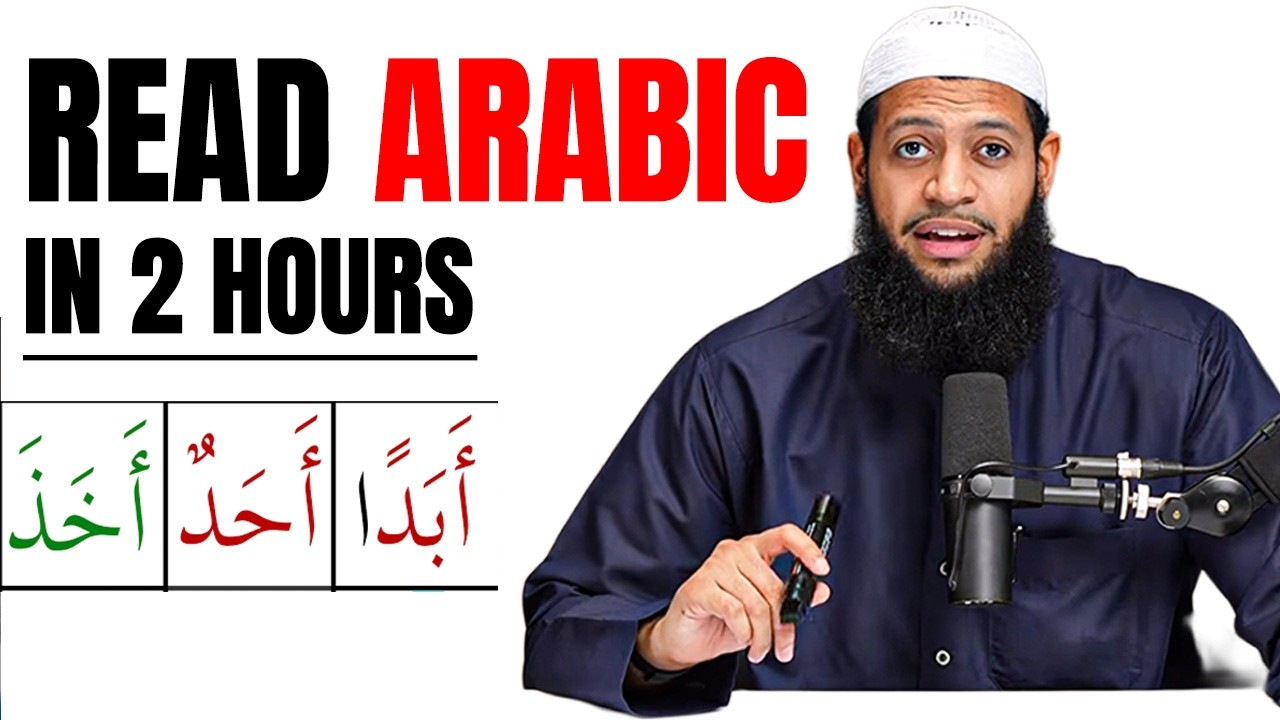
Video summary
This comprehensive guide promises to take complete beginners from zero knowledge to reading Arabic fluency within two hours by focusing on the alphabet, pronunciation, and essential diacritical marks. The instructor shares his personal journey of self-teaching in 2011 and creating these resources years later to emphasize that reading is the foundational first step for mastering any language. For English speakers accustomed to inconsistent letter sounds, the Arabic script offers a phonetic system where every letter has a consistent sound, written from right to left, with letters changing shape depending on whether they appear at the beginning, middle, end, or in isolation of a word. The lesson systematically introduces all 28 letters of the alphabet, noting that while the standard count is 28, the inclusion of the Hamza can bring the total to 29 in certain contexts, and it highlights specific challenges such as distinguishing between similar-looking characters like 'HA' and 'HAA'.
Once the individual letters are introduced, the guide explains how to decode words by recognizing their four positional shapes and applying vowel signs known as harakat. Short vowels are indicated by a line above for 'a', a line below for 'e', and a small 'waw' above for 'oo', while certain letters like 'ta' and 'ya' appear as isolated circles with dots because they do not connect to the following letter. The instruction covers advanced symbols including 'tanween' for double vowels like 'an', 'in', and 'un', which often appears with an alif at the end of a word, and 'sukun', represented by a circle on top, which indicates silence or the absence of a vowel causing the sound to stop. Additionally, the concept of 'shadda' is defined as a symbol that combines elements to indicate emphasis or the doubling of a consonant sound, while 'madd' extends vowel sounds using alif, waw, or yah, including specific variations found in the Quran where these signs appear without full connection.
To build confidence and proficiency, the instructor encourages learners to decode short words by identifying each letter's shape within the context rather than guessing entire words at once. This methodical approach involves practicing one letter at a time before moving on to real words, ensuring that students master the individual tools of the script before attempting complex sentences. The guide concludes with an interactive exercise prompting viewers to identify and pronounce sequences of letters to solidify their understanding of the script's structure. Ultimately, the video stresses the importance of daily practice, particularly with the Quran, as a means to achieve fluency and internalize the reading system through consistent engagement with the material.
Read the full video transcript
If you have been searching for a guide
that teaches you how to read Arabic,
then you have found it. My promise in
this video is simple. If you go through
this video and use the free practice
course that I have prepared for you, you
will learn the Arabic alphabet
pronunciation, the Arabic letters, and
the different concepts that allow you to
finally read Arabic. Everything you need
is completely free and the only thing
you need to bring is the willingness to
sit down, practice, and finish it. By
the end, you will be able to read Arabic
with vowels and diiocritics like the
text that you see right now on screen.
And know that reading Arabic is the very
first step to learning the language. So
if you want to learn the language later
on and whether you continue studying
with us at Andrew Institute or somewhere
else, every Arabic student has to learn
this first. There is no way around it.
To make that as easy as possible, I have
created a completely free practice
course for you. So you have to go here,
put your name and your email and it will
give you access to the platform. That's
where you will find all the practice
material you will need. You see, when I
was learning Arabic, I didn't have
YouTube. I didn't have free online
courses. I didn't have flashcards like
the ones that I have created for you. I
had to teach myself. And I still have
the notebooks that I used back then.
This is the notebook where I wrote in
about 2011 the first Arabic letters
ever. later I was writing notes as you
can see fully in Arabic to show you that
it is actually possible and today
alhamdulillah in 2026 I'm able to build
these kinds of resources that I wish I
had when I started my only hope here is
that you learn how to read Arabic that
you go on to read the Quran and that
every word that you read becomes a
source of reward for both of us with
Allah's permission so please take this
seriously a lot of time and effort and
money went into creating these free
resources and it will be a shame if you
watch only a few minutes and you never
finish it. The only thing that I ask
from you is this. When you have finished
and you can finally read the Arabic
language, come back to this video and
let me know in the comments that you can
finally read. That will make me very
happy and very proud of putting this
together and the little Arabic learning
community that we have created in our
YouTube channel. Now, let me quickly
tell you how this works. This video
right here will teach you every
Arabic reading concept one step at a
time. Whether is the letters, whether is
its pronunciation, whether it's the
different vowels, whether it's the shed,
the sukun, the fat, the kasra, you will
learn the Arabic letters, how they
connect together and all of these
different concepts. But understanding a
concept is only half of learning. The
other half is actually practice. And
that is why after each section of this
video, you will go to this free course
that I have created for you and practice
that exact concept using interactive
flashcards that I have prepared for you
until you can use that concept
comfortably. Then come back here for the
next lesson and the next concept that we
are going to learn until you have
covered all the concepts. So you will be
moving in between this video and the
course uh that I have prepared for you
with a flashc card so you can practice
everything. If you do that I promise you
you will be able to read Arabic by the
end of it. So enjoy and happy learning.
Before we start we are going to talk
about important things to know before
learning the Arabic language. Especially
as a English speaker, you should know
that the Arabic alphabet is actually
easier than the English alphabet. So
there's four things that I want you to
know before we start. The first one is
that Arabic, the Arabic alphabet is
actually phonetic, meaning everything
you see, you read. As for the English
language, for example, if you pay
attention to these different words,
especially as a as as a English not
being my my language, I can tell you
that this is definitely
a something that messes up with your
head and is it's tricky in the
beginning. But in the English language
for example you have words like through
then you have
tough
then you have though.
So even though these are the same
letters, somebody who doesn't know
English, the first thing he would say,
okay, so how do you pronounce O and U?
Okay, so
the and the but but as you can see in
English, even though it's the same
letter, the same letters, you pronounce
them differently.
Through, tough,
though. As for the Arabic language, this
doesn't happen. Whatever you see is
going to have the same sound most of the
times. It never changes
and that's how it stays. The second
thing that I want you to know about the
Arabic alphabet is that you write and
read from the right to the left. So we
write al
like this from right to left. In the
beginning, it will be a little tricky,
but later on you will get used to it.
Likewise, when you open the Quran, you
will see that you open it from the left
to the right and you flip the pages from
left to right being the being because we
we read from the right to the left. The
third thing that I want you to know is
that letters have different shapes. Just
like in the English language, you might
see a capital letter A and a lowercase
letter A and they look slightly
different but they are the same letter.
In the Arabic language we have the same
thing but a letter can have four
different shapes. So first you are going
to have for example with letter B you're
going to have the first shape which is
by itself. By itself the letter B looks
like this. Then the letter B in the
beginning of a word looks like this.
Then in the middle of the word is going
to look like
this.
looking at this right here.
Okay. And then at the end of the word is
going to look like this like the full
letter. So here instead of instead of uh
ignore this right here this will be like
this basically. So you have four
different shapes by it the letter by
itself. You have the beginning of the
letter. You have the middle of the
letter and you have the end of the
letter. And the fourth and last thing
that I want you to know for now is that
the vowels in the Arabic language are
symbols instead of letters as we have in
the English language. So in the English
language you have uh a, e, o, u, i as
vowels. In the Arabic language is just
symbols. So, for example, you're going
to see on top of a letter a symbol. This
makes it makes it sound like h
r
fu. But it could be as well instead of
bu with this letter, it could be ba, b
and boo. Okay, we're going to get into
it. I'm just giving you a a general
understanding now. That is the fourth
thing that I want you to know. So again
the four principles and the four fun
facts or interesting facts about the
Arabic alphabet that I want you to know
is first of all that the Arabic language
is phonetic. Everything you see you
read. The second thing is that you write
from the right to left.
The third thing is that vowels
are symbols or the third thing the third
thing is that letters have four
different shapes by itself in the
beginning in the middle and at the end.
And the fourth thing
is that vowels are actually symbols and
not letters. So now that you understand
how the Arabic alphabet works, now we
can start actually learning how to read.
And by the end of this video, you are
going to be reading the Arabic language.
If you don't, I want you to report the
video. And if you are, I want you to
subscribe, give us a like, and tell me
in the comments that you can finally
read the Arabic language. Now, let's go
with the first part. The first part is
where we are going to start going over
the actual alphabet. Now, first of all,
I don't want you to get overwhelmed and
and think that you have to memorize
everything from the very beginning and
think and start feeling like this too
complicated for me. Just take it slowly
and and take it easy. Take a notebook
and start taking your own notes and try
to actually write them as you see me
write the letters as well. Now in the
Arabic alphabet, in the Arabic alphabet
there is 28 letters. You might hear that
there is 29 and that is fine as well is
is is correct and I will tell you in a
little bit very quickly why that's the
reason. But let's say that there's 28
letters. Now it's easier to learn the
Arabic letters when you group them by
shape. A lot of them have similar
shapes. And usually what makes you
recognize the letter is the dots.
Whether it has one dot on top, two dot,
two dots, two dots on top, a dot at the
bottom, whatever it might be. So let's
start with the first group. The first
group we are going to have the first
letter in the alphabet is
al if
and the sound is a not a or but e is in
between a a full a and a
is e al if alif al if okay the second
one is ba B like bat like bat in English
bat. The third one that we are going to
take here is T which is the same shape
with two dots on top. And the fourth one
is going to be the same
but three dots on top. F like think
like think. T like like t ba like bat.
Al if like a like the sound ah. Now the
next group that we are going to take is
the shape of of ala which looks like
this.
A little wave on top and the body
ha. Okay. And first before this one
comes gym then
then.
Okay. So gym like J like gym like like
going to the gym. Gym gym. Then ha
ha ha. Don't get too overwhelmed yet
with the pronunciation. We're not
looking for per perfect pronunciation.
Just try and say it after me. Ha ha.
like
okay
don't say
okay and
like you're clearing your throat this is
the ne the next shape group
the next group we have is
Dell which the sound is D. So D is the
name of the letter the sound is D like
like the D in in the English language
and its brother or sister is
which with a dot on top like this in
English. This this
val that's the name of the letter.
Okay. And the sound is like this in
English. So dal and
dthe
like a dv
like this this
and that. The next one
is
which goes like this
and then it's brother or sister
which is the same with a dot on top.
As you can see, their body is long and
to the bottom. And Zane as Zane as well.
So Zane Zane is the name of the letter Z
like like the like the Z in the Z in uh
in English.
Don't roll it too much. Especially if
you Spanish and and Spanish is the first
your first language like me. Don't
like Rammon but raman
alman. If it's a little diff difficult
in the beginning it's normal. Don't
worry too much about the pronunciation.
Now I just want you to recognize the
letters. So this is
and if and this is zz
and the name of the letter is zen.
Zra
zra.
The next group is
and aen. Okay. So two little waves in a
big body.
So seen like s in English.
This is the name of the letter seen. The
sound is s. And sheen like sh in
English. Sheen is the name of the
letter. The sound is s. I mean sorry sha
sha sha. So sa sha sa sha s sha like the
name Sasha. So seen as sen
as sh
seen as sen
as sh
sa.
The next one is
Assad
Assad.
And then you have
which fun fact about is the only sound
the only letter or sound found in the
Arabic language is the only language
that has it. So pronouncing this one
might be a little bit tricky which makes
sense.
So s don't do like a lot of people do
with their mouth.
No need to do this with your with your
mouth. And as you can as you can hear
from my voice is a little bit more
uh strong when you pronounce it. It's
not s it's s
and l is not the like like we have seen
earlier like that but ba
saw
and the name of the letters for
the name of the letter is
the name of the letter for is bad. So s
is the name s
the you will find it in the in inah fat
at the end of the fat say
you will find in in fat as well.
Okay. So s
then we have the same group which have
the same the same body as law
but with
a antenna
t
and v t v. The name of the letter is t
for this one and the sound as well. Ta.
And this one is vad.
Okay. Va. This is the sound of the
letter va. Tva.
And as you can pay attention to how I'm
pronouncing as well is a little bit
stronger as well. It's not t and that.
But it's
tova.
Again, no need to do your mouth like
V. But
but but make sure that you pronounce it
like t
and v va
tva.
The next group is
this one is a little bit of a tricky one
for pronouncing in the beginning, but
then you're going to get used to it. It
looks like this like a three reversed.
So this is this is the name of the
letter
and this is
al
okay try after me.
Allah says in the Quran as well
al
Alhamdulillah.
And then you have which is
Allah inah as well.
So this is
this is
okay. Again, I'm not trying to make it
to make you memorize it yet. Right now,
it's just about recognizing it a little
bit and know and hearing the
pronunciation of it. And later on, we
are going to get to go a little bit more
in depth with it. The next group is F
like F in English like the F the sound
of the F f.
And then you have al
as you can see f has a long body. F and
you have not K but
F
and
the name of the letter is
F.
The next group is K. The sound of cat.
Next one is la like like the L in
English.
The next one is
meme
non.
So you have cat K.
Okay.
La. So as you can see cat this one is
this one is like cat. It's not as we
just I was just seen here but
K. This one is la like the L in English.
This one is like like the the M in
English. And this one is noon like the
like the N in English. Noon. Okay. Okay,
the sounds are ka.
Okay, these ones are quite easy. K, la
because English has already these
sounds. And then the last three we have
h.
Okay, I'm going to write it again. So,
pay attention. I start here. I go up. I
go down.
And I close it like this. H. Then we
have
Wow.
Wow. H. Wow. And then we have
Yeah.
H wow. Yeah. So h don't mistake it with
ha which we took in the first few groups
in the first group actually I mean in
the second group this one is ha the
other one is ha this one is ha
okay again don't get too overwhelmed
with the pronunciation in the beginning
it's normal that you're not going to get
it from the very beginning
at least know the nuance and uh and and
that this one okay this one is a little
different the pronunciation and whatnot.
So this one is H. This one is W. Okay.
And the name of the letter is W. But
then the sound is W. And this one is Yah
like the Y in English. Ya.
This one is W like the W. Wa. This one
is Ha.
Now why did we say in the beginning that
some people say that there are 29
letters instead of 28. So these are the
28 that we just took. These are the 28.
However,
sometimes you will see that people or
different alphabets, different books,
different curriculums, they add the
letter hamza which is something that
looks like this.
Okay, this is letter
Hamza. And the sound is just a a.
And if you pay attention in the
beginning,
if you pay attention in the first letter
of the alphabet, it has this letter
hamza on top. Okay? And sometimes you
will see the al if it comes by itself
without it. And sometimes it comes with
it. So sometimes if it comes without it,
it's it has a particular sound. If it
comes with it, it has another different
sound. But this is the reason why some
people separate it. Some people they
don't separate it. So you can say
there's 28 letters in the alphabet or
29. If you consider this as a separate
letter letter
because as we are going to see later on
with the vowels hamza has a e and u can
have different different vowels. So
don't get too overwhelmed with that. I
just wanted to give you a side note and
let's just keep it as 28 letters. So now
that we took the 28 letters let's do in
within the part one a little a little
session practice session. So, we are
going to go over all of them and we are
going to pronounce them. And I want you
to say it after me. Don't just watch the
video, but say it after me. Try it. So,
first we have letter alif. And and I'm
just going to go with the sounds now.
Instead of saying the name the names of
the letters, I'm going to pronounce the
sounds. So, do it after me. This is a a
a
Next one is ba
ba
ba like bat
b.
Next one is t
t
like t
a b t.
The last one in the first group is the
like
think.
The like think.
A ba t
a ba t t t t t t t t t t t t t t t t t t
t t.
So if in your mind you try to link it to
the actual to an actual word in the
English language, it's going to be
easier to memorize. So ah is the first
letter of the alphabet. Just link it to
a as alpha. A bat for bat.
Ta for t
and th for think.
Ab bat t think. Ab bat t think.
A ba t
ab a
if you get this right then we are
getting serious now because many times
there is an example that's given that
says man you don't even know you don't
you don't even know as in you don't know
no Arabic so if you get past this now
you cannot be from the from that group
anymore that don't know Arabic. So,
aba.
Perfect. Now, let's go to the next
group. The next group is the
nicely shaped group. So, we have the J
for gym. Gym. I go to the gym with this
letter. Gem. I go to the gym for this
letter. So, J.
This is the haha
letter. Ha ha ha
haha. Imagine when looking at this
letter, imagine this letter smiling
almost.
It's almost like the letter is smiling.
Haha.
So,
and then you have the throat clearing
letter.
So I go to the gym with this letter. So
j I laugh with this letter haha.
And I clear my throat with this letter.
And the only thing that makes the
difference is the dot.
If I go to the gym with it, the dot is
in the middle. J.
If I laugh with this one, his the the
mouth is just wide open. So, ha ha ha
haha
if I clear my throat with it is because
I have a little a little dot here which
is a
which is a hair in my throat. So, it's
I'm trying to get the dot of my throat.
So,
Ja.
Perfect. Let's take the next group which
is the equivalent to a D. And so just
imagine it. Imagine it like this. If we
were to
to to write. Okay. So this is the the so
that the the goes like this, right? So
now if we just close it
a little bit is a D
or this will be this will be an actual B
actually. So just imagine it like this.
Okay. So this is a da
d the
so the same as letter d in the English
language and the for this
this this
that
the that the
A the
for this this
da for da
da da. So the two sounds is da and the
da and the da and the.
Next one is
like the close to the letter R in in
English
raz
like the sound of a snake. Imagine this
as being a snake, a python. There's the
head and there's the body. And it's just
standing up like this.
Or the sound of a bee as well.
Or the sound of a snake. Z.
Okay. Soz
razor
z.
The next one is the very simple one.
This is Sasha. You remember Sasha? This
is Sa and this is Sha.
Sa and Sha.
Okay. So these two imagine her as Sasha.
Her name is Sasha. So Sa and Sha.
Sa and Sha.
Sa for sea. Imagine the waves of the
sea.
Sea
sea. Okay. And this is imagine that the
sea has the waves and it's raining. So
it's
pouring water into the sea because it's
raining with the three dots on top. So
this is sea because it has waves. And
this is she
because it's pouring water into the sea.
So it's raining.
And both together are sasha.
Sa and sha.
The next one is
saw and
as you can see from my pronunciation is
a little bit stronger. So you say s
and
the and this is the unique one and this
is why they call the Arabic language
the the language of the
because it is the unique letter. So sa s
s s s s s s s s s s s s s s s s s s s s
s s s s s s s s s s s s s s s s s s s
n n n n n n n n n n n n n n n n n n n n
da da da
sa ba sa ba sa ba.
Next one we have
to like a t but pronounced heavy. T T.
Okay. T. So imagine a T the opposite
way. And then we have the the so close
to this. But this this
is this.
This my brother. This. So imagine maybe
a Persian person or I don't know who has
this accent. Think of somebody who has
this accent. This I want this. I want
this my brother. So the va is this. VP
vp.
Next one is the tricky one for English
speaking people which is
you have and you have
so this is close to clearing your throat
but not really.
It's more like when you when you gargo
with water because your throat hurts or
whatever it might be, you go like
same thing with this letter.
And this one is
next one very easy is F
as the letter F in English F. And as you
can see it has a long body like this F.
And this one is the
Okay. Okay. So, as you can see, it's
like K but said a little bit stronger
instead of K.
So, F.
Now, the next one we actually have the K
like the K like the key in English. So
imagine this maybe as a key and this is
the the the the keyhole where you put
the key and this is the the door. K key
K.
And then you have la like an like the
letter L in English. La.
And then you have ma ma like the letter
M in English.
Ma ma. And then you have na.
Na like the letter N in English. Na na
which is a open body like this.
Maybe a bath a bathtub
with a dot with a drop of water falling
into it.
Okay. N
km.
And then the last group
we have
ha
where
yeah.
So h
as we seen in the beginning similar to
but this one is coming more from from
here from your chest going out.
Okay. So you you bring the air from here
and you take the letter out from from
deep inside of your throat. So you go
Wow.
Like w a wa
ya like the
Y in English. W I mean sorry. Yeah.
Yeah.
Yeah. So this one is Yeah.
Yeah. When you see this, you think of
Yeah. and two dots. Yeah. And two dots.
So, h
yeah. So, now that you have gone over
the Arabic alphabet, what you are going
to do is you're going to go to the
Arabic reading course and you are going
to start from the beginning of the
letters and you are going to go into the
practice section and you're going to
start practicing.
So the whole idea is that you see a
letter as I see here al if and you test
yourself do you know it or not al if
then review the end
>> alif.
>> Okay perfect and here you tell if you
knew it instantly or you knew after
thinking or if it needs revision or if
you forgot. And the whole idea is that
you need to three rounds of knew them
all instantly for you to master this
section and go into the next one. So for
example, if I say al if I knew instantly
but then ba
>> ba
>> I knew it after thinking a little bit
then that letter gets added into the
weak letters. And so once I once I
finish this section, I check the weak
letters and I revise the weak letters.
But the goal is to do for three rounds
all of the letters, knew them instantly.
Once you have mastered it and you knew
it instantly, then you can move into the
next section into the letter shapes. So
now that we took the letters, if you
remember in the beginning we said that
letters have four different shapes and
and that is important to know and is
important to to understand because for
example in the English language what are
we going to to do in the English
language? you're going to write for
example
uh
h
pto
right and as you can see the letters are
separated here so as long as you
recognize you know the the letter O and
the S and the P and the I then you are
going to be able to recognize the
letters. Now sometimes though in in in
cursive for example if you write in
cursive
uh you might write like this
right or
hus
to not even wait
right something like this hospital I
didn't write like this since I
maybe 10 years old. So in cursive or or
when you write like this together, it's
similar to how uh the Arabic language
works. The Arabic language works like
this kind of all the letters they get
connected to to the next letter. So so
this is why in the beginning we said
that so that's why in the beginning we
said that letters in the Arabic language
can be recognized or can have different
shapes. if it's in the beginning of the
word, if it's in the middle of the word,
if it's in the end of the word, or if
it's just standing alone.
So now we took and you hopefully
recognize
uh or at least a little bit the letters
when they are alone. So now we are going
to work on recognizing the letters when
they are in the beginning, middle and
end because that's when we are able to
start decoding and we are able to start
reading. Now before I start showing you
the letters and how they connect to
other letters, how they look in the
beginning, middle and end, we have to
mention though that there are a few
letters that after them they don't
connect. So in general all letters in
the Arabic alphabet connect after them
connect to the letter after them.
However, you have these letters which
are
you have alif.
You have the da and the the for this.
You have
and
you have.
All of these letters in the alphabet
which are not too many six they don't
connect with the letter after it after
it.
So so keep this in mind these letters
it's going to be easy to recognize them
because because they don't like to
connect to the letter after them. Now
let's get into how do letters look in
the beginning
middle and end.
So first of all we have al if. So al if
is very simple because
in the beginning
it just looks like this and it doesn't
connect with what comes after it. Now if
it's in the in the middle it will come
from from some from another letter.
So it will have a body at the bottom but
then because it doesn't connect after
it. just going to look like like this in
the middle, right? With a space
and then at the at the end
again it would look like this.
So al is very simple.
Now al which is the next letter in the
beginning it looks like it's its
beginning shape
and then the dot comes right here in the
middle it's going to it's going to come
from another letter and you're going to
see something like this with a dot at
the bottom
and at the And it will be easy to
recognize because
it will have its own shape.
Now for the T and the T the same thing
very easy to recognize because all the
only thing that would change that would
change is two dots at on the top.
Same thing in the middle.
two dots on top. Same thing at the end.
It's just gonna be two dots on top. Ta
and T. So here the tricky ones are in
the middle.
Same thing with the
will be
three dots on top,
three dots in the middle
and at the end it will look something
like this. The
okay so this is the first group and this
how it looks in the middle. So, so pay
attention to it. Remember the body is in
the middle. They just look a like a
little like a little small pyramid.
And what makes the difference? Will make
the difference is ba
and th.
Now we are going to the gym with letter
J. So in the beginning letter J is going
to you're going to see the the head of
it. So it's going to look something like
this
J. And it's going to have the the dot at
the bottom.
Then you're going to to see in the
middle it's going to come like this. And
then you're going to see the head.
J
and at the end you are going to actually
see the body.
So it's going to be easy to recognize
J
and J. Same thing with
letter. So you're going to see the body
in the beginning. In the middle is going
to go like this.
And at the end
you're going to see the body. And same
thing with the throat cleaning one.
You're going to see
the body in the be in the beginning in
the middle
and at the end
you are going to actually see the body.
H.
So J in the beginning looks like this. H
in the middle looks like this. At the
end looks like this. The next one is
those that don't connect. So we have the
for for D in English
in the beginning.
Okay. in the middle is just going to
come from somewhere and it's going to go
like the like this
and it's not going to connect after it.
That's going to be the middle
and then the N will be easy because it
has the same body.
Sorry, I'm almost doing a
So, same thing with the for this
is going to come like this in the
middle.
And
like this
the now next one is going to be
the and z
which are from those that don't connect
either. So in the beginning it's going
to go like this
and
and it's not going to connect to to
what's next. So that will be more in the
middle. In the beginning it will be by
itself and in the end it will be by
itself. Same thing with
a
in the beginning it will be the actual
body in the middle is easy to recognize
because it doesn't connect
and at the end it will be by itself
coming from another word. So this line
I'm showing you that that there's a
space so it doesn't connect. here as
well there is a space so it doesn't
connect to the to the next word that's
why I'm writing this like this so this
will be the beginning this will be the
middle this will be the end raz
raz raz and ra and z now we're coming
back to sasha you remember sasha for the
sea and when the and he's when when it's
raining he goes like so here we have we
have the beginning which will be the
actual C waves.
So you're going to see something
like like this.
You're going to see the C waves in the
beginning. In the middle
it would be just the C waves as well
and at the end it would be the actual
body
like this.
Not the best handwriting.
So sa sa sa
then you have sha when it when it rains
it pours.
So
So we go
you're going to see something like this
raining in the sea.
Then we then we then in the middle
you're going to see
something like this.
Then in the end
you are going to see the actual body of
Sha and both together they are Sasha.
Okay. Sha in the middle as you can see
not too different. Just just missing the
body.
Now we have
sod. So sod in the beginning again is
going to be
the head. Saw in the middle you will see
the head as well. And at the end you
will see
the actual body. Then for blood
you will see in the beginning as well
the head
in the middle
you will see the head. Oops. Sorry this
is the end.
So scratch this one.
In the beginning,
but in the middle
you're going to see like this and at the
end
you are going to see
the actual body of the
so and
so and so.
So pay attention to the middle. That's
the trickiest one.
That's the trickiest one in the middle
and in the beginning as well. So, if you
just remember how the head looks,
you're going to be fine.
Now, the next one has a similar body,
which is the T and the V. So, in the
beginning, you're going to see as well
the head
In the middle
you're going to see
and in the end you're going to see the
body as well for
same thing with you remember this this
this my brother this
okay maybe in like a Russian accent
Maybe. So this but this is going to be
a
and then
v. Okay. This is uh
this is supposed to be like this va p
and va p and va. So pay attention to the
middle
t and va. Now the next one is the a
little bit tricky one for English
speakers which is so
you are going to see in the beginning
the actual head like this
in the middle you're going to see
this
and at the And you are going to see
the actual body, but it's going to look
like this. So, this is a little bit of a
tricky one because is it's almost like a
new shape when it's in the middle or the
end. And it
remember when you gargling water
in the middle, you're going to go
like this. is gonna have the same shape
but with a dot on top.
And likewise at the end
and
now we are going to have the F in
English sound with al
F in the beginning.
F in the middle is just a circle. So you
see it was kind of like a tri triangle
fat is more like a circle in the
beginning with a with a dot on top and
then at the end it's just its own body
fat.
Then with
in the beginning is a as well a circle
with two dots.
In the middle a circle
with two dots and at the end
is
its own body. And the only difference
with with the th
is that it has more of a body going
down. Instead of of a lengthy body like
this, it goes down like this.
Now, as for the calf,
the calf in the beginning, you're going
to see it like this.
And it's going to be something like
this. K
in the middle.
It's going to be something
as well like this.
K. And in the end is going to be its own
body that we seen earlier. K. But in the
middle and in the end, it looks
something like this. Ka cat.
As for the lamb in the beginning, might
trick you with an al if.
But the lamb in the beginning looks like
this.
In the middle, it looks like this
connected. So the difference that you
that you can make in between this one
and the al if is that the al if doesn't
connect after it.
And then the the N is easy because it
has its own body la.
Then for the meme
in the beginning the meme
looks like this. And as and pay
attention how I'm writing it
by going down.
Not up, not a circle up, but down. Same
thing
here like this. Down. Meme.
And then at the end is simple to
recognize because it has its own body.
Meme.
And then noon in the beginning is simple
because you go like this noon. You
you're going to see the beginning of the
body
and a noon
and a dot in the middle is going to be
like this noon.
And at the end is going to be
like the actual body noon
ka
ma na. Next one is ala. So ala if you
remember earlier we write like this. We
start with a line to the top.
Then we go a little bit lower than where
we started the line.
We bring it here.
This is the beginning. In the middle is
going to look, it has different shapes,
but the one that I'm going to show you,
I'm going to show you two. Sometimes you
are going to see like this.
H
and sometimes you are going to see it
like this.
Okay, this is common in the Quran
and then at the end is the same thing
goes like this.
Then at the end it looks like this.
Okay, which is which is
um which the T can come like this as
well.
So here I show you the T.
Okay. And and we forgot to mention that
there is another type of ta
that you might see which looks like like
this in the N as well.
Looks like this.
It comes like this and it closes like
this T. And so if you remove the these
two dots it will be similar to the or it
will be the actual H. So a T can finish
like this or like this depending on the
word. So coming back to the H beginning
H middle H
of H.
Then the wow as we said earlier is from
those that
don't
connect with uh with the word next to
it.
So in the middle is going to look like
this and then the next word is going to
come and in the end it's going to look
like this. So no no difficulty here.
Wow. Wow. Wow. As for the yah. In the
beginning,
it will come like this. Yeah. In the
middle,
it will come like this. Yeah. And at the
end is going to be easy because you're
going to see the body of Yeah.
Yeah.
Now it's worth mentioning that in the
Quran sometimes and this might confuse
you confuse you in the beginning because
there's different different types of
calligraphy. All right. So what I've
been writing which is the simplest one
is is uh called
which is kind of like you know what a
computer would write. So in a computer
is very simple because you're going to
see for example uh you're going to see
na and then the letter
j.
So you're going to see the beginning of
the word of the letter n and then j.
However, sometimes you will see some
calligraphy especially in the Quran they
are going to do something like this. So
na and ja they are going to put the na
on top like this and ja like this.
Or sometimes it might
you might come across something like
like this
and then the the dot will be like this
na.
And so this can happen with all the
lettuce that are that are basically just
just the kind of uh the same body or
close to it similar shape but the dots
differ. So some sometimes as well you
might see the ba and meme. So let's put
together ba and meme. So ba and meim the
simple way how I would show you is a ba
and a meme, right? Ba and ma.
However, you might see it
like this.
And you might see like this
or you might see it like this.
B.
Okay. So, let me make it a little bit
more clear.
You might say it like this almost like
almost like in on top of the of the
actual letter
B or BMA.
So, so that's just uh good to know. just
know it because you know I want you that
after this video after we complete
everything you are able to open the
Quran and actually read words
and uh and these might confuse you
because the Quran depending on which
which print as well it will have
different calligraphy.
So, so then that is going to come with
with practice. But inshallah, my promise
is that at the end of this video, you
are going to be able to uh to read
Arabic. And like I said, if you don't
report the video and say in the
comments, I I couldn't. It's not It
wasn't re It wasn't It wasn't real. But
if you can then go ahead and like,
subscribe and tell me in the comments
what was your experience learning how to
read with this video. So now that you
have mastered the Arabic alphabet and
you have learned about the concept of
the different shapes of the letters, you
come to this section and you go into the
practice of the different shapes.
>> You start your practice.
Ah
sha
>> sha
>> b
>> ya
>> and like that. And you have to knew
instantly all of them. If you don't know
them instantly, then they become into
your weak letters and you have to redo
the round until you do all of them on
the first try and you knew them
instantly. And that's how you master all
the different concepts in the alphabet
in order for you to learn how to read.
So now that we have seen the different
shapes, the different four shapes of
each letter, now is when you are going
to start reading. So I'm going to uh
slowly inshallah get you get you
confident and and start understanding
that reading Arabic is actually just
putting those letters together. So we
are going to start one letter at a time
and I'm going to give you a small
example and you are going to see that
you are going to be able to to read it.
So here we have the first four letters
if you remember a ba ta and tha and here
we have the middle of the letters and
here we have the n of the letters okay
so take this as a reference and I'm
going to write now a small a a small uh
word
and by taking this as a reference and as
a cheat cheat sheet
okay you can cheat in this uh in this
practice
uh you're going to read what I'm going
to write. So So look at this letter
here. Remember which one is it? A ba ta.
So we're going to take Ba
and we are going to write
here B.
And remember remember let's say
let's say this letter here the in the
middle
you're going to say the
and remember
this letter which was T. And we are
going to go like
T.
Okay.
Now read with me. This is
B.
This is
the
This is
T.
bathe
bathe.
So as you can see now you're reading
this is reading Arabic script. Okay. So
let's let's take a few examples like
this and just and just try and decode it
after me. Don't try and guess the word
all together. Don't try and go fast.
Just go one letter at the time. Ba th
ba tha or bathe
na.
And so as you can see depending where is
it in the middle you have to go back and
look at okay is it this one is the end
this one is the middle
this one is the beginning.
Okay. So let's take another example. So
now taking the letters that we took in
the beginning as a reference we so now
you know ba and you remember tha.
So now let's take one of these letters.
Okay. And I'm going to let you guess
what did I just write and how and how
you read it. So, I'm going to write this
one
and then
this one
and then
this one.
So, I'm going to give you five seconds
to try and read this
before I tell you.
Ba
j
remember j like going to the gym? Going
to the gym
because it has a big mouth laughing and
clearing your clearing the throat.
So
okay so now remember these
we are going to try and read another
word now we have and so now if you
remember these letters don't connect
after it
so we are going to go to the gym
and we are going to stop by this
And we are going to
think the think.
So h
this think.
So try and read it.
H
the
h the
h the h the
Okay, now let's try another one. Again,
those letters that don't connect.
So, we are going to the we're going to
the going to the gym again. Actually, we
said going to the gym here. So this will
be ja or ja.
So this one we are going to actually
we're going to
so
but then we are going to ra
and then we are going to
t.
So try and read.
Now you're reading Arabic
and this is how every expert reader
started.
Now we are back at Sasha.
So if you remember the sea because it
has waves. Okay, I don't really like
this scene. This scene should be like
this.
Okay, a little bit closer. So sa and sha
because it's the sea because it has
waves and it's pouring sh
so it's raining
and together they are sasha.
So we are going to use
pouring
and we are going to use in the beginning
we're going to go to the first group
and then
we're going to use
so try and read this. Which one is this?
Sha.
This one is from the first group. Sha
sha ba ra sh sh sh sh sh sh sh sh sh sh
sh sh sh sh sh sh sh sh sh sh b.
Perfect.
Next practice.
And again, you're not supposed to
recognize all of them now. I don't
expect you to recognize all the letters
and so we are just practicing together.
So little by little with repetition
it will stick to to uh to your brain and
you are going to recognize them uh very
fast inshallah.
So now we just came from Sasha
and we are going to to saw and
saw and
okay so this is the unique letter in the
Arabic language if you remember
and we are going to use one of those
that don't connect.
So we are going to go with the
okay da
and we are going to
in the middle take
and we are going to go back to who
the
b
sha d Absha
da
sha
dba.
Perfect. Now let's continue the practice
with
and this brother
the
this. So this but with an accent
the thev the Okay. So we are going to
take the fir from the first group we are
going to take
the
if you remember let me see if you
remember
and then we are going to go to
and then we are going to go to where
so ba A
v
S
B V
and now we have here
now we have here the F and group.
So we are going to take from the group
of Sasha
and we are going to
take this one
and
this one.
So what is this?
T.
But what if I add another dot?
It becomes
sha.
Okay, this is an actual word. These act
it means apartment. Okay, so soak shak.
Perfect.
Now we are going to get one of these
letters
and na.
Okay. So we are going to go back to the
group of Sasha.
We are going to go to
to the sea
and then we are going to come here.
And if you remember this one.
So sh
Let's take another one here. What about
this one?
So what is this one?
La
this one.
Ma
this one.
Na la la la la la la la la la la la la
la la la la la la la la mna.
LaMa
sha cat
la.
Moving forward on the last ones.
We are going to
take an example.
If you remember this one
from the first group we are going to
take. If you remember one dot at the
bottom
I'm not even going to say it.
You say it
ba
ha
and we are going to take the group of
sasha.
So ba
ha
sha baasha
baasha
ba.
Now what if we take instead of one dot
on the first one two
and then we go to
this letter.
Ah
we almost forgot this.
Now this one
is the equivalent as if I had wrote for
example
if I had wrote
la ma t it would look like this
but because this little sneaky one
doesn't connect with the letter after it
then it's just a circle with two dots on
top.
Just a circle with two dots on top. So
this will be ya wa ta. Right. And this
will be la ma.
Right? Now we said that this one and
this one are similar but just different.
Uh the only difference is is that it has
two dots on top. So, what if we
had something that looks like
first group
B
and then just a little H
b.
Why? Because the wow is one of those
sneaky ones that don't connect after it.
they don't like to connect with the
letter after them. So we cannot write we
cannot write
ba ma and ta like this for example
ba ma. So we have to to separate it and
just have a circle circle here for the
ta circle here for the ha. So now we
have gotten to the point where you are
able to decode letters. We are not
reading words but we are decoding
letters. So if you only focus on the on
the actual letter that that we have been
taken now and you and you think of
reading like like this. What letter is
this? Ah
what letter is this?
Going to the gym. A j what letter is
this?
A
what letter is this?
So now we are decoding letter by letter.
The only thing that we are doing is that
we are reading them of how they are when
they are connected.
Okay. So a ja
a
and so now we are decoding
letters instead of reading words and
later on we are going to read all the
all the little pieces that allows us to
read uh words as words and right now you
might not understand but you're able to
to read word by word and later on
inshallah you are going to uh become a
proficient reader and actually read full
words. Now it's time to practice for you
the reading joint letters. So what
you're going to do is you're going to
come to this section number four and
you're going to start trying to read
>> this simple this simple uh joint letters
and you need to make sure that you knew
instantly all of them before you master
them. Now for me here you can see is all
mastered but for you it will be locked
and it will be set to zero. Now if you
remember in the beginning of the video
we spoke about how in the Arabic
language
letters are not enough for vow for
vowels to be recognized but rather there
are there are signs symbols that make
the vowel not like in English which are
letters a e uh o u i in the Arabic
language is actual signs. So we are
going to now that we have been learning
how to read letters now we are going to
know how to read sounds and we are going
to see the difference. So we are going
to take from the first group
letter B.
So as you can see here we have letter B.
But letter B if we add a little line on
top it becomes B. The sound is B which
is what we have been learning and is the
you know the default sound in the Arabic
language and the easiest to to
pronounce. Then we have a line at the
bottom
becomes B.
And then a little letter wow on top
becomes bu.
So the sound now is a,
e, and u. So again a line on top becomes
ba
and and gives the sound a
line at the bottom of the letter gives
the sound e. A little wow letter if you
guys remember the wow. Okay from amongst
the last group.
If you add a little wow it becomes the
sound oo bu boo. And you might see
different signs as well in the Quran.
Sometimes the the the ooh sound might
come with a different symbol like like
this sometimes,
but the default symbol is a wow on top.
Okay. So now this is this this is uh not
too complicated and it's made it's made
like that for that reason. But this
allows you to now start reading sounds.
So, we are going to do some practice
right now. What if I give you
this letter right here?
Remember this letter?
What if we add a line on top? It becomes
it becomes
fa.
Great. What if
This letter now
has a
symbol like this on top.
It becomes
fu fu fu.
What if now we have
this letter right here?
You remember gargling?
Uh
what if we add a line at the bottom? It
becomes
Now what if
you remember Sasha?
What if we go to the sea
and we have this symbol?
What does it become?
Sue. Sue. Sue. But what if we go to the
sea and it's pouring and raining
and it has a line at the bottom
it will become she.
So sue and she.
Okay. So line at the bottom is the e
sound. line on top is the a sound. Wow.
symbol on top is the ooh sound.
What if we now we have the yay?
The yay.
Yeah. What if we have the yah
letter and it has a sign like this on
top?
It becomes
you. You
you What if we have
a a
with a line
at the bottom?
It becomes
ye.
Now, what if we have a letter
that looks like this,
but it has a line at the bottom. It
becomes
key.
But what if this same sign
now
has a sign boy like this on top. It
becomes
C.
And what if this same letter
What if this same letter
has a line on top?
It becomes
Now more practice. What if
we have
a letter in the middle that looks like
this
and it has a sign on top?
Do you remember what letter has a dot on
top?
New. With this sign on top is new. New.
What if
we have
this letter in the middle
and it has a sign on top like this? It
becomes
sa.
And then what if
we have these in the middle
or let me write it better.
What if you have this sign and it has a
wow sign on top?
It would be
ru R.
But what if this now this this same sign
this same letter
has a dot on top
and it has a line at the bottom.
It will be
re.
Now what if we have
three letters? Now if you remember this
one
and this one
and
just a circle like this. And now we have
a line on top B
and we have a line at the bottom.
So ba
we
and then we have something like this
here.
B
we
who bioo.
Ah, so now we reading.
What about if we have
T and then we have this sneaky one that
don't like to connect after it.
And we have two dots like this.
And we have a sign like this.
Boo.
And then we have B Z
B Z. And then and then ta boozita.
And now what if we have now we have this
letter here or this
invented word
sha.
We
to
shall we to
shall we to shall we to some more
practice. What if we go to the gym
and
and then we say, "Wow." And then, "Yay."
And then we have
this line here.
This same letter, but it's small as a
sign.
And this, what would it be?
J Woo because it's a wow. So, ju
ju
ja woo ye ji.
Okay. So, now we put in vowels together
with words. Some more practice. What if
we
go with this letter?
What would
this and this and this be?
Who
see
na?
Who see na? Who see na? Who see na? And
so now you can do something powerful
which is look at a letter recognize the
letter whether is in the beginning in
the middle or the end and then look at
its vowel and read that letter with the
sound with the correct sound. And so
that is the framework. You look at the
letter first then you realize what the
sound is and you say it out loud. So now
even if you are saying slowly and you
have to think first for the letter who
which which letter is this one so h okay
but is uh is a woo sign so is who and
then s this is s but is a line at the
bottom so who see and then this is na
but it's a line on top so now okay so
who see now that is
the closest you get from from reading
and now you are recognizing letters and
putting the sounds on it which is what
we want to accomplish from this part. So
now that you have learned the short
vowels
and what you're going to do is come to
section five in the reading course and
start practicing
>> the
>> until
>> you know all of them instantly
three times three rounds until you
master it. So now here in part six we
are going to take what we call at tenwin
which is the same concept that you just
learned
but
it's going to be double what you've
learned. What do I mean by that? So now
you have learned that one line on top
which we call feta
gives you the sound ba right and one at
the bottom gives you the sound b and one
sign like this gives you the sound boo.
Now there is a vowel which we call
tenwin in the Arabic language which is
basically a double vowel. So instead of
one line is two lines
and instead of one line at the bottom is
two lines at the bottom and instead of
one wow sign is two wow signs and this
gives you the sign or this gives you the
sound ban
ban
an and
gives you the sound
in
and this gives you the sound un.
Okay. So ban bin boon ban bin boon
badoom.
So here is another vowel another vowel.
So now very simply is the same concept.
So if we take the first letter or from
the first group
our friend ba and then we take a letter.
What is this one?
lamb. And then we take a letter mim
and we add this
ba ban
lim
moon
ban lim moon. Now I don't really want to
show you this because in the Arabic
language uh these these uh double vowels
can only come at the end of a letter or
a word sorry. So at the end of a word
instead what we are going to we are
going to take a a real word. So we are
going to take this word
a lamb a ba
a noon
and a t.
Now what we are going to do is add a fat
la
a
b
a fat here na
and here is going to have a
tenwin with
two fatas. So,
which is a brick lab.
Now what if
instead of 10
we say
what if instead we say instead we say
laon
lab.
Okay.
And now what if we have
a word like this?
Huh?
And we go H and we put two lines at the
bottom. What? It becomes
min.
What if we go with a sneaky one that
don't connect
and we add a yah and a non
and we say the
ye
what is this
none
Now here we have something to mention
which is when there is a tenuine.
When there is a tenuine vowel and the
last letter in a word is when it's an
then we add with it a al if so for
example. So here we have
fu
and so we add this al if like this.
So
in this case,
the al if comes by itself because wow is
one of those sneaky letters that don't
connect after it. However, if it was a
letter that connects, for example,
son here,
it will be like this
son.
Son, son.
Okay. So this is a nuance to know that
if there is a tanwin
at the end of a of a word it will come
with an al if. Okay. Another thing to
mention as well is that some scripts
some scripts as we said earlier
might have different uh different signs.
So you might come across something like
this. Instead of of uh of two
wow signs, it will be something like
this.
So is a is is a wow
is a wow as a as a symbol
but it has a line like this. So it
becomes un as well and some scripts of
the Quran have that. So instead of two
two wows
to make the sound un
it will be like this.
All right. So pay attention to that as
well. So here let's have some practice
with the tenuine.
We have a
ba.
Read this for me.
Abaden.
Which means never in Arabic. Abaden.
Now what if we take this like this?
And this becomes
what if we take
this word and we give it a fat
to fat here
and and two kasin
barin.
H.
What if we have this one?
What if we have
nun
bun?
What if we have
but then we add
and two lines at the bottom.
Now if you remember in the beginning we
said that al hamza sometimes comes
and and we add a vowel to it. So we said
there was 29 sometimes there's 28
letters in the alphabet sometimes 29
because the hamza sometimes comes in um
in different in different placements and
he and he gives it a vowel. So for
example
here
as you can see this letter
is a hamza hamza and depending on the
vowel on top or at the bottom it will
make a different sound. So here is
so as you can see it has the body of the
yah but is actually a hamza because the
hamza came here. So you say
and sometimes it might come
like this.
Yeah.
In the Quran, you might see this
ain
a you see the a by itself here. Don't
pay too much attention now and why this
is here by itself and so on. We're going
to learn this later on. But I'm showing
you the hamza.
Okay. instead of of with the with the
line as we as we seen earlier.
Likewise, you might see it with the
vowel on top.
You might see the hamza come like this
soon.
R. So if you see a wow and it has a
hamza on top, it will be whatever the
vowel is.
Ru.
This one
is a. This one is a a
because of the vowel. So in this part we
have learned the tenuin which is just a
variation of what we have learned in the
part before of the au sounds. This is
just an in and un. And I gave you a
couple examples on how you can uh uh as
well recognize the a
like this. Sometimes it might just come
and you it might confuse you. But the
most and the main important fact here
that I want you to take from this part
is the an in sound. Two lines on top an
two lines at the bottom in two little
wows at the top un and sometimes as we
said it might come
the sign of un might come like this.
So now that you have learned about a
tenuin,
come here to part number six and start
working on the practice for tenuine
when Jun
>> until you master all of them and you
knew them instantly. Now we have been
taking vowels that have sounds a e and
u. But what happens when a letter
doesn't have a vowel? What do we and how
do we pronounce it? So right now we are
going to take a vowel that's called
sukun sukun
which could mean in the Arabic language
silence and so that's what happens when
there is no no silence in a in a word I
mean in a letter instead of for example
ba you say ab or b which is a circle on
top of the letter a circle on top of the
letter. So for example here if I add
a
letter.
So this would be for example
cab.
And so you apply this to any other
letter.
Let's say
if you have a word like
you have
then a sukun
and then
a tan.
So it stops at the sound of the letter
Yah,
right? The sound of it. Yah. So if it
doesn't have a vowel, it will be Y.
E. So B, the sound of the letter is B.
If it doesn't have a vowel, it will be.
So this is why this one is.
This one is.
Likewise, if I write if I write here
this
lamb and wow. So the sound of the lamb
is la.
And if it has a sukun will be la.
Likewise, if we have
this,
which again a hamza could come at the
bottom
if the vowel if is a castra. So, e
in in.
Likewise, if we have
a lamb
and a meim, we say lamb
lem
lamb.
Likewise, if we have
A if we have here
if we have a a
I don't like this. Let's make another
one
and a meim, right? Because the ra
doesn't connect after it. So you would
say
ra
okay or in in the Arab countries in the
stop sign instead of saying stop which
it says stop it say stop as well but you
would see the word stop in Arabic which
is
sorry I'm going to put it here
So if the letter has a sukun on top, a
circle on top, it stops at the sound of
the letter. M.
Okay.
Ke in
lamb.
All right. So this is another variation
of the signs that you are going to see
on top of the letters. Now so far you
have taken all the vowels
a eu.
Likewise tenuin and inun. Now this is
the sukun which is when there's no
vowel. What do we do with it? We put a
circle on top and we just stop at the
sound of the letter.
All right. And sometimes as well, just
as a side note, sometimes the sukun
might come,
if I write it here,
if I write lamb.
Sometimes the sukun might come like
this.
sometimes especially in some scripts
some uh calligraphies or some scripts of
the Quran it might come like this
okay but is a circle
in general and you stop at the sound of
the vowel this part is this simple
so now that you have learned the concept
of
you are going to come to section seven
of the reading course and you're going
to practice is the sukun with these
flash cards.
>> How
>> how
the
z
>> zah
>> and make sure that you master it for
three rounds by clicking on new
instantly is you if you know them
instantly and obviously be honest with
yourself. All right. So now we are
getting close to completing all the
tools that you need in order for you to
read. So so far we have gotten the
vowels first the au sound. Then we added
the tenuin to it. Okay? So an in
added sukun to it. When there is no
vowels, what do we say? Which is the
quiet sound.
Now we are getting to the shed. The shed
is
basically
the two that you have learned already
which is the vowel
uh a eu sound and the sukun together.
But we are going to put it together and
it's going to look like this.
So you see here we have a and then we
have ba with the fat on top the line on
top which we call fata and then we have
this sha the shda is an is an m but on
the opposite on the opposite upside down
basically a upside down M. And so what
the sha is, imagine it like this.
What the sha really is? Here we have a
sha well written. So imagine the sha
written like this.
So all the sha is is a sukun and a fata.
Aba
abba
abba.
And so when you put it together,
you put these two together, you get
this. And you write the sha like this
like a upside down M letter in the
English language. Like a upside or like
a W basically like a small W.
All right. So this is what the sha
really is. is is two letters together.
The first one is has a sukun and the
second one has a fata a line on top or
it could be it could be another one. It
could be for example
So you could be ab
or you could be au.
All right. And so the three vowel sounds
that we have learned a eu the fat line
on top the line at the bottom and the
which is the wow sign on top. All of
those can be uh converted into a shda.
So here we have aba this has a sha here
we have ab and here we have abu.
Now one important thing to pay attention
here is that sometimes
the sha
can come
or it can be a little bit confusing.
Why? Because now I have showed you that
if it's a kas like you can see here the
kas comes right below the sha but
sometimes you might find in different
places written it like this which is
rare but it could happen right. So ab so
the sha always goes on top and for that
reason most places we write it like this
with the sha and right below the sha the
kas sometimes you might see it like this
ab
as for
and aba is always the same thing.
Now if we take a couple of of examples
so you can see how
it works before before we get into the
practice.
If we write bula
and we write
okay I'm going to come back to the
vowels
and we write
All right.
Dada
and we write
D.
So here we have
ba
biza
biza.
Here we have
Here we have.
And here we have
So a very common word that you have
probably heard before is the word the
word j.
So Jenna
that sound that you hear in the middle
of the word of the word Jennin
let's say
this is the sha jatin jatin. So if you
pay attention again so this this is
clear is almost as if you was reading
this
Jan
nin.
So imagine it as
jin
you just stop at the sukun. So when
these happens
it it becomes into a sha in the Arabic
language
j and so now you know the sha and and
we're going to get into some practice
before we get into alud the
prolongation. So now that you have
learned about a come to section 8 and
start practicing the flash cards for
>> a
until you master all of them by knowing
them instantly as as you see them
for three rounds straight
before you move into the next section
and watch the the concept for this for
the next section on the video and come
back for the next section. Now we have
got to the last tool that you are going
to need to read the Arabic language like
a pro inshallah. Just a small uh recap.
So you've got the vowels which is the
nouns
fat on top
line at the bottom and which is the wow
sign on top. A eu. Then we doubled it
with the tenwin. So it becomes an in and
un
an in and un. And we said that for
anything that uh that has a sh a um a uh
a tenuin and it's mansub.
It it comes with a al if. So for
example,
so if he if he if he comes with
with if there is a a tenuine
mansub at the end he comes with a alif.
Likewise here for another example if he
comes
Kufu one. If there's a letter that
doesn't connect after it because it's a
silly one, then it's separated, but the
al if still comes. Okay.
All right. Now, after the tenwin, we got
the sukun.
So, the sukun is just the the non vow
the non vowel. So when there is no vowel
we say
ab
then we took the sha which is when there
is a one with sukun and one with a harak
or with a with a vowel okay we call this
harakat this line on top this line at
the bottom all these vowels are called
harakat that's why you might hear
sometimes I don't know how to read
without the harakat at i.e without these
signs on top of the letters.
So the sha is when there is a letter
that comes that is with sukun and one
that has a haraka one that has one of
these vowels. So it becomes abba aba for
example
aba
here
aba but this is not written correctly
and how we actually write it is like
this aba
aba all right so that's the shda
Now all of these are the tools that you
need to learn Arabic. I want you to
realize that before we go into the last
tool which is what is the vowels the
actual sounds then the tenwin which is
the double vowel then the sukun which is
the non vowel then the sha which is the
you can say duplicated vowel shda comes
from putting a little bit of force into
it. Shed shed putting a little bit of
emphasis into it. And now the last tool
is the prolongations.
Prolongations of letters. Prolongations
of letters. That's the last tool that
you are going to need to to read
Arabic to read the Quran.
So the prolongation
has three letters
that get prolonged. Okay. The first one
is our number one friend alif.
We use these to prolong any uh any fata
any any uh any letter that has a line on
top that has a fat.
Now from the prolongations
the al if sometimes might come with the
body of a yah but don't have any any uh
any dots. Okay. And sometimes you might
you might see you might see a line like
this.
Okay. So that is a al if as well. Then
we have
that gets prolonged with theat
or with the letters that that come
before it that have a a
which is the little sign that gives the
sound oo. We use the wow to prolong it.
Okay, don't worry if it's too technical
yet. We're going to get into it. And
then we have the letter yah.
letter Yah gets prolonged as prolonged
as well for the letters that come before
it that have a kasra which is the line
at the bottom. So now let me give you a
small example of how
does this happen. So if I say for
example
if I say and you might see this in the
Quran and it might it might confuse you
a little bit in the in the beginning you
might see something like this.
This is a lamb
and an al if
together. So it becomes la.
So you see how I pronounced it la with
the prolongation. If it was just the
lamb, it would be la. If it was just the
al if it would be a but if it's
prolonged it becomes la.
All right. Another example
with the word how do we say door in
Arabic
we say bab.
So you see the prolongation of the fata
it becomes with an al if baboon
baboon.
So this is how the prolongation
here works.
Now let me give you an example with this
this al if and where does it come. So
you may have come across in the Quran
where Allah says in the Quran
he says
so it has a here.
So this is a prolongation of this letter
with the fat and so you say
if these wasn't there it will be
but because he has a prolongation you
have to say
another example with this uh
prolongation
is another word which you will find in
the Quran as well with the letter the
for this
Vikra.
So you see this
this is a prolongation of the al if the
this is a pronunation of the al if as
well
this is a prongation of the al if the
there's a prongation of the of the of
the fat. Sorry. Oh yeah, prongation with
the al if of this fat.
Now before we get into the into the wow
and the yah which are the simplest one I
want to bring to your attention as well
that sometimes you will see you will see
in the Quran you might have come across
or might not. So don't worry if you
didn't. So in the Quran sometimes you
might come across
uh prolongations that are actually not
showing fully. So for example in you
will see
something like this.
You will see something like this.
And you will see a line like this,
right?
And so this right here is representing a
prolongation. So every time you see in
the Quran a letter
and
and right on top of it there is a
haraka, but there's as well something
like this. Then this is a prongation of
the al if. This is a prongation of the
al if and it can happen across many
different uh
many different letters where you will
see the letter and something like this.
So this is
all right. You might see as well
the word hudah going back to going back
to these example right here and you
might see something like
or
okay now in this case this pronunation
is showing like this.
So here it will be just huda huda or
hudan hudan.
All right. So this is the different sort
of prolongations that you might come
across in general in regular script. You
will never find you will never find
these sort of prongations with the with
the lines. This is specific to the
Quran. These are specific to the Quran.
And I know if you want to learn how to
read Arabic, you'll probably want to
learn how to read the Quran. So that's
the reason why I why I am mentioning it.
But the most common prolongation
that I want you to focus on right now
and these ones is fine if you didn't if
you if you don't grasp it right now. The
the one the most common ones are for
example
if we write a f and we say fat
or or
m
or
okay
M
all of these are prolongations.
Now going into the next one, the one
with wow.
The one with wow is simple is the letter
before
with a wow.
And and this is how it will go. Boo.
Boo. So when you write it like this,
when you write it um when you like
handwriting or taking notes, what taking
notes whatever it might be, it will be
written like this. Boo.
Uh,
okay.
And in general, it there's nothing that
goes on top of the of the alif or on top
of the wow. However, you will find in
the Quran, and this is just as a side
note, this is not the amongst the things
that I want you to memorize, but in the
Quran,
you might find it like this.
You will find the the which is not the
best but the and then a little thingy
like this on top of the of the of the
prongation.
But in general, you don't write the
sukun on top of the
of the of the prongation prongation
letters. But in the Quran is specific
and it has a specific script. So I'm
just telling you in case you come across
it, just know that that's specific to
the Quran. So you might come across
something in the Quran
like this. For example,
something like this.
All right. But all of these is the same
context is is I mean the same the same
uh the same concept.
All right. So you just prolong the the
the the sound before. And here a big uh
common mistake is either prolonging too
much or prolonging too little. So you
have to find the middle ground.
Now with the prolongation of the yah. So
we said there's three letters that get
prolonged,
right? Or extended. We have the al if,
we have the wow,
and then we have the yah as well.
So for example
B
okay B
or we can have
key or key sorry key
right or if something is mine I Say hi.
This is mine lee.
So this is how you prolong
these letters B or this haraka this uh
this um vowels
B key.
Now what happens if there is an al if
that gets prolonged with another al if?
So what do I mean by that? In the Quran,
you'll find this word.
So when when there is
an al if that gets prolonged,
you will find something like this on top
of it. So if you see an alif that has
this on top,
what it means is actually
is actually there is an al if and an
alif.
And so when there is two al ifs like
this,
they become
this right here.
And so this is a prongation of the al
if. So you say ah
ah. So this sort of wrongation you might
see it in in words like
lea.
So you see the prongation.
So now that you have mastered al mad and
pronugation and you have taken the
concept from the actual YouTube video,
come to the flashcards on section number
nine and start practicing the
prolongations
>> until you master all of them.
>> The So now that you have learned all the
concepts, now it's time to read words,
real words in the Arabic language. So
you're going to come to this final
practice and you are going to have two
sections for the final practice. First
you are going to test yourself with
these words and these are words that are
are real words but are are singular
words. So
>> and so you're going to test yourself
with all of these. You have to master
all of them. And then lastly, you are
going to come to the last section number
11. And you are going to test your
reading
>> as such. So you are going to to press
the the arrow left arrow button and
you're going to read before you press
the arrow. So here I'm going to say
Y
>> and so you test you you test yourself on
to see if you know it before you
actually hear the the voice to see if
you are at that level and after this
section come back to the video because
you are almost done and by now you
should be reading the Arabic language.
So alhamdulillah I have to congratulate
you if you have made it all the way
here. Tell me in the comments if you
were someone who didn't know how to read
and you actually followed all the steps
that I gave you in this uh video
tutorial and you actually learn how to
read. Now here what is expected is not
that you are a proficient professional
super fast reader but that you are able
to even if it's slowly as of now you are
able to recognize every letter the sound
of that letter that should go with and
you are able to go over a word with
different letters together and you are
able to recognize them and read them. So
I congratulate you if you have made it
all the way here. And now all you have
to do is practice, practice, practice.
Take the Quran every day. Find you a
teacher, Quran teacher that you can
actually start reading with that you can
memorize the first uh few suras of the
of the Quran. And that is what will make
you a good proficient Arabic reader. And
if you are interested in other sort of
uh resources to actually continue your
process of learning the Arabic language,
check the description and in there
inshallah you are going to find
different resources that might help you.
He wasam.