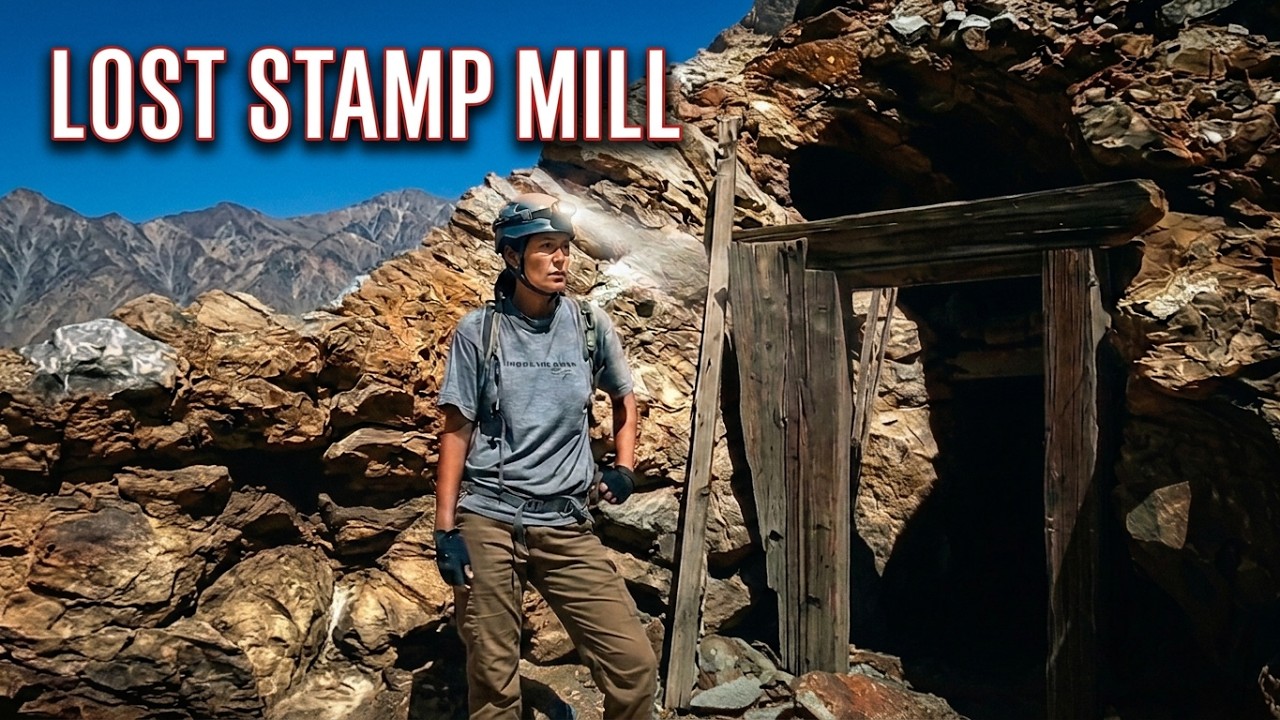
RARE MILL & UV-GLOWING MINERALS IN THIS DEATH VALLEY MINE
Watch on YouTubeVideo summary
Tom and Julie begin their exploration at an historic silver lead mine that was originally staked as a claim in 1871, situated on the rugged slopes overlooking Death Valley with Telescope Peak visible in the distance. The site features extensive upper workings carved into steep veins, characterized by haphazard diggings and numerous small openings scattered across the mountain side. As they navigate these narrow passages, they encounter impressive crystalline formations that appear to line entire walls like the interior of a giant geode, showcasing the chaotic yet fascinating nature of this century-old mining operation where miners worked for over 150 years under difficult conditions without modern safety standards or clear trails.
The highlight of their initial discovery is the unique optical properties of the minerals found within these veins, which exhibit striking fluorescence when exposed to ultraviolet light. The hosts turn off their regular lamps to reveal crystals that glow vividly in orange hues, creating an ethereal effect inside the dark tunnels and narrow shafts they investigate. They examine various pockets containing gray crystalline structures and a particularly interesting vein with iridescent purple tones visible outside of direct sunlight, noting how these geological oddities make for a visually stunning experience despite their irregular shapes and lack of deep penetration into the hillside.
Venturing deeper toward the base of the mountain, Tom and Julie descend through loose debris and old waste piles to locate what remains of a single-stamp mill located approximately 1,000 feet below their starting point. They uncover remnants of industrial activity including an old ladder constructed from sturdy two-by-fours rather than original timber, ventilation tubing stretching far into the tunnels, track switches for rail cars that once hauled ore via mules or small engines, and even a preserved dynamite box bearing the Dupont logo alongside scattered tools like carbide cans and wooden planks used as scaffolding. The mill itself stands intact with its heavy hammer mechanism still in place, powered by a double-cam system designed to lift blocks for crushing operations, all situated in an isolated location that defies easy access from the valley floor.
After completing their descent through hazardous terrain filled with sulfur smells and unstable rock faces, the explorers make the arduous climb back up the steep ridge on foot, emerging exhausted but satisfied with a comprehensive look at this remote mining site. They reflect on how such operations functioned in isolation far removed from civilization, relying on animal power or small engines to transport ore between the upper workings and the lower mill while dealing with constant geological surprises around every corner. The video concludes with their legs shaking from the strenuous hike up a thousand-foot elevation gain over loose scree, yet they remain amazed by the colorful mineral displays, preserved machinery, and sheer ruggedness of this forgotten piece of American mining history that offers both danger and wonder to modern-day explorers.
Read the full video transcript
These are These are always kind of fun.
You never know what's around the corner.
>> Just don't hit the brake or the gas
instead of the brake.
>> And don't go too far to the left.
>> will take the fast way.
Wow, look at that corner.
>> Wow.
>> Wow is right.
>> That was a little sharp.
>> Oh, yeah, here's something else.
>> we found out here.
Oh, that's a pleasant surprise.
That's what you find around the corner.
>> Good morning, YouTube Mine Exploring
fans. Tom and Julie here.
We are here at an old mine. This was
first established as a claim in 1871.
It's a silver lead mine.
And later silver chloride.
There was a cool
chute here that comes down. There's some
higher workings.
You can see the waste pile up there.
I'm standing on top of a pretty big
waste pile.
And there are workings all the way down
this mountain side, it looks like.
And then way in the distance down there
probably around 1,000 ft down is a stamp
mill, a single stamp mill.
And we're going to hike down there
later.
So, let's get going climbing the hill.
We're going to go up to these upper
workings and see what we find and we'll
start there.
That's looking out over Death Valley.
In fact, I believe Telescope Peak is
straight ahead in the middle of the shot
there.
This way there are all kinds of little
workings
on this steeply angled
vein.
Uh
and then up the hill is a few more.
So, we're going to start all the way up
the hill. Well, here's a pretty big
opening.
Uh some different looking stuff there.
Crystals, you can see all there
forming cubes.
This kind of goes all over the place,
doesn't it?
>> Up, down, around.
>> Up, down, all around.
They're very haphazard workings around
here.
There's little diggings everywhere.
>> Look at this, just sitting in there,
too.
>> Huh.
>> Isn't that crazy? Look at that.
>> Yeah.
Those are all crystals the way that's
cubed like that.
Okay, this has the look of inside of a
geode.
Isn't that crazy?
All those crystals.
You turn your light off once.
For a while they fluoresce.
Look at that.
They fluoresce in orange.
That's pretty cool.
Okay, turn your light back on.
So you can see what we're looking at. So
we're looking at this whole wall of
stuff here
that would all fluoresce like that.
Okay, here are these crystals again.
Let's try one more with the
ultraviolet.
Yeah.
I don't know if the camera's picking it
up, but it's pretty cool in person.
Isn't it, Julie?
>> Yeah, it's awesome.
>> So, let's go a little further in here.
Okay, cut your light. Oops.
Look at that.
Wow.
>> Yeah. Yeah.
>> It's like we're inside a geode.
Okay, there's a whole big set of
crystals up here.
All right.
I wish I knew what these are. Are these
chloride crystals?
They might be.
So, here's this white vein there of all
crystals.
Let's look at that in the
UV spectrum.
So, it's just that narrow band.
Man, that is cool looking though, isn't
it?
>> Yeah.
>> I hope it's coming out on the camera.
All right. Well, you could sit and look
at this all day, but
we've got other things to do, so
let's go do them.
Okay, let's take a slow trip over this
way.
Wow, look at the echo. Oh.
>> It's so weird.
>> It must really be a hard rock
at it.
I don't see any vein here.
>> No.
>> Well, that does echo. Woo.
I can see the face already.
Man.
>> This would make a good bomb shelter.
>> It'd make a good place to play some
music.
A natural reverb.
Here's the face.
Here are some pockets they've dug out.
And they went back that way, but we
didn't see anything. This vein comes
over this way.
And then we're back to this neat area
here with all these crystal structures.
And see, we're not very far in here. So,
let's see what else we have around here.
Besides beautiful views.
Look how rugged this is.
It's crazy.
You want to go down this thing?
>> Down it?
>> Yeah.
>> Okay.
>> You want to go down in this hole for a
minute?
See what we see.
Man, the 1871, think of those guys
digging around here then.
That's a long time ago, huh?
>> Mhm.
>> 150 years, is it?
Wow.
You weren't even you weren't even born
yet.
Follow Julie.
Looks like it's open to the outside
there, too, huh?
>> Yeah.
>> Okay, we came down that little
slope.
Short 20-footer to the left.
There's an old ladder, it looks like.
>> It's a little guy.
>> Yeah, it is, a narrow one.
>> Mhm.
>> Goes up into a little stope.
>> It's a good vein.
>> There's some more crystalline stuff.
These look like gray crystals of some
sort.
Yeah, there was track in here, some tie
bumps.
Here's a face [clears throat] on this
little mini crosscut.
And then here's the face of this other
These aren't very long workings, they
don't go very
deep into the hill.
Interesting, though.
This vein has a little more red in it.
Another opening.
Not sure if it goes anywhere.
There's a pretty good waste pile outside
of it.
It's not going anywhere though.
That's interesting.
>> There's some stuff there.
>> Oh yeah, here's more of this
crystalline stuff.
I'll have to ask one of my geologist
friends what that is.
>> Look at this.
This is a vein.
>> Yeah.
Definitely a strange vein, isn't it?
>> Isn't it though?
>> It's kind of a hellacious looking open
cut here.
A lot of stuff above it on this waste
pile.
And
it goes in and down to the right.
I suppose I could try taking a peek.
Okay, that's part of it up.
And this is the part that goes down.
I don't think it's going to go real far.
It's like an old door.
This is kind of interesting looking van
I'm following.
Looks like it just stopped down here.
The vein is almost iridescent purple
when I see it out of the direct light.
That's it.
Crazy area geologically speaking.
That's looking up where I came from.
All right, guys. What's this thing?
I thought it was heavier duty like a
cylinder and a piston inside of it, but
it's not. It's It's pretty light duty.
And then there's a hub or something
right over there.
All right, we're heading down to see if
that's a mill down there or what it is.
Not easy going down this actual uh
pile [snorts] and slope. Everything's
loose. Well, here's what's left of a
dynamite box. Looks like a Dupont, I
think.
Looks like the Dupont logo there,
doesn't it? If you
Turn it to Turn slowly turn it a little
bit again.
Yeah, right there. What does that say?
Yeah, that says Dupont.
And then the other side is
just says high explosives.
Okay, there's our new little dynamite
box.
Maybe the rest of it's around here
somewhere.
>> Right there.
>> Yeah, there it is, actually.
Maybe somebody will nail it back
together.
>> Bridge.
>> Bridge ahead.
Doesn't look like it's over anything to
speak of.
Is there something down there?
>> Just a little bit.
>> What is that green stuff down there?
What's that?
There's a few stalls and a plank, it
looks like a working plank
for a scaffold.
What is this track in here?
>> Another?
>> Mhm.
Actually, that's a piece of
That's like a track switch.
Here's a little cross cut.
10 ft left, 12 ft left.
And to the right, a little gob wall.
A rat's nest.
Fuel can and a lot of 20-ft cut to the
right.
Here's some ventilation tubing.
That goes a long ways.
Oh, I see a ladder.
>> Oh boy.
>> Ooh.
There was track in here.
I'm surprised that they put track for
that little distance.
Well, that's a nice looking ladder.
>> Now, this is a ladder.
That is a solid.
Look at that.
>> That doesn't really go anywhere.
>> Mhm.
>> Or down there.
There's a hole up there.
Wow.
Let's see if we can climb it.
>> Okay, Tom's going to go up the ladder.
It's the sturdiest ladder I think I've
ever seen.
>> Yeah, it's made out of all 2 by 4s.
>> Yeah.
>> This ladder is not from 1871, that's for
sure.
>> No, it's a newer one.
>> I don't know if you can go up past this
stuff. It's pretty slippery.
>> slippery.
>> Goes up to a little teeny hole up here.
>> Uh-huh.
>> I don't think I can get up there.
>> Okay. Come on back down then.
>> Here's a top to a small carbide can.
National Carbide.
>> All right, we found another portal here.
Let's take a look.
Goes a short ways over here.
Up to the top there.
And just a short ways down there.
A little pocket.
>> Here's another opening.
Looks like they had vent line hanging
there.
I can't imagine it goes that far.
None of them have so far.
>> Just goes to there.
About 30 more feet.
I'm not going to crawl in there.
There's some big planks.
Real 2 by 12s.
Look at those things.
I think we've intersected a road looks
like below me. But I spotted this it
looks like a piece of tire.
Can you imagine riding on those little
old tires?
So it looks like this was an old road or
a trail of some sort.
And we're heading down to the mill.
>> [music]
>> Okay, this is crazy.
There's a once town mill.
Out here in the middle of nowhere.
It's quite a ways below the mine we've
been exploring which is
way at the top of the ridge on the
horizon as far as you can see.
This is looking out into Death Valley.
There's a trail that comes up over here
which is right ahead of Julie but I
don't see how you would haul any ore.
Maybe down it.
On a mule.
This would be the mount for the engine.
Which would line up with the big wooden
drive wheel there.
Which would turn the shaft there
and the cams, see there's a double cam
there on that shaft.
And it would hit the lifting block and
lift the
the hammer up.
Union Tool Company from LA.
And
the hammer's still here.
Everything's here.
This is crazy. What's it doing out here?
I noticed that this one support on this
side
I was standing up on top of it was
getting pretty rotten.
This little funnel here is where you
would have fed the ore
or down into this
area on top of the hammers.
And every time it would lift up a
certain amount would slip past that
and fall into the
area where the hammers are. I can't
believe this thing's out here.
I mean, it's really cool to see it.
Bang, bang. Can you imagine this thing
banging away out here in the middle of
nowhere?
And how in the heck did they get ore to
and from this thing?
I mean, it's crazy.
>> [music]
[music]
>> Hope you guys are enjoying this cuz this
is a real treat for us to see.
Now we got to climb the hill back up
there. It's got to be at least what?
>> Steep and rocky.
>> Probably a thousand feet or better.
And there's no trail to be found.
Probably a big hit and miss engine down
here.
Here's an old Havoline Havoline
motor oil can.
One quart, made in USA.
Final place of the day for exploring and
we are going home.
The end of this timber's hand
the chopped with an axe it looks like.
All right.
You don't fall down the hole.
We're both a little tired after hiking
up from that mill.
Legs are a little shaky.
Yeah, my legs are a little shaky, too.
>> You smell sulfur?
>> I don't know.
Oh, yeah, there's sulfur in front of
your head here.
And to the right, see it?
>> Oh, yeah.
Now I smell it.
>> Oh, yeah, my legs are tired.
Knees are sore.
>> You got a little bit of everything right
in here, it looks like, don't it?
>> Yeah.
>> Wow, colorful.
Slabbing off a little bit, too, ain't
it?
All this stuff we're walking on.
Anything in there?
>> No, it just goes a little ways.
It's a bad trap in here.
>> Yeah.
It's about 10 ft of mine, huh?
And we're back out, just about.