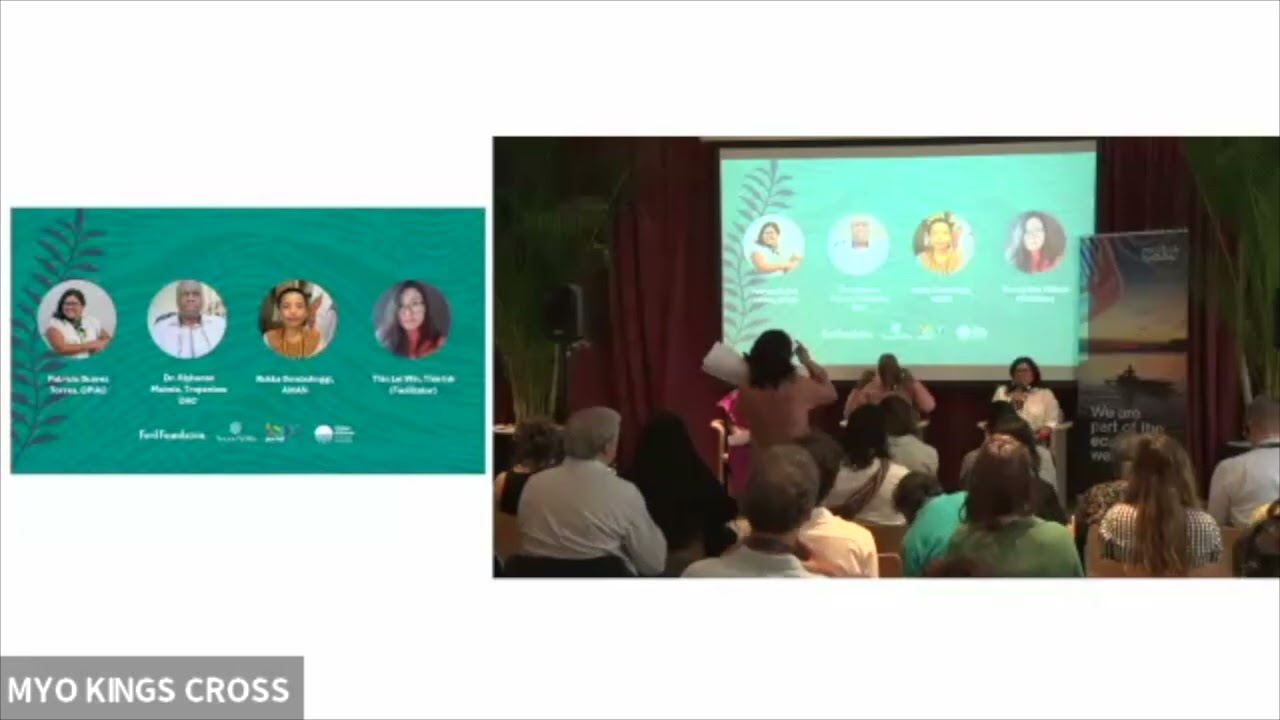
Qui permet aux forêts tropicales de rester debout? « Land Dialogue » Semaine pour le climat Londres
Watch on YouTubeVideo summary
The central theme of the "Land Dialogue" session is that tropical forests remain standing primarily through robust community governance systems rooted in traditional culture rather than relying solely on top-down state management or external intervention. Speakers from Colombia, the Democratic Republic of Congo, and Indonesia highlighted how indigenous communities utilize pre-existing structures involving elders, wisdom committees, and cultural rituals to maintain forest health without needing constant outside support. In these contexts, sustainability is driven by daily ancestral practices that reject monocultures and chemicals in favor of methods aligned with nature, alongside inclusive dialogue among youth, women, and leaders who collectively make decisions within their territories facing immense pressure from external forces like mining or carbon market exploitation.
However, the relationship between formal legal recognition and actual community autonomy presents a complex reality where administrative legitimacy does not automatically equate to effective governance. While laws such as Colombian ETA decrees or DRC concessions returning ownership provide necessary resources, they often clash with customary systems; for instance, in the Congo, dual legal frameworks can create conflict between traditional chiefs, civil servants, and politicians unless management is shifted toward elected local collectives. Furthermore, development projects frequently threaten these established ways of life by destroying environments, which underscores a critical need to strengthen existing governance models while formally documenting spiritual practices and territorial maps to support true sovereignty against the risks posed by donors or NGOs who might impose agendas that undermine community independence.
To address significant power imbalances where less than one percent of pledged climate funds reaches frontline indigenous groups due to two-tier financial systems, speakers called for structural changes including direct financing and broader collaboration beyond just legal aid from non-governmental organizations. This expanded approach recognizes the vital role of religious institutions in Indonesia's diverse faith landscape and emphasizes that technology should be viewed as a respectful partner rather than an enemy when integrated into monitoring systems while addressing ownership issues. The dialogue format used during the event successfully broke down barriers to emphasize that protecting forests requires listening to those who make daily decisions, leading to key suggestions such as using digital tools to preserve indigenous knowledge and ensuring investments focus on people's well-being alongside forest longevity goals like in Guatemala.
Ultimately, the session concluded by affirming that lasting protection for tropical rainforests depends on respecting communities' identities and homes through inclusive governance that honors traditional practices deeply rooted in spirituality. By combining persistent advocacy against external pressures with respectful integration of technology and direct financial support, these groups aim to build a future where forest maintenance is sustained by collective wisdom rather than exploitation. The consensus among the speakers was clear: successful models must prioritize listening to local voices, strengthening customary leadership structures, and ensuring that any technological or legal interventions serve to empower indigenous autonomy without compromising their cultural integrity or spiritual connection to the land they steward daily.
Read the full video transcript
how to defend, protect and
care for these territories, often in
situations of great pressure. So
it is important today when we
talk about this topic to understand that
governance does not begin with a
formal recognition of
land rights. Of course it's important,
it can protect territories and
allow communities to make
decisions and have a
legal framework. But that doesn't create
governance in itself. That's not insignificant
. In many places,
governance systems have existed for
generations, even before,
long before recognition,
legal recognition.
We will hear
practical and real-life examples.
Today we're going to talk about meetings
and community rules.
Collective decision-making
also demonstrates leadership between
generations.
Monitoring, responses,
and
forest shaping by communities. This
also shows how conflicts are resolved
and how decisions are made
over time.
These connections
are at the heart of our discussions
today.
Therefore, whether communities continue to
manage this practice depends on the
processes
proposed in our current reforms. What
is important is that what we
do within communities and in
spaces we do not see
is responsible for
the forests and for the proper maintenance
and longevity of forests and
territories.
to prepare ourselves for this
discussion.
We often ask ourselves what
communities need to protect forests.
But perhaps a
possible question for us is what to do
to support the governance system
that is already doing this work
of protecting forests? How can we
improve
this system to increase the benefits
we have already experienced?
Today we will hear
experiences from Congo, Asia, the South,
and the Amazon. And I hope this
conversation will give us
the opportunity to talk about the proper
maintenance of forests. But not only
that, it's also important to
listen carefully to the people who
make these decisions every day and
who have experienced everything I've just
described. Thank you for being here
today and for your interest in
this conversation,
and thank you for listening to the
examples of this and that
every day. Thank you.
Thank you so much.
Thank you very much, Marc.
Thank you for reminding us that when we
talk about tropical forests, there are
many elements.
We have indigenous,
African, and African-descendant communities
who have maintained
these forests
that have protected them without support, without
legal recognition, and often in
situations of high pressure. So what
can we learn
from them? This is not a situation where there is
no governance, it's just
that we haven't understood this
governance. So I'm going to explain
how today's session will unfold
. This is going to be a little
different from most of the
roundtables you've
attended before. We are going to practice what is
called a
fishball dialogue. Do you know
what this is? Have you done it before?
a few, some women. All right.
GOOD. So for those who don't
know, the idea is
the limits and distances between the
public and the speakers, we don't
really want to have them, to have these
limits. We want to have speakers
who sit in a circle in the center of
the room, surrounded by you, the audience. And
the idea is that you can follow the
conversation closely, a bit like
observing fish in a
bowl. Hence the title fish ball dialogue
or dialogue in a jar.
But today we will have the
speakers on stage, but
the idea remains the same. We will have
three
parts depending on the time available, and we
will change the speakers with
each part.
And then I'm going to ask people
in the room to come and contribute as we go along
. I hope I
explained it clearly. So for the
first part, we're going to have a
traditional format. We will have
the three speakers on stage who
will share stories from their
territory where
they work
and then I will have questions for them and
for her. Next, they will sit down
and then for the second part, we
will have other speakers,
the leaders of the territories. We
have already invited several
territorial organizations to
share their thoughts on what we
have heard. There are three seats. So there will always be
a
free seat so that someone can come,
someone who is a leader
of the territories as well. And then we
also want to hear from people who
support these organizations, the
funders who will once again
uh share their thoughts
and then I will also share the
thoughts of those who are online.
Is that clear? up to this point. So
there will be some movement. It might
be a little chaotic, but we'll
try to do things right. And
then
I also wanted to get a better
idea of who is there,
who works directly with or for
indigenous or local communities
in the forestry sector. raising hand, someone who is
well-off or
has experience in the field of
finance or investment. Is there
anyone capable of directing
capital? GOOD. And who here comes from
the world of politics,
administration,
or activism?
Not many, but there are some nonetheless.
And who is new here to
explore the theme of
territorial governance?
Welcome, you are most welcome.
Well then, it's a very good mix, a
very rich mix. That's exactly what
this discussion needs. So,
I'm going to start our discussion
entitled "Who preserves
tropical forests?" By asking this question,
we are really trying to find out who
manages these forests on a daily basis, who makes
the decisions
that concern them, and what allows
decisions made by
indigenous peoples, people of
African descent, and communities on the
territories to prevail against
external pressures.
So, allow me to introduce
the speakers in alphabetical order
to do things properly.
Professor Alphonse Mindo, director of
Tropenbos DRC, a position he has held since
2017. Thank you for joining us on stage.
Al has been a human rights activist
since the early 90s and has
over 30 years of experience in
national and international NGOs.
Next, we have Patricia Suarez
Torres, who is an advisor to
the National Organization of
Indigenous Peoples of the Colombian Amazon, who
came as Opiac.
She is a prominent figure and advocate for
human rights and
territorial rights. She is from the
indigenous Muroui people of the
Amazon department in Colombia. And then Roua
Somolingi, Secretary General of
the Alliance of Indigenous Peoples of
the Aman Archipelago.
Roka comes from the indigenous
Toraya group of Suawess in Indonesia. So
my first question is addressed to the three
speakers. You will have 4 minutes to
answer.
I would like you all to give us
a picture of what
forest governance looks like on the ground where
you are. Can you
tell us an anecdote from
your territory or the territories
your organizations support
that shows us who really makes the
decisions, the big decisions
when an important decision has to be
made concerning the forest, who is around
the table and how you manage to
get everyone to agree?
Patricia, would you like to begin?
Hello everyone.
Thank you very much for this
invitation. I am delighted to participate
in this space - I greet you
from the 64 indigenous peoples who
live in the Colombian Amazon.
I am delighted to be here with you. In
my community, we say that there are
people who are born to make
a contribution through
words. And there are others who do it, who
were born to do it, to
do something. And I was born
to do, to act. This is what I
do in the territory because those
who were born to act are there in the
spaces to share the word and the
need to have this link and to
connect with the Amazon.
Unfortunately Margrette has already said
everything I wanted to say, but oh well, it
shows how important it is.
It reminds us that we are all
connected no matter where we
come from.
It is also important to say that
governance is nothing new
for indigenous peoples in the
Amazon. We have always been there.
We have always had our own
governance systems.
Imagine in the regions,
the indigenous peoples in the
Colombian Amazon,
there are traditional authorities,
there are elders who have a system of
governance and knowledge in
progress. And that is why
he protects the forests. And we are here
to share these experiences and this
knowledge with you. I would
also like to say that this system of
governance and ours
has resulted in
a green Colombian Amazon. If
you look at the map, 93% of the
territory is jungle.
It is the most protected place in
Colombia.
And what we are doing
thanks to your support is
protecting 97 million hectares that are
protected by indigenous peoples.
Regarding the question of who makes the
decisions,
we don't. It is not one
person who makes the decisions, it is
the result of a process of several
round tables to say that were
established from a cultural point of view, a
cultural context and also a political one. And
now the decisions that were
made by the indigenous peoples in the
Amazon
have worked well. And the result is
that we have a forest, a green forest.
We have roles
authorized by the authorities. We
had a committee of wisdom which has
specific roles, it
also has administrative roles. And thanks to
this, we have this
governance system in place and
we can reach decisions
that contribute to the proper maintenance of
forests. So, the story I wanted to
share with you today isn't
really a story, but it's just what
we do in several
territories in the Amazon.
We organize a dance in the
communities and it's a whole process.
There are operations to be carried out. There are
steps to be followed that include all
members of the community, all
family members, and other
communities as well. Each person plays
an important role in ensuring that this
dance
is performed. And it's not just
something that is important in the
moment, it's something that is
important even before the dance. It's a
bit like planting silences and
then of course it blooms and the flower
is the dance. So I see that I don't have
much time but just to
share a message with you, I
wrote it because I didn't want to
forget it. Forests still exist
because indigenous peoples
exist. We have
governance and knowledge systems. If the
world wants to protect forests, the
world must protect
indigenous peoples and our
knowledge and governance systems
and ensure that our forests
are alive. Thank you.
Thank you, Patricia. I have another question.
Thank you very much for this answer, but
I would like to hear more about
this dance,
but perhaps we can talk about it
during the coffee break.
Um, I'd like to know more about
Indigenous territorial entities. If
I understand correctly,
Colombia has given
formal recognition to this indigenous territorial entity
. Does this change anything
? Is there more
power involved, or is this just
an administrative milestone? You have
4 minutes to answer the question.
All right. Alright.
So this second question gives me
the opportunity to
share more with you. It's
something, it's a theme we
discussed last year,
I remember
when there was this recognition
that was made by a law, but it didn't
start there.
It was a decree, but we fought for
many years to have
this entity, this status of
indigenous territorial entity, and this despite the fact that
in the 1991 Constitution in
Colombia, there are departments of
community departments and
indigenous territorial entities (ETA),
but it has not been implemented.
For years we fought
for this and in 2018 we were able to
get this decree decree
decree 60002,
but it depended a lot on the
political will,
no, the application or uh the
implementation of this legislation, but we
continue to manage our territories
in Colombia. It is said
that beyond administrative economic resources
, we talk about how to
manage the territory and then we
think about what we need to
continue this administration.
And then in relation to these ETAs in 2025,
thanks to this decree, we have had
this recognition of an indigenous territorial entity
, but it is a struggle that
we have been waging for several years.
So, what's new?
Therefore, we can have more skills than
before.
governance and administration resource skills. And
this process, as I said, is nothing
new. This didn't start with this
decree;
we were doing it before. But what
we have now is 22
Indigenous territories working on
this political proposal,
many of which are working on
centralisation with
administrative acts,
and
obviously they are in
very difficult situations. It's difficult to
do this work because these are
communities that are far removed from the
government. I am talking about the distance and
also the political situation which prevents them
from making
rapid progress in this process.
But I would say that it is an opportunity
for Indigenous peoples, a good
experience for those who wish to
know, because it allows
Indigenous peoples to practice their
self-determination, to live it, and
also to coordinate it. Coordinating with
local entities,
governance, and local government
allows us to be part of
the decision-making process, doesn't it? Because
normally, this is a situation
in which other people
make decisions about us,
Indigenous peoples, and
we were not at the decision-making table.
So the message that
I had noted for you
and that I shared with you is the
following:
indigenous governance is nothing
new. It has always existed, but with
this new legal proposal, it
will allow us, it will help us to
maintain the forests
because it will help us to have
clear actions to maintain the
forests. Thank you so much.
Alphonse, I would like to turn to
you now. Could you share,
describe how
forest governance actually works in your
region?
Yes, thank you very much.
If I consider the governance of
forests in the Democratic Republic
of Congo and in the regions where we are
currently working, we know,
we see that it is the first in
fact in terms of a dual
legal system, that is to say that we have
customary law, but we
also have modern law in quotation marks, which
concerns
customary rules,
three customary rules. Normally,
communities, elders, and
community assemblies should make
decisions normally, but this was
destroyed
for decades during the colonial period
also by the State, also a
very centralized system of government.
So really, those who make the
decisions about the forests are the
traditional chiefs.
and
civil servants as well as
politicians.
The communities
have been somewhat removed from this, from
this decision-making process in
the forestry sector, and you also have
some cases where
they have expelled people who had
lived in areas for
generations. So that's how
it works.
To complicate matters further,
according to Congolese law, the forest
is an area of shared competence
between the States, the State, the provinces
and decentralized entities. So you
have three levels of entity in the
modern state that are actually competing
for the management of these forests. You
may have situations where
the Ministry of
Forestry has made a decision on the
forest, but you see that the
provincial governor has made a
different decision, and this results
in conflict.
So sometimes communities
see that
their forests have been allocated by a
foreign company or
external actors. So it
's a very complex situation. I would
say
that according to customary law,
the only ones who can control
decision-making are the
traditional leaders. But we also have
great men in quotation marks, the
elites in quotation marks of these
communities who sometimes do not even live
in the village or in
the region. They often live in
cities which also participate in
decision-making with customary rights
and the community is therefore somewhat
sidelined. So I wouldn't say it's
really a governance system because
governance means inclusivity,
legitimacy, accountability. And for that reason,
if you look at it,
none of these criteria are met.
And then we can talk about management,
simple top-down management
. So that's what I
could say about
forest governance and how it
looks today.
So you talked about governance
with the three elements of legitimacy,
inclusivity,
and you also talked about how
communities are sometimes left out
. So I would like to ask you
a question now about
community forest concessions
because often when we talk about
protecting forests, they
are often turned into national parks and
communities find themselves evicted.
But from my understanding,
community forest concessions are actually the
opposite, or rather,
communities take control,
and what are the
potential long-term benefits of this type of model for both
forests
and communities? Yes, thank you very much.
You see,
before that, before we had
the intervention of the State which took
ownership of the forests and also the
underground, the soils, the forests and the
subsoil which, in quotes,
belongs to the State. Before this
event,
the communities
owned the forests and the land.
Everything belonged to the communities. But
now with these
community forest concessions, it's actually a bit of a
step backwards where we
give control of the forests and
ownership is returned to the
communities. This means the
community is taking control. There is a
change of power somewhere, and it has been returned
to the hands of the communities, and this will be
forever. In relation to and according to
this reform which was introduced a
few years ago, they indicate
that concessions are entrusted to
communities
up to 50,000 hectares of forest and this
forever and free of charge. So
when communities receive these
concessions,
the communities then become the
owners of these forests.
They can then establish
simple management plans for the forests and
determine how to allocate activities
within the forest, and this
relates to governance. Here we have
real governance in the sense that
you have different entities that are
responsible for the governance of these
community forest concessions.
You have the local committee responsible
for management and the people are chosen and
nominated by the
community members who actually elect the
people who are responsible for the
day-to-day management of the forests. And
something that is very interesting
is that we see within the framework of the
election process, we
also have what we call
social cadets in quotation marks who are
elected, who are responsible for
management. We also have women
who are presidents of these communities.
We also have young
people who are involved in
the management of these activities and who are
accountable to the community. The
traditional chiefs who are responsible
for the community are no longer
the ones making decisions
regarding the forest. It is a
collective action, a
collective decision-making process that was
put in place to ensure inclusivity and
legitimacy because they
recognize the role of the population.
This changes a lot of things because, according to
them, the forest is
not outside. That means they are part of,
they belong to the forest somewhere in the
natural domain and so
when they take control of these
forests, it
also improves because for them it is not
only a question of preserving
the forest, it is also a way of
preserving themselves because they belong to
nature, they belong to the forest.
So that's why we see that
in these concessions,
biological diversity is returning and
we also see that the forests
are better protected. So I would say that
for the forests we monitor,
we see that they allocate at least 70%
of their concession for
conservation activities. And for
them, conservation is not just a matter
of biodiversity, but also for cultural purposes,
for ritual or elements or
activities. I see that my time is
up now. I'm going to stop
there. Thank you so much. Thank you very much,
Alfons
Roua. I now turn to you
to listen. Tell us about
forest governance in the region where
you are located.
Yes, thank you very much.
I will therefore express myself in Indonesian.
My true language is Toraja.
Unfortunately, we do not have a
Toraja interpreter here. So I
apologize.
The video we watched yesterday,
I think some of you
still remember it, where we saw
children swimming in the river,
the story of the river.
also how
indigenous peoples protect nature
and protect the future.
We have several friends who are here.
Juan Martinez, who is with us, who
went to the forest in 2012. Din
Corfus, also who is with us, and
I would also like to take this
opportunity to announce
that we are now members of the United
Nations Permanent Forum
on Indigenous Lending Issues
. You are the representative for
Asia.
And we also have Cafine. Is
Cafine in the room? Yes.
Yes. Who is already present and who has
also experienced what we
call in our indigenous systems
that governance is real.
This is not something
romanticized like in
children's stories. No, it's real. For what ?
Why was this the reality? Because
in our means of subsistence,
we do not distinguish between
the political, the economic, and the social.
Everything complements each other. and interconnect.
The legal system as well as the
system of indigenous peoples is
not only to regulate
relations between humans, but also to
govern the relationship between humans,
nature, including with animals,
trees and also regulates the
relationship
between the living
and spirits. the spirit
in the region I mention so the
name of the allengtan river
is only one of the
seven systems
of governance
where we have been
working with Indigenous peoples for
over 40 years. So they are
under pressure, the companies that cut down
the wood, the companies in the
agri-food sector,
the plantations, all the plantations
and so on. But now,
there are many people who are
involved in
ecosystem restoration. We don't know what they
want to do. We
still have good ecosystems. They
may want to do
restoration work and they are
also competing with
carbon projects. So
the most difficult ones
are the people who come and
promise us that if you accept
the carbon markets, money will
fall from the sky like leaves
fall from a tree. So everyone is
talking about money, they're presenting
money and they're saying that it's to
their advantage. But of course, it would be
simpler to protect the forest.
The river
contains over 1 million cubic meters
of carbon.
I don't know. What is the equivalent
for emissions for a small country?
But it's a reality. So the river
represents a lot of carbon. Everything is
regulated not only to protect
the forest but also people and
including agri-food systems
and to try not to cause
harm to health.
In some cases, they use
rituals
to see or lift breath, and
can experience and
feel the moisture using
their fingertips
because they are connected with their
ancestors.
The government also regulates
when rituals should begin,
when we should start sowing
seeds, when we should go
into the forests, which rivers
can be used for washing,
which one you can use for
drinking, and also where you should uh
plant crops because there is
ancestral protection in
place. And if you do that, when there is
protection,
you may then have become
ill or your mind may be affected
if you do not respect its rules and
even your mind may be removed.
This is what makes
indigenous systems very close and intergenerational means of
subsistence
between every human being
and some 50,000 hectares of forest
still protected and which
populations can appreciate
through the community. THANKS. The
situation
in your region, as you have just
described, is very worrying. I have a follow-up question which
is a little different in that
a single forest region of
Indonesia may be threatened by
different governance jurisdictions.
We are talking about Indigenous systems,
we are talking about the provincial dimension
and also the governance of
conservation systems. So how do
indigenous peoples actually manage to
cope with this overlapping of
systems? And how can they
ensure they maintain authority over their
territory?
Good for the river and the Lingbang.
This is the primary generation of
mapping defined in the
[grunt] 80s 90s.
Support,
we are only talking about the bad
influences of technology on
indigenous peoples who want us to
fight against modernization. But
uh, but in Indonesia, we
also rely on technology as a weapon to do
digital mapping of
remote sensors. This has already been implemented
for both rivers,
and has been since the beginning,
for the last 40 years. And that is
why
all the stories, all the
memories of their land continue
to be shared.
And that's also where the
governance system works because we
've already agreed on the spaces that
need to be managed. What are the
spaces that are considered
sacred spaces for the ancestors and to
protect, and this is something that we
follow, that we must follow
carefully.
In August 2019, we accompanied a
group of young people from all corners of the
world, from Russia, from all
regions, to visit the river.
And on the last evening
of their visit, they were outdoors,
and one of them said,
"If all indigenous people
lived like this, we would all be
living
in a happy world. The government
is only there to cause
problems, and that's what happened to
the river
because forest governance isn't just about
governing the forests;
it's a very complicated system in
Indonesia,
and here it's defined as two types of forests:
forest areas and
non-forest areas. The rest is
then divided into concessions as
national parks, some of which can be used, as well as
non-forest areas. So
the river
is in Lingtang,
an indigenous region that has been
defined by four forms of governance
according to government instructions.
Some areas are considered
non-forest areas, one is
considered forest area, and
another is
protected forest and
forest production. So they keep trying to
do everything, to
change everything, and it can change at
any moment. But why
is the river important?
Because from the Initially, they had the map,
the available maps. Every time
a company wants to set up in
the region, it's refused. All
they really want is to be
left alone.
So that's why Aman and
our goal is to ensure that
the maps are rigorously
respected and followed. And
the government must
recognize that the
forest areas must be returned
as customary forest.
Based on the constitution, the
forests belong to the
indigenous people. Of all the
government governance categories, the only ones that
apply are
customary forests.
That's why nearly
half of the region has been returned as
customary forest because
some of them are still
threatened due to the lack of
legal recognition. That's
another problem. The problem we have is
with
NGOs that want to develop so-called "
social forests," but these are
forests that belong to the
indigenous people. Now they
want to obtain permits for
social activities and
carbon permits, and that This is a problem
for us. Thank you.
Thank you very much, Ra. We can
applaud our speakers.
You may return to your seats, but please
leave the microphones on
your chairs if possible. So,
we'll come.
Thank you all. So, we've just
heard three very
different visions of
territorial governance: in the Amazon, the
Congo Basin, and
Southeast Asia. And there are two things that have
already struck me: none of these
systems is simple or static. It's
not a single law or a
single leader that allows
this system of governance to be maintained. There are different
levels of
exchange. We're going to look
not only at how decisions
are made in
governance systems, but what makes
these decisions sustainable. So, we're going to
ask the territorial people to
come and talk to us about
this. I'd like to invite our second
group of speakers. I'd like to
invite D. Montier from the
Indigenous People and the Local Network for
Forest and Ecosystem Management to the stage.
Central Africa. Thank you, Diel.
Diel is from the learned Bambouti people.
We also have Liva and Sucré
Romero,
co-chair. Liva is the co
-chair of the Global Alliance of
Territorial Communities (GATC) and the executive
director of the
Mo-American Alliance of Peoples and Forests.
Léviille is from the
Bribamanca Indigenous community of Costa Rica.
You'll see there's still one seat
available if there are people in this
room, a young person or an elder who
belongs to a
territorial leadership organization who would be
interested in sharing their
field experience and answering the
questions I have. There's still one
seat available if someone would like to
take it.
Brooka, you've already spoken, so
perhaps not you. Is there
anyone, a woman, or a young
leader who would like to speak again on behalf
of a territorial organization who would like to
join us? This is your
opportunity to share your thoughts,
your ideas.
Very well, perfect. Come on, come on.
The question I'd like to ask is... The question I'm asking
you all is, when you consider
communities in terms of
how decisions are made and
how everyone reaches an agreement, and
consider communities where there are
strong territorial leaders who have
endured year after year, this isn't something
that has been
developed over the years. So what
is the secret ingredient? What
makes it work and
maintains the cohesion and strength
of this community? I'd like to
start with you first.
Thank you very much. I am Mr. Di
Miré.
I work in Central Africa, in the
Congo Basin,
and particularly in the
Democratic Republic of Congo.
This question
is too profound, as
the decision
concerns our very lives. When we
make a decision,
it directly affects our
dependence,
our very lives.
And this means that,
if you had understood my predecessor, I
tried to
review
the legal decision-making mechanism,
which, in my opinion, has
impacted
decision-making processes within
the indigenous system for
years.
I can To assert that we were in a
situation where
others made decisions
through legality,
through states that decided
our very lives without us.
But with the current
community forestry system, if we utilize
legality, if we utilize the law, we
are going down to see
how to internalize these
traditional decision-making mechanisms.
For us, it is oral and visual transmission that is our
responsibility, that touches us. Our
sensitivity
is linked to our lives, that is to say, our
forests, our lands,
which constitute our identity,
to safeguard and govern them.
We have traditional institutions
that are there to ensure
the
implementation of decisions made
by the community,
through
established and
known traditional rules. That's what
I can add in terms of
sustainability, and that reassures us about the
intergenerational transmission of our
traditional knowledge. Thank you.
Thank you very much.
Sorry about that.
Thank you very much. I know you
said it was a complicated
and difficult question, but I think you You did
a fantastic job
answering the question. Thank you very much,
Levi. Can I come to you now?
Well, I agree with Diel that the
question was very profound, very
complex, and to answer it, I would like
your help. And to do that
, I would also like to ask you a
question so that you can
understand my answer. Which of you would
destroy the only home you can
live in?
For us,
we believe
that the forest will be
preserved if the people
want to preserve it.
If you reconsider the three
commitments made at COP30,
this reality—
the fact that the forest will be preserved if
the people want it, and that the
people will become a reality if the
three commitments are respected—if
you consider these three commitments
from COP30,
the FTFG, the
FF, and other decisions, what
happens with that?
We must recognize that the TFL
very timidly acknowledges
that Indigenous peoples
have their role. They recognize the
need for direct investment,
but it remains very low for the
Maintenance and preservation of forests.
That's why we at GATC,
through the mechanisms we're developing, are
working
on measuring the impact of this 20% of
direct funding. Do we
want to share this? We want this
to be known because what we
need is for future
commitments to be measured not only
by the quantity of forest but also by the
number of people who live around and
in these forests.
So how do we do this within
our communities? That's the answer
to your question. Here I share and
agree with you how
profound and
intense this question is, and how to find the
secret ingredient. We were asked, so the
first of these ingredients, I would say, is
the daily practice of
our ancestral traditions within
our community. The second ingredient
is inclusive dialogue.
Inclusive dialogue among leaders, between our
youth and women, and territorial leaders,
is what allows us to be
involved in governance.
Governance that goes beyond the laws
imposed upon us. It's about
dialogue. It's this dialogue that
allows us to truly
govern well. The third ingredient is
the use of ancestral practices
in our production methods. You won't
find us working with
monocultures and
chemicals. No, that's not us. And
another important point, which isn't
ancestral in
nature,
is the dialogue—the
daily dialogue, again and again—that we
try to engage in with
our governments. Today we
'll try to do it, and
tomorrow we'll try again; we
do this year after year. This is what
allows us to fulfill our
functions. And here we have the four
ingredients that are important to
give you a concrete and
specific answer to your questions. Thank you.
Thank you very much.
These are very
tangible, very concrete ingredients that you've
shared with us to help us
reflect on what we
need to strengthen governance.
So, could you introduce yourself
and then share your Reflections
on what we've heard,
and also share any other
secret ingredients you'd like to share
with us?
Hello,
my name is Cat Patachot from Ba do Sud
in the municipality of Potoseguro,
Brazil.
We had the colonization of this place
in the year 1500. We were colonized
by the Portuguese, invaded,
we were deprived of our system of
territorial governance,
and the Portuguese brought their
traditions,
and they [clears throat] entered our land
and invaded everything.
They took our language. They
stopped our culture. We were
forced to speak another language, a
foreign language. We had no rights.
We couldn't even
believe
in our religions or have our
customs.
So that's the context. We couldn't
live, we could only survive
because of this
system of massacre. We also had
very harsh political situations.
We even had to give up our homes, and now
the youth are seizing the opportunity to go to
university
and educate us about the laws, the The
constitution, the legal world, and
now we can have
our territories again,
we can reclaim them,
and as my
colleagues have said, our home
is the forest. The forest is our
home, it's our life, it's our
livelihood.
If we don't have forests,
if we don't maintain the forest, if
we don't protect it—the same goes for the
river, the ocean, the seas,
nature—well, nothing
can develop.
We must ensure the survival of all
nature.
We have 800,000 to
72,000
hectares for local communities and
Indigenous peoples who
value life, who recognize
life, and scientists have even
stipulated that the PACL (Protected Areas of Local Communities)
contribute to the continuity of the planet, to ensuring
the planet's survival through
our protection of nature. There will be no
one on Earth without the
cultures of Indigenous peoples. We
have our own systems
of health, medicine, and remedies,
thanks to the forest. We use the forest
for our livelihoods, but without
destroying it. We are developing
also ecotourism and a
wellness system where I live
in South Bayant.
And we have survived despite
colonization, and
I am delighted to contribute to
the land's survival. Thank you.
Thank you very much for all these
contributions.
You can sit down and leave the
microphones on the seats.
We have heard from different people
who work in
different governance systems,
and that this is done over several
generations, years, and relationships;
it is based on trust, and it can
be difficult
to establish, but there are
people who contribute to supporting
this creation of trust and
relationships. But before we move on to the
next step, I would also like to
share some thoughts from people who
are online. We have over 100
people connected online,
and I will read some reflections. There is
one that is very short.
It is based on what you have
said. He said it is an experience
we also have in India that is
very depressing: solidarity. So I am
sending you a message of solidarity following
these very difficult. We
also have comments from
Sarah Tolbet online responding to
what Alphonse said. She said that in
my experience
in eastern DRC, even though
logging concessions are free, in reality
they are very expensive to
implement. That's
why today
concessions
are created with NGOs. NGOs
are necessary but sometimes play a
very problematic role in these
concessions because they control
the information communities
receive about the
logging concessions. And because of this, I've
seen that a lot of power is
given to NGOs, much more than to the
communities, which is far from
ideal.
There's a question.
What are some examples of
community interest in
forest preservation? So this isn't
a Q&A session,
but I just wanted to share this
question. We've heard from
those in the
forestry system. Now we'll
move on to the third step:
researchers, donors... funds,
academics. And the question
we have for you is based
on what has just been discussed
and what truly strengthens local governance
. And what
more should we do
to support them in the future? To
answer this question, I would like to
invite
the following: Sergio Guzman,
from the local communities of Etou,
Guatemala, and head of Guatemala
Carbon for COFOP;
and then two other speakers. If you
are a funder, thank you very much, or an
academic or
conservation partner, this is an opportunity to
share your thoughts. It would be good to
have a woman, please. Thank you
very much.
So, based on everything
we have heard so far, what do
you think are the
key elements that
truly strengthen local governance, and
what more should we do to
support them in the future? Let's
begin,
and I ask you to
introduce yourselves if you are new.
Thank you very much.
Hello everyone.
Yes, indeed, I am from the
local community of Etou, Guatemala, and head
of AkoFOP. We have 24 community
associations. We are
also members of AMPB,
the Mesoamerican Alliance,
and we have
received support from several
donors. So
today's event by Tier Facility, the Ford
Foundation, is very relevant. There are
many people, many
organizations that have supported us over the past
25 years.
So, what have we done
thanks to this support? We've heard
colleagues say that forests are
where the people are, and it's the same
for Guatemala. If you
look at a world map in
satellite view, where are the forests? Where are
these green spaces? Where are the
Indigenous peoples, the local communities? And
Guatemala is no
exception. We have 40,000
hectares of forest in Guatemala, which may
seem very small compared to
Colombia. But for us, it's
enormous. We are a small country,
and for us, our
forest governance has worked thanks to the support of the
donors who have
worked together with us, who
have provided us with Support with drones,
technologies that allow us to
care for and
protect forests. And we also received the
land rights model without which it would be
difficult to continue protecting forests
for future generations.
So
sometimes we spend on
market opportunities such as carbon credits,
and that's why the INIA is so
important. So how do they
help
community governance models?
They help us in the area of
French rights to better
use technologies, and another
thing,
we have to work with
governments, whether it bothers us or
not.
Governments are governments
. They have the
political power and the management.
But of course, those who truly manage the land are
us, the
Indigenous peoples.
So the role of donors
could
help us fill these gaps and
work more closely together.
There are people who don't like to
mix things up. No, we can't
use our resources in the
political sphere. But ultimately, that's what
we have to do. We have to
work together. We have to have
this collaboration, this It's a mix.
Sometimes it feels like we can
just have meetings and that there are always
limits, barriers.
But I think it's very important
to continue this advocacy and to
do it in all the spaces
we have. And another thing that has
helped the forest governance model
is focusing on sustainability.
When we work with
communities,
we strengthen
sustainable management. What does that
mean? Focusing on the trees,
for example, making sure the forests have a
long life. No, that they
live for
hundreds of years to come. Forests
know how to
live, but when we take care of them
, when we use them
sustainably,
we contribute to their longevity
.
We can't cut down trees
without noting where they were because
otherwise we'll lose them
forever. So we need
sustainable management. It's really key, and
financially as well, because we're
talking about job creation here, because
who pays to maintain the forests?
No, the Communities do the work,
and they may or may not be paid
.
Often, different resources are used, such as
forests,
and then there's something else, like
climate management
and working with
biodiversity credits.
Uh, all of this in that area... a, support there
is really very important and as Lév
said,
we can't just talk about
carbon credits or targets. We must
talk about people, about individuals, because
without them, we will have no success.
Yes, thank you for wanting to
introduce yourself.
Good afternoon. Salama,
I'm going to speak in Indonesian.
Hello, I am Annie Parlan.
I am the
lead facilitator for Forest Initiative
Indonesia. To answer the question of what
we should do,
I would like to
talk about the struggle of
indigenous peoples in Indonesia.
It's a very long struggle. We have
faced many challenges,
not only
on a territorial level,
but also with
businesses,
the presence of businesses,
and we are being expelled in the name of
development, right? and
mining and all sorts
of so-called development projects.
Then there are housing projects,
bridges and so on, and there are many
challenges
that always come back to the same
story, development,
development. And it's really not
easy for us because the
government says this project is meant to
help the people in Indonesia. It's
something for development, but
in reality it destroys the environment.
Especially for us, our sustainability,
our future is really affected by
this. We are talking about the destruction of
our way of life, we
indigenous peoples and
local communities. That's the first point. Secondly,
after the struggle, we see that in Indonesia
we have a population of almost 300
million people with 27,000.
It's not easy to wage this
struggle. So if we want to
fight for the rights of
indigenous peoples, we cannot
work alone. That's why
we're
developing [clears throat]
coalitions
and that's why we have this
coalition with 50 organizations. Is that
enough? 50 organizations? No.
But we must continue, and it is
also about communicating well,
and I completely
agree with what
Roua said. She had spoken about the
forest area
and customs.
The forests belong to
the indigenous peoples. We
also need to talk about
terminology, and
government policies as
well. This is a whole
conversation about the
value of indigenous peoples. We
know it's not going to be an
easy process.
This will only be possible if we
work together.
So, another point, my 4th point
and the next one.
how to
work
together
formally
and not only that but also with a
favorable mechanism within the
community and also with several with
an interreligious dialogue.
We have five religions in Indonesia,
more than 96, uh, 100,
one
religion. So it would be very important
to be able to talk with priests, with
imams, with all
religious leaders. So we not
only need
legal support from NGOs but also from
religious institutions, and
we have that support. Then,
establishing
a campaign and a team that
focuses on that campaign
is important so that the public can
understand what we are doing. THANKS. First of all
, I apologize for being
a white man on stage again, but
I am somebody, I care deeply about
the Amazon. I am Patrick
Cunningham.
I
work with a
charity that
supports the Shingu community in
Brazil.
So earlier, we were talking about
governments in a broad sense.
Governance depends on several things.
For example,
formal structures.
But what is important, perhaps
more important, are the
power structures within these
formal structures.
And
it is very important that
Indigenous peoples have their position
recognized
in relation to the fact that they
have quite
little power, which is due to a lack of
funding or financial support. I
think
we really need to balance
this power because indigenous peoples
are the first to be affected
by these scourges. And that's all I
wanted to say because I think it's the
most important thing.
We have a structure in place
to provide financial support to
Indigenous peoples who are on the
front line. But it doesn't work
in cops and
high-level meetings. There are pledges, promises,
commitments,
hundreds of millions of billions of dollars in
support and so on for the climate,
and of
which much less than 1% reaches these
frontline organizations, and this
is due to a lack of formal structure
and the two-tier system in which this
money passes through several
national and international organizations,
banks, NGOs, and then what
arrives on the ground is very
little,
and this is something we must
address
from the top down, of course, with the
participation and in conversation and
dialogue with the indigenous peoples
who have the initiative and the capacity to be
part of this process and who
absolutely must be consulted and be
part of this dialogue. To do this, you need
funds, funds to
really bring about real change at the
structural level, and of course, you need
the financing for these
indigenous organizations. I'll stop here.
Yes.
Thank you so much. Yes, you may
sit down.
We will go through this session.
I wanted to read another thought,
another comment from people
online, but the conversation doesn't end
there. uh you can uh have a ter
coffee uh d'or and continue the
discussions. I think that uh Patrick
really shared well to
conclude and then Patti online Patti
Rohayu gave three
specific suggestions. First,
spiritual practices and
territorial maps must be formally documented and
recognized as a
right to support
Indigenous sovereignty. We must also pay
attention
to identities which are sometimes difficult
to recognize in
current systems because we often forget
these close communities.
Scientific research and
digital technologies can help
strengthen, preserve and support
indigenous knowledge while
respecting property rights. And
I think it's really very
important to use technology,
but there's always this question of
who owns this technology, who
can use it. So I think that's
also a very good way to end
this morning's discussion. Bravo, let's
applaud everyone who came
on stage to contribute
and thank you to those who are here online. I
will now hand the floor to Carlos Juan
Carlos to conclude.
OK,
he has to
leave. So Margaret,
I'm going to ask you to wrap things up
and
give us that overview of
this morning's conversation.
Thank you so much. First of all
, I would like to thank you
for your energy.
discussion today. So, a few
points to highlight before leaving the
room.
From all the speakers, it was very
clear
that
customary systems of governance
have always existed and will continue to
exist. What we do
to strengthen them
will be essential for the preservation of
forests.
A governance system that is not inclusive will
never work and will not
help us in the future.
that the support we provide must
always contribute to this spirit
of inclusivity. It must be recognized that
traditional practices
and actions
are based in spirituality and
faith
which we need to
use more and better understand
because it shapes the
knowledge and understanding
of forests as a home and
nobody wants to destroy their home. We
do everything possible to ensure that
where we live, our identity is
preserved
and to make it endure. And
lastly, technology and
science are not an enemy, they are our
partners.
and
how to use and integrate it
into our monitoring systems
and how we use forests
and keys for forest sustainability in
the future. So a big thank you to
everyone. Thank you to this audience who has so much
energy and thank you to the moderator.
Thank you very much
for
the closing remarks.
What we have heard today and
what the exercise of
authority looks like, not by decree, but by
practice, through rules that
the communities themselves have
written, through decisions that
are defended not only
in the courts, but also
in the valleys, the forests and at
community meetings,
I want to thank the organizers.
You can see them. Global Alliance,
the Global Alliance, Land Portal Facility
and the Ford Foundation. There will be
another Land Portal event, a
dialogue about the land. So if this topic
interests you, I invite you
to participate in this event.
We are coming to the end of our
event, but I hope this will
not be the end of the conversation.
I hope we can continue the
discussion on how to protect
these systems we have and how
we can
contribute to them. Thank you very much. pleasure
of being