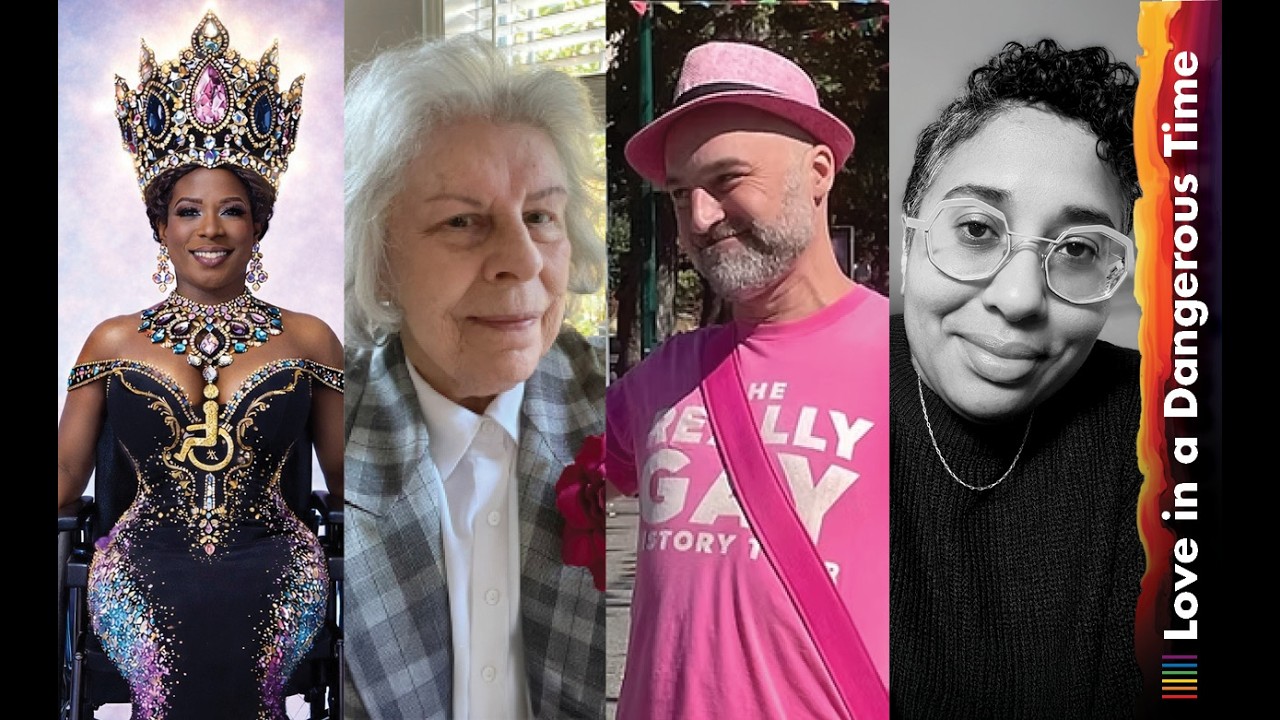
Queer Histories Panel: An Evening of Resilience, Strength, and Storytelling
Watch on YouTubeVideo summary
The Queer Histories Panel held at the West Vancouver Memorial Library offered a profound exploration of LGBTQ+ history through the lenses of resilience, storytelling, and community solidarity. Moderated by Chanel Tai and hosted by Cashelle Theen, the event took place alongside the Canadian Museum for Human Rights' exhibition, *Love in a Dangerous Time*, which contextualizes the historical persecution faced by queer individuals within Canadian institutions. The discussion was led by three distinguished guests: Michelle Halei, an elder drag performer advocating for queer seniors and disability justice; Jackie Hayward, an activist who helped establish the oral history project *In My Day*; and Glenn Teach, a researcher who developed Vancouver's sole gay history tour. Together, they illuminated how preserving both the struggles and the joys of the past is essential for future generations to understand their heritage and continue the fight for equality.
A central theme of the conversation was bridging the intergenerational gap between youth and elders, emphasizing that current freedoms were hard-won through decades of activism. The panelists argued against creating "empty" histories by documenting only pain, instead highlighting stories of joy such as photos from a 1950s social club found in a shoe box and Michelle Halei's performance during the 1990 Gay Games amidst the AIDS crisis. They recounted how the community united during the epidemic, with lesbians supporting gay men, nurses donating medication, and friends smuggling life-saving drugs across borders when hospitals refused care. Furthermore, the speakers addressed significant archival gaps caused by early collections dominated by cisgender white men, celebrating the exceptional work of Ron Dutton, who voluntarily built a comprehensive archive in his apartment that intentionally included histories from Indigenous peoples, people of color, disabled individuals, and rural communities to prevent bias.
The necessity of translating raw archival materials into accessible formats like books, plays, and tours was stressed to ensure these stories reach diverse audiences rather than remaining locked in researcher-focused repositories. The panel noted that many international visitors from non-Western countries view the tour as a rare opportunity to be openly queer before returning to unsafe environments at home, underscoring the responsibility of allies and activists to preserve missing narratives. While criticizing media representations that often depict queer people solely as addicts or drunks, the group recommended films like *Desert Hearts* and *The Birdcage* for their positive portrayals of love and family life. The discussion also touched on reaching non-accepting communities, with one speaker sharing an anecdote about helping a young man escape an arranged marriage, asserting that those in need will eventually seek out support networks without requiring active outreach into hostile spaces.
In conclusion, the panelists emphasized the critical role of "history interpreters"—artists and storytellers—in synthesizing oral histories from projects like UBC's HIV in My Day and SFU's Lesbian Oral Testimony Archive into digestible formats for schools, libraries, and walking tours. They acknowledged that much queer history prior to the 1970s exists only in biased police records or court documents, making oral history and lived memory vital for humanizing these accounts. The event also highlighted hidden histories, such as those of deeply closeted men who stayed silent to survive or individuals like Michelle Halei who used drag as a disguise to safely participate in activism while fearing family destruction. Ultimately, the consensus was that maintaining respect for these diverse narratives ensures that future generations can honor the lineage of their rights and sustain the ongoing movement for justice and inclusion.
Read the full video transcript
Good evening everyone. Welcome to the
West Vancouver Memorial Library. My name
is Cashelle Theen and I'm the
communications coordinator here at the
library. Thank you so much for joining
us in person and everyone at home. I
would like to begin this evening by
acknowledging that the West Vancouver
Library resides on the traditional
ancestral and unseated territory of the
Squamish Nation, Lelaywood Nation, and
Musquam Nation. We recognize and respect
them as nations in this territory as
well as their connection to the lands
and waters around us since time
immemorial. Tonight's program is
presented in conjunction with Love in a
Dangerous Time, the Canadian Museum for
Human Rights traveling exhibition that
is currently on display upstairs in our
main hall.
Uh, this exhibit will be with us until
September 15th, so you have lots of time
to explore the info panels during your
vid.
Love in a Dangerous Time explores the
history of the LGBT purge, a decadesl
long campaign in which thousands of
members of the Canadian Armed Forces,
the RCMP, and the federal public service
were investigated, harassed, and in many
cases dismissed because of their sexual
orientation and gender identity. And
with that, it is my pleasure to welcome
tonight's moderator, Chanel Tai.
haven't even started yet. You don't know
if I'm good.
>> Hi friends. I'm Chanel Tai. She her. I'm
very happy to be here. Um I do this kind
of stuff all the time. I'm a um
anti-racism and equity and queer
inclusion consultant. Um so that means I
get I'm a paid homosexual to be queer
and to hang around with queers. and I'm
very honored to be here uh with these
particular queers. Uh tonight we're
talking about queer history. And I think
often when we say the word history, we
think of archives, we think of the past,
we think of something that maybe we
weren't there for. Um today we have
people who were there for it and
continue to make queer history. And so I
invite you on this little journey to
talk about queer history, to learn about
local queer histories and stories. Um, I
have it on good authority that these
three are talented storytellers,
so we might have to stop them from
talking.
Um,
>> so thanks for being here to talk about
not only what queer people uh locally
have endured, but what we've created,
what we've imagined, what we've
reimagined, and I'm so happy to hear
what you wanted to say. So, without
further ado, let me introduce you to
these three homies. Um, we're going to
start on the end with Miss Chantel Lee.
Michelle Halei is a longtime community
advocate. She's a performer and activist
and a respected elder in queer and drag
communities. And for decades, she's used
performance, storytelling, mentorship,
and community care to create spaces
where queer people can gather and heal
and be celebrated. Uh her advocacy spans
HIV and AIDS, um queer seniors, trans
visibility, and disability justice.
She's also the past mixedgate princess,
empress 52 of Vancouver, Empress 49 and
a half of Calgary, which I think is more
titles than most of us get in a life or
something.
>> So, your Majesty, thank you for being
here among us.
>> And uh we also have Jackie Hayward in
the middle. Jackie has spent decades
documenting, creating, and living
Vancouver's queer history. She's worked
in HIV and AIDS uh for nearly 30 years
and was the first person hired by the
Vancouver Vancouver persons with AIDS
coalition. Um she she's also helped
found found she founded the positive
women's network and theater positive and
she's created peer-led healing retreats
for people living with HIV and we found
out is also an author and a playwright.
Um Jackie's part of HIV in my day. It's
an oral history project uh which later
again we found out became a plague um in
my day. Uh and she continues to help
preserve and share the stories of queer
elders. Thank you Jackie for joining us.
>> Thank you. And then last but not least
is Glenn Teach. Glenn is a storyteller
uh if you can't tell by the hat. Um, and
he's a researcher specializing in
Vancouver's queer history. Uh, you might
have heard of Glenn because he created
Vancouver's only gay history tour in
2018. Uh, and he's introduced thousands
of people, right? It's a lot of people
who come through your tours,
>> of course.
>> Um, and he talks about a lot of
Vancouver's overlooked or kind of hidden
queer history, the undocumented history
of our past. Um, and Glenn does a cool
thing where he uses archives and court
records and oral history to um bring
awareness to um our histories of queer
activism and resistance and community
life and community building in the city
um all the way to the present. So, it's
not just Vancouver's history, kind of
Vancouver's current contemporary
history, I guess, is what we call it. Uh
and famous His tour was ranked by Trip
Advisors as among the top 10 experiences
in Canada.
>> Oh, dang.
>> And we have Niagara Falls.
>> So, these are our three special guests.
Um, shall we jump in? Yes. I have a
question for all of you on preserving
and losing queer history since that's
what you do. You preserve the history so
we don't lose them.
Um let's start with uh let's start with
the challenges. So what are some of the
challenges involved in uncovering and
documenting queer history that you've
run into and what happens if those
histories are not preserved?
Well, sometimes it's finding people that
want to listen
and not thinking that that queers have a
history that that was back in the old
days and it's not interesting and let's
move on and that's so I think that's
it's not that important. Yeah.
>> Okay. I
talking with the younger generation we
hear I'm so tired of hearing back in the
days back in the days we weren't born
then but I think the missing component
is back in the days create today
and what you're experiencing now came
from back in the days.
So there's that bridge that we need to
strengthen between the younger
generation, languages and interest with
the older generation.
I'm saddened to hear that the two of you
have that experience of feeling like
there's a disinterest because I found
something different which is on the tour
I often find young people who are
desperately hungry uh uh to hear what
their history is or what their lineage
is uh but often don't know where to go
to find it and uh that's heartening and
and so I want to offer you that
encouragement that there are young
people who are who are hungry to know it
they understand that there has been some
kind of struggle struggle to get where
we are, but they don't know what that
struggle has entailed. But I will agree
with you both that there is a generation
gap. Uh and uh that queer youth aren't
uh there's not a lot of opportunities
for queer youth to be in the same spaces
as queer elders. And so there there's a
there's a gap. There's a chasm there. Um
and I I think it's important that we
find ways to try and bridge that gap.
>> Yeah. I'm wondering if part of the
challenge has this is not on my notes.
So, um I'm wondering if part of the
challenge is that young people that you
two have um encountered think about the
back in the day as negative, right? It's
like all the difficulties that we've
gone through as a people. Do you think
that's part of the the challenge for
them?
>> You want to go first?
>> No, because I don't have a good answer.
Um
I work with a lot of um
age range in my movement in the
community and what I have found is
the sense of community
is where it breaks down.
Um for
the village itself being the last three
remaining village across Canada and
North America. I find that the younger
generation don't have
a connection to that being born in a a a
what I call the free world where you
don't have to fight for anything. It's
already there. and trying to understand
the importance of keeping a community as
it changes and not get rid of a
community because you don't understand
it. The community has always been the
backbone
and the driving force for a lot of
movements and a lot of changes.
And when you look around what's
happening now as if a lot of it is being
taken away
and Canada is not too far behind. So I
think the idea of keeping that community
a a source of strength instead of
fragmented
is very very important. And we're having
more and more talks between the gaps to
try and bridge that. And I think that's
what we need is more space like this and
more conversation like this and having
different demographic in the same space.
>> Yeah. And we are lucky today there is
quite a swath. I mean you know it's a
diverse group. So yeah
>> that's that's good news for us in the
community building.
Jackie do you have something now? Well,
you mentioned the In My Day play, which
is a verbatim play um that came from the
oral history project that um you Vic and
SFU took on and
I'm skipping ahead. So, the in my day
play uh was presented at the Colch. It
was also presented at in the Phoenix
Theater in Victoria and it was done by
UIC students
and each student played a person that
words were verbatim from the in my day
play from the HIV in my day oral history
project. So that was pretty phenomenal.
I went to that play and I was
interviewed in the oral history project
and some of my words are in the dialogue
of the play as a character named Jackie
who was played in Victoria by a young
woman from the uh from the um UIC drama
department
and that was an amazing experience. We
met each other and we both hugged and
sobbed and laughed and so that was a
crossover and I think it was very
successful. All these young people
played
folks from the day with their own words
from those folks. So there there's an
exception and it was really high reward
and it was intergenerational
good feels all around. Yeah.
Jackie,
um I want to come back to something that
Shantel said just now, which is linked
to what you just said, Jackie. Um
this idea that some people may have, and
you're you're both kind of spotlighting
younger generations, but it could be
anybody. Um that we have arrived
somewhere, and we don't need to look
back anymore. uh is an interesting thing
in in the current climate because we see
our neighbors to the south losing rights
left and right and we know that that is
uh I don't want to call myself an older
person
but let's be honest
um I only look this good in old but we
know as people who have lived a little
that your rights are not static right we
can we can fight to get them we can also
have them taken away at any moment,
especially in marginalized groups like
like ours, queer folks. So, it's I think
I think you're right. I think it's
important to have opportunities like
like you offer, Glenn, to um and then
you talk about with the play to have
these intergenerational conversations
and um and interactions because
yes, we have rights now, but who knows
for how long. It was really an amazing
experience to sit in that audience and
hear that young woman
saying this words from my interview
from my experience. It it was just
mindblowing. But yeah,
but that's a story.
Don't guess what that's going to be the
next question. Yeah.
>> Um
because I'm wondering, you know, like
there's there is this piece of of course
preserving that back in the day this is
the struggle. Um these are the losses.
These are the the rights that we have
won through fighting. There is something
important about that. But there's also
something important about preserving
stories of joy uh in the queer and trans
community. And so I'm wondering
storytellers if you have stories um you
know a moment of joy uh from from our
collective career history local care
queer history that you'd like to share
with our our audiences.
As recently as 2015,
uh, a shoe box was found near a dumpster
in the West End and it had the photos
and,
um, memorabilia of a man who lived in
the West End in the 1950s who was pretty
clearly gay because there was some like
racy postcards. Uh, and
uh, so that shoe box found its way to a
local uh, journalist.
Uh, uh, you probably know Kevin Dale
Mung.
>> I read that. Yeah, you read about this
and uh it was kind of discovered that he
there was a membership card to a private
members club called and this is very
charming uh the happy time social club
and this uh they were able to
reconstruct that this must have been a
previously unknown queer meeting place
in the 1950s and it was right on Davy
Street in what would later become the
queer village decades before it was
anything like a queer village and uh the
fact that it was priv like that uh that
it was exclusively queer because it was
a private members club was really
unusual for the time. Uh but it's also
this is a place in the ' 50s when it was
dangerous to be out when it was a crime
and you could go to jail and lose your
freedom and and uh it was unsafe to be
out. This was a private place. Oh, and
do you want to know where it was? It was
in the basement of what we now call
celebrities.
>> So what would later become a gay bar uh
down in the windowless basement was this
private meeting place. So, a place where
gay men could feel safe, they could
connect, and they could perhaps uh make
connections. And among those photos is a
series of photos that show this man,
Joseph, together uh consistently over
the years uh with another man who was
probably his lover. And uh and then
there's a little scrap of uh of paper uh
like a note that says, "Do you remember
I forget what date, but do you remember
the date of whatever date uh in my
little old apartment?" And it just makes
me emotional because this is an example
of queer joy that that at a time when it
was dangerous, these men found a place.
It it seems that Joseph was able to find
a measure of happiness at the happy time
social club
>> in the basement of celebrities
where some of us still find some happy
time.
Um, for me, I think back to the gay
games that were in Vancouver, 1990, gay
games, and that was still in the height
of the AIDS crisis, the the fear and the
hiding and the death and the illness.
the Gay Games came to town and there
were 27 different
countries represented
and 7,000 athletes
for me rounding my numbers. And there
was 1,500 cultural um participants in
the arts and dance and and theater. And
um I performed during those years as a
character, a comedy character named
Lovey Sizzle.
And um Lovey was hired to do a show uh
during the Gay Games and it was at the I
think it's BC Place. and she wears a
hairet and a weird outfit and pointy
glasses and and she's u irreverent and
sassy and hot as can be. And so Lovey
was on the stage in front of 2,000
screaming
lesbians
much like we had.
>> And they weren't screaming to run out of
the room, I tell you.
And the bit was there was a fabulous
woman who's a was a clown and that's she
you could do all these juggling and
things and lovey. So this gave me a lot
of joy. Um and the joy under the tent
I'll tell you. And so Lovey takes off
her outfit to that tune of Gloria.
Gloria. Gloria. And you can't help but
move when you hear that song.
And the the w the woman's name escapes
me, but I'll it'll come to me like
things do recently in about 10 minutes.
Oh, yes. That was a baloney sandwich.
So she took my clothes that I had taken
off and she put them on and and clowned
with putting them on and underneath I
had a little flimsy thing
>> and that that was brought me a lot of
joy because it was during a dark times,
hard times and there we were with 20
with 2,000 screaming lesbians.
>> Sounds like it brought them a lot of
joy, too.
It's good to laugh and to hoot and to
Yeah. So,
>> do you think we could get a special
appearance from Lovey Sizzles and have
you done next?
>> No, I can always wait.
>> Um, mine is
bittersweet.
And I say that because it was at a time
where
the AIDS pandemic came out
and so many of our friends were falling
and a lot of family didn't want to do
anything with them. And what brought me
joy was watch our community come
together, take shifts. If you worked
night, you would be there during the day
and would take shift to make sure this
person is eaten. We had connection with
nurses and doctors who would
donate medications.
Um would raise money for those that want
to go home and they didn't have that
money. Would put on shows and would
raise a lot of money. would auction
stuff off to get plane ticket to send
them home to be at peace. So
that I hold very dear to myself. Um and
a lot of people do hold it very dear to
watch a community
in spite of everything
come together
and give somebody their last bit of joy.
>> I like it. Oh, sorry, Henry. I'd like to
add that the lesbians showed up.
>> Yeah. Oh, yes.
>> I mean, East Side met Westside, so to
speak. The lesbians really showed up.
When I was hired in 1987 to work at um
Persons with AIDS Society, I didn't have
one gay male friend. I lived on off
Commercial Drive. I was hip deep in in
boots and women and oh well not in that
order but you know
I was busy with commercial drive of life
and I was serving my community and so
the lesbians showed up and that's what
you say the community
>> they really came together. Yeah.
>> Back then we didn't have all these
different labels to identify people. It
was the gay community.
>> That's right.
>> So when I use that reference, it
includes everybody under that banner.
>> And we had the community come out and
out. And I was on night shift, so I
would get day shift
before going home to sleep to go back
and work. I would do a show, scrub out,
and then go to work sometime with the
brows still on.
But the community um brings me a lot of
joy when I see stuff like that and
remember stuff like that. And we still
do it, you know, not to the magnitude as
it was before, but our community still
come together when needed. That's the
one thing I can say about the LGBTQ
community. They may not always be there,
but they will be there.
I don't think everyone realizes. I'm so
glad you brought that up, Jackie,
because I don't think everyone like
people don't understand how siloed the
gay and lesbian communities were leading
up to the AIDS crisis and how much that
changed during the AIDS crisis. And it
was because lesbians stepped over the
line and showed up and said, "We're
we're a part of this, too." and that
every step of progress that we have made
since then as a community we kind of owe
to the le it's because we became a more
cohesive strengthened community and that
was the the lesbians stepping up and
that was us turning crisis into like a
really ugly crisis into something
beautiful. Yes.
>> And you mentioned how people
or one of you mentioned see bologn
sandwich one of you mentioned how um
families wouldn't necessarily accept
people home that was rampant
>> and that's where the community came
together
and so many men that I spoke to they
they could not go home because they were
sick or then everybody would know they
were gay.
>> Yeah.
>> Or I remember one young man couldn't go
home for Christmas because his sister
had a new baby and they needed to keep
the baby
>> and Yeah. So there was a we all pulled
together and um there's a lot of
caregiving and a lot of bringing meals
and um
who could take me to the hospital and
can you go with me and and
>> we had a a a huge schedule to keep in
the community safe and to make sure it
wasn't spreading as badly as the media
would like us to think.
So there was information being given. We
had um medical team that would talk to
us.
Um we could get certain pills
that wasn't allowed to be given to us,
but we had friends on the inside that
could sneak a pill here or sneak a pill
there. You know, it's what I say. It's
beautiful to watch.
Even though it's in the midst of crisis,
it's so beautiful to watch an entire
community without judgment,
without segregation, without anything
come together for one cause. Let's save
our community. And there were doctors
that would not take HIV positive men.
>> But then there a cadre of doctors
formed.
>> Yes.
>> Yeah. And then we all know their names,
>> right?
>> But
>> I don't know if I can say them.
>> Yeah. But a lot were turned away. I
mean, we our organization
um ran a bit of a smuggling
ring across the border to get this
particular product that was supposed to
be the the best thing that was going to
happen. It was egg leison
was a nasty yellow substance and I had a
freezer chest next to my typewriter
because it had to be kept frozen and we
couldn't get it in Vancouver and it's
kind it's it's a fun story I could save
till later but we were yeah
>> we we jumped on anything that was even
halfway
>> an opportunity
>> and that's the beautiful thing. Yeah, it
was it was a great caper. I'm glad I
remembered it.
>> Me, too.
>> I'm glad we're among criminals. This is
fantastic.
>> I'm I really love the way you answered
the question, uh, Chantel, because I
like, you know, you asked us about um
queer struggle versus queer joy. But
sometimes they're not that separate.
Sometimes it's finding the joy in the
midst of the like so much of the queer
joy that we've had in our history has
been through the activism and through
the resilience. That's where we found
our joy often as a community.
>> Yeah.
>> Right. Um I'm wondering so you've shared
these moments of joy all of them about
connection and community
uh and in in the face of a world that
that does not treat us well. Um, I'm
wondering if you can be really explicit
about why it's so important for us to
preserve those stories of joy and care
and friendship and community or just
like ordinary queer life. Make a
breakfast with your uh with your lover
after a night in the happy time happy
time social club. That's what it was.
Yeah,
>> that's what it was.
>> Yeah. So, what what what's the
importance you think keeping those
histories? I mean, I think that's what
all of the activism and resilience and
fight is for is for that is is to if
it's not for the joy and the and the
love and and the freedom to be
ourselves, then what else are we
fighting for? I think that that's
in terms of why it matters
uh for preservation of history. If you
don't have that element of the story, if
you don't have that element of the
history, then it's an empty story. It's
a shallow story. I think that's what
gives the story its heart is that we are
a people. We're we're just like anyone
else. We are a people who want to love
and laugh and uh be be loved and be with
our partners and be ourselves. That's
what motivates us. That's what motivates
the activism and the uh and the
struggle. Well, I think it's to balance
myths and stereotypes too that there
were brave people there and there were
people that died very young and and
community came together and and they
were not all they were not sissies. They
rolled up their sleeves. We fundraised
our butts off and we we broke through
barriers.
And I think that's that's important to
to shine a light on on that time.
>> I think we can learn a lot from any
history.
So we don't repeat it or we don't allow
it to be repeated. I think not knowing
where you the root of everything where
it all started that yellow brick road if
you are unaware of it makes it harder
when things are coming to know exactly
what to do even though you weren't born
in that struggle.
the fact that you have that freedom
and looking at the history and see how
far we have come
you know and look at all the struggles
that we've gone through to have this
freedom I think you you look at your
freedom completely different
>> it it carries a lot more weight when you
know the the backstory and know that I
didn't have to do that but somebody did
and now I can because of that person. It
gives you more of a pride in how you
treat each other, how you communicate,
how you live,
you know, it it it create that level of
truth and respect
>> and that's so important. That's so
important to know where you have been,
know where you are going. I I also want
to again I'm not young though I feel
young. Um but for me
one of the things that was so helpful in
my coming out. I grew up in a very
religious household um from the
Caribbean like very like very homophobic
society.
You know what happened over there. Um,
and so for me it this like the struggle
isn't history still, you know, like I
lived through that struggle of finding a
community, loving myself. Um, you know,
when I started dating my now ex-wife,
but when we started dating, gay marriage
was not legal in Canada. And it never
occurred to me that I could or should do
that uh growing up or even in my even in
my 20s, you know. So I think for me
preserving that joy is also to help
folks who aren't, you know, like it's
not it's not a it's not a binary, you
know, it's not people who have struggled
and people who have all the freedom.
That's not really what's happening in
our in our communities because our
community is diverse. But for those
people who are still in struggle, to be
able to see that queer joy that has has
persisted despite the struggle is hope,
right? And that hope is what we need, I
think, to get us through whatever the
struggle we're going through is. So,
and I know I'm a moderator, so I
probably shouldn't say things like that,
but I have a mic, so I'm going to.
>> It was good. I appreciate you saying
that. Thank you. Thanks.
>> Um Glenn, I want to come back to
something that you mentioned.
>> You talked about like the importance of
preserving history as like a as its own
kind of thing. Um I'm you know queer
history is it's it's shared, it's
preserved, it's kept in many ways. You
know, today we're doing a lot of oral
history. Um but there's like there's so
many ways to keep queer histories.
There's academic research. Um there's
archives, there's court documents that
you look at. Um there's art, there's
activism, there's lived memory, there's
community memory. And so this question
is for Glenn. Don't worry, I'll ask you
two hero questions soon. But um so for
you when you talk about preserving all
those histories, whether resilience,
joy, or struggle, um
how
how do all the things that you look at
to create your really big history tour,
how do they um how do they strengthen
each other and inform each other when it
comes to preserving your history?
Um I think that
um I think it all sort of
cross-pollinate like just in terms of
different
um kinds of research or different
sources for like where the stories come
from. I think it all cross-pollinates. I
think that um if you're looking at uh so
so like documented queer history has
only really happened since the 1970s
um when queer people started
saving the stuff that they were creating
magazines and newsletters or whatever
because um uh because there was a shift
in in criminal law. So prior to that
there isn't much like um there is we're
lucky to have what there is. Sometimes
there's love letters or journals that
have survived. Uh but often what you
find yourself looking at and you
reference this is like police records or
whatever like arrest sheets and that
doesn't tell you much. That just tells
you when someone was arrested uh and
what they were arrested for and that's
all. Uh but at least it can be a
starting point. So you're like all right
well I have a name. Uh maybe I can find
out more about this person. So, uh, so
sometimes you can find records like
that, but all of it, uh, what I'm trying
to say is that all of it
cross-pollinates. Sometimes you need,
um, old police records or court records
or that kind of thing to get you
started, but then that does that's not
going to tell you anything about what it
was like for the queer person. Like,
that's an official record from someone
who was persecuting queer people. So,
it's through the filter of bias. So,
you've got to read a little bit against
the grain. You've got to try and figure
out from other clues what it was like
for that person. Um, and uh, so and and
then when when you're talking about more
recent history, there's stuff in the
archives uh, that's been saved. That's
great. That can give you some clues.
There's oral histories. Uh, oral
histories are really useful because that
gives you someone's lived experience.
But then sometimes that can also be full
of bias. Uh, people misremember things
or they, you know, they remember
themselves in a flattering way. So I I
think you need like the rigor of a
historian who's doing academic research,
but you also need um the uh color of a
of a storyteller, of an artist or or a
novelist or a playwright or a
storyteller, someone who knows how to uh
take those historical details and then
reanimate them and bring them to life so
that it becomes a more vibrant living
history because that's what people want.
like some I guess there are academics
out there who are just nerding out on
the details, but for most of us, what we
want to know is the social history,
right? We want to know what it was like
for people and how they live their
lives. And I think that that takes the
work of an artist or a storyteller or a
a historical interpreter to bring those
histories to life so that people
understand what it was like.
>> I like that historical interpreter.
>> Yeah, I like that.
>> Um, I'm going to skip you for a second,
Jackie. Bright to Shantel. Wow.
>> Um because you are a storyteller, right?
And you have lived so many lives. And
I'm wondering for you,
um is there like we've talked about kind
of a historical story of Re Joy. Um can
you tell us a contemporary story from
your life
>> of joy?
>> Of joy.
I think I was about 17
when I um
got into a relationship with my
university friend at 21
and that lasted on the ground for many
years without anybody knowing.
um both families knew each other, but we
were best friends and that's all there
was to it. And we would have sleepovers.
Um
like any other kids doing sleepover.
That's all I'm saying. Don't give me
that.
Like I clearly I took out of your book
because
>> it was fun
sleepovers and I got to learn a lot
in the broad sense and um it was
something that I I still hold dear and
we still talk to today. They're still
around. um they're not married
and
um they never miss a birthday, a
holiday. We still talk. We talk on the
phone still. Um and that was my first
love.
>> That's so good. That's so great. You're
still in touch with your first love. You
had sleepovers.
>> Um in fact, to put it a little bit
further, I'm still in touch with all my
exes. Good for you.
>> And we're still good friends.
I don't know how their partner feel
about me, but we're still good friends.
Um, they can call me up and ask me any
favor and I'd still do it. Um, it's just
for me
those relationship
never fade because we're not in it.
The the love for me doesn't stop because
we're not in a relationship.
I love them, they love me, life happens,
but we still carry
a deep connection with each other even
though we're not together.
>> Yeah. And I think this is a beautiful
part of of queer cultures is that we get
to create these things that are are
outside, you know, cis head culture that
we're friends with our exes and that we
still carry that love and connection.
And of course, not every queer person is
going to do it, but most of us are going
to do it, you know.
So, thank you for sharing that about
your first love. I will ask you later
for details.
Not much.
>> You got to wait for the book that's
coming out.
>> Um, so that Jackie, this is your
question. Um, so you talked about, you
know, this very raw and personal oral
history
and and we know that queer histories can
start from a a very personal place like
an oral history, a story, a photo, a
shoe box full of photos and clippings.
of course is misleading but I'm
wondering because you basically you've
took taken something very personal your
history in the AIDS crisis and HIV
crisis and turned it into something very
public facing which is a really
interesting way to preserve a history so
I'm wondering
what was the inspiration for you to do
that how did you do it
>> and Why?
>> Well, the playwright really did it with
um choosing. Okay. The oral history
project had did 108 interviews from
various people and one of the I'm
getting here. One of the in people that
were interviewed and was an interviewee
was a man named Rick Wes who was a
playwright and Rick had a side job of
trans um that's what transcribing
transporting
transcribing
these uh these um interviews and he said
oh there's a play in here.
So he took it to ZZ theater. I'm a board
member of ZZ Theater. Go Zezy. And um
and producers and they crafted the the
play in my day and he chose some of my
words from my interview. So Rick created
that. Um but I do have um an interesting
bit about it's not a sleepover. How many
have had those kinds of sleepovers? Oh,
quite a crowd.
>> Um, I was invited as uh this is making
changes and and making bringing people
awareness of of a of gayness. I was
invited to go to White Horse to uh as
Lovey Sizzle to a conference.
women women were awarding the frozen
turkey award to the man and I'm sure it
was a hatman uh a man who had made some
of the worst misogynists or
anti-feminist comments in in in
government or in media and there was
going to be a big conference and this
this this guy was going to get a frozen
turkey award so they asked Lovey to to
present it white horse anti-feminist. Go
get them. So, um here's the night and
here's the the big um ballroom. You hear
glasses clinking and people talking and
of course changing in the washroom,
right, sister? Yeah.
>> Changing in the washroom and and to
Lovey and then they came in and said,
"Okay, it's time. It's go time." And so
I burst through the the room and all the
tables and came up to the front and got
to the microphone and everybody like
and I don't know where it came from but
I tapped the mic and I said testicle
testicle
that gave me so much joy.
Do we have permission to use that
going forward? It it was great. It just
it just what I needed and
>> yeah.
>> Love sounds like a hoot.
So, I am
I'm interested from the three of you,
you know, like we've got all these
histories that exist somewhere,
whether it's in our hearts or in the
archives or in the court documents or
hidden away under somebody's bed. Um,
but I'm wondering like whose stories do
you feel like we're missing in the
greater, you know,
where history keeping uh saga would
>> uh I think
uh may I please
>> okay um I have like a two-sided answer
to that because on the one hand I think
typically what happened in the ' 70s
when queer people started like
documenting their lives more and saving
their stuff is that it was the people
who had the ability to create stuff and
then save it got their stuff saved. So,
uh people who had means to create flyers
or newsletters or you know events and
rallies and then and promote them. So,
people who um have those kinds of
resources or access to those kinds of
resources and then the resources to be
able to save them like a basement or an
attic or whatever like so some kind like
usually that means some kind of stable
housing. So, people with more like
relatively more privilege
um which usually means cis white men are
going to be more in a position to be
able to save their stuff and I don't
think they were in necessarily in any
way gatekeeping whose histories were
being preserved they were just saving
their own stuff and that's kind of how
it happened and now and so I think that
does create a gap in the records that we
have the archives that we have which is
why I think it's so important now uh
that we capture as many oral histories
as we can of elders who who are holding
these histories in their heads, who are
aging um and are uh passing away uh
especially from diverse communities
before we lose those histories. So
that's one side of the coin. But I do
want to say I don't mean to ramble, but
I also want to say that here in
Vancouver, we're actually very lucky
because um the the guy who started
keeping an archive here, some of you may
know know the name Ron Dutton, or if you
don't, I'd like you to meet him right
now. Uh because Ron Dutton is a man who
just started saving stuff in his
apartment in the 1970s without any
budget or funding or job like like he
just did this. He volunteered to do it
and he created what we now call the BC
gay and lesbian archives. And he
immediately recognized that we were at
risk of that happening that we were
going to get a biased collection if he
didn't actively pursue more marginalized
histories. So he created categories for
uh indigenous queer people and people of
color and people with disability and
people uh like poor people and regional
queer history like people of like rural
queer history. He created all these um
categories in his archive and then
actively sought out to have those
categories filled. So not every city has
a Ron Dutton, but we have him and we we
have this incredible archive that is
probably more diverse than most. So
isn't that amazing? He's not here. But
can we just like have a camera done?
Hold on. Hold on.
>> This is a physical archive. Just one
second. This is a physical archive that
we can access or
>> Yes. So for most like from the ' 70s
until a few years ago, maybe 5 years
ago, he kept it in his apartment in the
West End. And I I got to go there.
Cashelle, you got to go there as well.
Uh we I think you and I were maybe some
of the last people to go there while he
was keeping it in his apartment. and I
was using it to create uh the walking
tour and you could just go to his
archive like his apartment and there
were like boxes like just boxes of
meticulously organized things. He about
5 years ago donated it to the city of
Vancouver archives where it is now
housed. So now it's more accessible for
everybody and they received a grant to
digitize some of it. So the photos and
the posters have been digitized which
means you can access it online. So, uh,
that's a step of making queer history
more accessible for all of us.
>> Good crap.
>> Isn't it amazing? Yeah.
>> Thank you for sharing that.
>> I appreciate that. I have a lot of
stuff. You know,
>> Ron would like it.
I say that some people we have missed
are the were the deeply closeted
I would say mainly men because that's a
lot of my experience too the shame and
the deeply closeted men that would that
couldn't come out or wouldn't come out
or would be dangerous or fear so many
layers of white people don't come out.
So I think that there's a a silence
group that Yeah.
>> that we've missed.
>> That's all. I'm just I'm I'm hearing my
partner uh speak and I'm just thinking
to myself
growing up in certain countries where it
is so taboo
and so much of
there's a lot of pressure on living up
to a standard
and expectation
and I know for a A couple of my friends
in my age group dead, had to get
married,
had to produce kids, had to live that
life, who are now divorced after the
kids have been grown and out the door,
and they're now just start living their
prayer lives.
And I think a lot of those stories you
don't hear about as much is people did
what they needed to do to stay alive
based on where they're from and what the
laws are there. And there was a lot of
closets that doors could never come on.
You know, they would sneak out at night
or sneak out through the day, made up,
do what they're doing, and then go home
because that freedom to be you did not
exist in their world.
And in order to stay alive, you had to
create a persona that everybody else can
see and accept and approve.
And I'm from one of those countries. And
when I moved here for years, I looked
over my shoulder
because information going back home is
just as dangerous as me being there.
So for years and this is how I actually
started drag was a disguise
people not to recognize who I was and
was brave enough to go out there and
march in every single pride across
Canada and do all the activism in face
cuz back then
you could be photographed you could lose
your job
destroyed families. There was so much
negative connotation
relating to exposure
and I used drag as my cover up to be on
the front to do what I do without being
recognized. And
it's beautiful.
And
5 years later, I'm still doing it.
>> Thank you.
Thank you. And I hope you are making
sure that story is is shared and
excited. I do um I do a certain function
every year and what I do is every
chance I get there's always an
educational component to all the shows
that I do. So I'm always getting the
message out there and that dialogue keep
it going.
>> Great.
Yeah. I mean, and that that fear is real
today.
>> Oh, yes.
>> It's still very real for many of us.
>> Oh, yes. When I say years of looking
over my shoulder, every time I see
another person that looks like me, I
have to wonder, do they know me? Is this
information going to go back? Do they
recognize who I am? I I can't be holding
hands. I can't be doing this. And it
took me years
to actually shake that fear
and be at a point in my life where I can
say, you know what,
take it or leave it.
>> This is it.
>> Yeah.
>> Right. But for a lot of us, we still
have that fear. even in today's world
coming from certain countries and
certain families where they just can't
be themselves and I get it because I was
one of those person.
>> Yeah. And I think there are still young
people who are are feeling that today.
There's
>> I I again am not young but when I came
out it was very hard for my parents. Um
and then and they of course told their
friends back home and so I have not been
back to my country since I was 18 which
was at 5 years ago.
>> We went to the same math school.
>> Yeah. And so like that's that's a real
thing I so loss that I I feel all the
time you know that disconnection of
culture and community that that exists.
But you know like as there's there are
reasons for us to to be
>> and and stay in the closet. You know
those men who you that we lament the
loss of their stories. You know there's
>> also no judgment there. People make the
decisions they have to make.
>> Yes.
>> To survive in the in the realities that
they live in. You know
>> Glenn you were going to say
>> uh one of the fascinating things that I
encounter when I'm on the walking tour
is um really diverse audiences. often
it's locals, often it's uh people from
elsewhere in Canada or in the States or
in the Western world, but often from
elsewhere beyond the Western world. So
like I've had many occasions where like
somebody from Poland is on the tour and
so we between stops we talk about it and
they're like, "Yeah, what what what
you're describing is history here sounds
like current events to me. I cannot be
out at home. It would be dangerous for
me to be out. So, this is my one big
week basically of coming to Canada and
being able to do something like a queer
history tour, maybe sort of go to a
couple of gay bars or whatever and be
out for one week and then I'm going back
to China or to Poland or wherever. I've
had this conversation
countless times with with guests on the
tour. Uh, and this is what it's like for
them. They get to they come to Canada to
have a taste of it, but they have to go
home and they have to go back in the
closet.
>> Yeah. And that's something the flip side
like I can't go home or like I choose
not to go home. Yeah.
>> And they have to live in that existence,
right? It's
>> two sides of the same coin.
>> So I'm wondering this is the final
question um before we open it up to the
audience.
I'm wondering, you know, like what is
what's our responsibility both as queer
and trans folk, but also as allies to
keep the histories of
especially those histories that we're
missing? What's our responsibility and
what can we do to make sure that we
don't lose any more history?
Well, I've been involved with um
creating along with Lisa Low, a
playwright um an 8w week storytelling
writing workshop for 55 plus gay or
queer uh seniors. And we've had two
great runs at these workshops and people
have been writing and sharing and the
stories that fill that room.
>> It's probably about 10 or 12 and they
work on prompts that and do homework and
we have guests that come in and are
fabulous Alan Morgan or Nora Randall and
and and share their story. So we're
right we're working some of us are
working on right keeping those stories
boiling and turning over and and being
worked on. So I'm doing my part.
>> Thank you for doing your
fun.
>> Yeah.
>> What's the name of that? It's the NRA
Collective.
Um, for me
being in in the spotlight in so many
different ways, um, I have the
opportunity of interacting with so many
different beach group and I like to say
it'll never be the same as you walked
into my conversation going out.
Um because at some point in that
conversation, I'm going to be educating
or exchanging information. So when you
walk away, you're walking away with a
little bit more than you walked in. Um
and every function that I do, I try and
input that um I have conversation with
different age group. I want to know your
story
and hearing their story and sharing my
story and others sharing their story, it
keeps it alive. And I think um a lot of
members of the LGBT does do storytelling
in some way, shape or form. And I think
a lot of it is being circulated
and without asking.
I I think it just naturally happens.
I will add that in my day play is going
to Toronto. It's going to be mounted at
Buddies and Bad Times Theater in Toronto
in 2027.
So I hope I really hope to get there.
I'm sure I will. hope to get there.
>> It's amazing.
>> Congratulations.
>> But reports.
>> Um I think uh can I jump? Do I answer
this time?
>> Okay. Um
question.
>> All right. What can we do to keep the
history alive? Yeah. I think that there
uh I think there's lots of things we can
do. I think that what we need is ways to
make it accessible to people because I
think there's
>> like there's such a vast chasm between
gathering the history or preserving it
and then synthesizing it in a way that
is digestible for people. Like people
aren't going to just go to the archives.
I know I told you that the archives are
like now accessible online which is
great. Go visit them. I encourage you
but also it's going to be kind of weird
when you get I don't know if you've ever
tried looking in an archive but it's not
the same as a library. Like you have to
know like archives are built for
researchers. So you have like you're
going to go find a document, you're
going to find an arrest sheet or you're
going to find a file folder of that you
can you're going to flip through to find
a you know what I mean? So there needs
to be researchers who go to those
archives who can pull out like extract
the information that's there and then
put it together in some kind of
digestible format whether that is a book
or a walking tour or a play uh or a show
or or an art show or whatever it is. So,
I think there needs to be more artists
and storytellers
and uh uh I know you like the phrase
interpreter history interpreters uh
people who uh who take that information
that's been saved by Ron Dutton and by
others. There's been lots of oral
histories gathered. I you you were part
of an oral history project. El Shenier,
who was going to be a panelist here,
created the lesbian uh I forget what
it's called, but the lesbian archives.
>> Thank you very much. Uh and Carmel
Tanaka has captured oral histories as
well. Do you know what those are called?
>> The Jewish oral
>> something something the Jewish oral
history project something
>> which is uh located at the Jewish the
Vancouver Jewish archives within there.
>> That's right. So all these things are
there but probably most people from the
public don't want to just go listen to
hours of oral history testimony. They
need people who can take those sources.
And so that's kind of our job. like we
need artists like us and more
interpreters of history to uh I think
that's the next step and there's a lot
of work to be done there.
>> Yeah. Because it sounds like things
exist somewhere. Yeah.
>> Which is great and maybe news to some of
us.
>> Yeah.
>> Yeah. So that's good to know. the oral
history project um HIV in my day through
U Vic and SFU is open is available to
the public and it's pretty easy to find
the 108 interviews. It's pretty easy to
to locate. So just go to UIC and and uh
HIV in my day oral history project and
yeah
>> you can stop and start and yeah.
Yeah. So it sounds like we need to both
create
interpret
um and also we need to go out there and
look look for what exists already.
>> Yeah. Okay. Um I want to say into the
mic what you said Kashelle that the um
Carmel Tanaka's work is in the Jewish
archives Vancouver. Great. And then what
was the other one we
>> archive of lesbian oral testimony?
>> The archive of the lesbian oral
testimony.
>> Let's get it at SFU.
>> At SFU that El Shier put together. to
know people who are not in this room for
you guys.
>> I know she's working on Joe's Cafe. What
happened at Joe's Cafe with the lesbian
kiss in and so this is her cuz I see a
lot of that on Facebook. Oh
>> yeah. Yeah. What was the movie Better
Than Chocolate?
>> Yeah, Better Than Chocolate also has
like a little was inspired by that.
>> Um Yeah, there's a piece of that and a
piece of little sisters.
>> That's right.
>> Yeah.
>> Yeah. It's nice. It's not exactly
history like a historical but it's
historical civilization those events you
know
>> you know I think we can all watch a
movie maybe in pieces but I think we can
do it.
>> Okay we are exactly on time. It's 7:35
>> which means it's time for questions from
the audience both in the room and
in space uh on the internet. So, if
anybody's got their question written
down, we won't be taking questions
horally, but if you got your question
written down, hand it to one of these
people who uh are standing and Cashelle
also he'll scoot around and
to prove that I am not in fact young.
It sounds like you're fishing for
someone to tell you that you're really
young and that you look great. What's
up, boy? I know. I know. I don't need
nobody to say it, but I appreciate that
you said it.
>> Um, so this question is, was there a
particular queer movie or TV show or
maybe a movie with a queer character
that impacted or influenced you?
I
I have to say
it impacted me um more than it
influenced me because most of it I lived
through. But to see them capturing the
raw essence and the history and put that
all into a movie was pot.
And after I watched the entire thing,
I've encouraged every single young and
old queer person to watch it.
It's like history on big screen.
And a lot of a lot of it is so
true to the date
>> and it touched on so many different
areas in our community and what we were
going through at the time.
And I encourage everybody to watch it.
If you haven't seen it yet,
it's amazing.
Go out, get it, watch it.
O
>> I don't have one.
>> Oh my god, I'm blank.
>> But I remember a 1957
Ford convertible and two women and some
great kissing scenes.
>> And can I get any help from the
audience?
>> Desert of the heart, baby.
>> Yes. Desert of the heart. Good woman.
Yes.
>> Desert Hearts as they read. Yeah.
>> Yeah. I'm I'm I'm a car fan, too.
Yes. Desert of the Hearts. Thank you.
Jane Rule wrote the book. Yes. Or the
story. Yeah.
>> Jane R. Kelly Galliano.
>> That's right. Yeah. Qu.
>> Yeah. There's another one. A couple. Oh,
dear. There's so many. Keep going.
Okay. How about this question for you,
Glenn? So, maybe there's not one that
influenced you or uh inspired you. Is
there one that you think, you know what,
that's not a bad representation of of
queers, our history community?
>> There's plenty of that. I think probably
one of the the best
uh
representations of the AIDS crisis that
that I've seen was uh was it's a sin on
Amazon Prime which was a TV series. I
forget how many episodes uh it was like
eight episodes or something like that.
Uh but brilliantly done. Yeah,
>> it's a
>> great
>> And for a fun one.
>> Uhhuh. Burkage. Burkage.
A fun one. Um it did touch in some
reality between Christianity and
accepting um LGBT and living together
but hiding at the same time and not
wanting to expose but
trying to navigate all that. So, it did
touch on some realism there. But for fun
show, I know I've seen the play, the TV
show, the original, but I think the one
that I loved the most was Robin William,
the new bird cage.
>> Agreed. Agreed. You know,
>> wonderful.
>> I still see him.
>> Right.
>> The house boy was the best. could not
walk in shoes, does it?
>> We're playing it next weekend. So, next
on the 29th on Saturday at 2 p.m. right
back here, you can come watch.
>> Okay. 29th at 2 p.m. in this room.
>> In this room.
>> Yeah.
>> The Westb Memorial Library.
>> Be here or be queer.
>> Be here and be queer.
>> Um, there's another question. Okay,
here's another TV question. uh which is
what are some stories that are
tragically missing from TV and film
since you know so much about queer
histories.
>> I mean I like
how do you where do you begin? Like I
think there's um
so much of our like the stories that I
tell on the walking tour I don't I'm not
trying to say that the stories that I
tell on the tour should necessarily all
be made into movies or TV shows but I am
saying that like none of the stories are
known like people are shocked when they
come on the tour and are like what this
happened in Canada this happened here in
Vancouver and this and it changed the
national like dynamic like pe like the
queer history in general and Canadian
queer history in general is just like
underdocumented, underknown. So this is
I'm I'm answering this in a very
sideways way because I'm not necessarily
saying that these things ought to be
made into movies or TV shows, but I am
saying that the history ought to be more
wellknown.
>> Absolutely.
>> Yeah.
>> Absolutely.
>> Okay. There is um
Oh, do either of you have things that
we're missing in our in our media?
I think um facts
um a lot of what's depicted that I've
seen and I've watched quite a few queer
movies and stuff is that they depict us
as horny
>> um addicts.
>> Yeah.
>> Um drunks.
Um orges.
Not that any of those are a bad thing,
but that's not what the community is.
And I think a lot of time when they're
doing these movies, it's always from a
negative point. Even though they have
queer representation, but it's never in
a positive light where two people fell
in love and they're not trying to kill
each other, you know. um to be fell in
love, adopt a child, and they're not
trying to cut each other's throat or
sniff stuff up their nose, you know,
they don't show that positive light.
>> Yeah. Or even the kind of mundane
>> Yeah.
>> light. Yeah.
>> And I'm tired of seeing tough
guys beat up on weak people, too. But
there's always got to be here comes the
guys in the pickup trucks and the hats,
>> right?
>> And they're gonna just take these guys
out and Yeah.
>> Yeah.
>> Yeah. Enough of that. We We get it.
We've lived it.
>> We need more positive representation on
TV. And um until that changes, the
narrative won't change.
And I think the stigma will never change
based on that as well.
Yeah. I mean, we're making strides, but
they're not there. We have still a very
long way to go.
>> Yes.
>> Before the queer character gets killed
off or, you know,
>> what the bisexual is some kind of sex
maniac or something. Um, okay.
But, sorry, I have lots of questions in
my lap. And, um,
we're going to change tag just a little
bit. Little direction change. Um, so
historically and now,
how do we access communities that are
not accepting
uh the queer community?
This says immigrant communities, but I
want to broaden that because there are
all sorts of communities that are not
accepting. So, how do we do that with
our histories?
>> I'm not sure I fully understand the
question. Can you say read it again? It
says, "Historically and now, how do we
access communities that are not
accepting?"
>> Sorry, could you speak just a little
louder?
>> Yep.
>> Historically and now how do we access
communities that are not accepting?
>> I don't know. I want to jump in here. I
don't know if we really need to access
those community cuz most of those
community the few uh queer living people
there
find us they find the family they find a
club we see them come on Dave Street
they find us we don't find them and when
you talk about a a community that's not
accepting
It's like swimming upstream.
Can't fight against it, but the ones
that need the help
will find us and we will give them that
help. We will give them the information
required. Um last year we had one young
man. He's from
Middle East
and his family wanted to get him married
and do the whole thing and he ran away
from home and he was sleeping on the
benches at
Gymniva Plaza where I normally have
conversation with people and have coffee
and
we started talking and he told me his
story and I'm like so what do you want
to do?
He doesn't want to go home but at the
same time he wants to please his family.
So he was torn between a rock and a hard
place. So you know they will find us
wherever we are
and they will seek help.
So he's doing better now. He now lives
in Toronto.
He has moved away from the family. He
has a job and he's doing very well. And
he's now in a relationship,
not the one that was coming to marry
him.
>> So happy ending to that story. But for
those community that are not accepting,
for those living in those community will
always step out of it at some point.
And if we can improve the image of gay
people to
folks in small towns or separate
communities and maybe do a little
education there, then the person that
wants to come out would not be seen as
silly or over-the-top or
girly or [ __ ] or what, you know,
whatever is being being shown in the
media or on television. vision. So if we
can improve there, we could probably get
better results at the other end.
>> We have another question.
This one is from online.
Um
it says, "After my grandfather passed
away, I learned that he and his wife had
hosted gay anonymous parties in West
Van." Feels like a story that isn't told
much.
>> Do any of you have knowledge of these
gay anonymous
tell is smiling?
>> What is this? What are these parties?
>> I'm smiling because um and I'm not going
to use the word back in the days, but in
my younger years,
like five years ago,
there was so many underground parties.
Um there was a specific color light to
indicate that you are there. Um there
was a lot of code to let you know where
you need to be and it was like following
breadcrumbs, you know, you got to know
what you're looking for to find it. So
there was a lot of underground parties
and clubs. basement houses had some of
the best parties and they had their bar
set up and
>> oh music and you know but it's also that
risk of the raid but there's always one
person looking out and um I don't know
of that particular one because they
never had a name but East Van had a lot
of cool parties just
Um, okay. Thank you. So, I'm wondering,
this is another question from one mind,
though. So, if we got these stories
about these underground parties or
pictures from the '9s or whatever,
where can who can we give them to?
>> Ron Dutton.
>> Shout out to Ron Dutton again. Yeah,
like I said, you can give them directly
to the City of Vancouver archives
because they now host his archive, but
also he's still around and actively
collecting things and would would be
happy like Yeah. If anyone has stuff,
>> make sure Ron Dutton gets it, he'll take
it to the archives.
>> D U T O N.
>> Yes.
>> D T O N.
>> Okay. Um,
last audience question.
Oh, there's so many good ones. I wish we
had a little bit more time. So there are
two questions about the queer community
coming together. Actually there are
three questions about that. And so one
of them is wondering
can we come together without something
as devastating as a mass
as a pandemic or an epidemic? Um and if
we can how? and can we pull together to
address
crises and situations that we are going
through now
there are a lot of organizations I mean
there's hymn health initiative for men
in Vancouver there are organizations and
uh community
and um aging queer aging BC C
um and a ribbon community which is
mainly for HIV AIDS. So uh Dr. Peter
Center
um there is Rainbow Refugee. There is
Outton Street which is a young queer um
film group that is in the film festival
every year. Like there's no one central
point to that question. Um we have now
set up so many different arms out there
in different communities that people are
accessing it everywhere now.
>> Yeah.
>> So it's not just a central hub and they
all are communicating with each other.
So we all know what each other is doing
and promote for each other. So it
doesn't matter where you are, there's
going to be some queer organization near
there.
>> Yes.
>> Might be a town over, but it's near
there.
>> All right. So it it's not a central hub
anymore. It's
>> expanded.
>> Yeah. Yeah. Thank you. Uh we've got a
wrap. Um and I've got to kick those
people who are in here out. Uh there are
still a couple of questions that we
didn't get to and I'm sorry we didn't,
but I'm going to answer one as I invite
you to make your way upstairs or log off
online. Uh there's a question here about
um is there who's telling these stories
to the children? Um,
>> Big Bird,
>> uh, out on out on screens sister
organization out at schools tells our
stories to the children through film.
>> That's great.
>> Um, yeah. So,
>> story time at the library.
>> Story time at the library. Idream
library also has like actual stories.
Um, Idream library.ca CA I think uh has
actual like stories of diverse queer um
experiences, graphic novels from like K
to 12. So they do exist. We are doing
this work.
>> If by children we also include teens,
then lots of high school groups come on
the walking tour as well, which is
amazing. Get get a queer history
education.
>> Yeah.
>> Fantastic.
Okay. Uh thank you all. A round of
applause for our panelists.
Thank you to Westb Memorial Library for
hosting us and putting this on. You had
a student. Thank you.
>> Will we do this next year same time?
>> Thanks.
Last
>> No, I still No. Yes. Can we do this next
year? Same time, same place. Oh, I
really hope so.
>> Oh, wonderful.
>> Now, if we have some uh surveys going
around, you can let everybody know how
much you enjoyed this and uh
>> they'll be emailed to you.
>> They'll be emailed to you. And we've
also talked about maybe a resource list
as well on where you can learn more
queer history. We just want to thank our
panelists, our wonderful moderator who
did such a fantastic job this evening.
And I want to thank everyone who came
here and everyone who tuned in online.
When we first had uh knowledge that love
in a dangerous time was going to be
exhibited here at the library, I just
had a moment and said, I really need to
have a panel uh happen at the library
that talks about the importance of queer
history and share stories. And this just
was so wonderful, beyond my wildest
dreams. I'm so happy this came together
and I appreciate everyone who came here
to hear our stories and please take them
forward.