PyCon India 2025 Keynote: Artificial Information: How Today's AI is Changing Information - Katharine
Watch on YouTubeVideo summary
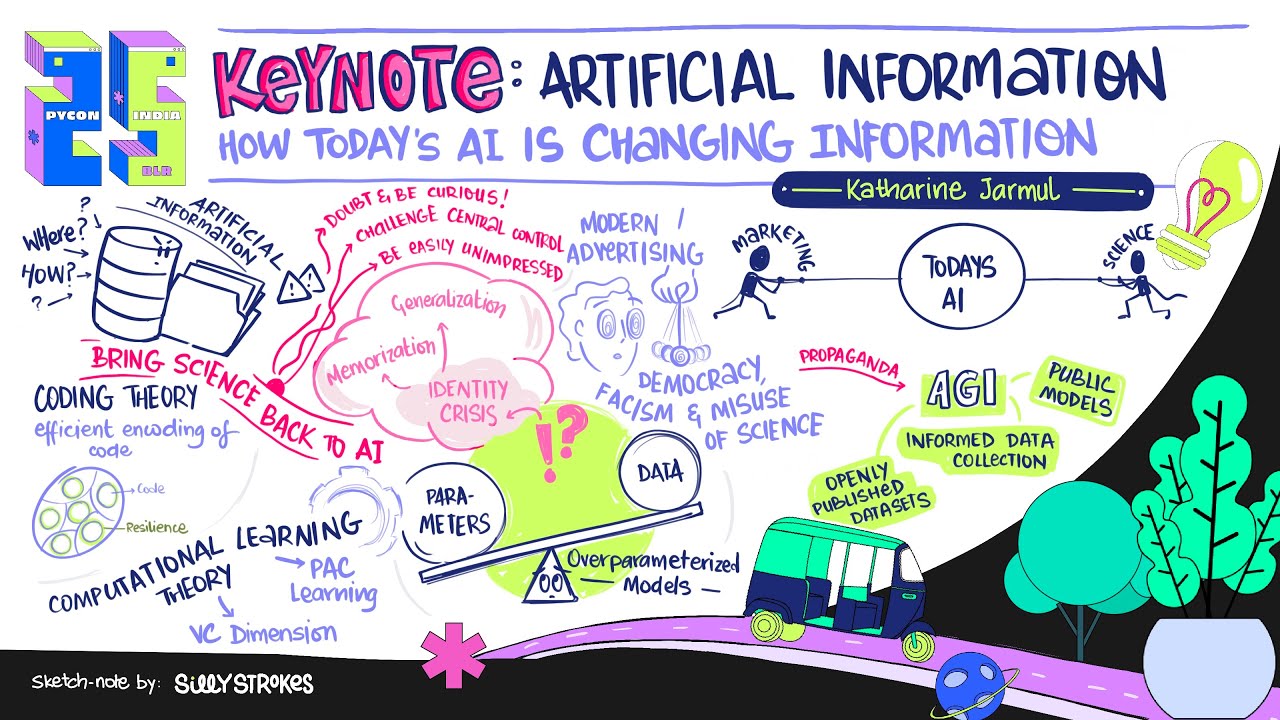
Katherine Jaral opens her keynote at PyCon India 2025 by introducing the concept of "artificial information," a term she uses to describe data that is processed and presented as truth despite having murky origins, poor quality, or unknown governance standards. She illustrates this phenomenon with alarming examples from Los Angeles, where immigration enforcement agencies utilize advanced technology to connect disparate datasets for surveillance and deportation purposes without understanding how the underlying data was collected or encoded. This issue extends beyond local borders to federal levels in the United States, where officials lacking technical expertise are tasked with linking incompatible data sources using AI systems that validate half-truths as facts simply because they have been processed by algorithms.
The speaker grounds her argument in fundamental principles of information theory and coding theory, tracing how Claude Shannon's work on entropy established that not all parts of a message carry equal weight, leading to more efficient encoding methods like word embeddings used today in deep learning. She explains that modern AI models are often overparameterized, possessing far more parameters than the data points they contain, which leads them to memorize specific examples rather than generalizing patterns as traditionally understood. While this ability to memorize allows current models to handle anomalies and unique cases effectively, it raises critical questions about what information is actually being stored in these vast parameter spaces and whether we are inadvertently preserving noise or biases alongside genuine knowledge.
Jaral further critiques the societal impact of AI by examining how worldviews and ethical frameworks become encoded into systems through a process she calls "model design," where storytellers shape user experiences rather than ensuring factual validity. She draws parallels between modern advertising techniques, historical propaganda used in Nazi Germany, and current AI development to highlight how these tools manipulate emotions and insecurities to drive engagement over truth. To counteract this influence of artificial information and marketing-driven narratives, she advocates for a return to scientific rigor through decentralized approaches such as local-first computing, federated learning, differential privacy, and encrypted computation, which allow communities to train models on their own data while protecting individual privacy.
Ultimately, her call to action is to challenge central control by building communal, open-source initiatives that prioritize transparency and rational inquiry over emotional manipulation or entertainment value. She encourages the audience to adopt a spirit of scientific doubt inspired by ancient Indian philosophical traditions like the Nyaya Sutras, fostering an environment where questions are constantly asked rather than accepting algorithmic outputs as absolute truth. By empowering individuals with local hardware kits and collaborative learning environments, she envisions a future where people can safely share private information, experiment freely without sending data to external servers, and collectively build AI systems that serve their communities while maintaining strict adherence to privacy and security principles.
Read the full video transcript
Thanks a lot Bhavin for the glimpse and
instructions. So are we ready for our
first keynote today? It's by Katherine
Jaral. She is a privacy activist and an
internationally recognized data
scientist and lecturer who focuses her
work and research on privacy and
security in data science and machine
learning. To know more about her, you
can follow her newsletters or her
published book. Uh, please have a round
of applause and welcome Katherine.
>> I guess this will not work. So, we'll go
back. I don't think it will work. Oops,
it will work. Okay. Um, hello everybody.
Good morning. Thank you for being here
early. Uh, my name is Katherine Darl and
I'm going to be talking today about what
I call artificial information. So, we'll
learn about it together. I'm really
happy to be here. By the way, the
organizing team has been amazing. The
volunteer team has been amazing. I just
want to really give a round of applause
mainly to them. They're the only reason
that uh I could make it here. Okay, so
artificial information. I come from a
place called Los Angeles, California. Uh
in Los Angeles, California, we're really
a city of immigrants. We uh almost
nobody of my age was born in California
in Los Angeles because it was a
relatively young city and we have
immigrants from all different places in
the world. I grew up with most of my
friends being from uh having different
languages at home, different foods and
so on and so forth. And in Los Angeles
right now uh there is very large-scale
protests that have been happening for
many months because of the changes in
immigration policy and enforcement
there. Uh basically rounding up
immigrants everywhere and deporting them
sometimes to countries that they've
haven't been to in 30 40 50 60 years.
Um, obviously as a as a native Angelino,
as somebody that spent all of most of my
life growing up there, um, this is very
disturbing for me. And one of the most
disturbing things that I've noticed is
the use of technology to surveil and
find and connect data sets and deport
persons. And this has been increasing
technology use that's happening by ICE,
the Immigration Customs Enforcements,
connecting lots of different previously
desperate or unavailable data and
putting it in the hands of persons that
are literally just snatching people off
the streets. This combined with the
powers that ICE is getting and and
increasing powers that they have is um
is extremely troubling for me.
Um but this is not just happening on the
local level in places like Los Angeles.
This is also happening at a federal
level in the US government. So here is
some persons who now are in charge of
connecting data sets, of running
technology, of running AI at a federal
government level who have zero
experience in any of these data sets
whatsoever. So they're connecting
disparate data sets. They don't know the
encoding. They don't know the data
collection. They don't know the data
quality. For any of you that work in
data governance, you're shrieking inside
of your head because we know as
governance professionals that if we
don't understand the data quality, how
the data was collected, the
documentation related to the data, we
should certainly shouldn't be connecting
data to each other and then making
either AI based or algorithmic based or
even analytics-based presumptions. And
that is what I call artificial
information. We take information that we
don't understand. We take information of
murky origin or governance. Perhaps
there's some truth in that information.
Perhaps there is some real information
in that information, but there's
probably also poor data quality,
halftruth, and then we push it through
AI systems and then we call it true. And
that's what we're going to talk about
today.
So, we're going to first back up because
I think we should make sure that we all
have the same understanding when I say
information. And what better way to
start talking about information than
information theory? So, who here is
familiar with Claude Shannon's
information theory? Yeah. So, Claude
Shannon, this is uh him at MIT during
his research times and his professorship
there. and Claude Shannon formed uh in a
thesis that he wrote or a very large
long paper that he wrote much of what we
today call information theory in his era
they were trying to figure out new
communication channel systems. So how do
we take information from one end of a
channel let's say a telegram and push it
to another end of a channel and at the
time um the prevailing idea of
information is every message is just and
every part of a message is just as
important as every other part we know
this is not true today but that's what
they thought then and what Claude
Shannon introduced is uh in in his paper
that I highly recommend reading if you
haven't read it at is this imaginary
word system. So this is our imaginary
corpus and next to our corpus we have
the frequency of the different words in
this language and we can see that some
words are quite frequent and other words
are very very infrequent and Claude
Shannon's thesis which led to a lot of
the computing power and the
communication power so the design of
packets and internet protocols and all
these things his thesis was that perhaps
some pieces of our messages are more
important than other pieces. And this
entropy that shows us that there's new
information or this rarity of some of
these words is something that we need to
explicitly preserve. So rather than if
we're communicating across a noisy
channel, rather than send everything
twice, we should be careful about how we
encode and send specific pieces that
have more information. we should spend
specific attention to those pieces
because they do indeed contain more
information. This was a huge
breakthrough and it led to a lot of what
we now call coding theory. How many
people have studied or come across
coding theory? If you if you haven't and
you want to learn, I highly recommend
Mary Wooter's class. She has a free
class online on YouTube. She's a
professor at Stanford focused on coding
theory. But in coding theory, we're
still thinking about this information
from Claude Shannon. And we're basically
trying to say if we need to put this
information into some sort of space,
some sort of representation.
And then we need to communicate it and
decode it, then perhaps we should be
careful and efficient about how we
encode and decode. And here's just one
example where we could have the code
words could be embedded in spaces within
these circles. And then the yellow shows
the margin of error that we can retain.
So the resiliency to some degree of
these encodings. So we can decode up to
a certain margin of error correctly. And
if we can't decode correctly, perhaps we
can take a good guess. And this this
type of coding theory thinking how do we
efficiently encode information allow us
to decode it. Not only did it lead
through all the breakthroughs or a bunch
of breakthroughs that we have in
cryptography, it also led to
breakthroughs in machine learning and
artificial uh intelligence.
So uh what the one of the huge
breakthroughs that allowed us to do deep
learning with language was word
embeddings which really if you've
studied coding theory word embeddings
are just a really clever way to encode
linguistic information into tensors into
some sort of embedded space. And when we
think about kind of the beauty of
language and obviously in India you can
think of the beauty of language in many
more flavors than my English upbringing
and Spanish upbringing. And we can
encode then many different languages
perhaps a language with itself or
languages with other languages into
these spaces. And by distilling the
information in a much smaller space than
what we used to do uh with one hot
encodings we can then have also uh
better uh relations between the types of
encodings or embeddings that we use and
then we can better learn. So when word
tveet came out the big thing was if you
took the embedding or the tensor that
represented man and you took the
distance and direction towards king and
you applied that to women you would get
queen
and this information theory coding
theory how we do embeddings leads us to
computational learning theory and if you
haven't studied any computational
learning theory that's fine I highly
recommend you look up VC dimension and
pack learning probably ox approximately
correct learning but essentially these
are some of the theories that run the
basis of how we do machine learning and
guess what AI is just machine learning
how we do machine learning today and if
we take some sort of embedded space so
we can imagine this is a multi-dimension
embedded space and then we try to
separate let's say sentiment let's say
language let's say concepts or themes
ideas right we can do this based on the
VC dimension of that data space and this
VC dimension alongside the theories that
we get from PAC basically tells us how
complex is this problem and complexity
and information are very much
intertwined. So the amount of
information directly relates to the
amount of complexity of learning a
particular problem
and alongside that when we have so we've
been spending all this time thinking how
do we efficiently take information how
do we encode information how do we then
learn that information right when we
look at today's models with VC dimension
we sometimes can review a model of what
is the VC dimension of the model. That
means what is the amount of complexity
that a model can learn correctly?
And uh when we talk about
overparameterized models, which is the
AI models that we have today, we're
talking about extremely high parameter
space related to the amount of data
points that are in that data. So we have
data, right? That's just some
representation of information. Some
data, as we learned from Claude Shana,
Shannon has more information than other
data. And then we have these embeddings,
right, that try to distill that
information from whatever space it is
that they occupy in in the encoding in
our computers. And when we talk about
overparameterized, we now have more
parameters than we even have data. So we
have way more parameters than we have
information.
This is important to think about because
it means well what exactly are we
storing in the parameters if we have so
many more parameters than we have
information.
Hold on to this slot. But this for
example just to show you this is just
looking at the GPT parameter size over
GPT 1 2 3 and four.
So uh there's a concept of overfitting
that I would say is now dead with
overparameterized models. With
overparameterized models, we have what
we experience what we call the double
descent when we train. Sometimes now
there's not even a double descent. But
essentially in in previous machine
learning concepts or in not
overparameterized models, we have a
limited parameter space. We have to stop
learning at some point in time.
Otherwise, we'll overfit and we'll
essentially just memorize the training
data and we won't generalize well on the
test examples. But with so much
parameter space, we are actually can
save tons and tons of information and
tons and tons of different boundaries
between decision space if we increase
the parameters and we keep training. And
now what we do normally when we train AI
models today is we actually overtrain.
So we train far beyond what we used to
train and far beyond when we see the
test error drop away.
What does this mean? What is happening?
So we want to kind of go back to these
fundamentals. Information theory, coding
theory, overparameterization. What is
happening here? We've spent decades
trying to efficiently compute and now we
are all of a sudden somehow
inefficiently computing. What's
happening? Well, there's quite a bit of
research on the fact that memorization
is happening. And memorization today
helps us actually generalize when we're
dealing with an overparameterized model
and trying to do something like learn
the world's information, right? And this
is uh let me take you through one really
interesting paper in the memorization
research, but I have a whole article
series on it if you'd like to read more.
But memorization uh is actually helping
us generalize because if we have so much
parameter space that we can memorize
unique examples, those highly
informative examples alongside
generalized common examples. We can kind
of do both at once. We can do anomalies
alongside common.
So Shiwan Zang uh is one of the great
researchers. Another one is Vital
Feldman whose work you can read. And
this is Zang's paper on identity crisis.
What they were trying to do is they were
trying to learn the identity function
which basically means I give you a piece
of data or I give you some sort of
input. I expect to get the input input
back. If you've done linear algebra, you
know this all too well, right?
So uh what they did is they trained
different size feed forward neural
networks in a highly overparameterized
state because the only thing they
trained on is this image of the seven to
the left the whole time they just
trained on the image of the seven and
they did uh one layer, three layer, five
layer up to 20 layer
and because they were using feed forward
networks we can also introspect the
outputs at a layerbylayer basis based on
the you know kind of typical CNN design
and what they found is the small layers
so small networks mainly up to five
layer those were able to learn the
identity function perfectly we got back
the inputs so we can see the inputs
across the top and we got them back as
we move into further layers we get maybe
edges some sort of non-learning space
right and then at the end when we get to
20 layer networks it perfectly memorized
the seven and this is exactly uh what we
have happening in today's AI models.
So, we know that we have these great
models. They're also very useful. I'm a
big fan of of of training models. And we
know that they have a lot of information
and perhaps they've also memorized some
of the essential information and maybe
even non-essential information that's
rare or informative.
Now what I want to shift to is talking
about how these models are perhaps used
today and to think about information
flows in our societies and how they
relate to power structures.
So, uh, Edward Bernay is, uh, if you're
not familiar with his work and you do
anything in marketing or advertising,
you should read some of his work. But
Edward Bernay uh was a New Yorker and he
was basically
king or founder of modern advertising,
modern PR
and Bernay uh helped do a lot of really
in uh informative and inspirational
advertising campaigns in the US. But he
also worked with the US government on
promoting like the SpanishAmerican War
and a few other things like this. And uh
I'll read his quote for us. This is
directly from his book. The conscious
and intelligent manipulation of the
organized habits and opinions of the
masses is an important element in
democratic society.
Those who manipulate this unseen
mechanism of society constitute an
invisible government which is the true
ruling power of our country. Obviously,
we can see US uh advertising uh coming
through. No. Um but uh the this modern
advertising idea, this idea that if you
got a message and that message was
compelling, you could convince huge
groups of people to believe something or
to do something that if they didn't get
that message, they might have never
done. And it was his theory that this
was how democracy functioned. Of course,
probably many other theories exist that
are also true, but this is really I want
us to understand that this is the same
theory. And this theory, um, Bernese
himself was a a New Yorker Jew, but this
theory was also used by Gerbas in Nazi
Germany for the propaganda department.
And that leads me back to Germany. I
live in Germany now. I've been in Berlin
for about 11 years. And in Germany
during the rise of the Nazi party and
the rise of the propaganda, there was
also a really cool group of scientists
studying at the Frankfforter School. And
here's two of them, uh, Max Hawheima and
Theodora Adorno. And they were studying
and trying to figure out how does
psychology work with politics, work with
economics and so on and so forth.
and they were publishing along with a
very uh diverse multiddisciplinary group
of scientists and creators and artists
during the 20s and the initial part of
the 30s before most of them fled
Germany. They were publishing a zitra
social
which basically means a publication on
social research
and had an essay thesis called
and that means uh observations about
science and crisis
and in this essay he was talking about
of course at this point in time uh the
Nazi party is rising to power there's
increasing ing hate crimes,
discrimination, there's increasing
economic crisis and political and social
crisis. And he said because of this
crisis state, science is being
perverted.
Science is being misused. It's being
taken by some people and it's being used
very similar to Bernay's ideas. Bernay
and Hokima were both contemporaries of
Freud. So very similar to these ideas to
influence and manipulate people. And
they said even scientists are being
manipulated now. They're being
manipulated because they need to get
funding. They're being manipulated
because they need to get support. They
need to get publication. And they are
being manipulated because it's the kind
of the trend. All of their peer group is
being manipulated. And we can take a
look obviously at Nazi science was uh
pretty uninformed on many topics maybe
informed on a few others but uh
physicists cannot be compromised right
um so this is kind of what happens with
fascism and the misuse of science
and now I'm moving us back to today's AI
because today's AI is maybe somewhere
between marketing and science
and in today's AI we have lots of
worldviews that are encoded. We have uh
if you ask chat GPT to make you some
world views. I did I think this is Chad
GPT4. The first world view that it gives
me is IAS the technoutopian who believes
that AI, biotech and space colonization
will save humanity. I don't know from
what but from something
and we can see these are worldviews.
These are encoded in how things work.
And even uh I've been an advocate for AI
fairness and AI ethics. But even when we
talk about fairness and ethics in AI or
machine learning systems, it has to be
contextual. It has to be informed. Uh
history and ethics, they're intertwined.
You cannot take the same ethics and
apply it everywhere.
And so here is an example from Google
Gemini that brought a lot of uh of
uproar showing obviously Nazi soldiers
who were clearly never Nazi soldiers and
this is again applying kind of Google's
mindset of trying to do the right thing
do fairness but then applying that on a
global level is is perhaps uh sometimes
hamfisted is not uh not useful because
again ethics have to be informed by
local experience and history.
And finally, OpenAI uh pioneered the
approach of developing a model designer.
A model designer is somebody that
chooses who the AI is. It writes the
stories that end up defining they work
closely with the research scientists
that take the model away from this is
what the model has learned from the data
and towards this is how the model should
interact with humans. somewhere this
step these fine-tuning steps between
pre-training mode and what we actually
interact with and if you look you can
look up the open AI page you can read
the career page for the model designer
these people are in charge of
storytelling they're not in charge of
information they're in charge of
creating an engaging experience of
course information is still there of
course otherwise nobody would use it
right but the main goal there isn't
validity to the training data or
validity to the information. It's an
experience that we should have. It's
entertainment to a certain degree.
And this entertainment combined with the
fact that we have a chat interface. That
means when we log in, we're not having a
communal interface. You know, Google, I
could send you my Google search. Let me
Google that for you. And you could have
maybe the same results, maybe different
results, right? But we could have we
could share that experience, the chat
interface. And I'm going to talk about
the work of another amazing scientist,
Joseph Fisenbomb, who's there on the
right. Claude Shannon's on the left.
They're obviously contemporaries. Um,
this is them at MIT with a few other
famous computer scientists. And Joseph
Fisenbomb built the first AI chat
therapist. Okay, it wasn't really AI
because this was quite a bit of time
ago. It was in the 60s, but this is an
example of Eliza. And Eliza was a system
that he built to kind of do Freudian
style therapy to try to pick out the
important words the person was typing
and reflect it back to them. And this
was kind of supposed to be a program
that people who maybe didn't have access
to therapy, couldn't afford therapy, how
they could get mental health. But
shortly after building Eliza, he
actually became a huge advocate to never
use something like AI or machine
learning for therapy. And why? Because
he found that the people who were using
it were becoming addicted to talking to
Eliza. They were becoming they were
sharing things that they would normally
never type into a computer into a
computer program which then got saved,
right? He was concerned about their
privacy. He was concerned about their
well-being. He said Eliza isn't actually
a therapist. Uh it's not a good
replacement for real therapy. It's
perhaps um maybe a tool that should have
never been built in his opinion.
And I bring us uh to AGI. I I generated
this image from chatbt, so I figure it's
fair game. Um, so, uh, when we talk
about AGI, like this is I feel like AGI
and the way that we're talking about
like AI gods and all of this stuff and
these type of most significant
development in human history like this
type as if information theory, if
information theory didn't exist, we'd
all be doing something else, right? Um,
but uh, when we talk about this AGI,
this is like supreme marketing, right?
We could maybe even call it propaganda.
We have moved away from like the science
of thinking scientifically about machine
learning, which I love, uh, and into
some sort of propaganda machine, which
is then being tinkered with behind
closed doors by people who are paid to
make us engage and make us dulge things
about us via interfaces.
And so uh I've spent a lot of time about
the problems. Let's talk about uh how we
can actually go back to real
information. So moving away from
artificial information.
Uh I was so excited in researching for
this talk to find out about the AI I for
I apologize if I mispronounce I'm very
sorry. the AI for Barat Barat
Barat Barat um at IIT Madras and uh if
you don't know about the program or if
you work in the program I want to talk
to you later if you don't know about the
program um they've been going around and
doing consensual informed data
collection for things like speechto text
to speech audio translation text
translation and hopefully or I know that
some of their work went into uh
developing
uh sovereign LLMs. So uh this is really
cool. This is a way to not do closed
information. This is a way to do open
collection of information that's
informed, that's useful, that also helps
uh helps build new types of models and
languages. Of course, will there be some
worldviews and some linguistic
worldviews in there? Of course. But this
is a much more open way and diverse way
to collect information. They've also
published their data sets. In case
you're also working in any of those
model types, uh please take a look.
And this leads to building public
models. So I think two or three weeks
ago, a pair twist launched. This was
from the Swiss government alongside
several large Swiss institutions and it
uh is one of maybe the first huge public
models where they've also released all
of the code for training a paper on all
of the data sets that they use how to
reproduce it as well as uh an analysis
of the memorization properties that they
found in the model which of course they
did. So they have a very long detailed
paper, they have a GitHub, they have the
openweight model. Um you can have a
look. I don't know how it how good it is
on uh all languages but definitely have
a look. And I think that this way of
publicly showing our work, which has
been a a history of science over all
times, is a cool way for us to kind of
build models that both have the power of
overparameterization,
but also are potentially less influenced
by marketing.
And I'm a huge fan. I'm going to now
move to the local level from the public
and massive distributors. Uh to the
local level, this is me at Pyon Germany
this year. Um myself alongside in
Montari who you probably know from
Spacey hosted a feminist AI land party
and I brought some GPU power. So this is
my gaming laptop. It's got 30 gigabytes
on it. And uh we downloaded a bunch of
models. We served them across a LAN, so
a local area network. If any of you are
old enough, maybe you remember LAN
parties. Um, and we we used our own
data, used our own notebooks, ran
workshops, ran experiments. We also had
diffusion models with Comfy UI. And we
were just hacking on how can we use
these models side by side, how we can we
compare them, how can we experiment with
them, how can we figure out which models
we like, which models we don't like. And
if you haven't already installed Olama
or GPT for all, I highly recommend that
you start trying out and playing with
local first AI or local AI to be able to
keep your information safe, secure,
relatively private, but still play
around with LLMs. And I have just an M1
machine and I can run most of the
models. So you your results may vary but
I'm very excited for a talk later today
um on edge ML and tiny ML. So there's a
talk later today I'll be there on how do
we use microcomputers to do also edge
machine learning. Of course, those
models have to be quite smaller, right?
But I think moving this information to
local, then you're kind of exposing what
models are good at what. You're not just
using a random interface. You don't
really know what model version you're
working with. You have to send all of
your data to it. Instead, you can try
doing all that locally.
And if you're practicing locally, you
also can move to collaborative
distributed federated learning. So I've
spent most of my career in machine
learning working in federated and
distributed learning. So how do we take
data from very disperate places and how
do we exchange just gradient updates or
other parts of the model to train right
and so this collaborative this is a real
example um taking a research group a
hospital group and a government and we
were able to collect data sets compare
them across and develop new ways to do
early preventative disease detection and
to actually allow for better funding and
better outreach. to communities and
areas of the country that were at higher
risk of preventable disease. So I think
when we think of collaborative learning
alongside all of these other things that
we've done, we can really decide what
information is going in, how are we
connecting it, how are we protecting
things like security and privacy, and
then what are we trying to learn out of
it? And I for me this is the most
inspirational machine learning work that
I've done.
How do we learn privately? What is even
possible to learn privately? Well,
there's a lot of I can send you lots of
learning theory papers on that if you
ever want to check it out. But in
private learning, and this is an image
from my book, we take uh the SGDs, the
stochastic gradient descent training
process, and we essentially insert
differential privacy into this process.
What is differential privacy? We're not
going to get into the details. You can
come find me. I'm happy to talk with
you. Maybe some of you also work in
differential privacy. But differential
privacy allows us to say that we cannot
learn from any one point. We can only
learn from groups of points. So when we
think back to the embeddings, it kind of
allows some fuzziness for the individual
points um via uh clipping noise a few
other techniques that we use
and some of the best work that I was
ever able to do is called private and
secure aggregation. And this is how do
we take federated learning systems. So
this collaborative learning, how do we
then encrypted send our updates? This is
a field called encrypted computation
which allows us to compute on encrypted
data with valid mathematical answers and
in that process how do we add some
differential privacy so that we can
guarantee individual privacy and then we
can combine the gradients and decrypt.
So uh this is also from my book. There's
a whole chapter on encrypted computation
and the work uh that of the team that I
was working with helped uh power the
initial Google implementation of secure
aggregation.
So my call for us today is to bring
science back to AI. I don't think it
ever left but I think the science should
be the middle part of the conversation
that we're having here.
I think that uh we should spread
scientific doubt and there was an
amazing Oenheim quote from Shakti's
presentation yesterday about doubt. How
do we challenge each other? How do we
spread doubt? And in in doing some
research on what is the history of
science in India, I came across and now
I pron mispronounce again the Nya
Sutras.
Okay, which is like by the way a
foundation of scientific process for
also a lot of the world um is about
perception, comparison, observation and
how do we then learn and challenge that
and in these nyaya sutras philosophy
there's also samsay sams say
>> thank you And this is actually what I'm
talking about. So this encapsulates this
scientific doubt. This being able to say
I don't know exactly what is the truth
but I am going to doubt and challenge
and doubt and challenge and by each
repetition of this I get perhaps
partially closer to the truth.
I also want us to be easily unimpressed.
I want us to have kind of our rational
mind take over our emotional minds. And
this is mainly because when we were
talking about Bernay's and we were
talking about the Frankfurter school and
all of that stuff, what they found why
they were both inspired by Freud is they
found that a lot of this marketing and
this propaganda, it uh it plays on our
own insecurities.
It plays on our own feelings. It plays
on our emotions. And when we're making
decisions based on our emotions, I mean,
that's fine to some degree, right?
Emotions are there for a reason, but
perhaps they're not the best decisions
that we've made in our life, right? And
so, when somebody is posting just some
nonsense that has like nothing to do
with real science, uh, I want us to just
be unimpressed.
I don't I don't think it's that
exciting. I didn't learn anything.
So, um be unoppressed, be rational,
challenge central control. I I have to
come back and I just have to study
movement patterns in many different
states of India because before I came
early, this is my first trip to India. I
came early. I went to Kerala for UNAM
and uh it was such an amazing time. If
you're from Carerala, you have a
beautiful state. Um, and on Onam, we
were actually at Alipe on a housebo. And
I thought to myself, there is zero
chance that all of these boats are going
to make it safely into this small
channel that we're all moving into.
Guess what? I'm here. All the other
boats are here. Everything made it safe.
There was kayaks. There was speedboats.
Uh, there was crazy amounts of awesome
music going on. Um, everybody was like,
"Who are those weird people? Wave to
them. Do they wave back?" Yes. Okay. So,
it was uh this beautiful study of
challenging central control. I had this
idea, you know, bringing my German mind
where is the stoplight? Where is the
traffic light? And Bangalore has taught
me you don't really need stop lights or
traffic lights. You don't need any of
that. Right? Uh so, uh you have a lot to
teach me about challenging central
control and uh I have a lot to learn
there. It's still a philosophy I very
much believe in. So, how do we
decentralize? How do we move things
locally? How do we allow people to be
the controller of their own information?
How do we allow people to share private
information safely? How do we do all of
this? And I think we can only do this um
when we bring the amazing drivers in
this room into the conversation and you
help teach me even more things about
challenging uh this central control
concept.
And that leads me um again this is some
photos from the Pyon Germany feminist AI
land party. Uh we have a website you can
look it up. We have open source kits so
you can run your own. Um I built the
hardware kit so I'd be very happy to get
feedback on on the hardware kit of how
to build your own gaming PC. And um
yeah, this was just a a really great way
to uh build locally both uh on our land
but also in our communities to then
support communal learning, communal
information, exchange of ideas and
workshops and and just tinkering and
experimenting and build collaboratively.
So um in my opinion the only way that we
can fight this artificial information
and to move away from the AGI marketing
blah blah into real science is to do so
via such initiatives and to build
communal local collaborative and
decentralized. Thank you very much for
your time today. Um I'm very very happy
to talk with you further.
Uh you can find my work on uh probably
private. I have a a YouTube and a
newsletter. Uh that's my book if you're
interested. I know that there's an India
edition as well. And if you're working
in collaborative information models or
you drive regularly in Bangalore and
want to chat uh come find me, okay? I'll
be hanging out by the tea. Thank you.