Publishing Research from your Marie Sklodowska Curie Action on Open Research Europe
Watch on YouTubeVideo summary
Open Research Europe (ORE) represents a transformative platform launched in 2021 by F1000Research to advance open research practices for eligible researchers, particularly those funded by Marie Skłodowska-Curie Actions. Designed under contract with the European Commission, ORE facilitates rapid publication, transparent peer review, and cost-free access for diverse output types such as methodologies, data, and preprints. Unlike traditional journals that often reject novel ideas or controversial work based on impact factors, ORE ensures that papers are not outright rejected but instead receive invitations for major revisions if they do not meet initial criteria. This approach empowers authors to retain control over their work throughout the lifecycle, allowing for indefinite revisions and continuous improvement even after passing peer review, thereby enhancing transparency, collaboration, and visibility while reducing research waste.
The publication process on ORE is characterized by its commitment to openness and efficiency, with a median timeline from submission to initial publication of approximately 50 days and final acceptance typically occurring within 90 to 100 days. Upon submission, articles undergo pre-publication checks for eligibility and data availability before receiving an immediate DOI, enabling citation and visibility even before the peer review concludes. The platform employs a non-anonymized peer review model where reviewer comments and author responses are public, fostering constructive debate and accountability; this process usually requires two reviews for final indexing in major databases like Scopus and PubMed. While reviewers are unpaid volunteers invited to ensure rigorous assessment, the system supports paradigm shifts by valuing individual research quality and adherence to FAIR principles over traditional metrics, a shift increasingly encouraged by European funders who are moving away from impact factor requirements in hiring and evaluation policies.
Eligibility for publishing on ORE is strictly tied to funding sources rather than author roles, meaning any contributor involved in work funded by the European Commission or eligible programs can participate without restriction. The platform operates as an exclusive venue where authors cannot simultaneously publish their results in traditional journals, ensuring that all content remains accessible and free of charge for those covered by central agreements with the European Commission. This model extends to various project stages, allowing associate doctoral candidates and fellows from co-funded projects to share their findings indefinitely, provided the work relates to their grant. By utilizing approved repositories for data sharing and offering tools like a reviewer finder, ORE creates an inclusive environment where researchers can decline reviews if uncomfortable while still benefiting from a supportive community that celebrates diverse contributions across all scientific disciplines.
Ultimately, the adoption of Open Research Europe marks a significant tipping point in the European research landscape, driven by a collective movement toward open science metrics and fair evaluation practices. As more institutions embrace these policies, the momentum for change is expected to accelerate rapidly, replacing the dominance of impact factors with a holistic assessment of research findability, interoperability, and reusability. The platform's success is already evident with nearly 240 articles published across disciplines, demonstrating its capacity to support groundbreaking work that might otherwise be marginalized in conventional publishing ecosystems. By centralizing funding and removing financial barriers, ORE not only democratizes access to scientific knowledge but also establishes a sustainable framework where transparency and quality drive the advancement of science for the benefit of society.
Read the full video transcript
Hello everyone. Thank you for joining us
today. Um we'll give everyone just a few
minutes to uh filter on through. Um but
I hope you're all having a wonderful
day. It's great to see so many of you
here. Got 100 participants so far. Um
with I think 300 almost 350 of you
registered. So, it's wonderful to see uh
so many uh Marie Cury funded researchers
here to learn more about Open Research
Europe.
Um let me know if you're having any
issues um with hearing me um or anything
like that in the chat function.
Um and I'll go through introductions and
everything shortly. Um
um just so everyone's aware up on the
sort of top bar of Teams there's a chat
function for you to discuss what we're
we're talking about at the moment. But
if you have any questions at all that
are specifically um questions uh do we
it would be helpful if you use the Q&A
function instead of the chat function
that just stops your questions getting
lost um and it means that um you can uh
upvote other people's questions. So the
chances are if you have a question
somebody else uh has that question as
well and they might have um been
slightly quicker on the draw in typing
it. Um so do feel free to um upvote any
questions that you see that you would
like the answers to. Uh we will be
posting that presentation up on Zenodo
after the event so you can refer back to
a sort of PDF of the presentation. Um
and I believe that you should receive a
link to a recording after um the
session's over as well. So, um you can
refer back to it and I'll give you you
can see my contact details here, but
I'll also have a bunch of other contact
details at the end um so that you uh can
reach out to me if you've got any
questions um and don't happen to sort of
see um or it wasn't addressed in the
webinar for whatever reason. Uh you may
also hear beeping uh over the next few
minutes. Um my uh colleague will be
joining us later, but I will be managing
things uh on both ends. um
uh techwise and presenting wise for a
little bit. Um so if you see me get
distracted by a notification, I
apologize. Uh I am letting someone in.
Um so it's been a few minutes. Um
so without further ado, um I think we'll
move into introductions and um saying
hello to everyone. Um so I am Emma
Smith. I'm the one that's been
monologuing at you for a little bit um
and will continue to monologue at you
for um the first part of this uh
webinar. I've worked in publishing since
2018 um and have joined um Open Research
Europe or F1000
um towards the end of last year and I've
been working on publishing platforms um
like Open Research Europe um since I
started uh sort of helping with the sort
of day-to-day oversight um and sort of
sharing information to folks like
yourselves. Um once I have stopped
talking about open research Europe um I
will hand over to Dr. Jean Baptiste call
um who is a researcher in tectonics and
structural geology and has published
several times on open uh research Europe
um and so they will share their
experiences of um publishing with open
research Europe um and give you a little
bit more of an author's perspective so
that you don't just have me telling you
stuff about the platform you also hear
like an actual author's actual
experience of what it's like um using
Open Research Europe um And so you sort
of have that additional perspective.
So without further ado, um I'll move
into my slides. Ah wrong one. Ah there
we are. That's the one that I entered.
Um so
um right now I'll talk to you about the
platform Open Research Europe um and how
it works.
So um before I go on to that, I'll talk
a little bit about open research
specifically. Um what is it and why does
open research practice benefit you? So
open science or open research more
broadly refers to making your academic
research freely accessible to everyone
including the public. I'm sure most of
you are aware of the move towards open
access publishing in recent years. Um
that's moving away from subscription
access to journals and putting articles
behind a payw wall. Um and so open
access is one key part of open research.
But open research does go beyond just
making the final research article
available. It also includes sharing your
methodology, sharing the underlying data
and also sharing accompanying
communication around the research. So
the back and forth that you have with um
uh researchers um who are reviewing your
work um posting preprints um as well as
having different versions of the article
um showing how the article progresses
over time um and uh across revisions.
And we're seeing that there is a real
growth in support for this practice of
open research both from the public and
from more institutional support like
funders requesting things like open data
policies and pre-printing articles
before formal peer review.
Some of the reasons that this benefits
you as an author is that it helps
provide greater transparency around the
research and review process. This helps
make um peer reviews um more
constructive, especially if they're
published openly. And it increases the
visibility and potential impact of your
work. Everyone is reading it. So um
potential policy makers are more likely
to have access to it. Your fellow
colleagues who maybe don't have a
subscription to that journal that you
were publishing in. Now that your work's
open, everyone can read it. And
therefore, that can lead to important
things for you guys as researchers like
higher citation rates.
It also helps um within the academic
community by making more kinds of
research um open to the public um so
other academics sort of know what
research um you're undertaking and are
less likely to repeat experiments or
conduct work that is redundant. um you
are better able to build upon one
another's research and make scientific
uh research and and humanities research
um a lot more um collaborative and
communicative um across uh different
fields and disciplines. Um altogether
this reduces research way uh waste and
sort of helps um with with research
endeavors in general.
So moving on to open research
specifically
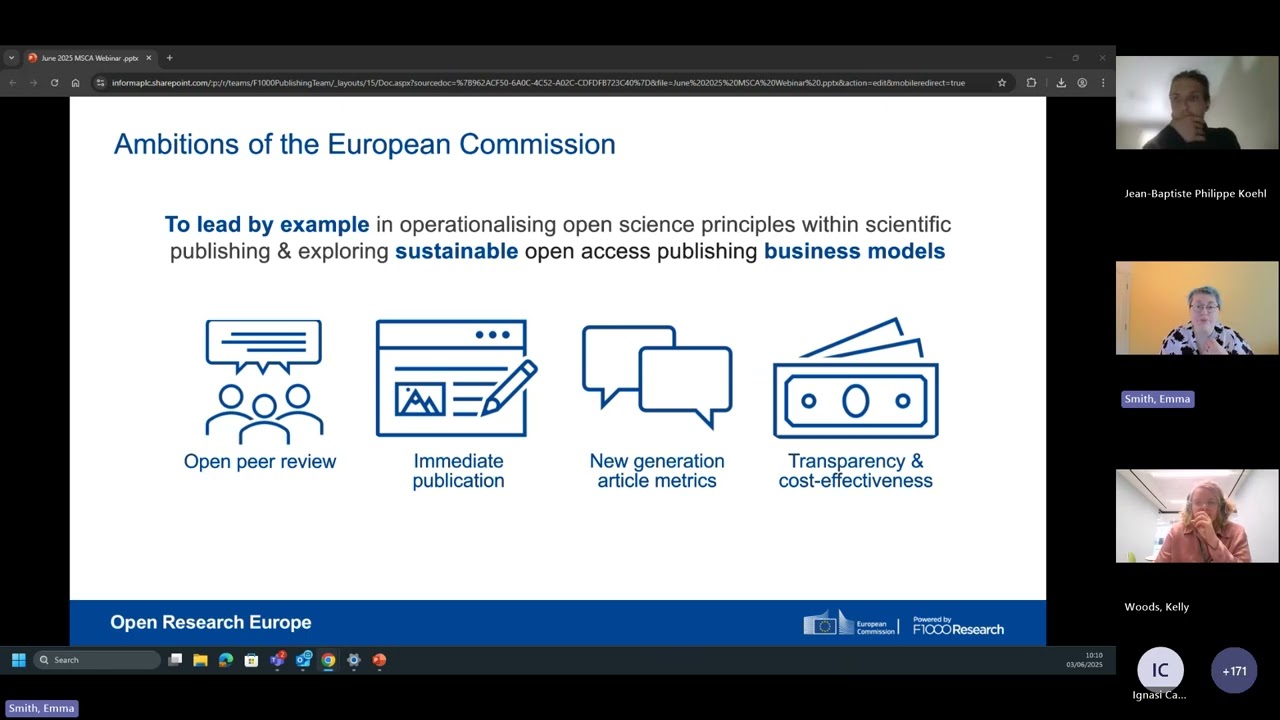
the European Commission wanted to
establish an open research platform that
sort of leads by example allowing
researchers to share their work
collaborate with others and gain
recognition for their contributions both
as authors and as reviewers openly and
quickly. Um
so uh some of the aims that they had
when developing that platform were to
share research quickly rather than
waiting rounds and rounds of revision
where your paper can't be read by anyone
other than the editor and the reviewer
um because it's stuck in that journal
system. It ensures they wanted to ensure
that papers are published as soon as
they are as soon as it's possible. They
also wanted to ensure that data uh is
made openly available and they wanted to
accommodate a really diverse range of
research outputs. Not just like a
standard research article and review,
but a much uh wider array of article
types to provide that more tailored
approach for you as authors uh to credit
you for the vast array of work that goes
into research articles. That's not just
that final product. Um, so for example,
sharing things like new methodologies
that you're creating and things like
that.
They also wanted a transparent and open
peerreview system and they wanted to
move away from journal impact factor as
an indicator of quality so that the
research uh can be judged on its own
merits and we provide article level
metrics to support that.
They also wanted a transparent and coste
effective way of publishing.
So that there was no cost to you as
authors or to your project budget or
grant. So if you are eligible to publish
on the platform which as Marie Cury
funded authors you would be um then you
can publish um an unlimited number of
papers related to your uh eligible
project project without any cost to you.
Um,
so F1000, uh, the publishing
organization I work for, uh, won that
tender back in, uh, the late 2010s. Um,
and Open Research Europe was launched
with these principles in 2021.
Open Research Europe has been lorded
across the widely wider scholarly
publishing landscape through initiatives
such as Plan S, the Coalition for
Advancing Research Assessment, and the
EU are increasingly encouraging open
research practices that Open Research
Europe uses. And we've seen several
major funders across Europe sign a
statement of intent to um support Open
Research Europe in the coming years.
So gone into a lot of what open research
principles are um and what open research
Europe um has as its sort of background
but what is the actual process of
submitting to open research Europe? What
is it that we actually do? So this is
our open research publishing model and
we'll go sort of one step at a time at a
time. So first um you would submit the
paper that you're wanting considered by
Open Research Europe and from there it
would undergo pre-publication checks. So
our in-house team of professional
editors will carry out those uh
pre-publication checks on things like
have you made your data available? um
and if not we'll sort of help you find
or share information that will help you
find um appropriate repositories to
share your data. Um are you as authors
actually eligible to publish on the
platform? Uh is your article a scholarly
article? Those kinds of checks. Um and
once you have passed all of those
checks, your article will be sent to our
production team. Our production team
will then fully type set the article and
you will receive those proofs and this
helps to um fully embed all of the XML
and sort of backend information uh that
helps make your article discoverable.
From there the article is published on
Open Research Europe as a fully citable
publication. It has a DOI and it's
indexed in Google Scholar at this point
in time.
Once it's published, that's when we
begin the peer review process.
Our in-house team of uh editors will
select uh expert reviewers to review
your manuscript.
This you can supplement uh with
suggestions um as of potentially
appropriate reviewers. Um but our
editors do sort of lead the charge on
that to sort of help reduce the amount
of work that you already have to do as
an author.
Once we have received two reviews, then
you as authors are encouraged to revise
the article and resubmit the much as you
would revise your article in a sort of
traditional journal format.
Once the article passes peer review, and
I'll get into the specifics of that in
just a moment, that's when the um
article is sent to indexers like Cenodo,
PubMed, Scopus and others.
An article is considered to be uh
completely reviewed when it has received
at least two peerreview reports. If um
the reviewers have
um excuse me as a part of the their peer
reviews that are made publicly available
um the reviewers are asked to provide a
status with their peer review and that
provides a sort of quick summary of what
the in their view the article is like.
So they can select an approved status
for when manuscripts are um pretty sound
in terms of their methodology and really
the only changes that are suggested
suggested are really very minor don't
have any impact on the conclusions that
the authors are drawing in the paper.
Then we have the approved with
reservation status. So this is when
there are suggested re uh revisions that
could help improve the paper, but the
fundamental results are
okay. Um and um
you know the the additional revisions
are helpful but not incredibly like
super super essential. Um and then there
is not approved for manuscripts where
the paper um needs significant major
revisions in order to support the claims
that the authors are making.
An article is considered to have passed
peer review like in this example here
when we have two approved statuses or
alternatively one approved status and
two approved with reservations statuses.
So this is when an article has passed
peer review and that's when it gets
indexed in those major databases like
PubMed and Scopus.
As I mentioned there are um we have
article versioning capability and the
versions are literally limitless. So um
if you wanted to you can continue to
update um your article you can revise it
both when the reviewers are suggesting
revisions um and uh for example even if
you've passed peer review but you may be
passed with one approved two approved
with reservations and you want to
address the uh concerns that the
reviewers raised in the approved with
reservations reviews. um you can still
continue to revise your paper.
Um in this paper for example, you can
see three um versions of the article um
are here on the right hand side of the
paper. Um in that first version they had
two um approved with reservations peer
reviews. um on revision. They then um
received um two approved with
reservations and an approved which means
that version two passed peer review and
was sent to indexes but they wanted to
address the remaining concerns raised um
and uh issued another version of their
article.
This is an example of open peer review
in action with the full reviews,
reviewers names published um alongside
the article and you can read the
author's response as well um which you
can read um clicking view um underneath
the um sort of status symbols. And you
can also see here that there are article
views and downloads metrics um that help
showcase the level of impact that your
research is having. um rather than using
the impact factor.
Um moving on to those article metrics as
I mentioned um this is a sort of wider
array of what we can show um and these
are immediately viewable after
publication. So you start receiving this
information um as soon as your article
is published which again is um before
and during the uh review process not all
the way at the end.
So what articles can be published on
open research Europe?
Um as I mentioned one of the briefs that
the Europe European Commission had was
to make uh to support a really diverse
array of research outputs and article
types um to help support uh research
across disciplines which have different
formats uh that they typically share
research. um as well as to provide you
as authors with more credit for the
research that you're doing.
So for example um we have um your
traditional research article as well as
brief reports for those sort of shorter
preliminary um outputs um and a variety
of other things. uh method articles
where you're developing a new
methodology, software tools for if
you're developing new software, um and
study protocols if you're wanting to
share your uh sort of uh protocol for
your research ahead of time. So, as you
can see, there's a really wide array of
article types to support a huge variety
of uh research outputs that you might
have.
Each of these um article types um has
guidelines and policies specifically for
research in science, technology and
medicine. Uh for research in the social
sciences and for research in the
humanities. So this isn't a
one-sizefits-all approach to a research
article. We appreciate there are wide
differences in what you would expect to
see in a research article, for example,
in an engineering paper relative to a
research article um about medieval
history. So um again the guidance sort
of varies by your discipline um and you
can sort of see that on the um open
research Europe website.
Um you have unlimited amount of
submissions. There's no uh sort of app
on the amount of submissions that you
can make to Open Research Europe. So you
could share research outputs from across
the life cycle of your project. So if
you wanted to, you could share an
initial literature review that guided
your um research proposal, the study
protocol for a particular experiment or
line of research that you're doing, the
methodology that you then used, you can
share a brief report from some of those
preliminary responses or results that
you received um and before diving into
the full research article. So this helps
give you credit throughout the research
process and begin acrewing publications
much earlier in the process uh than you
would get in just a traditional research
article format.
So let me take a sip of tea.
Um what are the sort of practical steps
about actually sharing uh your research
on open research Europe?
So um as a sort of general submission
checklist
um it is pretty standard with what you
would expect to see at other journals.
So things like the work is original and
hasn't been submitted to another
journal, isn't under consideration at
another journal. um that the study
itself meets uh the relevant research
and publication standards that the
methodological details you know where
you have them are uh supplied and that
the data has been made available
that everyone understands uh open
research Europe's journal policies and
the publishing model where we publish
first and then do the peerreview process
openly and transparently afterwards
um and um ensuring that your author and
affiliation information and conflict of
interest statements are all fully
provided.
This um oh it says cost action there. It
should say Marie Cury. Um so the open
research Europe um publishing with us
ensures that you're meeting your Marie
Cury uh grant requirements in terms of
sharing your um research in an open
manner.
In terms of your data availability,
um we ask that all uh data is made
available unless there are some limited
exceptions. Um so this can be raw data
for example data you've actively
generated um as a part of your study um
and you can share this in an approved
data repository under an open access
license so that other people can reuse
that data um and there should be a
permanent identifier for that data set
like a DOI
or it could be source data um so data
that you maybe didn't generate but it
was used for your research So for
example, if you've used archival
resources or if you've used another
person's data set, you should just
provide the relevant details so that
other people if they wanted to could
access that source data. Um so in
general this principle is making your
data as open as possible and as closed
as necessary. So if you need to protect
participant anonymity that's absolutely
fine. But what can you make available
and how would people go about accessing
that data through various data sharing
agreements?
If you have any questions, you're not
really sure um exactly where would be
the best place to deposit your data,
please do get in touch with us. Um we
have resources um on the website, um and
do feel free to um get in touch. Our
editorial team may be able to supply
more uh resources and I'm also happy to
chat um and sort of help provide
guidance where I can.
I also wanted to highlight that the
Marie Cury um actions have their full
own gateway on Open Research Europe and
this allows you to submit your work
directly to um the MSCA gateway. Um and
so your work can be included among the
work of other MSEA beneficiaries. Uh
currently we have almost 240 articles
published there across a really wide
array of uh subject areas and
disciplines. I've included a um
uh sample of them here. Um but you can
uh always browse that and see um what
other research uh your MSEA uh
beneficiary colleagues um have been
publishing.
And then in terms of indexation, I just
wanted to highlight that we are indexed
in a variety of places. So as I
mentioned, your initial publication um
the one that comes out first before peer
review is sent to Google Scholar. So it
begins being uh discoverable very very
early in the process and then once the
article passes peer review so after the
peer review process and you have those
two approved or one approved two
approved with reservations peerreview
statuses attached to your article that's
when it's sent to indexes such as Scopus
PubMed and uh the others uh sort of
listed on this website
um you can see a full list of um what is
um where we're indexed on the um Open
Research Europe website as well if you
would like to get into that in a bit
more detail.
So in terms of what's next for Open
Research Europe, uh there is a new
open-source platform that is currently
being built by public knowled the public
knowledge project um adapting their
systems to suit open research Europe's
model. Um we're also looking to widen
the eligibility criteria. So um
initially open research Europe was only
um accessible to beneficiaries of the
horizon programs um and now as you can
see as Marie Cury beneficiaries um you
are also elig eligible to publish and so
we're we're seeking to sort of widen
those criteria.
We've also received support from
national funders across Europe to uh
support Open Research Europe as a
platform and this really helps drive
Open Research Europe forward as a
collectively owned and supported
European research uh publishing program
for the benefit of European researchers.
So I am going to uh keep quiet now um
and get rid of my slides before I hand
over to uh Dr. Cole. So let me stop
sharing.
I'm sure you'll be glad of a change of
voice. Um yes, Doss Cole.
Is it okay? Can you see my screen now?
You see that? Fly publishing dawn of a
new new age. Yeah.
>> All good. Yeah.
>> Okay. Great. Excellent. So, thank you
very much for this introduction, Emma. I
mean, it's um really great to be here.
Uh and um just uh find out now how many
of you have felt like the guy on this uh
picture when it comes down to publishing
papers? Show hands.
Yeah. Yeah. Yeah.
Yeah. uh felt like that so many times uh
when it comes to publishing and uh uh
really um you know have any any one of
you seen that movie the the internship
uh I felt it was quite an interesting
movie especially when it came to that
moment where Vince Vaughn comes and say
to this pizza pizzeria place owner uh
that we all like we know what we know
but you know what's the scariest thing
in life is the thing in life that
frightens us the most. Change and yeah
change can be a bee. It really can be
and drive us nuts. uh and and and change
affects also not only us uh who are
marry and therefore probably
non-permanent employees but also
unfortunately our dear uh elderly more
experienced researchers uh whose
instinct has not been accustomed in the
latest years to be subjected to change.
So their survival instinct suddenly
perceives the change of paradigma or
whatever your paper is going to suggest
as a threat because it's going to
involve uh uncertainty for them and
certainly effort to which they're no
longer accustomed to adapt to a new
model to a new parody
of course. Yeah, I think that sums it
up. Um so that that comes from many many
many places and I think this is um uh
yeah omnipresent among scientists. I
should yeah I changed that to people.
Yeah. Uh what Alfred called complexes of
inferiority uh basically a feeling of
inferiority helplessness uh which one
needs to compensate uh inadequate
upbringing people feeling like uh uh
never feel felt gratified or never felt
encouraged and that leads to complexes
of inferiority and also complexes of
superiority which are actually rooted in
a complex of inferiority. That's very
sad because it leads to aggressive
behavior and withdrawal and
victimization. And I'm not talking about
you. I'm talking about these elderly
people who are supposed to be wiser,
more experienced that are judging
chosen to judge your your research as
reviewers or as editors. And you have to
think of them like this. And just like
us when we get a paper rejected, they
have to go through the grief cycle. Now
we are temporary employees. So we must
move on. We don't have the choice. Life
is kicking us in the ass and we need to
move on with denial, anger, bargaining,
depression and we need to accept the
fact that we can't control everything.
While these gentlemen which let's face
it and still male dominated
unfortunately but it's changing
gradually but these people are generally
u these more experienced people are
generally stuck in a denial anger phase
when they see something new that they
don't like or that destroys their
legacy.
Now enough about them a bit about me.
This is who I am. I am a crazy mad
scientist. I I love writing papers and I
do research differently and I think
differently. I think out of the box. Um
and uh a bit where I come from. Well, I
started in in France and did a bit of um
industry or should I say energy industry
uh in my lifetime uh twice actually.
once uh after my bachelor and once after
my uh master's degree because I couldn't
get a PhD unfortunately which was what
my lifelong dream uh be a researcher
which I eventually got uh had short
stints visiting PhDs visiting
researchers and I wrote one uh two and
three mercury application before I got
it uh with short-term positions
associated to that uh so lecturers
researcher commuting doing here and
there. Now I have my uh and then I got a
postoc uh just before leaving uh and
before getting my marury uh I got a
two-year postto which I combined with my
three-year marury between Montreal and
and Oslo that was really a blessing at
the time
and what I had not really understood
then was um I actually inconsciously
understood later but uh on the moment is
that when I was submitting my second
marry application I chatted finally with
the person that was supposed to be main
supervisor and I showed him some of my
research finding and what I did without
knowing it, I lit a bomb which blew up
in his face and destroyed his entire
research uh publishing strategy for the
next 20 years. It had just swept the
carpet from under his feet and he was
just the only word that he could find on
the moment was the f word and the B word
to to throw at me. And that was really
really tough and really I did not
understand what was happening. And then
I went across the street on the re on a
research center as a as a crossdoc as I
was as I got uh just before getting my
uh third application funded and then I
without knowing an even bigger bone with
a another discovery that I made which
blew up in the face of the lead
researcher there. uh and these two
gentlemen did not like that at all and
they have segregated my research which
is uh unfortunate because they well it
can help I I believe it can help and
they are not comp but it's also one
thing is that I did not see that they
were not competent to understand my
research they had no background in the
field that I or the skills I had gotten
from industry and this is this is my my
my mistake I had not managed to get
these gentlemen on board uh all the way.
Um so be careful and be be sure of what
people's intentions are. But anyway, now
these gentlemen, they are very powerful
and they have made it awfully
complicated for me to publish my
research because as you know in the
research landscape or the publishing
landscape, the editors and the reviewers
have all the power.
And generally when they read something
new that does not agree with their own
papers, they're very angry and they
reject your papers. Right?
And on top of that, uh that's probably
something that has some positive uh some
positive um um
sides to it. But I don't have time. I
don't have time for these gentlemen to
to go through any their grief cycles
successfully. Uh I have many to go on
for myself and my life is not going to
be as long as these two gentlemen. I am
autistic which I have just discovered
and I have a chronic or genetic heart
problem which I am sure not to live past
uh 60 70. So I don't have time I don't
have time for that. But luckily there is
a light at the end of the tunnel to
share this exciting uh this exciting
discovery that I've made and this light
is open research Europe. When I
discovered it about a year and a half
ago late 2023 I sent one paper and I
couldn't stop myself. I think I've
published seven first author paper
papers in open research Europe and I
have two more uh in review and that's
just one year and a half that I had a
lot on my chest with this discovery and
I still have a lot um so
it's very very nice to have a journal
that can really accept so much workload.
I mean it's F,000 powered so it's it's a
really huge team that has an incredible
potential and a bit about the journal as
I was saying but from the author's p
perspective the great thing about that
is that it's published first with a DOI
findable immediately anyone can see it
anyone can contact you and and then spit
keep spitballing you know it's get the
ball rolling in many different direction
and see where where things go and and
and one more
It can never be rejected if it passes
the first ethical and and fair data
checks and all eligibility checks. Your
paper cannot be rejected as it so often
is when it proposes something
dramatically new that people cannot
comprehend uh because they don't have
the experience or because they fear
repraisal from disagreeing with a
powerful individual.
So cannot be rejected. it will be
published and it will be findable
forever that it passes peer review or
not it doesn't matter it will be there
so now a bit about how to find the
peerreview process it's not so much of a
hassle I must say and it's really
transparent it really is something
completely new you are the as the author
are empowered you finally finally have
equal power as the reviewers and this is
something really important that you have
to understand. The reviewer can no
longer bully you in saying that you're
just full of That doesn't work. It
can it no longer works. This is what is
really great with Open Research Europe.
So you can of course uh name three
opposers u but that doesn't really
really matter. You can suggest
reviewers, which I strongly encourage
you to to do. Um, because it really
speeds up the process and and and gives
the team at F000 a lot of names to that
they can check uh and they do check
thoroughly uh for uh conflicts of
interests and uh potential uh uh
collaboration on previous papers. But
you can also use the reviewer referinder
tool which is really helpful sometimes
when you really have papers that you you
you don't know uh you are in in a field
where you are you're exploring the
implication of a groundbreaking uh
discovery you made and you you're not so
sure I I I'm I'm structural geologist
and I am I have my my research has
profound implications for paleontology
but I don't know so many paleontologists
unfortunately so I don't know who would
be a better best reviewer. So this uh
tool can really help be helpful. You can
click on the on the uh three matching
publication. It will display the names
and and authors. You can in links to to
their PubMed page or something like
that. And you can decide whether you
think this uh suggested uh reviewer is
is a potential match or you can uh so
you add it to the list here or you can
just decide no I don't like this person
or I have a conflict of interest with
this person or this person is not
competent to to to review my research or
is not simply not relevant. That that
really rarely happens. the tools are
pretty good at finding uh matches, but
it can happen. And now off with the
peerreview process. And I think the
greatest one of the two greatest
features of of Open Research Europe
together with the fact that your papers
can no longer be rejected is that um
sometimes I would see you. So you see
here the the status of all the the
reviewers that I have added to the list
or that some the editor editorial team
has added themselves because it was
suggested by another referee or by
someone that couldn't review and some
people agree and then you say, "Oh,
okay. Great three people have agreed I
have will speed up the process and
suddenly one of them you would realize
one of them has dropped out. So one
thing that can happen is that they
suddenly realize oh no I don't have time
to do that but it's rare I must say very
it is very rare when you accepted to
review a paper it's you do it what h
what happens is that and I I know that
because I know personally some of the
individual that have suddenly
disappeared from that list have agreed
uh is that people at the moment of
submitting their peerreview report
realize that oh shoot I can't remain
anonymous I cannot insult that person
and be different in my comment. Shoot, I
don't have all the power anymore. Oh, so
I will just not submit my report. I will
not be a reviewer anymore. So that can
no longer happen. You
referees, it's pure fully transparent.
Referee cannot no longer remain
anonymous and they can no longer be
injurious in their in their comments.
They have to have their name attached to
their comment. They have to be to stand
up for for for that comment for what
they say. That means that open research
Europe is also on the other side trying
to create an environment for young
scientists to also feel like they can
express their opinion. May they disagree
with powerful individuals and that I
think is a really um amazing thing to
do. Uh and of course if you you may be
afraid of sharing your opinion then just
decline. If you're really really really
afraid to disagree with someone just
decline. But um if you if you are a
researcher you and you want to propose
something new, you you must be a tad
courageous. You don't have the choice.
You are going to change you're here to
change people's life. Europe believes in
you. We believe in you and we really
want you to achieve great things. So
please share it with everyone else. Open
research is a great place to do that.
You're not going to be just Oh, by the
way, did I mention that it's a diamond
open access journal? Free to publishing
and free to access. It's just checks all
the boxes and now yeah just on the
editors I mean this is very new but open
research Europe the editor is no longer
this person that tells you that okay the
re the reviewers one of the reviewers
said no out of three so I'm inclined to
say no like him so in in most journals
the editors will take also will also
u have an opinion on whether your paper
should be published in their in their
journal
No longer it is the case in open
research Europe. An editor's mandate
should not be to to to to decide whether
a paper should should be published
because an editor is actually well
technically biased because it would
generally tend to try to have as many
papers to published or or if it with uh
questionable uh ideas and just wants to
segregate ideas that are not agreeing
with his then he would decline
publications which suggest an
alternative to his models. An editor
should be impartial. It should be a
conflict solver between reviewers on one
side and authors and help them solve
their uh differences. It is all about
that. Once a manuscript is submitted,
the editor is is a facilitator that
sends the manuscript to the reviewers
and tries to talk each of them to try to
agree and make compromises. This is what
it is about. And sometimes it's
difficult and sometimes not possible. Of
course, that that happens very well. and
then the paper does not pass peer review
but it's still there and still can be
improved. That's the beauty of open
research Europe. It is all it will
always be there and if you 20 years
later you want to give it another crack
at this paper that still hasn't passed
peerreview and let's say mentalities
have evolved paradigms have changed in
your field then you go back to it and
you can do it and you can you don't
start from scratch again
and open research Europe as said it's
moving away from irrelevant and insist
on on the word irrelevant impact factors
and citation indicators these are not
relevant to evaluate the quality and
impact of your research and I'm going to
get and this is very stupid example most
not stupid it's very basic example that
shows the irony of using such irrelevant
parameters this is Alfred the father of
plate tectonics basically the father of
the foundation of the geocciences for
everything we do is connected to his
finding that the continents have moved
and are still moving. He published this
book in 1915 or his first version, first
edition of the book which has been cited
a whopping 1500 times. Google Scholar.
Now we know that is mostly true. Not
everything is true in his book, but a
lot of things are still true and
accepted widely accepted. Now we go to
this gentleman which against which I
have nothing against. I mean he's a very
decent person, a very good researcher
and that also is very open to
characterizing the uncertainty around
his research. In 71 he published an
update an upgrade to the continental
plate tectonics theory of beginner
and this has been cited more than twice
uh more than
uh book although it is actually
extremely controversial and very it
works almost in no situation.
So if you want to focus on being cited
and having high impact factors, I
suggest you start understanding that
your research is going to be wrong or
controversial. Let let's put it this
way. If you want to write a research
proposal or write a paper, the
introduction to a paper, let's say, and
you want to introduce the field, you are
not going to refer to something that is
broadly accepted. We know it. We don't
want to repeat it. But you want to go to
the point, okay, these mental plumes
that this mr. Jason Morgan has published
about in 71. This is still not
completely accepted and it still has
problems and therefore it is cited
because it is still controversial.
All right. Uh I'm going to stop now but
yeah just to to tell you open research
Europe is really one of the greatest
thing that has happened to me in the
last year and a half. It was it's really
a great experience and great manuscript
handling. uh every time you look at
nature and science reviews by authors
whether their paper was accepted or not
most of these review are negative
because people feel like they're treated
like This never happens in open
research Europe. guarantee I've I've had
nine manuscripts submitted there and
it's really every time it's different
but you feel like you're supported
throughout the process and you feel that
you are always partly in control that
you have equal power with with the other
forces in that are at play. So thanks uh
thanks a lot if you have questions of
course again I'll stay here and uh don't
hesitate I have you also will have my
presentation and my email is in there so
happy to converse about this further
cheers.
Thanks, Sean Bertis. That's super
helpful. Um, Kelly, um, I don't know if
you are around to help with Q&As's or
not
>> because I haven't seen your face
>> to share a little bit.
>> Um, would that be okay? Uh, just because
I am aware I monologued a lot for most
of this uh, webinar. So, people might
want another voice. Um, so for those of
you um, I think I may have forgotten to
introduce Kelly. That's entirely on me.
Um, but Kelly is um does a lot of the is
a lot of the driving force behind Open
Research Europe. Um, and um is uh a
wonderful person um and has worked in
open access publishing for many a year.
Um so uh they are uh wonderful.
So questions throw them at us. Um, and
in the meantime, I will share the
contact page for myself for people that
that have any questions that we don't
get to.
>> Thank you very much. Um, so I will be
using the up vote feature in the Q&A to
determine which questions we'll get to
first. Any questions that we don't get
to, we will post in a blog post at the
end um on Open Reset Europe. So, we will
get to all the questions even if we
don't get to them in this session. Um,
so the first question we've got is can
we publish the same note or paper in
archive and in open research Europe?
>> Yes, you can because archive is a
preprint server um and open research
journal acts um it's a peer-reviewed uh
platform for like a journal. So it's um
they are sort of distinct kinds of
publication um and so preprint servers
are absolutely fine um for you to share
your work in and then submit to us.
>> Perfect. Thank you. Uh second question,
if you're working on a Mary Cury project
that has finished or the grant has
ended, are you still eligible to publish
the results from that project on Open
Research Europe?
>> Uh yes, you are. You can publish um as
long as the research is coming from that
project, you can publish uh that
research um with us for as long as you
would like after the end of the actual
project itself. So, um, if you have, um,
a research output that you're thinking
of sharing, but you're like, man, my,
uh, grant ends in a month, and there's
no way I can pull this research article
together in a month, absolutely fine.
Uh, just share it with us when it's
ready. Um and that's um absolutely um a
okay just as long as it is funded in
whole or in part um by one of our
eligible funding streams of which the MI
cury um actions are one of them um then
it's eligible for open research Europe.
>> Thank you. Um and then we've had a few
questions just asking to confirm that
publication is free. Who is eligible to
submit for free? How can it be free? How
is it funded? That sort of thing.
Yeah. Um, so we work centrally with the
European Commission. So when you submit
um a manuscript to us, we um then tell
the European Commission like, "Hey,
we've had x amount of papers published
um on the platform and then we chat with
the European Commission centrally about
um funding arrangements. So for you guys
as authors um it is free for you to
publish as long as you're one of our
eligible funding streams. If you're not
an eligible funding stream, then you
can't publish on the platform. There are
a really wide array of eligible funding
streams. So, um, Horizon 2020, if
there's anything outstanding from that,
Horizon Europe, cost actions, um, the
Marie Cury actions, um, if you're a
member of staff with the European
Commission, things like that. Um there
is a web page um that I won't be able to
pull up right now um but it's called
eligibility under our how it works
section on the open research Europe
website um and that um lists all of the
Thanks Kelly that lists all of the
eligible funding programs. So if even
one author is publishing an output um
that relate that that they use that
funding for on that paper then it's
eligible to publish. So if you um have
um a sort of PhD that's funded by the
Marie Cury um actions um and you're the
only person with eligible funding who is
publishing on that paper, that article
is still eligible for publication on
open research Europe.
>> Just to further clarify that point as
well because we've had another question
around that. Um the authorship position
in the publication doesn't matter
either. You do not have to be the first
or the last author. You can be any
author in the paper as long as the work
itself was funded by the commission and
and the eligible programs listed on that
website. Um then you can publish. Right.
Let me get back to the Q&A.
Um how is a recognition for papers
published in Open Research Europe? When
thinking about when your funding
proposals are being reviewed or job
applications, how do they assess papers
published on Open Research Europe?
Um that is an excellent question that
will probably vary by institution. Um
but what um I can say is that when your
article is published so again like that
initial stage um before peer review when
it's very first published on the
platform it receives a DOI and can
immediately start being cited start
being viewed um and things like that. So
you can point to your um publication on
open research Europe even before
peerreview as a demonstration of
productivity um and um that something is
undergoing peer review as a part of your
um grant application and things like
that um and because of the transparency
of our process um it is easy for anyone
who looks at that paper to see where it
is in the process. So for example um if
you've just submitted a revised version
um that has started going through peer
review and you have those sort of
earlier maybe you've got two approved
with reservations peer reviews um then
um anyone sort of looking at that paper
can see um the stage that it's at read
those previous reviews and things like
that. Um and finally once it passes peer
review so you've got those two approved
or one approved two approved with
reservations peerreview statuses
attached to your article um then the
open research Europe paper is then sent
to indexes like PubMed and Scopus um so
that it is um more akin to a sort of
final version um that you would find in
a sort of traditional version
traditional journal article um because
it's being sent with two sort of indexes
as a sort of
Thumbs up. The reviewer said uh yes to
this one. Um so that uh are those are
some various different ways that you can
use a publication on open research
Europe throughout its life cycle with
us. Um and not just as you would have in
a sort of traditional process of
manuscript in prep uh under review and
then an actual publication. You can
instead point to exactly what reviewers
have said, exactly where it is in the
process. Um and I think Jean Baptiste
maybe has something to contribute as
well from his experiences.
>> Yeah, actually this is from my
experience as an ERC reviewer evaluator.
Um if I see a proposal that does not
contain that we will the project will
publish the data on xenodor open on open
research Europe or on any open access
journal or open but especially open
research Europe or on any of the open
access data repository. I would not
respond positively to that to that
proposal. Uh the reason is Europe is
making that change and Europe is one of
the European Commission is one of the
main source of funding for universities
in Europe. There is a reason why we're
going in this direction. Uh we need
progress to accelerate not to be stopped
con constantly. Uh and um I think
universities will have no choice but to
adapt in the very near future. There is
a need for them to value the fact that
you have published in open researcher
that you're acquainted with what it
takes to make your research truly fair
and and findable uh available interpable
and and reusable. This is where we're
going and there's no going around it.
>> Brilliant. Thank you so much. Great to
have the author perspective there on
that one. Um let's have a look. We're
getting quite a few questions around
timelines. So can you give an overview
of the timelines from submission to
publication and then from publication to
peer review etc.
>> Yeah. Um so obviously everything that
I'm about to say is um related to our
sort of medians um that we um sort of
take um
so um in terms of submission to
publication those initial
pre-publication checks the ones where
our editorial team are checking like hey
is the paper eligible is the article um
in scope for us um and the various
different pre-publication checks.
um they should get in touch with you um
within a few working days um if they
have any questions about that uh those
sort of initial checks. Uh from there it
depends a lot on um author
responsiveness. Um if you are traveling,
if you've submitted your paper right
before conference season and can't get
back to us, um that will uh sort of
obviously change um how quickly um the
the paper goes from the submission to
publication. uh stage. Um one of the
things that we find is that there is
sometimes confusion over um what data
can and should be made available. Um how
best to make it available. Um so when
you are preparing your submission um
it's worthwhile checking out both our
article guidelines and our open data
software and code guidelines. Um I've
got my email up on the um screen that
hopefully you can see. Um, so if you
have any questions ahead of submission,
please don't hesitate to get in touch.
There are also additional resources on
the website just to check those things
and then prevent delays just because
you've um misunderstood what the data
availability policy actually is and
things like that. Um, but yes, so you
should get that initial email from us uh
within a few working days. um in terms
um of
from when it's like accepted so our
editorial team's input is over you've
had that back and forth um to when it's
published that's normally I think a
couple of weeks uh to get all the
production stuff um sorted the proofing
the type setting um any uh errors to
correct in the proofs um and then it
will go up um online um so I think again
because it depends so heavily on author
responsiveness and what questions our
editorial team ask um and what needs to
be provided um that can vary quite
widely in terms of submission to
publication times. Um, Jean Baptist, she
wanted to chip in here as well.
>> From experience, uh, if the stars align
and you have done your due diligence of
preparing your data the way they should
be prepared or or and you know how they
need to be prepared in advance and you
have done all the reference check in
your in your paper etc. It could go as
as quickly as one or two weeks to get it
published uh and and fully available. It
can be awfully quick. But if you are in
a if you are writing a paper like I did
recently on a field that is not exactly
mine then the data are a bit more
challenging to to know how to share them
how to present them and it took about
two months of back and forth but it was
like two months it was really intense
discussion was not a lot of work but it
was back and forth. I think we had the
five or six exchanges with the
production team and and Q and Q&As on
how to share the data or the references
etc. And it took about two months. It
was it was really not overwhelming. It
it was really good. And and when it
comes to the peer review, if you want to
have a firm number on it, I've had
papers uh peer-reviewed uh as quickly as
and accepted and passing peer review as
quickly as three weeks. And that again
if all the stars align then and you have
recommended a lot of referees and
reviewers and and and they are available
and they want to get rid of their paper
off their plates because it's Christmas
then they will review it very quickly
and done done there can be that quick.
two weeks plus 3 weeks. It was the
quickest paper I've ever seen accepted
in passing peer review. Five weeks total
this one took. But I have another one
that has been submitted more than a year
ago and it's still uh not uh hasn't
passed peer review and it's a paper that
shakes the foundation of my own my own
science field. So it's completely normal
and I I expected that and and it is
perfectly fine. Uh so you have depending
what you are publishing.
Thank you so much. Um, so just to add a
few concrete numbers to that, I think
the the case study there from John
Baptist is really helpful and the
overview from Emma, but um, the median
times we're looking at at the minute
from submission to publication are
around the 50-day mark. Um, as we said,
there's lots of variation there.
There'll be some that come in within two
weeks and some that take a bit longer,
but median is around 51. Um, most of
those papers receive their peer review
reports by around the 70day mark. Um,
and then they ultimately end up passing
peer review somewhere around 90 days to
100 days. So, these are the numbers that
we're working with at the minute, but as
Jean Baptiste said, if if you've done
your due diligence, that can happen a
lot quicker. Um, or if your paper is
particularly complicated, then that can
happen a lot slower. So, um, swings and
roundabouts really. I don't know if
that's an expression that translates
across all of Europe, but it's a very
British one. Um, okay, let's have a
look. What have we got? Oh, we've had
some questions about the thematic scope
of Open Research Europe. and do we have
sections or anything like that?
>> Um that is a great question so thanks
for asking. Um so open research as a
whole is designed for European
researchers as a whole. Um so uh in
terms of subject scope as a platform um
as long as you are eligible um to
publish on open research Europe we will
accept any topic um for consideration
for our um editors to go through those
pre-publication checks and to sort of
begin that peer review process
um in terms of looking like hey I work
in chemistry or I work um on medieval
history or renaissance history in a
particular
um country. Um we have um on the website
uh community gateways um which is our
funky name for subject areas. So if you
want to have a look um for a specific
broad topic um then the community
gateways tab is where you would look. Um
so maybe I should pull up um open
research Europe here. Um so you would go
to gateways and collections and
community gateways and you can see the
sort of broader subject areas here. Um
we also have collections uh which are um
akin to uh sort of much narrower in
scope. There are sometimes like
commissioned articles or we've um or
we've got gateway advisers that have
reached out um uh about a specific topic
um or for example cost actions are
normally sort of larger
interdicciplinary networks that want a
home for their research. Um and so these
are much smaller in scope than the um
community gateways which are sort of
broader subject areas. Um but yeah,
those are the places that you would
look. Um, and if you click into each of
them, let's say you're a health sciences
researcher and you want your research
tagged into that gateway, you can click
directly submit to this gateway and it
will take you to a submission form and
automatically tag your research into
that gateway. Um, so um that hopefully
is helpful in terms of uh scope
questions.
>> Brilliant. Thank you. Um, we've had
someone comment saying that they agree
with Jean Baptiste about what you said
about journal impact factors, but sadly
many hiring committees still focus on
this when reviewing applicants CVs and
it still seems to have weight for things
like the UK ref. Um, is there any
insight or data on how open research
Europe is viewed by the ref or other
national bodies such as the AQ AQU
Catalonia in Spain or by social science
departments particularly with reference
to hiring or promotion. Um so as Emma
and John Baptist said there really is
big movement across Europe in particular
to move away from using things like the
impact factor in hiring decisions and
also in funding decisions but that is
going to take a really long time. Um if
we think about how long the world
actually took to accept peer review
although we consider that to be a
standard um practice in publishing
actually took decades before people were
accepted accepted uh having their papers
to be peer- reviewviewed rather than
just having them published as soon as
they were submitted. So change takes a
really long time. However, um things
have really kind of picked up in the
last few years, especially with the co
the creation of Kowara, the coalition on
advancing research assessment. I think
it's done. Um and also with the European
Commission pushing Open Research Europe.
So, I'm not sure if Emma mentioned this
during the presentation, but um the
European Commission is really committed
to expanding Open Research Europe and
removing the eligibility criteria of it
to allow researchers not funded by the
European Commission to also make use of
the platform. And in order to do that,
they've been negotiating with uh many
different funders predominantly across
Europe at the minute for obvious reasons
um and asking them to contribute
financially to the running of Open
Research Europe and therefore allow
researchers based in that country or
funded by those organizations to um
publish in Open Research Europe as well.
So I mentioned this just to say that the
more of these national funders and
institutions that get on board with a
model like Open Research Europe and
engage with KOAR, the more they will
have to change their own hiring policies
and funding policies um to reflect this
support for um or the support for moving
away from the impact factor and instead
focusing on each individual piece of
research and the the worth of it in on
its own merit instead of looking at the
venue of where it's published. Jean
Baptiste, do you want to come back in on
that?
Yeah. Um I I want to say that it can
really hap a change can really seem a ms
away but s can really happen very
suddenly quickly and when the first
domino falls then everything falls into
place and it's it's going to happen very
quickly. So you want to be on the right
side uh once this change happens and and
and just to my surprise I was invited to
to give that talk. I just had not
realized that I was that I had that much
experience after a year and a half with
open research Europe you you get a lot
of opportunities be on the right side of
it right now just it takes all of us to
make the change but it actually not
doesn't take so many of us it takes only
the 10 first 10 the first 10% until we
reach tipping point where all the others
which are generally followers and we can
be followers for very different things
in our lives but we also can be drivers
and those 10% of people that are th all
that we need to drive the other 80%
because there will all be always be
these 10% of resistant people that will
never accept it which is fine we all we
need diversity but these 10% pe people
will drag the other 80% with them so
once this happens it's going to be
moving very fast you really want to be
publishing on open research Europe now
and that would make a big difference for
you for example in terms of funding as I
say as I review proposals for the ERC
and I I got to make the decision me out
of all the evaluation Since I know very
much about open access, I was the one to
make the decision on the last proposal
funding. Uh we we funded three proposals
and two were very tied. One knew about
open access. One did not even mention
open research Europe. Had no previous
experience about open science and
anything like that. That was clear. It
was a clearcut. It was a clear decision.
>> Brilliant. Thank you.
Um, someone's asking if their paper is
rejected or I'm guessing in our quirky O
language. Um, if it receives uh not
approved peerreview statuses or doesn't
reach the threshold to pass peer review,
does the paper remain on the platform?
>> Yes, it does. Um, so um, one thing that
I normally emphasize and didn't uh, in
this webinar uh, for some reason um is
that not approved despite the sort of
scary red X is not a rejection. It is um
an invitation for you to undertake major
revisions. So um much as like in a
journal you can get um sort of uh
accepted minor revisions major revisions
that's sort of broadly how you can think
um of approved approved with
reservations and not approved. So, um
there is no outright rejection on Open
Research Europe um because you can
always revise your manuscript, submit a
new version, and then those re uh
original reviewers are reinvited. Uh we
could potentially also secure new
reviewers depending on if the first
reviewers are unavailable for any
reason. Um and then um with though uh as
those original reviewers now update
their reviews to reflect your revisions,
what was previously potentially like um
you had one not approved review and one
approved with reservations, those could
now become two approved reviews and
therefore your article would be would
pass peer review and be indexed in
Scopus and PubMed and what have you. So
there is no rejection on the open
research Europe platform. It is instead
a go away, revise your paper, come back.
Um and once you've got that new version
um issued
um then you know the new reviewers
original uh or the re-reviews sorry the
new reviews um can be updated to reflect
those changes.
>> Go for it.
>> If I if I can say
>> Yeah. Yeah. Go for it. If you if you if
you really just want to focus on the
peer review on passing peer review, it
doesn't matter how many researchers
disagree with your point of view and and
want to to not not approve your paper.
As long as you can find a small
community of people that agrees with you
and and and understands what your paper
is about and want and approve your
paper, that's that's all that matters.
If a thousand people reject or want to
not approve your paper, it's up to them.
But it will pass peer reviews as soon as
two people have approved it or one
approved and two plus with reser
reservation.
>> Yeah. The other thing to mention on that
point is we do check all of the reviews
before they're published to make sure
that they actually founded in something
and not just saying this paper is
rubbish or I don't agree. They really
have to explain in detail what it is
that is the problem that they have with
this paper and they have to advise the
authors constructively on what they can
actually do to improve the paper. It's
not enough to say you don't agree or you
don't think this should be published.
You need to explain why and explain what
the authors can do to get it to the
point where it should be accepted. So
that's another kind of key difference um
in our model. I'm just going to nip to
the chat because there's a few questions
in here. So should the platform be
considered an alternative to the journal
or um can you submit to both Open
Research Europe and any other named
journal?
Um, so it is an alternative to a journal
instead. So you wouldn't be able to um
publish your research in the journal of
neuroscience and open research Europe.
It has to be one or the other because we
are a peer-reviewed platform and if your
article passes peer review then it is
indexed. So um in much the same way as
you wouldn't send your article to two
journals at the same time, uh you
wouldn't submit your article to Open
Research Europe and um another another
journal. So it is either or.
>> Uh then there's a question asking is
there any plan by the European
Commission to suggest that universities
consider open research papers because
they don't currently exist. Um yes and
the commission has followed up on that
and particularly where there are
national policies or for example
national approved lists of journals that
you must publish within these named
lists of journals in order for your
paper to count for your next round of
funding. Um, if those sort of lists
don't include Open Research Europe for
whatever reason, then the European
Commission has been lobbying, I guess
would be the word, or at least uh having
conversations with those various funding
bodies um and institutions to say, you
know, you really should be including
Open Research Europe and this is why.
And a lot of the times we've we've we've
had those discussions, we realize it's
just a lack of understanding or a lack
of awareness as to what Open Research
Europe is, how it's different and how it
should be seen as the same as a as a
journal or an alternative to the
conventional journal publishing model.
So um yes, they do do that and uh we we
should see that changing in the future.
Um, a question about someone looking to
publish their review article and how
long it might take to publish a review
article in particular.
Um, so we do consider review articles.
Um, I'd recommend checking out the
article guidelines for your specific
field of research. Um, as I mentioned,
we have those sort of categories of
science, technology, medicine, social
sciences, and humanities. So whichever
most applies to you. Um but review
articles are considered by Open Research
Europe. Uh in terms of timelines, it
would be the same as the ones that we
previously mentioned. So uh when you
submit it to us, our editorial team
should be in touch um within a few
working days. Um then depending on the
sort of back and forth um that you have
with them, the sort of median time from
submission to publication being around
uh 50 days and then those peer reviews
um the median time to receiving at least
two peer reviews um being around 70 days
and to passing peer reviews. So the two
approved or one approved, two approved
with reservations um that hovering
around the sort of 90 100 day mark. So
those um are sort of broadly uh similar
in terms of timelines. Um
yeah, I hope that helps.
Um then there was a question about do we
have difficulty securing peer reviewers?
Um is it more difficult than a
conventional journal because they have
to be um non-anmized and they their
reports will be published. Do you want
to take that one Emma or do you want me
to take it?
>> Um would you be able to take that one?
Um I don't think we have radical
differences but I can't remember off.
>> No. Um so it normally takes us about 20
reviewers on average um invited in order
to get the two or three reviews secured
for the platform. Um and the vast
majority of people that decline um to
review for Open Research Europe is
because of time. It we don't really see
a significant increase in people
declining to review because of the open
peerreview element. It's really just um
part of the reviewer crisis that there's
so many papers to review and lots of
demands on researchers time that this is
often one that that falls off and that's
completely understandable. So um no I
mean that's a fairly standard um amount
of invitations to be sending especially
in an an open access um journal or
publication. John Baptist.
>> Yes. Thanks. um use the reviewer finders
tool. If you don't if for whatever
reason that is you don't have a list of
a ready list of ready uh email addresses
of individual that you know would be
able to act uh for as reviewers in this
field or this field then I I suggest to
use this reviewer find finding tool so
that you have at least about 10
reviewers at all time in the list uh
ready to be checked by the editorial
team in case some of them should drop
out or should not have time or should
not feel quite Wi-Fi to review your work
and then that would really speed up the
process and select kind of reviewers.
>> Perfect. Thank you. Um, so we've had a
question about when budgeting for a new
Horizon Europe project, are publication
costs still eligible under purchase
costs or is it mandatory to use Open
Research Europe? It is not mandatory to
use Open Research Europe. Um, under the
agree under your Horizon Europe grant
agreement, you are free to publish uh
wherever you want as long as the paper
is made openly available um and the data
as well if possible. There are um
exceptions to that rule as there are
with any but um yeah, you don't have to
use open reset Europe and I believe you
still can claim for publication costs
under purchase costs. Um, but they would
like it if you would use Open Research
Europe and I would like it too.
>> Um, it's free with us. So it
>> it is free. Yeah, you don't have to
claim because we charge the commission
directly and they take care of all of
that for you. Um, John Baptist, was that
what you were going to say because your
hand went up?
>> No, no, no. I was going to say that when
as a reviewer uh when I see uh costs
attached to publication uh to to say
that they would
um reports or projects are going to
publish in nature in science I start
saying no that that is for me if when it
goes to to to cost it it is a cost that
is very likely to be cut so be careful
with that you you don't need those costs
you can publish in many other journals
we don't need impact factor we don't
need citation anymore these are so why
publish in nature which is a journal
where generally the research published
there is wrong so it's you know not
always but it's uh yeah we're trying to
move away from that
>> yeah that is one thing I would say I
mean the the cost that we charge to the
European commission is significantly
less than what the average article
processing charge would be to in another
open access journal um and we are much
more open on the website about the
service that you actually receive from
us for that money that the commission is
paying so as Emma may may have mentioned
there's a pre-publication checks page on
our website that fully explains
everything that we do to check your
manuscript. So, it gives you a bit more
of a quality check when it's initially
um published and then we detail all of
our peerreview processes, the production
phase. So, we're much more transparent
about every stage of the process. Um so,
you really know kind of what you're
getting for what the commission is is
paying in comparison to other venues.
um could you please elaborate on the
difference between the pre-publication
um indexation and the approved version
indexation? So when it after it's passed
the pre-publication checks, where can we
find it? And then once it's passed peer
review, where can we find it?
Yeah, that's a great question. So in
terms of when it's very initially
published, it's just passed the
publication checks and it's just gone up
on Open Research Europe. You can find it
on open research Europe and on Google
Scholar. Um in ter once it's undergone
the peerreview process um that's when it
is um and it's past peer review that's
when it's sent to other indexers as
well. So, Scopus, PubMed. Um, a full
list of this is detailed on our
indexation page um going through um who
exactly it is uh the paper is sent to um
after it passes peer review. So, there
are uh some national um biblometric
databases and then some of the sort of
more well-known ones like PubMed and
Scopus. Um so that's the sort of
distinction there is uh Google Scholar
will um index quite broadly um whereas
uh some of the other databases will only
index once an article passes peer review
and that's the sort of distinction.
>> Great John Baptist.
>> Yeah just in case uh some of you should
should wonder each version of your
article because it will have a different
DOI. So when you publish your you submit
your article it's published but not yet
peerreviewed that's one DOI and then
when the peer reviewers have come back
to you and you have made revisions and
you have submit re submitted a revised
version of your article this will be
attached a new DOI which all of which
you will be able to find on the
manuscripts page uh once they're
published they will always mention when
you get to the papers page uh if by uh
mistake you are thrown to the first
version of an article we always tell you
there is an updated version to that
article do you want to see that one
>> yeah so so each version of the article
gets its sort of child DOI um and so you
can sort of trace back for example if
there's a comment attached to like the
first version of the article um and um
you know uh later versions potentially
address that comment then the the you
can sort of decouple uh versions but
it's also So they're they're linked
together so you can see um an article
that that um pro how it progresses over
time as well. So yeah, thanks.
Okay, let's have a look. So we've had
someone asking how they can become a
reviewer for Open Reset Europe and I
have dropped in the link to the reviewer
page on the platform where if you scroll
right down to the bottom, you can fill
out a form to volunteer to become a
reviewer for O. So if you're thinking
about that, please look for that
question. Um, we've also had a question,
how are the evaluators recruited
considering that researchers do not pay
for the publication? I think you're
talking about reviewers. Um, in which
case we've spoken about that quite a
lot, but the reviewers are um not paid.
Um, that was actually a discussion that
we had at one of the open researcher
scientific advisory board meetings where
it was kind of universally decided that
that was a terrible idea and introduced
this bias into the system. Um but uh
yeah so the reviewers are invited by the
editorial team. Um we can source
reviewers for you but as Jean Baptiste
has mentioned you can also uh put
suggestions for reviewers in yourself
and you can use the reviewer finder tool
as well to help you do that. Did you
have something to add to this comment
John Baptist or is your hand just still
up from last?
>> Oh no sorry it's lower.
>> Um yeah I do. Um so in terms of um
benefits you would get as a reviewer as
well. It's worth um highlighting that
each review receives its own DOI as
well. So you can um that means you can
link it to your orchid as a reviewer. Um
all reviewers are named. So the the um
work that you put in um is credited um
to you and potentially if you're
mentoring a PhD student in peer review
and things uh they can be a named
co-reer and also have their orchid
linked. Um so it allows you rather than
your peer review being buried in the
back end of a journal system never to
see the light of day. Instead, your um
expertise is showcased. Um your
thoughtfulness in your peer reviews is
showcased as you provide comments
publicly and openly um to um your you
know fellow uh colleagues um in the
research community. Um and because it
can be linked to your orchid profile as
well then you know you can showcase that
in a sort of separate place as well. Um
and because it has a DOI it can also be
uh receive views and citation metrics on
its own. So u there are a lot of uh
benefits to providing your open peer
review um beyond um
uh you know financial um which we don't
provide at uh there is that sort of um
more for the general good and also
receiving like actual credit for this um
rather than just being like hey I
reviewed in a CV.
Um so David is asking in our Mary Cury
action we've decided to select associate
doctoral candidates which was not
initially planned in the project can
they also submit articles as long as
you're going to credit uh the Mary Cury
grant that you were awarded in the
funding section of the paper. So the
work that was conducted in this paper
was funded by the Mary Cury grant that
is fine whether it was initially planned
in the project or not but doesn't really
matter as long as we can clearly see
that the subject matter is related. So
obviously you can't have a grant on like
plant biology and then come along and
submit something about I don't know
poetry or so like we will check to make
sure that the work does appear to be
connected to the grant that you're
citing. Um but yeah, otherwise that's
fine. Um also a question about Mary Cury
co-und projects and are all fellows
still eligible for publishing their
research? I believe that they are. I
think that is listed on the eligibility
page, but please double check. Um since
there is not an impact factor parameter,
how is the quality of Open Research
Europe as a journal evaluated?
>> Um yeah, that's a that's a great
question. So I think um one thing to
note is that the European Commission um
really wanted to focus on um the impact
of your individual research and the
quality of a journal um measured through
impact factor is literally uh the amount
of citations that that journal got um in
the past couple of years divided by the
amount of papers they published. So it
doesn't measure the quality of your
article. Um what we have instead is the
full reviewer comments fully available.
So um the when a reviewer states how
amazing your research is and all of the
strength to your paper and that it's um
a glowing uh gem in your research field,
which obviously your research is. um
then um you can point to that, you can
cite that um and sort of showcase uh
sort of what your peers are saying in
the community. Um you also have those
individual article level metrics to
showcase your research, so views and
downloads and who's um reading your
research where. Um and so you can
showcase that over time and you can
begin acrewing those views and citations
much earlier in the process than you
would in a traditional journal because
of course in a traditional journal
you've got all the rounds of review and
then the um the revisions that you have
to do and then the re-review and then
potentially the other revisions and then
uh the production process before it's
finally made available to the public. um
in all of that time um open your work
would have been available on open
research Europe so you could begin
sharing it amongst your networks for
people to read and and influence you
know their research and the way that
they're thinking about your field um so
that also helps to um sort of showcase
the impact of your individual work um so
I hope that sort of helps um address the
question um which um is more that um The
journal's quality is made up of the sort
of quality of the peer review we provide
and and the articles that you guys are
submitting and not um this sort of
overall
uh very um
sort of generic very vague uh sort of um
measure that is impact factor.
>> John Baptist did you want to come in?
>> Yeah. Yeah. From experience. So first
first when because your papers on open
research Europe are not mine now that I
know that I recommend as many reviewers
as possible because then I get not only
two reviewers reviewing my papers but at
least four or five or sometimes it
really gets a lot people and when the
evaluators will no longer be able to
look at impact factor and citation. They
will go into your research. The first
thing they will find on Open Research
Europe with the DOI is the peerreview
reports. How people have passed from
rejecting your paper to progressively
accepting it. They will see that you're
a problem solver that you put that you
set everyone or that you make everyone
agree with you or you convince people.
The second thing that came back from uh
the feedback that came back from
evaluation reports uh recently from
evaluators that are re reading my work
uh in evaluating my my suitability for
research project is that they are forced
to now look at the quality of your
research. Are you creative? Are you
thinking out of the box? Are you
proposing groundbreaking research? And
they truly look at that now. They don't
have the choice. There's no way around
it. they have to look and read a bit of
your papers when they evaluate your
proposals. So that's that's a great step
forward I should say.
>> Yes, it's kind of concerning that we
were making judgments without actually
reading people's papers but it's fine.
Um so I have double checked and the
merry cury co-und projects are
definitely eligible to publish their
research on open research Europe. So
please carry on and then just in the
last couple of minutes we've been asked
to elaborate on the relevance or
advantage of nonomized non anonymized
peer review. Would it not be better to
have double anonymized process in order
to tackle the power narrative presented
by Jean Baptiste and also avoid the
inconscious bias towards names? This is
a really interesting question. So, just
thought we'd end on a end on a high bit
of a debate. Um yeah, this is a really
interesting question and one that comes
up a lot in the publishing e ecosystem
um of you know how do you address these
um sort of
the ways that you know conscious or
subconscious biases can affect the um
review process.
Um I think from like my perspective and
from sort of the the mandate that we
were given by the European Commission in
making open research Europe is very much
around transparency. Um it's only by
having um things made available to the
public and um items that previously were
sort of you know publishing is a bit of
a black box. It's like um very um
difficult to access pieces of
information in a sort of traditional um
journal process like you know peer
reviews are not typically published
still. Um, so
by having everything out in the public,
by having um the um reviewers comments
public and attached to their names, it
ensures that reviewers um are
providing their reviews in the most um
constructive way that they can. Um
and still um ensuring that those reviews
are sort of honest critique because you
know um but done so respectfully because
you have to stand by your comments um
and do so in a sort of public way. And
the same goes for authors, right? The
author response is made public. The way
that the authors address the comments
that are provided by the reviewers,
that's all made public as well. And so
by having this discussion out in the
open, um it helps uh sort of um what is
it? Sunlight's the best disinfectant
kind of thing. Um it ensures that
everyone is held accountable for their
actions and the way that they approach
um revisions, the way that they approach
scholarly discussion and scholarly
communication. Um, and I think it also
becomes a really powerful resource for
the research community because you can
use these reviews as a teaching tool and
the author responses as a teaching tool,
um, members of the public get a better
understanding of how research works. And
so rather than the narrative of well one
scientist said this and therefore this
is truth capital T truth um they get a
better understanding of no there is
nuance you have to make decisions based
on budget or what tools you have access
to or the the latest developments in
your field and so it really helps
showcase what research actually is uh
which is a lot of scholarly debate um
reaching a consensus of greater and
greater understanding of a topic. Um, so
I think that's sort of one of the
benefits of transparency versus double
anonymization which can kind of allow a
lot of these things to happen in the
background um that aren't based on names
um solely.
>> Okay, we'll hand over to Jean Baptiste
to take your perspective.
>> Yes, this is what it is. If you double
anonymize, you're still hiding. You do
not own your research. You do not own
your comments. You have to own it. You
have to have the courage of your words.
Your words mean something that you
cannot just say something and not attach
have it attached to your name. This
these are important things. We can't
just play a game here. We are not in
World War I where we were fighting in
trenches and throwing missiles at at
people we couldn't even see. We are
throwing words that mean something at
another human being that may or may not
think like like we do. But we are going
to try to find common ground with these
people. We cannot segregate these
people. They are they have the right to
live. They have the right to have their
ideas. They have the right to publish
their research. We are going to find a
way to make it through together all
together.
>> Brilliant. Thank you so much. Emma, do
you want to close us out?
>> Um Oh, sure. Um so, uh thank you
everyone for joining us today. Um I hope
you found um the webinar useful. Huge
thanks to Jean Baptiste for joining us
today sharing his experiences. It's
greatly appreciated and I know that I
saw um several people in the chat
thanking you for your your presentation
and your passion. So uh thank you for
for coming on uh today and sort of
sharing uh from the author perspective.
>> Cheers Dan. Thanks for the opportunity.
It was really great.
>> Um so um I believe you'll receive a um
recording of the event after the
session. um should be via email. If you
do have any questions, please don't
hesitate to reach out. Um I'm happy to
help answer any questions that you might
have. Um and as we mentioned, anything
that's still um on the uh questions that
are still outstanding, we'll uh address
in a blog post um in the coming weeks.
So, thank you so much for everyone
attending um and I hope that this was
useful and uh please do go ahead and uh
hopefully submit.
Thank you. Thanks so much everyone. Have
a great rest of your day.