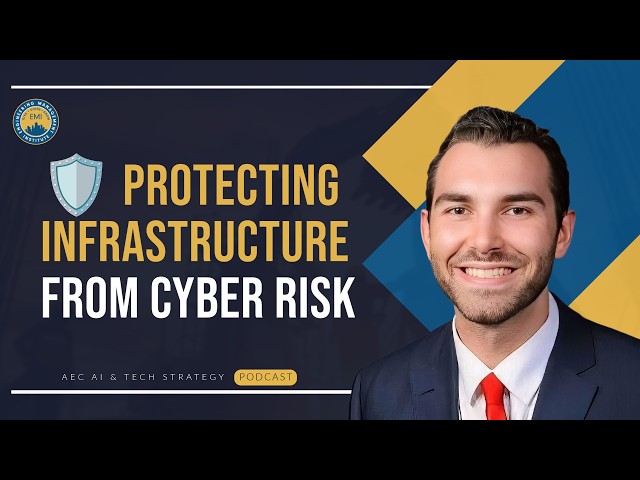
Protecting Critical Infrastructure Engineering From Cyber Risk
Watch on YouTubeVideo summary
The video addresses the critical misconception that cybersecurity is solely an IT department responsibility, arguing instead that it is fundamentally a business and engineering challenge. The speaker highlights that most cyber incidents are not purely technical but stem from management systems, governance gaps, training deficiencies, and human factors. With engineering firms facing a cyber security incident attempt every 39 seconds, the industry must recognize that digital components like automation, applications, and SCADA systems cannot be an afterthought in infrastructure design. Instead, these elements must be integrated into the upfront planning and procurement processes to avoid reactive measures that expose organizations to significant risks and additional costs.
To build a resilient technology roadmap, leaders should prioritize three key pillars: governance for AI and software applications, data strategy, and human capital development. As artificial intelligence infiltrates business operations, companies cannot ignore these technologies but must also prevent them from becoming unregulated free-for-alls. Furthermore, the rapid evolution of work due to AI requires a leadership imperative to reskill employees and ensure no one is left behind. The discussion emphasizes that humans act as orchestrators of digital tools rather than being replaced by them, necessitating a culture where staff feel comfortable engaging with new technologies without fear of displacement or confusion.
Ultimately, the core advice for engineering and utility leaders is to remain focused on the customer rather than becoming blinded by the allure of new technology. While it is tempting to chase the latest shiny objects like AI tools, true value is created only when technology solves real customer problems end-to-end. Leaders must avoid the traditional technologist trap of simply procuring and securing a tool without defining its use case or demonstrating how it creates value. By bringing people along on the journey through collaborative learning and specific examples, organizations can transition successfully from their current state to a future-ready position where technology serves as an enabler for lasting impact rather than a source of risk.
Read the full video transcript
Speaking of of risk and cyber security,
you'll often hear that as like a hey,
that's like an IT issue, not my
department.
Why do you see it as a business and
engineering issue? Like why is it so
important? I think there's a a lot folks
want to try to understand before they
can dig in and if they can
compartmentalize it and set it on a box
and say, "Oh, so and so's got that or or
we can handle that later or that's being
handled by a consultant or a contractor,
a partner." It it's nice. It feels good
to put it in a box and set it set it
aside. The reality is most cyber issues
are not actually technical. I've been
leading cyber in some ways for the last.
Did you know the average engineering
firm experiences a cyber security
incident attempt every 39 seconds?
Behind that number is a question the
industry is just starting to grapple
with. Why has protecting critical
infrastructure become just as much an
engineering challenge as a technical
one? Today we're going to dig into this
and what it means for the firms that are
building tomorrow's infrastructure.
Joining us today is Nick England, chief
information and corporate services
officer at Volteg where he leads the
technology functions driving both
protection and the transformation of the
business. With more than 20 years spent
at the intersection of technology and
engineering leadership, Nick has built a
reputation for turning innovation into
real lasting impact for clients and
teams alike. In this episode, we'll dig
into why cyber security can no longer be
treated as someone else's job, what it
takes to build a technology roadmap that
help holds up under pressure, and how
leaders can build organizations ready
for what's next instead of scrambling to
catch up. If you're an engineering or
firm leader trying to figure out where
technology fits into your future and how
to protect what you've already built
when you get there, this conversation is
for you. Before we jump in, I want to
tell you about AEC PM Connect, a series
of in-person events we've created at AMI
for AEC project managers and the leaders
who develop them. You want to stay on
top of PM trends, elevate your team, and
deliver stronger project results. These
full day events are built for you. I'm
coming to Kansas City this October.
Learn more at registered
aecpmconnect.com,
and I hope to see you there.
It's now time for our conversation of
the week with Nick in England. Nick,
thank you so much for taking the time to
join the show today. Welcome.
>> Thank you. Glad to be here.
>> Yeah. And I know we just had a had a
really nice chat. I think your
background spans a couple different
areas. It's very interesting. I know
you've been with uh old tag, your
company for for quite some time here.
So, let's just jump in. So, Nick, how
did you find your way into engineering
and technology? And then what led you to
where you are today as chief information
and corporate services officer at
Altech?
>> Sure. That's a a fun question. So
child of the child of the '9s. So grew
up with uh with with tech and kind of I
think I was trying to you know cur
through curiosity and kind of
troubleshooting. I was trying to take it
apart before I knew how to work it. And
uh that pretty quickly led me into a
career in software engineering. So the
the basic idea that you could kind of
create something and get near
instantaneous response through through
development and then solve problems that
people actually care about um just
fascinated me and drew drew me into it.
So my early career was almost
exclusively doing integrations between
between systems. So software engineering
to do integrations between systems
mostly in the ERP space. I joined u in
the engineering firm. So alt tag here
it's been about 18 years a little over
18 years ago and uh what drew me I would
say I was less drawn to engineering and
more drawn to professional services
broadly broadly I wanted to be at a
company that cared deeply about people
and uh you know I'd come from come from
large publicly traded traded firm that
you know they they had a view about
stake stakeholders and what mattered and
um I was really attracted to what I saw
from folks that I knew who worked in
this space and actually folks I knew
that worked at Alt and that care for
people and their and their careers and
getting to do things for folks that
cared about employees, cared about their
their customers really resonated for me.
And then of course once you get under
the covers and you get to work with a
bunch of great engineers who who it
turns out are also naturally curious
folks that like to solve solve problems,
it's really a great space to spend spend
your time in. Everybody wants to solve
all the problems every day. It's fun.
>> Yeah. Engineer I mean you know you've
you know have you know haven't seen the
sitting in the seat that you've sat in
engineering great industry. Um sounds
like your people are really you know a
testament to that but um like as the
engineering space becomes more digital
how do you guys rethink your
responsibility for protecting critical
infrastructure across your different
service lines? Yeah. So you maybe maybe
I would start by saying that the
infrastructure space is is having having
their moment and kind of their
realization with some other spaces have
have had a while ago which is to say
that digital whether you're talking
about automation or applications or or
SCADA systems it can't be an
afterthought. It needs to be part of the
upfront design and procurement of the
process. And if it's not, you end up in
this really reactive space where you're
exposing things to risk or risk,
additional cost and you know maybe maybe
support or commissioning issues when
you're when your infrastructure
ultimately goes into service
increasingly and I think it's happening
in different parts of the infrastructure
space engineering space at different
times in different ways right now. But
it seem it seems to me that most
infrastructure will have the opportunity
to be better better for the you know the
end customer the the population that
uses it through digital systems in some
way whether it's a you know a power
plant that's got smart aspects and
sensors etc or it's a you know smarti
devices in roads and bridges to help
make them safer. They're digital
components and for for a while it was
kind of an afterthought and I think
folks are realizing that it needs to be
part of the upfront upfront stream when
the thing is designed to actually think
about you know what who are all the
players in the process. What are the
cyber security implications and you know
even some of the the kind of the less
the less cyber the less digital
implications about supply chain as well.
You know who's responsible for for this
piece? Who can support it long term? Is
this entity going to be enduring? What
are my alternatives? You your
traditional supply chain management kind
of things that you need to think about
and um you know infrastructure's got a
lot of smart parts in it now and it's
just going to going to continue and that
supply chain risk is got to got to be
part of the upfront design.
>> And speaking of of risk and cyber
security, you you'll often hear that as
like a hey that's like an IT issue, not
my department.
Why do you see it as a business and
engineering issue? like why is it so
important?
>> Well, I I think folks folks by nature
and and this is a good thing and good
thing generally and it reflects on how
people like to lead and folks like to
put things in a box. You can put that
box up on a shelf and you know when it
comes to to tech issues and and
especially cyber I think there's a a lot
folks want to try to understand before
they can dig in. And if they can
compartmentalize it and set it on a box
and say, "Oh, so and so's got that or or
we can handle that later or that's being
handled by a consultant or a contractor
or a partner. It it's nice. It feels
good to put it in a box and set it set
it aside." But the reality is most most
cyber issues are not actually technical.
You know, I've been leading cyber in
some ways for the last last 15 or so
years. And you know, my my take is that
maybe if you're lucky, 40% of that cyber
stack gets to be technical stuff you can
actually solve with systems and
processes and kind of what you see on
TV. Most of most of it is management
systems. It's process, it's governance,
it's training, it's like the human the
human factors, the human performance
factors behind it. And if you don't
integrate that stuff into your business
strategy, into your human capital
strategy, into your, you know,
day-to-day work, it uh it just doesn't
doesn't work because either your cyber
folks don't understand what your people
are actually doing. They think they do,
but they don't because they're not
talking or your or your folks don't
understand the cyber risks. So, they go
about their job every day and they don't
realize they're taking on risk risk to
the company. you don't inter in
integrate those two things and really
think about it as a a human challenge a
people a people thing you leave a lot of
risk out there a lot of risk on the
table strong project outcomes need
skilled managers and competent leaders
EMI's corporate training delivers
expert-led courses in project management
and people leadership plus industry
recognized certification and exclusive
premium content to take your team even
further elevate your team's leadership
capabilities today visit engineering
management ment institute.org and click
on corporate training.
>> Yeah. And as we know people are not uh
let's say they're not deterministic
systems, right? So there's always
>> there's there's always going to be
variability and that's that's the fun
part of of dealing with people.
Everybody's a little bit different and
every situation is a little bit
different. So not to say that even the
technical portions of cyber security are
that way but you know
>> but they are to to a certain extent you
know the technical aspects are more
deterministic. We uh I think IT folks in
general have a reputation you mean like
for being pretty heads down and kind of
focused on the tech. It's it's easier to
solve when we know how it's going to
behave. You don't always know how a
human's going to behave when you pick
them up pick up the phone and you you
call them and it's like hey why'd you do
that? You don't know what you're going
to get. folks don't like to do that but
that's really where the magic happens
that's how you how you actually have an
impact on on risk is when you engage
with it with the other humors
and I think part of that is like you
know that's part of an overall strategy
so if we zoom out like Nick say you're
you're sitting down to build a
technology roadmap which is going to
include right some of the the
qualitative pieces and some of the
quantitative pieces but when you when
you zoom out and look at that road map
like what are the your top three
priorities that you're going to weigh
against everything else you have to deal
with.
>> Yeah, it's interesting. So, right now in
today's landscape, maybe I should caveat
that and I I actually think it's really
important that a business has a digital
strategy and a technical strategy and a
tech strategy and there's separate
separate things. Your digital strategy
really needs to be focused on how you're
going to change the business, what
you're delivering for your customers,
and how you're going to compete. Tech
strategy is a little bit of different
space. And interestingly right now I
would I would say 23 of those three
points so two of them are really in the
governance space. So I think that you
know one of them you you need to have a
handle on what I would call SAS and AI
governance the pace that new
applications are kind of infiltrating
both both in terms of the value they can
provide. So you can't ignore them. You
can't just you put your blinders on and
say nothing new. So you can't ignore
them, but you can't just let it be a
free-for-all. And it it is harder today
to to govern AI applications, AI use,
and just plain old SAS application usage
than it than it has ever been. So I
would I would put that at the top of my
list. Second one on my list would be
data strategy. If data is the new new
oil, as some folks like to say, need to
understand where your data is, where the
value is, and and what the potential
long-term is to monetize it, what the
roadmap is to make sure that you're
setting the company up to do that long
term, to get the value from whatever
data it is you you have or you think you
have.
>> And then finally, and this is this is an
interesting one when I was thinking
about this this question, Nick, my my
third pillar right now would actually be
human capital. And the the reason reason
why and this is kind of an interesting
interesting time in tech. I think that
if you if you view what's going on with
AI, you know, there's probably some some
bubble aspects of it under under the
covers and a little bit going on, but
there is a a rethink of how of how
humans work going on right now that
maybe is akin to an industrial
revolution. And I think as as tech
leaders, as business leaders right now,
we have we have an obligation to all of
our people to make sure that we are
making the investments in them to bring
everybody along. So some folks are, you
know, might be might be scared. Hey,
this this AI tool is going to take part
of my job or I'm going to get displaced.
I think the real question is how do we
bring everybody along together so they
know how to think about and know how to
engage engage with and use these
different different tools at a time when
work is changing maybe more rapidly than
it ever ever has been and we we don't
want to leave anybody behind. So I think
the the human capital intersection
intersection with tech and AR right now
would be my my third third pillar
>> which is uh right if you if you only
paid attention to mainstream news and
media you would think like we wait a
minute like I thought all of our jobs
were going to be taken away and and
replaced by this all powerful technology
but right we we both know that's not
true. It's a it's a very kind of
interesting interesting space like right
now you know kind of the
the the threading you know initially it
was you know this world of possibility
when you know when you're
you know your chatbased LN started
coming out and then this this revelation
with uh with agents agents as you know
they've been able to progress into doing
doing actual work in some cases. I think
right now the the threading is this idea
around the human as the orchestrator or
the orchestrator of the orchestrator and
almost you know we're we're the manager
of the of the agents of the tools that
are that are doing some of the some of
this work that used to be done by
people. The I think the challenge is
that the somewhere along the line there
does need to be a human in the loop for
most of these things. They need to
understand the tech, at least understand
it enough to know how it's working or
kind of what's under the what's under
the covers. And then also, not all
humans are kind of natively built or
trained to be able to manage and
orchestrate large swaths of things. So,
I think there's some reskilling and some
rethinking there. And I, you know, I'm
I'm an optimist and I tend to have a
growth mindset about things. So I I
don't I don't know that I I see the the
doomsday all the jobs are getting taken
by tech kind of angle, but I do see a
need like I do think there's real risk
if uh we don't help people feel
comfortable and feel good about what's
changing that that folks could get left
behind and I think that's a leadership
imperative right now.
>> Absolutely. And uh as you know right
different people have different levels
of that ability to like manage or
orchestrate
and also at the same time how do they
deal with and interact with technology
like I know people who right just
turning on the computer can be a little
bit challenging and then others it's
just you give them the tools and
equipment and they're off to the races.
>> Yep. And you can have issues in both
ends of those spectrums. Right.
>> Yeah. Well, because if somebody can't
turn on a computer, there's only so much
damage they can do in the digital world
at least. But, uh, you give somebody the
keys to the castle without the proper
guardrails. Oops.
>> It's amazing what some folks can
accomplish. Like the ultra curious when
there aren't any fences, you know, hey,
and I vibe coded this and it does this,
this, and this. It's like, that's
wonderful, and let's talk about how we
can govern govern that.
>> Yes. And uh some and sometimes, right,
the best thing is like uh hey, we're
just going to give you a machine. It's
isolated from the network and you can
blow it up. It's cool. Just don't do
that when it's uh it is connected.
>> Yeah.
>> So, Nick, what's uh one piece of advice
you'd leave with utility and engineering
leaders that are kind of being I don't
want to say dragged in, right? But we
all kind of are like this future is
coming.
um whether we want it to or not and like
you said earlier there's a lot of
change.
Yeah, I would I was thinking about th
this one, Nick, and to me the piece of
advice is the same and and the ir the
interesting thing here is I've seen
folks lose lose sight of this thinking.
It it's still all about the customer,
you know. So, we're you know, whether
you're in the engineering space or
you're, you know, or you're running a
utility,
it's not about it's still not about the
tech. And we occasionally get blinded by
the shiny penny and we think it's about
the tech, but it really is about the
customer. And if you can't if you can't
look at the look at real problems that
your customers have and ways to create
real value for for your customers and
kind of map that through end to end with
the tech, size the prize and what's in
it for what's in it for your customer,
um you're you're probably looking at it
a little a little wrong. And uh I think
that's been right now kind of with the
the Berber fever pitch with with AI
right now. I I can't count how many
times I I've heard peers peers who are
doing doing what I do at other
engineering firms who have this
imperative for the from their leader.
It's like oh go tell it go tell us what
we're doing with AI. It's like maybe
maybe let's think about AI as the tool
or think about digitization as the tool
and then let's look at what the real
problems are that we can solve and
figure out how they can create value for
the customer. And the irony like like
where I started here, Nick, is I think
that's always been the the way to look
at it. We just occasionally get
sidelined by the shiny pity of a of the
the next thing or new tech, especially
when tech gets consumerized and you know
the that thing shows up in your in your
phone and everybody everybody knows
knows about it and they're kind of aware
of the potential for business value.
Still got to go back and figure out how
it how you can create value for your
customer with the thing.
>> Yeah. And I think the sometimes the f
especially like you get to a certain
point in your career, a certain position
in the company where maybe you're not as
connected to the customer as much as
you'd like facing their day-to-day
problems and it does become easy to get
sidetracked, distracted by the shiny
object. So I'm in agreement, right?
Because uh without customers, well, none
of this is possible.
>> Yeah, that's right. Nick, this is this
has been an awesome discussion and like
I said earlier, it's also also great
when we can get more Nicks on the show.
I love that. So, the final question I
have for you today is if you're a firm
looking to adopt AI, any new technology,
be innovative, what are you telling them
to focus on from a leadership and team
development standpoint to make the
transition from where they are today to
where they want to be successful?
>> People. So, in a word, focus focus on
people. And it goes back to some of what
I some of what I said before, which is
really just I I really do see it as a as
kind of the leadership imperative of the
day to bring people along and not leave
folks behind, leave folks, you know, out
in the cold for tomorrow's work
workforce, so to speak. My my colleague,
which you previously interviewed, Brian
Brian Gas, has a thing he likes to he
likes to say, and I'm going to butcher
his analogy a little bit, but I think
it's really good. So, you know, Brian
would would say that, you know,
traditional techn technologists
have a habit of maybe they'll hand you a
bike and say, "Go do something with it."
And in this case, the bike is akin to a
tool. Like, I hand you a piece of
software. It's like, "Oh, go figure it
out. Go use it." Um, and with with AI
and digitization in particular, folks
don't necessarily know what to do with
the thing. So, Brian's saying is it's
not like here's your bike. Brian's
Brian's saying is let's go ride bikes
together. Let's figure out that figure
this out together. Let's go on this
journey. Let's learn together. And I
think that's really really apt when
we're thinking about thinking about tech
and digitization and AI right now. And
when we're trying to bring people along,
I think we need to give specific
examples and kind of show them along
along the way. It's not about here's the
tool, go do something with with the
tool. It's like, hey, here's how here's
how I use the tool to help me do this.
Here's some training to help you and
let's sit down and talk about some of
the ways that you use the tool to kind
of bring them along bring them along
together. And whether that's, you know,
using co-pilot to help you draft a
PowerPoint or work on meeting notes or,
you know, there's examples in
everybody's day-to-day life, but for for
a lot of a lot of folks, it's not enough
to give them the tool and the training.
I think we've got to give them the use
case in circle doc and kind of, you
know, ride the ride the AI bike together
to use Brian's and how you go.
>> I love it. And you know, and that's that
really is like the the the classic IT
answer which is like, hey,
>> we've procured it. We've got it set up.
We've got it secure. All right.
>> Our line is like the use case is
squarely on like the business. But when
you have leaders,
>> here's a tool. We've checked our box. We
have this project is a success. We give
ourselves an A and then you're never
going to hear from us again. That's kind
of the traditional technologist way.
>> Yeah. And and as you know, right, like
where does all the business value come
from? It's it's the use case.
>> Y use case and the people and sitting
down and shining them. So, you know,
great response. I'm a complete agreement
and I love it. But, uh, Nick, you know,
again, thank you so much for taking the
time to join us today. If the audience
wants to connect with you, maybe ask you
some more questions or chat, what's the
best way for them to reach you? I've
reached out to me on LinkedIn.
>> Beautiful. Thank you so much for taking
the time today. This was awesome.
>> Yep. Thank you. It's wonderful to meet
you.
>> Yeah. Likewise. Till next time. Please
remember you can find the show notes for
this episode at aechpodcast.com.
There you'll find a summary of the key
points discussed in today's episode as
well as links to any of the resources,
websites, or books mentioned during this
episode. Until next time, I wish you the
best in all your engineering and
technology endeavors.