Prof. Peter Ruppel (CODE University) - Token Networks and & Announcements - #BFSCON
Watch on YouTubeVideo summary
Professor Peter Ruppel from CODE University introduces his institution as a private, state-accredited university of applied sciences located in Berlin, which focuses on self-directed, project-based learning within interdisciplinary teams. Drawing on his background as a postdoctoral researcher at Technische Universität Berlin and the Telecom Innovation Laboratory, he explains that CODE is deeply embedded in the local business ecosystem, allowing students to choose their own problems while professors act as mentors rather than traditional lecturers. This educational model aims to cultivate blockchain expertise by having students work on real-world challenges, bridging the gap between academic theory and practical industry application.
A significant portion of his presentation highlights the Token Gallery, a web-based tool he developed for analyzing token transfer networks on blockchains. This visualization platform displays thousands of different token networks, revealing complex transactional patterns such as failed airdrops, fractal structures associated with token burning, and hub-and-spoke models involving major exchanges. Ruppel emphasizes that while these visualizations are fascinating, the underlying graph theory reveals entirely new structural patterns emerging from blockchain usage that differ from traditional social, communication, or transportation networks. Whether analyzing tokens used for online poker, test smart contracts, or failed distribution events, these unique structures offer rich opportunities for research and potential future applications.
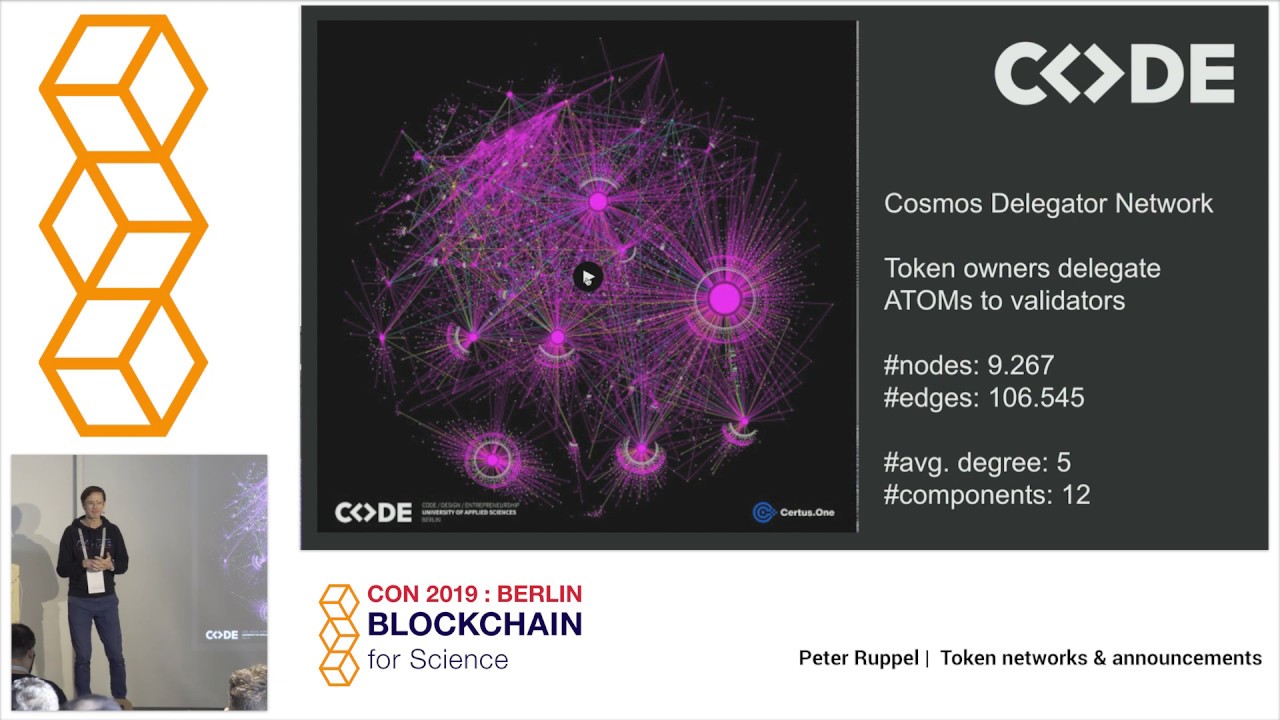
The discussion further extends to the critical topic of blockchain governance, illustrated through a visualization of token delegations on the Cosmos blockchain where holders delegate ATOM tokens to validators. Ruppel points out that analyzing these networks helps answer fundamental questions about control and authority within decentralized systems, particularly when observing burst events like massive reallocation of tokens triggered by real-world incidents. By examining proxy votes and delegation shifts, researchers can better understand who effectively controls the blockchain and how governance dynamics evolve over time, providing valuable insights for both academic study and practical system design.
Finally, Professor Ruppel invites the audience to engage with this growing field through an upcoming conference called Triple E ADEPTs, scheduled for April in Oxford, UK. As one of the organizers, he notes that this is the second edition of a conference focused on decentralized applications and encourages researchers and practitioners to submit their ongoing work before the end of the month. He concludes by expressing his willingness to answer questions regarding how these analytical models can be integrated into university curricula at CODE University, acknowledging that while decisions on specific processes are still being made, the goal remains to enrich student learning environments with advanced blockchain analytics tools.
Read the full video transcript
thank you very much when I came here
this morning I wasn't aware that I'm
going to give a quick talk presentation
so thank you very much for the
opportunity to talk a little bit about
what is code and what code has to do
with with blockchain and blockchain
research so I'm Peter I recently joined
Cote University of Applied Sciences we
are a private state accredited
university of applied sciences about 500
meters from here into that direction 400
students 3 study programs software
engineering product management
interaction design and part of my new
job is also to cultivate and to build
blockchain from an educational
perspective before I was a postdoctoral
researcher at technische universität
Berlin and telecom innovation laboratory
is also here in Berlin doing blockchain
analytics and in case if you haven't
heard about code before code is
basically trying to do a lot of things
new and better when it comes to
education it's about self-directed
project-based learning in
interdisciplinary teams and code is also
very deeply embedded into the Berlin
ecosystem of companies so that students
basically can choose their own problems
working on them and we the professors
are more acting like mentors or
consultants to the students and helping
them learn along the way and what I
would like to do in the next few minutes
is to introduce you to some of the work
I also did in the past and I'm currently
working on one example is called the
target gallery you can also open this in
a browser and this is an example for an
analysis of token transfers on block
chains and you can see visualization of
about thousand different token networks
in which we can
observe different transactional patterns
where tokens are being transferred
between different addresses some of
these tokens are being traded on major
exchanges and by just browsing through
this list you can already just by
looking at these patterns guess that
tokens different tokens are being used
in different ways somehow we can see
some I mean obvious patterns like this
this is probably a failed airdrop so not
a lot of activity here we can see some
fractal patterns down here they
typically come with burning token
somehow we can see some quite obvious
structures maybe over here what we have
one big exchange involved and we have a
couple of bigger hub-and-spoke patterns
but there are also some patterns that
can't really be explained so far so if
you're interested and want to learn more
about this go to token gallery dotnet
and you can yeah basically find find
more at this website now I just wanted
to point out that when it comes to
analyzing token networks nowadays that
it is first of all fascinating I mean
this is very nice it's very colorful but
also if we went more deeply into the
network and the graph theory behind we
would find that many of these structures
very new we haven't seen them before if
you do social network analysis if you
look into communication networks if you
look into transportation networks the
structures in these graphs are different
and these are new patterns that we can
now see emerging from the usage of
tokens on block chains and no matter
whether this is about for example a
token that is used to play poker online
or someone deploying a test smart
contract
on the blockchain or again a failed
airdrop over here these are all new
patterns and that is from a research
perspective of course fascinating to
analyze and to observe first of all but
it is also interesting maybe for future
applications to look into how tokens are
actually being used and what we can
learn from these patterns yeah there are
many of these visualizations available
just feel free to go there and look look
around and the second topic I would like
to very briefly mention is also the
topic of blockchain governance and here
you can see a recent visualization where
atom tokens on the cosmos blockchain are
being delegated by the token holders to
validators so that these validators can
- it can take the delegated tokens and
then get elected to create new blocks on
the blockchain and by just looking at
this again this is just a high-level
visualization but we can first of all
apologize for the low resolution is I
think better if you go online later on
but you can already see that in time
there are some burst events where
massive read allegation of tokens happen
at some point in time in indicated by
blue lines now probably this was some
real-world event happening many people
reconsider the delegations and this is
of course also interesting if you ask
who's actually in charge who is actually
in control of a blockchain if you look
into token delegations read allegations
proxy votes and the ultimate question
who is controlling the blockchain so
these are questions we are we are
currently dealing with we are we are
looking at to analyzing these networks
and basically here today to say that you
are welcome to join this discussion if
you're interested in these topics and
the last thing I would like to briefly
mention is that there is also a
conference upcoming which I'm one of the
organizers it's I Triple E adepts it's
going to take place in April in Oxford
UK
next year it's a second edition of
conference on decentralized application
and the submission deadline is the end
of this month so if you have something
some ongoing work you would like to
submit you're very welcome
and hopefully see you in Oxford these
are my coordinates and feel free to
contact me if you like I'm also be
around only today unfortunately not
tomorrow and now I'm open for a couple
of questions thank you very much
[Applause]
okay yeah have you tried to apply any
like you're like token garments model
within a quad University within within
quad Berlin well one of the ideas is now
to build some environments and some
structures at code first of all to make
students able to quickly learn about
these concepts but we're also thinking
currently about what kind of processes
we could possibly integrate and enrich
we are by means of DLTS to the best of
my knowledge and no decision has been
made yet but we are actively thinking
about it thank you do you know that they
had ropes failed because there was no
usage anymore at some point in time so
basically usage was was dead
you