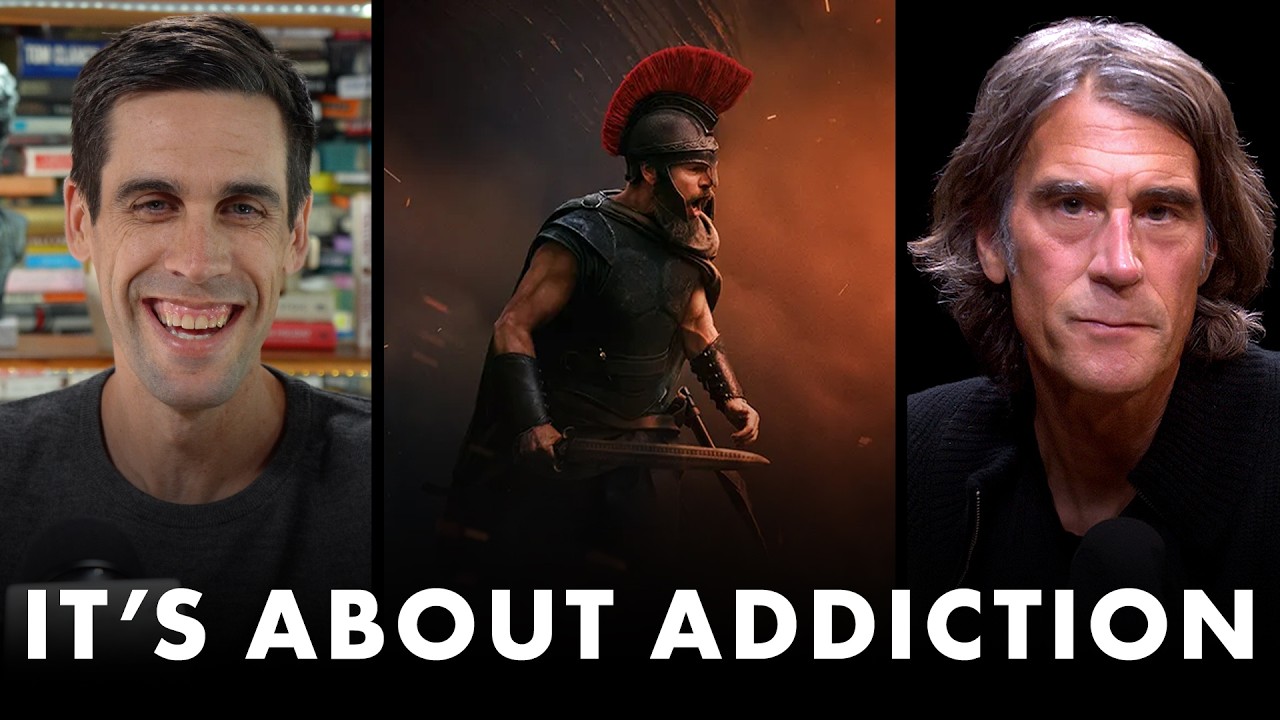
Video summary
Ryan Holiday argues that Christopher Nolan's adaptation of *The Odyssey* functions less as a singular narrative with one correct interpretation and more as an architectural framework for storytelling that evolves across generations to reflect contemporary issues such as PTSD, moral decay in leadership, and the presence of unreliable narrators. In this modern retelling, Odysseus is portrayed not merely as a triumphant hero but as a "striver" suffering from deep-seated guilt who cannot rest even after returning home, highlighting themes of trauma and denial rather than adhering strictly to ancient texts where he might have accepted his consequences more readily. The film illustrates how violating natural laws like hospitality leads to the collapse of civilization, transitioning society from a bright Bronze Age to a dark Iron Age where literacy is lost and stories must be passed down orally, while also depicting both father and son as flawed individuals who eventually achieve character growth through their respective struggles with restlessness and insecurity.
The discussion further distinguishes between mere persistence in achieving goals and the deeper concept of perseverance required for recovery, which involves surrendering control when self-will becomes an obstacle to healing. This philosophical shift is evident in how Nolan portrays divine figures as distant observers who know everything but do not constantly intervene, contrasting with traditional mythology where gods actively manipulate human affairs; consequently, Odysseus's fate is sealed by his own need for attention and bragging rather than solely by external malice or the Sirens. This dynamic parallels modern addiction recovery models found in twelve-step programs, emphasizing that structural prevention mechanisms are far more effective against temptation than relying on willpower alone, a lesson reinforced when Odysseus eventually lays down on a raft to let fate take him home instead of fighting every battle with cunning survivalism.
Ultimately, the analysis celebrates Nolan's revival of these foundational stories as vital for addressing current societal fractures caused by the loss of common mythological language and shared values like loyalty and moral responsibility. The narrative arc concludes optimistically with a peaceful transition of power from Odysseus to his son Telemachus, representing an older generation voluntarily stepping aside to allow a clean slate free from the bloodstained legacy of their predecessors' actions while demonstrating how even flawed individuals can evolve into capable leaders. By engaging with these classics and companion works like Aeschylus's *Oresteia*, audiences are encouraged to confront fundamental questions about morality, the nature of heroism versus villainy within themselves, and how they navigate modern distractions akin to ancient sirens' songs in an era where understanding our own limitations is essential for true recovery.
Read the full video transcript
Ryan, you are an expert on stoicism and
Greek philosophy. This is your moment.
Christopher Nolan's The Odyssey. The
Odyssey.
>> The [music] Odyssey. Possibly the most
anticipated movie of the year.
>> Already breaking ticket sales records.
>> The story's endured for 3,000 years.
It's resonated with every generation.
>> Each generation reads The Odyssey
differently than the generation before.
[music] The more you know about it, the
more it operates on all these other
levels. The whole point is that the
Odyssey [music] is complicated and you
it's hard to know who the good guy is.
Odysius in his odyssey is a reflection
of the human undergoing any kind of
ordeal. He's both like the best and the
worst. We contain that in ourselves,
too. That is the point of the Odyssey.
Are we cool with spoilers uh in this
thing?
>> I think so. [laughter] Yeah.
>> Okay. The cat should be out of the bag
by now, 3,000 years later.
I'm super excited to talk to you, Ryan.
You are well known worldwide for being
uh uh an expert on stoicism and Greek
philosophy generally. We're having a
monoculture moment that you must be
relishing where everybody is celebrating
this old poem by Dent of Christopher
Nolan's I'll say it right now,
masterpiece. I love the movie. Saw it a
second time last night. and you have
been posting lots of videos and this
YouTube video with your thoughts on what
we should understand from the Odyssey,
what's important to understand. And so I
thought it was an opportune moment to
just get you on here and uh have you
share your reflections on Homer's
Odyssey, Nolan's Odyssey, and how you're
uh kind of synthesizing this and
interpreting it uh for us for so first
of all, I guess like how did you know
how did you like the movie? [gasps]
>> Well, I should I should stipulate here
that I know it not as a classicist. I I
don't speak Greek or Latin. I know it as
a a regular person who uh has been
fascinated with it, who under who
studied it with its connection to to
sort of stoic and other sort of forms of
philosophy. And then uh my my
nine-year-old son got very excited about
it. And so I' I've sort of hit it from a
bunch of different angles, but all of
these angles much closer to a lay person
than say like a translators, right? So,
I do feel like I I was able to enjoy the
movie on a couple of different levels,
and I really did enjoy the movie. I
thought it was spectacular. I I have
some some quibbles here or there, but I
think what we have to understand is the
Odyssey, like all of the other Greek
myths, was both a form of art. It's
beautiful language. It's evocative. It's
entertaining. It's all this. But then it
it was there in a way that we don't
always understand art and entertainment
to be today, which was a means of
communicating
ancient wisdom and timeless moral
truths. So, you know, like if you watch
a a Greek play, um you know, like
Shakespeare, all the actors are men, but
they're not really like they they wear
these masks. it. The acting is not the
key in a Greek play or in a Greek
tragedy. It's the language. It's the
It's the lessons. It's the lines. And so
I think the problem is we don't always
understand art as being that. Like you
know, most fiction today is almost like
I want to say it's almost amoral and
that it's like designed not to teach
moral truths but to question moral
truths. And so if we understand the
Odyssey as being this sort of story that
was told and retold and retold for
thousands of years, each generation sort
of thinking about the same truths but
bringing their own interpretation
and understanding of them, their
understanding of Odysius, for instance,
the understanding of Odysius's dilemmas
throughout the play. it then then you
should actually
um appreciate both what Nolan did in
telling it his own way and you should
appreciate the arguments over it, right?
Like that is the point is that each
generation reads the Odyssey differently
than the generation before. And then
each new medium that we're able to tell
it in, including going from an oral
tradition to a written tradition is
going to fundamentally change. The
medium is the message. So, so each
generation intelling and retelling it
and how it captures it, whether it's
with film or radio or a television
miniseries versus a a blockbuster, all
of this is changing the story and
allowing us to see it in a different
way, which is the whole point.
>> Yeah. The the assignment is the
interpretation. There is no one singular
odyssey. There is this, you know,
original text. I suppose we're not even
sure that Homer was one person. every
interpretation or translation is
different and it it kind of evokes the
lens of the translator. And right now we
have Emily Wilson, her translation is
apparently a primary influence on
Nolan's version, his interpretation in
this movie. It's been interesting to see
the discourse around her kind of like
review of the movie, like her
celebrating the fact that this is a
monoculture moment and it's kind of
exciting in that regard. while also her
taking issue with how he has interpreted
it. But I think that that that is, you
know, part of what is exciting about
this. It is the clashing of these
interpretations and how different people
see it differently. like who is this
character uh Odysius and what you know
what is it about him and this story that
is so indelible that has made it the
architecture for all stories and a tale
that has withtood you know eons of time
and is still relevant today that's the
debate that we should celebrate and
that's what the conversation is about
and I think that's very different than
you know hey should Helen be black or
not is it okay to have a trans person in
or not like which which which which is
one of the points that I want to make
and I think Emily Wilson would
appreciate given that she wrote she
wrote a famous biography of Senica uh or
earlier in her academic career but
Senica 2,000 years ago in one of his
letters is lamenting just people totally
missing the point of the Odyssey and and
I think it's it's fascinating to think
that 2,000 years ago people were having
these debates about where was Troy and
um you
uh where were the different islands and
like did it actually happen or not? Just
like today we're like is Homer really
one person was he blind or not? And he
was saying that that this is not what
it's about. like we're not supposed to
be debating the trivia of the art, but
we should be going to the essential
questions of the art and that ultimately
we should understand that Odysius a in
his odyssey is a reflection of the human
undergoing any kind of ordeal, battling
their sort of higher self and lower
self, you know, the perils of hubris,
the impossibility of ever returning
home, you know, that that he he's saying
like If you don't see the phil if if
what you're debating about the Odyssey
is not the philosophical questions, then
you're just, you know, you you're you're
just engaging in culture war nonsense.
Obviously, he wouldn't have used that
term. And I think it's sad that it's
devolved into sort of culture war
nonsense, but if if that's what you're
fighting about, then uh you're part of
the problem, right? Like I think there's
like a lot of things to argue about in
the Odyssey. And I I there's a bunch of
issues I take with I I would argue over
interpretations and arguments that that
Nolan's uh Odysius and Odyssey are
making and and how they um not like
because oh, you have to be true to the
text, but but this choice versus that
choice, you know, fundamentally changes
the arc of the story. I'll give you a
really good example. So like the whole
the whole and are we cool with spoilers
uh in this thing?
>> I think so. Yeah. Okay. The the the cat
should be out of the bag by now, 3,000
years later. But I I think the premise
in in Nolan's uh odyssey is that this
sort of law of hospitality, how we treat
strangers, how we treat others, um and
we violate this at our peril. And so the
the tale of Polypheis, the the the
interaction with the Cyclops is so
fascinating because um in and my again
my children love this story, you know,
Adysius in the in the poem, you know, he
introduces himself as uh that his name
is no man. He tells Polyfamous that his
name is no man. So then when they blind
Polyphemis and he's screaming to the
other Cyclopses, which also don't exist
in the movie, he's saying they say, "Who
hurt you?" and he says, "No one has hurt
me or no man has hurt me." And they say,
"Okay, well, if no one has hurt you,
shut up. This isn't a problem." And then
he goes away. And then Odysius, having
escaped, shouts out at him, "Hey, uh,
actually, it wasn't no one that hurt
you. It was me, Odysius, sacker of
cities that did it, and you'll know my
fame." And and so it's this moment of
hubris and ego where Odysius needs
credit for what he inflicted on
Polypheis that sets in motion the
central conflict of the book which is
he's cursed by the gods. So that's
missing and I think uh people will will
recognize that. But to me the the
critical choice that Nolan makes is that
they walk into the cave, they start to
sense something is a miss and then the
cyclops walks in and then begins eating
them. Right. So, so the Cyclops is is
indisputably the monstrous villain of
the encounter, but in the in the poem
and in the most retellings, Odysius and
the men walk into the cave, see that
it's full of sheep, slaughter the sheep,
and eat them. And then Polypheis comes
in and is enraged that someone has
killed his sheep. And so it's actually
Odicius first who violates the law or
oversteps and and Polypheis is although
monstrous and and and eats humans
somewhat righteous in his anger and then
Odysius is cunning in his craftiness for
getting out and then egotistical in in
claiming credit and then bringing the
wrath of gods upon him. So, so it's it's
like obviously you have to simplify it
in the movie, but I do think this is an
essential simplification because first
off, it makes it simple and the whole
point is that the Odyssey is complicated
and you it's hard to know who the good
guy is. [clears throat]
But but also um the idea that Odysius
just shoots Polypheis with an arrow when
he escapes and this is what makes the
gods angry is is really not
what is the driving force of the Odyssey
going forward.
>> Mhm. It strikes me as a glaring omission
if you're trying to underscore uh the
hubris of Odysius. But the way that I
make sense of that begins with the
Chiron at the very beginning of the
movie where it says this is a time of
apparent magic. And I think the word
apparent is important. I think what it's
telegraphing is that this is a story of
unreliable narrators. And the way that
Nolan plays with time and narrative is
through the this the whole movie is
anchored in a recounting of what
happened through the perspective of a
couple different people. It's Odysius
telling the story to Calypso when he's
on the island with her and it's Menaaus
sharing what he remembers from the
Trojan War to Telmachus. And so we have
to question whether these recollections
or the way that these be these stories
are being told are actually what
happened or a version of what happened
that suits the internal narrative of the
narrator. And I think when you think of
the way that Odysius is recollecting
what happened and you know his version
of what went down with the Cyclops,
maybe he conveniently decided to omit
that part because confronts him with his
own guilt. And his guilt and his trauma
and this PTSD that he's suffering seems
to be what Nolan is most interested in.
and he's interested in it because this
is his portal into wetting this ancient
story with what he with his perspective
on what's happening right now in modern
society. And for me, that's what makes
this version his interpretation so
resonant because it seems so current
with what we're seeing around us at the
moment. And this is something that you
talk about a lot through the lens of
stoic philosophy. this degradation of of
kind of our moral center at the moment
where
>> if you look at what's happening in the
house of Ithaca, you know, there's sick
offense and people behaving badly uh
acting on their own self-interest in a
very craven way and is this not simply a
metaphor for the White House at the
moment? And
>> it's like a hostile takeover. Yeah, it
seems to be like where where Nolan's
interest is and why,
you know, he felt urgently about telling
this story now. Yeah, it's it it's about
a collapse of the old ways. And I think
he does a really good job, maybe a
better job than I would have have
anticipated or or even considered of
showing the collapse of the old ways all
the way around. Back to uh even uh you
know interpreting the Trojan horse as
some sort of um you know violation of
the laws of of war and trickery.
Although it it it even goes back you
know e even further. there there's a
sort of predecessor story of of the to
the Odyssey of of why they get sucked in
to this law of war. There's this, you
know, sort of party of the gods and they
all make this pact about who's the most
beautiful one. And it's a it's a long
story, but basically like um Odysius
doesn't want to go fight in the Trojan
War. That that's not something you see
in this movie or in the Odyssey.
Exactly. But Odysius doesn't want to
fight in the Trojan War. He tries to get
out of it and he actually claims that
he's crazy at first. Um, and uh, he
claims that he's crazy and and only by
the test that they prove that he's not
crazy. He's like plowing his field and
they lay Telmachus down in front of him
plowing his field. And when he stops to
not run over his own son, that's how
they realize that he's not actually
crazy. And so the whole idea of this
being this sort of insane war that
shouldn't have happened in the first
place that he's sort of sucked into and
fights in reluctantly because of this
kind of pact that he'd made many years
before. All all these sort like what I
think what's so what's so lovely about
Greek mythology and about philosophy is
that kind of the more you know about it
the more it operates on all these other
levels. Like this would be a modern
analogy, but it's like you can't watch
Arrested Development one time. You got
to watch it like 30 times. And then you
understand that it's it's operating on
all these different levels and there
these callbacks. And so not only is the
Odyssey something you should read and
watch and uh read and watch again, but
you should read multiple translations
and then you have to read the other
myths and then you have to read the
poetry about it and the stories about it
and the interpretations of it. What you
start to get each time is just a
slightly different understanding of it.
And and and
from that you're able to consider these
questions from all these different
angles. Mhm. Each author has a different
take on Odysius. Uh has a different take
on Helen, has a different take on um
Polypheis as we were talking about, has
a different take on Telmachus, has it uh
you know, is Odysius a hero or is he a
villain? Is he both? Um, you know, is is
Agamemnon a hero or a villain? Is Helen
a hero or a villain? Um, you know, was
she kidnapped or did she fall in love?
You know, um, uh, or there's another
version of it where she's like
transported to Egypt. There's all these
different versions of it. And so if we
understand it more as like source
material that people are riffing on over
and over and over again, almost like a
song sample, I think we understand a
little bit more of what they're what
they're trying to do. And then the idea
is each one of these reads helps
correspond to something ultimately in
your own life. This isn't just like
debating what style of painting is best,
but this is like, okay, but what kind of
person should I be? And what you find is
that ultimately all these things come
down to some of the most fundamental
questions in philosophy and in life.
Like the trolley problem is really
interesting in philosophy, right? This
idea of okay, do you have a trolley run
over one person? Uh if you do nothing, a
trolley runs over uh uh what is it? Five
people, but if you pull this lever, it
runs over one person. Right? That's the
trolley problem.
But this is actually the choice that
Odysius has to make between uh Sila and
Corbus.
>> Caribbdus, although I always thought it
was uh Charbbitus cuz I never heard it
out loud.
>> Yeah. No, it's I'm pretty sure it's
Caribbdus. It it is [laughter]
um but but like he and he doesn't fully
weigh weigh it that much in the movie
but like between a rock and a hard place
or sometimes you'll hear people say Sila
and and Kuribdus as just meaning like a
dilemma like just a hard choice but it's
so much more than that. It's Odysius has
to choose between letting six of his men
be destroyed for sure or do they all go
down in in the whirlpool. And and it's
actually really interesting because in
the in the movie Nolan kind of has him
trick the men into choosing for him.
Like he kind of abdicates the moral
choice. But but as as the band Rush
would say, even if you choose not to
decide, you still have made a choice.
This is still he's still the moral
choice. So anyways, I I just think it's
so fascinating that you have this poem
from 3,000 years ago accidentally
chancing upon or not accidentally but
chancing on this moral question that
philosophers are still debating to this
day. On top of that, there's the
question of transparency with
leadership. like should he have told his
soldiers what this dilemma was and let
them choose of their own free will or to
just make the choice for them with them
knowing uh what the consequences are.
And that same dilemma plays out with the
Elliot Page character. What's his
character's name again? Uh starts with
>> Sinnon. uh where in Hades, you know,
Sinon is is is sort of taking Odysius to
task for not trusting him with the truth
that there were soldiers inside the
Trojan horse. And this this becomes like
a you know kind of a central recurring
theme like what is what is Odysius's
relationship with the truth and with
being truthful with the people that he's
responsible for? But I think this idea
you you mentioned, you know, Zeus's law
a moment ago, which is a reductive take
on Zenia, like this idea that there is
right and wrong, like there is natural
law that exists independent of men. In
the same way that what resonates about
this story has nothing to do with
interpretation or authorship. It's just
in the ether. It is a story that speaks
to us. It is an architecture that is
almost, you know, embedded into our DNA.
And I think that that is one of the
reasons why it continues to live and and
and be relevant. But with this idea of
like there being a morality at play and
what are the consequences of violating
that, we have Odysius who in his hubris
thinks that he can defy the gods and get
away with it, that he is beyond
consequences in this regard. Uh but
what's interesting is the denial that he
has to harbor in order to, you know,
continue to kind of function. Like when
it comes to hunting animals with his
bow, like he always pulls the bow
because this is the just and fair thing
to do. But what he does with the Trojan
horse is exactly the opposite of that.
Like it is the antithesis of that. And
it's in the aftermath of that that he
recognizes that he he's basically broken
the world. And this will end the Bronze
Age and usher in this time of darkness
where the only stories that will be told
of what happened are in song because
nobody will be able to read or write
again which which kind of conveys this
idea of interpretation. Like however
this story is going to be told in song,
it [snorts] can't possibly be as
truthful as it could be because there's
no one educated enough around to like be
a, you know, kind of a responsible
steward of this story. And so it dooms
the future to repeat the mistakes of the
past.
You really get to know your mattress in
the summertime. [music]
Don't laugh. It's true. The nights get
warm and if you're sleeping on a slab of
[music] synthetic foam, you're going to
feel it. And now I've been on a birch
mattress for about I think about 5 years
at [music] this point. And I think the
thing I noticed the most this time of
year is that I just sleep cooler. It
breathes and that [music] comes straight
from what it's built out of. Organic
cotton, natural latex, real materials,
responsibly [music] sourced. Firm, yes,
but also comfortable and more
importantly built to last. [music] No
polyurethane foams, no questionable
offging, which matters when you think
about how much of your life you actually
[music] spend on the darn thing. And
they make it easy to find out for
yourself. It ships free, rolled up in a
box, simple to set up. You get 120
nights to see how your body responds,
[music]
all risk-f free. And they back every
single mattress with a limited lifetime
warranty. Because they own their own
manufacturing and stand behind the work,
they [music] can do that. Sleep is the
foundation everything else is built on.
And it's really worth getting it right.
I want all my listeners to enjoy [music]
a deep, restful night's sleep with a new
mattress from Birch. Go to
birchliving.com/rich
for 20% [music] off sitewide. That's
birchliving.com/richroll
and get 20% off sitewide.
This episode is sponsored by BetterHelp,
which is why I'm going to [music] cross
my legs right now and lean back into my
therapist posture. BetterHelp surveyed a
couple thousand Americans this year and
[music]
shockingly 85% said getting support is a
wise thing to do, but 74% felt like
society still quietly discourages it.
That gap is nuts. Like we believe in the
importance of getting help while
simultaneously being discouraged to seek
it [music] out. Well, you do not have to
wait for a crisis to talk to somebody.
Therapy can just be a place to slow down
and work through what's been building up
before it feels unmanageable. And
BetterHelp makes all of that super easy
with a starting point that's an [music]
easy lift. You just answer a few
questions. They handle the matching and
you're connected with a fully licensed
therapist who works under a strict code
of conduct. [music]
If the fit isn't right, you switch any
time. And with over 30,000 therapists,
that's a lot. It served more than 6
million people. That's even more with a
4.9 out of five average from over 1.7
[music]
million reviews. The point is, don't let
stigma stand in the way of support.
Start therapy with BetterHelp. Sign up
and get 10% off at betterhelp.com/rich
roll. That's betterhp.com/rich
roll.
Element has been with this show for a
very long time, but it has been really
fun to watch them expand. first into
sparkling cans and now into something
brand new, lemonade iced tea, [music]
which is now the newest addition and my
morning go-to in my home gym. And what
I've noticed by incorporating this into
my [music] routine is a reduction in my
coffee consumption. Something I confess
to drinking more than I should, often
because coffee does a pretty good job of
quieting the signal that my body is
[music] tired. But what actually
supports energy at a foundational level
is hydration, replenishing your [music]
electrolytes. And by practicing this
more consistently with Element, I've
discovered [music] a better and more
sustained degree of energy in my
workouts, of course, but also over
[music] the course of the entire day.
Element is the electrolyte formula that
has everything you need and nothing you
don't. No additives or sugar. And their
new lemonade iced tea builds on that
same electrolyte formula plus 50
milligrams of [music] naturally
occurring caffeine from tea along with
elenine and polyphenol. So it [music]
feels smoother, something more strategic
than typical caffeinated drinks to reach
for [music] when you want to stay sharp.
So check it out. Try out Element's new
lemonade iced tea. Get a free 8count
sample pack of Element's most popular
drink mix flavors with any purchase
[music] at drinklement.com/rich
roll.
I'll give you one little quibble and I'm
not normally like a cap a
cinematographer like I don't usually
harp on these sort of little choices but
I do think it was illustrative. If the
point is golden age leads to dark age
because of choice of Odysius, I think it
was odd that he presents the Greeks
in such sort of darkness. And I I don't
want to say ruins, but like one of the
interesting things that we miss and it's
just it's always interesting how how we
interpret things. Our understanding of
Greece is like that it was bronze
statues and sort of like uh white marble
when actually it was an incredibly
bright and shiny world. The buildings
were painted, the statues were painted,
the armor was bright and had things
painted on it. Right? It's only because
after 3,000 years, most of that is
scraped away or ruined. That that we
tend to think of that world as being
like it's like you grow up now, you
think the Statue of Liberty is green,
but that's not what it was like when
they put it up, right? And so I thought
it was interesting that like his
castle's kind of old and and dark and
like I don't know, like I don't think he
did an amazing job of showing the the
actual brightness of the Bronze Age.
just like what antiquity was like. Um uh
and and and there have been people who
have quibbled at sort of like how
realistic the armor was like. I I care
less like whether Agamemnon's uh helmet
was realistic or not and more like why
was everything so somber and dark when
that's not really what that if that's
the apotheiois of the moment. It's not
fully representing it. So I did I I did
take a slight quibble with that. But I
think like to me what's so interesting
about um the the [clears throat] sort of
moral uh the contradictions of Odysius
is that is the point of the Odyssey.
He's both like the best and the worst.
He's this trickster character, right?
And and he's both better than everyone
and possible capable of worse uh things
than everyone. And that to me is
supposed to illustrate that we contain
that in ourselves too. And which side of
that are we gonna are we going to let
out?
>> Yeah. This is the mindset of every
alcoholic and addict. Like I'm smarter
than everyone else and I'm actually the
worst person in the world. And and it it
is a megalomania. Like that speaks to
his hubris. like like he believes that
he's so powerful that he could break the
world or make the world and and that's
absurd, right? Like this is, you know,
it's death by a thousand cuts or the
contributions of millions of people.
He's taking the full moral weight of the
Trojan War that he was, by the way, as
drafted into as everyone else and as at
the mercy of Agamemnon as everyone else.
And I think that's a great point. There
is a there is a grandiosity about
>> he makes himself the main character and
I mean he is in a way the main character
but he has this kind of main character
syndrome and and you see it in the movie
it's like these other men are raping and
pillaging Troy and yes it's it was his
idea. Um but he's not doing it but he's
looking around and going what have I
done? Because I think that's the point.
He he has the he has the capacity to
feel the responsibility and the guilt
that if he didn't if he was more a
product of his time I think he would get
away with like we don't get the sense
that Agamemnon was carrying the same
guilt for sacrificing his daughter uh as
as say Odysius was even for just being
away for 20 years.
Yeah, it's important to understand that
your actions have consequences. Uh but
it's also important to have the humility
to understand that you're actually not
as important as you might believe
yourself to be. And he's on both
extremes of of of this spectrum. Um I'm
curious also uh around your thoughts
around the ending. we see them sort of
sail off into the sunset and you know in
a way that is not really authentic to
the to the text. This is a guy who Yeah.
Like this is a guy who can't sit still
for a minute. As soon as he's like they
do address the this getting back to
denial like
>> after he hears the song of the sirens,
he's he's disabused of his denial that
he actually doesn't want to go home.
like it's all about like we just want to
go home. And actually maybe one of the
reasons he doesn't follow Agamemnon is
because he doesn't want to go home and
he's trying to find the long way so that
he can stay away. He he can't say that
out loud and maybe he can't admit that
to himself but you know he is you know
to kind of quote Arthur Brooks like he
is a he is a stver facing the stver's
dilemma and he just cannot sit still for
a moment with himself and the minute he
gets home he has to leave again and go
off on another campaign and Nolan
chooses to end the movie differently. Uh
you know what is your what are your
thoughts around that? Why do you think
he made that decision? And what is it
that the Odysius that you know uh did
and why? So, I I think there's there's
two there's two reads here that I want
to get into. The first is is yes,
Odysius, the striver. Odysius the
restless Odysius actually the tragic
tortured hero who not only can't go home
as he he hears from the sirens. I think
it's worth pointing out, you know, the
sirens don't just sing a beautiful song.
The sirens tell you exactly what you
want to hear or the the deepest most
painful slash beautiful truth you can
imagine. Um, so so in the movie they
tell him, you know, basically you don't
actually want to go home. And I think on
a simple level the Odyssey is about a
guy fighting to get home. Uh but when
you when you look at the full arc of the
character, you go for a guy who claims
he wants to go home, he sure makes a lot
of choices that prevent him from getting
home as you said in the movie from not
uh following Agamemnon, but like you
know he he spends seven years with
Cersei. Not like uh she does drug him a
little bit, but but he basically has a
seven-year affair on his wife and he
lives in paradise, right? Um, and he
also had like a one-year affair with
Cersei, didn't he?
>> Yes. Yes. He has a lot of affairs.
Penelope is supposed to be true and
loyal and Odysius is under no such
compunction, right? And so, you know,
you imagine it's like that's his son
from 13 to 20 or something like he
misses like a good chunk of his son's
life cuz he's really enjoying himself on
an island paradise. And if we can
understand Odysius as as not just a
character who doesn't want to go home,
but as as people in the ancient world
would have understood Odysius, putting
aside Nolan's ending for a second, um he
leaves after he gets home in some of the
other retellings, like he he has to go
replenish his coffers. Actually, one of
the one of the post stories has Odysius
leaving Penelope at the end and marrying
somebody else and and and then like it
goes on and on. He he is the the addict.
It you know the typical addict, the st
person for whom there's never enough
who, you know, has the midlife crisis
and starts a second family and a third
family. Like he can't he can't help
himself. And so even I I think when you
read Tennyson's poem uh you you get the
sense depending on what age you are
reading it that actually it isn't
admirable and impressive that this guy
what is what is the wording? Let me find
it here. He says um uh made time made
weak by time and fate but strong in will
to strive to seek to find and not to
yield. You know he's he can't stop he
can't slow down. There's never enough.
um he's not capable of being still. And
if we understand Odysius as this
tortured hero in that way, it's like uh
you know, and a lot of people have made
the PTSD comparisons, but if you've seen
the Hurt Locker, right, he gets home or
if you've seen American Sniper, they're
similar uh character arcs. They get home
and then they're just like this is
nothing compared to
>> what my life was out there. And in that
way they are tragic, flawed, broken men
that we should pity rather than
celebrate and want to be like. Back to
the sirens. Uh what's great about that
is you can draw this parallel on this
notion that they're singing this song of
everything you always wanted to hear.
And there's a beautiful monologue
[clears throat] that that um that is one
of my favorite parts in the movie where
u Odysius says, you know, I can't
recount it exactly, but it's it's
basically like everything you always
wanted to hear about, you know,
everything you always wanted to have and
can't have but already had and you know,
like some kind of thing like that. And
it's just like it perfectly encapsulates
this idea.
>> But there is this parallel with
confirmation bias in social media. It's
like it's telling you what you want to
hear. And that is a, you know, hypnotic
um thing. You know, it's very difficult
for us to immunize ourselves from. He
has to they have to put wax in their
ears to prevent them. We have all these
devices that we have to put on our phone
to kind of like protect our attention.
Something going on with this. It's like
it's like these tech and you've talked
about this like you know the tech barons
and all the like they are the sirens on
some level. Well, and the reason we have
to be familiar with the Odyssey is just
the sheer amount. It's like you have to
watch The Godfather or you'll miss like
40% of pop culture references, right? Or
you need to know what you need to know
your sports history or you're going to
miss out on a lot of metaphors and and
references. Um, you have to know the
Odyssey because so many of the things
that we use to explain the the the the
present come from the literature of the
past. I mean, Chris Hayes last year
wrote a really good book called The
Siren Song that's all about comparing
social media and the attention economy
to the sirens. And he makes this point
about how the sirens aren't just, you
know, this beautiful seductive thing,
but there's there's some element of the
confirmation bias at work that you said
and and and how we are complicit in our
own manipulation. And he does a good job
in the movie of the guy rips the beeswax
out of his ears and throws himself over
the boat. It's like the sirens aren't
plucking him from the boat the way that
the monster is, right? They're saying
like, "Hey, come over here. It's nice."
And uh and people are willingly killing
themselves to get it. Which I think is
the sort of ultimate metaphor of the
thing. And then yeah, the the the
commitment device of Odysius saying, "I
want to hear it, but I don't trust
myself, so I want you to tie me to the
mast." Is what I thought was interesting
is okay. So, so Odysius knowing that the
that if he goes to the sirens, he will
surely die. So, he doesn't just say,
"Hey guys, don't let me go over there."
He says, "I need you to tie me to the
mast, and under no circumstances can you
uh can you undo it, and I'm going to
block your ears." So, flash forward uh
like an hour or so in the movie, they
they are landing at the island where the
sun god keeps his cattle. And and
because they they learned this from from
the dead in Hades, if they eat the the
sun god's cattle, they will all die. Not
Odysius, but everyone else will die. And
at first, he doesn't tell them this. And
then they ask him, and he does. He
discloses. He says, "If you eat the sun
god's cattle, you will die." And and
they go, "Okay, we still want to land in
the island. We just won't do it." And he
says, "No, no, no. The best thing is to
not go anywhere near the island." Right?
the commitment device again, like if you
don't want to eat, if you don't want to
drink, don't have alcohol in your house.
Right? And they go, "No, no, no. We're
fine. We promise we won't eat the sun
god's cattle." And then what happens?
They get there and their willpower lasts
for a while, but it's not uh it's not
invincible. And eventually they do eat
the sun god's cattle and they die. I
thought that was an interesting contrast
between the two commitment devices. Like
a promise is not enough. A commitment is
not enough. That you have to be able to
prevent yourself from doing the thing
that you know you don't want to do.
>> Mhm. And Odysius is rolling the the dice
and in defiance of the gods by not
putting the wax in his ears and and and
sort of wanting to be the one person who
can survive this to distinguish himself
and make himself feel special.
>> Okay. So, to go back to the ending real
fast, cuz this this is something I I
haven't seen enough people talk about.
So, there is a giant plot hole in the
Odyssey. There's two, but I I'll go back
to one, but the the big plot hole in the
Odyssey is um Penelope is weaving the
burial shroud, right? So, Odysa
is without a king and and Telmachus is
too young to rule, right? Odysius is
gone and Penelope is stalling by weaving
the burial shr. Who is she weaving the
burial shroud for? Right? Leertes,
Odysius's father. So, our modern
understanding of kings, it's like, why
doesn't he, if he was previously the
king of Ithaca, why doesn't Leertes just
come back temporarily until Telmachus is
old enough, right? I don't really know.
There's not a great answer to this
question. and and and but I think the
idea their argument was like if you're
not strong enough, if you're not fit to
be the king, you have to voluntarily
seed power and then once you voluntarily
seed power, it's not yours anymore.
Right? So there is something interesting
about Leert's waiting on he's like my
time is passed. I'm no longer fit to be
king. Yes, that leaves a power vacuum,
which is a bit weird, but Nolan Nolan
kind of solves for this by when Odysius
comes home, he doesn't rule Ithaca
uh for very long before he leaves and
seeds it to his son. So there's an
interesting statement here I think
particularly in this uh in this aging
democracy of ours where uh where where
what do they call it a gerontocracy
where where old people are not stepping
away. There is something about the
peaceful transition of power here that's
really interesting that Odysius in going
into voluntary exile now that his son
has proven himself is demonstrating in a
way that I think is interesting. It's
not the main point of the Odyssey, but
the the going into exile to me was less
about um in in one reading, it's less
about Odysius's restlessness and even
the debt he has to pay to his old
soldiers and more about solving for the
the question of who's the next
generation and and I think also the less
implicated generation, right? If if
Odysius's generation has failed and
corrupted itself and stained it its in
blood with the murder of the suitors for
instance, then what Telmachus portends
is a potentially a fresh start, you
know, clean hands. And this is why
Odysius is so insistent that he not
participate in that final massacre.
Odysius is the sea people who's been
raiding and murdering and doing all this
bad stuff. and Telmachus represents
potentially a new and brighter future.
>> That's an interesting perspective. It's
a little bit more optimistic than mine
in that uh
there is this peaceful transition of
power. There is succession and we're
meant to feel like things are stable
while at the same time understanding
that the Bronze Age is over and we're
going to now be entering, you know, into
this age of darkness. Um,
clearly Odysius does not want Telamachus
involved in killing all these suitors.
Uh, and Telmachus, we're pretty clear
that, you know, he's not he's no great
warrior. You know, he has his one moment
upstairs in the in the weapons locker
where he finally gets the best of that
one guy. But that aside,
we're in no position to believe that he
has matured to the point where he's he
he can successfully,
you know, kind of take charge of of
Ithaca and, you know, kind of acquit
leadership responsibly. And it's unclear
whether Odysius has considered this.
He's just like, I'm out of here now and
we're going to go over here. And I feel
good about my son taking over, but we as
the audience are left to question
whether that is actually a good idea. I
know in other interpretations of the
Odyssey, Odysius grappling with his
striving and his restlessness says at
some point, and I think you've talked
about this, to Telmachus, like, "You're
a better man than me, and you're more
you're more fit to rule than I am
because I can't just sit here on a chair
in this throne in this house. It's like
I have to go out and and conquer in you
know like achieve uh
>> to use a you know kind of a modern you
know a modern version of that and he
basically conveys to his son like you
know this he he's passing the torch in
kind of a beautiful way that we don't
see in the movie.
>> Yes. Obviously in in the poem, you know,
both Odysius and Telmachus are
blessed by Athena and guided by her,
right? Mentor I is is Athena in in the
the poem. And I think what the sun is
setting on one and the sun is rising on
the other, we could say. And so yes,
Telmach is especially at the beginning
of the play and and Emily Wilson has
talked about this in her translation
just like how modern some of the sort of
whiny, insolent,
insecure,
just like how teenagery uh Telmachus
comes off in the early pages of the
Odyssey and then his journey to see
Menaaus and then uh Neestor and then
coming back and then you that that this
is the be there's also this coming of
age story at the beginning of the
Odyssey and and throughout it and we're
supposed to see Telmachus as a kind of a
rising hero who yeah who's young and
inexperienced and and and desperately
needing of of help but but comes out of
the other side of this I think ready and
stronger. One of the things my
nine-year-old pointed out, or I guess he
would have been seven or eight when when
he pointed this out, but I thought it
was interesting because it goes to the
Polyfamous thing we're talking about. He
was like, I don't understand if if
Polyphemis is Poseidon's son, why did
Poseidon need Odysius to take credit for
blinding him to know that he did it?
Isn't he a god?
>> Mhm. I went to read about it and I I I
asked chat GBT about I was trying to
figure this out because I I hadn't
thought of that either. And then like
what I what I came to understand is like
that was my son projecting like the
Christian om omnisient god on to
Poseidon like that that the Greek gods
knew everything that was happening
everywhere in the world that they were
minutely monitoring human affairs which
they which is not the Greek
understanding. Like the Greek
understanding is the gods are over here
on Mount Mount Olympus doing weird
stuff, you know, raping people and
taking them prisoner and starting storms
and feuding and fighting with each other
and then occasionally coming down to
earth and interfering and getting
involved. And so it is interesting to
think that the Greek understanding of of
Odysius is that had Odysius just kept
his mouth shut, he would have gotten
away with his crime. But it was it was
the bragging about it and needing
attention for it that actually sews his
fate.
>> Yeah.
>> It just shows like the the different
understanding
of the gods. There's this famous quote I
like from Flobear. He said when uh the
gods had ceased to be but Christ had not
yet come. He says between the time of
Cicero and Marcus Aurelius. So now we're
going from the Greeks to the Romans
here. He says man stood alone in the
universe. That there was this brief
moment of of philosophy when the old
system was falling apart. You know the
the the Greek understanding of the gods
which the Romans inherited and then
before the Christian understanding of of
an all powerful allseeing god who gives
us the golden rule that that that Nolan
is sort of projecting back on the
Greeks. there was this kind of brief
moment where you know humans are just
doing their own thing. U and then this
is when we get kind of the phil this is
where we get stoic philosophy and
epicurian philosophy and and and all
these other school sort of other ways of
thinking. I just thought about that
quote because you know at the beginning
of the movie he says in a time of
apparent magic he's kind of saying the
same thing like there are gods but
they're not as involved they're not
everywhere they could they you know it's
the the concept in the movie is that
like you have to treat the stranger well
not because God wants you to but because
that stranger might be a god. They're
probably not but they might be. And so
it is interesting. Uh this kind of like
maybe maybe notness of the magic in the
movie is interesting.
The first time I saw an R2 in person, I
got it immediately. [music] This is the
Rivian that a lot of people are going to
be able to enjoy. Driving it with R.J.
only confirm that.
>> All right. So first impressions in my
first in your first experience in the
R2.
Nice. All right. Now I'm getting the
feel.
>> Yeah.
>> Feels really tight.
>> It feels nice, right?
>> Yeah.
>> Interestingly, like from a first
impression point of view, when you see
it from a distance, proportionally, it
looks very similar to the R1, you know,
like the way that it is designed, it
looks kind of integral with the
original.
>> It's quite a bit [music] smaller. And so
when you look at them separately,
sometimes people be like, is that an R1
or an R2? and they have a lot of
similarities,
>> but I I actually think R2 ended up with
a better set of proportions. And it's
that kind of thinking that just [music]
exists across everything to try to
deliver an experience that still feels
really Rivianike, but at a fraction of
the cost of R1.
>> First impressions aside, there's a lot
more to the R2 than what you see at
first glance. To learn all about the R2,
watch the rest of our conversation and
book a demo drive at stories.
/richroll.
This episode is brought to you by Whoop,
the wearable health and fitness coach
that for 5 and a half uninterrupted
years has delivered me tremendously
valuable, highly personalized insights
[music] into how my habits impact my
sleep, impact my recovery and stress
levels. So I can uplevel those habits
and [music] make more informed decisions
about the strain I impose upon myself.
It keeps me on an optimal growth
trajectory and sets me up to show up as
my best self more consistently, which is
even more urgent for me these days as I
rebuild my body in the aftermath of
spinal fusion surgery. And one of the
key lessons Whoop has helped me learn is
that pushing harder isn't the answer.
It's knowing when not to and humbling
myself to hold back when my instinct is
to hit it like I always used to when
[music] I was 23 or even 43. All of
which is a long way of saying that Whoop
saves me from myself by decoding my
body's reactions to my decisions. Now, I
adjust my training and my work output to
ensure I don't exceed what my body can
absorb. [music] By knowing when a hard
day is the right call and when the right
call is rest. By doing that, I've
actually accelerated my recovery because
I'm not breaking down [music] and that's
really priceless. So, try it for
yourself. Go to join.woop.com/roll
whoop.com/roll
for one month free of Whoop.
I thought that Nolan was
implying uh indirectly and overtly at
times a degree of omniscience with the
gods because unlike other versions that
have rendered on screen and in the text
like the gods are not around all the
time. We see Athena pop in and out, but
you know, the gods aren't like, you
know, coming down and interacting with
humans in the way that, you know, other,
you know, other versions of this
describe. And Odysius doesn't have to
say, "I'm Odysius," to the Cyclops.
Like, it's just understood that this
communication is going to get conveyed
to Poseidon, or he's overlooking this,
and then, you know, hell is going to
break loose on the open seas. Similarly
with the sun gods and the cattle like he
even says Odysius overtly at one point
like do you think did you think like the
sun gods weren't going to notice? So
>> this is the best part of the movie
>> Nolan is saying like there is an
omniscience here and he's sort of
layering over a more Judeo-Christian
notion of God as allseeing.
>> Yeah, you're right. Yeah. He says uh did
you think if you ate very quietly the
gods wouldn't know you still you ate
there kind of
>> kind of in this hole, you know, like
they dig this hole. So like as if
they're that is going to protect them,
you know, in some way.
>> But then they say, "We didn't think we
would fool the gods. We were just trying
to fool you."
>> Yeah. And what does that get them?
>> Yeah. It doesn't It doesn't change the
prophecy, you know.
>> I want to I want to turn to uh some of
the lessons for life that we can extract
from this story. In your video, maybe we
can start with this. you talk about uh
the difference between perseverance and
persistence and I'd never really heard
those parsed in that way and I thought
that was super interesting
>> and look I I might be I might be making
a you know a semantic difference but I
do think there is something there
there's something about you know uh hey
I'm going to I'm going to do this hard
thing for a while and then you know I
got to do this the rest of my life,
right? Like the day-to-dayness of
endurance um is is to me the more
impressive thing. Like how how do you
deal with this forever? Um and and you
could say like, you know, the 10 years
of of War and Troy, the 10 years on the
journey home. In one aspect, that's
that's the odyssey for Odysius. But the
deeper one might actually be once he
gets home, the guilt and the pain and
the re-entry is actually the harder and
longer battle. in in the obstacles the
way I I made us I I sort of did I used
Odysius to make that distinction between
you know perseverance and and uh
persistence that that perseverance is
just sort of persistence on steroids and
that that you know wanting something
really bad and being willing to
sacrifice for it is one thing but um you
know life life asks so much more of that
than you and I do I mean look when you
do endurance sports It's like you think
you think you've hit your limit and then
there's this whole other reservoir that
you have.
>> Yes. Yeah.
>> Yeah. I I think what's interesting in
this context is we see Odysius. He is
this avatar of perseverance, of
persistence, of being unrelenting in
this quest to win the war and get home
and all these sorts of things. And it
speaks to like the human will and our
capacity to you know weather obstacles
and overcome them etc if we just stay in
it and remain focused and you know just
never give up and all of that. But
ultimately
the only way that he gets home uh when
he departs Calypso is through surrender.
like
>> he has to relinquish his his grip on
control and recognize that not only can
he no longer defy the gods that he has
to completely surrender and let go of
any attempt to even try to get home and
put it completely in their hands. And
there's something beautiful about that
in a in a Zen Cohen kind of way like you
have to stri you have to strive, you
have to be, you know, perseverant and
persistent and courageous and
unrelenting if you want to achieve
things and accomplish your goals, etc.
And yet ultimately you will be capped in
your potential to the extent that you
are refusing to relinquish your grip. At
some point you have to recognize that
your self-will is the obstacle in your
way and that the the kind of next level
whether it's climbing Maslo's hierarchy
of needs or just growing and evolving as
a human being demands surrender like
this recognition that there are higher
forces at play and that you are not the
center of the universe that are you know
you're not the puppeteer pulling the
pulling the strings
>> and and that ultimately that requires
more willpower and discipline that that
surrender that that uh submission. It
seems like weakness, but it's not. It's
much harder for him to
lay down on that raft and let the waves
take him where where they will then to
stay on that beach for 10 years and
figure out how he's finally going to,
you know, breach [clears throat] the
walls of of Troy.
>> Sure.
>> Yeah. And look, uh, you know, the the
great American named after Odysius is
Ulissiz Srant, right? That's how uh the
the name is is rendered. Uh Ulisses, you
know, uh one of the great military
victories in American history is the is
is Grant's Vixsburg Grant's victory at
Vixsburg, right? Where um you know, he
he basically lays siege to this citadel
like not unlike Troy for for months and
months and months. He has to try to
reroute the Mississippi River at one
point. He ends up having to cross the
river, you know, miles miles south. He
has to run these gun batteries. It's one
of the great military campaigns in in in
human history. Um with with actually an
equal amount of cleverness to to
Odysius. He he basically goes around
Vixsburg and then he attacks it from the
other side and then they're they're
suddenly trapped in this fortress as
opposed to being, you know, safely
enscconced inside it. So Grant's sort of
success in the Civil War is your sort of
standard persistence, right? Like he's
like, look, I don't go backwards. I
don't quit. I they said he's like a
bulldog. He grabs on and he doesn't let
go. That's Grant's sort of military
strategy. Um and he ends up, you know,
succeeding and he probably thinks that's
the most difficult thing I'm going to
have to do in my life. That's that's his
sort of persistence. Well, after Grant
is is president, um all of his money is
stolen from him. He gets swindled by
this uh like sort of ba Bernie Maidoff
figure. He loses all his money. he has
to hawk his Civil War uh momentos and
uniform to to to JP Morgan just to pay
off his debts. And so he's basically
looking at, you know, complete poverty,
humiliation, and then then he finds out
he's dying of throat cancer. He's smoked
like 20 cigars a day. Uh and so so uh so
Grant is now facing what they call his
final battle. under debilitating pain.
He uh writes and dictates his memoirs
over the next several months. Mark Twain
agrees to publish them. He ends up
publishing them. You know, he dies like
3 days after he finishes his memoirs,
becomes the the bestselling book in
American history. It's it's his final
battle, but I think at some level it's
it's a it's a different kind of
persistence, right? It's perseverance
because it's operating here now at like
this kind of soul level. It's it's one
thing to like fight really hard for what
you want and I think it's another thing
to sort of stare down death or to
conquer your own body. And so I when
we're talking about the distinction
between persistence and perseverance, I
think yeah, fighting fighting at Troy is
persistence, but the odyssey home and
the ultimate surrender as you said and
then the the as he as he says in the
movie just like taking your punishment
basically that is a perseverance at a
different level and then the making of
amends and having to face the people
that he's wrong. That's just a whole
other kind of journey that's different
than being cold and tired and wet and uh
and lonely. And and I think ultimately
that's the message of the Odyssey that
that sort of pers perseverance not
persistence.
>> Mhm.
>> The the acceptance of certain things
that are unmutable. Like there is the
idea of we're going to breach the walls
of Troy. It's unacceptable uh that we
can't and we're not leaving until we do.
uh a refusal to accept a certain reality
because on some level there is a sense
of mutability to that. But cancer, you
know, like having your money swindled or
whatever to persevere, you have to first
accept this as reality and then figure
out how to survive and navigate your way
through it.
>> Yeah. To accept your humiliation and
your failure and your mortality. These
are all, I think, you know, much more
soul level battles as opposed to, you
know, most of the Odyssey is Odysius
fighting with his cunning. We're told
over and over again in the poem that
he's the craftiest, most cunning, you
know, smartest man in the world. And
that that only gets him so far and
ultimately it gets him into trouble.
Right. Like
>> Right. He's a he's a galaxy brain.
>> Yes. and and it's it's that the sort of
um having to conquer the other the other
things at the deeper level which I think
the movie does a a much better job.
There's less catharsis in the poem.
there's less resolution because the
Greeks didn't have the same
the same struggle with guilt and
responsibility and you know Odysius is
not as tortured of a figure in the poem
like he's like yeah I'm going to murder
all these people and I'm also going to
murder all the female slaves for
covorting with them even though I think
we could we would say now that they were
not consenting participants in in in
these exchanges. Um but yeah, at the end
he just murders all these. The catharsis
is the murder. The catharsis in the
movie is the what am I culp is dealing
with his own culpability and his own
responsibility and and then ultimately
trying to make amends uh by heading
heading west and and um
>> honoring
>> honoring the dead.
>> Yeah.
if if you were going to like what stood
out for you as intolerable in the movie
that you would change like if you were
doing your version like what what was
missing or what do you think is relevant
for us to know that was lacking in the
film?
>> I so I I don't think Christopher Nolan
does a good job showing how crafty and
clever Odysius was, which is his
predominant character trait in the poem.
And so I think skipping the opportunity
to trick Poly Femist, the no man uh
joke, which is it's just amazing that
like, you know, watching my kids just
like fall over in laughter at a
3,000-year-old joke from an ancient epic
just it just does show
>> it's who's on third, basically.
>> Totally. Totally. It's incredible. It's
absolutely incredible. And and so he
misses a handful of opportunities to
show Odicius as as being clever and how
that cleverness, you know, is both his
secret strength and the source of his
undoing. I I thought that was a a flaw
of the movie. The only casting choice
that I think people are allowed to uh to
to be upset about is the casting choice
of Agamemnon. Um, I think uh Black Helen
totally fine with uh uh Elliot Pageige
totally fine with fine with everything.
I just don't understand how the Bane
character could be uh one of the Safy
brothers. Like how how he's supposed to
be the more intimidating
brother of Menaaus who who uh John what
Bernenthal plays?
>> John Bernthal. Yeah.
>> Incredibly. And you can get both the the
pain and the kind of menace. Like I
think he captures like I mean that's why
he's a special forces operator in like
every movie. Like and and he's the
punisher. He he is perfectly cast and
captures it perfectly. Peeking behind
the mask on Menaaus. I'm like I don't
buy it. I don't like it at all. Um I I
would have loved
>> you mean not sorry. Sorry. I would have
I I think Killian Murphy could have done
it. I think Christian Bale could have
done it. I think so many other people
could have done it. I just did not buy
him. That that's my that's my I'm
violating my own rule by p by
questioning about this. But that's my
pitily concern with the movie and I
hated it.
>> But he's framemoging everybody in every
scene that he is. I mean, when the gates
of Troy open, he's 10t tall and he's
just dominating and you don't see his
face. you know, someone like Killian
Murphy or or or Bale, they're not
they're not gonna say yes to a small
part like that.
>> That's why I think it would have been so
good.
>> But to me, it doesn't it doesn't really
matter because he never you never really
see his face. He doesn't take his mask
off until the end. And when he does,
it's this moment of vulnerability and
realizing that he is gravely, you know,
made this grave mistake that ends up,
you know, with him being killed. And
again, it goes to the unreliable
narrator aspect of it in that this is a
we're seeing Agamemnon through the eyes
of Odysius telling the story to Calypso.
And so whether or not Agamemnon was as
tall and as imposing in real life
doesn't matter. It's it's Odysius's
interpretation of Agamemnon through his
memory of Agamemnon being this imposing
figure dressed in all black. It's so
interesting that we have Agamemnon in
black and we have the black helmets of
of you know the Ithaca army, the
warriors, and everybody in um in Troy is
dressed in white. You know, this is like
>> it's you know, it's pretty binary in
that regard. Interpret from that as you
will. uh but he's inverting you know
these expectations slowly.
>> If I could give another recommendation
to people, Escilis's trilogy Arrestia is
a side plot of the Iliad and the Odyssey
that you you briefly see in the Odyssey
because they do focus on uh Agamemnon a
little more than people would think. So,
so for people who don't know that the
brief story is is uh to to get favorable
wins to Troy, Agamemnon sacrifices his
daughter, which uh obviously his wife is
not happy with. So, uh what Clemennstra
again I'm bad with the pronunciations.
Um but but his wife takes a lover while
he's gone and then when Agamemnon comes
home he and she kill Agamemnon and then
they don't bury him and then the the the
rest of the the trilogy is in and this
is also where we get the story of
Cassandra because he brings Agamemnon
brings Cassandra home from uh from Troy
and she is gifted with uh the the power
of prophecy but cursed that no one will
listen to her. And so she predicts all
this is going to happen and uh nobody
listens, right? He ends up dying. Um but
then um uh his his son avenges his
death, kills his mother and uh her
lover. That's the second one. And then
the third play is really interesting
because you get where all these myths
come to explain to us like where our
modern system, where our civilization
comes from. So, so anyways, after he
kills his mother, he brings on the the
the furies, right? The gods are angry at
him for killing his own mother. And so,
they're chasing him and torturing him
and and he he flees to the to the temple
of uh of Apollo. And and um what is
proposed as a way of of um solving this
conflict is that he plead his case to a
jury of 12 peers and and explain why he
did it and what happened and then
they'll render a verdict and he will
abide by that verdict. And so from this
play, this fictional avenge, we have the
Greeks explaining and trying to deal
with the cycle of vengeance, right? Like
somebody does a crime, someone avenges
that crime, and then someone has to
avenge that crime. So the Greeks were
wrestling with this question of how do
we stop the cycle of violence? How how
does the state step in and resolve the
the cycle of violence? And they settle
on the legal system, right? the
impartial legal system in the jury of
our peers. And so it's just incredible.
You're just reading this play that's,
you know, basically 2500 years old. And
then you're like, you're recognizing,
you're like, "Oh, wait. This is where
that comes from." And so again, these
stories are not just weird stories with
names that are difficult to pronounce
from a time long ago. They are the
origin stories for the institutions that
we take for granted today. And they are
also wrestling with the same like
fundamental problems that groups of
humans which we call society have
wrestled with for all time.
>> Everyone can kind of quibble around the
margins. Oh, it should have been like
this. Why didn't they do that? I don't
understand this. It doesn't make sense.
If I was doing it, I would do this.
Everybody's free to go off and make
their version of the Odyssey and render
it to film. Uh my thing is we should
just be celebrating what is just an
absolutely
fantastic uh achievement um on behalf of
Nolan and everybody who contributed to
this extraordinary work of art. like the
attention to detail, the scale. Like
I've watched all these documentaries on
how they, you know, how they did what
they did, the behind-the-scenes stuff,
um the sets that they constructed, the
the the the far corners of the earth. I
mean, they go to Iceland for one
sequence to shoot the Hades thing, you
know, and they're shleing just an
unbelievable amount of gear and this 70
mm camera that they had to construct a
housing for so that it wasn't uh so loud
that they couldn't record dialogue
between two characters standing in front
of it. The House of Ithaca, like you
know, everyone had to get into costume
and hike up there. like the commitment
to render this story on film in the most
visceral and authentic way possible is
something to really appreciate and
marvel. And I think the fact that
leading into it there's sort of this
culture war going on at least on X which
like side sidebar like everyone on X is
arguing about casting. Um
>> these are the sirens.
>> What's that? Yeah, there are the Yeah,
these are the sirens. the influencers
are the sirens. They're having this
ridiculous debate that makes it seem
like there's a controversy when I
actually don't really think that there
was. And Nolan recognizes this, like
he's not paying any attention to this.
But all of that quickly gets replaced as
soon as Emily Wilson uh writes a a
somewhat negative review of the film and
then all of the discourse on X becomes
like kind of piling on her like suddenly
they're on Nolan's side. Like anyway,
that's all weird and very funny
actually, but we're all talking about
this story.
>> Yes.
>> And we're all wrestling with the themes
and what it means and how it applies to
our our lives. And I think that that is
just, you know, just an incredible
thing. Like the conversation that I had
with my 19-year-old daughter on the way
home from seeing the movie last night
was just, you know, precious and I'll
never forget it. And I think that that
is super cool. And I think that Nolan is
his own superhero for figuring out a way
to make us interested in this thing and
we should be doing nothing but
celebrating this achievement.
>> It's really powerful to think that that
conversation you had on the way home is
the conversation that parents have been
having with children for for almost
3,000 years. Right. like like people
coming home from from hearing uh a bard
sing it to them. People coming home from
from seeing it performed, people uh
seeing art talking, seeing it in museums
and in statues and in private homes.
Like they just found a mummy that was
wrapped in papyrus because that's what
they would use to wrap the mummies. They
found a mummy in Egypt that was like 19
years 1900 years old. And one of the
pieces of papyrus has lines from the
Odyssey. Like somebody had a copy of the
Odyssey, threw it away, and they used
the scraps to wrap a body that's almost
2,000 years old. I was just in Italy and
on this island of Ithaca, they
discovered a cup that is they call it
Netor's cup and it's just like a cup
with a line from the Odyssey that's like
again 2,000 years old. And so just
people have been quoting lines, talking
about these ideas, debating them, um,
wrestling with the moral questions of
them, saying things like, you know, I'm
between Sila and Kuribdus here, or
you're distracting me like the sirens on
the rocks, you know, I'm on an odyssey
here. Like, they've been making these
references and illusions for for
basically as long as there has been such
a thing as Western civilization. and
like we're a part of that tradition. So
Nolan should be celebrated not just for
for bringing it back, but I think also
for managing impressively to like add a
new take on it. Like I I think his take
is fresh and new and different. And
there's parts that I would disagree
with. There's parts of it that I think I
prefer the older part, but I think he
has he has presented an interesting take
on Odysius that it that that lands
especially hard now. And as you said,
it's hard not to to see the suitors
overrunning the house and like the just
sort of looting it and destroying the
institutions and viol like and then go,
yeah, like we have a similar hostile
takeover of our political system here in
the United States. like this is this is
the subtext through which we are
interpreting this this art. And
hopefully a thousand years from now if
we haven't uh you know destroyed
ourselves we'll be uh we'll be looking
at different takes of different kinds of
odysseies because we'll have a thousand
years of history
um you know repeating the the
fundamentally human themes from the art.
>> Yeah, beautifully put. I mean, there's
no reason in spending years trying to
render a version of this story to the
screen unless you have an
interpretation, you know, and it's about
like this is we're kind of like coming
full circle to end this with the point
that we raised at the beginning, which
is
>> the point is
>> interpreting it and sharing that
interpretation and the discourse around
that interpretation and other people's
versions of that story and their
interpretations in that synthesis. this
we find some indelible truths about what
it means to be human, what it means to
live a meaningful good life and what's
important. And I think that the
conversations that are happening all
over the world right now around this,
we're getting like a B12 shot right now.
And I think it's really [ __ ] cool.
>> Yeah. And and I I'd much prefer we were
debating this about Homer and the
Odyssey and Odysius than, you know, like
superheroes. No offense to the Batman
movies, which I also thought were good
and he imbued with with sort of real
substance and symbolism, but like these
are the myths that people used to
understand. They used to un we when we
we would teach kids at a young age about
hubris about loyalty about angering the
gods about moral injury and by by sort
of going like oh that's a bunch of old
dead white guys you know um or oh those
are old stories or those are racist or
violent or all the different you know
both the right and the left have
undermined our collective stories and
and then our education system has
underplayed them. They're like, "Oh, let
let's read The Hunger Games." You know,
I think anything that brings these
ancient stories to a modern audience is
doing something really important because
all those norms that Odysius is
lamenting are being violated, are being
violated today. But we just don't have
the shared language and story and myth
that helps people appreciate where those
norms came from and what they mean and
and and what the costs of violating them
are. That to me is is the
the sort of the the one of the root
causes of the the political and cultural
nightmare we're in.
>> Agreed, my friend. Uh well, this was
super fun. I could talk to you about
this uh for a million hours. Um I
appreciate your perspective on this. Uh
hopefully more conversations uh like
this to come and uh I loved it, man.
>> Thanks.
>> Anything else? Was there anything unsaid
that any point that you wanted to make
before we end it here?
>> You know, I actually I was curious for
you. How did the Calypso scene resonate
with you as a person in recovery?
Because in the poem, he's a much more
active participant and conscious
participant in his sort of indolence and
escapism. She presents him more as a as
a person who is injured and physically
and spiritually and is just in a kind of
a self-induced stuper because he can't
can't handle the pain and it takes him
time to sort of claw his way out of the
bottle, so to speak. I was curious how
that how that scene landed with you.
>> Yeah, I thought it was fascinating. Here
you have this guy who's, you know, in a
modern day context, he's a workaholic.
He's a stver. He can't sit still. It's
always about, you know, the next
conquest. What's he going to achieve?
And the thing that he's trying to
achieve in the moment is to get home,
whether he's in denial or not, like he's
on this quest. Um, but he doesn't really
want to go home. uh and he can't
tolerate the internal dissonance that
he's experiencing. On the one hand, he's
being celebrated as this great leader
and he has this egoic attachment to his
identity as this great leader. And yet,
he also knows that he is a complete
piece of [ __ ] who has just broken the
world. And how do you reconcile that
internally? And that dissonance is
eating away at him. he's already
established himself as an addict,
addicted to uh striving and work, etc.
Uh and that blinds him from being able
to be uh the better leader that he could
be. And so when he lands on this island
and Calypso gives him the lotus flower
and he takes a taste of it and suddenly
he can't remember and he doesn't feel so
bad, he's all in. like this is like the
person who's tried heroin for the first
time and they're like, "Oh my god, like
finally I can breathe and all I want to
do is do this." And even Calypso says to
him at one point like, "Wow, you really
like that." Like even she, you know, I
know she's a manipulative figure and
she's got her own agenda and all of
that, but she's the codependent in this
relationship and she's more than happy
to hold him captive and feed him the
lotus flower because her emotional needs
are are being met on some level by him.
remaining there. So she's participating
in this and contributing to it. And the
only thing that brings him out of it,
the only way that he'smer able to emerge
out of it is because deep down he has
this knowing that uh that um he could be
better. Like he in order to save
himself, he's going to have to get off
of this island
>> and drugs.
>> Yeah. like he doesn't have there isn't
like a a a well- definfined like rock
bottom for him. But he recognizes that
if he doesn't get off this island and
stop eating, you know, these these lotus
leaves that, you know, he's never going
to leave and he's going to he's going to
perish on this island. And that is more
painful than the pain of him having to
reckon and reconcile his guilt and his
guilt over what happened in the Trojan
War and his guilt for having left his
son and his wife for so long. And that's
ultimately what wakes him up. But in
this very kind of like 12step way. Yeah.
The only solution, the only way he's
going to solve this problem isn't
through like white knuckling it or like
trying to just will his way out of it.
He has to surrender. And this is
beautifully illustrated on screen. Like
he has to let go and like I can't like
the the alcoholic is like I I can't
control my drinking. My life is
unmanageable. I have to turn it over to
a higher power. And Odysius
>> has to turn it over to the gods when he
lays flat on that raft and says just,
you know, you take me like it's your
problem now whether I get home or
whether I end up drowning in the sea.
And I think that there is this really
poetic and beautiful parallel with the
the addiction recovery story in that.
>> I I thought the same thing. It's like
there's surrender, there's accepting a
higher power, there's the fearless moral
inventory, there's the making amends. He
basically goes through most of the 12
steps to remember doing this inventory.
>> Yeah, he's got and she he's doing a
fifth step with her like she's on the
receiving end of him like explaining
like all of his moral failures and
character defects. And she takes that
and says, "Okay, now you have to go. now
you have to really surrender and like
take these contrary actions.
>> Well, and his his speech to Penelope is
a similar one. You know, he's making
amends to the men when he goes and
leaves. But but when he sort of when he
lays out everything and she sees it, she
goes, "Oh, you were the sea people."
This is her wrestling for the first time
with who her husband was and what he
did. And you know, she accepts him
anyway. um which is a beautiful sort of
gesture and that the screen between them
eventually comes down. But yeah, if if
you told me Christopher Nolan was was in
recovery and that was the subtext for
the whole movie, I would buy it. You
know, it seems like it's there.
>> Yeah. Yeah. Yeah. Yeah. It's pretty well
illustrated. Yeah. And the final amends
is him going to the West to pay tribute
to the dead. It's a living, they call it
a living amends because he can't
actually make amends to these people.
They're already dead. Yeah, I'll
probably see it a couple more times in
the theater. The first time I saw it in
Washington DC in a Dolby uh with Dolby
sound, but not in IMAX. I saw it last
night in the Chinese theater in IMAX 70
millimeter, which was its own insane
experience. Um, if you have made it all
the way through to the end of this
podcast and have not seen the movie, I
don't know why you would still be
watching or listening. Uh, but please
make a point of of going to see it
preferably
>> in IMAX. You know, I just
>> nine years old is too young, right? I
can't take my nine-year-old to see.
>> I think I think it's I think it's too
young. Yeah, I think it's too young for
that. But there is this thing like I'm
sitting in the Chinese theater. It's
being projected in there's a difference
between IMAX and 70mm IMAX. Like this.
There aren't very many theaters that can
do this. And I just thought like this
is, you know, I'm so glad I'm doing this
because soon this will not be in the
theaters and maybe five years from now
they'll screen it again, but um there
was this specialness to the idea that um
we have this [clears throat] opportunity
to have this story be told to us in this
way.
>> Uh hopefully more stories like this will
be rendered to the screen in the wake of
this massive success.
>> Um all right, dude. I'll let you go.
Thank you so much. Super fun.