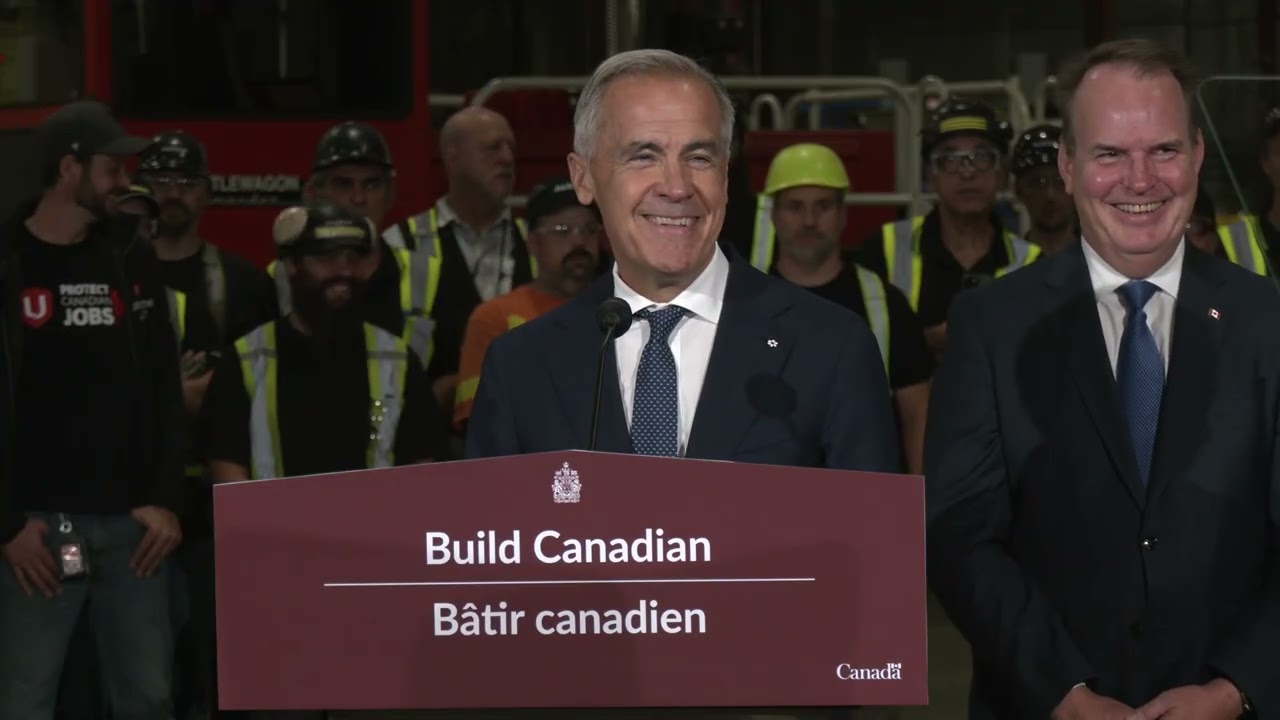
Prime Minister Carney announces the largest investment in VIA Rail’s history
Watch on YouTubeVideo summary
Prime Minister Carney has announced a historic $4.7 billion investment to manufacture and maintain 313 new passenger rail cars for VIA Rail, marking the largest commitment in the company's history. This initiative represents a significant shift from previous decades, as these vehicles will be designed, built, and maintained entirely within Canada for the first time in forty years. The project aims to replace aging fleet members that are over seventy years old, ensuring that the nation's long-distance, regional, and remote routes are served by modern, energy-efficient, and reliable trains capable of withstanding extreme Canadian temperatures while maintaining essential comforts like dining cars and sleeping berths.
The investment is deeply rooted in a strategy to restore Canada's industrial capacity and keep economic benefits within the country by leveraging domestic talent and resources. The manufacturing will take place at the historic Canadian Car and Foundry in Thunder Bay, utilizing Canadian steel, welding, machining, and electrical expertise provided by over 900 local suppliers. This approach is expected to directly support nearly 700 jobs in Ontario and Quebec while generating more than $1.6 billion in total economic benefits through a robust supply chain. By bringing this work back home, the government emphasizes that Canadians will continue to take care of each other despite external trade challenges, reinforcing national resilience and self-sufficiency.
Beyond the immediate economic impact, the new rail fleet serves as a vital lifeline for communities across the nation, particularly those in remote regions and Indigenous territories where road access is limited or non-existent. These trains provide critical connections for patients reaching doctors, students returning home, and families staying together, effectively bridging gaps that infrastructure alone cannot fill. The announcement also highlights the cultural significance of rail travel in Canada, referencing iconic journeys like the "Canadian" service between Toronto and Vancouver, which has traveled over 150 million kilometers and connects diverse landscapes from the prairies to the Rockies. Ultimately, this project strengthens Thunder Bay's legacy as a builder for the nation and ensures that future generations can experience the quintessentially Canadian journey on trains made entirely at home.
Read the full video transcript
Thank you. Thank you very much, Steve,
Minister McKinnon. Thank you, Patty,
Minister Haidu, Marcus, Metsu, Michael.
Thank you all. And let me thank first
and foremost Uniform
who are here with us today. [applause]
Because, [applause]
as you've gathered, when Canada looks to
build, it looks to you. It's your skill,
your dedication, your resilience that
makes today possible.
You know, we're standing here on the
historic grounds of the Canadian Car and
Foundry, better known as CAN Car. For
more than a century, workers here have
built what this country needs to move
and connect. Railway cars, street cars,
buses. As Marcus mentioned, in the
darkest days of the Second World War,
workers here built what the free world
was counting on, the Hawker Hurricane,
the fighter that helped win the Battle
of Britain. More than 1,400 of them came
off the floor of this plant. At peak
production, 15 a week, built by nearly
5,000 Canadians, more than half of them
women. That's what Thunder Bay does.
When this country needs something built,
we come here.
You're the story of Canadian industry.
Yeah.
[applause]
You can applaud for yourselves.
[applause]
Exactly.
You're the story of Canadian industry,
the spirit, ingenuity, and the people
that carry our country forward. Building
big, building fast, building Canadian.
And as you sense and Canadians know,
that strength is more important than
ever
because our country is being tested. Two
weeks ago, we made the right decision to
suspend our trade negotiations with the
United States. We couldn't accept what
they'd offered. We wouldn't give what
they'd asked. As a result, the US has
imposed new tariffs designed to hurt and
divide us.
Now, that's a miscalculation
because Canadians will always take care
of each other.
[applause]
And it's a miscalculation because we
have everything we need to build the
country we want. We have the reserves.
We have the resilience. And we have the
right plan.
Fundamental to our plan is building what
this country needs here at home with
Canadian materials, Canadian ingenuity,
and Canadian workers.
So, we know we need more clean, reliable
power. We've just launched the largest
clean energy initiative in North
American history. 23,000 jobs to build
it. Enough power for every vehicle in
Canada.
is construction
breeze glass
construction Canada.
So when we need new power, we go to
Canada. When we need new ice breakers,
we go to Canada. When we need new subway
cars, we invest nearly a billion dollars
into new cars for Toronto's line, too.
And you're building them right here at
Olston. Thank you. [applause]
Right across Canada, everywhere across
Canada, we need new ports, new mines,
new energy corridors
in just one year. Just one year we have
referred 27 nation building initiatives
to the new major projects office. What
does that translate into? Half a
trillion dollars in new private
investment and the shovels are already
in the ground at Darlington new nuclear
at the contraur terminal at the port of
Montreal at the new vulmon graphit mine
in Quebec in the McKenzie highway in my
native northwest territories.
Crucially,
as we're building, we are restoring our
industrial might and capacity,
reinforcing our factories, the supply
chains, and building the talent that
lets our country stand on its own.
You know, for too long, we bought from
abroad what we were more than capable of
building right here at home. We're
bringing that work back, and we're
turbocharging it.
Canada needs better, more reliable
passenger rail.
Our rail cars
on our long distance and remote routes
are more than 70 years old.
They were built when the NHL had six
teams. [laughter]
Goalies wouldn't wear masks.
The Leafs would win the cup. That's a
long time ago. Those old cars,
things are changing even for the Leafs.
Even for the Leaf, those old cars have
served our country well, but they're
long overdue for retirement. It's time
to build new ones, to build them here at
home.
[applause]
>> [applause]
>> And to that end, I am proud with my
fellow colleagues to announce that the
government of Canada is investing $4.7
billion to manufacture and maintain.
[applause]
So, we'll manufacture and maintain 313
passenger rail cars for Via Rails
long-distance, regional, and remote
fleet right here in Canada. For the
first time in four decades, those cars
will be produced and assembled and
maintained in our country. Cars that
used to be built in the United States
will be built right here in Thunder Bay
at Alam, Canada [applause]
by the best workers in the world.
[applause]
generate
shack compos.
Shu
service
Canada.
Consequent
cars will be a tribute to Canadian
talent, a showcase of our innovation,
our expertise, and our industrial
capacity.
The construction of this fleet will
directly support nearly 700 good jobs
here in Ontario and in Quebec. And in
line with our by Canadian policy, Olm
will leverage and expand its extensive
network of more than 900 Canadian
suppliers to deliver this new fleet,
maximizing the use of Canadian steel in
structural assemblies, supports, and
fabricated metal elements. It'll be
Canadian electricians that install the
wiring. Canadian machinists that will
make the precision parts. Canadian
welders will build the steel frames from
Canadian carbon steel.
[applause]
And that work, as you know, reaches well
beyond the factory floor into
communities across our country. All
told, this project will generate more
than $1.6 billion in economic benefits,
hundreds of good jobs, hundreds more
down the supply chain, paychecks that
stay here in Canada,
and you're building something deeper.
Because we know in Canada that rail is
more than a means of transportation.
It's part of our country's story. It's a
thread that's always connected us. The
iconic VIA service that runs between
Toronto and Vancouver over four days and
four nights covers 4,000 kilometers.
Thus far, it's journeyed more than 150
million km, equal to almost 200 round
trips to the moon. Every year, 750 L of
maple syrup are consumed on board.
[laughter]
And on board, many young Canadians
travel across this great country for the
first time to witness its beauty, meet
its people.
There's no journey quite like it. You
can fall asleep under the prairie sky
and wake up to sunrise over the Rockies.
As you know, it's called the Canadian.
When I was governor of the Bank of
Canada, we put the Canadian on the $10
bill because it represents the
connections between us. And it's a great
feat of engineering from Canada's past,
joining the East and West by rail. And
now we're here today because the
Canadian will be made in Canada.
[applause]
[applause] Hold on. It's it's
this is one of many VIA services that
will have a new generation of passenger
cars. Cars that are more energy
efficient, better for the environment,
more reliable, more comfortable.
Engineered to run through Canada's most
extreme temperatures so service is safe,
dependable year round.
Modern comfort, better accessibility.
Cars that keep what people love. The
sleepers, the full service dining, the
panoramic views.
Grades
reserv.
Traverse Canada.
As Minister McKinnon, Steve mentioned,
in addition to these long distance
routes, we're protecting regional and
remote services that are lifelines for
many communities, including 165 First
Nations.
On some of these routes, the nearest
essential service is a train ride away.
It's how people fill their prescription,
stock their kitchen, get care that they
need. So, we're keeping the trains
running from Winnipeg to Churchill, from
Jasper to Prince Roupert, so patients
can reach their doctor, students can get
home, families stay together, and we're
protecting a lifeline to communities
that roads never reach to keep Canada
connected.
So today, we're here on truly historic
ground. A place that built the rail cars
that opened this country, the aircraft
that helped defend freedom, and now will
build the trains that will keep us
connected for generations to come.
History isn't something that's behind
us. It's a foundation.
Our history points our way forward.
Years from now, a young Canadian will
ride the Canadian built in this factory.
A new car, all Canadian, built here at
home. The timeless, beautiful landscapes
rolling past. That tradition, that
quintessentially Canadian experience
lives on. And by renewing Thunder Bay's
tradition of railc car manufacturing,
we're strengthening the city that builds
what this country needs in a time when
Canada needs it the most.
This is how we build Thunder Bay strong.
We build Canada strong for all and
forever.