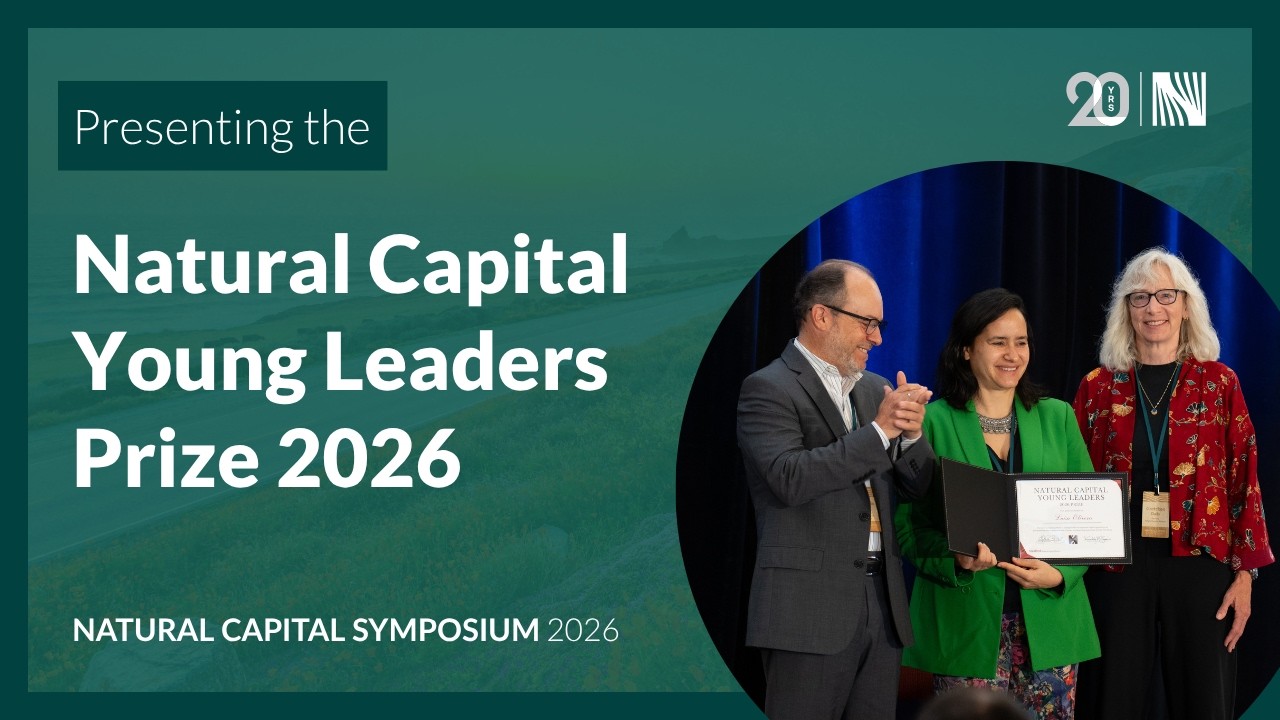
Presenting the Natural Capital Young Leaders Prize | NatCap 2026
Watch on YouTubeVideo summary
The Natural Capital Young Leaders Prize 2026 celebrates the third cohort of emerging leaders who are translating research into tangible policies, investments, and actions that improve lives globally. This year's award uniquely recognizes both individual innovators and entire organizations for their leadership in advancing natural capital accounting. The session was introduced by Gretchen Daily, who emphasized the prize's goal to elevate these achievements, build capacity within a growing network of leaders, and ensure that nature is not viewed merely as a backdrop but as a fundamental driver of economic prosperity and human well-being.
The first recipient honored was the National Statistics Bureau of Bhutan for pioneering the deployment of Gross Ecosystem Product (GEP) at a national scale. Rooted in the philosophy of Gross National Happiness, which mandates that 60% of the land remain forested forever, Bhutan has successfully maintained its status as carbon negative while balancing economic progress with conservation. The Prime Minister and King have championed this approach to make nature's contributions visible through new metrics like GEP, a critical step for securing climate finance and guiding sustainable development in an era where environmental stewardship reinforces socio-economic growth.
Following Bhutan, the award expanded its recognition to Latin America, highlighting Luisa Olivera from Uruguay and Fabian Villalba from Colombia for their work integrating natural capital into fiscal policy and national planning. In Uruguay, as a nation where nature constitutes nearly 98% of land cover, Luisa bridged the gap between economists and environmental scientists by quantifying wetland services like flood mitigation to inform economic instruments. Similarly, in Colombia, Fabian utilized his background in theoretical physics to model ecosystem accounts that reveal spatial relationships between communities and resources, demonstrating how technical innovation can embed ecological realities into decision-making systems across various sectors.
The final honoree was Dr. Boris Ochoa-Tocachi from Ecuador, a hydrologist who combines rigorous science with indigenous knowledge to address water security in the Andes. Leading his team at Atuk Strategic Consulting and collaborating on major initiatives like the People, Planet, Prosperity project, Boris has worked to quantify ecosystem services in regions such as Yasuni Biosphere Reserve to support local livelihoods and national policy. His work exemplifies the prize's core mission: redefining humanity's relationship with nature by proving that science must be translated into practical decisions that protect watersheds, strengthen resilience against climate extremes, and ensure a sustainable future where humans recognize themselves as an integral part of the natural world.
Read the full video transcript
Good morning, everyone.
Welcome to day two.
I can tell by the conversations that
you've all already made lots of friends
and colleagues and it's wonderful to
hear all of the the conversations
happening this morning.
Um
we want to go ahead and get started with
this morning's session.
Um and I just want to thank everyone
first of all for just a fantastic day
yesterday. All of the speakers,
um all of you in the audience here, the
questions, the engagement during all the
breaks. Um it was really stimulating and
interesting and so we're looking forward
to another great two days together.
So, I'm really pleased to be welcoming
you to this uh morning session. And
first I just want to explain
uh briefly that we are going to the
first part of this morning session is
going to be the natural capital young
leaders prize. And then we're going to
move directly into the plenary session
for the second half of this morning
session before the coffee break.
So, to start um I am very excited about
this young leaders prize award session.
It's the third year, the third cohort of
the young leaders prize and I think one
of the most rewarding parts of our of
our work at the natural capital alliance
is
supporting the next generation of
leaders who are advancing natural
capital approaches around the world and
it really tries to recognize people who
are not only doing you know, great
research, um
but also who are really translating that
into policies, investments and actions
that are really improving the lives of
people and communities around the world.
Um and this year we're really excited to
recognize not only individuals, but also
an entire organization um for their
innovative leadership in advancing
natural capital accounting. So, you'll
hear more about that momentarily.
Um so, thank you so much for joining us
as we celebrate these people. And I'm
first to going to invite Gretchen Daily
to share some words about the
inspiration and the vision for the prize
and to introduce our first prize winner.
So, thank you, Gretchen.
>> [applause]
>> Morning everybody. I hope you had a
fabulous evening and a restful night.
And um
just building on what Kim's saying,
there's just nothing more joyful
um or fulfilling [clears throat]
than to see
the young leaders coming along in our
big community.
And that seeing them doing things we'd
never have dreamed of when we were
young. And it's um just brilliant to
um have this moment to reflect on
where we've come from, where our
movement is heading, and really shine a
light on some of the many
beautiful young leaders coming along.
And um
I also want to say a little bit more
than um building on what Kim
announced with respect to the purpose.
The idea here in all our work is to help
elevate one another,
elevate the tremendous advances that are
being driven, the innovations. And in
this case, there's just amazing um
progress being made by a set of people
that you'll get to know in a moment. Um
and our purpose is to help bring
credibility, bring visibility,
bring impact to what they're doing. Let
others learn from it and um
adapt and adopt their approaches.
We're also trying to help, you know,
build their experience and capacity and
um network. So, as the time goes on, if
you identify young leaders,
um we'll be interested to hear um who
you might recommend and bring them into
our process for for selecting, which is
the most difficult part of all this.
And then mainly they they help
strengthen what we're all doing.
So, I want [clears throat] finally,
before introducing the first set, to
thank Chuck and Roberta Katz especially
for the vision behind this and uh for
launching the prize. So, thanks so much
to um the two of you.
And now um
thinking about the actual leaders we're
going to present,
uh the first set is actually a team from
Bhutan
working in the National Statistics
Bureau and taking on a really um
exciting
challenge and impactful challenge um to
deploy GEP in Bhutan to be the first
country to do so at the national scale.
And starting really from scratch, we've
been working closely together um to help
build capacity and develop um the gross
ecosystem product accounts.
And with the inspiration really from the
Prime Minister
and from His Majesty the fifth king,
um
there's tremendous scope to illuminate
the power of this new um metric and
whole set of approaches that go with it
um around the world and
um in working with
with the National Statistics Bureau whom
you'll meet in a moment um it's been
fabulous just to appreciate the culture
of Bhutan the collective culture the
um
the sharing of
of credit and everything and the
collective spirit in which we're giving
the prize honoring the entire um
National Statistics Bureau. We had hoped
that several members could be here today
but unfortunately they
didn't manage to get a visa
>> [clears throat]
>> and um
so we're going to celebrate them
um more or less online and I'll turn
over to that now. Thank you Kim.
>> [music]
>> Distinguished delegates, fellow leaders
and members of the Net-Cap team, ladies
and gentlemen, Kuzuzangpo and warm
greetings from Bhutan.
It's indeed a great honor and privilege
for the National Statistics Bureau of
Royal Government of Bhutan
to be invited to this very important
symposium and to be recognized for the
Natural Capital Young Leaders Award
2026.
We are deeply grateful to the organizers
and the Net-Cap team for this
recognition.
More importantly we value the
opportunity to join a global community
committed to advancing our understanding
of natural capital and its role
in sustainable development. For Bhutan
the idea that nature matters is not new.
It is deeply embedded in our development
philosophy of Gross National Happiness,
first articulated by His Majesty the
fourth Druk Gyalpo, King Jigme Singye
Wangchuck.
For decades, this philosophy has guided
Bhutan's efforts to pursue development
that balances economic progress with
environmental conservation, cultural
preservation, and good governance.
This commitment is reflected in our
Constitution, which requires that at
least 60% of Bhutan's land
remain under forest cover for all time.
Today, Bhutan remains carbon negative,
demonstrating that environmental
stewardship and socio-economic
development can reinforce one another.
As countries around the world seek more
sustainable pathways for growth, there
is increasing
recognition that nature is not simply a
backdrop to development.
Nature underpins our economies, supports
livelihoods, strengthens resilience, and
contributes directly to human
well-being.
As Bhutan looks ahead, we are also
exploring new approaches to sustainable
development.
One such initiative is the Gelephu
Mindfulness City,
GMC,
envisioned under the visionary
leadership of His Majesty the King,
Jigme Khesar Namgyel Wangchuck.
This initiative seeks to integrate
economic opportunity, innovation,
environmental sustainability, human
well-being,
while remaining fully aligned with
Bhutan's long-standing development
values. It represents our earnest effort
to explore how future urban development
can balance economic aspirations with
environmental responsibility, spiritual,
and social well-being. In Bhutan,
natural capital accounting has gained
important national priority.
During the fifth session of the fourth
parliament in June 2026,
Honorable Prime Minister Dasho Tshering
Tobgay,
in his state of the nation's report,
underscored the importance of developing
the system of natural capital and gross
ecosystem product as tools to recognize
the value of natural assets
and to support opportunities for climate
finance, sustainable investment, and
green growth. In this regard, the
National Statistics Bureau is privileged
to be working with the NatCap team and
other partners in developing Bhutan's
first
gross ecosystem product and natural
capital accounts.
This work will help make visible the
contributions of forests, rivers,
biodiversity, ecosystems to the economy
and society, strengthening the evidence
needed to support sustainable and
informed decision-making.
This award is therefore highly
meaningful and significant to us.
We accept it not only as an honor, but
also as an encouragement to continue
learning, collaborating, and
contributing to the advancement of the
natural capital accounting and
sustainable development.
I would also like to express
our sincere appreciation to the NatCap
team, particularly Gretchen, Tong,
Annie, Stacy, Eric, and all those who
have supported Bhutan since the
beginning of this initiative.
Your expertise, partnership, friendship
have been invaluable
and we look forward to your continued
support. Allow me to conclude with a
simple thought.
Nature sustains all economies,
all societies,
and ultimately all people.
Yet, too often
its contributions remain invisible in
the decisions we make.
The growing global movement towards
natural capital accounting is in many
ways an effort to make the invisible
visible.
By doing so, we can make better
decisions
on behalf of the Royal Government of
Bhutan
and the National Statistics Bureau, I
once again express
my sincere gratitude for this honor and
congratulate all fellow recipients of
the Natural Capital Young Leaders Award.
We accept this award with a deep sense
of humility,
appreciation,
and renewed commitment to advance this
very important work.
Thank you and Tashi Delek.
>> [music]
>> That was
beautiful video. We will
um be sure to convey to the the entire
team
um our congratulations.
Um so, thank you for your attention.
That was really really beautiful. And if
any of you do ever have a chance to go
to Bhutan and meet the amazing beautiful
people there,
Highly recommended.
Um so, now we are going to move from
Bhutan to another part of the world, to
Latin America, where we're going to
recognize
um
our next winners, who we had the fortune
to meet through the last couple years,
really, through working on the People,
Planet, Prosperity project that you've
heard about. Um and so, we're um really
pleased to be able to recognize and
celebrate these remarkable individuals.
And it's my pleasure to be able to
welcome Juan Pablo Bonilla, manager of
the climate change and sustainable
development sector
at the Inter-American Development Bank.
And some of you had a chance to meet him
yesterday, and he is going to provide
the introductions for our next two prize
winners. So, thank you, Juan Pablo.
>> [applause]
>> I thought I I was going to get one of
the prizes.
Not too young anymore.
>> It was a bait and switch.
>> No, it is really um a pleasure um having
the honor of recognizing
uh two who young leaders.
And uh as you mentioned at the
beginning, I think it's a recognition
not only for them, but for the
institutions that they represent.
Uh yesterday, in the opening, I
mentioned to you how we have been
working together with the
NatCap
to support, I would say, the
mainstreaming on how ministries of
economy, planning, are working together
with ministries of environment to really
being able to incorporate the natural
capital agenda into finance, into
planning, and being able to do that as a
system in the countries.
Uh so, today, I have the pleasure of uh
recognizing together two young leaders
that have been key in doing that in
countries of Latin America and the
Caribbean.
Let me start with Uruguay.
Luisa Olivera from the Ministry of
Economy and Finance
has been our counterpart
in advancing this agenda of
mainstreaming natural capital in a
central economic institution.
Through the Uruguay pilot, Luisa helped
integrate the perspective of the
ministry into the project ensuring that
the science and economic valuation of
wetlands in Uruguay could directly
support the development of economic
instruments to sustain their protection.
Beyond that, I mentioned yesterday that
we have supported the region in creating
a platform for ministries of finance
about sustainability, climate,
biodiversity, natural disasters.
And Luisa has been keen as co-chair
of the nature work stream at the
platform to advance and integrate nature
into fiscal policy at the regional
level. Her leadership reflects how this
agenda can be effectively advanced with
finance institutions strengthening the
way macroeconomic and fiscal decisions
are informed.
Luisa, it is a pleasure to invite you to
the stage and recognize your
contribution.
>> [applause]
>> Hi. Good morning to everyone.
Um let me see.
Okay. I like to start by telling you a
little about where I came from.
Uruguay is a small country in South
America about the size of Washington
State
between Brazil and Argentina.
We are a country with 3.5 million people
and where 98% of our electricity comes
from renewable sources. Also, we have
nearly 98 95%
of our land in natural ecosystems or
agricultural land.
So, nature is not a backdrop
to the economy. It is the economy.
Our rivers, wetlands, grasslands, and
coastlines are the foundation of where
we produce, what we export, and how we
live. So, for Uruguay,
um integrating nature into economic
decision-making is not an abstract
aspiration. It's something It's an
urgent need.
So, okay, but what What about me?
I'm an economist at the Uruguay Ministry
of Economy and Finance.
I have always been drawn to to natural
world outside of work since very little.
I'm a certified gardener and a bird
watcher.
But, when I started study studying
economics in Uruguay, nature was nowhere
to be found in the curriculum.
Not even remotely. The idea that
ecosystem um had economic value or that
biodiversity loss had a fiscal
consequences, that simply wasn't part of
the conversation.
Fortunately, this has changed
internationally and uh slowly is
changing at home, too.
But, that gap between between what
economic was and what it needed to
become
has shaped my career.
I spent uh over a decade working on
infrastructure, evaluating
public-private partnership, assessing
financial risk, designing regulatory
framework.
I It was an important work. I like it,
but I kept feeling that something was
missing there.
We were building roads, railroads,
social infrastructure, but where they
were blind to something fundamental, the
natural capital that those projects
depends on.
And the ecosystem they affect.
As an economist, I realized we were
missing half the picture. So, in 2023, I
moved to the environmental area at the
ministry that was recently created. And
that missing piece finally had a place
in my work.
And okay, what does the work actually
look like now?
As it's core,
it's about building a bridge, or more
specifically, a common language between
two words that don't really speak to
each other. Economists and environmental
scientists.
The pilot project with the NatCap team
is the perfect example of that. Together
with colleagues from the Ministry of
Environment, we run a natural capital
assessment of Uruguay wetlands
using biophysical models to quantify
four ecosystem services: water
regulation, coastal coastal protection,
flood mitigation, and carbon
sequestration.
The question we we wanted to answer was,
"What is the value of wetlands?" And how
we this information can be used to
policy instruments.
To answer that questions, geographers,
biologists, and economists have to sit
at the same table with the same data,
and agree on what value means. That is
what what building a common language
looks like, I think.
Another important motivation motivation
for me is that climate change dominates
the global conversation on
sustainability and it's okay, it's
right, but for countries like Uruguay
and for Latin America, the agenda must
go further.
Biodiversity loss, water quality, soil
degradation, ecosystem services, those
are not secondary issues. So, I think
nature transition is the defining
challenge for our generation and it's
required the same urgency, the same
financial innovation, and the same
institutional commitment as
climate change.
Our wetland assessment is an effort in
this way.
Finally, um
I want to take a moment to say that the
work I described is only possible
because a remarkable team of colleagues
at the Ministry of the Environment, at
the NACAP team, and also the support of
IDB.
So, science, policy, and finance only
connect when people trust each other
enough to learn from each other.
So, I'm deeply grateful to everyone
because I think we achieved that.
So,
I'm honored, generally really honored
for this prize, and also because this
prize recognizes also the work that
Uruguay is doing to put nature into
conversation
of economic decision-making. So, thank
you very much.
>> [applause]
[applause]
>> Yesterday we talked about key things for
mainstreaming nature. I think Luis
explained it way better than all of us.
But I would just highlight Luis what you
mentioned at the end is the ability with
a lot of humility to listen to the
others,
learn about each other and create that
trust. I think that's going to be for me
one of the key messages here.
Congratulations again and now let us
turn to Colombia.
Fabian Villalba from the National
Department of Planning
has played a leading role in advancing
the use of natural capital accounting
to inform sustainable development in
Colombia.
His work
has helped translate ecosystems
accounting into practical inputs for
policy, finance and national planning
processes.
This includes pioneer efforts to
demonstrate how ecosystems underpin
water and energy security in the country
as well as advancing approaches to
protect
protected areas, protected area finance
and broader application of ecosystem
accounting.
Through through this leadership Fabian
has helped position Colombia at the
forefront of countries in Latin America
and the Caribbean developing and
applying national natural capital
accounting.
Fabian's leadership showed
how technical innovation can be embedded
into decision-making systems
strengthening the way development
priorities are across the sectors.
Although Fabian is not able to join us
today in person, the Natural Capital
Alliance has a video from him to share
with all of us.
>> Hi, good morning from Bogota.
First
I would like to thank give thanks to God
for this opportunity and for to the
people, communities and institutions
that have shaped my journey, especially
the National Planning Department of
Colombia.
I also want to thank the NatCap team,
the Natural Capital Alliance, and the
selection committee for this generous
recognition. I am deeply honored to
receive the Natural Capital Young
Leaders Prize.
I regret that I cannot be with you in
person today, but I'm very grateful for
the opportunity to join you through this
video. I also want to congratulate my
fellow prize recipients. It's a
privilege to share this recognition with
leaders that who are working to make
nature more visible in the decisions
that shape our societies.
So, let me share some small
presentation.
So, what can I say? My journey began
began with curiosity.
Since I was very young, I have been
driven by a desire to learn, explore,
and understand things I did not know
before.
That curiosity first led me into
science, and eventually into theoretical
physics. I completed a PhD working on
general relativity, gravitation, black
holes, and complex systems.
Physics shaped the way I think, looking
for structures, relationships, state
variables, and the deeper logic behind
apparently different phenomena.
But my curiosity was never limited to
one discipline.
I also had a very personal connection
with nature. Some of my my earliest
memories are walking through the
countryside where my grandparents lived
here in Colombia,
exploring the forests, the dry tropical
ecosystems, and the biodiversity around
me. In a way, those two worlds, the
abstract language of physics and the
living complexity of ecosystems, shaped
the way now I now approach public
policy.
Around 50 15 years ago, I had the
opportunity to move forward from
academic science into public policy.
My entry point was technical,
computational modeling, numerical
analysis, and the study of macroeconomic
flows.
One of the most important experiences in
my career was contributing from 2011 to
2013
to pioneering work on the economic
impacts of climate change in Colombia.
At that time, climate economics was
becoming a new and influential field
globally, especially after the Stern
Review.
That experience was decisive for me.
It showed me that models are not only
academic tools.
When used well, they can help
governments see risks, compare
alternatives, and open new policy
conversations.
More recently, my work has moved towards
natural capital and ecosystem
accounting.
What I find powerful about ecosystem
accounts is that they allow us to see
nature territorially,
not as an abstract resource, but as a
set of spatial relationships between
ecosystems, people, communities, and
economic activities.
In the Sinú Basin, for example, this
work helped illustrate how ecosystems
support water and energy security,
and how ecosystem information can inform
investment and planning decisions.
Through the People, Planet, and
Prosperity Initiative, I also had the
opportunity to contribute to the
prioritization
of ecosystem services, especially
water-related services, and to reflect
on how this information can be connected
with financial instruments and policy
decisions at the local level.
For me, natural capital accounting is
not only about measurement.
It is about helping institutions
understand the systems they are trying
to transform.
What inspires me most is the possibility
of connecting worlds that often seem
separate, science of and policy, public
finance and environmental action,
economic modeling and territorial
realities, nature and development.
In my own journey, moving from academia
into public policy taught me that
connecting these worlds requires more
than technical knowledge.
It requires understanding how
institutions work, their mandates,
constraints, procedures,
responsibilities, and cultures.
This has helped me see see that good
ideas need more than evidence. They also
need institutional pathways.
They need to be translated into
decisions, instruments, budgets, and
processes that can actually work in real
contexts.
The transformation we need is
environmental,
but it is also economic, financial,
productive, and institutional.
For Latin America, I believe natural
capital leadership must be able to speak
with many different actors and help
build consensus.
We need leaders who can connect evidence
with decisions, finance with nature, and
technical tools with the realities of
people and communities.
I receive this award with gratitude and
also with a sense of responsibility
toward the younger leaders who will
carry this work forward.
I hope that whatever I have been able to
contribute with
can become one small stone in the
foundation of what future generations
will build.
Thank you very much.
>> [applause]
>> All right.
>> [clears throat]
>> Wonderful
Uh words from Fabian from Colombia.
Um and I find fascinating that's perhaps
not a typical path
um into natural capital accounting sort
of via theoretical physics and studying
black holes. So, I imagine conversations
with Fabian are are fascinating and
varied. So, we will be sure to convey
our congratulations to him.
Um so, I have the pleasure of
introducing our next and final prize
winner,
uh Boris Ochoa-Tocachi.
And um
Boris is from Ecuador
and he worked closely with Hector
Angarita from the NatCap team on
uh some of the people planet prosperity
work in Ecuador as well as some of um
the projects in Uruguay and he supported
a few other things uh that we were doing
and uh
Hector had to say about Boris,
"Boris is the most interesting
hydrologist of the 21st century in the
northern Andes.
The work he is doing on mountain
hydrology is incredible."
Let me tell you a little bit more about
Boris before you get to hear from him.
So, he's a hydrologist. He's a civil
engineer and an entrepreneur
whose work really exemplifies
the the power of natural capital
approaches combining rigorous science
with practical policy solutions
um to try and solve various
environmental challenges particularly
with respect to water and hydrology.
So, he's the CEO of Atuk Strategic
Consulting, which is a certified B
Corporation in Ecuador and he's has
applied natural capital approaches to
improve water security, climate
resilience, and sustainable development.
His work has been widely recognized in
scientific publications, international
collaborations, and leadership roles.
And he has really explored this this
nexus
of how indigenous knowledge and
nature-based solutions can be combined
with modern hydrological science to
strengthen water security in the Andes
and beyond.
He has
an inspiring commitment to ensuring that
scientific evidence really informs
real-world decisions.
And his leadership is really helping
demonstrate how natural capital
approaches can support resilient
communities, healthier ecosystems, and
more sustainable economies. So, please
join me in welcoming and congratulating
Dr. Boris Ochoa T.
>> [applause]
>> Thank you very much. It is a real honor
to be here. I want to thank the
University of Stanford, the Natural
Capital Alliance, the Inter-American
Development Bank for being instrumental
to the systemic change.
I want to tell you a little about
the work that we do.
This is a journey through a stream. This
is to mainstream natural capital
approaches
in Latin America, in the Andes, and
beyond.
I did study civil engineering.
My inspiration was my father, actually.
He was a lawyer, and he was working with
indigenous and rural communities. and my
mother was a travel agent and a nature
lover that seeded us love, the same love
for nature and for traveling, which is
something that I
really enjoy.
And when I was
studying in civil civil engineering, I
wanted to connect that with that love
for nature.
And the way to connect civil engineering
to that was hydrology.
What you see here, this movement, like
this respiration that the Andes feel,
this interaction between the Caribbean,
the Amazon and the Pacific
are these flying rivers that we've been
talking about during these days. How
water moves throughout the Andes and how
landscapes are created because of this
variability, from deserts to rainforests
and people that have lived here for
centuries adapting to these very extreme
conditions.
And these are two sides of the same
coin.
Flooding when we have excess water and
droughts when we have when a lack of
water.
I was very
grateful to work with the IMEA. This is
the regional initiative for hydrological
monitoring of Andean ecosystems
that we're looking at replicating an
experiment throughout the Andes to
understand how land use management
changes the hydrological response of
Andean catchments. This is a group with
more than 30 stakeholders, more than 50
sites of monitoring in the Andes and
more than
200 equipment located in the Andes to
understand how rainfall transforms into
river flow and how that sustains the
livelihoods of people in in the Andes.
More specifically in Peru, I had the the
pleasure and the honor to work with the
natural infrastructure for water
security project uh
which was funded by the now extinct
USAID and the government of Canada and
implemented by a consortium of
institutions led by Forest Trends
that mobilized a portfolio of 300 more
than 370 million dollars into
nature-based solutions for water
security and it strengthened the
capacity of more than 5,000 people of
which 2,400
were women
uh and uh tried to really create
policies that could be in place in Peru
in order to invest in water security for
disaster uh
management and for uh water uh
availability in general.
And more recently in Ecuador uh the
natural capital uh project alliance now
uh implemented this
uh
assessment of natural capital and
ecosystem services in the Yasuni
Biosphere Reserve in the northern
Amazonian
uh
region of Ecuador in which uh
more than uh 150 local stakeholders
participated in this effort to quantify
the value of ecosystem services
to understand how this can sustain also
the livelihoods not only of the people
that are living in the Amazon but also
uh
for the entire country and the benefits
that we produce for the rest of the of
the world. I want to really uh thank
here
NatCap Insights our partner that
together with that took develop this
project the natural capital alliance uh
and the Inter-American Development Bank
and the GEF uh for supporting this uh
study that has been instrumental now to
create policy within the Ministry of
Environment and Energy the Ministry of
Economy and Finance and the National
Institute for Biodiversity that are able
now to use this as a reference for
future projects in the country.
I also want to recognize that this is
not only an individual effort. I am the
visible face here, but this is a team
effort. And I want to recognize the the
faces and the work that the Atuk team
has put into this this work. When I went
back to Ecuador and created uh
Atuk with my brothers, one is a is an
economist, Eric, and Diego, my other
brother is a mathematician.
Uh we wanted to connect economy,
science, and nature, particularly water,
to solve uh problems. Uh this is our
role. How we can translate science into
policy and and financial decisions. How
we can go through this multi-level
decision-making from local communities
to governments and ministries. How we
can incorporate science in these
decisions.
I don't want to repeat uh the same
sentence that we've been repeating, but
this is very important. Nature is the
economy. It's not only a support for the
economy. And I think that we all have a
role in translating this knowledge, this
science, and creating this dialogue
between indigenous and ancient knowledge
and western scientific knowledge to uh
provide information for better
decisions. Our purpose for the future is
to redefine the rela- relationship
between humanity and nature. And I'm
sure that we all in this room have the
same vision. We want to create a
different future, a better future, in
which humans and nature understand each
other, and we understand that we are
part of that same nature. Thank you very
much. I want to thank again the
University of Stanford and the Natural
Capital Alliance for
uh this award. And I also want to
congratulate my fellow award recipients
for this great honor. Thank you.
>> [applause]
[applause]
>> Well,
that was really fun. I always
get a tear in my eye listening to people
um speak so eloquently and passionately
and with such depth of experience and
feeling and
um
all domains of
being um
and integrating so many dimensions of
uh the world that we're hoping to knit
together better for
a much better future.
And thank you very much for
participating in this. Let's have a
final round of applause and we'll move
on to the next session.
>> [applause]