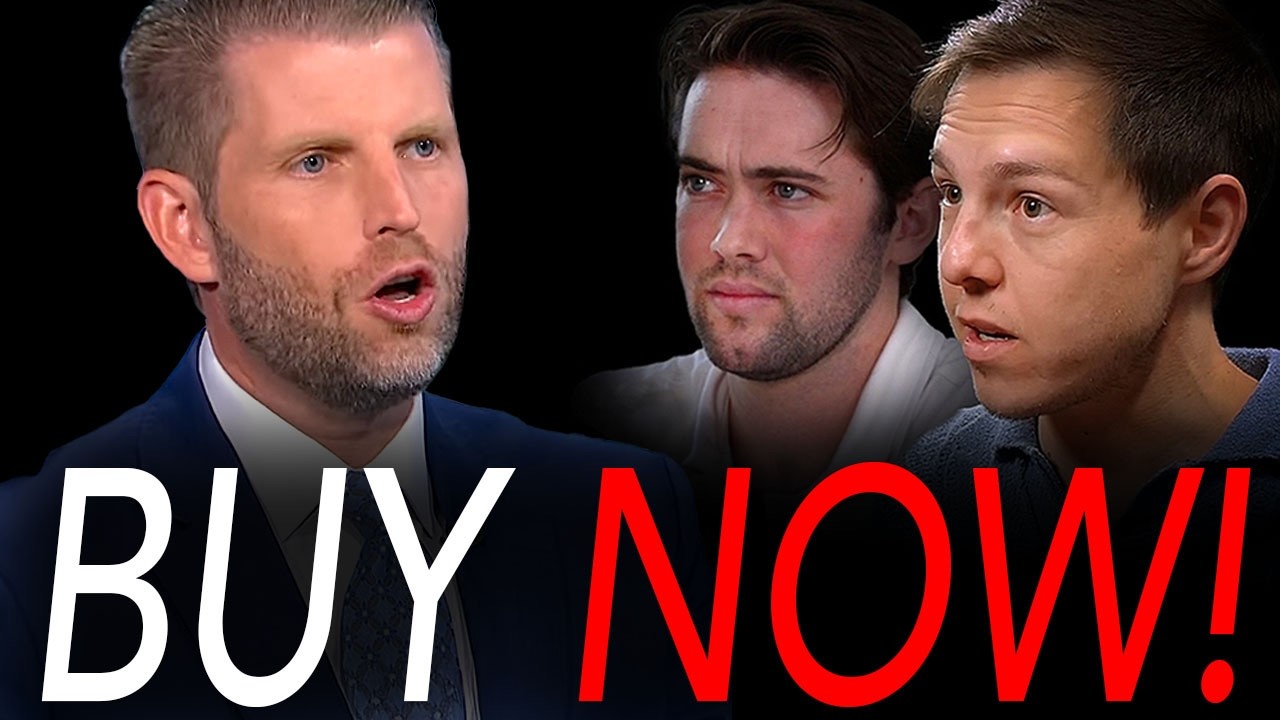
“Prepare NOW!” Eric Trump’s Shocking Prediction For Stock Prices, Bitcoin, & The US Dollar
Watch on YouTubeVideo summary
Eric Trump joins a discussion to outline his family's aggressive shift toward cryptocurrency following their exclusion from traditional banking systems, which he describes as being weaponized against them due to political affiliations and support for "Make America Great Again." He details how the Trump organization was debanked by major institutions like Capital One, Bank of America, JP Morgan Chase, and First Republic, with accounts closed without cause or explanation. This experience drove Eric and his family to launch their own crypto projects, including a meme coin that briefly surpassed Ethereum in market cap, successful NFT ventures, World Liberty Financial (a stablecoin), and American Bitcoin, which mines cryptocurrency using cheap energy from West Texas. He argues that the government should actively purchase and hold Bitcoin on its balance sheet, citing it as the single greatest performing asset over the last decade with consistent year-over-year growth of approximately 70%, contrasting this performance against poor historical investments by nations like Germany or price-gauging policies in grocery stores under current administration leadership. The conversation extends to a critique of the American educational system and public policy, where Eric argues that schools are failing students financially and practically while promoting revisionist history through DEI curricula. He advocates for replacing portions of academic coursework with financial literacy training and vocational skills like basic trades, noting that high tuition costs often outpace future earning potential in many majors. Furthermore, he criticizes politicians who lack real-world business experience, pointing to the negative economic impacts of rapid minimum wage hikes which force automation rather than job creation. He contrasts this incompetence with his father's foreign policy successes and peace efforts in the Middle East, suggesting that bureaucrats like AOC or Kamala Harris are ill-equipped to manage a complex economy without practical industry knowledge. Eric Trump also addresses the psychological impact of political persecution versus personal fulfillment, asserting that money does not buy happiness but rather provides the necessary tools for those fighting against rigged systems to survive and fight back. He identifies his primary sources of joy as his family—specifically his wife Laura and children Luke and Carolina—and his passion for building projects, shooting sports, and outdoor activities like dirt biking and fishing. Despite facing immense pressure from legal battles involving 112 subpoenas and indictments against his father, he maintains that the ability to defend oneself financially was crucial in avoiding imprisonment or bankruptcy. He reflects on a specific incident where an FBI briefing on cyber threats from Iran was leaked by ABC News before he could leave the building, illustrating what he perceives as government overreach and corruption involving figures like Hillary Clinton and Barack Obama regarding the "Russia hoax." Regarding investment strategy for the average listener, Eric recommends that while saving money is essential, relying solely on stable assets or index funds limits wealth accumulation. He suggests allocating a significant portion of one's portfolio to Bitcoin, recommending anywhere from 5% to potentially higher percentages depending on an individual's risk tolerance and income generation capabilities. He emphasizes the importance of "diamond hands" and holding through volatility rather than trading short-term, noting that while memecoins are prone to manipulation by whales, Bitcoin's liquidity makes it a robust long-term asset. Finally, he promotes the accessibility of crypto today compared to five years ago, where buying required complex cold storage setups; now, investors can easily purchase spot ETFs or American Bitcoin via major financial institutions like Fidelity and Schwab, making entry into this future-focused sector much simpler for the general public.
Read the full video transcript
Why isn't finance 24/7? Why isn't it
immediate?
Why is it that every bank in the world
has to have their fingers [music] in
absolutely everything?
>> Americans can have confidence that the
banking system is safe.
>> Why can't you just send me a link and 3
seconds later it's in your bank account.
We are on [music] the one yard line to
to something incredible. Crypto and what
we're doing. It's growing faster than
the internet grew in the '90s. Can you
make the argument that the government
should be buying Bitcoin [music]
>> because it's the single greatest
performing asset over the last decade,
increasing in value 70% year, year over
year. When you look back in 5 years, the
entire financial landscape is going to
be much different. And that's all
because of cryptocurrency. I became the
most subpoenaed person in American
history. 112 subpoenas for doing nothing
wrong. I've never gotten so much as a a
traffic ticket. 91 indictments toward my
father, debanked by every major
financial institution in the country.
They came after us like we were dogs. I
really believe it can never [music]
happen again based on the moves being
made in crypto. All the public
criticism, all the attacks, [music] how
do you deal with it? You know how you do
it? You fight back. You don't give up,
you fight back.
>> Eric Trump, thank you so much for coming
on the ice coffee hour. Really
appreciate it.
>> Good be on, guys.
>> So, you tweeted today and it went viral
that the Trump family has made more
than1 billion dollars in crypto. How did
you guys make it? Well, we started the
the three most successful, you know,
crypto projects probably in history. We
started with a a meme coin, Trump coin
for a period of time. It was uh I think
above the market cap of Ethereum. It was
pretty amazing. It went it went
parabolic. I'll never forget we launched
this on a Friday afternoon. I look at
the price the next day was at like 70
bucks or something like that for for
literally a meme. And um you know, just
had a lot of fun. Obviously, we're
really successful in the NFTs, you know,
in the early days. And then we started
World Liberty Financial. Everybody knows
we're the fastest growing stable coin on
on Earth right now. Uh, and then
personally I'm doing a project called
American Bitcoin and every, you know,
bit of my heart and soul is in it. We
just listed on the NASDAQ. So, we mine
Bitcoin um out of West Texas using some
of the cheapest energy anywhere in the
world. We we mine a lot of Bitcoin.
We're doing it about 50%, you know, of
of spot prices right now for for BTC and
um and having a great job doing it. So,
we're we're going to accumulate. We're
obviously, you know, mining and so
crypto's become a big part of the
portfolio. I was always a hard asset
guy. That's what I I did. I think you
probably know me from building hotels
and skyscrapers and golf courses and
residential buildings and commercial
buildings and uh uh crypto's been
incredible and it came out of us being
debanked, right? I mean, because we wore
a hat that said, "Make America great
again."
>> A lot of the financial institutions
around the country, they were
effectively told to weaponize our banks
against us. And
>> you know, I found some of the smartest,
greatest people that you'll ever meet in
the crypto world. And um it is the
future. I have no doubt about it. It is
the future of finance. And uh as a
family, we're all in and and personally,
I'm all in. What do you think separates
great investors from good investors?
>> Yeah, I think being able to see the
future obviously um and also being
passionate and and and oftentimes, I
know this is going to be contrary and
every Harvard professor is probably
going to scream, but it's probably not
always diversification. I wouldn't
exactly say we made our family fortune
based on great diversification when, you
know, we were all into real estate.
Everything we did was hard assets. We
weren't diversified. We believed in a
certain category. We were damn good at
that category and that category grew
extremely quickly. Um, you know, and and
we made a fortune off of it. Um, I think
a lot of times you have people who go
out and they'll put, you know, 2% into
bonds and 2% into stocks and 2% into
crypto and 2%, right? And at the end of
the day, you're not going to move any
different than an ordinary market can
move. It's a little bit hard to break
out of the pack when you're doing the
exact same thing as the pack is doing.
So, um, listen, I think being able to
look look ahead, um, and see the future.
And that's certainly what I'm doing in
crypto and the the future is is crypto
on every single front on payment rails
on on obviously Bitcoin being digital
gold. There's no question just the
modernization of finance having 24-hour
finance having much more efficient
finance having less fees having less
costs being man more transparent but but
listen if you look out and look look at
what AI's done look at what quantum's
you know done um you know look what's
happening in so many of kind of the the
energy advances and and look how
parabolic those stocks and those
companies are going you know I I I think
you have to you know look out and and be
very good and harness your efforts and
exploit your talents and um you know
that's how you do well in life see I'm a
pretty firm believer, as is Graham, in
saving more than you spend and then also
investing that in index funds, a
diversified portfolio. Do you think that
that is still a good approach to go all
in on like, you know, more, you know,
cutting edge crypto?
>> So, so break the two things apart. I
mean, one is a savings strategy. The
other is a, you know, career path if
you're an entrepreneur, right? And and
so, uh, yes, should you save a hell of a
lot more than you spend? of of course
otherwise you can't get to the pro like
how do you invest in crypto if you have
no money to invest right let's let's
start at the very basics so you know you
you better save money and you better be
able to invest that money into something
right um yes I I I do believe in that
and I do believe that there's a big
portion that you know in a way should be
peeling off 12 13% in in in in great
ETFs that are efficient where you're not
going out with crazy money managers that
are underperforming the market where
they're charging you 220 and all sorts
of crazy rates so so listen there's
there's certain discipline finance. But
I think in terms of of becoming a great
investor and really making your money,
you're not going to do it simply by
investing in T- bills. You know, it's
just never going to happen. No one's
ever become wealthy, you know, investing
in in a product that goes up 5% a year,
4% a year. You know, you can hold on to
wealth. You can save money. If you've
got a great career and you're siphoning
off $100,000 a year or $500,000 a year
or a million dollar a year and you're
investing in a product that's stable,
fantastic. Um, but you also need a
career that can that can throw off
enough money that you can actually get
to that that promised land.
>> What's the best investment advice that
you've heard?
>> Well, I mean, I guess there's difference
between investment and and and career,
right? I mean, I I focus so much of of
my investments on my actual career and
on betting on projects that I think I
can effectuate and and do a great job
with. And so, I I think you have to
separate the two, right? And and then I
think once you make a lot of money here,
you can take that and you can properly
invest it over here and you can do so
very kind of safely and securely. But I
I think the vast majority of our our
bets have always been on ourselves and
our talents. You know, we go find a
messed up hotel. You know, great
location, great property, you know,
iconic as hell, run like hell. Um, you
know, no money was put into it.
Management team stunk. Uh, they weren't
good with what they did. They didn't
have the heart. They didn't have the
soul. They didn't have the passion. The
owners didn't have the vision. Um, and
so often times we go in, we'd buy those
properties for pennies on the dollar. We
put money into them. we'd reinvision
them and we would turn them into gold
mines and we did that over and over and
you know in a certain way it's almost
like venture capital,
>> right? But but but in a a little bit of
a different space in like the hard asset
space, right? And and that's always
really rewarding when you can take
something that was a mess. Hey, I did
with this property that you're you're
standing in right now. This was a Rich
Carlton. They had run the thing into the
ground. They didn't know the difference
between, you know, T and a a fairway and
a a green. They weren't golf people.
They were sucking money. They were
losing a lot of money every single year.
I bought the property and nine months
later I had the thing, you know, cash
flowing positively and today is one of
the most successful properties in all of
Florida, right? And and so, you know,
going in with a little bit of common
sense and um and fixing a place,
repairing it. Um, you know, I I like
that kind of bet. I do have to say the
team here was incredible. Thank you. We
moved some of the furniture around and
immediately when I texted Nancy, three
people showed up within a minute and
they came with tape measures and they
were making sure everything was level
and the same height. It was incredible.
So, so that's my anal that comes
through, you know, the teams and and you
know, I've become famous for, you know,
not walking through the front doors of
our properties, going through the
loading docks, you know, I know every
single mechanical room in every single
one of our properties, in every one of
our attics, I know every HVAC unit, you
know, it's we are very, very granular.
And if your back house is perfect, if
that mechanical room in the basement of
a building is spotless, well lit, well
painted, um, immaculately kept, you
don't need to worry about anything else
in the operation. And and that standard
will will flow through all the employees
and everything they they do. And and I
can't tell you guys, especially with
Secret Service in our lives now.
>> Yeah. You know how oftentimes I go
through the back of one of these famous
hotels all around the world. They are
normally dirty, grungy, lights are
burned out, the ice machines are
disgusting. They they they look gross.
You will never find that one of our
assets. So why can't we apply that same
standard to politics? I'm curious, going
from business into politics, what was
the one thing that surprised you the
most out of all of it? I'm sure you went
in with an expectation as well.
>> Yeah. I think the lack of competence of
a lot of politicians if you want, you
know, know the truth, right? I mean,
these are mainly people who didn't have
jobs. Look at Joe Biden, right? Joe
Biden, you know, had been in politics
for 55 years, 56 years, actually when he
got out, right? I'm 41y old guy. I've
got gray in my beard. Think about it,
right? Never signed the front of a
check. Never built anything. You know,
most of his life had yes, no decisions,
yes, no votes. Could you imagine if my
life was a a yes no vote, right? I mean
I might need to effectuate 500 things to
get to the end result and it's all a
road map in order to get there and so I
think it creates very binary thinking
you know and and and often times some of
the politicians who are you know
debating and voting on the most
complicated you know items that we have
in society know nothing about and have
zero real world practical you know um
skill in in I mean look look at like
some of these minimum wage you know
proposals that are going up in in New
York you know doubling tripling minimum
wage well you know that's great other
than the fact that they're just going
to, you know, automate every single
service and you're not going to have any
jobs in the state because they won't be
able to afford to pay for it, right? And
and and you see that like look at
California, right? You know, they want
to triple minimum wage, double minimum
wage. And guess what Dunkin Donuts does?
You know, they just automate all of
their their processes and fire all of
their employees. And and you know, I I
think sometimes you need to be able to
have a comprehension of the other side,
you know, of of a topic. And so often
times these politicians because they've
never run a business and they've never
signed a check and they've never had to
make payroll and they've never lived
through a recession or a depression,
they have no idea what the hell they're
doing.
>> Now, in fairness though, isn't that
advancing something that we're going in
that direction anyway? So let's say they
do raise the minimum wage and now it's
$40 an hour.
>> I feel like we're heading in that
direction anyway. The jobs are going to
be taken over by AI. So they're just
speeding the process up.
>> They're probably speeding the process up
probably at the behest of of people. Um,
and they're forcing it. All right. You
know, right now it's not forced. It can,
you know, capitalism can it can, you
know, chart that path and the speed of
that path. I think so often times, you
know, they make bad decisions that that
that forces something that wouldn't
otherwise have to be. And I think that's
again at the best of of a lot of people,
right? And and so that always enamored
me about about politicians, right? When
you have people who really never had
real world experience and all of a
sudden they're on a you know, but yet
you'll hear you'll hear from all these
people, right? you know, Hillary
Clinton, you know, what does Donald
Trump know about foreign policy? Oh,
haha. Well, I mean, in fact, from the
fact that we've spent our entire life in
just about every country around the
world because we're in international
real estate, you know, maybe nothing,
but her foreign policy caused 20 years
of of death and destruction and wars,
whereas, you know, my father was serving
French fries 12 months ago and all of a
sudden we have, you know, peace in the
Middle East. So, everyone knows that
politics is extremely corrupt, but what
was the exact moment in your life that
you realized it's way worse than you
could have thought?
>> Well, you know, it's funny. I talk about
it in this book and and congratulations
by the way and I never thought I would
be a number one bestselling author. I'm
a guy who builds you know buildings. I'm
I'm number one in in the United States.
It's kind of a you know crazy thing.
>> I'll never forget I I got a call from
the FBI and they said we we need to see
you at FBI headquarters in in downtown
New York. There's a threat against your
company. And so naturally I rushed down
there and no one knew I was going. They
and they specifically asked that like
please no one knows you're coming. And I
drive into parking garage. The only
people who who knew I was there was
Secret Service, a guy driving me down.
And uh go up to the eighth floor into
one of these, you know, skiffs. It's
kind of this, you know, lead lined room
where, you know, you can't, you know,
you can't bring cell phones. You can't
bring anything into it. And they go,
"Hey, there's a cyber cyber threat
against your company." I go, "Okay,
great. I can see every cyber threat
that's coming into our company, right?
If you have a half decent IT department,
you can see cyber attacks every single
day, right? This is like, you know, 101
business stuff." And uh I go, "Where's
it coming from?" You know? Well, sir, we
can't tell you that, guys. Is it China?
No. Is it Russia? No. Is it Iran? And
their eyes just, you know, light up.
Okay, so guys, so there's cyber threat
coming out of Iran. Least shocking thing
I've heard heard all day. But you can't
tell anybody that this is happening. You
know, this is this is absolutely secret.
You can't tell anybody. And I Okay, I
won't tell anybody. Thanks a lot. Like
this whole thing's feel felt like it's a
waste of time. You could have just told
me, "Hey, there's, you know, cyber
threats. Just be really careful with
your servers and everything else." But
they swear me to secrecy. I go down to
the parking garage. I get in a car and
no one guys knew I was there. My
assistant didn't know I was there. No
one the company who knew I was there. I
was driving up the ramp in the FBI
building in New York and I got a call
from the head of ABC News, a friend of
mine. Eric, I hear you're down at FBI
headquarters. And I go, John, what are
you talking about? He goes, I hear
you're at FBI. I'm like, I'm not at FBI
headquarters. He goes, yes, you are. I
know you're in the building right now. I
go, John, I'm not at FBI headquarters.
He's like, Eric, listen, we've known
each other for a long time. Don't lie to
me. I go, how would you know something
like that? And he goes, "Because their
press office out of Washington DC just
called to tell me that you just left
their skiff and they were they were
briefing you on a cyber threat from
Iran." And I go, "You got to be freaking
kidding me." Beyond the Secret Service
agent in the front of the car, you know,
who was with me for 3 years. He I had I
had him on speaker phone at that point
was clenching his fist like he wanted to
fight. I I just couldn't believe that
was the status of the government that
they would they would do something like
that. And then we get into under siege,
right? That was kind of my my my first
where they impeach my father twice,
right? They make up dirty dossas. They,
you know, I mean, the dirty dossier were
talking about golden showers. They were
talking about things. All they wanted to
do was have my father, you know,
divorced, lose his family, embarrassed,
all paid for by Hillary Clinton, right?
They made up the the Russia hoax. So, we
had secret servers in the basement of
Trump Tower communicating with the
Kremlin. Give me a break. We don't have
servers in the B. You know why you don't
put servers in basements? Because
basements flood, right? Uh, let's just
start at the the basics. I became the
most subpoenaed person in American
history. 112 subpoenas for doing nothing
wrong. I've never gotten so much as a a
traffic ticket, right? 91 indictments
toward my father. Debbanked by every
major financial institution in the
country. They came after us like we were
dogs. They raided Mara Lago. They raided
Melania's room. They raided Baron's
room.
>> It was it was the government. It was I
mean it was the government. It was it
was Joe Biden. It was Merrick Garland.
>> You think Joe Biden is literally pulling
the strings saying like you do this, you
do that. because I I actually don't
think that he was, you know, competent
enough to
>> Okay, fine. So, Joe Biden or the autopen
or his underlings or Merrick Garland who
was definitely, you know, capable enough
of this. Um, they lied when they raided
Mara Lago. They said it was on behalf of
N Archives. Does anybody really believe
that the National Archives has enough
power to tell 30 armed FBI agents to
raid Mara Lago and it not come from from
the White House? And by the way, they've
all but admitted that it came from the
White House at this point, right? But
you know, no one believes that, right? I
mean, why was Leticia James at the White
House every week, right? Why was Alvin
Bragg at the White House every week? Why
was Fanny Willis and Nathan Wade at the
White House every single week? Was that
their was that their jobs? You know,
like isn't that a little bit Isn't that
a little bit strange? You know, like we
know that Hillary paid for the dirty
dossier, right? We we know that Barack
Obama was the one that that did, you
know, the Russia hoax, you know, first
because they wanted to try and make sure
my father didn't get as many votes and
then second of all because they were so
embarrassed that a ragtag group of
people who didn't know a damn thing
about politics beat them that they
wanted to be able to perpetuate this
narrative for a long period of time,
right? They weaponized every bank. They
weaponized every, you know, financial
institution. They weaponized the DOJ.
They spied on our campaign. Kind of
forgot to mention that before. You know,
>> how do you handle all of this? all the
public criticism, all the attacks, how
do you deal with it? You know how you do
it? You fight back. You don't give up,
but you fight back. Right? And that's
that's this story, guys. Right? They
wanted to destroy us. They wanted to
bankrupt us. They wanted to have our
family get separated. They wanted
certainly my father to get divorced.
They wanted to see us voiceless. Hence
the reason we all got stripped off
Twitter, Instagram, Facebook. You know,
they turned down all of our dials. It
It's one of the reasons you guys are as
successful as you are, right? because
people are sick and tired of, you know,
they want to hear independent media
versus, you know, the nonsense that ABC
and NBC and CNN and everybody else was
shoveling for for years. I mean, they
wanted to see us dead. They wanted to
see us in a jail cell. And when none of
this worked, you know what they did?
They tried to shoot my father, right?
Not not only the first time in Butler,
but then they tried to get him 8 weeks
later, you know, about 4 miles away from
here at at Trump International. They
wanted him off of the stage because they
couldn't control us, right? you know, we
weren't one of them. We weren't the
establishment. Uh they couldn't believe
that we beat them at their own game. I
mean, guys, we self-funded our first
campaign. Hillary Clinton raised 1.5
billion dollars and actually knew what a
delegate was and we still beat her,
right? It's it's kind of a remarkable
thing. And we love this country. Uh we
love our nation. We love the
Constitution. We love God. We love
faith. We love freedom.
And our country was going to hell. And
and so guess what? We fought. And we
fought relentlessly. And and I talk
about in the book, it it was guys, we
either won the White House or we were
going to be in jail for doing absolutely
nothing wrong, you know, like that that
was that was the pendulum. That was the
the the Trump life. And I said that to
my father in a car one day. We're coming
out of a court courtroom in in downtown
New York. And I go, "It's either 1600
Pennsylvania Avenue or you and I for
doing nothing wrong or going to be in
use jail cells because that's how bad
the system was weaponized." We all spend
money on little things every week.
Coffee, gas, groceries, nice suits. But
imagine if all of that spending
automatically earned you Bitcoin. Well,
that's exactly what the Gemini credit
card does. They are the only instant
Bitcoin rewards credit card out there.
With this, every purchase you make earns
Bitcoin back. Or in this case, you could
get up to 4% back on transportation, 3%
on dining, 2% on groceries, and 1% back
on everything else. It's really one of
the simplest ways that you would be able
to gain a little extra exposure to
Bitcoin without trying to time the
market or buy it yourself. All you have
to do is swipe your card like you would
normally and you're investing as you
spend. And here's some crazy
perspective. Bitcoin rewards earned and
held for one year on the Gemini credit
card have appreciated 277%
on average. Now, of course, crypto is
volatile, but it just shows the
potential if you're thinking long-term.
Plus, the card has no annual fee, which
I know this guy really appreciates. All
you got to do is head to
gemini.com/istic,
and when you're approved and spend
$3,000 in the first 90 days, they will
give you $200 in Bitcoin. You can also
check if you're eligible with no impact
to your credit score. So use the link
down below in the description or again
head to gemini.com/is
to sign up today. Check out the rates
and fees down below in the description.
Thank you again to Gemini for sponsoring
this episode. What do you think is the
main thing people get wrong about the
Trump family? The closeness of our
family is remarkable. Um having gone
through the fights that we've gone
through, they would have otherwise
destroyed every single one of of of us.
I think conventionally, and I really
mean that. I don't I'm not sure how many
other families could have taken what
they put through us. You know,
thankfully we had the checkbook that we
were able to fight, you know, the legal
battles. I mean, guys, we spent over 400
million bucks in legal fees, right? Just
fighting off, you know, the Russia hoax
and the dirty dossas and everything else
that they threw at us. Um, you know,
thank God we also had a voice and that
probably came a lot from The Apprentice
and being on TV before politics, you
know, being pretty comfortable in front
of the microphone before,
>> but we have a family that fights
together that's always stuck together.
Uh, that was unbreakable. Um, we're a
very, very close-knit group of people
and um, and honestly, it's probably the
only thing that kept us alive. That
reminds me of what I thought was one of
the most pivotal moments of the first
candidacy, which was in the debate with
your father and Hillary Clinton, and
they were asked to compliment each
other. And Trump said, "Oh, she's a
fighter. She'll never give up. She's
hard worker." And she said, "Oh, you
have great kids." Yeah,
>> which is kind of like everyone thought a
backhanded compliment. It's like, well,
you're not really complimenting his
character. You're not compliment. You're
just saying, "Oh, you have good kids."
>> I'll take it as one of the kids as one
of the benefactors of the compliment.
>> But I'm curious, what is something that
you learned from your father that's
outside of politics, outside of
business, just purely on a a human
level?
>> I think whatever you do in in in the
world, be myopically focused on it,
right? And that probably goes back to to
what we were talking about with
business. you know, everything I had
ever seen him accomplish, you know, when
it was the residential buildings, he was
myopically focused on the residential
buildings, you know, building Trump
Tower, right? And and and he just it
would be the only thing that was in his
mind, you know, when he got to the golf
courses. He loved doing the golf courses
and and and me and him were myopically
focused on is all we thought about is
all we did. It's it was it was literally
occupied 95% of the same thing with The
Apprentice. like when I was apprentice
just everything was ratings, it was the
cast, it was it was you know the filming
but you were just nothing else came in
the way. He was always incredibly
focused. When politics came around his
only focus was politics 7 days a week,
24 hours a day and every single thing
that he did he he he turned to gold,
right? And and I think when somebody
becomes myopically focused on their
passion, whatever that might be and for
whatever reason they're trying to do it,
I think it's awfully hard to beat them.
Uh, I think kind of the the weekend
warriors are very easy to beat and the
people who are lazy, the, you know, the,
you know, people who show up at work at,
you know, 10:30 in the morning and and
and go home at 3:00 in the afternoon,
they don't stand a chance against that
person who's driven and will will will
go through every single wall in order to
get to their objective. But there's no
denying that people like that exist. Do
you think that they're just a product of
their environment where being lazy is
totally fine? There's no real push to be
exceptional at anything. Or do you think
that, you know, they're making the
active choice and they're just like,
it's nobody's fault but their own. For
example, we have a question we asked on
this podcast. We used to ask it quite
often, which is, if you're poor between
the ages of 25 and 45, do you think that
it's your own fault? You better find a
different career path and you better
harness, you know, whatever your talents
are, and you better run at those
talents, you know, as hard as humanly
possible. And listen, there's a lot of
people have advantages, right, in the
world. There's a lot of people that that
have opportunities and there's a lot of
people who who were given nothing who
became the wealthiest people in the
history of this nation out of out of
nothing. I I mean, you know, I know so
many of them, right? You didn't graduate
high school and and and built billion,
you know, billion dollar companies and
uh have done tremendously well. And so,
um, I I think if you're ever in that
spot where you're bored as hell, um, and
you're not moving forward, you should
probably pull the ejection seat and and
get out and find something that you're
you a love or you're passionate about.
Um, something that has high growth,
something that you're able to monetize.
And I would I would sprint toward
whatever that might be in your life. And
what that is for you is probably very
different than it is for me. And it's
probably very different than it is for
you. Right? It's uh, you know, I think
people have to harness their skills.
Skills come in a thousand different
forms, you know, and and ultimately
monetize them. Um, if you're not
passionate about something and you
really are working, you know, three
hours a day and, you know, and don't
don't give a a damn about whatever
you're doing,
you're not going to break out from the
pack. It's just it's very hard.
Statistics will show you that it's going
to be next to impossible for you to, you
know, overachieve. What separates the
people though that are not
self-motivated with those who are?
Listen, maybe it's attitude. Um, you
know, I I I I would hope maybe the
utopian view would be that, you know,
everybody could self-motivate if they
found the right thing that motivated
them. And I would hope that'd be the
case. I'm not saying that's the case.
You know, you probably have people in
society who are lazy. I I hate to say
it. Um, in fact, I probably know a
couple of those people. Um, and then I
certainly know those people who are
absolute overachievers and, you know,
everything they want to do, they want to
do to 110% no matter what it is, where
it is. And um and I think those people
are probably, you know, will we will
overachieve. You know, as kids, we
didn't have the opportunity. It it was
we didn't have the opportunity to be
lazy. I should say, you know, we were
put on construction sites when we were
11 years old. You know, if we wanted a
bike, congratulations. Go work for it.
You know, go earn money. And you know,
we we were spoiled as hell in the
conventional fashion. We had, you know,
a warm roof overhead. We were always fed
and we have had great education. But,
you know, if anybody thought that we
were rolling around with $100 bills in
our pocket, you know, we we weren't. We
were working on I was doing demo all
summer and again you wanted a fishing
rod. Congratulations. You used the money
that you earned, you worked for and you
went and bought it.
>> But what was your attitude towards the
work when you were young? Were you
excited? Because you right now seem
highly industrious, highly productive.
You love what you do, but back in the
day to take a while to to foster that
sentiment.
>> Well, I loved it. I probably would have
done it.
>> So, you always loved it.
>> Yeah. Honestly, I probably would have
done it for free, right? And and so back
to your last question, you know, was
that built into your your DNA? Was that
nature? Was that nurture? you know, I I
don't know. It was built into my D and I
I loved it. Um, but it also taught me
the value of dollar. It taught me the
the, you know, the value of hard work.
Uh, it certainly taught me a skill set,
right? Which is kind of the building
blocks to what I do every single day.
Um, and by the way, it tired out a young
kid. You know, if you're a 13-year-old
kid or 15-year-old kid and you're type
A, do me a favor. Don't give them money
and don't give them a lot of free time
because bad things are going to happen,
right? Like a terrible recipe. And and
so my parents were were were exceptional
were exceptional when it came to that.
>> You know, we asked Dave Ramsey the same
question and he said the reason a lot of
people aren't motivated or they feel
hopeless is that they believe that the
work they put in is not going to have
the result that they want. And I think
for you, you could very well see that if
I do this,
>> this is what's possible and you see the
reward of that.
>> Light at the end of the tunnel. I think
a lot of people in America feel like
they're they're hopeless, that they
can't get ahead, that they feel like
housing is too expensive or the stock
market's overvalued or that crypto they
they could have gotten in at $1,000 and
now it's $110,000. I feel like they
can't do anything to get by. What would
you say to those people?
>> Yeah. Well, I think you have to find
the, you know, industry that you're good
at and I think you have to find the job
that you're passionate about and I think
you have to find, you know, the
opportunity, whether it's
self-employment or or not. Um, you know,
I mean, I I can't tell you how many how
many friends I have who started, you
know, small electrical companies. You
know, they were they were electrical
foremen and, you know, they they they
worked their way up and then they went
out and they started doing their own
jobs and all of a sudden they're they're
running 30 40 50 crews with unbelievable
companies and they built it from from
nothing. And it's hard to get there.
It's really hard to get there. But, you
know, I think you have to take the
initial step. I I think I agree with
with Dave, but but what you have to do
is you have to take the initial step
toward whatever that is that you're
ultimately passionate about. um you know
so often times it's well the market's
not right so I can't do it right now or
life's not right or you know it's a hard
time or this or that you know you have
to take the step you have to be able to
take that initial leap and and um I
encourage people to do that you know
follow their hearts follow their
passions you know preferably in an
industry um that has growth or that has
you know real kind of potential.
>> Do you think the national debt affects
the average person out there?
>> Yeah of course it does. And and what
does that look like to the average
person?
>> Oh, listen, you have a national debt of
what, 37 trillion right now?
>> Um, yeah, you better believe it does
because it hangs over everybody's head
and and and whether you like it or not,
at some point everybody's going to have
to pay that national debt and it's
compounding rapidly. Um, so in some way,
shape, or form, you're going to pay that
in taxes. I mean, if we didn't have
national debt, you your taxes would be
substantially less than what they are.
That means you could probably afford a
nicer home and and more belongings and
to take a better trip with the kids. And
yet every single year this thing goes up
by by by an absolute fortune because the
government's out of control um and has
been um and absolutely rebelss against
people who try and cut the hell out of
it. And you see what's happening right
now with the government shutdown. You
know, they want an extra what, you know,
$2.7 trillion for healthcare for illegal
immigrants, you know, and and when you
say no,
not a single Democrat comes out and and
votes in favor of reopening the
government, right? Among other things,
by the way. Um, yeah, I I think I I
think it affects everybody that lives in
this country. There's no question about
it. And in fact, it might be the
greatest risk that we have as a nation,
you know, outside of serious armed
conflict. How do we solve it? Is there
any way out of 37 trillion? Cuz I've
heard either you have to let it inflate
away or you hope it doesn't go up so
much that maybe AI could help boost our
economy and make enough money to start
shipping it away. Like, can we ever pay
this thing back?
>> Yeah, you have to grow out of it, right?
I mean, anybody thinks you can cut out
of 37 trillion, you can't. I mean, will
cuts be important? Yes, you need to get
rid of of fluff and garbage and fraud,
waste and and abuse. No question about
it. Um, at the same time, you have to
have unbelievable growth. And I think
that's what we're seeing. And how do you
how do you get growth in society? You
need the lowest energy cost in the
world, right? You need to be champion of
industry. I think my father did that
better with with crypto than than
anybody before. The entire world is
following us. America is the crypto
capital of the world by far, and we were
losing our standing there. We're also
losing our standing on energy. I mean,
look at look at nuclear power. We
haven't had a nuclear power plant in
this country built in in 30-year period
of time. And we are the ones that
championed
>> nuclear power. I mean, for a long time,
France had more expertise in nuclear
power than the United States of America
did. You know how embarrassing that is.
You know, what's France in terms of
economic power of of of the world? What
like 13th in terms of GDP? You know,
it's a joke. America has to be number
one at absolutely everything we do. We
have to be number one at at energy and
that's not not just nuclear that's oil
and gas and everything else. You know
any country that has low energy costs
you know has has much better
productivity. That's just pretty simple
correlation that I think you know
anybody can can can understand. We have
to champion industry. We have to win the
AI revolution. We have to continue to
win the space revolution. You know we we
have to be the most businessfriendly
country on on earth. We we need to
maintain the reserve currency under and
by the way we are the reserve currency
that no one can argue that it's not even
close. No one no one wants any of the
Asian currencies. No one wants any of
the South American currencies. Certainly
no one wants the euro for for obvious
reason. No one wants the pound. Um so I
think it's great advantage and we better
we better maintain the greatest you know
rule of law an honest rule of law
because it's why we have so much direct
inward investment in in the United
States of America. You know they they
look at their own countries and they see
no promise. They see no future. They see
no they see massive government
corruption. They they know all of it can
disappear like that. And guess where
they park their assets? They park in the
United States of America. We better
maintain that safe haven for for people
parking their money. And so long as we
do, we'll maintain the greatest economy
ever.
>> Seems like energy is going to become a
major issue over the next 10 years. Why
aren't we going heavier into nuclear
energy today?
>> Well, I think we are. I mean, I think I
think my father, what was his exact
quote? If you propose a nuclear plant,
I'll give you approvals in 7 days. You
know, I mean, my father's the biggest
proponent of nuclear energy.
>> How many people applied
>> in terms I have no idea. But, you know,
I mean, these are big because these
things cost $30 billion to build, but
>> you know, you've how many times have you
heard drill baby drill, right? And
people are drilling. I mean, we're
exporting energy for the first time
again. We're exporting in the first
administration. Then we stopped
exporting. In fact, we became an
importer of energy. Now, we're exporting
again. And and that's not just oil,
right? That's that that's natural gas.
You know, you've got states, look in New
York with Marcelis and Udica, and you've
got the the greatest natural gas, you
know, shale anywhere on Earth. You know,
it makes Saudi, it makes it makes the
UAE like look like small potatoes in
upstate New York, in Ohio, in
Pennsylvania. They're not even tapping
into most of it, right? And and so we we
need to drill. We need to be energy um
independent. And by the way, there's
there's a ton of other forms of energy
as well. I mean, solar is doing great,
right? We're in Florida right now. Every
every day there's another solar field.
And you know, it's it's working great.
It's it's augmenting the grid and you
know it has its purpose but nuclear is
going to win the day especially these
small nuclear uh reactors that are
coming out these SMRs and it's it's it's
fascinating what's happening. So we're
huge advocates for financial literacy. I
mean that's what Graham built his entire
brand on. I joined because I became
financially literate because of his
content on YouTube helped us create this
podcast. And I think that that is pretty
much the main thing causing people to go
poor or some people to go to go wealthy.
Why is financial literacy not taught in
schools? Some people speculate that
there are elites that want to keep
people poor so they can keep them under
their thumb.
>> Why is it not taught in school? It's the
simplest thing. We learn the most.
>> It's useless. I zoned out in high
school. I hate it. Then why do we teach
anything in high school?
>> It's such an obvious. It's such an I
mean I agree with you guys 100%. It's
because our educational system is
absolutely broken. I mean, I went to a
school where I was taking Latin classes,
you know, no no disrespect to, you know,
formation language, but, you know, give
me a break, right? I mean, you know,
100%. I mean, I listen, I went to
Georgetown. Georgetown's what top 10
school in in the country and in in the
world. It's, you know, it's up there
every single year. You know, I can't
tell you how many nonsense classes that
we took on in and you know, I don't want
to disrespect um you know, um
I mean, I could go down the list of of
of worthless classes that that I took
there, but you you had liberal arts
majors who who couldn't calculate
mortgage, who had no idea what the
difference between principal and
interest was, right? I mean,
>> compound interest, probably less than
50% of people know about compound
interest. credit score. How to how to
get an 800 credit score,
>> how to open up a how to get a home
mortgage, how to get a, you know, car
lease, how to exactly the difference
between interest principal or how to
calculate any of it, right? I mean, you
know, how the stock markets work, you
know, how the bond markets work and I'm
not talking about, you know, complicated
quant, right? I'm I'm talking about
just, you know, the fundamentals of of
of all of it. Yeah. Exactly. you know,
how how how the FICO system works and
you know why you might want to actually
maintain a high score and and um no and
by the way even even just basics how to
open up a bank account, savings account,
all right, you know what a 401k is and
how to utilize it effectively and what
you should be doing with it. No, no, we
are grossly and by the way and that's
before you get into just the basic
concepts of of economics and and other
things that can help in your your your
you know daily life and and business.
But but why is that not taught? Because
we have an incompetent educational
system. I mean guys, we have an
educational system in our country that's
ran ranked 10th, you know, 30th in the
world and and we spend like, you know,
seven to 10 times the amount per pupil,
you know, educating people, right? The
curriculum, I mean, this is something my
father's fought so hard against, right?
I mean, look at the DEI curriculum that
you've had over the last in the WO
curriculum. I mean, they're teaching
revisionist history. We couldn't get
past the fact that they were going up to
first graders, you know, drawing a line
across a chalkboard, you know, male,
female, you know, little Johnny, go put
your your mark on the line as to, you
know, where you think you are on the
spectrum of, you know, confusing. I
mean, we got over that about 8 months
ago when my father got into office and
absolutely killed that entire
curriculum. But this is this is where
our country was going in terms of the
educational teachings, let alone trying
to teach them, you know, financial
literacy, which there is nothing more
important to the world, right? Let me
just let me say that there is nothing
more important. I I would get rid of
half of the curriculum and I would
translate that over to and by the way,
you know what else should be taught?
Basic trades,
>> right? I mean,
>> I have some of the smartest friends who
do exceptionally well who couldn't hang
that picture on the wall. Zero chance.
Zero chance. And if they did, the thing
is going to be crooked as hell. You
know, they're certainly not lining up
two pictures and having them be within
an inch of one another, right? They
would have zero chance of being able to
do it. Like, how about actually teaching
some people some real world skills so
when they move into their first
apartment, you know, they can mount the
TV and actually find a stud in the wall,
right? And and I I think our educational
system is broken and uh it's it's a
great shame. Well, we were thinking
that's something we're extremely
passionate about and if there ever isn't
an initiative to increase financial
literacy in any way we could be that
would make our dreams come true. We work
for free. We just want to make sure
people understand the basics of
investing the safe way.
>> I'll partner up with you guys.
>> He's already taught millions of people
like people coming to him. I opened up a
Roth IRA because of Graham. You know,
simple simple I would love to see. I did
a whole analysis on this and it seemed
like once the government began
subsidizing a lot of public schools and
colleges, uh the amount of money per
student stayed the exact same, but the
amount of money for administrative and
staff skyrocketed.
>> Have you ever seen like the charts where
where they take the amount of student
loans, meaning the actual like monetary
supply of student loans outstanding, and
they they actually track that to college
tuitions
>> and and you know, the more money that
they put into the system,
>> the more they charge. It almost tracks
like perfectly, right? It's like it's
like Bitcoin and M2, right? They almost
like track perfectly.
>> Who would have thought?
>> No, it's crazy. and you know they'll be
charging $90,000 for a degree and you
know somebody will come out with a a
basket weaving major and you're saying
they're saying I I don't know like like
maybe maybe some of these schools
especially when you're getting financial
assistance maybe should they should
actually peg it to the amount your
career will pay when when you come out
of that very institution
you know based on that that respective
major because it's I mean how many times
do you hear somebody coming out of
school with with a with a given degree
you know and and and they're making
$25,000 a year and they spent $80,000 a
year for a three-year period of time,
four year period of time to get that
respective major and they they're just
never going to be able to pay it back.
You're giving the person, you know, the
chance of either you you default
>> um you know, on your your student loans
or just never fill it and and and live
behind an interest lock and you know and
and and interest payments for the rest
of your life.
Um
I I I mean it's now what's also
interesting is that also correlated with
mortgages as well that the overall size
of someone's mortgage was correlated
almost exact to the amount of uh
government loans that were issued.
>> Yeah.
>> So that's also something that I find
kind of interesting that housing prices
also went up along the same as what they
were able to get as a mortgage.
>> I'm the biggest proponent of higher
education, right? the the biggest if
done right. I can make a solid argument
and it hurts me to say this, but I can
make a solid argument for what the price
of a lot of these colleges are charging
and for the product that they're putting
out.
>> You know, you'd be much better off
taking the $300,000 that that education
would
put in like anything else. Do anything
else.
>> Yeah. Yeah. Put it put in an ETF,
>> you know, attracting the S&P 500, you
know, down payment on a house.
>> Yeah. 12% a year every year for you know
in perpetuity you know add to that every
single day by by going you know and
saving you know starting a career saving
and years of time too that you're
sinking into 100%
>> and get a get a great jump start uh
there there's there's almost no question
about it I think our colleges in this
country have a lot of soularching to do
a lot of soularching to do
>> although really quick before we go into
that I just want to say that eating
healthy sounds simple until of course
life gets in the way like a lot of us
don't have the time to go and cook six
cups of vegetables to hit her nutrition
goals. That's exactly where our sponsor,
First Leaf, makes it easy. They've
created a microgreen supplement with up
to 40 times the nutrients of fully grown
vegetables. Just one scoop gives you the
benefits of six cups of greens. It's
packed with vitamins, antioxidants, and
phytonutrients that support gut health,
immunity, and natural energy without
stimulants. And considering the fact
that these nutrient-packed supplements
are usually really tough to make taste
good, these actually stand on their own
legs. Although personally, I really like
to have it blended into a smoothie with
bananas, yogurt, and a few berries. It
makes it creamy and fruity, and it's
such an easy way to stay consistent
every day. It's also clean, non-GMO,
vegan, pesticide free, gluten-free. And
what's super unique is that FirstLaf
actually does the growing and harvesting
themselves. So, try it out today by
going to drinkfirstleaf.com/ic
to save 30% off your first month
subscription. Seriously, guys, do not
skip your veggies. Either mix it with
water or throw it in a smoothie and it's
a super easy way to stay consistent on
your nutrition. Again, that's
drinkfirstleaf.com/
ice to save 30% off your first month
subscription or the link is down below
in the description. Thank you so much to
Firstleaf for sponsoring this episode.
How has the quality of your life changed
over the past few years? You know, I
started fighting for cause um that that
wasn't monetary um which is which is
very different, right? I always I always
wanted to build great buildings. I
always wanted to have unbelievable
teams. Um, I always want to, you know,
recreate skylines and landscapes and and
that's what we do in hard asset space.
And I I was dead serious about that. And
then all of a sudden, we were fighting
for something that was a little bit less
tangible. Um, we were fighting for the
American spirit. We were fighting fight
fighting for the American flag. We were
fighting for our Constitution. We were
fighting for our nation. And um, it
changed in that every single day I
started taking arrows for for for doing
something that I thought was noble and
and righteous and um, and and and right.
Um, I I never thought that because you
love America and you wanted to fight for
its betterness, you would start becoming
the most opinionated person ever. I I
never thought that you'd have to spend
$400 million defending yourself from
shams because, you know, Hillary Clinton
made up a, you know, Russia hoax and,
you know, I I just I never thought that
we'd be there. But it it's also been
really kind of rewarding. I have this
99-year-old grandmother who always has a
saying. She goes, "How many steaks can
you eat?" And and I it means a lot to
me. um where you know a certain point
it's not monetary it's not about
succeeding in business it's it's about
it's about doing the right thing you
know how many how many steaks can you
eat and and uh I think um
it it's it's changed me in that I think
I have multiple purposes in my life now
one certainly a company that I love and
one of the great real estate companies
anywhere in the world but also one you
know fighting for American spirit and
American people that I adore and in a
movement that has become I think the
most powerful political movement on
Earth.
>> You mentioned that you're very lucky
that you were insulated from a lot of
these attacks because of your your
pocketbook. Basically, you had the money
to stay protected from all of this
stuff. Would you say money buys
happiness?
>> Um, no. Money definitely doesn't buy
happiness. But hold on one second. I got
to go back to the insulated.
>> We were far from insulated. Um, they
wanted us imprisoned
>> and they did everything they could to
affffectuate that. And the only tool
that we had was the fact that we had
enough monetary means and allowed enough
voice to be able to go and and fight
back against an incredibly rigged
system. If we didn't have the voice, we
would have lost. If we didn't have the
the monetary means to pay a lot of
lawyers, we we would have lost. Um, and
it was touch and go. You better believe
it was touch and go. Uh, I will tell you
some of the most miserable people in the
world are some of the wealthiest. and
and uh you know I I've met people who
have achieved every milestone in life.
Um they have their private planes, they
have their this, they have their that,
they've got their beautiful houses,
they've got their trophy wives, they've
got their trophy husbands, right? And
yet they're still miserable. So no, I
don't I don't think money buys
happiness. Um I think being a great
person, I think being missiondriven, I
think being loving what you do. So often
times I think it's when you when you
lose the passion um that you find the
misery. you know, the the people who
have done extraordinarily well but are
passionate about what they do are
normally incredibly kind of happy people
um versus the people who are now sitting
on, you know, tremendous fortune um with
idle time are are typically the people
um you know who who who go down the
other path. And I've I've seen that a
lot and it's a shame.
>> So, what would you say for yourself are
your primary sources of happiness?
>> Yeah, I've got two unbelievable kids, uh
Luke and Carolina. Uh they are
absolutely my joy in life. I've got an
unbelievable wife, Laura. You probably
know her from um she's become a
superstar in the world of politics and
on Fox News and and she's amazing. Um I
love building. I mean, in my free time,
I I love projects. Uh I love the
shooting sports. Um love the outdoors.
Love being outside. Love dirt bikes.
Grew up on dirt bikes and and uh still
doing a lot of the ATVing stuff. So I I
just I love the outdoors. I love waking
up early. I'm up at five o'clock on the
weekend normally in my truck and you
know I'm watching the sun come up and uh
I love fishing and and uh skiing. I mean
>> how do you even find time to do that
stuff?
>> I I don't I don't but I try and I try
and carve out a day a week.
>> Is this a recent thing? Oh, a day a
week. So you have like a schedule?
>> No, it's Listen, on you know if I'm not
traveling on a Saturday or Sunday, you
know, I I I try and find some time for
myself and you know it's listen it's
difficult, right? We run a very big
company and um work very hard and um
don't sleep a whole lot and you know
always get interrupted no matter you
know what I'm doing and and and that's
fine right that's it's the life I I love
and it's life I enjoyed and I think if I
ever had free time I'd probably be
miserable and incredibly bored right you
know I think there's certain people who
are my grandfather had this great
expression it's to to retire is to
expire and and I think we're all built
that way I think humans are probably
actually built like that um but no I I
like to run hard in everything I do and
I can't tell you how many times I'll
come off a plane at 1:00 in the morning
and I'll be up at 5:00 in, you know, in
the morning to to try and get a couple
free hours of of free time. So, I think
what actually gets compacted in my life
is actually probably sleep, but that's
okay. We we operate on very little sleep
anyway.
>> Would you ever run for president?
>> I retired from politics. Um, I called my
father the the morning of of the
election after we won in in it was
November 6th and I said, "Pops, I love
you. I'm I'm going back to the company.
I'm going back to the people I love. I'm
going back to you know, doing this, you
know, I'll run this side of of of life
and, you know, you you do a great job
for the country and you won't need to
worry about anything over here and, you
know, I know the country is in great
hands and um I never thought I would
have been in this race. Um I never
thought I would have been a major player
on that stage. Um and I was and and
arguably without without me, my father
couldn't have done it, right? Because
there would have been no one watching
over the actual company and you know
that was everything he had ever built,
everything he ever created as a major.
Um he had an answer back in the 80s
which is you know if it ever got so bad
u that we had no other choice I would do
it and that would probably be my answer
as well. Um I've seen the best of
politics. Um I've also seen the worst of
politics. I've seen how they can try and
destroy a family for doing absolutely
nothing wrong. I see how they can lash
out and try and imprison you and
bankrupt you and then kill you as they
did to my father twice. Um
at the same time I see this kind of
amazing transformational change that
he's making every single day. Right? I
mean peace in the Middle East. to who
the hell would have thought, right?
Look, look at where our economy is. Look
at where our world is. Look at our
standing around the world. And so, you
know, the good news for the first time I
can see, you know, I really see people
who are making a difference. He's making
a difference. And and I think that's a
beautiful thing for our nation. And we
better have good business leaders
>> running this country and not these
bureaucrats who have been I mean, can
you imagine AOC ran a 32.5 trillion
dollar economy?
>> Yeah. Well, it's Deote. They're
polluting the uh the oceans. Did you see
that?
>> Yeah. I I I mean [laughter] but but like
I mean look at look look at you know
Kamla right I mean she goes out and
talks her big economic plan was to stop
the price
what did she say and no she say gauging
price gauging
>> oh sorry price gauging at the uh grocery
stores.
>> Yeah. Yeah price. So she wants her
economic plan for this country is to
stop the price gauging. Now I I
>> have you seen the the margin though that
they have at the grocery stores are
making a ton of money. They're making 1%
margins.
>> Yeah. I mean those guys if anyone has
money it's run the
>> grocery the grocery store owners
>> you know Casmatitis is a friend of mine
right owns Christis and Dustinos and all
those
>> and um a lot of places are not even
making that you know why because of the
theft in some of these cities right when
when you used to have a theft rate of
you know half of 1% and now all of a
sudden you know you have 7% of product
walking out of your stores and high tax
environments you know with spoilage and
everything else that you have in the
supermarket business you're not making
anything and um the hardest business but
yet mandami wants to go and nationalize
iz grocery stores, you know, in in all
the infinite wisdom of city hall in New
York. I mean, I've saved them more times
than you can count. We saved them on a
skating rink in in in Central Park. We
saved them on
>> a golf course, which they spent 30 30
not three 30 years trying to build at a
cost of almost $300 million to build a
golf course and I got the thing done in
18 months, right? And yet in City Hall's
infinite wisdom, they're going to go
nationalize grocery stores and make
these things profitable. Give me a
break.
>> How are you going to save New York in a
sense? Like it it seems like he's
getting a lot of attention and I would
even love to have him on the podcast.
>> Guys, we try to have people on the left
on this podcast all of the time. I'm not
just saying that. Seriously,
>> they don't do it. They don't do it. We
want We want more people on from the
left.
>> We have Eric Trump here right now. Guys,
if we could just get Mandani, if we
could get if we could get anybody, any
AOC, Bernie Sanders, please
>> ask all the same questions you asked me.
>> We would love to. We we've thrown out
the offer for years and zero response
back. So if if you could help because
I'm in real estate on talking terms.
>> Well, I mean I can be honest.
>> I'm in real estate. Yeah.
>> I mean the reason they won't do it is
you know they don't control you. They
control ABC. They control NBC, right? I
mean network TV was be became the the
you know kind of the PR arm of the
Democratic party. Everybody knows that,
right? You know, the reason you guys are
doing great is you have an independent
voice and you can ask questions and you
can ask them uncomfortable questions and
because of that they won't go on your
programs, right? Like if they go on CNN,
they're going to just they're going to
hold up little, you know, fluff tea
balls, you know, and let them kind of
hit it out of the park all day long with
nonsense. And in the case of ABC, you
saw what they did with, you know,
Camala's interview. They literally
edited all the questions to make her try
and sound intelligent. They took
questions, they edited her answers, and
they tried to make her sound
intelligent. like this is and that's the
reason these people won't come on your
podcast because they they have to do
what I've done for the last 90 minutes
where you actually have to be
intelligent and run your mouth and you
know know the answers to kind of
farreaching topics of which these people
don't because they've never lived in the
real world and as I said before most of
their votes have always been you know
yes and no
>> but seriously that is an honest offer so
if anyone you know if you know Kamla
>> are you worried about him getting
elected and destroying a city and
putting these policies in place and
driving people out. He was talking today
about a 52% tax rate in New York City.
>> Well, listen guys, I left New York. I
left New York because the weaponization
in New York, but I left New York also
because of the taxes. I mean, between,
you know, between
>> we left California.
We left back in 2020.
>> How can you blame me? I mean, let's just
take a tale of two cities, right? New
York, which was our entire life. I still
have a lot of assets in New York. And
let's take Florida for a second, right?
>> You know, New York is thinking about
increasing property tax, you know, just
taxes in general more. You mentioned
that the 52% you know kind of marginal
rate
>> yet Dantis is coming out every day
saying he's going to eliminate all
property taxes in the state of Florida
right you know why Dantis has that much
cash because everybody left New York and
they all came down here there's an
article in New York Times saying that
the top 18,500 taxpayers in New York
City paid 85% of the taxes and they all
left. They all left and now all of a
sudden they want to raise taxes again.
You know what they should do? They
should go the exact opposite way. cut
wasteful spending, bring down the tax
rate, and no no city in the world could
compete with New York. I love New York.
New York's me.
>> I love New York. I love everything about
the city.
>> If if they had, and I'm not talking
about bringing down to zero, but if they
brought like, you know, state and city
tax down to like what North Carolina
has, you know, 4%, four and a half%.
>> Oh, it would crush. Same with
California. So many people would move
back to California.
>> People would pay the marginal difference
100%. You couldn't compete against New
York. You could pay a little bit more,
but
>> you know what's going to happen? He's
going to come in. Your streets are going
to get dirty. Your streets are going to
get unsafe. you know, he wants to defund
the police as you know, you know, he
hates the Jewish population. I mean, he
says he's including last night on Martha
McCallen, he said that he wants to
imprison, you know, Netanyahu if he ever
came into to New York. So Netanyahu
comes to to speak at the UN and you're
going to have the mayor of New York
imprison him. This can't be serious.
This this this can't be serious, right?
So congratulations. You're just going to
have major world leader that doesn't
come to the UN, which is going to
diminish what the UN function is, which
is going to only diminish New York. It's
uh it's it's hard to believe we're here.
It's uh incredibly
>> So, what are you planning to do, if
anything?
>> Listen, I no longer vote in New York.
I'm a proud Florida resident. I I love
it down here in Florida. Um it's sad.
Again, I have a lot of assets in New
York and I I only wish the best for the
city, but it's um
>> But you do have a big platform and a big
voice.
>> Oh, and believe me, I use that platform
and voice. And um you know, it is hard
to run against somebody who promises
everything for free, right? It's it's
kind of, you know, one of those life
lessons that I think we've learned over
hundreds of years. you know, somebody
goes around, you know, promising, you
know, the world for free. I mean, it's
easy to promise something until you
actually have to pay for it. And uh and
I think they're going to run into that
in the hard way. And I think if he does
in fact increase taxes again, I think
you're just going to see another exodus
from from New York to Florida. And I
think that's just going to continue to
make Florida real estate more expensive.
So guys, honestly, I want to bring in
Asher Genude. He's one of our partners.
He he's part of American Bitcoin. This
company that we we started, we just
listed. Um I've never been more proud of
a company in my life. Again, as I said
before, we're literally mining Bitcoin
at $50. I believe in the future of of
cryptocurrency, probably more than
anything I've ever believed in my life.
I think it's the the greatest
complimentary asset uh to hard assets,
which is what I do every every day. And
and uh we should have him uh we should
have him join. There's no no one sparter
in the space. Real talk for a second. If
you're trying to grow on social media,
short form content is literally digital
gold. It has been one of the biggest
drivers of success for the Ice Coffee
Hour. We just take our best moments from
the podcast and we can clip them up for
Tik Tok, Instagram, YouTube, you name
it. But let's be honest, it takes a lot
of time to do that properly. And that's
why tools like our sponsor, Opus Clip,
are a total gamecher. For those unaware,
Opus Clip isn't just a clipping tool
anymore. It's a full-on AI powered video
editor built for creators. So incredible
that it could automatically pull in your
long- form YouTube videos, find the best
moments, add captions, B-roll, and even
schedule clips to post while you're
away. It's like having an entire editing
team but built by AI. Top creators like
Jubilee and Darmman are already using it
and we actually use it here on the Ice
Coffee Hour. You see this clip Togei
reacted to it was made with Opus Clip.
And here's the best part. Everyone who
signs up with our link gets one week for
free plus 50% off your first 3 months.
All you have to do is go to
opus.pro/iced
coffee hour or click the link down below
in the description. Again, that is
opus.pro/iced
coffee hour. Seriously guys, we cannot
recommend it more. For what they
deliver, it is extremely affordable. So,
if you want to get a bunch of content
super fast built by AI, I highly
recommend Opus Clip. Thank you so much
to OpusClip for sponsoring this episode.
Although, really quick, let's be honest.
The big phone carriers are all stuck in
the past. I mean, over $100 a month for
a phone subscription that barely changes
is insane. That is exactly why our
sponsor, Helium Mobile, is flipping the
script on wireless. And you can actually
get a phone plan for free with this.
Their Zero plan gives you reliable
coverage for $0 a month. No contracts,
no credit card required. Plus, you could
also bring your own device and phone
number. This is perfect if you're a
light user, a traveler, or just someone
who wants to try out a second SIM. And
Helium Mobile is the only plan that
rewards you back. It's called Cloud
Points. You earn them from just using
your phone, and you can redeem them for
e gift cards for brands like Amazon,
Apple, and Sephora right inside the app.
Then from there, if you want more data,
you can upgrade to their air plan at $15
a month or the Infiniti plan at $30 a
month for unlimited everything. All of
this is still way cheaper than the big
guys. If you're curious about coverage,
you get nationwide 5G plus their
community-built network. Kind of like
their Airbnb of telecom. That's exactly
how they keep it reliable, affordable,
and yes, even free. So, click the link
in the description or download Helium
Mobile on iOS or Android today. skip the
contracts and try the plan that's
reshaping how everybody connects. Thank
you again to Helium Mobilebile for
sponsoring this episode. So now we're
going to be adding in Asher Jenut from
Hut 8. He's the CEO of HUD 8, which
builds and operates data centers. How
did you guys meet?
>> Got it. Seemed like we had every mutual
friend in the world who goes Eric, you
need to meet Asher. And then I think
they were saying to Asher, Asher, you've
got to meet Eric. And uh the rest is
history. We become dear friends. And no
one better, smarter, no one better in
the energy space, no one better in the
crypto space anywhere in the world. And
we we started uh American Bitcoin
together.
>> Yeah. Uh Mike and I were chatting about
this actually last night. We were saying
that one of the first uh nights that we
met, we had like a pizza party and we
were chatting about just what drove us
and kind of what was the kind of
intrinsic driver. And I think we
connected really well because mining
lives in the center of real estate
development and also this crypto world.
And so we started talking about and he's
like, "Look, I grew up living on
development sites. I grew up building
these buildings, these real estate
properties." And so we connected a lot
on kind of our both of our passions to
build infrastructure.
>> Okay. So in the simplest ways possible,
because we're going to do a deep dive on
crypto. That was one of the main reasons
we wanted to film this episode was to
talk about crypto and its involvement in
the United States.
>> Explain what it is exactly that you do
and how it ties in with what Eric does.
>> Sure. So, HUT 8 is an energy
infrastructure company and the idea is
we're harnessing power to push
technologies of the future forward. And
what that exactly means is we're
investing into power infrastructure. So
that's power generation, interconnection
to the grid. And then we're building
data center capacity. Those are data
centers that support Bitcoin mining
compute. Those are data centers that
support AI compute. And so when we
formed American Bitcoin, HUD was one of
the first Bitcoin miners out there, one
of the first companies that was publicly
traded to own Bitcoin on the balance
sheet. And we said as we continue to
become more and more of an energy
company, we need to separate kind of the
Bitcoin in in the energy businesses. And
then so HUD basically builds and
operates all the data centers. And then
American Bitcoin owns the actual servers
that mines all of the Bitcoin and is
able to produce the Bitcoin. And so if
you think about American Bitcoin,
essentially the business model is we're
increasing the amount of Bitcoin we
have. So our shareholders increase their
Bitcoin per share. So essentially it's
like a Bitcoin yield. um if you were to
own Bitcoin directly versus owning a
percentage of the company.
>> How profitable is it to mine Bitcoin?
>> Depends on when. Right now it's been
really great. I mean we have over 50%
margins right now in in terms of how
we're mining and the unique thing about
our business is I think our competitive
advantage is that relationship with HUD.
Had a large shareholder in American
Bitcoin. So I obviously serve as a CEO
of Had and also the exec chair of
American Bitcoin. And so there's this
natural synergistic relationship where
American Bitcoin doesn't have to go
spend the money on all these low lower
yielding assets. So like when you invest
into a substation or into a building,
you're not expecting to be paid back in
two or three years. When you're
investing into Bitcoin servers, you're
expecting to be paid back really
quickly. And so we have this unique
relationship between the two companies
that allows American Bitcoin to have
these vertically integrated cheap
economics without having to put out the
capital spend up front and then without
having this kind of large team and
overhead that we have to carry.
>> So when did the both of you first learn
about Bitcoin?
>> You go first. You go first because you
you were first. [laughter]
>> All right. Um so I mean I I learned of
Bitcoin itself
early on. And I mean we have two people
in the room today uh who are partners in
American Bitcoin as well. So early on
Bitcoin and then crypto in general and
Ethereum. I remember when Ethereum was
sub $100, Matt Prusk who's our president
sent me a long email and like if Bitcoin
is digital gold, Ethereum is digital oil
and kind of the whole presentation. And
then in terms of mining specifically is
our CEO Michael Ho and he started mining
really really early on 13 14 as kind of
a hobbyist and then really 15 16 and 17
on an industrial level. And so when we
started kind of the business, the idea
was Bitcoin mining is now an industrial
scale business and we can go and build a
blue chip company within the sector and
within this ecosystem and that kind of
so really early on from buying interest
hobbyists of buying GPUs and plugging
them into racks and mining Bitcoin to
now large scale infrastructure projects.
>> But how early on like what age were you?
What was the price? What was the price?
the first time you bought.
>> So my my story is a little my story is a
little bit different because my story
was when we started so we started a
company called US Bitcoin Corp. emerged
into a company called Hadate and so we
run hot today and then we spun out
American Bitcoin. So there's a lot of US
America in in the story but when we
started the company in 2020 that was
basically my approach was very
conservative which was I don't know
Bitcoin that well. it's this awesome
store of value, but there's also in
crypto as folks I'm sure are listening
for every one or two great projects,
there's 100 200 not great projects,
right? And so actually understanding
which projects to actually invest into,
what are the long-term stable assets. So
Mike has owned Bitcoin since I don't
know 2012, 13 um if not earlier. And
then my experience coming into it was
very different which was okay if I
invest in Bitcoin, I'm taking volatility
risk. It can go up, it can go down. And
my thesis in Bitcoin grew as we started
building the company. And the reason we
started a mining company was if Bitcoin
doesn't go to zero and we're one of the
best operators, we'll always make money.
When times are good, we'll make a lot
more money. When times are bad, we'll
make less. We'll always make money in
betting on kind of this asset class. And
so I have a very different and unique
way of entering the space. It came from
a energy background of if we understand
energy and energy is the thing that
produces Bitcoin when you're mining and
we're a lowcost operator then I have a
different so I'm not the bought Bitcoin
super early on have believed in Bitcoin
for the last uh two decades Mike our our
partner is is much deeper I came from
very much the power story which was how
do we invest into Bitcoin in a kind of
d-risk fashion and how do we manage
through [clears throat] kind of
volatility and obviously since building
the business and growing we've become
only more and were passionate about this
asset class. When did you first learn
about Bitcoin?
>> I really got into crypto when we started
getting debanked. Um the same people
that were coming after us uh were going
after all the crypto people. The same
people that were shutting down our bank
accounts were shutting down the crypto
people's bank accounts all because those
people believed in a different, you
know, type of finance. Um a different
way to move money. Think of Bitcoin. I
mean, I think it's really important for
people to kind of, you know, zoom out.
Um we we have a company that literally
can mine any product for roughly 50
cents on the dollar, right? So the spot
price of Bitcoin right now is, you know,
115,000 roughly, you know, and we're
mining it every single day for roughly
50% of that. Go talk to anybody who does
copper. Go talk to anybody who does
gold. Go talk to anybody who mines lead.
Go talk to anybody who mines silver.
Most of the time they're actually mining
at about par. And then they're using
complicated options and and and
financial kind of mechanisms to
otherwise get, you know, they're selling
futures and and all sorts of other
things in order to make their profit.
You you also have a product that's
limited, right? And I think it's the
only commodity in the world, the only
product, the asset class in the world
that, you know, can't grow. You've got
21 million Bitcoin, slightly less
because some of it has been lost over
time, but you have 21 million Bitcoin.
If if the cost of gold ever went up to
$20,000 an ounce, I I would break down
this wall. There's concrete behind it,
you know, and we would extract gold from
those columns because there's gold in,
you know, virtually everything, right?
as price goes up, Elon will put a a
spaceship on Mars and he'll extract gold
and and the supply of gold will go up.
That can never happen with Bitcoin,
right? So, it's this it's this
unbelievable asset, but it's global. It
has immediate liquidity. You know, try
walking through an airport with a gold
bar, right? They're going to arrest you
and they'll probably call the IRS even
if it's your own money. You know, around
the world, it's become such a powerful
tool, even maybe more so outside of the
the United States in that you've got
absolute government corruption all over
the place. You've got massive inflation.
You know, I often use Zimbabwe because
I've I've been there and I've seen it.
But, I mean, you had Zimbabwe, you had
inflation that was going up a,000% a
year. You had inflation that was
actually going up more than that. And
during certain periods of time under
Mugabi, I mean, imagine getting a
paycheck.
You work in in Zimbabwe. The second you
get the paycheck, it's gone. Set it on
fire. It's it's gone. Now, all of a
sudden, with a with a basic phone, being
able to connect to, you know, the
internet, which virtually everybody has
in in the world now, you can buy an
asset class that is has 24-hour
liquidity, uh that's global, that's
incredibly in demand, that has a limited
supply, that can never be taken from
you, that can never be confiscated from
you, that you can't get debanked, you
know, you can't be burned, it can't be
taken out by a tornado or a hurricane,
you know, it's it's not subject to your
little local branch that can be robbed.
Um, Bitcoin has become an unbelievable
an unbelievable asset. Try and transfer
money. We transfer a lot of money in
because we're a very big company. Try
and transfer money at at 5:01 p.m. on a
Friday afternoon. Yeah. Through the
Swift system, that money won't get to
its intended recipient until, you know,
Monday afternoon, maybe Tuesday morning.
Why isn't finance 247? Why isn't it
immediate? Why Why is it that every bank
in the world has to have their fingers
in absolutely everything? you know, if I
want to go buy a watch out of Geneva,
you know, why do I have to transfer
money from, you know, Chase here or
whoever the hell I bank with to to
Geneva? You know, you have FX, you know,
currency exchange fees. The bank's going
to have his finger in the transaction.
Why? Why can't why can't you just send
me a link, you know, a link to your
wallet and instantaneously you receive
the funds at at virtually no cost to
move that money and instantaneously that
watch is in a FedEx coming over to the
other side of the
>> How does this compare then to the
dollar? Couldn't the dollar be
digitalized in such a way that it could
do the exact same thing?
>> It is being digitalized.
>> Right.
>> Right. It's called stable coins and but
but you're then betting on on on
completely you're you're betting on on
the dollar, right? I mean, Bitcoin is a
store of value. It's digital gold,
right? That's here. Stable coins is
obviously, you know, uh digitizing
obviously a currency. It doesn't have to
be the US dollar, but the vast majority
of stable coins is the US dollar. We
have USD1 which is the fastest growing
stable coin on on earth right now and
it's pegged onetoone with treasuries off
of the US dollar. And so there's no
question that the Swift system is going
to disappear. There's no question that
finance is going to become 247. There's
no question that you're going to have
this DeFi atmosphere, you know, using
blockchain and smart contracts that can
play a major role in the role that
traditional finance is playing right
now. If you have a million dollars worth
of assets, right, and they're in they're
in JP Morgan Chase, why are you going to
JP Morgan Chase to ask them to give you
financing and why does that financing
take you 120 days to get after going
through paper contracts and and know
your customers while they have every
skyscraper in every city around the
world? Why why can't you just go on
there and say, I want to borrow against
my money. I'm going to do this in a
smart contract. And 3 seconds later,
it's in your bank account. Right? And
that's what's going to happen to
finance. We are on the one yard line to
to something incredible. I mean, listen,
crypto and what we're doing, it's
growing faster than the internet grew in
the '90s, right? That's just a fact.
>> When you look back in 5 years and 10
years, the entire financial landscape is
going to be much different. And that's
all because of cryptocurrency. And
that's why I'm so damn excited about it.
And I would have never gotten excited
about it had it not been for this, had
it not been for a siege, had it not been
for a debanking, had it not been for
deplatforming and realizing that there
are a couple people, you know, sitting
in their ivory towers that can control
what you do, what I do, what what all of
us do. We've all been he's been on the
receiving end of of being deplatformed
all because he believed in industry that
was the future of finance. And we we've
all been there and um and I really
believe it can never happen again based
on the moves being made in crypto.
>> What does it mean to be debanked? Does
that is that just something that happens
overnight? You check your accounts,
there's no money in it.
>> I'll give you an example. His is much
more extreme, but we started the
company. We're young entrepreneurs. Just
raised our series A, right? All of our
money was in Bank of America. All in one
bank, one bank account. We were just
starting the company. We didn't have a
bunch of different bank accounts. And we
get an email and said, "Your account is
shut down. You'll receive a check in the
mail in the next four to six weeks." And
we just said what? Like
>> four to six weeks.
>> We have to pay bills. We have to pay
employees. We have to pay our vendors.
We raised the money to go buy equipment
to go build a facility.
>> And so we had this period of time where
people said, "Do you actually even have
money? Are you a real company or not?"
We're like, "We do. We just don't know
what's in the ether." decides that at
Bank of Americ
>> and you say, "Where is my accountant?"
And they look it up and they say,
"Doesn't exist. We can't help you here."
>> But then what did what what does that
escalate into? You say, "Okay, well,
>> you literally just wait and check the
mailbox. There's no person you can
contact."
>> It's insane. You go into the branch,
you're not in the
>> So, who's making that decision then?
>> Bureaucrats. People who can hate you
because you believe in something that
they don't, which is exactly what's
happening to us. So you were posing as
competition for Bank of America, I'm
guessing.
>> I think it was just because we were in
the we weren't even buying Bitcoin. We
were in the business of buying equipment
that were building data centers to
support the Bitcoin ecosystem.
>> A call in the middle of the night.
>> I did. In fact, I got a letter in the
middle of the night.
>> I got it from Capital One. I got it from
all the banks, but I I the biggest one
was Capital One by far. Eric in your
accounts are all shut down, right? You
know, we give you a couple days to to
migrate your accounts, but they're all
shut down. Now think about a company
like ours where you have some of the
biggest commercial buildings in the
world, some of the biggest hotels in the
world where you have thousands of
vendors, thousands of tenants. Um you've
got lockbox provisions in in and loan
documents, right? Where you know money
has to flow in and out of certain
accounts, right? So you know mortgages
can be paid first after taxes and
everything else and then it can
waterfall.
>> You've got a payments coming in from
every direction. You've got real estate
taxes. You've got, you know, you've got
hundreds of employees. You've got every
cost imaginable, right? Thousands of
inputs. This isn't a this isn't a a
personal account where you pay a credit
card out of and you pay, you know, a
couple bills, couple homeowner bills.
You have thousands and thousands of
inputs. And then you take that and you
spread that out to 300 accounts that all
have that scenario that all have that
Christmas tree.
>> And they call you up saying,
"Congratulations, you know, you're done.
You're closed or you give you a couple
days, the account's closed, go somewhere
else, right?" They wanted to take the
rails out from under us, right? They
wanted to see us bankrupt. They wanted
to see us gone. They didn't want us to
be able to, you know, to to conduct
normal business. These are for
condominium associations. These are for,
you know, golf courses.
>> And who is they? Who do you think it is?
>> Well, I mean, two things. Um, in a lot
of cases, it was the actual bank and the
higherups in the bank who simply didn't
agree with let's make America great
again, right? They weren't wearing the
red hat. Um, you know, and and they
didn't like my father's political views
and the fact that I was standing on that
stage. So, so they assert that them. And
then I think in a lot of cases it was it
was well it's not that I think I know it
was government regulators going in and
you know they happen to flip to page 17
or whatever the hell page it was. Oh
interesting. You have the Trump
organization. I' I'd be very careful
doing business with them because we're
the regulators and you know we we we
will you know start looking. I can't
tell you how many of my friends ran ran
big banks and they were shaken down by
the government saying I hear you bank
Trump and you better not do that
anymore.
Guys, this is real world stuff. This
isn't this isn't makebelieve. This is
and I would have never believed it could
have happened in the United States of
America
>> if it didn't happen to me, right? If I
didn't see see assets that had no
affiliation with politics shut down in
the middle of the night for no reason
whatsoever other than political
affiliation.
>> What banks shut you down?
>> Oh, let's start. Capital One, Bank of
America, JP Morgan Chase, um, uh, First
Republic. First Republic was was was
big, right? and then about you know 12
others behind then but but beyond those
you know I' I'd say just about every
major financial institution in the
country but then you had the AON
insurancees of the world then you had
the Shopifies of the world I'll never
forgeting you know all our e e-commerce
platform for for Trump was on Shopify at
the time and you know congratulations
you're hereby closed why like why are we
closed because we're selling golf polos
that say Trump national golf course on
it right and that's when you realize
that there's nothing that can be done in
that world that can't be done better on
blockchain
using smart contracts. They can't do
that to you.
>> How is your relationship now with those
banks?
>> Well, they all kiss our ass. I mean,
what do you what do you think they would
do now? You know, how many of them have
come back to me and lick their wounds,
you know,
>> and how does that look like? Do they
just apologize? Do they ever give you a
reason?
>> Yes. Normally, uh, you know, we very
much, you know, Eric, it's so great to
see you again. You run into them at
like, you know, cocktail party or or a
lot of times they'll reach out to you
and, you know, we we really like to
bring the teams back together. You
really have an amazing company. We're
really proud of everything that you've
been able to accomplish. And I'm sitting
there gritting my teeth saying, "You
dirty." I can't say it on the podcast
because but you can only imagine my
anger uh when I had hundreds of
employees who didn't sleep for months on
end, you know, as as as we're working on
on Hail Mary after Hail Mary to find try
and find every little small regional
bank who by the way loved our accounts,
right? Because of the the value of them
>> after being thrown off for dogs for
doing absolutely nothing, right?
>> Could you ever talk to him and be like,
"Hey man, let's just like go off to the
side here." what happened? Like who told
you this?
>> Yeah. But my my conversations aren't I
think the conversation you would have is
probably exponentially nicer than
[laughter] the conversation that I would
have, right? And and I think maybe
that's a little bit of bitterness over
what happened.
>> Sure.
>> And you'd probably be in the same seat
if they did the same thing to you.
>> What's funny, my Bank of America account
was shut down. This is back in 2020. And
my theory, and I've had this account, by
the way, for 15 years, and I had a
mortgage with Bank of America. And my
theory was that I had too much money
going in the account that it flagged it.
And they gave me thankfully 60 days.
They said, you know, after 60 days, we
have to shut down your account.
>> That was very kind of them. [laughter]
>> But I had everything going into one
account, but I think too much money was
going in and then I would transfer that
to investments. And I think they saw
like big transfers in and out within
like
I guess it was that. I'm not sure. I
never found out. Exactly.
>> Uh yeah, it was just it was a letter I
got in the mail. I reached out and they
say, "Oh, your your account has been
flagged for something." And I I looked
it up online. I couldn't find
>> exactly what it was. the employees at
those banks, right? Obviously on a
smaller retail account, you probably
don't have an exact account rep that
just kind of owns you.
>> I remember calling some of our account
reps who would be crying, which is like
their entire livelihood was managing the
Trump accounts at these various
financial institutions and they were
they were gone. They were just they were
out of they were out of work. I mean,
you know, everything that you know, all
our accounts were just closed down for
no reason other than some call from
above. Um, it can't happen. Uh, it can't
happen. And I'm proud to say I've I've
held a lot of the banks accountable. You
know, I was one of the first that
started talking about this. Asher is the
first one to say it. It's like he's
like, I never talked about this because
I always found it embarrassing. And and
by the way, back in the day, I almost
found it embarrassing, too. Like, how
can you lose a bank account? Like, we're
we're a great business. We're one of the
greatest real estate companies anywhere
on Earth. How the hell do you lose a
bank account? Like, it was it was almost
like a mark of shame. And now, honestly,
it's like almost like a badge of honor
that we fought through it. And I've held
every single one of those banks
accountable. And there's probably one
that I'll sue next week. Okay. But
honestly, just to make the point, they
guys, it wasn't just us. They were doing
this conservatives all across the
country, right? Like again, not not not
back to this, but this whole concept of
of what I wrote about under siege. It's
they were coming after all of us. They
had they weaponized the IRS against, you
know, churches, right? Against
conservative causes. They weaponized
every aspect of this system. The fact
that both you and you have been debanked
and I've been debbanked, like that's
more than coincidence, right? I mean,
this was happening to a lot of people
that they didn't like and and and so to
crypto, like, why am I such an advocate
of Bitcoin? Why am I such an advocate of
of blockchain and and DeFi, you know? I
would love to see so many of these banks
fail to exist.
>> Can you make the argument that the
government should be buying Bitcoin and
putting that on their balance sheet?
>> Yeah, 100%.
>> Why aren't why is the government not
getting involved? Why are they simply
taking crypto and holding it rather than
the argument for for both sides, right?
Why should any government be buying
Bitcoin? Because it's the single
greatest performing asset over the last
decade increasing in value 70% a year,
year over year, every year. Like Germany
a couple years ago, there's a great
article. You'd probably you might know
the exact numbers, but Germany had like
30,000 Bitcoin or something along those
lines and they they sold it right away.
They monetized it into, you know, their
currency and and it was like the worst
investment ever made by a government.
And and by the way, that's a pretty damn
low bar as you know, right? Um the
government should definitely have have
um certain crypto assets on their on
their balance sheet mainly mainly
Bitcoin and actually the United States
government does right you have a lot of
for forfeitures
>> correct
>> and and and they've taken a great stance
saying that we're not selling any of it
um you have a lot of countries around
the world that are actively buying if
you go to you know the UAE if you if you
go to a lot of countries they are
actively putting that in their
treasuries and you look at the Fortune
500 companies they are actively hoarding
Bitcoin the biggest families the biggest
[snorts] companies you know countries
sovereign wealth funds and individuals
are all hoarding Bitcoin, right? It's
it's why it's been as explosive as it
is. And it's funny, people like, "Oh,
well, Bitcoin's down like 3% now." It's
like, this time last year, Bitcoin was
at like 55,000 or 60,000 roughly.
>> Um, it's had unbelievable explosive
growth. Why is the country not go just
going out and taking billions to go buy
it? Because America kind of doesn't work
that way. You have sovereign wealth
funds in other countries and they go out
and they make investments on behalf of
that country. And and honestly, I wish
America had a sovereign wealth fund. I
think it would be the greatest thing we
ever did. But America doesn't kind of
work that way, right? America's, you
know, pretty myopic. You take in tax
revenue, you pay the expenses, and you
let capitalism in the private industry
reign. Most of these other companies,
you don't really let capitalism in or
countries, you kind of let you know,
government take every penny they can,
invest it on behalf of the country, and
then pay out dividends. And so, it's
it's a little America has a little bit
of a different way of thinking, and and
obviously, thus far, it's served us
well. So, what percentage of both of
your portfolios are in Bitcoin and or
crypto? And for the average person out
there, the average listener, what
percentage do you recommend that they
would have reflected uh of Bitcoin in
their portfolio?
>> So, I have a pretty large percentage of
Bitcoin. I am a large owner of Hadate.
Had a large owner of American Bitcoin.
We hold over 10,000 Bitcoin at 8. We
have a lot of Bitcoin we're accumulating
at American Bitcoin. I haven't shared uh
the updated numbers yet, but I would say
it's really what is your investment
horizon. If you buy Bitcoin, you're
buying it and holding it, and you don't
want need or want that liquidity. And I
think that's key. And so, everyone has
to think about all right, what
percentage of my portfolio can I just
buy and hold? Like, Bitcoin is a
volatile asset. Over the course of the
last decade, it's compounded at over 7%
on kind of an average annual basis. And
so, but there are years where there's
pull downs and you have to be able to
withstand those pull downs and not sell.
And so, I would say I mean, if you're
just kind of passive and you say, "Hey,
I want to dabble." Have a couple
percentage points, 5%, potentially even
10% and just hold and leave in and
pretend that that capital doesn't exist
and in 10 years from today, you'll be
very, very happy. Right? On the other
hand, if you're younger, you're a bit
more risk-taking and uh you want to
build more generational wealth, then you
can increase uh that percentage because
you're a large earner and can have new
income coming in that you spend instead
of uh your assets.
>> And also, where do you hold your
Bitcoin? Like, do you have it in cold
storage? Cuz I I mean, I don't maybe
want to say exactly. I have mine in
Coinbase. I don't know like, you know,
how secure that is. This is like a very
novice question, but for the people out
there that want to buy Bitcoin, what's
the easiest and best way of doing it?
>> You know, the amazing thing now you can
buy Bitcoin in a thousand different
ways, right? Go back 5 years. You had to
buy it on a ledger and you had to kind
of put it in in cold storage. You were
buying it mainly on DeFi and it was
complicated process. It lost a lot of
people, you know, and and and and it was
it was it was hard. Now it's easy. You
can go to Fidelity and you can stand up
a digital asset wallet in 3 seconds. You
can go to Schwab. You can buy you can
buy ETFs. You can buy American Bitcoin.
I mean, we're we're listed, you know, so
so your your your stock account, you can
literally go buy American Bitcoin on the
NASDAQ as of, you know, 6 weeks ago when
we listed the company, right? I mean,
you can buy it through most the
financial institutions and if you can't,
you can buy spot ETFs and if you don't
want to do that, you can buy pure plays
like us and and you know, or or you can
go to Coinbase or you can go to a Kraken
or you can go to Binance or you can go
to, you know, a thousand other, you
know, places or you can go back and do
it, you know, the traditional way and
and and own it on ledger if if if that's
what you choose to do. But, you know,
Bitcoin has so many different kind of
ways you can can own it relative to to
where we sat 5 years ago. And I think
it's one of the reasons that all of
crypto has has exploded the way it is
because a lot of people just didn't want
to go through the hassle. A lot of
people didn't want to go through the
pain. And now now guess what? The market
opens up at 9:30 in the morning and you
know, you can put $10,000 into something
that you believe in. But, you know, I
think Asher said it best. You know,
there's a lot of people who who love
crypto and they'll hop in and they'll
ride it up. They'll ride it up and
they're seeing these compounding returns
that are insane. 70% year-over-year as
as as Asher said and then all of a
sudden it draws down 10% or it draws
down 20%. Right? And they lose their
minds. They they can only see a a
one-way arrow. And I think you have to
have, you know, they call them diamond
hands, right? But like you you've got to
be able to hold and you've got to be
able to understand that you might have 5
6x the return, but you also might have
five sixx the volatility. And volatility
is actually what's amazing in in crypto.
Go buy the dips, right? the people who
have been successful in in crypto or the
the ones who bought bought in here rode
it up. It might come down and guess what
they they dollar cost average back in
rode it up even higher it comes down
they buy back in by the dips in crypto
and the people who have done that
historically have have made an absolute
fortune. How manipulated is the price of
Bitcoin? Because I see all of these
charts and analysis on Twitter and they
say, "Oh, this Bitcoin whale just came
in and like shorted the market and then
bought the dip perfectly and like all of
this stuff and now there's this
narrative out there that like someone's
behind the scenes." Like, you know,
being able to influence the market upper
down like 10 20%.
>> Well, I think it's certainly easier to
do with memecoins, right, than than it
is in Bitcoin. I mean, you know what's
the average liquidity? Michael, our
partner, would know this right behind
us. Michael, what's the average like
liquidity of Bitcoin on on
>> 60 billion a day? So, you know, somebody
going in with 100 million bucks isn't
moving moving BTC
at all. Right. It's And by the way,
yeah, there there people who take these
wild bets. And by the way, I've seen as
many go right as go wrong where somebody
goes in with 20x leverage on a BTC bet,
right? And then, you know, BTC goes down
$1,000 and they get totally liquidated.
Like, that's not how you play this game
in my opinion. I would never play the
game like that. I I really do believe in
in buying and holding longterm and I I
think if you if you buy Bitcoin and you
you buy and hold and you buy into some
of the dips at obvious times and you
open up your eyes in in a four or five
year period of time, I think you're
going to have done exceptionally well.
>> You know what's funny is have you seen
the stuff online where people are
speculating that Baron is like a secret
crypto whale? People on Twitter are like
posting that.
>> Yeah. What was really it was really
bizarre is the same tweets that come up
about Baron come up about me in the
exact same verbiage with the same images
just with a different face. I mean,
apparently last week I bought a billion
dollar yacht. I'm not sure if you saw
this now.
>> Oh, how is it?
>> Hey, I you know, I've been really really
busy with under siege. So So
>> this is how you relax. [clears throat]
>> No, I guess I guess I just forgot that I
bought a a billion dollar yacht. I just
I guess I didn't know about that. I
don't know the name. I don't know where
it's being built. I know nothing about
this yacht, but apparently I bought a
billion dollar yacht last week. And
>> congrats,
>> you know. So, so you guys will be the
first guests when we get this.
>> No, it's a joke. And then I I'll see the
exact same picture of the same
fictitious yacht and you know, Baron
Trump just bought a yacht and it's it's
>> Don't believe what you you know, believe
credible people. Don't believe what you
read on the internet. Right.
>> That's what we've come to experience as
well.
>> People like to think though that Baron's
behind the scenes. Like I see him next
to Trump. It's like father by now or
like father time to dump. It is funny
and I think people like us he's a bit
mysterious like people don't see him. By
the way, Baron's a sweetheart and he's a
he's a great friend of mine. Um, and and
he's uh he's really I brought him into a
lot of the crypto projects that that
that we've done and and he's uh he's
done great for himself and uh and we've
had a lot of fun doing it together. But
I I can tell you that I look at those
memes and I literally
>> I laugh. Right. And by the way,
>> hilarious. Yeah.
>> You know, a meme is meant to be funny,
right? I think sometimes I I I hope I
hope serious people or or or or or
people who are are trying to get into a
space don't take this crap literally. Um
because I think that's dangerous and and
I think you know once in a while the
industry has to mature a little bit.
It's matured a lot. I mean over the last
5 years it's matured a lot. You have
serious people. I like I am dead serious
about replacing traditional finance with
cryptocurrency. I I'm dead serious about
this. This isn't fun. This isn't trading
meme coins. This isn't screwing around.
This isn't gambling on on on brands you
like. I am dead serious about the the
the rails of what cryptocurrency will do
and having America lead the way. um and
and and and curing so many of the wrongs
that have been perpetrated against so
many people including both of you and me
uh based on what you just said and and
so um there's a lot of people Asher I
mean he's building spending billions and
billions of infrastructure electrical
infrastructure the heaviest gauge wires
you've ever seen be behind the the the
biggest energy you know uh formulation I
mean you know in the greatest
complexities you've ever seen you Look
at you look at one of our sites that
mines Bitcoin, right? Every one of these
computers is literally running
underwater. It's all they're all liquid
cooled. All the chips are liquid cooled.
I mean, this is space age stuff. It is
real. It's tangible. Um it serves an
amazing you know, purpose. And it is the
future of finance. There's just no
question about it. And uh you know, you
have to be able to differentiate that
from the from the garbage and the meme
warriors and you know, the people who
haven't left their their their you know,
their grandmother's basement in a long
time and just want to spew nonsense and
make up facts and you know, claim that
Barrett and I both bought the same boat
for a billion dollars last year.
>> We're going to be giving away a hat to
one iced coffee hour member. So this is
it.
One of you will win it.
>> Pass me those other two books.
>> Yeah, dude. Okay, so this is for us.
Eric, thank you.
Great.
>> Thanks.
>> Thanks, guys.