Video summary
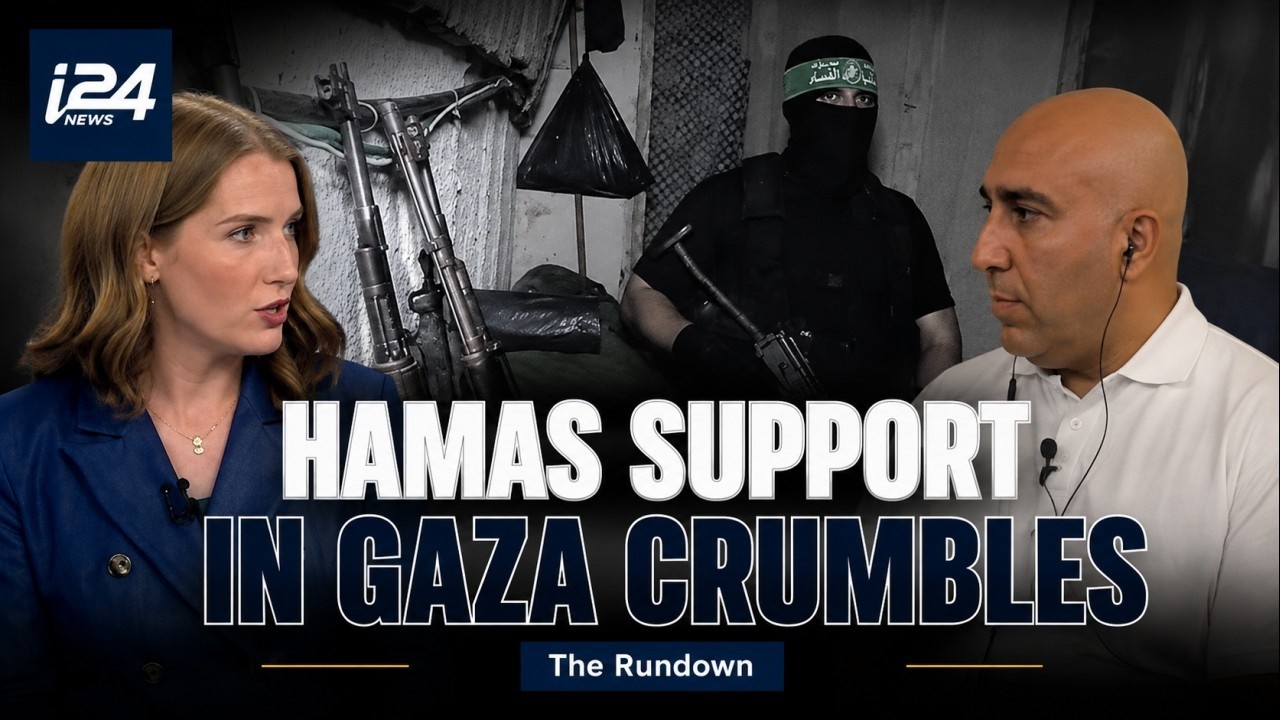
As pressure mounts to convert Gaza's ceasefire framework into a lasting peace arrangement, significant internal fractures have emerged within Hamas's military wing, the Al-Qassam Brigades, regarding disarmament and weapon handovers. Sources indicate that leadership concerns persist that Israel might exploit any disarmament process to launch further attacks or assassinate Hamas leaders. These fears are compounded by a sharp decline in Palestinian public support for the group, particularly in the West Bank, where fewer citizens now believe Hamas emerged victorious from the war. Despite this waning popularity, a major obstacle remains: a large majority of Palestinians still oppose Hamas surrendering its weapons before a full Israeli withdrawal from Gaza, highlighting the complex interplay between internal security fears and public sentiment.
The interview with Sameh Snishlawi, head of the new Masar Jadid Palestinian Party, reveals that these divisions stem from the total destruction of Hamas's traditional chain of command since October 7th. While political elections have occurred and Khalil al-Hayya leads the political bureau in negotiations, the military wing on the ground has effectively dissolved into chaos, with individuals acting independently rather than under a central authority. Snishlawi explains that many fighters now view their weapons as personal property worth significant value, serving as their only means of protection against angry crowds or rival gangs. Consequently, he argues that disarmament cannot be a one-day event but must be a supervised, multi-stage process enforced by a new Palestinian technocrat government to ensure it serves national interests rather than just external demands.
Public perception data from the Ramallah-based Palestinian Center for Policy and Survey Research underscores a dramatic shift in sentiment, with satisfaction levels for Hamas dropping from 66% ten months ago to 45% in the West Bank and falling to 38% in Gaza. Snishlawi attributes this decline not only to frustration with current leadership but also to a clear desire among Palestinians for democratic change that can replace destruction and corruption. He emphasizes that upcoming elections will likely show even lower support for both Hamas and Fatah, as the majority of the population seeks an alternative politics focused on providing services, education, employment, and reconstruction. Ultimately, the poll suggests that while frustration is high, hope remains for a new path that prioritizes coexistence and development over continuing cycles of violence.
Read the full video transcript
As pressure grows to turn Gaza's
ceasefire framework into a lasting
arrangement, I24 News has learned that
there are major disputes within the
leadership of Hamas' military wing, the
Al-Qassam Brigades, when it comes to
disarmament and actually handing over
the weapons. There are concerns within
the terror group that Israel could later
exploit this to carry out further
attacks and assassinate the Hamas
leaders. While at the same time, a new
Palestinian poll shows support for Hamas
has dropped sharply, particularly in the
West Bank, with fewer Palestinians
saying the group emerged victorious from
the war. But the survey also underscores
the central obstacle ahead. A large
majority still oppose Hamas giving up
its weapons before a full Israeli
withdrawal from Gaza.
Joined now by Sameh Snishlawi, head of
the new Masar Jadid Palestinian Party.
Sameh, great to have you with us on I24
News. A source from within Hamas told
I24 News that there are these major
differences within the Al-Qassam
Brigades over restricting weapons. How
significant could those internal
divisions actually be?
>> Well, I can understand these divisions
because now Hamas is not exactly what it
has been on the 6th or the 7th of
October.
The uh uh
chain of command has been totally
destructed and disappeared. There is a
lot of chaos.
The The organization is not acting as an
organization, especially when it comes
to the military wing. Yes, on the
political level, there have been
elections. There have been the political
bureau that is functioning now. Khalil
al-Hayya is the head. He is handling
negotiations even with top American
diplomats. But on the ground, the
military wing has been totally
disappearing little and little, and
there is no central command. So,
uh the individuals there who have been
still uh uh
present on on the ground are taking more
individual decisions, and especially
when it comes to disarmament, you know,
a piece of of arm like a Kalashnikov in
Gaza worth around 100,000 shekels. And
any any Hamas member believes now that
this is his own property. He he owns it.
It's not the organization anymore. There
is no organization. There is no
central command that is
above him. Uh
and
it's not only the value of of of the
gun, it's also that this gun is becoming
his only source to protect himself maybe
from angry
crowd in the future. So, we can we can
understand that there would be a lot of
difficulties in the disarmament. That's
why I keep saying that disarmament of
Hamas cannot be a one-day event. It is a
process and it should be
a process that is supervised,
implemented, and enforced by Palestinian
uh
leadership, by Palestinian new regime,
by the technocrat government, the
technocrat committee that is supervised
and empowered by the board of peace. And
this process should
you know
it start. The trigger is the change of
power. We need to get back the power
from Hamas and then using this power
including the
the the ability to enforce law into
forcing the disarmament on every
individual including Hamas, including
there is a lot of chaos now in in Gaza.
There are lots of arms again among
families, among gangs. It's a big mess.
And it needs a certain process that is
tough, that is determined, that is
accurate, that we understand that we
need to do it as the Palestinians out of
national interest, not because only
Israel demands it, because we the
Palestinians need, because this is the
first step for a new future, for hope,
for the Palestinian people, for
development, for the reconstruction of
Gaza, it starts with the disarmament of
all the groups including Hamas in Gaza.
>> Well, we're staying on the public
perception right now of Hamas. This new
poll from the Ramallah-based Palestinian
Center for Policy and Survey Research,
it says in the West Bank 45% of
responded
they're satisfied with the terror group.
That's 45% but that dropped from 66%
that were happy with Hamas 10 months
ago. Somewhere in Gaza, that number is
38% that are currently happy with Hamas.
What do you think is driving that
decline?
>> Well, let me tell you that
uh
the only real
poll
that will really give us an accurate
uh reflection of the Palestinian public
opinion will be the elections on the
28th of November. These polls, I think
the margin of error is very big but they
show you some tendency and I think they
are accurate.
This tendency, first of all,
they show clearly that the Palestinian
people are frustrated from the current
leadership, whether it is Hamas or
whether it is the current leadership in
in in Ramallah. But at the same time,
where frustration is clear,
it there is something that also clear
that the Palestinians did not
uh lose hope of a democratic change.
They still see that there should be some
kind of a new path
uh of of an option that will replace the
destruction of Gaza and the corruption
in the West Bank. So, frustration is
there but hope is still there.
Second, I think uh the poll focuses a
lot
about the
different
political options. Some of them are not
realistic. Okay, putting Marwan
Barghouti together with other candidates
and running a poll, it's like telling
the Israelis, "Would you vote to Ben
Gurion or uh uh Gantz or or uh
Lapid or Bennett or or or Netanyahu? Uh
there is something not realistic. People
will not vote this election on the
Palestinian side will not be a vote a
choose between parties. It will be a
vote between two options. Whether the
Palestinians would like to stay for
another
uh circle of violence and suffer and
pain and and uh
uh you know blood on both sides or will
the Palestinians choose for a democratic
change, for hope, for construction, for
dialogue, for coexistence? These are the
two options. It's not choosing between
political parties, it's choosing between
those two options. And I'll tell you
something
maybe uh to a little bit ease
the the fear among Israelis from the
Palestinian election. I think the
Israelis should not be afraid of the
Palestinian
elections. I think that allowing the
Palestinians to choose democratically
their their leadership will be maybe in
the best interest of Israelis because I
do see according to this poll also that
the tendency for a change is clear.
Together Fatah and Hamas are less than
45%
and in reality you will see on the day
of election that it is much less than
this. The majority of the Palestinian
people, maybe 60% of the Palestinian
people are looking for something
different, are looking for a politics
that can better their lives. Okay, we
want to reach to a Palestinian state
next to Israel, but why should we suffer
while reaching there? Why don't the
Palestinians deserve to have a
government that provides services, that
provide better education, that provide
employment, that focuses on
uh uh
simple needs of the Palestinian people
because Palestinian people are also
families who would like to live a better
life. So, we see tendency towards
choosing an alternative, something
better than Hamas and Abbas.
>> A positive look towards the future, it
sounds like. Sami Abu Zuhri thank you
for being with us on i24 News today.
Appreciate it.