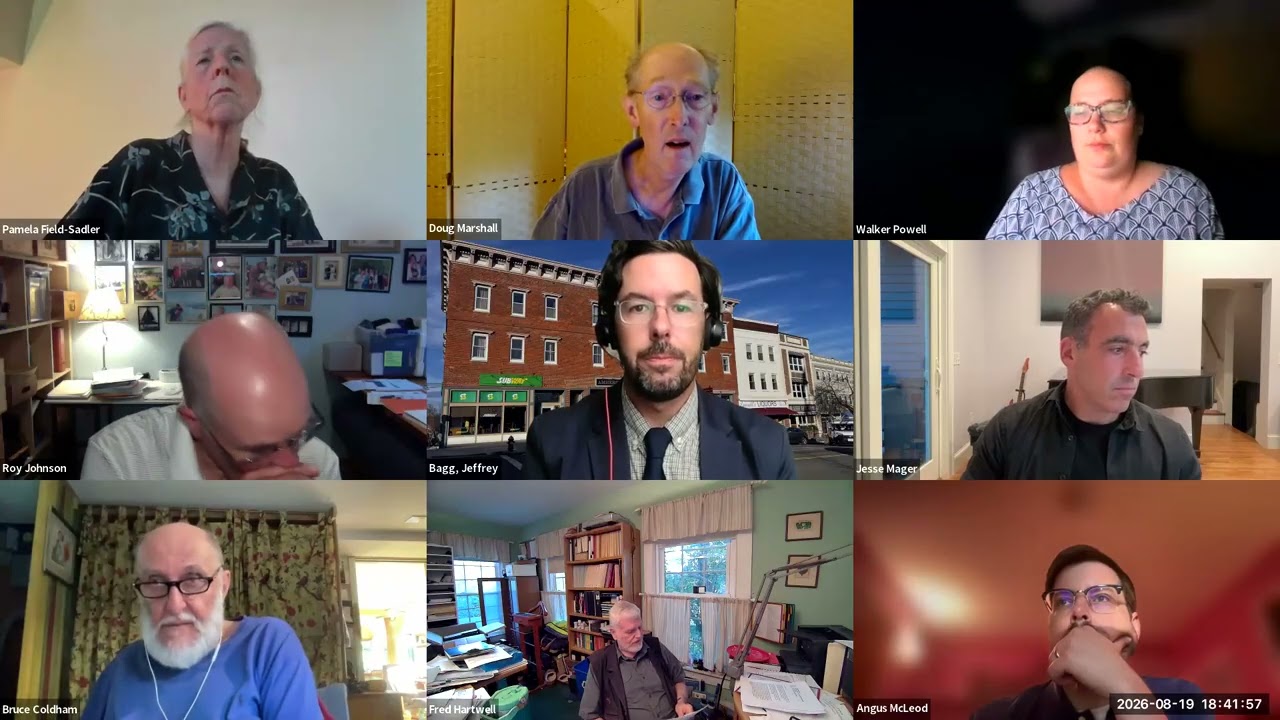
Video summary
The Amherst Planning Board convened on August 19, 2026, via Zoom due to technical limitations that prevented in-person public attendance, beginning with the approval of previous minutes before shifting focus to a critical zoning study for the Hampshire College campus. Jeff Bag, Director of Planning and Economic Development, introduced consultants Horsley & Whitten Group and U3 Advisors to outline a twenty-week process aimed at producing draft zoning amendments by January 2027. The proposed strategy emphasizes public engagement through workshops starting September 14th, alongside GIS assessments indicating that while approximately 200 acres of the nearly 800-acre campus are developable, significant portions remain protected as wetlands, sensitive habitats, or farmland. The board's goals prioritize housing diversity, small business growth, and tax revenue generation while ensuring infrastructure capacity is sufficient for normal improvements, all within a framework designed to avoid over-complexity by learning from precedents like Village Hill Northampton.
In parallel discussions regarding the East Amherst Historic District, the board reviewed a revised proposal to nominate 22 properties, addressing earlier concerns that designation might hinder infill development in an area with mixed zoning near commercial strips and a new school. While some members expressed hesitation about limiting future intentional zoning changes, others argued that historic districts rarely act as significant barriers to larger-scale projects and emphasized the urgency of preserving pre-Civil War architecture to maintain Amherst's historical character. The debate highlighted the architectural diversity of the East Village and the risk that overdevelopment could diminish commercial activity and housing variety, with speakers urging support for the nomination despite mixed owner sentiment and concerns about potential impacts on property values. Ultimately, the board recognized the Local Historic District Commission's limited authority but agreed that the effort invested in this initiative had a "sell-by date" requiring immediate action to align with the town's master plan responsibilities.
The meeting concluded with a decisive vote to recommend the adoption of the revised historic district nomination to the Town Council, passing 4 to 3 after board member Bruce Coen recommended the move despite his earlier reservations about owner sentiment. Following this decision, the board turned its attention to zoning amendments for PRP districts, agreeing that members Roy and Angus should draft a memo based on previous discussions and input from staff director Jeff Bag to clarify regulations and prevent future conflicts regarding ADU bylaw appeals. Throughout the proceedings, the board balanced the town's "once-in-a-generation" opportunity to explore diverse development options, such as workforce starter housing and efficient multifamily units, against the need to protect educational uses under Chapter 4A Section 3 regardless of zoning changes. With these key items addressed, including updates from staff reports and committee reviews, the Planning Board adjourned the session and confirmed the date for their next meeting on September 2.
Read the full video transcript
Okay, Mr. Marshall, let's see. You have
a quorum of the board. We are recording
this meeting. You are the co-host of
this meeting and the attendees are
coming in. I think we're ready and good
to go.
>> All right. Thank you.
>> You're welcome.
>> Welcome to the Ammeris Planning Board
meeting of August 19, 2026. My name is
Doug Marshall and as chair of the Amoris
Planning Board, I'm calling this meeting
to order at 6:35 p.m. This meeting is
being recorded and is available live
stream via Ammeris Media. Minutes are
being taken
pursuant to chapter 20 of the Acts of
2021, extended by chapter 2 of the acts
of 2023, and further extended by chapter
2 of the acts of 2025. This meeting will
be conducted via remote means using the
Zoom platform. The Zoom meeting link is
available on the meeting agenda posted
on the town website's calendar listing
for this meeting. No in-person
attendance of the public is permitted.
However, every effort will be made to
ensure the public can access this
meeting in real time via technological
means. In the event public access is
disrupted for any reason, we will post
an audio or video recording, transcript,
or other comprehensive record of
proceedings, as soon as possible after
the meeting on the town's website.
Board members, I will take a roll call.
When I call your name, unmute yourself,
answer affirmatively, and return to
mute. Bruce Coen,
>> I'm here.
>> Brad Hartwell.
>> Brad is here.
Jesse Major
>> present.
>> I Doug Marshall and present. Angus Mloud
has told us he'll arrive around 7
o'clock this evening. So we'll look for
him. Roy Johnson
>> present.
>> And Jara Smith
>> present.
>> Thank you all.
>> I'm also present.
>> Technical issues. Oh, Angus, good to see
you. Sorry, I just joined.
>> All right. Thank you.
If if technical issues arise and the
discussion needs to pause, it will be
noted in the minutes, please use the
raise hand function to ask a question or
make a comment and I will call on you to
speak. If speaking, remember to remmute
yourself.
To the general public, the public
comment item on tonight's agenda is for
comments on topics not appearing later
on the agenda. Please hold comments on
those later specific topics until we get
to those topics. When public comment is
solicited, please indicate you wish to
make a public comment by clicking the
raise hand button. If you have joined
the Zoom meeting using a telephone,
please indicate you wish to make a
comment by pressing star9 on your phone.
When called on, please identify yourself
by stating your full name and address
and put yourself back into mute when
finished speaking. Residents can
typically express their views for up to
three minutes or at the discretion of
the planning board chair. If a speaker
does not comply with these guidelines or
exceeds their allotted time, they may be
disconnected from the meeting.
All right, time is 6:38. We are all
assembled. So, we'll go ahead to our
first uh denda topic, which is approval
of minutes. We have the minutes from May
6th available for approval.
Uh, does anybody have comments or
want to make another make a motion to
approve? Jesse?
>> Yep, I read them. I thought they were
quite fine capturing the discussion. So,
I would move to approve the minutes as
they are.
>> All right. Uh, if does anyone else have
any comments or would someone like to
second the motion?
Okay, then uh I guess I'll assume there
are no other comments and I'll go ahead
and second the motion.
All right, last call for comments on the
May 6th minutes. All right, we'll go
ahead and vote for approval.
Starting with you, Bruce.
I am voting to abstain since there's a
full board here and and I was not
present to the meeting.
>> All right. Thank you, Fred.
>> I
>> and Roy,
>> I'll abstain. I wasn't at the meeting
either.
>> All right. Jesse,
>> I
>> Jar
>> I.
>> And Angus
>> I.
>> I'm an I as well. That's four in fav. S
five in favor and two abstensions. The
motion passes.
All right. Thank you all. We'll go ahead
to the second item in the agenda, which
is the general public comment
topic.
So, uh, members of the public, this is
the time to make comments about items
that don't appear later on our agenda.
So, um, I also typically read the names
of the attendees I can see, uh, on the
Zoom screen. So, while I'm doing that,
if you have a comment you want to make,
please raise your hand.
I see Kathy Axelson, Barry, Dodson, and
Flinker, Hilda Greenbomb,
Jeff Davis, Nate Kelly, Peter Flinker,
and the Ammerst Notetaker.
All right. Um,
still don't see any hands raised. I know
several of these attendees are here for
items on later on the agenda. So
I guess we will conclude that there are
no public comments today.
All right, time is 6:41. We'll go ahead
to the third item on the agenda,
which is a presentation on the Hampshire
campus zoning study. Uh we have Jeff Bag
here, director of planning and economic
development from the town to introduce
the topic. Um Pam, I know he has a
couple of uh consultants that need to be
brought in. Um
so if you can do that and um I will just
say upfront uh it's my understanding
that this is anformational session for
the board to be updated and the public.
Um, so,
uh, it's not a public hearing. We won't
have to have public comment, but, uh,
if, uh, it looks like we have relatively
few members of the public attending. So,
if if there are any that want to make a
brief comment at the end of this
presentation,
uh, I will ask for that at the time of
the at the right time. Okay. So Jeff,
welcome and u welcome to your
consultants and uh take it away.
>> Yep. I'll start off really quick, but
thank you for having us. Um the board
members should have a memo in the
packet. Um so it's available on the
website and then at the conclusion of
tonight, we'll make the slide
presentation available so that can also
be included in the packet. Um we're
really happy to be with the plan board
tonight. you know, it's really a first
time to be engaging with with you as a
board on um the Hampshire College
resoning project. The request was for
the members to watch the community
meeting recording. So, we had a first um
community engagement session on July
21st. So, it's kind of a really ground
setting the foundation and and
establishing the groundwork. We're going
to just do a really brief recap of some
of that and then kind of move forward
with some of the continued discussion um
towards a zoning amendment package. And
so, um, we're really thankful to Mass
Development who is offering the town
this technical assistance. And, um, you
know, we are also going to be going to
the town council for a work session on
August 31st to engage with the town
council as we continue on this process
of a multi-step engagement. Um, and then
we'll talk about the schedule in a few
minutes. So I think with that I will I
will cover a couple slides along the way
but I am going to hand it over to Nate
Kelly who's the president of Horsely
Whitten Group to kind of kick us off
share screen and walk us through the the
project to date. So so thank you again
for having us.
>> Thank you Jeff and thank you planning
board. I echo those sentiments. Thanks
for having us here tonight. I'm going to
try to uh share our screen here
and
All
right, we can see your screen.
>> All right, thank you for that check-in.
One never knows. You've done this 50
times and all of a sudden you don't do
it correctly. But thank you for that.
Um, and so again, I'm Nate Kelly. I'm a
principal planner and president of
Horesley Whitten Group. And I'm joined
here tonight uh with my friend and
colleague Peter Flinker, who is probably
no stranger to many of you, has done
quite a bit of work u with facilitation,
design, and um all sorts of great
planning work in the Amherst area. And
as Jeff said, we'll go through this
pretty quickly tonight. You've seen some
of this um but it is good to run through
it a bit um to give some context but we
have some added detail uh related to the
public process project schedule and then
some of the things that we're starting
to think about uh relative to the key
questions that need to be asked. Kind of
getting into a sort of a bigger level of
detail. Um thinking about the area,
thinking about the site um and also
thinking about the zoning. this is a
zoning project and how we want to
approach this. Um so with that again
we'll just do our introduction which
we've taken care of go through some of
the process. Uh we'll recap for viewers
and everybody just the alignment with
town plans. Um again you're no stranger
to a lot of this material but it's
really great for us as consultants to
come into a community and see the ties
see the policy context that's already
been set. Um, and it's really important
to come back to that uh repeatedly. So,
we, you know, we have our compass, our
north star as it were, going through
this. And as I mentioned, we'll talk a
little bit about early zoning
considerations. Um, you there's still a
lot of work to do in that regard,
thinking about our best approach, our
best fit for a for a complex site like
this. Um, but this is something that,
uh, we've looked at a lot over the
course of, you know, the last 20 years
or more. uh Peter and myself thinking
about different ways to uh approach this
from the regulatory context and then we
can open it up for some early
discussion. So our team again is of
course town of Amherst and Jeff
mentioned Mass Development um provided
uh the resources for this Whitten is a
is what Mass Development calls a house
doctor. We're on call uh with with mass
development and do quite a bit of
technical assistance assist assistance
with them on projects of various scales
but a lot of it is this pre-planning and
zoning work. We are Horsesley Whitten.
Uh not with us tonight is U3 Advisors
who is as the process goes on, they're a
real estate uh economic development
firm. And so once we start to look at
different scenarios and think about
different ways this site could be used,
U3 will help provide some market context
for us and look at some fiscal
scenarios. So as we think about
different mixes of whatever it may be
that occurs on the site um they can um
again provide that context. Is it
realistic? Uh what are some of the
barriers or opportunities from a market
perspective? And then if we want to test
ideas they could say well here are the
costs and benefits uh that the town can
expect uh from different outcomes. And
then lastly, Dodson and Flinker will um
help us really through uh the some of
the heavy lifting around um how we
visualize and think about how the site
is going to be used. We'll have plenty
of community engagement uh that's going
to operate on different levels. Some of
you have already attended our first
event u but we're really going to get
into that um uh soon with a sharet
process that Peter will talk us through.
I mentioned we have fiscal analyses that
are going to occur and we're monitoring
infrastructure all the way through.
We're not doing indepth sort of
infrastructure feasibility but we've had
some preliminary conversations with
folks who you know are in charge of your
infrastructure uh thinking about what
the challenges may be in the future um
and how those will get managed. And then
our goal ultimately is to have dra full
draft of the zoning um in January and we
can head into the adoption process at
that time.
Peter, I will ask you at this point um
this is a sort of a new slide uh where
we've really started to map out of how
this process because it is is pretty
complicated um and we want to get to
that January time frame. So take it away
Peter.
>> Thanks Nate. Good evening everyone. So
yeah, we have um I guess the good news
is this is a great time to do public
participation. People are coming back
from the summer. Uh it's a great time to
do public meetings. Um the bad news is
we're trying to get everything done in
the next basically the next 20 weeks. Uh
so you see across the top of the page,
it's sort of se starts in September and
goes through December. And this of
course is the sort of a phase two uh
schedule. We've already started
collecting a lot of information about
the site and then we had the public
forum last month. Um so our goal
really with this with this process of
course is to produce draft zoning
amendments but have those based as much
as possible on real ideas for the site.
So to get to those ideas, we're going to
start with a public cheret. uh hopefully
the week of September 14th uh maybe
Friday and Saturday September 18th and
19th and at that chet we'll be sitting
down in large groups and small groups
and doing our usual um collection of
exercises to try to help people
understand the site, understand the
history, and then think about what's
possible in the future. And that's going
to produce hopefully half a dozen
different alternatives. And over the the
rest of September and the beginning of
October, we will refine those concepts
into some clear alternatives and then
present those to a series of small
groups, focus group meetings. Those
could include residents of Applewood and
the surrounding um neighborhoods around
Hampshire College. They could include
members of the Hampshire College
community itself.
uh town staff and officials um and be
interested to hear from you who you
think it's important to meet with. And
then the idea is to sort of have a
chance to have a conversation with each
of those groups about different ideas
and through that sort of flesh out are
these the right alternatives? What
additional things do we want to explore?
and then over the course of the rest of
October to sort of refine those into a
series of clear concepts and
alternatives for the site and then to
present those the first week in November
at a second public workshop and then in
conjunction with that we'll have sort of
web- based feedback. So people who can't
attend the workshop will have an
opportunity to look at and comment on
the different ideas. Then following
that, we'll have a period of review with
our team internally and the town town
staff and elected officials uh to
finalize the scenarios and then move
forward to some final illustrative plans
over the course of uh the second part of
November and then trying to finish the
sort of illustrative plans by the middle
of December.
Meanwhile, um if you look toward the
bottom of the screen, um starting in
October with the sort of the first set
of wellthoughtout concepts, uh U3 will
do uh some fiscal analysis to understand
sort of what the how the market right
might react to those concepts, but also
just as importantly what the
implications would be for town finances
and services. And then they'll do that
again with the final set of illustrative
plans in December.
And then there's at the bottom a
separate track for looking at zoning
which we'll be doing collectively as a
team but led by Horsely Whitten. sort of
starting out with uh exploring different
zoning approaches uh different
alternatives for zoning and then as we
get through into October and November
trying to refine those into a clear path
for the best fit between the zoning and
the site plan
goals
and then finalizing uh draft zoding
amendments by the end of the year for
presentation in January.
Okay, we'll come back to that a bit when
we get to the end here. You know, again,
just to recap, um some of the local
context and especially there's, you
know, anybody will watch the recording
of this. You know, the the top
priorities
have were stated by town council um in a
vote on June 1st, 2026. And these
priorities focused around housing, small
business development, and tax revenue
generating uses. There's a clear
acknowledgement that there's some
sensitive lands here, sensitive habitat,
farming, other resource areas. There
needs to be a balance and adequate
protection for those areas. With regard
to the housing development, I think
there's a recognition on the part of
this this resolution um that this is an
opportunity to provide a wide range of
housing types. Um perhaps a once in a
generation opportunity for a community
like Amherst. And of course, all of this
needs to be um considered in within the
context of services and facilities. What
are the opportunities here? What are the
things that the town uh could take on uh
to help better serve uh the folks who
live here?
We have had preliminary discussions
about utilities. I think the takeaway
here is that there are no major red
flags. Um there are some utilities on
site. There are some extensions that
would certainly be needed. There are
some upgrades that would certainly be
needed. But generally speaking, when you
look at the capacity uh of the roadways,
when you look at the capacity of the
water and the sewer, again, there are
really no major barriers anticipated
here uh beyond what you know again the
normal improvements that need to take
place as part of a significant
development project.
The current zoning as all of you uh
certainly know um this is really part of
the urgency of this project is right now
the core of this is the ED district um
which allows basically for one thing to
occur and that's you know what's been
occurring there since uh the the college
was established and so that um changes
need to occur in order to meet any of
the of the um potential options or
different uh ideas that may uh be
floated.
Um, importantly, there are areas around
um the the the core that are zoned for
lower density residential. Uh, so that
provides some important context. And
there's some the farm overlay district
in this area that provides special
considerations and protections and
encouragement uh for the continued use
of some of these areas uh as
agricultural use.
And then this was a a map um that we
spent a little time using some desktop
analyses. Maybe Peter you can just give
us a quick uh walk and walk through on
how we came to this and how this helps
us.
>> Yeah, I mean as as so you know that the
entire Hampshire property is close to
800 acres
>> with about um 630 of those acres in the
town of Ammerst. And so this was kind of
our usual site assessment process to try
to understand how much of that is
actually developable. And of course this
is as Nate said a remote process using
existing GIS data. Probably the most
important thing to remember is none of
the wetlands
um have been surveyed in the field and
would have to be before determining
what's actually developable. But what
this shows is wetlands and water bodies
and the associated buffers. It also
includes hydric soils which are likely
to include um additional wetland areas.
And what we learned is sort of what you
you understand through common sense if
you drive around the site, which is
there's a a high and dry central plateau
that sort of runs north and south
through the campus. And that's where
they built the majority of the campus
buildings. And then the water drains off
to the east and west into uh the various
brook systems. And as you get further
down into those brooks, it gets less and
less uh developable probably. And as a
result, I think our preliminary
conclusion that there's probably at
least 200 acres that are developable,
probably more uh subject to uh more
intensive site review. Um but that a lot
of it is also sensitive habitat and
wetland areas that probably cannot be
developed under current regulations.
>> Great. And you know in terms of context
I won't spend a lot of time on these
slides but you know your 2010 master
plan which was readdopted in uh 2020
um really just provides again some
really sound uh policy frameworks
relative to land use, housing, economic
development and sustainability that will
carry forward um through this process as
an important backdrop um again as an
important policy foundation um
supporting wellplanned mixeduse
communities.
uh on the Hampshire campus
in 2021. The comprehensive housing
policy um talks about providing housing
that balances the needs for students,
families, and seniors, promoting home
ownership, increasing housing supply,
that variety that we talked about, um
promoting climate sustainability, and
aligning and leverage multiple funding
sources to support affordable housing.
So, these are important for us to carry
forward in this process. continuing to
build into the housing production plan
which provides some really good fresh
data for us. Uh that helps us think
about the different needs that could be
fulfilled uh looking at this site in the
future. Um so it really does you know
again we won't spend a lot of time going
through this. I think most of you are
familiar with this, but these are just
really important um uh sort of
documentation that again as consultants
we'd love to see this going um coming
into a process like this because it
really gives us something sort of firm
to stand on as we go forward.
Um, in terms of local precedents, um, we
had talked about some of the, uh, you
know, Jeff talked with us a lot about
some of the most more recent, um, zoning
efforts that have occurred in the
community and the developments that have
come from that. Maybe Jeff, I could just
ask you to, um, talk about how these are
useful to us.
>> Yeah, thanks. you know, so since the
town went to town council formal
government, there there's not that many
um things that we can go back to, but we
really want to sort of highlight
University Drive overlay district and
the effort, the thought that went in and
how that actually has resulted in
development to occur, which was the
goal. And so kind of the overlay
district is a success story that we want
to kind of look at. Here it says it may
be more about the intent rather than the
specific uses and that's something that
we have to tailor as we move down south
to the college campus. But uh five
university drive is an example that has
benefited from the zoning change, the
predictability and some of the some of
the things that the plan board spent a
lot of time and you know town council as
well spent a lot of time on crafting. Um
and then you know um the time that the
planning board and the zoning
subcommittee has spent looking at North
Ammerst and the idea of the overlay
district over some of the existing
apartment complexes also gives us a
guidepost to kind of look at and um
while we're acknowledging that it wasn't
imple implemented it was kind of held
back for a little bit. The idea of
looking at an area and encouraging
certain types of development to occur in
a predictable way is really a great idea
and a great model that we want to look
at for for this area. And then I think
just kind of we have a lot of project
examples, but the two that we kind of
called out are some of the housing types
that we see is some of the larger
buildings, um, rental units and that
kind of thing. And then you know the the
project on Monagu Road the the 30
affordable home ownership units is
something else that we can start to to
look at and understand that there is
demand for that and how could it
potentially fit in the context of the of
the of the college campus land that's
available. So those are you we're
starting to backfill a lot of that
information to the team so that they can
see where um we've had success and I
think we can go to the next slide.
um some of the constraints as well. So
um on the left, you know, we're really
um looking at the site for the first
time. It's just it's just always existed
as uh Hampshire College and the town
hasn't really investigated it. And so
that's that's really what the team has
been doing since since we started is
really just kind of catch up on a lot of
the baseline information that we often
get if we're looking at like East
Ammeris Village. you know, the, you
know, we have information and we've
looked at some of those areas and
they've been zoned. Um, here we're
really starting from scratch and so
looking at um the resource areas and,
you know, acknowledging that there are
farmland and conservation interests that
are kind of surrounding the campus
infrastructure as was mentioned and then
really just this opportunity that it's
presenting itself for the town to uh
meet some of its housing needs, also
produce much needed tax revenue and so
there's really an opportunity here. Um,
and then the challenges, you know,
there's a couple projects. The plan
board has gone through a couple of
these. Um, you know, it's a variety of
different challenges that we that we
want to walk through when we look at the
zoning. Some of it has to do with the
the community character, the resource
areas or the location. Um, all of which
we see some potential benefits um with
this the way that the college has been
laid out and and its location close to
roads and infrastructure and things like
that. So, I think um I don't know what
the next slide is. if you can go to the
next slide. I think this is where I'll
hand it back over to either Nate or
Peter to talk about a couple case
studies.
>> Yeah. And so, thank you Jeff. So what
we've been doing um all of us on the
consultant team have some experience um
in different communities where this sort
of larger site u you know single
opportunity uh has come up and so we we
brought our own experience with a few of
these projects and then we've uh reached
out into the planning community and then
done some of our own research um to pull
together uh probably about a dozen
different case studies that We're still
combing through to make sure that we
understand. Um but you know, it's just
it's always good to know how this has
been done elsewhere, right, before you
start to try to reinvent the wheel. And
so we've looked at a few different um
examples uh that were brought to this
presentation. Uh but again, there's more
sort of back in the lab, if you will,
that we're we're looking through and and
thinking about, you know, where is it
relevant, where is it not relevant to
Amherst. And um one that you all are for
familiar with is the Village Hill
Northampton. And this is a 126 acre
master plan community. Um combining
commercial, R&D, light, residential
uses. Um and it really uh is just again
it's a good visual uh for everybody uh
who's who's been there to see how these
different uh uses can be woven together
in sort of a cohesive concept. but one
that gets built over time. Um and so we
thought it was important to look at both
the outcome and the approach. Uh there
are some unique uh aspects of this from
an administrative aspect that make this
really different. You know the the
presence of mass development uh as a as
a key player providing a lot of
administrative capacity and oversight.
That's something that's going to be very
different from Amherst. Sammers is going
to be um you know administering this at
the town level through their normal
development processes. So it's a little
bit different in that regard. Um but it
is nice for us to look at sort of a
success story here that evolved over
time and ask ourselves questions about
the design. What makes this a good
output? Um how does this or does this
not apply uh to Amherst? They are
interestingly they they started out with
a special permit process with their plan
village district um and it appears as
we're reading this that it evolved uh
into a 40R when those provisions and
those incentives became available. So
the foundation changed from a special
permit process uh to a byright process
over time. Um but still uh good to look
at those different design aspects and
how they baked that into their zoning.
Uh with Sudbury uh there was the Rathon
property. So this was a major
manufacturing operation uh out in
Sudbury, Massachusetts.
um where you know they really had a
considerable amount of uh potential uh
developability there. Uh which turned
into a really nice uh mix of housing and
commercial uh development. Uh big sort
of plaza concept, very walkable in the
way it's set up. Sort of like a
lifestyle centers is one of the planning
terms that you'll hear. Uh but it's got
the mix of grocery and everyday goods
and restaurant. Um and that one was set
up um with with a lot of oversight in
the beginning. This is an interesting
concept where they actually required a
physical master plan to be approved at
town meeting with a twoth3 vote. And so
that was a high bar uh for the developer
to get through. After that high bar,
from that point the approvals, the
individual approvals have essentially
been administrative. So they really
frontloaded the scrutiny on this and
then when they were happy with that they
sort of let the normal uh building
permit process take over
uh with Retham Village. So this is not
the Rentham outlets. Uh this is Rentham
Village. Uh this is an interesting site
where they have their traditional town
center. U but right adjacent to it just
to the north is the old Tao industrial
site. So again, another sort of
largecale 50 acre um
site that has a unique uh development
opportunity and it's right adjacent to
you know a wellestablished town center.
Um so they had sort of a an interesting
setup of uh you know two different
districts an A and a B and those were
further subdivided. So the scale of this
project, not particularly large, allowed
them to really get in there and think
about sort of different zones, different
subzones, um, and how they wanted to to
move this forward. Um, and the special
permit does play a role, uh, in this
particular, uh, process as well.
Interesting. Another interesting note
here is they have it's pretty much a
mandatory pre-application process. So
this helps them to sort of set the stage
early with developers of sort of larger
scale chunks of this as they go through.
Um in Great Bington there's the campus
overlay district. Um so this is uh an
area that um encourages this is where
Bar College campus uh was and this
encourages a mix of uses um and operates
on different scales uh very similar to
sort of a conventional um zoning piece
where they have a mix of special
permits, a mix of you know and it really
depends on the density. So certain
densities are going to be allowed um
with a lower level of scrutiny and as
you get up the ladder they they sort of
ratchet up uh their different permitting
process. Um so modest densities again
site plan review and several of the
districts especially with some existing
structures. The higher you go the the
more that special permit uh sort of
kicks in along the way.
And then of course we are looking at
your existing zoning. you have some
tools in the toolbox here. Um, and we
look at something for example like plan
unit residential development. Does this
have a place or something like it have a
place here? You know, this is something
that you're used to using. Um, so we
will look at this closely and see if
there are elements of this that we can
carry along. Um, Jeff, I didn't know if
you wanted to add anything to that, but
that's really what we're thinking there.
The only thing I'll add is it it's
probably not as well used as it should
be. And I think that's one of the things
that we can hopefully kind of assess is
is there something in here that's
holding things back and do we have an
opportunity to clarify or or adjust it?
And I think you'll talk about a couple
of the other zoning districts on the
next slide too which are very very
similar circumstances of kind of just
testing what we have and is it producing
the things that we hope for. Um I think
that would be what I would add.
>> Yeah. So here with the um you know the
resident village center, the business uh
village center um these are things that
have been tested that are at play in the
community. So what elements of these are
potentially scalable? What elements of
these could fit nicely into a larger
concept? Um so between those uh two
village center districts, the University
Drive, we've already talked about um you
know what's working, what fits, what
doesn't fit. So an interesting
observation is you know these are areas
where more than u one potential
principal building is allowed on a
single lot. That's really an important
consideration going forward. So our job
is to kind of go through sort of
surgically and look at these different
things um that we want to carry over
that we want to borrow that we want to
tweak um as we go into our sort of new
zoning uh that will be developed for
this.
Um, you know, other considerations,
we're looking at housing types. Remember
in the beginning of the presentation,
this is really an amazing opportunity to
provide a diversity of housing types.
So, what definitions, what controls do
you have in place now relative to
mixeduse apartments, different scales,
different densities, and we'll be
looking critically like, do those meet
the needs, and are there things missing?
are there just definitions of different
housing types that we need to fold in
here to make sure we get that rich
diversity that um could be a great
opportunity here.
And so here, you know, this as we get
close to the end here, as you saw in
Peter's schedule,
we're thinking very high level right
now, but we are thinking about, you
know, the different zoning elements
here, whether we'll be looking at an
overlay or a new base district.
Predictable permitting is going to be
essential here. in a complex site, you
don't want to fall into the trap of
making your zoning too complex. There's
already enough to think about and there
are good tools and good approaches in
here that can help make this
predictable, easy for you to administer
and attractive to the developer and good
for everybody because you know what
you're going to get. Um, and this idea
of master plan approval phase
development, as I mentioned, we'll be
looking at the plan unit residential. We
have to think about building reuse.
There may be an opportunity to reuse
some of these buildings and we don't
want to unintentionally
um draft zoning provisions that all of a
sudden makes that really difficult uh to
do going forward. If that's a good idea,
if that's a desirable use, I talked
about the definition of housing types.
Design standards will be key to this as
we go forward. How they fit in uh
remains to be seen. And then a large
site's going to have different ownership
opportunities. And again, we just don't
want to set up barriers to that um going
forward and make sure folks can
seamlessly integrate the experience of
multiple parcels even if they have
different owners across the site. And
then maybe you Peter you could speak a
little bit to you know what's the link
here between these questions and these
considerations and the sharet process
the public process that we're going to
be doing. Well, I think it's uh it's
easy to say but hard to do. But I think
where we've seen successful examples,
it's where there's the right fit between
the zoning and the site planning goals.
And so, as I said, what we're going to
be doing as we're thinking about
different alternatives for the physical
layout of the site and the types of uses
and the type of structures uh that we
want there. We'll be thinking about
what's the best fit with the zoning
strategies and how do we make it really
easy for developers to do a good thing
and sort of get out of their way while
protecting the town's um the town's
needs to ensure that there are no
negative impacts or at least reduce
those impacts. So that's it's going to
be an interesting interesting challenge.
Uh but one of the things we want to hear
from you tonight is uh what aspects of
zoning do you think are really important
to explore in this way
>> right and so we you know we had sent
along some primer questions um but you
folks um certainly I mean this is your
meeting you can you can bring forward
what you think is important u but you
know broadly we want to know what your
top goals are for reszoning the campus
why are those the highest priorities
what are your biggest concerns um as a
local official and what are your biggest
concerns for your constituents and the
public? Um you know, what specific
conditions, what kind of safeguards or
performance standards do you think are
going to have to be included in this to
to make it successful? Um what type of
housing, you know, what are the housing
types, the building heights, the
setbacks? was sort of the key zoning
elements um that you think either have
to be flexible or have to be really well
defined. Um so yeah, we're thinking
about you know what kind of
opportunities you think this presents
very broadly and looking ahead you know
20 years from now what's a really
positive outcome going to look like? So
with that I'll I'll pass it back to you
Mr. chairman and and um you know you can
sort of
have folks weigh in as you see fit.
>> Okay. Thank you Nate and thank you
Peter.
Board members,
any thoughts?
I know this this uh study was not
initiated at our request but
this is our chance to influence where
the consultant team is going.
Bruce. Um,
>> first of all, I was really raising my
hand to ask if we can take the uh the
visuals down and and see our ourselves
all together. There we go. Uh, but
basically it's accomplished. But not
seeing any other hands. I'll say
this in the presentation and what I've
seen and read about the intentions of
the town.
I haven't come across anything that I
have found to be
seriously problematic or something that
has galvanized my uh concern, shall we
say. I mean, it's not that I don't have
any and that I don't have interests. I
have many of those. But I thought it
might be useful to say that the general
intent here seems to be uh in my
judgment to be applauded. I think it was
the the the speed with which the the
town moved to secure the mass
development interest and the support and
then to engage the uh trio of
consultants and what's come so far is um
generally very encouraging from my point
of view and I'll I have other things to
say but I'll stop at that for the
moment.
>> All right, Angus.
>> Yeah, I'd agree with a lot of what uh
Bruce just said. Um, so it's great to
see the work that y'all are doing. Um,
and thank you for for coming here and
sharing Simo with us. Um, I guess I have
uh two questions about kind of process.
Um, I'd agree with Bruce that the the
priorities the town has put forward seem
in keeping with the master plan, the
housing production plan with the
opportunities this this presents. Um, so
I guess my my two questions for you all
are um, one, there are uh, reported
attempts to uh, by Hampshire alums and
other groups to try and raise money to
to purchase the land and keep it focused
on education on an educ some kind of
educational mission. Um, which would
would seem to run counter to the plans
that we're exploring here uh, for the
most part. Uh, so I guess one one and I
don't know how serious those are, but
but it's something that I' I've heard a
lot of people talking about. So I'm
curious how that's being thought of. Um,
and then uh perhaps connected to that um
I'm also curious how Hampshire College
itself is is figuring into this um and
the the likelihood that they'll be I
mean I know we're on this expedited
timeline, but Hampshire also seems like
it needs to sell the land quickly. Um,
so I guess I'm curious how you all are
thinking about this planning process
when Hampshire is simultaneously having
a process and conversations with,
you know, possible buyers um, who whose
vision may not be as aligned with this,
although through zoning we can control
to an extent what they can do. Uh, so I
guess I'm just I'm curious about those
kind of two things.
>> Jeff,
I'll try to take I'll try to take a stab
at that. I mean I think you know we have
been trying through the that community
meeting you know be very clear that we
are we are not making the decisions
about what happens um that is something
that's solely the responsibility and and
and the control of the college and the
trustees. Um however um you know zoning
is what the town does. Um, this is
pretty common for the town to zone
private property to assess and
understand and envision the the you know
what does the what is the best for the
town. So that's that's really our
opportunity and our our goal here. And I
think in terms of like the timelines and
over you know the questions about
timeline are great. They're great
questions, but the rationale that we
have is that we our best foot forward
and our best opportunity and our most
legitimate um process is to just jump in
and start. We don't want to wait um and
just sit around and find out what
happens. Um that's not going to serve
the residents of Amoris the best. And
it's also going to likely put us under
the most pressure possible is if we just
sit back and wait for a sale of some
sort to happen and then try to respond
to that, we would be behind the curve.
So we just try to position this that we
are communicating with the college.
They're aware of our process
um but we are moving forward and and the
thing that we're trying to do is do it
as quickly as possible so that we don't
interrupt what they need. We complement
it somehow. So this is options. I I said
in another meeting this is like a menu.
Uh we're helping create a menu of
options. Right now the menu is very
minimal opportunity for institutes of
higher education to to function here. Um
so we just want to open it up and we
want to use it use our plans and all of
our thought process to kind of set us up
well for the town. And then the one more
specific comment is in terms of
educational institutions or people who
want to reestablish educational use. And
we want to be really clear that that's
always an opportunity. So chapter 4A
section 3 has has certain protections to
uh educational institutions where you
know it doesn't matter what the zoning
is, they can always establish an
educational use. And so we're not
restricting them in any way. We're
actually just creating that menu of
other options. You know, understanding
that the town has so many needs and
they're really well established as Nate
said. I mean, the master plan and all of
our planning documents point us to talk
about a walkable village center here.
And so, we we just jumped in to act as
as quickly as we can. We're not rushing
it, but we just need to be approaching
this with erns because this this has a
real potential to uh be necessary and
also critical for the town. So this is
this is not like a blue sky exercise
that we just want to put on a shelf.
This will be utilized. And so you know
just to reiterate like the college is
has its own process and we'll be making
its own decisions but we are um really
considering what the town's needs are
and establishing what we can through
through zoning which is under the town's
control. So hopefully that starts to
answer that question.
>> Thank you Jeff
Brad and then Jesse.
>> Yeah. Um I generally support Jeff's uh
approach
but I have to ask um guys I have not
heard whether
uh UMass has been approached
uh to step in here because
uh I mean from the perspective of the
housing subcommittee uh we are very
aware of the uh effects on the of the uh
the pressures occasioned by off-campus
student housing of UMass students
and you know if uh it wouldn't be awful
if UMass stepped in here and said okay
now we have a whole bunch of basically
dormitories
and that would take a lot of the
pressure off of the uh housing the
adverse pressure off the housing market
if you mass got involved in here. So,
I'm just curious whether uh they have
been approached uh or whether that's out
of the question.
>> Jeff,
>> also try to answer that. I mean, I I
we are not in the position to be
approaching, you know, UMass or other
organizations. That's that that would be
something that would be the college.
This is the college's land. We are
working to establish the zoning that
would allow multiple different things to
potentially happen there. I think the
the key thing though, Brett, that you
did mention, which is which is
important, is housing and the the demand
and things like that. I mean, what the
town council initially voted on back in
June was that this is an opportunity to
potentially generate new tax revenue
from land that had never really been
considered as a potential option for tax
revenue. So over the coming months and
year, we're going to start hearing other
conversations at town council level
about deficits, budgets, structural
deficits, and things like that. And just
a growing need for the town to to
increase its taxable base. And this does
create this unique opportunity that
hadn't really been ever uh considered
until recently. you know, inviting UMass
um could have some potential benefits of
relieving some of the demand, but if it
immediately or just transfers and
continues to stay off the tax roles,
that's not going to benefit us in the
other way that um town council has
identified as a goal. So, it's a it's a
little bit of a balancing act there, but
I guess the bottom line is that to the
best of our knowledge, we're it's not
it's not something that the college is
is pursuing. Um that's what we think we
know. Um the college has a lot of its
own initiatives. The UMass has a lot of
its own initiatives. They have a big
program that they're launching to
investigate, you know, the condition of
all their facilities and buildings and
things like that. So I just don't think
that's going to be the highest or most
direct path forward. More so that this
is going to be sold and um we want to
just at least set the stage for for the
town to to kind of reap some kind of
benefit um if possible. So Fred,
hopefully that answers some of the
question.
>> All right, thanks Jeff. Uh Jesse,
>> great. Thanks and thanks for the
presentation. Um
overall very supportive of the approach.
Uh just one quick comment I guess you
sort of ended with looking at the
mechanisms we already have in zoning and
how that could fit in here. And in my
mind it it's almost like why go there?
like what this is a real opportunity to
do just different things we can't do the
rest of our town and like in you know in
subcommittee and planning board also
we've talked about 40R 40 Y different
types of things like that where we
couldn't figure out where it made sense
in our current zoning and to me this is
a really big opportunity to do that kind
of thing and do it differently there
because it is such a large
physical and otherwise opportunity um
and priority wise in my mind is sort of
the workforce starter housing would be
top of the list if you were asking us to
prioritize. So yeah, thanks.
>> Oh, thank you for that and I I couldn't
agree more. This is a a once in a
generation opportunity. So we'll, you
know, we like to do our homework and see
what's on the books right now, but we
will be thinking outside the books. Um,
most certainly.
Um, Angus, uh, go ahead.
>> Yeah, I was just gonna also, um, echo
what Jesse is suggesting. Um, that the
idea of a 40R district is is great
there. Um, I think the other thing that
I I was, uh, also thinking as as you all
were talking about possibilities. Um, I
remember talking with Nate Mallaloy
about um the the prospect of trying to
bring another grocery store into town or
something something like that and uh his
concern or what he voiced was that
there's not really places in town that
would allow for a whole lot of parking
for another grocery store um apart from
the big Y. Um this also seems like it
could be another opportunity and that
would be a major source of tax revenue
which could also be helpful. Um, so I
think also just trying to think about
what kinds of commercial spaces would
work there. Um, it's not a great
location for a lot of commercial spaces,
but it if if you were able to build if
we're able to build up some kind of a
walkable area, it's near Atkins, like
there there could be things that we
could that that could could be viable
there. Um, which I would I hope would be
included. And it sounds like y'all are
thinking of those kinds of things.
Yeah, that Sudbury example um I think
really speaks to um the kind of thing
you're talking about, Angus, in terms of
how they took advantage of those sort of
like larger um larger development
opportunities.
>> All right, Roy, you're next.
>> I want to commend the town for hiring a
group like Horley Whitten and um I
really like the examples that you gave.
you know, like I've been around the uh
village hill at Northampton and that
gave me a a picture of what could be
there. So, I just wanted to thank you
for doing that and any more that you
find like that I think would be really
helpful for anybody looking at what the
possibilities are there. Thank you very
much.
>> All right, before Bruce, before you go,
I'm going to jump in with just a couple
of responses.
Um,
one thing that I'll be interested in is
how you think about this parcel in
relationship to what we thought was
going to be a town center just south of
it. Uh, kind of around Atkins.
Um, which we found out, you know, with
the project that was proposed down there
a year and a half ago. Uh, there's a
fair amount of wetlands and it's fairly
difficult to develop.
So, you know, should the village center
that we envisioned not be centered on
Atkins or those roundabouts which are
frankly not very pedestrian friendly and
should it be centered on the Hampshire
campus?
Um, so you know, maybe we want to have
some village center zoning and some
other, you know, more commercial zoning
in a part of the property.
I guess the other thing, um, from my
perspective, we have a lot of single
family housing in town. We're going to
have a bunch of ADUs in town whether we
like it or not.
Um, we have a fair amount of what I'll
call multifamily, but you know, a lot of
it is student housing in downtown and
certainly there's the potential for more
around the university,
but we don't have
uh places like Amity Place, I guess,
which which are condos.
Um, reasonably, I don't know, maybe
there's what, maybe 12 units per acre.
Um, but those kinds of things uh are
fairly efficient in terms of land and
are taxable and they can function as
starter homes for families. They're not
single family homes,
but they are, you know, single family
dwellings which can be bought and sold
in the market.
So, I would I would encourage a fair
amount of consideration of of that kind
of development. Um, I'm more of a fan of
that than I am of
uh the sort of tiny little houses on
individual plots.
Um, which I although they're charming,
uh, I I'm not sure they're very
efficient in terms of land use. and um
they certainly demand more yard upkeep
than u some families may want to do. So
that's my two cents. And with that, I'll
turn it over to Bruce who's got his
hands up.
Um
I I I kind of agree. I I I I look at uh
this opportunity and so far as housing
is concerned my general sense is that it
should be more dense rather than less
dense. I think the uh the ball lane
example is probably kind of minimal in
terms of uh density and that we should
move up from a base slightly higher than
that. I also think that uh I I recall
that the board the planning board was I
think universally supportive of the uh
project that Archipelago brought to
Atkins Corner. We never got to formally
vote on it. The only ray I think I know
what I'm talking about is when uh um
when it came time to withdraw the
application and the application was
withdrawn uh we all took it upon
ourselves pretty much spontaneously to
express some degree of regret. Um I
think I said when that project first
came I said this is what uh good
development looks like. Uh that was a
phrase first thing out of my mouth at
the beginning of that hearing, the first
hearing of probably five.
And I never really changed my mind on
that. It seems to me and I don't know
this but that what uh uh the possible
waterloo of that project was the the ex
the incursion into the wetlands which
may or may not have been uh slightly due
to parking and the the amount of parking
generated may or may not have been to
the amount of first floor commercial
space that the uh the applicant the
developer perhaps thought that was
necessary in order to gain approval. And
we've been looking at that, this board
has been looking at the percentage of
first floor use of com, you know,
non-resident commercial for quite a
while now. And we we've thought about it
and we've shaped it and steply
tend like we recognize that there's a
resistance to providing even the minimal
levels that we've proposed. And it seems
to me that on this part of town rather
than University Drive, we might be more
forgiving. So I think I would ask that
the uh the study a thought in terms of
uh some development or encouraging some
development opportunities saw uh in
South Amos. That would have been a
beautiful building if it had have gone
forward. It was really elegantly
designed. It really would have been nice
to have lived in. It would have been
nice to visit. It would have been nice
to look at in my view. Although if
people in in Applewood may not have
agreed but I think they would have in
time actually. Um so
that development seems to be one of the
uh
guidelines the the formal guidelines
that I would like to think that we could
have there. But nonetheless,
um,
South Amist
is more spread out that this opportunity
should seek to
go backwards from the the the general
configuration of South Amist. I don't
know that people in South Amist would
agree or disagree with that. My sense is
it should be non not controversial. We
have a unique opportunity. So using this
opportunity to consolidate uh density
and so forth in various ways would be I
think uh an important thing to do.
Number two, I also agree with I agree
with Jesse and others that workforce
housing should be a primary objective
here. It seems to me that it's too far
away from campus to be as effective at
UN at student housing as the overlay in
North Amist was was deemed to be by
those of us that were trying to advance
it. So workforce housing is also been
something that we spent time wondering
how to make happen and this seems to be
a good opportunity, a good place and so
forth. Um what else did I want to say?
Um,
I wondered about I think something you
said Jeff or one of the one of the maybe
Nate uh the existing buildings and and
uh and how to encourage, manage,
regulate the reuse of those buildings
and for what purpose.
It's seems that that portion of the site
that's already got buildings on it
represents different challenges and so
forth than the open parts of the site.
May be wrong, but it seems to me that it
probably is different. It's not
obviously going to be ideal for housing.
It's uh we don't perhaps know what it
might be ideal. might be ideal for some
other educational institution although
that would seem to be a challenging
thing to wrap one's imaginative mind
around but nonetheless I'm wondering
whether the process would um
phase or subdivide the uh the way in
which the uh the zoning is brought
forward uh to
to to the extent that if the existing
block is more challenging more
demanding, more difficult that maybe
that gets handled on a different
schedule because you have got a as you
said a pretty advanced schedule and I'm
wondering whether letting focusing on
the easier and perhaps the larger of the
200 acres uh that are there and not
letting something that may be difficult
and uh uh slow down the process if it
can be intelligently and manageably cut
out and and put onto a different um
zoning um schedule. Uh I don't think I'm
expressing myself very well, but you
kind of bright intelligent people. I
think you can figure out something from
what I'm getting at here. It's the um
I think I'll stop for the moment. I've
got a couple more things, but I'm not
sure that they're um worth saying yet.
Oops, wrong thing. muting
>> Jeff. Thanks, Bruce.
>> Sure. I just wanted to offer just a
quick comment on the existing buildings
and reuse. I mean, I think um our our
conversational example that we've been
using is the Red Barn. Um you know,
right now the thing that we're facing is
without an institute of higher education
owning the property, the Red Barn cannot
operate. Um, so it is what Bruce said
very important that we are addressing
this. I think we want to go with as much
flexibility as possible for reuse of
existing buildings. Um, you know, so
much so that maybe they're not even
required to have their own lot. You
know, maybe there's ways that just allow
them to be reused. Um, but the Red Barn
is our our conversational example
because it's pretty wellreceived. It's
pretty well understood. you know, it's a
it's it's a venue for a bunch of
different events and and it would be a
shame if we can't figure out a way to
allow that to continue um easily and
quickly. The only thing I just wanted to
add to this was the idea of thinking
outside the box, you know, my my
approach, my push is let's not talk
about this never getting passed. Let's
talk about making this happen. let's
talk about how important this is and
let's get the zoning passed so that it
doesn't have to get broken up and that
we can actually accomplish this sometime
early next year. Um I think to me that's
thinking outside the box for for what we
can do and what we need to do to really
maximize like the timing of all this.
But that's just my opinion. Uh that and
site plan review kind of discussions I
think would really be outside the box
and kind of help us push push just push
this forward so that it the opportunity
doesn't get missed. And I think that's
one of the biggest concerns we have is
just making sure that we don't miss the
boat. Um, so I'll stop there.
>> Okay. Thanks, Jeff. Jer,
>> thank you. Um, I just want to say thank
you guys for all the work that you have
put in and will be putting in over the
next couple of months. It's a lot. Um,
uh, I just want to echo
really actually all these sentiments
about thinking outside of the box. I
love Jeff's point about making sure that
we have something practical that can be
passed. Um, but I do also, you know, I
would enjoy being challenged and being
presented with new ideas that we haven't
seen in Ammerst before. And I would
encourage you guys to be bold and
creative um, within the world of
reality, of course. Uh, but thank you
for all you're doing and uh, I look
forward to to seeing what you guys
produce.
>> All right, Jara. Um, I had one other
thought uh that I'll express um at the
risk of making probably an enemy or two.
um the farm that's at the sort of the
northern end of the property along Route
116.
Um
you know, to me it feels like a relic um
in that it has it's not it's it seems
like it's mostly been livestock and I
don't see very much other livestock
farming uh in town. So
although it it lends the sort of rural
character to that end of town, I'm not
sure that it's a really economically
viable piece of land for some new owner
to come in and farm. So, I guess I'm
just saying it wouldn't I don't think
I'd be all that disappointed if if that
parcel was
uh zoned for new housing just like much
of the rest of the open land on the
property.
And that that may prompt some folks to
disagree with me and that's that's fine.
That's why we're here. Bruce.
>> Um, do I correctly understand that that
parcel is in APR?
>> I don't know.
>> Not that we know of.
>> How did you? So, it said it said FC and
I farmland conservation and I wasn't
sure whether that extended to being APR.
I can say that u u I'm the chair of the
board of the North Amus community farm
and that is a 30 acre parcel of which 20
is arable and so forth and we're in the
process of trying to figure out how that
land can be maintained in a useful uh
agricultural uh and very broadly
interpreted so but also with a strong
community involvement and so forth and
it's a problem we haven't solved with
our as our current lesses have
uh entering some form something
something effectively a bankruptcy. So
we're we're we're navigating that water.
So there may be some uh
particularly if it was APR land that
we're talking about here. The experience
that we're going through in North Amus
might be useful for that pass parcel of
land. But that's not actually why I put
my hand up. Um that was just app propo
of you what you said Doug. uh and for
the for the for the group's record I I I
I I could be useful if that is in fact
APR land. Um but uh as we I thought it
would might it would be my question to
myself and perhaps so others then was uh
on this land is the opportunity
sufficiently attractive to development
or could it be made sufficiently
attractive to development where the
inclusionary zoning fraction could be
lifted from 10% to say 12% or something
like that. I would simply ask whether
the study would ask that question
because uh um it was something that we
were thinking about in the North Amist
and whether it not it would be an
unacceptably disincentive
or whether the whole proposition is
sufficiently attractive that uh that the
that it could stand
a greater slightly greater percentage of
inclusionary zoning um attached to it.
So that's really really just a
suggestion or a question.
>> Bruce, you're reminding me I think I saw
an article just this week uh that some I
don't know if it was San Francisco or
one of the or Berkeley or one of the
towns around there. They were thinking
of actually eliminating their
inclusionary zoning requirement to spur
more housing construction.
Um, I realize that's probably not a an
option we'd want to consider given the
the state benefits uh for maintaining
our level of of affordable housing. But
um you know on the other coast it seemed
like the pendulum might be swinging a
little bit in the opposite direction.
>> Yeah. To to be clear uh I'm not
advocating this at all. I'm simply
saying that is this an is this a moment
when the question is asked and we learn
a little bit.
>> All right. Thanks Jeff.
>> Again just um
>> Whoops. I can't hear
>> my microphone. Yeah. Just to offer just
a thought on inclusionary zoning. I
think we have identified it as a
potential policy discussion that we want
to chew on as this unfolds. And I do
want to just offer I guess using the
outofthe- box theory just you know there
could be other opportunities to not
require the inclusionary not apply the
inclusionary zoning but think about
other mechanisms to bring the mix of
housing. So, you know, one thing that we
see is that um affordable housing
developments are, you know, especially
of a certain type, if they're located
correctly, they just need bigger
buildings in some cases. And so if
there's a way to create an area that's
suitable and allow the denture
development to occur and encourage that
to be affordable or potentially even
create a pocket that's going to be for
affordable housing, there could be
another way to do this that would
actually um allow more creativity to
come um from the development community
into a parcel like this. So we're going
to look at inclusionary zoning and and I
think this is kind of the weighing the
pros and cons of different options. So,
it is on the list and I think um a
policy discussion about whether applying
the inclusionary over this acreage is
the best way or if there's another
alternative way, but I think it's a good
conversation piece. So, I just wanted to
kind of lift that up and echo it.
>> Great.
>> Bruce again,
>> the never ending Bruce. Um
the question I you went through a number
of things that you were doing Peter you
Nate and you Jeff uh with charetses and
and and and so forth and so forth but
what I didn't hear uh was whether there
is any intent to try and convene uh a
little focus group of the five or six
existing active uh property developers
in town. Um, I would simply say beyond
that that when we were 30 years ago
trying to uh do the beginnings of what
was then comprehensive planning we would
call it, there was a different uh they
weren't the same. It was hard for us to
get that group to even uh pay attention
or to be involved. But it seems that uh
that we've got uh developers in town who
are active now who who would be prepared
to uh uh sit down and talk. Is there
intent? Is there value? Is it would is
or is there perceived no value in
talking to these folks? Or is it just
something you intended to do that you
didn't broadcast and maybe you don't
want to broadcast it? I don't know. Or
maybe you would just say no comment. But
I it seems to me that that this is a
group of individuals that should be u
brought into this discussion uh to the
to the to as as as engagingly as
possible.
>> Yeah.
>> Yeah. We we we welcome that idea and
it's definitely been in our thought
process. I think the unique the
uniqueness is the way that the college
has their request for prop request for
proposals process out. So we have you
know talked that if there's
organizations that have expressed
interest through the college and would
like to talk to the town we're we're
very open to that. Um I think it's the
size and scale of it that we want to
make sure that we're understanding
um the the size and scale and the need
if if you know one of the options that
we think is one entity who has a series
of partners within it to to do different
types of things. We think that could be
one scenario that might play out and you
know if understanding that size and
scale and those needs would be would be
important for us and that's helping that
would help us calibrate
um the zoning so that we want to make
sure that our zoning is um sufficient to
to support the things that people say
they what the market will need or what
people are proposing. So we we are
looking for ways to calibrate what we
propose. We don't want to propose
something that's too small or so low
density that it will never materialize
cuz that's not that's not worth anyone's
time and it's not um going to help the
town. So, we are we are thinking about
that. Bruce, I think the focus groups um
is not fleshed out exactly who they will
be after we have these next couple
meetings, but it is something that we we
see part of the process.
>> All right. uh Jara and then I think I'll
ask if there's any members of the public
that want to make a comment.
>> Thank you, Doug. Um
uh actually Jeff, you kind of alluded to
this just at the end there about if we
if we were to zone this like too low
density, it may never materialize.
I really appreciate the fact that
several of you have mentioned that this
is like a generational opportunity for
Ammerst. Um because I think a lot of
people don't quite understand that. And
so what do we need to do to either make
sure that we really take advantage of
that or what could we do to get in our
own way of being able to take advantage
of that? I know that's not a super easy
question, but uh I would love your
thoughts.
Jeff, you want to take it up?
>> And that one is a great question, Jar. I
think that's what we need to focus on. I
think that's the input we're gathering
tonight and just understand that. I
don't I don't actually have an answer to
that, but I think that's the kind of
thinking that we need to bring through
the process and whatever zoning
amendment package gets produced in for
January
and gets referred to to the the CRC and
the planning board, you know, at that
time, that's what we need to be making
sure of that we've been clear what if
we're producing barriers or if we're
creating the opportunity that we we hope
to.
>> Uh Nate, I said you put your hand up.
Yeah, just to to quickly for you Jarro,
I think you know a lot of this is
sweating the details in the zoning and
you know that's one thing that you know
Peter and I have we've given conference
presentations for decades on the common
pitfalls like where communities get cold
feet where communities
um
put something on the books that seems to
make perfectly logical sense but they
don't understand the unintended
consequences. And so, you know, some of
this is big picture and thinking outside
the box and being bold. And then the
other side of that coin is sweating the
details and just making sure we don't um
you know, put in
overly complicated provisions or um
capriccious density caps and you know,
just things that you know make people
feel comfortable when they read it on
paper. but you know sacrifices some of
this incredible opportunity.
>> Very well put. Thank you.
>> All right. So, members of the public, uh
do does anybody want to make a comment
about this topic?
Uh then now would be a good time to
raise your hand. Um
we typically allow three minutes.
All right, I am not seeing any hands. I
guess everyone is here for the next
topic on our agenda.
So, um, with that, Nate and Jeff,
uh, have you gotten what you hoped to
get tonight from us? This is great and I
hope to see many of you all of you as we
keep you know convening folks and at the
shared it'll be will it will be a lot of
fun.
>> All right. Well, thank you for coming.
>> Thank you for having us.
>> Yep. Thank you very much. Great timing.
Appreciate it.
>> All right. Good night. All right. We
usually take a break around 8:00 and I
think this would be a good time to do
it. Uh it's now 7:54 on my clock. Uh
board members, if you can mute and turn
off your camera while you go away and
come back by 8:00, that would be great.
Thank you.
All right, as you come back, panelists,
please uh turn on your camera and let me
know you're back.
Looks like we've got one member left to
return.
All right, Jara
and uh Pamfield Saddler. I'm seeing uh
two
Ammerst notetaker
Uh, is that a is that an AI recording
device you're using or is that not
related to you?
>> That is not related to me.
>> Okay.
>> As far as I know.
>> Okay, that's fine. Then I guess uh
whoever's managing that will manage it.
All right, time is 8:02 and we'll resume
with our agenda. Next item is East
Ammerst local historic district review
proposed revisions for the East Ammerst
Historic District. So from my
perspective, we've received the proposal
from uh the local historic district
commission. Uh we've received at least I
think two memos from their chair, Steve
Bloom. Uh we've received uh couple of p
pieces of correspondence from the
public. Uh one from Cinda Jones
and one from Janet McGawan and one from
another gentleman. I don't remember his
name, but we have all that material
available to us. And um we've been asked
whether we would like to recommend this
uh revised uh historic district to town
council for adoption.
And with that uh I guess I think we
should just go ahead and have a
conversation. Um, I will ask uh or offer
members of the public uh an opportunity
to make uh to comment on the proposal or
whatever
uh at le point during the discussion.
So, um I guess the only other thing I'll
say is um
we
reviewed the initial proposal I think
back in April. Um, Bruce, you were out
of the country at the time. I think the
rest of us were here except for Roy. Roy
obviously was not part of the board at
the time. Um, I think then the vote that
evening was something like five to one
maybe. Um there were six votes I think
that night um against a a recommendation
which had prompted the commission to
come back with their revised proposal.
So
anybody want to talk about this?
Angus then Jesse.
>> Yeah, I I wasn't here la uh at the last
planning board meeting. um we were in
the hospital. Um
>> congratulations by the way.
>> Thanks. Yeah. Yeah. Baby baby is good,
mom is good. We're we're in good shape
now. Um so, uh uh there's just a couple
of things that I I I that I wanted to
add that I that I would have shared
then. Um, one I I wanted to say that I
am really impressed with the historical
commission for the work they did with
this consultant to record information
about these properties. Um, to to you
know write them up in a report. Um, and
I'm really excited to um I've already
driven around a little bit and looked at
some of the houses. I'm excited to like
actually walk around um with the the um
packet and like spend some time looking
at the properties. Um and uh and I think
there's a lot of opportunity for us to
think about ways of foregrounding this
area and helping people understand this
area better. And I think the historical
commission has done a really nice job of
like jumpstarting that and I'm excited
to see what else we could do with it.
Um, that being said, I expressed uh a
great deal of hesitation around the
initial proposal um of the East Ammerst
Historic District. I think this is a
much better proposal than the one that
was brought to us before that is more
consistent with balancing a number of
different priorities that the town has,
including historic preservation, but
also including lots of other things.
Um, that being said, I don't think this
is the right time for me at least um for
us to to uh move forward with this
historic district. Um, especially
considering the changes we're
considering to the commercial area just
directly abuing this area. Um, I I've
already expressed a number of thoughts
about the this particular um area that's
under consideration for this historic
district. I'll just add a couple of
other final thoughts. Um, one, I I'm not
sure what our vision as a planning board
is for this particular intersection of
streets. Currently, it falls under four
different zones, RVC, BVC, RN, and RG.
Um, I don't know what that means. What I
do know is that it it it's on a PBTA bus
route. It's right near one of the only
commercial strips in town and it's near
a brand new large elementary school. So,
I think there's actually a lot of
prospect for us to make some changes to
this area and to think more
intentionally about what we want the
area to look like in the long term. I
don't feel at this juncture that a
historic a local historic designation
will help us with that process and I
fear it could hinder it. Um the final
thought I'll just leave with is that um
any additional regulation,
zoning or otherwise, um is going
naturally reduces
um new construction.
That's fine if that's a trade-off that
the town council wants to accept. Um but
it's something that I am hesitant to
just run forward with without deep
consideration. I think this is an area
that's ripe for infill. Um, and I'd like
us to be thinking about how we can
change the zoning to make that more
possible and to have a coherent vision
for this portion of town. Okay, that's
it. Sorry, but I wasn't here at the last
meeting. Thanks.
>> Thank you. Thank you, Angus.
Jesse,
>> thanks, Doug. Um, I also missed the last
meeting. I did watch most of it after
the fact. I was here at the original
meeting. Um, in April, I was also not in
favor of the broad district. I actually
do like this um proposal to identify
specific properties.
Living in our one of our other local
historic districts, I have not seen it
as a big barrier to development or
infill. I know some of the parcels might
limit larger scale thinking. Um,
but I agree with what Angus just said is
we want to be intentional about that and
I don't think this would would really be
prohibitive of some of these larger
scale thought processes that could could
still include some of these
identified
properties. So yeah, I would I would
vote in favor of it. That's all. Thanks.
>> Okay.
Anybody else want to make a comment?
Okay, Bruce, I can always count on you.
>> You can, but uh my I've got some menu
bar on the bottom of my screen that's
interfering with interfering with the
hand raise function, so I use the
oldfashioned way. Um, whilst I
appreciate Angus' uh deliberation on
this and and I should say that he's done
more deliberation than he gave rise to
in the uh his comments including a
certain amount of research of uh studies
and so forth because he was uh engaged
by my comment uh last time uh last a
couple of weeks ago where I thought that
where I said that I I was unaware that
there was any studies that substantially
indicated that local the strike
districts inhibited uh uh development
opportunity and in the way that uh
caused uh limited the housing
opportunities and so forth. He sent a
few studies which I reviewed and uh I
was interested in them. I think they are
uh they are I will well uh refer them
and uh and commend them to the local
historic district commission and to its
archive and so forth. I think they were
very helpful but I also think that they
were not entirely uh relevant to our
situation because they mostly centered
in large metropolitan very large
metropolitan areas and so forth. But
nonetheless it's very instructive
reading. Um, so as I said, I'm Angus,
I'm I'm impressed with the way you've
approached this, but I disagree with
you. I'm uh I essentially agree with
Jesse's position that I think that this
is not something that will interfere
with our deliberations. The local
historic district commission's purview
while as you noted Doug is absolute in
the sense of whether it grants or not a
certificate of applicability it is
narrow in the sense of uh how it can
exercise that uh um absolute discretion
and so forth. It's quite narrow and
we've defined it a little better
recently with we being now the local
historic district commission which I am
also a member of and have been for eight
years. Um
we've taken steps to improve our
understanding of what is in our um
baywick, what what what is our what what
areas of our authority and so forth
which is as I said quite limited. So I
don't think that this is going to be an
inhibiting factor. I also know that the
local historic district commission and
certain members have put a lot of time
and effort into this and if we don't do
it now it's not going to happen. Um I
don't think I mean this this amount this
amount of e effort doesn't have doesn't
doesn't get redone. It doesn't have a
long shelf life. Um members of the
commission turnover uh except me it
seems uh which is distressing but
nonetheless uh there's not another
architect type people in town who are
prepared to kick me off and so I've
agreed to keep staying. But there's a
there's a there's a sell by date on that
one. I'm sure. I hope. But uh so while
I'm still there, I I agree that uh this
is a good opportunity. I think it's
appropriate. Uh but I think that the um
the the the commission will will will be
uh will benefit Angus from the
deliberative work that you've done.
Thank you.
>> All right, Bruce. I will I I'm going to
just interject. Um, I I was on the CPAC
commission when the request for funding
for the study came to the to CPAC and um
I voted in favor of conducting the
study. Uh, at the time I said I'm in
favor of doing the research, but I'm not
sure I'm in favor of a local historic
district. Um, and that position really
hasn't changed. Um, I know I mean I'm I
my personal observation from a couple of
projects that are that have had to
interact with the commission is that it
does it may end up with a better
aesthetic product. Um, but it does take
more time and uh if you have consultants
involved, time is money.
So um, you know, I do think it's a
barrier. Um and um I said at the last
meeting that uh you know I I just
question how many how much of town we
want to have under a local historic
district and that is not clear to me. Um
I'm not really prepared to
increase that amount at the moment. Um
and
you know so be it.
I'm probably uh making it Bruce so that
I can never succeed you on the local
historic district commission, but uh I
guess I'll take that risk.
Um Jara,
>> thanks Doug. Uh I'll just say I I agree
with everything that you just shared. Um
I agree with Angus's sentiments and
everything that he stated beautifully as
well. Um, I will restate like I did last
time, I would be willing to consider
this proposal down the road, but I don't
think that right now is the right time.
>> Okay. Um, I will say, uh, Bruce, um, I'm
surprised that you think that this has a
relatively short shelf life because I do
I could imagine. I mean, I've I've
looked at some of the material on the
Historic Commission's website that has,
you know, pages about historic
properties that were done back in the,
you know, back in the 70s. Um, and that
kind of information is still useful, I
would think. Um, so I'm surprised to
hear that that there really is a an
urgency to this and that we couldn't
come back and consider this in
three years or something once we've
thought more about
uh East Ammerst at you know larger
scale.
Well, we could we would need a champion
at that point in time and the current uh
board will have turned over and unless
it's uh um driven by Walker or somebody
who's and we don't know where Walker
will be in three years. So, uh I mean
that's not okay. That didn't come out
the way I intended.
>> We don't know whether you'll still be on
the commission at that point.
>> Well, we hope we know um that I won't
be. Um, but uh it's it's just that that
you know the way the world works Doug
the things come up and they capture
attention for a period of time. This has
captured the local historic district's
imagination
or attention for what it might consider
to be too long and which is to say over
two years and so other things come up
and with other people on the board and
and I that's why I think it has a
limited shelf life because uh this is
the board this is the commission con as
constituted that have put the effort
into this that have developed the
arguments that understand it and have
driven it forward. forward and uh it
would have to be resurrected by um a
group that would want to put the time
into going back and further
understanding and so forth. And of
course things would have changed and so
it will require another load of work.
That's why I think it has a short short
shelf life. I don't think that's the
primary reason for why we should move
forward. I think we should move forward
because I think it's the right thing to
do. Um and but but I understand that not
everybody on the board here would
support that proposition.
>> Okay. Thanks, Bruce. Fred.
>> Well, I completely agree. Um
I've said many times that uh I'm
reminded of the Joanie Mitchell, you
don't know what you have got till it's
gone.
And uh I live in this part of the town
and I live in an uh an 1868
uh Greek revival
and uh I've done a detailed analysis of
the the history of this part of the town
and uh I think that uh this is certainly
worth uh protecting uh to the mild
extent the very mild extent that is
involved in the historic district. So, I
will support this.
>> All right. Thanks, Fred.
Any other comments from the board at the
moment? Roy.
>> Well, I was really impressed with Cinda
Cinda Jones and what she wrote up and um
you know, it's it's hard when someone
pays that much money not knowing that
it's going to be in a historic district.
So, I can appreciate that. Uh, and at
the same time, I thought the
presentation by Elizabeth Sharp really
made some sense to have those 22
um homes on those streets to go into
some type of a historical uh district.
Um, so I'm kind of on the fence on that,
but um both points are made. Um,
remember I'm new to the board and I
think right now I would fa vote in favor
of it.
>> All right. Thanks, Roy. Angus.
>> Yeah, I don't want to belabor the point
because we we need to have a vote. Um,
but I would just say that to Roy's
point, they are currently already in a
in a national historic district. So,
this is would be voting to place them
into a local historic district and the
national designation doesn't come with
any kinds of limitations on what
property owners do.
>> Okay, Rory, I'm going to drop your hand.
Bruce, I'm gonna recognize your hand.
>> Thank you. Uh, I move that the board
recommend the the uh adoption of uh the
East Ammeris Local Historic District to
Town Council.
I think that's simple enough.
>> Before we have a second, I'm going to go
to public comment because we have a hand
raised.
>> Oh,
>> all right. Uh Pam, could you bring over
Nancy Ratner
and anybody that wants to make a public
comment, please raise your hand.
Hello, Nancy. You have three minutes and
give us your name and your street
address.
>> Uh thank you. My name is Nancy Ratner.
I'm the chair of the local historic
district and uh I want to remind the
board that the Amoris master plan
enthusiastically adopted by the planning
board the plan to have local historic
districts and it's your responsibility
therefore to be supporting preserving
these kinds of neighborhoods. We've gone
to great lengths to come up with a plan
for this neighborhood. We've reduced the
number of properties in response to your
concerns. I just want to also uh mention
that several of the things that were in
Cinda's letter were incorrect. Uh she
mentioned a property that was not invol
included. That property in fact was
included. Uh and if you prefer to have
uh all of the houses in the district
included, we would support that. It was
in response to your concerns that we
reduce the number of properties. uh the
I believe that the it's important to
remember that the National Historic
District does not protect the historical
properties. It only identifies them. So
being in the National Historic District
is of no help in retaining a historical
section of our town. Um and it's very
few towns have the kind of history that
we have. These are houses that are all
pre-Ivil War. They involve important
figures in history. And if you value
history at all, which I would hope in a
college town, uh, and this is really a
college town in many ways, that you
should be thinking about ways to
preserve what is part of our important
history. Uh, I I'm very concerned that
you are ignoring the tremendous amount
of work that went into putting together
this proposal. Uh what Bruce said about
uh having a shelf life, I think is
correct. Uh many of the documents that
we turned to were documents that had
been put together uh about 10 years ago.
Uh they all had to be redone because
there's been change and there will
continue to be change if you don't um
allow us to go forward with this. And
some of that change will end the
historical nature of the most important
and most historical part of our town.
Uh, I sent you a letter uh talking with
with a reference to a Connecticut study
which said, excuse me, said uh some very
important things about the strengths of
historic local historic districts and
>> 30 30 seconds.
>> Uh, I I just want to uh encourage you to
support this.
>> Okay.
Thank you, Nancy.
All right, Pam. Can we bring over head
startup?
>> All right. Welcome, Heddy. Uh, if you
can remind us of your street address.
>> Hello, Doug and everybody on the
planning board. Thank you for your
service. Um, my name is Hetti Startup
and I live on North Pleasant Street
and um I just want to um support what
Bruce says and have you urge you to
pass this and forward it to town
council. It was something dear to the
heart of Paul Buckleman
um to look into this um nomination. Um
and those 22
buildings um contain some of the most
interesting architectural
styles and history and materials that we
have in our town. They are finite. You
will not see those kinds of buildings
ever again.
in terms of square footage, um, in terms
of how much that kind of craftsmanship
would cost today.
What what if you if you ignore this,
what you're ignoring or saying can be
done down the road um is is an
appreciation of of something that is
character defining. Um, it's part of the
texture of town, but it's also tied with
memory. Um, I just recently went to
Historic Deerfield and they're working
on their federal brick mansion and it's
just really fascinating and I want
Ammerst to be part of that that wider
story of the beginnings of our town. So,
I I really hope that you will have um
those of you who are unsure of this or
don't want this to go ahead right now
will have a change of heart. Thanks,
Doug.
>> Thank you, Hetty.
All right, Pam. Um, I think it's Kitty
Axelen Barry is next.
>> Hello. And if you can Hello, Kitty. Can
you repeat your name and give us your
street address? Yes, Kitty Axelenberry.
Oops, there. Okay.
>> Yep, we can hear you.
>> And I live at 89 Stony Hill Road, which
is in Echo Hill South, which is part of
the East Village. Um, I do it's a really
vibrant area. I do all almost all of my
grocery shopping here. I use the nail
salon, the dry cleaner, the dentist, the
tax preparer, um the library that's just
over the border in um Pelum as well as
the car repair place. I take the bus
here to go into Ammerst for a filmer
concert. So, I'm very familiar with East
Village and the historic properties here
and they really add up to something as
Hy Henny mentioned the word texture and
I think that's a really a good word
because we all have a very human need
for beauty and for diversity and for
texture and I'm talking about diversity
of architecture. I would hate to be
surrounded by the canyons and the
monotony that are created by certain
types of development in particular when
it's development for one age group only
as is the case elsewhere in Ammerst in
places that were not preserved in what I
think and what the master plan calls for
as um reasonable and historic. Um, I
would like to refer you to the town's
master plan, which is really reasonable
based on in-depth consideration by so
many residents with diverse viewpoints.
Unfortunately, the implementation
committee that it calls for has never
been created. So, we've been
cherry-picking from it ever since. But
the master plan repeatedly calls on us
to honor the historical, cultural
character and beauty of our
neighborhoods and to protect historic
cultural and environment areas from
quote domination by development and to
quote emphasize preservation.
Um we have some work to do on
preservation of historic properties
here. I hope you will vote on behalf of
residents and the need to protect those
that kind of diversity and in the three
years or so that Doug Marshall mentioned
um that we have plenty of time for this
sort of thing. There could be a serious
dimmunation of the diminu whatever
lessening of commercial the commercial
activity here and the diversity housing
too. if like if it if it happens to um
if we overdevelop like we did in town to
the destruction of commerce in town in
downtown Ammerst and the destruction of
>> uh you have 30 seconds.
>> Okay. And don't worry if you if you are
familiar with this area you will realize
that there is plenty of opportunity for
development and densification all along
Route 9 um Beluretown Road Col Cottage
College Street and also Main Street and
Pelum Road.
Okay, thank you.
>> Thank you. Thank you Kitty.
All right, Pam. Next is Steve Bloom.
Steve, don't say anything to
>> All right. Welcome back, Steve.
>> Oh, I'm sorry. Can you hear me?
>> Yes. Welcome back.
>> Okay, great. Okay, thank you. I'm uh
Steve Bloom. I live at 259 Lincoln, and
I just wanted to make first uh two small
corrections. First off, as Nancy just
said, I'm the vice chair, not the chair
of the of the local uh historic
commission. Uh secondly, the vote that
was initially taken by the planning
board was not back in April. It was in
June. So, I just wanted to, you know,
correct the record there.
>> The main thing I wanted to ask is I
wanted to ask Mr. Mloud and you know
that and also um uh Jared, I'm sorry,
I'm blanking here. What's going to
change in you say it's not the right
time. What's going to change in three
years? And what is your vision for this
area? I'm kind of at a loss. I mean, is
it a vision that there would be smaller
buildings, you know, of infill behind
these historic structures, or are you
hoping to have massive apartment
buildings made possible by the
demolition of 200-y old buildings? I I I
I'm not I'm kind of at a loss of what
what you're you know what you guys are
driving at and what you think is going
to change and why this isn't the right
time.
>> All right. Thank you, Steve. Anything
else?
>> No, thank you.
>> All right.
Uh let's bring over Hilda Greenbomb.
Not kitty access and berry.
There we go.
Um, Hilda Greenbound, 298 Montreu Road.
I live in one of the oldest best
preserved houses in Aramos built in 1737
and it's built and will last longer than
any of the new buildings that are being
built and my house happened to have been
the family home of the trolley conductor
Baxter Eastman. Um, a little bit of
history, we've got two people on this
board that have no idea about this town.
They're newly here within the last
couple of years and I really resent the
fact that they're deci deciding very
important issues about which they know
zero. Um, a little history about Main
Street
in the 1950s that street was a slum. 797
Main Street, which was a important
factory house. It's called the Smith
House East, was covered with tar paper.
And luckily the interior and the most of
the exterior was survived underneath the
tar paper. My husband and I have saved
at least six houses on Main Street and
Joel has saved a couple more after that.
We have turned the neighborhood around
so that now those properties are selling
for big prices. People like living in
old houses that have character
and it's not true that saving old houses
ruins neighborhoods. There's no
absolutely no data to support that. And
I would like to say that the first
historic district, the national historic
district which was founded and started
working on at least mid70s and passed I
think around 1980. On that board along
with my husband was Cinder Jones's
mother. Cinder Jones's mother has
written several books on the history of
old houses in Ammerst and particularly
one about old barns in Ammerst. And what
Cinder wrote in her letter is totally
contradictory to what her mother
probably taught her as a young kid. So,
um, at this point, I'm very upset about
the kinds of positions that young people
new to town are taking because they just
don't know. and I'm very angry and I I
wish that there could be better support
from the planning board, but I don't
support a lot of things that you're
doing because you just don't know what
what's in this town, what the geography
of the town is. And um I'm just very
unhappy and I I I just I don't know what
to say, but I I I I'm have made my
living and I am giving my money back to
the town that helped me make this living
because every time I got a $2,000 job,
we bought another old house, fixed it
up, and put it back on the market. And
now they've become quite valuable
looking at the recent sales. So, um, I
think I'm living and prove that a lot of
the things that are being said by this
board just aren't true. So, I can't I
can't make you change your mind because
you dug in and
that's your your problem, not mine.
Thank you.
>> All right. Thanks for taking the time to
come and talk to us, Hilda.
>> All right. Um
Pam, you can move Hilda back when you
get a chance.
All right, board members, any any
further comments you want to make uh
having heard the comments or had other
things come to mind? Roy,
>> I was in Boston yesterday and as I drove
through and went by the old state house
where the Boston Massacre happened, um
it really hit home that preserving some
of these buildings is so important. And
can you imagine if they had torn that
one down? And there's these skyscrapers
all around it. And so Elizabeth Sharp
made some great points in the meeting
last week. And that's one of the reasons
that I think we should support this.
It's only 22 buildings. I don't hear any
of the owners coming and talking against
it. And I would uh I would probably feel
different if the owners of those
buildings came forward and said
something to the effect that it was
going to affect their property value or
something like that. So I'm very much in
support of this. Uh I heard Hilda. I
knew Ruth Owens Jones and knew the work
she did and I think we need to move
forward. I think Bruce is right. You
know, let's let's put it to the uh town
council and see what they want to do.
You're excluding Cinda, right? Right.
From
>> she's obviously an owner that did reach
out to us.
>> Yeah. And I think she'll be okay.
>> Okay.
Angus.
>> Yeah. Just two quick final comments. Um,
one, the survey that the historical
commission did indicated that there were
other owners of properties that were not
enthused about the local historic
designation. Um, the only other thing
I'd add is, uh, there were others who
were who were in favor of it. So, I
think, you know, it's it's there's mixed
reception. Um, but, uh, the only other
thing I'd add is I think it's
regrettable
when, um,
uh, people in town respond to arguments
with ad hominemum attacks, and I don't
appreciate that. Um, I think the
historical commission has done really
wonderful work. I think they're putting
forward
um a really great idea um in in a lot of
ways. It's one that um I think when as
the planning board we have to balance
different parts of the master plan and
local historic designation, local
historic district designation is one of
those options for historic preservation.
There are others. Um Jara mentioned some
of them in his memo, but they're also
listed in the master plan itself. Um,
regularly updating inventories,
um, preserving preserving historic
properties through direct acquisition,
encouraging preservation, res
restoration and rehabilitation and
adaptive reuse through a variety of
financial and other initiatives, um, tax
incentives and abatements, federal
funding and assistance, shortened
project review time. Anyway, these are
all in the master plan. Um but my my
point is just that um I think it's
unfortunate that
several times both in my nomination to
the planning board as town council was
considering this and now in this
situation there are um people engaging
with attacks on character as opposed to
arguments and I've also heard attack
criticisms of the arguments which I
think is very fair. Um, there are
different priorities that we're trying
to balance here, but the planning board
is trying to balance those different
priorities, and the historic commission
is focused on historic preservation,
which is their goal, and it should be
their goal, and I appreciate them for
doing that work. Thank
>> All right, Angus. Thank you.
>> All right. Um,
I guess I I will say I enjoy seeing and
going by the the Noah
uh Dickinson House and the Daniel
Kellogg House. Um, I appreciate the
architecture and the settings of those
buildings. Many of the other buildings
don't strike me as architecturally
special. They probably are much more
special in terms of their history.
Um, but uh just wanted to go on the
record that I don't hate old houses.
All right. Um, we have a motion on the
on the floor from Bruce. Does anyone
want to second his motion to recommend
to town council that they adopt this uh
local historic district? All right. I
see three hands. Jesse, you got there
first.
>> Sure. I'll second that.
>> Thank you, Jesse.
All right. Uh, are there any more
comments?
All right, then we'll go through.
And I think I'll go ahead and start with
you, Bruce.
>> I'm an I.
>> Thank you. And Fred,
>> Roy,
>> I
>> Jesse,
>> I
>> Angus. nay.
>> Cher
>> nay.
>> And I was a nay as well. So the motion
carries four to three.
And
um Walker, will you be drafting a
recommendation memo for me to sign or
how will we convey that to town council?
Yeah, I'll get a memo drafted and let
you know when it's done and then you can
sign it and move on to the next steps.
>> All right. Thank you.
>> Thank you.
>> All right. The motion passes and we'll
move on to our next item on the agenda.
>> Time is 8:40. Uh we can go to the fifth
item which is the general housing
discussion.
And first item is to talk about the
zoning amendments, Angus, that you I
believe drafted for us to uh allow
housing in the PRP zoning district.
And I don't know, Angus, are you going
to lead this discussion or Walker, will
you? How do we want to do this?
I believe we left off the previous um
discussion of this matter that Roy and I
were going to do some additional
research and followup. Um so I'm going
to go ahead and say that Roy and I
should probably speak first and I can
start. I was um charged with talking to
Rob Moira about the prospect. Um I did
discuss it with him. He said that he is
in favor of it. it's been supported by
the planning department in the past and
he would like to see um a memo and a
draft of the language that would include
the parcels to be impacted um and see
what that would look like, but um he
didn't have any negative comments about
it.
>> All right.
>> So, Roy, did you come up with anything?
Well, I've spoken to five out of the six
owners of the U properties and all of
them are really excited about uh
changing the zoning to anywhere from u
55 and over type housing, mixed use,
affordable housing, I heard and one
person was really excited about doing
even more with the town with their other
parcels. So, I was pretty excited about
going forward with this. I sat and
talked with Jeff Bag for a while and um
I think it's time to continue moving
forward, but I think the uh planning
board, the zoning board, the staff was
is pretty overwhelmed at this time. And
I think as Jeff gets really comfortable
with doing and pulling all the staff
together, I think this can um take
place.
>> All right. And one suggestion Jeff had
he mentioned to me was that um
potentially Roy or anyone Angus, anyone
who's interested maybe draft the memo um
the first time around and that I can
then revise it um to save me the time on
that at least I can also take a look at
what the zoning language would look like
if anyone's willing to take a stab at
that.
>> Um
Angus, I'm going to call on you next.
Yeah. I'd
>> really hate for us to be giving you
anything new to do.
>> Yeah. I don't want to force it on you at
all.
>> Well, I'm just trying to clarify it. Is
this different from the memo I've
already written about the proposed
changes?
>> Yeah. So, the memos that go to the town
council typically include a background
of previous discussions on the topic,
why it's being considered, um similar
zoning, like kind of an overview of the
entire thing because they may not be
familiar with the discussion at all. So,
it will it'll kind of end with what you
have, but it should also include kind of
a history of the project, which I'm
aware is probably not the easiest to do
um without been there. I mean they
usually I mean I when uh when when
Christine Breastrip used to do it
um she really it it sort of was ed was
based on the minutes for the meetings
and and took the text of the minutes and
sort of listed that in chronological
order and then ended up with some of the
pros and cons.
>> Yeah, that's kind of the best view is to
go back and look at previous
discussions. You know, I wonder are you
you're saying you really don't have time
to support this at the moment. Is that
right?
>> I don't want to say that for sure. Um I
I would like to work on it. I think that
if we'd like to get it moving a little
faster, um some help from the board
would be appreciated. Um but I'm not
like so far behind that I can't start
taking a look at it.
>> Uhhuh.
Okay. Uh Roy, I guess I'll call on you
and then we can have a discussion about
how might forward
>> two things because Angus started this
project. If you could forward any of the
paperwork or anything that you have to
me, that would be really helpful. And
then I know you're really busy, but if
you have time for 20 minutes in the
morning for a cup of coffee, I'd love to
sit down and talk with you for a few
minutes to to see uh what more I can do
to move this forward.
Um, Roy, that was a question to Angus or
to Walker?
>> To Angus. I've met with Walk.
>> Oh, we can get coffee. That sounds good.
>> Yeah.
>> I'll email you.
>> Okay. And um
uh Pam, I'm wondering whether since you
are our center of action on minutes,
would you be able to
uh
tell Roy which meetings
we've discussed this topic
>> in case he you know in case he's able to
generate that chronology. Mhm. I will I
will definitely be able to tell them
which um agendas it was on. Um we just
have to keep in mind that there were
many nights that it was on the agenda
that we tabled it,
>> right?
>> Um but yes, I can put together that
list.
>> All right. So Roy, we will check in with
you at a certain point about that.
Jesse, I do see your Do you want to
weigh in on this conversation?
>> Just to help we find information. I
believe it was discussed at the
subcommittee, but Angus, correct me if
I'm wrong, not in any detail. It was
really just about if that should be on a
priority list somewhere. That's my
memory. So rather than have you hunt
through all those minutes also that's
all I'm saying.
>> Yeah. I mean the conversations were not
were not that substantive. It was it was
really basically do I I asked the
subcommittee is this something that we
want to look into? Subcommittee said
yes.
>> Right.
>> And then I think I asked the sub we we
discussed in one of our meetings whether
better to do an overlay or to just
reszone PRP. But that was pretty much as
detailed as the subcommittee got because
we stopped meeting
uh around March, April, somewhere around
there. Um and that was really when I
started actually trying to change the
language in the bylaw because that was
kind of the next step. It was like we
the subcommittee needed to actually see
the change in language um before we
could do anything with it. So I mean I I
could we could find, you know, that that
meeting potentially um and reference it,
but but there's not much of substance.
And then as far as I don't I don't know
the full history of PRP and like
proposed changes over the last 30 years.
My understanding is you know was created
with one intent.
Not much has transpired. There's been
some some failures. So, so I'm not sure
that I I could narrate that and I I
don't know if town staff hopefully y'all
yall could I know like there's like the
that project up in the north Ammerst PRP
that fa that didn't come to anything you
know a few years ago accelerator or
something
>> the erupter
>> the erupter um so but but you know but I
don't know if there's other examples of
that um yeah
>> well didn't didn't this this particular
change show up on one of Nate's lists of
potential things to do.
>> Yeah, I think maybe looking through some
of Nate's files would be helpful. And
just even if we just gave a brief
overview of the fact that this zoning
was created with a certain intent in
mind and that it appears to not have
been particularly successful um at
achieving goals, that might be enough.
Yeah, we may not have to do specific
project examples,
>> right? Uh, Bruce,
>> um, I've got to question or do my
comment first. Um, Roy, it might be
helpful, it might be possible to give
Christine Breast a call. She's retired,
but she's only recently retired. And
I've uh with her consent and and support
uh called her on a couple of things that
that were and asked for for her
recollection and her input and she's
been uh very forthcoming. So it might be
that the question about the history of
the PRP or you know that that the
sentence or the paragraph that she could
uh help with that because she's probably
got a longer institutional memory than
anybody else u around at this point and
she's and she's she hasn't lost it. I
mean it's still very much there.
So, I think she'd be willing, you could
suggest that I suggested it um and uh
and uh and see what happens. And then
there was a question, Doug, we I
ordinarily there would be some kind of a
vote to to to move this forward, but it
sounds like maybe we would wait to move
it forward until the the board creates
this document. Uh
>> yeah, I think that would be that would
make some sense.
>> Okay. especially with the language still
needing to be drafted for this the bylaw
the article,
>> right?
>> Oops, low hand, Bruce.
>> All right. Thanks, Bruce. Uh Roy,
>> thanks, Bruce. I'll reach out to
Christine. I know her pretty well. And u
yeah, when I met with Jeff Bag, um Jeff
Bag really kind of felt like we should
um get together again to go over uh
because he had a lot of information. And
so I had one meeting with them and I
think once I meet with Jeff again I
think we can start moving things
forward. But anything that anybody has
if they can send me that would be help.
And I could write up a bylaw and and
send it as a uh first draft that would
be helpful.
>> You're you're writing a memo, right? Not
a bylaw.
>> Just a memo with bylaws, whatever
whatever's whatever is needed.
>> Okay.
Angus. Well, just to clarify, so the
I've I've edited the bylaws that's in
the in the document that that or the
documents that have been sent around,
right?
>> Um we we could, you know, go in a
different direction with with those
edits, but the memo and the memo that I
sent around explains each of the line
item changes to the zoning bylaw. Um, I
think I I would find it helpful if
before our next meeting, um, Walker and
Pam, y'all could send an example of one
of these, um, memos that the town
council would want to receive. Um, I was
modeling my memo off of memos that that
Nate had sent, but I think they weren't
like formal town council memos. Um, so
it would be that that might help us as
we're thinking about what we're aiming
for.
>> Yeah, definitely. And also, there's
certain like legal language around a
zoning change. you have to list all of
the parcels that will be impacted and
some of that hasn't been finalized yet.
I don't think I don't think we have to
change any of the the actual edits of
the bylaw that you did. I think that's
all good.
>> Well, we could. I mean, like I'm not you
know something the board was interested
in.
>> We don't have to just to make it like
legal or anything.
>> All right. Sounds like a plan. So
Roy and Angus are going to have coffee.
Mo many of us are going to send some
stuff to Roy.
>> Yep.
>> Angus will be as in involved as he wants
to be.
>> All right.
So, uh, why don't we just include this
on next meeting's agenda just to kind of
see if the pieces are coming together or
not.
>> All right. Um, it was not listed, but
under general housing discussion, I
thought we could have a brief
conversation about the ADU um,
situation with the bylaw that we passed
last year. I saw in the gazette that the
zoning board did make a decision and
Walker, I wondered if you could just
recap what happened and tell us what the
next steps are. I'm not sure where it,
you know, what where does it go from
here?
>> Yeah, I actually just talked to Rob
about this today. Um, everyone's a
little bit unclear. It's a it's kind of
a unique situation, but we are waiting
for the official written decision from
the ZBA. Um, so that's the first step
and then they have to have a specific
finding which involves figuring out
exactly what they voted on which I guess
in the end of the meeting was a little
unclear. So once they resolve that,
we're going to figure out what sort of
enforcement can be done um and how
that's going to impact other projects in
town and projects moving forward. And in
the meantime, there's almost certainly
going to be a proposal to change the
bylaw um so that we don't run into this
situation again, which I think is going
to come through planning staff to you.
>> Okay,
good. Um Jesse and then Angus.
>> Thank you. Uh thanks Walker for that. I
was going to raise this exact issue and
I spent a little time with the ADU bylaw
and was going to share and propose some
language change even though it seems
kind of ludicrous to me. But maybe
that's a little ahead of us. If you're
going to work on it, I'll just wait and
see.
>> Yeah. Although, if you want to send me
suggestions,
>> sure. I mean, it's pretty simple, but
>> yeah, I don't think it needs to be a big
change, but
>> I'll send you what I did. And of course,
you're the expert, so thanks.
>> Okay, Angus.
>> Yeah, it a bizarre hearing. um and a
bizarre like cough uh thing to be
navigating. Um uh I guess the only
question that I have um I think it's
great for us to to think about re reward
wording uh by law. Um is the town
expecting a lawsuit over this decision?
>> Um I can't speak to that. I um I think
that probably the person who appealed to
the ZBA wouldn't sue the town because
they got their their they were their
appeal was approved by the ZBA, but um I
can't speak beyond that.
>> All right. Uh Fred.
>> Yeah. Um,
as I understand it, the the ZBA hearing
was
and the issue was an appeal from the
decision of the building commissioner.
uh and the way that he's applying the
the bylaw, I um
uh was
uh gratified by the uh the ZBA decision.
Um
and uh
uh as I indicated at the last meeting,
this is a highly consequential
uh situation uh and uh issue. Um
and uh
just in my own neighborhood uh uh the
neighbor that uh has been a a friend of
my family for 30 years is uh now moved
to New York because of the consequences
of the degree of uh uh uh change that
has been involved in this kind of uh
construction
and uh
yeah uh so it that I I take this uh to
some extent personally um uh I can
remember
30 years ago my 5-year-old daughter uh
discovering that uh the people who moved
in and the uh adjacent blot also had a
5-year-old daughter and they became best
friends forever and subsequently were
maids of honor at each other's wedding
and so forth. And um because of the way
things have gone
uh they uh their uh parents uh
discovered that every morning they had
to go out and remove beer cups from uh
their front lawn that were coming from
across the street. And then when this uh
situation happened and something very
comparable happened even closer and they
realized it was just going to get worse
and they voted with their feet and as I
said a couple weeks ago they they're now
residents of New York State. Uh this is
a extremely consequential
and very important issue and uh I
applaud the decision of the zoning board
of appeals and we should uh uh support
it uh if necessary with clarifying
language in the bylaw. Thank you.
>> All right. Thank you, Fred.
>> All right. Um, anybody have anything
else on general housing discussion?
All right.
Uh, we'll move on to old business time
is 8:59.
Any old business not anticipated?
Nope.
Uh,
>> any new business not anticipated?
No.
>> Nope.
form. Uh, Angus,
>> I'm sorry. This might have been under
under old old business. Um, I guess I'm
I'm curious. Um, especially hearing the
the Hampshire plan tonight. Um,
there's so much on the planning
department's
uh,
you know, list of things you all are
working on. um the downtown design
review standards. Um Hampshire, the you
know commercial strip on College Street.
Um I So I guess I'm I'm curious
uh I don't think it needs to happen in
this meeting. um especially because it's
late and we're I'm sure we're all tired,
but um I'd love to to get a sense um
from y'all maybe in the next meeting
about how y'all are thinking about all
the different things that you have
cooking and um um balancing
prioritizing, you know, if we're still
on track with the um design review
standards or if that's just kind of been
paused as we shift to Hampshire, you
know, which is more timesensitive.
Anyway, I'm just curious about that. But
but it doesn't have to be denied. I
don't need any answers tonight. Just
wanting to know more.
>> Yeah, I can come back with some thoughts
at least.
>> And deeply appreciative of y'all for
everything you're doing. It's it's a lot
on y'all right now.
>> Thank you.
>> All right. So, maybe Walker, let's put
that on the agenda for next time,
whether it's its own item or just a
report of staff.
All right. Any form A&R subdivision
applications?
>> No.
>> Okay. How about upcoming ZBA
applications? Anything we might be
interested in?
>> I was supposed to talk to Jeff about
that and I hadn't gotten to it. So, I'm
still not aware of any.
>> Okay.
SP, SPR, SUV applications.
Yeah.
>> Nope. Okay. All right. Um, committee and
liaison reports. Bruce, anything for
PVPC?
>> No, there was a meeting, but my uh my
Zoom uh meeting crashed and I couldn't
get back in. So, and it happened at the
very beginning. Sadly, something must
have happened, but I don't know what it
was.
>> Okay.
>> All right. Um Roy, uh have you started
meeting with CPAC?
>> No, no meetings yet. But who is the lay?
Who's the staff person for that
committee?
>> Leah Carver, the accountant.
>> All right.
I'll reach out to her to find out when.
>> Yeah, I know they're going to start um
accepting applications in October, so
I'm guessing you'll be meeting around
then or a little later.
All right. And then um I haven't
received official notification or
appointment of that I was appointed to
the design review board, but I
>> I did talk to Angela today about it
though. It is in process.
>> Okay. Well, I I did get invited to their
meeting last week. Um, and uh, the the
agenda was one set of signs on a bank
building along Triangle Street, which
was pretty straightforward. So, that's
all I have to report for that.
All right. Uh, next item is report of
chair. I really don't have anything to
report. Uh, Walker and Pam, anything for
report of staff?
I don't think so.
>> No.
>> All right. Anybody else have anything
they want to say before we adjourn?
>> All right. Well, time is 9:03 and Oh,
>> sorry. I just wanted to say I I really
appreciate, you know, Bruce, I think you
said it earlier that um you were
expressing appreciation with some of the
things that I was saying, but also um uh
said that you disagreed with them. And
um I think that's just a a really um I
appreciate this board and the members of
this board for um being willing to
countenance disagreements of opinion and
not let them kind of devolve into
something unproductive or unhealthy or
or whatever. We we can and should
disagree and people in f all over this
town disagree in different ways. And so
I just wanted to thank you all for
modeling that um civic discourse.
>> Thank you Angus Bruce.
>> Um yes, that was welld deserved. Angus's
contribution to this discussion did not
sorry not did not deserve the kind of
skeptical reception that various members
of colleagues of mine on the local
historic mission delivered. uh and I'm
trying to help them think and behave
better. But what I put my hand up for
was to say that the work that Angus did
in digging around and then forwarding
stuff for me for my opinion, I think I
copied Walker with the reply that I made
to Angus. And then within a very short
time, I got an equally thoughtful and uh
thorough
evaluation of what Angus had written and
what I had written, which was nowhere
near as thoughtful. Uh and so between
the three of us in the course of a short
period of time, um a fair amount of
light uh and very little amount of heat
was uh put onto the subject and and uh
frankly that I will try and bring my
commission colleagues uh to understand
that whereas the planning boards uh may
not have its primary purview in the work
that the historic local historic history
commission does uh when we turn our
attention to things, we we we do it
diligently and and I really want my
commission colleagues to understand and
appreciate that and that will be um
something that I raise probably not on
the agenda Walker but in some way will
try and communicate that to uh uh the
the the commission. I mean essentially
we the vote was turned around but it was
it was three and a half to three and a
half or maybe Roy your on the fence
comment moved slightly in the latter
part of the meeting but essentially
essentially this uh board is uh
constructively skeptical of the
situation and the vote reflected that
and uh and that is probably
probably not going to have much effect
on the on the town council. I think I
think the council is going to make its
own decision and I think if the local
historic district commission doesn't
behave a little better, it will be
shooting itself in the foot and I think
we have to help them walker understand
that.
>> That's it for me.
>> All right, Bruce.
Any other last words?
All right, time is 9:06 and I guess we
are adjourned. Next meeting is in
October or is in September, right?
>> Um, does anybody remember the date?
>> It's the second,
>> Pam. Second of September. Okay.
>> It is the second.
>> All right.
All right. Well, enjoy the rest of the
summer and we'll see you in September.
>> Thanks everyone.
>> Bye.
>> Good to see you, Angus.
Okay, we're stopping recording.