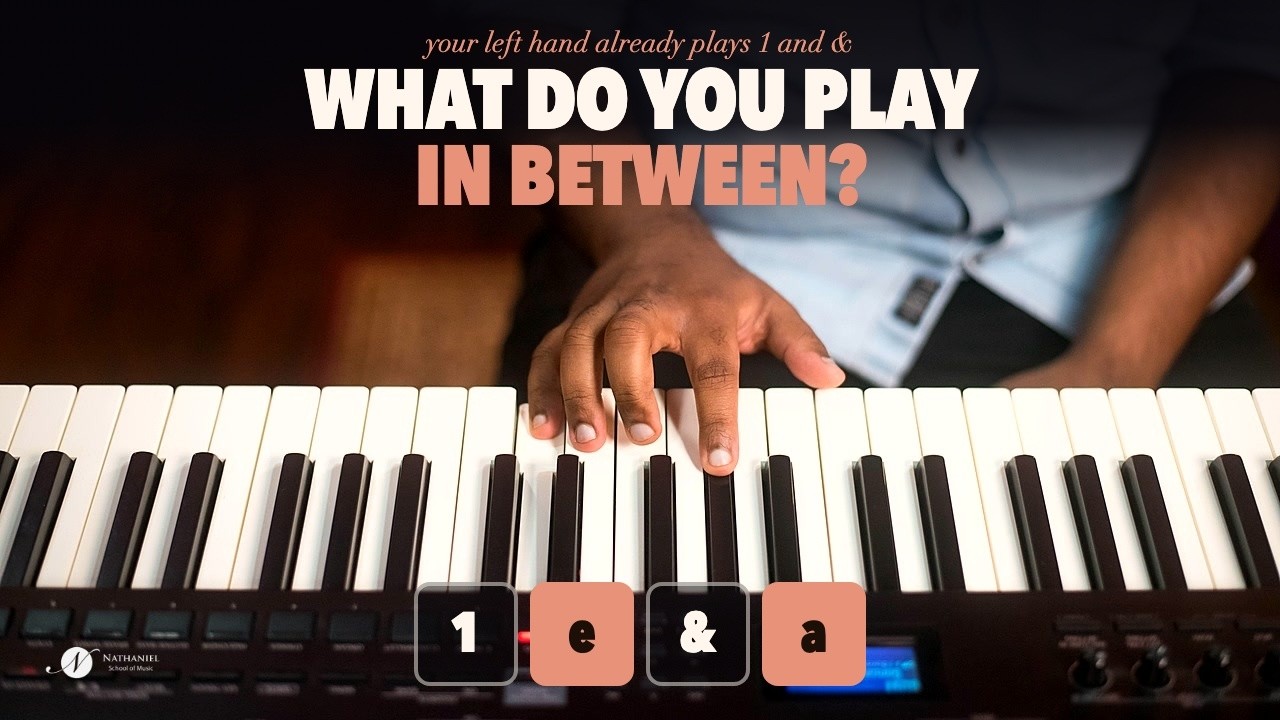
Piano Hand Independence and Rhythm: The Subdivision Exercise That Makes One Chord Groove
Watch on YouTubeVideo summary
In this lesson from the Nathaniel School of Music, instructor Jason Zach introduces a fundamental exercise designed to develop piano hand independence while enhancing rhythmic groove. The core concept involves maintaining a consistent arpeggio pattern in the left hand—specifically using an E major chord played on low-high-middle-high notes—while simultaneously exploring various subdivisions within the right hand. This approach allows one hand to provide a steady harmonic engine, much like a stringed instrument such as a fingerstyle guitar or banjo, while the other hand accesses faster rhythmic layers that add flavor and movement to the music without disrupting the underlying pulse.
The instructor demonstrates how to progress from basic eighth notes in both hands to more complex subdivisions like semiquavers and triplets in the right hand, all while keeping the left hand anchored on specific beat points such as "1" or "e." He encourages players to treat their two hands almost as a single unit by playing them close together initially before expanding into different time fields. By focusing only on certain fingers of the right hand or alternating between hitting the main beats and the off-beats, musicians can create interesting folk rhythms that feel fluid rather than rigid. This method helps bridge the gap between strict metronomic counting and the natural swing often found in jazz and folk music by leaving out middle subdivisions to introduce a laid-back groove.
To further enrich the musical texture, Zach suggests adding melodic elements such as diatonic thirds or fifths that float around an anchored note in the left hand while continuing to play scales on specific hit points with the right hand. This technique allows for harmonic exploration where one voice remains stable while another moves freely through different intervals and time signatures like triplets versus straight eighths. The exercise is highly adaptable, permitting players to change chords or experiment with major sevenths and minor sixths as they navigate these rhythmic layers, ultimately fostering a deeper understanding of how harmony and melody can interact independently yet cohesively within the same performance space.
Ultimately, this practice methodology serves not only as an effective drill for improving technical facility but also as a creative tool for composition and improvisation that many musicians find personally useful in their own work. The lesson emphasizes that while there are structured patterns to follow, such as rolling through specific note sequences or sticking to certain rhythmic grids, the harmony and melody remain open to personal interpretation. Viewers are encouraged to pause and practice along with a study guide available on Patreon, utilizing various apps for ear training and rhythm exercises to solidify these concepts before exploring further lessons on floating intervals and folk music styles offered by the school's comprehensive curriculum.
Read the full video transcript
[music]
Hi everyone, this is Jason Zach from
Nathaniel School of Music. In this
lesson, we are going to learn something
really simple, subdivisions, but
accessing those subdivisions that
matter, that add groove and flavor to
the music in one hand while maintaining
something more consistent in the other
hand as you kind of maybe have figured
out in the intro performance. So we'll
just take a simple chord maybe E major.
[music] This is E major by the way. E G
sharp B and upstairs
we'll start with just a single E which
is the [music] root. And we are going to
look at first of all how we can divide
the beat. Then how we can access the
subdivisions of the uh music after
dividing it. And then we'll play around
with a lot of melodic and harmonic
things on the piano. We'll keep that
very free flowing. So I'll just wing it
so to speak. However, there'll be a lot
to understand harmonically to interact
with the two hands. So it's almost a a
lesson where we are trying to emulate
instruments like or stringed instruments
like the finger style guitar or the
banjo even. Okay. So get your pianos
out. There's going to be a lot to work
on. uh maybe even get your books out and
if possible you could pause the video
and head over to our Patreon. You'll
have a link in the description where
you'll get a study guide with notated
exercises and everything to help you
learn this lesson even after watching
this video. So that's about it and this
is the Nathaniel School of Music YouTube
channel. So, what it needs is you to hit
that subscribe, like, share, any button
that you find there that you enjoy
touching, touch it. Okay, cool. And now
over to the lesson. Let's get cracking.
So, let's find the E major chord in the
left hand. [music] Here you go. And the
first arpeggio pattern to deal with is
low, high, middle, high. Low note is E,
high, B, middle, G sharp, B.
And then you roll with a minimum speed
[music]
of quavers or eighth notes. [singing]
1 and [music] two and this is our left
hand engine.
What we do in our right hand [music] is
to access the subdivisions that might
occur
within these quavers. So what would that
be? Semiquavers. So 1 and 2 [music] and
3 and 4 and is dividing the beat by two
while 1 e and 2 e [music] and 3 and 4 e
and basically begs to ask the question
what to do in between. So [music]
what to do at the e 1 e and 2 e and e
and e and 1 e.
So let's first target just the E and the
in the right hand with the single
[music] E. So
[music] 1 E and 2 E and 3 E and
you want to keep [music] your hands
flowing such that they almost serve as
one hand.
So I'm playing them close to [music]
each other.
1 1 E [music] 2 E M 2 E 1 E 2 E 2 E
Okay.
[music]
What about the O's? 1
All with the single E with my thumb.
[music]
[singing]
I'd also encourage you to maybe use this
as a pattern and maybe hum a melody line
alongside this.
[music and singing]
[music]
Of course, we'll change some chords
along the way [singing and music]
goes on. So that's all that happened.
And it may became so much more groovier
if you ask me from here to
to that uh [music] and all you need is
one out of the five fingers in the right
hand. So if you do it with your thumb
>> [music]
[music]
>> because it's a very interesting folk
rhythm. Or
maybe you could do both the E and the
ears.
Drop it [music] down to maybe a major
7th
flat 7, [music]
major 6.
[music]
Another thing I like to do is maybe
[music] access different time fields. So
if you're going here in the as quavers
in the right hand [music] maybe you
could consider t.
What's that? That's basically [music]
triplets. So
you don't have to hit all the triplets
cuz that'll align here.
And [music]
there's all three.
Maybe that. [music]
[music]
Okay. [music]
Another thing I like to do is maybe
change the time field itself. So maybe
in the left hand
[music]
simple way to change the time field is
just simple swing. 1 and 2 and 3 and 4
and 1. Swing basically [music]
will leave out [singing] the middle
subdivision.
One and [music] a two and a three. So in
your right hand, in your left hand,
you're doing one uh uh uh where's the
end
[music]
and
fret.
Just roll with that in the right hand.
That that could be the first exercise,
you know, just play the E major scale on
those hit points.
[music]
>> [music]
>> If you observe, I'm even pivoting
[music] my third and my fifth in the
left hand and floating around my pinky
to play notes of the E major scale in
and around here. and also trying my best
to you know create a melody on those hit
points. In this case, the one and two
and three of the triplet. While if I go
back to semiquavers and maybe pick the
[music]
sounds [music] quite cool. Sounds like a
melody also, come to think of it. So to
add more flavor to this, perhaps you
could play thirds in the left hand,
dietonic thirds. [music]
Like I said, the harmony and the melody
is up to [music] you. You can just float
around.
Keep one note anchored. Sounds [music]
very nice.
All thirds diatonic third. So the in the
E major scale di theatonic thirds are E
G sharp [music]
F sharp A G sharp B A C sharp B D sharp
C sharp B D sharp F sharp E major.
[music]
Okay, let's get back to the drill
[music]
with some thirds.
[music]
Float the thirds.
[music]
All you need is E. Come to think of it
[music]
or toggle.
[singing]
[music]
So thirds in the left hand.
And on [music and singing] the hit
points, I'm trying to create a melody.
[music]
Let's head over to the triplet world.
>> [music]
[music]
>> all and and and and [music]
so the whole idea is to practice those
in between subdivision hit points in the
right hand in this case a constant left
hand arpeggio pattern which in this case
is LH MH low high middle high low high
middle high and so on okay so I hope you
found the exercise useful or the
practice methodology useful we've done a
lot of other lessons on folk music as
well as floating thirds floating fifths
keeping one thing as an anchor and then
moving this around it's just a style
which I personally find useful to my uh
uh for my compositions and so on. So do
check out some of those lessons. We
leave you a link in the description and
you'll also get a Patreon study guide
which is very exhaustive. It'll teach
you all of this really well. And for any
of the other practice tools, do head
over to our apps repository which has a
lot of the practice tools for chords,
inversions, rhythm, notation, and
obviously ear training which we tend to
do a lot on our channel. Okay. And if
you'd like to learn a course at
Nathaniel School of Music, do consider a
semester. You can do our flagship course
music method live with online lessons or
you can come over to one of our
Bangalore centers if you are from
Bangalore. Uh you can also if you if
time zones don't match or if your
schedule is very busy you can consider
self-paced learning where we have our
everything for life bundle for you to
consider. Okay, thanks a ton for
watching this and I will catch you in
the next one. Cheers. Don't forget to
like, share, subscribe.