Video summary
The video provides a comprehensive review of circular motion and gravitation concepts essential for the Physics 12 final exam, emphasizing that while work and energy are not on the test as a separate section, the law of conservation of energy is integrated into other problems. The core principle discussed is centripetal acceleration, which always points toward the center of the circle regardless of where an object is in its path. A key distinction made between perceived outward force (centrifugal) and actual inward acceleration involves understanding that velocity is tangent to the radius while the net force causes circular motion; this concept was illustrated with examples like a motorcycle on a merry-go-round, explaining why riders feel pushed out but are actually accelerating toward the center until they lose grip.
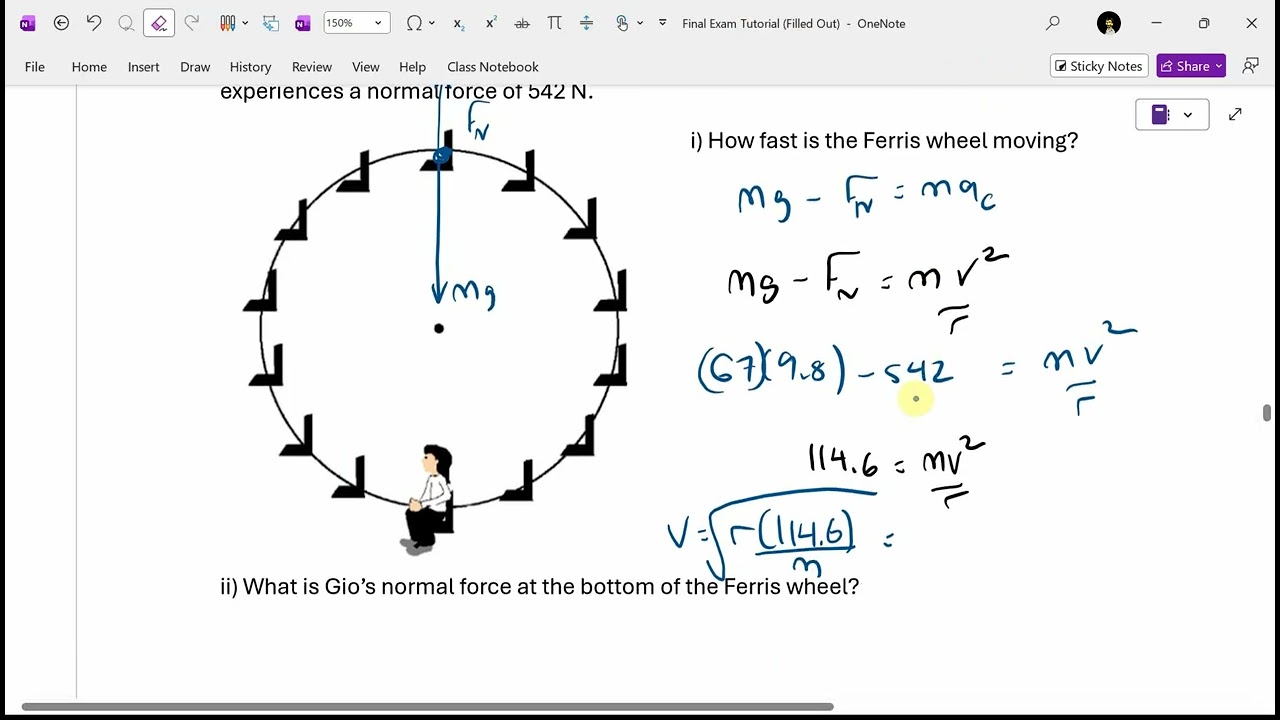
The instructor walks through specific amusement park scenarios to demonstrate how to apply Newton's second law ($F=ma$) in different contexts, starting with a Ferris wheel problem where a rider experiences varying normal forces at the top and bottom of the loop. At the top, gravity is stronger than the normal force because both point downward toward the center, whereas at the bottom, the normal force must exceed gravity to provide the necessary upward centripetal acceleration, making riders feel heavier. The lesson extends to other rides like a Gravitron, where friction provides the vertical support against gravity while the wall's normal force supplies the horizontal centripetal acceleration required for circular motion, allowing students to calculate minimum coefficients of friction or periods based on given variables such as mass and radius.
The review transitions into gravitation by distinguishing between gravitational force measured in Newtons and gravitational field strength expressed in newtons per kilogram or meters per second squared. A critical point highlighted is the difference between orbital altitude (distance from the surface) and orbital radius (distance from the planet's center), which must be accounted for when calculating periods using Kepler-like relationships derived from equating gravitational force to centripetal force ($GMm/r^2 = mv^2/r$). The video also covers escape velocity, deriving it through energy conservation where initial kinetic energy plus potential energy equals zero at infinity, showing that mass cancels out and explaining why leaving a planet requires significantly more energy than maintaining orbit or traveling within the solar system.
Finally, the session concludes with practical problem-solving strategies for orbital mechanics, such as finding unknown variables like period or radius when given others in scientific notation, often involving cube roots to isolate radii from equations containing $r^3$. The instructor warns against common pitfalls like confusing altitude with radius or mixing up gravitational constants during calculations, noting that even Earth-like planets can have different surface gravities affecting human physiology. By mastering these derivations and formula manipulations without relying on memorized shortcuts for every variable, students are better prepared to handle the various versions of exam questions involving Ferris wheels, roller coasters, Gravitrons, and orbital satellites.
Read the full video transcript
We're now I I told you for work and
energy I didn't put a separate section
for work and energy on your test, but
you need to know the law law of
conservation of energy g g I snuck it in
in other locations.
And this took us to after Christmas. We
started circular motion I think maybe
one lesson before Christmas, but it's
primarily after Christmas. So, what were
some key concepts? If we're moving in a
circle, we always asked ourselves what
path are we tracing out? What was the
response? Starts with letter c.
A circle.
If that's the case, which way are we
accelerating?
That was the key idea towards the
center.
Oh, which way is the winning direction
in my free body diagram then? Same
answer. Of course it's the same answer
because that's what Newton's law says,
the unbalanced force is the direction
you're accelerating toward the center.
You might recall I showed you a
motorcycle merry-go-round video. I can't
find it on YouTube anymore. Okay, I got
to pause for a second here. Give me a
second.
Those of you on YouTube, I got
interrupted my chain of thought, so it's
going to seem weird. I think Oh, I think
I was talking about the motorcycle
merry-go-round video. Y'all remember
that one? Where the guy went flying out
and we had to say first of all,
he was accelerating towards the center.
He would have thought he was getting
pushed outwards, but that's because he
was having to apply a force with his
arms and because he's not used to doing
that, he would think, "Oh, I'm
accelerating outwards." He's not. When
he flew out, what direction was the
velocity? Something to the something.
Tangent.
To the radius, at right angles to the
radius. You're accelerating towards the
center, then that force is towards the
center, the velocity is at right angles
tangent to the radius of the center. And
that's what we saw him fly out. I showed
you a few other ones as well, but that
was the most dramatic one cuz I know I
can pause that at just the right moment
and freeze him in midair as he's about
to experience some bad physics.
Note, on your formula sheet, there is
not a single equation that says FC
equals. I gave you the acceleration. How
do I turn an acceleration into a force?
F equals what times A?
Don't forget to multiply by the mass
because the circular motion equations
were so complicated, it was easy to
think, oh, that's the force. No, no, no,
no, it's MA. So, remember that FC equals
MAC, where AC was which two equations? V
squared over R or 4 pi squared R over T
squared? WHICH ONE DO I USE? Depends on
what they gave me.
I've got You'll have two different
circular motion questions, and it'll be
between a Ferris wheel, a Gravitron, and
a roller coaster. So, you'll see two of
those.
Geo has a mass of 67 kg. He's riding a
Ferris wheel of radius 11.2 m. At the
top, he experiences a normal force of
542 N. Part one says, how fast is the
Ferris wheel moving? Canaan, any
suggestions on how I might want to
start?
Is he ready? I'll give you your hint.
What path are we tracing out?
What path are we tracing out? The line
you're looking for is a circle.
Which way are we accelerating?
What might this be a good job for?
Okay. Where are we in this question? Top
or bottom?
Where are we in this question? Top or
bottom?
Okay, read the question. Don't look at
Read the question. Where are we?
What are the forces acting on him? Get
the obvious one.
Why did I draw mg so long? Which way are
we accelerating? Toward the Which way is
mg pointing? Toward the It's the
winning. Okay? What else?
Which way? Whichever way your head is
pointing, which in a Ferris wheel will
always be up.
On a roller coaster, it depends where
you are in the loop.
Why did I draw the normal force smaller?
Which way are we accelerating? Toward
the Cuz what path are we tracing out? A
circle.
Okay, there's my start step one. Those
are the two forces right there. Who's
winning?
Losing.
Equals MAC.
Winner
minus loser equals MAC. Now, here's the
question from my formula sheet, which
version of AC am I going to use?
What are they asking me to find?
So, which version of it Go look at your
formula sheet. Which version of AC am I
going to use?
You're going to use an acceleration. You
have two ACs. Go look in the circular
motion. I I know I sound harsh. I'm
pushing you.
See Can you look in the right place? It
says AC equals There's two Which Now
you're seeing it. You're going I should
have had that 5 minutes ago. Which
version am I going to use? The one with
the V in it or the one with the T in it?
Yes.
So, I can say this.
mg minus the normal force equals mv
squared over r. Now, technically, if I
wanted to get the V by itself in one
step, don't write this down, but you
can. It would be times this whole thing
in brackets by r, divide this whole
thing by m, mass of square root. And if
you want to do it that way, that's fine.
This was around where my love of formula
manipulation started to hit a wall. This
was around where I would have said to
you, "Just turn this into a number." I
would have said, "You know what? Let's
go 67
* 9.8
542
that equals MV squared over R. Also,
notice the mass doesn't cancel here
because all of you experience rides
differently. What you're experiencing is
the normal force and your normal force
depends on how big you are. You may find
as you get older and you put on your
middle-age weight, you may age out of
rides that you used to like when you
were a kid. You may suddenly go,
"I'm feeling crazy now." It's because
you're experiencing a bigger normal
force.
Uh let's get out our calculators.
67 * 9.8
542
and I get 114.6. I'm not going to round
that off at all.
That equals MV squared over R.
Now, I can use formula manipulation jet.
Now, I can go divide by M times by R
square root.
V is going to be
R * 114.6
/ the mass
square root.
And to cut down on time, I'm going to go
straight to my answer. On the test, I'd
certainly write out the numbers so that
I could if I made a mistake, still get
part marks. What was R? 11.2
* answer button divided by the mass
square root of that.
I get double check me 4.38 m/s.
Not very fast. Is the Ferris wheel
considered a scary ride or a tame ride?
Is the Ferris wheel considered a scary
ride or a tame ride?
Yeah.
Roller coaster, I'd be looking at
something in the teens or maybe even in
the 20s.
Ferris wheel, single digits.
Yes.
Pause.
4.38,
is that right?
m/s
What else could I have done? Oh, instead
of asking you to find the speed, I could
have asked you to find the period of
rotation.
Uh it would be the same except Kanan
right here you would have written m 4 pi
squared r over t squared. You get the t
by itself.
What's Geo's normal force at the bottom
of the Ferris wheel? Alexis, you know
who this is a good job for?
Okay, now we're at the bottom. What are
the forces acting at the bottom? Get the
obvious one.
What else?
Which way?
Bigger, smaller, or the same size as mg
and how do I know? What path are we
tracing out?
So, where is my bigger unbalanced force
going to be pointing?
Winning.
Losing.
And I guess because I have the speed
from part A, I'm going to use mv squared
over r. I can do use the speed for a
Ferris wheel because the Ferris wheel is
rigid. Everyone's traveling the same
speed. Not on a roller coaster loop.
You're slowing down at the top and
you're speeding up at the bottom. So, I
couldn't clone this for a roller coaster
loop. I'd have to ask something
different. Um what do you want me to Oh,
get the normal force by itself.
The normal force is going to be mv
squared over r plus mg.
What's your normal normal?
What are all of you feeling right now is
your normal force?
Oh, but look look look look at the
normal force.
So, the normal normal is mg. We're
adding you feel heavier at the bottom,
which you do.
What's your normal normal? mg. At the
top, you're feeling lighter because the
normal force is less than gravity.
See it?
So, we can explain the physiological
feelings of that ride. The normal force
is going to be What was m? 67?
times answer button squared since it's
stored on my calculator divided by the
radius. What was the radius? 11.2?
plus 67 67 shut up times 9.8
Uh YouTube, if you're watching this like
5 or 6 years from now in the year 2016
middle school and teenagers middle
school students had a stupid 67 meme
thing going on right I whatever. No one
really understood it.
Uh answer button squared divided by 11.2
plus 67 times 9.8
Of course, by now you're typing this
into your calculator and getting an
answer. Do we got an answer? What you
get?
You did more typing to be less accurate
and introduce the possibility of a typo?
771.2 if you use the answer button all
the way through? So, I'll go 771.
Uh what else could I do with this as
follow-up questions? Ooh, if he's
sitting on a kilogram scale, what would
the kilogram scale measure? How would I
convert that to kilograms?
Okay, just for kicks.
divided by 9.8
Not feeling much heavier and again,
that's because the
roller coaster Ferris wheel's a tame
ride. It you're not going on there for
the stomachy
you're going on there for the view and a
breeze on your face and maybe the swing
the car is a little bit, but it's not
one necessarily unless you're afraid of
heights. Most people are going to go on
the the Ferris wheel, okay.
Gravitron
Oh, what a great ride.
You'll notice it wasn't running at
Playland. Why? Cuz the PNE owns the
Gravitron, not Playland. So, it only
comes out in the summertime at the PNE.
Gravitron has a radius of 8.35 m. It
spins once every 4.65 seconds. A rider
of mass 76 kg on the ride, what's the
minimum coefficient of friction needed
between the mass of the rider and the
wall of the ride? Okay. Arnica, you know
what this is a good job for?
Let's represent this person with a dot.
I'll do it in red. What are the forces
acting on this person? Get the obvious
one.
Which way?
Down.
Is this person accelerating downwards?
Are they accelerating upwards?
That means forces must be I'm looking
for one that starts with letter B.
I know there's an arrow the same size as
mg pointing up. I'm not sure I know what
it is, but I know it's there. Mine looks
a little too long.
About there.
Oh, what path is this person tracing
out?
Where must there be an unbalanced force
pointing toward the So, I also know
there's a force here.
That's the one I think I can figure out.
What force is that? What's pushing this
person inwards? Well, it's the wall.
What do we call the force from a surface
like a table or a wall?
Ha.
And that gives me a hint as to what that
vertical force might be. Who remembers,
what's that vertical force?
Friction.
This one was interesting because you had
two equations. One equation is gravity
is the same size as friction.
And the other equation is normal force
is what's pushing me in a circle.
Over here, Canon coming back at you,
which version of AC am I going to use?
The one with the V or the one with the T
in it? How do I know?
Why? They gave me the period. Or they
could have given me the speed. Or they
could have asked for the period, then I
would have used the one with the V. OR
THEY COULD HAVE ASKED FOR the speed, I
would have used the one with the V. But
I can certainly say this, the normal
force is equal to M 4 pi squared R over
T squared.
Mr. Dweck, it just says 4 pi squared R,
there's no M. That's because I told you
the acceleration. F equals M A.
On the left-hand side, I would drop the
mg down, and I would probably do physics
11.
Friction is what times what, Arnica?
And then you might recall I would often
say something like, I don't know the
normal
Wait a minute.
Okay? Now, I'm going to pause. Or I
could have given you the coefficient of
friction and asked you to get the T by
itself. You could still plug this whole
thing in there and get the T by itself.
Or I could have given you the
coefficient of friction and asked you to
get the V by itself. You'd have an M V
squared over R, and you get the V by
itself. Basically, for this particular
Oh, or I could ask you to find R.
For this, I can spin off four different
questions from the gravitron. I can give
you one piece of information, either
mu, R, V, or T, and you can find any of
the other ones that I ask you to find.
In this case, this is probably the
easiest case version because I can say,
"Hey, mg equals the mu drops down and
then it's m 4 pi squared r over t
squared." Arnica, can little kids and
grown-ups go on this ride together?
Why?
So, even though they gave me the mass,
and I guess they want me to get the mu
by itself. I guess I'm going to divide
the four and the pi squared and the r
and I guess I'm going to times the t
squared. That'll get the mu by itself.
So, the g is going to drop down like a
domino.
I'm going to times the t squared. I'm
going to divide the four, the pi
squared, and the r. That's apparently
the minimum coefficient of friction. Why
did I say minimum? Shaz, there it could
be way stickier and give you a lot of
breathing room, but you have to have at
least that.
It's going to be 9.8
times Arnica, I've scrolled down. What
was the period?
Don't forget the squared divided by 4 pi
squared. What was the radius?
Gerry, I thought for a minute I forgot
to give it to you. It's good. Did I give
them an impossible question? I hope not.
What's mu? I don't know. What's mu with
you? You'll miss that joke. Trust me.
It's funnier than you all let on.
It was them at the physics conferences.
9.8 * 4.65.
Don't forget the Oh, not the square
root, Mr. Squared.
Divided by bracket 4 pi squared
* 8.35
No squared.
Close off the top.
I hope I made up good numbers.
Oh, sure. 0.643
Has anybody been on the Gravitron?
Okay. If you're on it, feel what's
behind you. It's fairly gripy. They They
didn't put you on like something slick.
Some kind of a fabric usually some kind
of a rubber where you can Oh, yeah, I
can feel if I try and slide down doesn't
want to let.
Oh, units.
Good.
Okay? So, you've seen how I can mix and
match the Gravitron. I think all of you
might Well, again, Ferris wheel,
Gravitron, or roller coaster. I've got
several different versions of my final
exam. I got four different versions,
five different Maybe five, I can't
remember.
Um
So, probably two out of Well, I got
three blocks. Yeah, two out of three
blocks will probably see the Gravitron
statistically.
Or we could do a roller coaster.
At the top of the circular roller
coaster of radius 9.8 m, I'm already
regretting using the 9.8 cuz you'll mix
it up with gravity. I'll change that
number next year. Don't like me using
the same number twice and causing
confusion.
A 76-kg rider experiences a normal force
of 4.2 times their weight. How fast is
the coaster traveling at the top of the
loop?
Oh, that's it.
Matt, what might this be a good job for?
Hey, what are the forces acting on this
rider? Get the obvious one.
What are the forces acting on this
rider? Matt, get the obvious one.
Yes.
What else? Normal force. Which way?
Which way is the head pointing? So, for
a roller coaster, if you're in a loop,
unlike the Ferris wheel where at the top
the normal force was pointing up, here
the normal force is pointing down. I'll
put it beside. Oh, at the bottom, it
would be mg down, normal force up, and
normal force would be bigger.
Who's winning? They both are.
Cuz what path are we tracing out?
Which way we accelerating? Toward the
Okay, so I could say winner
plus winner equals m a c.
Canon, back to you. Which version of a c
am I going to use here?
How do I know how fast? And
Honestly, for a roller coaster, I can't
ask you to find the period because it
depends on the speed of the loop. I'll
ask you to find the speed at the top and
a different speed at the bottom if I do
anything.
Or ask you to find the normal force. Uh
here they gave me the normal force. They
said 4.2 times their weight. No, now,
when I say weight, what do I really
mean? Two letters.
So really, this is going to be 4.2 m g's
plus m g. That equals m v squared over
r.
What number is in front of the m g right
here? It's invisible.
What number is sitting right there
technically always?
So what's 4.2 m g's plus 1 m g?
Yeah, they're like terms.
I get 5.2 m g's equals m v squared over
r. Will little kids and grown-ups all
feel 4.2 times their weight?
Carly, is there an m in the left-hand
term?
Is there an m in the right-hand term? Is
there an m in everything? Will little
kids and grown-ups all feel 4.2 times
their weight? Yes, but because little
kids have less mass to begin with,
they're not going to feel it as much as
an obese heavy person like me.
Right?
I'll feel it more than you guys will.
Um
Oh,
get the v by itself.
How do I move the R over.
And we see our old friend. Hello, old
friend. I see the square square root of
gir and other stuff, but that was kind
of my If that showed up, I've probably
done it right little mental checklist.
I'm going to get V equals
the square root of 5.2
* gir. If I give you a roller coaster
loop,
I probably won't make it survivable. Who
remembers we actually looked at roller
coaster loops? What was the minimum Gs
that you were pulling at the bottom?
Minimum.
It was six, minimum.
It was six. And that's that's barely
making it over, so close that you almost
fell off the top of the loop. Of course,
in real life, you would want a big
safety margin.
Please don't try and calculate the
number of Gs they're pulling at the top
or at the bottom. Well, here, they're
pulling 5.2 Gs at the top. They're
probably pulling seven or eight at the
bottom. This is not a safe ride, but I
wanted to make up a roller coaster.
Uh it's going to be the square root of
5.2
* 9.8 *
also 9.8.
You see why I said I felt bad using R as
9.8? CUZ YOU WHY ARE THERE TWO GS IN
THERE when you're looking at it later?
It's a preventable dumb error that I
should have thought of as a veteran
teacher, Annie.
Uh oh, well. Although the bonus is,
Annie, I can just go 9.8 squared and
save myself some typing, I guess, even
though that's not really what I mean. Uh
22.3
m/s.
We did do a car going around the corner.
I'm not putting that on your test. That
was where friction is what's pushing us
around the corner. It was too basic. I'm
going to give you
two amusement park rides.
Ferris wheel, roller coaster, gravitron.
Two of those.
I think that's the end of the circular
motion section. Yeah, yeah. So, then
gravitation overlapped a lot with
circular motion because in orbits you're
moving in a circle. First of all, you
need to know the difference between a
gravitational force and a gravitational
field. What was our equation for
gravitational force? That was big G, big
M, little M over R squared.
What was our equation I lifted that
right from the formula sheet, yes. What
was our equation for gravitational
field? Tucker, here's what I wrote on
your formula sheet. Gravitational field,
little G,
is the force of gravity divided by
little M.
It's this e k this this thing
cross out the little M.
It's big G, big M over R squared. A
number of us lost marks on the test.
There was one question on your unit test
where I said find the gravitational
field around a black hole and some of
you found me the gravitational force.
Not what I asked for, you got a zero. I
mean, you may have done it right, not
what I asked for. So, make sure you
understand the difference between force
in Newtons and field, which is that.
Newtons per kilogram if you want to be
nitpicky because Newtons per kilogram.
That also means it's technically meters
per second squared cuz that's got to be
an acceleration.
If we're in orbit, what's pulling us in
a circle?
So,
gravity, I'll write FG, is what's
pulling us
in a circle. If we are in an orbit, we
would say gravity is what's pulling us
in a circle. Big G, big M, little M over
R squared equals MAC. Which version of A
can it depend on on whether they asked
for or gave me the period or the speed?
>> know any one of orbital speed,
orbital period, orbital radius, or
orbital altitude, if you know the
radius, subtract the radius of the
planet, now you've got the altitude, we
can find the other three.
You need to know the difference between
altitude and radius. A lot of us got
those mixed up. Radius is measured from
the center of the planet, altitude is
measured from the surface of the planet.
Um
I might even have space to do a diagram
there. If I can, I will.
Then we said that potential energy, we
couldn't use mgh. Why couldn't we use
mgh for gravitational potential energy
anymore?
Be nice. Why can't I use mgh?
Cuz as you move further away from the
planet, g gets smaller and smaller. So,
we had negative big G, big M, little m
over r, not r squared. Why was it
negative? We had to define zero
somewhere. The phrase I introduced to
you was relative to zero at infinity. We
said that you had no energy out at the
edge of the universe. Why? Cuz if we let
you go, you wouldn't fall. No gravity.
Anywhere closer, there'd be a tiny pull
of gravity, you would fall, you must
have some energy. So, you have less than
zero.
What numbers are less than zero?
Negatives.
Who's in calculus?
It's negative because it's the integral
of the force equation. You have an r
squared on the bottom, that's an r to
the -2. If you take the integral, you
will get a negative one in front of
everything.
Oh, I've been
That's the correct answer, not the
garbage I gave you before. Oh, there
will be an escape velocity question,
even though it should be called escape
speed. I'd be crazy.
Planet Pit has a mass of that and a
radius of that. A satellite of mass that
is in a stable orbit above the planet
surface. What is its orbital period?
Okay.
What word is this right here, folks?
It's a trigger word. What word is this
right here?
Orbit. If I see the word orbit, I can't
say gravity is pulling me in a circle.
But, let's visualize what's going on.
So, here is planet pit.
Here's the satellite.
That's the altitude.
This is 1
.2s
* 10 ^ 6 m. Is that the radius from the
center of the planet?
We're going to have to add
the radius
of the planet.
In other words, before I start this,
because they gave me a little altitude,
not attitude, I get that from you guys,
little altitude, I'm going to have to
make a little note that the orbital
radius
is going to be the planet and let's
write this out, so when you're studying
we know what we did.
Plus the altitude. Now, if they give you
the orbital radius, you're home free.
Take it.
But, if they give you an altitude,
you've got to add the radius of the
planet.
So,
the orbital radius is going to be What
was the planet? 7.74
* 10 ^ 6. And again, the reason I know
it's an altitude above the planet's
surface. If they had said from the
center of the planet, div, that's a
radius.
I'm home free.
Uh
uh plus the altitude, 1.2 * 10 ^ 6. So,
let's get the orbital radius. We had to
remember how to do scientific notation.
>> [snorts]
>> At an altitude above this planet pit,
our radius is 8.94 * 10 ^ 6
m.
Now I'm good to go.
Peyton, can you read to me the last
sentence of this question?
Did you say orbital?
Gravity is what's pulling me in a
circle.
Which gravity? Now we got to use the
cosmic Newton's law of gravity. That was
the one that said big G, big M, little m
over r squared equals m a c.
Peyton, not Canaan. Peyton, which
version of a c do they want me to use?
What are they asking me to find?
I've scrolled down. You'll have to read.
Oh, which is the version of a c that has
the period in it? Go look at your
formula sheet. It's on there.
By the way, folks, look up.
Apparently,
I don't need the mass of the satellite
even if they gave it to me.
Which is true. Yeah.
Good. Okay, let me write that down on
the next line. It's the big G the big G
big M over r squared drops down and here
it's got four
pi squared r Keep going. Is it over t
squared? Is that right? Okay.
From this equation, if they give me the
radius, I can find the period. If they
give me the period, I can find the
radius.
Let's get the t by itself. Peyton,
where's the t squared right now? On the
I would multiply it to the top.
I'll drop my equal sign.
I already have a 4 pi squared. That
would stay behind. How would I move this
r squared over? It would multiply up to
here. I would have an r cubed.
How would I move the big G and the big M
over?
Okay? Tucker, is that okay? This would
end up right here.
The big G and the big M would end up
getting divided down to the right-hand
side.
That would give me a t squared. A t
what? A t squared. Talk to me, Tucker.
How do I get rid of a squared?
And you may recall, hint, hint, hint,
one of the ones I loved was getting the
r by itself because how would you get
rid of an r cubed?
This was where you had to do a cube
root. I had that on your test. That's
going to be on some of the versions of
the final, as well. Okay? So, you would
start off with this equation, but you
would get the r by itself. Times the r
cubed here. Times the t squared. Divide
the 4 pi squared. Cube root. Here, we're
getting this by itself. You're going to
have to read me the numbers, Payton,
because I've scrolled down. It's going
to be 4 pi squared. What was r?
We calculated it. It should be up there.
If you wrote it down. Uh-oh. Did someone
not write it down?
Yes. What? Sorry, what was it? 8.
Times 10 to the?
Yes. And cubed. I'll have to find my to
the power of and cube button. All
divided by Hey, everybody, what was big
G?
Shut up.
6 7.
Okay, 6.67
times 10 to the -11. And I made up a
mass, Payton. What was the mass of this
mystery planet?
I missed that. 6.
2 5.
Times 10 to the?
Earth-like. Earth, I think, is 5.98
times 10 to the the 24th.
And Earth's radius is
6.38. This This is an Earth-ish planet.
What do you get?
I would probably, for something this
complicated, I'm going to type what's
inside the square root first, and then
I'll go square root answer button. 4 pi
squared times 8.94
scientific notation button 6 to the
third power divided by bracket 6.67
scientific notation -11 times 6.25
scientific notation 24th close off the
bottom.
Let's wait Oh, oh, square root, square
root. Almost forgot.
Y'all get 8,225?
800 6 actually. I'll just I'll go 8,230.
Yes?
8,230
m/s.
I'm going to add a part Is that right?
Oh, that's the period. That's good. I
was thinking that seems way too fast for
me. That's almost approaching Earth's
escape velocity. It's the period, Mr.
Dewitt. It's seconds. By the way then,
just for giggles, that's seconds divide
by 60. You'd be orbiting every 137
minutes divide by 60. You're orbiting
every basically 2 and 1/2 hours.
Okay.
Um I'm going to add a part B.
Find the gravitational field strength
on
the planet
surface.
That's
Oh, I did add a part
Jeez, thank you, Shaz. I was going, "How
did I miss that?"
Is it the same numbers or did I change
them? I used them again cuz I was
thinking this seems fairly Earthish. I'm
going to guess we're going to get
something
not hideous to live in.
So, how do I find the gravitational
field strength? Thanks, Shaz.
Uh little g equals the force of gravity
divided by little mass. The force of
gravity is big G big M little mass over
r squared divided by little mass.
Your gravitational field strength is big
G big M over r squared.
If you plug in Earth's numbers, you'll
get 9.8. I get 9.799
as it it 9.8.
Mystery planet, I don't know. 6.67
* 10 ^ -11
6.25
* 10 ^ 24th
all divided by don't forget the squared
mystery doohickey. 7.74
* 10 ^ 6th
squared.
This should be close to Earth, I think.
We're a little larger in mass,
which would increase it, but we're a
little larger in radius, which would
decrease it cuz you're further from the
planet center. So, I'm not quite sure
which one's going to win out here.
>> [sighs]
>> You get 6.96?
Basically about 2/3 of Earth's gravity.
Fairly livable.
You'd have to adjust cuz everything your
timing would be off for everything. If
you dropped something, it just wouldn't
quite fall right to your eyes. But
probably you'd be able to stay in this
for a few months without major damage.
Your heart muscle would be the bigger
challenge. It would weaken a little bit
cuz it's not having to pump as hard.
6.96.
And you could say meters per second
squared because the acceleration due to
gravity on this planet, but I usually go
Newtons per kilogram because Annie I
went force divided by mass in my
original definition, but I would take
either.
So, that was a quick review of orbits.
Gravity's what's pulling us in a circle.
I can give you one thing, you can find
lots of other things.
Uh gravitational field strength.
Oh, escape velocity.
So, let's suppose we were on this planet
and you wanted to get off of this planet
and head back home to Earth. And again,
we're assuming that we end at rest. What
we're saying is we're going to fire our
engines in one mighty blast and then
coast the rest of the way.
And we're ignoring air resistance.
Who remembers how do we do escape
velocity? And your hint is it should be
called escape speed.
The reason we use a scalar approach.
You may have memorized the formula and
as long as you have it in your cuz I
won't let you put it on your yellow
sheet. As long as you have it in your
brain, you can jump straight to it. But
let's re-derive it. We derived it from
the law law of conservation of energy.
We said this.
KE initial plus PE initial equals KE
final plus PE
That part is Faith Physics 11.
But then it got a bit weird. We wanted
to escape the planet, which means we
want to make it to the edge of the
universe. What's our gravitational
potential energy exactly as a number at
the edge of our universe?
So, strangely,
this became a zero.
And we wanted to do it so perfectly that
we're coasting, slowing down, coasting,
slowing down, coasting, slowing down cuz
gravity's still pulling on us. The
second the split second we're actually
out of all gravity, we come to a stop.
And so, we wanted that to be zero as
well. It was a little weird.
KE is still what it is from Physics 11.
Faith, what's kinetic energy?
A half little m v initial squared plus
potential energy I've got to use the
cosmic one from my gravitation section.
Negative big G big M little m over r
initial. That equals zero.
First thing that I always did is I said,
"Well, let's get rid of the negative.
Let's just plus that over since there's
a zero there."
And I rewrote it as a half m v initial
squared equals positive big G big M
little m
over r initial.
Thank you.
Did they need to give me the mass of the
spaceship?
Did they give me the mass of the
spaceship? Nope. All the spaceships will
have the same escape velocity because
there's a little m over here and a
little m over here. In fact, I could
have crossed it out on the previous
line, but it's a little easier to spot
there. Get the V by itself. I'm going to
go times by two.
You could also divide by 0.5, but that
looks cleaner. That's a squared
Escape speed is the square root of two
big G big M over
R initial the surface. And what we
notice, I don't know if you remember
this, I think Owen does cuz I think he
was remembering this equation. Don't
write this down, but look up. That was
orbital speed without the two. That was
escape speed with the two. We said to
get I went on a big rant. I said the big
challenge for space travel is getting
off the planet. Once you're off the
planet, getting further out Alexis way
less energy.
To get off the planet takes us all that
whoop, sorry. Let's go forward. To get
off the planet takes all of that. To
leave the solar system only takes the
square root of two as much, which is
1.41 times as much. So much more of your
energy is getting off the planet. I
think I probably mentioned to you
Earth's gravitational field of 9.8 is so
big we can barely make it to orbit. If
Earth was much bigger, about 15% larger,
you can run the equation for E equals MC
squared, which is the most energy you
can get and you can show yeah, not
getting off the planet.
And I think I mentioned there may be
intelligent life out there that is
involved evolved on larger planets
somewhere in the universe, they'll never
have a space program. They can't.
It's impossible.
Which is sad.
But cool.
Let's crunch the number.
Faith, you're going to have to read the
numbers to me. Square root of two. I'm
just going to write big G instead of
writing out the numbers. Uh what was the
mass of the planet?
And the radius of the planet?
Louder, please. Sorry.
>> This is Earth-ish, Earth-like.
I think Earth's gravitational Sorry,
Earth's escape velocity was 11,200 m/s.
I'll bet you we're going to be in around
the 10,000-ish, but I don't know. 2 * 6.
Okay, I
thought thought that's what I heard.
It's going It doesn't seem 6.25?
I think she read it as 7.35, did she
not?
And what's the radius?
Tucker, you have an answer? Yeah.
Good. What's your answer?
I I said I think it's going to be close
to the Earth, and I know the Earth is
11,200, so that seems ballpark. I'm wait
Oh, square root, Mr. Dewitt.
10,400? Yeah.
m/s.
I can't remember if on your final I put
you on a planet or near a black hole,
but I could ask you all of this near a
black hole just for giggles as well.
That is a really quick review.
Hold the toy, please, Brett. That's a
very quick review of
circular motion and gravitation.
Are you feeling up to trying to dive
into some circuitry. Let me check my
schedule, Mr. Dewitt.
Um, I got one, two, three more classes.
I have to go over the
test.
How many do I have? One.
Oh, only two? Oh, you know what? I'll
bet you I have one that we have to
rewrite. Yeah, here I don't have a pair
at all. Ugh.
Oh, no, I do have a pair. This one's
going to fall apart. I don't need to
rewrite this one.
This one I'll have to rewrite.
I think
Pause.