Video summary
This physics review focuses on mastering the fundamental equations of circuitry, specifically Ohm's Law and Joule's Law, which serve as the primary tools for solving electrical problems. The instructor emphasizes that understanding these core relationships allows students to determine any unknown variable if they are given two others; for instance, knowing voltage and current enables the calculation of resistance or power using derived formulas like $P = V^2/R$ or $P = I^2R$. A central theme throughout the lesson is a skiing analogy used to visualize how electricity behaves in circuits: batteries act as chairlifts that provide potential energy (voltage), while resistors represent downhill slopes where this voltage drops. This conceptual framework helps students understand why current splits at junctions but rejoins later, whereas voltage continuously decreases as it moves through components from high to low points.
When approaching specific circuit problems, the instructor advocates for a strategic method often referred to as "knock-knock," which involves looking immediately for any resistor where two pieces of information are already known. If such a scenario exists, there is no need to redraw or simplify the entire circuit first; instead, one can directly apply Ohm's Law or power equations to find missing values like voltage drops across individual resistors. The process typically begins by identifying these solvable sections and labeling the "downhill" paths on the diagram to track where energy is lost. Only when no two known variables exist for any single resistor does the instructor suggest combining series and parallel resistors as a last resort, calculating total resistance using reciprocal formulas for parallel branches or simple addition for series connections before determining the total current leaving the battery.
The review concludes by demonstrating how this systematic approach simplifies complex problems without requiring constant circuit redrawing. Once the total current is found in an equivalent simplified circuit, that same current flows through all components in a series arrangement, allowing students to calculate voltage drops and power dissipation for every resistor using their respective values. The instructor highlights various forms of Joule's Law available on formula sheets, reminding viewers to select the version containing only known variables—such as $P = V^2/R$ when resistance and voltage are present—to avoid calculation errors. Ultimately, the lesson reinforces that by consistently checking for two known quantities per resistor and utilizing the skiing analogy to track energy loss, students can confidently solve both straightforward and intricate circuit questions on their final exam without unnecessary complications.
Read the full video transcript
[music]
>> So, a very quick everybody has the
tutorial? Everybody's got it out?
Looking at you for some reason, I don't
know why. Um,
very quick review of the basics of
circuitry. You do need to know Ohm's law
and Joule's law. Those were the two
primary equations. Ohm's law was the one
that said
V equals I * R.
Uh, and that meant I equals V over R and
R equals V over I. You need to know that
V and I often put the wings on there so
that I didn't accidentally think that it
was a speed cuz that would be silly or a
velocity.
Uh, V is volts, I is current measured in
amps, R is resistance measured in ohms.
So, if you gave me two things, I could
find the third, but then we expanded
that by one step. We had Joule's law,
which said power equals V * I.
But, I could also use Ohm's law and
substitute in for the V and I got I
squared R or I could substitute in for
the I and I got V squared over all R.
Cool. Then this allowed me to say if I
know two things, I know four things.
Any place on a resistor in a circuit, if
you give me two things, I know four
things.
Uh, we talked about Kirchhoff's laws.
Current splits up and rejoins. Voltage
just gets smaller and smaller as long as
you're skiing downhill. Whatever voltage
you gain, I gave you the analogy of the
ski hill. I said a battery was like a
chairlift. I said voltage was kind of
like height. You had to then lose it to
get to the bottom of the chairlift as
long as you continue to ski downhill.
That was our ski hill analogy. We said
to solve a circuit, the first thing I
try and find is the total current cuz if
I can find the total current leaving the
battery, the question's going to fall
apart. I don't know how, but I know it's
going to fall apart. Then another thing
I always look for is the phrase I used
is knock-knock. I know two things, I
know four things. I look for a resistor
where there are two pieces of
information. If that was the case,
usually Anna, that meant I did not need
to rewrite the circuit. I could just
solve it as it was without having to
combine the resistors. Now,
I'll start my
trying to find the total current.
Question falls apart if there wasn't the
ski method working. If I couldn't find
the total current. If there wasn't knock
knock, I know two things. As a last
resort, I would combine the resistors. I
would combine them by going 1 over R
parallel equals 1 over R1 plus 1 over
R2. That's on your formula sheet. If
they were in series, I would just say R
total equals R1
plus R2 plus whatever.
But I only did that as a last resort.
Some of you got in the habit of all
trying to redraw the circuit right away.
Not if they give you two things. Usually
that meant you could just with a bit of
cleverness use the ski method.
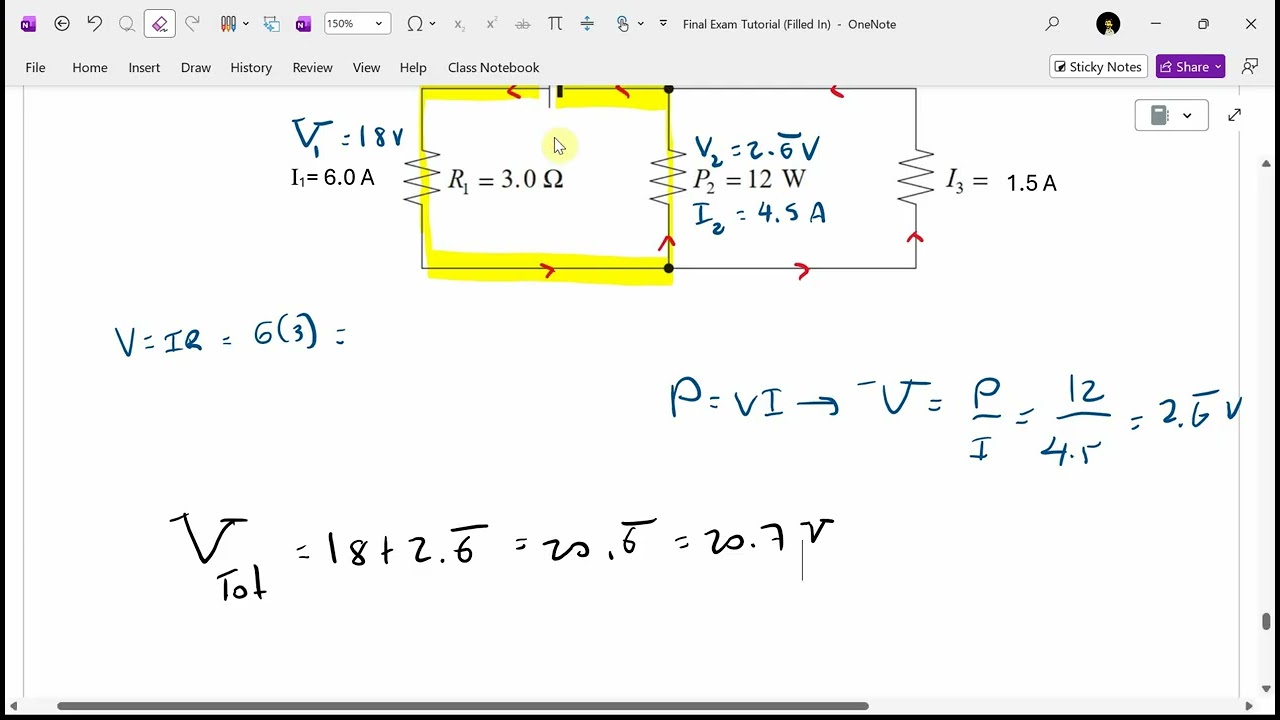
So, here's an example. Example A says,
find the voltage of the power supply. I
guess they want me to find the voltage
from the battery. First thing I noticed
here Nyla is knock knock, I know two
things. I probably am not going to need
to redraw this circuit. Very first thing
I always do is label downhill.
That's downhill. Up the page is down the
hill. That's downhill. Up the page is
down the hill. And along the top,
downhill is to the left.
Well, if I know two things, I know I and
R, I can certainly use Ohm's law. I can
go V equals I times R. It's going to be
6 times 3. And hey Tristan, I bet you
can even do that in your head.
I did it. Terrence, 18.
Sorry. I'll call that V1 cuz they put an
I1 and an R1 on there. Lazy but
organized. 18 volts.
Did that mean the battery is 18 volts?
No.
Ah, but what else do I notice? This time
I'll go with Tristan, not Terrence. I
know the total current because how many
amps right here, Tristan? How many amps
right here? How many amps leaving the
battery? This question's probably going
to fall apart as they ask keep going.
How many amps right here?
Here? Here? Here? Here? Oh, here's a
junction. How many amps went this way,
Anthony?
How many amps must have gone up this,
then?
4.5. Yes?
Hey,
this I2 has to be 4.5 amps.
Knock, knock. I know two things. Now I
can find everything I want to hear as
well. Specifically, I'd like to find the
voltage. So, uh I have power, I have
current. You know what? I can use power
equals V * I. I can use the voltage is
going to be the power
divided by the current. It's going to be
12 divided by
4.5.
12 divided by 4.5.
Of course, you're all going to your
calculator rather than waiting for me to
type it in.
>> [clears throat and snorts]
>> I got 2. And then the six repeats. You
know what I'll do? Anytime I use this,
I'll go 2. And I'll type about five or
six sixes and a seven on the end, and
that'll be pretty good. But for now,
I'll say I know that the voltage in
resistor two is 2.6 repeating volts. 2.6
repeating volts. I'm not going to round
this off cuz it's not my final answer.
What did this question Shay want me to
find?
Believe it or not, I think I'm nearly
done. Shay, let's ski.
Ready, ready, ready?
How many volts did I lose going through
this resistor?
I'm still going downhill. How many volts
do I lose going through this resistor?
Repeating.
Did that get me to the bottom? That's
got to be the height of the chairlift.
So, I can tell you You want to know what
V total is?
V total
is going to be 18 plus 2.6 repeating.
That one I can actually do in my head
cuz 18 + 2 is 20. It's going to be 20.6
repeating or 20.7 V if I go to my final
usual three sig answer three sig fig
answer.
>> [gasps]
>> Now,
what else could I ask? By the way, I
haven't even really looked at this
shape. How many volts did we lose going
from here to here?
Repeating?
How many volts will I lose going from
here to here? Did I start and end at the
same spot? This is also got to be
2.6 repeating volts. You know what? I
could tell you the resistor.
This might be I could give you the same
circuit and ask that.
Which is how do I figure that out? Well,
if V equals I times R, I guess it's
going to be V divided by I. On my
calculator, it's going to be 2. And I'll
put a bunch of sixes and a seven divided
by What was the current? 1.5 amps.
I get 1.78
ohms. Or I could ask Let me write that
down. 1.78
ohms. Or I could have asked you for the
power usage there. It'll be V times I or
I squared R or V squared over I could
use either of those. I'd probably go
V 2.6
times 1.5 and I get 3.9999 What number
do you think that would be if I used all
my repeating decimals?
Yeah.
4.0. Power's measured in what?
Thank you.
So, that's an example of one where I
could tell I don't think I need to
rewrite this. You're going to get two
circuitry questions on your final. I'll
bet you one of them you won't need to
rewrite, you'll note two things.
Like this.
This next one as soon as I glanced at
it, I went, "Oh, I'm going to have to
rewrite this." Why? Do I see amps
anywhere, Ally?
Do I see two things on any resistor
anywhere?
I'm going to have to rewrite this. I'll
still label downhill.
And it looks like they want me to find
what do the power use in R4. Okay, as
long as I find one more thing, I can go
I squared R or V times I or V squared
over R.
All righty.
Um R1 20 ohms and R2 10 ohms, they're in
series. I'll combine those later if I
need to, but that's 30 ohms. I can do
that part in my head.
How do I combine these that are in
parallel? This av was that reciprocal
thing. It's going to be I'll change
colors.
One over R parallel is going to be one
over 12 plus one over 24 and then you
take the reciprocal of your answer.
This might work out evenly. I'm doing
the quick math in my head. This might
actually work out clean.
What could I replace that R parallel,
those two resistors, with?
Cole, what do you get?
So, typing this in, remember I
introduced you all to that reciprocal
button, which was really handy. You
could go 12 reciprocal plus 24
reciprocal equals reciprocal answer
button and eight. Yes?
I'm going to resketch this circuit.
I'm going to say that What was the
battery? 160. I'm going to say this
circuit mathematically, Shay, is the
same as still 160 V.
But on the bottom here, that's just a
single 8-ohm resistor.
And then next to it, there is a 10-ohm
resistor.
And where's that 20? Up here.
That's not even a proper circuit sketch.
I don't care. Why do I like that? Cuz
those are all in series. Kobe, what's
the total resistance of this circuit?
And in our notes, let's write 10 + 20 +
8, so we know what we did. Yes, you're
correct. And what's the total voltage?
Well, it's 160.
I can tell you the total current. It's
going to be the total voltage divided by
the total resistance. V = I * R, Ohm's
law.
>> [clears throat]
>> This is not going to work out very
cleanly.
It's going to be 160 / 38.
Yeah. Uh I'll go 4.2105.
I'll carry some extra sig figs.
Volts.
And as soon as I do that,
sorry, not volts. Amps amps amps amps
amps. Sorry, folks.
Nate, as soon as I do that, because
these are all in series, what I can tell
you is going through this mathematical
equivalent is 4.2105
amps, 4.2105
amps, and 4.2105
amps.
Why is that so handy? Knock knock. Now I
know two things. In my mathematically
equivalent circuit, I can certainly go I
* R, I can find the resistance. You know
what? This one I can do in my head, cuz
it's the 10 times table. 4.2105
* 10, That's going to be
42.
105
V.
And 4.2015
* 20
20 *
answer button
I get 84.2105.
I could figure out the voltage here.
Now, honestly, I really didn't need to
find these two. I'm just showing you
that I could have. The fact that I have
two things here, I can tell you the
voltage drop in this section right here.
The voltage drop is going to be 4.2105
* 8. 4.2105
I
* 8 R. How many volts do I lose going
through here? 33.684
V.
Anderson, how many volts do I lose going
through here? Say it again.
How many volts do I lose going through
here? Say it again.
How many volts do I lose going through
this section? Say it again.
Which means each of these must lose 33.
684
V and 33.684
V. And now
I'm home free.
Knock knock. I know two things. I can
What do they want me to find? I've
scrolled down.
And which one?
Which version of power has a voltage and
a resist a V and an R in it? Give me
that equation.
Isn't V divided by
R?
Find the power equation. P equals I
assure you there's one that has V's and
R's in it.
Help me out, folks.
Your V squared over R, yes.
Show me Oh, there. You see it?
It says P equals V times I right next to
it. Doesn't it say equals I On your
formula sheet
on your formula sheet in the electricity
section right next to where it says V
equals I times R, it says P equals V
times I equals I squared R equals
Okay, there's the version that has the V
and the R in it. So, I'm going to scroll
down here, but I can say, "Okay, power
equals V squared over R. It's going to
be 33. 6 6 8 4 Don't forget the squared
divided by
not 8
24.
The power in resistor 4 is going to be
that number squared divided by 24, and I
get Have I made a dumb mistake? Oh, I
did answer I did times. Rats. Now I get
Ah! Okay, I have to retype it.
Clear. 33.
6 8 4 Don't forget the squared divided
by 24.
Do you get 47.3?
Is that right?
Power is measured in watts.
I could have asked you to find the power
in R uh is it R3?
That one there?
Could ask you to find the power there.
It would be one extra step cuz you have
to find some So,
point being
have if I can, don't know two things. If
I don't know the total current, I can
rewrite it, and then usually it'll fall
apart from there.
So, that is a
Adam question, you're looking a little
befuddled. You're good?
That is a quick review
of circuitry. Did I make a dumb mistake?
I see people looking at me as though I
may did something wrong. I might have.
No?
I'm going to pause the video for a
second.
The reason I'm hesitating is I think I
might have done it wrong in the previous
class.