Video summary
The video provides an extensive review of forces and momentum concepts essential for a physics final exam, emphasizing the use of free-body diagrams and Newton's laws as primary analytical tools. The instructor revisits fundamental equations such as $F_{net} = ma$, weight ($mg$), and friction ($\mu N$), while stressing the importance of identifying key phrases like "constant speed" to determine that acceleration is zero and forces are balanced in specific directions. A significant portion of the lesson focuses on calculating normal force, noting that it does not always equal an object's weight when additional vertical forces, such as someone lifting or pushing down on the object, are present. The instructor also highlights common pitfalls, such as creating unrealistic numerical values for coefficients of friction during practice problems and clarifies how to handle vector directions by defining positive axes based on the problem context rather than assuming standard orientations like "north is always positive."
The discussion then transitions into momentum, distinguishing between linear momentum ($p = mv$) and impulse (change in momentum), which are calculated as force multiplied by time. The lesson explains that during collisions or explosions involving multiple objects, the law of conservation of momentum applies because internal forces occur in equal and opposite pairs, meaning impulses cancel out within the system while accelerations differ based on mass differences. This concept is crucial for understanding why smaller vehicles suffer greater damage than larger ones in crashes; although they experience the same magnitude of force, the lighter vehicle undergoes a much higher acceleration due to its lower mass. The instructor uses examples like rifle recoil and multi-stage rockets to illustrate how momentum conservation works when initial systems are at rest or moving, requiring careful algebraic manipulation to solve for unknown velocities after an event.
Finally, the review covers various types of collisions, specifically contrasting inelastic collisions where objects stick together with elastic ones where they bounce apart. In inelastic scenarios involving a stationary object being hit by a moving one, the final velocity is found by dividing the initial momentum by the combined mass of both stuck-together objects. For more complex elastic collisions where both objects are moving after impact and directions change—such as cars traveling perpendicular to each other—the problem requires setting up equations that account for vector components in different axes (e.g., south vs. north). The instructor advises students on how to manage these multi-variable problems by isolating the unknown variable through systematic addition, subtraction, and division of momentum terms before calculating final speeds and directions. Overall, the session aims to equip students with the strategic thinking needed to tackle diverse physics problems ranging from simple force balances to complex two-dimensional collision analyses without relying solely on rote memorization but rather on a deep conceptual understanding of motion dynamics.
Read the full video transcript
So looking at forces, remember for
forces, what were our tools? Free body
diagrams and Newton's laws. We only had
really only had three equations. It was
Fnet equals MA. That became winner minus
loser equals MA. We had weight. No, now
the force of gravity was mg, which
technically is ma in disguise where g is
the acceleration due to gravity. And we
had an equation for friction. It was mu
times the normal force. We introduced
the concept of the normal force. How
hard the ground pushes up. Also, what a
scale measures. So, example three says a
75 Newton. Ooh, what did I just give you
when I said a 75 Newton sled? Did I give
you its mass? What did I give you? No.
Now, I gave you its weight. So, this is
mg,
which means I can find m. I might make a
little note here. M equals it's going to
be 75. How do I turn newtons into
kilograms?
Yeah. In other words, to get the m by
itself, divide the g over because the g
is multiplying. So, I'll divide by 9.8.
And I'll probably store that on my
calculator because I don't think this is
going to work out to a nice number.
Maybe it will, but I'm doubtful.
75 / 9.8. I'll make a note. Yeah. Uh
7.653.
Maybe
I don't want to round off too much. I
wouldn't say 8 kg even 7.7. That's going
to introduce a lot of error into the
rest of my calculations. Uh, a 75 Newton
sled is pulled across the snow at a
constant speed. A horizontal force of 85
newtons is exerted to keep it moving.
What is the coefficient of friction?
This is already a pretty difficult
question. I would consider this probably
a C plus B. I call this a B-level
question. Um, there's a key phrase in
here that's going to make this slightly
easier. Ryan, what do you see as the key
phrase that's going to make things
slightly easier? If it's at a constant
speed, what's my acceleration? And that
means forces are everybody. I'm looking
for the stress letter B. Okay, this is
going to be a job for a free body
diagram. So here's my sled. What are the
forces acting on it? Martin, get the
obvious one.
Is the sled sinking into the ground like
quicket? No. Is it flying through like
Superman? No. You know, and in this
case, I think the normal force is the
same size as mg. So later on, I'm
probably going to say I don't know the
normal force. Oh, but look, look, look,
look, look, look. I don't know the force
size as the normal force. What else? We
have this horizontal force of 86 Newton.
Who remembers what did we call the
mystery force coming from off the page
quite often because we don't want to
make up a backstory.
Yeah, we called it F applied.
That equals 86. By the way, I guess I
could even put the 75 right there, which
means the normal force is also 75. It's
got to be.
Why can't this be correct? Why is this
impossible based on this question? That
can't be going at a constant speed
because forces aren't balanced. Jacobe,
which way do I need to add an arrow? How
big?
Yes,
there's friction.
That doesn't quite look the same size,
but it should be the same size. In fact,
I can even say friction is 86 newtons in
this case. Now, if there was an
acceleration, that would make raise this
to like a B plus A minus level question
that I'd have to do a full winner minus
loser. But in this case, because it's a
constant speed, it's a tie. I could go,
who's winning? Who's No one's winning.
What I can really say is horizontally
friction equals F applied,
where F applied
is 86 newtons. They told me that.
Friction is what times what?
So I could say on the next line, mu
times the normal force. And they want me
to get the coefficient of friction by
itself. You know what they want me to
get by itself, Rat? The mu. What's the
normal force doing to the mu, Renat?
Adding, subtracting, multiplying, or
dividing. How move it over then? And so
I'm going to divide by the normal force.
I don't know. Oh yes, I do. The normal
force is 75 newtons. It's going to be 86
divided by
75 newtons. I've made up a terrible
question with terrible numbers. I'm
going have to change this next time
because we're going to get a coefficient
of friction bigger than one on snow. It
should be like 0.1. We're going to get a
huge nonsense coefficient of friction.
I'll change that for next year. This is
I made up really dumb numbers. To keep
this going at a constant speed, I
probably only need to pull with 8
newtons, not 86 newtons in real life
because it's easy to pull stuff on snow.
So, I apologize for that. But it would
be 1.15,
which h I hate making up dumb numbers,
but clearly I did this time. This
irritates me.
And and that that's what they wanted us
to find. Normally coefficients of
frictions again are between zero and
one. And if the closer to zero, the
slipperier it is. Snow is slippery.
Should be like 0.152
maybe. So I feel bad for this one.
Sorry.
An object with a mass of 32 kg has a
weight of 528 newtons on a certain
planet. What's the acceleration due to
gravity on this planet? Okay,
they gave me the mass. They gave me the
weight. Oh, my equation for weight
is mg. Now, we're on a different planet.
G is not 9.8. Eve, they want me to get
the acceleration due to gravity by
itself. How would I do that?
How would I get the G by itself? Because
that's the acceleration due to its
gravity. This mystery planet is gravity.
I'll move the m over.
What's what? Yep. Yeah. We call this
gravitational field strength. So, it's
going to be the force of gravity on the
planet divided by the mass. Remember,
mass is the one that doesn't change.
It's constant anywhere in the universe.
Wait, no. Now, that's the one that
changes cuz it depends on what planet
you're on because of the G. What's G on
Earth? 9.8. What's G on the moon? 1.6. G
on Mars about 3.3. So, this is a mystery
planet. It says the weight is 528
newtons. It says the mass is 32.
Let's find out what the acceleration due
to gravity is on this mystery planet.
I get 16.5.
Probably a bigger planet than Earth.
Am I wrong? Not Newton's Mr. Dick. Thank
you, Mason, for giving me the stink eye
there. It would be m/s squared cuz it's
an acceleration. Or you could say
newtons per kilogram cuz we did go force
divided by mass. That is newtons per
kilogram. These two units actually work
out to the same thing.
B. Mason, what does B want me to find?
Oh, that's easy. The weight is mg. So,
it's going to be uh 125 * 9.8, right?
Oh, we're on a different planet. It's
going to be 125 times new gravitational
field, which is 16.5.
Let's crunch that and see what we get.
Pause the video. Got someone coming in
late.
So, it's going to be 125 * 16.5.
Uh, do you get 2,62.5?
I'll go 260 newtons, but if you wrote
the whole thing, that's whatever. Your
test is multiple choice, so that's the
one you would pick. I'd probably go to
three sigfigs.
Turn the page.
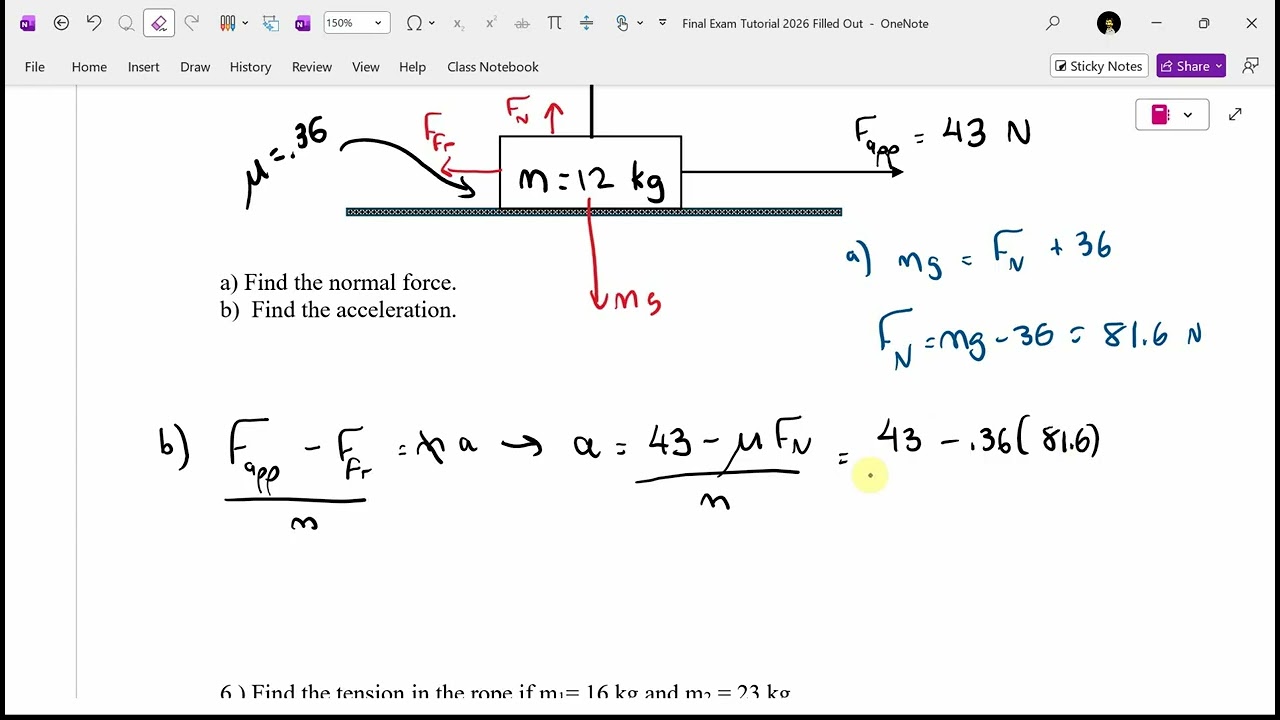
This I would consider a solid A level
question. And the reason is there's an
extravertical force besides mg. I see
friction. I see an F applied. So it says
given the following situation, find the
normal force. Find the acceleration. You
know what? Before I even start, what
might this be a good job for?
>> Yeah, I'm going to do a free body
diagram. So, did they give me a picture?
I'm going to label the picture right on
here with my forces. What are the forces
acting on this C? And I get the obvious
one. Which way? Yep. So, I'll put that
there. MG.
What else? Are we sinking into the
ground like Quickset? No. Are we flying
like Superman? No. So, there is a normal
force, but you notice there's an extra
vertical force lifting up. That's not
the normal force because someone's
lifting up. The ground isn't having to
push up as hard. The normal force is
going to be smaller than mg. If someone
was pushing down, did I do pushing down?
Nope. If someone was pushing down, the
ground would have to push up harder.
Then we have F applied. Oh, there's a
coefficient of friction. So, I should
also add Sienna. There's friction.
So, A said, find the normal force. Did I
give you lots of space? Maybe. I'm going
to do part A. I think right over here in
the margin over here. Sienna, back to
you. Are we sinking to the ground like
quick sand? Are we flying here like
Superman? Normally, I would say I don't
know the normal force. Oh, but look,
look, look, look. Except here, it's a
bit more complicated because they're
extravertical forces. What I can say is
everything down has to equal everything.
So, everything down in this case is mg.
Everything up is the normal force plus
and the 36.
If I was pushing down, then Jamie, I
would have mg plus something equals the
normal force, which is kind of easier
because the normal force is already by
itself. See, I got to get the FN by
itself. How? I'll move the plus 36 over.
Yeah. How?
Yeah. The normal force is going to be
mgus 36. And I'm going to go straight to
numbers. M is 12. I'm going to go 12 *
9.8 - 36. And I'll carry all the
sigfigs. I get, double check me, 81.6.
So there's part A. I would have to do
that if on a test I gave you this one. I
don't think I gave you one this tough.
Oh, sorry. That's a lie. On your final,
I did ask you to find a normal force
that isn't mg. Probably half of them
will have something pushing down. Half
of them will have something lifting up.
But I don't think I added the part B.
Part B says find the acceleration. I did
this just to review the fact that we can
handle it. Uh if we are accelerating,
we're probably accelerating to the
right. So Claire, who's winning?
Losing
you think friction's winning and f is
that correct? I think maybe now we'll
find out if we get a negative
acceleration. You might have been right.
Minus friction equals ma.
Was it Ryan's theorem? Are you the one I
and you barely showed up on time? Wow.
We can get the A by itself. Divide by M.
I'm going to move sideways to try and
make sure I fit this all in. F applied
is going to be 43 minus mu * the normal
force divided by m. You know what that's
going to be? 43 minus what's mu? I don't
know what's mu.36
uh the normal force 81.6
divided by 12. That'll get us the
acceleration.
Once you have that written out, go to
your calculator.
Uh, a a solid A or A+ level question
would be me giving you the acceleration,
asking you to get the coefficient of
friction, the mu by itself.
Let's see. Mr. Dick brackets around the
top. 43 -.36
* haha answer button close bracket
divided by 12
sadie did you get
or cla sorry did you get 1.14
yeah
m/s squared it's a positive answer so f
applied is winning if it wasn't then
friction would be winning I'd do a quick
change I'd make that a positive that a
negative in a more complicated question
I might have hadrict pointing the wrong
way. But here we're pretty
straightforward.
I definitely put an Atwood machine on
your test. Okay, this is probably the
longest question in terms of the most
amount of writing.
Jacobe, what's it asking me to find? I
can't. I first of all, I'm going to find
the acceleration of everything.
Sorry, I'm going to write an equation
for everything to find the acceleration
of everything. Why can't I find tension
from that equation?
Help me out, folks.
I lose tension. Wow. Right. I did the
stupid joke about the tension deficit
disorder. Then I'll find the tension.
So, to start out, you know, this is
going to be a good job for Yeah. So,
let's label what are the forces on M1.
Jacobe, get the obvious one. M1G because
there's more than one mass. What else?
Yep. On the second mass, it was M2G.
And tension. The tugofwar is really
between the two gravitational forces.
Which one's bigger? Which is the bigger
mass?
So, which way is m2 accelerating? Which
is the winning force? Don't say m2
because that's not on my free body
diagram.
Which is the winning force? Help me out,
folks.
Yes. Good. Now, I often, just so I
didn't forget, once I figured out the
direction of the acceleration, I often
just drew that on there because jazz,
it's easy to lose track and forget. So
now we got our equation. We're going to
start out walking along the rope. Who's
winning? M2G. Anything that ends up
pointing down once it gets to the right
hand side is going to be winner plus. So
then we have minus tension. What about
this tension? Is it a winner because
it's pointing up? No. Follow it. Follow
it. Follow it. Follow it. Follow it.
When it gets to this side, it ends up
pointing. So is it a loser because it's
pointing up? I said that backwards. It's
a winner because it ends up pointing
down once it gets to the right hand
side. This one, Lachland, you might say,
is a winner because it's pointing down.
But again, if you follow it, I don't
want to draw on there. If you follow it,
follow it. When it gets to this side, I
think it ends up pointing loser or
minus. What do I have to change the
right hand side to if I have forces from
more than one mass?
M all
a tensions cancel. And then we can still
use Ryan's [clears throat] theorem.
[snorts]
Get the acceleration. And it's going to
be 23 * 9.8 - 16 * 9 9.8
all divided by 16 + 23. These masses are
fairly close. I don't think we're going
to get a big acceleration. If it was
like 23 and 22, they would barely
accelerate at all cuz they'd almost be
balanced.
I know it's going to be less than 9.8. I
can tell you that. Uh 23 * 9.8 - 16 *
9.8 8 close bracket divided by a bracket
16 + 23.
Let me know what you get, Jacobe.
So 1.75897.
I'm going to write 1.76, but you know
I'm storing this on my calculator,
right? Or if I knew I was going to do be
doing more than one step, I'd write this
down elsewhere. So 1.76 m/s squared. Not
what they asked us to find. What do they
ask us to find?
Look at an individual mass to find an
individual force. So which mass do you
want to use? Okay. Which way is m1
accelerating?
Which way is the winning direction? Same
answer. Which force is winning then on
m1? Yes.
Which one is losing? M1 g. And that's
going to be m1. If you used m2, it would
be m2g minus tension equals m2a. You'd
have to do a swappy dance to get the t
by itself. Here we don't need to do a
swappy dance. We just need to plus the
M1G over, which is actually a little
easier. So, it's going to be M1 A plus
M1G.
It's going to be M16
A button plus M116
G9.8.
Oh, I don't need to put in brackets. 16
* answer button plus 16 * 9.8
and I get 185
newtons.
So you are going to see an Atwood
machine on your test. What I'm not going
to give you on your final is a missing
mass question. I don't if you remember
we also did Atwood machines with missing
masses. I put that on your test. I
didn't put it on your final. That was
where you got to use that clever math 9
operation. How many m's do I have? One.
How many? Two. How many would I prefer?
One. And you have to use the GCF trick.
We'll revisit that if you take physics
12.
And I think this is the last forces
question. Yes, it is.
I have several different versions of the
test. Some have an Atwood machine, some
have this one. These are the two
multimask questions. Find the
acceleration. Find the tension. Brooklyn
spoiler alert. What am I going to do
first? What might this be a good job
for? And again, I'm going to write find
the equation of the acceleration of
everything by writing an equation for
everything. And then I'll find an
individual force by looking at an
individual mass. Probably this one, the
12, because it's going to be less
cluttered. Brooklyn, what are the forces
acting on the 4.3? Get the obvious one.
I'll call that M1G.
And I think there's going to be a normal
force the same size as M1G. Renaut, I'll
call that for normal force number one to
go with mass number one. Is there a
rope? We have tension.
Is there friction in this question?
And this is going to be pulling down,
sliding to the right. So, I'm pretty
sure friction is pointing to the left.
I'll call it friction force number one
to go with mass number one. What are the
forces acting on the 12 kg mass? Get the
obvious one.
Yep. What else?
Yep.
A says, find the acceleration. Okay.
Who's winning? m2g. And then the most
common mistake people wanted to include
m1g. Remember, we're only going to
include forces along the rope. So, I'm
going to walk along the rope, which is
going to give me m2g minus tension. This
tension here becomes a winner plus when
it gets over this side. And friction
force number one is a loser. M1G hasn't
showed up in the equation. It'll show up
in the friction portion later, but it
doesn't show up in the first section.
that equals m all a.
Once again, I would stretch it out
losing tension.
Once again, Ryan's theorem.
So, a is going to be m2g
minus friction is what times what,
Brooklyn?
I don't know the normal force. Oh, but
look, look, look, look, look. I know the
force the same size as the normal force.
And this is where the m1g makes its
appearance inside the friction equation.
Uh, divided by m1 + m2. I've scrolled
down. What was it? 12 and 4.3. 12 *
9.8us what's mu? 28
* 4.3
* 9.8 8 all divided by 4.3 + 12.
Oh, I made a typo. Glad I caught that.
Insert a time sign. 12 * 9.8 minus mu *
the normal force / Brooklyn. Did you get
6.49?
No, I see people nodding. Yeah,
I wouldn't round off to 6.5. I don't
need to. Three sigfigs is pretty good.
If I know I'm going to be using an
answer to find another answer. I usually
carry four or five just to be paranoid.
But 6.49. I'm going to store this on my
calculator.
If I gave you this question, just like
the Atwood machine, I said find the
tension. If you get this one, I'm just
gonna say find the tension and I'll
expect you to clue in Nikki. You have to
find the acceleration first. So Nikki,
let's find the uh tension. Which mass
would you go with?
Yeah, less cluttered. Uh which way is m2
accelerating? Which way is the winning
direction? Same answer. Who's winning?
M2G minus tension equals M2A. That's the
equation just for that mass. What's
right in front of the T that I don't
like? I'll swap you dance.
It's going to end up being m2 g minus m2
a that equals tension.
It's going to be m212
g 9.8 8 minus M212
times answer button.
You get 39.7.
Newtons.
So, from last class and today, that's a
quick review of forces. That's what I'm
going to expect you to know. Okay?
If you're looking for a better idea of
how I turned these into multiple choice
questions, look at the final practice
final exam that I gave you today. You
we're going to work on it Wednesday. And
then I would also work on it before you
write your final as part of your
practice.
Pause for a second.
Give me one second
if you're okay. I want to try and plow
through all of momentum for the
remainder of class so I can give you a
complete review period on Wednesday.
That's the goal. So really quickly, key
concepts for momentum. Remember momentum
was a vector. So if there's more than
one direction, we needed to let one way
be something and one way be something.
Okay?
plus V. That's my abbrev minus V. You
can write POSOS or NEG.
You need to know the difference between
just plain old momentum
and change in momentum. So if you look
at your formula sheet, plain old
momentum was just P= MV. Oh yeah, we had
to use P because uh M was lowerase M is
mass uppercase M something else already
taken. So it's from a Latin word. What's
change in? Well, what's the symbol for
change in?
So a lot of people kept calling either
this momentum. It's the change in
momentum, which means the only way that
occurs is if momentum is changing. If
there's a difference. Uh what's another
word for change in momentum? Starts with
an I.
And what's changing anything?
I'm going to abbrev F minus I.
And so that gave us our impulse equation
which ended up becoming MV final minus
MV initial and force time. Uh collisions
and explosions. If you see a collision
or an explosion, there's two masses. Uh
that you want to use is the law of
conservation of momentum.
And then I'm dropping some blatant hints
here because I turned these into
multiple choice questions. Forces come
in opposite. So in a collision between
something big and something small, are
the forces the same? Yes, in opposite
directions, but they come in opposite
pairs. What about impulses? In a
collision between something big and
something small, impulses also come in
opposite pairs.
Do accelerations come in opposite pairs?
Why not? F equals what? What?
The only way the accelerations will be
in pairs is if the masses are the same.
And this goes my to my big rant of why a
small car is often so much worse off in
a collision with a big truck. Same
force, small car, way bigger
acceleration. And I've tried to teach
you what does damage. Acceleration is
what does damage.
There was several of those questions on
your momentum test and I li as multiple
choice and I lifted those and put them
right on the final. All righty. A force
of 12 Newtons acts on an object for 8
seconds. The mass is 3 kg. What's the
object's change in momentum? Remember
change in momentum is delta P. It's
impulse.
So I'm going to look at that equation on
my formula sheet. I notice they gave me
a force. They gave me a time. I think
I'm going to use the version of impulse
that says force times time. The third
version
Eve is looking. Yeah. Make sure you see
where it is on your formula sheet.
Right. It's that that middle one that
had three equations in one that we said
really it was a nice shortcut. Uh it's
going to be 12 * 8 which is 96. Double
check me.
And the units for momentum, oh 96, Mr.
Dick, were kilogram meters/s. The units
for change of momentum were kilogram
meters/s. But the same units are also
Newton seconds because force times time.
If you simplify force newtons time
seconds, you will end up with kilogram
meters/s. So you can use them
interchangeably.
B. Jess, what did B want me to find?
What did we find in part A?
There's a word in front of it. We didn't
find the momentum. I got to be nitpicky.
Change in momentum. Okay, so we're not
doing P= MV. We're in that middle
equation. Hey, that middle equation also
said that change in momentum is M delta
V. How would I get that? That's the
change in velocity. That looks like an
A, Mr. Do it. Make it a delta.
Jess, how would I get the delta V by
itself? how I move the m over.
Yep.
The change in velocity is going to be
the impulse, the change in momentum
divided by the mass. It's going to be 96
/
3, which is I should be able 32. Double
check me.
Yeah. And it's a veloc a change in
velocity. So, it's just meters/s. That
means that its velocity changed by 32
meters/s. If it was originally going
two, now it's going 34. It was going 10,
now it's going 10 plus 32, 42.
Example two. What will the recoil
velocity, magnitude, and direction be if
a rifle fires a bullet with a velocity
of 410 m/s north? When you fire a rifle,
that's an explosion. There's more than
one mass. Harit, this is going to be
conservation of momentum. What did we
say for that? Well, we said your the sum
of your initial momentum had to equal
the sum of your final momentum. That was
the summation notation that I taught
you, which was the shortest way to write
that. But really, we need to visualize
firing a rifle. Uh, I said be lazy but
organized. I'm going to use R for rifle.
I'm going to use B for bullet. You could
also use mass A and mass B, but if I
could, I tried to use words that started
with it. Easier to remember.
So, here is my rifle analog.
Before I pull the trigger, what's
moving? The rifle, the bullet, both or
neither?
Be stupid obvious. Neither. So, what's
my initial momentum? Yeah.
After I pull the trigger, what will be
moving? Well, definitely the bullet. And
it wants me to fire find the recoil
velocity which does have to be there
because forces come in pairs. There's
going to be a force on the gun. I'm
going to have momentum sorry mass of the
rifle velocity of the rifle. There's the
final momentum of the rifle plus mass of
the bullet velocity of the bullet
because momentum is mass times velocity.
They want us to find this.
Okay, Lachlan, I need to move this term
over. How will I move this term over?
What's it doing to the velocity of the
rifle? So, and there's a zero over here.
0 minus anything is just negative that
thing. So, I'm going to say, you know
what we end up with over here is
negative mass bullet v bullet.
That takes care of this term. Now I need
to take care of this mass in front of
the rifle. What's this mass doing to the
V? So,
and if you don't mind, I'm going to put
the velocity of the rifle over here
because that's where we're used to
seeing the thing by itself. And I'm
putting in the vector signs to remind
myself I better pay attention to
direction.
Mass of the bullet it says is 036.
Oh, don't forget the negative. Mr.
What's the velocity of the bullet,
Lachland?
And by saying that, you've just decided
north is positive. You could have said
negative 410 and decided north was
negative and I would have gone along
with it. But if we get a positive
answer, that'll be north. What if we get
a negative answer
with confidence and authority in your
voice? Yes. Uh divided by the mass of
the rifle, 2.2. We are going to get a
negative answer. I'm not going to say
negative south. After I get an answer,
I'll say equals and then south. So, it's
going to be 036 * 410. No, Mr. Dick,
it's going to be.6
* 410 / 2.2.
Do you all get -6.71?
I need nods. Yeah. So, -6.71,
which is 6.71 m/s
south.
That was the explosion question that we
looked at for momentum. Sometimes we had
an explosion where the initial momentum
wasn't zero. We did a spacecraft capsule
that blew up into two pieces and
actually it worked out well because the
probe got extra velocity for free.
That's why we have multi-stage rockets.
The engines lose momentum. Well, then
the probe has to gain or the capsule has
to gain momentum. We're okay. So,
everyone looking out in the hallway.
We're back now. Squirrel distraction.
Uh, I think this is the last one or two
more car crashes. I put one car crash on
your final. Either in the car crash they
stick together or they bounced apart.
Ooh. What do we call a collision where
they stick together?
Inelastic. Bounce apart. Elastic. Rubber
band. Bounce apart. Elastic. So car A
has a mass of that traveling west hits a
stationary car B. If it's stationary,
what's car B's initial velocity as a
number exactly? What's car B's initial
momentum as a number exactly? I made the
question easier for you. The collision
is inelastic. That means they stick
together. Find the final velocity. Okay.
Is this a collision? Yes, we're going to
use conservation of momentum. Before the
collision, what was moving, Sadi? Car A,
car B, both or neither?
So, I'm going to have the mass of car A,
velocity of car A initial.
And what do I always do here? Do you
remember? Bam. They collide after the
collision stuck together or separate
inelastic. So, in brackets, car A plus
car B val. This is the trickiest one to
set up but the easiest one to solve
because so many things are either stuck
together or zero because jazz this wants
me to get the final velocity magnitude
and direction. What's the bracket doing
to the V jazz? Adding, subtracting,
multiplying or dividing. So how I move
the whole bracket over? What's the
opposite of multiplying? Yeah, even
though this starts out complicated, this
is probably the easiest one
mathematically I can give you. It ends
up being the mass of car A, velocity of
car A initial divided by
the mass of both of them. That's going
to be Vfal. And now I can crunch my
numbers. 2,350.
I've just let west be positive. If I get
a negative answer, then that'll be east.
and stuck together. 2,350
+ 1,400. This is the same physics.
Instead of a car, I could make it a
football player tackling and wrapping
someone up when that person was standing
still.
That would be say if you watch football,
if the receiver was standing still when
they caught the ball and then right when
they caught it, the defender went
plowing through them. That happens
fairly often.
uh 2,350
* 26 / bracket 2350
+,400 close bracket
16.3 direction.
It's got to be west cuz I let west be
positive.
By the way, that W since it's after an
at symbol is west. Otherwise, it could
be work. It could be watts. I mentioned
we don't have enough. Hopefully, I
mentioned we don't have enough letters
going around.
Example four. This is probably the
toughest type of collision. Here we have
I was still nice and I think on the
final exam I always let one of the
objects be stationary at the beginning
just so you had a little fewer terms.
But here afterwards they're both moving.
It says it's elastic. They bounced
apart. So before the collision, what's
moving? Car A. So we're going to have
the mass of car A, velocity of car A
initial.
They collide. Sorry for those of you on
YouTube with headphones. After the
collision, Eveuna, read the question.
Car B is traveling south and it wants me
to find the velocity of car A. They must
not be stuck together. Otherwise, the
answer to car A would also be 24
meters/s south. Uh, I see the word
south. I see the word south. I don't see
the word north. I'm going to make a
little note cuz this one's more
complicated. I'm going to let south be
positive. If I get a negative answer
because it's possible car A bounced off
and reversed direction. It might have,
then I'll know. Uh,
mass A V A final mass B val
final momentum of car A final momentum
of car B not stuck together
Eugen what's this asking me to find
which one there's three
which one there's two
of car What
car? What?
Yes. Wants me to get that by itself.
Okay. Hey, this is formula manipulation.
Complicated but still doable. What's
going to drop down like a domino? The
left side. Yes.
Mass a va initial. And then I'm going to
do my adding and subtracting. You I need
to move this over. How will I move this
term over?
Yep.
How will I move the mass of A over?
Yep.
That equals VA final. I'm not sure
whether I'm going to get a positive or a
negative answer. Let's see. Mass A 2250
car a ma velocity A positive 32 minus
mass B 1,400
car B 24. You know what? It's getting
rear ended. Car B is going south at 24.
It's getting rear ended by car A. So,
car B is going to speed up, which it
Okay. So, no, car A, car B was stuck
still. Yeah. Yeah. Yeah. Sorry, I'm
visualizing the question here. Uh,
divided by mass A. Mass A 2250.
I think you do end up with a positive
answer. I think I think I think
I hope
maybe maybe
what'd you get?
17.1. Anybody else? Yep. So car A slowed
down because it gave some of its
momentum to car B, but it's still going
forwards. We visualize that. Car B was
parked. Car A came in. Boom. And they
both kept going, but car B kept going
away faster. 17.1
meters/s direction positive. So
I'm not doing a review of work and
energy. I'm kind of hoping that's recent
enough. Uh on Wednesday, if you want,
you can also ask me to look at any of
your unit tests if you're thinking about
doing a rewrite. I won't do that today,
but I'll sign those out and collect them
at the end of class. any flex block this
week. If you want to come in, you can
also sign out a unit test. Folks, that
is a really quick review of the course.
Let me just hit stop here.