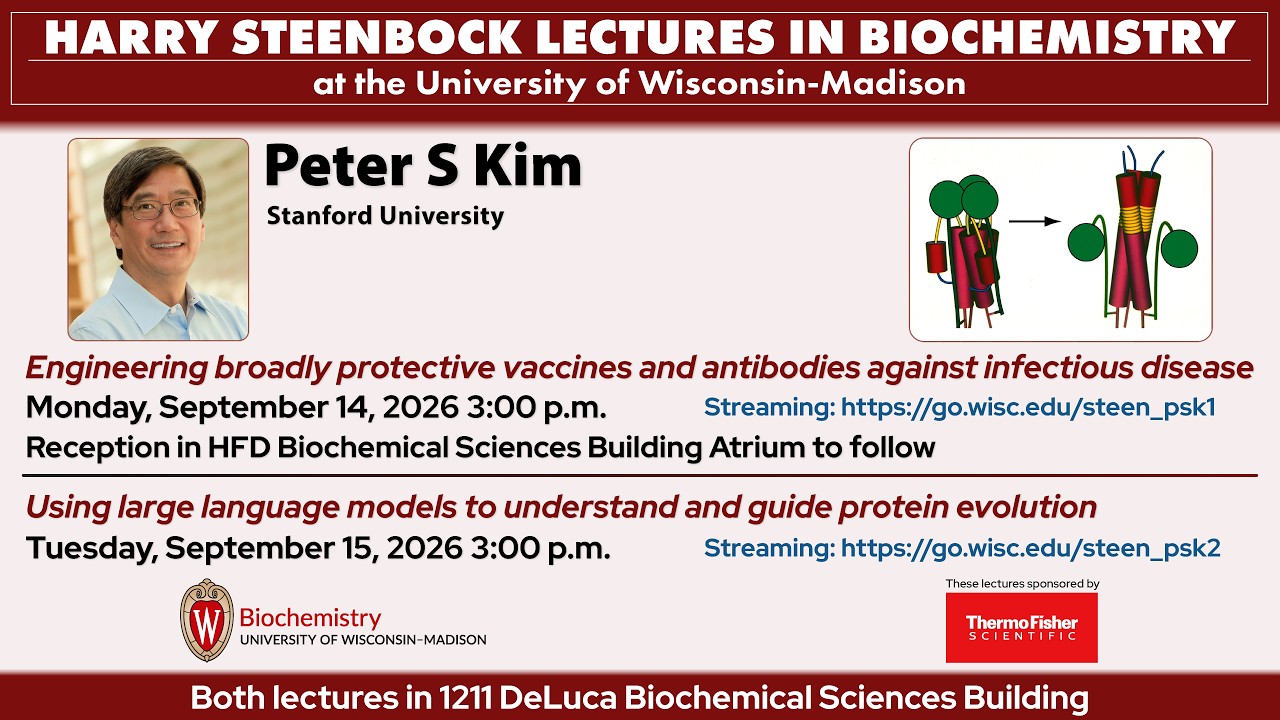
Peter S Kim - Steenbock Lecture I - Fall 2026
Watch on YouTubeVideo summary
Peter S. Kim's Steenbock Lecture highlighted vaccines as a monumental public health achievement, particularly for their cost-effectiveness and historical role in eradicating diseases like smallpox. A central theme of the presentation was the biophysical mechanism of viral fusion proteins, which operate via a "spring-loaded" system where viruses store energy in a metastable prefusion state to overcome activation barriers without external energy sources like ATP. For effective vaccine development, it is crucial to stabilize this specific prefusion conformation using strategies such as proline mutations, preventing spontaneous inactivation and ensuring that antibodies target the correct structure. This approach has been successfully implemented in COVID-19 vaccines and is being adapted for HIV research through SOSIP constructs, demonstrating how understanding these molecular mechanics can drive innovation across different viral threats.
Despite these advances, significant challenges remain regarding immunogenicity, particularly when dealing with large epitopes that may be too bulky for immune cells to access effectively. To mitigate this, researchers have inverted protein constructs to expose critical epitopes, a project currently continuing at the University of Wisconsin. Another major hurdle is the "immunofocusing" problem, where the immune system mistakenly targets non-protective surface regions rather than conserved, protective sites. Kim presented innovative solutions for Ebola virus vaccines that utilize feritin-based nanoparticles to enhance immunogenicity while employing glycosylation strategies to shield variable regions. These methods successfully direct the immune response toward conserved epitopes shared across multiple Ebola species, including Zaire, Sudan, and Bundibugyo, thereby broadening protection against various strains.
The lecture also addressed practical considerations surrounding mRNA vaccines, acknowledging their rapid production capabilities and established safety record among hundreds of millions of people, while emphasizing that their risks must be weighed against the devastating 40–60% fatality rates of diseases like Ebola. Although mRNA technology faces hurdles related to cost and cold storage requirements, it remains a viable solution for outbreaks if adequate funding is secured, with Moderna already developing candidates for both Bundibugyo and broader neutralization. Concerns about feritin nanoparticles acting as immune distractors were refuted by evidence showing low anti-feritin responses that can be boosted without interference, though optimizing antigen spacing using DNA spacers remains critical for effective B-cell receptor cross-linking. Furthermore, researchers are exploring alternative strategies such as evolving antigenic peptides to match existing antibodies and investigating whether neutralizing antibodies bind to the same epitope footprints on the glycoprotein through direct and indirect methods.
Looking toward the immediate future, an existing Ebola vaccine is currently being tested in Africa against the Bundibugyo strain, while Oxford and Moderna vaccines have entered Phase 1 safety trials with results anticipated by January or February. If these trials prove successful, the World Health Organization plans to deploy them immediately, although other research groups are simultaneously developing potentially more effective alternatives. The ongoing investigation into antibody binding mechanisms and antigen geometry underscores a commitment to refining vaccine technologies beyond mere efficacy, aiming for broader neutralization and robust protection against emerging variants. Ultimately, the lecture concluded that by combining deep structural insights with advanced nanotechnology and evolutionary biology, scientists can overcome current limitations to create next-generation vaccines capable of addressing complex viral threats like Ebola and HIV with greater precision and speed.
Read the full video transcript
Okay everyone, it's close to three. Uh
we'll get started. Welcome to this
year's uh Harry Stebach lecturesship. So
this is one of the most pre prestigious
honor bestowed by our department. Harry
Steinbach was a pioneering leader in the
field of vitamin metabolism as a member
of our faculty in the earliest 20th
century. During his time he discovered
that vitamin D deficiency is a cause of
ricketetts namely the weakening of bones
in children. And then afterwards because
of his research and then he were able to
establish the therapeutics for the
disease and he also played the
instrumental role in establishing the
Wisconsin Alumni Research Foundation
namely Warf today which is now among the
oldest and most successful technology
transfer offices in the United States.
And this year we're lucky to have uh
professor Peter Kim from Stanford give
us the steamog lecturesship. So Peter is
the Virginia DK Lubic professor of
biochemistry at Stanford. He started his
career at the as the whitehead fellow at
MIT and then went on to be the associate
head of the department of biology and
the Howard Hughes medical uh institute
investigator.
And then uh after around 10 15 years he
was at MIT he be he decided to go to
became the president of the merk
research laboratories from 2003 and 2013
where he oversaw the development over 20
new medicines vaccines including
gardicil the first vaccine for cervical
cancer zostax the first vaccine for
prevention of shingles in adults as well
as kuda the first FDA approved and PD1
inhibitor for the treatment of cancer
among many others. Yeah. And then so uh
he's known for discovering the spring
loaded mechanism for how proteins cause
viral fusion with host cells for which
he was awarded NAS award in molecular
biology. And this important discovery
laid the foundation for a critical
aspect of protein engineering namely
stabilizing the meta metastable state of
virusion proteins now found in many
different vaccines including the
vaccines for SARS kov2 which caused the
co9 pandemic and among many awards
accolades uh I want to say uh he's a
rare group of people who's an elected
member of the national academy of
sciences national academy of medicine as
well as national academy of engineering
ing and then uh the final words I would
say he's also a tremendous mentor he has
mentored um dozens of students postocs
and among them six have have become
members of national academy and one
became the president of the HHMI and
many others in leading uh institutes in
biotechnology as well as pharmaceutical
industry yeah without further ado let's
welcome Peter
>> [laughter]
>> Thank you very much DA for that kind
introduction.
Uh it's a pleasure to be here. I've had
a wonderful day uh meeting and talking
with people and I'm looking forward to
uh future meetings. Um this lecturesship
comes with two lectures. [laughter] So I
actually had to prepare two lectures uh
for this trip. And so today what I'm
going to talk about is uh vaccines. And
tomorrow I'll talk about uh using
protein language models to uh evol
understand and evolve uh proteins. But
today's focus is on vaccines. And I
thought I would just start by saying
that you know vaccines really are one of
the most profound public health uh
achievements of biomedical science. And
I think after
uh probably after clean water,
one of the most coste effective ways to
prevent serious disease and death is
vaccines. You know, you think about it,
you can give a uh a baby one or two
shots of a vaccine and they can be
protected for life against a disease
that could potentially uh kill them. Um,
importantly they affect not just the
health of individuals but also the
health of uh entire communities and that
in turn leads to uh actually big
economic uh issues with countries and
there indeed where countries don't have
access to vaccines they're profound
economic consequences.
The third bullet is really remark a
remarkable statement and that is that a
disease a disease called smallpox
which had a 30% mortality rate uh was
declared officially eradicated by the
world health organization in 2011. Just
think about it. We've completely
eliminated a disease from earth uh using
uh vaccines. And indeed there are
several other vaccines that have been uh
over 90% eradicated in the United States
and three polio, measles and uh rebella
that are targeted for elimination by the
WH.
Um
this is a picture that I like to show of
uh people inside what's called an iron
lung machine. And basically when someone
would get infected with polio which is
causes polomiitis
it causes infection of muscles. If those
muscles happen to be your diaphragm
muscles that you need to breathe they
would literally take such people and put
them in these chambers where they could
control the pressure so they could
breathe. Right. And this shows the
effect in in the United States alone
there were times where there were over
20,000 cases of polio per year. And what
you see is that when the sock vaccine
came along, that plummeted. Then the
live oral vaccine from saving came
along. And in the United States, the
last indigenous case was in the 1970s.
Unfortunately, even though we have
excellent vaccines against polio, uh
it's not yet been eradicated. Indeed in
Afghanistan, Nigeria and Pakistan uh
there these three countries have had
polio continue and have have never uh
been interrupted in terms of the um the
disease even and you know it's really
you can see the big change between 1988
and 2014 when the WHO and others really
put in a huge effort to try and
eradicate polio. And the reason why I'd
like to show this slide is to point out
that it's not science that's holding us
back here. We have the scientific
solution to eradicate polio. The
problems have to do with infrastructure
and with issues such as guerilla warfare
where people that are trying to
vaccinate other people are literally uh
killed as a result. So the point and and
now in this country I can make the point
more generally. The the problem of the
vaccines are amazing things. They are
among the most cost-effective ways to
reduce serious disease and death. And
yet there are scientific issues and
scientific problems we need to solve.
But there are also non-scientific
issues. And those non-scientific issues
also need to be solved in order for us
to realize their potential. Today I'm
going to focus on the scientific issues
about vaccines. And there are three uh
topics that I'd like to talk about. One
of them is a very old story. It's older
than many of you in this audience. Uh
but I'm I I'd like to tell it because it
has recent implications for uh vaccines
that are quite important and it's been
an important part of what made the COVID
19 vaccine successful and it's also now
become incorporated into modern vaccine
design.
And then I'd like to talk about what I
call the amunof focusing problem
statement. There are some vaccines that
have been very hard or to date
impossible to make. And uh even though
we think we know exactly what we need to
do, we can't actually make them. And I'd
like to talk about that. And then I'd
like to close with um a vignette about
vaccines to protect against Ebola
virus.
Okay. So here's the start of the story
and the start of the story goes back to
uh the late Don Wy who was an amazing
structural biologist at Harvard and what
he was able to do was to solve the
crystal structure of this protein the
influenza hemoglutin protein
and the reason why that was such a big
deal when he solved it was that it was
known in the field that influenza
hemoglutin the protein found on the
outside of the flu virus uh surface was
nec necessary and sufficient to cause
membrane fusion. So I should say that
you know in order for an envelope virus
to get into a cell the membrane
surrounding the virus needs to fuse with
the membrane surrounding the cell. And
it was known that the only thing you
needed to have that happen was to have
this uh protein on one membrane and the
receptor scyic acid on another membrane.
And if you brought the two membranes
together and you lowered the pH you get
membrane fusion. So all the information
for causing membrane fusion was in this
protein. There were two puzzles. One was
that it was known from chemical studies
that this part of the protein down here,
it's a trimer and I'm just highlighting
one of the three one of the monomers,
one of the protein
down here, which is called a fusion
peptide, that this was the first part of
the protein to insert into the cell
membrane as part of the fusion process.
And the reason why that was a puzzle was
that the cell is up here. Here's where
the viral membrane is. Here's where the
protein is. The cell would come down
here. The receptor binding domain is up
here. So the puzzle was how did this
fusion peptide way down here get
inserted into the cell as one of the
very early steps of membrane fusion.
The second puzzle was that there was no
need for added energy to cause membrane
fusion. There was no ATP hydraysis.
nothing was uh needed for energy and
that uh was a puzzle that we'll come to.
Well, we uh came across this problem
when we were studying coiled coils. We
originally started with what were called
loosing zippers showed they were coiled
coils and then we went on to trying to
understand coiled coils and predict them
from amino acid sequence.
And Chave Carr when she was a graduate
student set out to take a look at those
proteins that were predict had sequences
that were predicted to be coiled coils
but then when we looked at the crystal
structure in the PDB were not coiled
coils and the one really prominent
example that she found is shown in this
uh yellow highlight here. This yellow
region of hemoglutin is very strongly
predicted by the uh prediction programs
to be a coiled coil even though as you
can see it's uh a loop region and coiled
coils I neglected to say are alpha
helyses that wrap around each other with
a a superhelical twist but what she did
was to synthesize this yellow peptide
and when she studied it in solution she
showed that in fact it formed a very
stable three stranded coiled to coil.
And so what that led to then was a model
and the model shown on the left which we
called the spring-loaded model in which
that yellow loop region in the native
hemoglutin upon dissociation of the
receptor binding domains up here formed
a three-stranded coiled coil a very
stable three-stranded coiled coil. The
net effect would was to propel the
fusion peptide from the bottom of the
protein up to the top of the protein
where it was in the right place at the
right time to insert into the target
membrane.
Subsequently, Don Wy structure solved
the structure of the uh low pH converted
form of hemoglutin and sure enough uh
that yellow region had formed a stable
three-stranded coiled coil.
We speculated at the time that this
spring-loaded model might be applicable
to other uh viruses including HIV and
that turned out to be correct as I'll
come to in just a just a minute. But
because of the implications for HIV, we
actually shifted our work and started
focusing on HIV. And David Chan when he
was in the lab as a postoc solved the
crystal structure of the core of the HIV
GP41 protein which is the equivalent of
um part of H he hemoglutin and indeed
what he found was that just like
hemoglutin there was a central three
stranded coiled coil and the fusion
peptides would be located up here.
taken together with a lot of other
people's work and ours this led to a
model for viral membrane fusion and a
model is depicted here. So initially uh
as shown for HIV initially there's a
viral uh protein that's on the surface
of the viral membrane. In this case it's
the HIV GP120 and GP41 proteins. It
interacts with a receptor on the native
cell membrane. That interaction with the
receptor ultimately leads to a
confirmational change in which now the
spring is sprung. The three-stranded
coiled coil is formed. The fusion
peptide inserts into the cell membrane.
And then there's a high affinity for
this region which we call the N heptad
repeat region. And this region down here
which is we call the C heptad repeat
region. There's a high affinity for each
other such that they form a trimer of
hairpins. And since this part of the
protein is inserted into the cell and
this part of the protein is anchored in
the virus, that brings the two membranes
together. And somehow magically that
leads to membrane fusion such that after
the reaction is over, you end up with
just one membrane and you've allowed for
membrane fusion to occur.
The remarkable thing that came out uh
over the next few years was that this
structure this trimer of hairpin
structure was something that was found
in many different viral uh fusion
proteins. Indeed here you see for
retroviruses including HIV uh for
parramixa viruses uh including
respiratory sensitial virus filo viruses
like Ebola or the orthamixa viruses in
each case there's a three-stranded
coiled coil that forms that's adjacent
to the fusion peptide region. So in all
of these viruses there's a
three-stranded coiled coil that's
adjacent to the fusion peptide region.
And in all cases uh there's another
region be closer to the C- terminal end
of the ectomain that forms the trimer of
hairpins. In case of HIV it's with alpha
helyses. In the case of influenza it's
with a long loop. So the way in which it
forms a trimer of hairpins is different
but in all cases it forms a trime of
hairpins which presumably brings the two
membranes together as I showed you on
the previous slide. And in all cases,
the set the um three-stranded coiled
coil is uh in the middle of the
structure.
This is for the protein after it's been
sprung is what it looks like. But what
about before it's been sprung? Well, the
remarkable thing is that before it's
been sprung, here's the structure I
showed you already for influenza virus.
This is after it's been sprung. This is
before. And what I've highlighted are
the regions in yellow which are the
three stranded coiled coil and the
regions in blue which are the part that
forms the trimer of hairpins on the
outside. And here you see in a native
structure that the blue and the yellow
are uh mixed intermixed but look here at
respiratory sensitial virus where the
yellow and the blue are completely
separated in the native structure and
yet they form a very similar trimer of
hairpin structure afterwards. In the
case of HIV, we have another fold in the
native structure. In the case of SARS
KV2, we have a very different fold as
well. So, it looks as though evolution
has actually come upon this solution of
causing membrane fusion uh through
convergent evolution and it's set up the
spring in many different ways in the
native structure, but after it's sprung,
it's come with the same solution of
forming this trimer of hairpins.
Okay. So that's the introduction to the
energetics which is what I want to talk
about uh in this first part.
As I said with an enveloped virus
there's an intact lipid billayer that
surrounds the genome. And as you know a
cell has an intact lipid billayer. In
order for this virus to infect a cell
those two need to become one membrane.
Thermodynamically this is a favorable
process but the actual
activation barrier to cause membrane
fusion is quite high. The the diagrams
of the transition state of going from
here to here are quite fanciful and they
involve somehow smooshing the the head
group lipid head groups that are polar
together and coming up with a way of
mixing the inner leaflets of the uh of
the um
membrane.
In the case of influenza
it's known it was known that influenza
virus binds to its receptor scyalic
acid. It then gets endocytos
and in the endoome the pH gradually
decreases until it hits a pH of around
pH6 5.5 to six. At that point the
confirmational change that I've been
talking about occurs that allows the
membrane surrounding the virus to fuse
with the with the endooal membrane and
release the genome into the cell.
It [clears throat] was thought going
back to what I was talking about in
terms of uh the lack of energy. It was
talk thought that somehow protons
must be important in providing the
energy to cause this uh overcoming the
activation barrier and indeed uh people
were wondering what sort of how it is
that the protein took advantage of
protons to cause this uh transition. And
so the missing link, it was thought
because there wasn't a need for ATP
hydraysis, the missing link was somehow
going to be protons.
But what Chavei showed was that actually
you can get virus membrane fusion to
occur at neutral pH without introducing
protons if you destabilize the protein.
And so here is a membrane fusion event.
What you can see is that [clears throat]
assay for membrane fusion if you lower
the pH to pH6 or pH5.8
you get membrane fusion. You can look at
the biochemistry of the confirmational
change. But [clears throat] if you go at
neutral pH and instead of lowering the
pH if now you add a denature it like ura
you [clears throat] can also cause
membrane fusion. And she showed that if
at neutral pH you increase the
temperature to destabilize things, you
can also cause membrane fusion.
And as judged by the biochemical assays
that we could do at the time, there was
no difference that we could detect
between the low pH, the high temperature
or the high ura induced transitions. And
so what this suggested or indicated was
that actually
you can trigger this membrane fusion
event as in any one of in any way that
destabilizes the protein. So if you
destabilize the protein, you actually
kick it over to the fusogenic state,
which implied that the native state of
the protein was not the
thermodynamically most stable state, but
rather when you uh denate when you
destabilize the protein, you allowed a
transition to a thermodynamically more
stable state.
And this of course was blasphemy in
biochemistry to say that uh the native
state of a protein is not the
thermodynamically most stable state. I
spent over a dozen years at MIT teaching
that the amino acid sequence of a
protein determines it threedimensional
structure which is the thermodynamically
most stable state of the protein. And
yet we were saying exactly the opposite
here. So how does this occur? Well,
the answer again came from uh Don Wy who
solved the well first I should say
hemoglutin is made as a precursor as a
single chain precursor and that's called
HA0.
It then gets proteolytically cleaved
probably by furine to produce two
subunits HA1 and HA2 that are dulfide
bonded.
When Don Wy solved the structure of HA0,
what he saw that it was exactly the same
as the structure he determined before of
HA1 and HA2 except in the region where
the cleavage occurs. And in HA0, there
was an exposed loop. And in HA1,
[clears throat] HA2, that loop gets
cleaved and part of this protein tucks
into the center of the protein, but the
rest of the protein remains exactly the
same.
And so what's going on here we think is
that HA0
follows Anfinson's rules. It folds to
the thermodynamically most stable state
of the protein. Okay? So here's the
unfolded state. HA0 folds to the
thermodynamically most stable state. But
then it's proteolytically cleaved. And
after it's proteolytically cleaved, it
doesn't now unfold and resample all the
confirmational space. It's stuck in this
confirmation. And the only thing that
happens is the part that gets cleaved
tucks into the center of the protein.
And it [clears throat] turns out that
that traps this protein in a metastable
state. And now if you destabilize that
state, it goes to the thermodynamically
most stable state. And the energy that's
released by the transition from the
native state to the fusogenic state is
used to overcome the activation barrier
for membrane fusion. So it's a
remarkable process and as I said
convergent evolution has come up with
this process through different ways of
setting it up but it's a remarkable
process of storing energy in a protein
and using it to overcome an activation
energy an activation barrier in this
case membrane fusion.
Subsequently uh several groups studied
other viruses and showed using this
rigorous definition of thermoability of
metastability namely that you can
trigger membrane fusion using
destabilization by a bunch of different
means uh and showed that in fact uh
these membrane fusion proteins are
metastable that is they're not folded
into the thermodynamic most stable state
and this is now commonly accepted in the
field.
So as I said the energy that's released
here is used somehow to cause membrane
fusion
and indeed this is now a general
mechanism for what are called class one
membrane fusion proteins which include
several of the pro proteins that I've
been talking about. But why is this
important for vaccine development?
Well, when this because this this state
is is uh metastable, it [snorts] will
spontaneously at some rate transition to
the more stable state and you can make
that transition faster by adding
denaturance or lowering the pH.
In the presence of a target membrane,
that transition will lead to membrane
fusion.
But in the absence of a target membrane,
if you just have the uh protein sitting
there on the viral membrane, it will if
there's no membrane to fuse with, it'll
lead to inactivation.
And so in fact, these proteins that are
metastable uh sitting on the surface of
the virus will uh come over and become
inactivated or if they're sitting on a
vaccine by themselves, they will become
inactivated.
And indeed in this experiment that I
showed you earlier when Chave first
pre-treated the virus with acid it was
now irreversibly uh denatured and or
irreversibly in its uh postfusion state
and it would not cause membrane fusion.
Similarly when she pre-treated with ura
it would not cause fusion. So it
[clears throat] get it actually becomes
inactivated.
Well, back after we proposed this model,
Judith White at the University of
Virginia actually decided to test the
model by introducing proline mutations
in hemoglutin in places where she
predicted based on the structure that
prolines could be accommodate
accommodated. And the reason she did
that is proline of course is a very
strong helix breaker.
And she reasoned that if she could put
the prolings in the native state, which
she was able to do, then if the
spring-loaded model was uh correct, this
should not cause membrane fusion. And
indeed with these two proline mutations,
she was able to get proper formation of
the trimer, proper cleavage, proper
function, proper antibbody binding. But
when she lowered the pH, she did not get
membrane fusion or um uh viral
infectivity. So basically providing a
functional uh confirmation of the
spring-loaded model. Well, this trick of
introducing prolines into the native
state of the fusion protein turned out
to be very important uh in in the
future. And the first example of that
was with the HIV uh envelope protein.
For many years, people tried to solve
the crystal structure of the HIV
envelope protein because it was such an
important structure to try and get and
everybody failed. The the envelope was
just too unstable to actually get a
structure. But John Moore taking a
lesson from uh Judy was able to find a
proline residue that when he inserted it
and when he stabilized the the envelope
protein with a dulfide bond leading to
what he called envelope SOSIP uh with
this isolucin the proline mutation which
[clears throat] would be in the middle
of the uh three stranded coiled coil he
was able to stabilize this protein
sufficiently that actually then it was
the structure was able to be solved and
indeed This SOSIP construct is the basis
still today of efforts to try and make
an HIV vaccine.
And over the years, starting with Judy
White's uh example in in influenza going
to John Moore's and HIV envelope, there
have now been many different proteins
that have undergone uh protein
engineering to introduce these such
proline residues. And [clears throat]
indeed
uh Jason Mlelen, Andrew Ward and Barney
Graham did this with corona viruses and
[clears throat] they were studying MS
and SARS which are two other corona
viruses. And they found and identified
two residues which they could mutate the
prolings which would stabilize uh these
proteins and prevent them from flipping
over into the postfusion state. and
actually were able to make vaccine
candidates with these uh proline
mutations.
Then when the pandemic hit
with SARS KV2, the sequence was released
in in January of 2020 and by May of
2020, uh both Mlelen and David Weezer's
group had the crym structures of the
protein for SARS Kovv2, the spike
protein, because they knew where to put
the two proline residues. based on this.
So they're immed being they were able to
immediately move forward and get the
structures and it turns out that these
two proline substitutions were also
incorporated into the successful COVID
vaccines namely the biioentech fiser and
the madna mRNA vaccines which
incorporated these same two proline
mutations. the uh vaccine candidates
like the Oxford Astroenica or the uh
Russian or or Chinese vaccines that did
not incorporate this these two prolines
ended up not being successful and we now
know at least for one of them that
that's because uh of the transition to
the postfusion complex. So the
stabilizing mutations lock the protein
into the prefusion confirmation which is
of course the structure that you want to
have antibodies made against if you
wanted to create a good vaccine. You
don't want antibodies made against the
postfusion state. And so by stabilizing
this prefusion confirmation, you make
the native protein uh the uh target of
your uh im of the vaccine uh response
and you therefore enhance immunogenicity
and stability and this was critical for
SARS Kovv2. So this principle of
stabilizing first of all the fact that
these proteins are metastable
and then that now induces the important
principle of stabilizing that metastable
state if you want to make a vaccine has
become incorporated into modern vaccine
development and design. And there are
many different uh ways of doing this now
going beyond um introducing proline
residues that people are are using many
people are using to make vaccines and
indeed the recent success of the
respiratory sensitial virus vaccine or
uh is was due in very large part to
stabilization
and tomorrow in tomorrow's talk
[clears throat] I'll talk about using
protein language models to uh understand
and guide protein evolution and indeed
Indeed, we and others are using such
protein language model approaches to
also stabilize vaccine candidates.
I'd like to now turn to the imuno
focusing problem. As I said, there are
some vaccines that have been very
difficult or impossible to make and um
that is in spite of the fact that we
know that we have monoconal antibodies
that prevent the disease. So there are
several diseases in humans and many more
diseases in animals or animal models
where we know that if we put a monoconal
antibbody on board
into that person or that animal we can
prevent the infectious disease.
And we know exactly where that monoconal
antibbody binds the virus or infectious
agent. And so we know exactly what the
epitope is of the antibbody that is
protective.
And so the problem then becomes very
easy to state if you for example in HIV
we have what are called broadly
neutralizing antibodies that people have
painstakingly
isolated. These are very rare antibodies
from HIV infected individuals but
they've been isolated. Beautiful cryomm
or crystal structures have been
determined. We know exactly where the
antibbody binds.
So if you want to make a vaccine, the
problem statement is very simple. Make a
vaccine that elicits antibodies that
bind exactly to this epitope. Okay? If
you if you make antibodies that bind
this epitope, we know that it protects
uh people or humans. and and indeed in
the case of HIV uh this is an experiment
done in humans and with a single
monoconal antibbody called VRC1 and it
it it shows that you get protection in
humans for the viruses that are
effectively inhibited by this antibbody
and yet we can't do that when we try to
make a vaccine that elicits antibodies
that bind to a specific epitope very
often we end up with antibodies that
bind elsewhere and it's what I call
distractoes. The you know the antigen
has something else that says look at me
look at me bind here and so the immune
system goes and it binds there and it
doesn't bind where you want. There are
situations where you have an epitope
that's highly conserved among different
strains of a virus and you have a
monoconal antibbody that binds there and
people have shown in animal models that
it protects against all these different
strains. And so it's very clear what you
want to do if you want to make a
vaccine. and make a vaccine that elicits
antibodies against this highly conserved
antibbody and yet we can't do that and
so that's what and in the case of HIV we
can't do that despite 40 years of
extensive very hard work on the part of
many people and so it's what it's what I
call the imunoc focusing problem that is
if we have a particular epitope shown
here in red that we want to target uh we
need to get figure out how do we get the
immune response to respond just to that
red far. And so people have tried
different strategies. For example, uh
using different um strains of the
protein from different viruses that have
the same red epitope to try and get the
immune response. They've tried putting
those on a display of of what's called a
mosaic display to do this, but now in
one candidate, they've tried cutting off
the distraes, but that requires protein
design and engineering, which is tricky
to do. They've tried putting the domain
that you want onto a different scaffold,
but that introduces new epitopes with
which includes a scaffold or they've or
they've tried using epitope masking to
hide try and hide areas that you don't
want to get antibodies to.
And uh much of my many people in my
group are in fact trying to develop
methods to do this to actually do
imunocusing. It's basically a protein
engineering problem. How do you actually
engineer a protein so that parts that
you don't want to be immunogenic are not
immunogenic and other parts are? And I
won't go through uh those different
efforts but instead focus uh today on
one vignette and that has to do with
Ebola.
So um [clears throat] Ebola virus is a
virus that causes hemorrhagic fevers
that uh have a very high fatality rate.
So far the outbreaks have all occurred
in in Africa and they occur on a regular
basis unfortunately. [gasps] Uh and the
predominant species that has caused um
outbreaks over the years is called Ebola
virus uh and is actually referred to as
Ebola virus zire because that was the
original isolate. Um and that's called
and that's the uh orange red dots here.
The size of the dots indicate the number
of cases that have occurred.
There's another virus related in the
Ebola virus family called Sudan virus
[clears throat] and it's shown in blue
dots and it's the second biggest cause
of major outbreaks
and there's a third virus which has
caused uh just a couple of outbreaks
called bundi bujo virus but that's the
virus that actually is responsible for
the ongoing outbreak that's occurring
right now uh in in DRC in Africa is the
bundi [clears throat] bujo it's a very
rare form of the virus and this outbreak
is bad.
The worst outbreak of Ebola virus was in
20 excuse me 2014.
It lasted two years and caused uh over
11,000 deaths with a 39% fatality rate.
So this is a bad bad virus to get
infected by.
up until uh this year, the second
biggest uh outbreak was of Ebola virus
year in 2018, which also lasted two
years and had a 66% fatality rate. But
now with the Bundi Bujo outbreak that's
occurred, you can see that in the first
120 days, it's actually become um the
second biggest outbreak already. The
largest outbreak was here with 28,000
cases. We're already up to almost 7,000
cases with the current outbreak
and it's continuing uh pretty much
unabated right now. And the issue um
again is both scientific and
non-scientific.
Uh the scientific issue is that the the
vaccines that we have right now all
protect against Ebove the Zire form and
uh that's because that's been the major
problem so far. That's where the focus
has been. But we don't have any vaccines
against BDBV.
And uh what's going on right now is that
the WHO is testing the existing vaccines
against Ebon to see whether they help
with BDBV.
We and others are working on trying to
come up with a BDBV uh uh vaccine.
Uh but in the meantime, the virus is
continuing to spread. And again the
issue there's there's a lot of warfare
going on and also in these countries
where this these out where this in the
regions where this outbreak is occurring
actually getting Ebola virus is about
number three on the list of concerns.
You know uh number one is just basic uh
survival and getting food to eat. Number
two is getting shot by the gorilla
warfare and then u you have um have uh
the spread of the virus. So again,
they're both scientific and
non-scientific issues that that we need
to deal with.
Well, the Ebola virus has like uh the
virus I've been talking about a single
glyoprotein that's prominent on its
surface and that's called glyoprotein or
GP. And as I've said already, there's a
family a genus of Ebola viruses. Ebola
virus zire uh Sudan and budnau are the
ones that have caused outbreaks. But
these others which have infected animals
and actually Taiforest has infected
humans once are all in this family. And
what we'd like to do is figure out how
to make a vaccine that covers all of
these viruses so that you actually have
a panbola virus. And so our efforts in
this regard were uh really jumpstarted
by somebody that some of you may know um
who uh when he was a postocck in my lab
uh really started the tremendous work
that um on Ebola virus and he really
focused on two particular uh issues. The
first is what I've been talking about
and that is that um because these
different species uh have residues that
are different, the current vaccines are
species specific. And so we would like
to do is solve that problem. But the
other thing is that the current vaccines
are all viralbased vectors. So they
require storage at minus 80° C. And that
of course is not very convenient when
you're running around Africa trying to
vaccinate uh people. And so uh also to
try to avoid the low temperature storage
issue. And what Duo did was to take two
approaches to use the uh use
proteinbased nanop particles u based on
feritin which we knew were thermo to try
and put these onto those ther uh
presentations and then to use um a
shielding method namely glyosillation to
immunofocus the antibbody response away
from the species specific areas shown
here in red and toward the conserved
regions of GP.
>> [clears throat]
>> So on the on the first issue of the
feritin based nanoparticles
um many years ago
Keno and Gary Nabel at the NIH showed
that feritin which spontaneously forms a
24
uh particle used to transport iron in
bacteria it self assembles to form this
nano particle made of 24 subunits And
there's this beautiful three-fold axis
of symmetry which actually uh
geometrically aligns well with the
trimer on in this case hemoglutin that
three-fold axis and they showed that you
could fuse these two together as a
genetic construct and make a particle
which displayed hemoglutin on the
surface. And the advantage of using
these particles is that dendritic cells
will grab particles and transport them
much more effectively than they will
small proteins.
And in addition,
particles will cross-link B cell
receptors on the surface of B cells
leading to enhanced uh imunogenicity as
compared to the isolated antigens. And
so multi multime display of antigens
promotes uptake by the dendritic cells
and it increases bell receptor
clustering and therefore signal
activation.
And what do Duo showed was that when he
put the glyoprotein onto the nanop
particles and then studied them in mice
comparing the trimer to the feritin
nanoparticle when he looked at binding
antibodies there were better binding
antibodies with the feritin nanoparticle
but it wasn't a huge difference but when
he looked at neutralizing activity of
the anti-era there was a big difference
with the glyop with the nanoparticle
eliciting much better neutralizing
antibodies against the virus than the
isolated trimer. So basically he had a
system to uh to work with uh as moving
forward.
So then for amunof focusing what do was
to install glycans into the protein and
in particular into those regions which
were highly variable and the reason the
way in which he did this was using uh
genetic expression and the and that's
because the motif that encodes for
glycosillation in malian in malian cells
is a sparaging any amino acid except for
proline and then searing 43 amine. So
this tri this three residue motif is
what is recognized by the glycosillation
machinery to add glycans. And so he
[clears throat] screened a bunch of
regions where there was variability in
the protein to identify those places
where he could insert genetically this
motif and get the glycan added.
And what he showed was that that
strategy was compatible with the
multivalent display on feritin. And he
could add two, three or four glycans.
And it turns out that the when he added
these three glycans to the region of the
protein which is highly variable called
the glycen cap, he could get um a good
stable nanop particle.
[clears throat]
And he went on to use this uh species in
mice. And in green you can see that with
his GP plus3 construct he's able to get
neutralizing titers against both Eboth
BDBV which we've been talking about for
the current outbreak and Sudan. So he's
been able to cover the [clears throat]
three different species that actually
caused outbreaks in humans.
And finally what he showed was that uh
when he takes his glycosillated
GP feritin construct GP plus3 and he
stores it at 37° C for up to two weeks.
There's no change in the thermal melting
curve of the protein. So it's a stable
protein that could be transmitted um at
certainly refrigerated. Uh in Africa
things get pretty warm. Uh sometimes
much higher than 37 but even 37 for two
weeks is stable.
So that's where um things stood as I
said um duo started with Ebola virus and
he was able to show that he got cross
protection against Sudan virus and buda
virus at least in mice. As I said
already there are vaccines already
against Ebola virus. There are no
vaccines that are specific for Sudan
virus which I which as I said is the
second leading cause of major outbreaks
of Ebola virus. And so uh what Rebecca
Costello went on to do was to ask
whether or not we could make a Sudan
virus vaccine since that is an unmet
need unmet medical need. So could we
make a Sudan virus vaccine but again
take the strategy that Duo used to try
and make it not just a Sudan virus
vaccine but something that would protect
against um other viruses as well and I
won't go through the process that I just
[clears throat] went through with Duo
for how she did this but again she used
a feritin nanoparticle presentation of
the glyoprotein again she focused in on
the glycine cap which is where the
highly variable regions are here's the
conservation. What she's trying to do is
focus the immune response on the
conserved regions. I'm just showing one
of the three protoimemer highlighted in
colors here. It's a trimer like the
other proteins. And she ended up uh with
this hyperglycillated version 2.2 that
showed the best properties. And I won't
walk through how she characterized it,
but she was able to get this this
protein on a nano particle.
And when she uh immunized um mice with
this with this with the wild type Sudan
versus the hyper glycosillated 2.2 2
version and she looked at neutralizing
titers against now all of the uh
different uh Ebola viruses. Here what
you see is that she gets good
neutralizing titers in both cases with
Sudan but then with Eb she gets much
better neutralizing titers with her
construct with Bundy BJO she's getting
good titers and indeed she's able to get
uh neutralizing titers against all uh
six members of the Ebola virus family.
So at least in mice and we're now going
on to test it in um guinea pigs uh the
uh her Sudan hypoglycosillated nano
particle is a pan Ebola virus vaccine.
And so um it just shows the basic
principles of taking advantage of
increasing immunogicity and uh using an
imun focusing approach to hopefully get
something which is a candidate that will
be across all Ebola viruses.
And with that, I'd just like to close by
saying I have an amazing group of
people. I've only talked about the work
of some of them. Uh they're listed here.
And um I'm fortunate in this current
environment to have funding in
particular from uh SEPY, the Coalition
for Epidemic Preparedness, uh and the
Gates Foundation to help support this
work. Uh and with that, I'll be happy to
answer any questions. Thank you.
Hi, that was a really interesting talk.
I was wondering if since you were
showing the conserved region on those
proteins is often on the side kind of
where the protein is on the feritin
particle. Uh do you ever have issues
with like immune cells not being able to
access an antibbody that's bound there?
>> Yeah, great question. Um
[clears throat]
the answer is yes. And sometimes it
works to our advantage and sometimes it
works against us. If if the epitope is
located on the side or even lower on the
side, um we can get antibodies to bind
there, but uh we but those regions tend
to be uh not very immunogenic. They tend
to be what I call imuno recessive. And
we think that that's because even though
an antibbody could get in there and you
measure the affinity for the binding,
it's lower by two or three fold, but it
can still get in. But there is some
steric hindrance. But a B cell where the
B cell receptor is on the B cell
membrane and in order to stimulate the
immune response it needs to get into
that epitope. It of course is much much
much larger and so we anticipate that
the accessibility there is uh going to
be a problem and that may be related to
why it is that they're much less
immunogenic. Um, another project that
Duo did which he's continuing here uh at
Wisconsin is to actually figure out how
to take such uh epitopes or such
constructs where the epitopes down in
the bottom and not very exposed and turn
it upside down and he did that and it
worked beautifully and he's he's
continuing to do that work here. Uh so
accessibility is a key issue in what in
what we need to do here, right? Yeah,
absolutely.
Hi, that was a great talk. Um, I'm
curious about like so the rise of like
mRNA vaccines and is that feasible for
something like Ebola?
>> Yeah, great question. Um,
I'll preface this by saying that mRNA
vaccines have have uh had an amazing
impact on uh the world. And um a major
reason that we're all here in this room
is thanks to mRNA vaccines.
um despite what you may hear from other
people. Uh and um the the advantage of
mRNA vaccines is that they are fast to
produce and um you can therefore change
the sequence very quickly which is very
hard to do with a proteinbased vaccine.
Um
the and now we know that the mRNA
vaccine has been tested in literally
hundreds of millions of people.
Anytime you take a foreign substance and
you put it into your body, there could
be side effects and those side effects
can be different for different people.
So there is a risk of taking a foreign
substance and injecting into your body.
I think the first thing that needs to be
acknowledged in this discussion is there
is risk. That risk needs to be compared
to the risk of the disease. Okay? And
that's where I think this whole argument
about mRNA vaccines has gotten
completely out of whack, right? Is that
the risk of the mRNA vaccine which is
there and it's real is is much much much
smaller than the risk of the disease. In
the case of Ebola
where you're talking about fatality
rates of 40 to 60% um this shouldn't
even be a discussion and indeed um Madna
is working on an mRNA vaccine right now
for BDBV
uh we're also working on an mRNA
construct which uh we hope will have
broader um broader neutralizing activity
not just against BDBV but also against
other Ebola viruses.
The issue with mRNA vaccines uh is that
they're expensive and they require cold
storage. And so it's not a very
practical solution. But in the case of
an outbreak like this uh and if you have
people that are willing to pay, which in
this case uh is going to depend in large
part on countries other than the United
States, um then they're they're a great
solution, right? Yeah.
>> Yes.
Um,
is this I had another question about the
feritin nanoparticle strategy. I was
curious basically how densely decorated
these nanoparticles need to be in order
to get a good response because I I
imagine the feritin itself could act as
another sort of distra for the vaccine.
>> Great question. So, we worry about that
a lot. We've shown um actually in
animals and um in a vaccine a COVID
vaccine candidate actually that was
taken into phase one clinical trials by
a biotech company that the responses to
feritin are uh low and you can actually
boost with these vaccines and not get
the antifarotin anti response to
interfere. But that's a definitely a
concern in terms of the first part of
your question, the density, you know,
[clears throat] certainly in terms of um
the B cell receptor cross-linking,
the spacing between the antigens is
going to be important. And so it turns
out that the spacing that the feritin
nanoparticles give us is actually
empirically very good for cross-linking
bell receptors. But uh if you were to
use different spacing or different nanop
particles, you could get very different
results. Pamela Bjorkman at Caltech has
done some very nice studies using uh
spacers made out of actually double
strand DNA to start to investigate this
problem. But this is something that
definitely is uh an important
consideration, right? [clears throat]
The geometry in the space and the
density, right?
Also on the same topic um instead of
using these uh feritin nanop particles
and you know trying to engineer your
epitope to you know target your immune
response to a particular location. Do
you think an alternative strategy that
might work would be to um say evolve
antigenic peptides uh because you know
like what the epitope should look like
and you have antibodies that could bind
your target. Would that be another route
to a vaccine?
>> Yes, I think that that that is
definitely a good uh path and people are
people are trying to do that. Uh as you
say in those cases where you have
antibodies that you know are effective
and you can use evolution to move things
forward. Uh it's definitely something I
think that's that's worth uh worth
pursuing and people are doing that.
Yeah. Absolutely.
>> Yes.
>> Uh thank you very much for that uh uh
interesting talk. I just wanted to
uh get some ideas about the Ebola in
particular, which is really a very big
problem in in Africa right now.
[clears throat]
And now that you have sort of begun to
develop
uh uh the vaccines against the four uh
Ebola species and you have tested them
in in mice [snorts] and you mentioned
that you also going into the guinea pigs
and I'm just curious because of the
seriousness of this problem how long it
is likely to take [clears throat] based
on your experience. right?
>> Uh to get out of the the guinea pigs and
then into the humans just just to be
able to help the global.
>> Thank you for that question. Um
there there are right now um
there the current Ebola virus vaccine
that works against the other species
Eboth
is being tested in Africa in the
outbreak to see whether or not it offers
any protection against Bundi BJO. So, we
don't know the answer, but we'll we'll
find out. And we'll find that out, I
hope, uh, in the next few months. Uh,
and and if it does, that'll be that'll
be great. As I said, there there are two
other vaccines that are currently moving
forward very quickly. One is the Oxford
uh based vaccine, which was used in
COVID. It wasn't terribly effective, but
it was used in CO and has a good um
manufacturing track record.
It's being produced now with the Bundi
BJO protein and um it has entered phase
one clinical testing. So they're
starting to test humans with for safety.
Similarly, Madna is making an mRNA
vaccine similar to what they did with
COVID using the bundjo uh construct and
that also has started phase one clinical
trials for safety in humans.
So, uh,
if we're lucky, we'll have the phase one
results or the comm we community will
have the phase one results for those two
vaccines in the January to February time
frame. And if that's the case and if
they look like they're safe and if they
have a good immunity immunogenicity,
then the WHO plans to test them in the
current outbreak.
others including us are a few months
behind but with something that in our
case with something that we hope will be
more effective in case these others are
not effective. Um and um but as I said,
we're we're a few months behind and
every with this outbreak every day
matters. So we're we're trying very hard
to move quickly. But as I said, the
other two outbreaks that have occurred
lasted two years. And so we think
actually that there's um still an
important need to try and keep going
until we have a good vaccine that can be
deployed. I should say that that's the
scientific part of the problem. The
non-scientific part of this problem are
very very substantial and uh that of
course is um something that I I have no
expertise in. Right. Yeah. But they're
they're very real. Yeah.
>> Yes.
>> A wonderful talk. I had a quick question
about the antibbody binding of your
panola virus. I was wondering if you
looked at specifically where these
neutralizing antibodies are binding to
uh the glyoprotein. Do they bind to the
same place? Do they have the same
footprint? Are there differences?
>> Yeah, great question. I would love to
know the answer to that. And uh there
are there are more direct and less
direct ways of trying to answer that and
uh we're we're pursuing both. Uh one of
them in collaboration with somebody
here. [laughter]
Yes. And and that's a very important
question to answer from a scientific
point of view in terms of
what what are we actually doing that's
leading to success so that we can
recapitulate that. Right. Absolutely.
Right.
>> Okay. Thank you very much.