PestFacts South Australia webinar – September 2026
Watch on YouTubeVideo summary
The September 2026 webinar, hosted by PestFacts South Australia as part of a GRDC-funded project, provides a comprehensive update on seasonal pest status and disease risks for growers. The session is led by editor Marame, who introduces Dr. Martin van Helden to discuss insect activity and Ian Thomas from Cesar Australia to cover risk assessment regarding red-legged earth mites. A central theme of the discussion is the unusual weather patterns of 2026, characterized by early February breaks, unexpected rainfall despite El Niño forecasts, and generally favorable temperatures that have pushed crop development ahead of schedule. While these conditions have led to optimistic yield forecasts compared to the previous three difficult years, they also create specific pest management challenges, particularly regarding aphids and virus transmission during the early stages of the season when crops were sown earlier than usual.
Dr. van Helden details the current landscape of insect pests, noting that while aphid populations were high at the start of the season due to warm conditions allowing rapid buildup, natural enemies like hoverflies have since taken over regulation, potentially making spring control better than average. He highlights that although early virus pressure on canola and lentils occurred before winter, late-season infestations are less concerning for yield because crops are more advanced. Other pests such as the diamondback moth and European bean leaf beetle (ETLA) are being monitored closely, with advice given to rely on natural enemies where possible and only intervene chemically if populations exceed thresholds. The speaker also addresses migratory species like lesser grain borer and common armyworms, emphasizing that while some have built up in the outback, migration into cropping areas is not yet automatic and depends on food availability and weather conditions.
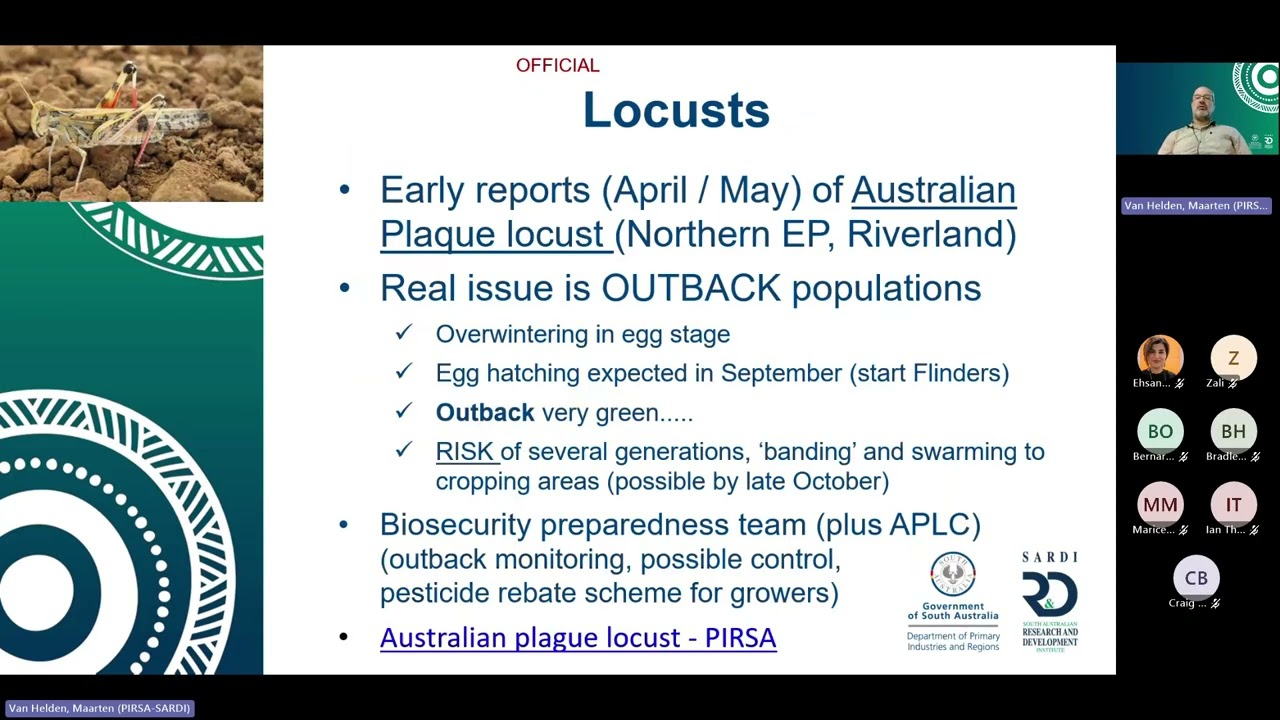
A significant portion of the webinar focuses on the potential threat of Australian plague locusts, which were observed migrating into northern regions in April and May, an unusual timing for this species. Although no major outbreaks have been seen yet, experts warn that populations could build up in the outback over the coming months before migrating into cropping areas by late October. The discussion stresses the importance of monitoring egg hatching dates using tools provided by the Australian Plague Locust Commission and urges landowners to report any sightings immediately. Crucially, the speakers explain that broad-spectrum locust insecticides are contact chemicals that must be applied directly to swarming nymphs or adults; spraying prematurely before the insects arrive is ineffective because the products do not have residual activity. Consequently, growers are advised to stay alert but not alarmed, preparing to act quickly once locust bands appear in their specific regions.
The second half of the webinar shifts focus to red-legged earth mites and the updated TimeRight system for managing them effectively. Ian Thomas explains that the model has been recalibrated based on twenty years of climate data, resulting in earlier spray dates across most of Australia to target mite populations before they produce diapause eggs. The new system provides a flexible spray window rather than a single date, allowing growers up to four or five weeks to apply treatments while still achieving high efficacy if weather conditions are unfavorable. Risk assessment is presented as the cornerstone of management, requiring farmers to evaluate current mite numbers, crop type susceptibility, stubble burning plans, and sowing times. Additionally, the session addresses the growing issue of insecticide resistance, particularly to synthetic pyrethroids in South Australia, and introduces a quick field test for detecting resistance before applying chemicals, aiming to preserve chemical efficacy through strategic timing and reduced reliance on frequent spraying.
Read the full video transcript
In this webinar, we are going to talk
about the spring pest watch from field
observation to time right. This webinar
is being delivered as part of GRDC
funded seasonal status of pest and
diseases for growers project. My name is
Marame and I'm pestfac essay editor and
hosting the webinar today. The
Department of Primary Industries and
Regions acknowledges the traditional
custodians throughout South Australia
and their continuing connection to the
land, waters and community. We pay our
respects to all members of the
Aboriginal community and their cultures
and to elders both past and present. In
today's webinar, Dr. Martin van Helden
will provide an update on locust
activity, key spring pest and natural
aid control by beneficial insects and
then Ian Thomas from Cesar Australia
will talk about time right and risk
assessment and resistance in redlem
>> my contribution to the situation in
South Australia um in a interesting year
as far as weather conditions is
concerned so I will probably start by
explaining that a little bit will the
ideas are about this year's weather
conditions and how that influences the
pest status. Um, so 2026 a very unusual
year. It's very clear. We had a very
early break in February. Uh, and we've
had follow-up rains in spite of the
announced El Nino. Um, it keeps raining
and it has been raining most of the
time. Um, crops are clearly ahead
compared to previous years because the
sewing was done much earlier and the
temperatures have been quite okay. So I
think everybody is quite happy with this
year with a yield forecast that's
looking really good especially compared
to the last three years which have been
tricky. So um that doesn't mean that
it's easy for anything that is pest and
diseases. Um diseases is not my part of
knowledge. So uh I'll let my colleagues
from pathology work on that. Um we will
be covering insects. Um so what we've
already seen very clearly is that in
2026
with the early sewing there was also
still an opportunity for aphits to come
into crops um causing virus inoculation.
And uh the big question now is how will
this all work out on aphids and all the
other pests that we can expect um but
for which we have no idea about their
population levels in the coming months.
spring is only just starting. Um, and it
certainly will be very interesting to
observe and I think we need to observe
to be sure what's actually happening.
Um, so if you look at the weather
conditions 2026 a very normal year as
far as temperature, this is temperature
anomaly from May and July. So very
normal year in that sense. However, what
was very different is rainfall. So this
is the rainfall from May to July just
taken from the bombside. So as you can
see there's large areas of South
Australia that have received between 50
and 100 millimeters rain more than they
usually do. These are the August
rainfall data um for all of Australia.
Um as you can see we still have had
quite a bit of rain in August. um large
sudden downpours with some flooding
events um which is still quite good for
agriculture. I think no farmer is
complaining about the rain. Um it might
be different obviously at harvesting and
would be still too wet but that should
be okay. Um so for this at this stage we
don't seem to have a very clear dry El
Nino year. You can see we're very much
above average in large areas, especially
in the north, which is not really
country, but more pastoral country. Um,
and you can see that around Adelaide,
um, it's it's quite a normal situation,
I would say. Um, on the App Peninsula,
they have a bit more rain than they
normally have. So, they are certainly
happy with the prospect of their harvest
of cereals, um, and some other lentils
and things like that. So high soil
moisture in the outback however means
there's a lot of green growth over there
a large amount of vegetation and that in
itself is potentially a risk for the
cropping in this spring and I will
mention a few cases where we think there
could be an invasion coming up and we
need to keep our eyes open. So aphits
and virus I think that was very clear at
the start of the season when everybody
started sewing uh early normal seed
treatments applied and then all of a
sudden there was aphits coming into the
crop because it was warm enough they had
had time to build up. Um they moved into
the crops and unfortunately the seed
treatments are not that efficient
anymore. Um so um yeah there was quite a
few aphits. If you now look over the
winter period from the reports that we
get in from farmers and aronomists, it
seems that the aphit population would
say relatively stable. We haven't seen
huge outbreaks. Um there's aphids around
but not huge numbers. However, what we
do see is that there's actually quite
large amounts of natural enemies
building up which is very positive. Uh
just here on the bottom left side, you
can see a yellow sticky trap that we had
up in Turretfield couple of weeks or two
months ago. I think it was this one. And
all these flies that you can see here,
all roughly the same size. These are all
hoverflies.
So they come into the crop and they will
lay their eggs near a maggots of the
hoverflies will eat the aits. So we
think that
even though there was high aid pressure
at the start of season, we think that at
the moment the parastoids and the
hoverflies have very well taken over and
probably some other natural enemies. Um
so we think that the regulation this
spring will be better than it usually
is. So take a look if you do your
observations monitor your aid population
but also look at the presence of natural
amies because it'd be a pity if you
would go in spray let's say cabbage aid
while most of them are already
parasitized. We had of course a high
early virus pressure on canola and
potentially also in lentils that could
be affecting the yield. Unfortunately
there's nothing you can do against that.
Um that has happened before the winter.
um spring virus infestation if it would
happen now has probably very little
impact on the yield because the crops
are much more advanced. So even if they
would get the virus now they would not
have a huge yield reduction probably
even no yield reduction. So I would not
be too worried about a few aphits
transmitting virus in the field at this
moment. Green peach aid should be quite
well regulated by natural enemies. Um
that's a different story. Um diamondback
moth we have very little reports. We've
had quite a few reports of early
infestation. Um, but over the last few
months, we've had little or no reports
of DBM. We think it's probably the same
situation that natural enemies are doing
a good job. Um, but keep an eye open, of
course, because DBM, if there would be a
high infestation in the potting stage of
canola, then potentially you can have
yield loss. So, look at that very
carefully and make sure that the
populations are not too high.
ETLA is one of those um crop specific
issues um little caterpillars that start
flying around this time of the year. Um
so we do have a model that allows you to
see when you should start monitoring and
it's actually in most cases around this
time sometimes even a little later. Uh
if you go to the
internet and you just look for ETL
model, you can enter your own data of
where you are and you can see how much
heat has been accumulated and when you
should start monitoring. Um certainly
don't spray because the model predicts
it's the highest level of population
because we have no idea and so far as
far as I know we've had zero reporting
of ETLA. So keep us informed and um
spray only if you need to. But worms um
we had some issues at the very start of
the year with some lesser butwarm. Um
these are migratory species that usually
come from the outback. So potentially
this year they can be building up in the
outback to quite high numbers. Then the
question is will they start building up
and will they start migrating? If they
have enough to eat, why would they
migrate? So I wouldn't expect them to
come in automatically. And we do have of
course the native trap bloodworm
trapping going on and that's being
reported on pests and also on X
regularly by Mariam. So far we haven't
seen much. So um but it's still a bit
early in season. They basically is keep
monitoring use your sweep net um which
is the best tool at this time of the
year to monitor for most of the diseases
also pest that can be around. Another
caterpillar that we did get some reports
in quite recently is the common army
worm. So it's a native species. We're
not at all talking about the fall army
worm because that's not a problem in
South Australia. It's just too cold
here. We're not expecting that to
establish and we haven't had any reports
so far over the last few years. Um but
yeah, the common army worm is a little
bit of a different insect which again
can migrate and can start to build up at
this time of the year. So the adults are
usually active in August and September.
Um they will lay eggs, the eggs will
give lavi and the lavi will mature in
November and December. Um that's where
you can potentially have some damage
especially if they start nibbling off
the heads of cereals and things like
that. So be very careful. Do your
observations and decide on whether or
not you think you should have a chemical
intervention. Last issue and and
probably the most worrying or at least
the most um unsure
um is the situations on locust. So if
you remember well in April May there
were some reports of Australian plate
locust on northern EP and in the
riverlands. So they were adult locust
migrating into these areas. They had
been building up in the outback. Very
unusual to have that at that time of the
year because normally it comes only
after winter. Um, so these locust have
been around there. There's been a little
bit of egg lay as far as we know. Um,
but the big question is what's actually
happening in the outback because that's
where potentially populations can build
up. Um, for those of you who are around
longer than I have been in Australia,
uh, if you still remember 2010, huge
outbreaks of locust. They had been
building up in the outback. It was also
a very wet year in the outback. So they
had been building up to high populations
then started to migrate um and then they
can cause issues when they when the
adult locust arrive in the cropping
country and that's really difficult to
control. So at the moment you might be
saying why is he talking about lo
because I haven't seen any. Well that's
normal because they are in the ground at
the moment they're overwintering in the
exchange. Um we work together with the
APLC the Australian plague locust
commission and biocurity.
um to monitor the possible hatching of
eggs and the densities that will uh
occur and we will start doing that in
September. So next this week actually
and next week um especially in the
northern fenders ranges where we expect
them to hatch first. Um, and then the
question is how will they build up their
populations in the outback and will they
build up to populations that basically
eat everything there and then they will
start migrating. So we still probably a
couple of months away before the problem
might arrive in the cropping country and
we're trying to do everything to avoid
that actually happening. So they would
have to do at least one and possibly two
generations before they start
banding as it's called and migrating
into
the cropping areas potentially into the
cropping areas depending weather
conditions. Um but yeah you it is
possible that it would happen by late
October. So there is already a lot of
things going on. You might not be aware
of that, but there's a whole bio
security preparedness team and also the
Australian plate locust commission that
are preparing monitoring in the outback.
They are preparing for possible control,
especially in those areas that are not
accessible and also nature reserves and
things like that where fortunately we do
have biological control agents that we
can use. Uh, and as you might have seen,
there's also a pesticide rebate scheme
for growers that's already been
announced. Um, it's a bit early to
decide on that now. I would probably
wait until middle of September, end of
September when we get the reports on how
many locusts are actually starting to
develop in the outback before we have a
better estimate of potential risk for
the cropping areas. Don't forget the
pesticide used for locust are
broadspectctrum insecticide, so they
will kill basically anything. um they
only work when you spread them directly
on the insects when they are present in
high numbers. So yeah, you need to
unfortunately wait until they are there
before you can start doing something. Um
but I can also understand that you want
to be ready if they would arrive to be
able to do something.
Um there's a persa site if you type in
Australian plate locust persa you will
come to that and there's also the APLC
Australian plate locus commission
bulletins which are available there
which can give you quite a bit of
information
for example this is the prediction of
the hatching date for the Australian
plague locust eggs. So, as you can see,
uh this is all of
Western eastern Australia. Um as you can
see in in South Australia, um most of
the hatching in the northern Flenders
range would probably be second half of
September. And uh if you go down to the
Riverland, it's probably only end of
September before the first eggs will
start hatching. And that's when we will
get a better idea of how big the
pressure is. But yeah, we we certainly
don't want to go back into what we've
had in 2010 when there was huge flights
of locust. And if there's a huge flight
of adult locust landing somewhere, they
will eat everything that's green. So,
we're trying to do our best. If you are
a land owner in those areas, you should
probably certainly be prepared and try
and do your observations and follow the
observations that are being done and
will be reported by the APLC and by
Persu.
um you are asked to report sightings.
It's a pest that you should declare. So
on the left bottom you can see the
exotic plant pest hotline. That's where
you can call and
um report the sightings of locust if you
see any. Um it's it's probably still a
bit too early. We expect that in two or
3 weeks to maybe start some little
nymphs to hatch and before you see them
they probably need to get a bit bigger.
But yeah, um we will keep reporting on
that through person spring with quite a
bit of uncertainty. Um I would say stay
alert, don't be alarmed. Um monitoring
is key. Get your sweep nets out, go
through your crops regularly. Um and be
very aware of natural enemies because we
think this year natural enemies are very
active and you can take these into
account to control populations of things
like aphids, DBM, and even some other
stuff. So for the locust probably wait a
little bit look at the APLC and first
updates report sightings if you see any
especially in areas where adults were
present in May where potentially they
have laid some eggs. I don't think
that'll be providing the large numbers
that cause problems. They will be coming
from the outback and that would be only
in October. Um like I said locus
insecticides are really not very nice
insecticides really broadsp spectrum
compounds. The only exception is green
guard which is a biological product but
that's a little bit tricky to apply. So
um that's probably not something you as
a farmer would use. You probably would
go for some of the other products. Um
very important these products you cannot
apply them before the locust are there.
You have to apply them on the banding
nymphs on the ground. It's contact
chemicals. Uh there's no use spraying
before the locust are present. you will
have no effect because the products
don't stay active very long. So, yeah,
it's it's unfortunate, but you'll have
to wait, see, and be ready to react if
it comes through quickly.
>> Yep. As Mariam said, my name is Ian
Thomas. I'm uh um an extension
professional for Caesar Australia, and
I'm here to talk about managing
red-legged earth mites using the time
rat system, uh performing risk
assessments, and the current resistance
profiles that we see uh in the
environment. Um, so to effectively
manage red-legged earth mites, the main
thing we need to understand is their
life cycle. So, as as I'm sure everyone
knows, they hatch out in autumn when uh
conditions are sufficiently moist and
cool. Uh, and then they will have uh
four three or four generations uh of egg
laying um mites during the cooler
months. Uh but towards the end of the
cropping season, uh they'll start
producing what we call diipause eggs.
Uh, and these are tougher, hardier uh,
eggs that will allow them to over summer
uh, and survive the warmer months. They
actually remain within the the corpse of
the mother when when she dies, which I
think is a really cool survival uh,
technique. Um but understanding this
life cycle also lets us to exploit it um
to control their population numbers
because if we can target mites right
before the last generation of mites
right before they start producing
diipause eggs we can reduce the number
of eggs in the environment ready to
hatch the following season and that's
the heart of the time right system.
So, uh, Timer functions as a website. It
easy enough. You can access it via this
QR code, um, or at wool.com/timeright
or by googling timeright. Any of the
usual ways you find things on the
internet. Um, you'll be put dropped on a
landing page that looks like this. um
which uh you'll have to scroll down a
bit of a ways, but you'll eventually
come to a little uh bar where you can
enter a your postcode in there and then
that will provide you with your time
right information. Um, before I show you
what that looks like, I'm just going to
quickly jump on to uh Caesar's
involvement in this in recent years
because Timer was originally developed
uh by AWRI, MLA,
uh, CSRO and GC um, 20 years ago. Um,
but it was recently updated. Uh and that
update has changed the underlying
mathematical model that uh calculates
the dates of the different regions and
in also has altered what um climatic
information is included to better
reflect uh current climatic conditions
and changes that have been observed over
the last 20 years. Um the upshot of that
is that this has shifted dates. Um so in
most regions across Australia the dates
have moved uh earlier in the year. So
here are just a few examples. So in some
areas the date shift has not been huge.
So Port Lincoln here for example uh
we're seeing a shift from the 18th of
September to the 13th of September but
in other areas such as Ararat in sort of
central Victoria or over in Esperence
you've seen two to three week shifts in
the dates and pretty much everywhere
those dates have shifted quite a bit
earlier. uh Caesar has been for the last
couple of years and ongoing for the next
couple of years for the lifetime of the
project I work on will be assessing
uh a number of sites in a variety of
areas across Australia to compare the
old time right dates to the new time
right dates and so far the results are
showing significantly higher levels of
control uh using the new dates versus
the old dates.
The other um shift that you'll see with
the new information is a bit more
evident in the way the data is presented
here. So once you've entered your
postcode on that website, you're going
to end up with a uh a chart like this
presented to you. Uh so this is the
chart for Buckle Boo um over on the air
peninsula. And in Buckle Boo, you can
see the best spray date for time right
is uh your time right best ideally.
Um, but the new system also provides a
best spray, an ideal spray window. So,
if you miss that best spray date, um, or
if it you think it's going to uh
coincide with unfavorable conditions for
spraying, um, you now have a window of
opportunity that can be anywhere between
3 weeks and up up to sort of four or
five weeks. Um, where you should still,
if you spray, you should still achieve,
we think, about 95% control. um as long
as it's sprayed, you should get that
high level of efficacy as long as it's
sprayed within that window represented
by these gray this gray sort of section
here. Um so this allows you to if you
miss your time dates still understand
that you have a bit of a uh a time to
get your um sprays out and still achieve
high efficacy. If we move over to Keith
now, sort of closer to the Victorian
border and and and and down and east a
bit, um you'll see that their spray
date, their their best spray date is not
coming up until uh the 6th of September
and um with their spray window extending
all the way out to the 21st. So, they've
still got plenty of time to do an
assessment and uh and put out a control
if they need to. Another thing to note
when looking at these dates is this
system is has been set up and designed
for pasture. um not necessarily this
system hasn't been this model doesn't
account for other cropping systems.
Um so the next step is I suppose
deciding whether you actually need to
spray on that date and the first thing
we recommend there is to perform a risk
assessment. Um there's some more
resources that I'll provide you later on
that will help you um perform those risk
assessments, but boiling it down to what
we think the the key factors you need to
be looking at this year are um uh is
dividing these into what we know for
this year and what we can think about
and predict for next year. So the main
one and the number one uh factor for
this year and determining whether you
should put out a time right spray is
might numbers. It's just if are you
seeing them out there? Are they causing
the damage, the silvering damage you can
see in this image here? Um, are they
higher than normal? Are they difficult
to control? Um, uh, that's going to be
your overriding, uh, driving decision,
uh, point there. And that's because the
more mites you have, the more diipause
eggs are going to end up in your system
next year, ready to hatch. Uh, another
thing that can increase your risk factor
is, uh, and this is a tricky one, but
it's a soft finish to spring. So, if
you're going to get a milder uh longer,
wetter end to spring, uh that will
increase your number. Obviously, no one
can predict the future, but it's
something to consider based on the
information you have at hand when making
a decision as to whether to spray. Uh
the next set of factors are the factors
for next year. So, things that we can
predict or change or control are crop
type. canas, clovers, forage brasacas,
and medics are all more susceptible to
are all quite susceptible to um
red-legged earthmite. So if you're
moving a system into say from pasture
into canola, you may consider a time
right spray because you want to reduce
your risk there. Um uh less susceptible
crops include legumes and chickpeas. Um
uh the second factor is is the paddic
going to be burnt over the summer. So
burning your stubble will uh um uh kill
diipause eggs. They tend not to survive
that. So that will significantly reduce
your risk and may affect whether you
want to put a time right spray out uh
prior to doing that. Uh another is time
of sewing. If you're planning on sewing
very early next year, um more than a few
couple of weeks early, but you know, if
we're talking about sort of three weeks
to five weeks earlier than than uh
emergence, uh sorry, then then
red-legged earth might hatch, you might
uh that that will significantly lower
your risk as well. So, those are all
factors to consider when looking at sort
of trying to introduce um time right
into a system. It's not just about
finding the best spray date and then
always spraying on that date because if
you spray on a time right date, you're
probably not going to need to spray the
next year hopefully. Um, moving on to
the next factor is um the resistance
profiles that are present at the moment
in the environment. So resistance uh was
first detected in 2006 uh and has been
increasing steadily over time and it's
particularly common in parts of South
Australia and across Western Australia.
Um so the first map here we have shows
resistance to synthetic pythroidids. So
the each one of these is a data point
for a population that Caesar has tested
um with uh um susceptible populations
coming up in blue and resistant
populations in orange. So as you can see
there's a fair bit around. Just because
there is a resistance in your area
doesn't necessarily mean you have
resistance in your paddic. Um however it
does significantly increase the chances
that you've got resistance in your
paddic. Uh and we see a very similar
story when we look at organo phosphates
um except that the resistance there
extends a little bit into Victoria as
well. Um yeah, so understanding what you
still are capable of spraying is good.
And in the best management practice
guide that I'm about to talk about,
there are some chemical windowing
strategies for people dealing with
different um resistance profiles.
Um so resources that we have available
to use for everybody that are Caesar
produced or produced in conjunction with
Caesar. Um the main one we have which we
recommend to everybody is the redlegged
earth might best management practice
guide. So if you wanted to grab a quick
screen screenshot you can use that QR
code there to access a digital version.
Um, I believe you can uh call up the
printer and request a version uh if you
like or you can just Google redlegged
earth my best management practice guide
which if I'm being honest is how I
access it 90% of the time. Um, other
resources we have include the time right
tool we've been discussing today. But if
you are hoping to get your local
population tested for insecticide
resistance, I recommend uh contacting
Dr. Aston Arthur, my colleague um who
would be presenting today except that
she is currently out in the field um
collecting red-legged earthmite samples
for resistance testing. Um uh bear in
mind that the ter the time frame on
these isn't super quick. So you are
unlikely to get uh results back uh in a
timely decision in order in in a timely
enough frame to um timely enough frame.
Yeah. To um uh make a decision for this
season. Uh however um for synthetic
pythroidids, Caesar has developed a
quick infield test for uh a rough and
ready test for determining whether you
might have resistance to synthetic
pythroidids um which can be performed
using plastic containers and common
things you will find lying around your
property um or your client's properties.
Um and yeah, so those are the tests uh
sorry those are the resources that we've
provided to help you manage radites and
we hope this has helped you make that
decision
and thanks. Oh and I'd just like to say
that the project is funded by JC and run
in conjunction with WD herd.
>> Are there any biological control option
for redleg
mites?
>> Uh yes so that's that's a tricky one. Um
we know that certain predatory mites
such as uh French mites and snout mites
do feed on redlegged earth mites. Um
however in most circumstances the
population numbers are not high enough
for effective control in a broadacre
system. Ways you can encourage those um
a big one is maintaining shelter belts
uh along fence lines and between paddics
to just keep those natural populations
high. We also know there are probably a
dozen or so other generalist predators
that will be feeding uh on red-legged
earth mites at the moment. Um there are
things like uh certain mites that are
sold commercially um but none are listed
like uh in Australia specifically for
redlegged earth might control in a
broadacre system or in a pasture system.
Um the loss of the chemistry is a real
problem uh for us at the moment. So as
part of the project uh I work on we are
testing some novel chemistries uh and
obviously we'll the results from those
will uh be coming out in in the future.
Um we don't have the results from them
yet. Um and uh we're also doing gut
content analysis on generalist predators
from a few different sites to try and
get a better understanding about what is
eating them in the wild. Um but yes at
the moment there aren't really great
populations. That's one of the reasons
we push the time right model so hard is
that when used correctly and in
conjunction with risk assessments um it
should significantly reduce the uh
requirement to spray particularly
spraying multiple times a season and um
uh allow sort of us to extend the shelf
life of those chemistries so that we're
not losing them um and uh and hopefully
that we're not putting as many of them