Path Integrals Properties: UNIZOR.COM - Math4Teens - Calculus - Integrals Part 2 - Path Integrals
Watch on YouTubeVideo summary
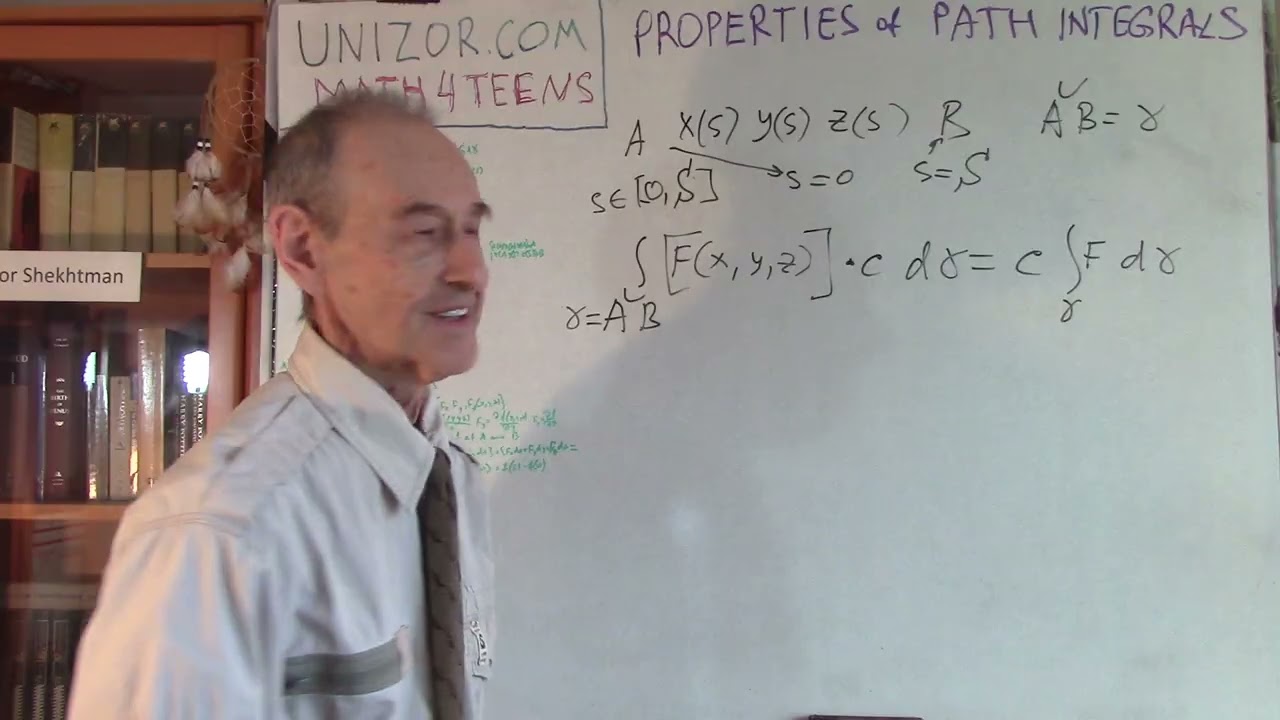
The lecture introduces the fundamental properties of path integrals, also known as line or curve integrals, emphasizing their critical role in physics rather than pure mathematics. Defined as the integral of a function along a smooth curve in n-dimensional space, these integrals are essentially regular definite integrals where the variables depend on a parameter that traces a path from a starting point to an ending point. Because they rely on standard integration techniques, all properties of path integrals directly follow from the well-known rules of regular calculus. The first few properties discussed are considered trivial extensions of basic integral rules: the sum of two path integrals equals the path integral of their sum, and constants can be factored out of the integral without changing its value.
A more significant property addresses the direction of integration, stating that reversing the limits of a path integral changes the sign of the result. This occurs because the differential element along the curve, often denoted as $ds$, carries a sign determined by the direction of movement; moving from point A to B yields a positive increment, while moving from B back to A results in negative increments, effectively flipping the sign of the total integral. Additionally, the integral over an entire path can be split into the sum of integrals over two sub-paths if the original curve is divided at any intermediate point, provided the curve remains smooth and differentiable throughout the process.
The lecture then transitions to vector functions and conservative forces, which are central to physics applications like gravity and electrostatics. For these special forces, the work done moving an object between two points is independent of the trajectory taken; it depends solely on the starting and ending positions. This is mathematically demonstrated by showing that if a vector field can be expressed as the gradient of a scalar potential function, the path integral simplifies to the difference in the potential values at the endpoints. Consequently, for any closed loop where an object returns to its starting point, the total work done by such conservative forces is zero, reflecting the physical reality that no net energy is expended when moving against and then with a conservative field along a complete cycle.
Read the full video transcript
Hi, I'm Zor. Welcome to Inor Education.
So, we continue talking about pass
integrals and today I will uh talk about
the properties of pass integrals.
Now, this lecture is part of the course
called math for actually the part of the
course which is called calculus
uh which is presented on munisor.com
totally free website. You don't need to
sign in. Uh no advertisement, no
subscription. So everything is free. And
there are many other lectures and
basically courses. This is a course mass
for teens. There is another course mass
plus 14. Uh there is a physics for
teens, physics plus for teens. There is
a relativity
course. I mean there are different
lectures and all free on unis.com. So
today we're talking about properties of
pass integrals. Pass integrals or line
integrals or curve linear integrals.
That's the same thing. Basically I'm
using pass integrals because it's more
applicable to physics. They like to call
it pass integrals where mathematicians
usually call it line integrals. In any
case, the probably I would say the
probably important the most important
purpose of pass integrals is in physics.
So that's why I decided to use the
physics term. Okay. So um we have
defined a path integrals as integral of
some function along a curve in some n
dimensional space. So first of all we
have defined a curve in well let me use
three-dimensional case. So what is a
curve in three-dimensional case from the
mathematical standpoint?
Um so I mean visually we understand this
is a curve um and we're talking about
smooth curve without any kind of break
breaking or or sharp angles or etc.
Smooth curve in a in this case three
dimensional case. How did we define it
in the previous lecture? We defined it
basically as uh three coordinate
functions x, y and z which are dependent
on some parameter.
Parameter can be anything
and uh you have some kind of a range of
parameters
from uh let's say from zero to capital
s. This is the lowerase s. Um so let me
just put it a bigger one.
And uh so the three functions which
depend on the parameter which goes from
one point to another
uh in real numbers. I chose from zero to
some kind of s defines a curve with
beginning of the curve one h would be uh
with s is equal to zero and the ending
so this a corresponds s to zero and s
equals to capital s corresponds to the
end of the curve. So as parameter S goes
from zero to capital S, point on the
curve moves actually from A to B. And
this curve sometimes I call A with a arc
or just gamma or something like this.
And now we are talking about properties
of integrals. So now the first property
now all the properties of integrals pass
integrals depend on the corresponding
properties of regular integrals because
we have defined integral
along the path
of some function.
This is basically how I
call this pass integrals. It's actually
integral from zero to capital s
functions
function f of x of s y of s z of s
ds.
So now this is a function of
s of the parameter. So this function of
three functions and each of them depends
on the parameter s and we integrate by
s. So this is a regular integral. So the
pass integral is defined through s
integral through regular integral and
all the properties of passive integrals
depend on the properties of um regular
integrals. And the first one is sum of
pass integrals
and integrals of sum. So if you have
something like this,
two functions.
This is
a sum of two integrals.
by gamma. So pass integrals of sum is
equal to sum of pass integrals. Why?
Again it directly follows from the
definition because this integral of um
sum of two functions pass integrals is
obviously defined as regular integral of
u sum of these functions which in turn
according to the properties of regular
integral it actually uh is equal to sum
of integrals and this is the sum of
these integrals. So that's the first
absolutely trivial property. The second
[snorts] which is no less trivial is if
you multiply it by some kind of a
multiplier.
So if you have this
times some kind of a constant
you put constant outside of the
integral.
again absolutely
trivially follows from the corresponding
properties.
Now the third property is well again it
it follows immediately from the regular
integrals but um it's a little bit uh I
would say a little bit more
entertaining.
All right so um here it is. What if I do
this integral first?
And then I will do integral from B to A.
I change the direction of integration.
Now and I integrate exactly the same
function.
So my uh the property which I would like
to say is that if you are integrating in
opposite direction is basically
according to the definition of the of
this particular integral that would be
integral from from capital s to zero. So
this is from zero to s
right. So this is
from zero to capital s f x of s y of s z
of s
ds and this is the same function
[snorts]
y of s z of s ds but integration is an
opposite direction from zero to s from s
to zero and Again according to the rules
of plain integration the integral
changes the sign if I will change the
limits. Why? Well because the ds would
be a different uh every ds would would
have a different sign because what is
ds? It's infinite decimal increment of
our um uh parameter. Now in this case
from zero to s we are going this way. So
every increment is positive. In this
case if this is zero this is s every
increment would be negative and that's
why the whole um integral change the
sign. So that's the third property.
Now the fourth property
is
if we will split
if we will split the curve into two
curves.
Okay. So let's say this is our curve
from A to B
and we will split it by point M.
So this is S of0.
This is S of capital S. Now this would
be this point would correspond to S of
some kind of uh value. Well, let's call
it
let's call it S M.
I shouldn't put S0. It should be S=0.
Parameter S is equal to zero and
parameter S is equal to capital S
and this is S is equal to SM.
Well, so what I'm saying is that
integral from a function
along the whole thing can be split into
integral from a to m of f gamma plus
integral from m to s uh sorry to b to b
f.
Now again y
exactly the same going to the properties
of regular integral. This is integral
from 0 to s
of f ds. This is integral from 0 to s m
f ds and this is integral from s m to
capital s f ds and this is a known
property of regular integral. So if
you're integrating function
on some
uh segment from A to B then you put some
point C in between the whole integral is
equal to sum of integral of this plus
integral of this. If nothing else then
basically uh the area of this is equal
to sum of areas of this and this. But it
all falls from the corresponding
properties of regular integrals.
Okay. Now, now we will do something more
interesting.
The next property is again I started
from some references to physics. So this
is reference to physics.
There are certain
um vector functions.
It's a vector function
and we have defined the um pass integral
for vector functions. If you remember
integral by gamma
d gamma
is actually it is actually
integral of
vector function in three dimensional
case it's three components each of them
is a function of a point where it was so
it's a component fxyz
component f_sub_y this is the vector so
it's three components in
threedimensional case
and component of Z of X Y Z. So this is
a vector. I put curly brackets
and the gamma is actually Z R again
vector where our vector is
XY Z
and this is considered as a scalar
dot
product. So it's all in the previous
lecture. So we have defined
pass integral of vector function which
has three components
and increment along the curve.
If r is the radius vector from zero to
the point on the curve, it always again
has three components x, y, and z. That's
the coordinates of the point.
So this is a vector and the scalar
product
as vectors we can do the scalar or dot
product is the definition basically of
this integral.
And now obviously again x is x of s y is
y of s and z is zero z of s and that's
how the whole scalar product which can
be actually expressed as integral of fx
* dx + f_sub_y * dy + fz * dz.
This is the definition of the scalar
product of two vectors. One vector is
this. Another vector is this dr
is equal to dx dy dz. Three components.
This is increment of the vector radius
vector to the point of the curve. So
basically this is element of the curve.
Increment obviously. Yes. Increment of
the of the curve. And uh geometrically
why is that basically done? Well because
if you have some kind of a line where
the body is moving and the vector of
force is at the angle. So this would be
d and this would be f as a vector.
Then you have to really to calculate the
work we have to calculate projections of
this vector on the direction of
movement. So this is a piece of a curve
right. So and projection is cosine of
the angle and this is basically what do
that product is. All right. So this is
all from the previous lecture.
In any case, so this is our integral
which obviously can be calculated from
zero to s where x and y and z are
functions of s. So the whole thing
becomes
uh some kind of integral of zero to s
some function of s d s where function of
s is basically this expression where fx
has three coordinates each of them
depends on s. dx has basically d uh dx
is what? It's uh x
um
dxp ds * ds. So this is the function.
This is the derivative of this function.
So the whole thing becomes integral of
s. Right? If you will substitute this
and the corresponding y and z and f
would be also as a function of xyz where
each x y and z depend on s. It's all
becomes a function of s. So we can
integrate it uh as a function of s from
zero to capital s and that will be the
value of this integral.
Now in certain cases in certain cases
there are certain forces which are very
special in physics I'm talking about
physics now these special forces and
examples are gravity uh electrostatic
forces and some others they are called
conservative.
Now the conservative force forces are um
are such forces which are
um which have a very important property.
If you're moving from this point to that
point because conservative forces are
driving you now the work which you
perform moving from here to here the
work by conservative forces will be the
same regardless of the path no matter
how you move it will be the same. So for
example, if you want to
um move let's say a stone from the
ground to a certain point above it, you
can move it straight up or you could
move it in this way or in this way and
you will still spend exactly the same
amount of energy. So that's what work
actually is.
Now these
uh vector functions have a very specific
property which I will assume is true
right now and I will prove that for
these forces for these vector functions
which um possess this particular
property
the pass integral depends only on the
beginning and the ending point and does
not depend and exactly on trajectory as
long as everything is smooth,
differentiable etc. And here is the
property which I have in mind.
Okay.
So we are assuming the following
vector f of xyz
it's a combination of three components.
So this is the vector. These are three
projections on three axis.
Each one of them function of a point. So
wherever you have some kind of a curve,
this is a point xyz.
And yes, we can definitely have x and y
and z depending on some parameter. So s
parameter goes from
uh from zero to capital s. the point xyz
moves from a to b. Okay.
All right. So now the property which I'm
talking about is as follows. Let's
assume that there is a scalar function
defined exactly on the same curve.
And let's assume that f ofx of xyz
is equal to
partial derivative of this function
by x. f_sub_y is equal to partial
derivative by y and f_sz is partial
derivative
by z.
Let's just assume this is an assumption.
Now from this from this assumption I
would like to prove that pass integral
of this
um vector function f along any pass
between a and b
this pass or this pass or this pass
no matter where it is depends only on
the value at point f a and b on the
value of function scalar function f.
Okay, how can it be proven? Well,
actually the proof itself is absolutely
trivial.
Now what is integral by pass of vector f
and I will use dr in this case like I
was just explaining it's a scalar
product right
this is integral of
f [music] ofx * dx + f_sub_y * dy + Z *
DZ. So this is basically the definition
of the pass integral of vector function.
Right? Now now we can replace f_sub_x,
f_sub_y and f_subz three components of
our vector f with partial derivative of
scalar function uh lowerase f. So if
we'll do that we will have this
df by dx
df by dy
df by dz.
Now great. Now what is this?
Well, this is a full derivative
full differential of function f
and if I will use right now the
parameterization.
So it would be integral from zero to
capital S and these are functions of S
d
I can put it this way
that's what it is right so this is a
function of s now so the derivative of
this function by s is basically the
integral
which means what?
Well, which means that this function
since it's a full differential,
the integral is equal to f of
x,
capital S,
comma Y, capital S, Z
capital
minus this is a formula Newton lab
x of 0 y of 0
0 0.
So this is basically the value of this
integral. So as soon as we have defined
function vector function f as being with
the components equal to partial
differentials
partial derivatives of scalar function
lowerase f as soon as we have defined
that I mean as soon as we know that this
property does exist
immediately from this follows that any
pass integral depends only on this
function f at points
a minus uh sorry b minus a.
So this is the x of s y of s z of s and
this is x of 0 y of 0 z of 0 0.
So this is a very important property. It
means no matter how you move from one
point to another
in let's say some kind of a field which
has forces like gravitational field and
you're moving against this field then
you have to spend certain amount of work
certain amount of energy to do this. So
no matter how you move you will spend
exactly the same amount of energy.
Okay. So this is basically a property
number five and the property number six
immediately follows from here is that if
you are integrating
function
conservative function which has this
type of representation
along
a closed loop.
So a is equal to b
then the result of that moving would be
zero.
So if you are moving let's say a stone
from this point along any c a long
trajectory and back to this point in
theory the total amount of energy spent
would be zero. Why? Because here you're
uh spending some energy
and then when you're moving down you are
actually working
uh you you're helped by by the
gravitational field which makes your uh
work being negative actually. So you're
assuming certain work in this case
you're actually assuming certain amount
of kinetic energy. So you're spent this
energy when you're moving it up and then
when you're moving it down you're
gaining kinetic energy. So the total
amount of energy remains exactly the
same which means you spent exactly the
same. So that's what the physical kind
of sense of the whole thing. Now how to
prove this? Well first of all it's
obvious from here that the difference is
equal to zero. And there is another very
cute proof which I would like to say.
Let's assume you have some other point
here m. [clears throat] Now the from
here to here
the pass integral is equal to something.
Okay let's call it a. Now from the same
point a to the same point m along the uh
another half of this trajectory you will
have to spend exactly the same amount of
energy. B is equal to a. Now if you're
moving from here to here you're spending
a
and then you're moving in opposite
direction. So it's minus b is equal to a
minus a is equal to z. So that's another
very trivial proof. That's it. So these
are properties of pass integrals and as
I was saying in the beginning they are
all follow from the corresponding
properties of regular integrals.
So that's it for today. I would like you
to actually read the notes for this
lecture. It's on unisur.com. You go to
mass4's course is calculus and then you
will find um I think it's uh definite
integrals part two. You will have this
uh pass integrals set of lectures. The
first lecture was previous one which
defines pass integrals. This is a
property and there will be another
and as I was saying everything
[clears throat] is free and I do
recommend you to do both read the
lecture notes on this website and um
watch the video which uh which I'm just
recording right now. So that's it for
today. Thank you very much and good
luck.