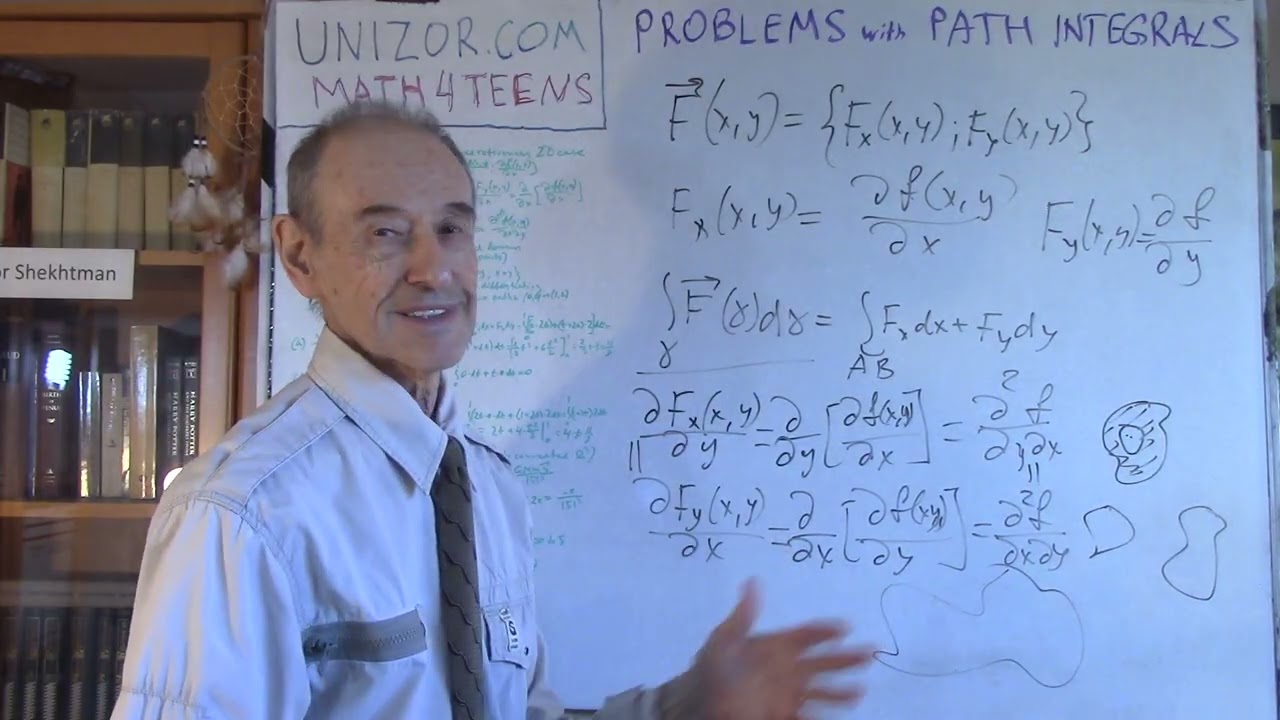
Path Integrals Problems: UNIZOR.COM - Math4Teens - Calculus - Integrals Part 2 - Path Integrals
Watch on YouTubeVideo summary
This lecture continues the discussion on path integrals, also known as line or curve linear integrals, by focusing on solving specific problems to illustrate their definitions and properties. The instructor emphasizes that while physicists often prefer the term "path integral," the terminology does not change the mathematical concept. The core of the lesson revolves around conservative vector fields, which are crucial in physics because they represent forces where the work done depends only on the starting and ending points, not the path taken. Consequently, the integral of a conservative field along any closed loop is zero, as the positive and negative contributions along different segments of the path cancel each other out perfectly.
The first major problem addressed is determining whether a given two-dimensional vector function is conservative or non-conservative. The lecture establishes a necessary condition for a vector field to be conservative: if a scalar potential function exists such that its partial derivatives match the components of the vector field, then the mixed partial derivatives must be equal. Specifically, the partial derivative of the x-component with respect to y must equal the partial derivative of the y-component with respect to x. If these values are not equal, the function is definitively non-conservative. While equality of these derivatives is a necessary condition, it is also sufficient provided the domain is simply connected, meaning it has no holes or gaps that could disrupt the continuity of the potential function.
To demonstrate this concept practically, the video walks through an example involving a vector field with components $xy$ and $x+y$. By calculating the mixed partial derivatives, the instructor shows they are not equal ($x$ versus $1$), proving the field is non-conservative. This theoretical finding is then verified by calculating the path integral along two different routes from the origin to the point $(1, 2)$: a straight line and a two-segment path. The calculations reveal that the integrals yield different values ($11/3$ versus $4$), confirming that for non-conservative fields, the result depends on the specific path taken between two points.
The final segment of the lecture applies these principles to a physical scenario involving gravitational force between a sun and a planet. The instructor derives the vector form of Newton's law of gravitation, showing how the force vector points toward the center of mass (the sun). By expressing the force components in terms of coordinates $x$, $y$, and $z$ and identifying the scalar potential function proportional to $1/r$, where $r$ is the distance from the origin, it is proven that the mixed partial derivatives are indeed equal. This confirms that gravity is a conservative force field, meaning the work done by gravity moving a planet depends only on its initial and final distances from the sun, regardless of the orbital path taken.
Read the full video transcript
Hi, I'm Zor. Welcome to Iner Education.
[clears throat]
Um, today we will continue talking about
pass integrals.
Now, the previous two lectures were
dedicated to definition of the pass
integrals. Pass integrals sometimes is
called line integrals or curve linear
integrals.
Now, in this lecture, we will just try
to solve a couple of problems. Well,
three problems to be exact. Uh as an
illustration of the definition and the
properties of the pass integrals. Um the
term pass integrals is more preferable
for physicists and there are many
application in in physics of these pass
integrals. So that's why I'm calling
them pass integrals but people call them
line or curve linear doesn't really
matter. Now this lecture is part of the
course math proteins presented on
unisord.com.
Uh more precisely it's a part of the
course which is dedicated to calculus
and within the calculus there is a
chapter uh called uh pass integrals. So
this this is how you get into this
particular lecture. Now every lecture
has video and text part on the same
website. So you can watch the video, you
can read the text which is basically
like a textbook in any order whatever
you prefer. But I do suggest to to take
both sources of information, the video
information, this this type of a lecture
and the text.
Now the website unisurid.com is totally
free. There are other courses like math
plus, there is a physics routines,
physics plus
um and some others.
Okay. So let's go to little problems
which we have for pass integrals.
Now [clears throat] the previous lecture
uh contains certain properties including
the property of the vector function
uh to be conservative. So let me just
remind that if you have let's say you
have two-dimensional vector function
which means for every point xy in
cartasian coordinates
um the vector is defined and vector
means it has x component and y
component. So I will use this type of
so this is the x component of the
vector. This is y component of the
vector. Okay. Now um and there was a
property of the vector function which we
called conservative.
Now the conservative vector functions
have a uh basically
such a
definition we can write it as partial
derivative of some scalar function. So
lowerase f is a scalar function. This is
by dx and f_sub_y
at xy is equal to df
by dy same. So if there is some kind of
a scalar function lowerase f
uh defined on the same uh domain as the
vector function capital f such that
partial derivative by x of this scalar
function lowerase f is the x component
and partial derivative of y is y
component of our vector function. Then
vector function is called conservative.
And one of the properties of
conservative function is the integral of
this vector function integral by some
uh
curve on a plane in this particular
case. So it's two dimensional case of
vector function.
I will put it this way
as as as a pass integral which uh
basically by definition is integral
by curve
f_sub_x dx + f_sub_y dy.
Now this integral this pass integral
depends only on a and b points and does
not depend on how we move from a to b.
So integral by any pass from a to b
would have exactly the same value. It
depends only on points a and to be more
exact depends on the value of function
lowerase f at point a and point b and is
independent. So this has been proven in
the previous lecture. Uh consequently by
the way integral by any loop from some
point along any path back to the same
point would be equal to zero like in
this case because this is a positive
this is a negative but their value um
from a to b would be the same so they
negate each other would be zero. So this
is all from the previous lecture. So
today I would like to have as my first
problem how to find out if given vector
function given means we have these two
functions of two arguments
x component and y component. So that's
what definition of the vector is vector
function. So if we have these two
functions of two arguments, how to
determine whether this uh is
conservative or non-conservative
function? It's important in physics by
the way.
In other word
does the lowercase f function of two
arguments xy exist such as it's private
it's partial derivative by x is equal to
first component and partial derivative
of uh lowerase f by y is y component of
our vector function. I don't know if it
exists. Maybe I can find it maybe not.
Question is whether it exists or not.
Now if I cannot find it just looking at
this function and doing something maybe
with this function. If I cannot find it
does it mean that the function is
non-conservative? No. It means I cannot
find it because maybe it exists and I'm
just not smart enough to do it. So
question is how to have some kind of a
necessary condition for these functions
which assure us at least that it's uh
definitely non-conservative.
So if this is non-conservative function
I would like to definitely know if it's
conservative I have to find but if if
it's non-conservative and and I can
actually find out just looking at these
two function that this is
non-conservative so there is no need to
find anything
now if I cannot prove that they are
non-conservative then maybe but it does
make sense to find out how can I find
function lowerase f. So right now I'm
looking for a necessary condition for
non-conservativism
of the function vector function f and
this is actually a very easy thing. Now
if I will do the following I will do
partial derivative of f_sub_x
by dy. What is this? Well, assume the
function is conservative, which means
that this is the representation of f(x).
Now, I'm partially uh differentiating by
y. So it would be sorry
d by dy
of
df of xy
by dx.
Now what is the function
if I will do
partial derivative of second component
by x.
Now if my function vector function is
conservative then the second component
can be represented this way and the
whole thing is this.
Now this is usually
it's the second derivative.
Yeah, [clears throat]
if we assume that the function is
conservative.
Now then the second derivative the well
derivative by y of the x component is
this and derivative by x of the second
component of vector function is this.
Now if the function lowerase f exists
then these supposed to be equal because
x and y are independent variables. But
there is actually a theorem which can be
proven that under a very very broad
conditions as long f lower lowerase f is
smooth enough um these two are equal to
each other. I'm not sure I covered it in
my previous lectures but it's kind of
feeling that this is the right thing to
do. So if such a function lowerase f
exists then these two derivatives
derivative of the first component by y
and derivative of the second component
by x must be equal.
If it's not if if they are not equal to
each other then the function
vector function capital f is
non-conservative obviously. So again if
it's conservative then f exists then we
can have these two new partial
derivatives and we should have the same
result. If we are not having the same
result then our initial assumption that
the function is conservative is wrong.
So we have come up with a necessary
condition for vector function to be
conservative. So the necessary condition
is that derivative of the first
component
uh by y and derivative of second
component by x. We're talking right now
only about two dimensional case, right?
So if they are equal then it's a
necessary condition. If they're not
equal then we can definitely say the
function is not conservative.
Now this is a criteria. Okay fine we
have come up with this criteria
necessary condition. Now is it
sufficient condition? So if these are
equal to each other, does it mean that
there is ex that there exist lowerase
function f? Okay, the answer to this
question is slightly above the level of
this particular lecture. But I can tell
you that if the function f ofxy is
defined on a domain which does not have
it's called simply connected domain no
holes and it's a one piece. So we are
talking about domain on the um two
dimensional plane. So it should not be
something like this.
So if this is domain
now why is it not a good domain? It's
not simply connected domain because it
has a hole. Now maybe is this this type
of domain it's not a good domain not
simply connected domain because there
are two parts of it. But if it's defined
on some simply connected domain then
this condition is also a sufficient
condition.
Okay. So that's my first problem. We
have established a necessary condition
and in most cases by the way in most
nice cases it's also a sufficient
condition for the function to be
conservative.
Now why am I specifying actually the
conservative function here? Why I'm
talking about conservative because in
physics conservative function do play
extremely important role and the vector
functions are basically the forces which
exist in the universe and the force is
basically a vector which is defined at
certain spots in space. So it's very
very practical and very physics
oriented. Okay, got that. Now the second
problem is basically an illustration of
the first.
Okay.
So let me just have one particular
example of function
vector function
of xy.
It has two components. First component
is x * y. Second component is x + y.
So for any pair XY we have two
components of this vector functions X
component this is X component and this
is Y component projections if you wish
uh so if you have something like this
this is a point XY
now for instance this is the vector f
which is defined at this point.
So this is projection on the x and
this is projection. So this is f_sub_x
and this is f_sub_y.
So this is equal to x * y and this is
equal to x + y whatever the points xy
is. So that's my definition of test kind
of a function vector function question
is it conservative.
Okay let's just do our criteria. We take
the uh the y uh derivative of the x
component. So dxy
by dy and it's equal to x y uh we are
differentiating by y which means x is a
constant. So a constant goes out from
the differentiation.
Now the second component which is x + y
should be differentiated by x. In this
case y is just a constant. So uh
differentiating of x plus constant by x
that's one.
They are not equal to each other which
means function cannot be conservative.
It's a necessary condition. not equal
means non-conservative.
So that's it very simple but let me
exemplify that this particular case when
the function is not conservative
we are um actually have a difference
between pass integral between two
points. So if these are two points
conservative function gives the same
integral no matter which path you take.
non-conservative function doesn't have
this property. So I would like to have
some example of two points A and B and
two passes and have two two integrals
two pass integrals not equal to each
other. Okay. And here is my example.
Let's just have
two points.
One is origin and another is
one two.
First I will do integral straight
from 0 0 to one two and integrate this
function. Second I will do this and
this. it's different paths which in this
case contains two segments and I will
integral
um both of them and and and and see the
sum of these two whether it's equal or
not equal for a conservative function I
should have exactly the same value well
let's check it out [snorts]
okay first let's do integration from
zero to one two straight. How can we do
it? Well, you remember that pass can be
defined parametrically.
So x would be some kind of a function of
t and y should be some kind of a
function of t and then everything
actually is um uh from from
[clears throat] the two dimensional case
we are going to integral by t. But in
this particular case I will do it x = t
and y is = 2t where t is from 0 to 1.
So this is basically
the
uh definition of this path
parametrically with t is equal to 0 we
have this point 0 0 with t is equal to 1
we have 1 2 and with everything in
between we have all these points
along this straight line because it's a
linear functions right in which case dx
is equal to dt
dy y is equal to 2dt right now my
integral
uh let's call it gamma 1
of fxy
d gamma
is equal to oops
integral from okay let's just do one
more like
um
xy
dx
+ x + y dy
right remember first component
time dx that's basically definition of
the pass integral which again we covered
in the previous lecture so you have x
component time dx and y component
* dy.
Now since we have expressed everything
in terms of parameter t, now it becomes
integral from one to from 0 to 1 for t.
x is t, y is 2t,
and dx is dt
plus
x is t, y is 2t,
dy is
uh 2dt
2d. dt
equals.
So what do we have? Integral from 0 to 1
2 t²
+
6 t
dt, right?
which is
2.
Integral of t² is a t cub / 3
+ 6 t is t² / 2
from 0 to 1. That's the formula of
Newton labs, right?
[clears throat] So at zero they're all
equal to zero obviously. So from one you
have
uh 2/3
+
3
3 is 9/3. So it's 11/3.
Okay. So that's the value of integral
along this particular path. Good. Now uh
let's do exactly
the same integral but along this path.
which contains two segments.
So let's do it one by one. So first
segment from 0 to 1.
Uh x is = 0. No sorry x is equal to t
and y is [clears throat] equal to zero.
Right? as I'm moving from 0 0 0 to 1 0
uh
this is
[clears throat] this is how my
coordinates are changing. So my integral
would be
x * y * dx
uh which is zero x * y * dx and dx is dt
+ sum x + y which is t
* dy which is also zero.
Obviously dy is equal to 0 * dt
that's 0.
So the whole thing is equal to zero. So
integral of this function along this
segment is zero. Now let's talk about
that segment.
X is equal to 1. Right? As I'm moving
from here to here, x is always one and y
is
from 0 to two. So I can put 2 t where t
is from 0 to 1.
If t is = 0, y = 0, which is this point.
And if t is = 1, y = 2.
Okay, same thing. Now integral
of
um xy function xy the product is 2t 1 *
2t * dx but dx is equal to zero
because it's a constant
plus
their sum 1 + 2t
times
dy which is 2dt D
equals to from 0 to 1
integral from 0 to 1
2 + 4 t
dt
= 2.
Integral of 2 is 2t. Integral of 4t is 4
t² / 2. And this is for the mutton wave
from 0 to one.
So now this is
two two.
So if t is equal to 1 this is four and
if t is = 0 is zero. So the answer is
four. So the first integral was 11/3.
The second integral is 4. So they are
close by the way but not equal to each
other and that's the proof that they are
not
um
that the function is not conservative.
Okay. And the third problem which I
would like to
to investigate basically is
more physical kind of a thing. So let's
talk about gravity. We all know the law
of gravitation learned in school that if
you have let's say sun which has mass m
and some planet which has mass lowerase
m the uh force is equal to between them
the force of gravitation of this planet
towards sun let's put it this way is
this
and it's directed towards sun. Let's
assume that the sun is uh the center of
the uh coordinate system in space. R is
the distance obviously and uh so F is
the force and the force is directed from
the planet to the uh uh to sun to the
center of uh coordinates. Okay. Now
let me call vector R which is X Y and Z
which is
position of the planet.
Well then this R is actually
modul of this vector the size basically
of this vector. Right now I would like f
to be a vector. So I know that the
absolute value is of this vector is this
one. But I need a vector
which means what? Which means it has to
have absolute value of this and it
should have a direction from the planet
to the sun which is opposite to this
one. If sun is the center of the
coordinates then vector r is from sun to
the planet. I want the backwards. So the
backwards would be minus r. Right?
But I don't want to change the value of
absolute value. I don't want to change
the modul. So if I would divide this by
r,
this would be my unit vector which is
directed exa exactly as I want from the
planet to the sun because of the minus
and it has a unit length because I
divide it by its own length. So
multiplying uh this value of the the
modulo of the of the force by this and r
is a vector I will get force as a vector
which means I can actually do it this
way.
So
and I can put it
minus here and times r here. So this is
my formula
for vector f where r is xyz which means
modula
r is equal to square of x² + y 2 +
z²
that's the length of the vector right
okay now
uh I would like to prove that this is a
conservative
force
How? By using
function f ofx
is equal to 1 divided by modul of air
with maybe multiply by some constant
whatever the constant doesn't really
matter because if I'm differentiating
uh f the constant goes out. So I would
like to basically using the constant I
would like to deal with all these
parameters.
But let me first check what is df by dx.
Now this is
x² + y² + z²
in the power of since it's a denominator
so it's -2
derivative by x which is what
is - 12
* x² + y 2 + z 2
- 3
*
differentiating
uh in differentiating time 2 x right the
derivative by x of this function
uh is 2x so this goes out this goes out
and what do I F.
This is minus
1 /
cube
- 3/2 minus means it's denominator.
Now 1/2 is a square root and three is a
cube. Now square root is r. So what I
have
uh times x sorry x time x. So I have
basically an x [clears throat] component
of this. So differentiating this
function this function differentiating
by x gives me x component. Right? This
means what? Means f x component is equal
to this thing
times x. f_sub_y is equal to the same
thing time y and fz
is equal to this thing time z and I have
exactly this
and I have a minus. So I'm using this
constant now to multiply it and I have
basically my function f. So the uh uh
scalar function f of x is g * m * m / r
uh by by modulo of vector r. So which is
basically square root of x + x² + y 2 +
z square. So that's it.
So that's a proof that my function is
conservative.
Well, that's it for today. Thank you
very much. Read the notes for this
lecture and good luck.