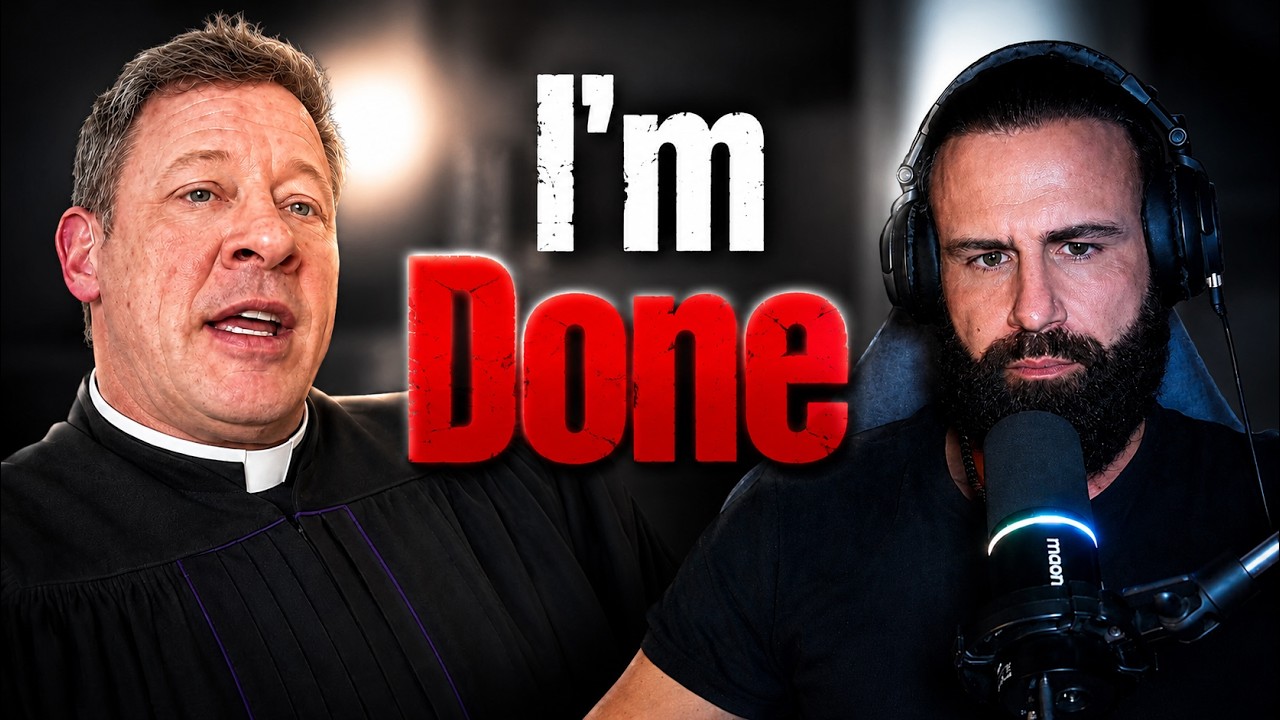
Video summary
The video features a reaction by the host, Bobby, to a transcript of Dr. Todd Phillips, a former mega-church pastor and Bible scholar who explains his departure from Christianity after twenty years. Dr. Phillips argues that he is not rebelling against God or choosing atheism out of anger, but rather has simply become unconvinced that Christianity is true. He emphasizes that belief cannot be chosen like putting on a shirt; one can choose to investigate honestly, but conviction must come naturally. His journey involved examining the foundational claims of his faith and finding them lacking under rigorous scrutiny, leading him from certainty to a state of agnosticism where he acknowledges the reality of a creator without subscribing to specific Christian doctrines.
A significant portion of Dr. Phillips' argument focuses on three main issues: the geographical determinism of religious belief, the problem of divine hiddenness, and the contradictions within the Bible itself. He challenges the idea that geography dictates eternal truth, noting that while birthplace influences cultural religion, it should not dictate theological reality for a sincere seeker. Regarding divine hiddenness, he argues that an all-powerful God would provide objective evidence of His existence rather than remaining silent or hiding behind free will arguments. Furthermore, he points out that the Bible reads like a human book from its ancient context, containing laws on slavery, violence, and gender roles that contradict modern moral standards, suggesting it lacks the perfection expected of a divine revelation.
The transcript concludes with Dr. Phillips addressing the historical problem of Adam and Eve, which he views as essential to the doctrine of original sin in evangelical Christianity. He asserts that if Adam and Eve were not real historical people, then humanity did not inherit guilt or corruption from a single act of disobedience, causing the entire framework of salvation history to collapse. He maintains that without a historical fall, Jesus' sacrifice lacks its intended purpose as a remedy for inherited sin. Ultimately, Dr. Phillips states that after years of questioning these core tenets, he found the cumulative weight of these issues too great to ignore, leading him to stop believing in Christianity while still respecting the possibility of a universal creator known through reason and natural predisposition rather than scripture.
Read the full video transcript
You can choose to be honest about your
beliefs, but you can't choose to
believe. You can't choose to be
convinced. And that's where I am. I'm
not refusing God, the God that I know is
real. I I'm not angry at a God I
secretly believe in. I'm not choosing
rebellion over truth. I'm simply not
convinced Christianity is true anymore.
>> Fair enough.
>> That's it.
>> There's absolutely nothing wrong with
this. If you read the Bible in and of
itself, you will realize that it's full
of contradictions and is most certainly
not true. It speaks about polytheism,
heenotheism, then monotheism, then later
about trinitarianism, etc., etc. It's
really a mess. Just pray is the only app
out there that tracks every single of
your prayers. And it stops every other
app when it's time to pray. That means
no more checking messages, no more doom
scrolling when it's time to pray. I
didn't partner with any other app for
one simple reason. They're not habit
forming. I would download an app, use it
for 2 minutes. After that, I would get
bombarded by ads, close it, and never
open it again. It just prays in a
completely different league. It notifies
you before your prayer, manages the time
window, tracks your delays, and
documents your spiritual journey. On top
of that, they have an amazing gamified
interface where every prayer grows your
garden. You can literally see your
progress. Additional to that, it has the
function of the prayer circles where you
can pray together with friends and
family. you can stay accountable and see
who prayed or not. Okay. All right,
guys. Welcome back to the channel. If
you're new, my name is Bobby. Guys, we
don't hear that often from the Muslim
world when it comes down to imams, when
it comes down to shakes, students of
knowledge, even that they leave Islam
for another religion or to become an
atheist or whatnot. But today, we're
going to react to Dr. Todd Phillips,
which uploaded the video why I left
Christianity after 20 years as a pastor.
Very interesting. And guys, before we do
so, as always, if you enjoy my content,
leave me a thumbs up. Subscribe to the
channel if you haven't already. Check
out the links in the description box
below to further support my work. And
now, with no further ado, let's have a
look.
>> People ask me all the time why I stopped
believing in Christianity and what
caused me to lose my faith. Hey, I'm Dr.
Todd Phillips. I'm a scholar of the
Bible and a former megaurch pastor here
in the United States. I used to preach
in some of the largest churches in the
country, and now I'm an agnostic.
>> So, you really heard it right here. I
need to stop this video and emphasize
this. He was preaching in the mega
churches, but he's a scholar of the
Bible as well.
>> Atheist. Now, what you're about to see
are the eight biggest reasons I no
longer believe Christianity is true. But
they're not the only reasons. And no
single one of them ended my faith
overnight. It was a cumulative weight of
all of them over about 10 years. So, the
first three deal with belief itself. Why
people believe religions that they
believe, why a god who supposedly wants
a relationship with us remains hidden.
and whether belief is even something
that we can choose. What if I told you
that religious belief is shaped almost
entirely by geography? Here's how I
discovered this truth and why it caused
me at least in part to step away from
Christianity. This was really a massive
hurdle for me as a pastor and it's
something thinkers like Alex Okconor,
you should check him out, they talk
about this a lot. It really breaks down
into
>> get influenced by Alex Okconor and now
Alex Okconor is going to become a
Christian dude.
I'd say three uncomfortable realities.
The first one is this kind of idea of
the lottery of birth. Your GPS
coordinates at your birth are the single
greatest predictor of your religious
identity. And the numbers are crazy. If
you're in the US, 70% of people are
Christian. But if you were born in
Pakistan, 96% chance you'd be Muslim. In
India, 80% chance you'd be Hindu.
Poland.
>> Okay. Hey, so I don't find this a good
argument. And I find it very, very
strange that a grown ass man would be
surprised by those facts. Alex Okconor
is in his 30s now, I believe. Maybe late
20s. I'm not too sure. And now this guy
is certainly in his late 50s, I would
say. And he's shocked by those facts.
How very American. So yeah, of course,
duh. The religion that you are born with
is determined by where you are born.
Genius. But of course, we're not talking
about the majority of people when we're
talking about theology. We're not
talking about cultural Christians or
cultural Hindus or cultural Muslims.
We're speaking about people that truly
believe and why they do believe, right?
So, yes, geographically, my parents come
from the Balkcon, from the Slavic
population, quote unquote, I would say
Slavicized. Of course, I did a DNA test.
I don't have any Slavic genes in me.
Anyways, be that as it may, they come
from the Slavic part and therefore they
are Orthodox Christians. And yes, I was
born into an Orthodox Christian family.
However, then I did my research and I
became a Muslim. Alhamdulillah. So when
we're speaking about geographical
religious belonging, yes, certainly I
have to confirm here that this is the
majority of people that adhere to a
religion. But this doesn't say anything
about the theology. I mean when it comes
down to different worldviews, let's say
philosophy, okay, the majority of
philosophy has been created in Greece,
in ancient Greece. But now the whole
world has access to philosophy, to the
rules of logic, etc., etc. So now you
don't have to be Greek in order to use
philosophy. Do you catch my drift here?
Certainly the geography played a huge
role for the longest time as well. But
nowadays, especially through the
internet and through migration, of
course, the world is changing and
becomes much more multicultural. People
have access to religious debate.
>> There's a 90% chance you'd be Catholic.
Look, none of us chose our starting
line. And yet it's it almost entirely
determines what we perceive as eternal
truth. And the second is what I call the
sincere seeker problem. I used to think
about this a lot. If someone in Thailand
is just as humble, just as prayerful,
just as desperate for truth as someone
in Texas, but they arrive at a totally
different absolute truth, does it make
sense to say one is right and the
other's just lost? I don't think so. It
started to feel like they
>> Okay, this is ridiculous, man. And I
really wonder how those people were
pester for such a long time. And now
you're speaking about moral relativism.
Ultimately, the question that he's
proposing here is if there is the
possibility, no matter what the location
is, for a person to derive truth with a
capital T, ultimate truth. And my answer
to this would be of course yes. Surely
from the Christian perspective, I see
where you have your hiccups here because
it would boil down to people actually
discovering Jesus and believing in
Jesus. So I personally believe that this
is ridiculous. Of course, why would
anybody that never read the Bible come
to the conclusion that there must be a
Jewish man that has been sacrificed for
your sins? That makes no sense at all.
But when it comes down to the truth
claim that there is one creator and one
creator alone, that is transcendent of
time and space. He is the creator of the
universe of the world so to speak. This
is a conclusion that people can derive
logically, philosophically, even without
any holy book. In Islam, this is
described as the fyra, the natural
predisposition to believe in a creator.
And you see this all around the world.
People do worship the highest entity in
some way or another. And then they have
certain additions to it. Even if you
look at Hinduism, which is obviously
polytheistic. Still the core of Hinduism
is Brahman. So there is one God that
they used to worship. But from there on
they have all kinds of stories that they
attribute to God. When it comes down to
Christianity, you have one God, but
well, this God has three different
persons and whatnot. When it comes down
to European pagan religions, nature
religions from back in the day, they had
all kinds of deities, all kinds of demi-
goods. But then they had the all father
which was the supreme entity. So the
Islamic theological claim is of course
superior here because we simply claim
that there is monotheism which is the
true religion of God to submit to the
one creator that created the universe
the necessary being. And now if a
Buddhist would come to the conclusion
that there is one necessary being a
matter of fact I spoke to Buddhists and
they came to that conclusion through
in-depth meditation and whatnot. Yes,
then they are upon the truth. If a
Christian realizes, hey, there's
actually just one God and the rest has
been manufactured by the church
ultimately, there is not a God man and
whatnot, there's actually just one
creator. Then that person has derived
truth as well. So outside of cultural
context, somebody can come to the
conclusion that there is only one being
that creates existence or is existence
itself. But he wants to disregard it
here and say, well, what if a Buddhist
came to the ultimate truth and that
ultimate truth is different from
somebody else's ultimate truth? Oh, well
then it's not the ultimate truth because
this is how we dive into moral
relativism and then ultimately nihilism.
I can sit here then and say, well, the
child molester came to his truth and he
believes that it's truthful and the
right thing to do to go out and molest
children. So therefore, who am I to say
that he is wrong? Now we have to draw
the line somewhere. When we apply the
rules of logic, it has to be coherent.
has to be congruent and we can do that
in theology as well.
>> Weren't seeking a different god from my
perspective, they were just living in a
different ecosystem. If
>> there is no difference,
>> if truth is actually universal, it
shouldn't look like a regional dialect.
Right? An allloving, all powerful,
universal God wouldn't design a system
where your eternal destiny is almost
entirely determined by which border you
happen to be inside of. And
>> no, he doesn't. And this is why God sent
messengers to every single country of
course messengers of pure monotheism and
then people started obstructing the
message. But when it comes down to this
fixation of language and why did they
reveal the Quran in Arabic? What is
going on here? Okay, why was the Torah
revealed in Hebrew? Why do you have the
New Testament in Greek? Why do I speak
English now as somebody from Balkam
parents that grew up in Germany? Because
this is the universal language right now
that we're using. It's a communication
method. So depending on the time frame,
a specific language must have been used.
And the Quran speaks about this as well.
I'm paraphrasing here that people will
complain why it hasn't been revealed in
this or that language or what not. So
this guy proposes here that if there is
universal truth, it must have come in a
universal language. Okay. And which
universal language is that? Especially
thousands of years ago. Now as I said,
we have the internet and now even people
like me here have to speak English in
order to reach people out there. This is
what we agreed upon. But back then,
English was nowhere. English was not the
global language at all. So therefore,
what kind of language should have been
the Bible or the Torah or the Quran be
revealed in.
>> And for me, once I saw that, once I saw
that my faith was mostly based on
geography, I just couldn't unsee it. It
moved me from a place of real certainty
in my faith to a place finally of kind
of honest empathy for the billions of
people who are just as sincere as I once
was. Another reason I stopped believing
>> once was yeah that is good I guess
especially for an American I can
understand this is a very American
perspective here he understood oh wow my
religion is actually dictated to me
because I'm born in America yeah that is
true but so are other things as well
your political orientation your language
that you speak the food that you like
etc etc you name it so therefore yes if
we're seeking truth we have to get over
our own biases and understand that we
are of course shaped by our environment
that's just what it is really wondering
that this didn't see it for 50 years of
his life.
>> Living in the Christian God is the issue
of divine hiddenness. When you look at
the narrative of the Bible, God
supposedly establishes this clear
precedent of making himself known in
very clear objective ways like burning
bushes, pillars of fire. He walks with
Adam and Eve in the garden. Eventually,
he comes to earth supposedly as Jesus to
perform undeniable miracles to prove who
he is. Right? If those stories are true,
then they prove one thing. that God is
fully capable of providing objective
physical evidence of his existence
without overriding our ability to choose
him. And a common argument I used to
preach and I certainly hear from
Christians all the time to explain why
God's actually silent today is that a
direct revelation would somehow force us
to believe and destroy our free will.
But I just cannot tell you that logic
doesn't really hold up at any level.
Knowing someone exists is not the same
as being forced to love or even to
follow them.
>> Even in the biblical story, Satan has
absolute objective knowledge that God
existed and he still chooses to rebel.
So, free will all over the place. If
knowledge were the same as coercion,
that rebellion wouldn't have been
possible. Look, the reality is that an
all- knowing God from my perspective
would clearly know exactly what every
single person on the planet would
require to be convinced that he exists.
He would know, for example, exactly what
I need to see and know and understand
and exactly what I would need to get
from him to believe he's there. And yet,
he hasn't done that. If he's all
powerful, he could provide that evidence
right now. if a relationship with God is
the most.
>> Yeah, if you see it that way, of course,
who tells you that this is what God
wants for you at all. I guess that's a
Christian thing. Yet again, I mean, when
it comes down to Christianity, God is
not hidden at all, right? Because in
Christianity, you do believe that God
revealed himself through Jesus Christ.
So therefore, they have your evidence.
Jesus Christ actually walked on earth.
He made wine out of water, yada yada
yada. So the Christians believe that God
is super personal and he was there. When
it comes down to Islam, it's very
different. We believe that this life is
a test. It's a test of if you can really
look through this deception here and
understand yes there is a creator behind
it. Again, we're not talking about the
creator that will hold your hand, will
sing kumbaya with you, hug you and kiss
you. We're simply speaking about the
creator, the king of the universe. If
you can actually see through all of this
here and understand that he is
behind it. important thing in all
existence. It just doesn't make sense
that he'd remain hidden behind a veil
of, you know, 2,000y old texts and
subjective feelings. And that's really
what it comes down to. Look, a loving
father doesn't keep himself hidden. He
shows up. He provides for his children.
If if if a if your child is about to run
out in the street and get run over, you
you go out there and you grab them and
you take over the control of that
situation to save them from that death.
A good father doesn't leave people
alone, children alone to struggle in the
dark. For me, the idea that God is
hidden to protect us and our free will,
is more of an excuse for the absence of
God. At some point, a hidden God and a
non-existent God look exactly the same.
I didn't choose to
>> A hidden God and a non-existent God look
exactly the same. Yeah, sure. If you
never had a experience of God, it can
look like that. I will most certainly
agree with this. But the question is, of
course, how do you want to see God? How
do you want to perceive God in this
world? You are in a world that is made
out of matter, out of time. You yourself
are subject to time. And now when we're
speaking about God, we're not speaking
about Jesus here. Obviously, I think
even this guy gets it now because he
doesn't believe in Christianity anymore.
We're talking about the creative force
behind it. So the creative force cannot
be bound by time and space. If it
creates time and space, it has to be
transcendent of time and space.
Otherwise, it wouldn't be the creator.
Otherwise, it wouldn't be God. So
therefore in and of itself for this
being and when I say being I really
don't want you to imagine a being I'm
speaking about the essence I'm speaking
about being itself existence itself the
ground of reality if you will the source
this source cannot be visible in this
physical world it's completely
impossible to paint a mental picture if
you look at the night the night is dark
because there is no sunshining right so
once the Sun starts shining, the
darkness disappears. Matter of fact, the
darkness is not even real. The darkness
is the absence of light. It is the same
world that you're seeing, that you're
perceiving, but it looks very, very
different. Right? When the night sets,
but when everything gets illuminated by
the light, the night disappears. It's
not existent at all anymore. It actually
never was. And I would say that this is
the reality of this creation. This
creation seems real. But if God, his
light, his eminence would illuminate
this world, then the world would
disappear. Because God, the ultimate
reality in Islam, al-Hak, is what is
really true. And once that light is
shed, this game here ends. It is over.
Time and space as we know it ends once
it is illuminated by God. And therefore,
for you to want to see God here is
essentially a death wish. And I believe
that this is what the Bible says as
well, right? Nobody has ever lived after
seeing God's face. I'm paraphrasing
here. It's completely impossible. I'm
very very grateful that I was a crazy
bastard back in the day. And I did a lot
of psychedelics as well. Right now it's
over 10 years ago. I think this was
around 2011 and 2012, but I think I
continued till 2016 or so, something on
those lines. Anyways, during that time,
I shattered my ego. I shattered my own
psyche. I went deep, deep, deep down the
rabbit hole and I saw for myself that
this reality truly is just an illusion.
It's not existent. It seems to be, but
it's not. It's almost, yeah, like a
projector in the movies, you know, when
you see that movie appearing in front of
you, but it's just being projected onto
a wall. It's not really there. And the
only thing that is real is the existence
that is giving existence to this
illusion. And that existence is God. but
very very different from the
understanding of God in Christianity. Of
course,
>> stop believing in God. This is one of
the things I wish Christians really
understood better. You know, people will
say in the comments, "Hey Todd, you were
warned or when you stand before God on
judgment day, you'll know the truth." As
if I'm standing here with this full
belief in God and just refusing to
submit to him. That's just not the case.
That's not what happened. I was a
Christian for most of my life. I
preached the gospel for more than 20
years. is I taught people how to be
saved. I prayed and studied the word
daily and defended Christianity. I built
my entire life around the word of God.
And I believed I had an intimate
relationship with the Christian God. And
then over time, I simply became
unconvinced. That wasn't a choice in the
way I choose a shirt to put on each day
is a choice. I didn't wake up one
morning and decide, hey, I think I'll
stop believing in God today. I just
reached a point over years of
questioning where the reasons I had for
believing no longer convinced me that
the Christian God was real. And
>> absolutely fair enough. Look into Islam.
>> You know that's true, Christian, because
you can't force yourself to believe
things either. You can't choose to
believe in Islam just because a Muslim
warns you about Muslim judgment. You
know, you can't choose to believe in
Mormonism just because a Mormon comes to
your door and tells you that you've been
warned. You know, you can't choose to
believe in a Greek god or a Hindu god or
any other god claims just because
someone threatens consequences.
>> No, of course not. It's all about
consequences. Simply really do your
research and look into the claims into
the truth claims of Islam.
>> Belief doesn't work that way. And you
inherently know that if you're a
Christian, you can choose to study, you
can choose to listen, you can choose to
stay open, you can choose to be honest
about your beliefs, but you can't choose
to believe. You can't choose to be
convinced. And that's where I am. I'm
not refusing God, the God that I know is
real. I I'm not angry at a God I
secretly believe in. I'm not choosing
rebellion over truth. I'm simply not
convinced Christianity is true anymore.
>> Fair enough.
>> That's it. Look, and if God exists, he
knows that better than anyone.
>> So once I understood how strongly
>> there's absolutely nothing wrong with
this, you have every reason in the book
to not believe that Christianity is
true. Actually, no pun intended. in the
book is really like that. If you read
the Bible in and of itself, you will
realize that it's full of contradictions
and is most certainly not true. It
speaks about polytheism, heenotheism,
then monotheism, then later about
trinitarianism, etc., etc. It's really a
mess.
>> Only geography and culture shape
religious belief and how hidden God
remains and that I couldn't simply
choose to believe. I had to go back and
examine the entire foundation
Christianity depends on, which is the
Bible. So, some of my questions were
around the idea if the Bible is a clear
revelation from God to humanity, I'd
really expect it to look and actually
function differently from an ordinary
human book. But the more closely I
examined
the Bible, it looked exactly like what
we would expect if humans actually wrote
it. If God wrote a book, I would expect
it to sound more like God wrote it. And
I don't honestly mean that as a cheap
shot. I used to believe the Bible came
from God and I preached it that way. I
built my life around it. I preach that
others should trust it and obey it and
build their eternity and lives around
it. But if this book really comes from
an all- knowing, perfectly good,
allloving God, why does it sound exactly
like the ancient world that it came
from? I mean, really, why does it
contain laws condoning, endorsing
slavery instead of just saying slavery
is wrong? Just don't do it. God has no
problem saying murder is wrong and lying
is wrong and stealing is wrong. Why does
it treat women in ways most of us, I
would like to say all of us, would never
defend today? Why does it prescribe
death for breaking the Sabbath? Why does
it contain so much violence that later
on Christians have to explain away and
soften and contextualize and defend? And
look, I understand the Christian answer.
I gave the Christian answer from the
pulpit for two decades. I knew how to
talk about context and progressive
revelation and ancient culture and, you
know, God meeting people where they
were. I knew all the ways to make the
Bible sound like it made sense. But that
answer only worked because I started
with a conclusion that the Bible was
perfect and couldn't be wrong. Because
if ordinary people can take a look at
this Bible and just look at parts of it
and immediately say that shouldn't be in
there, then we should all ask why a
perfect God put it in there in the first
place.
>> Ah, well, it's not a good argument
either because nowadays society has been
liberalized hardcore and this guy is a
boomer as well. So therefore understand
why he has this liberal stance. But that
doesn't define truth. Truth can be
absolutely uncomfortable. It might not
even sound true to you. But who are we
to define what is true and what is not?
Our society nowadays has all kinds of
new problems. Of course when it comes
down to women being so empowered, so
liberated. Women are opening up only
fans. Now I think the statistic last
time I checked was in America every 10th
girl so 10% from the age of 18 to 25 or
so is having an only fans. That is
insane. So every 10th girl now in
America is a prostitute. An open public
prostitute, mind you. Back then the
prostitutes even had a bit more decency
and they would hide away in a hotel room
or whatnot. But now they're just doing
it publicly as if it's nothing and we
are supposed to accept this as the norm
now and this is totally normal and yeah,
this is what people should do. We are
all free. So long story short, I
couldn't care less what society now
thinks, what they believe is right or
wrong. This doesn't define what
revelation is. And I'm not defending the
Bible here whatsoever. I'm simply saying
you cannot define revelation just by
what the current norm is.
>> For years, my job was to defend the
Bible.
>> Now I have to be honest about what I
see. The book looks deeply and
unmistakably human. There isn't one
Christianity. There are thousands of
Christianities. The Baptists think they
have the correct version. The Catholics
think they do. The Calvinists think they
do. the Pentec
Well, when it comes down to
sectarianism, it is not so hard to trace
back the origins of Christianity and
then come to the conclusion who the
original church was. And it's not so
hard with Islam either. It's not so hard
with any other religion, matter of fact,
to trace it back to its origin, to trace
it back to its orthodoxy, so to speak.
>> Your voice, the evangelical gospel has
an Adam and Eve problem. Original sin
only works if Adam and Eve were real
historical people. And I don't think
they were because if Adam and Eve
weren't real people, then there was no
historical fall of man. And if there was
no historical fall of man, then one of
the central pieces.
>> Okay. So now you're Darinist. Basically,
if you don't believe that God created
two people first, if you don't believe
this, you're subscribing to evolution
potentially and therefore, yeah, you're
looking for the historical Adam and Eve.
Obviously, nobody will give you a trace
of the historical Adam and Eve. This
impossible. Essentially, he's moving the
goalpost now. Okay, let's find the
historical Adam and Eve and then I will
believe
>> of evangelical Christianity just
collapses. Now, I know people in the
Christian community will say, "Hey,
people still sin." And of course, people
do harmful, selfish, cruel things. And
that's not the point. The point is
original sin. The point is the idea that
humanity inherited guilt and corruption,
death, and a broken relationship with
God because the first human beings, Adam
and Eve, just just disobeyed God in a in
a real garden. At least that's the
story. But if Adam and Eve aren't
historical people, then there wasn't a
single, you know, first couple who
brought sin into the world. You know,
there was no moment when human nature
fell. There was no curse that suddenly
entered creation because two people just
ate from a tree. And that creates a
massive problem for the version of
evangelical Christianity I preached for
more than 20 years. Because the story
that I preached was simple. God created
the world and it was good. Adam and Eve
sinned. Humanity fell. Sin entered the
world. We inherited guilt and separation
from God from Adam and Eve. And then
Jesus came as a solution for Adam's
fall. That was it. But if Adam isn't
historical,
>> it's not simple at all because okay,
Jesus came and he fixed what exactly?
You're still separated from God. As you
said, you're seeking God and you cannot
see God. There is no personal God for
you. Where is God? You still have all of
those questions. Nothing has been fixed
at all. Moreover, you said as well that
people are still sinning. So therefore,
what now? God himself crucified himself
in order to remove original sin, but
you're still sinful. What's the whole
point, man? Anyways, guys, I'm going to
cut it off here. I understand why this
guy left Christianity. I left
Christianity as well, but now he's
getting into this atheistic perspective
where he becomes intellectually lazy
ultimately and doesn't want to seek any
further into theology. Honestly, I don't
want to blame him. I get this as well. I
know many people from the diet niches
back in the day. They get frustrated
with carnivore. They get frustrated with
veganism and then they ditch their diets
altogether and they become fat souls.
That can happen too. And this guy is the
theological spiritual equivalent to
that. Don't be lazy. Look into Islam.
All right guys, but this is it for
today's video. If you enjoyed it, leave
the thumbs up. Subscribe to the channel
if you haven't already. Check out the
links in the description box below to
further support my work and our brothers
and sisters in Gaza, Sudan, and Syria as
well. Download the Just Pray app. It is
an amazing tool to get your salah on
point. As always, may God bless you all.
Much love and peace.