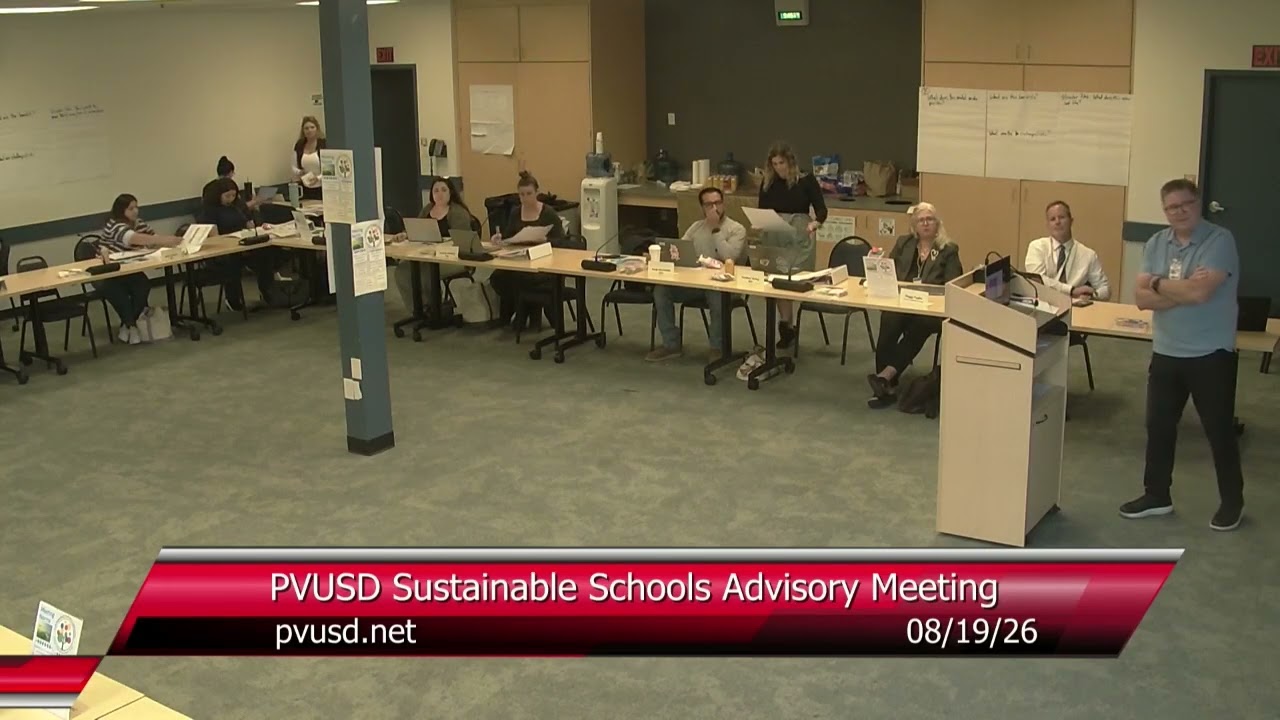
Pajaro Valley Unified School District - Sustainable Schools Advisory Meeting 08/19/2026
Watch on YouTubeVideo summary
The Pajaro Valley Unified School District convened a strategic planning session focused on aligning its resources with the mission of cultivating a nurturing environment where every student thrives. To support this goal, representatives from Furbush presented their advanced boundary planning process, utilizing specialized software integrated with Esri's ArcGIS Pro to analyze demographic forecasts, historical grade progression, and new residential developments. This data-driven approach allows the district to visualize impacts on school capacity and feeder patterns while ensuring sensitive student information remains secure in the cloud. The meeting also addressed significant challenges facing California districts, such as declining birth rates, high living costs driving families away, aging infrastructure, and competition from private schools, prompting a reevaluation of how enrollment, staffing, programs, and facilities can be harmonized to improve academic outcomes and student well-being.
A central theme of the discussion was the necessity of repurposing closed school facilities into wellness or community centers rather than converting them into offices or yards, thereby retaining families within the district. Stakeholders emphasized that deep investments in facility upgrades must be matched by corresponding program resources to avoid spreading funds too thinly, while also critiquing current budget practices that cut teacher supplies in favor of administrative positions. The conversation shifted to specific structural models for elementary schools, where participants debated between traditional K-5/6-8 structures and TK-8 configurations. Although some expressed a preference for five-cohort models based on past experiences with strong grade-level collaboration, the group ultimately voted to begin with a four-cohort model due to realistic assessments of current capacities and funding constraints, acknowledging that such expansions are not financially sustainable across the board without tailored local strategies.
Community engagement played a pivotal role in shaping these decisions, particularly after attendees identified "safety" as their top non-negotiable priority using interactive polling tools. This broad definition of safety encompassed environmental concerns like pesticide exposure, physical conditions such as restroom facilities, and emotional support systems designed to prevent behavioral shutdowns among students. Special education needs were highlighted as a primary consideration in the design of cohort models, ensuring that future configurations support diverse learning requirements. The session concluded with staff breaking into small groups to develop elevator pitches for different structural options, including no change, four cohorts, or five cohorts, and casting votes on which model to prioritize for further analysis. Ultimately, the district aims to use these community-driven insights to create prototypes for new elementary configurations that balance long-term educational programming with immediate resource allocation needs.
Read the full video transcript
um helping them plan a new attendance
zone um for a new elementary school and
uh fast growing master plan uh
community. Um so kind of working with uh
the community and board members trying
to find the best solution there. Um
also made uh tools for other districts
like we made an interactive uh map
showing the walks of analysis for uh Mil
Valley uh district up in Marin County.
Um,
also made a uh boundary planning story
map. Um, just kind of walking through
walking the community through like the
boundary planning process, all the
different factors that went into it, all
the different things that were
considered and uh analyzing that across
different dimensions, showing kind of
describing how that would impact them um
for handover county, Virginia. Um also
whenever we do this project we provide a
lot of analysis like showing um how
students are impacted um what the feeder
pattern impacts would be um what the
utilization level uh would be is based
on the current boundaries and different
uh new proposals. Um so yeah very uh I
always like to for all the districts
that we work with we do this kind of all
over the country. Um we have a standard
workflow and we like to provide a lot of
data to help you make the most uh best
informed decisions.
Um so we've already been working with uh
Paharo Valley for uh for a while now.
For this past year, we produced a uh
demographic study for the district. Um
so as part of that, we kind of uh set up
the data, looked at all the uh
looked at your student files and
geocoded it. um tracked any new uh
residential development that was
happening in the district. Um kind of
looked at what the uh the demographic
dynamics of the area um and then looked
at uh and then in total we developed
resident forecasts u broken down by
grade and by attendance area. And then
as you'll see those are going to be the
building blocks for the uh the boundary
planning that we'll be doing.
Um this this was presented earlier to
the board but just a quick overview of
what all went into that. uh that
forecast. Um we looked at birth data uh
how many births are happening in the zip
codes that overlap with Bahro Valley. Um
looked at currently how students are
moving through uh the grades like from
kinder to first, first to second and on
um over the past few years. And then we
analyzed how many students are coming
from existing uh new residential
developments um in order to predict how
many might come uh from new ones in the
future.
Uh and then finally uh we put all this
together. We have a purpose-built uh
boundary planning software called school
site pro that we use to uh perform this
work. Um it's kind of sits on top of or
is integrated with EZRE's RGIs Pro. Um
and Ezre is kind of the leading uh GIS
firm in the country or in the world
really. Um and we're a gold partner with
them. So we're kind of constantly
working with them uh trying to improve
what we do, add new functionality. Um,
so we're definitely wanting to be at the
uh sort of top of our game on this.
And finally, I'll get into uh sort of
what this process is going to look like,
what it actually looks like in the
software for Bajar Valley.
All right. So, this is um your
attendance boundaries. um right now that
we've worked with the uh district to
create uh we also broken down your
district up into study areas. That's
kind of what these little white blocks
are um that are all across the district.
Um so that's the level that we do the
forecasting. Each of these little areas
has a special uh different forecast
projection associated with it. So you
can as you move each of these little
blocks, you'll be able to see um what
the impact is going to be not just now
um but into the future.
So right now this is kind of the base um
level that we have. So if you wanted to
for example uh it also shows um how many
students are residing uh in the district
based on the uh October 2025 snapshot
that we used to build the uh the
forecast projections. So this is uh keep
good to keep in mind this is not a uh
representation of how many students are
enrolled at each of these campuses. It's
just how many prek5 students there are
that reside uh in its geographic
boundary.
So uh we can uh manually reassign uh
areas and that's what I'll show you in
just a second. But we also have a few
tools um that allow you to um
automatically reassign areas based on a
few different uh parameters. For one,
this one will kind of move each study
area to be zone to its closest school.
And that's we uh we mostly just use that
as example or a potential starting
point, but it's kind of um what a like
sort of ideal um geog geographic based
uh plan is versus what it currently is
now. So yeah, you can kind of see it
usually kind of messes everything up,
but it's always an interesting visual.
Um,
and then I'll go back to uh your current
boundaries.
So we have this uh statistics pane um
that we use. Um there's a few different
things you can do here. you can uh check
off to see what uh not just how many
students reside in each area but um what
percentage that is of the district's uh
of that school's capacity
is based on data that we worked with the
school district to gather. Um
so you can see right now um based on how
many uh students reside Landmark
Elementary for example is at 56% of its
designated capacity um Radcliffe is at
71%
um alone also 71% and so on
and then uh again as you as you get into
moving study areas you'll be able to see
um how that percentage can change. Um,
you can also add in different layers to
uh sort of be referenced. For example, I
added in the uh agriculture zoning
layer. Um, so you can see kind of where
the greatest concentration of that is um
and how close those are to uh the
schools. Like for example, there's quite
a lot in uh in Solo. um
it's probably where the biggest
concentration is but then there's a lot
in Landmark as well Kabasas
um Bradley MSD
and then any other things that come up
in your discussions you would like to
see um geographically
um like maybe city limits um other
attendance areas we'll be able to
geographically bring those in uh and
compare those two different uh proposed
boundary plans.
What data do you need or receive to
change boundaries or what other than you
show colors, show numbers, change them
in and out, what do you really do with
this data? Where do you get it? And how
is it expected from us? And then how do
you handle it as far as end product?
Um, I'm not sure I heard all of your
questions. Uh, so I might need to be uh
corrected. Um, but again, this is data
that we've gotten from directly from the
district. Um, over the past we received
your uh, attendance boundaries. Um,
received your uh, student data. Um, we
kind of received guidance in how to uh,
break up your district a little bit. um
everything that we're working with
essentially except for um development
information and those birth rates are
things that we directly get uh from the
school district and we're uh all uh all
our team is furbus certified. We're very
uh protective of this data. Um
>> what is stored uh safely in a uh in the
cloud.
>> You say the word data, what data exactly
was an example to you talking about? Can
you can you zoom in on one and show the
the student uh pinpoints?
>> Um, sure. Yes. So, I can go ahead and
bring those uh geocoded students on. Um,
>> so and working through it. This is all
of the students within the district of
where they live.
>> And so, what you're going to do with
Preston is you guys are going to talk
about what you think should happen. And
then from that, that will go into them
and they'll give you back sort of like,
oh, this is what you thought. Here's
what it looks like.
>> Okay. So, now let's just take those two
sentences.
What we gave them, what would we give
them? And then what would he test? And
what was he looking for?
>> That's what you're going to work on
next.
>> No, I'm talking about not the end. I'm
talking about what data
does he expect from us? Like names,
numbers, changes in boundary, uh, and
close of school. What does he look at as
a set of facts and what form is those
facts?
>> The facts is the optimal program. The
facts that we give them the optimal
program and then they work through that.
>> Give them in the program and what does
the program want.
>> Well, number one is the cohorts which
we're going to talk about today which
defines the size of the schools
future schools that we may see. So they
take the size of a school
and they know what the capacity is
and so then what is the next step he
does with that information.
So go ahead Cameron real quickly if you
can like just maybe show how we're
you're going to look at starlight
and say we're gonna make that a bigger
school and so we're gonna do some
So yeah, like for example, if Starlight
you wanted to say like, "Oh, we want uh
based on your uh the decisions you're
going to make tonight, we want that to
be about like a 500 student uh campus."
Uh that's the size of the cohort. That
makes sense. So let's say I'll go in and
say like, "Oh, let's try uh pulling in
from areas that are like geographically
um close to the campus but aren't in it
um but also aren't too uh far away from
a different school." So, like for
example, let's pull these areas up at
the uh top of hide and see what that
does.
See, let me turn those uh selection off.
Redo that.
>> So, those boxes that you just had
highlighted which are not there now.
>> Yes. So these areas are currently zoned
to uh hide
>> those boxes. What people ch children by
by age, what information do you have in
those boxes? And then what are you going
to do with that information in relation
to the pink one compared to the blue
one?
So we um those dots you see um at the
beginning of this process we received
sort of an Excel file of like all the
students that are enrolled in Paharo
Valley with their addresses and so that
like Excel uh entry is now a point on
the map. So you can see based on that to
Starlight.
So now you can see that actually yeah
works perfectly. Um Starlight now is
like 499 students um right at that
hypothetical target. Um, and now that
brought its percent operating capacity
up to 71.3%.
Um,
and then, uh, we'd be able to, obviously
this wouldn't be the only change, like
we'd probably want to say, oh, now is
too small and needs to pull in some, uh,
students from another area.
So uh
>> I'd like to stay with
>> these two from
>> pardon pardon me. If you stay with one
school and march us through it, we
understand the trail and where it's
going and what you're providing. when
you jump around different districts
to assimilate that data for me um is
confusing sometimes or not fully clear.
So if we're talking about Starlight and
you just showed an example.
>> Mhm.
>> So then if
um Starlight closes or takes on those
students, uh what does that do to the
remaining school district that they were
at that you know about from this
information?
>> Just what just less numbers? These are
great questions
that you'll be back
many many times with sort of that
exactly what you're asking for but with
very detailed information about what you
decide. So he'll be back.
All these questions are great. We're
going to get them all from you and make
sure
this is just a quick demonstration of
when you give them something, they do
the work for you. You don't spot kids.
These are the experts that fought kids.
This is what they do every day.
We give them the guidelines and the
parameters and they go through the work.
>> They'll be back next time as well.
you wanted time to talk and that has
always been on agenda. That's your time
to talk about next step.
>> So then that information
does it also include um
students with um
difficulty with English language? Does
it make it clear what other special
support programs they need? Every piece
of information that the district has on
a student is in here. Okay. So, we're
going to turn Thank you very much,
Cameron. We're going to turn it over to
Preston and we're going to switch over
to that presentation.
>> All right. All right. Thanks for
presenting for you all tonight.
>> All right. It's good to be back with you
all. Um, and a happy new school year. We
basically I think both school districts
open on the exact same day. So, I know
it's really hard to go from zero to 100
miles per hour in two weeks. So, I
really appreciate everybody being here
tonight. Um, I brought Do I have to
stand here now that I can move or
>> Oh, I can move. Okay, great.
>> Just one of the things as I I was kind
of sharing with folks in Oakland about
kind of the process that you all are
going through here. Um, I brought a
couple people and I've actually
referenced these people in without their
names. I just want to introduce who's
with me here today. Um, Pina Ramby is
our executive director of planning and
she loves this GIS spatial stuff and is
really responsible for um, Oakland
Unified School District's master plan.
Um, so she we were talking about what
you all were doing here and she decided
to come on down and check it out and um,
is going to help facilitate a couple
pieces. um Killian Betlock, if you
remember when we started talking about
um secondary slides, he was the
principal that merged two schools
together um and talked one of the slides
like highlighted some of the um changes
to the school site. So, you know,
Killian also now leads our enrollment
team and so he's here tonight to just
kind of participate in the conversation
and help facilitate a little piece of
it. So, just brought some of the
expertise that we've been talking about,
the same things that you're talking
about here in um PDUSD. So, tonight um
do is there a clicker or are you gonna
Oh, sweet. Um
you've got a lot of data, right? And one
of the things actually I just want to
point out real quick when you saw all
the colors in those maps that was done
years ago and Perita pointed out she's
like, "Oh, they have a little island." I
don't know if you noticed that color
where the pink color kind of went up and
then there was one of the other
boundaries kind of ran through that and
then the pink was on the other side.
There was a reason for that. I don't
know what it is. Sometimes it's like
there was a new street that came in or
whatever. And it is really important to
look at those boundaries again to figure
out how you're going to reconfigure the
district. So, I just wanted to name that
like that island that you had in the
middle for one of the schools, we have
one in Oakland, too, right? Right. And
it's a it's a legacy of like thing Oh,
thank you. things that have been done in
the past. So, a couple of things and
you'll cycle. I I brought this and I'm
going to go through just a quick recap
of some of the things that we've talked
about. Um, this is kind of the overall
design process.
You're here tonight. We're here to
listen to you ideate about what you want
the future, particularly in elementary,
to look like. We're not making any real
decisions. We're just talking about like
putting some of the pieces together so
that Cameron's going to come back and
show you some prototypes next week of
elementary based on the conversations
that you've had. Right? So, this is a a
place for you to start applying some of
the lessons that you've had and and
we'll go through some of that. Um,
so I want to go back here. I really
really really think that this is
important slide and I'm just going to
just say it over and over again. You
have an amazing mission and vision. It
is not very different from most other
school districts that I've seen, but I'd
love for you to put voice to your
mission and vision. So, I need somebody
to read out your mission.
>> This is your district.
>> Go for it, Casey.
>> Mission.
>> Yeah. We are committed to cultivating a
nurturing environment where every
student thrives academically, socially,
and emotionally, empowering them to
flourish in a dynamic and evolving
world.
This is our foundational beliefs and
this moves towards the lived reality.
You're in this room because there are
some things about the lived reality that
need to be changed. Everybody in here
has a different perspective on what that
might be,
but the mission leads to your vision.
So, can I get somebody else to read the
vision?
>> I'll read it.
Unified School District.
At Parro Valley Unified School District,
our vision is every student will
graduate graduate ready to share their
unique skills and abilities and be a
positive contributing member of their
community and their world.
>> Is everybody generally aligned with
that? Just kind just, you know, shake
your head, give me thumbs up. Okay,
here's where school gets hard, right?
You have a theory of action about how
you're going to go about doing this.
Then there's some strategies. And what
we're talking starting to talk about is
some strategies to reshape the the way
that school is being done. Then it goes
down to goals, actions, and work plans.
This is where it gets really hard. Um,
and I want to check a little check for
understanding here. Um, what I've heard
from you all through I've watched
several of the meetings online is that
in terms of the problems, how might we
organize our schools and resources to
create the strongest possible learning
environments for every student?
Does that resonate with you all?
Okay.
So the theory of action based on that is
if we align enrollment, staffing,
programs, and facilities around the
conditions students need to thrive, we
can improve student well-being and
academic outcomes for every PVUSD
student.
If we do this hard work that at the
other side of it, we're going to improve
outcomes for kids.
Okay, I'm seeing a lot of nods.
There's a second piece that has come up.
Buildings by themselves don't support
the academic outcomes for Kim. It's the
people inside the buildings that are
critical.
And so given that our people are the
greatest resource, how might we
structure schools so that staff can work
in strong, supported, and sustainable
teams?
Having teachers and staff classified and
certificated work together for years on
end can create a very powerful dynamic
environment for kids. So if we create
the appropriately sized, well-resourced
schools, we can strengthen staff teams,
improve retention, compensation, and
provide students with more consistent
access to highquality learning
experiences.
This is what I think the theory of
action you all have been talking about
as I've been watching the meetings. Does
this resonate with people? And does
anybody have any questions around that?
Because fundamentally, if we're going to
move forward tonight, if you have any
questions, I'm going to give you some
time to talk. But if this doesn't feel
right, my whole presentation's
a little bit off. But this is why we're
here.
I'm gonna do some uncomfortable wait to
see if anyone wants anything. Okay.
All right.
What
they weren't talking about, I just want
to rename the headwinds that you're
facing. And this is not different than
what we're facing in Oakland. It's not
different than what they're facing in
other parts of California. It's not fa
different than other parts of the
country.
You have declining enrollment at the
state, the local, state, and global
context. You saw it on Cameron's slide.
Birth rates are going down. A lot of
that is being driven by change in
lifestyle, but also cost of living is
really high for folks and they're making
decisions not to have as many children.
That impacts the school system. I just
met with a city council member in
Oakland talking about their commitment
to affordable housing because without
affordable housing, we don't have kids
that come into the schools, right?
Higher cost of living, immigration
policy shifting is impacting a lot of
our schools.
aging infrastructure that requires large
sums of money and deferred maintenance
and aging portable portables. All of
those things are impacting
you have competing demand for competing
systems. So surrounding districts, I'm
sure I've heard you talk about it,
interd district transfers where students
are choosing to leave the district. You
also have children that come into the
district. That's the same across many
school districts. you're competing
against private schools and charter
schools and even intrad district
transfers that I've heard you talk about
where about 25% of your students go to a
school outside their neighborhood in
Oakland it's what 50 about half
right
um shifts in transportation and costs
across the district and then also just
higher general cost of living for both
families that live here but also staff
that impacts your
Um, so I'm gonna when I was kind of
making this presentation, it was like
kind of the beginning of the back to
school work and we have in I was sitting
in Hertha Hall which is in our Met West
and I got inspired by Dolores. So um,
which this quote I think is really
important for where you all are in this
journey. The freedom of association
means that people can come together in
organizations to fight for solutions to
the problems they confront in their
communities. here. I'm here to help you,
but this is you all have to solve this
for Po Unified School District.
The great social justice changes in our
country have happened when people came
together, organized, and took direct
action.
We can talk a lot about all of the data
and all the all the different components
that you've all been reviewing, but it
does require some level of action to
create change. And I'm here to kind of
challenge you a little bit around what
is the action that's going to come out
of the the SSA, right? What's the action
and the recommendation that's going to
come forward to the superintendent and
then the board that will help lead to
change for kids?
All right. So, in front of you, I hope
did everybody grab the toolkit?
I'm gonna give you a little did give you
a little homework. I know it's a busy
time of the year. I'm gonna just kind of
point out a couple of things. Okay.
In your toolkit, you have this place map
and I changed it a little bit, but
always it should be driven by academic
outcomes. Like what are you trying to
get for your kids? Then you look at the
facilities factors. Those are probably
the two biggest factors that we're
talking about here. What do you want for
kids in terms of programming experience
for staff? And then what do you want the
facilities factors that you've learned a
lot about? We're going to go through
those.
Once you've talked through that, there
are some operational implications and
there are some facilities implications
as well. All of that is driven by the
enrollment in the senate. So there's
some guiding questions for you as you're
thinking through this tonight is these
are just some prompts for you to be
thinking about as you go through the the
dialogue tonight.
Secondly is I gave you the OPM cohort
toolkit, right? which is just some of
the slides that we have talked about
here. And I've walked you through these
over the over the two days that we met
in June, but it's just a refresher for
you around the cohorts, the sizes, and I
want to point out one.
I'm gonna go all the way to the end.
There was a really great question.
Um,
so I could go to any of these, but there
was a question that I kind of left
hanging last time I left. It was a
question about special education,
and it was, "What schools, if any, in
Oakland, have dual language? Do any
include special education students? What
supports are in place for incoming
students if they need a teacher aid? Do
they have on-site sped teachers?" I
don't remember who asked that question,
but it's a great question. I didn't know
the answer to it. So, I went back and
one of our strongest elementary school
models in Oakland is a TK through 8 um
dual immersion school. And I didn't know
exactly what the special education
programming was in the school. So, I
asked,
remember when we talked about those
cohorts and how you're thinking about
how your special education students are
flowing through the system? I don't know
in in some of those slides that we
talked about
they have a SCP class they have three of
them they have a TK to two then they
have a 3 to five and then they have a
six to eight and it's in dual language
so sometimes when you think about like
is do kids have access to that that
curriculum the answer is yes you can
build it into your school there are
other dual language schools that on the
drive down we were talking about that do
not have a fully integrated dual
language but they are incorporated in
those continuums within the school. So I
thought it was really important because
this is one of the hanging questions
that I hadn't come back and talked to
you about and I just wanted to share
that um with you all as kind of one of
the prompts from the last time we met.
Okay. So I gota go all the way back.
What I'd love for you to do
is I'm going to give you about three or
four minutes. I just want you to look
through the packet and I want you to
think about and hold in your mind what's
the one thing that you don't think we
should compromise in this conversation.
It could be a structure. It could be the
special education. What is the
if you were designing a school today
based on everything we've learned and
everything that's in there,
what would one thing be that you would
refuse to compromise?
Okay, so I'm going to give you four
minutes to kind of go through the packet
and go through and it doesn't have if
it's not in here, that's fine. What's
one thing you absolutely want to be true
for students?
You can use these tools
any when when you're thinking about what
you want to be true on the other side.
What's the one thing that you absolutely
hold true for kids
and then we're going to use the menty
meter to kind of pop. But I'm going to
give you about four minutes to just kind
of go through it, look at some of the
things and remind what we talked about.
And then I want you to come up with your
one thing.
If it's for your own kids, for those
students in your class, what's the one
thing that you refuse to compromise?
All right. So, I see people are getting
down. People need more time or
Okay. Now, we're going to try to use
some technology. I am This is where if
not, we're going to post-it notes. But
um if you could grab your phone and grab
the menty meter and what I want you to
do is see if you can log on and add
whatever that thing is that you just
wrote down or you grabbed a hold of.
You're going to put it into the menty
meter and then I'm going to show you
everybody's results on the screen.
How many? 35
>> 25. It's it's
you'll get you'll get it tight.
Are you able to log on? Oh, that was
easy.
Oh, yes.
Awesome.
Okay.
Can you
check and see if it's revealing on the
other page?
Here we go.
Oh, wow. All right.
Here we go.
I got fully staffed schools.
Putting students first.
Student supports
safety seems to be coming up for a lot
of folks. I assume that's lots of
different types of safety.
Um, financial support. Interesting. OPM
as a benefit for PV
benefit. Oh, I got it. Relationship with
community, a welcoming environment.
So what you're trying to do does anybody
want to put voice to some of these like
safety clearly that's the largest one?
Anybody want to
share why? Yeah, go ahead.
Is this on? Like safety from pesticides
and the environmental stuff. We know
that Driscoll has been doing a lot of
bad things around some of our schools
and so I believe they should be held
accountable for some of that and moving
forward the safety of for students
>> here right I for me
yeah no definitely
yeah but this is what's so important
about your local context you would have
only known that I don't Right. And when
I saw safety, I made some assumptions.
There's a local context to what safety
means for kids, and that's an important
one. So, I thank you for putting words
to what it meant. Did anybody have a
different definition for safety?
>> Yeah. Go ahead.
One of the things that we teach as a
part of mindfulness and um SEAL which is
social emotional learning um is about
the difference between the amydala and
the frontal cortex. And we teach kids
this and so when they don't feel safe
their brain literally is shut off from
their frontal cortex which is their
learning center of the brain. So when I
think of safety, I'm thinking inside
those schools um and where kids are um
either not getting enough support from
staff or um or there's a lot of
behavioral issues that aren't being
addressed fast enough. Um or just you
know the like having systems set in
place where students can um work through
moment just moment by moment sometimes
issues that come up that shut their
brain off from learning because we have
a learning this this is what we're all
about. we're about learning and when
their brain is shut off then our job as
teachers is we have to stop teaching and
we have to start bringing in behavioral
uh resets to help them open up their
brains again so that they can learn. So
the safer this environment within the
school then the more successful we're
going to have as with students the more
success we're going to have with
students. Oh
>> that's fantastic. So two very different
>> I have one I have one
>> I I'll one comment and then um
>> okay go ahead
>> is that as you're starting to think of
those boundaries and you're starting to
think of those those areas you're
thinking about the environmental safety
that comes along with your schools right
what you're talking about also is that
if a student feels fear a threat
goes to more of a primal area in the
brain where they shut down on the
learning part right and it does require
a safe trusting space to be able to open
that up to push them around the
learning. So, thank you for bringing
that. Go ahead. One more.
>> Having said that, what you just
mentioned, also having a healthy school
facility and then also helping students
with their inter interpersonal skills
because there's a lot of uh students who
do not speak out when they're being
bullied or being harassed, especially in
the restrooms. So, safety is huge. I
think all of us have many definitions.
>> You just brought in an important factor
is the facility itself, the quality and
condition of the building that they're
in. And one of the things that we're
moving to when we have our first school
that's going through a a new school
design around private restrooms within
the school because of the lack of safety
that kids feel within the restroom. And
that does require resource and you can't
do it everywhere. We're doing it in two
schools. And hopefully after we learn
from that, we'll move to more schools.
So, okay. So, I want you to hold this,
right? That there's a lot of alignment
around what you're trying to accomplish
here. Um, can we go back to the
PowerPoint because Yep.
So, I want to remind you back to the
people and this is I think this is
>> Yeah, this one's really important.
When I first started teaching my first
year, I thought I could do everything,
right? I was stuck in my classroom all
the time. I was working late into the
night doing lesson plans. It wasn't
until like the second year of teaching
that I realized that I was way stronger
with the other people around me, right?
And so when you look at the research
around what creates quality learning
environments for kids, I just want to
remind you that it's really about
building adult collaboration coherence,
what you're doing from classroom to
classroom and how it builds on itself
through grade levels, um feedback, and
tiered student supports. And so finding
ways to make sure there's collaboration
and coherence, formal and informal,
having a great p partner next to you. It
might not be formal. It might not be on
your PD day, but it's at four o'clock
when you walk across the hallway and you
have that conversation about a really
bad day. That helps create quality
spaces for kids.
Creating high expectations, timely feed
feedback and progress monitoring, and
strong instructional clarity. These are
all things that tons of research backs
up in PLC's and creating these spaces
within schools is what creates quality
outcomes for kids.
Okay. Um, now I want to just
make sure that we're not going too far
here. I just want this is actually a
slide that we're showing with our board
tomorrow. Um,
is that this is all the things that
we've been talking about in here and I'm
going to walk through that. It's your
facilities master plan. It's like a lot
of the demographic data. It's really a
combination of your current and future
enrollment needs, space requirements,
the portfolio, the capacity of each
schools. when Cameron was presenting,
you saw on the side there was a chart
that showed the capacity of each of your
schools. Um what are the facility
conditions like which ones are the ones
that don't have the safe portables that
need to be removed? Um and then what are
the geographic or regional needs? That
goes to kind of whether you're in close
proximity to some of the agricultural
spaces.
We're not going here yet. What are the
programs that are inside those
buildings? Right? And I just want to be
really clear about it. And then there is
a discussion that we're in because
Oakland didn't put all these things
together. We have a whole bunch of
vacant assets. There's all these
properties that are empty, right? And
there wasn't a plan for that. So there
is a conversation as you move forward
that you also have to be thinking about
what are the alternative uses. And um we
could definitely share some examples of
things that we're doing and thinking
about in open. So just we're I just want
you to stay here. When you start
thinking about are we going to do an IB
program or are we going to is this
school going to be the dual language
school or whatever that's a later
conversation and that really requires
you to go into the community and engage
with the community about what they want.
>> Yeah. Go ahead.
>> Maybe you're getting to this but I I
think one thing that I feel like keeps
not coming up is because you've got it
on the agenda tonight as elementary
schools. I think there's a fair amount
of research that suggests TK through 8
performs better and California is
phasing out uh 78 junior highs and so
there is value in that and so my
question is really just where where does
that fit into the discussion in terms of
when we talk about an elementary school
what do we mean by that?
Um, Stockton Unified did they were
really struggling with middle schools
and so they went K8 as a strategy and
you have to have the capacity in a lot
of your schools. I think I would say and
I don't know Killian might jump in on
this one as well. I think Oakland's had
a mixed bag. They've looked at one spot
and they said, "Oh, you know what? This
is a really good school. Let's make it a
a K8."
And then it didn't sustain the
enrollment in six, seven, and eight. and
then it shrunk back down to an
elementary school, right? We have a
bunch of 612s. There's three 612s and we
talked about it with CCPA. Our two
highest performing high schools are
612s.
The middle school ages are really
complex for kids, right? And so that is
a conversation we should be having here
programmatically like what do and and I
would do it in coordination with the
whole portfolio of schools because one
of the things that we did there's four
dual language schools that all surround
another school that by default impacted
the enrollment of that one school and it
segregated out the community. So, I do
think that that's part of the
conversation that we can have around the
model. And I don't think you were here
the night I talked about the 612s. Um,
that that is kind of a unique structure
where we're going 612, but K8 is an
important area as well. The the one of
the things that we find with the K8s is
a lot of students leave in the six
through eight period if the school is
too small
because they're not getting the middle
school experience. are not getting the
peer interactions and that's where
thinking about the number of cohorts you
would want in that school is really
really important but we're open to
having that dialogue with y'all
and I think you should have it in the
room okay so here's okay y'all are
swimming in data and I just want to name
that so that these I tried to go through
all the agendas and just lift up you're
sitting here with the SSA advisory
you've talked about facilities
conditions multiple times. You talked
about the portable conditions and where
you have portable locations. You've
talked about the fit reports and
analysis, school capacity analysis. You
know, how big your schools can, what
they can currently hold. There's a
special education landscape. I think in
elementary you have about 200 SDC
students or um within your program that
you need to identify locations for. You
I think last session you talked about
English language learners. You have the
resident cohorts, which are the number
of cohorts that come out of the
neighborhood. Um, you have student
addresses and density, student
demographics, enrollment trends, current
trends, snapshots from the past,
snapshots for the future. There's a lot.
That's what Cameron's going to help you
with. Right? One I just the thing that
wasn't exactly clear, but I I I'll just
say each one of those dots was an
address where a kid lives, right? And so
you can reconfigure your boundaries. You
can start to avoid particular areas.
That is some of the work that after you
figure out your the number of cohorts
that we're we're talking about and why
getting clear about the why, they'll
start doing some modeling for you and
they'll bring it back to you in two
weeks. So I just want to make sure you
don't have to be an expert on all this
but there are these sheets that if
you're the data person and you want to
dive in and go deep like you can go to
this and you can start looking at it
individually. So I just want to name you
have a lot of information and there is
not a right answer. There's a there's an
answer that you're going to come to
that's going to be the best answer for
the school district. Okay. So
here's where we are. What are the
optimum elementary configurations we're
trying to create for students and staff?
Then we're going to go where are the
best locations in the school district
that can can be configured to meet the
optimum programs. That's the next
meeting. And then how are we going to
organize our resources, programs, and
staffing to best serve the students in
those schools. So, we're here tonight.
You're going to make some decisions
tonight. And then you're going to see
what those what those options are when
we come back. Okay, so
here's where you are. Started the school
year. It's 26 27. You all are going to
think through all this and there's a
future PVUSD that is doing something,
right? Different. I hope you're all here
because you want to change something
because the status quo will just keep
going and you'll have declining
enrollments and it'll just continue
because that's the trend.
Okay. Um, so this is where we're going
to spend a few minutes. I'm going to
give you a second. I've said a lot. You
all have some elbow partners.
I just as you've gone through all of the
sessions that you've been in because how
many meetings have there been now, Bill?
Is it nine?
>> A boatload. You got a boatload of
meetings. You've been gaining a lot of
information. Honestly, there's no one in
Watsonville that has more knowledge
around school
like these types of um data points than
the people in this room.
You've developed a much deeper
understanding of the factors that shape
school quality, sustainability. What aha
moments or new insights do you have
about the future PBUSD that's critical
to include in optimal elementary school
design? So, I just want you to take two,
three minutes with your partner, pair
share. I think everybody's pretty close.
And then I'm just going to give you an
opportunity to share out and I'm going
to just write them all down. Okay. So,
does the two of you will sit together to
everybody has a partner.
Okay. Two to three minutes just to share
kind of your response and then we'll
share out to the whole group.
You don't have Yeah. No. Okay. All
right.
Lots of robust conversation. This is
good. Okay. So,
I need a brave group to go first.
So what's kind of something and it you
don't have to have this all figured out.
I'm not asking you like we were just
having a conversation about the
capacities like it's where are you
leading right now? What are the ideas
that you have so that we could track
them and make sure that they're present
in the models that we're creating for
you all. Right. So Kelen and Prenita are
going to take some notes as you all
talk. Is there a brave group that wants
to go first?
>> Yeah, let's go.
Um, I'll share what Steve and I had
discussed and for me it was feeling a
little bit like well have I really had
many ahas because like I'm embedded in
the district by my role as president and
so we got started talking about well
maybe there are things that I might miss
or what's a different perspective and um
Steve shared that like when we started
this exercise he was looking at it
through the lens of like resource
allocation and budget and finances and
maybe solving a problem of today and now
realizing that we can't really solve
that problem of today without the vision
of a long-term educational programming.
And so identifying what we want in the
long-term programming will then help
inform us of how do we go about changing
or combining schools and what um bond
money gets allocated as a priority. But
you really can't answer those questions
if you don't have the long-term vision,
right?
I I I was having a harder time, but I
think for me the thing that I've been
wanting to voice as my aha is like
saving schools doesn't just necessarily
automatically mean we're going to save
money. And there are studies that show
there are ways that that can actually
push families and students out of the
district. So, one of my priorities is
figuring out how we're going to use the
facilities in the future. We can't just
turn them all into a busy yard or a new
district office. Like, we should be
looking at wellness centers, community
centers, and being able to let our
families know like, yeah, you might have
lost your neighborhood school, but
you're getting this that's going to keep
you in this district. Um, is sort of
where my mind is, too.
>> And there is alignment, too.
>> Look at that full arc. Awesome. Let's
give them one big clap. One, two, three.
All right. Now you pick who you want to
go next.
>> Oh, straight across.
>> I know. All right. All right. All right.
around wait a second I see this thing
I'm not sure how it maps out and that's
what Cameron's going to help us do with
the facility condition so I think it's
fine and we'll capture that and then the
second thing can you say a little bit
more about the K8 because gentleman that
just oh he'll be back kind of mentioned
it and then you piggybacked like what is
it about the K8 that is is intriguing
Yeah.
That's great. Well said. Heather, did
you wanna
>> Can I interrupt just real quick? I'm
getting texts from folks who when we
don't turn on the microphones, the
people watching can't hear. So,
>> Brandon, there's a great
>> um I lost my train of thought. I was
thinking we talked about, you know, the
difference between cohort four and five.
>> See if this one's better.
>> Yeah, that one does not like me. Um, we
were talking about the difference
between cohort cohort four and five and
just the difference between the two. And
you know, me personally, I'm leaning
towards more the five cohort model.
Yeah.
>> Say, can you say a little bit more about
why?
>> Um, just, you know, I've been working
here for 20 years, so back
uh aging myself right now, but back when
I was younger and, you know, I did work
in elementary that hel held around 700
800 kids at the time. So, um, and I just
remember having like four classrooms per
grade level. So,
>> and what what was it about the four
classrooms that like you have a positive
association with that?
>> I have a positive just the the grade
level collaboration was really strong.
You know, the teachers working together
was um you just it was more
collaborative and I just felt like it
was a good use of
uh driving instruction.
>> Okay, beautiful. That was great. Um, who
do you want to hear from next?
Edges went first. That was good.
>> Yeah, you get to pick. You have all the
power.
Joanne and John. Okay.
job.
>> You can want a good program,
but you got to fit it in so someone has
the money to pay for it.
And
you can talk around in a circle and
there's no one would disagree that long
term you want performing schools.
But the question will be if you only
have a limited amount of money,
what do you do first?
Some want to do programs and others want
to do facilities.
Um, our thought back and forth was you
have to do both at the same time.
Um, because it's like washing your
hands. To do it together, probably do it
faster.
one hand then the other you got a lot of
problems and then something changes
and so the question really is that we
have a lot of data. We've had no time
for everyone to sit around and exchange
what's make up one problem or one
solution not prefer solutions and say if
I close school X
so how can we make better programs and
enhance the other schools
>> and if you took the one that the data
says 53 to 51 million
one school here is what's needed
So if you just said, "Okay, we'll close
that one." Because we don't want to
spend $51 million out of measure and we
want to put it in the other schools.
So now let's talk about what programs we
want, both facilities and programs to go
to the other schools.
And I think once you put on the table
what you don't want because it's too
expensive to fix and it has very little
yield compared to what you can do with
the same money everywhere else. I think
you get a lot of people here who start
thinking about a lot of things they need
and they would like to do and can do
now. And I think we have to get there
sooner than later and we're running out
of time. In my world, you know, we can
um we build a lot of facilities,
but you got to have the money to make
the program and the facility work
together.
And we're not there yet. And it's
because um I think you come up with some
ideas, you test them, you come back and
look at those ideas, you test them, and
that's just kind of basic field of
research. of trial and error. You know,
wonderful here is you can do it and have
all these people who've got this
experience about what will work and what
won't work before you spend the money,
>> but you get going into the problem to
solve it.
>> Can can I make I I want to make sure I
catch I think there was an important
piece that you said in multiple phases.
So, I just want to I think one of the
takeaways that you're talking about is
somewhat here that there is a tight
connection between the facility and the
programs you're able to offer and that
that's an important consideration as
you're moving forward. And if you don't
go there, you are spreading yourself
very thinly across the district. You can
make deep investments right in a
facility, but you have to know that
that's the long-term home and you have
to match it with the program. Is that
>> absolutely I mean and I agree with
longterm and I agree with you know um
programs
and I also look at you're bleeding
somewhere and how do you put a
tourniquet on it?
Oh, no. We talked about that, but I also
brought up how well in general we say
that we um value our teachers and
keeping that
maintaining that. But if they're not
getting money for their program supplies
that's getting cut out of budgets and
then admins stacking for positions that
seem somewhat unnecessary, then that's
kind of a
slap in the face to the teachers that
need their school supplies. Now, it's
the beginning of the school year and and
I'm just thinking like how much did they
have to pull out of their pockets
because their personal pockets because
they don't have those siphons anymore.
So, there's kind of mixed messages
coming from the overall district like we
want to maintain you. You're so
important to us, but then give us back
the siphon. Oh, and by the way, we're
we're frontloading or toploading admin.
So, as a person just coming in on this
and hearing this and seeing this, it's
that to me is like a major not just aha,
but a slap in my face and a slap in the
face of a lot of the teachers that, you
know, are here.
So I I think that that's a great that
that's one of the the things around when
we were talking about the theory of
action that people are well resourced.
And I just want to say that like in this
model right here, these two elements at
the top, the facility and the program
that you're promising kids, you do have
to be able to resource it.
And that has to be a factor. It's not
the first factor. you design what you
want for kids, but then you have to make
sure that you can resource it with
supplies, things of that nature,
>> right? So, it's great that in theory,
like, oh, yeah, we totally go with this,
but what are we really doing as a as a
district?
What what is really happening
>> and it's that the teachers are not
getting what they need? And
>> and that's a test for you though at the
end of this process. Well, no, it's a
test for the it's a test for the
teachers because they're asking for
this. And
>> I Yeah, I said I said it like in the way
that you're evaluating this process,
>> right?
>> The test for you as to whether there's
integrity to this is if at the end
product down the road, people are better
resourced.
>> Oh yeah.
>> And there's and there's trust that needs
to be earned along that path. For sure.
Okay. Thank you.
Who do you want to hear from next?
Which group?
Megan, do you want to start us off?
>> Sure.
>> Um, we talked a bit about the cohorts as
well. Um,
and like where the idea of having such
big schools makes us a little bit
nervous just because you don't want kids
to get lost in the system. But then we
also were talking about when you have,
you know, multiple of the same grade,
then it's not just one teacher looking
out for this kid, it's also the other
teachers of that grade looking out for
the kid. And so that for me was kind of
an aha of,
oh, it's not this way that I was looking
at it. It could also be this way. And so
I think just trying to look at things
from different perspectives.
Um, but what I had also mentioned to her
was one of my ahas from these meetings
has been when you first came and you
mentioned when you guys did the
this stuff
um how you focused on sped first
and that's something that I found very
interesting that
it was like that and then everything
else kind of around it. um just because
that's not what I'm used to seeing. And
so I thought that was cool.
>> Thinking about what Heather said a
second ago, we were actually walking
through a school site and first year
teacher was there and one of the kids
just bolted like just took off like and
just was gone. And it was it it was
amazing because there were four kinder
classes that were right there and one of
the I don't even think it was his
student. He took off after the kid,
right? And everybody else just kind of
seamlessly like it was almost so casual
because there was a support structure
and I was thinking like if he was by
himself and that was his class. I wasn't
even sure who the teacher was of the
student that would have been a real
complex moment for for that teacher,
right? and the kit takes off, you've got
20 over here and then one's running,
right? And so I do think there is this
piece around how you're designing and I
think one of the ahas for and I really
appreciate you sharing it. How do you
think about your special education
students first in the design of these
cohorts and how you're building them
out? And I do believe and I I I'll check
with Bill real quick. They do um MGT has
like the data as to where special
education students are. Okay. So, they
specifically know where their addresses
are to figure out where they might be
clustered around schools. Okay. Did you
want to go next?
So, check mark. Check mark. You get two
votes on.
Well, I'm gonna be boring. I agree with
Jorge um with the K8 and I'm at a school
which they say we're dual, but we are
not completely and I wish we were. And
it would be it would be interesting
because that the um right across the
street from us is a middle school. So,
it would be great to have a dual K8. I
don't know how they would configure
that, but um it has been a a a thing in
the 21 years I've worked here, but it's
never been really resolved for this
group of students who live in that
neighborhood. That's what I was offline
about.
>> Could Can I ask you just one quick
question because you're like, "We're not
all the way there. What stops you from
being all the way there?" Um we were a
early exit school for a really long time
and then um we were told we were going
to be a dual language school and that's
never the supports and the resources
have never really come to fruition. So
that's what's stopping us.
>> No, I agree with her.
I agreed with um her aha and um to have
a continuum of the curriculum to the
middle school which then feeds into high
school and supports the A throughG
requirements of you know knowing another
language a foreign language
>> and what better way that to reinforce
the primary language especially making
sure that it's academic Spanish.
And just as somebody that was a high
school person, to hear you thinking
about elementary but also thinking the
long game is is really really powerful
that they're set up to be ready for
middle school and then ready for high
school. That's great. Thank you. Um
let's go over here.
We didn't really have any aha moments,
but um we discussed that, you know, we
were we've been given all of this data,
but we don't have any community input or
staff input. So, how can we
go forward with changes if we don't have
that data? you know, a lot of um changes
are made at the top and you know, staff
practically live at these sites, so
they're the experts, so they should be
having more input on, you know, the
facilities and the safety concerns and
um everything that's going on the at the
sites and what do parents prefer? I
mean, just because a K8 model, a K
through 12 model works in Oakland,
doesn't mean it's going to work here.
We're a completely different community
than Oakland and you know what is
teacher and parent input on the
different types of models. Um and we're
just missing that chunk of information
>> similar to this room or not. I'm just
curious like when you say because I this
group is representative of different
groups. We are representative of
different groups like for example I am
the high school parent representative
but I'm not going out to all of the high
schools and getting you know
information. I'm not even given that
opportunity like oh hey do you want to
have you know a forum with high school
parents like we're not given that
opportunity. Um same thing for I mean
special education or elementary like we
don't go out and get any type of input.
No, I I would just Okay, that was super
helpful because I do think there are
going to be some surveys down the road
that go out and some engagement that
happens in the future after we get
through the optimum. I just want to
confirm that that's going to happen.
>> Okay. And I also I did want to say like
yes, I'm I'm not saying that what
Oakland does is going to work here. I
also went to San Juan Batista Elementary
School that was a K8 and it was like two
classes all the way up. So, and it's
changed dramatically.
a few years ago since I've been there.
But yeah, so it does need to be a model
that resonates with you here. I was
running back.
>> I have a question about this never gets
answered.
>> If you close a school,
how much money do you save or don't
spend if you close the school? It's kind
of no different than in my world, you
know, if you close
a library or you close a production
factory
and and relocate and redo whatever.
Someone knows there's a number of
dollars here. So, what does it save?
>> So, can I I'll come back to that. I will
like I just want to go. We have four
more people to hear from and then I will
come back.
>> You need to answer it. You never do.
>> I I'd be happy to answer it. I'll answer
it. We'll go four more people and then
I'll come back to it.
>> Done.
Go ahead.
>> Um, I agree with Delila. Um, I guess I
feel like I we haven't really been given
what exactly we're doing to like the
idea of like what we're looking for to
close the school and kind of given that
um we've been given all this data, but
really we're not having I guess we're
not given that information of what we're
actually looking for and how we can
support our families and staff and
parents.
Is there one thing that you want in
terms of kind of in this participation
around this that you're realizing that
once we get that participation this is a
key thing that needs to be an element
here?
>> Um
I guess just kind of pinpointing down
like one thing I I don't really have an
idea right now but just that one thing
that we need to look for into what we
need to do for to close the school down.
I I think also the just and and maybe
let me take the the one thing comment a
little bit further like a lot of times
in school districts we I'm not saying
this about you all we do too much and I
think that's why we wanted to start with
getting really tight around what it is
that you all want to be true for your
staff and students around the design and
then we'll start looking at what might
be those configurations so that you can
focus on less things because there is a
lot of information on that. I just gonna
name there's a ton that's been there. So
like trying to keep it simple so that it
is clear to the community about what
they're gaining if you move to a five
cohort model like what is the benefit so
that it's easily explained and we have
to keep it simple. Okay. All right. The
trio
we get to close this out and we're going
to move into some smaller groups.
We were kind of going in the same way um
that I would be interested in exploring
K through eight or the 6 to2 cohort
something new for our district and but
what it isn't really it's yeah my our
idea but we need to see like like a
business is are we going to sell it to
our community are they willing are they
to explore so I think that's a key
factor that families and our students
are our clients and we need to see what
their needs are and if they're going to
go for it because it's no point in
investing in something if they're not
going to go with it. And I think the key
thing I'm going to be honest when you
first came I'm like okay what do they
want to try us to convince us to do but
once I heard um what you guys did it was
really amazing but one of your key
things that you guys did at Oakland was
that you brought your community you
listen to their needs and I feel that in
our district we are missing that we are
not really investing in our community
and listening to them. I mean, they're
they're told and the board means what
they want, but they're not being heard.
And I think that's the key factor that's
going to that really make a difference
in our in our decision making.
>> I just you brought up something really
important and I wanted to just bring
this back right
here.
You gota in the design process of
whatever you're building, you have to
constantly bring it back to empathize
and understand what students and
families are interested in. One of the
things that's really interesting about
those boundaries that Cameron was
showing up there, so many times school
boundaries are decided by a street. It's
a big street. It's dangerous or there's
a perception around we want to create
this line right here. And it might not
make sense long term, but it becomes it
is a real children walking across the
street to get to school is a huge
variable, right? And you don't
understand some of those things if you
don't go back and listen to the
community and empathize with them about
what the real dilemmas are when you're,
you know, moving boundaries and things
like that.
And we're going to be here prototype and
then we've got to test it in the
community to figure out what people are
thinking. So a
right on that you have to do that.
Secondly, Oakland has failed at this
many many times. I don't want to give
you like a perception that it's always
gone smoothly. We have had boards pass
school mergers and and closures and then
reverse it. We've had times that we've
done it. What I tried to do was pick out
the times that we did it right. Right.
And because it it goes back I mean
Oakland was at its peak in right around
2000 with about 53,000 kids within the
system. We now have 34 35,000 in the
system right now, right? Totally
different. We have a lot of kids in
charter schools. We're seeing a lot of
charter schools. So, I just want to name
that like in different iterations when
it has worked well, people have listened
to the community and figured out what
the community wants. So, I just want I
don't I don't want you to come away from
this and go Google open that there was a
lot of dram if you remember my first
presentation board meetings that were
really really hard. So, I just I just
want to make sure that you're like I
don't want to oversimplify this process
because it is
>> No, no, no. But I think one of the key
things is listening, right? Really
listening and and being a being in
partnership. I think that's really
important because if you don't listen,
then it's going to be one person making
the decision that that's not what we
need.
>> That's right. Okay. I just want to make
sure I didn't want to over
>> sound bite saying Preston says it's easy
to know. I don't know. Okay. So,
Jessica, go ahead.
>> Yeah. and I was on the same page on here
and just to add a little bit on my
perspective was um my a moment was
definitely not that the possibility of
we don't need to be the cookie cutter.
We could do what we need to do for our
community as long as there's a need and
um there's a need and and you know
everybody's going to be working together
because if the community doesn't need it
or doesn't want it then it's not going
to work out. So seeing what Oakland has
done and seeing what the possibility is
we have to make it where it's going to
work for us and that was my ah moment
and it's been since you actually
presented the first time. So that was
just my perspective
>> and and I was say like and that's what
this process is going to help you do
hopefully as you continuing the
conversation and actually Killian used
to work in Alam Rock which we drove
through on our way down here and all
three schools the school that you work
in and your two friends all are now
closed.
>> Right. So lots of cities and lots of
districts are dealing with it and you
have to figure out the version that's
going to work here, right? Bring us home
and then I'll come back to your
question.
>> As a teacher, I let my students know
last year that I was in this committee
and I was having um just some good
discussions with them. They were very
curious as to what's going on with our
district. And
um I just let the students know we're
having to um look at ways to downsize
because there's just not as many kids
being born these days. And one of my
students raised his hand and um he said,
and this is a student who's been through
a lot, mind you. Um, and he raised his
hand and he said, "Miss Britain, that
means we're more valuable."
And that's my aha moment
that maybe we have less kids, but
from his perspective, you know, seeing
the tree through the forest,
we get to hopefully, you know, like less
kids, but we get to focus on on the ones
who are still with us more.
That's my aha moment.
>> That's a I'm having to use. That's
great. That is great. I And I think to
and and I'll connect it actually with
John your question.
The district is going to get like I I
really push back on the savings. There's
no savings in the like it's not it's
about investing in kids. So like whether
the district has where are you at
enrollment wise right now
15,000
$15,000 15,000 children are going to
generate x amount of dollars from the
state that's going to come into the
school district regardless of how you
structure your district it's going to
come in and then it gets allocated out.
What we find when you do the analysis,
it's not about saving any money. It's
about where are you investing the money
more deeply to provide like value for
those kids, right? And so the scenario
that I was talking about, first year
teacher, right, teaching on an island by
themselves and one of their kids runs
off and they've never dealt with that
situation before has to figure it out.
That's hard. It's to I'll bring it back
to the amygdala the the comment. So
you're trying to create experiences
where people aren't having that
experience on a daily basis. So it is
really about what you're investing that
money in instead of the other thing.
Does that make like there's not a direct
and and there is some analysis that we
can get to towards the end after we go
through this around how you can reinvest
the dollars but I can you know like I
just want there there is this misnomer
that you're saving money. You're not
you're just investing.
I'm saying to you, why spend money on a
facility
that
um doesn't contribute
in the community where the money that if
you didn't spend at that school can get
reortioned
and that's important thing. or you put
that school and take it offline and find
another use to it. And the use is for
the community. It doesn't mean selling
it.
>> Okay? And my point is um no one's
talking about saving. I'm not talking
about saving. I'm talking about not
drowning.
Okay? So the idea is to get to a place
where you can walk in the swimming pool
and not face a drowning. Not talking
about saving here. Okay?
>> So I do I would not want you to misstate
what I'm saying. But if you have a
school over here and they're taking
Measurem money and they're taking they
don't get the fair share of money from
the rest of everybody.
maybe there ought to be a better use for
that so the money can go everywhere
else. And I don't hear that kind of
conversation yet.
>> So I I will give a quick example and
then we'll jump into the next portion of
this where you're going to break into
some smaller groups. Um I agree with
like facilities dollars are huge and
they're usually big numbers, right? We
had one of our schools um Kaiser
Elementary which was closed. We had
invested over a million dollars in a new
kitchen there and then it closed right
and it's like what are you doing right
and right
in we didn't have a plan immediately for
it but then it got reused as an early
childhood center so the kitchen then was
able to be reused but on its surface if
we had not had a plan like that that's a
wasted million dollars and I think
that's part of this conversation when
you were talking about the connection
between program the program and the
facility. You want to make sure you're
investing your facilities dollars in the
long-term places. And I think that that
is an important takeaway from this. So,
yes. And but I but I and I thought I
heard you say around savings, but I I
apologize if I got it wrong. I think you
hear in the dialogue that the district's
going to save money. That is that is not
the right language. If you hear people
using that language, you should redirect
it because you're going to get the same
money. It's how you're allocating those
resources, whether they're bond dollars
or whether they're general fund dollars.
Okay?
You're getting a greater return on your
investment for sure. Okay. All right.
So, one other piece here I just want to
because we're talking elementary and
actually if you're talking about other
configurations, you're talking about
multiple. I I gave you an example of how
uh CCPA did a really amazing job of
thinking developmentally about what 68
910 um and then 11 through 12. But just
elementary schools looking for adult
approval is highly valued. Rules,
routines, and structures create
security. Um students are building
confidence habits and foundational
skills. Family remains the primary
influence on some of their decision-
making and where they go to school. What
students need? They need strong
relationships with trusted adults,
predictable routines, safety, belonging,
and opportunities for success. And then
school design implica imp implications,
tighter learning communities, stable
classrooms, strong student teacher
relationships, clear routines, visible
adult supervision, and family
engagement. Like those are just kind of
developmental needs for kids at that
grade span. Okay. Um here's where I'm
going to break you up into groups. And
it doesn't matter which group you go. If
you've already landed that you want the
five cohort model, that's okay. You
might be in the one to two cohort model
um to do a little bit of work right now.
So, I'm going to have you I'm going to
count you off into group A, group B, and
group C. Group A is going to look at if
we don't do anything and we start
getting down to one to two cohorts,
what's that going to feel like? Okay.
Then group B is going to be over here
and they're going to be looking at the
four cohort model. What additional
educational opportunities might be there
for that group? And then the five cohort
model is going to be over here. And so
what we're going to do is I'll be with
A. I'm just going to count you off like
you you bring your toolkit, bring your
ideas about what this might mean. Um and
you're going to actually start with
question two.
what does this model make possible?
Right?
Then you're going to go through what are
the benefits? What are you seeing as the
benefits for student learners and staff?
So, think about students and staff and
families.
Then what are the challenges or risks?
And I gave some primers here for things
that you might be thinking about as
you're going through. When you get to
the final one, you're going to create
your elevator pitch.
You don't have to necessarily believe
it. if you're like definitely a four
cohort model, but like what would you
say to people out in the community about
why PDUSD is moving in this direction so
that you have the narrative there,
right? And then you're going to get a
after you finish it, you're going to get
a chance to kind of walk and see the
other models and put some sticky notes
on it. And then we're going to close out
tonight with giving you an opportunity
to kind of decide what's the first model
you want to be presented
next week. Okay. So, let's start on this
side. So, we're going to go A B C and
then ABC again. So, here we go. And do
you do you all want to join in or you'll
circulate? Okay. Here we go. A.
There we go. All right. So, the A's are
going to come with me over here. I'm
just gonna scribe what you say. The B's
are going to go over with Killian, and
then Prenita is going to work with the
C's. And we're just taking notes. You do
need to figure out one person to report
out for your group. They're going to
give their elevator pitch. All right.
Is that There we go. Oh, awesome. Okay.
All right. Group C, you got a great I
already see the response. It's
fantastic. You're ready to go. Okay,
this group had a very, very difficult
task. Is that there are things that as
schools get smaller, people start to say
about why they're really great for kids.
So, I do want to name that they had a
very difficult task. Um, so there's some
really good insights here, but now it's
Mads is going to give you the elevator
pitch around why this isn't the
direction the district should go.
>> Okay. Um, I think what we hear from our
community is that we want results, we
want resources, and we want lots of
options for our students and and when we
coalate resources, that's possible. um
when we go towards smaller smaller
schools, smaller cohorts, um we just we
can't do that. We can't afford it. It's
not sustainable.
>> All right.
Do you want me to come back to you as
the Are you ready?
>> We're winging it. Okay. Here we go.
>> All right. So, I'm the elevator pitchman
and we were a little stuck on our
elevator trying to separate the reality
from the ideal. But in the ideal, we
believe a four cohort model would have
more efficiency in um the programming
that we're able to offer. We're thinking
of like our school sites who have
limited release is what we call it. When
a teacher goes on their prep, the art
teacher comes in, the music teacher
dance, we'd be able to have more release
options. So, our students are getting
that. Um we would have less staff that
are assigned to multiple sites. So, we
would be able to cut down on some
itinerant staff. And then our staff
would have people to actually
collaborate with. You'd have better
built out grade level teams and your
supports can be more focused by having
the staffing we need for counseling. Um
I think that's about it because we were
stuck like I said.
All right, let's give it up for the four
coho model. Yep.
I think one of the things that you just
modeled right now, I just want to name
there are certain advantages when you
start looking at it and when you put
voice to it, it's like I started writing
notes about like when you start having
people that are not moving between sites
that resonated with me, right? That
you're stationary in a particular spot.
So, thank you. All right, the biggest
model of them all. Here we go. The five
cohort. Here's your elevator pitch.
>> Five cohort. Here we go. Ding. Uh, more
holistic resources that um by that we
mean um not just the um stuff and things
that students need to thrive
academically and relationally. Um but
also the knowledge sharing and
collaboration between more teachers with
um treasure troves of information if
information to share um that offer
quality programming development of whole
the whole child. Uh we the five cohort
model um offers opportunities for where
students are at and um we can float more
opportunities where needs are. Um, no
model is perfect. However, ours comes
pretty close
>> and she knows how to close. That was
awesome. All right, let's give it up for
them as well. Okay, so I overplanned of
course with a walk, but you've you've
been able to hear and talk through this.
I'm gonna ask you all to move back to
your seats and then we're going to go to
a menty meter. before you log on to it,
I just want to give you kind of a quick
heads up on it.
So, thank you and thank you Pernita and
Killian.
Okay. Um,
so
one of the things that I I like you
haven't really had an opportunity to
talk, but you heard like kind of
spreading resources thin over here. You
heard about kind of where at a four
cohort model you start to hit at some of
the things and then closed out over here
with a five cohort model.
This isn't where we're not making a
decision here. This isn't like four or
five. Yes, this is it. You're going to
get to see what that's going to look
like for the district and this is going
to be the starting point for the
conversation. So, and I have noted and
and we'll bring it back to talk about
the the KA kind of conversation that has
emerged tonight at least heard it three
or four folks. Um, but what I want you
to do is of the two options for MGT,
which option should we use as the
starting point for the analysis around
optimum elementary school design? So,
it's going to be when you saw that map.
So, now I want you to grab it and you're
just going to say a four cohort model or
a five cohort model. You're not being
influenced by any people around you. You
get to do it at the privacy of your
phone. No one will know what you voted
on. So,
>> well, we
>> can we have them do both?
>> Because I feel
>> Yeah, we're it's which one we start with
first.
>> Both.
>> Okay, that's
I don't think that that's a choice, but
but we will look at what it looks like.
But the first one is the one that we
want to start with.
Okay.
All right. So, we're gonna switch over
to Has Everybody logged on?
Make some eye contact with me if you've
already done it. Okay, beautiful.
Okay, we're gonna Yeah, let's jump over
to
Got to stop.
We got 15 of 17.
We have 18 16. There's 18 people in. So
there's three people that are new.
Okay. Yeah. Yeah. Yeah.
So Okay.
There's a lot of four.
Let me just hear a few people like
explain why because Casey sold me. I was
ready. I was like, it's the best. Just
clearly 11. There's definitely a
majority in the room that are interested
in starting with the four cohort model.
Does somebody just want to explain why?
>> Yeah, I I'll just say from a realistic
what our schools have capacity for. Um I
don't know that we realistically have a
lot of capacity for five cohort models.
>> Can just by a show of hands, how many
people was that influencing kind of your
vote? Like knowing the capacities of
schools? Yeah, just I just want no hold
them up so I could just so of the 11 one
two.
Okay. So a large percentage it was based
on the current capacity analysis and
that's why you wanted to start here.
That makes sense. Okay. other comments
around the four cohort model.
Okay,
I think MGT has got the work ahead of
them to look at a four cohort model and
kind of come up with a pres
presentation. We will try to look at
both, but we're going to start with four
and it is strongly based on the fact
that you all are seeing, hey, wait a
second, I've p and actually this is
kudos to y'all. One of those bubbles
around capacity, you've internalized the
capacity of your current sites and
that's a starting point for you and
there might be a way to have some five
cohort models as well so there could be
split. So anyway, I think that's it for
yeah
it's really all
so I think the the two things that we'll
be doing in the next couple of sessions
one MGT is going to come back and you're
going to start to see the tool that they
shared with you to tonight they're going
to put a four cohort elementary model
and utilize the students that you know
and those addresses to kind of put
together the model that we've talked
about. We're going to try to leverage
some of the things in the whole group
share out here in that model so that
you'll be able to talk through what
that's going to look like. Then we're
going to pivot to talk about
middle school,
right? And so middle school, we're going
to be looking at middle school options.
And you know, and and this is where I
need to like kind of circle back and
think about what what a K8 might look
like and what a 612 might look like um
with the team because those are I did
share with you a 612 model and those are
realistic models that are out there. Um
and I think that we can come back and
talk about that over the next couple of
times and then the same process would be
repeated once you've seen what
elementaryaries look like with MGT and
doing all the boundary changes and
things like that that would be required
there. Then you'll see the same thing
for middle school as well. Okay. Yeah.
Couple questions. Yeah. Go ahead. Are we
going to see different different options
or are they just showing us one option
to capitalize on the the poor cohort
schools?
>> Like
>> I didn't
>> Yeah, there might there there might be
some v variation like if you have
clusters of special education students,
you might have multiple cohorts of
special education students at a
particular school. I I haven't worked
with them specifically on it. for just
kind of like getting the foundation and
then I think that there'll be some
iteration around it.
>> I'm sorry if this was addressed but was
there a reason why you jumped to four
versus three and I ask again purely from
our existing capacity. Yeah, I think one
of the things when we had conversations
about three, four, and five, um there's
a certain threshold around some of the
sustainability issues around funding and
kind of spreading resources thinner. Um
that we started with four and five. You
can I mean there could be a combination
where you have some schools that are
five, some that are four, right? Like
and I think that that's part of the that
there's no perfect answer to this. For
example, if you decide to go for a K8 in
a particular area, that's going to
influence every single school around it,
including the middle school. So, they
are interconnected. It is an ecosystem
of like all the different schools. And
so, I think starting with four and five
as a good starting place and then, you
know, layering in the rest of the
district from there. But there is no I
mean, there literally is no right way to
go about doing it
for
I I can I can't I can't personally
that's a like a PBUSD kind of we would
have to come back at a certain point. Uh
the question was just about dollar
amounts like how much
how much is leveraged in a closure of an
individual school to reinvest in other
schools. So we could come up with some
models to share with you. So
yeah,
it's there are different way we we let's
talk off a line and I can there are
different ways that you can present that
data.
Okay. All right. Any other questions
before we go?
Okay. I appreciate you all. We have we
have some direction to come up with a
model and we'll see you in two weeks.
All right. Thank you.