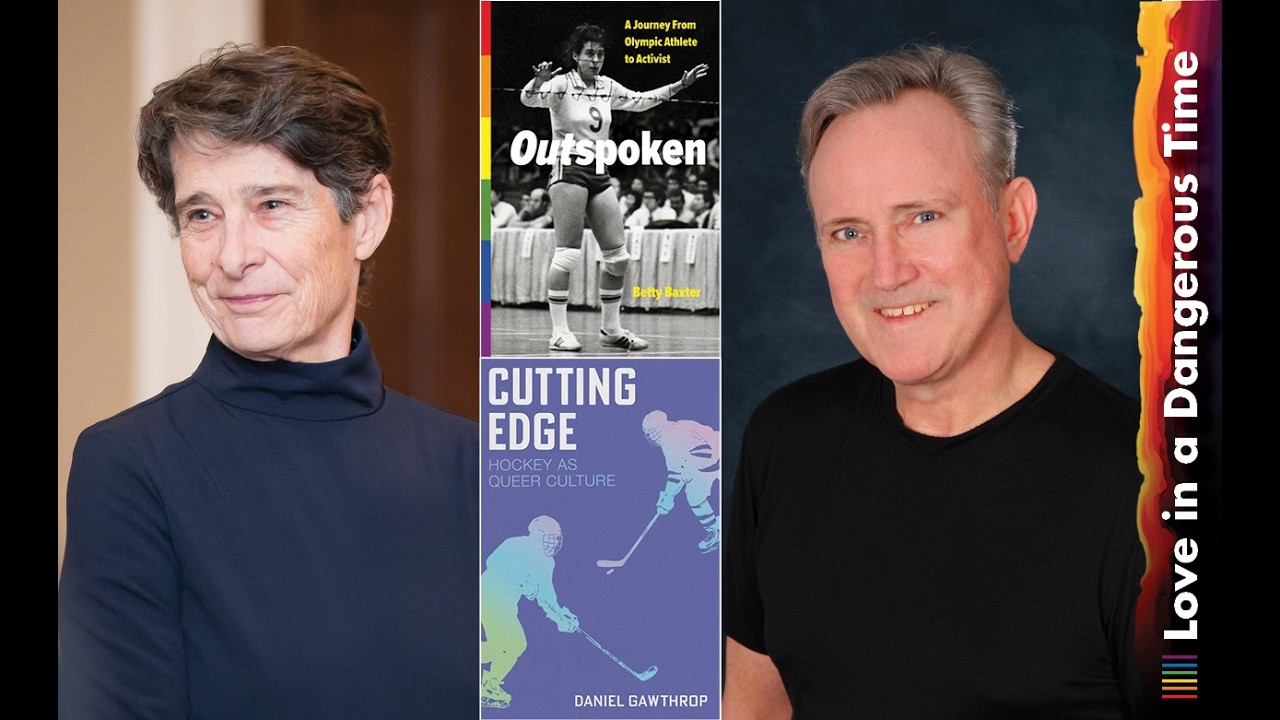
Outspoken: An Afternoon with Betty Baxter and Daniel Gawthrop
Watch on YouTubeVideo summary
The program features Betty Baxter and Daniel Gawthrop reflecting on their personal histories against the backdrop of Canada's LGBT Purge, a decades-long campaign that investigated or dismissed thousands of federal employees and military personnel based on sexual orientation or gender identity. Baxter recounts her journey as captain of the national volleyball team, describing the pervasive fear athletes faced when being "out" could end careers or endanger lives; she shares harrowing anecdotes from 1975 in Cuba regarding an interpreter seeking help for herself and details how rumors about her sexuality led to a vicious gossip campaign that ultimately resulted in her dismissal after coming out on national television in 1984. Gawthrop complements this narrative by exploring toxic masculinity within hockey through his book *Cutting Edge*, illustrating systemic homophobia with stories of male figure skaters ridiculed for choosing individual sports, William Brightell who was bullied and sexually assaulted because he did not play hockey, and referee Russ Neely who hid his homosexuality until quitting officiating in 1985 to pursue the Gay Games.
Despite being fired from UBC and Volleyball Canada due to her refusal to remain closeted, Baxter eventually returned to coaching practices at the University of British Columbia War Memorial Gymnasium in 1985 thanks to the persistence of colleague Kim Harris, overcoming intense personal fear associated with re-entering that space. Gawthrop discusses how he initially formed a team called "The Real Puckers" for Celebration 90 but struggled with roster continuity due to the four-year cycle between games; consequently, in fall 1993, he and reporter Kevin Griffin established a lasting team at UBC's Thunderbird rink named "Cutting Edges," which later formalized as the Vancouver Gay Men's Hockey Club (VGMHC) in 1998 with an aim for political visibility while welcoming allies. The organization has since evolved significantly to include San Punzo, the first openly transgender man to play after joining in the early 2020s, who had previously been barred from adult leagues due to unfounded fears of competitive advantage despite his skill level; following a vote in 2024 to change the club's name and definition to an inclusive LGBTQ+ association along with policy updates like adding a trans flag stick to their logo, Punzo credits these changes for making the team more welcoming.
The discussion also addresses current challenges and hopes for the future of inclusion in Canadian sport amidst shifting political landscapes, particularly following a March commission report that exposed systemic harm within athletics. Gawthrop notes concerns about potential backlash but points to public response to his book as evidence that community accountability can raise moral standards even when federal action remains uncertain; he highlights Luke Provo, an NHL-drafted player who came out post-draft but has not yet played an official game, suggesting the Edmonton Oilers could invite him to training camp as a step toward inclusion without overcommitting. Furthermore, Gawthrop firmly rejects arguments for excluding trans women from women's sports as false and harmful, asserting that such exclusions stigmatize strong or non-conforming individuals across all demographics while noting how successful storytelling in series like *Heated Rivalry* has increased audience interest in inclusive narratives within hockey, particularly among female viewers. Ultimately, both speakers emphasize the importance of acknowledging past wrongs to work toward a more inclusive future where visibility is supported rather than treated as a distraction that hinders careers.
Read the full video transcript
Um so today we are so excited to welcome
Betty Baxter and Daniel Gothra. Uh Betty
was a member of the National Advisory
Council on Fitness and Amateur Sport, a
founder of Canadian Women in Sport and
initiated the National Coaching School
for Women. She spent years as an
educational and human rights consultant.
Daniel Gothre is the author of seven
books, a co-founder of The Cutting
Edges, Vancouver's LGBTQ plus hockey
association, and has written extensively
about hockey for numerous publications.
Today's program is part of Love in a
Dangerous Time, which is a traveling
exhibition from the Canadian Museum for
Human Rights, which was developed in
partnership with the LGBT Purge Fund.
This exhibit is currently on display in
our main hall upstairs, and it'll be
there until September 15th. Um, this
exhibition explores the history of the
LGBT purge, which was a decadesl long
campaign in which thousands of members
of the Canadian Armed Forces, the RCMP,
and the Federal Public Service were
investigated, harassed, and in many
cases dismissed because of their sexual
orientation or gender identity. We
invite you to spend some time with this
exhibition while you're here. You can
also visit at the table an exhibition by
Salt Spring Island artist Janette Sir,
currently on display in our East Gallery
um as well as on the lower level.
Lastly, the co-chair of the LGBT Purge
Fund, Todd Ross, um actually wrote the
forward for Betty's books. I'm just
going to read at her request uh the last
two paragraphs of this wonderful forward
by Todd Ross. When Betty approached the
LGBT Purge Fund and shared her story, we
were pleased to support her through the
LGBT Purge Fund Community Fund, her
story and the connections to the LGBT
Purge hit home. Not only was an
exemplary career cut short, but her
dedication to sport, to call out wrongs,
and to continue in the face of
injustices matched the same courage and
conviction of so many who were wronged.
Betty Baxter was the right person to be
building Canada's national team. Her
powerful narrative will grip you from
beginning to end. And while we can't go
back in time to correct these wrongs,
her story reminds us of the importance
of doing what is right now and for the
future. Welcome, Betty and Daniel. I
want to start every talk that I give in
public acknowledging the LGBT purge
fund. I I'm just going to throw this
out. How many of you had heard of the
LGTB purge today before today when you
walked in the lobby upstairs?
>> So several had heard of it. So you're
90% ahead of most of the groups that
I've been talking to. And that's one of
the things that Daniel and I talked
about is we wanted to focus the readings
from our respective books on the human
rights aspects and some of the wrongs
that we experienced and what how we
coped with those wrongs. Um, I'm in
particular trying to talk at the
beginning of every talk about the purge
fund because I'm conscious that the
reason there was a community fund as
part of the class action settlement is
because people died. The people who did
not live long enough to get
reconciliation or any of the funds from
the class action, their monies went into
a community fund and I received a grant
from that community fund to help promote
my book. So, I feel that responsibility
very heavy that I'm able to come here
and travel to other cities to promote my
book because people didn't live long
enough to hear an apology from the
federal government. So, I want us all to
hold that that it was a time when no one
acknowledged the harm that was done. And
now that it's being acknowledged, I'm
thrilled that here we have one of our
our lovely libraries in British Columbia
putting that exhibit so that the public
can see it. And I spent about 10 minutes
when I first arrived here. It's a very
moving exhibit. I also want to thank
again Todd Ross. Uh I called Todd Ross
at the uh suggestion of my publisher
because we were trying to figure out how
to appropriately acknowledge that the
Purgeman had contributed to the book.
And when he answered and said that he
had been a volunteer coordinator on my
campaign in 1993
and met me when I was running for
federal office because he had just been
declared by the military in a squimalt
that he was disadvantage disadvantagally
unemployable because of homosexuality.
So he was a young man of 21 and I knew I
remembered the name and when I saw his
face I recognized a young man who
stepped up to help me as I was trying to
run for federal office. So these are the
things that happen after 40 or 45 years.
You run into good people still doing
good things. So, with that, I'm going to
start the reading off and Dan and I
agreed that we would have me do some of
the readings that exemplify the human
rights issues and then I'm going to pass
it over to Dan and then we'll come back
again for some of the things that we did
that became a little more celebratory or
positive in nature.
So, my first reading takes place in
Cuba. I am a member of the national
team. The first part of the book is
basically a young athlete coming from
southern Alberta, small town, learns the
ropes, makes the national team, and
we're training in Cuba. And I've been
out to myself and some close friends,
and I will say one or two of whom are in
this room that uh I've been out as gay
for about a year and a half, two years,
and we never spoke about our sexual
orientation on the team. It would
basically have ended our careers. So,
we're in Cuba
and I am rooming with the one of the
only other uh lesbians on the team.
It one afternoon a strange event
unfolded unfolded when the Cuban
interpreter, a woman in her 20s who had
been assigned to our team, came to the
room at the resort that I shared with
Carol. This interpreter had guessed that
we were gay, the only two gay players on
the team at the time, and she asked to
come in and quietly closed the door
behind her. He sat carefully on one of
the cotss and whispered that she needed
to ask us a serious question. We stopped
what we were doing. I sat on the other
cot facing her while Carol stood at the
end of the cot where she had been
folding clothes. We were very curious.
The interpreter spoke English well, but
she was obviously having difficulties
finding the words to use for her
question. Finally, in a quiet voice, she
said she liked women and asked if there
was any way we could help her get out of
Koopa. She believed she had been
discovered and that her job and perhaps
even her life may be threatened. We were
a gasast. We were also instantly fearful
about our own safety. How had she picked
us out? We didn't know how to help her
and we stressed that she should not
approach approach our team leaders as
they wouldn't have any information and
in fact might further endanger her by
taking information to our hosts. My
heart was pounding. Would she out us?
Could we be ejected from the country if
someone learned of this private
conversation? We were out to only a few
of our teammates and none of our
coaching staff. Were she truly in
danger? We were afraid for ourselves and
for her, and after several moments of
stressful conversations, we suggested
she contact the Canadian embassy in
Bana, but we had no other ideas as to
how to help her. As she left, we
stressed again that she should not
contact our coaches. When the door
closed, we were both too alarmed to say
much to each other. But we swallowed our
fear as we prepared to go to training
that afternoon and hopefully lose our
distress in our physical efforts. Now,
for the first time, the fear that our
personal lives could be exposed tainted
our training environment. At that time,
women athletes were often called
lesbians or dikes as a common insult. If
women played softball or even
basketball, the slurs were more
frequent. But volleyball seemed to have
escaped the butch reputation, and we had
felt relatively safe as long as we
stayed closeted. If you were strong,
people believed you couldn't really be a
woman. And many female athletes went out
of their way with feminine dress,
jewelry, and manners precisely so they
wouldn't be suspect. I already knew
students who had been rejected by their
families because they were gay or knew
of coaches who purged their teens of any
loan known lesbians, claiming they were
harmful to team harmony.
Canada was thought to be a safe country,
but the federal government had been
actively purging gays and lesbians from
the civil service since the late 1950s,
and the military had followed suit as
homosexuals were considered a security
risk. It had only been a few years since
homosexual had been decriminalized, and
it would be many more years until
Michelle Douglas's groundbreaking
military case was settled in December of
1992.
Our conversation was 1975, so we're in
the late mid70s. and Canada began the
process of adding protection based on
sexual orientation to the country's
human rights legislation. Back in 1974,
gay block bashing was common on Canadian
streets, and we knew that being
discovered at a gay bar could ruin our
athletic careers, especially as gay bars
were routinely raided by the police. In
Cuba, we didn't know what kind of
punishment discovery would lead to. We
never raised the subject with our
teammates and other athletes didn't even
joke about it because it was too raw and
too risky an insult for any of us.
straight or gay. As a result, there was
no one we could safely speak to about
our encounter that afternoon. We saw
that young woman briefly in the gym that
evening and then didn't see her again in
our remaining days in Cuba. Had someone
seen her exiting our room? We had no way
to even ask about her. She seemed to
have been reassigned.
The next piece is quite a bit later
and in the middle what happens is I
finish a successful career as an Olympic
captain. I become an apprentice coach
and then I am named as the coach of
Canada's national team which was I was
young for the job and I had been groomed
specifically for the job. So this is
what happens the fall after my first
international tour. There's a few
adventures around the international
tour, but I'm going to read you as I
pinpoint from that first summer. So now
we're now in 1981.
In the fall of 1981, after the world
university ad in Romania and three long
weeks of traveling, the athletes
returned to their home cities to enroll
in their various university programs.
We'd planned to meet again for a
Christmas training camp in Toronto. As
head coach, I had sent them fitness
training programs and spent some
administrative time in the volleyball
association's office in Ottawa. My tasks
were to write up the competition
reports, prepare my travel schedule, to
scout some of our opponents, and to
determine the logistics for the winter
and spring training camps. No one
questioned me about our summer travel,
and I had no opportunity to find out how
we had ended up on a train in Romania
without appropriate travel documents.
That's a reference to the future, the
previous chapter. This silence was odd,
but then on one of the first trips back
to the office in late September, a
colleague and former member of the men's
national team, who I'd known for years,
asked me to step into his office. He
closed the door quickly behind him, and
as he sat down, I stopped in front of
his desk, raised my eyebrows. What's up?
gesture. He drowned his fingers on the
desk for a moment, then looked up and
said, I want you to know some of my best
friends are gay, and it's not an issue
to me, but I'm giving you a heads up. He
paused, searching for the words.
"There's a lot of talk about you being a
lesbian. Too much talk." "Why are you
telling me this?" I asked with some
trepidation. Though I'd known him a long
time, we were never more than
acquaintances, but he was good friends
with the technical director, who had
been my master coach the previous year,
and who had seemed oddly absent since my
return. In my 12 years of being
affiliated with the volleyball
association, no staff member, coach, or
official had ever raised the topic of my
sexual orientation. This was my first
encounter with the administrative staff
since returning from Europe. I wondered
where the executive director and other
office staff were. I didn't believe this
encounter was merely by chance and asked
myself, was the office empty today by
design? Was his task to see my reaction?
But he seemed calm, almost disengaged.
"I don't know," he said. "I thought you
should know." "They might ask you
awkward questions at November's board
meeting." Uncertain whether his comments
were based on friendship or even
goodwill. I left the office troubled,
but as I walked away, I also remembered
the strange encounter when the executive
director had come to the training
gymnasium in early July is where he
asked me pointedly why I was taking a
gay athlete on the team. After that
short discussion with my colleague, I
wondered whether a gossip campaign had
been initiated while I was away. I
prepared for a trip to Mexico to observe
an international volleyball tournament
in October where I would scout young
athletes. I re resigned myself to
dealing with the organizations concerned
at the November board meeting. But in
the meantime, I did confront an Ottawa
University coach who worked and traveled
with the national team when I was a
player. I happened upon him on the
street outside the University of Ottawa
gym a few days before I left for Mexico.
After a brief but friendly greeting, I
asked, "Have you heard rumors this past
summer about my sexual orientation being
a problem for the national team?" He
shuffled in place, backed up a bit, then
looked at his hands before stuffing both
in his jeans pockets. "Yeah, there's
been a lot of talk. None of it official
though." He paused before continuing.
They've made some good points. I looked
at him closely, surprised that he was so
forthcoming, but now I was curious. Such
as. He shifted his weight again, clearly
more uncomfortable, and answered
quietly, "Well, what parent would send
their daughter to a program if they knew
the coach was a lesbian?" I held my
temper in check when I answered, "You
and I both know there has been
inappropriate behavior by coaches in
these programs, but I have not been one
of them, and you also know that." I
walked away considering the double
standard that was now apparent in fuming
about how many times the CDA had put
aside complaints about male coaches
inappropriate behavior towards young
female athletes. But I was also worried.
I'm going to stop there and then I'll
pick up after Dan has a few moments to
tell you about hobby.
>> Okay. Thanks be. Well, first of all, um,
welcome everybody here and, um, I have
to say it's, uh, it's quite an honor to
be sharing, you know, a platform here
with an Olympic athlete since, uh, I
come to my book not from any sort of
level of achievement as Betty has, but
rather as a u, as I call it, a perpetual
intermediate recreational beer.
Um, [laughter]
it's a it's [clears throat] interesting.
Betty, this is first today is the first
time in 33 years that Betty and I have
seen each other. Um I was covering her
campaign uh for um uh MP for uh
Vancouver Center, an election won by
Betty Fry, who's held the seat ever
since. And uh Betty and I, the story of
Betty and being fired, um there's some
commonality here because I was fired
too. Um but I was fired by Extra West um
after endorsing Betty on the front page
of Extra West without informing my my
bosses in Toronto. [laughter]
[gasps] But uh I was also fired because
I didn't do a good job as publisher, but
that's another story. Um anyway, um I
really I really was also uh moved to be
invited for this particular discussion
because um in terms of the purge, the
story that I have to tell doesn't have
anything comparable around people being
fired from hockey for being gay. And
part of the reason for that is that it
would have been impossible because there
is nobody who would ever have been
identified as gay in hockey. And so that
itself is part of the paradox and what
I'm talking about. So [gasps] what I
bring instead to um to to this
discussion is is a look at um and with
through the book was a look at how um
orthodox masculinity came to uh u has
evolved in terms of its its hold over
the game and how it's perceived. Um
before I get into my two quick readings
just wanted to um give people an idea uh
about what the book's about. my
publisher at Arsenal Press, Brian Lamb,
asked me uh to contribute to what he
called a publishers's letter that he
sends to people to get them to endorse
the book. So, the short piece that I
said was that back in 1994 when
Vancouver's cutting edges were born, and
that's the um the gay men's team at the
time that I helped that I started, um
the idea of gay men playing hockey and
competing against straight men who were
fully aware of our identity was indeed
cutting edge. Hockey, like many other
team sports, was a homophobic game that
had long tormented us, forcing many to
abandon it at puberty. So, why did we
come back then? What was it about a
sport long known for its on ice violence
and off ice toxicity that attracted
queer focus fans and players? And how
could we reclaim the sport from our
traumatic memories of it by embracing
our true authentic selves? These are
questions I've explored ever since. What
was missing from hockeyy's historical
record was what I like to call a
forensic audit of its orthodox
masculinity, the triumphalist machismo
that still dominates it.
And so
with Cutting Edge, I set out to examine
how traditional ideas about sexuality
and gender have determined how hockey is
played, who ought to play it, and who
it's for, and how might queer culture
point the way toward a more enlightened
game. So, for my two readings, I've
chosen um a couple of examples where
this maxi this masculinity and toxic
masculinity um it's the heaviest part of
the book. There's a chapter midway
through that's the heaviest part. It is
ultimately a story of triumph, but two
examples where that masculinity had an
impact on gay gay boys and young men.
And so I'll begin with this one.
Among gay men who have been alienated
from hockey all their lives, no one has
had it worse than the figure skater. If
there was such a thing as a purple heart
for adult survivors of my favorite
sport, some form of official recognition
of the courage it took to resist
hockeyy's hegemonic hold over the
experience of Canadian boyhood. The most
deserving recipients would be the men
who as boys had the courage to choose
figure skating over hockey.
Targeted for homophobic abuse regardless
of their sexuality, these men made
themselves vulnerable as boys just by
being who they were and wanted to be and
by expressing themselves artistically on
the ice. Ridiculed by other boys, the
male figure skater was subjected to
abusive bigotry for no other reason than
the stupid idea that figure skating is
just for girls.
Hockey players in particular resented
the male figure skater for choosing the
silent inner world of a low masculinity
individual sport, more of a creative
pursuit really, over the compulsory
camaraderie of a high masculinity team
sport. As if the queer male figure
skater effeminy, his visible gayness was
not enough of a threat to their own
sense of manhood, hockey players could
not fathom how another guy could prefer
a sport that emphasized aesthetics over
aggressive physical contact.
and they were jealous of those homos for
being better skaters than they were.
One of the most revealing personal
accounts of this experience is that of
William Brightell, a sports sociologist
and former competitive figure skater
whose story I drew uh from his uh essay,
What do you mean you don't play hockey?
You a queer or something? Reflections on
life as a non- hockey playing Canadian
boy published in Overcoming the neutral
zone trap hockeyy's agents of change a
University of Alberta press publication
from uh 2021
was that rarest of creatures in the
small Ontario town where he was born and
raised. A non-disabled white male who
not only never played hockey in his
youth but also never attended a single
hockey game at any level. nor as an
adult had you watched an entire NHL game
on television. Not even Olympic hockey
games when Canada was playing the US. On
the final day of the 2010 Winter Games,
when most Canadians were glued to their
screens watching their men's hockey team
win gold, Bridell was teaching a yoga
class in Kingston.
Sydney Crosby in overtime. Yawn.
Whatever.
Ryell came by his anti-hockey snobbery,
his purposeful indifference to the sport
honestly. From early childhood until his
peak years in competitive figure
skating, he was taunted, bullied,
harassed, and even sexually assaulted by
Canadian boys and young men who played
hockey.
His story should be familiar to any male
figure skater who fails to comprehend
the appeal of a sport that has done
nothing but oppress them all their
skating lives. As Bradell recalled, his
problems began at age five when he got
his first pair of figure skates, a
handme-down from his uh sorry, from his
sister. They were white.
Boys at the local rink waiting to play
hockey after his skating sessions teased
him about those skates. The problem, it
seems, is that white skates are for
girls. Everyone knows that, he wrote. By
age 11, Brideel had, in his quote,
endured six years of being called queer,
on a more or less daily
basis. I'm frequently shoved around,
punched, and on occasion kicked. This
mostly happens during recess at school,
but the boys who bully me are hockey
players, so it's pretty much guaranteed
that if they miss me at school, they'll
find me at the rink.
And on it went throughout adolescence
and into young adulthood. At one point,
Bredell was invited to a sleepover under
false pretenses by a hockey player he
was attracted to, only to become the
victim of a degrading group sexual
assault by that player and his
teammates.
And the second story is about hockey
directly.
>> [clears throat]
>> So to give a bit of context, the next
section I'm going to read uh takes place
during the gay games in 1990 in
Vancouver, which I co-organized that
that event. And I earlier in the
chapter, I talk about how difficult it
was to recruit gay men to my team that I
was trying to have. There was already a
women's team already registered for the
games, but I wanted to have a men's
team. And it turned out I ended up
having to recruit a lot of women because
there were too many and couldn't get on
the women's team. Anyway, this is how
this section starts. [gasps and sighs]
I recall nothing of the pre-ournament
scrimmages, but I do recall my alarm at
the closetedness of some of my male
teammates, their discomfort the closer
we got to opening ceremonies about the
prospect of media covering an event for
which they'd signed up of their own free
will.
It was here I learned one of my first
sobering political lessons about gay
liberation. Despite our shared desire to
be free, we all have different levels of
anxiety and ways of coping as gay men,
especially when it comes to the
pressures and expectations of orthodox
masculinity in mainstream culture. For
me, the matter was simple. After a long
hibernation, I had come out at last, not
screaming my sexuality from the
rooftops, but no longer hiding it
either.
My politics were typical of an earnest
human rights activist with all the
militants one might expect of a lapsed
Roman Catholic recently unshackled from
his Vatican chains. Brother Mark
uh I was getting on with life by living
without compromise more than happy to be
witnessed in the gay millu. Zealously
prescriptive I wanted everyone to
achieve and celebrate the same hard one
liberation I had. My assumption was that
all participants regarded the gay games
the same way as a public expression of
celebration, a shared rejoicing in the
simple fact of being ourselves. I
thought we all felt or sought to feel
the same way, fearlessly confident and
happy to be seen by our friends and
families who of course were allies in
embracing the moment of our own
becoming.
But such a perspective was far too
idealistic.
Damn. Where am I here? Oh yeah. As a
couple, as I'm going to talk about one
of these teammates, there were two, but
I'm going to talk about one. As this
teammate in particular would
demonstrate, true liberation is never as
simple as one declarative statement or
single event. This player was forced by
his own experience of hockey bigotry to
adopt a personal survival strategy of
quiet discretion.
He was the best player on our team, a
gifted skater with a fusive, sorry,
fusive. Sorry, my eyes here. I might
need readers, too. with offensive talent
who had once been a referee in the
Western Hockey League WHL.
For years, Russ Neely had moved up in
the game as a ref, advancing in every
level of on ice official until reaching
the pinnacle of major junior hockey.
Neie had every reason to believe that
those green lights would keep going for
him all the way to the NHL, where he
would become part of the world's top
refereeing fraternity. His WHL
colleagues told him as much. However,
the walls were closing in. His gur
ambition was colliding with his desire
to be true to himself. He had grown up
in the heart of the Fraser Valley Bible
belt in a town where evangelical
homophobes typically spewed their
bigotry at any sign of unorthodox male
behavior. And so from elementary school
onward, he had put on a survival mask of
pseudorness.
This mass would serve him well in
hockey, especially in the black and
white world of the zebra striped ref,
where poker faced inscrutability, was a
necessary component for projecting
impartiality.
The pressures of being a ref in the WHO,
a significant feeding source for the NHL
draft, are heavy for anyone, regardless
of sexuality. The fan abuse to which all
refs are still subjected today, abuse
that includes homophobic taunts and
epithets, has long been seen as part of
the game. Straight presenting and
masculine, Neely had a good cover. He
doubted that anyone in the hockey world
suspected his secret. During his first
season of roughing in the W, both teams
in a division final asked him to
officiate.
But by the time his second season began
in 198485,
Neie already hiding his homosexuality
from fellow on ice officials, players,
team staff, and rink personnel, was
finding the pressure unbearable. Every
night he could hear the mobs of drunken
fans screaming at him from the stands.
"Whenever I heard shouts of you,
ref, I wondered if my mask might be
slipping," he told me recently, breaking
a public silence of four decades. I may
have had the courage to referee for
league finals where games drew as many
as 15,000 fans, but not to do it as an
openly gay man. Even if I did possess
such courage, I knew that opportunity
would not exist if I were true to
myself. So, I decided it's either hockey
or it's me. And to borrow the title of
Derek Sanderson's book, I decided I've
got to be me.
By January 1985, Neie called up in
January, sorry, in January 85, Neie
called up the WHL's executive director
and supervisor officials of officials
and told him he was quitting.
He was met with shock. After all the
training and sacrifice, you now decide
to quit when you're this close. The only
explanation he gave was that he wanted
to pursue a different path. 5 years
later, here he was, signed up for the
gay games where he could enjoy hockey as
a player without putting himself in the
crosshairs of unwanted attention. At the
time, I hoped he would share his story
with any media covering the games,
failing to appreciate how rot this
traumatic experience still must have
been for him. Now, he was coming out at
his own pace by participating in a more
positive sort of blending in the
solidarity of shared experience through
gay sports. After the hell he'd been
through as a ref, there would be good
karma for Russ Neely. A few years later,
he became one of the few guys in my
little hockey world who met their future
husbands by playing on the same team.
>> So, you can see the theme that we're
trying to do is show you that certainly
our encountering with discrimination was
not individual,
but was actually endemic and and
symptomatic of the time. So Dan left us
in the early '9s. Uh I'm going to take
us back to 1994 or 1984 rather.
By this point in the book, I I think
there must be some rule there. You're
not supposed to read at the back so that
people will have to read the book, but I
seem to want to, you know, tell you some
hits from the back of the book. At this
point of the book, I was fired shortly
after my encounter with staff and that
November board meeting and I was fired
with no notice. So it it was a traumatic
life shattering experience that suddenly
after 18 months my job was gone. So I
came back to Vancouver and I talk a
little bit about uh some touching
moments with my family as I decided
exactly as Dan has explained. You have
the choice between being who they tell
you is unacceptable or being yourself
and you have to make the choice to be
yourself. So, I am now in San Francisco
at the very inaugural gay games in 1982.
I have a new lover that I've met in
Vancouver. I am determined that I will
be an out and proud lesbian. And in some
of circles that was a bit obnoxious. In
fact, I will share it's not in the book.
I kind of made a point in those years
that I would say the word lesbian in
public until people stopped gasping
[laughter] when I said this. And so I
wasn't really welcome company in lots of
places because I decided like you're
going to do this. So this is now uh at
the gate games and people are trying to
encourage me to play volleyball but I'm
very aware that the sport and organized
sport is a place of pain for me. The gay
games encouraged the representation of
individual cities, not countries, as
required by most international sport
competitions. As a result, 55 gay and
lesbian participants had come from
Vancouver, including a men's volleyball
team. I hadn't even known there was a
gay volleyball league in the West End,
although I stayed away from watching any
volleyball, as my feelings about that
sport were still too raw. another other
than the soccer game featuring Anita's
team, which was my new partner. I didn't
watch any other sports as I felt a vague
hostility toward organized sport and had
yet had yet determined hadn't yet
determined if the gay sport environment
would be a safe one for me. But hanging
out in the Castro area of San Francisco,
watching the antics as women and men
from cities across North America
celebrated on the streets was both
eyeopening and healing because everyone
was out and proud and so clearly having
a good time. Watching men holding hands
and dancing or women hugging and kissing
on the street was something I'd never
seen before. Six months earlier, I had
been fired for being gay. And here I was
amid thousands of people o openly
celebrating the same identity that my
former employers felt was too toxic for
sport in Canada. In Ottawa and
Vancouver, the gay bars had been in
secret locations, often in dark alleys
behind unmarked doorways. And when you
rang a buzzer, a small slot opened to
reveal an unrecognizable face behind a
grate. That person, the person behind
that face, checked to determine if you
were someone who belonged there or if
you might be someone who had brought the
police.
I had always been intrigued by this
secrecy and recognized that it was a
very private and sometimes dangerous
social life, but I had never felt
ashamed of who I was. Being fired made
me wonder about the ethics of a sport
system. But even though I felt off
balance, I knew my sexual orientation
was not a problem, but rather a gift.
Here in San Francisco, gay life was
celebrated each day when the bars and
clubs opened their doors to the streets,
the sunlight glancing off glistening
tables and countertops. Patrons called
out to each other across the street all
day long, and many emerged into the
sidewalks from every venue during the
evening hours for spontaneous street
dances. In the Castro area, I met gay
men from Vancouver, and they were
already talking about coming back to Gay
Games 2 in four years and bringing a
much larger contingent. They urged me to
put together a volleyball team to return
with them. It was tempting, but I
worried that stepping back onto the
court in any sport would mean more pain
for me. As I sat with the soccer team in
an open air bar, watching a continuous
party in the street, I thought about the
great fun they'd had on the field, even
when they lost. I imagined how different
life would be if we could be open about
who we were all the time. These games
with their focus on inclusion and a
celebration of joyful physical activity
seemed much closer to what I valued
about sport than the competitive elite
system run traditionally by older men
who rarely considered the athletes needs
never mentioned inclusion and were
content to change or ignore the rules if
it benefited their friends. That was the
system that had so unceremoniously
thrown me out a few months earlier. At
the time, I didn't know that some of
Vancouver's gay men had met earlier in
the week with Tom Wedell, a decathlete
who had represented the USA at the 1968
Olympics. Tom had founded these gay
games, and the Vancouver contingent was
so impressed after meeting with him,
they committed to starting an
organization at home that would actively
organize sport and celebratory events
for the city's gays and lesbians. Nor
did I know that in Mexico in 1968, Tom
had witnessed Tommy Smith and John
Carlos raise their black fist, black
gloved fists at the medal ceremonies as
a symbol of black athletes stand against
racism.
He had come back from those Olympics
inspired to create a healthy space to
challenge attitudes about the gay
community. That had been the same
historic moment that I had heard about
from my brother, a moment that had
caused me as a teenager to think about
the Olympic movement. That week in San
Francisco, I wondered not just about
improving opportunities for women in
sport, but also about justice in sport
as a system. When I learned that Tom
Modell had wanted to call this event the
Gay Olympic Games, but the International
Olympic Committee had initiated a
lawsuit to prohibit the gay organizers
from using the O word, or even the five
ring symbol. The cynic in me nodded in
understanding. I knew the IOC prided
itself on representing only the elite
and felt entitled and obligated to make
such exclusionary decisions. The San
Francisco committee had fought the legal
battle for months and eventually dropped
the word Olympics but continued to use
three intersecting rings in the gay
games logo. It seemed typical of
international sport that the powerful
IOC would see a volunteer-run
organization, a volunteer-run
celebration as impinging on their
territory, especially if the Olympic
symbol was to be used by a community
that was already marginalized,
encouraged to stay invisible and
stereotyped as unhealthy.
I loved my experience in San Francisco,
but I was not ready to physically
participate in sport. In my core, I
needed to feel strong again and feared
embracing any kind of sport because of
the emotional turmoil. But staying away
but staying away from participating in
sport helped me find a community of
women who were interested in change and
I had a new circle of feminist friends.
I was learning about the horrific
discriminatory treatment leveled at the
gay community. I may have lost my job,
but at least I felt safe on the street.
Every major city has stories of gay men
brutally beaten and regular police raids
on anti on any local gathering place. I
met women whose families had disowned
them after learning of their sexual
orientation. Others who had lost custody
of their children and who could never
return to their hometowns. I became more
and more committed to being an
outspoken, visible lesbian working for
change. I didn't set foot in a gymnasium
for 3 years.
My healing from the experience of being
fired was progressing and I remained
invested in the women in sport
organization that I helped fun when I
was fired and determined that I could
make a difference as an activist. When
the athletic director from UBC, my
former coach, called me in the spring of
1984 and urged me to submit an
application for the coaching position of
the university's women's volleyball
team. I was hopeful that it would be an
opportunity to renew my passion and
explore athlete- centered coaching
again. So I submitted an application.
However, between the application and the
deadline deadline in the interviews for
the position, I was invited to appear on
a CBC television panel to discuss women
in sport. The 1984 Olympic Games were
proceeding without the Eastern Block of
Countries, and as a result, there was a
sudden interest in the politics of
sport. The first question put to me was,
"Have you ever experienced
discrimination as a woman of sport?"
I replied that I had been fired from the
position of national coach for
volleyball Canada because I was a
lesbian. Due to my commitment to be out
and proud, I'd come out on prime time
national television. I don't believe.
The CBC, however, had some trouble with
my statement, and supposedly in fear of
slander, they had my words dubbed over
by the host, Valerie Pral. UBC athletics
must have had some trouble as well for
even though they had asked me to apply
and I was one of the most qualified
coaches in the country at the time, I
was never asked for an interview. I was
crushed. These were people who knew me
well. They knew especially my skills and
abilities in coaching. I had applied
because I trusted the athletic director
who requested that I do so because I saw
the UBC coaching position as a way to
regain the respect and status to make a
difference in a sport I loved and had
lost access to. There was only one
reason possible for my exclusion. They
would not hire a lesbian who would not
remain in the closet.
An interesting aside, and I hate to
start rumors 40 years later, I was told
by a UBC staff member that the hockey
coach at the time who was a very very
well-known man said that I would be
hired over his dead body that he made
that public statement. So, we continue,
but then kind of some nice stuff
happened. So, I was devastated by that
that occurrence. But about six months
later, then in 1985, Kim Harris, a gay
man who had attended the Gay Games in '
82 and had been a club volleyball player
that I had met while in graduate school,
contacted me to ask would I help with a
practice of the UBC women's team, the
very team I applied for the year
previous.
I applied for the coaching job just over
a year earlier. Kim was a large athletic
man with red hair and a big smile and
was now assistant to the university's
second new female coach in two seasons.
However, she was very ill and would be
away for weeks. I said no initial
initially, not daring to be heard again.
But Kim was incredibly persistent, and
after much discussion, I agreed to come
and conduct a practice. I didn't think
he clear I don't think he cleared his
request with anyone in the athletics
office at UBC, and they may not have
even known I was there. I had played
happily in War Memorial Gymnasium at UBC
throughout my varsity career, but now I
found myself terrified to enter the gym.
I knew it wasn't rational, but my
dismissal from sport and a lack of
employment considerations by the
operators of the same building was huge
in my mind. I began to sweat with fear
at the thought of even going on campus.
I went alone to the gym the evening
before the practice, and although the
place was almost empty, my heart was
pounding. I stood at the entrance and
looked at the volleyball court with my
face heated and my pulse racing. To move
toward the court would take all the
courage I had. It was as if I was to
face a firing squad. Would someone
discover me here and throw me out?
Organized competitive sport had become a
zone of emotional terror for me? I
stayed at the door trembling until the
lone basketball player shooting hoops
had collected his gear and left by the
door at the other end. The gym was now
empty and silent. I took two steps into
it and stood beside the playing court
through several long moments of cold
sweat and heart palpitations.
Eventually, my heart slowed and I
listened to my slobes,
deep breaths, turned a small circle,
looked at the empty bleachers where I
had trained so hard. Finally, I decided
I could walk into the gym the next day
and be a coach again. I've got one more
small section, but I want to tell you a
very personal issue. I'm doing a reading
in exactly 11 days at the University of
Ottawa in the room beside the gym
>> where I coached and was fired from.
>> And I read that piece today because I'm
going to have to call the dean at the
University of Ottawa and say, "Can
someone come to my hotel and babysit me
for about 45 minutes because I need to
stand in that building until I can
actually go and speak to people about my
book." So, even as I read that, the
reason I pause to tell you that A,
you're a super friendly group, but B,
it's been 44 years since I've been in
Ottawa and and 40ome years since that
moment at UBC,
but I had a heart response as I was
reading that to you. So when someone
takes away who you are,
it's not like a bandage that get that
gets fixed. So it's an important part of
my book that I start these
conversations, but also that I'm able to
go back to Ottawa in 11 days and say, I
want to talk to you about some of the
mess that's Canadian sport and see if we
can't make it better. So, it's like I
don't know, maybe old activists never
die, but the opportunity to let people
know that that harm isn't a one-time
thing. I will read you now kind of a
nice a nice thing and then I'll pass it
[snorts] back to Dash.
So, of course, because Kim wouldn't let
me not be a resource in volleyball, I
got involved and I got a team with one
that woman back there and we went back
to You can put your hand up here.
[laughter]
We went back to San Francisco and won
the gold medal at the gay games and
suddenly I'm helping organize for the
the games to come to Vancouver. And now
I'm on the board and we're going to meet
with the press because there's been some
opposition. homosexuals coming to
Vancouver.
In July 1990, a few weeks before the
opening of Celebration 90 Gay Games and
Cultural Festival, our board of
volunteers, of which I was now the
official spokesperson, was invited to
meet with the editorial board of the
Vancouver Sun and its sister newspaper,
The Province, in the imposing boardroom
of their corporate offices. We entered
the room with some some sense of
intimidation, but we were keen to
promote the games to these key media
people. Five of us sat in a semicircle
at one end of a large table while the
two editorial teams took seats down each
side. They had questions that they were
coming they said were coming from their
readers. The editor of the Vancouver Sun
posed the first question. How can you
expect the city to be welcoming to
people coming to attend an event for one
special interest group? My my board
colleagues from Metropolitan Vancouver
Arts and Athletics Association looked to
me to respond as I had done far more
media events than most of them in my
years in sport. I was well prepared with
this question. That's exactly why we're
here to talk to you. I said, "The public
and the press seem to believe this is an
exclusive event, but the basic principle
of the gay games is the complete
opposite of what you assume. The gay
games are more inclusive than any sport
or cultural event ever held in this
city. They are open to participation by
anyone to join and celebrate anyone. We
don't ask for identification, a sexual
orientation, or even gender on the entry
form. There are no minimal standards for
entry. As with most sporting events, if
you want to play and you're willing to
stand with thousands of members of the
LGTV community, you can play.
Even if you are members of the press,
you're welcome to send in a registration
form and participate. This is the
antithesis of a special interest group.
We will welcome any volunteers. We'll
also welcome any volunteers who want to
help us support those participants. He
leaned forward in his chair. But how do
you know you won't have protests or
violence? We knew we know there is
opposition to these games. He was
referring to the full page advertisement
in his newspaper that had run weeks
earlier.
Sorry, I just lost my place. Paid for by
the pastor of a church in the Fraser
Valley. That advertisement had asked the
public to pray to God for intervention
and in boldface proclaimed, "Keep the
homosexuals out of Vancouver."
"We acknowledge that there are members
of the public who don't like the ideas
of these games." I said, "But the 29
sports we are offering all have male and
female co-chairs who have created
disciplined volunteer teams for every
venue to ensure these competitions run
smoothly. We'll have trained volunteer
security at every venue to provide
athletes and cultural participants with
the safety and support they need. In
fact, since the ad opposing the event
ran in your newspaper, we've had a flood
of new volunteers call our office. It
seems Vancouver is ready to show the
world that we're an welcoming city after
all. The session with the editorial
boards went well. The following week,
both daily newspapers ran positive
editorial commentary encouraging the
public to support the celebration, a
change from the tepid opposition in
their editorial few weeks earlier.
>> Over to you, sir.
>> Okay. Well, I just hearing that now,
Betty, it's funny because I really I was
struggling for what exactly to read
today because there are so many passages
that are we and I I have a lot on the
gay games in this book as well. Uh but
you know we're limited for time. But
I'll just say the one thing that you
know around the same period. Um when
when I first found out about the games
while I was living in the valley working
in a small town newspaper, I would pick
up the Christian fundamentalist
newspapers for amusement to read the
headlines because they were all so
alarmist. And so the main one about the
gay games that we all remember was
sodomite invasion planned for 1990.
And so when I moved to Vancouver, a
group of cheeky writers who I got to
know in a little writer group
appropriated that headline for the title
of our own journal called the sodomite
invasion review. Anyway, that's not
[laughter]
that's in there as a footnote.
>> We met at the gay games him coordinating
hockey and be on the board.
>> Yes. Um okay, I'm just going to get to
my sections here so I don't get lost.
All right. Um,
okay. Yeah, that's right. Okay.
So, um,
this part, this my my last kind of
section of reading is going to be on and
what are we what are we at, by the way,
time?
>> I didn't even look at the time.
>> I've got it here. It's
>> Oh, it's almost Okay. Yeah. So, I'm
calling this kind of what's in a name
because uh it's about how the cutting
edge is started uh briefly and got our
name and then I'm I'm kind of cutting to
a later part of the book to show how um
every organization has to evolve and
it's not like some linear thing. Okay,
we created this great thing and now
we're never going to change it. Um we
had to change and so I'll explain that
[clears throat]
during the week of celebration 90 Kame 3
and cultural festival. While playing in
the hockey tournament I helped to
organize, I had a chance encounter with
an acquaintance that would lead to
events that finally produced the safe
game hockey environment I'd been
seeking. I had just finished a game at
Britannia rink with the real Puckers.
One of the host city's two teams at the
games when I heard someone call out my
name from the bleachers as I left the
ice. Smiling and waving at me from the
stands was Vancouver Sun reporter Kevin
Griffin. I had met Griffin during my
brief stint at the Sun the previous
year. We'd worked on one story together,
but never gotten to know each other
personally. I'd heard it through the
city's lavender grapevine that he was
one of a handful of gay men in the
paper. In those days, one had to be
discreet about sexuality in a big city
newsroom. The sun was managed by rugged
bricks and other aging white men, their
faces flushed with the whiskey of their
liquid lunches as they ogled the young
female staffers.
I hadn't seen Griffin since early
January when I was last in the newsroom.
Now, here he was, notepad and pen in
hand, covering the games in his capacity
as a son's multiculturalism reporter. A
fact we both found highly amusing. "Dan,
this is great," he enthused. "I had no
idea they had hockey. I wish I could
have played." "Well, maybe I can next
time," I replied. A throwaway line,
really, since I had no confidence there
would ever be a next time. Over the
three years that followed, Griffin and I
became good friends, but other than
joining a few drop-in sessions here and
there, we didn't do much on the hockey
front. In the wake of Celebration 90,
there was no urgency to build a new
hockey team. The struggle to build a
roster that first time was still fresh
in my mind. But during the fall of 1993,
when Gay Games four organizers in New
York City ramped up their call out for
registrations, Griffin and I got serious
and put our heads together. The real
puckers no longer existed, but a few of
the players were still around. One of
them, a lesbian realtor, offered to host
a meeting at her apartment west of
Denman. Griffin and I, along with one
other player, attended the meeting with
her. She wanted to play in New York at
the games and was willing to help put
together a roster. I shared my
frustration that there had been no
momentum from Celebration 98. No
realistic way to keep the real Puckers
together to continue playing on a
regular basis. I didn't want to have to
start over from scratch every four
years, assembling a team for the Gay
Games, only to disband it when the event
was over. Griffin agreed that we should
try to build a team that would last. At
the same time, we discussed the
importance of the team name to its
identity. Real Puckers was a bad pun.
Cute for the moment, but as random and
temporary as the roster I'd assembled in
1990. A few straight friends and
relatives had suggested Gay Blades, a
tired 60s slang reference I knew was bad
because, well, straight people had
thought of it. [laughter]
In my case, the team from a team from
Southern California had already taken
Blades for their name, so we weren't
going to be copycats. Meanwhile, there
was a question of where to play after
the New York games were over. Given the
challenge just to assemble a team for
the same event every four years, the
notion of an allgay league in a city
like Vancouver did not seem realistic.
Even if we did stay together after Unity
94, as the games were called in New
York, it was pretty clear we would have
to compete in a regular beer league
against mainstream i.e. straight teams.
What were the options apart from the
wreck leagues run out of municipal
rinks? Griffin told us there was a deer
league at the Thunderbird rink on the
Point Gray campus of the University of
British Columbia, UBC.
This was recreational, non-cont, adult
safe hockey for all skill levels.
Perhaps playing on the grounds of an
educational institution would be a safer
route for a gay team than a regular beer
league run by the municipalities,
offered Griffin. But if we wanted to
sign up for this league in time for the
next season, we'd have to investigate
the idea as soon as possible. If UBC
turned up to be a good fit, we could be
signed up and ready to go for our first
season right on the heels of Gay Games
4. Wow, guys, exclaimed the lesbian
realtor. That would be amazing getting
into the UBC league as a gay team. I
mean, that would really be cutting edge.
Those last two words jumped out at me.
That's it. I said, we have our name
right there. The name cutting edges
would telegraph our hypnosis, our
relevance as groundbreaking gay hockey
players competing outside our safety
zone of the gay ghetto. It was a good
hockey name, too, incorporating the idea
of the damage that skateblade edges can
do. In a team name, such a double
onandra implied a menacing opponent.
Griffin endorsed it, and so did the
realtor and the other player present.
Now, cut to the early 2020s.
From the very beginning, we were known
as quote Vancouver Vancouver's gay men's
hockey club. A mission statement
formalized in 1998 when we registered as
a nonprofit society. We saw this
specific identity as politically
important because gay men were the most
stigmatized players of the world's most
high masculinity and homophobic sport.
But we also hope that others who were
curious about the cutting edges,
straight allies, women, bipok people,
would understand that it wasn't just a
gay men's hockey club, nor only a white
one. That they would feel confident
enough to approach us if they wanted to
play with us, that they knew they would
be welcome if they were in solidarity
with us and had enough game to keep up
in a wreck league. And many did join us.
We had at least one straight ally, a
lesbian, and an indigenous man on our
eight person roster in New York at the
gay games before our first season at
UBC. Over the years, we've had a handful
of cis women along with several bipok
men, both queer and straight, and some
straight allies. But when I think back
over our long history before the last,
say, five or six years, I can't recall
an openly transgender player on any of
our rosters. and club by definition is
exclusive. So as a queer organization,
how cutting edge were we now?
The first openly transgender man to play
with the cutting edges, and who still
does, was a small and speedy forward
named San Punzo, aged 31, when we sat
down at eight ranks for an interview
just before our respective edges teams
hit the ice to compete against each
other. Punzo told me he'd been playing
hockey since he was 8 years old. Growing
up in Maple Ridge, a small community
nestled on the Fraser River about an
hour's drive east of Vancouver. He
played on girls teams until he graduated
from high school. "I never played rep
hockey," he said. "I was always like a
bubble player. I just couldn't quite
make that top team, and there wasn't
really a very large girls hockey program
in Maple Ridge. If I was in a bigger
city with more teams, I would probably
have been able to play in tier 2 and
maybe move up a little bit. But
basically, it was you were either rep or
your house. those were the only options
and that was kind of when I started to
look into my gender identity. Ununzo
said he always knew he wasn't really a
girl. He had distinct memories of being
four and 5 years old and telling his
parents he was a boy. This was around
2000 when there were when there was
growing awareness of transgender issues
and his parents were supportive. They
bought him boys clothing and put him in
different sports. While his inner sister
while his sister danced, he played
hockey. After high school graduation,
Punzo played juvenile for one year and
then when he turned 19, switched to the
women's adult league. I hadn't started
transitioning yet and I played adult
women's hockey for a year. I found
people I connected with, found a team,
and that was about when I decided to
start to transition. He told me, "Once I
started taking hormones, the league
wouldn't let me playing. Once I changed
my driver's license and my birth
certificate, when I changed my gender
marker on them, they were very adamant
that I wasn't allowed to play.
He never got an explanation, but
suspects the league was worried about
backlash from other teams that they'd
complain it was unfair because Punzo
would have would have a competitive
advantage, which was ridiculous, he
recalled, because they also had women
who played college level hockey on
scholarships
who were way better than I would ever
be. And that was also supposed to not be
allowed. If you were on a college team,
you were supposed to not be allowed to
play rack hockey. That was in the rules.
But they wouldn't let me play. And then
it kind of got to a point where I didn't
really feel comfortable playing even
though I was on a team that was
accepting and encouraging me to stay. It
no longer felt like a comfortable place
for me to stay. And so I actually just
stopped playing completely.
It was 8 years before Punzo played
hockey again.
He heard there was hockey in Vancouver
for queer folk, but wasn't entirely sure
he'd be welcome because the cutting
edges were a self-described gay men's
hockey club. Other LGBTQ plus hockey
organizations referred to themselves as
gay hockey associations without adding
the word men and we were a club. So
that's raised questions for Puno. I
wasn't sure if I'd be able to play
there, but then I thought if I'm going
to be able to play anywhere, it would be
on that team. That's where I would feel
the most comfortable potentially and I
would probably have the most chance of
being accepted on that team. But I
wasn't going to drive to UBC from Maple
Ridge. Then just before the 22 23
season, Punzo learned that the edges
were moving to the eight ranks hockey
palace in Burnaby due to changing
demographics within the club. That
sealed the deal for him. I told Punzo
that I remembered when he first joined
the club and we played together on team
green. He was pretty quiet in those
early days, a good communicator on the
bench and on the ice, but not very
demonstrative in the dressing room where
he would change quickly after the game
and leave right away without showering.
But ever since the cutting edges voted
in 2024 to change our definition from
gay men's hockey club to the more
inclusive LGBTQ plus hockey association,
then adjusted our logo to include a
hockey stick taped in the colors of the
trans flag beside the rainbow tape
stick. He had become much more engaged
with the cutting edges and more willing
to share his opinions within the
association.
He had voted for the change. I told him
that I'd noticed more trans players,
mostly trans men, but also a couple of
trans women and one or two non-binary
players joining us since the change. He
said it made a big difference in how
welcome trans players feel with the
edges.
I think when you don't institutionalize
who the organization is for and you
don't have language on it, it's left to
interpretation and it kind of creates a
bit of ambiguity. He explained, "Gay
men's hockey, even though the intention
behind it was to be inclusive, does send
a message that's not inclusive. In order
to clarify, someone would have to reach
out or know somebody to be like, "Oh,
no. Everyone's welcome." Well, you'd
have to know that. So, yeah, I think the
wording change was huge and times
change. this description now 30 years
from now might not work too right but
that's why we continue to evolve and
grow and as a postcript to this little
story at our AGM this year San Penzo
became the first trans person on our
executive acclaimed as vice president
>> so we have the time to do some questions
I know that uh there was a question
collection if people want to write down
a question. Um, who was the men's hockey
coach?
>> No, that was for you. I think you left
out.
>> Oh. Oh. Who was the men's hockey coach?
>> Yes.
>> He's passed away.
>> Yeah, I'm allowed to.
>> Are there any lawyers in the room?
[laughter]
>> His name was Bob Hind
>> and he was very well regarded and and I
actually know I have many friends on the
Sunshine Coast who know his son well who
I have no women, you know, peace with.
But uh just the fact that a highprofile
a high-profile hockey coach like that
would just say you know right
>> keep the dikes off our staff.
>> But you that's the times right from the
80s and 90s that was a fair.
>> Sure.
>> Go ahead then. You got a question?
>> No this is that was it. That wasn't that
was it I'll see.
>> Try that one.
>> Okay. All right. That was one there. So
we'll just put the other ones there.
Okay.
>> Oh yeah. Considering what's happening to
gay rights in the US now, do you think
there could be a backlash uh in in
Canada? Um
well, that's interesting because um
>> I mean either one of us could answer
this. I mean I I think I almost feel
like I need to know a little more about
the question because in a way
I guess yeah if if we can see similar
things. I mean, one thing that I was
puzzled about, and I haven't seen
anything since, just just to go to
hockey, is that, uh, last year, um,
Trump, President Trump, uh, appointed
Gary Bman, the NHL commissioner, league
commissioner, and, um, Wayne Gretzky,
famous Trump supporter, and, uh, um,
Matthew Kachchuck, captain of the
Florida Panthers, who were then the the
the Cup champions at that time, to his
uh, sports council.
uh about and and the role that they were
to play in terms of uh the culture of
sport um was questionable and and we
still don't know what they're doing but
um backlash I don't know I mean we know
that things uh around you know mega type
things we have our own we're not in
Canada when we know what's going on in
Alberta and other places and I mean
betting anything
>> I'm going to add a question that I'm
going to pass that one to you folks
offer um I get asked this question all
the time because my book has probably
six or seven themes that are about the
sport system, about coaching abuse,
about funding inequities, about the the
lack of I'm going to say it as straight
as I can in that it's about the silence
in sport. There's a culture in sport
where people will know or wonder about
abuse, a coach abusing an athlete
regardless of gender or sexual
orientation and they will not speak and
that if you speak up about abuse, you're
somehow betraying the sport system. And
I am keen to talk about that and
encourage people to talk about that. We
won't stop harm unless we are willing to
name what the harm is and where it's
coming from. So having said that in many
talks that I've been doing these last
few months for the book people ask me am
I hopeful and am I hopeful about
removing discrimination in sport? Not at
all. Am I hopeful about fixing fixing
the sport system? Not at all. The
commission that reported the end of
March that actually named the harm and
quoted over a thousand sport
participants talking about how sport
hurt them.
It it's the first commission of the half
dozen or so that really tells the true
story. Since then, the government, the
federal government has put about 80
million towards athlete support and
supposedly there may be a new Brown
Corporation that's recommended to take
on sport. But if there's no action
within 6 months of the report, there
will not be any action. So, I am not
hopeful. What I am hopeful about is the
response to my book. I mean, in I'm 44
years late writing this book, but people
want to hear this story. So, I am
hopeful that people like you in your
communities and teachers I've talked to
and parents I've talked to will point
out coaches that are too harsh or
violent with athletes and say that
doesn't happen in my community. We will
raise the standard, the moral standard
of sport. And forgive me because it's
really easy for me to get on a soap box
about this, but it it won't happen
because the federal government passes a
new policy or rejigs a system that has
rewarded people who manipulate the
system for so long. And it won't happen
if every sport organization has a safe
sport person who has to report to the
same CEO that has come up through a
system of basically old old uh you know
what is the word nepotism. So, we have
to be cynical, but we have to be hopeful
and we have to keep naming it.
>> I I do want to read one paragraph
because someone wrote a nice question
that I have the exact answer to in my
book. So, sorry.
>> No, that time
>> your question was, "Thank you for
sharing. When you came out to your
family, how did they react? I was an
athlete very aware of suppressing who I
was." Well, as I said, when I was fired
in Ottawa, it felt like my legs were cut
off and I was thrown out in a matter of
10 minutes. I didn't get to say goodbye
to the athletes or talk to anybody.
There was media silence when I was
fired. So, I went across Canada and
stopped at every place I had a family
member and came out to them.
The most poignant of these conversations
took place in Brooks, Alberta, at the
kitchen table after dinner with my
parents. My dad, who was never one for
discussions of feelings, didn't go to
the living room as was his habit, but
instead stood up from the table and went
to the sink and began washing the
dishes, something I had never in my life
seen him do. He wanted to stay in the
room. As I was carefully telling my
mother how my close relationships had
been with women, awkwardly trying not to
use the word gay or lesbian, she reached
across the table, took my hand, and
said, "I've sought for a long time that
you are a lesbian." My relief was huge.
My life as an out public and political
activist began that moment in my
mother's kitchen with her act of
unequivocal love and acceptance.
So that's how and it took there was
there were issues. It took many
conversations with many family members
but in general it was informed by love
and I am so grateful that I grew up in a
family that put love first. I want to
give you a little postcript.
In the summer of 2024, nine years after
my mother's death, I had the privilege
of reading her journal regarding the
struggles she faced in 1982. I was fired
in January 17th, 1982. I came out to my
mother first week of May as I was
driving across the country. She was 62
years old, had just been diagnosed with
type 2 diabetes. My dad was in pain with
arth arthritis in his spine. My two
youngest siblings, both in their 20s,
had moved home that summer to prepare to
attend postsecary institutions in the
fall. My younger sister was dating a
young man who had left the local
Hutterite colony, and by September, she
was uncertain about continuing the
relationship. I was surprised to read
that through those summer months, my
mother had often shed tears when
discounting my declaration that I was
quote different to my aunt, her close
sister, and my own two sisters. But when
summarizing her years, she wrote at the
bottom, "Three things I have to
understand. Back pain, arthritis,
diabetes, and homosexuality." Now, if my
youngest will just spare me to study at
the Hutterites.
>> So, I think that answers the question in
the only way that I can.
>> Okay. I I'm actually sorry, passed on
the soccer question because I really
want to answer this one. Any thoughts
about the first male out player in the
NHL, Luke Pro with the Edmonton Oilers?
Okay. Well, this is an interesting
construction of the question because uh
in fact, for those of you who don't
know, uh Luke Pro is not the first out
player in the NHL. He's the first player
who came out of the closet after being
drafted by an NHL team. He has not
played an NHL game. He has not been
activated into an NHL roster. So he's
still kind of like in
coming out purgatory, let's say, or
Catholicize his situation.
>> Is that the same thing that happened to
Michael Sam, the pro football player who
was drafted as an openly game man and
then never played?
>> Yeah, I think so. But um yes, plenty of
thoughts on Luke and he's actually
there's a section about him in the book
and I I I referenced him as well. The
appendix to cutting edge includes an
actual communications plan for NHL
players to come out of the closet. It's
a serious plan based on my 20 years as a
professional communications, you know,
rep. And um and the NHL will probably
ridicule it because of course, you know,
I haven't worked with them and don't
know them and I'm not part of their
thing. But I mention Luke in it because
in a way he's already achieved a lot. Uh
it's unfortunate because the irony of
what he's doing like since he came out,
this was uh he was drafted in 2020, he
came out in 2021 and he's played four
seasons since in the minor leagues. He
looked like he was going to be out of it
completely because he was in the ECHL, I
think it was called, which is one below
the American Hockey League. Then his
contract with Nashville ended and then
he started playing with Bakersfield who
are a they're a they're a farm team of
the Oilers and he's from Edmonton. So,
I've already in an op-ed that nobody has
taken yet, I've already suggested that
the the Oilers at the very least,
without making it a um uh you know, just
a publicity stunt could based on his
progress, if he's making progress, cuz
he's a defenseman and he's a big
bruising defenseman and he he sells
himself as a player in a in an article
that I quote from including that he
might want to get into a couple of
fights, which is interesting for the
first out player, But the Oilers could
say, "Invite him to training camp,
right? It's not like they're committing
to anything. Just invite him to training
camp. See if he can get into a couple
exhibition games." Like, I mean, what's
wrong with that? They're not uh they're
not, you know, like I say,
overcommitting. Or give him a 10ame try
out and then boom, he's the first player
in the NHL. Um, I do advise him, unlike
everyone else who hasn't been in the
media yet, to just keep it really keep
it really brief what he says about this
because everyone already knows. But
here's the irony. One of the reasons
that nobody comes out is that uh, every
NHL player knows that if you come out,
you instantly become a distraction. And
that's the word that Bman uses. That's a
word that all the league governors use.
you become a distraction because you're
a story and you're drawing attention to
yourself. It's no different than if you
say came out about some condition you
had or you were you needed to use a
player assistance program for drugs or
something. You're drawing attention. So,
ironically,
um
>> four more questions.
>> Yes. Okay, I'll finish this one up.
Ironically, um in a way, he's now done a
documentary. It's called The Hockey
Player. I haven't seen it yet. I think
it's on uh I don't know if it's on
Disney or on um uh one of the other
platforms, but anyway, the irony is that
he has he wants to be known for what he
does on the ice. Yes, he wants to help
uh queer players everywhere, but he
really still does. He's only 24. He
still could make it and he'd like to,
but he has become this has become his
story. So,
>> I'm gonna get down the two on heated
rivalry just because [laughter]
and I'm gonna apologize to whoever the
person wrote about soccer. I know
nothing about the gay soccer leagues in
Vancouver. Dan passed it to me. Um, I
think it's great if there's gay soccer
leagues. That's awesome. I don't know
anything about the context or how they
were set or the history. So, not having
and also in many ways I'm a bit of a
fraud to talk about sport because I've
been very out of organized sport for
decades. So I follow the politics of it
and I've gone in researching my book I
went online and looked at the measures
that they've taken to make sports safer
and more um objective which are small
but there are some. Okay. So that that's
a comment.
I'm going to take the political one
about municipal uh what municipal
governments can do. But first were you
actually told why you were being fired?
This is a common question that comes to
me. The first chapter of my book is the
confrontation where I was asked to go to
a roadside motel and confront the three
men who fired me. So that those two
pages answer that question. On the
actual firing day, which was four months
later, no, I was asked to come into a
room. I a legal paper from a lawyer was
read to me that terminated me with no
cause and I had 10 minutes to gather my
possessions and leave. So that's how
they do it. And
>> so with no cause?
>> Yeah. So you and it had to be no cause
and that's a very interesting question
for those of you that might feel that
there's you know you know people who
were compromised my lawyer I did the
part that I stopped reading I didn't
talk about how I talked to a lawyer
after the first challenge to find out
what were my rights and what might I
expect in in the 1980s and 90s until 96
there was no protection federally zero
so people could fire you even if they
did name it but the lawyer told me if
they were firing you for sexual
orientation they would have to prove
that they could prove it. So that meant
anybody who had associated with me or
who I had dated or who had seen been
seen with me say at a club would have
been compromised. So [clears throat] for
me to even say it out loud means that
they would be able to go and try to
prove or not prove it. And that's why in
my book the other question that's often
asked is why didn't you name names?
Well, in part the men who fired me in
volleyball are revered and wellknown and
everybody knows who they are. or you can
look up the date and the title and know
who they are, but they've had their
airtime. And the reason I don't name the
bad guys in the book is that this book
could have been written about any sport.
It those three men who fired me could
have been any three men in any one of 88
sport governing bodies in Canada because
they had the power. They did it because
they could. So that's an important piece
to know the legal piece. I was fired for
no cause because that was easy under the
law.
Me telling the story, that's why it's a
personal memoir. Lots of folks in
volleyball have very different, very
positive memories. They might have quite
different stories, but everything in
this book happened to me. I'm pretty
much an authority what happened in East.
Now, let me answer if I can. What can we
at the community and municipal level to
help promoting tolerance and equity in
sport? Well, first of all, Dan's given a
great example. We can be explicit in our
language of inclusion.
I'll I'll use the Ottawa example again.
The dean in the Ottawa University that
where I'm speaking in 10 days, was very
gracious in describing me and describing
the event and my athletic achievements,
but she never mentioned LGTQ, whether
you want to use the multiple letters or
a short version. She never mentioned it
once. So, when she asked for feedback on
the description of her announcement, I
went back and said, "You need to put in
the words
You need to if if you can't without
going to the board of governors or
whatever you need to do in Ottawa in my
bio put that I have been an activist for
the LGBTQ plus community because if you
don't people will assume that the
exclusion is on purpose. So those of you
that are you know in mainstream
organizations or part of municipal
governance we have to be explicit. It's
I'm still that person that wants to
stand up and say lesbian get over it.
Lesbian get over it. So
that's where we are and the more we
disguise discrimination by neutral
language, the more we enable the silence
about harm. And I think that's
critically important. And municipal and
local governments and local
organizations are the ones who talk to
families every single day. And those
families, the more they know it's okay.
It's okay to have a trans friend. It's
okay if your, you know, friend from
childhood is dating a woman. It's okay.
Like the Harrison Brown, who Dan I think
is has got a blur from knows well. He's
a trans He was a trans player that was a
women's pro hockey player is now a trans
man. It's an advocate. He's written a
book called Let Us Play. That's the
simple answer. And I I'll get on my soap
box for one more minute. Don't let
anybody tell you that keeping trans
women out of women's sport protects
women. I could use very colorful
language about that. What that means is
that anybody that doesn't look like a
woman or act like a woman or whatever
the stereotype of a woman is should be
suspect in sport. Those of us that have
been in sport for 30, 40, 50 years,
we're suspect as soon as we're strong.
And as soon as we get any good, we have
to play against men because we're better
than all the women. So saying that we're
keeping trans women out of sport to
protect women is the huge false
insulting statement.
>> I won't say more, right? I
>> I was going to riff off you anyway, but
because of what you were saying about
language, I wanted to add something just
to the last bit of reading I did about
the whole change within the edges. And
it was that, you know, a lot of people
of course uh who weren't aware of of us
or how we were just hearing this would
think, oh that's just a lot of wokeness.
You're just, you know, was being woke
this and that criticism. Some of the
older guard players from our first
generation of the edges when I met them
recently privately, they they had heard
about this. They're no longer with the
the organization, but they said, "Can't
we be gay anymore?" And you know that
reaction was interesting to me because I
said well of course we can but you know
this I said this is better and you know
one one indication of it for me was that
when when we changed that and all these
other people came to join our
organization and play with us. Well
first the rest of us could see the
players who had already been there could
see that the moment the trans players
were included and they knew they were
actually okay and good to go. We could
see them thrive and we could see how
they really brought game. And suddenly I
found myself after some of my games
saying turning to my manager and saying,
"Hey Trevor, um can you bring so and so
back again?" Damn, she's a good passer.
Jesus. And um it just it's it's given
our organization uh we feel way stronger
now as a whole organization and um
there's a lot more laughter I have to
say. So inclusivity is fun. Now
questions. Uh heater rivalry rivalry you
go on that one.
>> How do you see the huge success of
heater rivalry uh impacting the quest
for more inclusivity in sports?
And Daniel do you wish you'd written
heated robbery? Okay. Well, [laughter]
>> well first of all no because I don't
write romance. So full stop. I I should
answer first before that on the next
question that um some people to anyone
who thinks that I'm that I wrote this
book somehow in a flash in response to
heated rivalry as an opportunistic
thing. Well, no actually um I did write
the book quickly, but I turned in my
manuscript um 3 days after heated
rivalry premiered on Crave. So, it was
already written, but when I passed it
in, my publisher said to me, "Well,
that's great, Dan. you got it in a month
early before you go back to Thailand
because I spend the first part of the
year overseas. But you might want to
hold off and wait a bit to see how this
heater rivalry thing plays out. So I did
have to do a little bit more work. But
no, I don't wish I wrote it and because
I wouldn't want to be I wouldn't want to
be Rachel Reed right now because she's
really really busy.
Um but uh I do think actually I do think
it'll be very big in in creating more
inclusivity in sports. I mean just the
fact that you've got um I mean
interestingly women [clears throat] more
than gay men. Women are the largest
audience both for the books and for the
series
>> and for hockey I think now it's grown
women
>> by by far in the PWHL. And there's a
chapter on the PWHL by the way in in Cut
Cutting Edge. Um but uh part of it is
that you know you've got this depiction
of men being with each other who are not
only having sex but of course they're
actually vulnerable with each other.
They're attentive to each other. They're
caring about each other in ways that we
don't often see in mainstream culture.
And I think that is changing how people
think about hockey. I mean, uh, my
chapter on on heated rivalry, uh, begins
with a sort of fantasy of my own. I'm
I'm doing a little bit I'm doing two
pages, okay, two pages of heated rivalry
style writing. I've got a press
conference. The chapter begins with a
press conference of an NHL player uh,
preparing to go to the podium to make
his announce his big announcement. And
he's asked what prompted him to uh, to
do this. and he says, "Oh, it's that
scene from episode five where uh where
Scott Hunter invites his his his lover
down onto the ice and kisses him in
front of the whole world." Um
>> so yeah, I think it will I think it will
um make a difference. I think it already
is making a difference.