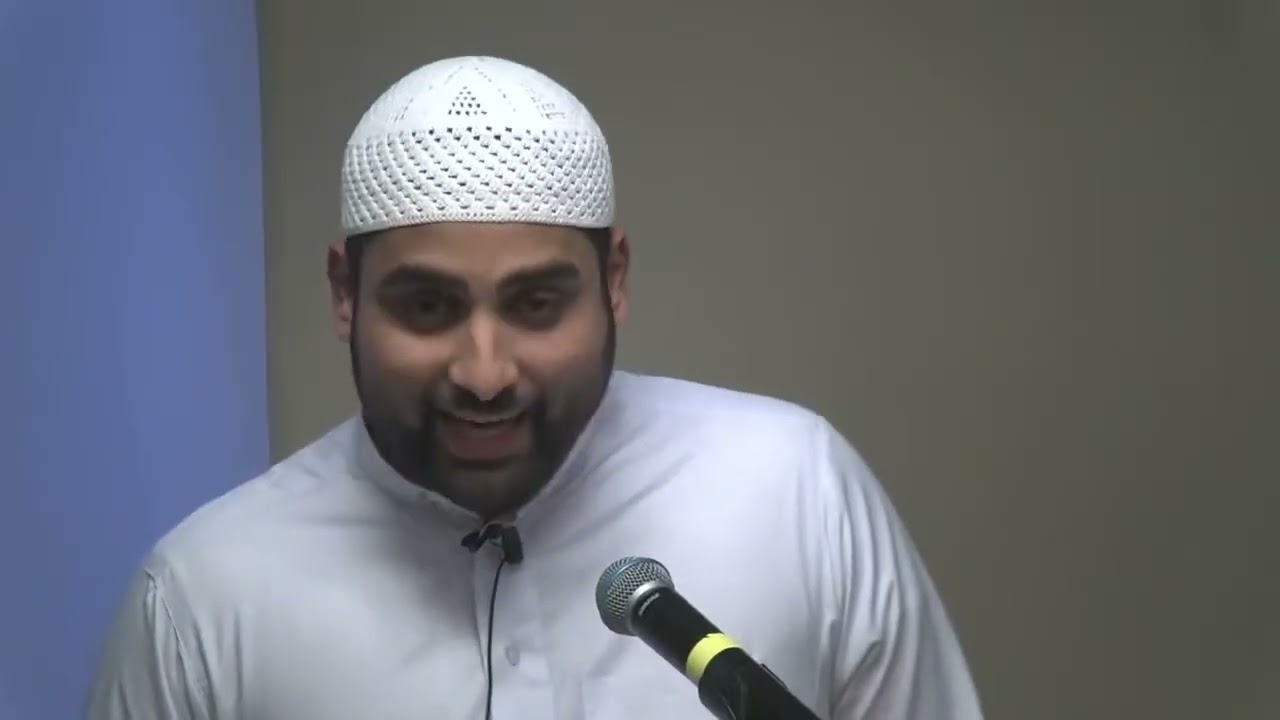
Our Mercy to All & Particularly the Young is the Foundation of Faith | Sidi Hashim Mir
Watch on YouTubeVideo summary
The speaker begins by reflecting on the intense emotional difficulty of sleep-training his four-month-old baby, an experience that pushed him to the brink of tears and led him to question how much effort parents should endure for worldly success versus spiritual protection. He draws a powerful parallel between the temporary pain of disciplining a child in this life and the eternal punishment of Hellfire, citing the Quranic command to protect oneself and one's family from the fire. This reflection sets the stage for his central argument: while it is natural to be strict with children regarding rules like starting prayers at age seven, there must be a profound balance between discipline and mercy. The speaker emphasizes that if we expect Allah's mercy in the Hereafter, we must actively demonstrate that same mercy to our children and others around us, rather than relying solely on fear or rigid regulation.
To illustrate this balance, the speaker recounts numerous examples from the life of Prophet Muhammad (peace be upon him) where he displayed immense patience, love, and gentleness toward children, even when they made mistakes or caused distress. Whether playing with a child who forgot an errand, shortening his prayer to comfort a crying baby, or cleaning a child's urine without anger, the Prophet consistently chose kindness over frustration. The speaker highlights that these actions were not merely about following rules but about embodying a deep-seated love for the faith and its Messenger. This approach transformed young companions like Malik and Zayd ibn Harithah, who gave up their wealth, status, and even biological families to remain in the Prophet's household because they loved him more than anything else. These stories serve as proof that strict adherence to religious duties does not preclude showing profound compassion and nurturing a child's heart.
The speaker further explores the spiritual significance of raising children with faith by contrasting the arrogance of those who reject religion with the humility of believing children who pray for their parents' well-being. He references a Quranic scene where desperate parents beg Allah to guide their wayward children, illustrating that having children who accept and carry forward the faith is an immense, unearned blessing that should be cherished above all else. He warns that many communities are currently facing decline as their institutions empty out, urging Muslims to recognize their unique responsibility to ensure the next generation remains steadfast in their belief. The ultimate goal of parenting, he argues, is not just to teach children what is halal and haram, but to inspire them to excel in their deen and become ambassadors of the faith who love Allah and His Messenger deeply.
In conclusion, the speaker calls upon all parents and elders to strive to be role models of mercy, forgiveness, and kindness, mirroring the character of the Prophet to transform the youth around them. He prays that Allah protects children from disbelief and grants every family righteous progeny who will continue the legacy of faith long after their parents have passed away. By combining clear boundaries with unconditional love and by frequently making sincere duas for our children, we can raise a generation that embodies the true spirit of Islam. The speaker ends with heartfelt supplications asking Allah to make our children the coolness of our eyes and to ensure that our legacy lives on through them until the end of time, urging us to be grateful for this gift and to act accordingly in our daily lives.
Read the full video transcript
Praise is due to Allah. We thank him. We
seek his help and we ask his
forgiveness.
We seek refuge in Allah from the evil
within ourselves and the evil resulting
from our deeds. Whoever Allah guides,
none can misguide. And whoever Allah
allows to go astray, none can guide.
And we bear witness on this blessed
Friday that there is no god worthy of
worship except Allah alone.
and that Muhammad peace and blessings
upon him is his last and final
messenger.
Dear brothers and sisters,
this past week I was doing something
that I had never done in before
actually, which was trying to sleep
train my four-month-old.
And for those of you who don't know,
sleep training is basically where you
try to teach your baby how to fall
asleep on their own. And the way you do
that is sounds a little bit cruel.
You take your baby, you put them in the
crib in a separate room, and then you
close the door and you wait for them to
try to fall asleep. And if they start
crying, you can't really interrupt or
soothe them. You have to wait for 10
minutes before you can go in. So you let
you have to listen to your baby crying
for 10 minutes before you go in. And and
the point here is to try to get them in
those 10 minutes to learn how to self
soo. So my wife and I did that for a
period of about an hour.
And after that, she just about had it.
She was in tears and she's like, "Look,
I can't do this anymore. We're not doing
it." So, as I was thinking about this,
as I and I was as I was as I was
preparing for the futa,
I was reflecting about how
this hour of pain that we had to
withstand for our for our child was so
intolerable as parents.
And as parents, we really want to do
anything to protect our children from
any kind of harm.
>> And if we think about it, of all the
things that we do to ensure that they're
successful in this world, how does that
compare to the effort that we put in
for a punishment that's far more severe
and everlasting, which is the fire of
hell?
Allahh says in the Quran,
Oh you who believe, protect
yourself and your families from the
fire.
What are we doing to protect our
children from the fire of hell and make
them successful in the life of the
hereafter? And that's my topic for today
inshallah.
And when we think about this ayah, of
course, it's very serious and we want to
approach it with kind of the seriousness
that it deserves. And so a natural
inclination is, okay, this is a very
serious punishment. So I'm going to be
very strict and I'm going to say, you
know, very regimented with my children.
And there's no doubt that there is a
time and a place to be strict and
regimented with our children. For
example, in a Hassan hadith, the prophet
sallallahu alaihi wasallam taught us
that we
command our children to start praying at
the age of seven. And if they don't, if
if by the age of 10 they're still not
praying, we're actually taught to
discipline them. So there's no doubt
that there's a time and a place to be
strict with the rules. But if we study
the s specifically the aspect of the s
where the prophet sallallahu alaihi
wasallam interacted with children
the overwhelming theme that you notice
is one of hope and mercy and kindness
and gentleness towards children. Even
when they do things that would enrage us
and to teach them a lesson we would you
know teach them a lesson. We would we
would show them to control themselves
next for next time. Even in these
instances, the prophet sallallahu alaihi
wasallam showed immense patience and
mercy.
And I wanted to share just a few
examples of how the prophet sallallahu
alaihi wasallam interacted with kids
and hopefully we can learn about how we
can be merciful inshallah. So one hadith
we find in the of im Muslim is that
Malik who used to be as we know in the
service of the prophet wasallam from a
very young age. One day the prophet
sallallah wasallam told him to run an
errand and so he goes out of his house
and he sees some children playing and so
he starts playing with them and he
forgets about what the prophet wasallam
told him to do and he spends hours and
hours and finally the prophet sallallahu
alaihi wasallam comes out he finds an
And what's his response? You'd expect
him to be furious because he needed
something to get done and this child
just forgot about it. Instead, he
approached Annis with a big smile and he
started laughing with him and playing.
He saw that he was playing and he said,
"Yeah, Unice." He didn't call him Anis.
He called him Unice out of a tumor of
endearment. He called him by his a
loving name, a loving nickname that he
gave little Annis. He said, "Yeah, Unave
have you done what I asked you to do?"
And he recognizes his mistake and he
said, "Oh, I'm going to go do it right
now."
In this moment where he could have shown
anger and frustration, the prophet
wasallam not only controlled it and
suppressed his anger, but he actually
showed love and kindness even when he
did something. Anis
did something that disappointed the
prophetam and rightfully so.
Another hadith we find is
one time the prophet wasallam was
playing with
who's his grandson and he went and
kissed him
and then a man comes by and he sees this
and he says I have 10 children I've
never kissed any of them
and the prophet wasallam's response to
this is whoever is not merciful to
others he will not be shown the mercy
from Allah subhana wa ta'ala.
Dear brothers, if we expect the mercy,
dear brothers and sisters, if we expect
the mercy of Allah subhana wa ta'ala, do
we show the same mercy to our children
and and for that matter for everyone
else around us?
And another hadith and a lot of us will
maybe resonate with this because we've
all been toaw, you know, when we get
ready, we're in the zone and we're like,
I'm going to have an amazing night of.
And so the hadith the prophet or the
prophet wasallam once he started a salah
and he had the intention of prolonging
it but once he started praying he
realized that there was a baby crying in
the back. And so his response to that
was to immediately shorten it because he
was so concerned about the mother and
how much distress she must be feeling at
her her crying child.
Now take that back to when that example
when we come and we're ready to pray for
a long night and then a child starts
crying. What is our natural reaction to
that?
Is it h here's the kid again like I I'm
so frustrated by this or is it I'll bear
this test with patience and I will
remember how merciful my prophet was and
I will follow that example and be
rewarded doubly for that.
One time the prophet wasallam took a
child in his lap and this child started
urinating in it on him. And so the
prophet wasallam rather than getting
angry or immediately reacting he waited
and then he put he moved the child and
he sprinkled some water on it and
cleaned it. And this is one of the
reasons that we learn that the
you know the pee of a newborn is
actually you can just wipe it away with
water. It's not something that you know
you have to go shower and stuff.
These are count there's countless
examples of the mercy that Allah the
that prophet sallallaihi wasallam exuded
and we would expect that you know one of
the most strict things that we do is the
salah.
>> Literally anything that you do during
the salah it could invalidate it. You
talk it's invalidated. You laugh it's
invalidated. you have to be you can't
move around too much. All of these
things, right? And it's, you know, sort
of designed to be very focused and
little room for anything else except for
the worship of Allahh.
And even in this most strict act of
worship, the prophet sallallahu alaihi
wasallam taught us there was this child
and you know there was no one taking
care of her. So he would actually pick
her up while he was praying when he was
standing in the and then when he would
go for s he would put her down and then
he'd pick her up again. And that's
another way that we learned that we can
have this mercy even when we're praying
in this most kind of strict act of
worship. We can have this mercy towards
children.
And we find time and time again the
prophet wasallam had this kindness and
mercy and that's really what transformed
the character of the youth around him.
And if you think about the success of
Islam, it is because of
the amazing accomplishments of kids that
were sometimes 13, 14, 15 years old.
And these people the one superpower they
had was that they were in the influence
of the prophet of Allah sallallahu
alaihi wasallam.
They were not only taught that Islam is
a religion of dos and don'ts and that's
it. You follow these rules and that's
what how you live your life. But they
actually started to embody this
deepseated love for the prophet and this
deep-seated love for the religion.
And they were so
close to the religion through this
that they wanted to do not just the the
bare minimum, but they really wanted to
excel in their dean. And so our goal as
parents and as elders to youth should
not just be to teach them haram and
halal.
It should be to want them to like really
do more than that. Really be the
ambassadors
of the faith. Now I don't have enough
time to go into all of the examples, but
I would encourage us all to read about
some of these Sahabah and refresh our
memory. You know,
Maliku.
All of these people spent their youth
with the prophet of the prophet of Allah
sallallahu alaihi wasallam and they were
so moved by his character and to the
point where they loved him more than
anything in the world truly even more
than their own parents.
I'll share one story before I move on,
but I would encourage you all to just
read up on these. So, for example,
we we all know his story. He came from a
very affluent family
and he was known for his, you know,
scented perfumes and his rich fabrics
and his clothing and all of this stuff.
And just after interacting with the
prophet sallallahu alaihi wasallam, he
was so moved by his honest and true
character, his sincere character that it
inspired this love, this love that
really conquered his entire heart. And
nothing of his previous life, of all of
the wealth that he had was enough to
sway him back. His mother tried his
mother tried very very hard to get him
to renounce Islam
and she she even imprisoned him in his
own house but still he would refuse
because the character of the ofam
was so precious to him that it just
transformed his character.
Another example is
he was kidnapped and enslaved when he
was visiting uh when he was traveling
with his mother and you know through a
series of exchanges he eventually ended
up under
and
she gave him to the prophet sallallahu
alaihi wasallam and the prophet his
immediate response once Once he got zade
was to free him and he freed all the
slaves and he said look you you're free
to do whatever you want but in the
little time that he got to know the
prophetam
can you imagine he had years and years
where he was taken away from his family
and he was a slave and when he get when
he gets his freedom what's his immediate
response is I want to stay with the
prophet
I don't really care about going back to
my parents his parents his dad after
years and years of searching even found
him and he goes to the prophet
sallallahu alaihi wasallam and he says
look I love my son and if we finally
found him I'm willing to give you any
money you free him and the prophet
wasallam said look let's call zed and
let's find out what he really wants if
he wants to go with you I'm not even
going to take a didham from you and when
zed is brought in front of his father
and he's told look you're you're free
and you're able to go back to your
parents he said no I want to live with
the prophet of Allah because I love him
so much. Can you imagine like what
living in the household of the prophet
wasallam could have been like for him to
want to not even go back to his own
parents? And they tried. They begged and
pleaded and he still said, "No, I know
that my mother is distressed by this,
but I love my love for the prophet
sallallahu alaihi wasallam is greater
than anything that you could offer me."
Dear brothers and sisters, this is I
give you just a few examples of the
prophet's mercy to especially towards
children.
And if we read the time and time again,
all we find is examples of how loving
and caring and nurturing he was. And
through that, especially with how much
he respected the youth and gave them
their and their honor and how much he
respected them as
not just, oh, you're just a child,
you're going to be told, you're going to
do what I tell you to do,
how much he trusted them even sometimes
to lead battalions.
This is really what transformed the
youth from just a generation of people
that you know are just looking to abide
by the rules and sort of live by the
land of the law and move on to a
generation of people that really wanted
to give their lives and souls and
everything they had for the benefit of
Islam. I pray that Allahh inspires us to
be like the prophetam with our children
and he inspires us to bring about a
generation of youth that transform the
religion in the same way that the
prophetam was able to transform ours.
Alhamdulillah.
Dear brothers and sisters, one of the
reasons that the prophet sallallahu
alaihi wasallam loved kids and in
general humanity so much was because
he'd been through so much loss.
At a very young age, he lost both of his
parents. So, he never knew what it was
like to grow up with a mother.
Throughout his life, the seven children
that he did have, he buried six out of
seven of them. Can you imagine for for
the parents out here, can you imagine
just even having to deal with the the
death may Allah protect our children of
one of your children? He dealt with six
of them.
How would that person not have mercy?
>> They witnessed their most beloved
children passing.
>> Many of us are here today and the only
reason we're here is because of the duas
of some elder, some parent of ours
who made dua and Allahh accepted and he
gave us the gift of haya.
And I was, subhan Allah, I was talking
to brother Munir about this just as I
was entering.
Mashallah, we're having good problems of
parking in the mosque,
which means that our congregation is
growing day by day. And the as he talks
to these interfaith leaders, rabbis and
Christian priests and all that, they say
just wait, we were also on an upward
trajectory. Then everything comes
crashing down. Now our churches are
empty, our synagogues are empty. I pray
that Allahh protects that. But the way
that we protect that, number one, is
recognizing the gift that we have. Far
too many of us, we take Islam and we
just pass it on as if it's a cultural
thing. It's like, okay, yeah, my my
grandparents did it. My parents did it.
I'm just going to pass it on. Do you
understand the gift that we've been
given? And are we grateful to Allah
subhana wa tala? And if we're great,
we're fortunate enough to have children
of our own who follow the message and
who've been granted the same gift of
iman. Are we grateful about that or are
we just kind of yeah, my parents did it.
I did it. My kids are going to do it and
they're gonna It's not by accident. It
is a huge blessing.
And I want to remind us of how great of
a blessing this is through just one ayah
of the Quran. we find in surah
where parents are presented in the in in
the most dire of predicaments which is
that they have children that have left
the faith and they don't believe anymore
and you see the raw emotion and the
desperation that these parents have and
then you realize what we've been given
and we take for granted every day
inshallah if we have kids that are that
have iman
Allahh says
These children, they schooled their
parents. They say enough with you. Are
you warning me that I'm going to be
brought forth from the grave when many
generations had already been, you know,
passed before me? What is this nonsense
is effectively is what they're saying.
And the parents
the parents cry to Allah subhana wa
ta'ala and they warn their children pity
for you have faith surely Allahh's
promise is true and the child responds
but the deniers insist this is nothing
but ancient fables
Allahh brings about this really
vivid scene of can you imagine being in
the shoes of these parents what they
would give for their child to turn back
to Allahh to be granted haya they would
literally give everything that they have
down to like the last shred of clothing
down to the last dollar of wealth that
they have
just for one thing for their kid to say
with iman with withlam else
and we've been given that for free
inshallah with our children. How much do
we cherish that and how much do we go
down in sujud after hearing these ayats?
How much do we sujud
and thank Allah subhana wa ta'ala for
this immense gift that not only we've
been given but we've been able to
transfer on to our children
and what's Allahh also contrasts this
with the example of believing children
in the same surah in the same passage in
Allahh says the example of a believing
child
He says, "My Lord," the the child says,
"My Lord, inspire me to always be
thankful for your favors which you
blessed me and my parents with and to do
good deeds that please you and still
righteousness in my offspring. I truly
repent to you and I truly submit to your
will.
Look at the contrast between children
who have rejected the faith and those
who have accepted it. The ones that have
rejected it have this arrogance that I
know better. Who is Allah? They have all
of these. And the children who accepted
it, not only do they humble themselves
and they're thankful, but they they they
make dua for their parents, they make
dua for themselves. and they make dua
that they're able to do what their
parents did, which is carry forward the
religion through their children.
In about 50 to 70 years from now, you
know, this mosque is going to be empty
of us and it's going to be filled with
the next generation.
And there's only a few handful of things
that when a person dies carry forward as
good deeds. Otherwise, your books are
closed. There's no more addition
subtraction and one of those things is
our children a righteous child
and that is our everlasting if we have
progeny that carries forward
that is the ultimate achievement.
So dear brothers and sisters
we've been given this immense gift
and we have this serious responsibility.
We literally have examples of other
faith communities that are laughing
right now saying, "Look, we were here
once and we saw that our churches get
empty. We saw our synagogues get empty.
And it's really up to us to decide
whether that's going to happen in the
next generation with our children.
Whether the religion of Islam is going
to keep growing or slowly our children
are just going to pass it off and and
reject it. May Allah protect us."
I pray that Allahh allows us to be a
great role model of mercy and of
forgiveness and kindness like our
prophet sallallahu alaihi wasallam and
we're able to transform our children's
character through not only the rules and
regulations of Islam but by showing them
how merciful and how kind we can be and
we're we're commanded to be. In fact, I
pray that Allahh protects all of us from
the evil fate of a child who
disbelieves. And I I pray that Allahh
grants us and all of our children and
all of our progeny to come haya until
the end of times. I pray that Allahh
inspires love and fear in their hearts.
And I pray that Allahh inspires us to
make dua for our children frequently and
he accepts those duas. Oh Allah, make
our children the coolness of our eyes.
Make our progeny a source of eternal
even after we pass. adding if