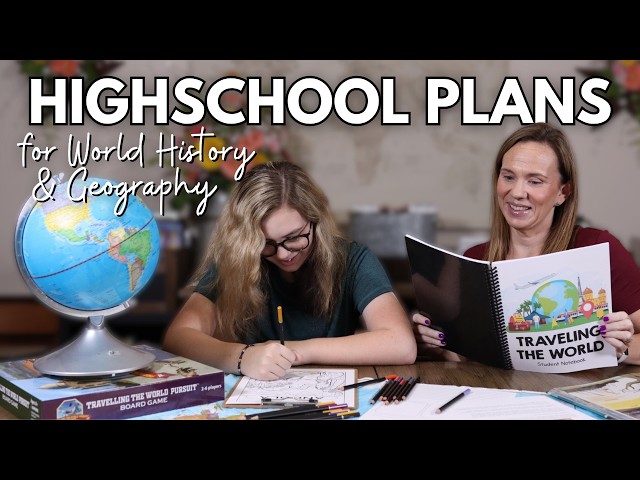
Our 9th Grade Homeschool World History & Grography Plans | Highschool Curriculum & Resources
Watch on YouTubeVideo summary
Jessica outlines her flexible approach to teaching ninth-grade world history and geography for the upcoming homeschool year, noting that she is still deciding whether these subjects will count as one combined credit or two separate ones. To make this determination, she plans to maintain a running log of the time spent on each subject throughout the year to see if they naturally fit into a single or dual credit structure. Regardless of the final credit calculation, the core curriculum for history will revolve around "Watch and Learn World History," which is based on Crash Course videos and scheduled for two days a week. This primary resource will serve as the timeline backbone for the course, allowing her to integrate supplementary materials like Discovery Decks on specific eras such as Ancient Rome or the Middle Ages as they arise in the lesson plan.
The geography component will similarly utilize "Traveling the World" books one and two, which she intends to use concurrently rather than sequentially. Her strategy involves tackling continents one by one, combining content from both books to cover all countries within a specific region during the same period. For instance, when studying Asia, the family will read about landmarks like the Great Wall and complete related mini-units, while South America lessons will focus on sites such as Machu Picchu. To enrich these studies, she plans to incorporate reference books like "Eat Your Way Around the World" for culinary projects, "Global Art" for artistic exploration, and "The Travel Book" for general travel knowledge, all of which will be part of their morning basket routine.
To provide historical context and relatable narratives, Jessica has selected a variety of award-winning novels to read aloud, each corresponding to a specific continent being studied in the geography unit. These selections include "Call It Courage" for Oceania, "Secret of the Andes" for South America, "A Single Shard" for Asia, "Number the Stars" for Europe, "Esperanza Rising" for North America, and "A Long Walk to Water" for Africa. She also plans to address Antarctica by creating a mini-unit using the book "Lost in the Antarctic," even though it is not part of the standard geography curriculum. Additionally, she will use reference sets like "Street Through Time," "Child Through Time," and "City Through Time" to help students visualize how daily life and urban centers have evolved from ancient civilizations to the modern day.
The educational experience will be significantly enhanced through a wide array of games, subscriptions, and interactive resources designed to make learning engaging. Jessica intends to use trivia-based games like "Who Knows History Better" and geography-focused titles such as "Mount Cleverest" during family dinners to reinforce facts in a fun way. She also plans to utilize the extensive collection of Professor Noggin decks, which cover various historical periods and countries, alongside board games like "Trekking Through History" and "The World Game." To bring history to life physically, she has subscribed to "History Unboxed" to receive curated educational kits on topics ranging from the Ming Dynasty to Julius Caesar. Finally, she has renewed her subscription to "Universal Yums" for global snacks and reactivated "Letters from Afar" to provide students with real-world correspondence from around the globe, ensuring a comprehensive and immersive learning environment.
Read the full video transcript
Hey everybody, welcome to the Waldock
Way. I'm Jessica. Today's video is going
to be all of the resources that we're
going to be using for world history and
world geography this upcoming homeschool
year.
Now, I am undecided whether this is
going to be one full credit, so like
half a credit of world history, half a
credit of world geography for a credit
of world history and geography,
or if world history is going to be a
credit and world geography is going to
be a credit, like one and one.
The reason I'm undecided is I'm not
really sure how much time this is all
going to take. So, basically what I'm
planning to do is keep a running log
of everything that we do and I'm going
to keep a world history and a world
geography, I'm going to keep them
separate and then at the end of the year
we'll see how it plays out, how many
hours we've spent in each and whether
I'm just going to combine the two for
one credit or let each of them stand
alone for a credit. If you're not sure
what I'm talking about, I will link my
high school planning video up here for
you to watch,
but basically
I'm just not sure. I mean, I know I'm
going to track it the same, I just don't
know what I'm going to equate it to yet.
It will be world history and world
geography, whether that's one title for
one credit or whether that's two titles
a credit a piece is the part I'm unsure
about. The resources that we're using,
we're going to be using regardless.
Okay. So, for the like backbone part of
world history, so like the thing that
we're going to be doing, basically it's
going to be the the spine of it, is
going to be the Watch and Learn World
History. So, this is based off of the
Crash Course YouTube video and so, I
think we're going to do this two days a
week and they will basically be reading,
watching a video and responding and this
is going to be kind of like the spine
for world history. So, the timeline that
this follows is the timeline that we
will follow for any other history
add-ons that I want to do.
And like for example, if I want to add
in some of the discovery decks like the
Stone Age or Ancient Rome, we also have
Ancient Greece, Ancient Egypt, um we
have Middle Ages, Vikings in Valhalla.
So any of those that I want to add in, I
will add them in as they kind of come up
in this. So for example, when they're in
the Stone Age or when they're in the
Middle Ages is when I would add in any
extra discovery deck cards that kind of
tie into that. May not have to be exact,
but for example, I'm not going to strew
American history when she's learning
about ancient. Probably I'm more than
likely not.
Also, my plan is to
include quite a few Who Was and What
Were books and mini units along with it.
So for example, when we're in the time
frame of Julius Caesar, I will probably
have her read this or we will read it
depending on how it plays out and we'll
do the mini unit. Same thing when we get
to some of these other ones like Joan of
Arc or Ferdinand Magellan or you know, a
What Was or whatever. But for the most
part, the Watch and Learn is the
timeline that we're going to follow
through the entire world history course
that we're doing.
The same thing is going to apply to
geography. So we are going to be
combining
Traveling the World basically one and
Traveling the World two
and we're combining them in the sense
that like when we do Europe, we're going
to do all of the countries from one and
two. When we do North America, we'll do
countries from one and two. So we're
basically going to be going, you know,
in order
continent by continent and we'll be
combining them and doing all of them at
the same time. So the same thing kind of
goes along with this. Whatever continent
we're in, I will try to tie as many
things together as possible. So for
example, when we're in Asia is when we
would read, you know, where is the Great
Wall?
And then that's when we would do the
mini unit to go along with it. When we
get to South America, that's when we
would read Where is Machu Picchu? And we
would do the mini unit to go along with
it. So, again, Traveling the World 1 and
2, and then we will be weaving in the
who, what, where units depending on how
that works out. Um am I trying to line
up history and geography? No, not
really. We're basically treating them as
two separate, we're following a specific
history timeline, and then we're just
going to go continent by continent in
the Traveling the World. Um for
Traveling the World, I will also be
using the Legendary Landmarks Discovery
Deck.
So, that is kind of like the basis for
those. We will be doing Watch and Learn
World History with mini units and the
decks, and then Traveling the World 1
and 2 with mini units in the decks.
For reference books, the things that I
have pulled to go along with them,
obviously, we have Eat Your Way Around
the World,
Global Art,
and the Travel Book. These are the three
um resources that are required for
Traveling the World, so obviously we
will be using all of these, and it will
help us
um you know, make recipes and learn more
and do some art and all of that. So,
those will be in addition to Traveling
the World.
Um as part of our morning basket, but
it's also going to be part of our world
history, is major events that happened
in world history. So, this is 50
defining moments from ancient
civilization to the modern day. Like I
said, this is a part of our morning
basket.
Am I going to try to keep this lined up
with the um world history she'll be
doing for Watch and Learn? I'm going to
try, but we're only doing morning basket
three times a week. She's going to do
that two times a week. So,
if it's not perfect, I'm going to and be
okay with that.
Um, we also have Timelines of World
History as far as a reference book and I
really like this.
The different timelines and the way it
kind of goes through everything.
It's from the Stone Age to the
Millennium.
And then this series is one that I've
always really liked. So we have a Street
Through Time,
a Child Through Time,
and a City Through Time.
And what I like about it is that it
shows like literally what it says. So we
have like
um the story of a city, the Greek
colony, a temple, citizens of Rome, the
medieval city, and it just kind of goes
through
all of those things and you can see it
change throughout history.
And I think that's really neat and I
also think it is a really great way to
relate
um like the history of things to kids
because every kid
or child or person or you know, whoever
like can relate to a city. They can, you
know, relate to a street, obviously. And
then they can relate through a child
throughout. So you have,
you know, all of these different like
this is a child in Rome.
And then we'll go all the way to
um a child living in the 16th century in
Timbuktu.
And again, relatable. So those are three
reference books that we'll be using. I
also thought that this was really cool.
Um, we had the sticker version of this
years and years and years ago. This is
the Big History Timeline Wall Book
though. So it is a 6-ft timeline inside.
So it's hardback and when you open it
up,
it's like, let me try to open the right
side cuz this way. Okay, here we go.
It's 6-ft
timeline.
Like
that's really big.
So I thought that would be a neat way to
see
like the different things happening all
around the world and see it on a actual
timeline.
So, I have that for us to reference.
For books, in addition to um the Who
What Where books, I did pick one
read aloud for each continent. Um most
of these were Newbery Medal Award either
winners or um nominees and they're books
that I really wanted her to read before
she left my home school. So, I have
Call It Courage, which is the book that
we're going to be reading when we do um
Oceania from Traveling the World.
Secret of the Andes, which will be when
we're doing uh South America.
A Single Shard,
that one will be for Asia.
Number the Stars, which will be for
Europe.
Esperanza Rising, which will be for
North America.
A Long Walk to Water,
which will be for Africa. And then I did
go ahead and grab um even though
Antarctica is not included in Traveling
the World, we are working on Where Is
Antarctica so that we can still do an
Antarctica mini unit during our
traveling. So, I did grab um Lost in the
Antarctic for an Antarctic read aloud as
well.
Um so, those are just books that we'll
be doing during our morning basket time
that we will be reading while we're, you
know, in that continent um in Traveling
the World and then that's just going to
kind of all be part of it. Okay, now to
the games cuz let's be honest, that's
the best part. Um the first like small
stack that I have are trivia-based
games. We like to play trivia during
dinner. Uh it's something that we've
done for years. Some of them we don't
play exactly the way that they say for
you to play them. We kind of just play
in a way of like one of us asks the
question to the group. Whoever gets it
right gets to keep the card. Whoever has
the most cards at the end of dinner is
the winner for that night. Um and we've
done that for as long as I can remember.
So, two that I picked up that I thought
would be kind of great additions is Who
Knows History Better, which is a
trivia-based game, and Who Knows
Geography Better.
Both of these are going to be great um
dinner time games. We really like Mount
Cleverest, and this is the geography
edition.
Um we also have the Guess in Ten. So, um
Guess in Ten has like the countries and
landmarks. So, we'll probably do those.
And then Professor Noggins, we own every
Professor Noggin that's ever been made.
So, I will pull these out. So, for
example, this is the ancient deck. So,
like when we first began um world
history, I'll pull the ancient deck out.
And then when we get from world history
into or from ancient into medieval, I'll
pull the medieval deck out. Um and then
we'll just continue like that through
all of the different uh Professor Noggin
historical decks, as well as um like
countries of the world and things like
that. So, again, these are like dinner
time trivia games that we will play.
And then I also have Around the World
Flux,
Timeline Twist,
The World Game,
Flag Frenzy,
Chronology.
This is Passport to Culture, the travel
edition.
So, kind of all over the world.
We have Explore the World, a game of
who, where, and what.
Oh, this is kind of heavy. We have
Trekking the World.
We have Trekking Through History.
And then the last one we have is
Traveling the World Pursuit the board
game.
And then I did get a few specific
subscriptions to go along with this. Um
one of which is History Unboxed. I
handpicked like four to five different
boxes. Um like for example, the Ming
Dynasty I know was one. I think there
was a Julius Caesar box that I picked.
But like I handpicked four or five. I
think so. Actually, maybe even six.
Specifically, and I bought single boxes,
and so they're not here yet. But I did
grab a couple of those just to kind of
go along with the world history. Um and
like I said, I picked kind of like,
okay, here's like I went through and I
was like, okay, if we're doing this for,
you know, 40 weeks or whatever lessons,
I just kind of picked like every three
to five weeks, I picked a box that would
go well with it.
Um and then I renewed cuz we had let our
Universal Yums go last year, so I did
renew our Universal Yums so that we
could have snacks from around the world
while we were in fact traveling the
world. This is everybody's favorite, so
I did move from the small box to the
medium box so that we would have a few
more snacks this time around. And we
have a teenager now. We didn't have one
of those before, and she will eat us out
of house and home, and Kevin and I will
not get to try any of the snacks. So, we
increased our box size. Um and then I
also reactivated our subscription to
Letters from Afar. I actually did this
um about
seven or eight months ago cuz I knew we
were going to be doing world geography
this year, and I've been collecting
letters, so we haven't opened any of
these. Um so, there will be a surprise,
but that way I kind of have like a
backlog of them to go through. So, we're
not just waiting for one every month
um when we do our mailtime Monday. So,
Letters from Afar specifically because
they are world geography-based. So, that
is all of the resources that I have on
hand for our world history and world
geography courses this upcoming
homeschool year. And if you have an
amazing resource that I missed, please
let me know down in the comments.
>> [music]