Video summary
The presentation by Sergey Droski Maraba and colleagues from Meta Platforms highlights the critical role of Linux in supporting modern AI infrastructure, despite it often being overshadowed by buzzwords. At the heart of their operations is the challenge of managing millions of external CentOS machines that require regular updates for security and policy compliance, yet operate on a lifecycle significantly shorter than Red Hat Enterprise Linux. To address this, Meta treats operating system management as a service rather than a static task, developing specialized tools to automate the entire process. This strategy involves synchronizing external repositories with internal infrastructure every few weeks, verifying RPM signatures, and building new images that are rigorously tested on production-like environments before being rolled out to the fleet.
Central to this automation is an internally developed tool called Antler, which integrates tightly with Meta's build system, Buck, to ensure scalability, speed, and reproducibility. Antler allows engineers to define OS images using declarative code where specific features, such as enabling systemd units or installing RPM packages, are layered onto a base image. A key advantage of this approach is that all builds are deterministic; by converting DNF repositories into Buck targets and storing them in source control, Meta can guarantee that an image built today is identical to one built months ago. Furthermore, the system supports OS-agnostic base images, allowing the same build pipeline to produce CentOS 8, 9, or 10 simply by changing a single parameter at the end of the layer stack, which greatly simplifies migration efforts across different versions.
The ultimate goal of these tools is the creation of Metal OS, a highly optimized and stateless operating system designed for Meta's bare-metal servers. Metal OS utilizes a unique boot mechanism involving a UKI bootloader that reads a host blueprint to determine the kernel version and configuration before switching to a read-only root filesystem. This architecture minimizes on-host updates by treating the OS as immutable, with changes only applied during periodic reboots or reimages. To manage this safely without disrupting services, Meta employs a "train" system where maintenance crews visit data centers in batches every 45 days to deliver fresh OS pieces and fixes, complete with automatic rollback mechanisms if an upgrade fails. This disciplined cycle has allowed Meta to migrate over 97% of its fleet from CentOS 7 to 8 and subsequently to 9 in a fraction of the time it would have taken using traditional methods.
Looking toward the future, Meta plans to further reduce the scope of in-place host updates by shifting more configuration management away from Chef and onto dedicated agents that enforce strict lifecycle constraints. While the company acknowledges the existence of other tools like MKI, they maintain that their custom solutions are necessary due to legacy platform complexities and specific isolation requirements for running services on bare metal. The team also notes that while most workloads run in containers on bare metal hosts, specialized hardware and switches may still require bespoke OS builds. Ultimately, Meta's strategy demonstrates how treating the operating system as a service, with rigorous testing, automated pipelines, and a commitment to upstream contributions, enables safe and rapid scaling of massive infrastructure essential for AI development.
Read the full video transcript
Hi. Uh my name is Sergey Droski Maraba
and we work for Meta Platforms where we
are responsible for running a Linux as a
platform. Um we are sorry our stuff that
we are going to talk about isn't as cool
as a most of the stuff you've heard
during today's
routine work. uh still we thought that
it might be interesting if we talk to to
you and present problems that we face
and how we solve them.
First of all why uh OS is important uh
nowadays uh everybody talks about AI
buzzword is isn't Linux anymore but the
truth is that under uh any AI there is
still Linux machine that needs to run
reliably.
Um what is the problem with uh OS
management that we challenge uh we we
have right what are the challenges first
of all uh meta doesn't own operation
system we run Santos which mean it's
completely external to us and we have to
deal with that we uh don't control
cadence how often it updates go there we
um at the same time we have to make sure
that machines and we are talking about
millions of cost that we manage gets
updated on regular basis because there
is security requirements, there is uh
policies and so on and so on and so on
and we need to uh go to the latest uh
releases as not as soon but with CentOS
streams the life cycle for versions is
much shorter than for Red Hat for
example. CentOS9 will be end of line
next year.
So what strategies? How do you solve
those problems? um standard uh image
based to us uh automate everything uh
uh can constrain or flight life cycle
meaning that to and uh try to manage OS
as as a service and to do that we
developed several tools um to some
extent some of them are open source if
you know how to run buck because uh
everything at ma is uh bug targeted and
bug bill and we are going to talk about
uh those tools uh little bit right first
of all uh OS snapshot and the tools that
we we used to create them is called
rolling OS updates
uh why do we need them again because OS
is uh external to us and we need to
combine uh Santos repositories DNF
repositories with uh some vendors
repositories like Nvidia and HP
Microsoft
with a hypers scale repos that David was
talking about a couple of hours before
and uh present it as a uh dated snapshot
to two uh parts of of uh uh our
infrastructure. one uh to a host as a
set of DNF repos through the standard
DNF uh protocol and another part to uh
image build system uh as a buckified
list of targets where every repo and
every uh
every package is can can be addressed as
a bug target and built as a buck target
and you can say that uh I want that
package dated and and and and predefined
Um so to do that uh we create we defined
uh major release like Santos 8, Santos
9, CentOS 10 as a set of DNF
repositories with their URLs. Then uh
every couple of weeks we uh do sync up
operation from inter external to
internal. And when we do that again as I
said we uh
upload everything into our internal
infrastructure and make them uh
presentable as a standard DNF repos and
as a list of uh bucket uh buck targets.
Uh we verify RPM signatures. We build uh
new images and images uh for services
and for operation system bootable
images. We test them before going
rolling them out into production. We
have to test to testing means uh
re-image rebuild um certain set of
machines uh into that new image and make
sure that at least they boot and uh
ideally they can run production
workload.
Then uh those snapshots gets released uh
to image build and to chef meaning um to
to production fleet.
Uh another tool that we built uh
internally is image builder that's
called antler. Um as you know there is
many many many uh image building tool.
Why did we need a a new one? Uh
basically again because we have very
specific requirements. It has to be
integrated with buck. It has to scale
up. It has to be able to build uh format
that uh compatible with our
infrastructure. It has to work fast. And
that's why we created antler. Creator is
here. Vinnie Marra. If you have any
questions, you can ask him. And he did
presentation couple of years ago on
that.
How does it look like image definition
in uh in antler? It's basically basel
code uh starlark code in in buck uh we
define uh certain features uh where
users can say that build my image use uh
such and such image as a parent layer
and then add a set of features. You can
install RPM you can uh enable
systemdunit if you want to. You can
create directories. You can do lots of
different stuff uh building and then you
do bug build and you get the image
either um on your local machine or uh
build and upload it into our infra. So
you can rebuild the machine uh server
test that image or install or it can be
integrated into CI/CD and then it it
builds and goes to prod if we are
talking about uh uh service images for
example.
Um
the main thing about this the good thing
about that that all builds are
reproducible and deterministics
because uh we convert all those DNF
repositories and RPMs into bug targets
and check them in into our source
control right uh you can check out uh
our source control code on any date or
any hash and you can build image and you
are guaranteed to to get exactly that
image how it was built months ago or
year ago
and it it's it's again was a real uh
hard requirement for us that we have to
have that feature uh images uh they are
uh OS agnostics meaning that when you
create an a base image you don't have to
specify what version of Santos uh you
want to get there 9 10 eight and only in
the last one. You see here uh we have
like image layer and then um
parent layer and and and then we default
uh in in the very last one we say that
it needs to be built as a send to S9 or
send to S10 and we get it uh as as as
requested
and using all those uh nice tools we
were able to create a product that
called metal OS which isn't distra but
the way how to rerun Santo to s at at
meta how we package and how to we
deliver it into production and uh
Marello is going to talk about that.
>> Thank you Sergey. So uh what is Metal
OS? We have this northstar that is what
we want to build is what we test and
that we run in prod. And uh in order to
do this we need an elaborate and uh
extensive image building subsystem such
as the one that Sergey presented. And
this CentOS flavor is assembled from
Quir pieces such as UKI bootloadader.
And some of the work that we recently
did ended up into systemd 257 such as
the uh command line uh the sorry the
micro microode adons because we needed
to load microode very early in the boot
process before other hardware was
initialized. Then this boot loader uh is
able to open up the control partition
that contains it's a single battery
first system that contains the all the
rest of the the pieces of the OS. The
bootloader then reads this well-defined
host blueprint. We call the the host
config that contains different parts uh
things such as the host identity, the
host name, the IP address or the root
root password hash. Things that can
change only when the machine is
reimaged. Then we have the boot settings
such as the kernel that the the machine
should run or runtime settings that can
instead be changed uh while the workload
is running. Boot settings instead
required at least a K exact.
The goal of this is to have an OS that
is as read only as stateless as
possible. So the machine boots the UKI
bootloadader is initialized open the
controls partition reads the host config
and finds out which kernel should I boot
now then it k exacts into the target
kernel that opens up the initi that
generates the configuration of the
running system out of the host config
itself and switches root into the root
fs. So you can change these pieces with
either uh reloads or reboots or reimages
and you have a unified and coherent life
cycle that allows you to minimize as
much as possible the on host updates.
Eventually the last piece that as well
has a config generation mechanism as
well out of the host config uh is is
able to run service containers that are
standard systemd exec uh containers with
sandbox sandboxes defined into the
systemd units and um uh these service
containers uh are a step ahead with
regard to what we were doing previously
because we used to run instead add say
log shippers or telemetry agents or
other agents that we run on all machines
all together into the same uh host uh OS
that that is not great for isolation.
Instead, we are we're going into a very
uh long running effort to isolate all
these pieces so that they don't stop on
each other. However, this is all fine
and good, but we can't migrate to this
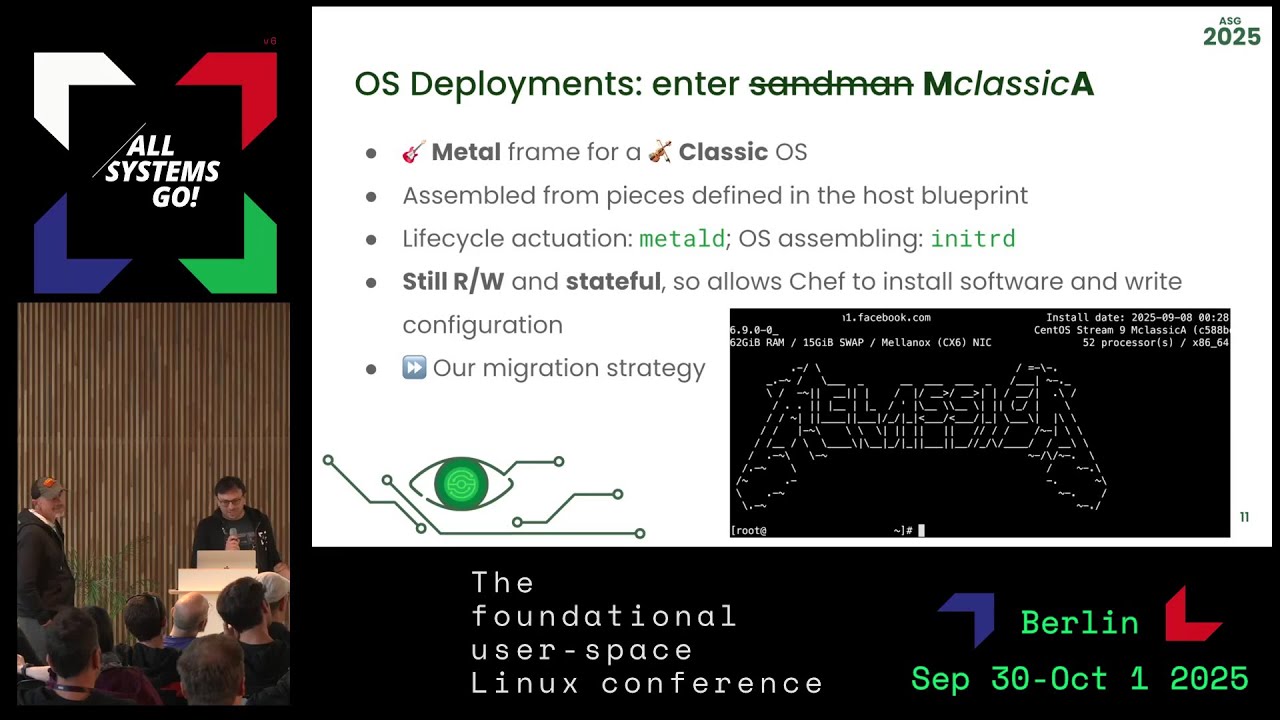
scheme overnight. So enter M classic
that in it's a metal frame for a classic
OS that is is assembled from pieces
defined in the host blueprint. We use
the host blueprint to assemble the OS.
We use changes to this blueprint to say
change the root FS that contains a new
CentOS release but it's still read write
and stateful. So it allows the old chef
recipes to install software right
configuration and it's our migration
strategy because it's a big fleet with
lots of teams and
a lot of chef recipes around and things
that have been done this way for uh more
than a decade. So it's difficult and I
mean it's a it's a big effort to
migrate.
So how we update this? Because if we say
we have an OS that is mostly mutable, we
need to have a way to issue maintenance
windows, drain the workload and um
reboot the host to install new versions
or if not reboot KXe. And like Santa
visits kids with presents, we have
trains that visits host with box cars
fulls of upgrades. And every host is
visited every 45 days. We do this in
batches. More or less each shared fate
zone is visited at the same time. and we
deliver fresh pieces. This is a way to
deliver safely non-critical fixes. Say
we have an incident, we put a
mitigation, then we want a permanent
fix, but we don't want to just SSH to
the entire fleet and deliver the flicks
to the the fix to all machines because
that would be unsafe. Instead, we say
okay, we're going to put this fix in the
next version of the OS image and we're
going to deliver it. Uh because we have
an established 45day cycle or rather
high impact upgrades say systemd
versions we used to update systemd
online while the work was running that
is unsafe and we decided to uh instead
do that with maintenance strengths. we
contain failure and if upgrades don't go
as planned there are automatic handbreak
mechanism so that they detect if the
success rate is below a certain relative
or absolute threshold then the uh
upgrades are automatically stopped.
Still we require a way uh to update
hosts in place because you can't just
tell security that hey that fix for the
zero day is going to be released is
going to be rolled out in 45 days. So we
still have chef but we are moving from a
design in which we had chef to do
everything that is first boot initial
provisioning configuration software
management and whatn not to have two
different agents one is called host
agent that is mostly workload oriented
so it takes care of what the products
need and metal d that is more oscentric
and they both enforce life cycles and
conr to ensure safe and coherent
upgrades. Further, these agents expose
APIs to the control planes
that roll out changes instructing uh
these two these two agents. Now what
where we headed? We want to move more
software and config management out of
Chef, leverage these two agents life
cycle and constraints and reduce the
scope of in place host updates and
possibly stop the arrow use that Sergey
described because we were in this I mean
scenario in which we build the OS image,
we test image, we roll it out and then
chef changes the OS image and we I mean
all our tests are less relevant.
uh new measure releases as well. They
occur every couple of years. They
require some preparation for the base
layers that build on the new uh measure
version. But the continuous provisioning
cycles that we've established in
reimaging the fleet periodically
made these migrations safer and easier
because it took 15 months to move from
CentOS 7 to CentOS 8. But then from 8 to
9 we took just 3 months that is just two
uh release cycles controlled rollouts
with incremental switch over and baking.
So we install a new thing and wait does
did everything break? Did something
break or is everything okay? Okay, let's
move on and have a roll back mechanisms
always in place. Reaching this 45 days
goal required a lot of coordination. I
was personally responsible for it and my
strategy was to first make everyone
aware of the benefits and ensure the
visibility that means do project manager
work and prepare dashboards with fancy
graphs and things so to convince people
hey this is the right way to do we work
together on regression and we gently
pushed back on requests to delay the
cycle proposing alternatives because
when people say I am scared of this uh
frequent reimaging. Let's do it instead
back to every 90 days. We work together
to make the updates safer and ensure
that the requirements were satisfied. Of
course, you need a buffer of machines
that you have to use when you take
machines out of production. you have to
move that workload to machines that are
idle and waiting for um uh I mean as as
a buffer and if these buffers are become
thinner because of other incidents then
your cycle is going to be impacted and
as well when you require technicians to
go into data centers and you have to
schedule manual work in data centers
that also is going to impact your cycle
because that takes an higher priority
because scheduling humans is something
different than scheduling upgrades on
machines. So there are many things to
think when you have to work at at this
scale. Anyway, we were able in about two
years to change the OS on 97% of this
multi-million server freight. We are
able now to visit and reinstall hosts
every five every 45 days. These images
go under an extensive testing uh on our
continuous integration pipeline that
provisions real hosts run real workloads
on hosts and verifies that everything is
fine before releasing the machines to
the maintenance trains and basically all
senate to and to centtos 9 migration was
automated the code modifications. Now we
are planning to migrate to Cent 7 at
this scale and hopefully we'll do that
in three months.
Thank you,
questions,
comments.
Yes.
um perhaps slightly OT but can you talk
a little bit about what you do in the
hyperscaler SIG and uh after all this
work if you are still happy with going
with CentOS or if you consider rolling
something of your own
>> um hyper scale and seek like David said
it's a version of software technically
upstream software that uh we and our
core partners built ahead of scale
schedule there is stuff like systemd for
example right we have our own systemd
team which uh develops features and and
sometimes they find bugs or adding new
features that cannot go upstream right
away so they build it and publish to
hypers scale so we can install it if
that makes sense eventually all of that
will go to uh upstream David wants to
add something
>> uh to answer your
Uh I think the IPL work is kind of
orthogonal to this and the idea with IPL
is to try to do as much of the work we
can as possible upstream and I don't see
that changing at any point in the
future. I think we'll always have things
like for example the system work we do
maintain there. Uh as for using
something else outside of Santos um
there isn't really a reason to. I think
if we were if we had nothing and we were
starting the company now and we were
discussing which OS to use, we would
have a conversation and that could go in
many different directions. But I think
even in a world where we have now where
we have millions of machines running
central stream, we have established
relationship with that community, we
have processes and tooling and work tied
in that space. I I don't see a
compelling reason to consider changing
other questions. So I have a question.
How many times per week does Dan ask you
to switch to MKSI instead of your beard
image tool?
>> Say it again. I'm sorry.
>> How many times per week do you get asked
to switch to MKOSI instead of your own?
>> Constantly people asking why you don't
use this or that or that. Uh the thing
is that we would love to but to some
extent we are uh we own legacy platform
huge legacy platform that we cannot
rebuild in modern uh way right without
getting into the world news with the
headers like hey WhatsApp is down for
three hours and
you know
>> yes sorry for being
>> I will also add that whatever Make OSI
is doing would never ever ever do what
they what they need. Antler is very much
the right tool for the job.
>> And to to make you happier, right, this
is a fleet that runs services and
technically internal. There is a uh se
at least two variations of metal OS uh
net OS that runs on our switches and uh
now we built AOS that will run on the
corner and those are more uh agnostic to
new platforms they built from from
scratches. So we are going to use more
modern technologies there.
Are you running this um all on bare
metal hosts or is this about VMs and
then how are you
>> it's bare metals but same uh antler
builds images for bare metals for
containers for services that run on bare
metals including uh images for uh twain
and our which is our scheduler for uh
jobs and production workload right the
goal is that no uh service userfacing
service runs on bare metal. Uh they run
in a container uh under our container
management.
>> Okay. How do you do the reimaging? Is it
do you do AB updates like if you look at
VMs or
>> it's it's a total rebuild. If you're
asking about bare metals, it's it's a
total rebuild. Uh wipe out and install
new inits,
install new everything.
>> Okay. Thank you. Mhm. It's uh we have an
entire net booting infrastructure and
and machines come from the manufacturer
to try to net boot first. Then they are
going always to send the HCP requests
but the HCP responds only to machines
that are configured for net booting. So
when we want to reimage them, we
configure them for net booting into the
networking infra. they reboot and then
they get an imaging ind that DDS the the
GPT image and then uh inside that it
downloads the other battery fest uh send
streams for the other pieces.
Uh, one quick question. Uh,
you I think you said that like 97% are
utilizing this OS. Um, are the others
just like uh is that a haunted graveyard
where you can't turn off a server or um
what's happening there? And also
>> it's long tail.
>> Okay.
It's long tail and might be special
hardware
that's not uh we we haven't uh
got to to to that LST that type of
hardware we are comfortable for running
of this but we are getting there
questions
comments
we have oh yes
are you generally metal fans on a team
or the metal reference These are from
the time when film was on the
>> you saw that we had t-shirts with that
Metallica classic. We don't wear them
today but u uh as you can say I I I grew
up on on metal music. Yes. Deep purple
lad Zeppelin and all of that. Yes.
>> Okay.
>> Not Metallica though.
>> I appreciate all the references
>> and uh those antlers are for antler
because they they have a similar
spelling. So that's a Linux penguin with
antlers because it's built on antler and
yeah with a rockar.
>> Any other questions?
>> It was named before we name it company.
Sorry.
>> Sorry. That's all the time we have. So
thank to the speakers.
[Applause]