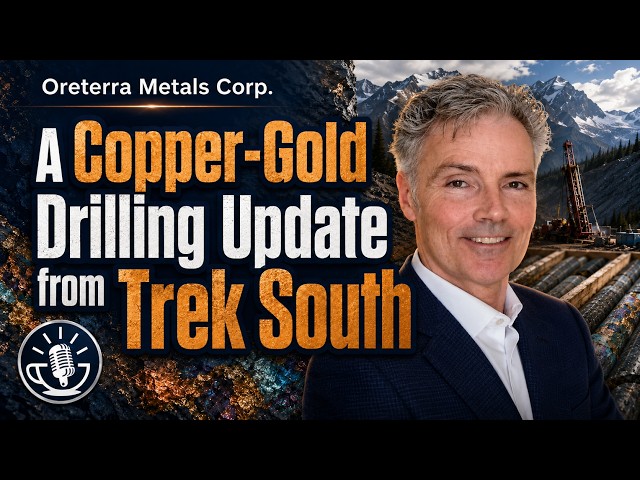
Oreterra Metals’ Kevin Keough Provides a Copper-Gold Drilling Update from Trek South
Watch on YouTubeVideo summary
Kevin Keough from Oreterra Metals is currently in the field at the Trek South camp within British Columbia's Golden Triangle, providing an update on the company's inaugural drilling program for this new project. The team has been actively geo-logging and tagging drill core since early August, focusing on identifying specific mineral indicators that suggest proximity to a major porphyry system. Keough emphasizes that while the market reacted positively with excitement and buying activity following their recent news release, there was also some selling pressure from shareholders utilizing warrants. He assures investors that these short-term market dynamics are expected for an early-stage company without a confirmed discovery yet, but he is confident that a substantial discovery is imminent based on the promising geological signs observed so far.
The primary excitement stems from the visual identification of key sulfide minerals such as bornite, chalcopyrite, magnetite, and garnet within the core samples. These specific minerals only form in close proximity to or within the actual intrusive body, which is described as a carrot-shaped root deep underground. While the surface area shows extensive alteration, drilling has been conducted progressively from the outside in to locate this central source. Keough explains that finding these specific sulfides indicates they are getting closer to the economic heart of the system rather than just encountering pretty rock, though he clarifies that visual inspection alone cannot confirm economic viability. The final determination regarding the grade and economic value of the copper, gold, and silver content will depend on pending laboratory assays, which could take a couple of months due to current lab busyness.
Regarding the drilling strategy, the initial plan involved approximately eight holes targeting depths around 600 meters, but this approach required significant flexibility as it was essentially a "shot in the dark" for an unexplored area. Practical logistical challenges, such as finding suitable locations to build drill pads, and occasional equipment or personnel issues have caused the drilling rate to be slower than anticipated, yet the quality of results remains high. The team plans to continue drilling through September before weather conditions in the rugged mountain terrain necessitate demobilization around mid-month. Once assays return, the data will help vector the drilling program deeper into the system, with plans to explore greater depths in future phases next year while also advancing work on a nearby property called JW.
Keough concludes by highlighting the importance of experienced management being directly in the field and closely monitoring the core samples to ensure adaptability throughout the program. The team's ability to adjust daily operations based on real-time observations from the drill hole is crucial for success, a lesson learned from their track record that benefits the entire Oreterra Metals operation. While the main focus remains on achieving a discovery at Trek South, the company is also actively prospecting and finding beautiful mineralization at the JW property, which is situated near the Galore Creek mine development and surrounded by major mining neighbors like Newmont and Teck. The overall sentiment from the team is one of genuine enthusiasm and confidence that they are very close to a significant discovery that will validate their investment and secure the project's future.
Read the full video transcript
[music]
>> I'm speaking with Kevin Keough from
Auratera Resources. You're out in the
field today, yes?
>> Yes, I am, Tracy. I'm in the center of
attention for the company at the minute,
which is the Trex South camp. Uh core
shack, where we've been
geo-logging, geo-tagging a lot of core
lately from the ongoing drill program.
>> And for everybody who's new to Auratera,
you are you are of course in the
illustrious BC's Golden Triangle, and
you put out breaking news yesterday. How
about we start there?
>> Sure. Yes, we've, you know, had a very
active drill program starting early in
August, and it's the first-ever drill
program on a totally new to science
project, Trex South, which shows all
kinds of promise. And yes, the news we
put out yesterday was really an update
in terms what we've accomplished so to
date, and what we have accomplished to
date is really pretty impressive for the
limited amount of drilling that we've
been able to accomplish so far. But,
um we tried to be very factual and
truthful in what we released yesterday.
We tried to show the market, tell the
market exactly what we ourselves have
seen, and that is describing the
minerals that are important to this
project. Um
I've had some some parties who seem to
think that maybe we should avoid all the
geo talk and just say we found stuff.
Well, you know, that's not how it works.
We've we've got a We want the market,
and I understand a lot of people don't
understand what bornite is or
chalcopyrite is, but they should look it
up on the internet because those are the
key descriptives in our case that
indicate we're close to
the major porphyry body that we're
looking for. So,
at this point in time, Tracy, the market
really understands everything we do, and
that generated a lot of excitement, a
lot of buying yesterday. It was, I might
say, also met with a lot of
warrant-related
selling activity. And for those of your
viewers who don't understand that, there
are, and we do have certain shareholders
that
their business model is to advance
capital
pre-discovery.
They typically will sell your stock in
order to hold the warrant, so it becomes
a quick win for them without any future
risk. And you know, we have to deal with
that when you're an early stage company
and don't have a discovery yet, but we,
and I can assure our shareholders, can
overcome all of that selling
with a substantial discovery here, and I
believe we're very close to one, and
that's what we said yesterday. So, stay
with the story because everything looks
really good.
>> I used the word exciting because, and I
quote, "There was real excitement in the
core shaft among all of us when bornite
was first identified in core." That is a
quote from you. And for those of you out
there, they're going, "Okay, we want to
find out more about this." Tell us why
this was so exciting.
>> Yeah, again, I mean, I think some
elements of the market, I'm thinking of
some of the
Stockwatch journalists, shall we say,
who maybe don't know that much about the
business. They seem to think that um
we shouldn't use terms like bornite or
anything else that it's somehow
that it's somehow promotional or they
think that we shouldn't talk about being
excited because they think it's
promotional. Well, I'm telling the
truth. We've got two uh myself and John
Bitsack have been here non-stop for the
last month just because this program is
so important and we know we're spending
a lot of shareholder money and we're
spending a lot of my money, too, I might
add, my actual cash money. And we want
this thing to succeed, so we're focused
on it. Um the excitement comes in and it
was very genuine. I'm actually in the
core shack right now
uh Tracy and I'm just going to turn the
camera. Pardon to viewers because, you
know, I don't have my normal camera
on me
as I would have at home. But basically
um
we knew from the start of this program
that we've got a lot of beautiful
looking changes in the rock visible over
a large area on surface. That's why
we've been excited. But so we started
and we described in yesterday's news
release what our drilling approach has
been. We set up a drill fence along the
sort of bisecting that uh vast area of
alteration and we've been progressively
drilling from the outside in to try to
locate what we believe will be the root
of a porphyry system, a big intrusion,
right? So, the excitement happens
because um we can drill a lot of good
looking rock, but it's the sulfide
minerals that indicate you're getting
close to
uh the source. And the source here would
be that carrot-shaped root. So, the
bornite that we talked about, the
chalcopyrite, but especially the
bornite, the magnetite, and the garnet
are temp- these are minerals that only
form when you're close to or in the
actual intrusive body, right? So, when
we see that in the core, it means we are
getting close to the source. And that's
why it's exciting, cuz I'm not
interested in just drilling a bunch of
pretty rock, right? It's got to have the
right sulfides. It's got to have copper,
and that's why we got excited. And I can
tell you uh
we did a little bit of hugging here,
quite honestly, because that's how
excited we were, and that's the truth.
>> Well, for those of you out there, we're
always trying to widen audiences and get
people more interested in this sector.
Auratera is drilling at its Trak South
property in the British Columbia's
Golden Triangle,
and this
technical news release is saying that
they believe they're getting closer to
the center of a large copper gold
system. That's the message, correct?
>> Correct. Yes.
>> Okay. But, as we all know, this is not
confirmation yet uh of a commercially
viable copper gold deposit, and
laboratory uh labora- laboratory results
are still pending. Can you give us an
update on how that process is going to
work?
>> Yeah, you know, uh we can't tell based
on visuals alone whether what we've hit
so far is economic or not, you know? And
by economic, that would be
pardon me, Tracy, uh a helicopter is
coming in outside right now, and can you
if you can hear that, we might just
I may speak a little closer here, but um
so, visuals alone won't tell us whether
uh uh we've hit an economic body. I can
tell you at the minute, we think we're
close. It doesn't mean that we think
we're in the core of the system. And I
think to be
um to have a viable project, one that
could become developed going forward, we
need to be in the core of the system.
What I can tell you, though, is that we
do expect that the drilling, and maybe
all of the drilling that we've done to
date, will have copper and gold and
silver values at some level within it.
Um, and again, I would emphasize that it
doesn't mean that those values will be,
you know, potentially of the grade that
the market might want to see in order
for it to be economic. But, it's early
days.
I would flip that around a bit by saying
we do think that some of what we've seen
is probably going to have economic value
in it. But, um, we're seeing a lot of
magnetite, for example, Tracy in the
current hole. And why that's important
is, you know, that stuff often carries
with it copper and gold. We know that on
this property, but you can't see it
visually. Therefore, you have to wait.
So, um, you know, I'm just saying we are
really, really pleased with how this
program has gone.
We do think we've hit. We will have
values of metal in what we've done.
It'll be up to the assays to to
determine to what level. Um, and that
will help us vector. Those assays will
help us vector to
uh the best of what we think is here
somewhere.
>> Can you talk about drilling depths uh
and the significance of them?
>> Yeah. Well, you know, the plan that we
announced further to our 43-101 earlier
in the year this year, it was kind of a
a first attempt uh because understand
that nobody's ever drilled this area
before. So, you really have no idea
what kind of how many holes you need,
what depths, what azimuths, right? It's
kind of a shot in the dark. You work up
your best
estimate of what you need to do to find
what's under there. So, the holes that
we announced in the 43-101, eight holes
approximately, certain azimuths drilling
predominantly to the southeast, certain
depths, they were all uh approximations,
shall we say, of what we thought we
needed to do. But, obviously, as we
start to drill and we indicated this in
our previous news releases, we would
adjust the number of holes, the depths,
so on and so forth, depending on what
each hole actually gives us. So,
um
I can tell you that the concept and the
current holes that are drilling now
are targeting about 600 m of depth as an
initial stab.
And the idea is to find near surface
where we really need to be, and then in
a future phase of drilling, we will go
deeper than that. But, first, near
surface, you know, from from surface to
say 600 m, we're trying to find where we
need to be in plan view, and then we
will follow what we hope to be the root
of the system to depth and potentially
to much greater depths, but that would
happen next year.
>> Well, I have to say, there's definitely
the vibe of a bunch of treasure hunters
>> [laughter]
>> searching for a treasure right now. So,
this of course is is the reason why so
many people get involved in this sector.
Um so, let's talk about your timeline.
While your news releases are incredibly
technical, uh they're also very
methodical and thorough. And it seems
like your timeline is right on track. Is
that conclusion correct or how are you
feeling about it?
>> Well, I would say that um yeah, our
program overall is on track. I would say
that our drilling pre- pays one drilling
has been a little slower than we
anticipated. Uh that's for a number of
reasons. One is that, you know, on a
first program like this, there's a lot
to learn. Just to give your your viewers
a simple Tracy, you may you may in your
planning think, "I'm going to put a
drill hole at point X."
But when you go out in the field and
actually look at point X, it may be
impossible to build a drill pad on. And
we need to drill we need to build drill
pads before we can drill. That's the way
it works here, right? So, there are
these practical kind of logistical
issues in the field that can slow you
down. So, overall, our rate of drilling
has been slower than anticipated,
but the results have been every bit as
good as we anticipated.
Um there are of course equipment issues.
Sometimes there are personnel issues
with drillers. All of these factors come
into play, right, in these programs. And
you expect them. So, I'm not I'm not
surprised by anything like this. Um
we are though very happy with what we've
seen to date. So, we will be drilling as
mentioned out into September. Uh there
are key holes that are underway right
now, and another one or two that are
hopefully really going to do it for us.
Um cross your fingers.
>> So, what should we be looking forward to
next? I mean, clearly you're out in the
field right now. How long How long do
you plan on staying there? And what
should we be anticipating next?
>> Well, um you know, the weather's going
to be changing here. It is uh mountain
country, gorgeous country, but really
rugged. And so, we will probably have to
start demobbing from here just because
of weather around the 15th of September.
Um we'll we'll progressively demob, and
that depends on the weather outlook. Um
the we will update the market in terms
of what we've seen in the holes that
we're currently drilling and continuing
to drill and the next one coming up. Um
after that, we will all have to await
assays. And at the minute, that's a bit
unpredictable because this is the very
busiest time of the year uh for the
assay lab. So, it'll be assays will take
well, let's say at least a couple of
months from the time we submit them.
Again, it's a bit unpredictable.
Um
so, that's the near term. Uh
Only other thing I would say is that um
we're focused on achieving this
discovery here, obviously. Uh we do have
another property, another porphyry
property nearby called JW. And JW, as we
announced early in the year, we're doing
work there, too. And all the this JW
property is totally surrounded by
Newmont and by Teck. And um so, we've
got big big neighbors, and they're
watching what we're doing. We have found
some beautiful um mineralization at JW.
We've been prospecting heavily there
that we're rather excited about. We'll
see what the assays come back there.
These are
potentially there's a a really exciting
target developing there and it's that
that that target is very close to the
Galore Creek
mine development. So, a lot going on.
The main focus here at Track South, but
we're complementing that as well with
the JW work.
>> And of course, I don't want to put you
on the spot by having you talk about
yourself, but I always tell shareholders
out there and interested parties check
out management and check out their track
record. But because of your track
record, what do you think you've learned
in the past that is proving to be very
advantageous for the team at Orezone
>> Well, you know, firstly you have to pay
a lot of attention to the core. That's
why I'm in the core shack, right? The
more eyeballs, the more knowledgeable
eyeballs on the core, the better because
a lot of what you're looking for
requires a close look at the core. So,
we have a team that's got a lot of
eyeballs in what we're doing and that's
really why we're all excited because of
what we do see.
The other thing I've learned is you've
got to be flexible on these programs.
You've got to be adaptable.
You've got to be able to adjust
day-to-day. So, it's it's it's tough,
you know, that's why we're here because
that's why I'm here because it's helpful
to have several technical people focused
on what's coming out of the ground
because you literally may adjust the
next hole based on what you see in this
hole and that's sort of the way it works
and that's why
you know, management on these important
programs should be in the field looking
at stuff and understanding what's going
on, understanding the problems you're
facing as well as the stuff that's
coming out of the ground. That's the
best way to ensure success, and that's
what I'm really here for, you know?
>> And for those of you going, "Okay, that
makes sense." Experienced and
knowledgeable management with their feet
on the ground, currently in the core
shack.
For those of you seeking more
information and or Terra Resources,
please go to the following website.
Thank you, Kevin, and good luck this
summer.
>> Thanks a lot, Tracy.