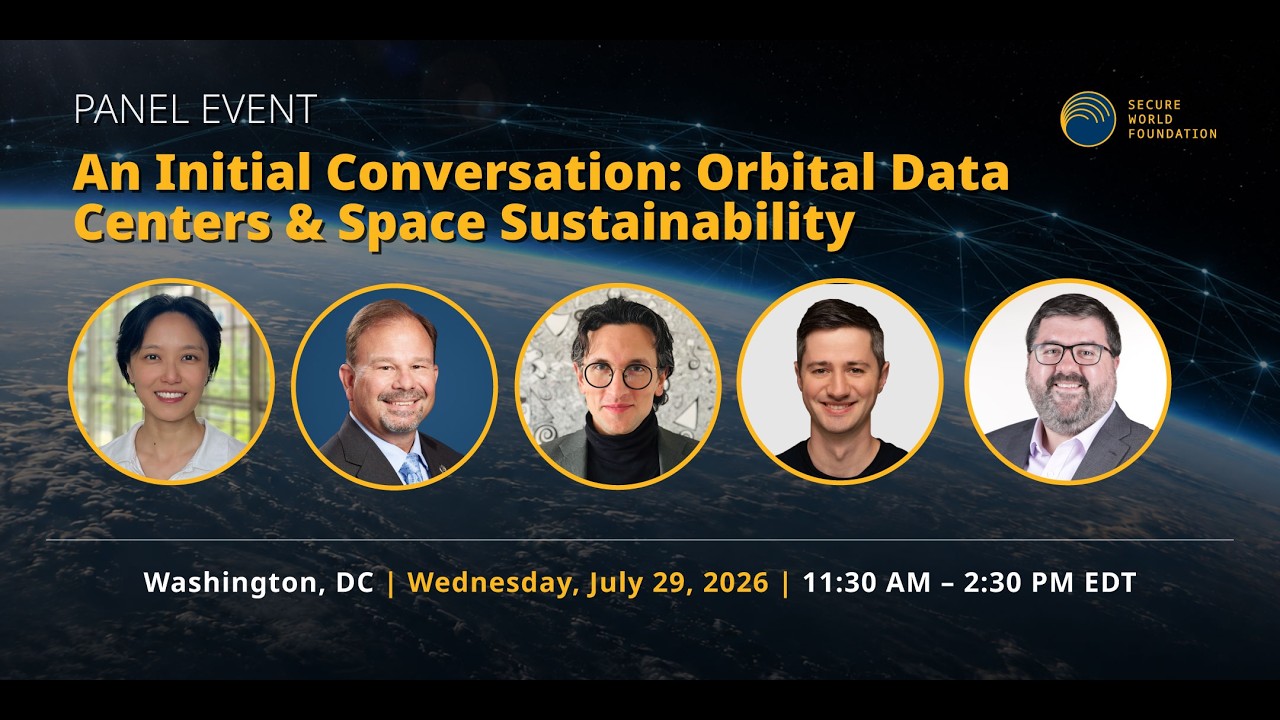
Orbital Data Centers and Space Sustainability: Policy and Safety Implications
Watch on YouTubeVideo summary
The proposed concept of Orbital Data Centers represents a paradigm shift in space infrastructure, distinguishing itself from current satellite networks through the potential deployment of up to one million satellites equipped with large solar panels and optical links primarily for sun-synchronous orbits. While technical viability remains debated among experts like Ron Burke and Jeff O'Neal, the primary focus has shifted toward addressing critical policy gaps and operational safety concerns that arise from such massive scales. Industry leaders argue that these centers are essential due to the exponential power demands of artificial intelligence which ground infrastructure cannot meet, presenting an existential risk if other nations secure this capability first. Consequently, there is a strong consensus that relying on a single agency for oversight is insufficient; instead, coordinated government action involving multiple departments such as the FAA, FCC, and State Department is necessary to manage authorization processes efficiently without creating dangerous silos or delays.
A central theme of the discussion revolves around establishing robust international coordination mechanisms to prevent catastrophic orbital congestion and collisions, drawing direct analogies between chaotic traffic conditions on highways where drivers choose different sides versus a unified rule set like English in air traffic control. Experts emphasize that while denying access based on hypothetical future users contradicts principles under the Outer Space Treaty, early leadership is vital to secure favorable positions before specific shells become saturated. To mitigate risks associated with high-density constellations, particularly those operating at dawn-dusk sun-synchronous orbits, panelists advocate for industry-wide agreements where all satellites in a given altitude band travel in the same orbital direction rather than mixing clockwise and anticlockwise paths. This approach mirrors aviation standards to drastically reduce conjunction risks and ensures that operators voluntarily adopt best practices regarding transparency on location and maneuver intent before formal regulations are finalized.
The environmental and disposal challenges posed by such vast numbers of satellites also demand immediate attention, as post-mission debris from over a million units could alter atmospheric chemistry more significantly than current micrometeorite influxes if not managed correctly. Four distinct de-orbit solutions require rigorous study, including the impact of controlled re-entries on air quality, collision risks in graveyard orbits, heliocentric disposal to prevent return to Earth or the Moon, and potential reuse capabilities via in-space assembly. Although controlled re-entry is suggested as a safety option contingent upon highly reliable propulsion systems, experts argue that full demisability should be mandated if such technology proves unreliable. Furthermore, Orbital Data Centers offer unique flexibility by operating at various altitudes with minimal latency differences compared to Earth observation constellations, allowing them to coexist neatly with existing users without occupying heavily used low-Earth orbit slots while providing cloud compute services for government entities on smaller initial scales.
In conclusion, the path forward requires a blend of proactive industry self-regulation and strategic space diplomacy led by US leadership to establish global standards similar to those in maritime or aviation sectors. The panelists propose actionable steps such as expanding knowledge bases for enterprise use within orbit, fostering an "industrial metaverse" concept for transparent planning among global operators, and reaching unified international decisions on orbital traffic rules to ensure sustainable operations. By leveraging the Office of Space Commerce as a clearinghouse under Executive Order 14335 while awaiting necessary statutory authority from Congress to address externalities like dark skies, stakeholders aim to balance current access with future needs effectively. Ultimately, the goal is to harmonize Earth observation, communication, and data center activities through consistent timelines and robust modeling of Space Situational Awareness capabilities, ensuring that humanity can harness orbital resources without compromising safety or environmental integrity in an increasingly crowded space environment.
Read the full video transcript
Okay. Well, good afternoon everyone. Um,
I guess we'll start. Thank you so much
for joining us today on this panel for
orbital data centers on space safety and
sustainability organized by the Secure
World Foundation. So, my name is Alex
Shei. I'm a senior program analyst at
SWF looking at space safety matters. Um,
and my background is a mix of policy and
tech. So I got my doctorate in aerospace
engineering focusing on space
sustainability and before that I worked
a number of years in government policym
um and I'm going to be moderating our
panel discussion for today. Um so before
we start I wanted to give a little bit
of a background on this topic. So over
you know this past year we've seen very
fast growing interest in orbital data
centers or ODC's. Um we've seen you know
a number of companies filing
applications with the FCC and there's
also you know growing interest and
activity overseas as well and from the
way we look at it when we look at these
proposed constellations uh we find that
there are a number of features that
really set them apart from the satellite
constellations uh that we see today. So
most notably in the number of satellites
um for scale we have about 16,000 active
satellites orbiting you know over
overhead today and many of these uh ODC
um applications are actually orders of
magnitude larger with up to a million um
satellites right um in addition to that
um a lot of them are also looking at
very you know large uh size solar panels
to address the uh energy use needs and
we see a lot of concentrated interest in
sun-synchronous orbits or SSOs Um and
some of them are also looking at you
know using optical links instead of the
traditional RF frequencies. Um so um in
this context the Secure World
Foundations has actually filed uh
comments to some of these uh company
applications with the FCC and in these
comments we um recognize you know the
importance of supporting commercial
innovation but at the same time we also
see um a number of unique space safety
and sustainability considerations that
pertain to these ODCs and that's what
we're here um to talk about today.
Right. So here in the US today um the
the the you know scope of ODC's and the
potential impact that they may have do
not cleanly fall within the remitt of
any you know single one agency although
we do have the space commerce cert
certification which I understand now has
the you know green light to go ahead. So
that might touch on some of that and
address um some of that we can talk
about that a little bit later. Um but in
general what we see is is a need for a
more kind of coordinated measured
approach to looking at these uh uh
satellite constellation proposals and
authorizing them for certainty as well
as uh consistency. So um we also
understand that you know there's a lot
of active discussion today about the
technical and economic viability of
orbital data centers in space. So those
are very important questions but that's
not going to be the focus of our panel
discussion uh for today. Nevertheless,
we're going to be interested in the
associated uh policy and operational
implications of some of these. So,
specifically questions like, you know,
what um what can space policy and safety
measures do to ensure a safe and stable
orbital environment while facilitating
innovation as the technology and
economics of orbital data centers uh
continue to develop. So, that's a very
big question. Uh fortunately, I don't
have to answer it. we do have with us
you know an esteemed panel of experts
with very very diverse experience and
expertise um to shed some light on this
topic. So I would like to now just give
a very brief introduction of our
panelists. Um they will probably share
more about themselves when they speak.
Um so to my right here I have Ron Burke
uh principal director of the space
enterprise evolution uh directorate of
the aerospace corporation. So Ron has
had decades of you know experience in
aerospace system strategic planning both
in government and in the private sector.
Um to his right we have Matias Kava the
national space policy lead at the office
of space commerce. So Matias oversees
the uh regulatory reform uh for mission
authorization for novel space missions
um in the US including space commerce
certification that I just mentioned. He
also has prior experience in the FAA on
re-entry um and launch licensing. And to
his right we have Jeff O'Neal which is
who is the director of government
affairs of Planet Labs. So Planet Labs I
understand has an ongoing collaboration
with Google uh for proposed orbital data
center constellation uh project
suncatcher I believe that's what it's
called. So in uh in his role Jeff uh
works with federal agencies and congress
on remote licensing uh policy. Um I
believe he also has experience on
Capitol Hill. And finally, last but
certainly not least, joining us
virtually, we have Ezra Felden, who is a
co-founder and CTO of StarCloud. So
StarCloud is one of the companies who
has filed a formal application with the
FCC for an orbital data center and at
StarCloud, uh, Ezra oversees ODC, uh,
development. So uh, very well a warm
welcome to our panelists. Really looking
forward to the discussion today. Um, and
just one more point I think before we
start on audience questions. So we do uh
intend to take audience questions via
slidoh. You will see a piece of paper on
your p on your tables with the QR code.
So feel free to you know scan them um uh
and enter your questions at any point.
We will try to weave them in during our
discussion but if not we will have some
time set aside towards the end for
audience questions. Um so yeah with that
now out of the way um I wanted to start
by maybe asking our panelists each to
briefly share your interest and
background on the topic and then maybe
start by talking through some of the
broad uh sort of risk and governance
related considerations of ODC's that you
see um in your role. So uh maybe you
know for the operators uh perhaps we can
get an operator view in terms of what a
safe and stable orbital environment uh
requires and what new considerations
ODC's might add to that and maybe you
know for Matias and and and Ron um on
the governance side you know what sort
of um maybe policy or coordination gaps
um do you think we need to maybe pay a
little bit more attention to with this
development um whether it's across
government agencies or maybe even
internationally.
So
>> yeah.
>> Yeah. Happy to happy to start kick it
off uh from an operator perspective. So
um for for those of you who don't know a
ton about Planet, we are mostly known
for taking pictures of the Earth. Um we
take a daily uh basically a daily scan
of the Earth with a couple hundred
satellites. Uh been doing that for over
10 years now. um trying to leverage uh
both sort of what we call medium
resolution, pairing it with high
resolution capabilities um or
hyperspectral capabilities to um make
better decisions here on Earth. So what
we've been gotten really good at is
building large building and operating a
large constellation of uh Earth imaging
satellites. Uh I've launched up uh
almost 700 of them over the course of
the history of the company. Um, so we've
gotten really good at figuring out how
to um get the sort of technology up
there, uh, leverage those capabilities
to image the Earth, um, de-orbit them
safely, um, maintain our sort of safe
orbital environment where we want to
continue operating, uh, and then sort of
continue to innovate sort of through
this agile approach to to aerospace
manufacturing. So taking you know
commercial off-the-shelf technologies uh
getting satellites up there into space
at at fractions of the cost that uh you
know some of the larger satellites uh
may operate with and still getting that
value for our customers. And so uh as we
you know sort of think of the the planet
of sort of here today and where we are
uh you know Google has sort of come to
us and said hey uh can we leverage that
sort of agile approach to uh aerospace
manufacturing and take that to sort of
orbital data centers and so uh we we
have this uh project suncatcher uh ops
mentioned uh to help test out some of
those capabilities. So take Google's
processing units and uh put them up in
space. So it's going to be on sort of
our next generation owl platform. Um so
instead of putting a telescope on it,
we're going to put uh these uh data
processing uh uh instruments. And so for
us as we are thinking about how we sort
of in a measured way test out the
capabilities and sort of scale we want
to both protect our you know existing
business and sort of where uh satellite
operators are today uh and make sure
that we are sort of scaling
appropriately and say let uh laying the
right foundation here today so that as
you know uh earth observing satellites
as communication satellites as these
potential orbital data centers are
continuing to operate operate
harmoniously. Uh we're doing so in a way
that everyone can have that same access
to serve their customers um as well. So
that that's sort of the framing I think
that uh you know planet and and I'll
bring to the conversation today.
>> Yeah.
>> Yeah. I'll I'll jump in next. Yeah.
Pleasure to to speak to you today. Thank
you for for having me on. Um as Alex
mentioned, my name is Ezra Fielden. I'm
the co-founder and CTO, chief technology
officer of StarCloud. I started
StarCloud with my two co-founders about
two and a half years ago um with the the
objective of deploying large scale uh
data centers in in low Earth orbits. Um
back in 2024, this was a a pretty
unusual idea um which was met with a lot
of skepticism um from from many many
different directions. Um so it's it's
been it's been great to see um how
rapidly it's been accepted and now I
would say is even the consensus view
that we will deploy gigawatts of compute
into low earth orbits. Um and uh yeah
I'm very happy that star cloud any role
that starcloud is played in uh in in in
that transition in in the industry. Um
we've been thinking about this problem
for I think longer than than anyone
else. So like I say, we've been uh
completely dedicated to this problem for
around 2 and a half years. Um and um I
think it would be helpful to just spend
30 seconds talking about why these um
orbital data sensors are are an
attractive proposition.
So the reason why we're building this is
AI requires an enormous amount of power.
Um I'm sure the audience is familiar
with with scaling laws. These these are
a set of holistic um
empirical rules which is which have
demonstrated that for AI to be more
capable and smarter, we need the chips
need to get larger and more power
hungry. Large numbers of chips need to
be deployed together and those chips
need to to think on on the problems that
we give them for longer. All three of
these factors means AI is requiring more
and more power to to be smarter and
smarter. The problem is we can't build
enough power on the ground in especially
in the western world. We really struggle
to build large scale energy
infrastructure. Um and the the grid
simply cannot keep up with the
exponential demand that's coming from uh
from AI. And so to to maintain the US's
leadership in this in AI um we we need
to look at all options including orbital
data centers. Um and uh and really this
uh It's it's I I I believe this is an an
existential risk for for the US if the
US loses its leadership in AI to to
other international players outside of
the West. So that's the the context for
why this is attractive. Um as far as um
what's required for a safe um orbital
environment for everyone, I think the
the example that we should be following
is is that of of Starlink. Um so Starink
has roughly 10,000 active satellites in
orbit today um and have been operating
um essentially without uh without any
major um safety issues. Um so I think
this is a clearly a good worked example
for for the industry to follow regarding
conjunction avoidance regarding
beginning of life end of life. Um and I
think this is yeah a template that
industry can follow um until each each
of uh you know each of these uh industry
players have a commen similar level of
experience and and capability with with
large scale constellations.
Um yeah to get a little bit more
specific um the the good example which
I'm talking about is deploying
satellites to a low altitude initially
so that they can perform checkouts um uh
at uh in a regime where if there's an
issue they rapidly the orbit. Um
coordinating orbit rays to their final
operational orbits. um having satellites
being uh the constellation being very
responsible with reliable propulsion and
critical subsystems, having transparency
of um the satellites operations and
publishing um ephemeras and tracking
data very freely um and at the end of
life um ensuring we have a rapid
de-orbit um passively um with full
demisability um uh yeah the demisability
I is in particular is is is very
important. Um and proposals which
require um a directed re-entry um I
think should be that we should take a
very close look at uh at uh the safety
implications of that. Um yeah very happy
to talk to to any of those points in in
more in more detail. Um but that's uh
that's what a safe orbital environment
looks like from from StarCloud's
perspective.
Thank you, Esra. Um, Ron Matias,
your end.
>> So, my name is Matias Cava, uh,
recovering lawyer. I'm now at the Office
of Space Commerce, uh, and I'm working
mission authorization. And for those of
you who don't know what mission
authorization is, the office of space
commerce was tasked with filling the
regulator or the governance gap that
Alex mentioned in her question uh with
regard to activities in space that are
not clearly or straightforwardly
regulated. Um now just to set the scene,
FAA regulates launch and re-entry. FCC
regulates radio frequency. uh KrisRA
regulates remote sensing. A lot of what
ODC's do is not in that list, right? And
regulation governance follows policy,
right? FCC uh via the Open Sky policy,
FAA,
via uh just public safety policy in
general. Now, placing mission
authorization at the Office of Space
Commerce suggests that the US government
recognizes the potential that ODC's
represent.
Uh, but precisely what the commercial
lens means, I think, has yet to be
determined, right? And I think that
that's what we're looking to do at the
Office of Space Commerce as we begin to
accept applications.
>> Thank you. Yeah, Ron.
>> All right. Thank you, Alex. Um, so Ron
Burke, uh, with the Aerospace
Corporation, which is a federally funded
research and development center, uh, for
the United States, um, whose purpose is,
uh, to support government agencies in
assessments and analysis associated with
the evolution of space systems. Um and I
think it's important to um to add the
note that there's an expectation from
our government sponsor that we uh
enhance and enable the success of
companies as well um in in in the
context of US leadership in space. So uh
the group within u aerospace that that I
support is the space enterprise
evolution directorate uh which really
focuses on the areas of space that are
evolving uh into the future. Um and and
colloally um I I I I tend to say uh
looking at the areas of space that look
very different through the windshield
than they do through the rearview
mirror. Um this clearly is one of those
um and areas and Ezra pointed out um two
years ago this was a relatively
um nent uh topic uh that didn't have
clarity on really where it might go or
or or how it might get there. Um over
the course of the last two years a
tremendous amount um has transpired and
and and progress has been made.
So [clears throat] in the context of of
those elements um our role um is to
support [clears throat] both uh the
government in terms of the physics and
engineering um assessments of the
viability and um independent objective
um assessments of performance of these
systems and be informed um on when they
might be available for purposes that the
government may have. Um and that's been
an interesting topic in itself.
>> Yeah.
>> Technical difficulty.
>> Yeah.
>> Okay. Sound check. Okay. All right.
Thank you for uh for that patience. Um
so uh both in terms of and helping them
to appreciate um when and and sort of
where the opport the act the
capabilities will be available um and
applicable um as well as an expectation
that we support any hard problems that
might be um identified along the way. In
the context of that uh there's also a
legacy expectation for aerospace to
conduct uh debris analysis. Um we have a
center for orbital um re-entry and
debris, our chords center. Um and uh
within that context um our subject
matter experts um are looking at this
domain um and recognizing the importance
of applying time and talent to be able
to model uh these uh capabilities into
the future. Um as well as to be able to
uh close gaps in both analyses and
modeling capabilities um including the
identification of thresholds for
metrics. And I appreciate how important
that is, Matias, in your work. Um, and
um, being able to assess uh, the degree
to which uh, the uh, disposal approaches
um, are sustainable. uh to to points
Ezra and Jeff made um as well as
assessing the
robustness of our uh space situational
awareness uh capabilities to be able to
monitor um all of these systems and and
their dynamic uh activities over time.
>> Thank you, Ron. Thank you panelists for
talking that um issue. So um I want to
maybe you know come back to our
operators for a minute and maybe touch
on something that Ezra mentioned a bit
earlier. I think you mentioned that you
know Starling has uh kind of set an
industry standard for safety of
operational safety um in in space. Um
you know they have 10,000 satellites in
terms of collision uh assessment and u
maneuvers. Um you know they're doing a
good job but um I want to maybe just
pull on that a little bit in terms of
you know some of the ODC constellation
proposals that we're looking at. a lot
of them are um several times larger than
that than 10,000 satellites that we see
and we may also have several operators
you know having that number of
satellites operating in very close or
very similar orbits so I'm wondering
from your perspectives for both
operators um is it you know how do we
kind of you know address the safety and
sustainability aspects of that is it
kind of just doing more of the same or
is there something different uh that we
need to be looking at and in that sense
um is there any role that policy you
should be looking to play if you're
looking at, you know, doing additional
uh safety measures.
>> Ezra, feel free to start. [laughter]
>> I can jump in. I think I think industry
coordination is the key really. Um the
if so it's it's uh one one can imagine
that um if a single operator deploys
into a single shell um of even to a very
high density um you know let's say
thousands of satellites in a single in a
single shell. um the number of
conjunctions can be very low um if the
the satellites are all co-orbiting um
and orbit rays in orbit lower in in a
way in a manner that's well coordinated
with the with within the constellation.
I think the challenge really comes when
um you have multiple players multiple
diverse constellations um which are
doing performing these activities um
without uh close coordination. So I
think that that's really the role that
um that uh the regulators can play is
that that is encouraging and
facilitating very close coordination
between um different providers um who
are looking [clears throat] to to use
similar orbsol regimes. Um I I think I
think that's the most important point um
on this topic.
Yeah, I I'll I'll add to that and I
think you've sort of heard this thread
around um you know for for me I'm still
thinking about it in terms of the the
coordination frameworks and uh for us
having um the the right SSA capabilities
that are sort of trusted um you know OSC
has obviously been working on this for a
number of years so have the Europeans
and Chinese are doing their own thing
right so there is this spectrum uh where
it's a really strong important role for
the US government to play to create this
trusted data set that's based on all the
transparency that Ezra and I have been
talking about around you know operators
publishing their ephemerous data. Uh it
includes better um modeling of the the
space environment. Um you know space
weather uh was actually the first panel
I spoke at for secure world foundation
years ago when I was on the hill. uh and
that is still very important so that we
can understand the the density of the
different um you know orbital altitudes
and what is happening in more real time
uh and so those are places where I think
we need to continue to spend time on
today uh that is going to help these
orbital data centers as they get off the
ground that's going to help remote
sensing operators the the comm's
operators so I I think as we're we are
thinking about this new problem of
million plus satellites you know up
there uh It's still in some ways
foundational to sort of how we take
these bite-sized pieces and we say,
"Okay, let's still continue to work with
our international partners to uh create
those sort of trusted partnerships on on
SSA data sharing um and and let's create
the right rules of the road with
operators so that we can encourage that
operator operator communication um and
sort of those uh those standards that we
can help create. So I I think all of
that is leading towards uh helping
today's environment and allowing us to
scale in the future.
>> Right. Thank you. Yeah. So SSA
capabilities certainly comes up as a
very uh you know talked about topic when
we when we speak to others about this
topic as well. I'm actually interested
in hearing you know what Ron and Matias
might have to say uh in this regard
whether it's in terms of the technical
capabilities or maybe the tracks
initiative. um just you know in the
sense that you know how well can our
current uh SSA capabilities and
mechanisms whether it's the hardware
part the software part the policy part
scale to kind of address some of these
considerations that the ODC
constellations uh bring up is there you
know anything more that we need to do
are there capabilities data that we need
to have that we don't have today that
will help us address this better
>> absolutely thank you um so it it it is
worth noting
um that the the systems [clears throat]
uh that are in play today um weren't
designed uh for the volume and and the
attributes or the characteristics of
orbital data centers. Uh so there is um
the need for um addressing a scaling
issue uh to be able to have sufficient
uh sensing capability with a s
sufficient um accuracy to
[clears throat] be able to not only
monitor where all of the spacecraft are
and and have a current and accurate
representation of where all of the
spacecraft are. uh but also to be able
to understand the potential for
maneuverability um and to be able to
track and keep up with uh spacecraft as
they move uh relative to their existing
positions. Um it's it's noted there was
a aerospace uh u u America uh article
that came out uh this week uh and it's
noted in that that article that um in
the current constellations there are
hundreds of thousands of maneuvers that
are done annually. uh that in a
environment with up to a million uh
spacecraft um that could be more like a
half a billion uh maneuvers um over
time. So that that sets the stage for uh
more robust uh sensing and um and um um
exchange of current and accurate
information of location. Um, it also
sets the stage for more robust modeling
um and digital engineering environment
configurations to be able to not only
keep up with where everything is, but to
be able to do assessments of what uh
different um uh decisions might have um
on where things will be.
>> Yeah. I mean, I think that these
constellations raise a few concerns,
right? I mean orbital congestion
certainly dark skies is another one the
effects of re-entry another one and
there are part fit solutions here right
so tracks which is in its pilot phase
has done I think a good job in terms of
SSA
in terms of atmospheric re-entry there
are some overlaps with FAA regs in so
far as the FA a has authority when
something re-enters the atmosphere
partially intact. In terms of dark
skies, you know, we just saw uh the FCC
say that uh they are limited in their
statutory authority, right? There are
some aspects of nonrf behavior in space
that they can't regulate. Um and those
certainly implicate uh what operators do
with respect to dark skies.
I mean these are
as I said part fits. Um and if you want
a full solution uh then uh I think you'd
need Congress to act to give statutory
authority to an organization agency.
>> Yeah. Um thank you Matias for mentioning
some of these potential externalities
because that was going to be my next
question. So I wanted to ask you know as
you mentioned you know today you know
that authority is kind of you know
spread out and I was wondering maybe uh
you can talk a little bit more about the
spacecommerce certification which of
these aspects you think that might be
able to address through the inter agency
mechanism which of these uh maybe you
know not yet might need more authority I
think people are also wanting to hear
more about it I've got one in my
audience questions asking about the
impact of space commerce certification
on companies including those looking to
to build orbital data centers is
>> so the space commerce certification is
tasked with
uh
making sure that the United States
fulfills its outer space treaty
obligations. Now the outer space treaty
requires that each state supervise and
authorize the actions of its nationals
right activities in space. Now the US is
doing this
but as activities get more innovative
more more interesting [snorts]
um those that framework which is
fragmented right now gets harder and
harder um it gets harder and harder to
maintain our treaty obligations right so
with that in mind the certification is
tested with two things one streamlining
author authorizations for inspace
activities and two authorizing
activities that are not clearly or
straightforwardly
uh regulated at the time. Now I've
already listed kind of where different
agencies authorities lie. The way that
the space commerce certification
will operate right now um because it is
derived from an executive order
executive order 14335 is that it will
leverage FAA and FCC statutory
authority. Now, what does this mean?
Okay. Well, for the for an an applicant,
let's say an ODC applicant, they will
apply to for a space commerce
certification and the
office of space commerce will act as
kind of a clearing house for the most
kind of important question, which is
will the US government authorize this
activity in space, right? And in order
to do so, it'll work with the FAA to
ensure that uh the applicant can
satisfy certain parts of the FAA's uh
regulatory requirements. And I'm
thinking in particular about payload
requirements.
Uh and for the FCC, we're talking non
radio frequency requirements, right? And
in order to do so, this means
bringing in DO for national security
matters, uh, Department of State for
foreign policy, international
obligations, and NASA for long-term
viability, right? in order to satisfy FA
and FCC regs and to ensure that the
applicant only has to go through one
review of those equities, national
security, foreign policy, international
obligations, longterm viability. As you
can tell, I've said that a lot. Um,
we want to kind of be the organizer,
right? to ensure that earlier in the
process than let's say the day before
launch
an operator can say publicly look the US
is going to approve our plan in space
now that does there are certainly limits
though without statutory authority right
what about activities that don't clearly
implicate those equities that I listed
um but the US nonetheless wants to
ensure
um it is continuing to supervise, right?
Things fall through the cracks
eventually in a fragmented system. So
again, to plug those holes, um I guess
the refrain is we need congressional
action.
>> Thank you very much for that. Um so I
think I I wanted to maybe touch on a
related point here. Um so in these you
know FCC applications and the comments
that uh we filed for many of the reasons
that Matias mentioned um we had a
proposal to essentially look at a
parallel notice of inquiry process where
we can tap on the inter agency to uh
kind of first identify uh you know
assess and then maybe manage some of
these potential externalities of um
orbital data centers um from a whole of
government kind of approach. So I think
you know you might have addressed a
little bit of that but um I think in our
comments we also you know saw some of
the uh responses come from companies and
here I want to thank you know StarCloud
um just for supporting our suggestion on
this um and I wanted to maybe build on
that to ask uh you know Ezra um that you
know if such a process were to go ahead
what you know in your view or who in
your view should be involved in such a
process is it the you know same agencies
that Matias mentioned anyone else you
want to um involve um but also um what
role can industry play uh in that and
you know Jeff feel free to jump in as
well.
>> Cool. Yes. So
I think the most important thing is um
space safety right is uh is is
absolutely paramount that other other
externalities um do require some thought
but space safety should be absolutely
top of of everyone's
um of everyone's priorities. Um, and the
the FCC is well placed to to evaluate
the the safety of the constellations
which it approves and that that
historically has has sat within the
purview of of the FCC. Um, and um and I
believe it will continue to to do so. Um
so yeah, StarCloud um supports and is is
willing to participate in a a process
which can holistically evaluate um all
of the ODC proposals together rather
than rather than one by one. Um and you
know that's that's likely to involve
input from from NASA um on on space
safety as aspects. Um
in with that in mind um we believe that
aggregate risks can can be lower um
conditionally lower than than many have
have suggested. For example, uh Ron Ron
mentioned the um you know half a billion
maneuvers per year which which we could
see with um with with the numbers that
are being deployed. those those those
analyses assume that the number of
conjunctions scales with the number of
satellites to the power of two. So it's
an n squ kind of relationship. Um and
and that assumption holds when the
satellites are um have conjunctions
among themselves um as as most
communications uh satellites do today.
Um that assumption does not hold if the
constellation is co-orbital. So if the
satellites are all orbiting um in in one
circular orbit um without intersect
without multiple planes intersecting. Um
so um I I think I think the the FCC
should absolutely take time to to look
at some of these aspects and to acquaint
themselves with um with uh the
implications of these um of these
factors um and in particular look at
dawn dusk sunsynchronous orbits as a as
a special case in a way um so dawn dawn
sso is is a very special orbit. is the
only low earth orbit which has the
potential to receive continuous sunlight
for for most if not all of the year. Um
and so it has this very special property
and it's um and it's going to be most of
the ODC um proposals target this orbit
with with one small exception but almost
all of the ODC constellations will be
deployed exclusively into dawn dusk
sun-synchronous orbits. Um and so given
the density of satellites that are going
into this orbit and the the very special
properties of this orbit, I think um we
should start to look at it in a similar
way that we look at um in a in a similar
vein that we treat geostationary orbits
as this very special orbit with a high
density higher than usual density of
satellites which requires a different
framework to to to to coordinate. Um, so
that's something that I'm uh I'm very
passionate about. Specifically in in uh
in StarCard's case, we are very
enthusiastic about coordinating
all of the users of this orbit um to or
to to
into either dawn dusk or dusk dawn. If
we if we have a mix of dawn dusk and
dusk dawn then we have a we have the
potential for a huge number of um
conjunctions. Whereas if if all of
industry can decide at least in some
altitude bands that um all the
satellites that will be deployed in that
band will be co-orbital. So let's say
either dawn dusk or dusk dawn and not a
mixture of those two then that can be
that can that can enormously eliminate
the number of conjunctions um that we'll
see. And I think that's something that
the FCC and and others can can be very
helpful in um in uh in supporting and
coordinating um following a um uh a
review of of of all these proposals in
in aggregate.
>> Thank you Ezra. I think um yeah maybe R
you want to add to
>> Yeah, thank you Alex. Thank you Ezra. Um
just something to really highlight,
right? Really shine a spotlight on that
Ezra just just said um is the importance
of not only looking at each um
individual
you know deployment not only of
individual spacecraft which is what our
legacy um is all structured for. uh but
and not even just the constellations but
the set of constellations. Um we are
clearly seeing an evolution of space
ecosystems. Uh we haven't used that word
yet in this session. U but it's
something that is clearly happening. Um
and in the context of um the volume that
we're talking about for ODC's where in
the context of a larger global community
of over 12,000 space companies um that
are all deploying different kinds of
capabilities all of which have to be
taken into consideration. So I just
wanted to sort of highlight u and
resonate with the point that it's really
important to have a
viable and trusted model of how all of
the systems will operate together um in
order for the owners and operators to be
able to interoperate together um in just
from a practical operational perspective
as well as for the government to have
that information to be able to inform
their decisions. Yeah, thank you.
>> Thank you, Ron.
>> I just had a point maybe slightly
different, but back to sort of the
governance piece and and sort of the
agencies involved and and we appreciate
OSC has sort of taken this role of um
being the clearing house, I think was
the term you used, right? And and having
one to the inner agency that's going to
uh involve a lot of opinions. Um
important to that process though is sort
of the timeliness to how industry
operates, right? And so, you know, I
think we've we've heard this a lot and
as we're thinking about sort of what
Congress is looking at providing to, you
know, OSC as well. Um, there are firm
timelines involved, uh, so that we can
get answers and it's not just this
continual we're going to keep looking at
it, we're going to keep looking at it.
Uh, it should be either a yes or a no
within certain time frames. And then we
need the transparency about why there
may be concerns on something. And it
gets a little difficult when you have,
you know, we've seen this in the the
Krill world where, you know, there's an
inter agency process that happens and we
don't know everything that happens
behind closed doors. That's that's for
the government to do. Uh but we do need
that transparency to industry so that we
can know what is uh sort of the the best
practices that government is comfortable
with and that they can work on the time
scales that we need to launch our
spacecraft. So, you know, as much as uh
you know, we Kris has been doing a lot
better job on it. Um you know, FCC has
been doing a lot better job, everyone's
adopting these timelines as well. Uh so
I think the as we're thinking about how
we set these up and we still rely on the
responsibilities of FAA, FCC, KRESA,
NASA and State Department and others, we
still need to also um maintain that
there is a single leader who's
responsible for it. So having commerce
responsible for that is great. uh and uh
having them sort of shepherd through uh
the process as well because I think
that's going to allow as you see you
know constellation operators and you
know Ezra and us you're going to see us
iterate as well and so there's going to
be you know slight differences of you
know our v2 versus our v1 um and that's
going to be a different review process
uh from the government perspective and
so if we're innovating that fast so that
we can actually uh scale appropriately
we need the systems to be in place um
with the feed back in order to help us
continue to to innovate.
>> Thank you. Thank you very much. Do you
want to
>> Well, I I guess I would just agree that
transparency is really important and
also we're committed to real timelines,
timelines that are uh that everybody
knows going into the process. Right now
I should say also that the the delays
that arise in the current system are not
the product of anything malicious.
Right? Um you have different equities
looking at the same operator's
application at different times for
different reasons. Right? uh state
department looks at an FAA's launch uh
license in so far as there's a payload
review and then separately we'll look at
that same license when the operator goes
to the FCC.
Um now that that's a duplicative
process, right? Not intentional. It's
just the it's just the natural product
of a system that has developed over
decades rather than through one
administrative act. Um that said, have
ensuring that that review does only
happen once and h maybe [clears throat]
happen sooner in the I suppose the
licensing lifetime is uh something we're
committed to.
>> Yeah, it's a it's a great point of you
know the more we can compartmentalize
and say okay this is the approval you
need or these are the standards you need
for everyone that can then rely on for
the different different pieces to it
it's going in the right direction. Uh, I
just think it's it's a great way to save
time on the on the government side and
on the industry side too.
>> That's right. I mean, and I should say
that it's like it's
it's not the lack of expertise in the
government, right? The problem is
siloing and that's that's a problem.
>> Yeah, exactly. It it those um sort of
books need to be opened up, right? The
transparency concept, right? But that
that particular kind of information
needs to be available for the
enterprise. um not not even only
restricted to um sort of bilateral
arrangements.
>> Yeah, thank you. So yeah, I'm catching
you know quite a few pieces that we
think are important here in this
process. So there is that coordination
between stakeholders at the real-time
level when multiple stakeholders are
operating um very large constellations
similar orbits. There is also that kind
of like oversight at the mission
authorization level instead of you know
looking at each of these um as they come
in to have some sort of like you know
oversight on all of these um
applications at the same time. Um and of
course you know coordination within
government breaking down silos and on
top of that two things transparency um
as well as consistency those are I think
coming out as as important pieces in
this conversation. Now I wanted to kind
of at this point maybe also bring one of
the audience questions that we have
which um um we can try to answer but um
a lot of what we've been talking about
here is kind of you know how we can
manage it within perhaps US entities
right so there's a question about how
you know there we also see interest um
internationally right from different um
countries from operators overseas and
and you know for some of these players
we might have slightly different
dynamics in our relationships with them
so when it comes to that coordination
piece beyond the US maybe
internationally um what can we do or
what are we doing is there is there
something else something different that
we need to be thinking of um again I
think the question is for anyone who's
who's game to answer
>> so this is in the thinking about uh
category um uh so one of the one of the
approaches that is used in other
industries um to be able to coordinate
multiple parties and how they act and
interact um is uh using or applying the
elements the tenants of a industrial
metaverse. Um and um that may or may not
be familiar to this audience. I'm I'm
not not sure. Uh but essentially it's an
environment where the community does
have access to transparent information
um including planning uh information uh
so that they can take it into account
relative to their plans. uh that is an
approach uh that can be adopted um in
the space enterprise. Um and by virtue
of um the allowance for all of the
operators and players in the world to
participate uh that could be
accommodated.
That said um it it has so many
governance uh um issues or or I um
considerations that will have to be
dealt with. But we do find ways for
international aviation uh to work
effectively um across borders uh safely
uh so and maritime um so there are uh
benchmarks there are ways of learning uh
from these other domains.
>> Okay. Um
>> yeah I
>> if I can jump in there.
>> Yeah I I I I agree with Ron here. Um and
um I think there's there's one very
specific area where international
collaboration will be will be extremely
important. Um I touched on it in my my
my last comment and um yeah I'd like to
reiterate this this point the
with so many satellites going into dawn
dusk or dusk dawn um sun-synchronous
orbit um the densities are going to be
enormously high and um we we need to
decide which side of the road the great
the analogy that I use here is we need
to decide which side of the road we're
going to be driving on so we We can
either be driving on dawn dusk which is
you can think of the satellites orbiting
clockwise um or dusk or dusk dawn where
the satellites are orbiting
anticlockwise in in a very similar
regime. Um if we if we choose just one
or the other then all of the traffic can
can flow together if you like. If if
half of the operators internationally
choose one and the other half
internationally choose the other, then
it's going to be like a like a highway
with the traffic without without us
deciding which side of the road the the
the traffic goes on with an an enormous
number of um head-on collision um risks
conjunction conjunction risks. If we can
all decide on one regime or the other,
then the the traffic can flow together
and we can enormously reduce the number
of conjunctions that we have in this
this very special orbit. Um this is this
is a topic that's very close to my heart
and um you know StarCloud um as you know
like like everyone doesn't want this
this very special orbit to be put put at
risk um with with these very special
properties. So I think that will take a
significant amount of international
coordination. I do not have any concrete
suggestions for how to achieve that. Um
but I I think that's something that um
we should be looking at very closely.
>> Yeah. And maybe just to foot stomp uh
something Ron said uh sort of he alluded
to the air traffic control um you know
system right globally air traffic
control uses English right? uh the US uh
sort of English uh operators helped
create a system and then worked to uh
get that adopted globally and so it sort
of uh serves as a a standard for how it
needs to be. We've been talking a lot
about this in terms of SSA um where the
US has this opportunity um and has been
sort of taking advantage of that through
through tracks in the office of space
commerce to create these systems that
they can then go and share with the rest
of the world and figure out how to
interoperate. Um that's that's how uh
sort of the US continues to lead is is
uh we can get to some of these answers
you know early with with the right
inputs from the global community um with
with industry and government figuring
this out together so that we can then
sort of scale that and think about it as
our you know space diplomacy or whatever
it may be uh sort of what how we work
around the world with with other
operators too. It's a, you know, Ron
mentioned it, but it's just, it's worth
uh emphasizing. It's a perfect example
of how I think we can set the right
rules of the road um for for everyone.
>> Um, so we do have a government rep here.
I don't want to put you on the spot, but
just wondering if there's anything you
can speak to that. Um,
>> well, I guess I should say first of all
that mission authorization, which is
what I work on, is uh at this time it's
only for US uh operators, right? So the
international aspect is not exactly in
my wheelhouse. I will point to two
treaty obligations though that I think
uh are really important here. One is the
free use and exploration of outer space,
right? And the other is non-inference.
Both of these arise under the outer
space treaty. And together uh when we're
thinking about constellations,
one could make the argument that they
require uh intergovernment coordination.
>> Okay. Yeah. Thank you very much. Um so I
mean I think on this point I'm also
looking through the audience questions.
We have about you know five to 10
minutes left and I want to maybe roast
some of them in. So um one of the
questions that I think I also originally
wanted to ask is you know we we look at
ODC's as one type of uh novel space
applications right so as we assess the
need um uh for orbital access or ODC's
how do we kind of from a policy and
governance perspective you know balance
that access against uh access by current
as well as future actors because there
may be new novel users that may also
want um orbits or sun-synchronous orbits
or even current ones So for instance,
suns synchronous orbits are also very
useful and sought after by uh earth
observation satellites which which
planet operates. So I'm just wondering
you know from that perspective um what
what is our thinking on on kind of
maintaining that sort of access for
current and future needs?
>> Yeah, I mean it's it's something that
we're thinking about hard at the office
of space commerce. I don't know that I
have a satisfactory answer. I so on the
one hand we recognize certainly that
orbital space is a finite resource right
on the other it is it's very hard to
countenance denying one applicant who is
real now on the basis of some
hypothetical future applicants uh
potential use for an orbit right now how
we balance those interests it remains an
open question. I think at the heart of
that is that the person who's first in
space isn't necessarily the best person
in space.
But it does very much, if I may, um, it
very much goes to the sort of the the
tenant or the the the fact that the
outer space treaty um, favors the
precedence-based um, operator, the
precedence-based
provider. Um, and that that basically
sets the stage for everything that comes
after, which is a major driver for why
it's so important for US leadership uh,
to to to to take that spot. I have that
uh have that pool position. Um just a a
a an an interesting uh fact right
relative to the density that we're
talking about um is that if you were to
according to a back of the envelope comp
uh calculation I did right if you took
the a million70 meter wide satellites um
and put them toeto toe or shouldertosh
shoulder um they would at 600 kilometers
they would wrap around the earth 1.7
times. So I think it's it's important to
have figures of merit like that just to
appreciate um the incredible scaling uh
that we're talking about. We're going
from an environment a legacy environment
where space was very large relative to
the to the deployed access and now we're
looking at a future where there actually
may be significant density in certain
orbital shells. Um resonating with
points made earlier.
>> Thank you. Yeah, you know, I I sort of
make the parallel a little bit to there
being shared opportunity. You know, our
public lands in the US, you know, you
have people that are just
recreationists, campers, you have
hunters and fishers, and you have all
these shared activities that that we've
found a way to to do together. Um, I
think that's sort of a very similar way
to to think about it um with with where
we're going in space. And I'm also just
drawn and it's not really a part of the
question [music] but for some reason I'm
thinking about it um of like why we're
also talking about doing this in in
general. And so as we think about
planet's mission to you know image the
earth and then you know get that data in
the hands of people who can use it. Um
speed matters and so you know we're
we're putting on our next generation
systems uh you know onboard compute that
will have you know limited you know
space and number of milliseconds that it
can run something right uh that then
could sort of transmit a uh an answer
down instead of an image more quickly.
Um eventually we may want to process the
whole image uh in space because once we
actually communicate our images down to
the ground, we still have sort of a
processing timeline that we can do here.
If we can speed that up um in space and
uh then get better um sort of real
imagery or real time insights into you
know our customers hands whether we're
talking about disasters or we're talking
about defense and intelligence uh
whether we're talking about you know
these wildfires that that we're seeing
right now um those are also just the
interconnected in terms of how it's
being used. So, it's as much as we've
been talking about this from a, you
know, oh, we're a space, you know,
companies that are doing these things or
where we're trying to um, you know, work
on how to regulate and how to sort of
structure these governance pieces. It's
also really connected to something real
in terms of the capability that we're
we're all trying to provide. Um, again,
the orbital data centers can be a key
part of that, you know, for the for the
Earth observation industry and what we
process, how we process, and how we
deliver to our customers. Um, and then
there's also, you know, teenth other,
uh, opportunities that I'm sure, you
know, Ezra and others can talk about,
too. But, uh, it's really helpful to
sort of draw that connection to what
it's not just on paper, right? Uh, we're
actually trying to deliver something to
to to customers.
>> Yeah. And yeah, StarCloud is Starcloud
is is doing that today. Uh so we're
contracted to perform essentially cloud
compute in in orbit for a number of
government users on uh both the vehicle
that we have in orbit today StarCloud
one and the vehicle which we're
launching in a few months starcloud 2.
Um so even before we get to this uh the
larger scale um con constellations which
which we've been talking about today um
there are very real and very precient um
and use cases many of which are
important to national security which can
be served with smaller ODC
constellations. So that's the first
point. The second point to uh to on with
regards to coexistence of um ODC's with
with other um other users of low earth
orbit. I think an important point to
note here is that unlike Earth
observation constellations, ODC's can be
relatively flexible with regards to
altitude.
um the uh the latency difference um
between a 600 km um SSO and a 1,00 km
SSO um assets is um not so significant
I'd say um for for for most use cases
that ODCs are being um are being uh um
proposed for at the m at the moment. Um
so for for that reason um ODC's can fit
in with existing um within with existing
users of of space um quite quite neatly
um and and not occupy altitudes which
are currently heavily used for earth
observation for example um and uh I I
think altitude is really the the one
knob which we can turn quite easily um
to uh to to to coordinate ODC's with
with existing users.
>> Thank you as so um we're almost at time
and I think you know I've managed to
wrap uh weave in some of the audience
questions along the way. So I just want
to ask one more audience question before
we wrap up. Um I do have a question on
um deorbiting. So we have talked you
know about mission authorization stage.
We've talked about the co coordination
stage when in when the satellites are in
orbit. There is of course also the
question of postmission disposal in
de-orbit. So if you're looking at you
know above a million satellites um that
kind of de-orbiting that kind of
re-entry activity is not something that
we have uh we have test or witnessed
before. So my question is you know to
any of the panelists you know is there
something we need to be aware of? Are
there studies that are going on that we
should uh we should know or within
government are there efforts kind of
look at some of those things to see
whether that's that's an area to take
note of.
Yeah. Um I offer that there are there's
a recognition that studies need to be
conducted uh for each of four uh types
of de-orbit solutions. U for atmospheric
re-entry um really studying the impacts
um of atmospheric chemistry and
composition uh from uh burnups in in uh
in re-entry. um as well as studying the
ramifications of a need for more like
n9% reliability or complete burnout um
than 0.90 which is more more current. Um
the second um area is in terms of
graveyard u u essentially deployment of
of u of spent uh systems um in dealing
with the potential uh for impacts in the
graveyard orbit and what that would mean
uh to from a cascading perspective. A
third area in the area of heliocentric
um disposal um is really understanding
um with certainty uh that those um
released um uh systems would not return
uh to the earth moon uh environment uh
at any point in the future which is um
would be absolutely critical to to to to
u get exactly right. Um and the fourth
is um in the context of reuse um and
being able to essentially apply ISAM
related uh capabilities uh to be able to
redeploy or reconfigure uh the systems
that are deployed uh in in that context.
>> Thank you. [laughter]
>> Excuse me.
>> Yeah, I think adding that extra lay
layer of flexibility in terms of ISAM is
an important part of this, right? not
just relying on orbitable orbital debris
plans, not just relying on orbital
decay, but also having the capability to
fix problems as they arise, right? Um,
and you know that's an ongoing effort.
But as we see the space economy grow and
more and more operators in orbit, it's
important to think about transitioning
from a purely
venture into space mentality to an
upkeep mentality as well. And that I
think is the ISAM aspect of that.
And I'll just add something to to Ron's
first point on the atmospheric piece
because uh Planet just joined uh
Astroscale actually a couple months ago
maybe I I think it's called an the airs
initiative but essentially we're we're
trying to work with researchers that are
trying to do some of this you know
atmospheric research and get them uh
more of the data they need from
operators to help do their research more
effectively. So uh we just announced
that because we we do think it's
important for us to continue to leverage
those uh opportunities to learn more so
that as we iterate on the technology we
can iterate on the best practices um of
how we do it and I think the same thing
can apply towards uh you know dark and
quiet skies and brightness as well.
>> Thank you. Thank you. Yeah, I I
completely agree. Um the the the
atmospheric effects of uh of this this
the levels of mass which we're talking
about de-orbiting per day is is not
fully understood. Currently we we have
about 100 tons per day coming from
micrometeorites. Um and the ODC proposal
proposals which we are discussing uh
will be launching many hundreds of tons.
So it it is it definitely warrants uh
greater study. It's relatively poorly
understood um to today and we we
absolutely support further further study
and and evidence-based policy that comes
from that. Um the the other aspect of uh
so we full demise I think is extremely
important and um um from a from a safety
standpoint. Um and I I mentioned at the
beginning that um controlled re-entry
should be taken. um we should we should
take a a very close look at whether
that's
an an appropriate um means of disposal
um as some ODC applications have have
relied on controlled re-entry um as
their as their primary means of disposal
which would require a uh a very high
reliability
um high thrust high delta V propulsion
system to operate um yeah extremely
reliably after many years in orbit which
which I think is um needs to be
considered very very carefully before
before granting. So um in in the absence
of that I think we should um we should
essentially mandate full full
demisability.
>> Thank you. Thank you Ezra. So um we're
at time I want to end just maybe on a
quick fire round. Uh you know we've
heard a lot today about the
considerations about what we could do.
Um but if I could just ask each panelist
to maybe name one concrete step or
action that you think we can and should
do now um so that we have the best
chance of setting you know this ODC
development onto a path that supports a
stable and sustainable uh future in
orbit what would be so maybe 30 seconds
each please
>> okay I'll start with um in increasing
our knowledge um and the availability of
a knowledge base that is um applicable
for the enterprise so that we can
accelerate ate um adding to our eyes and
ears in space. Um actually add brains in
space.
>> Uh I think I would say that you know the
government is taking a lot of actions to
update the way that it authorizes
activity in space. I would encourage
operators to not wait for government
action to develop and abide by best
practices. Right? best practices. Uh we
see them in the ISAM context coming out
of conference and cosmic. Um this should
be the way that the the object that
determines how regulations develop
anyway. Uh so before those regulations
come out, I suppose are released, I
guess I would encourage operators to
think about how they would want their
competitors to act in space.
I uh I'm thinking kind of back to
something I already said around uh SSA
sort of real- time SSA capabilities and
and Ronnie also mentioned the uh sort of
maneuver intent of where you're going to
go. So where where you are now uh the
transparency for operators of of how we
you know get that data out there, the
systems we put in place now and uh
declaring our intent to where we're
going to be. So, where we are, where
we're going to be.
>> Yeah.
>> Yeah. For me, I'm I'm going to come back
to my uh my favorite topic, that is
deciding which side of the road we want
to drive on. You can imagine the chaos
that we would have if um if we had
traffic uh heading head, you know, head
head on to to to one another um without
a clear delineation of we're driving on
the left side in this direction, then
we're driving on the right side in this
direction. I think that analogy is very
apt and is absolutely applicable to to
dawn dusk versus dusk dawn um
sun-synchronous orbit. I think today we
need to decide which side of the road
we're going to be driving on. Is it dawn
dusk or dusk dawn at and at which
altitudes that applies.
>> Thank you Ezra. Thank you all. So I mean
we've certainly given us a lot to think
about. I know that there's still a
number of audience questions uh that I
didn't manage to get through, but the
good news is that we do have a lunchon
that's to follow and three of our
panelists will be able to join us for
that. So, you can send your hardest
questions to them in person. Um Ezra,
thank you so much for taking the time to
join us virtually. We really appreciate
it. Hopefully, we'll have the chance to,
you know, host you in person sometime
when you're able to make the trip. Um
but other than that, I would like to
invite you to join me in giving a round
of applause to our panelists. Thank
[applause] you for your time. Thank you.
and lunch is outside. Thank you.
Thank you so much.
>> Thank you so much for your time.