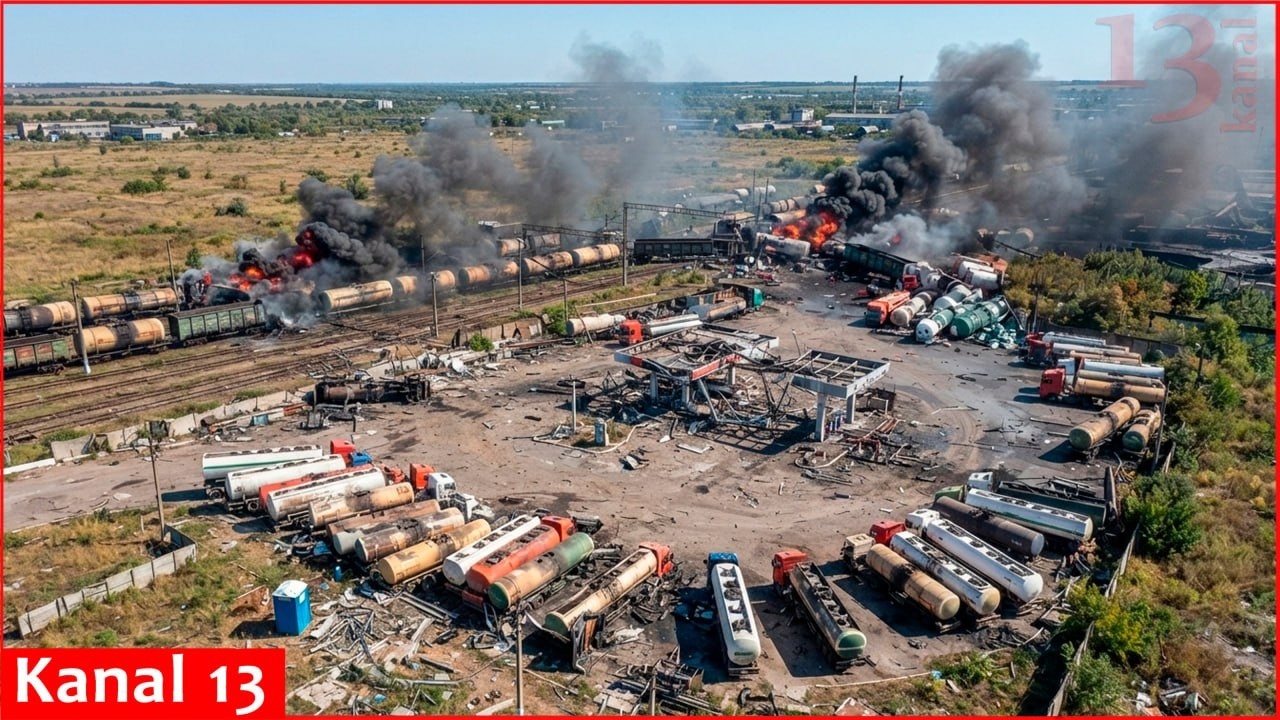
Operation "Hell-2": Ukrainian Azov fighters destroyed dozens of Russian fuel tanks in the Donetsk
Watch on YouTubeVideo summary
In Operation "Hell-2," fighters from the first Azov core of Ukraine's National Guard successfully targeted and destroyed critical fuel storage facilities used by Russian forces in the occupied Donetsk region. Upon detecting the movement of Russian fuel tankers, Ukrainian defenders utilized drone strikes to eliminate these stockpiles before they could be deployed or stored safely. A statement released by the unit emphasized that while they had warned the occupiers a month prior about their awareness of enemy movements, some Russian units persisted in storing fuel within the occupied territory, prompting a decisive response. The operation resulted in the destruction of 67 tankers, effectively neutralizing over 4,221 tons of fuel and lubricants that were intended to support Russian military operations along the front line.
The video documentation accompanying the report highlights a map showing the locations of these targeted facilities, which are now described as scorched earth following the successful drone attacks. The Azov unit made a clear distinction between their tactics against military infrastructure and those targeting civilians, stating that unlike the Russian occupiers, they do not attack civilian gas stations or harm non-combatants. Instead, the statement underscored that the infrastructure supporting occupation forces would be destroyed without mercy, reflecting a strategic focus on disrupting the logistical supply chain rather than engaging in indiscriminate violence against the local population.
Despite these tactical successes in damaging Russian logistics, the broader situation on the ground remains tense as Russian troops continue to make advances in the Pokrovsk district of Donetsk Oblast. According to the Deep State Monitoring Project, enemy forces have pushed forward near the village of Novooleksandrivka, which is part of the Kryvyi Rih rural community, allowing them to shift their line of advance in this sector. While the monitoring project confirmed the fact of this specific advancement, it noted that the exact distance of the push remains unspecified and that no other significant changes have been reported in this immediate area as of the latest update.
The ongoing conflict is characterized by a dynamic front where monitoring projects regularly revise their maps based on new intelligence regarding shifts in the battlefield. Although the Deep State report confirmed the Russian advance near Novooleksandrivka, it explicitly stated that there was no information available regarding other changes in this specific region at this time. This highlights the fluid nature of the war in Donetsk, where Ukrainian forces continue to execute precise strikes against key supply nodes like Operation "Hell-2," even as they face persistent pressure from Russian attempts to expand their territorial control in the Pokrovsk district.
Read the full video transcript
Fighters of the first Azov core of the
National Guard of Ukraine destroyed
facilities used to store and supply fuel
to Russian forces in the temporarily
occupied Donetsk region as part of
operation hell two. Ukrainian defenders,
having detected the movement of fuel
tanks, launched drone strikes to destroy
the Russian occupiers fuel and lubricant
stockpiles. A month ago, we warned the
occupier. Azov is aware of their
movements and will strike at the right
moment. However, some units of the
Russian armed forces continued to store
fuel in the occupied territory of the
Donetsk region, the statement reads.
NSU's first building also released a
video showing a map showing facilities
used to store and supply fuel to
Russians. The site of these facilities
is now scorched earth. As Ukrainian
defenders noted, unlike the Russian
occupiers, the first core of the Azov
National Guard does not strike civilian
gas stations or attack civilians. But
the infrastructure of the occupation
forces will be destroyed without mercy,
the statement emphasized. The video
shows the drones hitting their targets.
It also notes that 67 tankers were hit,
destroying 4,221
tons of fuel and lubricants. As reported
in July, Azov fighters carried out
operation Peklo using drones to strike
the infrastructure of a secret Russian
base in Novoambrosiyevka, Donetsk
region, from which was supplied to a
wide section of the front line. But
recall, Russian troops have made further
advances in the Pokrovsk district of
Donetsk Oblast. According to the Deep
State Monitoring Project, the occupiers
have advanced near the village of
Novooleksandrivka.
The map has been updated. The enemy has
advanced near Novooleksandrivka,
the project's report states.
Novooleksandrivka is located in the
Pokrovsk district of Donetsk Oblast and
is part of the Kryvyi Rih rural
community. Thus, on this section of the
front, Russian troops were able to shift
the line of their advance. At the same
time, the Deep State report does not
specify exactly how far the enemy has
advanced. The Pokrovsk district remains
one of the areas in Donetsk Oblast where
Russian troops continue to attempt to
advance. Monitoring projects regularly
update maps based on available
information about changes on the front
lines. Such data may be revised as new
information becomes available.
Currently, only the fact of an advance
near Novoalexandrovka has been
confirmed, according to Deep State. The
project's report contains no information
about other changes in this specific
area. The monitoring project Deep State
reported on the advance of Russian
troops.