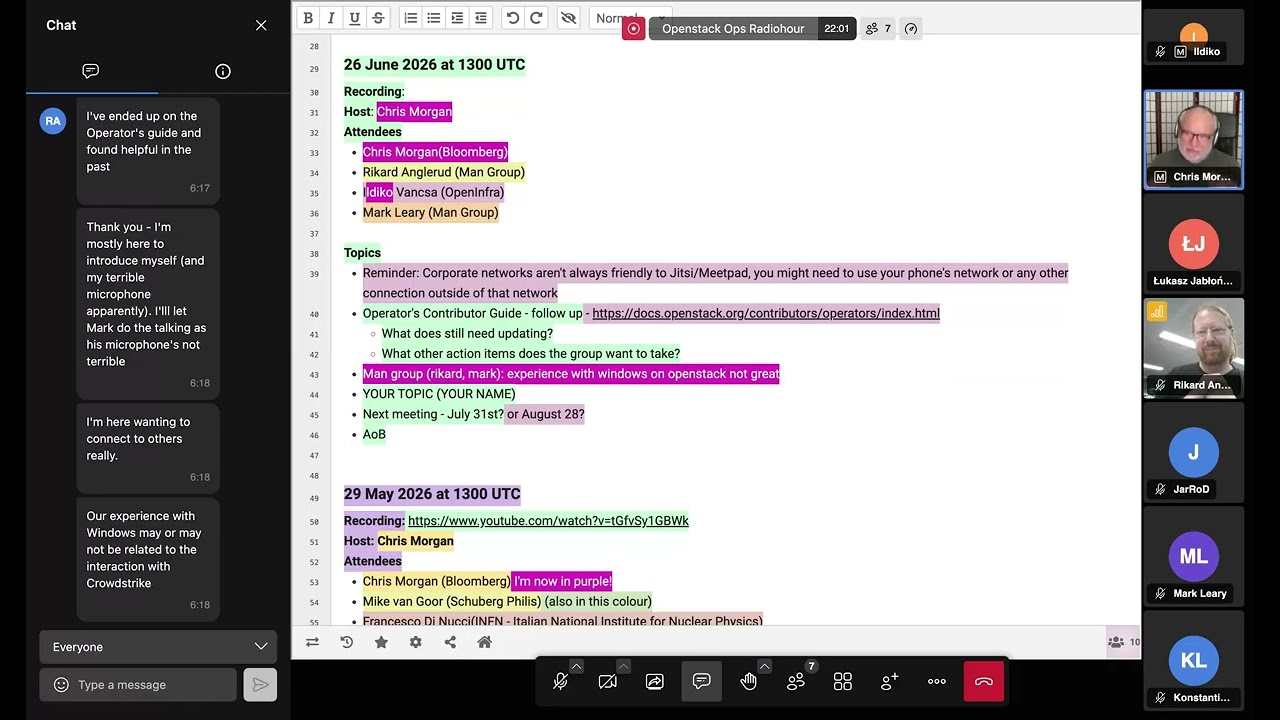
Video summary
The OpenStack Operators Ops Radio Hour from June 26, 2026, served as an informal monthly gathering for community members to discuss operational challenges and share experiences regarding the management of OpenStack environments. The meeting began with technical difficulties related to connectivity issues between corporate VPNs and Meepad, highlighting a specific tip that participants should avoid using their company networks if they experience unreliable connections during these sessions. A significant portion of the discussion focused on updating the Operator's Contributor Guide, which many attendees felt was outdated regarding modern tools like Ansible and lacked coverage for current best practices such as Matrix communication channels instead of IRC or email-only workflows. The group agreed that while a comprehensive Administrator's Guide covering every possible deployment scenario might be obsolete due to rapid technological changes, the Contributor Guide is salvageable with necessary updates to reflect how new operators can effectively engage with the community.
A major technical highlight involved detailed troubleshooting regarding running Windows VMs on KVM-based OpenStack platforms, where participants shared breakthrough solutions for common pitfalls like incorrect metadata tagging, hardware clock synchronization issues between local time and UTC, and MTU negotiation problems affecting jumbo frames performance. The conversation also addressed human factors in cloud operations, specifically the friction that arises when distinct teams (such as Windows administrators versus cloud engineers) operate in silos without direct collaboration channels; one speaker described successfully resolving this by establishing a working group with shared access to test clusters and hardware resources to de-risk production deployments before full rollout. Additionally, attendees discussed migration strategies using tools like VJailbreak for converting proprietary virtualization environments to OpenStack, noting that while some vendors have raised prices significantly driving users toward open-source alternatives, managing diverse operating system families still presents challenges regarding support liability and incident response expectations.
The meeting concluded with logistical planning for the next session scheduled for July 31st, acknowledging potential attendance dips during summer months but committing to maintain a consistent schedule rather than pausing operations entirely. Participants emphasized that specific technical inquiries about subsystems like OVN or ML2 should be directed toward the OpenStack Discuss mailing list or Matrix channels where subject matter experts are more readily available than in this general operator forum. The host also informed attendees of recent issues affecting community resources, such as the OpenStack wiki and other infrastructure pages being intermittently slow due to massive AI crawler traffic mimicking DDoS attacks, advising users to exercise patience when accessing these sites. Ultimately, the group reaffirmed their commitment to fostering a collaborative environment where new operators can find reliable guidance, share knowledge across fragmented communities, and continue refining operational practices through open dialogue rather than isolated troubleshooting efforts.
Read the full video transcript
Now we are
>> okay. Thank you. Welcome everyone. It's
a small gathering. This is the OpenStack
operators ops radio. If you haven't
joined before um think of it as a zoom
meeting once a month where we just get
together and chat about um OpenStack and
being operators of OpenStack. Um
the people who are joining today seem to
have terrible connection problems. My um
and I know I'm repeating myself, but for
the recording, my experience is I cannot
be on my my company's corporate VPN and
stay reliably connected to Meepad. It
connects and disconnects. It connects
disconnects. It's awful. So, I have to
drop that and I tell my colleagues, hey,
I'm not connected for the following
hour. Um so, that may be a a tip. Um,
the way this meeting works is we have a
ether pad and if you haven't found it,
if you click on the dot dot dot menu at
the bottom of the screen, it says more
actions. Uh, you can do open shared
document. So, if you aren't seeing an
ether pad in the in in the in your view,
that's the agenda. And it also has um
you know um the uh the host, which is
me, the attendees and the topics. and
then you can just type into it. So what
we do is we work on this doc document u
to try and capture some material, some
questions, some comments, some some
shared info, hints and tips. Uh
and you can probably see I thinko is
actually writing that the tip that
corporate networks don't work with this
very well. Um
I like the fact that we tried to use
Meatpad because it's infrastructure
hosted by the open infra foundation but
um yeah it's not Zoom. Um
you know big companies have special
arrangements with Zoom to make it work
well and scale and stay reliable and
Meepad is just over the over the
internet. So it's prone prone to these
things. Anyway, the agenda today um
pretty light. Um it's summer and uh
people are probably busy. Um here in New
York it's the last day of school so
people probably traveling that kind of
thing. U but the topic that did come up
is the operator's contributor guide. Um
what does still need updating and what
other action items does the group want
to take? But then there's um uh anything
else that people want to discuss. And
then um the question of the next
meeting. Um I haven't looked at July
31st. Um I do think that we could try on
you know in a month's time. Um so
the context for the operator's guide
which is the first agenda item is it's
out of date and um people have looked at
it and said oh it seems to be you know
needing an update. So I foolishly
volunteered to update it but we need
some sort of requests some content some
I guess bug reports. One thing is it
doesn't mention ops radio I believe and
it emphasizes um mailing this to IRC.
IRC is um difficult for many um people
in the community these days. For example
my employer it's um real IRC protocol is
banned entirely. We're not allowed. And
even a website that wraps IRC often
triggers the content protection agent.
So it's really hostile and it's just
kind of annoying. Um the ones that are
lively and work the mailing list I think
has become preeminent again and uh
matrix um there's a special channel for
operators there. uh but an eternal topic
is that uh people who are doing
OpenStack hang out in half a dozen other
places former Twitter, Reddit, LinkedIn,
Slack.
Um there's other suggestions for other
chat technologies. There was one last
month, I forget the name. Um but I I
think probably the the simplest thing
these days is probably the mailing list.
OpenStack discuss.
Hey Mark. Um I think you're one of the
people who was dropping in and sorry
joining and then disconnecting. So it's
hard for us to know whether you've got
anything out of this meeting yet. Um
>> yeah, I'm on my personal laptop. It's
working now.
>> Okay. Um so it's not clear whether we
have quorum for this meeting. So I'm
just I'm just kind of uh trying to see
if we if we can get a discussion going.
If if we don't have enough today, we
understand that it's summer. It's kind
of common that these things kind of
peter out. Um, we don't have to take the
whole hour. I'm very conscious that you
should always end meetings when when you
can. Um, but uh the the suggested topic
this week was going over this doc. I
think the link is actually uh somewhere
deeper in the ether pad, but I'm not
going to spelunk and find it. Does
anyone have comments on the doc? Like
would it be valuable if it was up to
date? Um, one of the things that we're
hoping to do is suggest that people who
are new to OpenStack do get on the mail
list and do get on matrix and we
actually kind of coales somewhat because
if there's 20 tiny communities, it's not
as effective as a couple larger
communities, I would say.
Um,
I have to kind of say this repeatedly.
This isn't a this isn't a lecture or a
presentation. And I'm not presenting
slides. It's meant to be a discussion. I
know some of you have have audio
problems or connection problems, but
like uh if it this isn't going to work
if it's just me speaking for forever.
>> Let me ask a question from the from the
group. Um is this the first ops radio
hour to anyone?
You can Okay, Ricard. Yes. Um I assume
maybe Mark 2 then if if you're with the
same same company. Um,
>> yeah, first for me.
>> Awesome. Well, welcome. Um, I'm curious
like what stage are you in with with
OpenStack? Have you already deployed and
running it or or um are you looking into
deploying OpenStack in smaller or larger
scale?
So be we've been running it for years
but um we're massively expanding the
scale of our
open stack platform as we're VMware.
>> How is your how is your OpenStack
experience so far? Like is it running
smoothly? like um you found this meeting
and you came to ask questions about
something that doesn't work well or want
to connect with others who are also
running OpenStack but you are currently
not experiencing challenges.
>> So our [snorts] biggest challenge right
now it's running smoothly with Linux
VMs. Um this our first time trying to
run Windows VMs on OpenStack and we're
not having fairy
That's interesting. We actually had some
learning with uh Windows on um OpenStack
ourselves. I could actually talk a
couple of things about that if you if
you like. I'm just trying to get a note
down about what we're actually
discussing because it seems like the
contributer guide doesn't have much meat
on the bone for this discussion, but
just generally like um getting into
OpenStack and Windows is a great topic.
Um so it's Richard and Mark
Uh
you can you can correct my language if
that's not a summary you you agree with.
So uh our hypervisor is KVM
and um you know you you deploy OpenStack
and you run Linux on KVM great right
everything works it's just fantastic
then you put windows on it sort of works
but it's kind of sucky and it's weird
right
>> so what we found is [snorts] uh the
Windows team had uploaded images to
OpenStack and they worked but they
weren't tagged as being of with metadata
windows I couldn't tell you the exact
thing for
I can get it if someone wants to email
me. I I'm happy to share. So, KVM has a
different set of defaults that are good
for Windows, but it has to be informed
that this VM is Windows.
>> Um, so that was a big step forward for
us. Um, the second thing was um
the Windows admins like to keep their
Windows machines in uh set with hardware
clock to local time which caused
problems with things like logging and
other things. Um and we were able to
verify with them
uh a registry change that told Windows
hardware time is UTC which is our
corporate standard and that worked well
after some fiddling around. Um those are
the two biggest breakthroughs we had
with Windows and then um we did have a
problem with um Go ahead.
I think someone was asking a question or
a comment. Go ahead.
It's open. It's not a presentation.
Speak up.
Okay. Maybe that maybe not then. Um
anyway, so we run um a fair amount of
Windows on OpenStack successfully now on
KVM. Um and um we've successfully got
past a few other issues that were more
minor. One of them was that um we moved
to jumbo frames and for whatever reason
Windows didn't notice that or didn't
negotiate that. So it wasn't correctly
setting the right MTU which is very
important if you're going to have good
performance on modern networks. You want
a 9K MTU. Um so those are some of the
things that we um stumbled across and
fixed uh and now it runs it runs very
well. In fact, we have um
sort of voluntary physical to virtual
migrations going on because we are in
more locations than the Windows team is
able to buy physicals. So, we actually
became preferred after. But one of the
things we had to do is um and this is a
I guess human factors thing. We had to
we had to actually reach out to the
Windows team and partner with them. What
we had before and this could be
corporate pathology unique to my
employer but I kind of doubt it is we
had the cloud and we had the Windows
people any problem the business people
would be territorial so there's a
problem with this server a VM running
Windows on OpenStack there's a problem
with the server so the Windows team is
like oh it's probably some cloud stuff
ask the cloud team to fix it the cloud
business owner is like well has the
Windows people investigated this first
they're the first line
uh escalation, send it back to them and
tickets would ping pong and nothing was
done. And so what we did was we set up a
a working group. They said we have this
issue and I arranged for them to have
direct access to our cloud engineers and
they just worked through um
you know this this this ops radio hour
is not really about how to manage teams
and conflict but that was a bigger
[clears throat] thing that was actually
a bigger problem than any of the
technical problems that I mentioned with
the hypervisor and tagging and MTU and
uh you know UTC setting. Um is any of
that helpful? I'd love to hear, you
know. Oh, two thumbs up. Wow. Okay. I'm
glad we had
super helpful. I'm just trying to not
have a microphone.
>> I really just can't make that out. I'm
so sorry. It's like you're in a It's
like you're in a force 10 gale. Like
you've got a microphone standing on a
yard in a storm. Like so. Um
>> yeah, that's helpful. Definitely the um
UTC something UT UTC thing is something
we should check. Um,
yeah, our current issue is we we
migrated a bunch of Windows test
machines, everything seemed fine, but
then when we went to migrate rail
workloads, we're getting a bunch of
random BSODs. Um, and we haven't fully
pinpointed the cause. Uh, part of it is
we run Crowd Strike on the Windows VMs,
which is not our choice, but we do and
we're forced to. Um and in a lot of the
crash dumps we've seen that crowd strike
seems to be involved. Um but that's
that's an ongoing issue we're trying to
diagnose.
I will say that um we used to be very um
dated on our versions of you know our
hypervisor platform which is Abuntu 22
our KVM QMU versions um and things
things are better for every all guests
uh now that we're on I think kernel 6.18
or something like that [snorts] um no
idea what how you're running your open
stack or whether that's an issue or a
possibility to go up to date um do you
know whether you are tagging the images
so that KVM is aware and some I know
that's thing with the mind.
>> Yeah, we we do tag the images uh with
with with with the OS type or whatever
the the property is. And um
>> yeah, we're running um OpenStack 2025.1
on Ubuntu 24. I'm not sure the kernel
version. Um and we use cola anible to
deploy
>> and it is KVM presumably.
>> Yep.
>> Yeah. Okay. Um well that's actually
newer than us. So you might have the
opposite problem.
So um yeah that's a that's a that was a
key priority for our product the private
cloud inside Bloomberg because
um previously you know we we were known
that Linux worked well in it but Windows
had been bad and the Windows people were
like oh it's just not really for us we
need you know something else and we
solved that. Um, so we partner with the
uh very experienced Windows admins and
it's very productive, but we haven't had
the specific things. I don't think we've
had a BB SOD for a while. One of the
things I was trying to recall was we did
have a problem with um I think SSD trim
and Windows handling of block devices.
Um,
Windows and Linux have different views
of how to drive
block devices presented by, you know,
KVM basically. Um, but that was several
years ago now, so I can't share great
info about it, but I can dig something
up if if so what we saw was file system
corruption and not a kernel crash. So,
um, probably a different issue.
>> Um, we do have crowd.
>> Very interesting to know that as well.
say again
that
>> that's very interesting to know that you
also have crowd strike um and and we did
we did find that our our machines were
not very happy when we switched from vio
store to uh vio uh but I don't think
that makes a huge difference for our
block storage on windows in particular
>> um yeah we're all our storage well 95%
of our storage is seth so Um
we don't I don't think we match the
storage configuration you have. We have
a little bit of um light bits NVME over
fabric. Um but I don't think that's
going to really grow anymore. Um anyway,
if um
if any of the things I mentioned that we
work through seem of interest, I can dig
out more information. probably all on
our Slack channel, something like that,
or you know,
PRs and
>> yeah, I'd love to know what what
metadata flags you you applied and then
we can we can try those as well cuz
yeah, we've been stuck for a little
while.
>> Okay. Um, cool. Well, I'm glad that we
were able to uh, you know, crack open a
topic and get something down. Um, so
my corporate email is corgan2
bloomberg.net. I'm not going to put it
in the ether pad, but you're welcome to
email me. We can connect that way. Um,
and then I will endeavor to dig out some
some fixes that we did for Windows. Um,
but uh yeah, we uh we are now u like the
Borg assimilating all of the Windows
infestations around the company. uh
because we we made the effort to make
our product good. But then of course
uh a big vendor who I shall not name
raised the prices for proprietary
virtualization
and now uh there's lots of people who
wanted to carry on with um Windows on
VMs the other way who now come to me. So
um yeah, it's been a good experience.
>> Probably the the very same reason is why
we're expanding our OpenStack footprint
quite significantly. Yeah.
Yeah. Um, do you actually use any of the
um, conversion tools from unnamed vendor
to OpenStack?
>> Um, I saw some presentations about that
and they're actually
quite good.
>> Go ahead.
>> And we're using a V jail Jailbreak. Um,
>> yeah, I'm quite liking. We have a couple
patches I'm hoping to get upstreamed,
but uh, yeah, quite liking it. Yeah. And
that if you're not familiar with it,
that uses vert v2v in the background
which is a more common tool.
I'm just trying to get something down. I
haven't heard of these things. Is B2B
the the open- source conversions or
toolkit?
>> Yeah, it's a very like command line
basic thing. And VGLER is a wrapper with
like a UI UI and API around it that runs
on Kubernetes. actually runs on K3s like
that. It self deploys in OpenStack
>> and
>> very nice. Yeah.
>> Uh the the company that makes it
platform 9 I think they have their own
OpenStack distribution that's you know
like a paid thing but we do not use
that.
Um this is actually useful information
for me. So I'm actually this is great.
Um I still have um potential customers
who come to me and um they're they're
there they're there what they come to me
is they say we'd like to use OpenStack
but we don't want to become your
customer. Do you have OpenStack kind of
in a box that we can install and we're
the admins
um but we no longer have to pay that
vendor. And I'm like, running OpenSack
is is, you know, kind of complicated.
No, we can't just give you our product
dehydrated and you take it away and then
you run it without our automation around
it. They're very disappointed. So, you
know, um maybe I can just say, you know,
if you really don't want to come and use
our actual cloud, maybe you can look
into VJL break, you know, because I
would like to help them um in whichever
way possible to get off um the platform
where the price rises are like, you
know, in some cases 10 times, right? Um
so I will look into V jailbreak. That's
great. Thank you. Yeah, that's open
source and free and yeah, we've had good
luck with it for the most part
>> and it's it's very user friendly. It's
quite a big selling point for it.
>> Um, okay. So,
you're running um Windows and Linux or
just Windows?
>> Oh, both. Roughly roughly equal amounts.
>> Yeah. Our old our old open stack which
is is running walabe is 100% Linux. Um
our new open stack yeah it's like a
50/50 mix or will be
>> cool cool. It's very similar to what
we're doing. We um we have um re andu
guests and windows and uh the latest
challenge is um
a vendor image from Cisco.
Um I'm naming them because I'm not
badmouthing them. Um for um SMTP mail
scanning um
you know our mail scanning people say we
want to use your cloud but we have to
use this this image. We've decided this
is the only way
>> and uh it's net BSD
>> and um we're actually um
>> oh
>> once bitt and twice shy now because
their attitude is we loaded it in dev it
runs so you're fine. You don't need to
worry about it works on your cloud and
but we know that
if if this appliance is doing the mail
scanning for the the entire Bloomberg,
you know, enterprise and that breaks our
incident support people will be like,
well, how do we fix it? What's wrong
with it? Is it the cloud? Get the cloud
engineers on the line. Even if it's, you
know, the middle of the night on a
Saturday night, right? So, um, we're
reluctant to pick up more mouths to feed
in terms of different flavors or
different OS families. So for us it's
real, abuntu and windows and that's
that's it.
>> Um it's a shame because
>> interesting for us because
>> yeah there we have a whole bunch of
things that are deployed as um I can't
remember the name of it but it's like a
like a package format for for VMware um
>> OVA or something
>> and and and yeah those are the ones.
Yeah. [snorts] So we'll see how those
go. We haven't we haven't dried those
yet.
Well, my my view is it's um like as as
uh Riota said, do or do not. So, NetBSD,
we support it or we don't. There's no
such thing as, you know, allowing it on
at their own risk because an app team,
they're not actually taking the risk,
right? If it's if it's running on our
platform and then it breaks because we
upgraded OpenStack and got a new
>> KVM and there's some misunderstanding of
how it views the network or storage. We
broke it. They didn't break it. Right.
So, um it's like gonna get the call.
>> Yes. So, um we're having that discussion
right now. Um you know, and people
basically turn up with I've made all the
decisions and the answer is your product
has to be our platform with the
following
demands. And we were like, nope,
sorry. Um
not just like that, right? Like if the
business decides um we do want to have
free BSD support, we'll first of all
support it non sealed vendor image right
we'll just upload an image and have some
tests does it boot does it consume
storage does it do networking and then
when we upgrade OpenStack we'll do those
tests right um otherwise it's a it's a
liability you know we don't have like
open season upload your operating system
on this cloud because when it when any
operating system issue turns up, we are
at least 50% on the hook. So,
>> I'm not sure anyone asked the question
that led to this speech, but I I'm
interested in what other people are
doing with OpenStack. Are they allowing
any OS? You know, is it truly, you know,
at your own risk, just buyer beware?
Because that's not our experience, you
know.
No, I I think we would very much prefer
to stick to a an unknown set of base
images. We we'll see if we can uh we can
hold that line.
>> Yeah. One of our problems with Windows
is our Windows team are well, it's not
combined Windows Linux team, but most of
the images are 2019. Um, and I don't
know if the crashes are related to it
being Windows Server 2019 or it's just,
you know, a statistical thing [snorts]
that most of the images we run are 20
Server 2019.
Um, we would we we would like it if they
upgraded to a newer version.
So, one of the things we we did uh and
um I'm not lecturing it just it used to
be that people thought that oh we do we
do all the cloud stuff but for Windows
we just said look we really don't know
right we don't know Windows we don't
want to know Windows but what we did was
we partnered with the Windows teams we
said you are key partners of ours you
will have image upload rights you will
upload images you will test and then if
you have any issues you have like open
access to the engineers
And you can have access to hardware test
clusters that we have that are identical
to the production spec hardware and they
run in the data center. The only
difference is they're not allowed to
have production workloads. So you can
upload windows there and you can do
things even up to internal beta with
everything representative right the the
network firewall policy the um the uh
even the the ACL's on the routers
everything is legit right. So if it
works here, we we've done a great job of
d-risking for full production open set
clusters and that's been extremely
productive because they they have the
confidence to kind of explore cloud and
understand that uh it's it's really it's
just like a different form of hardware,
right? Like you you load them windows on
it probably works. If it doesn't work,
there's a bug. we might talk to the
vendor or in our case, you know, they
might ask us about storage performance
or network issues, but [snorts] it's not
so mysterious once we partner with them.
Um, so now they're kind of
um
helping our product do a great job for
the Windows users at Bloomberg, which is
still, you know, huge. It's critical.
So, um, that's how we kind of solved
that. Um but we had to kind of take like
a left turn because the the old way was
butting heads you know cloud business
sponsor Windows owner just we're like
this you know that doesn't that doesn't
help.
uh any any more topics about any more to
discuss about you know initial
experience with with open sec group um I
am conscious we have other people
there's a question here Lucash about a
specific bug and I think you've you've
handled that in the uh in the chat
somewhat is that yeah that's that's way
outside and we don't even use OVN or
call anible so it's lots I can comment
I don't know if anyone on the call is
working with cola anible or um
is aware um like have looked into that
um that bug. Yeah, I we grabbed the the
patch link but I personally don't have
information whether or not um like what
the plans are in cola anvil. Does anyone
else know?
We do use cola anible and OBVN. So we
would be interested in this.
>> Okay. I mean what I usually do um two
things. I write up a a quick summary of
of these meetings and I send it out to
the OpenStack discuss mailing list and I
also post it on the um OpenStack Ops
matrix channel. So those like the
mailing list has a wider reach [snorts]
so people can follow up there. If we
don't have anyone here on the call
specifically who's knowledgeable what
the plans are, then the mailing list can
be a good um
followup
um to see if if someone someone else
knows or if multiple of you raise
interest that yeah this would be great
to have then figure out how to get to
the implementation part and figuring out
the
um resolving the bug and and all those
kind of things
>> and the um the matrix channel could be
um the matrix channel could be a good
place to also discuss even the
metadata and things that that you were
talking about for the for the Windows
WMS. Um, if there's anything that that's
not too specific and you don't mind
sharing on sharing it on the matrix
channel or on the email uh mailing list,
then others can benefit from the from
the guidance and experience that you all
have as well.
>> I don't know, Lucas, I saw that you um
that you just joined back. Um, I don't
know if you have any other um things to
say about the the BOG and the OVN BGP um
agent support topic.
I was just describing that um I'll send
notifications and um recap to the
mailing list and hoping that someone
might jumps on the topic.
Yeah, I would echo Elico. Um I agree
because the purpose of this meeting is
to try and get operators together to
sort of elicit um you know
collaboration between operators about
their experience about running it. But
when it comes to a specific request for
this but this feature being added to
this you know um OpenStack project um we
don't necessarily have those people on
this call. So uh I do think as Eldico
said the the mailing list has the best
reach these days. We we determined that
really all of the other sort of splinter
groups and all the other social media
platforms are very small, very
scattered. Um but there is also some
attempt to say but you know we do like
chat programs. Matrix is the one in that
space. So I would take that question to
one of those two places. Um but I will
say that people people do review these
uh recordings and then uh some
conversations happen based on just
issues raised in ops radio happen just
spontaneously someone like I saw this
question
>> um raised in the ops radio and here's
the here's the you know the the fix or
here's the the release that that fix
that feature will go out and that kind
of thing. So
>> I'm not [snorts] saying don't mention
your your questions your your needs
here. It's just that you know we don't
actually have a caller Ansible
representative here or you know a Nova
compute expert you know that we don't
have the developers here. Um I'm trying
to sort of facilitate the operators
community
kind of reforming into an actual
community that can actually communicate
with the developers. Um, but this would
not be the actual forum for deep
questions on subsystems of OpenStack.
Um,
and I hope that made sense. I feel like
I'm rabbiting on here. Um,
>> can you hear me now?
>> Yes.
>> Oh, great. [snorts]
Uh,
>> loud and clear.
>> Yeah, I'm quite new uh in OpenStack
world. So
BGP agent and and cola.
Uh
>> I'm afraid you dropped out again, Lucash
there. Um we know we we heard half of
that. Um you're saying you're quite new
and then there was a a gap. Um, I don't
know if you heard what I was saying, but
um, Ilico had said that for very
specific questions like this, you should
probably go to the OpenStack discuss
mailing list because that does get
>> um, good interaction. There are lots
lots of places where people discuss
OpenStack. There's this, but there's
also Slack, Reddit, Twitter, um,
other chat platforms. But I think I
think we're trying to emphasize matrix
and the mailing list. Um I would take
that there. Um although there is a
chance that someone will see this and
respond later. It has happened because
people check these recordings and then
you know there are people who said I
can't make the meeting but I'll look at
the recording after. But yeah if you
need to get an answer for specifics like
that mail list is best I would say.
>> Okay. No thanks.
Uh
there's some chat going on here. I'm
just reading it.
Okay. Um,
I'm not sure who Moose is, but uh
um
is this
um I'm sorry, I'm trying to understand
the chat retrospectively.
>> No, it's just
>> Oh, it's about the wiki being broken.
>> Threads. Yes. uh if if anyone runs into
the OpenStack wiki not loading or the
the mailing list page is not loading
momentarily.
Um so the the background issue is that
there are lots and lots and lots of AI
crawlers on the web these days and they
are bringing down all kinds of resources
including open dev resources as well.
the open death team is who's running the
the wiki and some some other um
resources that the communities um
supported by open infra are using and so
the team has implemented some guard
rails but every now and then it's um the
wiki and and other pages might still be
slow or you run into some checks that
think that you are also an AI crawler
sometimes like my web browser definitely
case every now and then seems to act
like that. Um, so don't refresh pages
too often or or too fast. Um, so don't
be surprised. Um, just be be patient and
try to load it again a little bit later
if you if you run into a challenge. the
team is aware but but AI crawlers really
show up as um DDoS attack like we are
talking about tens of thousands or
hundreds of thousands um requests
pouring in by the second kind of anyway
some some kind of a crazy scale I don't
know the exact numbers just trying to
throw out something really big um but
that's what's going on in the in the
background it is unfortunate and um
sadly it's not an easy challenge to
solve.
So that's um yeah.
I also dug up the um
mailing list um
info looker. Uh drop this into the ether
pad.
So, I just dropped in the a link uh for
the OpenStack discuss mailing list. Um
if you haven't had that one yet, if
you're not subscribed, um it is in my
understanding the the mailing list is
now running on Mailman 3, which is kind
of a little bit of a fusion between
mailing list and the forum. Um I haven't
tried it. I haven't tried to use it in
the forum way, but if like if you don't
want to want to necessarily subscribe,
there might still be a a way around to
to use the mailing list, then you can
always access the archives. They are
public and visible to to everyone. Um,
and I'll also dig out the matrix link
from somewhere.
Thanks, Silico. That's a that's a great
reminder that the mail list is is is a
lot better than it used to be. Another
thing that um helps it um have good
signal to noise ratio for your topics is
to use the tags in square brackets. So,
OpenStack operators issues the
suggestion is to always put ops. Um, and
other people will do things like Nova or
OVN or Cinder or those kinds of things.
Um, and then you can just filter for
those. So, even though it is a bit of a
fire hose, um, if you wish to just see
certain topics, you can do that. Um and
I think um
Fungy Jeremy Stanley was one of the
infrastructure supremos um recommended
the web interface um as another way if
you don't want to subscribe to so many
emails into your actual mailbox.
Um so while you were speaking Ilicico I
did a sneaky look at my calendar. July
31st will work for me. Um I'm game for
doing it if you're game for turning up
and doing a recording and we can try. I
will be around. Um,
will people be available? Like it's
middle of summer, so there's a
likelihood of not having that many folks
around, but even today like we got up to
9 and 10 9 10 that was great. So I'm I'm
a
>> I I agree with that. The end of July is
is not great, but I think August 28th is
also not great, right? And then I
wouldn't want to say like, oh well,
we're closing until end of September.
That just seems, you know, too long,
right?
>> Yeah,
>> we might have a couple of thin meetings,
but I mean, I think we exchanged great
information about uh Windows, you know,
in this small group, right? So, um I'm
game, so I'll put it on my calendar. Um
if unless there's an objection of anyone
present, the next meeting would be
Friday, July 31st. Same ether pad, same
meat pad. um we don't change that which
is something the older coast suggested
which is brilliant. So you just always
keep this one link and you can find the
agenda the zoom meeting link I mean pad.
Um so that that works. Um,
>> also,
>> so I need go ahead.
>> Um, just a just a quick quick thought
like if if you all have any topics that
we um
that we didn't touch on today or didn't
find the answer to. um like either drop
it in the ether pad or or what would be
even better just speak out loud because
I always send out reminders to the
upcoming calls. So if there's a
particular topic that we could dive into
um then people will be aware sooner like
before the call and even if they cannot
attend maybe they can provide some
information. So it's it's easier to
encourage some more folks who might have
answers to questions if we know some of
them in advance because it's a it's a
bit random. OpenStack is a is a big
community with a lot of project teams
and we don't we usually don't have a
representative from every single project
team which means if you have a very
specific question then we unless someone
has experience with it on the call
otherwise we it's less likely to be able
to dive very deep into it. Um, so is is
there is there any topic or or any other
um bugs or challenges that that people
are running into that you would want to
try to have a an answer to on the call
on July 31st or by then?
>> That's a great question. While people
are thinking um we did have a request I
think three meetings ago for someone to
talk about high availability and
resilient architectures for OpenStack
and I actually hold in one of my
colleagues who's phenomenal at this and
he gave a talk on it. it will be in the
recording archive. Um because we run H8
control plane, we're we're 247 even
during upgrades. We don't go down at
all. Um
you know, so um
if that's something that you're
interested in, you can put in Slack or
not Slack, I'm sorry, you can put in
Matrix or on the mail list, you know, a
request and we I can try and get someone
to talk about a specific topic. Um there
I think we had universal information to
share. Um our networking is kind of very
niche. We use Calico for our neutron
implementation which uh is not very
common. So when people ask about um
open v switch or um OVN issues, I'm
sorry. I'm just like I have no idea.
Sorry. Um but it's it's completely valid
to to bring those topics. Maybe I can we
can find someone who can talk about
that. you know, if we said there's um I
mean, hypothetically, we said there's
new OpenStack installations going on.
The operators would really like to hear
from, you know, experienced
practitioners of X technology, whatever
it is. Maybe we could get a guest,
right? Um my vision for Ops Radio
was that it would be like one of those
talk shows where there's like a host and
then there's a guest, right? So, it can
be something you can just tune in and
sit back and listen to discussion. um
we've managed to do that a couple of
times but um I think we that would make
it um really valuable to to sort of get
the thoughts of a of a subject matter
expert related to OpenStack and get it
recorded and you know
bring that to the community. So are
there such topics
that anyone can think of? Um,
Eldica, I think, uh, you do a great job
always closing the loop and bringing it
back to the mailing list. Um, maybe we
should, you know, try and drum up topics
more actively. I I think I've been
remiss in that. Uh, for next time, um,
>> yeah,
>> sometimes have a have a chat in the
matrix room as well. Um, I don't know,
Chris, if you have you started to update
the operators contributor guide already.
>> Um,
>> I haven't started yet, but uh, I did get
myself an action. I'll I'll honor that.
So um I think we we have some material
further down this agenda dock about some
of the things that are obvious like um
you know um making sure that um uh
the matrix channel for the operators um
this event for the operators the
operators wiki uh you know is all
highlighted and anything that's that's
completely obsolete and wrong gets
deleted. Um
but no I haven't started yet. I haven't
actually done a docs change for a while,
so I'd have to kind of refamiliarize
myself with how you do that. I have done
it in the past.
>> Okay. Um, let me know if you need help
or if you want I can I can put in like
the the matrix and and wiki pointers and
you can do the cleanup. Um, I'm just
thinking of Lucash and and others who
might be newer. um so that we could
start pointing more actively to to that
document as well to help folks to figure
out where to reach out and how to get um
answers to some questions or guidance on
on how to take next steps on things. Um
>> yeah, that's that sounds like a good
plan. Um we heard last time and this
time that it is useful from people who
are new to OpenStack. So I I definitely
feel like we should I should make the
effort. So um we'll clean it up, get rid
of any outof-date stuff. Um there are
other documents that we discussed
previously where it's a bit of a bigger
problem. For instance, the um the uh
operator's guide, I think it's called,
tells you how to run OpenStack and that
is like 10 years out of date, 15 years
out of date. Like it's so the question
is is it even salvageable? I think maybe
not. But the contributor's guide looks I
you know I had a quick look at it and uh
it does need an update but it is worth
saving I think. So um
>> that's where we should start I think.
>> I think community processes evolve a
little bit slower than the ways how you
can and should set up OpenStack. So it's
uh it's definitely simpler to keep the
contributor guide up to date compared to
the the operator guide which is also
goes into I assume some of the details
where it's a little bit of a preference
on yeah I want to deploy my environment
that way but what if I don't what if I
have another
setup in mind and then the operator
guide operator's guide doesn't cover it.
So yeah that that one is a bit more
challenging. I don't know if there's
anything that could be added there about
the Windows VMs and and those kind of
things or if that information is
available someplace else. Um I myself
have not um dug into those bits of the
documentation um as I'm not running an
OpenStack cloud myself so I I don't
necessarily know others might do.
>> Yeah.
So um it seemed it seemed that in a
previous meeting on the specific thing
of an administrator's guide, it seemed
like the the very idea of one guide
being a single document that told you
how to do OpenStack was kind of a a lost
cause now because you know it mentions a
range of tools most of which are no
longer used. For instance I think it's
Ansible Chef and Puppet and I haven't
heard about Chef and Puppet
being used by operators for years. So,
Ansible of course is still huge. Um, but
then there's all you know there's um a
lot of people are running OpenStack is
just an application on top of their
Kubernetes cluster or vice versa and
that it doesn't cover that at all. So,
it's it's extremely dated and to really
cover everything would be extremely
difficult now. It would be a much bigger
document. It would be continuously out
of date. So, I think that is
unlikely to be updated and be useful.
But I think the contributor's guide it,
you know, is just needs a a quick
retouch. So, um, I've given myself that
action and I'll I'll have a go and, you
know, um, I think Elder, if you and I
can contribute, collaborate on that,
that would be great. I am conscious that
we're
used up our time slot. I'm sure that
people have other things they need to go
do. So, um, any other business, any
other questions? Um, put in the ether
pad, put it in the chat. Some of you
have microphone problems. Um,
last time you ran slightly over and I
hate that, you know, because then maybe
someone was late for another meeting.
Always looks bad. So, I'd like to end on
time this time. It seems like we're
done. Um,
so thanks for joining. Especially thanks
if you tried connect many times and got
dropped off. That's um very painful. Oh,
Constantin says something would be
interesting to hear is the experience
with ML2 OBS. Okay.
Okay, I don't have time to sort of
comprehend that and respond before we
run out of time. I've just dropped it
straight into the ether pad. And if you
don't see the ether pad on the screen,
you maybe don't know what I'm talking
about. Um the dot dot dot menu. If you
mouse over it says more actions, open
share document and you'll see it. I put
it in for topics for next time.
Something to do with ML2 ovs uh which I
do not use so I can't comment on that.
Uh, anything else people want to drop in
or I think we we'll we're out of time.
So, um, thanks everyone. Um, if you can
if you want to join this again, I
recommend arranging to be able to do it
not on a corporate network because it
doesn't work for me and it didn't work
for I think uh, Rickard. Um, it just not
a good experience. Um but uh we'll try
and do this again on July 31st and put
topics in the mailing list or matrix for
next time and we will go over them and
if there's a
if a if a theme emerges we'll even try
and get a subject matter expert for that
topic. Can't say better than that right
but for now I think we are done.
>> Thank you so much for organizing this.
Uh this this has been Brian. Thank you.
>> Oh oh oh well thanks for joining and I
think we we're still growing this. I
think it's going to go from strength to
strength. Thanks to Ildico for always
closing the loop and keeping this thing
going and uh we will see you next time I
hope.
>> Thank you.
>> Thanks [snorts] a lot. Thank you. See
you then.