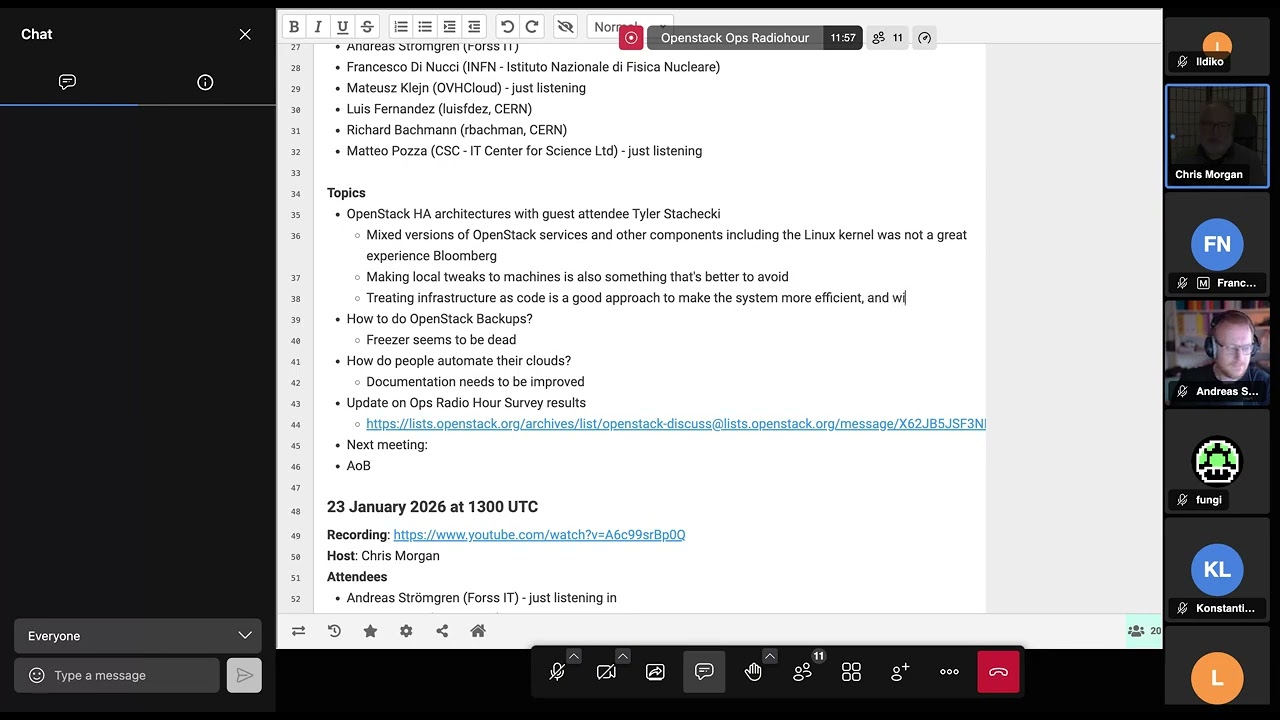
Video summary
The February 27, 2026 episode of the OpenStack Ops Radio Hour featured a deep dive into High Availability architectures and operational best practices, led by host Chris with special guest Tyler, Bloomberg's technical lead on their private cloud product. The discussion emphasized the critical importance of version convergence to manage scale and eliminate obscure bugs, prompting the team to adopt Infrastructure as Code and minimize local changes in favor of universal features or metadata toggles. To handle the increasing load on control planes as virtual machine counts grow, significant efforts were made to mitigate database strain, particularly within the Nova metadata service, by extending cache TTLs and optimizing internal configurations. While OVN remains the upstream default, the conversation highlighted that troubleshooting complexity often drives organizations like Bloomberg toward simpler Layer 3 implementations using Calico, especially when security constraints prevent full SDN overlays, though they remain open to adopting advanced features in the future.
Operational resilience was another central theme, with the team retiring legacy Nova-network clusters over a decade old and addressing storage challenges by negotiating for HA-capable NVMe drivers from vendors who initially lacked them. The group stressed that non-HA storage backends are no longer acceptable for enterprise environments, while also debating backup strategies; although separating data from the OS using Cinder volumes allows for independent infrastructure rebuilding, immutable backups like tape remain necessary to satisfy regulatory requirements and protect against ransomware. Automation tools such as Ansible were identified as essential but insufficient on their own for large-scale clouds, leading the team to integrate more robust orchestration solutions like Airflow, Puppet, Foreman, and ServiceNow for complex tasks such as hypervisor evacuation.
Following the technical deep dive, the meeting shifted to community engagement and future planning based on survey results, which revealed that the OpenStack Discuss mailing list is the primary discovery channel for new participants. The feedback indicated strong satisfaction with the current 13:45 UTC time slot, with most attendees preferring to maintain the monthly cadence rather than switching to a bi-weekly schedule, despite some interest in exploring different frequencies. Topics of high community interest included real-world war stories, pain points, automation techniques, monitoring, and deployment methodologies, reflecting a desire for practical content over formal presentations. The group confirmed that the next session would be scheduled for March 27th, coinciding with CubeCon EU, but noted that conflicts are unlikely since many attendees will not be traveling to Europe, allowing them to finalize the calendar entry after checking for any specific objections.
The episode concluded with a warm acknowledgment of Tyler's participation as the first official guest speaker, who shared valuable insights on scaling OVN and his volunteer contributions to the community. Attendees expressed particular appreciation for the working session format, which encouraged open dialogue and problem-solving rather than one-way presentations, and voiced enthusiasm for future deep dives into high availability topics. As the hour-long meeting drew to a close, the host decided to end the recording early to give participants time for coffee before wrapping up, ensuring a relaxed and collaborative atmosphere that reinforced the community's commitment to sharing knowledge and improving OpenStack operations globally.
Read the full video transcript
So for the uh February 27th, 2026
OpenStack Ops radio hour meeting, the
recording is now running. So uh Chris,
the floor is yours. take it away.
>> Thank you, Elderico. Okay, welcome
everyone. Welcome back. I guess we've
done quite a few of these now. Um so I
hope you can all see the ether pad.
That's the um the rough agenda. Um we
don't we don't have like a rigid
structure. Um so if people want to call
out and you know add topics, they can
write them there. Um but we do have kind
of a special guest. So last month there
were questions to me about um how do you
run OpenStack in a high availability
mode and um I started to answer the
questions thinking I really wish I could
just ask Tyler who's really our
technical lead on our private cloud
product which is based on OpenStack and
I said could you just join the next
meeting and he said sure. So he's
actually joined. So Tyler has been uh
instrumental in building this to a key
platform for Bloomberg uh and has
presented at OpenStack uh or open infra
conferences in Berlin and uh has
upstream contributions. So um he knows
his stuff uh better than I do these
days. So um he's here if uh if any of
the people who had questions last time
are here they can ask or we can just you
know um
uh
you know discuss HA architectures in
general um we run uh a mix of
architecture so we don't have one giant
cloud that must be up all the time we
have
uh between 10 and 20 instances but each
of those is also getting large these
days
>> and has enough scale fail to be um a
scaling problem and also enough business
logic dependent on it that if it's down
it's you know it's a major outage. So um
you know the HA aspect of it the control
plane is a very important thing that we
uh you know put a lot of effort in. we
have uh most of those key services
clustered or in HA mode um you know uh
database load balancer
uh
message bus uh storage control plane
etc. So are there any any specific
questions on on on how we do all that
that Tyler might be able to uh you know
comment on.
So uh in case anyone is um new to this
um this is actually supposed to be a
working session. This is not a
presentation. So if no one speaks it's
going to be very short. So um please do
actually uh you know participate. Um
it's not a slideshow, right? You're
tuning in to actually talk about the
work we do. So um really need people to
actually talk rather than just sit
there. Right now I've got only one
person on video, no one's speaking. So
it makes it impossible to to get
anything out of this. So
>> don't be shy.
>> There are still people joining it seems
um at least in the past minute or so.
And um based on the survey, HA and HA
configurations is one of the topic areas
that people are curious about. I'm not
sure if everyone is ready to ask
questions. Maybe some folks are new and
trying to figure out how to do HA in the
first place. I don't know if you all
could maybe share some good practices
that you had good experience with or
some things that you ran into and you
had to resolve or any challenges in
terms of how to operate OpenStack in
high availability
configurations
that you think would be great for people
out there to see because um there will
there will also be people who will be
watching the meeting recording on
YouTube and um so if if there's any
lessons that you learned good or bad um
and you don't mind sharing that would be
I think very useful for folks on the
>> Sure we can we can talk about some
lessons learned I think we are deep
enough in that um we've made some
mistakes and then recovered from them
one of the things we had when we first
started our current product was we had
skew between the different deployments
so we had you know two or three clusters
and they they were initiated at a
slightly different time. So they ended
up with a different version of the DRO,
different version of the Linux kernel
and slightly different versions of
OpenStack. Um, and it was kind of a
pain, but we could deal with it. But as
you get to,
you know, um, approaching a different
order of magnitude, it's unsustainable.
So what we did was we actually um got to
a point where we converged uh the exact
software version of all of the
deployments to one release as we you
know we cool we call it and um we also
stopped making local changes to machines
in the vast majority of cases. So
there's in the production fleet there's
no machines where the Nova configuration
is slightly different because we had a
different workload and we really wanted
to just do a special favor locally. Um
we um we treated as infrastructure as
code. So if we need to do a feature it
has to either be universal or we have to
uh have you know toggles in the metadata
for a particular installation. Um but
the code is universal. So when we do
testing um it's actually representative
because we have hardware test clusters.
They're small but um the key point is
that actually puts some mileage on the
configuration that we use in production.
It's not one of many or close. It's
actually the same. It's exactly the
same. Um the main differences we see are
test clusters. You can't afford to have
them at the same scale as your
production installation. So problems of
scaling are harder to spot. But of
course we can do things like impose a
punishing load and push things to their
limit like maybe make cues grow, make
memory under pressure, make storage
slower, those kinds of things. And um I
think to a large extent that's allowed
us to scale to as I said between 10 and
20 production installations
um without a growing amount of um you
know uh
local changes and local pain and local
divergence and inscrutable bugs because
this cluster is different from that
cluster. We can often debug our problems
on the test cluster and then deploy the
fix to the production cluster and it's
it's effective. Um, does anyone want to
speak about how the problem of skew that
they've had? Is anyone actually uh
running more than one installation and
they're different?
Uh, I see Fungi would like to
participate. Does that mean you want to
speak? I I don't use this other than
monthly. Go right ahead.
>> Yeah. Um, I I
don't have a ton of experience operating
OpenStack clouds surprisingly. Um but uh
as a as a user we see a lot of
challenges
um related to version skew between
different versions of OpenStack. um just
because uh we run uh a lot of crosscloud
workloads and being able to to have one
single client that works with you know a
dozen different versions and vintages of
of OpenStack APIs out in the wild in
public clouds becomes challenging really
fast. Um, so I I can I can kind of
understand even just from a from a user
pain perspective that version skew
becomes problematic. Um I I did have one
uh related question
um which was were there specific
services within OpenStack that that you
found more challenging to make highly
available and and for that matter even I
a lot of people have different
definitions of of what highly available
means for for their deployment and you
know where do you draw the line between
like is it making sure that the the APIs
are are available continuously or do you
accept interruptions in in API access
and is it just making sure that the
workloads that they're managing stay
running all the time? What what is what
what is your definition of highly
available there?
>> Ter you want to just take that?
>> Yeah, it's actually a really really
really good question. Um
there are many different ways to look at
highly available uh and there are
different different designs that you can
take with OpenStack that
your business may be willing to accept
risk of some form where another business
may not be willing to accept that risk.
I think you know when you look at uh
OpenStack the regions feature for
example is really interesting in some
cases because it's so well integrated
with uh a UI like Horizon. So somebody
might want to, you know, one business
may find it, you know, valuable to go to
Horizon and have a single pane of glass
or even have a single endpoint where,
you know, their entire cloud is a
federated
uh asset. However, that it kind of means
that you are solely relying on one
global keystone instance. And there's
been a lot of work in the space where if
you go look you know a lot of people
have had um a lot of thoughts gone into
how you operate my SQL alongside
keystone in a way that you know provides
that uh you know the level of high
availability or stability. Um but at the
end of the day it really if you do that
kind of design you do have a single
point of failure in sense where like you
are solely relying on keystone and it's
supporting services to to drive your
cloud whereas other businesses say we
just we can't accept that risk at any
point and they have totally separate
endpoints totally separate clouds. Uh
high availability to one person may not
mean high availability to uh another. Um
beyond that is is your next question.
Your next part of the question I think
was about like certain parts of the
control plane. Um we've also we've gone
through you know Chris it's been seven
or eight years since we started like the
last major iteration of our our design.
We've gone through a lot of different
parts of the the growing pains
experience. Um early on surprisingly one
of the things that caught us offguard
early was actually uh the Nova metadata
service. So when we did our last um
major kind of overhaul of the
infrastructure and cloud became and
OpenStack really became a you know an
important you know essential out
critical part of the business. um
the
you know number of VMs grows and as VMs
are you know being used occasionally
people are quering metadata what's its
host name what availability zone is it
in all those kinds of questions but that
means though that essentially you know
as your number of VMs grow so does your
control plane load and for us it
eventually got to the point where we're
trying to figure out like where is all
this database load coming from and we
eventually kind of narrowed it down to
uh the metadata service was the
predominant
you know source of load uh across the
cloud just with the number of VMs
increasing on it and simply doubling the
TTL of that cache
>> gave us so much breathing room to the
point we ended up um doing some our own
kind of internal changes to the metadata
service to to reduce the load uh on on
our infrastructure in a way that is not
general purpose but it you know worked
for us and it allowed us to to scale a
little more. Um and beyond a certain
point you can use there are existing
um
things in upstream OpenStack that that
can afford you ways to shard out load
for things like the metadata service.
you can use cells within a a particular
region uh to grow you know nova Nova's
control plane alongside the number of
VMs and instances and things like that I
think there are um CERN and other I
think believe CERN uses cells I think
they they've published some
>> yeah we we use
>> yeah so there there's definitely use
cases out there where where people are
are leveraging that kind of
functionality uh one of the other
challenges that we've seen as you get
really really really big is neutron
because neutron does not have that
equivalent functionality for you know
there are no cells for neutron. Neutron
is really one bigger instance that has
to begin coping with the larger number
of uh instances across your
um you know alongside nova. And so now
we're getting to the point where we're
trying to figure out like how do we
scale neutron? So high availability and
scale it's very it's a very fluid
discussion and it's a very hard to to
quantify. Uh it depends on how you end
up architecting uh OpenStack and what
choices you end up making and what
you're what risk you're willing to
accept.
Another more recent um uh example of
talent of solving HA Tyler. Um so for
unnamed vendor of NVMe over fabric um
they delivered uh an overdriver but it
was not it did not support HA mode. So
they're like you know here we go we
we've we've you know we do OpenStack use
this. And then we talked to them and
said well we're not using a nonHA
storage driver. Come on. Like we've been
HA with Seth for uh a bazillion years. I
mean it's it's like 12 years now or
something. Um so they thought about it
and they said well actually we can we
can support it. It just might not be
perfect or you know there's there's this
said well we're only evaluating your
storage technology now anyway. Give us
HA and then you know if we have a bug
then we will work with it. You're our
partner and we want to get a different
storage back end. um into our product
and you know not necessarily unnamed
vendor but that technology looks very
promising. Um so you know um that was a
little challenging for them because
they're not just able to say here's some
software download it install it they
have to upstream it. So they actually
have to do OpenStack the the proper way
which is they need to uh you know meet
with the community get their stuff
reviewed get it merged and only then
were we willing to take it. So um you
know
it was a learning process for them that
um although we wanted to do a a
relatively small engagement with their
technology
they're still expected to both do open
source properly and to support HA
architecture because a non-HA storage
backend is an absolute non-starter for
us now like it's just not like what do
you mean storage is down like
>> they to them ha meant something
different I think when we first you
approached the vendor. They were new to
OpenStack and uh when we asked if if
they were HA they were thinking like you
know are you providing HA enterprise
storage and they were like yes yes yes
you know of course we're providing HA
storage they just didn't associate the
fact that the the Cinder driver has to
explicitly declare itself as highly
available with regards to allocation and
that kind of stuff and it it was a lost
in translation exercise that as they
became more familiar with OpenStack they
were um you know they're able to support
it.
>> I I correct me if I'm wrong, S, but it's
fair to say that their their stuff one
of the weaknesses is when they when some
of the associated actual storage servers
are having a problem, the the storage
service also has a problem, right?
In terms of maturity, it's a little less
seamless than Seph where when a Seth
machine is having a problem, Seph just
kind of evicts it and
uh yes to a degree. I mean this is one
of the I would say maybe one of the
ch more you know challenging things as
you're you know as we try to kind of use
OpenStack as an enterprise product
and similar things with other aspects of
um other things in the Linux Foundation
like Seth OpenStack is one of its um
utilities and powers is that it has so
many features
It's so interoperable. Um, there's so
many things you can do with it, so many
different ways you can bend it and shape
it and use it in your infrastructure.
But that inherently means that, you
know, with all of that flexibility, with
all those choices, with all those
options, it's hard to get total coverage
on, you know, and test confidence across
so many different options.
Um, so there's always going to be bugs
and issues that you have to, you know,
prepare for and help contribute back and
fix uh as part of,
you know, you know, what works for you?
Bunky, did that answer your question?
Anyone want to sort of ask qu related
questions to the topics that we brought
up? There are other things on the
agenda. Go right ahead.
>> That that was great. That that uh that
was quite thorough. Thank you.
>> Uh another thing I wanted to mention, we
talked about skew. Um I always want to
be honest about, you know, like the
struggles we've had. So we only just
retired from production, but we haven't
switched off yet our Nova network-based
legacy OpenStack clusters that started
like more than 10 years ago.
And so of course um we did have skew in
that sense because they they were they
were a evolutionary dead end because um
you know Nova network wasn't going
anywhere became deprecated and we
couldn't drag those clusters over to a
neutron based architecture in any way.
So and they still had workloads I mean
diminishing number but they I think the
last workload only got off like within
the past month. So um you know it is a
problem for anybody. Um you know you do
some open stack you get some workloads
on it that's it. You kind of took a vow
right you're supporting that until
that's off. Um we're very happy to say
that we're all um you know um caracle
set caracle I think and uh neutron with
with calico. So um we finally uh we
finally got that albatross off our neck.
Um we've got other albatrosses but that
was that that that infrastructure
predated almost every member of the team
being a member of the team. So it was
increasingly difficult support burden.
Um
>> okay so
>> um
>> go ahead if I may ask because in terms
of and high level of the service absent
we have been running the cloud for many
years now. So we have plenty of recipes
um yeah that is working for us like lot
of things rely on it proxies etc etc but
just as a question for the people in in
in the call in case they are facing this
and we are curious about it now we are
migrating to OBVN and this is something
that worries us because we are moving
from minus to OBN and one of the areas
we're focusing on now is how to provide
a proper available OBN setup um for
Nitron so I wonder if you're already
using OBN or in which networking stack
are you?
>> So that has to be a question for the the
non- Bloombergers because we haven't
touched OVN ever. I can tell you what it
stands for and that's about the limit of
my knowledge. I want to be very
forthcoming. Um but but please this is
again meant to be a working group. If
someone even wants to say yeah we're new
to OVN and we're looking at it that
would be like you know welcome
>> because from our side we try to follow
as close as possible upstream
recommendations like you know you run a
cluster uh OBN database you have some
layers of u relays that interface
between the DBs and the hypervisors but
yeah but I'm curious if someone out
there with more experience have faced
some problems with the setups and they
have tuned or refine their their setup
in a way that could be useful for others
because I guess many people now with the
application within splits they will be
moving to open vets OBN that is the
recommended default upstream
I uh I don't know if anyone's willing to
share that they even run OBN other than
yourself uh
someone's saying would like to speak
just go right ahead
>> yeah we're we're running OVM in our uh
stack setup. Uh and that is just because
that it was the recommended uh setup
when we when we started out a couple of
years ago.
So far it's been running good. Um I
would say it's a little bit complicated
to to um troubleshoot. Uh
uh but but it's been running stable. We
have a fairly small small setup. So, so
I couldn't speak for for you know uh any
HA setup with OVN but but for for our
single uh single cluster with
uh not too many machines it's it's
running it's stable. Um the main issue
is uh when you're trying to debug why
does the traffic go the way you expect?
uh it's
>> very complicated to to look in in all
the uh all the tables and trace all the
traffic um but but uh yeah when it works
it works and it usually do so
>> great thanks for the contribution
Andreas um we had special constraints
uh from our security people that
actually wanted to stop our product
doing full software defined networking
and keep it as some sense as simple as
possible in sense that no no overlay
network, no NCAAP, Dcap um you know so
uh we we use Calico for um like um a
layer 3 neutron implementation without
most of the SDN the fancy SDN features.
So from our point of view OVN looks uh
fascinating and full of toys but I never
love to play with it.
Yes, the we are starting to to embrace
and adopt all these fancy features and
also discussing as well with our
security team what the implications from
the point of view will be for for many
of these things because yeah things are
more complex but many things are
encapsulated that so everyone should
have a good visibility of what's going
on
>> so one thing um I would love to do is um
get more guest speakers if you will or
guest participants um but I don't even
know an OVN like advanced practitioner
in the OpenStack space. So if anybody
does know somebody um and you know they
could reach out to them and see if they
would join for a different session where
that could be a focus because um yeah
it's it's a unknown territory for me. Um
>> I think from from the from the
experience I had in the summit in Paris
I think the people from stack it they
have quite some expert in the area. So I
think maybe that would be a a good
community to to maybe one one month come
here and and discuss a little bit these
topics.
>> Okay. I mean I' I'd love to coordinate
with them, invite them try, you know,
try and uh demystify this and um you
know uh so if someone could put either
could reach out to them or give me
contact info, um I'll try and make that
happen. Um so uh that's quite a lot on
the first item on the agenda. Uh so I
guess I'll ask for any more questions,
comments, observations, experience with
uh OpenStack HA in particular. Um
>> the only thing I'll add to the OVN
discussion, I'm with Chris. I don't
really have experience in in OVN. uh but
more to say like when you're do when
you're talking HA opent stack uh moving
from one technology to another or
drastically changing how you deploy
parts of your stack it's a it's a big
lift and shift so when you're do talking
about HA deployment when you're looking
at OpenStack for an enterprise use case
be be very intentional uh do scale
testing think about how you're going to
use it see where the the limits are and
and size things appropriate you know
design your architecture to size things
appropriately. Uh because the last thing
you want to the last place you want to
find yourself in is starting to grow
into OpenStack or starting to grow into
an OpenStack deployment and finding out
that you know you're out of you're not
able to scale uh some part of the
control plane or some aspect of
OpenStack alongside the needs of your
business. Uh I think one of the big my
understanding of OBVN is one of the big
reasons it came too was because that
there were uh scaling issues with OBS as
it grew into a very large uh control
plane which you know going back to the
earlier point about when Neutron gets
very big it can get it can get hard to
scale and so you need to intentionally
see where those breaking points are and
and you know for your use case and be
prepared to deal with them ahead of time
because retroactively shifting things
that are in the air can be hard.
>> I agree with that and that actually
brings up all of the pain of the older
cloud which I won't bore people with too
much but for example it used tagged
VLANs which are finite. It used the
layer 2 span which means that you have
to have large switches and you
eventually run out of ports and um the
way that Nova network worked is each
tendency had an IP subnet. So you had to
decide how many subnets do I have which
is how many tendencies you have and how
big are they. So we had to have some
small, some big. Lots of people got big
tenencies and put two VMs in and other
people got small tendencies and filled
them to the max.
And we abolished supporting any of that
I think literally two weeks ago. So phew
um okay uh great great discussion about
HA and as Tyler alluded to we could
never get to the bottom of all of it but
um you know as as previously if people
have specific questions after this uh
you can reach out to me on um on element
well on matrix I guess element is the
client uh we're trying to get that chat
room off the ground um that seems to be
something that the community thinks is
okay other than I mean much better than
for instance, the you know the old sort
of Twitter community which is dead and
gone.
Um we are again just some people heard
this but our our project is not
currently open source but we do want to
re-release it in a in a a form we're
proud of in the future including a
buildable HA version. We did have that
for a while but some bits of our stack
became non-free due to vendor changes.
So uh but um as of right now you know we
are open to talking about how we do
things if they're interesting. Uh but I
do want to move on through the whole
agenda. Um so OpenStack backups um I can
take this question for us. We do the
most obvious and stupid annoying thing.
Uh apologies to any anyone who thinks
this is great, but basically we don't
provide it in the cloud, but uh VM
owners can talk to the actual backups
team and they install a net backup
client to install it and then send their
data out to the existing corporate data
protection complex and ultimately that
has I think a staging area on disk and
then giant tape robot libraries which I
think is super cool, right? But what's
what am I contrasting that with? Well,
there are continuous data protection
things that plug into OpenStack and
become self-service. You're like, "Yes,
protect my data." Uh, I won't name
vendors. I'm not supposed to favor
vendors, but um I think some of that
stuff is really cool. I wanted to go
there, but um you know um we already
have a backups and data protection team
and uh we also can't afford to back up
the entire cloud. Um I think that they
wanted it to just be teams who go and
talk to the data protection people and
then do the normal thing. Um, so if
people would like to volunteer something
maybe more interesting than that, please
speak up. Um, you know, I'd be
interested to hear um other other things
or you know, you can probably talk about
vendors more than than we are permitted
to. I don't know that could be true.
Um,
if if the person who asked the question
is here, I could ask them. Did that
answer the question?
Maybe they're not here. Sometimes you
have a problem that people put a
question on and then they don't they
can't make the meeting. So we can't
actually close the loop and make sure
that they got the answer.
From an infrastructure engineering
perspective, I would advise people it's
probably a better option uh to
leverage the capabilities of OpenStack
and and design, you know, going back to
designing infrastructure intentionally.
Uh you can avoid full backups by you
know intentionally making sender volumes
and putting your data on those sender
volumes and using cinder volumes to
carry your state as you need if you you
know use the instance in a um
declarative fashion. So if you correctly
model your infrastructure so that you're
you know able to just rebuild a VM
separate and have the VM's configuration
the software and everything separate
from the data you can then your backup
story becomes easier because your data
is separate from your operating system
from your operating system
configuration. You can redeploy
uh your infrastructure, patch it, secure
it, test it, uh stage it, all those
kinds of things separate from your data.
You can back up your data uh and manage
it just through uh Cinder at either the
block level at either the the you know
database or file or object or whatever
you want to do. So, you know, full
system backup, it it may, you know, I I
would probably steer people away from it
unless you really really have a need for
it or, you know, a legacy use case.
I will just argue with Tyler, which is
weird, but um uh keeping your data safe
and your application working on the
cloud the way he said is a great
technique, but it's not technically
backups in the sense that it's not an
offline disconnected uh thing that would
would be compliant with um regulators
who need to hear about tape and storage
and and and those things. Um we do have
some of that. Mostly what people want is
I want my data to be safe and if I have
a hardware problem, I want it to be
rescued and I want my application to
keep running. actual backups. You know,
the regulators need to sometimes see
that you actually have tapes on a shelf
or dis replicas that are disconnected so
that you know, for instance, if you had
ransomware loose in your network and
encrypted all your apps that you could
actually recover from an earlier
snapshot, that kind of thing. Um
so we don't have a lot of um interaction
with that because basically the app
owners if they need real backups it not
necessarily tape but you know tape like
disconnected immutable um they just they
install at the application level uh
and the other thing about Tyler's answer
of course is having a cinder volume
where your precious data is kept is is
of course u very resilient if your
storage is very resilient. We run Seph
with four replicas which is kind of
expensive on on NVMe so that uh we just
don't we really don't lose data if it's
in a cinder volume. Um we did in the
past have ephemeral storage which could
go away if there was a hardware failure
but exactly the wrong set of clients
used it. So we withdrew that because
they actually lost data. And one of my
favorite um you know stories over a cup
of coffee is uh the conversation where
someone said Chris we're friends right?
Surely you have my data in one of your
secret backups.
I like we are friends but I don't have
secret backups. I'm very sorry. Um you
know when we said your VM is going away
it went away. So um okay so trying to
move along if that topic is is done. Any
any further comments? Uh, how do people
automate their clouds? Um,
I think our answer is all Ansible all
the time at core, right, Tyler?
Um, there's many other things to be
said, but um, we used to do a mix of
Chef and Anible. Um, Chef is going by
the wayside. Uh, but we have our own um,
take on it. Um,
not the OpenStack Anible playbooks. they
kind of were opinionated in ways that
clash with other architectural decisions
that we made or had imposed on us. So we
have our own
um
and we're not containerized. So it's
kind of traditional in that sense. Um
anyone else want to talk about how they
automate their clouds particularly if
you're running a large one. The other
thing that I'm sorry
>> the other thing that came up with uh
Anible I think when we started out using
OpenStack it you know Anible was a great
first step tool in terms of you know
provisioning infrastructure as code and
treating infrastructure as code. I think
one of the challenges we had with Anible
as we you know the size of our cloud
grew is eventually your ability to
maintain your cloud you know you you
can't you stop being able to rely on
workflows that are manually
orchestrated. So even you know as you
have lots and lots of clouds running a
deployment across lots of them with
anible and having complex deployment and
release processes it becomes unwieldy.
So for really really large organizations
or if you have a lot of clouds, you'll
probably find eventually that it's
necessary to invest in
um you know how you actually use
Ansible, how you deploy Anible and
putting an API in front of Anible so
that you can begin kind of gathering
metrics on your deployments and and
things like that and treating the actual
Anible infrastructure itself as code.
I I believe uh is it Luis was was trying
to get a word in? Um just go ahead.
>> Yeah. Um because from my side I'm
curious at the level of managing
OpenStack not only the infrastructure
but how people automate the I don't know
how to call it like operations business
processes things like how do you handle
new projects? How do you handle when
things go wrong and you have to evacuate
machines? What sort of uh workflow
engines do you have there? In our case,
when it comes to infrastructure, we
continue to use the same tools we use at
the beginning. So, a lot of puppet
involved. Uh but then on top of that,
when it comes to interface with our
repair team in the data centers, we have
I don't know things like run jobs where
we are able to delegate task to them.
So, they're able to train our
hypervisors, put things out of
production, bring things back to
production, these sort of things. And
then we could be using as well things
like I don't know mistra workflows to
also automate some other processes to
make our lives as operators a bit
easier. So I'm curious what people use
for these sort of things beyond an or
maybe anible as well for some things but
apart from the the deployment of open
stack itself more like the operations on
top.
>> It's a great question. I see um
Franchesco has a hand up. Go ahead.
Just my two sh two two cents on
automation. Um we are using forman for
the full life cycle management. So
instead of anible we're using for and
puppet.
>> Great. Thanks for the thanks for
participating. Um yeah we actually do
use sworn. Um for us uh there are layers
of um automation that are not critical
to the core operation of the cloud but
there are things I think mentioned like
evacuating hypervisors. Um and we do
have um in the cloud reliability team is
called uh a lot of airflow. Um the nice
thing about that is uh it does integrate
with um our anible but it also
integrates with nonopensac systems
within Bloomberg. So for instance, it
can create tickets for a team who are
the owners of a tenency. Um and um I
think I also heard a question about how
do we handle tenencies? Um that again is
um basically an integration between our
OpenStack and other Bloomberg systems.
So it's kind of further away from my
area of expertise, but we did have to
make that basically self-service. Um
ultimately we none of us have done you
know like openstack project create for
an end user in
10 years.
>> So so I guess it's similar to our case
because in our case for instance that
workers will be some many in-house uh
pling between uh in our case open stack
and service now that for instance is the
platform that people would use in in our
uh in our organization to request new
projects in open stack and these sort of
things.
I think I heard service now. Yeah, I
haven't uh I haven't used that. Um
again, when you when you share a unique
perspective on these things, if you if
you'd like, you can put drop it on the
ether pad here because there are people
who come and read it after and get
answers or at least think, you know,
find out what we talked about and maybe
it spikes some conversations.
Um so basically we've done we've got
Anible, Airflow, Puppet, uh Foreman, the
usual things. Um
so any any more on the on the automation
thing? I mean obviously it's another
deep topic. Um and how are we doing for
time? We still got time. Uh so the last
item um or last substantial item update
on ops radio survey results. Um
I wonder Elica would you like to take
that maybe?
>> Yep. Yes. Uh so there's a link on the
ether. Um I don't know if you all want
me to try to share my screen and show
what's in there. It is the email that I
sent to OpenStack Discuss. So if anyone
is subscribed to OpenStack Discuss, uh
you probably received it already. If
not, then the link itself is pointing to
the archive with my summary. So, we
closed
the ops radio hour survey this
Wednesday, two days ago. And um if
anyone hasn't seen it, then it was
targeting to get information on where
people are finding the meeting series
and what time would work for folks. um
what cadence and um also what topics
people would like to discuss. So um
are you all looking at the uh the email
summary uh through the link or do you
all want me to try to share my screen? I
don't know how that works with the
recording though. Have I'm not sure if I
tried that before. Um I mean if you talk
through it I'm sure people can go and
get the details. I mean do you have a a
take on the sort of like key findings?
>> That sounds good. So in terms of where
people are finding the meeting series um
OpenStack discuss mailing list was
mentioned most frequently um almost 50%
of people and then the rest is uh the
scientific sig slack workspace was
mentioned we also did the opening for
foundation did a direct email outreach
to send out the survey links to
operators
So that was mentioned. The matrix
channel was also mentioned which I was
very happy to see. Um and we had uh
Reddit in the list and then OpenStacks
Summit and the the YouTube channel. And
um so we have a little mix of um the the
main communication channels for for the
community, the OpenStack community, and
then some other um ways how people find
the meeting series. We did ask whether
or not the current time slot works for
people.
um 80 almost 87%
of the responses said yes. Um with only
13% of responses saying no. Um in terms
of preferred cadence, bi-weekly and
monthly are in a tie with um over um
like what 43.5ish%.
And then weekly came up and every two
month came up as other answers for
preferred time slots. The current time
slot is not the absolute winner.
However, it is in the top three. Um 13,4
and500 UTC got the the highest votes. So
my personal assumption is that people
are respondents are likely in a bigger
percentage um maybe in Europe
um or east coast of um North America or
something along these lines. But um I
think every single UTC slot got some
votes. Um and if you look at the um the
email uh summary then you will see that
there is a little bump in the 01 and 2
UTC and then it goes down and it starts
to come up at 800 UTC and then it grows
um it goes up uh and the highest is400
UTC that got the most votes and then the
the curb curb curve starts to go down.
Um and um
the the absolute low is yeah towards the
uh the 22 2300 and then the 3 4 500
um UTC. So we have folks all around the
globe who are interested um in
participating.
um 87% of people would support to run
these gatherings in um in an alternating
time slot. So this is something that we
could try and in terms of topics that
people would like to cover that was a
very wide range of everything. Uh many
people would love to hear real life
experiences.
Uh what are the pain points? what are
the bugs and issues and how people got
around them and got them fixed. OP oops
uh war stories um came up because people
like not to feel alone with any
challenges that they are facing. Um
automation that we just talked about
today, backups and disaster recovery and
what do we do now that freezer is dead.
Um HA also came up. monitoring was
mentioned multiple times. Um
documentation is also something that
that came up. Um one thing that I
personally found interesting that things
like uh training and skills development
for operators came up as a topic idea
which I don't think we explored too
heavily in the past. So that is
something that I found very interesting
and we could consider the group could
consider to put it on the agenda and
also um getting involved and
contributing to OpenStack as an operator
came up which we touched on a little bit
but I don't think we um we dug into it
very very deep and then things like
deployment methodologies,
configurations, upgrades and patching
and how to automate that and how to do
that um those are the uh to me uh less
surprising topic mentions because these
things come up um relatively often.
So there are a lot of things that people
would like to talk about and um this
time slot is in general not a bad one to
stay with but we do have options to
explore in terms of hopping around uh
time slots a little bit and whether we
um do bi-weekly or monthly um that is uh
a question to the group to decide but in
terms of survey respondents
they would welcome welcome either of
those options. So, this is roughly um
how the the survey um responses turned
out and all of this um is in my summary
email on OpenStack Discuss and I will
share the the
>> I wish I could but I can't help with
emails here. I'm sorry, my my home
assistant just talked, so I don't know
why
my pod. Uh, that's great, Elico. Um, so
I think a key uh limitation of doing
these bi-weekly would be um hosts. Um,
this might seem really self- serving,
but I've done the last few. I'm wanting
to try bi-weekly, but um I don't think I
can get to weekly.
Um,
>> oh, people don't want that either. Um it
was like maybe it was a very low uh
percentage. Let me see. Uh yeah like
eight eight n% which was um technically
two um two people saying that weekly
could be a good idea and every two
months was one person. Um which was
representing 4% of the responses.
>> Um it sounds like
um a rough consensus that we're doing
okay for now. Um, I don't know how to
see whether we should go bi-weekly
experimentally. I guess we could set the
next date to be roughly two weeks from
now and see if we have uh involvement.
Um,
I haven't actually looked at the
calendar. So, um, did you have a
suggestion for the next
uh, meetup? So, um I mean do you want
like two weeks from now is uh
let me go back to my calendar. There we
go. Um
is March 13th and then if we keep the
monthly cadence that would be March
27th. I don't know if folks from this
group are going to CubeCon EU because um
that is that week. So if that is a
concern then we could um do March 20
which is between the the two and four
weeks um from now. So those those are
the options.
Uh,
>> so do you do you have a meeting on
Friday the 13th
is I guess the question for the
bi-weekly cadence first.
>> I mean u the people who who um joined
today should probably speak up. Um I
think the the options that Eldico put
forward are get I mean run this in two
weeks time in four weeks time or split
the difference. Um
I can try and run it. The other person
who has run some of these is I think
busy today. Um but uh it's really kind
of a question for the community like how
often should we try and do this?
>> So people on the call um are you
interested and available and have topics
to come and get together in two weeks on
March 13th?
raise your hand or say yes or
>> um
I if I could speak that I would say that
there isn't doesn't seem to be a strong
mandate from the people here to change
anything. Would that be fair? Does
anyone want to say that they disagree?
Um so maybe we should just go monthly
for now and then I think if we if we
started to have too much um content
then we could say let's just do more
meetings. Um, so I'm seeing some thumbs
up now. So maybe I'll take that as
people agree with what I said. So, uh,
is the time in in four weeks clashing
with Cucon EU? Is that what you said?
>> So it's the it's the same week. I think
the conference ends on the 26th. So if
people are going to EU, then they will
likely be traveling home on Friday. But
if this group is usually not attending
that conference, then it doesn't really
matter. But it's a bigger conference
um and it's in Europe where at least
some of the folks on this call are so it
it it might be something that people
attend. So that's why I wanted to bring
bring it up to make sure that we're not
colliding with it. Um if it's a if it's
an issue for this group. Is anyone going
to CubeCon Eve from from the folks
around today?
Seems like cricket so might not be an
issue. Um,
>> so Friday the 27th seems to be
unopposed, should we say? Is that is
that accurate?
Um, okay. So, not much response from the
room, which doesn't actually prove
anything, but I saw one thumbs up. So,
uh, March 27th, is that what what you
said
as
>> I mean that's technically the the last
Friday of of March. So, that would be
the four weeks monthly cadence. Yes.
>> Okay. So, um, we're running out of time
or let's let's say we've we've filled an
hour, which is great. Um, so let's let's
let's put an asterisk on that and put it
in the matrix chat. Uh, we're thinking
this date. Um, if people want to make
Ops Radio and that's a bad choice. We're
open to moving it. Let's just see if
that sparks conversation. If not, I'll
put it up at the top and put it on the
calendar and uh and plan to to run
another one of these in a month's time.
if someone has contact info um or wants
to talk to an OVN practitioner about you
know joining this as a guest speaker the
way Tyler did today um so that they can
get more into you know how their
experience is how you scale it um that
would be great but let's see if we can
actually get the guest speaker I think
this is the first time we've had an
official guest speaker so I want to say
thank you to Tyler um Tyler and I have
worked together for years but you know I
asked him if he would do this um and he
said yes so He's a volunteer. Um, so
please please thank him.
>> Sorry.
>> I always forget about the noise.
>> Um, no, I actually I I'm glad to hear
the room's kind of coming alive. I do
emphasize this is this is meant to be a
working session, not a presentation. If
you gave me a score for as a
presentation, I know it would be very
low. It's meant to be we get together,
we talk. So, um, thank you Tyler for
joining and sharing your perspective
and, uh, I'll say any other business
because we've got about 2 3 minutes
left.
Any feedback on on this session? Would
someone like to say that what they what
they learned or was it interesting? You
know, speak up or press the emoji button
if that's all you're comfortable with. I
actually enjoyed that.
very interesting to slowly see the
slowly be more uh engaged with community
and better understand the perspective
the community is moving with
because I am quite new to participation
in the community direct directly.
>> Yeah, I would say we're new to our
OpenStack journey. We're still just
starting out, but I definitely find
these sessions useful and very
informative today around the the HA
stuff and and all of those. So yeah, any
more deep dives on that is is greatly
appreciated.
>> Okay, I love the feedback. Um, you know,
it makes it all worthwhile. So, uh, I'll
do my best to get an OVN practitioner.
Um, but I don't know any. So, you're
going to have to help me a little bit.
Um, I will ask other people, you know,
we maybe we can drum someone up. Um, I
think the guest speaker makes this uh,
you know, uh, really great. Um, I'm
thrilled with it. So, we'll try and do
more of that. This was actually the sort
of vision I had for it. When we set Ops
Radio, it was meant to be like, you
know, a host and a speaker and then
other people can kind of phone in. Even
though we're all actually on Jity, um,
this is actually what I had in mind. Um,
so let's keep let's keep going with
that. Seems to be something that people
enjoy. Uh, we are we're an hour in, but
not quite at the top of the hour, but of
course people need to grab a coffee and
things. So, I think maybe we should call
it. Ildico, do you do you agree? Should
we stop the recording and say?
Yes, I think we are ready to do that.
Yes.
>> Okay. Thanks very much folks and see you
next time.
>> Thanks.
Thank you. Have a nice meeting. Bye.
Bye.