Video summary
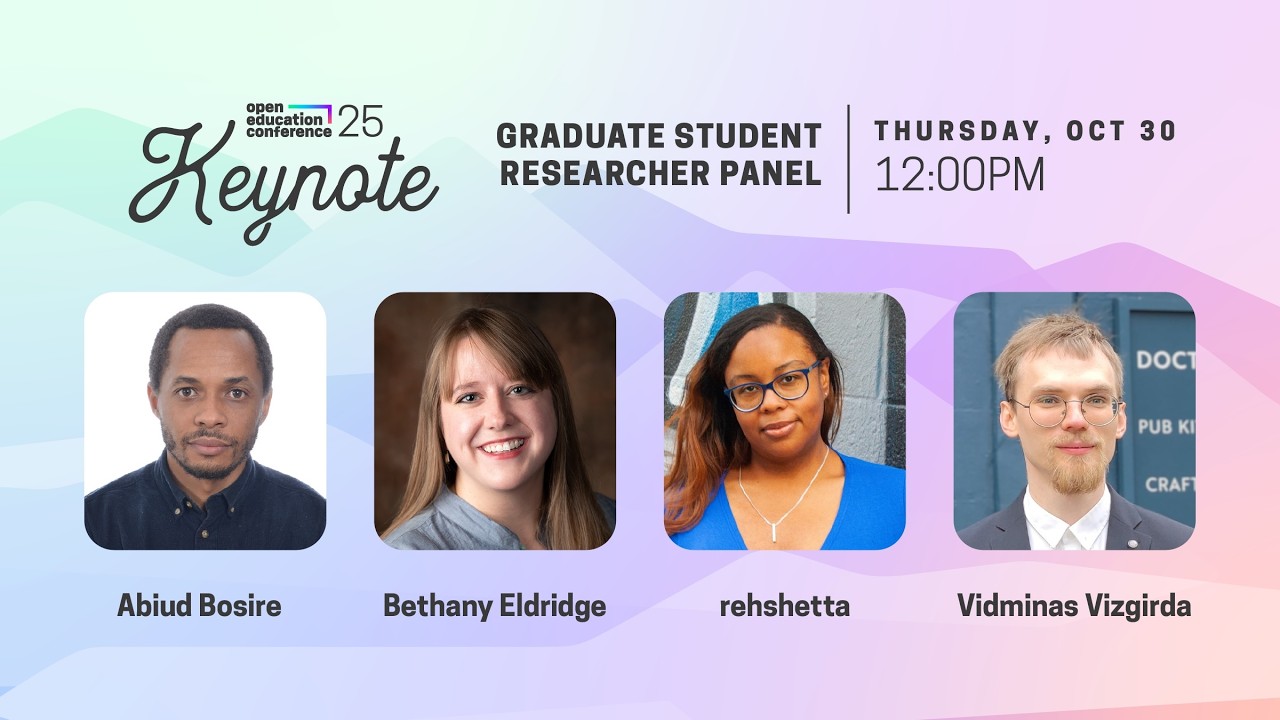
The closing plenary session of OpenEd25 highlighted the vital role of graduate students and early-career researchers in advancing the field of open education. Introduced by Brandon Carson, a conference board member from the Missosagas of Skugog Island First Nation, the event celebrated the next generation of scholars whose work explores how open practices, policies, and resources shape teaching and learning. The panel was supported by the global OAR graduate network (GOGN) and the Open Education Research Fellows Group, organizations dedicated to promoting equity, inclusion, and openness within research spaces. Facilitated by Virginia Clinton Lel, an associate professor at the University of North Dakota, the session brought together diverse voices from around the world to discuss how their unique perspectives are pushing the boundaries of what is possible in open education.
The panelists shared personal stories and research focused on addressing real-world challenges through collaboration and community engagement. Bethany Eldridge discussed her work with a grassroots organization in Lebanon, where they developed a digital platform called Tapshura to support students during times of economic crisis and conflict, emphasizing self-directed learning as a means to maintain access to quality education. Rashetta, a doctoral student focusing on incarcerated populations, explained how open pedagogy allows students to be co-creators of knowledge rather than mere consumers, framing their work as an act of resistance and radical care. Abid Boser highlighted the barriers faced by educators in Kenya due to high costs of materials and argued for democratizing knowledge through open resources, while a computer science PhD student from Edinburgh emphasized the importance of reusing educational resources to save time and build on collective ideas.
A central theme of the discussion was how research can serve as a transformative and participatory process that connects policy with practice across different contexts. The panelists argued that advancing open education requires moving beyond descriptive exercises to embrace comparative studies, interdisciplinary approaches, and inclusive knowledge partnerships. They stressed the importance of not pretending to be experts in every area but instead valuing diverse lenses and lived experiences, particularly from the Global South. Research networks were identified as crucial infrastructure for building relational equity, ensuring that decision-making spaces include early-career researchers, that credit and resources are shared fairly, and that research agendas reflect diverse realities rather than imposing a single narrative.
In their final remarks, the panelists called for continued innovation in research methods to better include underrepresented communities and advocated for shifting focus from mere adoption rates to understanding the deeper impact and power of open education initiatives. They encouraged researchers to be the change they wish to see in the world, whether by spreading awareness through DEIA efforts or by creating sustainable models for future generations. The session concluded with a strong message that open education is not just about access to resources but about fostering a global community where everyone can participate, contribute, and thrive regardless of their background or location.
Read the full video transcript
[music]
And now, please will you join me in
giving a warm welcome to conference
board member Brandon Carson to your
screens to introduce the closing
plenerary.
>> Good afternoon everyone and welcome to
our closing plenary. My name is Brandon
Carson.
>> Recording in progress.
My name is Brandon Carson. I'm joining
you today from the lands of the
Missosagas of Skugog Island First
Nation, part of the traditional
character of the Missaga and in the
lands covered by the Williams Treaties.
I am deeply grateful to live, learn, and
raise my family on these beautiful
lands.
I'm an open education practitioner,
researcher, and doctoral student at
Ontarot Tech University, and I'm excited
to learn alongside you today. Over the
past few days, we've shared ideas,
sparked collaborations, and kept our
eyes on the horizon together. Thank you
for the energy, curiosity, and
generosity you brought to Open 25, both
here in Denver and online around the
world.
Now, to kick off your closing program,
we're shining a spotlight on the next
generation of open education scholars.
This session features graduate and
doctoral students and researchers whose
work is pushing the field forward,
exploring how open practices, policies,
and resources are shaping teaching,
learning, and opportunities.
This panel was developed with support
from the global OAR graduate network,
also known as GOGN, and the Open
Education Research Fellows Group. GOGGN
is a global network of researchers that
works to raise the profile of research
into open education spaces.
Its goal is to offer support to others
conducting doctoral research in this
area, promote equity and inclusion in
the field of open education research,
and to develop openness as a practice of
research.
The open education research fellowship
is an opportunity for early career
researchers across disciplines to
conduct and publish a study in open
education. The fellowship provides
mentorship, collaboration, and financial
support. We would like to extend a
special thank you to Beck Pit and Rob
Pharaoh from GOGN as well as Virginia
Clinton Lel from the Open Education
Research Fellows Groups for their
support in coordinating today's panel.
So without further ado, please join me
in welcoming our facilitator Virginia
Clinton Lzelle as well as our incredible
panelists. We look forward to learning
from your work and your vision for what
lies ahead of us in the world of open
education. Over to you, Virginia.
>> Thank you so much, Brandon, for that
introduction. My name is Virginia
Clinton Lel and I'm an associate
professor of educational foundations and
research at the University of North
Dakota. I also serve as a primary
researcher for the open ed group which
mentors the open education research
fellowship that was mentioned. I'm
excited to moderate today's panel of
incredible open education researchers
who are joining us both here in Denver
and from across the world. Today's panel
will discuss the vital role of research
in advancing open education in today's
complex educational landscape.
Together, we will explore how research
strategies can help shape resilient open
education initiatives and ensure open
education remains a driving force for
inclusion for learners everywhere. Now
without further ado let we can turn it
over to our panelists. So your first
question can you each tell uh us a
little bit about yourself, your research
and your why for conducting research in
open education.
>> Hello everyone. Uh my name is Bethany
Eldridge and I just finished my PhD at
the University of Michigan.
Thank you.
Um, I was studying educational studies.
Um, and so I chose open education
because it offers this opportunity and
space to both think about and work
collaboratively within a community about
what it means and what it requires to
have um, access to quality education.
And since quality and access are both
very like contextualized goals, for my
research, I worked with um, Lebanese
Alternative Learning um, or L. Um it's a
grassroots organization in Beirut,
Lebanon. Um and they developed a digital
platform um that housed content that was
aligned with the Lebanese curriculum for
grades K through nine. Um and the
platform is called Tapsura or Chalkboard
in Arabic. Um and so together we were um
looking to answer how teachers were
using this resource to support students
in a challenging time that was
constantly changing. This started in
2023. So they were dealing with an
economic crisis, a refugee crisis and
things have continued to evolve with um
the increased um escalation of conflict
with Israel. And so together we through
the research we found how teachers used
Tapshura or the OAR um to to think about
um how to still maintain access um
despite schools closures and how to
think about quality of education as well
by centering the student and um
supporting self-directed learning. Um so
open education really provided this
space to think both about the
possibilities of OAR while also
supporting um a nonprofit think about
how to expand its reach with its
resources.
>> Hey y'all. My name is Rashetta. I do not
use a last name so just Rashetta. I am
from Greensboro, North Carolina. I am a
doctoral student at the University of
North Carolina at Greensboro
um where I am focusing on educational
studies with a concentration in higher
education.
Uh I'm also an open education research
fellow uh which I am very pleased uh to
be under uh to get such great guidance
and leadership through um through the
fellowship I am focusing on uh work that
I'm already doing incarcereral spaces
where I'm using um open pedigogy and
open education resources
uh for my students who are incarcerated.
And for me, my why is because open ed
allows me to kind of buck the system of
capitalism where especially in higher
ed, we see that students are viewed as
consumers instead of co-creators of
knowledge. So that is what I am looking
at um because this gives us a way not
only to collaborate amongst ourselves
amongst folks who are faculty and staff
but looking at students as co-creators
of knowledge as it said you know those
of us on the panel we were it was said
that we are the next generation but who
else is coming behind us and those are
the students who we are also bringing
up. So what research can we see of how
open ed is saying we're not raising a ne
another generation of consumers because
we are not Amazon we are educational
spaces so things should be created I
think of education as art um my
dissertation
also my dissertation topic draws on that
a lot and it looks at the ways in which
black and latin fem faculty Y are using
those practices um as forms of
resistance and radical care uh when they
are mothering each other and students
and um administration
and that work is invisibleized but also
the backbone of most of our
institutions. Um, again, my why is
because
the work we do is art, y'all, and it has
to continue. Uh, again, this is not a
product that we are creating. We are
creating something sustainable for the
next generation and several generations
to come.
>> Thank you. Uh, we'll turn it over to our
virtual panelists.
Can you hear me?
>> We can. Maybe I'll go first. Um, yeah,
it's been lovely to hear from you,
Bethany and Rashetta. Your research
inspires me and all of our fields are
really different. myself. I'm a computer
science PhD student from the University
of Edinburgh and my research is on the
intersection between education
technology and open education. I'm
almost done with a project last so now
just got some corrections to do and it
will be done. Uh but this project in
particular was about how do teachers in
Scotland and schools share and reuse
educational resources.
I think I got into open education uh as
a means to an end. I was interested in
open educational resources in the
beginning and the concept of reuse
environments and [snorts] whether this
might be a way for people to save time
and build on each other's ideas rather
than constantly reinvent the wheel by
making their own. Um and then the rest
of open came with all of its other
meanings.
Perhaps coming back to the roots, why
education in the first place? If I had
to think about the most important
problems of the world, be it war,
hunger, poverty, climate change.
Unfortunately, there's many to name.
It's really hard to pick just one to
focus on. Uh but taking perhaps the easy
way out, it certainly isn't an easy way.
Education can help with all of them.
And yeah, I see open as a useful tool
for advancing education, enabling more
people to participate and allow people
to build on each other's work and ideas.
Okay. Um,
okay. Thank you. Thank you so much. I
think I will go now. And hello everyone.
My name is Abid Boser. I'm a doctoral
candidate at the University of Nuremberg
in Germany. And I'm also currently in my
third year. I just finished um my field
work and I'm trying to put together all
the findings to come up with the
dissertation and also to present and see
what happens next. So my research
focuses on the implementation of global
education in secondary schools in
diverse contexts. So it's a comparative
study between secondary schools in
Germany and secondary schools in Kenya.
So I'm trying to see how we can leverage
on open education resources to promote
uh global education in this context. And
when I talk about global education, I'm
looking at um a global perspective to
teaching and learning, especially as we
live in a highly interconnected and
interdependent society where we have,
you know, complex realities and students
are supposed to be prepared to address
um these challenges by not just you know
working within the globalized world but
also providing solutions to these
challenges. So my why um for researching
or for working in open education I look
at it from my context and when I talk
about my context I'm talking about a
global south um perspective because I
come from Kenya uh but I have also this
privilege of studying in the global
north. So I research global education
from this context to respond to both
local and global education realities. So
for instance in Kenya access to quality
learning resources materials remains a
challenge up to now. So many learners
and educators face barriers because of
high cost of materials. So therefore
open education offers um a meaningful
way to address these challenges and
provide a framework through which uh
knowledge can be democratized and
learners and teachers can access adapt
and create learning materials which are
relevant to their own context. So
through this also I may be able to
contribute you know an alternative uh
perspective to global education you know
an alternative narrative to how we can
approach global uh open education. So
just to give a brief example on um the
why to open education and why I feel
open education has been uh very
important in my journey and it still is.
Um four years ago I conducted research
uh in Rwanda as part of my master's
dissertation and what came out of this
research which was focusing on teachers
understanding and willingness to include
global education and global issues in
their everyday instruction in the
classroom is that the teachers were
mostly willing to introduce um uh global
education is issues in their teaching.
you know to introduce issues which were
a bit difficult to teach in their
context. But the biggest problem was
that you know um access to materials was
an obstacle. So access to textbooks,
access to global education, relevant
materials was a challenge to them. So it
was difficult for them even in their own
willingness to implement u global
education. So they were not able to
access relevant materials and because
global education is not a mainstream
subject that is included in the
curriculum. So you have to look for
materials from other context and try to
you know adapt them to your own context
to teach and now resources were a big
challenge. So this also amplifies you
know the need for global education I
think not only in my work but in so many
other educators um and teachers who work
in my context and like I said I speak of
context uh from the global south
perspective. Yeah. Thank you.
Thank you for those responses. So our
next question, how can we as an open
education field better employ research
as a means of advancing the field?
Um I view research um moving the field
forward by um mirroring the same like um
what's at the heart of open education by
both being collaborative, thinking about
co-creation and innovation. Um if we're
wanting to support, you know, students
and teachers to succeed, we need to
understand what their goals are and how
openness can play a role in that. Um and
so with my project, you know, centered
around this relationship with law. Um
and so you know this relationship took a
long time to develop like I worked with
them for a year um to um to connect to
learn from each other and to build trust
in order to build a project that would
be mutually beneficial. So this type of
work does take time in order to create
something that's participatory. Um but
it's very valuable. Um for instance in
my research um law does not promote
their research uh their work as OAR.
they view um OAR, you know, they connect
it with licensing and creative commons
um and they just don't have the capacity
at the moment to think about
categorizing and licensing their
materials. But through since they're,
you know, they're dealing with several
crises at the same time. Um but through
the research, we can see that the way
teachers engage with Tabura does reflect
how openness is described in literature
and how we think about it. Um it both um
but it also expands the way we think
about what it means to use, adapt and
create um in a classroom. Um so it
builds this idea of what openness could
be but also in turn it also um by using
openness um as like this lens to do
research it also supports law to like
have another perspective on their
research to see what what makes their
platform what makes their OAR so
important to teachers. Um so I really
view research as like you know a theme
that we've had at this conference about
connection and community that um that
needs to be at the heart of the research
process as well. Um you know I'm not an
expert in Lebanese context. I never will
be and I don't want to pretend I am. Um
and so having a partner though doing
this research, it helps you know include
other voices and helps um really put the
value on those who are doing the work
particularly in um underresarched and
underrepresented areas which I think is
kind of at the heart of what open
education is about.
Bethany, I like something that you said
that um you know, you don't pretend to
be an expert um in an area. And I love
that, right? That we can know things and
not know everything. That Bethany knows
things that I will never know and
Virginia and all of you all do. And but
we see here we are so freely and happily
wanting to share the knowledge, wanting
to share our research. And for me, while
that does exist in other sectors and
other communities,
um,
in open ed, it just feels
um
it feels more intentional.
And that is what I believe is needed
especially um as someone who my master's
degree is in adult education. So I focus
more so on non-traditional learners. So
those are folks who are not your typical
18 to 25 year olds who are like fresh
into college. Those are um what because
I was a non-traditional learner. So
please don't take this the wrong way but
you know a little battle tested. We I
came in weary. Um, I went back to school
and got my associates degree while I was
pregnant with my son. I was 30. Um,
y'all, I was tired. [laughter]
Anyone who's ever been a pregnant
person, you know, everything is swollen
and you're exhausted and you can't
breathe and you're struggling and you've
got to provide for these children and
you're thinking about life in a lot of
different ways. Um, but you have a
willingness to learn.
Um and so what I've noticed here is that
there's um an acknowledgement of that,
right? That folks are coming to uh
education from many aspects of life and
that that should be embraced and we
don't all have to know everything. We
don't all have to look the same way.
However, we are all doing research. We
are all practitioners in different
lenses.
um and that is what advances the career
um the field of open ed so when we're
thinking about um what is needed what
support systems are needed um while I
did just say you know I'm not a fan of
capitalism we do need funding we do need
support um I myself am not uh while I've
just started diving into quantrit I'm
not too keen on quantitative research
but there are folks here who are and we
need that data um so that we can advance
things. So again
for me uh what I the way in which I view
open ed research in Virginia I hope that
I'm answering this question um properly.
>> You're doing great.
>> Okay. Thank you. Um is that there's this
community where we are so different. We
have such different lenses and none of
us are pretending there's not errors
being put on that we know everything
that we are experts in one thing and
that's the end all be all. Um there is a
sense of wanting to learn from one
another but also to give away um what we
know that we want to not be gatekeepers
of the knowledge that we understand that
in order to have a better resourced uh
not only nation but world that openness
needs to exist. Um, so again, Virginia,
I'm not really sure that I did answer
the question, but I was very um
inspired, Bethany, by what you said that
we don't have to pretend to be experts
in anything.
>> Thank you. Uh, we'll go online again.
>> Yeah. Um thank and I think it's really
important um when we think about open
education and research
and I think to advance open education as
a field we must view research not just
as a descriptive exercise but we have to
look at it as a transformative and
participatory process you know one that
connects policy and practice and also
they live realities across different um
context And for me uh if we can use um
research to advance open education
I tend to sum it up in three ways or
through three aspects. So we can use
research to broaden the I'd say
epistemic base of open education
scholarship and in this case I tend to
look at it in terms of you know when we
look at what we have in literature
extant literature most of it is
dominated maybe by perspectives from the
north which sometimes might overlook
innovative and contextually grounded
practices which are emanating from the
south. So uh because of this I believe
there's need to have a more comparative
approach or cross context studies uh for
open education to highlight how open
education and um open education
resources tend to function in different
spaces what people do in different
spaces and how we can bring together
these practices these approaches to try
and enrich the field of open education.
And a basic example in this case could
be you know uh studies on oeer
adaptation in Africa. You know Africa is
uh is a huge continent 54 states very
diverse and or even research on OA in
this African countries and in African
schools which could illuminate how open
openness intersects with different local
pedagogies and linguistic diversity. And
secondly, I look at it as um you know
using research to advance or open
education by integrating
I'd say in integrating inter
interdisciplinary approaches.
So we can conduct research that brings
together insights from different fields,
from different specializations for
instance from education, from sociology,
from technology like what V is currently
doing and other related studies which
can help us to understand you know not
only what works for open education or
open education resources but also why
and for whom we are doing these uh open
education research practices. So and the
third one um I look at it as you know
the larger open education community
everyone who is involved in open
education you know be it teachers,
students, educators in different um in
different parts of the world they should
come together as knowledge partners and
not others as just subjects. I think uh
this approach with an open uh which
encompasses I'd say the open movement
ethos of collaboration and um
democratization of knowledge. It's what
can help um open education to leverage
on research to move forward and I basic
example again is more about uh what
Braden talked about at the beginning the
go network you know which supports early
career researchers from different
countries from different contexts in the
world to develop and co-develop
education projects and share findings
openly in conferences and workshops and
in my opinion this um is the one of the
ways that we can build a vibrant open
education
ecosystem.
>> Awesome. I think because we're all
working in different fields and in such
different environments too, it's not
always easy. I'm sure that we've all
experienced this in different ways. Um,
when I went into schools and started
talking to teachers about open
education,
a lot of the time, um, outside of
academia, People will hear research and
think this is something big and scary.
This is not for me.
Um but research really in practice is
something that I think everyone can use
not just academics.
So there's a quote from Karl Marx said
philosophers have long interpreted the
world. The point however is to change
it. So as a saying research can describe
the world. There are different kinds.
Some describe it some study experiments.
Some look into transformation, but
generally research tends to enable
change. So it will provide more
information, more knowledge for people
to build on and implement that. And we
need people outside of academia to then
drive that change. The research is
useful for learning from what people
tried and found and can be from around
the whole world. Uh it can be useful for
seeing different contexts and
perspectives other from just what's
around you. And it can also be useful
for advocating for change as you can
point to collective evidence of
something that's not just your own
opinion, but this is something that's
been said by a number of people in
various places. And so you've got a base
to advocate for a change that you would
like to see in the world.
So yeah, I think that the open education
as a whole field can employ research for
advancing it and no matter what your
role is, there can be something that you
can make of it as well.
>> Wonderful. Next question is, how can
research networks serve as a potential
route to relational equity?
Um well there's many ways I could answer
this question about research networks
but like on a personal level you know
I'm part of the goian network I'm part
of the research fellows that helped put
this together and like both groups
really supported my work um enhanced my
thinking about open education um I had a
very supportive committee at the
University of Michigan um in fact
they're the ones who helped me begin the
connection with law, but um they were
new to open education OAR. So to have
support on how to think through these
things, this research network um that
other researchers was really important
um specifically like within GoGen and
research fellows, everyone comes and as
you can see from this panel, everyone
comes from different backgrounds,
different regions, um studying very
different things. And so by you know
everyone having a different um approach
to openness and oar um it really
highlights like what is the possibility
of o um o and openness with thinking
about it beyond just being open for the
sake of open. So it really helped me
think about what was for law what was
making tapura and the oar important for
them. Um and then also like on a of
course research networks help also on um
an emotional level. We've talked several
times here about how, you know, being a
teacher, being a student, um being a
researcher, a librarian, an advocate,
it's all hard work. And um and so being
able to work in community with people
who are doing the same thing or have
done research before, it's um it's such
a it's invaluable um support to keep
going and to um think through the
challenges. Um and just one quick story
about that is when I was in Lebanon, um
there was one day that I came down to
the hotel lobby that I was staying at
and I heard someone yell my name and I
was like, who would I know in Lebanon
that would be at this hotel and I turned
around and it was a fellow member from
Goian. Um, she had finished her PhD and
she was supporting a project in Lebanon
and we just happened to be there at the
same time. didn't know it ahead of time
and so one you know it was wonderful to
see a familiar face in a new place for
me but also like I connected with her
colleagues and everything so just again
expanding that network so just there's
so many so much value from a research um
for me personally but then also just to
take it out to when I'm working with law
like I you know I take their knowledge
into the network and then I can take
what I've learned out to the to law
themselves so it becomes more of a
continual cycle of knowledge sharing
like I liked um earlier someone said the
uh knowledge partner sharing so it's
just um networks help in um all levels
of research
>> uh yeah that's a that's a good question
what my grandmother would call a $2
question um
so I I think I want to share about how I
even came into the open education
research fellow so when when I was um
getting my masters
um one of my mentors actually spoke to
me about open education research and
this was like 2019
um the fall of 2019 and then we all know
what happened spring 2020 you know we
were supposed to just go home for two
weeks and then everything's going to be
fine you come back outside everything's
going to be great um didn't happen that
way um and so that kind of stifled my um
look further into um OEER. And then
flash forward to uh 2024,
so just last year, and I was part of
like this online group I had found
through LinkedIn, and they have an app
called Cohort Sisters, and someone
shared about um the open education
research fellowship. Um and you they
were recruiting and things. I was like,
"Oh, wow. this isn't just like this
small little thing that I thought that I
heard about in 2019 and you know I was
trying to apply it in different ways all
by myself so I was siloed uh and there I
found like a larger network and got
connected with Virginia and other folks
um and now I'm here with all of you all
and finding out that the community is a
whole lot larger um and the reach can be
greater
uh than what I initially
um thought of. So when we're thinking
about um how research networks then
build a a greater capacity for
relational um building um that's exactly
how it works. So, it was a little seed
that was planted um in my brain in 2019
and it kind of got put on hold because
of the start of COVID um and then it
came back um in 2024.
So, I think a lot of times when we're
we're looking at it and we feel like it
has to be this big grand thing that, you
know, we're going to go and talk about
open ed to someone and they're going to
like drink the Kool-Aid and they're
going to be they're going to fall in
love. It's going to be great, right?
It's going to be so romantic because we
romanticize things so much. And I wish
that were were true. Um especially as a
researcher because you you will spend
years
deeply invested into something and then
you go to a conference and there's like
two people there and you feel defeated.
But you never know, right? You you never
know um what can happen. So it doesn't
have to be this huge like romantic thing
that we think is going to be beautiful.
Sometimes it's a slow burn. And for me,
that's what it was. and then finding
other people who wanted to talk about um
OEER and that wanted to get more folks
on board and wanted to share what it
looks like in different aspects no
matter um what your your background
could be whether it's education or
technology or engineering or art or
music that there is something um that
OEER can do for you. there's some oeers
out there that you can get connected to.
So I think a lot of times it doesn't
have to be um this big beautiful thing.
It can be something very small as I was
sitting in um a professor's office and
she told me about open education and I
wanted to look more into it and did not
for several years and now here I am in
front of all of you all. So, I say all
that to say, y'all, please don't ever
get um the burnout is real. Um so, let
it wash over you and you know, re
hydrate yourself and get back out there.
Uh because we never know who we're going
to touch and how far that can go.
Thank
>> Thank you. Onto our virtual panelists.
Those
are great stories. Love Rashetta and
Beth. You know when that feeling of
going to a conference and meeting two
people there feels relatable and at the
same time really matters who those
people are. I think there is this
culture of care and love that just it
opens you up and it's also very
gratifying to know that somebody cares.
Now I must admit I had to look up what
is relation like with demon mean.
So I understand it as fairness and
balance and how we interact with each
other and the environment.
Fairness and balance I guess it means
both taking and giving in equal measure.
Um it can also mean exchanging
experiences, ideas and culture. This is
where the goian network has been an
excellent example for me. I think it's
not uncommon for people to be the only
open person in their institution. So in
my case that was very much the same. U I
taught my supervisors about open
education. Uh but Gojian was a place of
inspiration and connections and also
serendipity. Uh so that's where openness
open-mindedness comes in.
Meeting people who work on completely
different things and then you weren't
ing it, but you get inspired by what
they tell you about and it leads to new
beautiful things. It's been amazing.
>> Oh yeah. Um I think I'd say research uh
networks are very important just like
Brethan said, you know, networks are
important because they enable you to
sometimes do things which you could have
not done on your own. And you know a
basic example was um when I moved to
Portugal to start my master's research
on open education and global education
and then I'm my supervisor then was a
member of go and she was like okay fine
now you're a member of the angel network
which works in global education but
there's one other network that you must
belong to if you really uh want to
survive in this environment and this
network was called GM
And I think uh through God um like
brother said I've been able to do a lot
of things that maybe I've not have done
you know through scholarships to conduct
research um in Kenya and like currently
we also have the goian hubs which are
also running activities in relation to
open education in Kenya and all these um
are ideas which are set by these hubs on
their own but then again um like V You
know the big question is what is
relational equity in this sense when
we're looking at networks and uh open
education and networks can serve as a
powerful route to relational equity and
this is um equity I look at it as equity
which is not just through access to
knowledge but also the quality of
relationship among those who produce and
use this knowledge in open education.
And you know uh when in open education
we talk about equity in terms of open
access or open licensing. But if we
think a little deeper about relational
equity, then it it should be about who
sets the research agenda in open
education, who gets resourced and who is
heard and who benefits from the
knowledge that is produced u within open
education and within this research um
networks. And
from where I see it for research
networks um they can promote this kind
of equity in several ways. And the basic
one could be co-creating research
agendas rather than imposing uh these
agendas within open education. And this
is when networks bring together you know
different researchers, educators and
practitioners from different context
jointly to define you know the questions
and to define what they want to address
within open education and the resulting
uh research then reflects diverse
realities. So that way we can be able
then to use uh research networks to
promote relational equity within open
education.
And the second one could be more about
you know the networks can help to
redistribute
um resources and recognition. For
example, you find researchers and
educators from different context can
come together, conduct research,
contribute uh data, but some of them are
left out in terms of authorship or let's
say in terms of funding. So I'd say
equitable networks should share not just
data, not just research but also credit
out of that research. So through
authorship micro grants to conduct you
know more research and capacity building
opportunities
um for all those who are involved in
these research networks and one aspect
um that I was almost forgetting is about
governance. I think in the networks we
work in uh in terms of open education,
we need to rethink uh governance in
these research networks and by this I
mean you know decision making spaces
where for instance in editorial boards
or project leads you know should include
diverse voices and include also in this
case um I'm not speaking for myself but
also include early career researchers in
the decision making process that can
then shape um the networks and also
promote relational equity. And I think
so we need to use um the networks more
as infrastructures of um relationships,
you know, platforms where we build
relationships which lead to equity.
>> Okay, thank you. We have uh literally
about one minute left. So, if you could
each take a max of 20 seconds stops,
no wait, divided by four, 15 second
stops. Uh, to answer the, uh, very short
and quick question of what work do you
think open education researchers should
take on next?
>> That's a lot to answer in 15 seconds.
Um, just keep working on community work.
That's how you figure out um uh what
access and quality will look like for um
people that might not be represented yet
in work. Um and then just be innovative
about how you do research. Thinking
about if you're doing with a partner,
how to do methods that might um be easy
for them to be a part of. Um yeah, so
just keep moving thinking forward on how
to include people more in the whole
process.
All right. Um
I would say if I had to be very specific
in our current current uh climate that
we find ourselves in, uh if you're here
in the United States, I would say DEIA.
Um and also y'all, I'm the daughter of a
Southern Baptist minister. So evangelize
folks,
[laughter] make them believers. Uh go
out and spread the word. Thanks online
>> say especially building on yesterday's
Dr. Reed's keynote when she said the
best way to predict the future is to
create it. So be the change that you
want to see in the world.
I think I'll summarize and say um I
think open education now needs to move
beyond
um adoptation rates counting um
downloads and think more about
understanding the impact the context and
the power of what we work what we do in
open education.
>> All right. Well, that's all we have time
for today. Uh please join me in thanking
each of our panelists for taking the
time to be here today.
>> [applause]
>> And thank you for all that you do in
open education.
[music]