Video summary
This maintenance stream focuses on resolving critical concurrency issues within the Rust crate `left-right` using ThreadSanitizer analysis. Two primary bugs were identified: first, a data race in `RightHandle::drop` where newly created read handles initialized with even atomic counters caused premature drops of shared structures; this was fixed by ensuring new counters are marked as odd to guarantee proper synchronization until all active reads complete. Second, the logic for handling re-entrant calls to `ReadHandle::enter` during a writer drop sequence was corrected from panicking on null states to safely returning `None`, preventing crashes when readers attempt entry after pointers have been swapped but before previous guards are released. These fixes were implemented locally and prepared for merge via pull requests due to repository access restrictions, alongside the resolution of failing tests in PR #149 caused by missing initial wait calls that led to out-of-bounds memory accesses.
Attention then shifts to the `hdr-histogram` crate, where safety was prioritized over performance after an unsafe optimization left memory uninitialized; safe zero-initialization is now preferred despite minor costs. The batch API for calculating percentiles was significantly improved by replacing vector-based sorting with an iterator approach using closures and `from_fn`, which eliminates unnecessary allocations and handles unsorted or duplicate inputs gracefully. Performance gains were further achieved through a "chunked skip scan" technique that processes fixed-size bins in parallel before walking individual elements, enabling better vectorization. Concurrently, the Minimum Supported Rust Version (MSRV) was bumped from 1.64 to 1.88 to utilize newer features like `use` syntax and optimized iterators, while redundant "paranoid" tests were removed as existing coverage already ensures correctness.
The maintenance workflow also addresses infrastructure challenges and project lifecycles, including the decision not to personally fix known security vulnerabilities in the abandoned `rust-imap` crate but instead facilitating a handover of ownership for an async rearchitecture under the same name. To manage CI failures caused by slow builds and missing secrets, the team switched from slower AI models to more efficient ones like Fable in Plan mode and updated dependencies systematically using automated agents. This approach highlights how AI tools are effectively utilized for mechanical tasks such as dependency updates and code modernization, allowing maintainers to focus on substantive architectural decisions rather than tedious manual labor involving constant log reviews and syntax updates.
Finally, the discussion covers the ethical nuances of leveraging AI in open source, distinguishing between appropriate uses like debugging assistance and initial filtering versus inappropriate low-effort submissions that require significant rewriting. While acknowledging concerns about training data scraping public code, the speaker emphasizes that roles requiring deep system understanding remain secure against automation, whereas niche tasks are at risk. The session concludes by reflecting on the realities of maintaining multiple projects over extended periods, noting that even simple updates can take days due to community reliance and platform-specific testing constraints, before thanking viewers for their support in this ongoing effort to keep open source tools safe and efficient.
Read the full video transcript
Hey folks, welcome back to uh another
Rust stream. Um this is going to be one
of the open source maintenance streams.
So um I've done a few of these in the
past, although it's been a while since
the last one. Um the intent behind these
is well I maintained a bunch of
different open source Rust crates. Um I
maintain some non- Rust things too,
although most of those sort of fallen by
the wayside um at this point. But uh
keeping up with the open source stuff
takes a bunch of time. Um there there's
a lot of like reviewing issues,
reviewing PRs, fixing issues, doing
releases, uh you know, updating
dependencies are going to depend upon,
fixing CI, like there's a bunch of that
kind of maintenance that, um I think
many people who are not used to being
open source maintainers don't really see
um they don't see it both in the sense
of don't appreciate that it's happening
and the maintainers have to spend time
on it, but also they don't get to expose
to it. So they don't know that those are
things that if you are to release
something in into open source you have
to spend time on and it will consume
some of the like it's not as though
putting an open source library out there
is just a matter of putting it out
there. You also need to sort of sub
subsist those projects over time. Um and
this is an intent to sort of show a
little bit of what that requires. Um and
so in particular we're going to
basically go through my GitHub
notifications. I've already pruned a
bunch of things of there. I mean, I'm
obviously subscribed to a bunch of, you
know, Rust issues and like tracking
issues and stuff, things that are not
that interesting to look through on
stream. Um, so we're going to
specifically look through for things
that require like my maintainer
attention. Uh, and then we'll just start
walking through them and dealing with
them as I would normally. Um, this is a
task that, you know, I have to do once a
week or ideally more often, but often I
don't even have the time for once a
week. So just somewhat regularly I have
to sort of cycle through these and and
uh keep up with PRs and issues and
everything and you'll come along for the
journey. Um now worth pointing out that
one of the things that makes this uh
challenging is that there are many
different projects and so we're going to
need to do quite a lot of context
switching. Anytime we switch between
repos there's going to be a bunch of
context you don't have for that
repository but that I have in my brain.
So I'll do my best to try to carry you
along here. Um, but just keep in mind
that the the transitions might be a
little jarring. Um, but I'll I'll do my
best to to have that not happen. Um, and
as always, like if if you have
questions, put them in chat and then
I'll I'll try to address them. If you're
watching this after the fact, we'll put
the questions
I I'm in on a piece of paper and and
make a paper airplane. I don't know. I
don't know what to do about them. Um,
but maybe you'll join the next stream
and you can uh ask me live. Cool. So,
um, as I pointed out, the one of the
problems here is that the notification
button on GitHub is behind the image of
me on the screen, and I have a little
danger box there so that I can see that
things aren't visible to you. But that
also means that I can't click on the
notification thing. So, I need to go to
notifications. Um, and then what I'm
going to do is, and you can't see this
offscreen either, but I'm going to sort
from oldest to newest instead of newest
to oldest because it tends to be the
case that the oldest ones are the ones
that most require my attention because
well, I haven't addressed them in a
while. Um, this also means that uh it's
sort of a a slight punishment for people
who keep bumping issues. Like if you are
if you want me to reply to something,
bumping it is not the way to do it
because makes me less likely not more
likely to look at the thing. Um, cool.
So, let's uh group this roughly speaking
by repository so that we don't end up
switching back and forth a lot. Um, so
you'll see there are a couple here from
left to right. So, let's pull those out.
Uh, and I think it's yeah, there's only
four.
So, for context here, left right I'll
I'll um pull it up here first. So, left
right is this uh concurrency primitive
that I've given a a talk or two about
this in the past. Um and it is a
concurrency primitive that acts a little
bit like a read or writer lock except it
is a lot faster for reads but it is also
slower and less memory efficient for
writes. Um and so it sort of makes a
slightly different tradeoffs in the in
the in the concurrency performance space
uh compared to something like a reader
writer lock. Um, this one has a lot of
like low-level um low-level like uh
concurrency manipulation and atomics and
stuff. Uh, but that's part of what makes
it interesting. It's also part of what
means that whenever I go back to look at
this, there's always like issues or pull
requests that are like very specific
about some aspect of the the concurrency
protocol. So, I always need to like
bring it back into my brain in order to
be able to address them. Um, so let's
see. The first one is fix the data race
on right handle drop. Um so if we pull
up left right um you'll see that when
you create a left right uh here for
example uh you call left right new uh
and then you give it a uh you give it
two types. One is the type of the data
structure you're protecting. The other
is the type of the operational type over
that value. So in this case um this is
an like in left right unlike with a a
reader writer lock for example you need
to define what operations are possible
to do on that data type so that they can
be replayed later. Um so left right from
a very base level it keeps two copies of
your data structure a left and a right
copy. uh and so the writer is always
modifying one of them. The readers are
always going to the other one. But that
means that you all your rights have to
be applied twice. Once to the left and
once to the right map uh or data
structure and so um you need to keep a
log of all the rights you did so that
after you've applied them to this, you
now need to remember them so that you
could apply them to this later. And so
that's what this this operational type
is. So it's generic over two things. Um,
and when you create a new thing like
this, you get back two handles, a write
handle and a read handle. The read
handle is clonable. So you can create as
many as you want. Give each one to a
reading thread, for example. The right
handle is not clonable. Um, and so it is
a thing that only you can only have one
writer unless you put this in a mutex or
something. Um, and so the right handle
is where a lot of the logic lives for
swapping between the maps, keeping track
of the operational logs, uh, waiting
until all the readers have moved from
one map to the other so that it's safe
to write to one. All of that logic lives
in the in the right handle. As when they
say here fix the data on the right
handle drop, they're implying that when
you drop a right handle, there's some
kind of data race uh, presumably around
the axis to the two maps. Um, let's see.
that allows read handles to enter while
the value is being dropped.
The issue was observed by building with
thread sanitizer in a test where one
thread creates a right handle and shares
a read handle factory for it with some
other threads. A read handle factory is
a a thing that can make new read handles
but is not itself a read handle. Um the
reason this can be useful is because the
work that a writer has to do is
proportional to the number of active
read handles. uh read handle factory
does not increase the performance
penalty of a right handle. Um and so you
might have a factory so that you can
produce read handles if you need them
but they are not themselves read
handles. Uh T1 continuously creates and
drops right handles
sharing the factory accordingly
while the other threads create new reles
from the factory and attempt to enter.
Uh so enter here is um if you look at
read handle
um on read handle you can call enter and
that sort of means give me access to the
underlying data structure. I want to do
a read uh and you get back a read guard
and the read guard is the thing that
actually dreferences to the underlying
data structure. The need the reason you
would need to have this guard is the
same the reason you need to have a a
guard for something like a reader writer
lock is because while you hold the guard
uh the writer can't modify the map
you're reading from. Um but the moment
you release that guard you're sort of
giving up your um uh your ability to
have access. I don't want to say
exclusive access because readers share
it with each other but to have access to
that and you will need to do more work
to coordinate in order to enter again.
Um,
okay.
Uh thread sanitizer here is a is a very
common concurrency checking tool that
essentially um you often run it in CI
but you don't have to where it um it
keeps track of all the memory accesses
by all of the threads in a program and
it checks that um none of them do atomic
accesses in such a way that they could
race like two threads uh concurrently
writing to the same memory location
without having done some kind
um atomic for that right for example to
ensure that they have not stepped on
each other's toes without realizing
um so Tzan reports a race where some
threads manage to read a bool within V
while T1 drops it
uh
co-authored with Claude surprisingly
common these days um yeah so you'll see
they posted this in April uh then they
did a follow-up in May and I just
haven't had a chance to look at it since
because I've been moving and stuff. Uh
this is sadly one of the realities of
open source uh software as well. So
let's see what's the change here. Okay.
So this is in the um
uh in the swap function.
Yeah. Okay. So
Oh, it's not in swap. It's in
drop
right so we have an impul drop from
right handle for right handle um and
what right handle will do is it will um
uh take the inner and the reason this is
a take is because I want to consume the
the fields that are inside of right
handle um whereas drop only gives you an
exclusive reference to them uh and so if
you actually looked at the definition of
right handle which we can do over here.
Um
uh
and then I will do
let me uh see if I can
move this so you can't see it and then I
will mute myself so you can't hear me.
and then let's try to pull again.
Excellent.
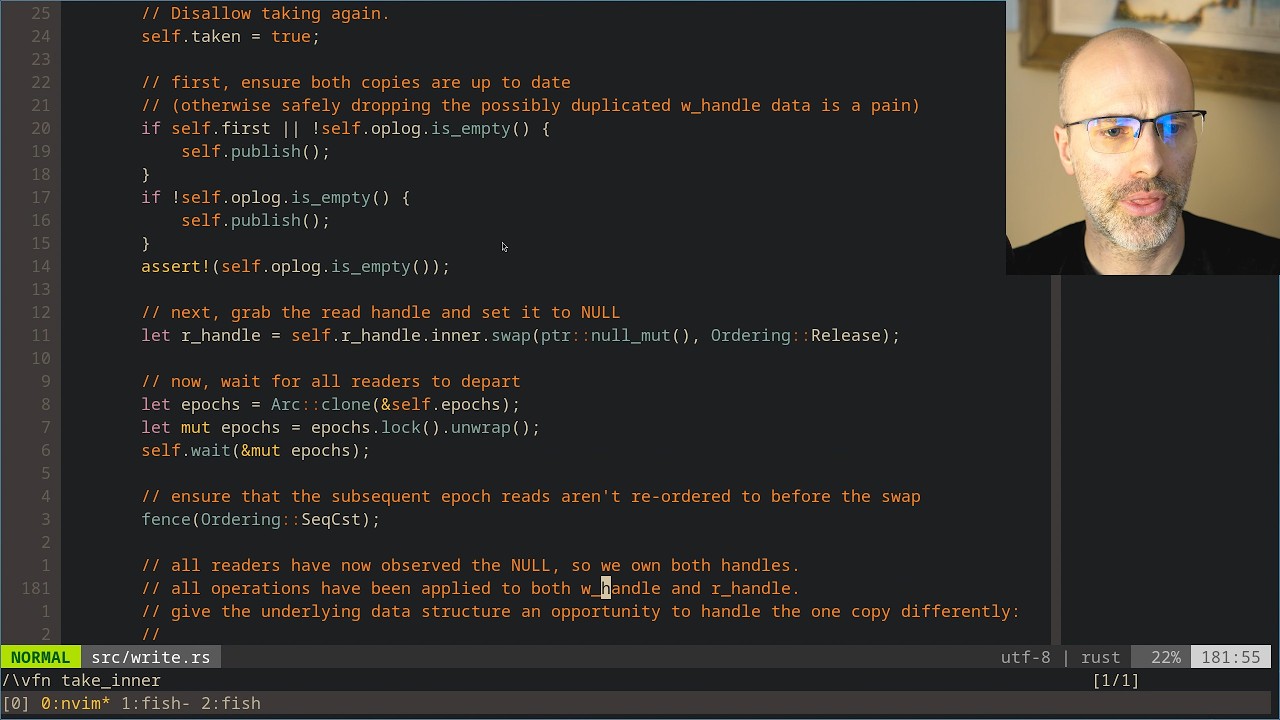
Um okay. So if we now look at left right
here and we look at the right handle,
you'll see the right handle um
here. So if we go to the take inner
Um, take inner is the thing that takes
out the the backing data structure. Um,
and the backing data structure here is
if you have a right handle to a T, it
basically gives you back the T so that
it can be dropped. And this is a tricky
operation, right? Because there are
actually two T's, the left and the
right. Um, and you need to only give it
out of the take inner for like actual
dropping. um once there are no readers
in left or right because if there are
any readers left in either of them then
now um you're trying to drop the data
structure while someone is reading it
and so that's not okay. Um so if we go
back to right handle you'll see that it
holds
um a W handle which is a non-null so a
pointer to a T and it holds an R handle
uh which is a read handle to a T and
read handle inside is itself an atomic
pointer to a T. Right? So there's two
pointers to T's here. One is the right
handle, one is the the read handle.
Um, and so these are the ones that we
need to get get the owned T out of
because currently these are just raw
pointers. So we need to get the owned T
outs so that we can um let them actually
be dropped. And this is where there
seems to be a um a race of some kind.
Yeah. So you'll see the the docs here
too. Uh make sure that all the pending
operations are applied and waits till
all the read handles have departed. Um
then it uses drop first to drop one of
the copies of the data and then returns
the other copy as a taken smart pointer.
Ah so this actually I I misremembered
this one. It it will actually drop one
of the copies and then give you back the
other one owned. It will not give you
back both copies. Um right. So it keeps
track of if you've already taken then it
it refuses to give them to you again
because if they've been taken you've
given out an owned copy. you're not
allowed to give out another one even if
you technically still have the the raw
pointer.
Uh first ensure both copies are up to
date.
Yeah. So this is doing so publish is the
thing that makes sure writes are applied
to both sides and and swaps the atomic
pointers and wait for readers to depart.
Um
and then we grab the read handle and we
set it to null
and then we wait for all the readers to
depart. Yeah. So this is making it so
that any read that happens will observe
that the read handle um is now a null
pointer rather than a pointer to a real
data structure. Uh and then we do this
um this wait call and wait is the one
that will wait for every reader to have
seen the last change to the atomic
pointer. Right? Right? So we swap it to
null and then we wait until all the
readers have now observed a null. Um
and then once we've done that now all
the readers must have observed a null.
Um and therefore
uh they all know that the data structure
is null and void. And so therefore it
should now be fine to drop drop one and
give back the other and take ownership
of the other. Um, but this is where they
claim that there's a bug.
I'm sure this one is
um
last episode with a snapshot taken after
the null swap above.
Without this refresh, wait would use a
snapshot taken at the end of the
previous publish and would skip any
reader whose epic was even at that
point.
Ah, okay.
So, there's a bit of nuance here. So if
we go to publish
um publish's job is basically
wait for
so let me try to explain the algorithm
top to bottom and then explain how it's
actually implemented. Um so you have two
maps left and right. Initially the
writer writes to left and the readers
read from right. Uh and there's an
atomic pointer that points the readers
to the right and away from the the one
that's being written. The writer then
has exclusive access to left. um data
structure. So it keeps making
modifications to that. Um and then when
the writer wants to make a change, it
makes a change to that that writable
side and then it does an atomic pointer
swap. So all all readers in the future
will now go to here. Um and then it it
um
then it waits for so every reader keeps
a sort of um atomic epic. It's a it's an
atomic counter that's per reader and it
waits until it's observed that every
reader has ticked its counter at least
once which implies that it's read the
pointer at least once since the swap has
happened. So they must now be reading
the the new pointer value rather than
the old one which means they can no
longer be in the in the old map and this
is what the read guard guards against.
Um so you you swap it over and then you
wait for everyone to move. uh and once
everyone has moved now it's safe for you
to use the the right hand side for
writing because the left hand side is
now uh for readers. The way this is
actually implemented is slightly
different which is that publish starts
by waiting
and then it does the updates and then
the swap. So you'll notice that the wait
isn't doesn't happen after the update,
it happens before. Um the reason for
this is a is a little bit subtle but
basically um we do the swap and when
we've done the swap we've applied the
rights and when we do the swap reads
will start immediately seeing the new
values that we've written and so you
still have this sort of consistency
guarantee that when publish returns new
readers will see the new value. However,
there's no reason to really wait until
the all the old readers move over as
well before you return from publish. So,
you might as well just overlap in time
that waiting with the like the code that
runs after publish returns. So you do
the swap and then you uh read all of
their epic counters uh and then you just
return from publish and then the next
time someone wants to publish which
implies they want to apply some rights
then you uh only at that point do you go
and sort of wait until the readers have
moved on because chances are in the
intervening time between the last time
you returned from publish and the next
call to publish some time has passed. So
readers have probably moved on. So this
wait might actually be really fast. Um
but this means that the the last thing
that happens when you call publish is a
swap. Um we can go look at this
um down here. So we do a swap and then
we read all the epic counters and then
we return which means
that
after this point
uh readers may still be in both maps,
right? There's no guarantee that the the
readers have have all all moved to one
map. Um
and so the question now if we go to take
inner
is so we try to ensure that all the
readers have moved over
and so
yeah so the oplog here are like pending
rights that we've not published yet. Um
so if there are pending rights then we
do a publish. So at at this point uh all
rights are applied to at least one map
or at least one T. Um
uh readers are all in.
So, we've waited for them all to move
and then we did a publish, which means
we did a write
uh we did a a pointer swap. Uh
and then we did a
we did a wait, we did a pointer swap, we
did an epic read, which is the readers
uh may be in either t
and so here after this publish all
rights are in
uh both t's i.e.
there are no pending rights.
Um, and so here
we have the still have the same property
that readers may still be in either t.
There's also a world in which the oplog
is empty the entire time. So we don't
call publish at all like there there
have been no changes in which case
readers may still be in either t. So uh
here readers may be in either T. Um
epic is the last scene epic
uh is the epic
uh epics are synced with the end of the
last publish.
And then we swap to null and then we
lock the epics.
I see. So there's a world here where so
we need to go look at what actually
happens to um uh when new readers are
created.
So the the structure that keeps track of
all these epic counters for the readers
is an arc mutex of a slab. The slab is
not super important here. Um but it's
just an arc mutx. You can think of this
sort of as a vector. Um, and inside of
that is an arc to an atomic u size. Um,
you need the double arcing here because
this arc is an arc that's shared between
one reader and the writer, right?
Because they both need to have access to
that reader's count um epic counter. Uh,
and we need one of those for every
reader. And then we need a mutex around
that thing so that we can add more
readers over time. That requires
inserting into this this effectively
this vec. Um and that needs to be shared
between the read handle factories and
the writer so that the read handle
factories can make more readers. They
need to have access to this mutx and so
that's why the outer arc is here. Um and
so if we go look at um
factory you will see that uh cloning a
factory is easy. You just clone both the
arcs. Um the inner here is the atomic
pointer to the t. Um this is the atomic
pointer that we'll we'll swap. Uh and
this is the um the epic counter arc
mutx. Now when you create a handle you
do this thing new with arc on read
handle uh and that will obviously create
a new epic counter and then it takes the
lock and it inserts the epic counter
that we got. And that's all you do. So
you just you just add to this list. Um,
and if we now go back uh to not here,
back to here. The other thing we need to
look at is what happens in publish
uh in wait um if you have new readers
that have come in. So you'll see that
what weight will do you see we take the
lock outside of weight and then what
weight will do is it will um you know it
keeps track of what the last epic it saw
for every reader is um and it will
resize that to um account for the
current capacity of epics. So this one
is is stored inside of the right handle
is not behind a mutx. Uh this one is
under the mutex that we're currently
holding. Um, and so we extend this by
nulls by by zeros to match the the
capacity here. And then we loop through
uh all of the epics
and we check whether they're even. So
let's ignore the even rule for now. It's
not terribly important, but we basically
check whether the epic counter that we
have is the same as the one we read
last, in which case they've not moved
along or if it's different like here,
then it must have seen the last swap
because they've exited, they've dropped
the read guard, which increments the
counter. Uh, and so this is the case
where you no longer need to check that
counter.
Um, does this mean that dropping the
right handle could take arbitrarily
long? Yes, exactly. It will wait. it
will have to wait for as long as it
takes for all the readers to depart. Um,
and so the problem we run into here is
if we go back here,
uh, or at least what's pointed out in
this is that what if a new reader was
added, um,
after
one of these publishes,
but before
this
and it has to be before this right
because after this we've taken the lock
so that there's nothing uh there's
nothing they can enter. So if a new
reader is added here,
um
then
that reader
will be in either map, which is fine.
All readers are in either map. Here
we'll swap to null. That reader will not
have seen this yet. Then
we lock
the epic accounting structure
and then we wait. Why is this weight
insufficient?
Uh this weight
should wait for all readers including
new ones to have seen the null.
Why does it not? Oh, I think I know what
the bug is.
I think the problem here is actually
this zero.
Uh
yeah, I think that's the problem. Let me
try to explain why. So the rule is not
actually that the readers increment
their counter once for every read. they
actually increment it twice for every
read. They increment it when they um
like
the moment they read the moment they've
read the pointer and they increment it
again the moment they drop that guard
the read guard. The reason they do it
twice is so that if you have an idle
reader like one that just sits on a
thread that's doing nothing, you don't
want that to block right handles because
it's not holding a guard. it it hasn't
read the pointer. It doesn't you don't
need to block on it, but you need to
observe the fact that it's idle. And you
can do that by observing whether the
counter is even. If it's even, that
means that that reader is not holding a
guard right now. Um, but you also still
need to keep track of this like not
equal because you could have a reader
that's active, but it's active after
having read the pointer a bunch of
times. So, you still can you it's fine.
You've it has moved on to the map you've
swapped to. The problem here is if there
are new readers added, we add them in
with an epicounter of zero, which
implies which is an even number, right?
Mod 2 is zero. And so therefore, when we
go through this loop, new epics uh
sorry, new uh new read handles we will
not wait for because they will hit this
check.
And so they will not block our weight
returning. And then uh obviously they'll
be filled in uh
where
they'll be filled in in um
so in publish there's update and swap.
So in update and swap at the end we read
in all the epics. So after the the next
publish after a uh a new epic counter is
added then we add read in their last
epic so it's no longer zero but before
that so if we if we
do a publish and a reader is created
after that publish then its last epic
will be zero which will be even which
will be ignored for weight even though
it might already be holding a guard. So
I think the actual bug here is that this
needs to be a one. This needs to be not
even.
Um
the default
right that's what that argument is
called. Yeah that the uh defaulted value
here must not be odd.
Uh and we'll put in a ref to number 144.
Uh otherwise new readers since the last
um publish won't be waited for.
And this this solves the problem because
it reads all of the epics and then calls
wait. But that shouldn't actually be
necessary. Um it's fine for those epics
to be stale. Um
because
actually is it fine for them to be
stale?
That's another interesting question
because imagine that neither publish
happens.
So this is for sure a bug. But imagine
that
neither publish here happens. So there's
some very old publish that last read the
epics. Um and then we swap.
Then
this weight
will wait for them to
have observed some pointer swap.
they'll they'll have observed at least
some pointer swap since the last
publish, but that could just be the
pointer swap of the publish. It is not
guaranteed that they've seen this
pointer swap.
Um,
yeah.
So we do actually also need to
here read all the epic counters again so
that we're when we wait we're we ensure
that we actually wait for them to
observe this swap not just the swap that
happened in here for example. So this is
actually correct.
Um
Interesting.
Yeah, this description isn't quite
right. I mean, it it gets at the
problem, but it's not quite the problem.
So, I think I want to write my own
version of this one. Um, this is not
entirely uncommon with PRs like this
where um I could either try to guide
them into what I want this to say or I
can just write it myself. Um so actually
what I will do here is this
and then I will do uh minor left right
gets stash
um and then I will check out PR 144.
Uh why? Why?
What?
Really? Okay. 53
2 one
F826.
Yes. Yes. Yes. Yes. Yes. That's fine.
Excellent.
Uh now can I check this out?
Excellent. U. So now I'm on their
branch. And so now I can go in here and
say um
refresh last after the null swap above.
Um
otherwise
we would only be waiting for the readers
to have observed
some swap
since the last publish
but not necessarily
our no swap.
in particular.
Uh they
may
simply have observed the
swap at the last publish.
Um and then this needs to be one again.
Uh here actually it can be zero because
we immediately overwrite it. Um
but we we should keep it one in in um
and then now so this is no longer true,
right? This is where that comment should
be. And this is
uh
well I guess this can stay here. And
then this is uh
uh and now block until every reader
has moved on.
Do the actual
blocking loop till every reader has
moved on.
Yeah, I'm not a huge fan of um of
uppercas and comments. I don't I don't
know why. I don't know where I got that
from.
Um
it would be better to actually have the
test case here. So, I'm going to ask
them to um to maybe add that in. Um,
and then the other thing I'll do is I'll
put in my
changes here.
And I'll actually leave this as zero
and then I'll make the 0ero to one
change separately.
Um
working on publish fix
um and then I'll
dash pump
and then now uh maybe in
Okay. And now we'll do this. We'll do a
reset uh head to bring back that one
little X change I did. Um
and then here we'll do
this and say uh
newly added epics. Uh
avoid ignore is skipping newly added
epics in weight. Um
a zero would be missed by
uh would be considered even is is
considered even. Uh and so would be
skipped in the loop even though that
read handle
may have done
um
may have done rights.
I may have done
reads. There's actually another
interesting question here of is one even
the correct value because
uh this means that
if the reader does
any value like assuming the new reader
was added and then it's done a bunch of
reads. Um
then
maybe it's correct to ignore them
because or maybe it doesn't matter
because they must have been created
after the publish
and so
then the swap has already happened which
means they must have observed the swap.
up and so therefore
it's
fine for us to not wait for them.
Yeah. So I think actually this change
isn't relevant.
I think it's it's okay to ignore them,
but the reason is a little subtle. So
maybe it's actually fine for it to stay
zero as the default value.
Okay, I think I think I believe myself
again. So that means
these can stay zero.
Uh although I do want to leave a sort of
note to myself here about that fact. So
we're going to do check outp.
We're going to check out this and then
we're going to go here and note
that the folder value here
is odd. So, new readers since the last
publish
uh
since they were created after the
after the swap. Anyway,
um
however, since they were created after
the swap anyway, uh they must have
observed that swap and so it's fine not
to. And so we don't need to wait for
them.
So just a clarifying comment. I'll leave
these two clarifying comments in there
as well. Uh
clarify why zero is okay.
Um and then I'll push [sighs]
uh yes I do want to
I don't understand why I'm not allowed
to do that. I thought it would sync this
to that remote
as uh
what I've definitely done this before
where I could just push to it. Does it
say
I'm not allowed to push to this because
if so that's pretty annoying. Um it also
needs to merge with main.
So we'll merge that in there. Um but
oh did I mean even? Did I misspell?
Oh the default value here is even. You
are completely right.
Oops.
Um
fine add
uh pretty
I was pretty sure
that
GHPR checkout would
set up the remote,
but I guess not. Okay. So, then we'll
have to do this the old way. Uh, which
is I need to do uh this is really
annoying. Uh, get remote add um
this and then get atgithub.com
that slashleft right.get Get get fetch
uh get
to there Freddy.
Aha. I think that's why I'm not allowed
to push to this PR because I think
they've not granted uh the ability to
for committers to push to their
branches.
which I guess they've turned off which
is annoying because it means I basically
can't take their change. Um well then we
will do it uh in our own branch instead.
Um so I will then go ahead to main. I'll
how do I want to do this actually?
I think I want to
um
candle drop rice
and then I'll reset that to this and
then I'll commit
um
race condition in
right handle drop um
closest 144 four.
Um
yeah, I guess I'll put in the
description here that um
uh previously the weight and take inner
I guess also affects
um right handle take Uh, previously the
weight intake inner would um
could
return even if uh could return if some
new uh read handles had only observed
the last publish but not the swap to
null.
uh fix this by
uh reading the epics again after the
null swap.
Um and then way to observe
them
take over
replaces 144 since uh I could not push
to their PR branch.
want to make
some changes
to the comments.
So, I'll push that up like so. Um,
wait.
Oh, that's not what that's not what I
wanted to do. Uh, that's not at all what
I wanted to do. Um,
I did a stupid
because now I think I just undid all
those changes.
Yeah. Um, what I actually want to do is
reset
um I want to reset hard to Freddy and
then I want to
reset
the branch to main.
Now I have the right thing and then I
want to get commit A
like so.
So this should now be right. Yes.
force release.
Okay. Uh and then I will go over here
and I'll say
sorry for the delay.
The middle of a house move. So time has
been typed.
um
wanted to make some smaller
modifications to the comments here, but
it seems I can't push to your branch.
So, I'm landing this in
definitely a bug here.
Uh,
one request though.
Could you um
open a PR where you add the
um
the TSAN
test case
that we catch regressions on this in the
future?
Closing
comment.
Now let's see what's this unhappy about.
It's unhappy about
codev is sometimes just unhappy. So
that's fine. Um
I can't approve my own PRs, can I? No, I
cannot. Okay, that's fine. So this now
looks good. This just takes forever,
which is fine. So, we are going to It is
me who've trained AI to use M dashes is
true. I love M dashes. Um I've used them
a lot way before AI.
Cool.
We'll merge this. Um and then I'll keep
it I'll keep it open and in tab because
we uh if I do another release of left
right to to include this change, then um
I'll want to post the version number
that I release it with in here. Uh but I
want to see these other ones first
whether that's something we need to
change. Uh can we wrap wait and publish
under condition for first publish?
Uh on first publish call there are no
readers on the right handle. So we can
just wrap that in not on first. [snorts]
I see you don't need to wait because you
know that there are no readers in the
right handle. So you can update it
straight away.
I think that's true.
First there are no readers can be on the
right handles and no need to wait.
Yeah,
I think that's true.
The only thing we need to be careful
about is whether there are any side
effects to wait.
Um,
but I don't think there are like it
doesn't read the epics or anything.
So,
uh, would it make sense to drop a
co-authored by them on the commit?
Probably. I mean, I reference their MR,
right, or PR? Um, and so the the the the
sort of chain of custody here is clear,
but but it would have been good. I
agree. Um, I simply forgot that that is
a a thing you can do in git. Um, I think
this is correct. So, I'm fine taking
this one. Um,
uh, on first publish,
no readers
are
are in the right handle, so no need to
wait.
approve.
Just want that one change to make the
comments more in my style.
And then I the update with a rebase.
It shouldn't be a problem. I think it's
just the CI that's changed.
[snorts]
And so this is another change so we can
get into the same release. Uh so I'll go
back to main here.
And so once CI is happy there,
this is done.
Um relax re-entrant null pointer
assumption. The re-entrant read handle
enter seems to have an unreachable
assumption that's a bit too strong.
Right handle drop can indeed swap the
pointer to null while the outer guard
keeps the reader epic active.
For instance,
right? So let's first look at the read.
RS
uh
so we have an unreachable here.
So, self.
Uh,
oh yeah, this is a this is to check that
if you tr try to enter the same read
handle multiple times, then the the
second one is a no up because you
you don't want to count. Let's look
here. Um
yeah, so uh imagine you like just in one
thread you call enter and then you
immediately call enter again on the same
read handle. The second one should not
increment the counter the epic counter a
second time because then it would appear
to be even. So the second one needs to
do nothing. So we have to we have to
have this guard this enter guard to make
sure that if we are entering twice um
then the the second one is sort of a
no-op we just give out another guard. Um
but the you'll see here the read handle
state that goes in the guard
uh keeps track of which enter it is so
that you know when to actually um
escape. So you'll see oops um you'll see
it keeps a a reference to the cell of
the read handle so that they can keep
track of the last one that's dropped and
only the last one that dropped sets it
back to to um to even.
So you'll see this just gives you
another read guard. So it it still
works. It's just that that one doesn't
do anything. But there's a guard here
that says if the read handle is null um
then we don't give out the read guard.
So the question is why is this marked as
unreachable?
If the pointer is null, no readguard
should have been issued. Ah so this is
incorrect because and this relates to
the thing we just fixed um which is
during drop the right handle is going to
set the um the the the pointer the
atomic pointer to null to indicate you
can't access this anymore. Um, so it's
not the case that it's just during setup
that it's null. It can also be null
during tear down. And so then we should
indeed uh return none here. Um,
and so I'm guessing that's what they're
going to show, right? So left, right,
new, enter.
Uh, in another thread you drop the
writer
and then
you wait until it's actually dropped.
And when it is
the you should expect enter to return
none. Um but instead it it panics. Yeah.
And I think that's totally right. It
should just return none.
Um it would be good to have this as a
test though.
Um let's see if we go back here. Uh
PR check out. Let's see if I can push to
this one.
Uh yeah. So see I've been inconsistent
here about the uh capitalization.
Fix that up. Uh the right dropped.
Uh right handle may have been dropped.
Uh, in fact, must have been dropped,
right? I don't know. Must have been
dropped. Um,
and the epic would be active anyway.
So the other readguard that we issued in
the first enter could still be some
right because it it's still active. It's
still sort of holding up the um uh the
right handle drop must have been
dropped. Um
so uh
um so even though the first enter may
have returned some all we can do now is
return
since the um
point t has vanished.
still active
somewhere since our first enter
must be preventing it from being claimed
yet.
Um
uh slight clarification
or
More words. Doesn't matter. It's going
to be squashed anyway. Can I push to
this one? Can I really not
head?
I don't understand why
I can't
am I like missing something in my
setup of this?
Let's see.
Get uh get remote add
left. Right. Get fetch this one.
Get push
this.
Yeah, but I don't understand what the
It's true that the PR creator can decide
if maintainers have access, but I feel
like normally people check that box or
at least I think it's checked by
default. This is two PRs in a row where
people don't have that. Um
uh that's annoying. Um
why why are these checks not running? Ah
approve workflow to run. Um well I guess
we will have to do the same thing here
then which is
uh check out main and then get pull and
then
uh
make
uh
re-entrant
enter
during drop
uh and then we will get reset hard for
this guy and that we will get reset
domain.
H
right
this also needs to merge main. So it
gets that change and then we will
get reset hard to the fix and then get
reset to main. So now we have this
uh and now we can actually do
um
now we can also add this as a test in
read.
Where's my where are my tests here?
Actually we could even do this with
Loom.
Um, but I don't think we need to. I
think this is actually sufficiently
deterministic.
It is a little bit annoying actually to
write tests for this. I don't know that
I have been very good about having a
easy to extend test suite here.
Um,
part of what's annoying about it is you
would need to have a a data structure
that implements the traits required for
left, right, which I believe this one
does, but it doesn't have that
trait. So
let's go ahead and simply try this.
Um
re-entrant enter during drop.
So, what's the uh
DQ and OP?
DQ
and OP.
And we'll import that.
Uh
I don't think this needs to happen in
its own thread. I think you can just
drop it here.
Uh and then we can assert
this is none.
uh value that's fine. This can be
derived debug.
No.
Oh, this is like a test data structure I
set up just for this test. And I guess
now Oh, and then debug partial eek and
eek.
And this can also be partially eek. You
happy now?
Okay. Uh, minor left. I don't know why
that was even there because I don't
think it needed to be. Uh,
read Guard
doesn't implement partial leak.
There's no real reason why it can't. I
think
maybe that's a thing we should do at the
Whoa. Something isn't happy with me. Uh,
why can't readguard
implement partial leak?
I think it should.
Uh, and in fact, I think this is
something we should add.
Uh, but we should not add that in this
PR. So maybe this is another good
modification for us to make just not
right now. Uh so then we'll just go with
the original assert
is
none.
This can go away.
Oh, I know why it's happening in a
different thread. It's happening in a
different thread because this will block
forever because this guard exists.
That's why
uh
so this
no
um so this actually needs to be is
none and then this needs to be
uh what they have they had like drop
writer this
which is fine
I don't know why they assign it to a I
think this can just be that uh and now
this is going to complain because I
happen to use an arc here.
H I'm using an RC so this isn't thread
safe.
Do I really want to make this whole
thing not thread safe?
I don't think so. I actually think I
want to create a new little test suite
for this. Um tests uh
simple. [clears throat]
Let's call it simple. Um so that means
this is going to go away from there. Uh
these I'm going to just undo so this
stays as simple as it or it stays the
way it was.
um
like so. And then here we're going to
make value
simply be an i32. It's not going to have
this value registry. The value stuff is
um a thing I added to be make it easier
to write tests to check exactly what
operations are applied. But you don't
actually need those. Um
so we can actually simplify this quite a
lot.
We just do this.
So,
uh, don't need the drop.
Don't need the value registry. That can
all go away.
Um,
don't need these.
In fact, maybe I should just have it be
counter. Fact I already have a counter
type I think that we can use here. Yeah,
we can just take this one.
Uh
have so instead of all of this stuff,
let's just use the one that's already
the example for left right.
So,
uh, we don't need all the docs here.
And I think this is also a defaulted
value. No, apparently not. Okay.
Uh, and now we can write our little
tests.
Uh, which is a lot of this stuff down
here can go away. We don't need all the
value stuff anymore and the DQ and
everything. Uh 24.
Okay.
And then we don't need these helpers.
And we can just do this.
This will be the actual test case.
This should now be thread safe
and we don't need the handles.
[snorts]
Uh, great.
Yeah, re-entrance during drop. And if I
now try to go back and undo this fix
uh and here set this to unreachable
that failed. Great. Uh and then I think
actually let's move test simple to test
counterrs.
Uh okay some spammer in the chat. Let's
get rid of that person.
Goodbye.
Uh, what do we wanna? Let's just do
that. Sure.
Report.
Goodbye. Hide user. Goodbye.
Um,
great. So now we have an actual test
that catches this. So now we can add
test counter.
uh and we can check out testdQ so that
we don't make any changes to that uh and
then here we can now commit this with
uh
I'll retain this and then I'll also do
the um
I'll also keep here the
patch
what have they changed that this used to
be a thing you could do. Ah I need to do
this I think and then patch because then
I can do this
uh and then I can write what was it
co-authored
by
um
and then I'll say here
um
it's possible for read handle will enter
to observe
null even after an initial
initial
successful enter. Uh specifically when
right handle drop is running
concurrently.
Um
so C handle right on drop is running
concurrently. Um
so the unreachable
was a little too strong.
Uh and then I will also do
actually um
replaces number 50 since I wanted to add
a test. and modify
the comments. But the
PR did not allow maintainer pushes
push you origin re-entrant.
So,
uh, I think this
Well, that's not happy. Why is that not
happy?
That made all the tests fail.
This is the the one where we skipped the
called to wait on first publish.
Why?
[snorts]
Why indeed?
Let's go down and look at one of these
failures.
Whoa.
panicked that read 59.
What?
Why would it fail there?
This is what I mean by side effects of
uh of weight.
So, what else does weight do?
Resizes last epics,
walks through epics,
loads from them,
but that's all it does.
So why
that's fascinating.
Wait, it fails
earlier, right? 449
length is zero but the index is zero.
Oh,
I see.
um
weight is the only thing that resizes
last epics.
And so
now that we no longer call wait in the
first case, if you have a test where you
only call publish exactly once, what
you'll end up doing is you'll never
resize last epics, but you will hit this
loop which assumes that last epics has
every index that's in epics. And so this
just needs a resize. This just needs um
and when when this panics that causes
the other one. So if we now find uh fn
weight and we take this from there we do
this
uh
like so [snorts]
that needs to be on the other branch
though which is uh oh no oh no uh
am I going to be allowed to push to this
one? What do we think? So if I now do
get diff get stash
uh PR checkout 149.
Okay. Get slash pop
uh publish may not
uh
wait may not have
publish.
Can I push now? This one I can push too.
I don't know, man. Okay.
Uh, approve.
This one fails just because of coverage.
So, that's fine. So, this one we can
merge.
Confirm and merge.
Great.
Uh so then I will go here and say
in this guy uh
with
uh 154.
So close that one.
Excellent. And now this should start to
go green.
Yep, this is green. Apart from the
coverage, we can update this with a
rebase
to get sure we get the CI for the latest
one.
Uh, and then we can start to prep a
release here. So, this will be 11.8. We
didn't make any breaking changes. Uh
we'll do a cargo update. Is there
anything we're behind on? No, cuz we
have basically no dependencies.
Although, what is the latest Loom? Is it
still 07? Yeah. Okay, great.
Then I need to refresh in order to see
the approve button, which I don't know
why GitHub hasn't fixed that issue yet.
This has been a feature for a while. Uh,
and then once this merges, we should be
good to go. And then we'll open a ah,
and then I also need to undo this
because otherwise I break the check with
the older rust version.
And now we twiddle our thumbs until all
of those pass, which should be pretty
fast.
I really should figure out why coverage
doesn't work. It might be It might be
something stupid.
Is there a
I wonder what version of GitHub
workflows
coverage?
Oh, why is this on the old style
coverage
because this has moved to seven now I
think.
Yeah. So that needs to move to seven.
So we can actually fix that at the same
time.
So uh we'll do here this will move to
seven
with this commit.
All right. Now just coverage which is
fine. And so we squash and merge
like so.
Excellent.
And now
we pull to get in that change. We cargo
update.
We undo this. Ah, great. And now we do
release 011.
What did I bump it to? Did I bump it to
seven or eight? Eight.
toml. Yes. Great. Um
0.11.8
release 11
8
so that we can check that CI is actually
happy.
Let us see.
and now hopefully coverage should be
green too.
And then we'll tag and upload.
Why not use something like cargo
release? H I could the the main reason I
there are a couple of reasons I don't I
I don't like CI having the power to
publish packages. Um even though I know
there's been a lot of work on making it
secure, I just I don't like it. Um the
other is I kind of like the ritual of it
of doing a release. Um
it lets me I don't know. This is
something where I'm like yes, I've I've
gone through the steps and agreed this
should be a release. Uh cool.
So
go in and squash that.
Boom. And then we'll go back to main get
pull.
We'll tag uh and then we will cargo
publish and get push the tags.
[snorts]
We'll go back here and we'll go
released in 0.11.8. Eight.
This one. This one. And this one.
Done.
That can go away. That can go away. That
can go away. And this is done. We can
delete the branch. Uh, something I
learned recently. You can do git push-
origin head to automatically push the
remote with the same branch name you're
using locally. Yeah, I know. It's neat.
Excellent. So, we did left right. Good
job, us is only took us an hour and a
half. Um, so what do we want to do now?
The sponsor of today's video and the
first ever sponsor of the channel is
Hudson River Trading. HRT is a
quantitative trading firm using the
latest advancements in machine learning,
high performance computing, and systems
engineering to make trades in over 200
global markets. They pride themselves in
having a deep engineering culture and a
relentless focus on performance. HRT is
primarily a C++ and Python shop, at
least for now. But the kinds of things
that draw people to Rust in the first
place are exactly what they're facing
daily. Delving deep into the lowest
levels of their hardware and software
stack, including instruction set
optimization and compiler tuning, all
whilst meeting strict correctness
requirements. They're hiring in offices
across the globe right now. And if
you're interested in joining, check out
the link in the video description to
learn more. What do we want to do next?
Um,
let's do HDR histogram because I see
there's a bunch of things on there. And
then maybe we do inferno after that. So
HDR histogram is this one, this one,
this one, this one, and this one.
And are those the only ones? Five of
them. Five. Great.
Uh so what is HR histogram? So for those
who are not aware, HR histogram is not a
data structure that was invented by me.
Um it was actually originally written
for Java by Jill Teen. uh and then
there's been ports to a bunch of
different languages and I happen to do
the rust port. It is a way to keep a um
a histogram. So think like uh you know a
bin diagram where the x-axis is some um
unit you care about like let's say the
number of milliseconds it takes to
process a request and the y- axis is the
number of times you've observed a given
uh amount of time. Right? So you can see
things like oh it um yeah 100 requests
took more than took 5 milliseconds uh
three requests took uh 120 milliseconds
and so on and you sort of bin those um
and normally with a histogram it's a
little annoying because you need to set
your lower and upper bound and then you
need to have a like you need to fix your
bin size. So let's say you wanted to
capture everything from requests taking
1 millisecond to a second or let's take
the easy case from 1 millisecond to
1,000 milliseconds which I guess is to a
second u but 1 millonds to 100,000
milliseconds then you need to choose
what resolution you want to have. So um
you could say you could put it into five
bins. So you would say any request that
takes between 0 and 200 milliseconds I'm
going to count here. anything between
200 and 400 I would count here and so
on. So you would kept five bins. Um and
so this way you're only really keeping
five integers but it also limits the
resolution that you get for the
histogram. So you can't tell out of the
requests that end up in the 0 to 200
bucket. How many took one millisecond
and how many took 200 because they're
all grouped in the same way and that's
frustrating. So you might want finer
grained buckets but the more fine grain
they are the more buckets you need. So
if you wanted like one if you wanted
millisecond precision then you need a
thousand buckets. Um if you also wanted
to capture like below a microscond maybe
more seconds if you had really slow
requests then now you might need 10,000
buckets or 100,000 buckets and all of
that needs to be stored in memory. So it
becomes pretty intensive. Um HDR
histogram is a high dynamic range
histogram. So instead of the buckets
being linear in size like all the
buckets are the same size um the buckets
are roughly speaking um logarithmically
spaced. So if you have um like let's say
you wanted to span from you know one
microscond to 10 seconds instead of
having the what would that be like um
10 million bins um you would instead
have one bin that's let's say 1 to 10
microsconds one that's 10 to 100
microsconds one that's 100 to a thousand
microsconds one that's 1 millisecond to
10 milliseconds and so on And those
buckets are not the same size, right?
The one that goes from um 0 to 10
microsconds is only 10 microsconds long.
The one from 10 to 100 is 90 microconds
long. And so they're not evenly spaced.
And the HDR histogram basically has a a
an algorithm for determining that
logarithmic spacing such that it's still
pretty fast to look up which bin a given
latency you want to record goes into.
And it doesn't just have to be
latencies. It can be any anything on the
the x-axis. But the intent is that you
now get um finer grain granularity
across a wider spectrum of data um
without having to store something that's
linear in the space you're trying to
capture in. Um so super neat data
structure uh and the Rust version I
think is pretty neat. Um and so let's
see. So, we have one unound buffer
initialization. That should be pretty
easy to fix
uh from two weeks ago.
Uh Marshall Pierce is one of the other
maintainers of that crate. Seems
Marshall is on top of this one. Has a PR
that fixes this.
[laughter]
The unsafe usage in V2 serializer was
only worth maybe a 5% speed up assuming
it was correct which it was not. Past me
did not worry enough about unsafe. Uh
let's go ahead and look and see what
that fixes.
Resize a lot of dummy bytes. Yeah,
because resize
um when you when you call resize it
resizes a vector. So it allocates more
capacity for it and it has to go write
zeros or whatever you pass as the the
value here into each of those slots and
that writing might actually be the
majority of the time because the resize
is actually pretty fast but it leaves
uninitialized memory in that space. Um,
so this the unsafe function set length
that just lets you set the length of the
vector to be equal to something that's
greater than its current length but less
than or equal to its capacity and just
leave the stuff in between uninitialized
under the assumption that you will
initialize it by writing stuff into it.
Um, and so you don't necessarily want
the the zeros to be written because
you're already going to write some other
value. you're not allowed to leave those
values just uninitialized because that's
undefined behavior in Rust to have
values that are readable by safe code
that don't have an initialized value.
And so it looks like the original audit
here was
um
yeah and code counts only writes up to
total length which might be less than
the max size here meaning the trailing
capacity might be permanently
uninitialized.
Um and so therefore serializing
Instagram triggers this this uh and this
was seemingly found by me.
Uh
cool.
So the fix here in this case just be
like that optimization is not worth it.
Let's just write the zeros. Um
although it is interesting because why
why are we even extending it
to max size?
Like why not just extend it to
total len instead?
And here's another unsafe forget
unchecked. This is probably trying to
optimize the bounce check, but the
bounce check should be gone because of
this assertion anyway. So, I don't think
that should be a problem. And this is
the same.
And then forbid unsafe.
Let's get rid of the annotations.
Um,
okay. Okay, I mean this seems fine, but
I am confused about
why we even do this
and why this is in parentheses.
Uh
it all he he also said that there was a
failing
coverage
rate limitly reached
like the last release of HDR histogram
was three years ago which is not because
it's unmaintained it's because it's just
hasn't really needed updates
Um,
I think I need to update the coverage
settings. That's fine. But
um,
I'm confused why this shouldn't be total
shouldn't simply be total len. I want to
extend the slice
all the way to max size when we're only
ever writing
len into it.
Oh, I think I know why. It's because we
don't know the total len until we've
done the encoding.
And the encoding needs to write into a
buffer that it needs a a safe allocation
into. That's why so you don't you have
no way to know total len here because
you compute it based on counclen and
counsel len is only computable after
you've given it a slice to write into.
Um so that's why that's this seems fine
to me. Um
don't worry too much about the coverage.
I think that's a repowide thing I need
to fix.
Proof.
Cool. Squash and merge.
Confirm.
Okay. So, that fixes this one. So, we'll
have to do a release. That's easy
enough. This one.
um a feature that adds single pass value
at percentiles value at quantiles batch
API.
This is definitely
this this looks like something Claude
wrote, but I could be wrong.
Uh
quantiles.
Okay. So, um there's a there's an API on
on HDR histograms that lets you ask um
what is the 95 95th percentile value for
example. So the 95th percentile value
would be um the value that 95% of your
recorded samples are below. Um so for
example the median is the 50th
percentile. Um so 50% of your values are
below the median. That's what median
means. But that way you can also compute
things like 95th percentile, 99th
percentile, 99.9th percentile and so on.
And currently the API for this is
there's a
uh there's a method called value at
percentile where you give in a
percentile and it gives you back the
value there. The way that works is it
basically walks all of the bins
accumulating the count and then figures
out where to stop based on the total
count. So think of something like you
know the histogram keeps track of I have
a thousand values in my map or in my in
my structure. Um and so it will start at
the lowest value the lowest bin and it
will add however many elements are in
that bin to a counter. If that counter
at the end of the bin is now uh more
than or equal to the percentile that was
the the if the count that we have so far
divided by the total count is more than
or equal to the percentile that was
requested then you return that the bin
the edge value of that bin. Otherwise
you go to the next bin you include that
in the count and now you check how many
percentile you up to now. You keep
walking up there until you've reached a
point where now you've gone over the
percentile they asked for and now you
know that's the value at which that
percentile was hit. Uh and the
observation here is like what if you
have multiple percentiles like you want
to get the 50th, the 75th, the 90th, the
95th, the 99th each time you're starting
the counting from the first bin. So
rather than do that, what you have a
thing where you can pass in multiple
percentiles, get all the percentiles out
and you can do it all in a single pass.
So it's it's a it's a really good
insight. um
get the values at several quantiles in a
single pass over the histogram. And they
presumably also have a percentile.
Uh yep. So the difference between a
quantile and a percentile is that the um
the percentiles are you pass in the
value 95 and that implies 95%. Uh the
quantile is you passed in um 0.95,
right? Because 95 divided by 100. So so
values at percentiles is just slightly
more easier to understand for humans,
but it's it's the same thing. Um
it's a little sad that it has to be a
vector, though. In fact,
I wonder whether the interface to this
should be an iterator.
Um
because currently we need to collect
into this vec and in fact any caller
that wants to use this data structure
would need to have all of the quantiles
or percentiles they wanted in something
that's contiguous in memory in order to
call into this. Um which isn't really
necessary, right? The only thing that's
necessary is that they are in sorted
order. So imagine they have it for
example in a B tree set or something
then they would need to collect it into
a ve and then pass it to this API. If we
took an iterator that would be um that
would probably be better and then we
would just have to enforce that they are
in sorted order and that's the part
that's maybe annoying. Um
let's see. So there's returns of vec. Uh
can you return an iterator over the
buckets with a cumulative quantile? Um,
so in theory we could write this as a
generator except that Rust doesn't have
generators yet is the problem because
then you could for each thing in the
iterator you got in you produce an a
value in the iterator but then you're
basically implementing iterator um over
another iterator and we we we could
totally have that be the interface but
then it wouldn't be a function in this
way. uh if it is to be a function, it
basically needs to be a generator
function, which we don't have in in Rust
today. Um
but that would be a really neat way to
do this. In the absence of that, the
return value here will end up being a
vector. The question is whether we
should require that the input is a
vector.
Uh but let's first check that it's
correct and then debate the interface
here. So returns a back 64 with one
entry per input quantile in the same
order as quantiles. Input order is
preserved even if quantiles is
unsorted or contains duplicates.
Each entries exactly what valued
quantile would return for that quantile.
But the counts array scanned only once
regardless of how many quintiles are
requested which is faster than n
separate calls for n greater than one.
So this is actually something we could
pretty easily write a quick check for
that these two are equivalent edge
behavior matches valued quantile.
Yeah. See so it um
basically what it does it reads in all
the quantiles into a vector and then it
sorts that vector
down here. In fact, it does this. It has
multi it has it creates three different
vectors
which feels very unnecessary given that
this um so HR histogram tries to be
pretty fast. Um and doing three
allocations here feels like it shouldn't
be necessary. Per quantile target
cumulative count. Yes. We basically turn
the quantiles into counts by multiplying
them by the the total count of elements
we have.
Uh we cap at one.
Uh
we
round up
and we ensure we count at least one
element.
This could just be a clamp.
And then we resolve them in ascending
order. So one scan is satisfies all of
them.
I think this these are integers. So this
could just be a sort. I don't know why
they're using sort by.
This reads very weird.
Why is this n comparison after the
allocation? Oh, because it returns a
vector.
Okay. And then we hoist the next target
into a local so the hot loop stays
tight.
Per crossing bookkeeping runs only when
a threshold is actually reached.
total to current index. So this is how
many have we counted past
and then it keeps track of what the next
target count is. So that's the next
thing in the order.
We loop over the counts.
Yeah. So the counts here are the the
bins.
track the bin. If it's above the next
target,
then that value is what we should return
there.
And then
we need to write out
Yeah, we need to turn that value into
the the actually boundaries of that bin
and then we move on to the next
position in the quantiles array.
Uh if we hit all of them we can return
if total to
less the next target.
H
this is written very strangely.
Um I also
I don't think this actually needs to be
a separate vector. I think you can just
compute the target count
directly here when you update it.
Like I totally buy that this is useful.
I don't buy that this implementation is
a good one.
Um
it's also
[sighs]
this is one of the things that I think
is is difficult with um
difficult with LLMs is like this code to
me reads like it's LM code.
Um and you can see it in like some
things as like referring to things as
rules.
uh or
like the m dash in the comment here is
like pretty uncommon. Even I don't do
that and I love m dashes. Uh and like
this kind of articulation.
Um, and the reason it matters here is
not because I wouldn't accept something
coming from an LLM, but it makes it
difficult for me to figure out whether I
should tell the author here what changes
I would like to see or whether I should
just do it myself.
Um
I see. And then they have Do we have um
quick check in here? Oh, wait. No,
that's the wrong project. Uh, it should
be
Oh, yeah. We ported. Did we write dare
histogram histogram on stream? I guess
maybe we did.
That's fun.
I've I've forgotten all the things we've
done on stream, which is kind of funny.
Uh
that's that's a shame that we don't have
prop tests in here because this feels
like a pretty good candidate. Um batch
and it's actually yeah uh batch value
must return exactly what the singular
value would have done for every edge
unsorted plus duplicate inputs an empty
histogram. So we create a histogram. We
record a bunch of I guess semi- random
values
like is this is a the half mercen
twister random number generator.
Why not just use a random number
generator? This is another example of
something I'm like who writes this? Like
what human writes this?
[sighs]
Um
age value quantiles
to the length is the same and check that
for each one it's the same as what value
of quantile would have given you. Same
thing for percentile.
Yeah. Okay. Uh test here is fine, I
suppose, but I'm tempted to try to write
a better version of this.
Uh
so let's go ahead and do
PR checkout.
The other thing that's missing here is
actually value at quantile.
Uh
in fact
if you are trying to
Compute multiple
percentiles.
Prefer
value at percentiles.
Multiple
There we go. Um, all right.
In fact,
let's make these
nope.
value at percentiles
value at quantiles
I can't spell
Um,
all right. Let's see what we can do
about this. So, I think I want to change
the contract here a little.
Um, so we could make this return.
We could take an iterator and return an
iterator and say something like
um we stop iterating if no longer in
order
or if we hit a duplicate. I don't know
if that's a nicer interface.
I think it is.
Uh the other thing I want to check is so
rust has a from fn iterator
from fn which takes ah an fn mute. I
think we might be able to write this
as
an FN mute
[snorts]
I think. So
let's let's see what happens. So if we
make this imple iterator in fact imple
into iterator uh item is
f64
and then we'll return something that's
imple iterator item is U64
and we'll do the same for value at
percentiles.
And then this can now be percentiles
into it
map
like so.
And then here
um
returns an iterator per input quantile
in the same order as quantiles
uh
but stops early.
Um
if
a quantile is not
strictly greater than the previous
I
uh provide quantiles in
ascending order
without duplicates.
And then we'll put the same down here
for uh
like so.
Okay.
And now what we want is we can get rid
of this.
Uh we can say that
target is going to
be a closure that moves in total count.
Uh you give in a Q
and it gives you back
Uh Q
dot
clamp
between zero and one.
The clamp allows the edge values I think
right
accuse NF64.
Yep. So we clamp it from 0 to one,
multiply it by total count,
take the ceiling,
uh, and then we clamp
and we take that whole thing and we do
max of
that and one.
Uh,
And so this is normal uh not normalizes
but clamps to
zero
to 1.0
uh
minimum count of one.
We don't need to do the sorting because
we assume that from the input.
Yeah, we could do the same as binary
search and just say that the values
might the returned stuff might just make
no sense if it's not in order. That is
maybe a better interface. Let's see how
it feels when we write it. Um this whole
thing we can go away. Uh we do need to
keep track of the total to current
index. We don't need to keep track of
the position.
Um,
but we do need to keep track of
uh
so quantiles is going to be quantiles
into
map target count of Q.
It's going to be targets.
And then we are going to do
um
[sighs]
mute uh counter. This is where it would
be a lot easier if we had um
it would be a lot easier if we had a
generator functions here because we're
basically going to sort of semi-handroll
the generator function. But what I want
is an iterator over self counts. Uh
counts.
Uh
and I think it needs to be enumerated
because I think I need the index as well
actually. Why? Why?
Oh yeah, because you need it for value
four.
Great. And then now we do uh stood itter
from fn
to return an iterator here. Um and it is
going to move all these things in there.
Um and then it's going to be mutating
these and that's sort of going to be the
state of the closure. Um it's going to
mutate them as each time it runs. uh
which is why it's going to be an FN
mute, but that's fine because from FN
allows it to be an FN mute. Um and so
what do we want from this? It needs to
return an option, which is fine. It
returns none when there's no longer
anything to return. Uh so then we say
let um
next target is
target.next
with a question mark. So if there's no
next target, there's nothing to search
for. And so we return um and then we
will then loop here. This is going to
continue the loop
I and uh
count is counts. Next. So we will keep
taking from this iterate. So we have
this iterator. We're trying to iterate
over all the bins, right? I'm going to
store that iterator here outside the
closure so that it gets shared between
each time the closure is invoked. And
this will just continue that iterator
from wherever it left off last. Um as
we'll take out the i and the count. Uh
this remains right. Uh that is plus
equals that count.
Um
and then this remains. So if
that is greater than or equal to the
next target
then
uh
of
quantiles. Ah, so we actually need to
keep
um
actually we can just do we can do this.
So this will actually be quantiles.
So next
quantile is quantiles.next next. And
then we don't even need that to be a
function because we can just call it
here and say next target is
here.
Next quantile,
right? Um
and then now here
let's make this a comment. so that we
actually get formatting here because
this is getting annoying.
Uh, and it's going to be upset that I
don't return anything. So, let's just
say none for now just so the errors go
away. Um,
why
does it ah the total count? So, you see
how we get a an error here. It might be
hard to read. Let me run it here. uh it
says hidden type for imple iterator
captures lifetime that does not appear
in it its bounds um and in particular I
believe the problem here is this closure
that we return is not allowed at least
here we don't say anything about it
borrowing from self but it will borrow
from self right because the iterator
here is borrowing um from selfc counts
here and so we need to make it clear
that this is actually borrowing from
self um there's a A couple of ways to do
that. One of them is, and this is the
one that is in the newest Rust version,
is to do um use. So we'll do um tick a
tick a use tick a
and so this is one way to do it. Um and
that will be right, but it will only
work with versions of Rust that support
the use keyword. So, HDR histogram tries
to support older versions of Rust, but
this will make it no longer do that,
which is a little sad. Um,
[clears throat]
uh,
yeah, let's let's see if we want to keep
that or not. The other thing is use
needs when you use use, you need to
explicitly mention all the type
parameters that you use, which includes
where's my uh, this is this file is way
too long. The HDR histogram type is also
generic over T. Um, and so we're going
to have to say that
uh this also uses T.
What else is it complaining about?
Uh,
oh, and I also captured the iterator.
Fine.
This will be the iterator
uh
where I is this
because I need to say that this also
captures I and T and now it's happy.
So
right. So now we can finally in peace
here go if we've passed the target then
we can do this bit
which is we get the value at that index
that we just passed.
Why is this a loop? This is a loop
because
oh this is handle duplicates correctly.
So that's why this is a loop because if
you have duplicates um this wants you to
keep returning the same value. And so I
suppose we could do the same thing
but I don't I think we just want to
ignore duplicates. I think we here want
to say
yeah. So this is where uh
so we would need to keep previous
quantile is none
and then here we would need to say
uh previous quantile is equal to
some
next quantile.
Uh and then here we say if next quantile
is sum and
the previous quantile
uh
and the previous quantile is greater
than or equal to the next quantile then
that means they're not in sorted order
or there are duplicates.
then return none.
Uh we could alternatively just peak the
iterator. That is true. So we can make
this a peakable iterator and then just
look forward. It's effectively the same
thing. Um
it would mean we don't need to store
this, I suppose. So we could say here
peakable
uh and then say
if uh quantiles do peak
but it's kind of annoying because you
still want to return the value for this
quantile. You only really want to error
on the next one.
Uh and so you would need to peak back
which isn't a thing. So I don't think
because I don't think we want to return
none if the next one is invalid.
I I guess we would do it um
here
right when you're about to return. So if
quantiles peak is sum and next
next quantile
is less than this can just I don't know
why these have to be next these can just
be called that uh
if next is
next that is less than or equal to
quantile
then
no it's the same problem right we still
want to return sum for the one that was
valid so I don't think this works I
don't think it can be a peakable
I think it actually needs to be this but
I do want to make this just read
quantile
And this
uh
to read just target
um
duplicate or not in sorted order. So
stop iterating.
Um
right. So now that we have that we need
to do this bit. This is something that
comes from um from the the highest value
thing we already have. Um so the sorry
not the highest value one the value at
quantile that we already have is this
rule that if the quantile is zero we use
the lowest equivalent of the bin. So the
low value of the bin um rather than the
high value of the bin, right? Because
every bin has a left edge and a right
edge. Um so we do let result is
um if
quantile
is zero then this
um and then we here
return some result.
Uh, and if we get to the end,
if we get to the end and we still have a
quantile,
then what do we do? I think this one
just
returns the value. But I'm curious to
see what the um what the original one
does.
So if we go to value at quantile
see how similar our code now looks to
this one. Um
but otherwise it returns zero.
Why does it otherwise return zero?
I mean I I guess we will mirror that
then.
So this will be some zero
match uh
value at quantile.
Let's see how that does.
Hidden type. Oh, this is for the
percentile version. It needs to do this.
It needs to look the same. So it needs
to have the same here.
Percentile
percentiles.
Oh, percentiles.
And now it doesn't need to have a must
use anymore.
And
ah I suppose this is
yeah this can be this
in
byref. So byref is a thing you can do on
iterators to say in so so normally when
you do for something in and then you
give it an iterator the four consumes
the iterator whereas this one saying
don't consume the iterator instead
consume the iterator by reference um
which I think is equivalent to us doing
this
um yeah that way we don't need it to be
a while
and it is also unhappy about something
else.
Oh, a lot of ellighted lifetimes. That
is true. I should arguably fix that. Um,
but these are all in pre-existing code
and now it complains because
wait, why does it need a compiler?
Oh, cargo update.
It's probably very old lock file. Let's
see this.
Uh, I'd write it just with while current
total is less than the current total
required for this quantile, then
advanced quantiles and return after the
loop. Duplicates would work
automatically.
Yeah, that's true. So, we could sort of
flip this on its head. So instead of
iterating through these,
you do the
you turn this into a while
a while less than
and then you only inc you increment this
after realizing it's less than. Um,
is that nicer? I don't know whether
that's nicer. Oh, why is it unhappy?
Oh, right. These
test data access
uh is empty won't work
because these are now iterators.
So,
uh
the singular would in input order
with the same handling of corner cases.
RNG.
Don't I already have rand in there? I
already have rand in there.
So,
just rand
random
mod
this
plus one,
right? Like why why make this?
There was even already rand there.
Great. Um
and now this is no longer going to be
out of order.
1.5
minus 0.5 just to see what happens. Um,
no, cuz minus 0.5 is going to be clamped
to this one. So, that won't work. So,
we're going to do this
uh
error
in fact into iter because it's an array.
odd copy.
Uh and in fact now we can do collect
here
like so.
Uh and then this now can be 0 50 99
99.99
100 and 150
um iteropied.
In fact, this also can be iteropied.
And then we'll do collect.
It's still gonna complain down here.
This
uh assert
this count
zero.
Great.
Um
we should just pass in quantiles.
Actually,
that's what we can do up here. We don't
even need this. We can do this.
And then we can do the same here.
Uh, and this is going to be
uh
U64.
Don't need a V.
And this fails down here, too. Uh let's
do dot collect there as well.
And now these should pass. Let's hope
so. Oh, fails because
qual one at 579
oo
because uh I can imagine it actually
failing because the lengths aren't the
same.
Uh, but that's not what's failing,
right? Because 1.5 is going to be turned
into 1.0
and that's going to be a duplicate.
So, why is it different? That is
interesting indeed.
Um, although we can, as someone
suggested in chat, flip this one around
so that it actually handles duplicates
correctly. Uh, which we would do by Oh,
which we would do by
having this say.
It would be a little ugly actually
because then we would need to reread
this inside the loop which makes me a
little sad.
Oh actually no we would not. We would
simply say
um
I see what we do. We would do this
um while
we're less than the target
then add the bin
and do counts. Next
uh and if
if
counts.next Next
dot is none.
Uh, no, that's not right either. We
would say count is counts. Next
else
uh we would return some zero,
right? That's the the thing we've landed
on here, which I think is incorrect.
Doesn't sound right to me, but okay. Um,
then count here now is
this.
Ah, because we need the eye.
Uh,
we need to keep track of the I is going
to be the annoying part. So, we're going
to have to say let mute at count i is
zero.
Um,
at count i is i.
And then
here
we would say, so now we're basically in
that if. So then we can do this.
Um,
and now I think duplicates should work.
And now this can also change and say
if the previous one is greater
then let me stop.
I should also only run the one I
actually care about running uh which is
data access.
Data access.
There we go.
Uh it would be for the case where you
want the iterators to be the same
length. Give the wrong values for
unsorted input.
Uh in iterator on arrays is hidden by
old rust editions. Yeah, I mean I forget
what we've set the rust edition for in
HR histogram. It's 2018, so I think this
one's okay. Um,
great.
I think I like that a lot better.
I do also want to push a cargo update
actually to um to HR histogram, but we
should do that separately.
Okay. Uh we also need to update the docs
here a little bit because it stops early
if a quantile is not not
greater than or equal to the previous IE
provide quantiles ascending order
and then we have to do the same here
not greater than or equal to
um and also our data access test now can
have duplicates. So this can be minus
0.5
uh and 1.5
just minus
50 some duplicates.
See that that still does the thing.
Great. There's a lot of tidying that
should happen in this repo. Maybe
someone wants to be great and go through
and tidy up all the all the lints we now
have. Um, so if we look at this, I want
to add source lib and test data access.
Um,
rewrite as iterator
without allocations.
Uh, you can't ever return the same
result, right? What if two quantities
should be in the same bucket?
Uh I think that's fine, right?
Because
you would just compute the same result
again because if uh if I read the next
quantile and it's the same quantile as
the one I just computed, then this I
won't enter this at all because this was
already met for the previous one. uh and
the target hasn't changed because the
quantile is the same. So I go here at
count I has not changed. So this value
is the same. So this value is the same.
This value
sets it to the same value. And so I
returned the same result. And so it
returns correctly returns the same
result if the quantile is the same. So I
think this correctly handles duplicates.
Um, so let's do this. See if we can
push. Excellent. Okay.
So, back here.
Um, [clears throat]
took the liberty to update this directly
with a zero allocation
version.
Um that instead just
gives it to the caller to ensure that
there that the values are in sorted
order and simply truncates the return if
they are not.
Um the other thing is um HR his history
does have a change log and so we need to
make sure we actually add to the change
log here. Um
that return zero should be dead code.
This um it corresponds to the case where
you iterated all the buckets and haven't
found the total you need yet which
should be impossible because of the
clamp.
Yes, that is true.
But do I want to make it unreachable?
Uh
unreachable.
Um because
target is
clamped
to total count.
So
by the time we
so last bin must make this false,
right? The la when you
get to the last bin, the last bin is
returned from here. That count must
bring total to current index to be equal
to total count. And since target is at
most total count, the two must now be
equal, which means this is not the case,
which means you don't go in here, which
means you must land here.
I buy that. Oh, the compiler does not
for an empty histogram. It's not true
because
there the total count is zero. So you
don't even enter this.
That's what this is for.
So
except in the case
where the histogram is empty
uh return some zero and then we can also
do an assert e uh self total count is
zero.
There we go.
Uh great.
So we will no add source lib um
explain
sum zero case.
Uh right. And then we also need to
change the change log to say uh added
uh HDR histogram
uh value at quantiles and
value at
percentiles
for faster lookup of
multiple
percentiles.
Um, and this is in PR 138.
Uh, and then now this is unhappy because
of that. So, we'll do an update with
rebase.
Uh, this one we've already merged. That
should be fine. This one should now run.
And then we should be able to merge it.
Yeah. Here's another thing that makes me
think this is LMS. You wouldn't put 7.2x
in here because the x depends on the
number of values you look up. So this
this is just an arbitrary number. Um,
cool.
Refresh so that I can hit approve.
Um, and then I also want to reset hard.
Go back to main get pull. Once we've
merged this, I want to do an MR that uh
bumps all of the dependencies
uh in this project. At least the the
cargo lock. We don't actually need to
bump the major. So maybe we should do
that, too.
Um, and then I want to
uh
add batch
Yeah, this stuff is all unnecessary.
I can go there.
Filipe reddis.com,
but also ollie@codeperf.io.
I'm confused.
whi which which which email do they
actually have? Um,
also reddis.com is reddis using hr
histogram because that's pretty fun if
they are. Oh, really? Why does that hide
the CI results? Come on.
Um, cool. So, that one will leave baking
in the background. Let's go look at this
thing.
Chunked skip scan and value at quantile
supersedes 139.
What is 139? Ah, this is 139. So, they
opened a PR
that they then decided to get rid of
because the other one is faster. Okay,
so we can ignore this one. It's handy
one for one fewer PRs.
Um, replaces the value at quantile
prefix sum scan with a chunked skip
scan. The old loop added one count and
branched on the running total for every
element. Yes. Uh this sums a fixed size
chunk at a time reduction with no early
exit that auto vectorizes and skips the
whole chunk while its subtotal cannot
reach a target. Only the single crossing
chunk is walked element by element. I
see. So instead of counting uh one bin
at a time, you count eight bins at a
time because that way you can use um
vectorzed ops counter non- negative. So
chunk subtotal cannot reach the target
and it's no crossing element. Uh yep,
that's fine.
Okay. Yeah, that's that's this is
definitely LLM. [laughter] It's like
that's not even a question. Um,
who calls it a white box par test?
Comparing the chunk scan to a linear
reference.
Okay, that feels like maybe even more
tests than we would want here, but let's
take a look. Is this done yet? What's
taking so long? Oh, yeah. Okay, the Mac
OS build. Um,
okay. Skip the test for now. I want to
see the actual change.
Okay. So, instead of walking the bins,
we are now walking.
I see the Yeah, the finish is just
that's the this bit. That's fine.
So we walk the chunks,
we sum the chunk,
and if we've passed the count, then we
walk the chunk bits one by one to figure
out exactly where we crossed. Otherwise,
we just skip this the chunk entirely.
And the tail is for if we don't evenly
divide eight then we have to walk the
remaining counts one by one.
Uh
yeah and this is unreachable. I agree.
>> [laughter]
>> The comment says that this point is
never reached followed by unreachable
with the same argument.
Um
yeah, I buy that that's faster.
Basically you um
sim over the counts.
But why?
This is not a useful test. This is just
copy paste of the old code to see that
the new code is the same. But we already
have tests the test that
that that that this
function does the right thing.
So this test file I just don't want.
It's it's not necessary. The existing
test already covered that this is
correct.
So we will kill those. That's easy
enough. Is this done yet? 64. I'm
basically I'm comfortable merging this.
These are these are not going to fail if
the others failed. We've made no um we
have introduced use actually. So the 164
build might fail.
Uh maybe even will fail.
I think it will fail because I don't
think we had use yet in 164.
So then the question becomes, are we
willing to bump the minimum supported
rust version here?
Mhm.
There you go.
Wait, it also Yeah. Yeah. Okay.
Because it fails to even parse the file.
[sighs]
Okay. Uh cargo MSR. Nope. cargo MSRV
find minimum of 168.0
and I want to use check.
Just going to do a binary search here to
find basically where am I allowed to
start using use 182
uh rust 1.82 when did rust 182 came out?
It came out in 2024.
I am okay with bumping that.
Uh workflow checks MSRV1
84.
It is like it does make me a little sad
because there's no real reason to do
this because that there is a workaround
we could do here that is technically
backwards compatible. At the same time,
I do think it's also uh like a two year
almost twoyear-old Rust release I'm okay
with bumping to if you want to have the
latest version of this
because I don't want to. This is a case
where I would have to make the code a
lot um uglier in order to not break old
Rust versions. The alternative is
there's a um um
um there's a crate called
Rust
version
um that lets you have yeah this um where
you can say uh conditional compilation
as of Rust version something but it adds
a build step to your thing which I don't
think we currently have uh build yeah we
don't currently have a build r uh so
this will be use of use.
Wait, that's it should be 182.
Uh, so someone in chat suggested instead
of using use, you can just use plus a.
Uh, the problem with plus a is it's
wrong. Um, it it does sometimes or
usually work, but it is is actually
incorrect. Um, especially this has to do
with variance. Um you're basically
making the tick a here invariant. Um
there's a the actual thing is there's a
you introduce a trait called captures
and you do this. Uh but that's not I
don't want to I don't want to do it.
This is an example of something where I
don't think you should bump the minimum
supported R version for arbitrary
things. I think you should only bump it
if it requires that you hold back the
ergonomics of working on the development
of the crate significantly. And I think
this is an example of that. Um,
MSRV for use of use.
Uh
note
that this also bumps MSRD to 1.84 from
no. 182 from 1.64.
Uh since uh we make use of
the use syntax
uh which also means I need to change the
change log.
Um,
that 1381.82
This doesn't that doesn't seem right.
What what is supposedly the last commit
here?
85.
Oh no, that is that is right. Okay, get
push. Cool.
So now that's just going to go run again
if we make it to run again.
Um, and then we can go check out this
one.
and
then get pull
checkout one
40
chunk scan. So here I want to get RM
source tests
value at quantile scan
and sort tests
test value at quantile scan.
Uh remove unnecessary
remove uh I don't even know what to call
these tests.
uh
unwarranted
parody tests.
And in fact, let's um
we already
fine. Uh we already have tests that
cover value at quantiles
quantile and friends. So no need to also
check that the implementation
equal to a copy pasted version of the
old one. New
paranoid non-regression tussia
uh unsloppy maybe. Um and then the other
thing I want to do is uh well obviously
I want to change the change log
um to say here that um
uh HDR histogram value at quantile and
value at percentile.
Now use uh vectorized
operations so that they should be
significantly faster
on larger histograms.
This was number 150.
Sorry, number 140.
change entry.
Uh and then for the actual
implementation
uh I think I also want
at
quantile
chunks at a time
can be done with Cindy.
Cindy
until
we detect a chunk that passes the target
in which case we walk.
Uh only then do we walk the chunk bin by
bin?
Why is Clippy unhappy? Consider using as
chunks instead.
Why?
returns arrays instead of slices.
Sure
as chunks.
So chunks is now
uh it's a slice of arrays of length
eight followed by a slice jar.
So this is chunks
and tail
and then
this
and this is not going to be remainder
anymore. This is going to be
tailor.
Sure.
Um
if scan chunk does not perfectly divide
uh the number of bins
handle the leftovers
some
bins in chunks.
There we go. And then this just to make
it more readable.
Comment can go away.
Great.
Simplify [sighs]
and
Clippy and better comments.
Great.
Now can I merge this
see? I passed.
Oh, a junk was stabilized in 188.
Yeah, I would have to, wouldn't I?
That's okay.
Um, squash and merge with this
description
and this squash merge.
This is the other reason actually why I
suspect at this point I think I know
that it was written by an LLM is that a
human would not have caught they would
have run clippy and went oh I should use
as chunks changed it to ask chunks and
then not have noticed that that would
break CI um for the rust version in
question. Uh so let's do here
uh
see main get pull
this get merge main
uh edit the change log because it's
going to be
um
1.88
S chunks.
Uh and at this point I think we should
also set uh rest version is 1.88.
Yeah, someone said that in in chat too
because uh um because at this point we
do actually require that version of Rust
in order to be compiled. Previously
wasn't set because it was the reason we
only supported 164 was actually not
because of code in this crate but code
in dependencies. Uh and so then the rust
version uh version
um and so if we had set rust version
equals 164 we're actually lying because
it supported I think down to 157 or
something uh but you wouldn't be able to
build because all the dependencies
required that you upgraded but it wasn't
our crate really that was the problem.
Now it is and so now I think it is
appropriate to set ROS version um
uh bump and set MSRV for as chunks.
Uh and then I think actually we need to
update this uh
this release to 1.88
because it uses a few newer Rust
features like use and
uh
chunks.
uh
iterate on MSRV note and change log
push.
Okay, so that one's merged. This one's
merged. This one is now going to run and
then be merged. And then there's no one
nothing else for this. Let's check if we
have any other poll requests that are
relevant.
Uh bump clap. Don't think I care about
that. Unrecord. No.
Uh, bunch of old issues that we're not
going to deal with right now.
Um,
cool.
Uh, and so then we'll go to main, we'll
pull and we'll do a cargo update. See,
this is the other thing is like now the
other thing that bothers me about
setting rust version in cargo toml is
when you run cargo update, uh the
default behavior in cargo is to update
dependencies only to ones that support
188. But I'm actually willing to have my
cargo lock have a newer version of Rust
in there, have newer dependencies, and
then bump the MSRV in the um in the CI
job to be a newer version of Rust for
the purposes of CI. Um, but we'll
um because I'd rather know that I'm
running on an older version of a
dependency. Um, but we will find out
what that actually leads to. Okay, this
uh the 188 passed. So now I'm pretty
happy to just merge this one. Um,
chunk skip scan invalued quantile
goes away rather than the atom branch on
every count element
empty. I'm going to do that in here so
that I get my little nice line wrapping
and such uh on every every counts
element bin uh sum a fixed size chunk of
bins at a time.
Um
so that the compiler can doization.
This is often significantly faster.
Uh 150 observes no
140 observes. Um
bins one at a time.
Uh like so
um also bumps MSRV to 1.88 88 in order
to use
as chunks.
Much shorter commit message, but still
means the same thing.
I'm guessing this is someone watching
the stream. Uh, this comment is somewhat
inaccurate. We just iterate in chunks
and that allows Yeah. Okay. Fine, fine,
fine, fine, fine, fine, fine, fine,
fine, fine, fine, fine.
Uh, fine.
Keeping me honest.
What
Cindy uh V chunks that they can be so
the such that the operation can be auto
vectorized by the compiler
until we detect a tank. There we go.
Yeah, chat is uh getting in my PR
comments. It's good. It's good. I don't
mind it. Uh techn technically correct is
the best kind
resolve.
confirm
and merge.
Uh great. So now we have this uh we'll
go back to main. I'll get pull um bump
CI. So this is oh get remote uh add CI.
So I have a repository where I keep my
CI config. Uh, and so for basically
every repo I have, I will merge that CI
repo into here so that when I make
modifications to my CI config, uh, it
brings in like all of the various um,
uh, all of the various dependencies, all
of the various changes from that those
CI changes so that I can do this merge
CI. Um, and now I'm bringing in all the
latest improvements I've made to my CI
setup into this repo. Uh, and I, you
know, it's it's git, so I actually get
to do a merge. I get merge conflicts and
all that good stuff. Um, so I can remove
this because it's not used. I can remove
that. Uh, let's look at check what has
changed here.
Um, I do indeed want my version. I want
my version.
Um
sim
confused about this part. What did I
change here?
I do want
this instead of that.
Ah, hack is moved is why. So there hack
was up here. Now Simber is up here.
Uh, simmer doesn't need to run on
nightly,
but it was also running a dock pass
with uh config docs RS and that one I
already have here. So, these bits can
just go away.
And then this
should indeed change this way.
uh
and then should change to be this.
So we add that
uh and then we want to check scheduled
what's changed there.
Yep, I do indeed want that version. So,
I've started um using the actual hashes
for all my GitHub actions rather than
just the version number because that way
I can actually control when they get
updated. If you specify something like
v6 here, in theory, your CI job can
change under you, right? Someone could
push to that repo under that branch or
that tag. Uh and now your job
immediately picks up their change.
Whereas, if it's pinned to commit, it
will only happen when depends.
Um which I'm more comfortable with at
least. Uh, so I'm guessing a bunch of
them are here. Those conflicts.
Easy to fix. Easy to fix.
Um,
don't need OpenSSL, so that can go away.
I don't keep the comment.
This stays the same.
Uh, why did I remove all features from
this?
Ah, for bench private. Yes. So indeed I
do not want all features.
So that can go away
but I do want to keep the recorded the
rest version.
Now the one thing that's important when
you do this is that when you merge
uh
bump CI
repository files.
Uh when you merge these, you have to not
squash. You have to do an actual merge
because otherwise you break the git
history as the merges won't work in the
future. You'll see this brings in a
bunch of other contributors that are
people who contributed to the CI. Um
which like is maybe weird but is what I
want to happen. Um so here specifically
this needs to be a merge commit. Um but
we'll wait for CI to pass there
hopefully and then afterwards we'll do
one where we um bumble the dependencies
and then we'll do the actual release.
This is why like open source maintenance
takes a while, right? Like this is we're
only on repository 2 for the day and we
started
3 hours ago. There's like we're
averaging about an hour and 45 minutes
per repository. Uh, and it's not like
there were lots of issues in either of
them, right?
Chat is the real LLM. It's true.
Uh, great.
So, we should now hopefully get this in
soon.
Uh, we'll go back to main and pull.
Um, and we'll fork. We don't need to
fork off that yet.
Um, you also don't technically need to
merge it with the merge commit because
this there already is a merge commit.
Uh, and so you can instead just do get
reset- hard uh bump ci. So now you'll
see this is at that same merge. Um, and
so I can just get push to main, but
that's only because I'm the maintainer,
right? So instead of merging this way, I
can just merge by pushing the merge
commit I already have in this MR. Uh,
and the only reason I open it as a PR is
to actually see CI run and see that it's
all green. Um, but I don't actually need
to merge it through through this.
uh that the other advantage of this is
that I can now fork off of this and
start working on some other branch and
it will actually be forked off of the
correct commit that will actually land
um bump depths
update
and actually now we can um uh
we could also upgrade the addition
actually because we moved to we moved to
one
188 and I forget what version that was.
Rust 2024 was released as 185. So given
we're now already at 188, we can move to
Rust um uh Rust 2024 straight away. Um
in fact, but I want to bump the
dependencies first, I think. So you'll
see there'll be some dependencies here
where we don't actually get the latest
version because we're behind on the
majors. Um but luckily I think uh we can
fix oops verbose.
So serialization here this should be
fine to bump
the nom bump is probably annoying. Uh
and the rand bump I think is probably
okay. Rand is only a dev dependency but
it will be slight. Actually, these
updates are something I found LM really
useful for is like I just tell it, hey,
update to the latest versions of these,
but go change check the change log for
what you actually need to change, and
they tend to do it really well. This is
like a super annoying mechanical job.
Uh, where LMS are actually super useful.
In fact, maybe let's try that. Uh, it
might be a good thing to stick in here.
Uh, I do want this to land first,
though. Just make sure I haven't broken
anything. Uh, I will land the bumping
the dependency separately, though.
Uh, maybe not. Maybe I will just make
that be
one PR that bumps the cargo lock and
then updates the the dependencies and
then um updates the addition all in a
row. I think we will do that. We should
also fix the um the clippy lints. Why is
coverage broken?
Ah, coverage is broken because I haven't
updated.
Let's see conf
Okay. So, workflows
test
coverage.
This is still using the wrong version
there. So let's um cd domini
get pull
github work with test coverage.
So this
no
where's my coverage job? This we need to
bump to um code cub actions.
Surprised actually the dependabot has
not picked up on this yet.
Um
so
diff
upgrade code cub to 0 0 push that to
rest cic and then I will actually
um this one's easy to redo
back to main actually I'll go back to
bump ci
uh I will reset that Um,
this is where JJ would be really nice
because now in order to merge, I want my
history to be nice. I don't want a
second merge commit because that's kind
of stupid. So, I will actually reset
hard to origin main. Uh, then I will
fetch CI. Then I will merge CI.
Then I will do this and this. And then
we have to fix up these again.
And this one stays.
That one goes away. This one stays.
Right. What had to change here? Nothing.
This can just go away.
This
does need to be this. And it needs to be
quoted, but otherwise that's the correct
one.
Uh, and what's the last one? Scheduled.
That one's easy.
commit get push force release.
So that should fix coverage. But what
happened to the uh what I wanted to see
was did this one ultimately pass?
It passed everything except coverage.
Uh, and I guess minimal versions hasn't
finished yet.
And minimal versions might not pass.
That's fine. Uh, so now I'm okay. Um,
I'm okay just uh merging that pumpci.
So now this should have that one. Yep.
Get push.
Okay. So now we can go back to bump
depths. Um we can do a cargo update.
Uh we can do a get commit. Um
update all the things. Uh
origin bump deps
and then we'll start a new PR. This
one's now marked as merge because I
pushed the merge commit directly to
main. Um,
that's just incorrect. Why is that?
What's What's happening?
Try again. There we go.
So, we'll create the pull request so
that we can start to get CI running. Um,
and then I want uh cargo check.
Does cargo check have a fix? I didn't
think so. Um,
a lot of the stuff is like in things
that is a little bit annoying. Um
but okay.
So now we just need to wait for LSP to
be happy
here. So this says use max. That's easy.
This says use max. Will cargo fix
actually do this for me? All right.
I think it will.
We'll do all of them. Uh
yeah. So this masks the lifetime from
there. That this is fine. That's fine.
That's fine. That's fine. Uh same thing.
These are all just mass lifetimes. This
changed in like a very long ago rust
version. Um what does cargo check say
now? What does cargo clippy say now?
Uh cargo clippy fix.
Fine.
Cargo fix.
Cargo clippy fix.
Nope. Cargo diff. Uh read exact. Yeah,
that's fine. That's fine.
That's fine. Okay.
Preix.
Uh, now I want
Oh, it's mad at interval log mod because
of the indentation.
Interval log mod
here.
I am also mad about that. Thanks,
Clippy.
That's not pedantic. That's just
correct. Uh, great lib.
This should be max.
This should be max. That feels like
something it could have changed for me.
Should be max.
and d serializer
167
check that all the tests still pass.
They should. Um there's something that
failed to to give me warnings here in
the tests too.
Uh so this is actually
more
more clippy fixes. Uh and then I want
cargo fix
uh all targets.
Why was it not happy about that?
Test data access
453.
What do you mean? It's never Oh,
this this indeed feels like there's a
thing missing. That should assert
something. I don't know what it should
assert, but should assert 4228.
Sure.
Okay. What else do we have? Uh,
example CLI
Max.
I see these fields are never read
because the debug is not considered
enough. But the debug might be printed
by main. Presumably,
yeah, the debug is the only reason we
need these fields. So, I can do
of unit type. Consider changing the
field to be of unit type to suppress
this warning while preserving the field
numbering or remove the field.
No,
wait. Unless
Yeah, cuz serialize returns one of those
that gets bubbled to main which unwraps
them. So they they need to exist.
Great.
Uh, lints in tests.
Okay. And then we want cargo d-addition.
Why did it only move? Oh, it only moves
one edition at a time. That's fine.
Okay. I think we need to
we need to figure out what to do about
these benches
2021 edition.
cargo clippy.
Uh
I like using expect rather than allow
for lints. Yeah, that's true. Uh
expect
uh
isn't dead. The reason I thought allow
here because is because technically it
shouldn't even be surface a dead code
because we do actually print out the
debug representation here. So in theory
Russ could realize that is true but then
I guess we should remove the the lint.
uh isn't dead, it's printed.
Um
yeah. Um,
and now the question is what to do about
all these benchmarks because there's a
bunch of benchmarks in in HR histogram
that uses um the bench support that
existed in older versions of Rust. Uh,
this has been like completely this is a
nightly only thing that I think they're
even planning to remove. Um,
[clears throat]
I think that's fine. I think we're just
going to keep that. Um, so now if we
look at cargo update,
there's no updates except there are
major updates. Um, and so here's what I
now want. I now want to bump all of
those to the latest version. Uh, the
some some of them I think will be pretty
easy like B 64. Some of them like the
nom upgrade is probably actually going
to be pretty annoying. Um, what I'll do
is I'll push this first so that that
makes it out the way. Why is coverage
broken?
Uh, oh, I need to add a token to this.
That's fine. I'll do that separately.
Don't want to do that on stream because
I don't want to leak my tokens. Um, so
here's what I want to do here. I'm going
to go ahead and say, "Hey, Claude,
um,
bump the major version of each uh,
dependency of this rust crate listed in
cargo update-verbose.
um
for each upgrade
uh for each dependency.
Uh do the upgrade separately
separately for each dependency. Um, and
make sure
you read the change log for the uh
create in question to see exactly what
changed and what you need to do uh
to match the newer
major version. Um, make a commit for
each upgrade using commit writer
before proceeding to the next create to
upgrade
next dependency
and then in theory that can run in the
background. Oh, I need to stop uh cargo
format
all
because the fixed things don't know to
format.
Try again.
[sighs]
Okay, so that can now be happy run in
the background. Um, and then once it's
done, we add to the change log and then
we can actually issue a new release of
HR hisgram.
Cool. So now this can just keep ticking
on in the background. Uh,
yes, that's fine.
Uh, and we will in the meantime go to
our notifications to see what there is
next. Um,
so Rust IMAP is a kind of interesting
one because
uh, Rust IMAP is a crate that I have
effectively abandoned. Um, the the
reason for this is basically I don't use
it myself anymore. I know that it needs
some pretty major rearchitecting. Like
it's not async at the moment and I think
it basically needs to be. Um, and I
simply don't have the time to put into
it to make it what it needs to be. Uh,
and so there's a thread, the maintenance
suggestions thread, where it's basically
a thread about who can take over
ownership for this. I've tried to pass
along ownership of it for a while
unsuccessfully. Uh, and in the meantime,
there's like a bunch of different uh,
upgrades and stuff that are just
pending. Like someone needs to pick them
up. Uh, and arguably I think the way to
move forward with the Rust IMPAP is just
for someone to write a new
implementation and then just sort of
import it into the same repo or we
rename the repo and then they take over
the crate, issue a new ma major um major
version that is effectively just a
different crate. Um, but actually doing
that handover is is non-trivial. So what
I'll do is I'll open each of the Rust
IMAP things and then many of them we
will just close out. Um, and then
they'll reply to the to the maintenance
thread. So like this one for example,
I'm just going to mark as done. Uh, this
is
command injection.
Yeah, I mean there's a there's a bunch
of things like this.
This is a very very long
Okay.
>> So, I guess this is Yeah. So, someone
has basically posted a uh an example of
something that allows you to inject
commands into um
uh into IMAP operations uh because
they're not sufficiently sanitized,
which or validated, which I think is
true. I mean, rust map was never really
written under the assumption that you
would have untrusted inputs into the
commands, but it is true that if you do,
it doesn't really guard you against it
very well. Um, there are fixes to this,
but again, the the whole point of saying
I someone else needs to take over this
crate is that I will not be maintaining
it. Um, so I'll mark that as done. I'll
mark this as done.
Uh this is
this is IMAP
memory exhaustion. Yeah, I mean I don't
it should be fixed but I don't care. Um
this is the problem of abandoning a
crate, right? It's like there are thing
there are things there are many other
things too where I'm like I know this
needs to be fixed but I cannot be the
one to fix them. Let's just check if
this uh yes fine.
Um
right. So is actually one of the people
who have contributed to this crate in
the past um and who's one of the people
who who might uh take over maintenance
of it. They basically built their own
rust crate um that that implements IMAP
and does async and they use it in a um
in an application and everything. So
it's a pretty good candidate. Um, a lot
of the discussion that's happened on
this issue is basically they've
described the way they've implemented
that crate. Um, and I think what I wrote
somewhere, let me see if I can find um,
uh, yeah, for a while the delay was like
they weren't ready to open source that
crate for whatever reason. And then
there's a discussion about like the way
it was implemented and everything. And I
think what I wrote somewhere was um
up here
uh
>> yeah and what I've written here too
right is that so I've already added two
people as maintainers of the crate on
GitHub um but they don't have publishing
privileges yet so instead um instead
that's sort of the last thing that I
hold back right is like you can't
publish under this name until we have
decided this the path forward but you
can go like now contributing to the
GitHub and everything because I am not
maintaining it. Um
yeah and then part of the debate here is
like how should this be implemented? So
we had some exchanges over email too
where I was basically like I don't think
the way they've implemented their
replacement crate is the way I would
have reimplemented it. But I think I
also wrote like I it that should not be
the blocker, right? Like think of this
as I've looked at the way you want to do
it. That's not how I would have done it,
but I am also not the maintainer. So I
should not be a blocker for if you want
to do it this way. Um like I would much
rather someone take over the IMAP crate
name and bring it back to life than that
we now have two crates, one of which is
abandoned but has the the the sort of
standard name. Um, and so I think that's
basically where we've landed here. Let's
see. So I finally released IO IMAP. It
sits on top of the IMAP types and IMAP
codec.
Exposes three APIs. IO free co-
routines, a stood client,
uh, and a full stood client.
Um, yeah. So the sonio approach is the
one that I'm I'm skeptical of. Um, but
they've found it to be good. It's almost
in production in a CLI and a TUI a mail
synchronizer mailbox watcher.
Uh it's more complex and verbose but
usually you won't face it because it's
hidden behind the client. It is true
like the what sense IO does is basically
you implement the whole state machine of
the protocol and all the parsing and
stuff but you don't actually implement
any of the IO. So you don't implement
interaction with um TCP or with TLS like
all of that stuff you leave to the
callers and then those are the like
basically think of it as implementers of
read and write are sort of passed down
the whole stack. Good job. You can
leave.
Sorry, a cat needed to leave. Um, so you
pass the the read and write down through
the stack and then the the sort of the
state machine and the uh the protocol
implementations like the parsers and and
stuff uh are all like you can think of
it as generic over the IO type. Um, and
so then you have a client that then sort
of instantiates the co- routines or
these these parsers and and and um
protocol implementations with concrete
implementations of IO like like TLS or
like TCP. Um, [clears throat] and so
yeah, I guess they're basically saying
it's sad that it would be split and that
was never my intent. My intent was that
the if if you have a way you want to
maintain it going forward, then please
maintain it that way. Like I don't want
to be in the way of doing that. It was
just giving sort of my um uh my opinions
on that design. It was not intended to
be blocking. Uh so let's make that
clear. Uh,
I want to get back to you
that the design is working out.
uh
certainly a good um indicator
might be
uh
a decent path forwards.
Um as I wrote above, please don't let my
preferences around implementation
um
in the way
in the way of
Let me find the crates here.
I'm perfectly happy uh for you to
basically delete
um all the code in this repository and
replace with your implementation under
the create name of IMAP. Uh,
as long as there's a new major version,
there's a new major version.
Uh,
and ideally a mig a migration guide.
Um
uh
I'll also then hand over um
privileges on Chris.io for the IMAP
name. Uh once you feel like
uh
you're
wait to do that switch over cuz then a
bunch of
uh current users of IMAP will come
knocking.
Nope.
Uh
uh what overhead does that incur if you
swap out IO types and APIs with
different memory models? It's not with
different memory models. it's that you
um you basically make the entire
implementation generic over the IO or or
have like they're co- routines. So
basically they they operate over they
they're monads if you will over the IO
mon they're not quite monads but kind of
monads. Um so they um you instantiate
them with an IO and then they do their
IO through that. Um and so the the
overhead is more that you have to
construct the state machine entirely
without the the IO parts which tends to
mean more buffering um more allocations
more keeping things temporarily because
um if if you have the the IO things like
hardcoded in your code paths like you
have a TCP thing um when you want to
write something out you just write it
directly to TCP. uh here you kind of
need to store the things that you will
write to the IO when you have one. Um so
that like when you when the when drive
is called on the state machine then you
write out the things because only then
do you have the IO and so that there is
more of that sort of um uh the sort of
intermediate steps that you end up
having to implement and the API also as
a result ends up more complicated and
the implementation ends up more
complicated. Now, as as um Soywood
points out here as well uh correctly,
the API for end users doesn't
necessarily get more complicated because
you can you can implement a a crate that
wraps the Sans.io crate um such that it
has an an API that just uses TCP and TLS
and then under the hood you have to
manage all that complexity, but the
outer interface can be a relatively
standard IMAP interface like a
synchronous or asynchronous one. Um, and
so it's more that it introduces sort of
cognitive and performance overhead. It's
not the fact that it's it's a bad
design, right? Because it does buy you
something which is this ability to be to
abstract over the IO mechanism such that
it can be not just TCP or TLS, but also
things like async or not async. You
basically take the whole driving of the
IO part away from the implementation of
the protocols and the uh and the the
data formats.
Um, cool. Replied. Nothing more to do on
IMAP.
Uh, let's now see how Claude is doing.
Oh, no.
I normally auto mode is better at this.
Oh, that's cuz I don't have sandbox on.
Sandbox with autoallow. Thank you.
And I will keep let that run in the
background. So, this is going to keep
updating all the things. It's still
unhappy about coverage. Um I guess I let
me see if I'm able to fix coverage
without
uh
HDR
In his Instagram rust
uh
without leaking the token.
That is the question actually. I wonder
is that token already there?
Uh
secrets
dependabot.
Yeah. So that's missing.
So uh [clears throat]
and this is still branch is still named
master. No branch is named main.
main.
Yeah. See, I want it to not show that
token. Uh, which I can do by
doing this so you can't see it. Closing
this to new repository secret.
Uh,
and then
also doing this in a different window so
you can't see it.
Sorry folks.
Regenerate this token. So the old one is
no longer valid.
And then
putting that into
this uh
to here
and into
where else does it need to go? It needs
to go into actions.
repository secrets
and here.
And so now if I go back here, you'll see
there is now a code token.
And so in theory,
currently stealing my credentials. Yeah,
I know, right? Uh hopefully I prevented
that from being the case. And so now
I think if I try to rerun this one. Oh,
I'll have to wait for
I'll have to wait for this guy to
finish.
Why is that
something makes this one really slow?
which makes me think that there's some
dependency where there's like a
performance problem in one of the
dependencies that we happen to hit in
this test. And so it's not that we don't
work, it's that if you have the minimal
versions of things, uh then this
particular work um flow is really slow.
Uh which I think is okay. But I can't
kick off the coverage job again until
this job either succeeds or fails. So I
guess I will kill it. Cancel.
And then once that's killed, I can start
the other one. All right. How's this
doing?
Uh, yeah, that's fine.
Cloud reading from NOM.
Yeah. So, this is what I was expecting,
right? for basic uh yes for B 64 uh it's
really just a simple version bump
because we're not using very much of the
B 64's APIs um the the interface there
that we use is is very very limited
uh isn't the dependabot secret just from
PRs from dependabot not from normal PRs
don't you need it as an action secret
yes so I added it for both um you're
just trying to get me to show you the
secrets
uh here I'll show you but I will first
kick off this one. Rerun failed jobs.
Rerun. So, if I go back to here now, uh,
and go to secrets, you'll see there's a
dependabot secret right there, but
there's also an action secret right
there.
So now maybe coverage will now be happy.
We'll find out.
uh and then we will see how this is
progressing.
Rand is the biggest surface. It is used
a lot but most of them should be pretty
simple I think.
Yeah, it's mostly renames I think in
Rand
I run claw directly on the prod server.
[laughter] No. Um I it really depends on
the task for this kind of stuff. I've
found the the sandbox is okay. Um but
you know it the the risk goes up every
day, right? Because the chance of
poisoning attacks goes up and the
sophistication of the poisoning attacks
go up. Um but in general the sandboxing
u seems to be pretty okay. The problem
is the autoallow, right? It's like if
you autoallow things to escape the
sandbox, well then the sandbox isn't
doing that much. Um but at the same time
without the autoallow it can be
extremely painful um to um to
not have to like approve things all the
time. Um but for like bigger jobs and
stuff I will run it like basically in a
VM or in a container.
Uh ah I didn't press show secret so
that's why the test is slow. I think
you're right. I think you're totally
right.
Uh, were you ever curious about feeding
the IMAP crate to Claude? Make this
async don't make mistake. Make code
reviewers cheer. I have thought about
it. The problem is I think it's a I
think it's such a substantial rework
that you would basically just throw away
the existing um you would throw away the
entire existing codebase. I don't think
you would reuse it.
Uh, I don't know if I'm being
unnecessarily paranoid, but I don't
trust the AI companies at all. I don't
trust their built-in security stuff to
even be sound. Yes and no. Right. So,
the the sandboxing is basically just um
uh using something like bubble wrap. Um,
so it's basically enforcing what it's
creating a little jail for the process
effectively for what things it's allowed
to read and write and what um what
network requests it's allowed to do and
that sort of stuff. So the sandboxing is
actually pretty decent. Um the the
problem is the autoallow, right? So if
the process has the ability to say run
this command outside of the sandbox
without prompting, that kind of ruins
things. Um, although interestingly
enough, I'm not sure I follow why
uh why it still keeps
prompting me
because this should be caught by the
sandbox already. I think it's maybe
because I enabled the sandbox after I
kicked off the work. Uh, yeah, that's
fine.
Because in general, I found that the
this kind of like approving lots of
small like prompts that are just read
only and there's no reason to really
prompt like this is this is the kind of
thing that makes you not pay attention
as well to the things that you're
approving and therefore makes your
security worse. I would much rather it
prompt me less often such that I
actually look at the things that it
prompts me with in more detail. Um, I
can press switch tap to switch to auto,
but I want it to be in plan mode because
I want it to be planning. Um, hence the
the problem. What? But what model am I?
Oh, I know the problem. Why am I using
sonnet 5?
That's not
because I've also found sonnet to be
much worse at issuing commands that
aren't silly.
Uh,
[sighs]
I'm going to actually stop this one. I'm
going to switch the model to fable.
Uh, plan mode sandbox.
Yes.
And then try that again
because the prompting makes it so much
slower and Fable is a lot better at
planning. I mean, Opus is too. Uh but
sonnet is not very good at that. Uh
don't ask him for Gary update. Uh don't
ask for index crates io. So I found
fable to be better at using the tools
such that I don't have to hit yes as
much for like randomly generated bash
scripts.
Um I've not tried um Saul. No, I I'm
only really using cloud. I'm not um I
haven't worked much with uh with codecs
for example at all.
There we go. See, this is a much more
reasonable way to approach it. Rather
than try to pull them out of the cargo
registry that's locally on my computer,
just like fetch them directly from the
GitHub page of each repository and then
boom.
And then you see the auto mode
classifier is a lot happier about let
letting things just sort of pass
through.
Um, cool. Now we got code coverage.
report is 55 commits behind head on
main. That doesn't sound right.
Oh, is the CI things. I'm confused about
why it claims we're behind.
Um, I suppose actually I could merge
this and then have the major changes in
separate commits, but I don't think I
care. I think I want the major ones.
Um,
but yeah, we'll we'll see. It'll be
interesting actually to see how annoying
these changes end up being cuz my
experience in general has been that um
catching up with major bumps and crates
like this is a lot of like look up the
change log, look up exactly what
changed, look at what I have, change the
syntax slightly here and there and here
and there and here and there to match up
and then run cargo check and cargo test
and then find whether it works and then
do it again and do it again and do it
again. and it's like extremely annoying
manual labor that can just like can
usually just happen in the background
while I'm doing the other things. Um,
and so this has at least traditionally
been things that I basically uh it just
saves me time. Um, let's see what we
have here.
Uh, yep yep those are indeed the
updates.
So print each dependency separately. It
is very important though to review the
plans because often they make very
little sense. Um, adapting the code to
each new major per its change log with
one commit per upgrade.
All other dependencies are already at
the latest majors. Yep. Uh, B 64 should
be trivial because
yeah, basically nothing. NOM 78 is
substantial
because oh combinators right forgot
about this. So nom which is the parser
generator crate moved from a sort of
functional syntax where you have these
combinators functions and now those have
gone away and instead there's a trait
called parser so that you move from this
this is the old style to this which is
the new style. Um and so you basically
need to like walk anywhere you use any
kind of non- combinator and make this
change. Um, and you also the the input
mechanisms change and so it's like still
a mechanical change but a really
annoying one. Um, so yeah, mechanical
change is expected. Shouldn't be too bad
I think except for the fact that it's
mechanical but not trivial with said.
Um,
and then rand
is mostly a bunch of renames.
Uh, small RNG goes away. That's fine.
Yeah, this seems totally fine.
Num, uh, we only really use num in um,
serialization.
Uh, so that should be fine.
Yep.
In order increased risk. So, we'll do B
64 then random nom. That seems
reasonable. Uh,
we'll use cargo ad. Not technically
necessary, but it's something I put in
my cargo toml because it tends to get
confused about which version to put in
there because it doesn't always pick the
latest one. Um, as a cargo ad just does
that more reasonably. Adapt the code per
the change log letting the compiler
drives the exact renames.
Um,
verify that everything works. Yes,
except I don't want with all features.
So, that is something I need to tell it.
Um,
all features won't work since uh that
enables nightly only things. Um,
but let's do this and see if that works.
Uh
you will need to use cargo plus nightly
test
uh in order for all features to
be usable.
Yeah, mechanical but not reg friendly is
perfect for agents. It's like agent
food.
Um,
seems like a good use of a clawed
workflow. Yeah, I think this kind of
like upgrade the majors is something
that you could pretty easily turn into a
um, uh, you could pretty easily turn
into a pretty standardized workflow that
you just have a well- definfined prompt
for.
Um, what terminal and desktop
environment are you using? This is
uh
what am I using now? It's a good
question. Oh, let me just approve this
first.
Uh let me check what it made down here.
Yes. And use auto mode. Um so right now
I'm using Sway um for the actual uh
desktop environment and and window
management. Um and then I have like DUN
for as a launcher. Uh and I'm decently
happy with that. Um terminal is
elacrity. I'm running T-Max in there
with the fish shell. So nothing has
changed in my setup there.
Um,
I'm generally fairly negative on AI, not
because the tech is inherently bad,
though there is some issues, but the
main problem is most people just turn
off their brain while they're using it.
I think that's very true. At the same
time, I also think one of the best uses
for like the the agentic coding agents
is for work where if you did it
manually, you'd kind of turn your brain
off anyway, like this kind of um of like
major major dependency bumps where if I
did this manually, it would be a similar
like very mechanical affair where I it
would just become sort of roach
repetition and I wouldn't really be
looking that carefully at every change
anyway. So, I'd actually rather have
this run in the background, me do
something else, like talking to you
about other things, um, and then review
the result to see that, okay, now I can
look at the result and actually focus on
them and see whether this looks
reasonable.
Um,
makes me feel better to see John using
AI. There's a decent level of guilt
behind it for me sometimes. You know, I
I I don't feel guilty at all about using
AI for for things where I feel like it's
an appropriate use, right? Like again
this kind of mechanical change for
example or there's some amount of like
uh you know turning PDFs of specs into
initial implementations like there are
bunch of those kinds of things where
they can be extremely useful. Uh I've
also found them very useful for
debugging. Um I think they're really
good at finding bugs not so good at
fixing them but really good at
debugging. Um, I also found them
decently good at like exploring new code
bases, uh, and helping me ask questions
about how things fit together. Um, that
they can really speed you up there or
from gathering like domain context that
I don't have. Like if I'm reading a the
source code for a crate where, you know,
I know Rust pretty well, but I don't
necessarily know the domain of the crate
very well. And so I can use its general
knowledge to like augment my
understanding of the Rust code that I'm
reading. Um, so there's a bunch of those
kinds of things where I think it works
really well and I don't think there's
any reason really to sort of feel shame
about using it in that uh in that way.
Um, code review too, it can work pretty
well, although it usually is not
sufficient, but it is a a useful step.
It can also be a really useful first
step before you use humans time to
review. Like one of the things that that
I've seen especially at work actually is
it's really useful if people go through
the sort of automated code review or AI
based code review before I go review it
because otherwise I will go through and
leave like 50 comments which takes a lot
of time. If they instead do like 45 of
those the AI can find and point out to
them and they can fix them before it
reaches sort of my desk. That's way
better for me. it's a way better use of
my time to read through and not have to
comment on all the nits. Um, and so for
that kind of thing also, I think it's
it's super useful. Um, it's when you
start using it for like the sort of turn
your brain off for something where your
brain really needed to be on um where it
gets frustrating or where it becomes
sort of loweffort PR contributions like
some of the ones we looked at earlier
today, right, where um the the
observation was correct, right, that
this could be made better. Um, the
feature request, if you will, was a was
a good one. Um, the implementation was
not wrong, but it's just not what I
would have wanted and not I feel like if
you think through it a little bit,
that's not really the way to expose it.
That's not really the way to implement
it. That's certainly not the way to test
it for for some of the the like parody
tests that was in there. Um,
and the the PR description write up was
like not super useful, very verbose. And
for those kinds of things that that is
where I would have some amount of like I
guess shame is the right word where I'm
like do one step better than that. Like
think about if you're the receiving end
of this was was this the best you could
provide for me to then review? And I
think the answer to that is no. Um that
doesn't mean that it would be better if
you did nothing because I'm very glad
they send those contributions and send
those um identifications. That's great,
right? Like now HR histogram is better
as a result, but the way you do it
matters, right? It it matters that you
um didn't go that extra step. Maybe it
would actually been better if you just
like filed an issue that said, "Hey, can
you make this change?" Uh rather than
the autogenerated change that I
basically had to rewrite manually
anyway.
Um, [snorts]
but I don't think there should be a sort
of unanimous like um AI is bad for
everything and and never always
something you should be ashamed of. I I
I simply don't think it's true. Um,
[clears throat]
do you think junior devs are cooked
because of AI? Like is there hope? I I I
don't think they're cooked at all. I
think they're, as I mentioned, there's a
bunch of things they're good at. There's
also a bunch of things they're really
bad at. Um, and where I think you need
to have like um an understanding of like
how these things fit together about what
you're trying to accomplish, what the
you end user's goal is, what your future
goal is for this codebase. Um, I also
find that LLMs make a bunch of mistakes
where they try to replicate patterns
even when the patterns are not
necessarily appropriate. Um, there's
also a bunch of places where there are
no existing patterns to necessarily map
well onto your codebase. And so I I just
don't think the engineering job is going
away. I do think that there are many
engineering tasks that would be reduced.
I also think there are some engineering
tasks that will go away. And so if your
job is only those tasks, then yes, it
will be a problem. Like you know, if you
run, I don't know, a business that um
builds custom WordPress templates, I
think you're in for a bad time. the
company might be in for a good time, but
you as an individual developer doing
that development, I think AI basically
does that job. Um, and so it's not clear
that that is a um that that you're in in
like a safe work environment. Uh that
that your position is safe. But for a
lot of the like back-end software
engineering like distributed systems,
concurrency, um safety critical systems,
financial systems, like I I just don't
think that it replaces the engineers. Um
and then people just accept the result
as it's perfect unless it's instantly
errors. Uh it's really a problem with
computers being math machines that
rarely make mistakes to normal people. I
do think that people have a sort of
instinct for if it's done by a computer,
it's probably right. That no longer
holds in the face of AI. I think that's
less of a problem for engineers. Maybe
more so for engineers that are newer to
engineering, but certainly for
experienced engineers, I don't think
they tend to believe what computers say
just because they say it because we're
so used to computers making mistakes if
we're programmers, right? Um,
the guilt for me is the ethics. Licensed
open source code is basically ignored by
all of the AI companies and we all know
they're just using scraped open source
code. So, so I I'm actually less
concerned about this certainly for for
for programming because the reason I put
my code out in public is not because I
want to claim ownership of it. And if
other people learn from it, that only
makes me happy, right? Uh, and if the
LLMs are trained on it, well, okay, that
just means that I now get a tool that's
better suited for how I think code
should be written because my code is
represented in what it does. U, so I
have much less of a concern there. Um,
yeah, they're also really bad at
designing abstractions and removing
code. It's true.
Um,
I hate AI discourse. Just the worst
opinions flying around. I mean, that is
the other problem. I think as a society,
I don't think we've figured out how to
even talk about AI because there are
very strong opinions on both sides of
the debate. Uh, and there's not a it
doesn't feel like the whole there's a
whole lot of room for nuance. Uh, and I
I think that's really unfortunate
because I think the nuance is where the
reality lies. Um,
okay. Uh, let's see. So, it's done. All
three major bumps are done. Each in its
own commit. Uh, cargo update dry run
verbose now reports nothing held back.
B64
only used the engine API which is
unchanged. Rand
uh did a bunch of renames.
And the now fallible
uh now fallible uniform new that we call
expect on that's fine because rand is a
dev dependency. We only use it in tests
anyway. The removed smallg cargo feature
was dropped in rand variant. I collapse
the nine hand unrolled uniform new
entries into stood array from fn rather
than repeating expect nine times
preserving the historical quirk that the
nine byte range excludes U64 max.
What we we have to look at that looks
weird. Um upgrade to nom 8 pars rate
migration turn out smaller than the
change like suggest only true
combinators need to need the new form
leaf one still return callable closures
replace the deprecated is digit with
asky digit
and we got rid of minimal exagert
explicit basic for
nom depth nom feature entries which are
removed to keep the implicit feature
consistent Uh
yes, I don't think we care about
maintaining that but let's go look. So
let's first start in cargo toml. So in
cargo toml
uh I do actually want these to just
enable the depths.
Uh but I don't think that matters here
because we don't it's not the case that
we want a feature by the same name.
Uh
although we can we can opt into that
because there's there's no real downside
to it.
Okay.
uh
flight nom,
but I want nom to be I want these to be
fully specified versions.
Um because otherwise we might
accidentally
uh uh update rep4.
What?
Fine.
Lock basis for uh so 02d1
uh num should be 8 0 0. It's just in
case we accidentally are now relying on
something that came in like 801 nom for
example then our minimal versions check
would would break.
Uh and rand is 0102.
should arguably do the same for for the
other dependencies too. Um,
okay. So
add cargo toml
uh make
minimal versions
explicit.
Um,
right. Let's go ahead and go back and
show dashp. No, get log P and see what
we got. So, let's go back far enough to
that's rand.
Where's the first one?
Here. B 64. Uh, we only use the engine
API which is unchanged.
So, we move to 022.
That's all. Cool. That's easy. uh for
Rand.
Uh yeah,
small RNG now becomes make RNG.
It's fine. Didn't really matter. There
was small RNG in the first place anyway.
Um,
but we need to look at this rand varant
stuff.
Okay, so this we fixed.
Uh, this is changed to make RNG. That's
fine. That can stay that way.
Make RNG. Make RNG. Make RNG. Make RNG.
Uh, uniform new is now fallible.
Um, but we just use expect, which is
fine because this is in tests anyway.
So that all seems like a fairly
mechanical change. More make
uh gen range to random range that seems
fine.
Ah, so here we had several hardcoded
ranges.
that I've now changed into
I see bite length is I + 1. Yeah. So
that's going to be this guy.
So
smallest is that one. Largest is that
one. Night bite ranges upper bound is
UC4 max. So plus one would overflow.
Give the historical behavior of
excluding U64 itself
rather than switching to new inclusive.
Ah you see here for nine we don't add
plus one.
That's fine.
But it feels like we should it does feel
like um new inclusive is better because
new include that that's really what this
is trying to do, right? Is uh this is
trying to make it inclusive of the
largest number. And it just happens that
for UC4 max that you don't plus one. So
I think we should just move this to um
new inclusive and that way this a lot of
this comment can go away. Uh range pix
uniform from 0 to 9. Okay that seems
fine.
Okay.
Uh, these all seem pretty reasonable.
Great.
Okay. And then the last change is the
nom change.
Dependency create dependency tree
shrinks. That's nice. We now
do the mechanical change to parse.
uh
and asky is digit.
Technically this one can be simplified
slightly but that's fine. Um so let's
then do
uh in a new commit uh move to uniform
[clears throat] new inclusive
for the nine
invite arrays.
Um and then I think we'll want cargo
format. We'll want a cargo clicky pass.
I think some things there didn't look
quite right to me. Um, but now we got to
just have that happen in the background
rather than that would actually have
been a pretty annoying thing that like
would have taken an hour in the
background. Yeah, exactly. So here,
um, this this now simplified to just be
new inclusive, which is what the old
thing was trying to capture.
Um
chat is going on about AI, but they're
going on with each other.
Uh okay. So
show dashp include U64 max in random
number var.
Great.
Now let's just see that that still
passes.
It does. Uh let's check that there's no
cargo update to apply. There shouldn't
be. Uh car we can remove session.mmd. We
can cargo format all. Uh we can cargo
clippy
all targets. It's probably not happy
about all targets.
Uh can we make it fix those? Let's make
it fix those.
Why did it not fix the max value things?
Like why is max value to max not an
autofix
sometimes? set is all you need.
Uh ah there's another one.
I 64
max value
and I64
min value.
What else do we got?
Okay.
You I suppose I could have just matched
anything here, but uh
you min
max.
I see a U16 up there too.
Yeah,
of course.
Uh, source reser interval log tests line
261.
Thank you, Clippy. And then it is
unhappy about
some other things. Tests
testators
I agree I don't like that at all.
Okay. Get those away from me. Oh,
nightly
night. I can't spell nightly
uh test serialization
58
and interval log
326.
Great.
format all
bunch of clippy things. Okay. Uh let's
run the test suite just to make sure
nothing silly happened.
Excellent.
Commit um cargoy
all targets
get push.
Um, this is the other thing I think is
important is that when you use AR for
some of these things, like leave Claude
as a co-author, make it very clear that
that part of the change was made by an
LLM because that way it's also clear to
someone looking through, I did these
ones, the AI did these ones. I think it
actually matters.
Uh, cool. So, once this is done, I think
we're in a pretty good place. I think
then we can finally do the HR histogram
release. Uh, and then I think we'll
probably end the stream there. So, we
only we only actually got through two
crates. Well, three if you count IMAP. I
wanted to also get through um inferno,
but I don't think there's too much
there.
Uh, let's let's let's look real quick.
Maybe we'll get that out of the way,
too.
It's only three for Inferno, I think.
Why are there a bunch more now for HR
histogram?
Oh no. Oh no. Right. Uh I forgot I
sorted oldest and newest. And so now
there's a bunch of newest comments on
the ones that we just landed. I guess we
should tidy those up at the end too. So
uh the release here, that's fine. Uh
this is
already addressed.
Uh
ah so now because HDR histogram hadn't
had a commit for like three years the
pendot wasn't running and so therefore
it wasn't proposing updates but now it
is proposing updates right so it's
trying to bump nom which we've already
done it's trying to bump a couple of
GitHub actions um which I'm fine with
um so we can actually land these that'll
be fine
Um, the nom one is going to go away
though the moment we land this PR. Um, I
don't want to land these until that
lands because I'd rather them be um
rebased on top. Uh, and then we have I'm
assuming these are comments from you
all. Uh,
here the quantile changes but the
previous quantile stays the same.
Yeah, that's that's a good point. Um, it
is true that technically we could start
returning sum after returning none. I
don't think it matters as as you point
out as well because the contract for
iterators is once you call none uh there
should be no assumption that anything
that comes after that is valid. Um,
I guess we can um we could fuse the
iterator. Alternatively, we could just
override um
actually
it's also kind of reasonable, right,
that if you if you have something that's
invalid, we return none. If the next
thing is then valid again, I'm okay with
us continuing to to return the same
thing.
Uh as you say
[clears throat]
since the
contract for iterator
uh beyond on uh that you don't cause UB
which we don't in fact arguably it is
more useful that the iterator returns to
a usable state
um
uh after it returns none for a an out of
order
uh quantile
This is also interesting because this is
the kind of thing that I think an LLM
review of this PR might have caught.
Uh, okay. So, we can mark that as done.
Took me long enough.
Uh, more updates coming in.
Uh, in
142
+ 140 and what were the other ones? 138
and 140.
Great.
Um,
yeah. Then we'll look at Inferno in a
second. I don't want to context switch
to it quite yet.
Ah, so there is one more Inferno one
that needs to go over here.
Oh, it's unhappy with something. See is
unhappy.
Oh, it thinks we needed to bump to a new
major version.
Uh feature has been removed. The feature
B 64 nom flate and crossbeam channel.
That's fine. Um these these it is true
that those are technically gone because
so in in older um rust version I can
close this. In older Rust versions um
when you didn't have this any optional
dependency
like here flake 2 for example is
optional any optional dependency
automatically became a feature that
consumers could in theory enable. Um
it's not just these it's also any
optional dependency. Once we made this
change then now technically um those
features those sort of implied features
go away and so someone could in their
cargo tumml have a dependency on our
crate where they write features equals
fleet 2. It is possible in which case we
will now be breaking them by issuing
this new release. Uh but if they do I
don't think this is actually part of the
contract this the the sort of implied
features here. So I'm okay with this
particular breakage. Um,
okay. And then patch these shouldn't m
minimal versions is probably just going
to keep hanging. Yeah,
it does make me slightly upset
um that minimal versions now just hangs
because that's going to be annoying for
CI going forward too.
uh
test sync no drop.
So that is using sync histogram which
does use crossbeam channel. So I wonder
if the way to fix this is actually
um
Yeah. So, it's probably using a pretty
old cross beam channel. So, cross beam
channel.
So, if I do cargo nightly update minimal
versions,
then what version of cross beam channel
do I get? 050.
So interesting. I wonder
that supports Russ version 160.
So I think we just bump cross beam
channel to 0516 and see if that fixes
the CI here.
Um because it's specifically in the the
sync tests which use cross beam
channels. So I'm going to try that. I'm
going to do cross beam channel 05.
We do 15, right? Like uh because 16 was
just released.
Oh, 14, 13, and 12 were yanked. [snorts]
0 is not yanked, but it kind of feels
like it should. It's probably I don't
know why 51 would be yanked. Um 515 is
over a year ago. So, what changed in
516? I'm inclined to say 515 so that we
don't force people to update to the
latest because some people like to have
an update policy where they only update
to things that have were released at
least 3 weeks ago or something for
supply chain security reasons. Um
but let's go ahead and see
what in crossbeam channel changed
support for rust analyzer autocomp
completion and make never
constant. So those don't matter to us.
So let's go ahead and try 0515
cargo update
get diff
uh try to fix minimal versions.
We'll see if that makes things more
happy.
chat is having [laughter] an extended
discussion of AI and how it relates to
Clippy
uh
LSP improvements inside the macro do
nice in general. Uh I was melding at
that with Tokyo. Yeah, it's true. LSP
improvements for macros are very very
useful. is more it doesn't matter to us
for this change because first of all we
don't even use that macro from the
channel stuff in this crate. Uh and so I
don't really want to mandate that people
upgrade to at least that version of
crossbeam channel just because they
wanted to update their um HDR histogram.
Like technically this could be a lower
version. It's just this is just to make
u minimal versions happy. So in fact if
I pull that up here I'm curious to see
whether that uh does the right thing.
And then in fact we can actually do the
release in this PR2. I think maybe
that's what I'll do. So we'll do um
we'll go look at cargo toml and we'll
say this is going to be 760.
Uh so I'm going to issue a a new minor
release not a patch because we're
bumping the Rust edition, the minimum
supported Rust version and the major of
a bunch of dependencies. So this feels
like it warrants a minor here. Um and
actually and we're adding um a new
external feature which is the uh value
value at quantiles and value at
percentiles.
Um,
so now if I go to the change log, I also
need to do this.
This is going to be 0. No, this is going
to be 7.6.0
released 2026
uh 0718.
Nothing was removed. Yeah. So there's
it's 3 years since the last release,
but the crate is still alive.
Actually, 75. So we're actually missing
links for 753 and 754. So this should be
3 4
6 0. So this should be 2 to 3. This
should be 3 to 4. This should be 4 to 6.
And this should be six to head.
Uh why not major if the minimum
supported Rust version increased? So um
I don't consider upgrading bumping the
minimum supported Rust version as a
major change to a crate. Um, I think
that is that puts too much strain on the
consumers of the crate because for most
consumers there's nothing they need to
do. All they have to do is like run
cargo update and things will just work.
If I make this a major change, it means
that no one will get these updates u
including like the vectorzation updates
that speed up a value at percentile
unless they change to 8 point something
which is just unnecessary. Um I I I
don't generally consider um bumping the
MS MSRV to to be be major enough to
warrant a breaking change.
Um cool. So get commit a release as Z
7.6.0.
Minimal versions passed. I was right. It
wasn't crosspin channel. Excellent. Um,
and then here
actually did it say wanted major or did
it say it wanted minor?
Yeah, major. Okay, that's fine. Um, so
now we will do edit um release 7.6.0
with
all of the updates.
Um,
so 6.0 material with the various things
already listed in the change log plus
uh cargo update.
uh
2024 edition
uh base 64 nom and rand updated
updated to latest major
uh
rust and clippy lints fixed.
Uh what else did we do?
and
coverage fixed.
Technically, that was fixed elsewhere,
but it's fine.
Uh, if if this fails, I'll be very
upset. It really should not.
This releases
Okay, so now we just did that one and
then we can squash this. I don't
actually care about maintaining all the
individual commits here. I think
uh maybe I do because we do have these
in here that are kind of handy to keep
separate if we ever need to do um
regression testing.
Uh
yeah, I think I'm going to make this a
merge commit. [snorts]
I like keeping history.
Come on, Mac Runner. I believe in you.
You can do it.
Do you believe in the Mac OS runners?
It's been running for six minutes.
Come on. Even the Windows runner is
finished.
Windows runner finished in
one minute. Mac OS, what are you doing?
What are you doing? You're just
compiling the last crate. What does that
even mean? There we go. All right. Come
on. Come on. Be green. Be green. Be
green.
Yes. That looks promising.
Ha. Okay. Green. It's green except for
simmer which is fine. So now we merge
this one.
No. A commit message is wrong.
The commit message is wrong.
That's fine. That's just the merge
message. It does have the
That's fine. It's fine. It's fine. It's
fine. But the the OCD in me is is uh
very upset. Okay. Uh so then we go back
here. We run this script, which I really
should open source somewhere. Uh and
then we do uh GC main. No.
Uh get tag-dv7.6.
I lied. I need to first pull on main
then tag uh then cargo publish and get
push tags. Yes, that's fine.
What?
I didn't. [sighs]
Okay, let's go ahead and uh undo that
one. Um, get reset hard
to
3733.
No.
Um,
I want to see where we
forked off.
Yeah, we forked off at Bumpsy. Okay.
Reset hard bumpi
push.
Force release. Undo the merge.
Undo the merge.
Undo. Okay. Yes. Yes. I know. I have
said this is not allowed. And yet here I
am being unwilling.
Allow force push specifically
John because John can be trusted.
Use pass key.
Push it.
What? Yeah. Bypassed. Great. Now we go
back here. What do you mean? No one
should be allowed to force push. Whoever
needed to do that. There we go. It's
safe again.
I was worried there for a second.
Get push.
Uh back to my pull request.
This one
which is now
uh
going to be
uh
bump deps this one new pull request.
This one is now going to be called this
because I don't think there's a way to
reopen this one now. So, it's going to
be this one. It's going to have this as
the description.
And then it's going to
mulligan on this one.
You saw nothing.
Uh,
and there's no reason to believe this
would fail now, right? We can just merge
this. We can just merge this.
We can just merge this. It's fine.
And I will choose not to add a bunch of
details to this. No, I'll add it. Fine.
[sighs]
Fine. Confirm.
It'll just be the sever check.
Yeah, it's fine.
So, as I was saying, now that we've
merged this PR with no problems
whatsoever, we can go back to main. Uh,
we can delete the erroneous tag I made.
Um,
and now we can we can tag and then we
can cargo publish and get push tags.
And now let's see how this does.
Oh, this is cued because I've probably
been running too many CI jobs.
But see now dependabot is starting to
close its uh close its PRs because we've
already done the updates.
[laughter]
Well, this is the other maintainer of
HDR histogram. Uh
release of this last commit to this
project was 3 years ago. So, not sure
I'd say I have plenty of time for it,
but luckily
it also seems to be in a pretty stable
state. Um,
I'm regularly going in and gardening it
either
like collecting
um
until it makes sense to
uh also doing this on stream. So, say hi
>> [snorts]
>> Great.
So, this one's now closed. We can ignore
it. Uh, this one's now merged. So, now
we can merge these guys.
Um, although I am going to tell the pond
to rebase all of them.
Aha, now they're running. Great. It's
okay, John. You can swear we've grown.
Uh,
yeah. So, Simmer is unhappy, but that's
okay.
The only reason I haven't hit uh enter
on this yet is just I want to I want to
see the CIB green on main before I push
the tag and actually upload. Um although
if if Mac OS is the only one left then
I'll I'll leave that to to be
so dependent rebasing. This should now
all turn green at least in theory.
Come on. And then on these we'll also
put uh released in 7.6.0.
We won't post it yet because
technically
it's not released yet, is it?
But it shall it shall be it shall be.
Oh.
Um, do you have your own skills in
claude? I do have some claude skills.
Like I have one for writing commit
messages for example that I'm decently
happy with. Um, I have one for technical
writing. Um, I also have some that I use
for
uh, so if you look at AVDL for example,
which we also built on stream. Um,
you'll see that there's workflow
prompts. Um, this is some of these are
pretty good for change log for writing
change logs and stuff. um and also for
iterating on this particular codebase in
such a way that it keeps getting better.
Um so some of this was actually in the
the stream we did on AVDL. I talked
through how we arrived at this
particular uh prompt loop. Um so I have
some that are project specific and then
some that are are um more broadly used
like that are basically in my standard
config. If you look at uh configs,
don't know how many of these I've
actually checked in of the skill. I
don't think I've checked in any of the
skills yet because I still need to do
some tuning of them before they'll be
useful to other people than me. But it's
uh it's on my list.
Um okay. I just want like one of the
actual Linux test suites to complete.
Don't know. Well, how is minimal
versions of Windows finished before
Linux has? What is this?
I just want just one of you. Come on.
I wonder if it's the linker.
I wonder if like linking the test suite
for this just happens to be really slow.
I want to hit the button.
Then dependabot is now happily rebasing.
Uh the other thing that's nice is
dependabot remember how we changed the
CI so that it's now tagging commits
instead of versions. Dependabot
understands that format. So you'll see
it it will update the version in the
comment of the tag but then also
actually update the commit to the thing
that points to that tag. Um so that gets
preserved even though dependabot updates
them.
Oh yeah, now we have green.
We have green. Okay, now I'm fine
hitting enter on this.
So now this should upload.
Yeah, setting up mold would probably sp
speed up um CI quite a bit. It's true.
At least for some cr for others it
doesn't really matter, but it would also
make the CI more complicated. And there
are a bunch of projects for where that's
not doesn't really matter. Um, okay. So,
this comment can be posted. This comment
can be posted. This comment can be
posted. And these I can close. This I
can close. This I can close. Uh, and now
I suppose technically it's these where
I'd be I'd be shocked if any of these
actually failed CI. Um, but we will let
them run through. So, we'll put those in
the background. Uh, and then I wasn't
going to do Inferno, but I guess we'll
we'll look at Inferno real quick. Um, so
first, so Inferno is the port of um the
port of Flame Graph to Rust. It's being
used in cargo flame graph for example to
render those like flame graph looking
SVG files for uh performance
information. Um, one of these is adding
documentation to the crate. Um the crate
is not really built to be super usable
for like programmatic access a little
bit but it mostly has a lot of command
line tools. Um so it has like actual
binaries to replace the flame graph
pearl binaries but it does have a slight
library interface and this is trying to
add um like module level documentation
to the the
the Rust API part of the crate. Uh, this
one I've actually already replied to, I
saw, which is, um, it is good to add
documentation to this, but I actually
want to do a pretty substantial refactor
of the API to this crate. Um, so this
one is an MR that I I posted back in
March. That's I finally had a chance to
like sit down and go over this crate and
make its API what I think it should be.
Um, and there's been an bunch of open
issues for like, oh, can you do
something like this? And finally, this
is now made. Uh, and I think this will
actually become the 1.0 release of
Inferno, but I'm basically waiting from
feedback from the people who said they
wanted these features on, hey, is this
what you were after? And I haven't heard
back from any of them yet. Um, but you
know, when that eventually comes in,
then this is the way to go. Uh, and this
one does uh it doesn't add too much in
terms of documentation, although it does
add some. Um, and so my hope is once
this lands, then it'll be more useful to
add actual documentation on top of um
that new API rather than try to document
the stuff that's already there. Uh, so
this one is just a there's no no action
here. So I'll mark that as done.
Uh,
this is
uh I'm profiling programs on
unfortunately Windows and using Vtune.
It seems ample XCL is being deprecated.
Now instructor to use vtune for the CLI.
Ah [sighs] so
uh let me dig this up. So this is
why did I do that? Uh the stream cd in
minor inferno. I really need to tidy up
my uh dev directories a little. Minor
inferno.
Minor inferno.
um get poll. So I have the latest.
Yeah. So I don't think there's actually
anything
in here apart from documentation.
Ah
our support for Vune. So um this tool
takes the output from various different
debugging tools like Perf uh and then
turns them into that flame graph
visualization but you basically need to
implement a a parser for each output
format. So Perf produces things in one
format. Vtune produces things in another
format. Um Drace from Mac OS produces
things in the third format. Java
produces things in the fourth format.
And so there's a bunch of different
format supports. And so the format
support for Vtune has been the format of
this uh Ample XCL tool that comes with
Vune. But apparently that's no longer
the tool to use. And so if it depends on
whether this is just Vune now ships Vune
is like the perfect equivalent on
Windows I guess kind of um if V2 now
ships with the CLI. The question becomes
whether that CLI produces call graphs in
the same format as the old tool and just
use this CLI instead or whether it also
comes with its own format because that
would be a little bit painful. Um
uh yeah so let me go.
Thanks for the report. Do you know or
can you check
um
uh whether the
whether Vune produces the same output
format as uh what's it called? Ample amp
ample XCL. I'm sure there's a good
reason for that name. um
or whether it also has its
new output format it uses.
If it's the former then yeah we should
just update all the docs but if
it's the latter also need to implement a
whole new format
given that I don't have YouTube myself.
uh would probably be a lot quicker for
you to just do a simple
local check.
Um this is also something you end up
doing a lot in open source maintenance
is like relying on other people because
like I don't have a Windows setup that I
could easily use for this kind of
development task. Uh I have one for
gaming but not one for this kind of
stuff. And so rather than me trying to
like spin up a Windows VM and then try
to install Vune and then get the old
tool installed and the new tools
installed and then compare them, it's a
lot easier to just be like reliant on
the community that needs that particular
support. Um, and sometimes that will
also be the reason why something
stagnates out like an issue or PR is
like I don't I'm not in a position where
I can test this or document this. Well,
I need input from the people who
supplied it or the people who will use
it, but until I get that, I'm sort of
stuck. Uh, and then you you end up
people asking like, has this made any
progress? And the answer is no, because
the people who need it haven't told me
the things I need. Uh, and so it does
really become this sort of community of
maintenance uh more so than like one
person being the one who is sort of the
the sole proprietor of the um uh of the
crate. Um so hopefully this is the
simple change but I guess we will find
out. Um
this has been closed.
Ah yes. So so someone made this huge PR
back in February where they made lots
and lots and lots of changes to um to
Inferno to try to make some
documentation changes, some feature
adding and some performance
improvements. Uh and I basically told
them I looked through some of the uh the
changes and um I basically told them
look you have to split this into
multiple PRs. I cannot review this on
its own because it's like if you look at
it you know it uh you can't tell cuz
it's behind my picture but it adds 314
lines removes 264 but the changes are
like all over the place. Some of them
are reasonable some of them are a little
weird. Some of them completely change
the the structure of some of the
formats. Um, and so I'm like the many of
these may be good ideas. I can't review
them in this form. So could you please
split them into multiple PRs? This is
also not uncommon in open source
maintenance that you basically push back
not necessarily on the change but the
mechanism whereby the change was
delivered right so it might be it wasn't
documented or it wasn't tested or can
you change the code around so that the
diff is minimal or in this case I can't
review it in this form. I need to review
it in more contained changes where I can
you maybe say no to some parts of the
change but yes to others. Um and so this
is the kind of stuff where I basically
told them
I'm happy to look at these but you need
to split them up. And then they split
them into this. This is sort of the
first change
uh where I left a bunch of comments and
then it seems like 5 days ago they
closed the PR. I'm not quite sure why
because I think this was a somewhat
reasonable change. Um, in fact, most of
the most of the bits in here that I
comment on were more like things to tidy
up, not really a push back against the
change as a whole. Um,
and I don't know why they closed it
without any
uh context.
Uh, just noticed you closed this any
particular reason.
seemed like it was
decently
promising
and we'll see sometimes people just
vanish uh or they get tired of open
source or they did it as part of work
and their work situation has changed.
All sorts of reasons why these things
happen. Um sadly not not uncommon.
Um,
right. Some of these now can go away.
So, for example,
this one I can mark as done.
This one I can mark as done. And then
these
we're still working on.
And this
can go away. And this can go away.
Uh, and then we have the last inferno
change will probably be the last change
of the day. Uh, avoid integer overflow
when computing percentage for large
sample counts. Ah, I think I remember
this bug report.
So
way back when
Yeah, I think this was like someone ran
a recording for a very long time, so
they ended up with huge sample counts.
Something that seemed entirely
implausible. Uh, but then they ended up
because we do some like multiplications
to to scale things up to make the SVG
look right. And the multiplications
basically made them overflow um when
turned into into integers because we do
the sample count times 100. And if that
overflows a U64, you get an overflow,
you lose all the precision or or it
crashes. Um, and so I basically told
them, look, something looks suspicious,
but also we could try to tweak this
computation so this problem wouldn't
occur. uh like for example turning into
an F64 first before multiplying by 100.
Um but this was back in 2020 and I guess
here now someone is fixing it. Um when a
stack has a very large sample count 100
times samples overflows
uh performing a flo floating point over
uh avoids the overflow it's unchanged
from normal magnitude inputs. Uh yeah
and I think I actually I already
reviewed this change because it it's
very straightforward and I just asked
you add it to the change log. Um, and
they did that last week and then three
hours ago they pinged me. Uh,
okay. Let's uh let's go in and take a
look.
Yeah. So, it just moves that to be an
F64 multiplication. Same for that. And
then adds a regression test and adds a
fix to the change log. So, this looks
great.
So let's get that in
uh approve workflow to run.
Then do we need the individual commits
here? No, I don't think so.
Uh and so what are we at here? If we
look at the log,
ah we're just one version like the last
release was not that long ago. So the
the only thing in the change log is
going to be this fix which seems fine,
easy enough for us to land. Uh once CI
is happy. Um so we will get that in
there.
This will just become uh 128.
I I'll wait with that actually until
this guy comes through.
Oh,
okay. is we got we got we did get four
projects I guess in the end right we got
um left right HDR histogram IMAP if you
count it and then inferno which was not
very much and this is also the nature of
these things like sometimes there'll be
a bunch of issues open but they're all
actually pretty quick to reply to
sometimes there'll be like two things
but they take an afternoon to do
anything about like left right because
it's there's so much stuff in the
details right Um
for large sample counts
that can go away. It just merges them
anyway. Confirm squash and merge.
Excellent. Get pull
uh uh head cargo.
So I want release of 127.
Sorry, I want release a 128.
Uh 128 cargo update,
cargo lock. That's great.
Cool.
Uh and change log needs to change
because this oops what did I do here? Uh
so this becomes 7 to 8. This becomes
eight and forward. Uh and
This goes here.
128
2026
07
18
0 128.
Actually,
wait.
There we go. That's what I meant to do.
And also, there's an extra space,
right? No, there's not. I lied. Uh, get
commit
and cargo update. Are we behind on
anything?
We are not. Okay, great.
Uh so we'll do get push u origin
head
over here
release 128
just to see that CI is still happy.
How are these guys doing? They're still
running. That's still running. That's
still running. Let's go ahead and squash
and merge that.
And I'm also happy to squash and merge
this one.
Can this still beh
update?
Very very frustrating. So now they both
have to be rebased again. So dependabot
has to go do that. So we can wait on
this guy. Um
and this too we can uh do this
hard to release 0128.
Um and then we will do cargo publish and
get push tags and get push.
Uh once I do this so many versions.
So once this is done, then we're all
good
and then it shall be the end.
Oh, we're so close. Yeah, Windows latest
is going to be fine, I think. Don't
think there's really any Windows
specific code in this crate at all.
I don't think so.
I mean, there's there's like
implementation of Windows specific
parsers, but they're compiled on every
platform.
Do I need to tell the penobot to No,
it's already rebasing. Great. It's
already rebasing here.
Come on. Come on.
And here we don't need to hit the merge
button because we're going to just push
the commit directly from uh from main.
Excellent.
And then we can go here and say released
in 0128.
Hooray. Done.
Excellent. Delete branch.
How's this now doing? Uh we
are pretty close now.
That can be marked as done. And now it's
just these two dependabot things which
these I can handle on my own. You don't
need to watch me wait for CI for
dependabot bumps. Uh any last things on
either of these? Let's see. So, if I
swap this back to newest to oldest,
just those two. The rest is just random
other stuff.
Look at us go team. We did it.
Now I got [snorts] to go actually have
dinner and water. But we what we did it
for about 5 hours and we got through
four projects, maybe three, maybe two
depending on how you count. And this is
the world of open source maintenance and
why sometimes it takes a while before uh
people actually comment on um on the
thing that you uh the the thing that you
left a PR for or commented on 3 weeks
ago and you still haven't gotten a
reply.
If you have enough projects to maintain,
3 weeks could easily go by before you
have a chance to look at it again. It's
not because anyone hates you. Um with
that I will sign off for today. Thank
you for watching and uh I'll see you
next time.