Video summary
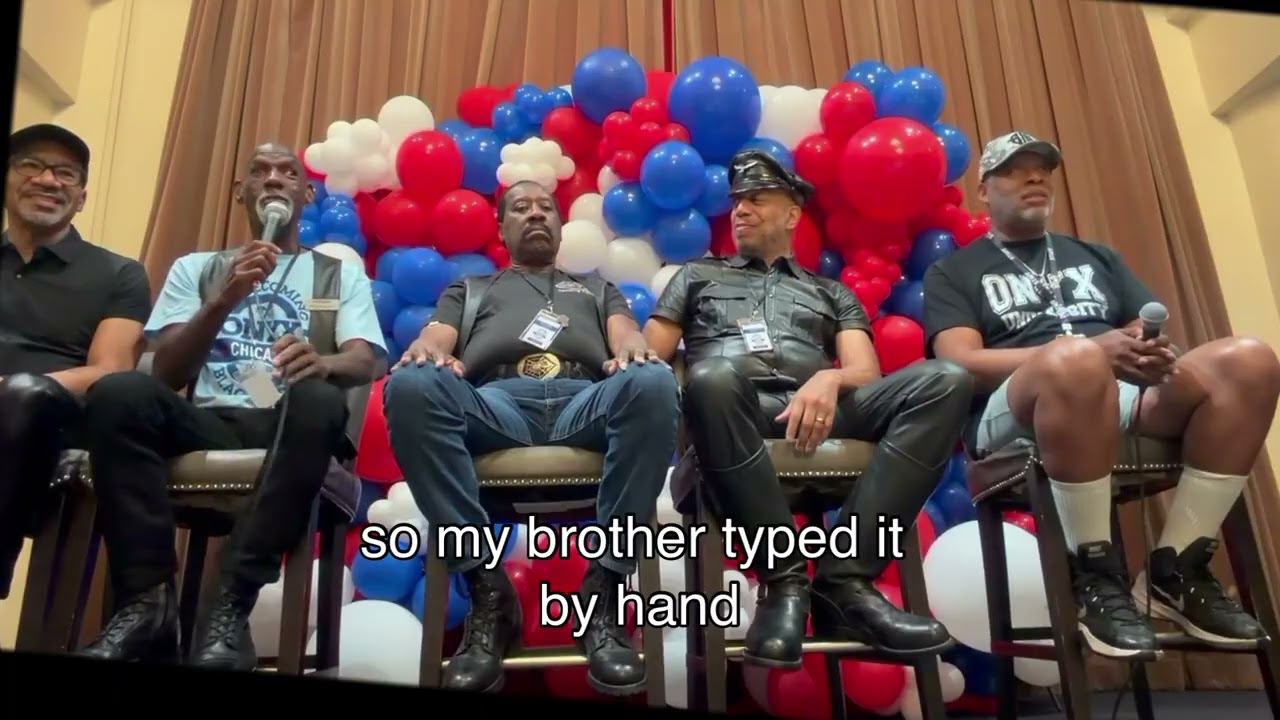
The Onyx organization was founded by five men of color—Wes Gibson, Steve Bis, Nate Green, David McKe, and Doug O'Keefe—who came together after realizing they were often isolated as the only Black men in leather bars and parties. Their journey began with a desire to create a supportive space where they could enjoy their kinks and fetishes without feeling like outsiders or needing permission from the predominantly white leather community. After visiting various clubs that did not reflect their identity, the founders decided to start their own chapter in Chicago, envisioning a brotherhood that would serve as a bridge for men of color to grow within the broader leather world while addressing issues specific to their experiences.
Despite facing fears of failure and having virtually no money to start, the group demonstrated immense tenacity by building their own table rather than waiting for an invitation. They secured essential resources like dance floors and bar nights through persistence and community support, eventually opening membership in 1996 after running ads in local magazines. The organization quickly expanded from a single club into a network of chapters across the country, all united by a consistent mission to empower men of color. Wes Gibson designed the iconic Onyx logo, choosing a simple yet substantial black stone symbol that represented their strength and imperishable nature, while the group's structure evolved to include full brothers and associates who could wear different patches depending on their chapter affiliation.
Beyond social connection, Onyx became a powerful force for community service and advocacy, particularly in supporting minority AIDS organizations and food pantries when the general leather community neglected these causes. The founders established forums, hospitality suites, and caucuses to help men of color find each other at large events like IML, ensuring that no one felt alone or like an odd man out. Their work earned them recognition within the leather archives, where they serve as caretakers of a specific room and display their colors prominently. Through mentorship programs and educational initiatives, Onyx continues to nurture new members from diverse age groups, proving that the organization is still a work in progress dedicated to becoming even stronger and more inclusive with each passing year.
Read the full video transcript
I'll stand up really quick. Hi
everybody. Thank you for welcoming me to
Onyx 30th anniversary. I am Doug
O'Keefe. I'm now from Palm Springs,
California, but I'm originally from
here. and I am so honored to be here to
be able to conduct this fireside chat
with the founders of Onyx. So, thank
you. [applause]
What I'd like to do first of all before
I do anything else for the international
audience, please tell us who you are,
where you're from.
>> My name is Wes Gibson. I'm originally
from Chicago. I now live in Brooklyn,
New York.
>> Okay.
I'm Daddy Steve, also known as matching
man. My government name is Steve Bis. I
live in Fort Lauderdale, Florida.
>> And my name is Nate Green. Uh, I'm a
native of Chicago, born and raised,
North Side Man.
>> Good afternoon. I'm David McKe. I'm also
originally a native of Chicago. was born
and raised here. Live in Oakland,
California now and originally from the
west side of Chicago.
>> West side
and I'm native of New Jersey and
residing here in Chicago.
>> All right. Well, from all over the
place,
I'm going to start off just sort of
generally right now asking
how did this begin?
Who wants to take that whole battle?
>> Go for it.
>> So, each of us had our own vision and
the way that this started, but um I
think it's safe to say that this was
conversation that Mufasa and I had at
the um manhole manhole.
>> We were both dancing at an underwear
party. I think we both had an armband.
I remember Kevin was wearing a New York
Yankees hat. So,
always loved my New Yorker. So I went
over and I'm like you want to dance? So
we enjoyed it uh that night and then we
started talking about the fact that we
were think the only two men of color in
the bar at night and would it have been
great to have a space that we could come
together and support each other and
enjoy our kinks and fetishes. So that's
my memory of it.
>> That was a good memory. And we then
started going to dances
um traveling to uh LLC, not LLC but
leather mal and we traveled to other or
other conferences and we love to dance
and so we went to the dances primarily.
We met some folks from Icon Detroit.
>> It's a good club and we loved them and
they had a club in Detroit and we
started going to Detroit to hang out
with them and go to their events and
came back and said why not
we we'll join a club in Chicago.
>> We looked at all 15 clubs.
They didn't look like us. they didn't
dance
and and we decided or we said, "Well,
why don't we start why don't we look at
starting a club here?" Um, we then I
didn't know I knew Wes and invited him
to come and talk and
David knew Nate and Steve and invited
him and we came to my house, sat down
and I pitched the idea. Um, I'm a member
of Alpha by Alpha. So I kind of had a
five six and so I had a an idea of
brotherhood. I had an idea of
brotherhood and what it may look like.
And the idea for me was a place for men
of color to grow and to be together and
to be a bridge into the leather
community, the general leather
community. because you guys were in the
community but on the fringes of the
community for years. But what does it
look like for us to actually be integral
in the leather community as men of color
and a place for us to grow and talk
about the issues that were gerine to us
pitched it.
They said yes
>> let's do this. Thank you. But
>> but
>> but we also had the conversation of
actually looking at a club that was
exclusively
for black men and we were looking for or
we were looking towards the future. We
did not anticipate us getting to a
30-year anniversary.
But I take my hat off to my honored
brothers. And
this
[applause]
this was this was the middle of the
beginning of something fabulous.
And we're growing and we're going to
continue to grow. We have 13 chapters.
We're concentrating on the 14th chapter
and it's going to be 15, 16, 17.
[applause]
>> This is my vision and this is my
brother's visions as well. This is what
I remember.
>> I remember all the people who said it
couldn't be done, that you will fail,
you will not last. And my first
commitment to this group was to make
sure that they were wrong and that
everyone who said we couldn't do this a
lot. [applause]
The um we also made friends in the
community.
Thank you to Icon Detroit. Thank you to
uh Trident City who actually lent us
their eyeliner
place where you can just put it in some
site whatever and change it. So my
brother typed it by hand note by note
word for word. We made a few changes in
terms of our structure because we
decided we were going to have a full
brothers full associates
and we don't have full associates and
associates and we wanted to make sure
that there was always a way for brothers
outside of Chicago to be members who
could wear the big patch and because
only associates could wear the little
patch and we had our full associates
wearing the big patch. So when we were
all together at things like IML or MAL,
they were our full brothers too. And we
always wanted to make sure that that's
really when we started talking about how
do we have other chapters. We envisioned
that these four brothers when we had
five or six of them in one place, they
too could become a chapter.
>> And the kept the clamoring started
coming from those people in the
southeast.
Oh my god.
>> They started to grow. Uh, one of my sons
was leading the charge there with my
other son who's leading the charge
there. He relocated from New York to uh,
Atlanta. And there was another son in
New York who started the charge there.
And, um, Jamal and Doc. Um, and uh, it
just kind of they were kind of gnawing
at us to try to figure this thing out.
>> And we struggled with that, too, cuz we
thought, well, what are we going to do?
franchises?
>> No, that won't work. And we looked at
other leather clubs who had multiple,
you know, brotherhoods, the command
group, and a few other clubs had, you
know, multiple things. But we wanted to
make sure that when we started new
chapters, number one, they did not fail.
Number two was we wanted the mission to
be consistent. We didn't want them to
turn into a softball league.
>> And so we had to make sure that no
matter where you went, if it was an
honest organization, it was still the
same organization.
>> So before we get too far because we're
talking about the chapters, we want to
go back. There's two great historical
aspects because when we came together,
we realized, well, we need to have some
type of name.
>> Yes. Yeah. And so, um, it sounds like it
would have been easy, but I'm going to
let Nate talk about that.
>> Well, we had two names. Uh, the one that
stands out to me is actually the name
that we have now, and that employed
a name that would carry weight. We
wanted a name that would carry power. We
wanted a name that would carry structure
and that's what we have and that's what
we all voted on and that's where we are
today.
>> I do not remember
>> I don't remember the other name
>> but I remember we fought about it which
is really funny. take my name, but we
voted as you do now. And onyx, which is
the stone, which is imperishable, which
is a dark non-porous stone. We felt that
we could stand strong as an
organization.
Wes designed our logo.
[applause]
>> You remember all how you came up with?
Well, you know, at the time I um I was
in school for graphic design. I fancied
myself a graphic designer and that this
is by far the most substantial thing I
ever created as a graphic designer. Um
one of the things that we wanted to
convey was uh uh being substantial and
being significant and being um uh the
equal of of of anything else. And um I
did a I did a bunch of different
designs. And I was actually surprised
that they chose this one because it was
the simplest one of of the ones I did,
but I can see now that that simplicity
is really what has made it so
successful. And so, you know, um such a
sort of um as I can see here, a
sought-after symbol. So, uh you know, I
really put my all into it. And sort of
my entry point into Onyx and even into
the leather community is a little
different because I was in recovery. Um,
and Onyx gave me an opportunity to do
something that didn't involve drinking,
>> you know, [cheering]
[applause]
it it changed the whole arc of my life,
you know. I went from being a party boy,
you know, to being someone who was part
of a community, you know, it was really
important. It was very uh it was very
sustaining for me. So, that was that was
my entry point. I just wanted to give a
shout out to anybody from his recovery,
you know. [applause] Um, hang in there.
Yeah. And and the graphic, the the the
design, um the beveled edge, the
metallic look, the the the uh the
substance of it was what I was trying to
convey.
>> And our colors
honor
the bylaws that we were given to borrow.
Icon's colors are silver and black. Our
colors are black and so
>> so in in all of this we've been working
on this and being all this coordinated.
What doubts did you have? If any concern
>> fear of failure
fear of failure fear that if we built it
they would not come. And you know, I
look around this room and my heart is
just so full,
you know, because
because you [applause]
being here just made all this we had
purpose
>> and it means something to see your
legacy live like this.
>> Wow.
>> So, thank you. Thank you. Thank you
>> each and every one of you.
>> Thank you.
>> And I didn't cry first. [applause]
>> I think that um when I do interviews now
um about how we started, what what fears
we had
or concerns.
I tell them that we really didn't have
other than not having any anything
money.
>> Not a dime.
>> Not a dime. Um I tell them that we
really kind of just went forward and
built our own table
that we really didn't have I mean the
fear of that they would not come but we
had each other
and I don't think anyone really stood in
our way. If anything, we you know, if we
stood in our own way of how we planned
and how we did things and how how we got
to where we are, but we asked for
certain things from people in community
and they said yes.
We asked for the doors to cellblock to
be open to us for bar nights. They said
yes. We served Sunday dinner. We had
chocolate cupcakes.
We danced on Sunday afternoon.
We asked IML for a dance. David is like,
I get a DJ.
Do you got a room for us? They said yes.
>> And the dance is still going on.
>> So
we I tell everybody, stop banging your
head up against the wall. People can
watch you.
And if you're trying to pull up a chair
to their table,
build your own table.
[applause]
>> But I listen I listen to my brother and
he speaks of fear. We had great
tenacity. We were each other's support
and we were determined.
We were going to make a good goal of it.
Fear was on the back of our lives.
Tenacity never
>> on our tongue.
>> Never on our tongue.
>> Never on our tongue, but it was
determination
and now it's success.
>> And to add to the community about this
story, it was because individually, I
mean, we probably had our own fears. As
Kevin said, we got in our way. And when
you think about that time, we didn't
have any role model. So we were stepping
off into this community that had been
traditionally white. We think about the
leather community and our fears always
went away when we were together
>> and I think each of us whatever those
fears were we never they never blocked
us when we were together. I mean it it
is a real sense of empowerment in this
honor.
>> What do you feel was the greatest
success of
>> You're looking at it.
>> [applause]
>> We couldn't be we couldn't be who we are
without others believing in the mission
and the vision.
We are a democratic organization. We
vote on everything.
And if it weren't for those that started
the chapters and voted um to move
forward and do the things and do the
community service and work in their own
community and that's what filled the
chapters because we were doing things in
Chicago and they started saying well we
want to do the same thing in our
communities because you guys are doing
great work. We started, we were the ones
who started giving to the minority AIDS
organizations
>> because the general levy community was
not supporting the minority AIDS
organizations. They were supporting the
general AIDS organizations, but no one
was giving to the minority
organizations. We started giving to um
foster care homes. We started giving to
food pantries. Things that affect our
people.
That's what we're about. things that
affect us so that we can keep living. We
can stay in community. We can do those
things. We didn't ignore the leather
community.
>> Right. Right.
>> No, but we quit asking for permission.
>> That's right.
>> Right. Right.
>> That [applause] was no longer permission
than somebody else.
>> We figured out that we could do stuff
under our own authority. And I can do
this. We can do this because that's who
we are because we are
>> and that's all the authority we need.
>> All right.
>> When when you're getting everybody
assembled, I I can't help but ask, isn't
there always a really good synthesis
that gets a certain group of people
together that gets things moving and
going forward? How do you feel you
achieve something like that among
yourselves?
Say that again.
>> You know, like when when you when you
organize a group, it's generally it
comes to a certain synthesis where
you've got the exact right people in the
exact right situation and you're able to
take it and go with it. How do you feel
you achieved that among yourselves?
>> Well, when I think back because I was
the first treasurer, I mean, as Kevin
mentioned, at certain point, we realized
that if you have objectives, the goals,
you have to have some money. And so we
realized we needed a structure and um in
our early days of just hosting a beer
bus so that we could get community to
acknowledge us.
>> I remember that.
>> Yeah.
>> We were always just trying to make sure
after a beer bus we balanced and had at
least zero.
>> We sold
>> and not negative. So it was always you
know at certain points you have to have
some structure.
>> We sold tickets in our league cuz I
remember being the first treasurer. Were
you the first?
>> Yeah. And and and and he was the fledge
master, but you know, neither one of us
were really comfortable and happy with
our roles and we had a conversation. Go,
well, I that's that's what I do, but I'm
not enjoying this [laughter]
and and and go, I would rather do what
you do. And so we just talked among
ourselves and we swap roles
>> and and and really because we didn't
have any pledges yet and we didn't have
any money yet. We had we had $2 on the
back of an envelope
>> and it's like I'll give you I'll give
you this little ledger that's got $50 in
it maybe and and and I'll go find us a
pledge which was them
>> incoming Jew
>> someone we put an ad
finally after a year we said we would
open ourselves for membership general
membership.
>> Um, so the year was 1995. We opened for
membership in January 1996.
>> We put, what did you do back then? But
put an ad in the back of Gay Chicago
magazine.
>> That's all we had. And so we put an ad
in Gay Chicago magazine looking for
members.
and someone wrote
wrote a letter to us
requesting membership.
That person was Bill.
We said we would start meeting at
Cellblock
and he came to the first meeting. I
wasn't there. I was on the road and you
were there.
>> Yeah. Bill walked into the bar that
night and and said, you know, introduced
himself and he says, "Well, are you
interested in that?" He says, "Yes, I
want to be a member." And he goes,
"Well, let me tell you about the club."
He said, "Just sign me up."
>> He had no questions, no hesitations. I
didn't have to answer any questions. I
explained it. They go, "But wait a
minute. I'm the pledge master. I'm
supposed to tell you about this. I'm
supposed to talk you into this." He
goes, "I'm done. Sign me up. Where do I
sign? It was task. It was it was the
easiest task I ever had. I went, "Oh,
this one will be easier." Everybody's
like,
>> dude,
>> but he he was just so ready when he
walked in the door.
>> I think he paid his dues that night.
You're right.
>> Yeah, he was ready. He was ready day
one.
>> We met the next evening, February. I was
there and we met
and
he had started to date another board
member. [laughter]
>> I didn't know that.
>> I didn't know that either.
You thought you all knew that? No, I
didn't know this.
>> I didn't know you knew that.
>> You told me.
>> But I will tell I will tell another part
of the story that you probably don't
know.
>> And we had had a dance and we, you know,
I wasn't wearing much but that little
battle skirt. And we had all checked our
coat. Well, everybody left and Bill left
with my coat.
And and it's like, well, I had to go
home wearing nothing but a harness and a
battle skirt, which is
and and my kids were in the pocket of
the coat. So, I had to go to my
neighbor's house dressed like this and
go, "Bing, bang, bang. Would you uh let
me have my spare key to the apartment so
I can get in the house?"
But it was But but then I met for lunch
the next day and he gave me my coat and
my keys back and he asked me, "How
serious are you? cuz I'm seeing somebody
and I got to make a decision about who
I'm going to see.
>> And and he and he was ready to make a
choice between us. And honestly, and I
love Bill, but at that point in time, I
said, I really like you, but I'm not
ready for commitment if that's really
what you're looking for. If you're
looking for love, I'm I'm still trying
to have a date.
And and I said, you know, and I will not
stand between you and my brother.
>> So, and I wanted him to be happy and I
wanted you to be happy and I was not
going to be in the way.
>> And of course, I was the gophet.
Right.
[laughter]
>> Well, who knew that we had that much
going on at once because we were all
trying to get discreet, you know, you
know, just tell,
>> you know.
>> So, as as things were coming together,
as things were growing, people were
moving in and out. Honestly,
what concerns or doubts did you have
about the success of Alex?
>> I think still going back to being taken
seriously that if this was our table
that we didn't need to ask for
permission, but you know, the bars, the
the parties, everything we went to. I
mean, the first party we had at IML, we
weren't even sure people would show up.
We thought and was pretty confident men
of color would show up but weren't sure
if anybody else would show up and take
us seriously. But it was very
successful.
>> But we ran down to the lobby of the
Congress Hotel and people who were in
the lobby were like, "Hey, come upstairs
and dance with us for a while." And we
ran downstairs and got people brought
them upstairs and they danced with us
for a while. Then they went on to other
things. But it didn't matter because we
were dancing together.
>> And
thank you to David for coming up with
the idea of the dance and
>> house music all the time.
>> House music all the time.
>> This is Chicago. It's got to be house
music.
>> And brought our first DJ in until that
DJ blew up in Europe and tried to
outrageously charge us when he came
back. So we switched DJs. Um [laughter]
um but but again that tenacity if we
don't we invite you but if you don't
want to come we ain't going to force you
to come. No,
>> I remember email and and trying to have
our brothers come together where we went
down to the coffee shop and made these
little handwritten Xerox invitations and
we're passing them out in the lobby.
Every time we saw a person of color, no
matter who they were with, we handed
them an invitation, said, "We just need
to talk. Come up. We're going to have a
little power ball." And so all the
people of color here at MAL come up to
our room. And we went down to the corner
store and bought some beer and put it
all in the tub with with all the ice we
could carry. And we had every member,
what you going to do? Go buy a 12-pack
or six-ack of beer and throw it in the
tub. And we all did that. And we did
that for years and years and years. And
believe it or not, they came and they
came and they came and they're still
coming
>> until they had to put us in the party
room at the Washington Plaza because we
were there were too many people in the
hallway and [clears throat] people
running gauntlet and trying to get to
their rooms cuz people would come in to
get a beer
>> and nobody was buying beer from them
downstairs. They were giving it away
upstairs,
>> right? And we had our clipboard.
That's what we had to do. They get
addresses. I was at the typewriter
typing newsletters when we got back.
Yeah.
>> Sending them out snail mail to people.
>> And I think Dominion was one of the
people who signed our clue board.
>> He's that old
that we have now. just bust in on the
internet.
>> So, I do have to ask something a little
sort of a little bit on the personal
side. How has being a board member, a
founding father of YX benefited each of
you?
>> I'm gonna let you talk later.
I think it's um for me it's opened doors
in other places because we now have um a
cadre. I entered IML in 1997.
Um went into the contest circuit not
knowing what I was doing. Um, we had
just opened the doors of Onyx. Um, I ran
for uh, Mr. Cellblock, finished first
runner up. Ran for Mr. Chicago Leather,
finished first runner up.
Asked the brothers, would they sponsor
me as Onyx Leatherman, and they said
yes. So, I was in the contest. Um,
finished first in interview. um coming
out of the contest and then ninth on
stage. Um but I think the visibility the
first one of the first questions they
asked me and I don't know if I shared
this with you in the interview was what
is onyx?
>> What did you tell them? Um, I said we
are a club for men of color in the
leather community and we do great things
in the community and we want to um
bridge ourselves men of color and teach
them about the community and bridge
ourselves into the community. Um, and
luckily there Mr. Marcus was the head
judge back then and he wrote a column in
San Francisco
um, in the Bay Area Reporter. I think it
was the the leather collar.
We never had a disparaging word said
about Onyx
ever
in the Leather Community College.
[applause]
Mr. Marcus was of of Latino descent and
those that type those types of things
opened doors started opening doors. We
started to be asked to come and talk
about men of color and leather. We
started to be asked to come and teach.
We started to be asked other people
started to enter contests. Um we never
we didn't have that before.
>> No, we didn't. And so now I look at our
cadre of teachers
of title holders
of people that are doing great things in
community
for themselves and in the name of
honors.
>> Yes.
>> And in the name of people of color. And
so I think our our our our staying power
is there that we've rooted ourselves
that we are a source
actually we're one of the only sources
[clears throat] as a community. So they
look for Onyx. They know the name
although they think every person of
color is a per is a is a member of Onyx.
So, we do get that, but the notoriety um
and every person of color is not. But
>> our thing was
yet our thing was that you never had to
join us.
>> No,
>> you didn't have to join us, but we want
to make sure that you're educated.
>> Right. Right.
>> We want to make sure that you feel
comfortable in community.
>> Right. And we want to make sure that you
build yourself in exploration, which are
our our our words, you know, our our
motto. But we know that people come and
people go.
>> Absolutely do. When we started, I felt
like a unicorn cuz you'd go into another
space and you would be the only dark man
in the room and they'd look at you and
go,
>> "Who are you? What the hell are you
doing here?"
you know, and they sometimes that they
would the bartender would even ignore
you. You'd have to wave money at them to
get a drink.
>> And so, one of the things that for me is
the beauty of this organization is that
there's this safety in numbers and that
people no longer do that. You don't have
to walk into the bar and feel like you
need permission. We walk into the bar
with an Onyx patch and they like, "Hey,
the the water's parked."
and and you walk up to the bar and and
you feel like you were honored. But the
one thing that is beautiful about this
is no longer feeling like I'm the odd
man out or the only one like this. I
used to think there were no more kinky D
with dark people. Am I the only pervert
in the world with dark [laughter] skin?
>> You know how you feel so alone and like
you're the only one. I realized I was
not a unicorn.
And that is to find out that there's a
whole community of of people just like
me
just was just so fulfilling. And so
thank you for that.
>> Yes.
Well, one thing I'd like to tell you
[applause] about
I relish being a part of an organization
that has structure. And what really got
me going was when Kevin started having
forums. Forums just a form of teaching
other people as well as teaching us
about who we were about
and that
was a great thing for me. I really seen
people coming in
uh never people going out and so it was
building and building and I was saying
to myself my dream is coming true. This
is our future and this is where we're
going to go far. We were not into
competition with anybody. We knew who we
were
and that's where we are today. We are
You know, I started the people of color
caucus at IML the year after the dance.
Why did I start that? I started it so we
could find each other at IML
so that there was a place on Saturday
that you could come to learn because we
used to do a talk first and then we used
to do demos
>> because people had not seen men of color
play with other men of color.
And so we used to do demos after the
talk and then hey let's go shopping. Hey
let's have a meal. Hey the dance is
tonight. Let's go together so that
people could find each other. That still
exists today. The people of color caucus
is still going on. We don't have to do
demos as as much as we did because we've
seen people of color play with other
people of color. But the talk is still
need necessary. Um we have uh the suite
at MAL. We started the hospitality suite
at MAL and then IML. Why? So people
could find each other.
>> Yes.
>> So they'd have a place at MAL amongst
all of the people that are there to come
home.
Homecoming. to come home, to be there,
to meet up with somebody, to find a
potential playmate. And again, we don't
care who you play with, but we care
about you and your ability to be
community. I just want to go back to the
early days of Onyx and IML because when
we started, a lot of the brothers didn't
know much about IML. There weren't a lot
of people of color at IML. So, one of
the first things we did was we decided
all of our brothers would volunteer at
IML. And we wanted to make sure that we
scattered ourselves all over IML so that
no matter where you came, if you got if
you walked in the front door, if you did
registration, if you got on the bus, if
you signed up for the contest, you had
to go buy an Onyx man. You could not
come to INL and not walk face to face
with a man from Onyx. [applause] He was
going to be all over IML and the only
way to go to IML was pass an Onyx man.
>> Bill loved riding the buses.
>> Yeah.
>> He was when they had the shuttles going
up north and everywhere. He was Mr.
Hospitality and he loved
>> riding the buses.
>> And so that you know we've stepped into
places.
>> Yeah.
>> Thanks to Mama Pie cajoling us.
We were the first organization to give
an organizational brick
to the leather archives.
[applause]
>> Thank you.
>> We are the caretakers of the Joe Carter
room.
>> Yes.
>> At the leather archives and museum. Our
colors hang outside of the green room at
the archives.
So we are in community. We do and
support the things that support us.
And that's important for us to do. And
we know that where we stand, we honor
everyone that's in this room because you
are a part of us in some way or another.
Even if you're not a member,
you're Alex and Jason. [laughter]
You're family.
We're we're running a little bit over
time, but I've got two more questions I
feel I need to ask these men. One of
them is, what advice do you have for
some of these people out in the
hinterlands somewhere who want to become
involved in the community? What can you
say to them?
You got the money.
>> Well, what I would say is to build
community and build relationships over
time because they're very sustaining.
Uh, one of the things that changed for
me is I moved out of um Chicago um out
of Illinois and eventually out of the
country, you know. So, this to me is
literally a homecoming. Um, and what I
would want for you to do is to have
those relationships that you can build.
So you can talk about the memories that
that we are talking about in the chapter
that you're in.
>> I would say that we are 30 years later
still a work in progress. Exactly.
>> We will never be finished. So I
challenge each and every one of you
because you need to leave here with a
challenge and that's to take this
organization as wonderful as it is
because we're good now but we can be
greater. And so I want you to find a way
to make this organization stronger,
larger, bigger, and better than it is
today. And it will be tomorrow.
And I would add, please just continue to
be ambassadors. Don't feel like you
don't have power. As long as you're
either part of our Onyx community or
you're just a friend of it, use as a
reason to start reaching out. Um, I
mean, we're definitely strength in
numbers,
>> mentorship,
>> take somebody into your wing.
Mentorship is important.
>> It people are afraid. They're afraid
because we come from backgrounds that
have demonized us as pure freaks that
people of color don't do that. It's a
white thing.
A lot of people of color do that. They
just don't talk about it.
And so mentorship is extremely important
um that we mentor those. And again, we
have members from age 21 to the early
80s.
And that is a testament of community
that we have elders that we have now
have elders in the community. We have in
our within Onyx, we have young people
within Onyx. We have title holders in
Onyx. We can mentor from within.
>> We don't have to go outside. And that's
the beauty of the organization that we
all have built.
>> The five founding members of honors
[applause]
>> [applause]
[applause]
>> Woo!
>> [applause]
>> As we're gathering,
um just two quick announcements.
One, um some people um have said that
they have been feeling overwhelmed or
would like a place to just take a moment
and congregate. Uh we do have a
hospitality suite there.
There isn't alcohol in the suite, but um
it's room 231. Just make sure you send a
message in either Telegram or um on
Facebook um to make sure that uh the
suite is open. Um, in addition,
there are some extra packages and so for
if you know someone who would like to
come to the dinner, um, we are selling
tickets to the dinner for $50.
Um, so if you know someone in the
Chicago area who would like to come or
someone who has not gotten their ticket,
um, make sure that they go upstairs to
registration to take care of that.
Thank you everybody.
[applause]
Also, we are running behind time. We had
Thank you for viewing inside leather
history, a fireside chat. If you enjoyed
the program, please visit our chats on
the YouTube channel. Like and subscribe
to Inside Leather History, a fireside
chat for further stories from the
leather community.
>> [bell]