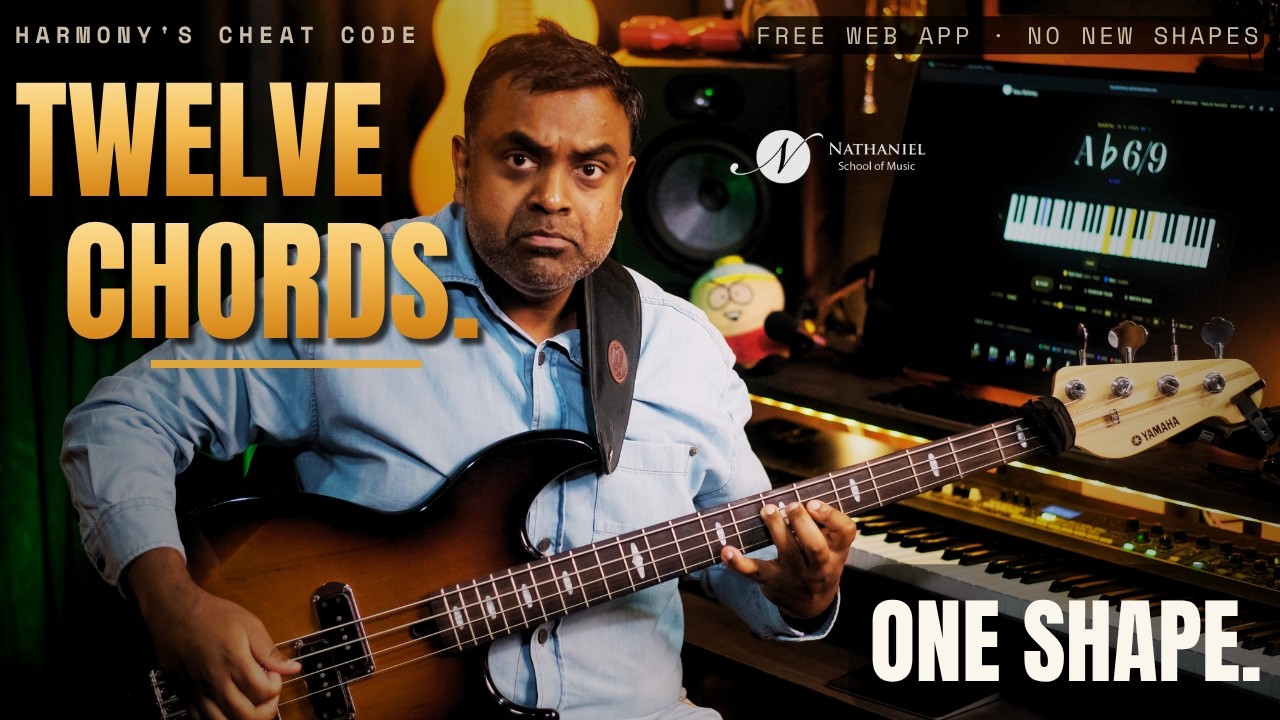
One Shape, 12 Bass Notes – Massive Chord Voicings!
Watch on YouTubeVideo summary
In this lesson, Jason Zach from the Nathaniel School of Music introduces an innovative approach to chord construction that moves away from traditional theory focused on stacking roots, thirds, and fifths. Instead, he advocates for using a fixed right-hand chord shape or voicing as a pivot point while experimenting with various bass notes in the lower register. This method allows musicians to form complex chords such as major ninths or minor elevenths without needing intricate theoretical calculations, effectively simplifying the composition process. By keeping one hand on a specific quartal stack—often consisting of two perfect fourths—the player can instantly generate sophisticated harmonies simply by changing the bass note, which offers a more ergonomic and flexible way to play compared to being confined to standard stacked intervals.
The video demonstrates how this technique works across different chord types, starting with major triads in right-hand quartal voicings that support any chromatic bass note. For instance, playing an F-C-Bb stack in the upper register can be harmonized by a C bass to create a C7 sus4, or by a Db bass to form a rich jazz voicing equivalent to a D-flat major 13th chord. The instructor shows that this single shape remains powerful regardless of whether it is played on an upright bass with plucked strings or picked electrically, as the resulting harmonies adapt naturally to different keys and perspectives. Even when exploring minor triad shells like F-A-C, the same principle applies, where shifting the bass note transforms a simple progression into classical sounds, dominant sevenths, augmented chords, or suspended structures that might otherwise seem difficult to construct from scratch.
Beyond simply forming static chords, this approach fundamentally shifts how composers think about harmony and melody construction by prioritizing vertical sound blocks over linear scale patterns. Jason highlights his app, Bass Alchemy, which generates various voicing shapes including diminished triads, augmented clusters, suspended fourths, and shell chords to facilitate ear training exercises known as "the alchemist's ear." Users can engage with random chord progressions accompanied by metronomes in different tempos and meters while listening to the contrast between the bass line and the upper-register piano part. This tool encourages musicians to build melodies from a foundation of pre-selected harmonies rather than adjusting chords after writing a melody, fostering a deeper understanding of how specific intervals interact within a chromatic family regardless of their traditional names or theoretical labels.
Ultimately, the lesson concludes that mastering this single voicing shape with twelve different bass notes provides an efficient pathway to expanding one's harmonic vocabulary and improving overall ear training skills available on any instrument. By focusing on these alternate harmonization methods, composers can break free from rigid conventions found in standard music theory guides like chord charts or circle-of-fifths exercises, allowing for more creative freedom in arranging music for choirs, orchestras, or solo performances. The video encourages viewers to explore the provided app and study resources to internalize this perspective, suggesting that even complex-sounding pop songs often rely on these simpler underlying principles rather than the complicated names written down online. Through consistent practice with these shapes across all twelve keys, musicians can develop a more intuitive grasp of harmony that makes composing both easier and more expressive without getting bogged down in nomenclature or excessive theoretical constraints.
Read the full video transcript
Hi everyone, this is Jason Zach from
Nathaniel School of Music. In this
lesson, we are going to focus on how to
train your year using the bass register
by keeping a pivot right hand chord
stack or a chord shape or a chord
voicing, if you want to call it that.
First off, I'm going to show you the
right hand chord voicings. Then I'm
going to show you when the bass is used,
how that can a train your ear, b give
you a different perspective to form and
analyze your chords a bit better without
really using too much of theory or chord
stacking methodologies which go from
root, third, fifth and you know the
traditional mindset. For example, how do
you just form a a complex chord like a
major 9th or a minor 11th chord using
just a very simple principle? And I
guarantee you if you stay till the very
end, you're going to learn a much more
efficient and simpler method to form
your chords and also make the process a
lot more ergonomic on your instruments
to not be confined to those three or
four notes which are stacked. You can
fool around, you can change it around,
you can voice it better, it'll work
better for a choir and an orchestra and
hopefully you as a composer as well. So
to make this process a lot more easier,
we have done a lot of lessons on bass
ear training on our YouTube channel. I
encourage you to check them out uh after
this one. We leave you a few links in
the description. However, what we ended
up realizing is there are too many
possibilities. If you just take one
stack, if you take a quartal voicing,
[music] which is basically two perfect
fourths, C F [singing] B flat, there are
so many things [music] you can do. If
you just play an A flat in the bass,
it forms a very sophisticated chord or
you can get a suspension
or [music]
an an add nine or a
a beautiful [music] F over A with a 11
in there. So you get some very advanced
chord shapes which when you read it,
it'll seem very complicated. The chord
itself will take you so long to read.
You can't even spell it out. But
actually, it's quite easy to form. And
this is how most of the even pop
musicians tend to compose chords. You
take a band like Green Day, it might
write E minor if you Google the chord,
but it's actually a very complex chord.
They may be playing
[singing and music] da da da da da da da
da da da da da da. [music] It might not
be what's written in a Google sheet.
Okay. Okay, so that's what this is going
to teach you. And to explain this,
considering that we have so many
possibilities, we've built an app called
Bass Alchemy. And what this will do is
it'll give you different voicing shapes.
We have the major triad.
We have the minor triad.
Minor triad.
The [music] diminished triad.
Then the augmented triad which is 1 135
sharp.
The suspension which is 1 2 5.
[music] The suspended four.
The open fifth.
sappa the quartal which I just showed
you stacked fourths
then you have the trionee cluster which
will have a trionee and then a perfect
fourth [music] major 7 shell
that's just the third and the major 7th
and a dominant seven shell
E flat that's the third and the seven
flat so let's first start with the most
famous of these stacked sounds the
stacked perfect fourths the sound of
McCoy Tiner and Herby Hancock and modern
neosoul composers if you wish uh the
quartal chord if I take here I can pick
a key so I'm picking the key of F so
since it's F major the way it's set up
in the app if I choose F you're going to
get a C F flat chord this is part of the
F major scale okay [music] we'll be
adapting the app shortly to support
every kind of key and every kind of
perspective. But anyway, let's just say
we are playing C, [music] F, B flat in
the right hand. What can we harmonize in
the left hand? Well, this this is the
chromatic family. So, what the app is
saying is if you now press C, F, B flat
in the right hand and stack it with a C,
[music]
you're going to instantly form a C7 sus4
chord. [music] And then if you go to D
flat, you're going to get a beautiful
jazz voicing which is D flat. You could
say major 13th.
How do we prove that [music] D flat is
now my new root? D flat [singing] major
7th
3r 13 or six just [music] by changing
the bass note. And you can adjust the
bass sound if you really want to explore
by by changing you know from upright
to picked.
I think I'm going to stick with picked.
So you go
see C forms what now? C forms a C7 sus
4. Now [music] D flat forms a 13.
Now you'll be D is another great sound.
D [music] minor 7
with that U [clears throat] B flat in
there which is a sharp five or a flat 6
you could call it
or you could even call it as a B flat/
D or something. Long story short, these
names don't matter because they get
quite complex as you can see in the
diagram and with me uh fumbling my chord
names, right? It doesn't matter. What
matters is the quartal shape in the
right hand is so powerful or not only
the right hand, the quartal shape is
great in the upper register period
because it supports any of the chromatic
notes in the lower register. Okay. So,
I've so far walked you through C,
[music]
D flat, D. What about E flat? E flat
will form a nice [music] E flat 6 sus 2
as it's written, but it basically has a
six. It has a sus 2. [music] And yeah,
you could call it E flat 6 sus 2. Nice.
You can even learn some chord names with
this app. Now, E is a
it says avoid, but even that sounds
good.
It's kind of like a C over E with that F
C7/ E. Yeah, it kind of works. But no
one really knows what to call this
chord, including the app. And then you
do F, [music] good old Fsus 4. Then
here you go.
Beautiful F sharp or G [music] flat
major 7, but with a
trionee
because of the C. [music]
It's not a regular F sharp major 7th. So
F sharp [music] major 7th or G flat
major 7 flat 5. Then you have an F
sharp.
Okay.
Oh, sorry. I changed my key. I'm going
to move it back to F and change my note
to G.
[music] It's a G minor 11 sound or G
minor 71 sound. [music]
As you can see so far, I'm guessing
everything sounds good. This is your
traditional A flat 69 [music] used a lot
in jazz music.
Very ambient sound. [music]
A A
have to use this sometime in life,
right? It's an F over A sound. [music]
Beautiful with that uplifting suspension
as well. So [music]
yeah, F major add four slash A I give
up. It's just a complex sound I guess.
[music] Then B
works. And the last note B
uh
probably the only one to avoid. So
that's 11, which sound beautiful over a
quartal chord in my opinion at least.
I'm sure you'll agree. Let me know in
the comments. So, moving [clears throat]
forward, you can harmonize pretty much
any cluster. And I'm sure you you get
the idea. If you harmonize an open
fifth, almost everything's going to
sound good, right? FC with a C, [music]
you almost everything's going to sound
good. This is your F C played upper. and
all the chords [music] E flat,
E,
Fifth,
G flat, which also sounds good, G7
[music] sus 4, A flat,
A minor,
like an F over A, B.
So with a fifth chord, I think
everything works. However, challenges
arise if you maybe take a minor triad
shell.
Okay? So now you're on an F minor. The
key is F. So you're you're playing F
minor. F A flat C. And now if we walk it
through F minor/ C.
Beautiful classical [music] sound. What
happens over F minor/ D flat? It becomes
a D flat major 7th chord.
>> [music]
>> Now D flat minor 7 flat 5
E flat
with that sus [music] 4.
Amazing. An augmented sound there. Good
old F minor.
I love this sound. F minor over G flat
bass.
That's an F minor/G.
F minor sl A flat.
Don't like this much, but it kind of is
an acquired taste.
B F minor or B flat.
Yeah. Yeah. As you can see, most of it
kind of works because a minor chord if
even the notes to avoid kind of make it
that additional diminished seventh
family note. So, it all sounds good. So,
[clears throat] long story short, this
is a nice way to kind of put music
together from a different perspective
and just hold down a chord. Maybe you
want to just play an F minor
and just explore the bass,
[music]
things like that, cliches.
Or maybe you're a newcomer to the
instrument and you just want to focus on
one chord with different inversions and
then explore some complex harmony but
still compose music like any other
composer. [clears throat] So whatever be
the case, you also have an option where
you can do musical random [music] and it
plays
what it thinks can work, you know, as a
random chord [music] progression.
And you can hear this with a metronome.
You can hear this in different arpeggio
patterns, different tempos,
different meters. The chord can be for
2x or halfx. And the metronome can be on
or off while you practice. And what's
cool is you hear the bass as well as the
piano playing the upper register chord.
So you have a good contrast. And what's
nice is you can train your ear, as it's
called here, the alchemist's ear. So you
can train your ear. Let's say I choose
quartal. And the job here is it'll give
you ear training challenges. So what you
hear, [music] you have to guess probably
E. Okay, cool. That's right. F. So
[music]
unfortunately I got it wrong, but you
get the idea. So it's a good
[clears throat] resource to kind of do
one voicing
12 bass notes, all the 12 on any key. So
this another app just like chord trees
that we have at the Nathaniel school
where we are trying to take an alternate
step to harmonization or another way to
do it as opposed to the usual
traditional write your scale in a
circle, do your triads, then do seventh
chords. You have a pallet or a set of
about seven of them and you use them to
write chords for a song. And then the
choice of making chords tends to be more
random based on the melody. It kind of
survives. But with a app like this, you
can focus on the harmony first and then
build the melody from the ground up
rather than have the melody and then you
know adjust based on the chords. So this
should be a good app to improve your
chord theory, improve your voicing
skills, especially with the right hand.
practice on all the 12 keys and more
importantly train your ear and give you
hopefully a different approach towards
composing music and creating harmony in
general. So do check out Bass Alchemy,
play around with it, let us know what
you think. The app is available for
free. Don't forget to like, share,
subscribe, and if you want a proper
detailed study guide on how to use the
app, don't forget to be a Patreon
subscriber. You'll get a PDF there. And
what else? That's about it really. If
you want to learn something more
structured and organized from ground
zero to maybe this point, do consider a
semester or two at the Nathaniel School
of Music. Thanks a ton for watching
this. I will catch you in the next one.
Cheers.